DOI: 10.1534/genetics.107.086306
Pervasive Sex-Linked Effects on Transcription Regulation As Revealed
by Expression Quantitative Trait Loci Mapping in Lake Whitefish
Species Pairs (Coregonus sp., Salmonidae)
N. Derome,*
,1B. Bougas,* S. M. Rogers,
†A. R. Whiteley,
‡A. Labbe,
§J. Laroche** and L. Bernatchez*
*De´partement de Biologie,§De´partement de Mathe´matiques and**Centre de Universite´ Bioinformatique et de Biologie Computationnelle, Universite´ Laval, Que´bec, Que´bec G1V 0A6, Canada,†Department of Zoology, University of British Columbia, Vancouver, British Columbia V6T 1Z4, Canada and‡Department of Natural Sciences, University of Alaska Southeast, Juneau, Alaska 99801
Manuscript received December 21, 2007 Accepted for publication May 30, 2008
ABSTRACT
Mapping of expression quantitative trait loci (eQTL) is a powerful means for elucidating the genetic architecture of gene regulation. Yet, eQTL mapping has not been applied toward investigating the regulation architecture of genes involved in the process of population divergence, ultimately leading to speciation events. Here, we conducted an eQTL mapping experiment to compare the genetic architecture of transcript regulation in adaptive traits, differentiating the recently evolved limnetic (dwarf) and benthic (normal) species pairs of lake whitefish. The eQTL were mapped in three data sets derived from an F1 hybrid-dwarfbackcrossed family: the entire set of 66 genotyped individuals and the two sexes treated separately. We identified strikingly more eQTL in the female data set (174), compared to both male (54) and combined (33) data sets. The majority of these genes were not differentially expressed between male and female progeny of the backcross family, thus providing evidence for a strong pleiotropic sex-linked effect in transcriptomic regulation. The subtelomeric region of a linkage group segregating in females encompassed .50% of all eQTL, which exhibited the most pronounced additive effects. We also conducted a direct comparison of transcriptomic profiles between pure dwarf and normal progeny reared in controlled conditions. We detected 34 differentially expressed transcripts associated with eQTL segregating only in sex-specific data sets and mostly belonging to functional groups that differentiatedwarfand normal whitefish in natural populations. Therefore, these eQTL are not related to interindividual variation, but instead to the adaptive and historical genetic divergence betweendwarfand normal whitefish. This study exemplifies how the integration of genetic and transcriptomic data offers a strong means for dissecting the functional genomic response to selection by separating mapping family-specific effects from genetic factors under selection, potentially involved in the phenotypic divergence of natural populations.
I
NVESTIGATIONS of quantitative variation in gene transcription have begun to open up the ‘‘black box’’ connecting genotype to phenotype (Gibson andWeir 2005; Prud’homme et al. 2007). Expression
quantitative trait loci (eQTL) mapping, which com-bines transcriptional profiling with linkage mapping methods, allows the investigation of the genetic archi-tecture of gene regulation and quantifies the herita-bility of these regulation factors (Wayneand McIntyre
2002; Schadt et al. 2003; Petretto et al. 2006;
Vuylsteke et al. 2006). This is also a crucial issue in
evolutionary biology, as many authors argued that changes in key regulatory genes may have a greater and
faster effect than changes in structural genes on early phenotypic diversification ( Jacob and Monod 1961;
Kingand Wilson1975; Purugganan1998), although
this is still a contentious issue (Hoekstra and Coyne
2007). Transcription QTL mapping has almost exclu-sively been applied to model organisms, including yeast (Bremet al.2002), human (Morleyet al.2004), mouse,
maize (Schadtet al. 2003), and Drosophila ( Jinet al.
2002); but see Kirstet al. (2005) for work on the
eu-calyptus tree. To date, eQTL mapping has not been specifically applied toward investigating the regulation architecture of genes involved in the process of recent population divergence in the wild. However, this should be a fundamental research goal since variation in gene expression within and between natural populations has been recently reported to underlie adaptation (Gibson
2002; Oleksiaket al.2002, 2005; Bochdanovitset al.
2003; Whitehead and Crawford 2005; Derome
and Bernatchez2006; Derome et al.2006; Roberge
et al. 2007). Investigating the genetic architecture of Expression data from this article have been deposited with the NCBI/
Gene Expression Omnibus under accession nos. GSE11378, GPL6260, GSM276833–GSM276834, GSM276836–GSM276842, GSM276995– GSM277089, and GSM277155–GSM277195.
1Corresponding author: De´partement de Biologie, Universite´ Laval,
Que´bec, QC, G1V 0A6, Canada. E-mail: [email protected]
transcriptome regulation in natural populations or closely related species exhibiting phenotypic divergence re-lated to distinct environmental responses provides a powerful means to reach a more complete understand-ing of the molecular mechanisms related to the process of adaptive phenotypic divergence, which in turn are involved in the course of speciation events.
Clearly, adaptive trait variation is multifaceted (Reeves
and Sherman1993). In many species, differences
be-tween the sexes add another important level of pheno-typic variation, as illustrated by substantial sex-linked effects in quantitative studies (Mckay2001) and, more
recently, studies of sex-biased gene transcription (Rantz
et al. 2003; McIntyreet al.2006; Yanget al.2006; Itoh
et al. 2007; Wayne et al. 2007). Indeed, speciation is
intimately associated with the evolution of traits related to sex and reproduction, including those affecting hy-brid incompatibilities (postzygotic isolation). Also, genes controlling such traits are particularly abundant on the sex chromosomes (Wanget al.2001; Ellegren
and Parsh 2007). However, to our knowledge, little
attention has been paid to investigating the genomic basis of sex differences in the context of an adaptive radiation (Pro¨ schel et al. 2006) or the evolutionary
consequences of the sex linkage of genes involved in speciation (Servedioand Saetre2006). However,
sex-biased genes have been observed to be among the most rapidly evolving genes in various taxonomic groups such as nematodes, insects, fish, birds, and mammals (re-viewed by Singhand Kulathinal2000; Ellegrenand
Fridolfsson 2003; Zang et al. 2004; Richards et al.
2005; Ellegren and Parsh2007). This phenomenon
was observed as well for somatic tissues (Parisi et al.
2004; Marinottiet al.2006; Manket al.2007), including
muscle (Yanget al.2006). Furthermore, these sex-biased
genes have been reported to cause genetic incompati-bilities by disrupting local adaptations or coadaptations within the genome (Parker and Partridge 1998;
Fitzpatrick2004). It thus appears crucial to investigate
the genomic basis of sex-specific transcriptional regula-tion by providing new insights into the role of sex-linked regulation effects differentiating two recently diverged genomes.
Sympatric dwarf (limnetic) and normal (benthic) species pairs of the lake whitefish (Coregonus sp.) constitute a case of recent adaptive radiation that is particularly well suited for investigating the genomic architecture of gene transcription. Geographic isolation during the Pleistocene (500,000–18,000 YBP) led to genetic divergence between whitefish populations in-habiting distinct glacial refuges (Bernatchez and
Dodson 1990; Lu et al. 2001). Secondary contact
between these evolutionary lineages subsequently oc-curred15,000 YBP within at least six lakes of the Saint John River basin in Maine and southeastern Quebec. Ecological opportunity and character displacement have both contributed to the rapid evolution of a limnetic
dwarf species, which has diverged in sympatry from the ancestral benthic normal species (Bernatchez
2004; Landry et al. 2007). Adaptive trait differences
observed in thedwarfand normal whitefish dichotomy are supported by several genetically based phenotype– environment associations, including for life history (age of maturity, life span), morphological (size, weight), be-havioral (swimming activity), physiological (metabolic rate and growth), and gene expression traits (Lu and
Bernatchez1999; Trudelet al.2001; Rogerset al.2002;
Rogers and Bernatchez 2005; Derome et al. 2006).
Indeed, dwarf exhibits a higher metabolic rate, partly associated with the cost of a more active swimming activity (higher position in water column, direction changes, burst swims), and lower bioenergetic conversion effi-ciency (growth rate/consumption rate ratio), associated with slower growth and younger age at sexual maturity in dwarf whitefish (Trudelet al.2001) when compared
to normal whitefish (Rogers et al.2002; Rogers and
Bernatchez 2007). Moreover, linkage mapping has
been used to document the number and effects of quantitative trait loci (QTL) involved in controlling the expression of these adaptive traits (Rogerset al.2007),
and genome scans performed in natural populations provided evidence that directional selection is main-taining genetic divergence between sympatric dwarf and normal whitefish by restricting gene flow at more than half of these QTL (Rogers and Bernatchez
2007). Finally, functional genomic studies performed in these same natural populations on the white muscle tissue showed thatdwarfwhitefish overexpressed genes associated with muscle contraction speed, which is con-sistent with the higher swimming activity of limnetic foraging species (Derome et al. 2006). Thus, the
ac-cumulation of genetic differences during the allopatric phase of geographic isolation in conjunction with ecol-ogical divergence that subsequently occurred in sym-patry led to reproductive isolation between dwarf and normal whitefish species pairs (Lu and Bernatchez
1998; Rogersand Bernatchez2006).
Here, we investigate the genetic architecture of transcript regulation in the white muscle tissue differ-entiating the recently evolveddwarfand normal species pairs of lake whitefish by conducting an eQTL mapping study using a 16,006-gene cDNA salmonids-specific microarray (Von Schalburg et al. 2005). Transcript
abundance was measured in the same progeny of an F1 hybrid-dwarfbackcrossed family for which a genetic map was recently built (Rogerset al.2007). In this way, both
genotypic and transcriptomic information were inte-grated to identify genes potentially underlying the divergence in adaptive traits betweendwarfand normal whitefish, namely in terms of their energy metabolism and swimming activity (Deromeet al.2006). As there is a
trade-off in energy allocated to growth vs. swimming activity (Trudelet al. 2001; Rogersand Bernatchez
between eQTL associated with muscle contraction, energetic metabolism, and protein synthesis. Namely, we predicted opposite additive effects between eQTL of transcripts related to growth and swimming activity.
Moreover, to test whether the architecture of tran-scriptomic profiles segregated between sexes, we com-pared sex-specific data sets to a combined data set termed ‘‘combined,’’ including all individuals, but ex-cluding the sex effect on transcript levels (seematerials and methods). Sexual dimorphism in gene expression
may be substantial, as reported recently both for Dro-sophila ( Jinet al.2002) and for mouse (Yanget al.2006).
Therefore, to distinguish between sex-specific effects (in-dependent from the segregating genetic background) and pleiotropic sex-linked effects potentially involved in the phenotypic divergence ofdwarfand normal whitefish (dependent on the segregating genetic background), we contrasted transcripts that exhibited eQTL from expres-sion profile mapping experiments to genes differentially expressed between sexes of the same backcross progeny. In this way, transcripts that exhibited eQTL in a male or a female data set, but were not differentially expressed between progeny of different sexes, were considered as pleiotropic sex-linked effects potentially involved in the adaptive divergence between whitefish ecotypes.
Finally, to further assess whether the eQTL detected were potentially relevant in the context of adaptive divergence, we conducted transcriptomic comparisons of pure dwarf and normal progeny issued from the grandparents of the backcross family and reared in controlled conditions. To identify potential candidate genes for which transcription levels may have evolved under directional selection betweendwarfand normal whitefish, we paid particular attention to (i) transcripts associated with eQTL that were differentially expressed between puredwarfand normal whitefish and (ii) eQTL belonging to functional groups that exhibited signifi-cant directional additive effects. The predominance of additive effects (i.e., amount of a given transcript mod-ulated by segregation of alleles between dwarf and normal genomes) in one direction for the loci under-lying the quantitative variation of a given trait would provide further evidence for the role of selection in shaping genome architecture (Orr1998).
MATERIALS AND METHODS
Linkage maps: The eQTL were mapped onto a hybrid
(normal female 3 dwarf male) 3 dwarf backcross (BC1) linkage map built by Rogerset al.(2007). Briefly, sex-specific markers segregating in the backcross families were assigned to a linkage group under a LOD of 4 while orders and re-combination distances of these groups were determined under the Kosambi mapping function independently for both families using MAPMAKER/EXP (Lander et al. 1987). De-fining sex-specific linkage groups was necessary since salmonids exhibit a sex-specific recombination rate due to tetravalent formations in the males during meioses (Sakamotoet al.2000;
Gharbiet al. 2006). The hybrid3dwarfmap was built using
a total of 389 AFLPs and 23 microsatellites covering a total of 48 linkage groups, including 34 female linkage groups (aver-age ¼8.0 loci per linkage group, average distance between markers¼17.3 cM, and a total map length of 2800 cM) and 14 dwarf male linkage groups (average¼8.7 loci per linkage group, average distance between markers¼17.96 cM, and a total map length of 2127.5 cM). The homology of these mapped loci was verified in a second backcross family where 34 linkage groups of the 40nexpected showed 83% colinearity among linked loci between both families (Rogerset al.2007). Tissue sampling, RNA preparation, labeling, and
hybrid-ization: Dissected white muscle tissue (250–350 mg) was
sampled for 66 individuals from the hybrid3dwarfbackcross mapping family and stored at80°until RNA extraction. RNA was extracted according to the Trizol Reagent protocol (GIBCO BRL, Gaithersburg, MD) and quantified with a GeneQuant spectrometer (Pharmacia, Piscataway, NJ), and RNA integrity was verified with a 2100 Bioanalyzer (Agilent). Reverse transcriptase PCR was performed using 15mg of total RNA per sample following the SuperScript II Reverse Tran-scriptase protocol (Invitrogen Life Technologies, San Diego). Indirect labeling was performed on individual cDNA following the Array 50 kit protocol (Genisphere). Transcriptome pro-files were obtained by using the 16,006-cDNA gene microarray (version 2) developed for Atlantic salmon (Salmo salar) by cGRASP (VonSchalburget al.2005) (Consortium for Geno-mic Research on All Salmonids Project) and successfully tested and applied to other salmonid species, including Coregonus clupeaformis (Derome and Bernatchez2006; Deromeet al. 2006; Rise et al. 2007). Gene identification with the corre-sponding EST sequence can be found at http://web.uvic.ca/ cbr/grasp/. Cross-hybridization is known to be potentially a problem for spotted cDNA microarrays because of sequence polymorphisms between strains or paralogous genes that affect the signal for certain genes. However, in this study, we did not compare Salmo to Coregonus transcripts, but a back-cross family of whitefish species pairs that diverged,12,000 YBP. Therefore, differences in cross-hybridization between dwarfand normal whitefish alleles would be negligible and unlikely to affect the results obtained. The transcript levels inferred from fluorescent labels were quantified by scanning microarrays using a ScanArray Express scanner (Packard Bio-science). Spot location and quantification was done with the QuantArray (Perkin-Elmer, Norwalk, CT) software, retaining the mean intensity value for each spot. Aberrant spot signals were removed before analysis and their values were estimated using the ‘‘K-Nearest Neighbors Imputer’’ function imple-mented in SAM software (Tusheret al. 2001). Genes with intensity less than the mean of the empty spot controls plus 2.5 times their standard deviation were removed from the analysis. According to this criterion, 2255 among the 16,006 transcripts passed this threshold and were considered for subsequent analyses. Raw and processed data sets are available at the GEO website (http://www.ncbi.nlm.nih.gov/geo/).
Experimental design and statistical analyses applied to
eQTL experiments:We used a loop design (Churchill2002;
Then, the gene–genotype interaction effect (G) was estimated using the R/MAANOVA software under a mixed-effects model of variance analysis (Cuiand Churchill2003) with the array term kept as a random effect, while genotype, sex, and dye term effects were fixed. Note that the genotype term refers to the individual, as each offspring of the backcross family constitutes a unique event of recombination between the parental genotypes. Two ANOVA models were used, the first one being applied to the whole data set, hereafter termed a combined data set [Yijkgh¼
m1Ai1Dj1Tk1Gg1Sh1(AD)ij1(GA)gi1(GD)gj1(GT)gk
1(GS)gh1eijkgh], and the second one used for separate sex data
sets [Yijkg¼m1Ai1Dj1Tk1Gg1(AD)ij1(GA)gi1(GD)gj1
(GT)gk1eijkg] (A, array;D, dye;G, gene;T, genotype; andS, sex;
terms in parentheses are interaction terms).
Detections of eQTL:For each transcript, the estimates of
the variation associated with gene–genotype interaction for the 66 individual progeny were used as the phenotypes along with the linkage map to perform genomewide eQTL detection from the combined and sex-specific data sets, using the UNIX version of QTL Cartographer (Batsenet al.2002).
The combined data set comprised all of the 66 mapped individuals, and the two sex-specific data sets comprised 29 individuals for each male and female. Although 37 females were available, we chose to use the same sample size as for males. The analysis with 37 females did not improve signifi-cantly eQTL detection, compared to the 29-female data set (data not shown). For eQTL detection, we used an interval-mapping approach (model 3 of the ZmapQTL module). Likelihood-ratio (LR) profiles [2 ln(L0/L1)], representing the ratio of the likelihood of the null hypothesis (L0, no QTL in the marker interval) to the alternative hypothesis (L1, presence of a QTL in the marker interval) were generated for each transcript at every 2-cM interval on the linkage map of
Rogers et al.(2007), using a window size of 10 cM. Three
empirical thresholds for experimentwise type I error rates (0.1, 0.05, and 0.01) were determined for all significant eQTL (P,0.05) by approximating their null distribution (H0). For each of them, we recorded the 10th-, 50th-, and 100th- ranked LR of 1000 random permutations. To achieve this, we de-veloped a PYTHON language script for the UNIX version of QTL cartographer, which allowed the automatic running of iterations among traits. Users are first required to set up the analysis in a parameter file containing the list of traits to be analyzed, the number of iterations, the number of iterations for each trait (here 1000), and the percentile values to be sampled (e.g., 99th, 95th, and 90th). The PYTHON script records the parameter values and calls the different QTL cartographer programs, including Rmap (reads the map), Rcross (reads the cross), and Zmapqtl (runs association analysis between traits and markers). For each trait (transcript), both during and following each iteration, a function reads the output from Zmapqtl and records the GlobalMax values with each percentile value fixed. The script is available from the authors upon request.
Transcripts corresponded to EST library annotations of Von
Schalburget al.(2005). Those annotated as ‘‘unknown’’ were
submitted to BLAST nucleotide and translated protein searches to determine if new gene identifications were possible. The highest BLAST score with a known function was recorded, for E#13105, and successful transcript finds were annotated as ‘‘similar to.’’
Functional annotation was done according to cGRASP. Functional categories include various biological processes (functions as annotated by cGRASP are in parentheses) and are defined as follows for the three most represented: (i) energy metabolism (electron transport, glycolysis, ATP synthesis, tri-carboxylic acid cycle intermediate metabolism, tritri-carboxylic acid cycle, malate metabolism, hydrogen transport), (ii) muscle
proteins (regulation of muscle contraction, muscle develop-ment, cytoskeleton organization), and (iii) protein synthesis (protein biosynthesis, electron transport, transcription, trans-lational elongation, ribosome biogenesis). According to these criteria, we observed among the 2255 significantly expressed genes that 158 of them (7%) coded muscle proteins, 310 (14%) belonged to energetic metabolism, 484 (21%) participate in protein synthesis, and 946 (42%) were unknown functionally, according to the cGRASP annotation.
To illustrate the genomic distribution of eQTL, we divided the genome into 17.6-cM bins, corresponding to the average distance between markers for male and female maps (Rogers et al.2007), which resulted in 366 bins. A Poisson distribution was assumed for calculating the probability of observing a given number of eQTL within any bin along the map. The mean of the Poisson distribution for each data set was estimated as the number of eQTL linkages/366 bins detected ata¼0.05. The proportion of positivevs.negative additive effects for eQTL (i.e., effect of segregating alleles on the amount of a given transcript) belonging to a given linkage group or eQTL hotspots (numerous eQTL located at the same bin) was tested using a Mann–Whitney test.
Expression profile differences between males and females
from the backcross family progeny:A classical paired analysis
was conducted between 24 male and 24 female backcross progenies chosen among the 66 slides used for the eQTL mapping experiment This was the maximum number of slides available upon which a male was hybridized with a female. A dye swap between Cy3 and Alexa 647 fluorophores has been used because it minimizes bias inherent to the dyes’ uneven fluorescence intensity (Churchill2002). Transcription data were corrected for regional intensity-related bias, using an R-LOWESS algorithm, and analyzed by ANOVA, using the R/ MAANOVA software package (Kerret al.2000) under a mixed-effect model [Yijgh¼m1Ai1Dj1Gg1Sh1(AD)ij1(GA)gi1
(GD)gj1(GS)gh1eijgh], where sex (S, male or female) and dye
(D) were fixed, array (A) was random, and (eijgh) was residual
error. Since our analysis model was across genes, and because gene expression levels may have different variances (Cuiet al. 2005; Kristianssonet al.2006; Mathurand Dolo2007), we used the shrinkageFstatistic (FS) to detect significant differ-ences (adjusted permutedP-values,a,0.01) in level of gene transcription between males and females (Cui et al. 2005). As recommended by the authors, theFSnull distribution was established by permutation analysis (1000 sample permuta-tions), considering each array as a sampling unit.
Expression profile differences between pure dwarf and
normal whitefish parental generations: Dwarf and normal
whitefish reared in a control environment were originally sampled in 1998 in Te´miscouata Lake and Aylmer Lake (Quebec), respectively, and held in captivity at the Laboratoire Re´gional des Sciences Aquatiques (LARSA) facilities (Uni-versite´ Laval, Quebec). Family crosses were made in 2001 to generate pure F1breeds. Both normal anddwarflines were kept at all times under the same environmental conditions (water temperature, photoperiod, diet). In September 2004, 12 randomly selected individuals of comparable sizes for each ecotype were measured (mean fork length, dwarf, 22.9 cm, SD¼1.8 cm; normal, 28.9 cm, SD¼2.2 cm) and then killed with a 0.001% Eugenol solution just prior to tissue extraction. Muscle tissue samples were immediately frozen on dry ice and stored at80°.
analysis. The ANOVA was conducted under a mixed-effect model [Yijkg¼ m1Ai1Dj1 Tk1 Gg 1(AD)ij 1(GA)gi1
(GD)gj1(GT)gk1eijkg], where sample (T,dwarfor normal),
gene (G), and dye (D) were fixed, array (A) was random, and (eijkg) was residual error. A permutation-basedF-test (FS, 1000 sample permutations) was used to detect significant differ-ences (permuted P-values, a , 0.05) in level of gene transcription betweendwarfand normal whitefish. Changes in transcription levels were calculated as aD/Nratio, where the mean transcription indwarfindividuals (D) was divided by mean transcription in normal individuals (N) for each gene.
RESULTS
Detection of eQTL:Among the 66 backcross progeny examined, a total of 2255 genes were significantly transcribed (see materials and methods). Striking
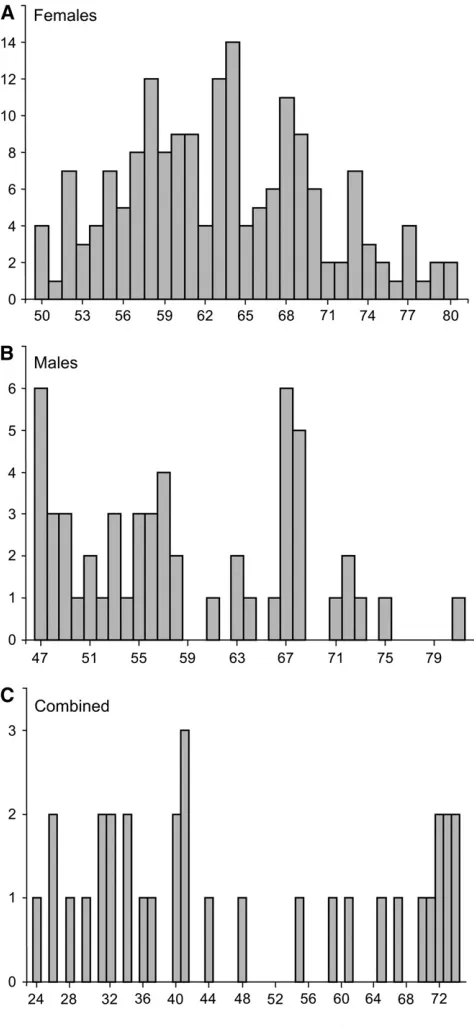
differences in terms of numbers and effects of detected eQTL were observed when using the combined (a data set of 66 mapped individuals, analyzed with an ANOVA model discarding the sex effect) and the two sex-specific (29 individuals for each male and female) data sets. Thus, the proportion of variance explained (PVE) by individual eQTL was much higher for both males (median value of PVE ¼ 66%; range, 47–81%) and females (PVE ¼ 73%; range, 50–80%) than for the combined data set (PVE¼30%; range, 24–75%), which suggested a potential Beavis effect (Lynchand Walsh
1998) and/or the conflict between sexes in the com-bined data set (supplemental Table S1, Figure 1). Moreover, for any given level of stringency, the number of eQTL detected in the female data set was significantly higher than that in both the male and the combined data sets (Table 1). Similarly, the number of eQTL detected in the male data set was always higher than that detected in the combined data set for any threshold value. This indicated that reduced sample size in the sex-specific data sets did not create a downward bias in eQTL detection and that contrasting patterns between sexes blurred eQTL detection when using the combined data set. Furthermore, the three data sets were also contrasted in terms of absolute values of additive effects (i.e., amount of a given transcript modulated by segre-gation of alleles betweendwarfand normal genomes). The female data set exhibited significantly more eQTL with absolute additive effects $1.00 (77/174) when compared to the male data set (3/55, P-value,0.001) and to the combined data set (1/30,P-value,0.0001). The mean absolute values of additive effects were also significantly higher in the female data set (mean¼0.99), when compared to the male (mean¼0.64,P-value¼0) and combined (mean¼0.58,P-value¼0) data sets.
Differences between the combined and sex-specific data sets were also found in terms of number of eQTL associated with different gene transcripts. Thus, at the
TABLE 1
Number of eQTL detected for a given empirical threshold for experimentwise type I error rates of 0.10, 0.05, and 0.01 that were determined for each significantly mapped
transcript (P,0.05) by recording the 10th-, 50th-, and
100th-ranked LRs of 1000 random permutations
Data set N a,0.10 a,0.05 a,0.01
Combined 66 38 (35) 33 (30) 16 (14) Males 29 75 (63) 54 (45) 20 (19) Females 29 250 (91) 174 (117) 57 (51)
The numbers of transcripts (i.e., associated with at least one significant eQTL) are in parentheses.
Figure1.—Distribution of eQTL according to their
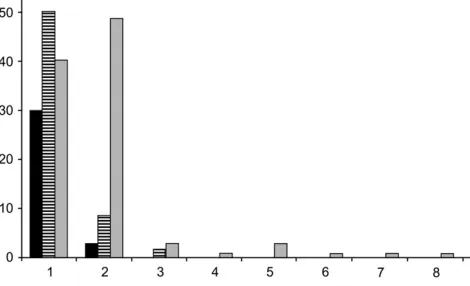
permuted genomewidea of 0.10 for suggestive eQTL detection, the average number of eQTL associated with a given transcript was comparable for both the com-bined (1.085) and male (1.190) data sets but substan-tially higher for the female data set (2.747) (Fisher’s test,P , 0.0001) (Figure 2). Thus, no more than two and three significant eQTL per transcript were found in the combined and male data sets, respectively, while up to eight significant eQTL per transcript were found in the female data set. The same differential pattern was still significant at a permuted genomewideaof 0.05, but not ata¼0.01. This supports the observation that the
trans-acting effects are generally of smaller effect than
cis-acting effects and will not be detectable at overly con-servative thresholds (Gibsonand Weir2005; Petretto
et al.2006). Finally, there were only three transcripts in common between male and female data sets, but with distinct eQTL locations: a nucleolar RNA helicase II (LG32f in male and LG19f in female), a 40S ribosomal protein S2 (LG25m in male and LG35m in female), and an ornithine decarboxylase antizyme (LG32f in male and LG14f in female). This suggests that transcript regulation was itself strongly influenced by sex.
Functional groups: At genomewide a of 0.05, 3 significant eQTL (8%) were detected, which belonged to energetic metabolism in the combined data set, 4 (11%) belonged to muscle proteins, and 13 (34%) belonged to protein synthesis functional groups. In the male-specific data set, 8 eQTL (15%) belonged to ener-getic metabolism, 7 (13%) belonged to muscle proteins, and 14 (26%) belonged to protein synthesis. In the female-specific data set, 23 eQTL (13%) belonged to energetic metabolism, 16 (9%) belonged to muscle proteins, and 30 (17%) belonged to protein synthesis and cell growth (Table 2, supplemental Table S1). These proportions of functional categories did not depart significantly from what was observed among the 2255 significantly ex-pressed genes (seematerials and methods).
Signifi-cant directionality of additive effect for two functional
groups, energetic metabolism and/or muscle contrac-tion regulacontrac-tion, was observed in the three data sets (Table 2). Energetic metabolism exhibited significant directionality in both the combined and the male data sets, but with opposite effects. Then, muscle contraction proteins exhibited significant directionality in both male and female data sets, but here again, with opposite effects: positive in males, negative in females.
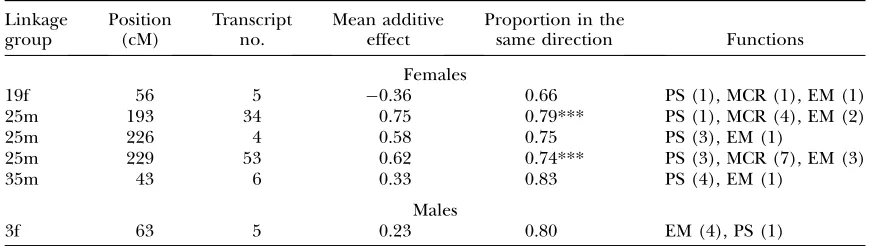
Nonrandom chromosomal distribution of eQTL: The eQTL linkages were not evenly distributed across the genome, particularly so for sex-specific data sets (Figure 3). Statistical significance of nonrandom distri-bution was assessed for a genomewide a of 0.05, for which totals of 33, 54, and 174 eQTL were detected for the combined, male, and female data sets, respectively (Table 1). For each of the data sets, we conservatively considered the occurrence of at least 4 eQTL within a given bin as an indication of eQTL hotspots. Indeed, the probability of observing $4 occurrences of eQTL in any given bin was,0.001 for the female data set when assuming a Poisson distribution. According to this criterion, both male and female data sets (but not the combined data set) revealed hotspots. In females, two major hotspots were located on the LG 25m subtelo-meric region, with 53 eQTL located at position 229 and 34 eQTL at position193, both of which exhibited a significant mean directional additive effect (Figure 2, Table 3). Furthermore, absolute values of additive ef-fects exceeded 1.00 for 77% of these 87 eQTL, whereas this proportion fell to 12% for the 79 remaining eQTL
Figure2.—Number of eQTL detected per transcript.
Re-sults are shown for combined (solid), male (striped), and fe-male (shaded) data sets. Thex-axis: classes of eQTL number per transcript;y-axis: class sizes.
TABLE 2
Summary of directionality of additive changes sorted by functional groups
Data set
Functional group
Transcript no.
Proportion in the same direction
Mean additive
effect
Combined EM 3 1.00** 0.84
MCR 4 0.50 0.04
PS 13 0.61 0.20
Males EM 8 1.00** 0.47
MCR 7 0.86** 0.61
PS 14 0.57 0.09
Females EM 25 0.52 0.08
MCR 17 1.00*** 1.05
PS 30 0.50 0.09
mapped outside the LG25m. This suggests that these particular chromosomal regions, both located on the same linkage group, have the most pervasive influence on transcript regulation and that this influence is strongly sex biased. Moreover, when considering func-tional groups, transcripts involved in protein synthesis, cell growth, and division exhibited systematically op-posed additive effects to those associated with energy metabolism, proteolysis, muscle contraction, and repair. In this study, the additive effect of an eQTL represents the influence of a normal allele segregating in adwarf
genetic background on the expression regulation of a particular gene. For example, a positive additive effect means that the normal allele upregulated the transcrip-tion of a given gene. According to this, six transcripts involved in protein synthesis and cell growth, including an histone H1 homolog to protein, a ribosomal bio-genesis NEP1 protein, a highly conserved transcript in eukaryotes and archaea identified as an essential growth factor regulator (Eschrichet al.2005), a GDP-l-fucose
synthetase, tightly involved in growth and development (Smithet al.2002), and a RhoGTPase, which is involved
in development of the striated muscles and in myofi-brillogenesis in vertebrates (O’Brienet al.2000),
exhib-ited opposite additive effects to four enzymes involved in energetic metabolism (a triose phosphate isomerase, a sarcoplasmic/endoplasmic reticulum ATPase, a glyc-erol-3-phosphate dehydrogenase, and a kinase precur-sor) and to six muscle protein transcripts [two actins, two collagen a-precursors, and a myosin heavy chain (supplemental Table S1)]. In addition, there were three small hotspots encompassing respectively five, four, and six transcripts, which were located on LG19, LG25m, and LG35m, respectively. These harbored very few eQTL exceeding an additive effect of 1.00. Concerning
the male data set, only one hotspot was detected on LG3f, located at position 62.89, featuring 4 eQTL: a ribosomal protein, an ATP synthase, a putative NADH, and an ubiquinol cytochrome c reductase, all of them exhibiting absolute values of additive effect,1.00.
Differentially expressed genes between progeny of different sexes:A total of 478 of the 2255 genes (21%) were differentially expressed between 24 male and 24 female progeny of the backcross family (adjusted per-muted P-values, a , 0.01) (supplemental Table S2). Genes belonging to several functional groups were clearly transcribed differentially between sexes. Namely oxidative phosphorylation genes were upregulated in males, whereas glycolytic enzymes, muscle proteins, and ribosomal proteins were upregulated in females. How-ever, only 20 (4%) differentially expressed genes be-tween males and females were associated with eQTL segregating in the female data set. This suggests that regulation settings for 96% of the transcripts differen-tially expressed between sexes were not sensitive to the genetic background of the backcross progenies, in which each individual represents a unique combination of
dwarfand normal alleles.
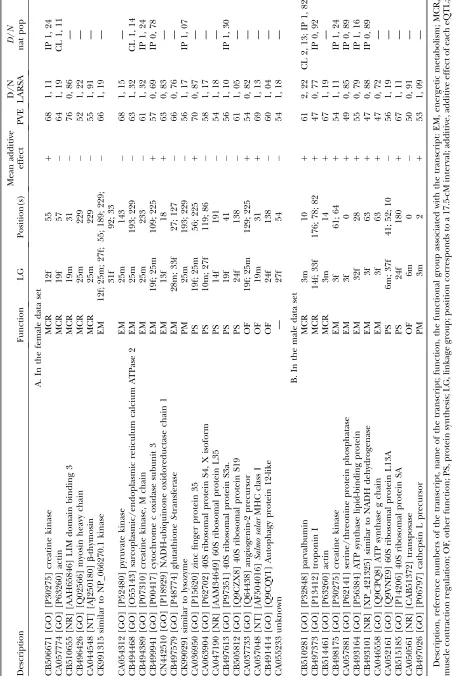
Differentially expressed genes between dwarf and normal parental species: A total of 253 of the 2255 genes (11%) were differentially expressed between 12 puredwarfand 12 normal whitefish (permutedP-values, a , 0.05) (supplemental Table S3). Of these, 34 transcripts were associated with 53 eQTL (20% of the transcripts segregating among the three data sets), 22 in the female data set (Table 4A), 12 in the male data set (Table 4B), and one in the combined data set. The differ-entially expressed transcripts segregating in male and fe-male data sets belonged mainly to three functional groups: muscle contraction, energy and repair (parvalbumin, TABLE 3
Hotspots detected among the three data sets
Linkage group
Position (cM)
Transcript no.
Mean additive effect
Proportion in the
same direction Functions
Females
19f 56 5 0.36 0.66 PS (1), MCR (1), EM (1)
25m 193 34 0.75 0.79*** PS (1), MCR (4), EM (2)
25m 226 4 0.58 0.75 PS (3), EM (1)
25m 229 53 0.62 0.74*** PS (3), MCR (7), EM (3)
35m 43 6 0.33 0.83 PS (4), EM (1)
Males
3f 63 5 0.23 0.80 EM (4), PS (1)
myosin, actin, troponin, b-thymosin, sarcoplasmic/ endoplasmic ATPase, and creatine kinase), energetic metabolism (pyruvate kinase, ATPase subunits G and C, NADH dehydrogenase, and cytochrome c oxidase poly-peptide III), and protein synthesis (ribosomal proteins and zinc finger protein). Genes belonging to muscle contraction, energy, and repair were systematically up-regulated indwarf, except for troponin, whereas both energetic metabolism and protein synthesis functional groups were not (Table 4B). Also, 125 transcripts for which regulating regions segregated in male- and female-specific data sets were not differentially expressed be-tween puredwarfand normal whitefish, which suggests they may be associated with either interindividual dif-ferences or stabilizing selection.
DISCUSSION
Documenting the genetic architecture of gene ex-pression provides a strong means for investigating the importance of the transcriptomic regulation during the course of an adaptive radiation in whitefish. Here, this approach revealed a complex genetic architecture of white muscle transcription, a tissue for which functional differences associated with swimming activity, energy metabolism, and growth have been well documented in the adaptive divergence ofdwarfand normal whitefish species pairs (Deromeand Bernatchez2006; Derome
et al.2006). The first striking result of this study was the much higher number of chromosomal regions influ-encing transcript abundance in the female compared to the male data set of identical sample size. The second was the identification of two major nonrandom aggre-gations of highly significantly mapped transcript regu-lation loci (eQTL hotspots) in the female data set. Those were responsible for significant directional pat-terns of additive effects, therefore identifying potential candidate genes whose transcription levels may have coevolved under directional selection (Orr 1998)
be-tweendwarfandnormalwhitefish. Moreover, patterns of eQTL distribution were strongly contrasted between male and females data sets. Indeed, the number and distribution of eQTL per transcript provided strong indirect evidence for both putativecisand trans regu-lation, with trans regulation being apparently more prevalent in females than in males. The differential genetic architecture between sexes was also supported by a significantly higher number of transcripts showing segregation of their regulating regions in females relative to males. Furthermore, 20% of the transcripts associated with eQTL were differentially expressed between pure dwarf and normal progeny, and those mostly belonged to muscle energy and repair, energetic metabolism, and protein synthesis, therefore identify-ing potential candidate genes involved in the adaptive and/or historical genetic divergence of dwarf and normal whitefish.
Sex-specific genetic architecture of gene regulation: Sex-specific effect or adaptive sex-linked effects? As stated above, the most striking result of this study was the much higher number of chromosomal regions influencing transcript abundance in the female com-pared to the male data set of identical sample size. Although several studies recently reported sex-specific transcript regulation (Von Schalburg et al. 2005;
McIntyre et al. 2006), including for muscle tissue
(Yanget al.2006), this possibility is challenged here by
the alternative hypothesis that the sex-specific architec-ture we observed reflects adaptive sex-linked effects. In addition, other hypotheses concerning the genetic architecture of whitefish and the experimental cross itself have to be explored. Thus, it is well known that recombination is strongly repressed during male meio-sis in salmonids (Sakamotoet al.2000), with a
female-to-male linkage map distance ratio of 6.4:1 reported in
S. trutta (Gharbi et al. 2006). Such a discrepancy
between male and female would significantly affect segregation of regulatory regions, which, in turn, could lead to differential eQTL detection between male- and female-specific data sets. Rogers et al. (2007) did not
detect any significant sex differences between the recombination frequencies in the whitefish linkage map. They hypothesized that elevated recombination in female markers of hybrid origin was likely offset by suppressed recombination due to the heterogeneous genetic background of the female hybrids compared to the pure parent in the pedigree. This, in turn, would have resulted in comparable levels of recombination observed between sexes, in contrast with previous studies in salmonids. Despite this, we recorded signifi-cantly fewer eQTL in males but also in the whole data set compared to females. Moreover, despite numerous unique combinations betweendwarfand normal alleles in the backcross family,.20% of expressed genes were differentially regulated between progeny of different sexes. Yet, 96% of these transcripts did not segregate in any of the three data sets, which suggests independence
vis-a`-vis their genetic background. Thus, most of the transcripts segregating in sex-specific data sets were not sex-biased genes. These transcripts were nonetheless under the control of the sex-determining region, which exhibited in that case a dependence vis-a`-vis their genetic background. The fact that different transcripts segregated in either male or female data sets strongly suggests that the sex-determining region exerts pleio-tropic effects. This in turn raises the hypothesis that pleiotropic effects of sex-determining regions may have played an important role in the adaptive divergence of
dwarfand normal whitefish and may have contributed to their postzygotic reproductive isolation, as documented experimentally in previous studies comparing fitness of pure and hybrid crosses betweendwarfand normal white-fish (Luand Bernatchez1998; Rogersand Bernatchez
Contrasting results among the combined and sex-specific data sets:Another salient result of this study was that there was no eQTL co-occurrence among the combined and the two sex-specific data sets. While the combined data set represents segregation effects on transcript regulation devoid of sex-linked effect, male and female data sets likely reflected contrasted eQTL occurrence due to, everything else been equal, differ-ential patterns of recombination in the sex-determining region. Sex chromosomes in salmonids are at the early stages of differentiation (Phillipet al.2001), and male
heterogamety and female homogamety are accepted as a general rule in salmonids (reviewed in Philippsand
Rab2001). Moreover, X and Y chromosomes still share a
similar repertoire of functional genes, conserved across a wide range of salmonid species (Woram et al.2003,
Artieriet al.2006). Also, male-specific loci of the
sex-determining autosomal region of two comparable young heterogametic sex chromosome systems (the medaka,
Oryzias latipes, and the stickleback,Gasterosteus aculeatus), were observed to not recombine and to include the sex-determining gene (Matsuda et al.2002; Peichelet al.
2004).
Aside from this, both size and weight at the same age differed significantly between males and females of the backcross family (Psize ¼ 0.018; Pweight , 1.106, one tailedt-test), associated with a variance four time lower in males, whereas these parameters did not vary between sexes either indwarfor in normal whitefish from natural populations (data not shown). This suggests, first, that recombination betweendwarfand normal genomes was responsible for both size and weight differences observed between sexes and, second, that these differences were mostly under the influence of a putative sex-determining region that did not recombine in males, as both weight and size variances were substantially reduced compared to females. This in turn suggests thatdwarf Y-like-linked genes imposed hemizygoustrans-acting effects among backcross males, despite autosomaldwarf/normal allele segregation. This hypothesis is reasonable because a majority of trans-regulation patterns occurred in the homogametic sex (seeresults) where segregation was
theoretically possible along the whole sex-determining region. It is also consistent with the work of Wanget al.
(2006), who observed a majority of sex-linked trans -regulation patterns in mouse. Taken together, it is likely that significantly lower eQTL occurrence in a male-specific sample would have resulted from a dominant effect of the dwarf Y-like nonrecombining autosomal region that would in turn impose strong pleiotropic ef-fects in a 75%dwarfbackground genome of the back-cross family. By contrast, free recombination between
dwarf and normal X-like autosomal regions during meiosis in F1females would have caused higher eQTL occurrence in the backcross female-specific data set. In other words, eQTL detected in the males would correspond to sex-linked effects outside the
nonrecom-bining region of the Y-like autosomal region, whereas those detected in females would correspond mostly to sex-linked effects encompassing the whole X-like chro-mosomal region.
The allopatric origin of the two evolutionary lineages used to build the backcross family may also partly underlie this striking difference of eQTL abundance between male and female data sets. The dwarf and normal whitefish populations belonged to different evo-lutionary lineages, Acadian and Atlantic–Mississippian, issued from distinct glacial origins (seematerials and methods). Therefore, 18,000–500,000 years of allopatric
genetic divergence between glacial races (Bernatchez
and Dodson1990) were enforced with12,000 years of
adaptive divergence that occurred between sympatric species and have potentially enhanced regional allelic incompatibilities between dwarf and normal genomes, perhaps also including the sex-determining region.
The major difference between males and females was further expressed in the nonrandom aggregation of eQTL at two tightly linked regulatory hotspots observed in females. Indeed, linkage group LG25m comprised .55% of all eQTL detected in the female data set, the majority (98%) of which were located at the distal tip of the linkage group. Furthermore, these two eQTL hotspots, which comprised 90% of all LG25m eQTL, exhibited a strikingly higher proportion of strong additive and directional effects, compared to eQTL found elsewhere in the genome (seeresults). Indeed,
the mean absolute value of additive effects reached 1.22 (range¼0.52–1.87), which is the very upper range of additive effects observed in mouse (Petretto et al.
2006). Moreover, additive effects were significantly directional when considering eQTL belonging to sepa-rate functional groups, namely energy metabolism (P¼ 0.016), muscle proteins (P ¼ 0.004), and protein synthesis (P ¼ 0.019). Directional predominance of additive effects in one direction for the loci underlying the quantitative variation of a given trait provides strong indirect evidence for the role of directional selection in shaping genome architecture (Orr 1998). Altogether,
when considering a functional group as a trait, this suggests that directional selection has been acting on patterns of gene regulation associated with these two tightly linked chromosomal regions. Strikingly, direc-tionality of additive effects was systematically opposed between transcripts involved in different functional groups. Namely, normal whitefish alleles induced neg-ative regulation effects on energetic metabolism and muscle proteins. On the contrary, normal whitefish alleles induced positive regulation effects on protein synthesis and cell growth functional groups.
This result is very consistent with both previous bio-energetic and population genomic studies on whitefish ecotype differences. First, Trudelet al. (2001) showed
bioenergetic conversion efficiency, both of them associated with slower growth and younger age at sexual maturity. In addition, parallelism in gene transcription of the same tissue in natural population pairs of whitefish eco-types showed that adaptive transcriptional divergence involved mainly genes associated with swimming activity and energy metabolism (Derome and Bernatchez
2006; Derome et al. 2006). Such a concentration of
eQTL belonging to diverse functional groups at these too subtelomeric positions (193 and 229) suggests that two single master regulators located at these positions are likely to control their expression. Moreover, all tran-scripts regulated at position 193 appeared also regu-lated on position 229. This raises the hypothesis that two duplicated regulating sequences are acting on the same suite of genes. This hypothesis is reasonable as positions 193 and 229 are separated by two markers that are associated with two regulating regions of, respectively, one and four different transcripts.
Among the transcripts that belong to both eQTL hotspots, there are four genes that are known to play fundamental roles in transcription regulation. First, the DPY-30-like protein gene encodes for a highly conserved protein throughout evolution, which is the upstream regulator of dosage compensation machinery of X chro-mosomes (Dong et al.2005). In addition, this protein
plays an essential role in sex determination(Hsuand
Meyer 1993) and may direct various developmental
processes via epigenetic control ( Jenuwein and Allis
2001). Furthermore, it has been recently demonstrated inCaenorhabditis elegansthat at least two separated DNA motifs, termed Rex1 and Rex2, act in combination or separately to regulate dosage compensation machinery via two DPY variants’ activation. Also, Rex1 and Rex2 are, respectively, located close to one of the two distinct DPY sequences (Mcdonelet al.2006). Such genetic
architec-ture of DPY regulation could be consistent with the observation of both its tightly linked eQTL located on LG25m. Therefore, DPY-30-like protein appears to be a very relevant candidate as a master regulating locus for both LG25m hotspots. Another such candidate is the Histone H1 homolog protamine transcript, which is known to play a pervasive role in transcriptome regula-tion (Bustinet al.2005). Interestingly, Nagyet al.(2001)
have demonstrated an interaction between a DPY-30 homolog and a histone protein as a sex-specific epige-netic regulation in Drosophila, where histone methyla-tion acts on chromatin dynamics. Therefore, as histone methylation is conserved from yeast to humans (Strahl
et al.1999), the coregulation of both DPY-30-like protein gene and histone H1 in whitefish could potentially account for regulating the suite of genes mapped on two tightly linked subtelomeric positions of a single chromosome. Another transcript potentially involved in the regulation of the two hotspots is the small ubiquitin-like modifier (SUMO). SUMO has emerged as an important regulator of diverse pathways and activities,
including protein localization and transcriptional regu-lation (Hamardet al.2007), and was observed to interact
with RAD23 (Ortolanet al.2000), an UV excision repair
protein that is itself involved in chromatin-mediated repression of transcription, and is alleviated by both histone modifications and ATP-dependent chromatin-remodeling activities (Gonget al.2006). Overall, these
results exemplify how natural selection could act on a single master regulator controlling expression of a suite of numerous genes belonging to diverse functional groups in a tissue highly involved in the adaptive di-vergence of whitefish and that would be ultimately able to modulate notably the organism phenotype (Deromeand
Bernatchez2006; Deromeet al.2006).
When extending the link between functional groups and directionality of additive effects to all linkage groups, only eQTL for transcripts belonging to muscle contraction proteins still have significant directionality, for which normal alleles induced a downregulation. However, the magnitude of their additive effects was weaker than that of those belonging to LG25m, suggest-ing a less profound effect in phenotypic differentiation between dwarf and normal whitefish. Significant di-rectionality of additive effects on muscle contraction proteins and energy metabolism was observed in the male data set as well but with both opposite and smaller effects than those observed in females. Thus, sex differ-ences of functional-specific directionality of transcript regulation add further support to the hypothesis that natural selection acted on a genetic architecture of transcript regulation mostly under the influence of the sex-determining region.
The eQTL hotspots on the LG25m are particularly striking because no such eQTL concentration was ob-served elsewhere on the map, and especially not on the LG25f, where alleles issued from the grandmother segre-gated. This suggests that this hotspot of transcriptomic segregation was specific to grandfather alleles, and, every-thing else been equal, these alleles would be linked to the X-like region homologous to the Y-like nonrecombining region. Indeed, loci associated with the sex-determining region in stickleback were reported to segregate only in male maps (Peichelet al.2004). However, although
many sex effects mapped to the LG25m, including a reproductive timing pQTL (Rogers and Bernatchez
2007), two eQTL of DPY-30-like protein, from which both regulating sequences and the gene itself were located on the X chromosome inC. elegans(Mcdonelet al.2006),
the genetic map was not dense enough to unequivocally determine a sex-determining locus.
in energy allocation in these species pairs in accordance with previous bioenergetic and transcriptomic studies (Trudel et al. 2001; Derome and Bernatchez 2006;
Deromeet al.2006; St-Cyret al.2008). As such, this work
provides further insights into the genetic architecture of transcriptional regulation in the time course of an adaptive radiation, in which historical isolation during an allopatric phase followed as well by ecological interactions encountered in sympatry following second-ary contact have been acting. Our results also add further support to the view thattrans-acting factors play an important role in the evolution of gene expression (Wanget al.2006), especially during the early stages of
adaptive divergence.
Comparison between eQTL and transcripts differ-entially expressed between pure dwarf and normal progenies:The eQTL detection is dependent on alleles with significant regulatory effects segregating between two genomes, therefore encompassing both interindi-vidual genetic differences and eventually regulatory changes differentiating distinct evolutionary lineages that may or may not be under selective effect. This study revealed that sex-linked pleiotropic effects have played pervasive effects in the transcript segregation. Here, there was no co-occurrence of eQTL between the three data sets, and only one transcript differentially ex-pressed associated with one eQTL in the combined data set (i.e., exhibiting transcriptomic segregation devoid of sex-linked effect). This supports further the importance of the sex-determining region in the genetic architecture differentiatingdwarfand normal whitefish. Furthermore, 12 candidate genes were differentially expressed in the same direction between the parental
dwarf and normal whitefish populations kept in con-trolled conditions at LARSA and that were used for genetic mapping, as well as one or two additional nat-ural sympatric pairs studied by Derome et al. (2006):
parvalbumin, actin, sarcoplasmic/endoplasmic reticu-lum calcium, creatine kinase, ATP synthase g, pyruvate kinase, lysozyme, and ribosomal protein were upregu-lated indwarfwhitefish whereas cytochrome oxidase sub-unit 3, putative NADH dehydrogenase, troponin, and serine/threonine protein phosphatase were upregu-lated in normal whitefish. This co-occurrence of di-rectional changes for these 12 specific transcripts, along with segregation of their respective regulating regions, further suggests that the regulation of these genes evolved under natural selection during the adaptive radiation of the whitefish species complex.
Concluding remarks:This study exemplifies how the integration of genetic and transcriptomic data offers a strong means for dissecting the functional genomic response to selection by separating mapping family-specific effects from genetic factors under selection, potentially involved in the phenotypic divergence of natural populations. In particular, the genetic dissection of gene regulation architecture underlying phenotypic
divergence between dwarf and normal whitefish pro-vided new insights toward understanding the molecular mechanisms underlying their divergence and, ulti-mately, their reproductive isolation. First, the integration of a paired analysis comparing expression across sex and eQTL mapping of sex-specific data sets revealed that the sex-determining region would have imposed strong pleiotropic effects on adaptive traits, which could in turn at least partly account for their postzygotic reproductive isolation. Second, a higher number of eQTL were re-corded in female progeny, for which two major hotspots of transcript regulation on two discrete positions on the LG25m encompassed more than half of all detected eQTL. This provides evidence for the existence of two master control loci modulating the same suite of genes, belonging to diverse functional groups involved in white-fish phenotypic divergence, including muscle contrac-tion, energetic metabolism, and protein synthesis. The pronounced directionality and magnitude of additive effects of eQTL found in these chromosomal regions provided strong albeit indirect support for the role of historical selection in shaping patterns of transcription for this large suite of genes. Third, the transcripts asso-ciated with eQTL that were differentially expressed between puredwarfand normal whitefish progeny added further insights into identifying candidate genes in-volved in the genetic divergence of these species. Overall, this study brings support to the hypothesis that natural selection may have acted on a few master regulating loci, which appeared to be under the influence of the sex-determining region. These master regulating loci, in turn, may have shaped the transcription profile at whole suites of genes through extensive pleiotropic effects and ultimately modulated phenotypic traits that underlay the adaptive divergence and speciation indwarfand normal whitefish species pairs.
We thank Serge Higgins and all the LARSA team for their support during the rearing of the whitefish, J. St-Cyr for tissue sampling, and Jennifer Lake for the parental line microarrays. We also thank N. Isabelle, S. McCairns, and S. Renaut, for their constructive comments on earlier versions of the manuscript. We also acknowledge the kind collaboration of B. F. Koop and W. S. Davidson, both leaders of the Consortium for Genomic Research on All Salmoids Project (cGRASP). Finally, we thank Lauren McIntyre and two anonymous referees for their very constructive comments and helpful suggestions. This research was financially supported by a Natural Sciences and Engi-neering research Council of Canada grant to L.B.
LITERATURE CITED
Artieri, C. G., L. A. Mitchell, S. H. Ng, S. E. Parisotto, R. G.
Danzmannet al., 2006 Identification of the sex-determining
lo-cus of Atlantic salmon (Salmo salar) on chromosome 2. Cytoge-net. Genome Res.112:152–159.
Basten, C. J., B. S. Weirand Z. Z.-B., 2002 QTL Cartographer.Program
in Statistical Genetics, Bioinformatics Research Center, Depart-ment of Statistics, North Carolina State University, Raleigh, NC. Bernatchez, L., 2004 Ecological theory of adaptive radiation: an
edited by A. P. Hendryand S. C. Stearns. Oxford University
Press, Oxford.
Bernatchez, L., and J. J. Dodson, 1990 Allopatric origin of
sympat-ric populations of Lake whitefish (Coregonus clupeaformis) as revealed by mitochondrial-DNA restriction analysis. Evolution 44:1263–1271.
Bochdanovits, Z., H. VanDerKlisand G. DeJong, 2003 Covariation
of larval gene expression and adult body size in natural popula-tions ofDrosophila melanogaster.Mol. Biol. Evol.20:1760–1766. Brem, R. B., G. Yvert, R. Clintonand L. Kruglyak, 2002 Genetic
dissection of transcriptional regulation in budding yeast. Science 296:752–755.
Bustin, M., F. Catezand J. H. Lim, 2005 The dynamics of histone
H1 function in chromatin. Mol. Cell17:617–620.
Churchill, G. A., 2002 Fundamentals of experimental design for
cDNA microarrays. Nat. Genet.32:490–495.
Cui, X., and G. A. Churchill, 2003 Statistical tests for differential
ex-pression in cDNA microarray experiments. Genome Biol.4:210. Cui, X., J. T. Hwang, J. Qiu, N. J. Blades and G. A. Churchill,
2005 Improved statistical tests for differential gene expression by shrinking variance components estimates. Biostatistics.6:59–75. Derome, N., and L. Bernatchez, 2006 The transcriptomics of
eco-logical convergence between 2 limnetic coregonine fishes (Sal-monidae). Mol. Biol. Evol.23:2370–2378.
Derome, N., P. Duchesneand L. Bernatchez, 2006 Parallelism in
gene transcription among sympatric lake whitefish (Coregonus clu-peaformisMitchill) ecotypes. Mol. Ecol.15:1239–1250. Dong, X., Y. Peng, Y. Peng, F. Xu, X. Heet al., 2005 Characterization
and crystallization of human DPY-30-like protein, an essential component of dosage compensation complex. Biochim. Biophys. Acta1753:257–262.
Ellegren, H., and A. K. Fridolfsson, 2003 Sex-specific mutation
rates in salmonid fish. J. Mol. Evol.56:458–463.
Ellegren, H., and J. Parsh, 2007 The evolution of sex-biased genes
and sex-biased gene expression. Nat. Rev. Genet.8:689–698. Eschrich, D., M. Buchhaupt, P. Ko¨ tter and K. D. Entian,
2005 Nep1p (Emg1p), a novel protein conserved in eukaryotes and archaea, is involved in ribosome biogenesis. Curr. Genet.40: 326–338.
Fitzpatrick, M. J., 2004 Pleiotropy and the genomic location of
sex-ually selected genes. Am. Nat.163:800–808.
Gharbi, K., A. Gautier, R. G. Danzmann, S. Gharbi, T. Sakamoto et al., 2006 A linkage map for brown trout (Salmo trutta): chro-mosome homeologies and comparative genome organization with other salmonid fish. Genetics172:2405–2419.
Gibson, G., 2002 Microarrays in ecology and evolution: a preview.
Mol. Ecol.11:17–24.
Gibson, G., and B. Weir, 2005 The quantitative genetics of
tran-scription. Trends Genet.21:616–623.
Gong, F., D. Fahyand M. J. Smerdon, 2006 Rad4-Rad23 interaction
with SWI/SNF links ATP-dependent chromatin remodeling with nucleotide excision repair. Nat. Struct. Mol. Biol.13:902–907. Hamard, P. J., M. Boyer-Guittaut, B. Camuzeaux, D. Dujardin, C.
Hausset al., 2007 Sumoylation delays the ATF7 transcription
factor subcellular localization and inhibits its transcriptional ac-tivity. Nucleic Acids Res.35:1134–1144.
Hoekstra, H. E., and J. A. Coyne, 2007 The locus of evolution: evo
devo and the genetics of adaptation. Evolution61:995–1016. Hsu, D. R., and B. J. Meyer, 1993 X chromosome dosage
compen-sation and its relationship to sex determination in C. elegans. Semin. Dev. Biol.4:96–106.
Itoh, Y., E. Melamed, X. Yang, K. Kampf, S. Wanget al., 2007 Dosage
compensation is less effective in birds than in mammals. J. Biol. 6:2.
Jacob, F., and J. Monod, 1961 Genetic regulatory mechanisms in
the synthesis of proteins. J. Mol. Biol.13:318–356.
Jenuwein, T., and C. D. Allis, 2001 Translating the histone code.
Science293:1074–1080.
Jin, W., R. M. Riley, R. D. Wolfinger, K. P. White, G. Passador
-Gurgel et al., 2002 The contributions of sex, genotype and
age to transcriptional variance in Drosophila melanogaster. Nat. Genet.29:389–395.
Kerr, M. K., M. Martinand G. A. Churchill, 2000 Analysis of
var-iance for gene expression microarray data. J. Comput. Biol. 7: 819–837.
King, C. C., and A. C. Wilson, 1975 Evolution at two levels in
hu-mans and chimpanzees. Science188:107–116.
Kirst, M., C. J. Basten, A. A. Myburg, Z. B. Zengand R. R. Sederoff,
2005 Genetic architecture of transcript-level variation in dif-ferentiating xylem of a eucalyptus hybrid. Genetics169:2295– 2303.
Kristiansson, E., A. Sjo¨ gren, M. Rudemo and O. Nerman,
2006 Quality optimised analysis of general paired microarray experiments. Stat. Appl. Genet. Mol. Biol.5:Article 10. Lander, E. S., P. Green, J. Abrahamson, A. Barlow, M. Daleyet al.,
1987 MAPMAKER, an interactive computer package for con-structing primary genetic linkage maps of experimental and nat-ural populations. Genomics1:174–181.
Landry, L., W. F. Vincentand L. Bernatchez, 2007 Parallel
evolu-tion of lake whitefishdwarfecotypes in association with limnolog-ical features of their adaptive landscape. J. Evol. Biol.20:971– 984.
Lu, G., and L. Bernatchez, 1998 Experimental evidence for
re-duced hybrid viability between dwarf and normal ecotypes of lake whitefish (Coregonus clupeaformisMitchill). Proc. R. Soc. Lond. Ser. B265:1025–1030.
Lu, G. Q., and L. Bernatchez, 1999 Correlated trophic specialization
and genetic divergence in sympatric lake whitefish ecotypes ( Cor-egonus clupeaformis): support for the ecological speciation hypoth-esis. Evolution53:1491–1505.
Lu, G., D. J. Basleyand L. Bernatchez, 2001 Contrasting patterns
of mitochondrial DNA and microsatellite introgressive hybridiza-tion between lineages of lake whitefish (Coregonus clupeaformis); relevance for speciation. Mol. Ecol.10:965–985.
Lynch, M., and B. Walsh, 1998 Genetics and Analysis of Quantitative Traits.Sinauer Associates, Sunderland, MA.
Mank, J. E., L. Hultin-Rosenberg, E. Axelssonand H. Ellegren,
2007 Rapid evolution of female-biased, but not male-biased, genes expressed in the avian brain. Mol. Biol. Evol.24:2698– 2706.
Marinotti, O., E. Calvo, Q. K. Nguyen, S. Sanayake, J. M. Ribeiro et al., 2006 Genome-wide analysis of gene expression in adult Anopheles gambiae. Insect Mol. Biol.15:1–12.
Mathur, S., and S. Dolo, 2007 A new efficient statistical test for
de-tecting variability in the gene expression data. Stat. Methods Med. Res. (in press).
Matsuda, M., Y. Nagahama, A. Shinomiya, T. Sato, C. Matsuda et al., 2002 DMY is a Y-specific DM-domain gene required for male development in the medaka fish. Nature417:559–563. Mcdonel, P., J. Jans, B. K. Petersonand J. Meyer, 2006 Clustered
DNA motifs mark X chromosomes for repression by a dosage compensation complex. Nature444:614–618.
McIntyre, L. M., L. M. Bono, A. Genissel, R. Westerman, D. Junk et al., 2006 Sex-specific expression of alternative transcripts in Drosophila. Genome Biol.7:R79.
Mckay, T. F. C., 2001 The genetic architecture of quantitative traits.
Annu. Rev. Genet.35:303–339.
Morley, M., C. M. Molony, T. M. Weber, J. L. Devlin, K. G. Ewens et al., 2004 Genetic analysis of genome-wide variation in human gene expression. Nature430:743–747.
Nagy, P. L., J. Griesenbeck, R. D. Kornbergand M. L. Cleary,
2001 A trithorax-group complex purified from Saccharomyces cerevisiaeis required for methylation of histone H3. Proc. Natl. Acad. Sci. USA99:90–94.
O’Brien, S. P., K. Seipel, Q. G. Medley, R. Bronson, R. Segalet al.,
2000 Skeletal muscle deformity and neuronal disorder in Trio exchange factor-deficient mouse embryos. Proc. Natl. Acad. Sci. USA97:12074–12078.
Oleksiak, M. F., G. A. Churchilland D. L. Crawford, 2002
Var-iation in gene expression within and among natural populations. Nat. Genet.32:261–266.
Oleksiak, M. F., J. L. Roachand D. L. Crawford, 2005 Natural
var-iation in cardiac metabolism and gene expression inFundulus het-eroclitus.Nat. Genet.37:67–72.
Orr, H. A., 1998 Testing natural selection vs. genetic drift in
phe-notypic evolution using quantitative trait locus data. Genetics 149:2099–2104.
Ortolan, T. G., P. Tongaonkar, D. Lambertson, L. Chen, C.