©
DOI: 10.1534/genetics.104.034488
Adaptive Molecular Evolution for 13,000 Phage Generations:
A Possible Arms Race
Holly A. Wichman,*
,1Jack Millstein* and J. J. Bull
†*Department of Biological Sciences and Initiative for Bioinformatics and Evolutionary Studies, University of Idaho, Moscow, Idaho 83844-3051 and†Department of Integrative Biology and Institute of Cellular and
Molecular Biology, University of Texas, Austin, Texas 78712-1023
Manuscript received August 16, 2004 Accepted for publication February 8, 2005
ABSTRACT
BacteriophageφX174 was evolved on a continuous supply of sensitive hosts for 180 days (ⵑ13,000 phage generations). The average rate of nucleotide substitution was nearly 0.2% (11 substitutions)/20 days, and, surprisingly, substitutions accumulated in a clock-like manner throughout the study, except for a low rate during the first 20 days. Rates of silent and missense substitutions varied over time and among genes. Approximately 40% of the 71 missense changes and 25% of the 58 silent changes have been observed in previous adaptations; the rate of parallel substitution was highest in the early phase of the evolution, but 7% of the later changes had evolved in previous studies of much shorter duration. Several lines of evidence suggest that most of the changes were adaptive, even many of the silent substitutions. The sustained, high rate of adaptive evolution for 180 days defies a model of adaptation to a constant environment. We instead suggest that continuing molecular evolution reflects a potentially indefinite arms race, stemming from high levels of co-infection and the resulting conflict among genomes competing within the same cell.
M
OLECULAR evolution is an established fact, but duration of the continuous culture, but those previous studies tended to be short (mostly 10 or 11 days, with the relative contributions of various factors toapproximately three phage generations per hour). The that evolution remain controversial (Kimura1983;Nei
nucleotide changes in those systems exhibited charac-1987;Gillespie1991;Li1997). Advantageous, neutral,
teristics of adaptive evolution: a high rate of missense/ and even deleterious mutations can become common
silent substitution and high rates of parallel changes. in a population, and their respective rates of evolution
Where the phenotypic effects of changes were identi-depend on mutation, the strength of selection, and
pop-fied, they could be interpreted as facilitating phage ulation size, plus the influence of other loci through
growth under the culture conditions (Bullet al.2000; linkage and epistasis. While much of the work in the
Crillet al.2000). field has focused on neutral evolution, a current goal
To further explore the nature of molecular evolution is to identify adaptive evolution by finding its signatures
in this system, we now report on a much longer duration in molecular data. Yet despite considerable evidence of
of phage growth in continuous culture. In addition, the adaptive molecular evolution, much uncertainty
re-culture conditions are more benign and are meant to mains about the nature of the selective agents.
approximate “control conditions,” which should impose Toward the goal of revealing the diverse mechanisms
less selection for change. By conducting a longer adapta-of molecular evolution, we have conducted several
ex-tion with frequent sampling of the populaex-tion, the tem-perimental studies of bacteriophage evolution (Bullet
poral characteristics of molecular evolution may now
al.1997, 2003;Wichmanet al.1999, 2000;Crillet al.
be studied. If adaptation in this system is primarily to 2000;HolderandBull2001). In some of those studies,
the constant (“control”) culture environment, we ex-phages were grown in continuous culture of a two-stage
pect that the initial rate of molecular evolution will be chemostat, whereby actively growing, sensitive bacteria
low and then wane as fitness approaches its maximum were continuously pumped into a vessel containing
(Fisher1958;Gillespie1983, 1984;Orr1998, 2002). phage, allowing the phage to infect and reproduce as
In two previous adaptations to inhibitory conditions, if their population were expanding exponentially (Bull
an initial high rate of molecular evolution decreased by
et al.1997;Wichmanet al.1999, 2000). Populations of
66 and 80% during extended adaptation in the same those phages accumulated nucleotide changes over the
environment (Bullet al.1997), supporting the theoreti-cal expectations of a plateau. While the initial rate of molecular evolution in this study was low, consistent
1Corresponding author:Department of Biological Sciences, P.O. Box
with the benign growth conditions, the rate accelerated 443051, University of Idaho, Moscow, ID 83844-3051.
E-mail: [email protected] during extended evolution and showed no sign of a
synchronous inφX174 as with the T-phages and is reported
plateau even after 13,000 generations. We provide
evi-to range from 15 evi-to 30 min with a mean of 21 min at 37⬚
dence that molecular evolution in this system is driven
(Hutchison and Sinsheimer 1963; Denhardt and
Sins-by high-density interactions, as observed in some other heimer 1965). This asynchrony stems from a passive lysis chemostat systems (PaquinandAdams1983;DePoloet mechanism that prevents synthesis of the cell septum and causes rupture when the cell attempts to divide; thus asynch-al.1987). This system allows us to examine the temporal
rony in cell division leads to asynchrony of lysis. Use of the
characteristics of the molecular evolution driven by
mean lysis time gives an approximate estimate of generation
these high-density interactions. The sequences here
time, but when the population is expanding (as here), early
cover the entire phage genome, allowing a comprehen- lysis has a disproportionate effect and causes the population sive level of analysis of tempo and mode of this evolu- to behave as if its generation time is shorter than the mean
tion. (Abedonet al.2001). We thus consider the generation time
in our chemostat to be 20 min (three phage generations/
The experimental evolution described below used the
hour). This number is necessarily approximate (indeed,
gen-icosahedral bacteriophage φX174. This phage has a
eration time will evolve over the course of an experiment),
small, single-stranded DNA genome of 5386 nucleotides but the exact value is unimportant to the conclusions here. and encodes 11 genes (Sangeret al.1977). The biology Fitness assays:Phage growth rate, represented as doublings of icosahedral phages has been intensively studied and per hour, was measured as the rate at which a phage increased its numbers when placed in a culture where cells outnumbered
most gene functions are known (Hayashiet al. 1988;
phages. Fitness was estimated as the log2of the increase in
Bangham and Kirkwood 1993), but more recently a
phage concentration per hour. The assay was conducted in
variety of structural studies has been coupled with muta- 125-ml flasks with 10 ml LB. Hosts were grown at 37⬚
with
tional analyses to infer gene function and interactions aeration to a density of ⵑ108 cells/ml. At this point (t0),
at a detailed level (Dokland et al.1997, 1999; Burch phage were added to a concentration of 103–104/ml and the mixture was grown for 40 min with shaking before growth was et al.1999;BurchandFane2003;Bernalet al.2004;
terminated with chloroform; the final concentration of phage
Novak and Fane 2004). φX174 does not encode its
(after chloroform) was not allowed to exceed the cell density.
own polymerase, but rather relies on host enzymes for
Phage titers were then determined immediately after harvest
replication. The virion binds to the lipopolysaccaride by plating. Fitness was calculated as 1.5 [log2(phage concentra-(LPS) in the outer membrane of its host, which must tion at 40 min) ⫺ log2(phage concentration atto)]. Other
considerations that apply to this assay have been discussed
lack the O antigen. The natural host is thought to be
elsewhere (Bullet al.2000).
a rough strain ofEscherichia coli, but the phage can be
Sequencing:Genomes of phage isolates were amplified by
isolated on or evolved to infect various LPS variants of
PCR in two overlapping pieces with rTth DNA polymerase, E. coli and Salmonella as well as some closely related XL (Applied Biosystems, Foster City, CA). Gel-purified PCR
bacteria. products were sequenced on an ABI capillary sequencer.
Am-biguities were resequenced, and if necessary a different primer or different DNA extraction was used.
Statistics:Where feasible, standard statistical tests were used, MATERIALS AND METHODS
as described in theresults. However, in many cases the sig-nificance of associations in the data was evaluated with
empiri-Strains:A wild-type isolate ofφX174 was used as the ancestor
for these studies (GenBank no. AF176034). The bacteria used cal permutation tests; the null distributions for these tests were for phage propagation wasE. coliC. generated by randomly associating the observed data without
Two-stage chemostat:A chemostat consisting of two con- replacement for at least tens of thousands of trials. nected 100⫻15-mm glass test tubes was used to select phage
populations (Bullet al.1997). LB broth with 0.005% antifoam B (Sigma, St. Louis) and 2 mmCaCl2was pumped continuously
RESULTS into the first tube, which maintained host cells at a density
suitable for phage growth; phage were absent from this “cell” Sustained rates of change tube. Overflow from the cell tube was drawn continuously into
the second tube, which contained phage (the “phage” tube). For the 180 days of evolution, crudely estimated as
The volume of liquid in the phage tube was maintained at 12,960 phage generations and a net expansion of 25,920 1–2 ml, with a flow-through rate of 7–10 ml/hr; thus the
population doublings, complete genomes were
se-volume of the phage tube was replaced on the order of 100
quenced from four phage isolates taken every 20 days
times/day. Because of the continuous nature of this
replace-ment, however, this exchange rate is equivalent to a growth (Figure 1). In the complete data set of 36 isolate
se-of 144 phage population doublings/day. Both tubes were aer- quences, 71 missense, 58 silent, and eight intergenic ated by bubbling with filtered air. Both tubes were immersed substitutions as well as four intergenic insertions/dele-in a water bath whose temperature was mainsertions/dele-intainsertions/dele-ined at 37.5⬚,
tions were detected. Overall, once a substitution first
0.5⬚above the designated chemostat temperature to
compen-appeared in an isolate, it tended to remain common for
sate for the observed cooling effect of the aeration. Chemostat
tubes and cells were changed at least every 2 days, thus dis- the duration of the experiment, although some changes
carding any phage-resistant cells in the phage tube. Samples remained demonstrably polymorphic, andⵑ20% made from the phage tube were run through a 0.2-m filter to only a transitory appearance before dropping to low remove the host (MillexGP, Millipore, Bedford, MA) and 0.2
frequency or disappearing.
ml was used to reinoculate the phage tube of the chemostat.
In previous articles (Bullet al.1997;Wichmanet al. The duration of a chemostat line is measured in days or
first 10 days of evolution in a strongly selective environ- statistically significant (P⬍0.02 for both, by a permuta-tion test). The slight decline in the number of missense ment. As expected for a virus evolving under benign
changes with time is not significant. Taken alone, this conditions, the rate of molecular evolution was initially
pattern might indicate that early evolution in this study quite low here, with only a single change during the
was driven by adaptive evolution while later evolution first 10 days of evolution (base 1301; data not shown).
was driven by purifying selection and neutral evolution. Unexpectedly, over the extended evolution we observed
However, we present arguments below that do not sup-a striking, nesup-ar-linesup-ar incresup-ase in substitutions sup-aversup-aging
port this notion. 11/20 days. Figure 2 shows not only the total number
Variation in silent/missense changes across the
ge-of differences from the starting genome for each isolate
nome:Silent changes were significantly clustered in the but also the pairwise distance between isolates from the
genome (Figure 3, top). The numbers of silent changes same time point, supporting the impression from Figure
in the single reading frame regions of genes A, F, G, 1 that evolution is dominated by a series of selective
and H deviated significantly from the expected numbers sweeps and that most time points also had considerable
on the basis of sequence length, with a large excess in variation. Figure 2 (bottom) shows that this clock-like
A and deficits in F, G, and H [2(3)⫽34.8, P⬍ 2⫻
accumulation applied to both missense and silent
substi-10⫺7]; the equivalent test for missense substitutions is tutions, with similar slopes over most of the experiment,
not statistically significant, but the ratio of silent-to-mis-but with a lag before the rise of silent substitutions.
sense changes is significantly heterogeneous across these genes [2(3)⫽12.7,P⬍0.006]. A clustering of
silent substitutions is consistent either with a selective
Signatures of adaptive evolution advantage of silent changes that were observed or with
a deleterious effect of silent changes that were not ob-When comparing sequences evolved in nature, the
served. To help discriminate among these alternatives, null model is that divergence represents neutral
evolu-we counted the numbers of silent and missense differ-tion. The experimental system is not necessarily
ex-ences between the same regions of the ancestral version pected to mirror natural evolution, both because the
φX174 and a closely related phage, S13. The distribution time span of experiments is too short and because the
of silent changes in this comparison differs profoundly experimental environment is likely novel and thus
from the distribution of silent changes in the should be selective. It is thus plausible that the
experi-mental line, whether the test treats each of the four mental evolution is more adaptive than natural
evolu-gene regions separately or combines F, G, and H (P⬍
tion (in terms of the proportion of changes that are
5 ⫻ 10⫺7). The comparison of missense changes be-adaptive), and there are several measures of molecular
tween the experimental line and theφX174-S13 contrast evolution that can be observed to assess the degree of
is not statistically significant, however. This evidence adaptive molecular evolution here.
supports the model that the clustered silent changes in
Missense/silent rates:An excess of missense
substitu-gene A of the experimental line reflect positive selec-tions (nonsynonymous) over silent substituselec-tions
(synon-tion, unless it is argued that negative selection on silent ymous) compared to the expected mutational ratio (i.e.,
changes operated differently in the chemostat than in
dN/dS⬎1) is considered a signature of adaptive evolu- the wild.
tion, while an excess of silent over missense substitutions
Codon bias: Although silent substitutions are often (dN/dS⬍1) is generally assumed to indicate purifying considered neutral, it is widely acknowledged that
selec-selection (Li1997). For φX174, the expected ratio of
tion in large populations can operate on silent changes missense-to-silent mutations in nonoverlapping coding through codon bias, nucleic acid secondary structure, or regions, given the mutational bias observed in this sys- binding of the DNA by proteins. Of the 137 substitutions tem, is 2.7 (analysis not shown), so a missense-to-silent identified during the 180 days, 58 produced silent substitution ratio of 2.7 would indicate adN/dSratio of changes. The distribution of base changes differs
sig-1. Previous work with φX174 in chemostats reported nificantly between the silent substitutions and the others an excess of missense substitutions, using 10- to 33-day [2(11)⫽ 26, P ⬍ 0.007]. This difference could stem
adaptations with temperatures in excess of 42⬚(Bullet from some mutational classes being more likely than al.1997;Wichmanet al.2000). That pattern held only others to create missense changes (e.g., transversionsvs. for early passages in this study (Figure 2, bottom). The transitions). However, half of the chi-square value comes cumulative dN/dS ratio was 3.70 (a missense-to-silent from a strong excess of T → C changes among silent
ratio of 10) by day 40, but fell below 1 at day 60 and substitutions, which may be the reversal of the large was 0.27 by day 180. The ratio of new silent vs. new excess of T in third positions found in the wild type. missense changes observed at each of the 20-day time Gene A (and A*) has the largest concentration of points is significantly heterogeneous [2(8)⫽19.2,P⬍ silent changes (36 in the region of nonoverlapping
Figure 2.—Cumulative changes in the φX174 chemostat line through day 180,ⵑ13,000 generations. (Top) Solid dia-monds show the number of differences between each se-quenced isolate and the ancestralφX174 sequence. Open tri-angles show the distance between pairs of isolates from the same time point (six comparisons per time). (Bottom) The number of differences between each sequenced isolate and the ancestral φX174 sequence is partitioned into missense (solid diamonds), silent (open diamonds), and intergenic (solid circles) changes.
the similarity of codon usage in a sequence to the codon usage known for highly expressed genes ofE. coli(Sharp
andLi1987). For each amino acid, the most-used codon in highly expressed genes is given a score of 1, and
less-used codons are given lower, positive scores. The CAI Figure3.—Point mutations appearing in different parts of of a sequence is then the geometric mean of the scores the genome during 180 days of evolution. (Top) The percent-for its codons. A geometric mean is highly sensitive to age of the total genome represented by each gene is shown by a solid bar, and the percentage of the total changes observed
extremely low values of any of its elements, so
improve-in the gene is shown by a hatched bar. (Intergenic regions
ments can occur in some codons with little overall
from throughout the genome are combined in category I.)
change in the CAI.
Overlapping reading frames contribute to multiple genes, so
The CAI over the 1092-base portion of gene A with the totals exceed 100%. (Middle) Missense changes in the a single reading frame improved from 0.32 to 0.33 when single-reading-frame codons of gene A (bases 3981–5072) are shown by the solid line, silent changes with the dashed line.
35 of the silent changes were added. One substitution
(Bottom) Missense changes in genes F, G, and H (solid line),
appeared simultaneously with a missense change in the
silent changes (dashed). Shown here are the total numbers
same codon and hence was excluded from this
calcula-of different mutations/substitutions seen in any calcula-of the isolate
tion. The null distribution was simulated by introducing sequences from the respective time point. Thus, a mutation 35 random silent substitutions into the ancestral, single- seen in one or more isolates at day 60 but not at day 80
contributes to the total at day 60 but not at day 80.
changes, 15 of 58 silent changes, and 4 of 12 intergenic changes were the same as or at the same nucleotide site as seen in other experiments. The proportion of previously seen changes declines with time, although the trend for intergenic changes is not statistically sig-nificant (on the basis of permutation tests and using the day each substitution was first detected, ⫽ ⫺0.87,
P⬍ 0.002 for missense changes; ⫽ ⫺0.93,P⬍0.002 for silent changes; and ⫽ ⫺0.77, P ⵑ 0.06 for in-tergenic changes).
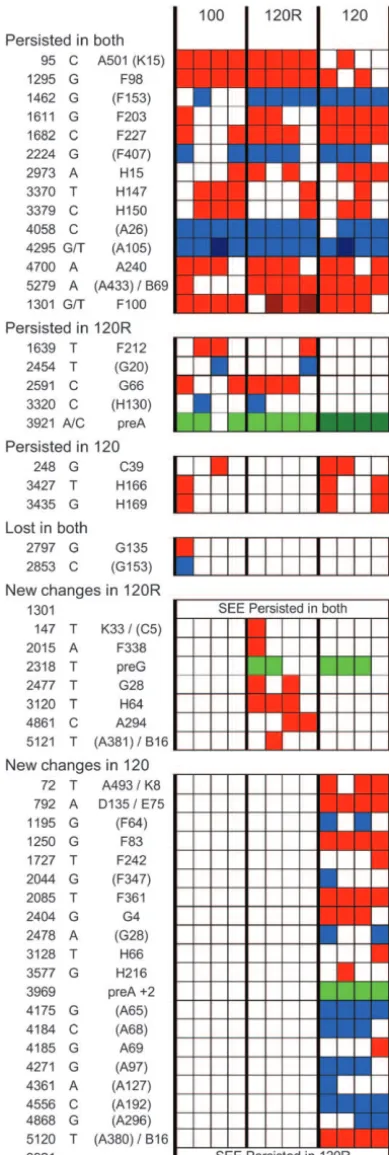
Repeatability of evolution—an extension from day 100 isolates:Beyond day 60, the samples exhibited con-siderable polymorphism and sustained a high rate of evolution, with much of the change from silent variants. To study the repeatability of this evolution, we initiated
Figure4.—Comparison of all changes seen during 180 days
a 20-day population with the four sequenced isolates
of evolution in theφX174 chemostat line to changes seen in
other chemostat evolutions ofφX174. Same-site amino acid from day 100; four new isolates were sequenced from replacements, unique amino acid replacements, same-site si- the population after 20 days (referred to as 120R). The lent changes within genes, and unique silent changes within
100- to 120-day time frame was chosen specifically to
genes are plotted in the first four blocks, with one bar for
ask whether the high rate of silent substitutions would
each time point from day 20 through day 180. Changes are
be repeatable.
plotted at the time of first occurrence. A same-site parallel
change is a mutation at the same genome position as seen This replicate differs in some obvious ways from the before, but not necessarily to the same base; a unique change original day 100 to day 120 population. The culture is one that has been observed only in this study. The
right-conditions maintained a large population size
through-most block gives the percentage of new changes seen at each
out the experiment, so the original day 100 population
time point that were also seen in previous experiments. This
undoubtedly had more genetic and phenotypic variants
block also includes intergenic changes and indels. The data
set used for comparison included changes seen inBullet al. than the four isolates used to evolve 120R. Thus we
(1997),Wichmanet al.(1999, 2000),Crill et al.(2000), and expect to see fewer new changes in day 120R than in the unpublished chemostats.
original day 120. On the other hand, using sequenced isolates allowed us to know the exact state of all fixed and polymorphic sites in the founding population and to more definitively identify any new parallel changes new CAI, repeated 100,000 times both with and without
replacement. The mean CAI of the null distribution was as adaptive. Figure 5 shows all sites that were polymor-phic at day 100, 120R, or 120.
0.006 lower than the CAI of the wild-type sequence,
indicating that random additions of 35 silent changes Fate of the day 100 polymorphisms:The day 100 isolates exhibited 20 variable sites, 19 of which could be used would have lowered the value. The slight increase
ob-served in the actual changes is nearly statistically signifi- to test for differences between day 120 and 120R. One site (3921) could not be included in this test because cant (Pⵑ0.06). This test merely indicates whether
co-don bias was a factor in the evolution of these silent all day 120 isolates contained a mutation that had not been seen at day 100. The differences between day 120 substitutions. We clearly cannot rule out codon bias as
a factor impacting the evolution of silent substitutions and 120R are not statistically significant for these 19 variable sites (P ⬵ 0.935; at each site, the exact prob-here, but the fact that the CAI barely increased suggests
that codon bias was not a major force favoring these ability of an outcome as extreme or more extreme than the results was calculated and conditioned on the mar-silent substitutions (to the extent that the CAI truly
reflects the impact of codon bias). ginal frequencies, and Fisher’s combined probability
test was used to measure the combined significance
Parallel evolution:Parallel evolution is an especially
useful signature of adaptive evolution because indepen- across all 19 sites). At 14 of the sites, the day 120 and 120R frequencies were as similar to one another as possi-dent substitutions of the same base in different lineages
(during brief adaptations) are plausibly attributed only ble, given the total numbers of mutations observed in the 120 and 120R samples. It is noteworthy that, of to selection. High levels of parallel evolution have been
observed in our previous studies, but because none of the six polymorphic silent substitutions in the day 100 isolates, the three that went to high frequency by day those phage populations were evolved as long as 180
days and few have been evolved under these conditions, 120 were found in three or four of the 120R isolates, and the three that were lost by day 120 were found in we do not have the ideal database against which to make
comparisons. Despite this limitation, a large fraction of at most one isolate of 120R. For one of the silent changes that went to high frequency, the associations of closely substitutions during the 180-day adaptation have been
120R; hitchhiking thus does not seem to be a likely peared in the four isolates of 120R. At least seven of these are likely to have been adaptive. At three sites, explanation for the increase of that silent change, but
hitchhiking is consistent with the increases of the other new mutations that were absent from day 100 isolates but were identical to substitutions that appeared in the two silent mutations.
New substitutions in day 120R:Eight new substitutions original 180-day chemostat appeared in 120R: 2318T was an intergenic change that also appeared at day 120, that were absent from the four founding genomes
ap-1301T was a missense change that appeared at day 140, and 2015A was a missense change that appeared at day 160. In addition, two of the eight changes (3120T and 4861C) have been seen multiple times in previous exper-iments, and two others (2477T and 5121T) were in the same codons but at different sites as changes observed at day 120. This further supports the growing picture that most of the changes in this long-term chemostat are adaptive.
New substitutions in day 120:The most apparent differ-ence between day 120 and 120R was the appearance of new mutations: 21 new substitutions and a 2-base insertion were seen at day 120, but only 8 new mutations appeared in 120R [2(1) ⫽ 6.533, P ⬵ 0.011]. The
difference appears to be chiefly in new silent changes: 0:7:1 silent:missense:intergenic new mutations for 120R
vs. 10:9:3 at day 120. The null model of no difference is marginally rejected [2(2) ⫽ 6.02, P ⬍ 0.05], and
a one-tailed Fisher’s exact test of the silent:missense differences is significant atP⬵0.018. Thus we did not observe the same rate of silent substitution in 120R as in the original day 100 to day 120 time period. It seems likely that the polymorphism in the day 100 population contributed to this difference. Mutations present at modest frequency in the day 100 population but not present in the four isolates could have ascended to de-tectable levels by day 120. In that sense the difference between day 120 and 120R is not surprising, merely reflecting the time required for different types of substi-tutions to come to high frequency in the population once they arise. One possible interpretation of this dif-ference is that most silent substitutions have a smaller selective coefficient than the missense or intergenic sub-stitutions. This might help to explain why silent substitu-tions did not begin to show up in appreciable numbers until day 60 of the 180-day chemostat.
DISCUSSION
The major pattern of interest in these data is ongoing molecular evolution during 13,000 generations in a seemingly constant external environment. A result of
continual molecular evolution in a constant environ- the basis of reversions of amber mutations atⵑ2⫻10⫺7 (Fershtand Knill-Jones1981), which is 1/5 that of ment is puzzling if most changes are adaptive, but is
not puzzling if most of the changes are neutral or delete- Drake’s generic estimate of one mutation per genome per 200 replications for DNA genomes (ⵑ10⫺6;Drake
rious. The large population sizes maintained in the
chemostat (see below) should have been inimical to 1999). Using these estimates and assuming thatφX174 replicates from the infecting genome as template, this fixation of deleterious changes, but the (near) neutrality
of substitutions is an option. In fact, several superficial would maximally yield one to five substitutions per 1000 phage generations if all changes were neutral. If we observations are seemingly compatible with neutrality:
the linear increase of changes over time, the excess of guess that 1/3 of mutations are nearly neutral, this would set an upper limit of 0.33–1.67 neutral substitu-silent substitutions after day 40, and (as shown below)
the absence of a “fitness” increase over time. Were it tions per 1000 phage generations, or 4–21 over the course of this experiment. This gives us a rough upper not for the consideration of other data, we might well
be unable to support adaptive evolution as the explana- limit if the population instantly reached the equilibrium rate of neutral mutation due to hitchhiking and hence tion for most of these changes. Below we present
argu-ments that (i) the rate of substitution was in excess of with low rates of recombination and without clonal in-terference. In view of the evidence for recombination the expected rate of neutral substitution and (ii) much
of the molecular evolution seen here has signatures of presented below, this upper limit is an overestimate. If this neutral calculation could be trusted, it would adaptation and is driven by high levels of within-host
competition. We then consider how our perspective might suggest that most of the substitutions in this system were adaptive. However, the uncertainty at every step in the have been different if we had not examined genome-wide
evolution. calculation warrants other evidence on the issue. We
thus address indicators of the nature of selection in this
Low expected rate of neutral evolution: In
consider-ing the causes of molecular evolution in this system, a system.
Chemostat design and the enigma of selection for
useful baseline quantity is the expected rate of neutral
substitution. Two issues need to be assessed with respect faster growth: Our intent in developing this culture system was to create an environment with a continual to the fixation of neutral mutations: the time it takes
such mutations to become fixed in the population and surplus of cells, whereby selection was primarily toward faster phage growth rate. At face value, the conclusion the expected ongoing rate of neutral substitution once
the population reaches the equilibrium rate of neutral that most changes were adaptive is consistent with the goal of the chemostat design, and previous work identi-substitution. In the absence of selection, the expected
time from origin of a successful neutral mutation to its fied the phenotypic bases of several substitutions with growth-enhancing effects (Bullet al.2000;Crillet al.
fixation is 2Negenerations (half that of diploids;Crow
andKimura1970), a time vastly exceeding the duration 2000). However, two contradictions challenge an inter-pretation of the chemostat as primarily selection for of this experiment. The ascent of highly beneficial
muta-tions can accelerate the fixation of neutral mutamuta-tions faster growth in a constant environment.
The first contradiction concerns the tempo and abso-through hitchhiking, but in the long-term, the
per-gen-eration fixation rate of neutral changes is expected to lute magnitude of change. The expectation for an adap-tive walk in a constant environment is that fitness should equal the genomic rate of neutral mutations, regardless
of linkage and the possibility of hitchhiking (Birkyand rise most rapidly early in the process and then plateau (KauffmanandLevin1987;GerrishandLenski1998;
Walsh 1988). Thus hitchhiking cannot increase the
equilibrium neutral fixation rate beyond what is ex- Orr1998;De VisserandLenski2002). Likewise, there is an expectation that the number of adaptive substitu-pected in the absence of selection; it can only accelerate
the time to equilibrium. But the effects of hitchhiking tions should plateau (neutral changes would continue), but no basis for predicting the total number of benefi-are countered by recombination, which breaks up
link-age groups and pushes the time to equilibrium toward cial changes without understanding the shape of the fitness landscape and where the starting genotype lies 2Negenerations.
If recombination were high enough in this system, in this landscape (Voigt et al.2000). As noted above, we have previously observed 12–15 changes in the first therefore, few if any of the substitutions in this
popula-tion would be expected to be neutral. This gives us a 10 days of evolution in a strongly selective environment (Bullet al. 1997;Wichmanet al. 1999, 2000). In this lower limit of zero for neutral substitutions. What can
we say about the upper limit? The maximum assumes experiment we observed only a single change during the first 10 days of evolution, followed by a near-linear that the neutral substitution rate reached equilibrium
immediately. We can calculate the expected equilibrium increase in substitutions averaging 11/20 days through-out the entire 180 days. Thus the tempo of evolution rate of neutral substitutions—the genomic neutral
mu-tation rate—if we know the genomic mumu-tation rate and was not as expected for adaptation to a constant environ-ment. The magnitude of change that could be ac-the proportion of mutations that are neutral. φX174
tinue indefinitely—as a new genotype comes to promi-nence, its prevalence provides the foundation on which yet other mutants may gain an advantage. We thus cau-tiously interpret our results as supporting a model in which sustained molecular evolution is driven by phage-phage competition within cells. This model of selection in our system is supported by four lines of evidence, as described below.
High titers:Titers taken at 5- to 10-day intervals usually exceeded 109/ml (data not shown). Since the chemostat
was maintained in a relatively steady state, the rate of co-infection can be determined from this value alone: the per-minute rate at which phages adsorb to individual cells is given by␦P, wherePis the phage concentration and␦ is the adsorption rate constant.␦typically lies in
Figure6.—Phage growth rate for selected isolates in the
φX174 chemostat line through 180 days of evolution. In this the range of 10⫺8–10⫺9 for sensitive cells across most
assay, the rate of phage population increase is measured in a phages (Adams1959). WithP maintained in excess of culture where hosts outnumber phage, thus representing 109/ml, the multiple infection of single cells within min-phage ability to increase without interference from other
utes is ensured. Superinfection exclusion (whereby the
phage. The decline with time is statistically significant. (The
expression and replication of an infecting genome is
correlation between growth rate and day is negative and highly
significant: ⫽ ⫺0.84,P⬍ 0.001; the correlation used the suppressed by phage genomes that entered the cell
ear-average growth rate of each phage isolate and the day of its lier) does not begin until 5–10 min after the first infec-isolation for the isolates shown.) The diamond at day 0
indi-tion (Hutchisonand Sinsheimer 1971), so this rate
cates the mean fitness of theφX174 ancestor. Open diamonds
of phage infection is more than sufficient to ensure
indicate the mean growth rates of isolates, and the solid
dia-competition among coinfecting genomes.
mond indicates the growth rate from a large sample of the
day 180 population. The means of the four isolates at day Decline in growth rate when hosts are in excess:It was noted
180 are significantly heterogeneous, with one mean being above that phage growth rate declined over the course
substantially above the others. of the evolution. A decline in φX174 growth rate was
also noted previously in a 10-day, high-temperature, Sal-monella chemostat line (Wichmanet al.1999). These on how far the ancestralφX174 started from the local declines provide direct evidence that selection in the fitness peak. In previous work,φX174 was adapted to an chemostat was not simply to maximize phage growth inhibitory high temperature (44⬚) with a serial transfer rate. A similar decline in growth rate was observed in protocol. Under these strongly selective conditions, fit- φ6 when the virus was grown at high multiplicity but ness reached a plateau after a mere three substitutions not at low multiplicity (TurnerandChao1998, 1999). per genome (HolderandBull2001). Although differ- Heterogeneity in growth rate:The four isolates at day 180 ences between the two protocols could account for some were significantly heterogeneous in growth rate, with differences in the outcomes, the 92–100 substitutions one isolate substantially higher than the others (Figure obtained here thus seem excessive for adaptation to a 6 shows the means of four isolates;F(3,8)⫽33.7,P⬍ constant environment, especially given that the condi- 0.001). As with the decline in growth rate when hosts tions here were less inhibitory to the virus than previous are in excess, this heterogeneity suggests that other
com-conditions. ponents in addition to growth rate were important to
The second contradiction to selection for fast growth fitness. It is noteworthy that the growth rates of three rate comes from assays of phage growth rate throughout isolates were low, indicating that the low growth rate the experiment. Phage growth rate actually declined was not likely the result of a spontaneous mutation. during the 180-day adaptation (Figure 6; growth rate is Evidence of recombination:InφX174, recombination can
measured with an excess of hosts). occur between the double-stranded replication
con-Figure7.—Schematic of variation between isolates in theφX174 chemostat line through 180 days. Each time point is represented by four isolates and a bar to the right. Each isolate is represented by a column of squares showing sites variable at that time point; the order of isolates has been arranged for ease of viewing and differs from Figure 1. Differences from the ancestor are in black, and ancestral states are in white. At least two adjacent squares exhibiting the same pattern of association among isolates are indicated by a colored block in the column to the right of the isolates (white otherwise). Other sites showing that pattern on that day are indicated in the same color if they are not interrupted by another tract, or in white if they are singletons within another tract. This is a conservative measure of the number of tracts. (There is no relationship among bars of the same color across days because most polymorphic sites become fixed or are lost between time points and recombination can break apart the linkage of those that remain.) Patterns are considered to be consistent between variable sites if they are the same as or are the mirror image of each other. For example,䊐䊐䊏䊏is considered the same pattern as䊏䊏䊐䊐. A continuous bar of one color at the right thus indicates that two distinct genotypes are present in the population at that time point (days 20, 40, and 160). Changing patterns of color are consistent with recombination between tracts. Recombination is most dramatic at day 120, but also is evident at days 80, 100, 140, and 180.
ple tracts in the same genome are inconsistent with founding genomes had been altered. Other instances of changes in marker association in 120R were observed a single haplotype. This pattern of mixed association
among variable sites is compatible with a buildup of as well.
The difference between what we had hoped to achieve alternate types over some or all of the genome (as seen
at day 40 and at day 160), followed by recombination in the chemostat and what we now think operates has many similarities to the difference between r- and during co-infection. Note also that the linkage
associa-tion of sites that remained polymorphic for ⬎20 days K-selection or density-dependent vs. density-indepen-dent regulation in ecology (seeFlegr1997 for history could be different across time points. While we cannot
formally rule out numerous same-site mutation events and extensions of the meanings of r- and K-selection in flow-through cultures). In its original formulation, without knowing mutation rates and selective
coeffi-cients of the variants involved, this pattern is highly r-selection represented selection for rapid growth, as would occur in populations whose numbers were main-suggestive of intermediate levels of recombination (but
not so much that linkage disequilibrium is destroyed) tained well below carrying capacity by extrinsic factors that were largely nonselective; K-selection represented and possibly compatible with the rates of 10⫺4–10⫺5per
co-infection observed byTessmanandShleser(1963). selection at high density, dominated by competition for resources. Our environments approximated a type of Additional evidence for recombination was detected in
the 120R experiment: by starting the replicate with K-selection. We suggest, therefore, that the high phage density promoted continuing adaptive evolution, where known isolates and sequencing multiple isolates after
20 days of evolution, we could detect three instances in the adaptation was specifically to the presence of com-peting genomes in the cell.
In some respects our study mirrors results from earlier ure 2—is less evident when a subset of the genome is examined. It is only when viewed from a total genome studies of chemostats and other protocols of
high-den-sity passage with microbes (reviewed in Adams2004). perspective that the clock-like evolution, the similar slopes of missense and silent rates, and the pronounced Many studies have shown a failure to exhibit progressive
increases in fitness measured as growth rate (Helling clustering of silent substitutions become evident.
Conclusions:Even if much of the continuing
molecu-et al.1987;Rosenzweiget al.1994;TurnerandChao
1998;Rozen andLenski2000;De Visser andLenski lar evolution in this system can be attributed to the high-density environment, it will be a far greater challenge 2002), and even in fact a decline in fitness over time
(Paquin and Adams 1983; Turner and Chao 1998, to partition the evolution into various underlying causes such as the types of selection and the specific functional 1999) as we observed. Another common feature is the
maintenance of phenotypic variants (Helling et al. effects of different mutations. Despite these difficulties, however, systems like the present one can continue to 1987;Kurlandzkaet al.1991;Rosenzweiget al.1994;
RozenandLenski2000). In our study, competing vari- yield new insights about molecular evolution in nature. This study raises the interesting question of how much ants at two time points could be inferred from sequence
analysis (Figure 7, days 40 and 160), but the phenotypic molecular evolution is driven by intraspecific competi-tion compared to other aspects of the biotic and the differences are as yet unknown. High-density passaging
can give rise to defective viral genomes (Huang1973; abiotic environment. A second noteworthy question is whether the clock-like rate of substitutions on a genomic
BarrettandDimmock1986;DePoloet al.1987;Roux
et al. 1991; Banghamand Kirkwood 1993), which in scale is a general feature of adaptive molecular evolu-tion, and if so what factors regulate the tempo of the turn can drive continuing molecular evolution (DePolo
et al.1987). Our observation of a high substitution rate clock. This system is especially amenable to further ex-ploration of these questions not only because of the is compatible with the sequence analysis of vesicular
stomatitis virus (VSV) and its defective particle (DePolo rapid generation time and ease of sequencing φX174 on a genomic scale, but also because of the ability to
et al. 1987); these viral studies contrast with the low
substitution rate seen in bacteria passaged 20,000 gener- apply reverse genetics, molecular biology, and structural analysis. We thus envision many opportunities to exploit ations (Lenskiet al.2003).
Whole-genome perspective:For most studies of exper- this system for further evolutionary insight.
imental evolution it is not feasible to sequence the entire We thank Eva Top, LuAnn Scott, Caitlin Coberly, and Kim Pepin genome even once, much less at multiple intervals for comments on an early version of this manuscript and Melodie Rai for assistance with data management and manuscript preparation. throughout the study. Here, we ask how the snapshot
We thank Ben Fane for many insights into the structure and function of evolution that we see in this study might have been
ofφX174, and especially for his suggestion to evaluate codon bias in different if we had been forced to examine a single
genes A and A*, and two anonymous reviewers for careful reviews gene or region of the genome. We illustrate this with and many helpful suggestions. This work was supported by RR016448 two regions that would have been logical choices for from the National Institutes of Health (NIH). J.J.B. was supported by
NIH grant GM57756. detailed examination if only a subset of the genome
were sequenced. Protein A is involved in replication and thus would be a likely target of the selection for
LITERATURE CITED
higher growth rate that we expected in this system.
Like-wise, proteins F, G, and H are known to be involved in Abedon, S. T., T. D. HerschlerandD. Stopar, 2001 Bacteriophage latent-period evolution as a response to resource availability. attachment, which is another likely target in selection
Appl. Environ. Microbiol.67:4233–4241.
for higher growth rate. Adams, J., 2004 Microbial evolution in laboratory environments.
Res. Microbiol.155:311–318. Gene A makes up 29% of the genome but accounted
Adams, M. H., 1959 Bacteriophages. Interscience, New York. for nearly half the changes (Figure 3, top). Evolution
Baker, R., J. DonigerandI. Tessman, 1971 Roles of parental and in the nonoverlapping region of A (Figure 3, middle) progeny DNA in 2 mechanisms of phage S13 recombination.
Nat. New Biol.230:23–25. began slowly, and by the end silent changes were more
Bangham, C. R., andT. B. Kirkwood, 1993 Defective interfering than twice as numerous as missense changes. Taken
particles and virus evolution. Trends Microbiol.1:260–264. alone, analysis of gene A would have supported the view Barrett, A. D., andN. J. Dimmock, 1986 Defective interfering
vi-ruses and infections of animals. Curr. Top. Microbiol. Immunol. that most substitutions during the latter half of this
128:55–84. experiment were neutral and that the excess of silent
Bernal, R. A., S. Hafenstein, R. Esmeralda, B. A. FaneandM. G. substitutions was driven by strong purifying selection. Rossmann, 2004 TheφX174 protein J mediates DNA packaging and viral attachment to host cells. J. Mol. Biol.337:1109–1122. In contrast, missense changes in genes F, G, and H
Birky, C. W., Jr., andJ. B. Walsh, 1988 Effects of linkage on rates increased in a near-linear fashion over time and were
of molecular evolution. Proc. Natl. Acad. Sci. USA85:6414–6418. never less than silent changes in those genes (Figure 3, Bull, J. J., M. R. Badgett, H. A. Wichman, J. P. Huelsenbeck, D. M. Hilliset al., 1997 Exceptional convergent evolution in a virus. bottom), butdN/dSwas⬍1 after day 40—again calling
Genetics147:1497–1507. into question how much of the observed evolution is
Bull, J. J., M. R. BadgettandH. A. Wichman, 2000 Big-benefit adaptive. The most striking aspect of this study—the mutations in a bacteriophage inhibited with heat. Mol. Biol. Evol.
Fig-Bull, J. J., M. R. Badgett, D. RokytaandI. J. Molineux, 2003 Hutchison, C. A., III, andR. L. Sinsheimer, 1963 Kinetics of bacte-riophage release by single cells ofφX174-infectedE. coli.J. Mol. Experimental evolution yields hundreds of mutations in a
func-tional viral genome. J. Mol. Evol.57:241–248. Biol.41:206–208.
Hutchison, C. A., III, andR. L. Sinsheimer, 1971 Requirement of Burch, A. D., andB. A. Fane, 2003 Genetic analyses of putative
conformation switching and cross-species inhibitory domains in protein synthesis for bacteriophageφX174 superinfection exclu-sion. J. Virol.8:121–124.
Microviridae external scaffolding proteins. Virology310:64–71.
Burch, A. D., J. TaandB. A. Fane, 1999 Cross-functional analysis Kauffman, S., andS. Levin, 1987 Towards a general theory of adap-tive walks on rugged landscapes. J. Theor. Biol.128:11–45. of the Microviridae internal scaffolding protein. J. Mol. Biol.286:
95–104. Kimura, M., 1983 The Neutral Theory of Molecular Evolution.
Cam-bridge University Press, CamCam-bridge, UK. Crill, W. D., H. A. WichmanandJ. J. Bull, 2000 Evolutionary
reversals during viral adaptation to alternating hosts. Genetics Kurlandzka, A., R. F. RosenzweigandJ. Adams, 1991 Identifica-tion of adaptive changes in an evolving populaIdentifica-tion ofEscherichia
154:27–37.
Crow, J. F., andM. Kimura, 1970 An Introduction to Population Genet- coli: the role of changes with regulatory and highly pleiotropic effects. Mol. Biol. Evol.8:261–281.
ics Theory. Harper & Row, New York.
Denhardt, D. T., andR. L. Sinsheimer, 1965 The process of infec- Lenski, R. E., C. L. WinkworthandM. A. Riley, 2003 Rates of DNA sequence evolution in experimental populations ofEscherichia coli
tion with bacteriophageφX174. 3. Phage maturation and lysis
after synchronized infection. J. Mol. Biol.12:641–646. during 20,000 generations. J. Mol. Evol.56:498–508.
Li, W.-H., 1997 Molecular Evolution. Sinauer Associates, Sunderland, DePolo, N. J., C. GiachettiandJ. J. Holland, 1987 Continuing
coevolution of virus and defective interfering particles and of MA.
Nei, M., 1987 Molecular Evolutionary Genetics. Columbia University viral genome sequences during undiluted passages: virus mutants
exhibiting nearly complete resistance to formerly dominant de- Press, New York.
Novak, C. R., andB. A. Fane, 2004 The functions of the N terminus fective interfering particles. J. Virol.61:454–464.
De Visser, J. A., andR. E. Lenski, 2002 Long-term experimental of theφX174 internal scaffolding protein, a protein encoded in an overlapping reading frame in a two scaffolding protein system. evolution inEscherichia coli. XI. Rejection of non-transitive
interac-tions as cause of declining rate of adaptation. BMC Evol. Biol. J. Mol. Biol.335:383–390.
Orr, H. A., 1998 The population genetics of adaptation: the
distribu-2:19.
Dokland, T., R. McKenna, L. L. Ilag, B. R. Bowman, N. L. Incar- tion of factors fixed during adaptive evolution. Evolution 52:
935–949. donaet al., 1997 Structure of a viral procapsid with molecular
scaffolding. Nature389:308–313. Orr, H. A., 2002 The population genetics of adaptation: the
adapta-tion of DNA sequences. Evoluadapta-tion56:1317–1330. Dokland, T., R. A. Bernal, A. Burch, S. Pletnev, B. A. Faneet al.,
1999 The role of scaffolding proteins in the assembly of the Paquin, C. E., andJ. Adams, 1983 Relative fitness can decrease in evolving asexual populations ofS. cerevisiae.Nature306:368–371. small, single-stranded DNA virusφX174. J. Mol. Biol.288:595–
608. Rosenzweig, R. F., R. R. Sharp, D. S. TrevesandJ. Adams, 1994 Microbial evolution in a simple unstructured environment: ge-Drake, J. W., 1999 The distribution of rates of spontaneous mutation
over viruses, prokaryotes, and eukaryotes. Ann. NY Acad. Sci.870: netic differentiation inEscherichia coli.Genetics137:903–917. Roux, L., A. E. SimonandJ. J. Holland, 1991 Effects of defective 100–107.
Fersht, A. R., andJ. W. Knill-Jones, 1981 DNA polymerase accu- interfering viruses on virus replication and pathogenesis in vitro and in vivo. Adv. Virus Res.40:181–211.
racy and spontaneous mutation rates: frequencies of
purine.pu-rine, purine.pyrimidine, and pyrimidine.pyrimidine mismatches Rozen, D. E., andR. E. Lenski, 2000 Long-term experimental evolu-tion in Escherichia coli.VIII. Dynamics of a balanced polymor-during DNA replication. Proc. Natl. Acad. Sci. USA78:4251–
4255. phism. Am. Nat.155:24–35.
Sanger, F., G. M. Air, B. G. Barrell, N. L. Brown, A. R. Coulson Fisher, R. A., 1958 The Genetical Theory of Natural Selection. Dover,
New York. et al., 1977 Nucleotide sequence of bacteriophageφX174 DNA.
Nature265:687–695. Flegr, J., 1997 Two distinct types of natural selection in
turbidostat-like and chemostat-turbidostat-like ecosystems. J. Theor. Biol.188:121–126. Sharp, P. M., andW. H. Li, 1987 The Codon Adaptation Index—a measure of directional synonymous codon usage bias, and its Gerrish, P. J., andR. E. Lenski, 1998 The fate of competing
benefi-cial mutations in an asexual population. Genetica102/103:127– potential applications. Nucleic Acids Res.15:1281–1295. Tessman, E. S., andR. Shleser, 1963 Genetic recombination be-144.
Gillespie, J. H., 1983 A simple stochastic gene substitution model. tween phages S13 andφX174. Virology19:239–240.
Turner, P. E., andL. Chao, 1998 Sex and the evolution of intrahost Theor. Popul. Biol.23:202–215.
Gillespie, J. H., 1984 Molecular evolution over the mutational land- competition in RNA virusφ6. Genetics150:523–532.
Turner, P. E., andL. Chao, 1999 Prisoner’s dilemma in an RNA scape. Evolution38:1116–1129.
Gillespie, J. H., 1991 The Causes of Molecular Evolution. Oxford Uni- virus. Nature398:441–443.
versity Press, New York. Voigt, C. A., S. KauffmanandZ. G. Wang, 2000 Rational
evolution-Hayashi, M., A. Aoyama, D. L. J. RichardsonandM. N. Hayashi, ary design: the theory of in vitro protein evolution. Adv. Protein 1988 Biology of the bacteriophageφX174, pp. 1–17 inThe Bacte- Chem.55:79–160.
riophages, edited by R.Calendar. Plenum Press, New York. Wichman, H. A., M. R. Badgett, L. A. Scott, C. M. Boulianne Helling, R. B., C. N. Vargasand J. Adams, 1987 Evolution of andJ. J. Bull, 1999 Different trajectories of parallel evolution
Escherichia coliduring growth in a constant environment. Genetics during viral adaptation. Science285:422–424.
116:349–358. Wichman, H. A., L. A. Scott, C. D. YarberandJ. J. Bull, 2000
Holder, K. K., andJ. J. Bull, 2001 Profiles of adaptation in two Experimental evolution recapitulates natural evolution. Philos.
similar viruses. Genetics159:1393–1404. Trans. R. Soc. Lond. B Biol. Sci.355:1677–1684.
Huang, A. S., 1973 Defective interfering viruses. Annu. Rev.