ISSN(Online): 2319-8753 ISSN (Print): 2347-6710
I
nternational
J
ournal of
I
nnovative
R
esearch in
S
cience,
E
ngineering and
T
echnology
(An ISO 3297: 2007 Certified Organization)Vol. 5, Issue 6, June 2016
Impact of Physical Layer Reliability on
Lifetime Prediction Based Energy Efficient
Routing Protocol In MANET
Ayushi Goel
P.G. Student, Department of Computer Science and Engineering, Emax Group of Institutions, Ambala, Haryana, India
ABSTRACT: Routing is one of the key issues in Mobile Adhoc Networks. Although establishing correct and efficient
route is an important issue in MANETs, a more challenging goal is to provide energy efficient and reliable routing protocols. Discovery of route in the topology is an important phase of the MANET. Depending on the application of the deployed MANET the cost of the routing algorithms are optimized. During route discovery if any of the intermediate node had severe interference from other nodes, then this will increase the packet error rate, leading to waste of the energy spent on the packet transmission as well as on retransmission done on that hop In this paper we will show the impact of reliability in terms of theoretical probability of bit error and SINR in selecting the most reliable energy efficient routing path along with available battery power and distance between source and destination.
KEYWORDS: MANETs, Routing Protocols, AODV, SINR, energy-efficiency
I. INTRODUCTION
Wireless communication is undergoing rapid advancements to meet the demands of current and future trends of communications. Unlike wired networks which require a fixed network infrastructure like a base station to communicate. Mobile ad-hoc networks are self configuring thus self organizing mobile nodes participate to form a wireless network without any existing network infrastructure. Each mobile node participating in this type of networks acts as a router by itself, there by discovering and maintaining the routes to other nodes to communicate over the network. MANETs are subject to rapid changes in their mobility and their performance is affected by topological changes. With limited band-width and power available to these nodes, the performance of these nodes hugely depend on the type of routing protocol used for communication. The nodes of MANETs have limited battery power and the routing protocols cannot efficiently serve the purpose of the MANETs’ applications during communications once the onboard battery power of the constituent nodes get exhausted. Hence, it is required to sustain the MANETs’ lifetime by properly utilizing the battery power of its nodes.
Energy efficiency has become one of the major design goals of any MANET routing protocols. Many routing protocols have been proposed which aim to make packet forwarding between nodes energy efficient. Different energy metrics have been used in each of them such as average energy consumption, network lifetime, energy drain rate, etc.
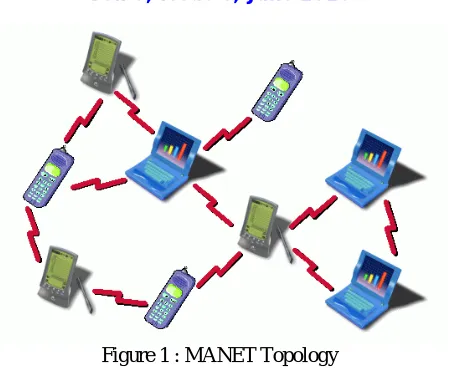
MANETs have several salient characteristics: 1) Dynamic topology
2) Bandwidth constrained , variable capacity links 3) Energy constrained operation
ISSN(Online): 2319-8753 ISSN (Print): 2347-6710
I
nternational
J
ournal of
I
nnovative
R
esearch in
S
cience,
E
ngineering and
T
echnology
(An ISO 3297: 2007 Certified Organization)Vol. 5, Issue 6, June 2016
Figure 1 : MANET Topology
II. RELATED WORK
Ad hoc network routing protocols can be classified as reactive routing protocols, such as DSR [1], AODV [2]; or as proactive protocols such as OLSR [3], DSDV [4]. Proactive or table driven routing keeps updated topological information about the network so that routes can be quickly found when needed. Reactive or on demand protocols discover routes when need for them arises. A third kind of routing protocols known as hybrid routing protocols has been proposed. Hybrid routing combines the feature of both reactive and proactive protocols, to give the best out of them both. An example of such a hybrid protocol is ZRP [5].
AODV is an on demand routing protocol. In a network using AODV, when routes are required, the source node broadcasts, RREQ packet. On receiving RREQ packets, an intermediate node either rebroadcasts the RREQ packet when it has no routes, or sends RREP containing the route back to the source. The intermediate node also creates the backward path on receiving the RREQ. The destination on receiving the first RREQ, sends RREP or Route Reply down the path from which it received the RREQ. While traversing its way up the source, the forward path is built up, and on reaching the source, the entire forward path gets built. The source only knows about the next hop, and sends packet to next hop which using its next hop information forwards the packet down the route. The process goes on for every intermediate node till the destination is reached.
[6][7] and [8] have discussed different ways in which multi-path routing can take place in MANET. Multi-path routing is preferable since multiple routes are available from source to destination. Thus, when one route fails, packets can be forwarded through the backup routes. Multi-path routing offers a robust alternative to MANET routing.
In [9], the authors have proposed a multi-path energy efficient modification to the AODV routing protocol. They consider the actual distance between source and destination nodes through each of the path taken and the minimum energy remaining in the node of the path as metrics. This information is collected while RREQs visit each node and aggregated in the destination node. The metrics are used to compute a cost function using network administrator set weights. The weights are set to give relative weightage to either the energy efficiency or the delay metrics depending on which factor we wish to optimize. All RREQs are collected for a certain time period. At the end of this time, the best path depending on the path having least cost is selected. Routing proceeds through the best path, till this path goes down and at that point backup paths are used. Backup paths are the next best path. When all backup paths have gone down, the cost is recomputed and paths are chosen afresh.
Costi = α * DEi + β * Disti where,
DEi is the difference between minimum available battery power of the node and the threshold. Disti is the distance between source and destination.
ISSN(Online): 2319-8753 ISSN (Print): 2347-6710
I
nternational
J
ournal of
I
nnovative
R
esearch in
S
cience,
E
ngineering and
T
echnology
(An ISO 3297: 2007 Certified Organization)Vol. 5, Issue 6, June 2016
III. PROPOSED WORK
Route discovery is initiated when a node needs to send a data packet but does not have an active route to the destination. Route discovery is started by broadcasting the RREQ packet by the source node. With the broadcast of RREQ packet, a timer is started, and by this time it is expected that RREP will arrive. If no RREP is received within this time, a fresh RREQ is rebroadcast. The broadcasted RREQ reaches neighboring node of source. If the receiving node is intermediate node, it first checks whether RREQ received is duplicate or not. If RREQ received is duplicate, then the packet is dropped Otherwise, the parameters are computed. New distance and hop count are calculated and replaces the old values in RREQ. Also, available battery power field is replaced with the node's available battery power if the node's available battery power is smaller than RREQ's value. When predecessor node is the source, available battery power of node value in RREQ is changed anyway. Also the theoretical probability of bit error is also calculated from the source to the current node .The predecessor node position is set to this node's position. The new RREQ is rebroadcast. This process continues until destination is reached. Also, as the RREQ propagates through the nodes, backward path from destination to source gets created. These paths are ranked zero and used for unicasting RREPs back to the source. The destination on receiving the first RREQ starts a timer, the destination collects further RREQs till this timer expires, after which all subsequent RREQs received are ignored. The parameter information contained in the RREQ are collected and stored in the Route Info Table. After expiry of timer, the cost of each path is computed by formula given below. The best path is selected based on the path having minimum cost, and RREP is unicast along the path. After the source node receives the RREP, data transmission commences.
At the destination, cost function is calculated based on the formula given below: Costi == α * Pe + β *Min(Ei(t)) + *disti,
Where
Pe is the effective theoretical probability of bit error.
Min(Ei(t)) is the minimum available battery power of the node in the path. Disti is the distance between source and destination.
α , β and are weighing factors, assigned by network administrators. They denote the specific weight-age of each of
the metrics.
IV. RESULTS
ISSN(Online): 2319-8753 ISSN (Print): 2347-6710
I
nternational
J
ournal of
I
nnovative
R
esearch in
S
cience,
E
ngineering and
T
echnology
(An ISO 3297: 2007 Certified Organization)Vol. 5, Issue 6, June 2016
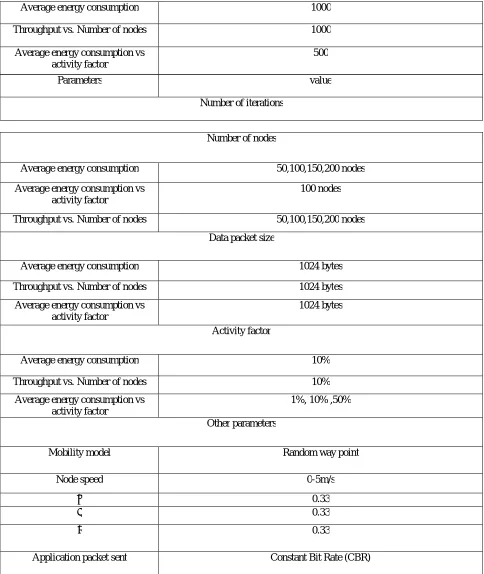
Number of nodes
Average energy consumption 50,100,150,200 nodes
Average energy consumption vs activity factor
100 nodes
Throughput vs. Number of nodes 50,100,150,200 nodes
Data packet size
Average energy consumption 1024 bytes
Throughput vs. Number of nodes 1024 bytes
Average energy consumption vs activity factor
1024 bytes
Activity factor
Average energy consumption 10%
Throughput vs. Number of nodes 10%
Average energy consumption vs activity factor
1%, 10% ,50%
Other parameters
Mobility model Random way point
Node speed 0-5m/s
α 0.33
β 0.33
γ 0.33
Application packet sent Constant Bit Rate (CBR)
Table 1: Comparision of different protocols with the given parameters.
Average energy consumption 1000
Throughput vs. Number of nodes 1000
Average energy consumption vs activity factor
500
Parameters value
ISSN(Online): 2319-8753 ISSN (Print): 2347-6710
I
nternational
J
ournal of
I
nnovative
R
esearch in
S
cience,
E
ngineering and
T
echnology
(An ISO 3297: 2007 Certified Organization)Vol. 5, Issue 6, June 2016
V. AVERAGE ENERGY CONSUMPTION VS NO OF NODES
RLP-ESAR: Reliability based lifetime predicition energy saving routing algorithm for MANET.
LP-ESAR: Lifetime prediction based Energy Saving Routing Algorithm for MANET
Fig 2 Average energy consumption vs no of nodes
Figure 2 shows the result of comparing RLP-ESAR, LP-ESAR, Reliability and distance based routing protocols in terms of Average energy consumption. The graph shows that for lower number of nodes energy efficiency achieved in RLP-ESAR is negligible in comparison to LP- ESAR Protocol. However, at higher number of nodes energy efficiency achieved by RLP-ESAR is significant in comparison to the other protocols. Overall average energy consumption is lowest for the reliability protocol followed by RLP-ESAR protocol. For LP-ESAR , which does not consider reliability based energy efficiency, average energy consumption is the most. The reason for better performance for higher number of nodes can be reasoned that with higher number of nodes better estimates on traffic situation can be made and as such reliability based energy efficiency cost calculation also improves in accuracy. Thus, better routing decisions could be made
1. THROUGHPUT VS NUMBER OF NODES
Improving network lifetime is a very important goal in MANET. Here, network lifetime is defined as the time by which the last node in the network dies and throughput is defined as the number of packets sent per second. In case of RLP-ESAR routing decisions are made taking theoretical probability of bit error into consideration. Figure 3 shows RLP-ESAR performing far better than the LP-ESAR. The reason for this better performance is because of explicit use of reliability metric in the form of theoretical probability of bit error. Thus, in case of RLP-ESAR the routing protocol is consciously maximizing the lifetime of the network, while in case of LP-ESAR lifetime is decreasing. Also, the
0 50 100 150 200 250 300
50 100 150 200
reliability
distance
RLP-ESAR
LP-ESAR
0 0.5 1 1.5 2 2.5 3 3.5 4
50 100 150 200
RLP-ESAR
ISSN(Online): 2319-8753 ISSN (Print): 2347-6710
I
nternational
J
ournal of
I
nnovative
R
esearch in
S
cience,
E
ngineering and
T
echnology
(An ISO 3297: 2007 Certified Organization)Vol. 5, Issue 6, June 2016
protocol performs better for more number of nodes in the network. RLP-ESAR consciously balances the routing load balancing among the nodes. Thus when more nodes are available, more loads can be shared.
2. AVERAGE ENERGY CONSUMPTION VS ACTIVITY FACTOR
Fig:4 Average energy consumption vs activity factor
Activity factor is defined as the percentage of the nodes which will be active for transmitting and receiving. As the activity factor increases, energy consumption increases since there will be more connections between source and destination and more number of nodes will be participating in packe t transmission .
V. CONCLUSION
Mobile ad-hoc networks (MANETS) are expected to play an important role in the deployment of future wireless communication systems. Routing is an essential component of communication protocols in mobile ad hoc networks. The design of the protocols are driven by specific goals and requirements based on respective assumptions about the network properties or application area. Therefore, it is extremely important that these networks should be able to provide reliable routes that can meet the vendor requirements. The SINR and BER are the main concern for reliability of routing protocols demanding that real time data be transmitted on reliable paths. The preceding sections have discussed about what MANET is, what are the routing protocols used in MANET and what should be the characteristics of routing protocols in MANET. Further, the evolution of routing protocols in MANET has been discussed in details. Much has been discussed on the energy efficient routing protocols and finally the necessity of developing a new energy efficient routing protocol in MANET. The new protocol designed have been discussed and extensively tested to ascertain its effectiveness in improving the performance of the already designed protocols. As has been discussed in the previous section, the protocol improves the performance in terms of energy efficient matrices like Average energy consumption and Throughput as compared to the ESAR protocol.
VI. FUTURE WORK
For the future work, the protocol can be improved in the following way:
1) We are of the opinion that predicted lifetime can be used to predicted congestion zones developing at specific points of the network. Use of predicted lifetime as a congestion avoidance measure can be investigated in future.
2)
Experiments may be done to try and improve the protocol by employing advanced time series analysis based statisticalmethods, like ARIMA.
0 50 100 150 200 250
Reliability Distance LP-ESAR RLP-ESAR
1%
10%
ISSN(Online): 2319-8753 ISSN (Print): 2347-6710
I
nternational
J
ournal of
I
nnovative
R
esearch in
S
cience,
E
ngineering and
T
echnology
(An ISO 3297: 2007 Certified Organization)Vol. 5, Issue 6, June 2016
REFERENCES
1. D. Johnson, D. Maltz, “Dynamic Source Routing in Ad-hoc Wireless Networks”, Mobile Computing, edited by Tomasz Imielinski and Hank Korth, Kluwer Academic Publishers, Chapter 5, pp 153-181, 1996.
2. C.E. Perkins, E.M. Royer, “Ad Hoc On Demand Distance Vector (AODV) routing”, Proceedings of 2nd IEEE workshop on Mobile Comp. Sys and Apps., pp. 90-100, 1999.
3. T. Clausen, P. Jacquet, C. Adjih, A. Laouiti, P. Minet, P. Muhlethaler, A. Qayyum, and L. Viennot, "Optimized link state routing protocol (OLSR)”, RFC 3626, 2003.
4. C.E. Perkin, P. Bhagwat, “Highly dynamic destination sequenced distance vector routing (DSDV) for mobile computers”, Journal of Computers and Communications, pp. 234-244, 1994.
5. Z. J. Haas, "A new routing protocol for the reconfigurable wireless networks", Universal Personal Communications Record, 1997. Conference Record., 1997 IEEE 6th International Conference on , vol. 2, pp.562-566 vol.2, October 12-16, 1997.
6. Singhal, A K Daniel., "Fuzzy Logic Based Stable On-Demand Multipath Routing Protocol for Mobile Ad Hoc Network", Fourth International Conference on Advanced Computing & Communication Technologies (ACCT), pp. 421-426, February 8-9, 2014.
7. Dr. Sucitra Upadhyaya, Charu Gandhi, “A node Disjoint Multipath routing considering link and node stability”, International Journal of Computer Science Issues, vol. 7, issue 1, no. 2, 2010.
8. Yang Li, Hong Man, Jin Yu, Yu-Dong Yao, "Multipath routing in ad hoc networks using directional antennas”, IEEE/Sarnoff Symposium on Advances in Wired and Wireless Communication, pp. 119-122, 2004.
9. Utkarsh, M. Mishra, S. Chinara, "ESAR:An energy saving ad hoc routing algorithm for MANET”, Fourth International Conference on Advanced Computing (ICoAC), pp.1-5, 2012.
10. M. Drini and T. Saadawi, “Modeling Wireless Channel for Ad-Hoc Network Routing Protocol,” IEEE Symposium on Computers and Communications, ISCC’08, Morocco, July 2008.
11. N. Jindal, J.G. Andrews and S. Weber, “Energy-Limited vs. Interference-Limited Ad Hoc Network Capacity”, Signals, Systems and Computers, 2007.ACSSC 2007, pp. 148-152, November 2007.