ISSN(Online): 2319-8753 ISSN (Print) : 2347-6710
I
nternational
J
ournal of
I
nnovative
R
esearch in
S
cience,
E
ngineering and
T
echnology
(An ISO 3297: 2007 Certified Organization)
Vol. 5, Issue 6, June 2016
Implementation of NLM for Denoising of MRI
Images by Using FPGA
Sumit D. Vaidya1, V. V. Hanchate2
Dept. of Electronics & Tele-communication, PES’s Modern College of Engineering, Pune, Savitribai Phule Pune
University Pune, India1
Dept. of Electronics & Tele-communication, PES’s Modern College of Engineering, Pune, Savitribai Phule Pune
University Pune, India2
ABSTRACT: Digital images play an important role both in daily life applications such as satellite television, magnetic resonance imaging, computer tomography as well as in areas of research and technology such as geographical information systems and astronomy. Digital image processing remains a challenging domain of programming. All digital images contain some degree of noise. Often times this noise is introduced by the camera when a picture is taken. Image denoising algorithms attempt to remove this noise from the image. In this paper the method for image denoising based on the nonlocal means (NL-means) algorithm has been implemented and results have been developed using VERILOG coding. The algorithm, called nonlocal means (NLM), uses concept of Self-Similarity. The image that is taken from the internet has got aligned pixel than the image taken from digital media. Experimental results are given to demonstrate the superior denoising performance of the NL-means denoising technique over various image denoising methods. This Magnetic resonance imaging (MRI) is a medical imaging technique used in radiology to investigate the anatomy and physiology of the body in both health and disease. Denoising of MRI is used to remove noise present in the image. There are several types of denoising methods.Anisotropic Diffusion filtering (ADF) and Non-Local mean filtering (NLM) are few types of denoising methods among them. These filters are used to remove the noise present in images by preserving its edges. By implementing these filters in VERILOG and comparing its result with the help of quality metric such as PSNR, MSE; it is observed that NLM filter has better result than ADF filter, but it has some drawbacks. As the process is computationally intensive, it is a time consuming if implemented in sequential manner. By converting the process in to parallel task, time for computation can be reduced. FPGA is the best option for the same.
KEYWORDS: ADF, Non- Local Mean Algorithm, VERILOG, Field Programming-Gate Array, Verilog.
I. INTRODUCTION
Over a few years, the digital images have invaded our everyday life. Numerical cameras make it possible to directly acquire and handle images and film. Their quality is now equivalent to and often higher than for images obtained through photochemical processes. Digital images are much easier to transmit, improve on, and store on data- processing supports. The need for efficient image restoration methods has grown with the massive production of digital images and movies of all kinds, often taken in poor conditions. No matter how good cameras are, an image improvement is always desirable to extend their range of action.
A. Digital Images
ISSN(Online): 2319-8753 ISSN (Print) : 2347-6710
I
nternational
J
ournal of
I
nnovative
R
esearch in
S
cience,
E
ngineering and
T
echnology
(An ISO 3297: 2007 Certified Organization)
Vol. 5, Issue 6, June 2016
in notation and display of experiments, we shall usually be content with rectangular 2D grey-level images. All of what we shall say applies identically to movies, three-dimensional (3D) images, and color or multispectral images.
B. Image Processing
Image processing involves changing the nature of an image in order to either
1. Improve its pictorial information for human interpretation.
2. Render it more suitable for autonomous machine perception.
It is necessary to realize that these two aspects represent two separate but equally important aspects of image processing. A procedure which satisfies condition
1. A procedure which makes an image “look better” may be the very worst procedure for satisfying condition.
2. Humans like their images to be sharp, clear and detailed but machines prefer their images to be simple and uncluttered.
Image denoising is one of the most important concepts in computer vision. It is widely used in various image related applications, MRI analysis, 3-D object detection etc. Most digital images contain some degree of noise. The goal of image denoising is to to restore the details of an image by removing unwanted noise. Theoretically, the denoised image should not contain any form of noise. Over the years, many denoisng approaches have been proposed. Some of the major denosing methods include Gaussian filtering and Wiener filtering etc. However, most of these methods tend to lose fine detail of the image which leads to blurring. In this paper, a non-local means approach is presented, which performs image denoisng while preserving most of the fine detail of the noisy image Previous methods attempt to separate the image into the smooth part (true image) and the oscillatory part (noise) by removing the higher frequencies from the lower frequencies. However, not all images are smooth. Images can contain fine details and structures which have high frequencies. When the high frequencies are removed, the high frequency content of the true image will be removed along with the high frequency noise because the methods cannot tell the difference between the noise and true image [1][2].This will result in a loss of fine detail in the denoised image. Also, nothing is done to remove the low frequency noise from the image. Low frequency noise will remain in the image even after denoising. Numerous and diverse denoising methods have already been proposed in the past decades, just to name a few algorithms: total variation[15], bilateral filter or kernel regression[2][16] and wavelet-based techniques.[3][10][19][20]. All of these methods estimate the denoised pixel value based on the information provided in a surrounding local limited window. Unlike these local denoising methods, non-local methods estimate the noisy pixel is replaced based on the information of the whole image. Because of this loss of detail Baudes et al. have developed the non-local means algorithm [1][2][3]. The rest of this paper is organized as follow. In section 2, we introduced the non-local means algorithm. Section 3 provides experimental work and simulation and section 4 provides results and some discussion about above mentioned non-local means algorithm. The last section conclude the whole paper.
C. Background
ISSN(Online): 2319-8753 ISSN (Print) : 2347-6710
I
nternational
J
ournal of
I
nnovative
R
esearch in
S
cience,
E
ngineering and
T
echnology
(An ISO 3297: 2007 Certified Organization)
Vol. 5, Issue 6, June 2016
formulations related to the NLM algorithm that can preserve texture patterns have been proposed [14], [15]. Wavelet denoising methods [16], [17], [18], [19], [20] have also been proven to be very suitable for image restoration. In these approaches, the wavelet transform coefficients are modeled rather than the intensities of the image. By treating wavelet coefficients as random variables and modeling their probability density functions, image restoration can be set up as a problem of estimating the true wavelet coefficients. Patch based approaches can be seen as related to wavelet based approaches when patches are considered as dictionaries [25]. B. Image Neighborhood Based Filtering Buades et al. introduced the NLM image denoising algorithm which averages pixel intensities weighted by the similarity of image neighborhoods [5]. Image neighborhoods are typically defined as 5_5, 7_7 or 9_9 square patches of pixels which can be seen as 25, 49 or 81 dimensional feature vectors, respectively. Then, the similarity of any two image neighborhoods is computed using an isotropic Gaussian kernel in this high-dimensional space.
Image denoising ismethod to remove noise present in use to recover the original image from noisy measurement. These denoising methods are depends on a filtering parameter. This parameter measures the degree of filtering applied to the image. For most methods, the parameter h depends on an estimation of the noise variance σ2. The result of a
denoising method Dh as a decomposition of any image v as
v(i) = u(i) + n(i)(1)
Where, v(i) is observed value, u(i) is true value and n(i) is noise perturbation at a pixel i. As indicated, the amount of noise is directly prportinalsignal-dependent. In noisy model, consider the independent random variables at different pixels the normalized values of n (i) and n (j) [3].
Different types of methods have been proposed to remove the noise and recover the true image u. Even though it may be very different in tools, but it must be emphasized that a wide class shares the same basic remark diagnosing is achieved by averaging. This averaging may be performed locally: the Gaussian smoothing model, the anisotropic filtering and the neighborhood filtering, by the calculus of variations: the Total Variation minimization or in the frequency domain: the empirical Wiener filters and wavelet thresholding methods. The decomposition of any image v is nothing but a denoising method Dh is given by
v = D v + n(D , v) (2)
Where, v is noisy image, h is filtering parameter which depends on the standard deviation of the noise. Originally, v (Noisy Image) is not as smooth asDhv and in realitya white noise is looks like n(Dh, v). In Y. Meyer studied the suitable
functional spaces for this decomposition. The primary scope of this latter study is not denoising since the oscillatory part contains both noise and texture. The denoising methods should not any change in the original image u.
Now, most denoising methods minimize or remove the fine details and texture of u. In order to better understand this removal, he shall introduce and analyze the method noise. Thedifference between the original image u and its denoising version is called as method noise. Firstlywe need to compute and analyze this noise procedure for a wide range of denoising algorithms, namely the local smoothing filters. The non local means (NL-means) algorithm is based on a non local averaging of all pixels in the image and it is defined by the simple formula
NL [u](x) =
( )∫ ∫ w(x, y)u(y)dy(3)
Where, x ϵΩ and C(x) =∫ w(x, y)dy is normalizing constant, Ga is a Gaussian kernel and h acts as a filtering
parameter. By using this formula the denoise value at x is a mean of the values of all points whose Gaussian neighbourhood looks like the neighbourhood of x.
By using all possible predictions of the image can provide is difference of local filters or frequency domain and NL-means algorithm.
II. RELATED WORK
ISSN(Online): 2319-8753 ISSN (Print) : 2347-6710
I
nternational
J
ournal of
I
nnovative
R
esearch in
S
cience,
E
ngineering and
T
echnology
(An ISO 3297: 2007 Certified Organization)
Vol. 5, Issue 6, June 2016
Jitendra Malik et al. [11]discoverd a class of algorithms that realize it was using a diffusion process. The advantages of this methods are it is the simplest version of anisotropic diffusion and can be applied with success to multiscale image segmentation. ADF preserves not only edge junctions but also the speed of computation which is perfect and the drawback isthe level of Noise varies significantly, making the system insufficient to obtain a correct multiscale segmentation. Moreover, anisotropic diffusion can reduce the amount of work
Luis Alvarez et al.[8]discovered a new algorithm about image restoration that based on mean curvature motion. In this algorithm he explained the most possible among all multiscale image smoothing method and preserving uniqueness and stability. The advantage of this method is it preserving uniqueness and stability.
C. Tomasiet al. [4]introduced a scheme for edge preserving smoothing and bilateral filtering. By taking the means of a nonlinear combination its surrounding image value this filter preserves the edges and smoothes images. The combination of gray levels or colours based on both their geometric structure of closeness and their photometric mirrorview and prefers near values to distant values in both domain and range. He implemented by a single layer of neuron-like devices that perform their operation once per image. In bilateral filtering, he not only explained the filtering domain and similarity metrics different from Gaussian but also explained the range filters can be combined with different types of domain filters which includes oriented filters. The disadvantage is that bilateral filters are harder to analyze than domain filters, because of their nonlinear nature.
L. Rudin et al.[9] discussed the total variation of the image is minimized subject to constraints involving the statistics of the noise in Non-linear total variation based noise removal algorithms. This method used the Lagrange multipliers and gradient-projection method and run the two-dimensional algorithm on graphs and real images. Itconsider the range from 0 to 255 and the Gaussian white noise is added when the resulting values lie outside this range. The purpose to display this range is only for threshold, however the processing takes place on a function whose value generally lie arbitrarily far outside the original image
David L. Donoho et al. [5]introduces a reconstruction function which is Soft-Thresholding for an unknown function from noisy data. It was explained in the wavelet domain by translating all the empirical wavelet coefficients toward zero. He proved that two results of this type of estimator, one is smooth and another is adapted. These two properties are unprecedented in several ways. The high probability function is at least as smooth as in any of a wide variety of smoothness measures this happens due to smooth estimator. And the estimator comes nearly as close in mean square to any measurable estimator can come, uniformly over balls in each of two broadscales of smoothness classes this is due
Adapt.Stanley Osher et al.[12] explainedtotal variation minimization and the H−1 Norm. A new model is used for image
restoration and image decomposition into cartoons and texture, based on the total variation minimization. The advantage of this proposed model was that it performs better on textured images and the decomposition of an image between a smooth part and a non smooth or oscillatory part.
Alexei A. Efroset al. [1] proposed a new method in Texture Synthesis by Non-parametric Sampling that explained parametric methods for texture synthesis. Texture synthesis is a process which grows a new image outward from an initial seed. This method of synthesizing uses a pixel when its neighborhood pixels are already known. This method cannot be used for synthesizing the entire texture or even for hole-filling since for any pixel the values of only some of its neighbourhood pixels will be known. The main advantage of this method is toproduce good results for a wide variety of synthetic and real-world textures by preserving as much local structure as possible. The future plan of this proposed method was an automatic window size selection, including non-square windows for elongated textures. This algorithm was quiteslowly, hence it was time consuming.
A.Buades, BartomeuColl and Jean-Michel Morel [14] explained to evaluate and compare the performance of digital image denoising methods. They introduced the concept of the denoising which is achieved by averaging all pixels in the image. The major pro in this approach is that it will remove the noise clearly and recover the true images.
III. METHODOLOGYUSED
A Whenever an image is processed or applied for segmentation, there exist a few irregularities in the alignment and parameters of the image. This is mainly due to the noise caused by white Gaussian effect (J. Portilla& V. Strela, 2003). Here a concept of denoising is introduced in order to recover the affected image. The process of recovery of digital image which is affected by noise is called denoising.
ISSN(Online): 2319-8753 ISSN (Print) : 2347-6710
I
nternational
J
ournal of
I
nnovative
R
esearch in
S
cience,
E
ngineering and
T
echnology
(An ISO 3297: 2007 Certified Organization)
Vol. 5, Issue 6, June 2016
elements are the gray level values of υ at Nκ, respectively. Also, Sκis a square search-window of fixed size centered around pixel κ. Then, the non-local means algorithm (1) defines an estimator for u at pixel i as
Where is a normalizing term and parameter hcontrols the extent of averaging. A. Stage I
1) ANISOTROPIC DIFFUSION FILTER:
As raw data consist of noise due to that image denoising is necessary to remove it. To remove this noise present in the database and to get the clear image, image denoising is necessary. Consider the basic concept of ADF filter in Perona-Malik we are design it. By taking the MRI image as an input if the image is colorto then first convert it into the gray image. From this input image we can find out first the normalized image. By taking this normalized image as a reference, we can compare this image to the output of the filter image until the better image is obtained.
To find out better image than normalized consider some parameter are applied to the magnitude images scaled to a range of [0, 1], number of iterations, integration constant and gradient modulus. For convolution purpose, we are using the 2D convolution mask in this matrix we are considering its central pixel is 1 and its neighbors are represented by -1. This mask is convolved with the difference image to calculate the diffusion coefficient and it can be calculated by two types. To find out better diffusion image, we are considering the output image of diffusion filter as a reference to the next image and so on. This procedure is continued until we get better images than a normalized image. After getting this diffusion image,calculate the PSNR of that diffusion image. The result are shown given below. The output images have good image and we can detect edges easily.
2) NON-LOCAL MEAN ALGORITHM:
By considering the basic concept of NLM in A. Buades, it is implemented. Non-local mean algorithm is used in image processing for image denoising. In local mean filterstake the mean value of a group of pixels surrounding a target pixel to smooth the image, but non-local means filtering takes a mean of all pixels in the imageand calculate the weightof similar pixels which are the target pixel. Due to thisthe detail in image result in lessloss of compared with local mean filter.
These filters are implemented in VERILOG and its results. By comparing both filter output parameters then it is found that NLM has better results than ADF. Results are shown in table 1.The advantage of NLM over ADF is that it has better results than ADF, Edge Enhancement as shown in fig 1 and 2. As it reads data sequentially so it is a time consuming inVERILOGwhich is its drawback. To overcome this drawback this filter is implemented in FPGA by using Verilog. B. Stage II
In this method we have to first convert image into .coe file then it gives as an input to FPGA by using block memory in IP core.Give the meory of image to this block memory and load the .coe file. After this we have to calculate the weighted euclidiean distance of targeted pixel after that calculate there weight repeat this procedure upto to tha last pixel after that calculate the final value.
IV. EXPERIMENTALSETUP
In this section , to verify the characteristics and performance of non-local means algorithm, a variety of simulation are carried out on the 512*512 bit gray scale image( flower.png & fish.jpg) as shown in fig. 1. All simulations are performed in VERILOG 7.0.[6][7]. In the simulations, firstly images is corrupted by noise and then it is denoised using Non-Local Means Algorithm. Fig. 1 showed conversion of RGB image into gray scale image.
ISSN(Online): 2319-8753 ISSN (Print) : 2347-6710
I
nternational
J
ournal of
I
nnovative
R
esearch in
S
cience,
E
ngineering and
T
echnology
(An ISO 3297: 2007 Certified Organization)
Vol. 5, Issue 6, June 2016
(a) (b)
(c)
Fig. 1. Anisotropic Diffusion Filter a) Input Image b) Normalized Image c) ADF output
ISSN(Online): 2319-8753 ISSN (Print) : 2347-6710
I
nternational
J
ournal of
I
nnovative
R
esearch in
S
cience,
E
ngineering and
T
echnology
(An ISO 3297: 2007 Certified Organization)
Vol. 5, Issue 6, June 2016
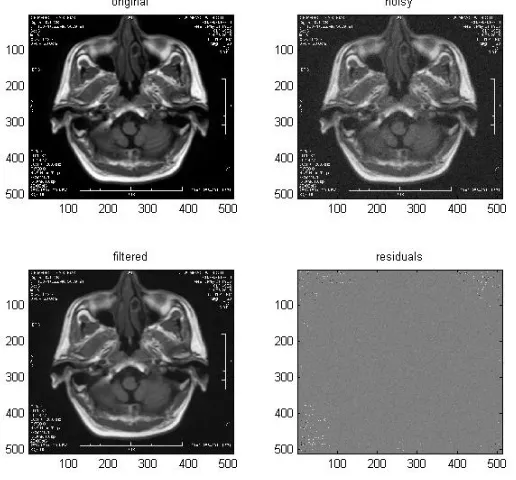
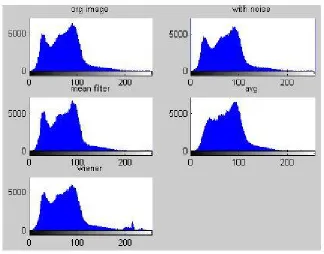
Fig. 3 Original, noisy, mean filter, avg , wiener filter and NLM method image of Flower and Fish and their histogram representation
B. Qualitative results
Mean, Wiener and Average filtering methods were compared to the non-local means method using four different criteria. 1) Visual quality comparison, 2) mean square error (MSE) comparison, 3) Peak Signal to Noise Ratio comparison and, 4) Noise to Signal ratio (NSR) . When compared visually, the denoised images obtained using the non-local means method were clear and did not seem to contain any noise. The MSE of these images were significantly lower. Table I shows that NLM provides minimum error compare to the other estimate which indicates that NLM is more efficient than remaining methods for image denoising. Table 2 provides statistical measurement in terms of Peak Signal to Noise Ratio (PSNR) and Noise to Signal ratio (NSR) for digital image of Flower and Fish.
TABLE I MEAN SQUARE ERROR TABLE
Image Noisy Image Mean Filter Weiner Filter Average Filter NLM
Flower 98.0404 22.3681 45.7773 43.3815 38.5673
Fish 99.1193 43.7966 80.5336 69.7614 58.3484
TABLE II. Output of ADF and NLM with various parameters
PArameter
and Filter
PSNR MSE SSIM SNR CNR
ADF 28.7753 86.2095 0.08186 0.142 41.0514
ISSN(Online): 2319-8753 ISSN (Print) : 2347-6710
I
nternational
J
ournal of
I
nnovative
R
esearch in
S
cience,
E
ngineering and
T
echnology
(An ISO 3297: 2007 Certified Organization)
Vol. 5, Issue 6, June 2016
V. RESULTSANDDISCUSSIONS
There are several transforms that do image denoising. In this paper non local means (NL-means) algorithm [5][6][7] is used. The denoised images obtained with various algorithms are shown in Fig. 5 for visual comparison. Pixel based processing is easy to perform as well as it will give accurate results in comparison to other methods. Two images have been taken in which one is available on system and the other which is taken from the digital media and then downloaded to the computer. Difference is occurred in the processing of two images i.e the image which is already available has got aligned pixels than the image that is downloaded from the digital media.
VI. CONCLUSIONS
This paper gives a generalized method for image denoising. Then in depth talk about the non-local means algorithm[7] for removing noise from digital image was given. The based on simulation results, obtained by VERILOG 7.0. Non-local means algorithm for image denoising is analyzed on Flower and Fish images. After the analysis of the test results the non-local means algorithm proved to be a better algorithm for image denosing, than its predecessors in terms of the PSNR, MSE and NSR value. In future the VERILOG code can be converted to VHDL code and implemented on FPGA kit in order to develop ASIC (application specific IC) for image transformation and analysis. ASIC can be made for doing the specific work of image denoising ,so a person who don’t know any algorithm for image denoising are also capable of doing it.
REFERENCES
A. Efros and T. Leung. “Texture Synthesis by Non-parametric Sampling”, In Proc. Int. Conf. Computer Vision, volume 2, pages 1033–1038, 1999. A. Buades, B. Coll, and J. Morel. “Neighbourhood filters and pde’s”, Technical Report 2005-04, CMLA, 2005.
A. Buades, B. Coll, and J. Morel. “On image denoising methods”. Technical Report 2004-15, CMLA, 2004.
C. Tomasi and R. Manduchi. “Bilateral filtering for gray and color image’s”, In Proceedings of the Sixth International Conference on Computer Vision, pages 839–846, 1998.
D. Donoho. “De-noising by soft-thresholding”. IEEE Transactions on Information Theory, 41:613–627, 1995.
E. Ordentlich, G. Seroussi, M. W. S. Verd´u, and T. Weissman. “A discrete universal denoiser and its application to binary image”s. In Proc. IEEE ICIP, volume 1, pages 117–120, 2003.
G. Roussas. “Non parametric regression estimation under mixing conditions”. Stochastic processes and their applications, 36:107–116, 1990. L. Alvarez, P. L. Lions, and J. M. Morel. “Image selective smoothing and edge detection by nonlinear diffusion” (ii). Journal of numerical analysis, 29:845–866, 1992
L. Rudin, S. Osher, and E. Fatemi. “Nonlinear total variation based noise removal algorithms”. Physica D, 60:259–268, 1992. M. Lindenbaum, M. Fischer, and A. Bruckstein. “On Gabor contribution to image enhancement”. Pattern Recognition, 27:1–8, 1994. P. Perona and J. Malik “Scale space and edge detection using anisotropic diffusion”. IEEE Trans. Patt. Anal. Mach. Intell., 12:629–639, 1990. S. Osher, A. Sole, and L. Vese. “Image decomposition and restoration using total variation minimization and the h−1 norm”. Multiscale Modeling and Simulation, 1(3):349–370, 2003.
L. Yaroslavsky. “Digital Picture Processing - An Introduction”. Springer Verlag, 1985.
A. Buades, B. Coll, and J. M. Morel, “A non-local algorithm for image denoising,” in Proc. IEEE Comput. Soc. Conf. Comput. Vis. Pattern Recognit., 2005, vol. 2, pp. 60–65.
L. Yaroslavsky. Digital Picture Processing - An Introduction. Springer Verlag, 1985
A. Hyvarinen, P. Hoyer, and E. Oja, “Sparse code shrinkage: Denosing of non gaussian data by maximum likelihood estimation,” Neural Computation, vol. 11, no. 7, pp. 1739–1768, 1999.
J. Starck, E. Candes, and D. Donoho, “The curvelet transform for image denoising,” IEEE Trans. on Image Proc., vol. 11, no. 6, 2000.
[A. Pizurica, W. Philips, I. Lemahieu, and M. Acheroy, “A joint inter and intrascale statistical model for bayesian wavelet based image denoising,” IEEE Trans. on Image Proc., vol. 11, pp. 545–557, 2002.
L. Sendur and I. Selesnick, “Bivariate shrinkage functions for wavelet based denoising exploiting interscale dependency,” IEEE Trans. On Signal Proc., vol. 50, pp. 2744–2756, 2002.