Copyright2001 by the Genetics Society of America
Bayesian Mapping of Quantitative Trait Loci Under Complicated Mating Designs
Nengjun Yi and Shizhong Xu
Department of Botany and Plant Sciences, University of California, Riverside, California 92521
Manuscript received April 10, 2000 Accepted for publication December 19, 2000
ABSTRACT
Quantitative trait loci (QTL) are easily studied in a biallelic system. Such a system requires the cross of two inbred lines presumably fixed for alternative alleles of the QTL. However, development of inbred lines can be time consuming and cost ineffective for species with long generation intervals and severe inbreeding depression. In addition, restriction of the investigation to a biallelic system can sometimes be misleading because many potentially important allelic interactions do not have a chance to express and thus fail to be detected. A complicated mating design involving multiple alleles mimics the actual breeding system. However, it is difficult to develop the statistical model and algorithm using the classical maximum-likelihood method. In this study, we investigate the application of a Bayesian method implemented via the Markov chain Monte Carlo (MCMC) algorithm to QTL mapping under arbitrarily complicated mating designs. We develop the method under a mixed-model framework where the genetic values of founder alleles are treated as random and the nongenetic effects are treated as fixed. With the MCMC algorithm, we first draw the gene flows from the founders to the descendants for each QTL and then draw samples of the genetic parameters. Finally, we are able to simultaneously infer the posterior distribution of the number, the additive and dominance variances, and the chromosomal locations of all identified QTL.
T
HE availability of dense molecular marker maps Slate et al. 1999). The main reasons behind thisin-creased power are: (1) a complex pedigree increases provides a large opportunity to locate genes
respon-sible for variation of quantitative traits in plants, animals, the chance that founder alleles are equally represented in the mapping population; and (2) there are more and humans. Experimental design and methodology
are two important issues in quantitative trait loci (QTL) informative meioses in a complex pedigree than in a simple pedigree for the same number of genotypes. mapping. Most QTL mapping techniques require
de-signed line crosses, e.g., F2 or backcross (BC). These A variety of methods have been developed for QTL
mapping (Hoeschele at al.1997; Lynchand Walsh
crosses do not exist in natural populations and are not
1998). These methods can be classified into three cate-commonly used in some plant species in the breeding
gories: least-squares analysis (LS), maximum-likelihood industry. It is not economical to design such line cross
analysis (ML), and Bayesian analysis. These methods experiments solely for the purpose of QTL mapping if
differ in computational requirement, efficiency in terms these crosses are not regularly used in a breeding
pro-of extracting information, flexibility with regard to han-gram. Almost all natural populations and most
domesti-dling different data structures, and ability in mapping cated plant populations consist of complicated pedigree
multiple QTL. The simple LS method is efficient in structures. Even if inbred lines are used, different
terms of computational speed, but cannot extract all crosses may be connected by some common ancestors.
information from the data and is restricted to specific A mating design combining information from multiple
mating designs. ML interval mapping (Lander and
crosses is more powerful than one involving a single
Botstein1989) is one of the most widely used methods cross (Muranty 1996;Xu 1998). Multiple crosses
in-for QTL analysis in a single cross. The interval mapping crease the polymorphic levels of QTL alleles and may
method has been extended to composite interval map-permit the detection of QTL that are undetectable in
ping and multiple interval mapping (Jansen1993;Zeng
a single line cross. Animal and human geneticists have
1993;Kaoet al. 1999). These extensions are designed paid considerable attention to the relative power of
particularly for mapping multiple QTL in a single line simple pedigree analysis and more complicated family
cross. However, it is not straightforward to apply these structures in linkage analysis of QTL and found that
methods to QTL mapping in general pedigrees. The large complex pedigree designs are usually more
power-identical-by-descent-based variance component method ful (e.g.,Welleret al.1990;WijsmanandAmos1997;
can be applied to general pedigrees (Almasy and
Blangero 1998). This method not only incorporates full pedigree information but also is robust to the num-Corresponding author:Shizhong Xu, Department of Botany and Plant
ber of QTL alleles. In addition, it does not require the
Sciences, University of California, Riverside, CA 92521.
E-mail: [email protected] knowledge of marker linkage phases (Schork 1993;
Amos 1994;XuandAtchley1995). The identical-by- reversible jump Markov chain Monte Carlo (MCMC) algorithm, which allows simultaneous estimation of the descent (IBD)-based variance component approach has
become a very useful strategy for QTL mapping in hu- number, the locations, and effects of identified QTL.
mans. If the linkage phase information is indeed known, by ignoring such information, the IBD method may be
STATISTICAL METHODS suboptimal. It is also questionable to apply this method
to plants where the pedigree sizes are usually large due Mixed model:Assume that the mapping population
to the need to invert large IBD matrices repeatedly for consists ofnindividuals with arbitrary pedigree
relation-each QTL position considered. ships, and among thenindividuals there aremfounders
Bayesian analysis is preferable because of its conve- and (n⫺m) nonfounders. The whole population may
nience and flexibility in the use of full pedigrees and consist of a single large pedigree or multiple
indepen-mapping multiple QTL, although it is computationally dent pedigrees. A founder in a pedigree is defined as
very demanding. Bayesian mapping fully takes into ac- an individual with no parents included in the pedigree. count the uncertainties associated with all unknowns in In contrast, a nonfounder is defined as an individual
the QTL mapping problem, including the number and with both parents included in the pedigree. Founders
locations of QTL, effects of QTL, and the genotypes of are assumed to be unrelated but can be inbred. The
markers and QTL. In plant line-crossing experiments, descendants may be related in an arbitrary way.
Bayesian mapping has been developed by using the Let y represent an n ⫻ 1 vector for the observed
Markov chain Monte Carlo algorithm, in particular, for values of a quantitative trait. When the trait is controlled
detection of multiple QTL (Satagopanand Yandell by multiple genes acting independently, y can be
de-1996;Satagopanet al.1996;Sillanpa¨a¨andArjas1998, scribed by the linear model
1999;Stephens andFisch1998;Yi andXu2000). In
y⫽Xb⫹
兺
l
j⫽1
(up
j ⫹umj ⫹ vj)⫹ e, (1)
animals and humans, Bayesian mapping has been de-signed not only to map multiple QTL, but also to extract
full pedigree information (Heath 1997; Uimari and whereXis a known design matrix for a vector of
nonge-Hoeschele 1997). However, most existing Bayesian netic effects b (including the overall mean), l is the
mapping methods assume a biallelic QTL model. Al- number of QTL on all chromosomes,up
j andumj aren⫻
though this assumption may be reasonable for a single 1 vectors for the paternal and maternal allelic effects line cross, it is less so for complex pedigrees. Therefore, for thejth QTL,vjis ann⫻1 vector for the dominance
Bayesian mapping needs to be extended to multiallelic effects for thejth QTL, ande is the vector of residual
systems. (environmental) effects. This model is written in the
There are several differences between plants and ani- original form of the animal model (Fernando and
mals or humans in the context of general pedigrees: Grossman1989) except that we have included the
dom-(i) many plant species are self-compatible and one must inance effects.
deal with a system that involves a mixture of selfing Denote aj as a 2m⫻ 1 vector for the effects of the
and outcrossing; (ii) inbreeding and line crossing are founder alleles (withmancestors, each with two alleles)
common mating designs in most plant breeding popula- and dj as a vector of interaction effects (dominance
tions; (iii) a breeding population of plants usually con- effects) between all possible pairs of the 2m founder tains fewer founders than an animal or human popula- alleles at thejth QTL. The dimension ofdjism(2m⫹
tion and the founders can be pure inbred lines; and 1). The dimension ofdjcan be reduced greatly in some
(iv) family sizes of plants are usually large compared mating designs where it is impossible for some founder
with animals and humans. These differences provide alleles to be combined in any descendant. The QTL
additional opportunities for detecting QTL. Unfortu- effects of all individuals can be expressed as linear func-nately, the Bayesian mapping methods developed for tions of the allelic effects and their interactions in the human and animal pedigrees cannot handle the unique founders,i.e.,up
j ⫽Zpjaj,umj ⫽Zmjaj, andvj⫽Wjdj, leading
properties for plant pedigrees. This poses unique chal- to
lenges for plant geneticists to develop new QTL
map-y⫽ Xb⫹
兺
l
j⫽1
(Zp
j ⫹ Zmj)aj⫹
兺
lj⫽1
Wjdj⫹e. (2)
ping statistics.
In this article, we develop a Bayesian method of QTL
mapping under arbitrarily complicated mating designs, This model is written in the form of a reduced animal
model (CantetandSmith1991) in which each allele
including a group of independent or related F2or
back-cross populations and complicated multiple-generation is traced back to one of the founder alleles throughn⫻
2mmatricesZp
j andZmj, also called the allelic inheritance
cross populations derived from inbred or outbred
founders. The method is so flexible that it can handle matrices. Note that the n ⫻ m(2m ⫹ 1) dominance
design matrixWjis a function ofZpj andZmj. The allelic
a variety of genetic models, such as arbitrary number of
the chromosome on which thejth QTL resides. There- each QTL has a uniform distribution of residing at any location on that chromosome. The prior distributions fore, the distributions of Zp
j and Zmj are functions of
marker information and the chromosomal location of of band2
eare assumed to be uniform on predefined
intervals, although other priors can be used. Finally, thejth QTL. The environmental effects are assumed to
follow aN(0,I2
e) distribution. p(Zp,Zm,M|l,,M*) is the joint conditional distribution
of QTL allelic inheritance matrices and complete The observables in model (2) include the phenotypic
values,y⫽{yi}ni⫽1, the covariateX, and the marker data marker genotypes.
In some situations, we need to add an extra layer to
M*. The marker data include the locations of markers
on chromosomes and the observed (possibly incom- the hierarchical model. The distributionsp(aj) andp(dj)
depend on other unknown quantities2
aj and 2 dj, the
plete) marker genotypes. The observed marker
geno-types in some individuals may not be fully informative allelic and dominance variance of thejth QTL. In other words, we replacep(aj) byp(aj,2aj)⫽ p(aj|
2 aj)p(
2 aj) and
and the patterns of allelic inheritance of such markers
p(dj) by p(dj,2dj)⫽p(dj| 2 dj)p(
2
dj). The parameters of
may also be unknown. The list of unobservables includes
interest now are2 ajand
2
dj, withajanddjbeing treated
the number of QTLl, the QTL locations⫽{j}lj⫽1, the
as missing values. The joint posterior distribution of all
complete marker genotype matrixM, the QTL allelic
variables is then factorized as inheritance matricesZp⫽ {Zp
j}lj⫽1 andZm⫽ {Zmj}lj⫽1, the
QTL allelic effectsa ⫽{aj}lj⫽1, the QTL dominance
ef-p(,Va,Vd|y,X,M*)⬀p(y|)p(Zp,Zm,M|l,,M*)
fectsd⫽{dj}lj⫽1, and the residual variance2e. The
loca-tion parameter,j, is expressed as the distance of thejth ⫻p(l)p(b)p(2e)
QTL from one end of the chromosome. The complete
⫻
兿
l j⫽1兵
p(aj|2 aj)p(2 aj)p(dj|
2 dj)
marker genotype means marker genotype with known linkage phase. A complete genotype for a nonfounder
⫻p(2
dj)p(j)
其
, (5)means a known allelic inheritance pattern. The QTL dominance design matrices are suppressed in the list
where Va ⫽ {2aj} l
j⫽1,Vd⫽ {2dj} l
j⫽1, and the distributions
of unknowns because they are completely determined
p(aj|a2j) and p(dj| 2
dj) are multivariate normal as given
by the QTL allelic inheritance matrices.
in the appendix. We use uniform prior distributions
In a Bayesian framework, the unknowns in the model
forp(2
aj) and p( 2
dj) within some predetermined
inter-are considered to be drawn from appropriate prior
dis-vals. Other terms in Equation 5 are the same as in tributions. The joint posterior distribution of all
unob-Equation 3. servables ⫽ {l, , a, d, b, M, Zp, Zm, 2
e} given the
Equations 3 and 5 correspond to two different ap-observables {y, X, M*} and prior information can be
proaches in QTL mapping, i.e., the fixed-model and
expressed as
the random-model approaches, respectively. If there are only a few founders who are not randomly sampled
p(|y,X,M*)⬀p(y|)p(Zp,Zm,M|l,,M*)
from a large reference population, our interest may be ⫻p(l)p(b)p(2
e)
only in the values of the actual allelic effects and the dominance effects for the founders at hand. Under the ⫻
兿
lj⫽1
兵
p(aj)p(dj)p(j)其
. (3)fixed-model approach the priors for the allelic and dom-inance effects are treated as variable with known distri-The likelihood functionp(y|) depends on the
distri-butions. The fixed-model approach is very common in bution of y. For normally distributed traits, it has the
designed line-crossing experiments,e.g., F2and BC
de-form signs, where the average effect of allelic substitution
is the parameter of interest. When the founders are
p(y|)⬀(2
e)⫺n/2⫻ exp
冦
⫺1 22
e
RTR
冧
, (4)randomly sampled from a reference population, we are usually interested in the variances of the genetic effects in the population from which the founders are sampled.
whereR⫽ y⫺Xb⫺Rl
j⫽1(Zpj ⫹Zmj)aj⫺Rlj⫽1Wjdj.
The priors of the allelic and dominance effects of In this case, the distributions for the allelic and domi-nance effects of founders depend on some unknown QTL,p(aj) andp(dj), depend on the inbreeding
coeffi-cients of the founders (seeappendix). The inclusion parameters. When the number of founders is so small
that a meaningful estimate of the allelic or dominance of inbreeding coefficients of founders enables the
pro-posed method to treat inbred founders. The prior distri- variance cannot be inferred from the limited number of alleles sampled, we may still use the fixed-model ap-bution of the number of QTL,p(l), is assumed to be
a truncated Poisson distribution with mean and a proach, even if the founders are a random sample. In
this study, we concentrate on the random model
ap-predefined maximum numberlmax. When no
informa-tion regarding the locainforma-tions is available, the prior proba- proach.
Reversible jump MCMC: In Bayesian analysis, infer-bility that a QTL is on a chromosome is proportional to
joint posterior distribution of all unknowns. Since the where * means all elements of except thataj kis
re-placed by the proposalaj* k .
joint posterior distribution does not have a standard
The dominance effects of QTL are updated for two form, MCMC samplers are used to generate samples
founders at a time, again in a locus-by-locus basis. De-from the joint posterior distribution (Metropoliset al.
notedj
kk⬘as a vector of dominance effects between alleles
1953;Hastings1970;GemanandGeman1984;Green
of founderkand alleles of founder k⬘at the jth QTL. 1995). The MCMC algorithm consists of the following
The dimension of dj
kk⬘ is three or four, depending on
steps:
whether k equals k⬘ (see the appendix). To update
a. Updating QTL allelic effectsa⫽ {aj}lj⫽1; djkk⬘, a new proposal djkk*⬘ is simulated by random walk,
b. Updating QTL dominance effects d⫽{dj}lj⫽1; denoted by
c. Updating QTL allelic variancesVa⫽ {2aj} l j⫽1;
dj*
kk⬘⫽ djkk⬘⫹(␦1,fk␦1⫹(1⫺ fk)␦2,fk␦1⫹ (1⫺fk)␦4)T
d. Updating QTL dominance variancesVd⫽ {2dj} l j⫽1;
e. Updating the fixed effects b and residual variance
ifk⬘ ⫽k; otherwise, 2
e;
f. Updating complete marker genotypes M and QTL dj*
kk⬘⫽ djkk⬘⫹(␦1,fk␦1⫹(1⫺ fk)␦2,fk⬘␦1
allelic inheritance matricesZpandZm;
⫹(1⫺ fk⬘)␦3,fkfk⬘␦1⫹ (1⫺fk)fk⬘␦2
g. Updating QTL locations⫽ {j}lj⫽1;
⫹fk(1⫺fk⬘)␦3⫹(1⫺ fk)(1⫺ fk⬘)␦4)T,
h. Birth of a QTL (adding one new QTL to the model) or death of a QTL (removing one existing QTL from
where␦1,␦2,␦3, and␦4are sampled independently from
the model).
the symmetric uniform distribution around zero. The new proposal is accepted with probability
The proposed algorithm starts from an initial point and proceeds to update each of the unknowns in turn.
min
冦
1,p(y|*)p(dj* kk⬘|d2j)
p(y|)p(dj kk⬘|2dj)
冧
, (7)
One complete pass over these eight update steps defines a cycle of iteration. Updating steps (a)–(g) are
conven-tional and do not alter the dimension of the variable where * means all elements of except that dj
kk⬘ is
vector. We use Metropolis-Hastings algorithms to imple- replaced by the proposaldj* kk⬘.
ment steps (a)–(e) and (g), and the Gibbs sampler to Updating QTL variances: QTL allelic and dominance
update step (f). Step (h) involves changing QTL num- variances are updated locus by locus. To update2 ajand
ber by one and making necessary corresponding 2
dj, new proposals 2*aj and 2*dj are sampled from the
changes to (a, d, Va,Vd, Zp, Zm, ). A reversible jump symmetric uniform densities around their previous
val-step is needed to change the number of QTL.
ues. The proposals are accepted with probabilities Several methods have been available for updating
marker genotypes in general pedigrees (e.g.,Sobeland
Lange 1996; Heath 1997; Uimari and Hoeschele min
冦
1,兿
km⫽1p(ajk|2*aj)兿
mk⫽1p(ajk|2aj)
冧
and min
冦
1,兿
m
k⫽1
兿
mk⬘⫽kp(djkk⬘|2*dj)兿
mk⫽1
兿
mk⬘⫽kp(djkk⬘|2dj)
冧
, 1997;BinkandVan Arendonk1999). In the simulation
study (see the next section), we adopt the method of (8)
BinkandVan Arendonk(1999) to update the marker
respectively. genotypes. For more complicated situations, a descent
Updating QTL allelic inheritanceZpandZm:Each allele
graph sampler of Sobel andLange (1996) is needed
in the descendants can be traced back to one of the (seediscussion). Updating the fixed effectsband
resid-founder alleles. This is reflected byap
j ⫽Zpjajandamj ⫽
ual variance2
eis also straightforward.
Zm
jaj, where each row of matrices Zpj and Zmj has one Updating QTL effects: The allelic effects of QTL are
element taking 1 and all other elements being 0. It is updated founder by founder and locus by locus. Denote
not convenient to generate realizations of Zp
j and Zmj aj
k as a 2 ⫻ 1 vector for the allelic effects of the kth
directly, but we can easily generate a sample ofZp j and
founder at thejth QTL (appendix). To updateaj k, two
Zm
j indirectly through the following recursive approach.
random variables, ␦1 and ␦2, are simulated
indepen-Consider a pedigree with m founders. Let the 2m
dently from the symmetric uniform distribution around
founder alleles be numbered consecutively from 1 to zero (random walk). The length of this uniform
distribu-2m.Then allele 2k⫺1 and 2kare the two alleles of the tion is determined empirically and should result in a
kth founder. Assume that individuals are entered into reasonable rate of average acceptance rate. A new
pro-the pedigree in a chronological order so that pro-the parents posal value ofaj
ktakesajk*⫽ajk⫹(␦1,fk␦1⫹(1⫺fk)␦2)T,
are evaluated before their progeny. Denote Zp j(i) and
wherefkis the inbreeding coefficient of thekth founder.
Zm
j(i) as theith rows of Zpj andZmj, respectively;i.e.,Zpj
The new proposal is accepted with probability
(i) andZm
j(i) store the allele identifications of the
pater-nal and materpater-nal alleles of individuali, respectively. For min
冦
1,p(y|*)p(aj* k|2aj)
p(y|)p(ajk|2 aj)
冧
, (6)
back to allele 3 of the founders and the maternal allele The proposals are accepted with probability is traced back to allele 10 of the founders, then the
third element ofZp
j(i) is 1 and all other elements are min 1,
p(y|*,*j,Zpj*,Zmj*)
p(y|) ⫻ p(Up*
j ,Umj*|j*,GLj,GRj)
p(Up
j,Umj|j,GLj,GRj)
⫻ q(Upj,Umj)
q(Up*
j,Umj*)
,
0, and the tenth element of Zm
j(i) is 1 and all other
(9) elements are 0. We now describe the recurrent process
of building matrices Zp
j and Zmj. Assume that we have
where * contains all elements of except j, Zp j, Zmj.
already built matricesZp
j andZmj up to the first (i⫺1)th
LetGL
j(GRj) denote the complete genotypes of all
pedi-rows and are ready to build the ith rows. If the ith
gree members at the left (right) flanking locus of the individual is a founder, say thekth founder, then the
corresponding location. If the proposals are accepted, (2k⫺1)th element ofZp
j(i) and the (2k⫹1)th element
we update the location of thejth QTL and also modify ofZm
j(i) are 1. If theith individual is not a founder but
the segregation indicators, the allelic inheritance, and the progeny of individualsi1 (father) andi2(mother),
dominance design matrices at thejth QTL at the same then
time.
Updating QTL number:The reversible jump mechanism
Zp
j(i) ⫽upijZpj(il)⫹(1⫺ upij)Zmj(i1)
is needed to change the QTL number in the model. In
and this study, a reversible pair is used: birth/death of a
QTL. In every cycle of the simulation, we make a random
Zm
j(i)⫽ umijZpj(i2)⫹ (1⫺umij)Zmj(i2),
choice between attempting to add one new QTL into the model or delete one existing QTL from the model, whereup
ijandumij are the paternal and maternal
segrega-with probabilities pa andpd ⫽ 1 ⫺ pa, respectively. Of
tion (meiosis) indicators, respectively, for individual i
course,pa⫽0 ifl⫽lmaxandpd⫽0 ifl⫽0, and otherwise
at the jth QTL. If the paternal allele of the father is
we choosepa⫽0.5, for 0⬍l⬍ lmax.
passed to individuali, thenup
ij⫽ 1; otherwise,upij⫽ 0.
For a birth step, we need to generate a new location The value ofum
ij is similarly defined but for the allelic
l⫹1, a new allelic variance2al⫹1, a new dominance
vari-inheritance of the mother. Note that Zp
j(i1),Zmj(i1),
ance2
dl⫹1, a new vector of allelic effects of the founder
Zp
j(i2), and Zmj(i2) have been previously built because
allelesal⫹1, a new vector of dominance effects between i1ⱕi⫺1 andi2ⱕi⫺1. Therefore, to trace the allelic
all possible pairs of the founder alleles dl⫹1, and new
origin, one only needs to simulate the segregation
indi-inheritance and dominance design matrices of all pedi-cators for each descendant.
gree membersZp
l⫹1,Zml⫹1, andWl⫹1for the new QTL. The
Simulating the segregation indicators (up
ij, umij) is
new location l⫹1 and the variances 2al⫹1 and 2 dl⫹1
straightforward. The segregation indicators (up
ij,umij) can
are sampled from the corresponding prior densities. take four possible values,i.e., (1, 1), (1, 0), (0, 1), and
The allelic effects al⫹1 and the dominance effects dl⫹1
(0, 0). The conditional posterior distribution is thus a
are then simulated from the distributionsp(al⫹1|2al⫹1)
discrete distribution over the four possible allelic
inheri-andp(dl⫹1|2dl⫹1) described in theappendix.The
segre-tance patterns and depends on the position of the QTL,
gation indicator matrices, denoted asUp
l⫹1andUml⫹1, are
the segregation indicators of flanking loci (markers or
generated fromq(Up
l⫹1,Uml⫹1) using the method of
updat-QTL), the phenotypic value of the progeny, and other
ing QTL allelic inheritance matrices, and new inheri-parameter values in the model. We then sample a value
tance and dominance design matrices Zp
l⫹1, Zml⫹1, and
from the posterior distribution and convert the
segrega-Wl⫹1are then calculated. The proposal is accepted with
tion indicators into the design matrices using the
re-probability cursive equation. The recursive algorithm for QTL
al-lelic inheritance can be applied to complicated designs
with mixture of outcrossing and selfing. min
1,
p(y|*)
p(y|) ⫻ ⫻
p(Up
l⫹1,Uml⫹1,|l⫹1,GLl⫹1,GRl⫹1) l⫹ 1
Updating QTL locations:Similar to the method of Sil-lanpa¨a¨andArjas(1998, 1999), we do not fix the order
⫻ pd/(l⫹ 1) pa⫻q(Upl⫹1,Uml⫹1)
, (10)
of QTL when updating the QTL locations. Elements of are modified one at a time using the Metropolis
algorithm. For thejth QTL, a proposal *j is sampled where * ⫽ (, l⫹1, al⫹1, dl⫹1, Zpl⫹1, Zml⫹1) with l in
replaced by (l ⫹ 1); GL
l⫹1(GRl⫹1) denotes the complete
from a symmetric uniform distribution in the
neighbor-hood of the previous value j. In the meantime, new genotypes of all pedigree members at the left (right)
flanking locus of the locationl⫹1.
proposals for the segregation indicator matrices, de-noted byUp*
j andUmj*, are generated according to the The death step is somewhat simpler. A random choice
is made among the existing QTL, and the chosen QTL method of updating QTL allelic inheritance matrices.
The new allelic inheritance matrices,Zp*
j andZmj*, are is then proposed to delete from the model. If thejth
existing QTL is proposed to delete, the acceptance prob-calculated using the recursive equations. Denote the
generating distribution of (Up*
form 20 full-sib families in the F2generation. Each
full-sib family is represented by an open square in the third row of Figure 1. Again, each family consists of 50 mem-bers, leading to 1000 individuals in the F2. The mating
was completely arbitrary, including selfing, full-sib, and half-sib mating. Although we did not simulate parent-offspring mating (overlapping generation), nothing prevents us from doing that.
A quantitative trait was modeled as being controlled by three QTL residing on two chromosomes of length 100 and 70 cM, respectively. The 40 ⫽ 2⫻ 20 allelic
effects and 820⫽ 40(40⫹ 1)/2 dominance effects of
each QTL in the founders were simulated from their corresponding normal distributions. The residual vari-ance was set at2
e⫽1.0. The fixed effect contains only
the overall mean, which was set at b ⫽ 0.0. The true locations, and allelic and dominance variances of the
Figure1.—The simulated pedigree consisting of 2020
indi-viduals over one base generation (founders) and two descen- three simulated QTL are given in Table 1. Marker data
dant generations. The 20 open circles in the first row represent were generated for all individuals. Eleven and 8
codomi-20 founders sampled from a large random base population.
nant markers were respectively placed on the two chro-By random mating (including selfing), the 20 founders form
mosomes with a marker distance of 10 cM between two 20 full-sib families (open squares in the second row), each
with 50 sibs, making a total of 1000 sibs in the F1generation. neighboring markers. Six equally frequent alleles were
Among the 1000 F1individuals, 20 were randomly selected to simulated at each marker locus. With this assignment
form 20 full-sib families of the F2generation (open squares of marker allele frequencies, many loci were partially
in the third row), each family consisting of 50 sibs, leading
informative and some were even uninformative at all.
to 1000 F2individuals.
No phenotypic records were available for the 20 found-ers. The linkage phases of markers in the founders were reshuffled and eventually reconstructed via the MCMC
min
1,
p(y|*) p(y|) ⫻
l ⫻p(Up
j,Umj|j,GLj,GRj)
⫻pa⫻q(Upj,Umj)
pd/l
, process. Two sets of data were analyzed: data I include
all 2020 individuals and data II include only founders (11)
and the F1generation, a total of 1020 individuals.
where * means all elements of except the items
The initial value for the QTL number was set at two corresponding to thejth QTL. Other terms of this
equa-and the corresponding locations were at 50 cM of chro-tion are defined similarly as in Equachro-tion 10.
mosome 1 and 40 cM of chromosome 2, respectively.
The prior Poisson mean of the QTL number was ⫽
A SIMULATION STUDY 2 and the maximum number of QTL waslmax⫽6. The
starting values were 0.05 for all QTL allelic and
domi-Design of the simulation experiment:The proposed
nance variances and 0.0 and 2.0 for the overall mean and method was evaluated empirically by analyzing a
simu-the residual variance, respectively. The initial marker lated large complex pedigree. The pedigree consists of
linkage phases were assigned randomly for each 2020 individuals covering three discrete generations.
founder. The initial QTL allelic inheritance for each The pedigree is depicted in Figure 1. Twenty founders
individual was determined by the initial QTL locations were randomly sampled from an outbred base
popula-and the initial complete genotypes of the flanking tion;i.e., founders were noninbred and genetically
unre-markers. lated to each other. These founders are numbered from
A flat prior was assigned to the overall mean. The 1 to 20 and represented by open circles in the first row
priors for all variance components were chosen to be of Figure 1. With completely random mating among
uniform on (0.0, 2.0], the right endpoint being equal the founders, 20 full-sib families were formed, each
rep-to the true phenotypic variance. The prior for the QTL resented by an open square in the second row of Figure
locations was uniform over the whole genome. The tun-1. Because of the complete randomness, some founders
ing parameters of the proposal distributions were cho-(11, 13, and 18) were not represented in the next
gener-sen to be 2.0 cM for QTL locations and 0.05 for all ation while others (e.g., 1, 6, 9, etc.) were
overrepre-other parameters. sented. Each full-sib family contains 50 members so that
The proposed MCMC sampler was run for 5 ⫻ 105
a total of 1000 individuals are available in the F1
genera-cycles in each of the MCMC analyses. The first 400 tion (the second row of Figure 1). From the 1000
indi-samples (burn-in) were discarded. To reduce serial cor-viduals, we randomly selected 20 as parents of the next
TABLE 1
The true locations and allelic and dominance variances of the three simulated QTL
Chromosome Location (cM) Allelic variance (2
aj) Dominance variance (2aj) Heritability
1 25 0.15 0.10 0.2
1 75 0.10 0.00 0.1
2 25 0.15 0.10 0.2
The heritability is defined as proportion of the phenotypic variance explained by the locus of interest.
cycles of simulations so that the total number of samples tions of these two parameters for data I are depicted in Figure 4. The posterior mean and standard error are kept in the analysis was 104.
Results:The estimated posterior distributions of the 0.2175 and 0.2790 for the overall mean, and 1.2037 and 0.0552 for the residual variance, respectively. It can be QTL number in the analyses of the two data sets are
given in Table 2. In each of the data sets, it is immedi- seen that the overall mean and the residual variance were slightly overestimated.
ately apparent that there are three QTL controlling the
trait. The posterior expectations are essentially the same Following the idea ofSillanpa¨a¨ andArjas (1999), two methods were used to assess the QTL effects (vari-as the true number of QTL for both data sets. The
posterior modes of QTL numbers are consistent with ances in our case). In the first method, we constructed
the location-wise posterior densities for the variances. the true number of QTL as well. The posterior for data
II is more widely spread than that for data I, indicating In the second method, we used only the posterior sam-ples in which QTL locations fall into the regions with that QTL can be more accurately detected using the
extended families. sufficiently high estimated QTL intensities to estimate
the allelic and dominance variances. Letfa(⌬k) andfd(⌬k)
QTL locations were estimated using the posterior
QTL intensity function (Sillanpa¨a¨ and Arjas 1998, be the cumulative distribution functions associated with the allelic and dominance variances of a putative QTL 1999). In practice, we divided each chromosome into
many small intervals of equal length, say 1 cM, and then in small interval⌬k. We used the means of samples in ⌬kto assessfa(⌬k) andfd(⌬k). Therefore,fa(⌬k) andfd(⌬k)
calculated the proportion of QTL in each interval from
the MCMC samples. The posterior QTL intensities for can be expressed as
data I and II are presented in Figures 2 and 3,
respec-tively. The QTL intensity graphs are concentrated f
a(⌬k)⫽
兺
104m⫽1
兺
l(m)q⫽12aq1( (m) q 苸⌬k)
兺
104m⫽1
兺
l(m)
q⫽11((qm)苸⌬k)
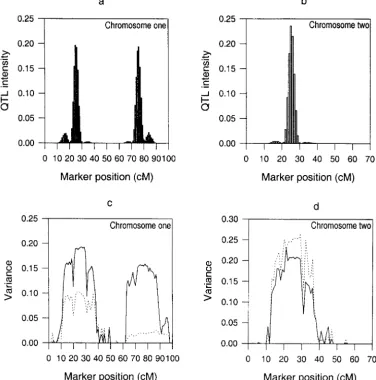
around the true locations of the simulated QTL. Three peaks of the graph for data I appear in [24, 25] and
and [75, 76] on chromosome 1 and in [24, 25] on
chromo-some 2. The corresponding peaks for data II are in [25,
fd(⌬k)⫽
兺
104m⫽1
兺
l(m)q⫽12dq1( (m) q 苸⌬k)
兺
104m⫽1
兺
l(m)
q⫽11((qm)苸⌬k)
, 26] and [75, 76] on chromosome 1 and in [25, 26] on
chromosome 2. These results not only support quite
strongly a model having three QTL but also indicate respectively, wherel(m)is the number of QTL in themth
posterior sample,(m)
q is Note thatfa(⌬k) andfd(⌬k) are
that the QTL locations are estimated accurately for both
data sets. Finally, we noted that it took only a few thou- meaningful only when a sufficient number of samples are contained in ⌬k. The plots of fa(⌬k) andfd(⌬k) for
sand iterations for QTL locations to converge to their
stationary states, regardless of which initial position was data I are presented in Figure 2. The chromosome re-gions with sufficiently high posterior QTL intensity are chosen, indicating that the algorithm for updating QTL
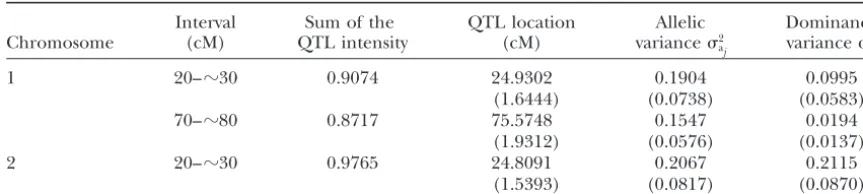
locations is very efficient. given in Table 3. The posterior samples in which QTL
locations fell into these regions were used to estimate The overall mean and the residual variance were
esti-mated from all MCMC samples. The posterior distribu- the QTL variances. Figure 5 depicts the posterior
distri-TABLE 2
Estimate of the posterior distribution of the QTL number and its expectation
Estimated distribution, forl⫽
Estimated
0 1 2 3 4 5 6 expectation
Data I 0.0002 0.0001 0.0024 0.9459 0.0511 0.0003 0.0000 3.048
Figure 2.—Histograms of the posterior QTL intensity (a and b), and QTL allelic and dominance variance estimates (c and d) over two chromo-somes with bin length of 1 cM for the analysis of data I. In c and d, the solid and dotted curves represent allelic and dominance variances, respec-tively.
butions for the QTL variances from the analysis of data the distributions of allelic and dominance effects of QTL,i.e.,p(aj) andp(dj), are treated as priors or not.
I. We also calculated the means and the standard errors
of the posterior samples for the QTL variances (see If they are treated as prior distributions, the parameters involved in the prior distributions are assessed before Table 3). In most situations, it appears that the estimates
of QTL variances are close to the corresponding true the experiment, and there is no attempt to estimate
them. The model is then called the fixed model. On values with small standard errors. The posterior means
and the estimation errors of the QTL locations are also the other hand, ifp(aj) andp(dj) are not the ultimate
priors but the distribution of missing valuesaj and dj,
given in Table 3. It can be seen that the estimated QTL
locations are very close to the corresponding true values. we are then interested in the parameters in p(aj) and p(dj),e.g.,2aj, which in turn need to be assigned a prior.
We are essentially interested in making an inference DISCUSSION
for2
aj. In this case, the model is called a random model.
For the fixed model, the update steps for QTL variances There are many statistical methods and computer
programs available for QTL mapping. Most of them are in the proposed algorithm are no longer required.
Therefore, programming-wise, the difference between specialized in one or two particular types of designs,
e.g., BC, F2, or multiple nuclear families. Here, we intro- a random and a fixed model depends on the turning
on/off of a single statement. duce a unified methodology of QTL mapping for
arbi-trarily complicated mating designs, ranging from a sim- The ability to handle arbitrarily complicated
pedi-grees and the flexibility of switching between fixed and ple line cross to multiple independent sib-pairs. Although
we developed the method based on a random-model random models possessed by our Bayesian mapping
arise from the use of an “allelic approach” as opposed approach, it works equally well for a fixed model. The
difference between the random and the fixed models to the traditional “genotypic approach.” In this study,
Figure4.—Approximate posterior distributions of the
over-Figure3.—Histograms of the posterior QTL intensity over all mean (a) and residual variance (b) for data I. chromosomes 1 (a) and 2 (b) with bin length of 1 cM for the
analysis of data II.
with discrete effects, we can modify the update steps (c) and (d) in the proposed algorithm. Assume that rather than the genotypic values. We also sampled the
there arekalleles at a certain QTL with allelic effects “allelic inheritance” from parents to offspring rather
{ai}ki⫽1, dominance effects {dij}iⱖj, and frequencies {pi}ki⫽1
than sampling the “genotypic transition.” As a result,
in the base population, wherepi,ai, and dijare the
fre-there is no need to consider the number of alleles and
quency and effect of theith allele and the dominance the total number of genotypes per locus in the mapping
effect between alleles i andj, respectively. The priors population. Instead, consideration is needed only when
for ai anddij can be assigned as independent normal
we assess the prior distribution of the founder alleles.
with known mean and variance. The prior for {pi}ki⫽1can
This treatment has greatly simplified the algorithm and
take a symmetric Dirichlet. In this case, the parameters increased the robustness of the method.
of interest are {ai}ki⫽1, {dij}iⱖj, and {pi}ki⫽1. The frequencies
In QTL mapping experiments of plants, founders are
{pi}ki⫽1can be updated using a Gibbs sampler because its
not usually a random sample from a reference
popula-full conditional distribution also remains Dirichlet tion. They are often selected to be complementary for
(Gelman et al. 1995; Richardson and Green 1997). some traits of interest. As a consequence, the
fixed-To update allelic effects {ai}ki⫽1 and dominance effects
model approach can be used. Under a random model,
{dij}iⱖj, we first simulate a proposal for each parameter
however, the update steps for the additional parameters
by using a random walk, then update the alleles of each included in the priors p(aj) and p(dj) depend on the
founder by sampling from a multinomial distribution, form of their prior distributions. We have only
ex-and finally use the Metropolis-Hastings algorithm to plained the reversible jump MCMC algorithm under
bial-TABLE 3
Highest posterior QTL intensity interval, Bayesian estimates of QTL locations, and allelic and dominance variances
Interval Sum of the QTL location Allelic Dominance
Chromosome (cM) QTL intensity (cM) variance2
aj variance2aj
1 20–ⵑ30 0.9074 24.9302 0.1904 0.0995
(1.6444) (0.0738) (0.0583)
70–ⵑ80 0.8717 75.5748 0.1547 0.0194
(1.9312) (0.0576) (0.0137)
2 20–ⵑ30 0.9765 24.8091 0.2067 0.2115
(1.5393) (0.0817) (0.0870)
Standard errors of the estimates are given in parentheses.
lelic QTL model have been proposed in Uimariand mixing of QTL locations in the simulation study. For
the normal QTL effects model, we found that the
Hoeschele(1997) andHeath(1997).
A problem may arise in real data analysis in which method used inStephens andFisch(1998) and
Sil-lanpa¨a¨ and Arjas (1998) resulted in QTL position the number of alleles of a putative QTL in the base
population is unknown, nor are the distributions of the stuck within the starting marker interval;i.e., the chain was essentially reducible. Furthermore, our algorithm effects of the QTL. In this situation, two strategies
should be considered: was much simpler than those of Heath (1997) and
Binket al.(2000). Second, the mixing of QTL number 1. We can use the fixed-model approach to solve the
was sensitive to the way in which the proposals for the random-model problem; that is, we first estimate the
new QTL were generated when one QTL was added to allelic and dominance effects of founders and then
the model and one QTL was removed from the model.
convert them into the QTL variances (Xu 1998).
The proposal distribution of allelic inheritance matrix This method is expected to be efficient in the case
Zp
l⫹1andZml⫹1was crucial for the reversible jump step to
where the number of founders is small.
perform well. It was found that QTL number mixed 2. In the case of many founders, one may use normal
poorly when p(Zp
l⫹1, Zml⫹1|l⫹1, GLl⫹1, GRl⫹1) was used to
distributions to approximate the prior distributions
generateZp
l⫹1andZml⫹1 in the normal-effects model ap-p(aj) andp(dj). In fact, drawing inferences about the
proach, although such proposal distributions of the ge-multiallelic QTL variance via the normal distribution
notypes of new QTL worked well in line crosses and the is a natural way to characterize genetic variation in
biallelic-effects model (Uimari andHoeschele 1997; the base population. In addition, normal distribution
Sillanpa¨a¨andArjas1998, 1999). Third, we found very of the allelic effects is usually a very robust
assump-little influence of the starting values of unknowns on tion. This has been verified in the context of ML
the mixing of the number of QTL. For example, starting
mapping by Xu and Atchley (1995) who found
withl0⫽6,lquickly dropped to 3 after several hundred
that, for data simulated under a biallelic model, the
iterations and subsequently behaved the same as that analysis based on normal distribution provided very
started withl0⫽3. We also found that the convergence
accurate estimates of QTL variances.
speed of different parameters was quite different. As expected, the dominance variance converged most Further investigation is needed to investigate the
ro-slowly due to too many dominance effects in the simu-bustness of normal distribution or other distributions
lated data. Finally, the implement of the algorithm was in the framework of Bayesian analysis.
computationally demanding due to the intricacy of our The proposed reversible jump MCMC algorithm
per-MCMC sampler. The analysis of data I with a chain of formed well for the simulated data. The following points
5⫻105cycles tookⵑ3 days on a SUN SPARC 5
worksta-are noteworthy. First, the update step of QTL locations is
tion. The most time-consuming parts of our program different from existing algorithms in Bayesian mapping
were the updates of complete marker genotypes, QTL (e.g., Satagopan et al. 1996; Heath 1997; Stephens
allelic inheritance, and dominance design matrices. The andFisch1998;Sillanpa¨a¨andArjas1998, 1999;Bink
computational speed can be improved substantially with
et al. 2000). We updated QTL location, allelic
inheri-more efficient programming skills. tance, and dominance design matrices simultaneously.
The assessment of the convergence and autocorrela-The acceptance probability depended on the proposed
tion of the MCMC with the use of the reversible jump location, the genotypes of flanking loci of the proposed
sampler remains a significant problem because the di-location (markers or QTL), and the phenotypic value
mension keeps changing from one cycle to another. of the progeny as well as other parameter values in
Figure5.—Approximate poste-rior distributions of the QTL al-lelic and dominance variances for data I. (a and b) Allelic and domi-nance variances determined from
interval 20–ⵑ30 cM of
chromo-some one, respectively; (c and d) allelic and dominance variances
determined from interval 70–ⵑ80
cM of chromosome 1, respectively; (e and f ) allelic and dominance variances determined from
inter-val 20–ⵑ30 cM of chromosome 2,
respectively.
also change. The parameters in one cycle of the iteration chain, and the interval length of subsampling to reduce the serial correlation. We used the plots of the changes may be different from those in the next cycle of
itera-tion. Therefore, the convergence criteria developed for in the number of QTL against the number of iterations to determine an approximate burn-in period (plots not the MCMC with fixed dimension are hardly applicable
to the reversible jump MCMC (e.g.,Brooks1997). In shown). The length of subsampling intervals was chosen to eliminate obvious changing trends for all parameters. our simulation study, therefore, we empirically
line-quantitative trait loci in outbred populations with incomplete
cross designs (e.g.,Sillanpa¨a¨andArjas1998), the
ac-marker data. Genetics151:409–420.
ceptance rates for adding a new QTL to the model and Bink, M. C. A. M., L. L. G. JanssandR. L. Quaas,2000 Markov chain
Monte Carlo for mapping a quantitative trait locus in outbred
deleting a QTL from the model in our simulation were
populations. Genet. Res.75:231–241.
relatively low. This result is expected because too many
Brooks, S. P.,1997 Discussion to Richardson and Green (1997). J.
new values need to be generated for a birth step in the R. Stat. Soc. Ser. B59:774–775.
Cantet, R. J. G.,andC. Smith,1991 Reduced animal model for
complicated mating design. The acceptance proportion
marker assisted selection using best linear unbiased prediction.
for updating QTL locations was rather high (ⵑ75%).
Genet. Sel. Evol.23:221–233.
We used the method of Bink and Van Arendonk Fernando, R. L.,andM. Grossman,1989 Marker-assisted selection
using best linear unbiased prediction. Genet. Sel. Evol.21:467–
(1999) to update marker genotypes in the simulation
477.
study. This method is established on a marker-by-marker
Gelman, A. J. B., H. S. Carlin, H. S. SternandD. B. Rubin,1995
and individual-by-individual basis. In general, this kind Bayesian Data Analysis.Chapman & Hall, London.
Geman, S.,andD. Geman,1984 Stochastic relaxation, Gibbs
distribu-of single-site update does not always lead to an
irreduc-tions, and the Bayesian restoration of images. IEEE Trans. Pattern
ible sampler because of the strong dependency of close
Anal. Machine Intell.6:721–741.
relatives and strong dependency of adjacent loci. In our Green, P. J.,1995 Reversible jump Markov chain Monte Carlo
com-putation and Bayesian model determination. Biometrika82:711–
simulation study, we did not find insufficient mixing in
732.
marker genotype sampling, because the marker loci
Hastings, W. K.,1970 Monte Carlo sampling methods using Markov
were not tightly linked. However, a block sampling,e.g., chains and their applications. Biometrika57:97–109.
Heath, S. C.,1997 Markov chain Monte Carlo segregation and
the genotypes at a given locus being updated
simultane-linkage analysis for oligogenic models. Am. J. Hum. Genet.61: ously for all individuals or sampling several loci jointly,
748–760.
is expected to be preferred over a single-site sampling Hoeschele, I., P. Uimari, F. E. Grignola, Q. ZhangandK. M. Gage,
1997 Advances in statistical methods to map quantitative trait
in complex pedigrees and tightly lined loci. Such a
sam-loci in outbred populations. Genetics147:1445–1457.
pling strategy will be incorporated into the proposed
Jansen, R. C.,1993 Interval mapping of multiple quantitative trait
algorithm. The marker genotype sampler used in this loci. Genetics135:205–211.
Kao, C. H., Z. B. ZengandR. D. Teasdale,1999 Multiple interval
study is suitable only in the case where there is no
miss-mapping for quantitative trait loci. Genetics152:1203–1216.
ing marker nonfinal offspring. When there are missing Lander, E. S.,andD. Botstein,1989 Mapping Mendelian factors markers in nonfinal offspring, more sophisticated sam- underlying quantitative traits using RFLP linkage maps. Genetics
121:185–199.
plers,e.g., the descent graph sampler (SobelandLange
Lynch, M.,andB. Walsh,1998 Genetics and Analysis of Quantitative 1996), are required to update the marker complete Traits.Sinauer Associates, Sunderland, MA.
genotypes. The descent graph sampler can be used to Metropolis, N., A. W. Rosenbluth, M. N. Rosenbluth, A. H. TellerandE. Teller,1953 Equation of state calculations by
sample the gene flow patterns in arbitrarily complicated
fast computing machines. J. Chem. Phys.21:1087–1091.
pedigrees. This powerful computational algorithm can Muranty, H.,1996 Power of tests for quantitative trait loci detection
be incorporated into our model. using full-sib families in different schemes. Heredity76:156–165.
Richardson, S., and P. J. Green, 1997 On Bayesian analysis of
Following the convention in human pedigree analysis,
mixtures with an unknown number of components. J. R. Stat.
we have assumed that all founders are included in the Soc. Ser. B59:731–792.
model. In open-pollinated trees, however, seeds col- Satagopan, R. J.,andB. S. Yandell,1996 Estimating the number of quantitative trait loci via Bayesian model determination. Special
lected from one tree (mother) are usually pollinated
Contributed Paper Session on Genetic Analysis of Quantitative
from multiple unknown trees (fathers). Because the Traits and Complex Diseases. Biometric Section, Statistical Meet-fathers (founders) are not identified, their contribution ing, Chicago, IL.
Satagopan, J. M., B. S. Yandell, M. A. NewtonandT. G. Osborn,
to the progeny is difficult to evaluate. Our model, in
1996 A Bayesian approach to detect quantitative trait loci using
theory, can include these founders in the pedigree but Markov chain Monte Carlo. Genetics144:805–816.
Schork, N. J.,1993 Extended multipoint identity-by-descent analysis
treat their marker genotypes as missing. A method that
of human quantitative traits: efficiency, power, and modeling
excludes the missing founders while still analyzing the
considerations. Am. J. Hum. Genet.53:1306–1319.
data properly is under development. Sillanpa¨a¨, M. J.,andE. Arjas,1998 Bayesian mapping of multiple
quantitative trait loci from incomplete inbred line cross data. We thank Claus Vogl and Lori Weingartner for helpful comments
Genetics148:1373–1388. on the manuscript. This research was supported by the National
Insti-Sillanpa¨a¨, M. J.,andE. Arjas,1999 Bayesian mapping of multiple tutes of Health grant GM55321 and the U.S. Department of Agricul- quantitative trait loci from incomplete outbred offspring data. ture National Research Initiative Competitive Grants Program 97- Genetics151:1605–1619.
35205-5075 to S.X. Slate, J., J. M. Pembertonand P. M. Visscher,1999 Power to
detect QTL in a free-living polygynous population. Heredity83:
327–336.
Sobel, E.,andK. Lange,1996 Descent graphs in pedigree analysis: applications to haplotyping, location scores, and marker-sharing
LITERATURE CITED
statistics. Am. J. Hum. Genet.58:1323–1337.
Almasy, L.,andJ. Blangero,1998 Multipoint quantitative-trait link- Stephens, D. A.,andR. D. Fisch,1998 Bayesian analysis of quantita-age analysis in general pedigree. Am. J. Hum. Genet.62:1198– tive trait locus data using reversible jump Markov Chain Monte
1211. Carlo. Biometrics54:1334–1347.
Amos, C. I., 1994 Robust variance-components approach for as- Uimari, P.,andI. Hoeschele,1997 Mapping linked quantitative sessing genetic linkage in pedigrees. Am. J. Hum. Genet. 54: trait loci using Bayesian analysis and Markov chain Monte Carlo
535–543. algorithms. Genetics146:735–743.
Weller, J. I., Y. KashiandM. Soller,1990 Power of daughter and
granddaughter designs for determining linkage between marker
loci and quantitative trait loci in dairy cattle. J. Dairy Sci. 73: Var(aj k)⫽ 2aj
冢
1 fk
fk 1
冣
, (Var(aj
k))⫺1⫽
1
2 aj(1⫺f
2 k)
冢
1 ⫺fk
⫺fk 1
冣
2525–2537.Wijsman, E. M.,andC. I. Amos,1997 Genetic analysis of simulated
oligogenic traits in nuclear and extended pedigrees: summary and
of GAW10 contributions. Genet. Epidemiol.14:719–735.
Xu, S.,1998 Mapping quantitative trait loci using multiple families of line crosses. Genetics148:517–524.
Var(dj kk)⫽ 2dj
冢
1 fk fk
fk 1 fk
fk fk 1
冣
,
Xu, S.,andW. R. Atchley,1995 A random model approach to interval mapping of quantitative trait loci. Genetics141:1189– 1197.
Yi, N.,andS. Xu,2000 Bayesian mapping of quantitative trait loci for complex binary traits. Genetics155:1391–1403.
(Var(dj kk))⫺1⫽
1 2
dj(1⫹fk)(1⫹2fk)
冢
1⫹fk ⫺fk ⫺fk ⫺fk 1⫹fk ⫺fk
⫺fk ⫺fk 1⫹fk
冣
.
Zeng, Z. B.,1993 Theoretical basis of separation of multiple linked gene effects on mapping quantitative trait loci. Proc. Natl. Acad. Sci. USA90:10972–10976.
If fk ⫽ 1 and fk⬘ ⬆ 1, then djkk⬘(1) ⫽ djkk⬘(2) and djkk⬘(3) ⫽
Communicating editor:Y.-X. Fu dj
kk⬘(4). Therefore,djkk⬘is equivalent to the 2⫻1 normal
random vector (dj
kk⬘(1),djkk⬘(3))T, with covariance
APPENDIX 2
dj
冢
1 fk⬘ fk⬘ 1
冣
.
The prior distributions for allelic and dominance ef-fects of the founders:Denoteaj
kas a 2 ⫻ 1 vector for Similarly, iffk⬘⫽1 and fk⬆1,djkk⬘ is equivalent to 2⫻
the allelic effects of the kth founder at the jth QTL, 1 normal random vector (dj
kk⬘(1),djkk⬘(2))T, with covariance
anddj
kk⬘ as a vector of interaction effects (dominance
effects) between thekth and thek⬘th founder alleles at 2
dj
冢
1 fk fk 1
冣
. thejth QTL. The dimension ofdj
kk⬘is 3 or 4, depending
on whetherkequalsk⬘. Explicitly,aj
k⫽(ajk(1),akj(2))T,djkk⫽ Finally, for the case wheref
k⬆1 andfk⬘⬆1, we can get
(dj
kk(1),djkk(2),djkk(3))T, anddjkk⬘⫽(dkkj⬘(1),djkk⬘(2),djkk⬘(3),djkk⬘(4))T
(k⬆k⬘). The dimension ofdj
kkis 3 because each founder
carries two alleles and potentially contributes 3 possible interactions in the descendants. The dimension ofdj
kk⬘ Var(djkk⬘)⫽ 2dj
冢
1 fk fk⬘ fkfk⬘ fk 1 fkfk⬘ fk⬘ fk⬘ fkfk⬘ 1 fk fkfk⬘ fk⬘ fk 1
冣
, is 4 because 2 founders carry a total of 4 alleles and
potentially contribute 2⫻ 2⫽ 4 possible interactions. The priors foraj
kanddjkk⬘are assumed to be indepen- and
dent normals:
aj
kⵑN(0, Var(ajk)), dkkj ⬘ⵑN(0, Var(djkk⬘)).
(Var(dj
kk⬘))⫽2 1
dj(1⫺f
2
k)(1⫺f2k⬘)
冢
1 ⫺fk ⫺fk⬘ fkfk⬘ ⫺fk 1 fkfk⬘ ⫺fk⬘ ⫺fk⬘ fkfk⬘ 1 ⫺fk
fkfk⬘ ⫺fk⬘ ⫺fk 1
冣
.
If the inbreeding coefficient, fk, for the kth founder
equals 1, the two elements of aj
kare identical, and so
are the three elements ofdj
kk. Therefore,ajkanddjkkeach
Under the assumption that the founders are indepen-turns into a scalar, aj
k(1) and djkk(1). Similarly, if both fk
dent from each other, the priorsp(aj) andp(dj) can be
and fk⬘ are unity, djkk⬘(1) ⫽ djkk⬘(2) ⫽ djkk⬘(3) ⫽ djkk⬘(4). Note
expressed as the following forms, respectively: that 2
aj and 2
dj are set at prefixed constants under a
fixed model. Otherwise, they are treated as unknown
p(aj)⫽
兿
mk⫽1 p(aj
k) and p(dj)⫽
兿
mk⫽1
兿
mk⬘⫽k p(dj
kk⬘).