Resonant coupling and negative differential resistance in metal/ferrocenyl
alkanethiolate/STM structures
Shuchun Wang, Wenchang Lu, Qingzhong Zhao, and J. Bernholc
Center for High Performance Simulation and Department of Physics, North Carolina State University, Raleigh, North Carolina 27695-7518, USA
共Received 24 August 2006; published 22 November 2006兲
Recent experimental studies demonstrated that self-assembled molecules sandwiched between metallic con-tacts can perform logic functions based on negative differential resistance共NDR兲. To understand the mecha-nism of NDR, the electronic structure and transport properties of one such junction, ferrocenyl alkanethiolate attached to a gold surface and probed with a scanning tunneling microscope tip, are investigated by large scale ab initiocalculations. TheI-Vcharacteristics show strong NDR features at both positive and negative biases, in good agreement with the experimental data. The voltage-dependent transmission, potential drop profile, and molecular level alignment under bias suggest that the ferrocenyl group acts like a quantum dot and that the NDR features are due to resonant coupling between the highest occupied molecular orbital and the density of states of gold leads. The strength of the individual NDR peaks can be tuned by changing the tunneling distance or using suitable spacer layers.
DOI:10.1103/PhysRevB.74.195430 PACS number共s兲: 73.63.⫺b, 72.10.⫺d, 73.50.Fq
I. INTRODUCTION
Ever since the concept of using individual molecules as functional electronic devices was first proposed in the 1970s,1having individual molecules perform the basic
func-tions of conventional electronic components became the goal of molecular electronics. Recently, this field has experienced dramatic growth, due to the emerging need for alternate routes toward smaller, faster, and cheaper integrated circuits. Key electronic components, such as wires, diodes, and tran-sistors, have been successfully demonstrated, all based on single or self-assembled molecules sandwiched between electrodes. For self-assembled molecules on a single-crystal surface, the substrate serves as one of the electrodes. A vari-ety of methods are used to form the contact with the other electrode, such as a scanning tunneling microscope 共STM兲 tip2–6and atomic-scale break junctions.7,8A number of novel
and promising characteristics for these types of molecular devices have been reported. For example, negative differen-tial resistance共NDR兲 共Refs.3and9兲and molecular memory effects10,11 have been demonstrated on a system of
phenyl-ethylene oligomers functionalized with different side groups. Recently, a ferrocene-based molecular wire with nearly per-fect conductance was reported by Gettyet al.12The ballistic
conductance thus reaches the criteria for real applications of molecular electronic devices. NDR has also been observed for ferrocenyl-undecanethiolate self-assembled monolayers 共Fc-C11S-SAM兲on Au共111兲surface.13,14
Self-assembled molecular systems with NDR are promis-ing devices, due to their utility in fast switchpromis-ing logic and simplicity in integration. However, in many cases the NDR mechanisms have not been unraveled either from experi-ments or from theory, hampering the development of mo-lecular devices. In many cases, theoretical understanding of the electron transport properties and of the underlying NDR mechanisms is critical for the design of such devices. For ferrocenyl-alkanethiolate SAM on Au共111兲 surface, the re-dox effect, i.e., a change of the charge state with bias, has been suggested as an explanation of the NDR.13 However,
resonant tunneling may also play an important role. Another possibility is some level of bond breaking when a large bias is applied,15resulting in a change of the atomic structure of the molecule or a change at the molecule-substrate interface. In this paper, we study the electronic and transport prop-erties of ferrocenyl-pentanethiolate SAM on Au共111兲. The atomic structures of C5S and Fc-C5S on the Au共111兲surface and their saturation coverages are determined by total-energy calculations. Our nonequilibrium quantum transport calcula-tions for geometry-optimized structures show NDR features at both negative and positive biases, in good agreement with the experimental data.13The mechanism responsible for the
NDR is uncovered by analyzing the molecular level align-ment, transmission spectra under bias, and charge transfer between the molecule and the STM tip.
II. CALCULATIONS
The calculations use a massively parallel real-space mul-tigrid implementation16of density-functional theory共DFT兲.17
Due to the relatively large sizes of the supercells, thek-space sampling is restricted to the ⌫ point. The exchange and correlation terms are represented by the generalized gradient approximation 共GGA兲 in Perdew, Burke, and Ernzerhof form.18The electron-ion interactions are described by
nonlo-cal, ultrasoft pseudopotentials.19A partial core correction is
added to the Au and Fe pseudopotentials in order to account for the nonlinearity in the exchange-correlation term.20 The
wave functions and localized orbitals are described on a grid with spacing of 0.20 Å. A double grid technique21 is em-ployed to evaluate the inner products between the nonlocal potentials and the wave functions, thereby substantially re-ducing the computational cost and memory without losing accuracy.
III. RESULTS AND DISCUSSION
A. Atomic structure
cal-culations. The gold substrate is simulated by a six-layer slab. For each of the structures, the molecule is anchored with a sulfur atom to the Au共111兲 surface and all the atoms are relaxed using first-principles forces. For the adsorption of alkanethiolate on the Au共111兲surface, two structural models have been reported. One is a共冑3⫻
冑
3兲R30° reconstruction with low molecular coverage.22 The other is a c共4⫻2兲re-construction with high molecular coverage.23Since the
mo-lecular density for the c共4⫻2兲 structure is too high when ferrocenyl heads are present, we only consider the 共冑3⫻
冑
3兲R30° structure, see Fig.1共a兲. Our calculations show that the fcc hollow site is favorable and that the molecular axes are tilted by 27° with respect to the surface normal. These results are in agreement with recent theoretical work24,25 and experiments.22In the case of Fc-C5S on Au共111兲, our calculations for the 共冑3⫻
冑
3兲R30° Fc superlattice 关Fig. 1共b兲兴 show that the re-pulsive interaction between the neighboring ferrocenyls is very strong, resulting in a positive adsorption energy. To de-termine the saturation coverage, we calculated adsorption en-ergies for a number of different structures and coverages. Among the structures that were considered, two molecules per共冑21⫻冑
7兲unit cell is the maximum coverage for which the adsorption energy is still negative共−0.3 eV per molecule in this case兲. For this coverage, the optimized tilt angle of the molecular axis is 15°. Clearly, the ferrocenyl head greatly decreases the molecular packing density on the Au共111兲 sub-strate.B. Electron transport
The nonlinearI-V characteristics are evaluated using the nonequilibrium Green’s function 共NEGF兲 methodology26,27
in a basis of optimal localized orbitals.28,29 The
atom-centered orbitals are optimized variationally in the equilib-rium geometry. Four orbitals for hydrogen, six for carbon, eight for sulfur, and ten for iron and gold atoms are used, all with the radius of 4.50 Å. The Hartree potential is obtained by solving the Poisson equation with boundary conditions matching the electrostatic potentials of the left and right gold leads, respectively. The surface Green functions are calcu-lated with a transfer-matrix technique in an iterative scheme.30A self-consistent calculation is carried out for each
bias, which is critical in order to obtain correctI-V charac-teristics at large biases.31Due to the efficiency of our O共N兲
methodology,28,29 we are able to include 372 atoms and a
total of nearly 4000 electrons in the calculations.
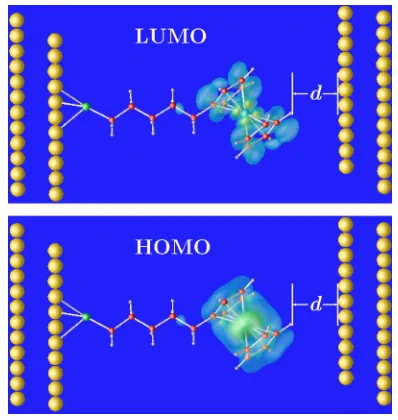
Figure2shows a schematic view of the system, together with the highest occupied molecular orbital共HOMO兲and the lowest unoccupied molecular orbital共LUMO兲. In our NEGF calculations, the conductor part includes eight layers of Au on the left, the molecule, and seven layers of Au on the right. As described above, the ferrocenyl pentanethiolate is an-chored with a sulfur atom to the Au共111兲surface共left part in Fig. 2兲. For simplicity, we model the STM tip as another Au共111兲surface共right part in Fig.2兲in the calculations. The effects of the shape of the STM tip will be investigated in the future. In experiments, the distanced between the molecule and the STM tip is determined by the setpoint current. The lower the current, the larger the distance, since the magni-tude of the tunneling current depends exponentially ond.
The transmission in the molecular junction is mainly de-termined by molecular orbital共s兲with energy levels near the Fermi level of the metal leads in contact with the molecule. These orbitals are usually either the HOMO or the LUMO. Their isosurfaces are plotted in Fig. 2. Clearly, both the HOMO and the LUMO are localized on the ferrocenyl head. After the potential profile is self-consistently determined, the transmission spectrum under the external applied biasV can be calculated by
T共E,V兲= 2e 2
h Tr关⌫L共E兲GC
+共E兲aR共E兲G C −共E兲兴
,
whereGC± are the advanced and retarded Green functions of the conductor, and⌫L,Rare the coupling functions to the left and right leads, respectively.
The calculated transmission spectraT共E,V兲are shown in Fig.3, with the Fermi level of the gold substrate at zero bias FIG. 1. 共Color online兲 Atomic structures of 共a兲 C5S-Au共111兲
共
冑
3⫻冑
3兲R30°, 共b兲 Fc-C5S-Au共111兲 共冑
3⫻冑
3兲R30°, and 共c兲 Fc-C5S-Au共111兲 共冑
21⫻冑
7兲.chosen as the energy zero. The two white lines show the chemical potentials of the left and right leads, withL−R =Vbeing the effective applied bias. We note that the trans-mission peak from the HOMO resonance is always near the lower chemical potential for both positive and negative bi-ases. This is because the bias-induced potential drop across the molecular junction is very different for positive and negative biases. At a negative bias, the largest potential drop occurs across the vacuum between the molecule and the right electrode 共STM tip兲, see Fig. 4共b兲. This indicates that the electrons on the left side of the junction共the Au substrate兲
can move into the molecule to effectively screen the applied field. However, at a positive bias, we find that the potential drops mainly in the carbon chain region of the molecule, as shown in Fig.4共a兲. As a result, the average potential around the ferrocenyl head is always aligned with the lower chemi-cal potential. The HOMO, which is lochemi-calized on the ferroce-nyl, is thus pinned by the lower chemical potential.
The current through the molecular junction is given by
I共V兲=
冕
−⬁⬁
T共E,V兲关nF共E−L兲−nF共E−R兲兴dE,
wherenF is the Fermi-Dirac distribution andT共E,V兲 is the transmission coefficient at biasV.
TheI-Vcurve calculated with the STM-molecule distance of d= 3.39 Å is shown in Fig. 5. The NDR features are at −1.6, −0.4, 0.2, and 1.2 V, compared with the experimen-tally observed NDR at −1.6 and 1.6 V. Tunneling through the ferrocenyl head is responsible for these features, since the calculated I-V curve without the ferrocenyl, i.e., for pen-tanethiolate on Au共111兲, does not show NDR behavior. This is in good agreement with experiments.13,14
All of the NDR features can be understood in terms of resonant tunneling between the two top occupied levels and the gold density of states. In the density of states共DOS兲of bulk gold, the first peak below the Fermi energy is at around −0.2 eV and the second one is at −1.2 eV. When the HOMO level is aligned with one of these peaks, the current reaches its maximum and NDR appears. Figure6illustrates the NDR mechanism at 1.2 V by plotting the DOS of the gold leads, the average potential, and the energy positions of the top two occupied orbitals. These orbitals are localized on the ferro-cenyl by potential barriers. One barrier is near the Au-molecule interface, while the other is in the vacuum region between the ferrocenyl and the STM tip. Therefore the fer-rocenyl acts like a quantum dot. As shown in Fig.6, at the bias of 1.2 V the HOMO level is aligned with the peak in the DOS of left lead. As a result, a current maximum appears. For negative bias, the NDR can be understood in a similar way, except that the resonant coupling is between the HOMO FIG. 3. 共Color online兲Calculated transmission spectra T共E,V兲
for the Au共111兲-SC5-Fc-Au共111兲 junction with d= 3.39 Å. The two white lines are the chemical potentials of the two leads, L=EF+eV/ 2 andR=EF−eV/ 2, as functions of the applied bias voltage.
FIG. 4.共Color online兲Potential drop along the molecule for共a兲 bias= 1.8 V and共b兲bias= −1.8 V.
and the right lead. Charge transfer between the molecule and the right lead also plays an important role in determining the position of the NDR. At a negative bias, charge transfer leads to an internal electric field that cancels out part of the applied external bias. As a result, the NDR appears at a higher volt-age for negative bias than for the positive one, because there is no charge transfer for positive bias.
The calculated value of the current in Fig.5 is about 50 times bigger than that of the STM measurement. This is mainly due to the unknown distanced between the STM tip and the molecule. In order to investigate the effect of this distance on electron transport, we carried out calculations for different values ofd.
Figure 7 shows the I-V curves for positive bias at
dis-tances of 2.01, 3.39, and 4.34 Å, respectively. Their overall shapes are similar and the NDR positions are at about same biases. However, the absolute value of the current decreases exponentially with an increase of the distance. For example, at the bias of 0.6 V, we can fit the current by I共d兲=I0e−d with the decay constant= 0.90. The distance also affects the shape of the NDR region, or its “strength.” Specifically, the NDR at 1.2 V is enhanced with increasingd. This indicates that a low current setpoint in the STM experiment is impor-tant for the observation of NDR at large biases. However, an increase of the distance has the opposite effect on NDR at low bias; the peak at 0.2 V is attenuated with increasingd. This result can explain why the low bias NDR is not seen in the STM experiment, because a high current setpoint would be needed for its observation. This “NDR tuning” effect can be utilized in the design of molecular devices, for example, by introducing spacer layers, which would adjust the strength of the NDR and the working current for optimal device per-formance.
Obviously, the length of the alkane chain plays a major role in determining the magnitude of the current. For com-putational reasons, our calculations were performed on fer-rocenyl pentanethiolate, while the experiment used ferroce-nyl undecanethiolate. However, we performed a few calculations for ferrocenyl undecanethiolate, from which we learned that a current of the same magnitude as in the ex-periment would be obtained at STM distance of 3.01 Å. Nevertheless, the shape and the major features of the distance-dependentI-Vcurves remain similar to those of fer-rocenyl pentanethiolate.
Apart from the distance and length effects, the unknown molecule-gold contact geometry and chemistry could par-tially explain the remaining discrepancies between theory and experiment. For example, if the molecule is attached to an atomic protrusion rather than an atomically flat surface, the magnitude of the current would be substantially lower.32,33 If the STM tip has a locally protruding atom or
group of atoms, the transmission would also be affected. For positive bias, the position of the NDR should not vary with the shape of the STM tip, since it is due to a feature in the density of states of the Au substrate. For the negative bias, however, its position may change if the STM tip assumes a different shape, since the local density of states would be altered. In addition, other variables, such as temperature or local disorder near the contact can alter the value of the current measured in experiment.
IV. SUMMARY
In summary, we investigated theoretically the geometry, electronic structure, and quantum transport properties of ferrocenyl-alkanethiolate self-assembled monolayers on Au共111兲 by large-scale first-principles calculations. The cal-culated NDR features at large biases are in good agreement with experiment. We find that the HOMO is always localized at the ferrocenyl head. It is pinned to the lowest chemical potential of the electrodes. Resonant tunneling through the top two occupied orbitals dominates theI-V characteristics, FIG. 6. 共Color online兲The NDR mechanism for the Au共111兲
-SC5-Fc-Au共111兲 junction at 1.2 V. The left and right panels are densities of states共DOS兲of bulk gold. The horizontal dashed lines in the DOS plot mark the left and right chemical potentials. The middle panel shows the average potential in the molecular junction. The horizontal solid lines in that panel mark the energies of the HOMO and the level just below the HOMO. These orbitals domi-nate the transmission.
with NDR effects being due to features in the density of states of the gold surface. The magnitude of the current and of the strength of the NDR are dramatically affected by the distance between the molecule and the STM tip. In practical devices, spacer layers will have a similar effect and can be used to tune the performance of the device.
ACKNOWLEDGMENTS
We would like to thank C. B. Gorman for stimulating discussions. We gratefully acknowledge support by DOD and DOE, and grants of supercomputer time provided by the DOD Challenge Program.
1A. Aviram and M. A. Ratner, Chem. Phys. Lett. 29, 277共1974兲. 2R. M. Metzger, Acc. Chem. Res. 32, 950共1999兲.
3J. Chen, M. A. Reed, A. M. Rawlett, and J. M. Tour, Science286,
1550共1999兲.
4S. Datta, W. Tian, S. Hong, R. Reifenberger, J. I. Henderson, and
C. P. Kubiak, Phys. Rev. Lett. 79, 2530共1997兲.
5Y. Xue, S. Datta, S. Hong, R. Reifenberger, J. I. Henderson, and
C. P. Kubiak, Phys. Rev. B 59, R7852共1999兲.
6S. Hong, R. Reifenberger, W. Tian, S. Datta, J. Henderson, and C.
P. Kubiak, Superlattices Microstruct. 28, 289共2000兲.
7M. A. Reed, C. Zhou, C. J. Muller, T. P. Burgin, and J. M. Tour,
Science 278, 252共1997兲.
8J. G. Kushmerick, D. B. Holt, J. C. Yang, J. Naciri, M. H. Moore,
and R. Shashidhar, Phys. Rev. Lett. 89, 086802共2002兲. 9J. Chen, W. Wang, M. A. Reed, A. M. Rawlett, D. W. Price, and
J. M. Tour, Appl. Phys. Lett. 77, 1224共2000兲. 10J. Chen and M. A. Reed, Chem. Phys. 281, 127共2002兲. 11M. A. Reed, J. Chen, A. M. Rawlett, D. W. Price, and J. M. Tour,
Appl. Phys. Lett. 78, 3735共2001兲.
12S. A. Getty, C. Engtrakul, L. Wang, R. Liu, S. H. Ke, H. U.
Baranger, W. Yang, M. S. Fuhrer, and L. R. Sita, Phys. Rev. B
71, 241401共R兲 共2005兲.
13C. B. Gorman, R. L. Carroll, and R. R. Fuierer, Langmuir 17,
6923共2001兲.
14R. A. Wassel, G. M. Credo, R. R. Fuierer, D. L. Feldheim, and C.
B. Gorman, J. Am. Chem. Soc. 126, 295共2004兲. 15J. L. Pitters and R. A. Wolkow, Nano Lett. 6, 390共2006兲.
16E. L. Briggs, D. J. Sullivan, and J. Bernholc, Phys. Rev. B 54,
14362共1996兲.
17W. Kohn and L. J. Sham, Phys. Rev. 140, A1133共1965兲. 18J. P. Perdew, K. Burke, and M. Ernzerhof, Phys. Rev. Lett. 77,
3865共1996兲.
19D. Vanderbilt, Phys. Rev. B 41, 7892共1990兲.
20S. G. Louie, S. Froyen, and M. L. Cohen, Phys. Rev. B 26, 1738 共1982兲.
21T. Ono and K. Hirose, Phys. Rev. Lett. 82, 5016共1999兲. 22F. T. Arce, M. E. Vela, R. C. Salvarezza, and A. J. Arvia,
Lang-muir 14, 7203共1998兲.
23J. J. Gerdy and W. A. Goodard, J. Am. Chem. Soc. 118, 3233 共1996兲.
24Y. Yourdshahyan, H. K. Zhang, and A. M. Rappe, Phys. Rev. B
63, 081405共R兲 共2001兲.
25H. Gronbeck, A. Curioni, and W. Andreoni, J. Am. Chem. Soc.
122, 3839共2000兲.
26B. Larade, J. Taylor, H. Mehrez, and H. Guo, Phys. Rev. B 64,
075420共2001兲.
27M. Brandbyge, J. L. Mozos, P. Ordejon, J. Taylor, and K.
Stok-bro, Phys. Rev. B 65, 165401共2002兲.
28J. L. Fattebert and J. Bernholc, Phys. Rev. B 62, 1713共2000兲. 29M. B. Nardelli, J. L. Fattebert, and J. Bernholc, Phys. Rev. B 64,
245423共2001兲.
30M. P. L. Sancho, J. M. L. Sancho, and J. Rubio, J. Phys. F: Met.
Phys. 14, 1205共1985兲.
31W. Lu, V. Meunier, and J. Bernholc, Phys. Rev. Lett. 95, 206805 共2005兲.
32M. DiVentra, S. T. Pantelides, and N. D. Lang, Phys. Rev. Lett.
84, 979共2000兲.