Research of New Non Iterative Fastest Neural
Network Algorithm
Bedre Heeramani1, B.Nagaraj2
Lecturer, Dept. of Computer Science, Sahyadri Science College (Auto), Shivamoga, Karnataka, India1
Lecturer, Dept. of Computer Science, Sahyadri Science College (autonomous), Shivamoga, Karnataka, India2
ABSTRACT: The goal of Artificial Intelligence is to develop working computer system that are truly capable of performing tasks that require high levels of intelligence . Intelligent computers have to be created with the principle of “human-brain-in computer”style for the advanced computing problems of complexities with the promise of providing definite, accurate & effective solutions. Computers are fastest, but with lack of logical common sense reasoning & theorem proving.This paper focus on the two objectives .First, research of a new recursive algorithm to increase speed of parallelism & next on challenges of artificial neural networks while solving the advanced computational problems.
KEYWORDS:Recursion, Algorithm,Intelligent, Artificial Intelligence, Neural networks
I. INTRODUCTION
Algorithm is sequence of steps leading to the solution of problem[2]. Analysis of algorithms[37] provides proof of the correctness of algorithms, allows for the accurate prediction of program performance, and can be used as a measure of computational complexity.Recursion[39] is a powerful concept in the development of program with the ability for a function to refer to itself to solve a problem. There are two types of recursion: Direct & indirect recursions.[1].
Depth of the Recursion[38] is the maximaum number of levels referred during its excution.
Intelligence is quick & accurate response to a stimulus.
Intelligence is the ability to acquire,understand & apply knowledge to exercise thought & reason and branch of Computer Science & Engineering for learning , developing & exhibiting intelligent is Artificial lntelligency. Artificial neural network[41] achieves intelligent results by using massively parallel computations & learning them. Depending on number of layers neural networks classified into single layer& multilayer neural networks , respectively.
Various Learning types are available including Supervised, Unsupervised & reinforced.
II. RELATEDWORK
Recurrent networks :
INPUT LAYER : No computation is done but they receive external signals
OUTPUT LAYER : Receives the signals from neurons.
HIDDEN LAYER: It lies between input and output layer.
At each step , activations of output units are compared with desired activations & propagate errors backward through the network. When training is completed , network will be capable of performing sequences of activations . Recurrent networks can update more than one unit .But due to recursive nature it suffers the memory overload .Recurrent networks can be trained with back propagation algorithm .At each step , we compare the activations of output units with desired activations & propagate errors backward through the network . When training is completed , network will be capable of performing a sequence of actions .
The term “recursive” reflects the fact that a local computation is recursively applied to each node in the input graph to yield a result which depends on the whole input data structure. The local computation is performed by a neural network and this choice guarantees the possibility to extend the supervised learning paradigm to neural networks for structured domains.
SCOPE OF RESEARCH:
Recurrent networks [6] can update more than one unit .But due to recursive nature it suffers the memory overload . It involves overhead of saving return address , formal parameters, local variables upon entry & restore these values on completion.
It has demerit of doubtful of long sequence learning.
Parallel processing [27] can be challenged in four levels [Diagram 2 ]:
Program level, Procedure level,Inter instruction level,Intra instruction level [32] The program level is implemented by algorithm.[29]
The Intra instruction level is implemented by hardware.[28]
From 1 to 4 hardware role increases.From 4 to 1 software role increases.
Now we can focus on the following recursive algorithm to find n th term in the sequence0,1,1,2,…. Algorithm: a(n)
step 1: if (n==0) then return 0; step 2 : if(n==1) then return 1; step 3: call (a(n-1) + a(n-2)) This is based on the formula A(N)= A(N-1)+A(N-2) FOR N>1 = 0 IF N=0
=1 IF N=1………….(1)
PROPOSED METHODOLOGY:
The same task can be done by new algorithm created as follows using algorithm B Algorithm: b(n)
step 1: if (n==0) then return 0;
step 2 : if(n==1 or n==2 ) then return 1; step 3: call (b(n-3) + 2 b(n-2))
a(5) / \ a(4) a(3) / \ / \ a(3) a(2) a(2) a(1) / \ / \ / \ | a(2) a(1) a(1) a(0) a(1) a(0) a(0)
/ \ | | | a(1) a(0) a(0) a(0) a(0)
| a(0)
Diagram 3: Depth of Recursion for a(5)
b(5) / \ b(2) 2b(3)
| / \ 2b(0) b(0) 2b(1)
Diagram 4: Levels for new recursive algorithm b
O1
0 50000 100000 150000 200000 250000
1 3 5 7 9 11 13 15 17 19 21 23 O1
Diagram 5: Graph for recursive algorithm based on equation a for a(25)
0 20 0 40 0 60 0 80 0 100 0 120 0 140 0 160 0
1 4 7 10 13 16 19 2 25 Series1
O1
0 2000 4000 6000 8000 10000 12000 14000 16000 18000 20000
1 2 3 4 5 6 7 8 9 10 11 12 13 14 15 16 17 18 19 O1
Diagram 7: Graph for recursive algorithm based on equation a for a(20)
0 50 100 150 200 250 300 350 400
0 5 10 15 20 25
Series1
Diagram 8: Graph for recursive algorithm based on equation b for b(20)
O1
0 1E+41 2E+41 3E+41 4E+41 5E+41 6E+41 7E+41 8E+41
1 15 29 43 57 71 85 99 113 127 141 155 169 183 197 O1
Diagram 9: Graph for recursive algorithm based on equation a for a(200)
0 5E+23 1E+24 1.5E+2 4 2E+24 2.5E+2 4 3E+24 3.5E+2 4 4E+24
1 16 31 46 61 76 91 106 121 136 151 166 181 196 Series1
Diagram 10: Graph for recursive algorithm based on equation
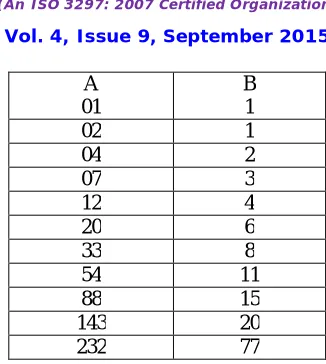
A 01
B 1 02 1 04 2 07 3 12 4 20 6 33 8 54 11 88 15 143 20 232 77
Table 1: Comparisions of recursive calls based on algorithms a & b respectively
III.RESULTS&CHALLENGES
Recursive algorithm performances based on equations (1) & (2) are displayed in the following tables with headings A & B,respectively.[table 1 ].
Graph for recursive algorithm based on equation a for a(25)[Diagram 5 ].
Graph for recursive algorithm based on equation b for b(25) [Diagram 6 ].
Graph for recursive algorithm based on equation a for a(20) [Diagram 7 ]. Graph for recursive algorithm based on equation b for b(20) [Diagram 8 ]. Graph for recursive algorithm based on equation a for a(200) [Diagram 9 ]. Graph for recursive algorithm based on equation b for b(200) [Diagram 10 ]. Some of the advanced computational areas of neural networks includes: Water purification
Beverage production Embedded computing[33]. Oil & gas industries
Multimedia communications[21] Image processing[20].
Data flow supercomputers[22]. Mobile computing[23].
Predictions for foreign exchange rates Medical & Engineering
Clouds [44].
Software development [24].
Apart from storage & processing time, parallelism level other challenges are as follows.
Neural networks have proved to be effective in solving a wide range of problems .As problems become more & more demanding, they require larger neural networks ,and the time taken for learning is consequently more. Parallel implementations of learning algorithm are vital for useful applications.
Less space for storage.
Retraining is required in case of damage to the network. Training is very difficult due to presence of hidden units.
IV. CONCLUSIONS
In artificial neural networks the calculation to minimise errors in supervised learning depends on algorithm used which is normally based on optimisation techniques & hence new algorithm b is preferable than algorithm a. In unsupervised training if input pattern is applied then neural network provides output response indicating class to which input pattern belongs . If class not found for pattern then new class is created . To achieve this algorithm b is quite faster then algorithm a.Based on the implementation results of recursive algorithm, it can be concluded that algorithm b is faster with less recursive calls than algorithm a & can improve the speed of parallel processing at algorithmatic levels..Todays computers are knowledgeable but far away from being intelligent which is difficult to achieve & processing intelligence even more difficult to overcome the challenges faced by it, for sophisticated applications
REFERENCES
[1] ”Data structures”J.P.Trembly & Sorenson [2] “Analysis of algorithms”Sartaj sahni
[3]Alfred U aho , Ravi sethi.Jeffrey D ullman ”compilers principles techniques & tools " [4] "C complete reference”Herbert Schildt
[5] “Systems programming”J Donovan [6] “Artificial Intelligence”Nilson [7]”neural networks”Bose
[8]”Introduction to languages & theory of computation”Martin [9]”programming with pascal”Gottfried
[10]”programming languages”Appleby [11] “computer organization”V.C.Hamachar [12]Computer fundamentals, Rajaraman. [13].Microprocessors- Goankar [14].Microprocessors- Ram [15].Digital Systems-Moris Mano [16].Computer networks- Tanenbaum [17].Software Engineering- Pankaj Jalote [18].Software engineering-Pressman [19].Computer graphics-Steven Harington [20].Multimedia making it work- Tay Vaughan
[21].Paper by Bedre Heeramani, B.Nagaraj: Volume 2, Issue 4, April 2012 ISSN: 2277 128X,International Journal of Advanced Research in Computer Science and Software Engineering Research Paper:”Research Issues of Interactive Multimedia for Advanced Computing &Communication for Challenging Applications” paper id-v2i4:0048.
[22].Paper by Bedre Heeramani , B.Nagaraj: Volume 3, Issue 3, April 2013 ISSN: 2277 128X,International Journal of Advanced Research in Computer Science and Software Engineering Research Paper:”Emerging technological trends of 2012-2013 data flow supercomputer design issues for challenging applications” .paper id-v3i3:0301
[23] Bedre Heeramani , B.Nagaraj: Volume 3, Issue 4, April 2013 ISSN: 2277 128X,International Journal of Advanced Research in Computer Science and Software Engineering Research Paper:” Research Dimensions of Advanced Mobile Computing Technology Security Issues for the Complex Applications” paper idv3i4-0499
[24] Bedre Heeramani , B.Nagaraj: Volume 3, Issue 6, April 2013 ISSN: 2277 128X,International Journal of Advanced Research in Computer Science and Software Engineering Research Paper:”Research of system software tool with innovative technological trends of detailed design in advanced software engineering and quality assurance tools for 2012-2013 applications ” paper idv3i6-0382
[25]. Computer networks –Frozen
[26].TCP/IP programming- Douglus E Comer
[27]. Computer Architecture-John L Hennessy & david A Patterson
[28]. Computer organization &design, revised fourth edition by john L. Hennessy. [29]. Digital design and computer architecture by Harris
[30]. Computer organization & architecture: Designing for performance by Stallings. [31]. Structured Computer organization by A.S. Tanenbaum
[32]. Computer system architecture by morris mano
[34].Programming in C++ - Stroustrup [35].Digital principles-Bartee
[36].Operating Systems -Galvin & Silberhatz.
[37].Introduction to algorithms-Coremen, leiserson, rivest , stein [38]The design and analysis of algorithms,Aho, Hopcroft, ullaman. [39]Algorithms and Data structures,Wirth
[40].Systems programming- Donovan j [41]Artificial Intelligency -Ritchie E [42]Unix-Sumitabh Das
[43]Java programming –Weber
[44]Bedre Heeramani, B.Nagaraj,paper “challenges of cloud computing” ,GJCSIT,Global Journal of computer science and information technology,volume2, issue4.
ACKNOWLEDGEMENT
We are heartfuly and sincerely thankful to our mother smt Pushpa who gave various suggestions and contribution for testing theoretical aspects with programming them and constant encouragements .
BIOGRAPHY
Nagaraj B, has completed BE(CS&E),M.Tech(CS&E) both first class from BIET, Davanagere & JNNCE Shimoga respectively.He has teaching experience of 18years for various courses BE(CS&E), MCA,Pgdca,BCA,BSc etc and handled about 50 computer science subjects.He is currently working as lecturer in department of computer science of sahyadri science college(autonomous university) shivamogga . His areas of interest includes artificial neural networks, programming languages, compilers, data structures, analysis of algorithms, multimedia, graph theory, computer architectures.