_____________________________________________________________________________________________________
*Corresponding author: E-mail: [email protected];
(Past name: British Journal of Medicine and Medical Research, Past ISSN: 2231-0614, NLM ID: 101570965)
Dexterity Testing in Dental Students
Tamíris da Costa Neves
1*, Vinícius P. Menegazzo
1, Juliana P. D. Novo
1,
Danielle Wajngarten
1and Patricia Petromilli Nordi Sasso Garcia
11
Department of Social Dentistry, Araraquara School of Dentistry, UNESP, Univ Estadual Paulista, Rua Humaitá 1680, Centro. Zip Code 14.801-903, Araraquara, SP, Brazil.
Authors’ contributions
This work was done in collaboration among all authors. Author TCN conduzed the experimental study and wrote the first draft of the manuscript. Authors VPM and JPDN helped in the adapting the Precision Manual Dexterity (PMD) Test to pre-clinical restorative dentistry training, Author DW analyzed the data. Author PPNSG designed and supervised the study. All the authors managed the literature search writing of the final manuscript and read and approved the final manuscript
Article Information
DOI: 10.9734/JAMMR/2020/v32i730458
Editor(s):
(1)Dr. Sushi Kadanakuppe, V. S. Dental College and Hospital, India. (2)Dr. Emmanouil (Manolis) Magiorkinis, General Hospital for Chest Diseases "Sotiria", Greece.
(3)Dr. Syed Faisal Zaidi, King Saud Bin Abdulaziz University, KSA.
Reviewers:
(1) Wilson Matsumoto , University of São Paulo, Brazil. (2)Mona Ionaș, University Lucian Blaga of Sibiu, Romania. (3)Hassan Baber, Dow University of Health Sciences, Pakistan. Complete Peer review History:http://www.sdiarticle4.com/review-history/56440
Received 05 March 2020 Accepted 11 May 2020 Published 03 June 2020
ABSTRACT
The objective of this study was to adapt a manual dexterity test to a pre-clinical training setting and to determine its reliability. Ninety-two students in the final year of their undergraduate program in dentistry at the School of Dentistry of São Paulo State University (UNESP), Araraquara, were evaluated. After the development of the Dental Manual Dexterity Assessment (DMDA), its reliability was evaluated in a reproducibility study. Two examiners evaluated twenty subjects’ test cubes in duplicate under the naked eye and using an X-ray view box and determined the subjects’ final scores on the DMDA. The examiners waited a week between their two scoring sessions, which were referred to as the first assessment and the second assessment. The intra- and inter-examiner reproducibility study was performed using an intra class correlation coefficient (ρ). A descriptive statistical analysis was performed, and the prevalence of the level of manual dexterity and the time required to complete the test were estimated using a point estimation and a 95% confidence
interval. Both intra-examiner reproducibility (ρ1=0.892; ρ2=0.938) and inter-examiner reproducibility (ρ1st=0.914; ρ2nd=0.813) were classified as “good” or higher. A high prevalence of manual dexterity levels classified as “high” was observed among the subjects evaluated. The adaptation resulted in a valid and reliable instrument for measuring manual dexterity among dental students. The method is simple and may be implemented early on in undergraduate programs in dentistry.
Keywords: Manual dexterity; occupational health; ergonomics; dental students.
1.INTRODUCTION
While studying dentistry, students must develop a variety of skills and competencies [1], particularly in terms of fine motor skills [2] including manual dexterity [1,3]. According to Neves and Garcia [4], manual dexterity is understood as the ability to coordinate movements between the visual stimuli received and the muscle movements to be performed in a given motor activity.
The development of manual dexterity specifically for dentistry begins with pre-clinical training, during which time students observe and perform a variety of procedures on simulators and dental mannequins [2,5,6]. With this type of training, cortical structures in the brain are activated and stimulated to improve hand-eye coordination, spatial awareness, and fine detail reproduction [7].
According to Neves and Garcia [4], the difficulties associated with manual dexterity become more obvious to students as their theoretical knowledge is put into practice. To overcome these difficulties and develop adequate dexterity, the implementation of training programs specifically focused on motor skills prior to simulated dentistry procedures has been recommended [1,5,8,9]. However, for the objectives of these programs to be met, pre-existing manual dexterity must be measured so that specific activities can be proposed in accordance with the deficiencies that students exhibit [10].
It is important to note that the quantification and qualification of students’ manual dexterity levels as early as the first year of their undergraduate programs may bring more awareness to this issue and thus motivate students to develop their skills over the course of their academic careers.
There are a variety of methods available to assess manual dexterity, including the Purdue pegboard (PP) test [11-13], the O’Connor finger
dexterity test [9,11-14], and the Minnesota rate of manipulation test, or MRMT [12,13,15]. Though these methods have been widely used in research, they are generic in nature and their use is therefore limited when applied to specific fields such as dentistry.
According to Neves and Garcia [4], the HAM-Man test, the perceptual ability test (PAT), and the manual dexterity test (MDT) have been specifically used in the field of dentistry to predict student performance in practical courses during the undergraduate admissions process or to aid in the practical learning process. Another option is the precision manual dexterity (PMD) test proposed by Bowers et al. [16] to evaluate motor skills in endodontic treatment.
Given the importance of manual dexterity in the academic career of dental surgeons, the establishment of more simplified and specific methods for educational purposes is crucial to the teaching and learning process in dentistry. The PMD test is a simple and low-cost method for evaluating fine motor skills among dental students in the field of restorative dentistry.
Thus, this study sought to adapt the PMD test to a pre-clinical training setting and to determine its reliability.
2.MATERIALSANDMETHODS
2.1 Adapting the Precision Manual
Dexterity (PMD) Test to Pre-Clinical Restorative Dentistry Training
Before adapting the PMD test to our purposes, we performed a literature review [4] to determine which assessment methods are available in research in general and in the field of dentistry specifically. Based on these findings, we tested out different adaptations to the PMD test in an attempt to obtain a test specific to restorative dentistry work and useful in an academic setting. We have named the final method established the “Dental Manual Dexterity Assessment (DMDA).”
First, the 21 mm #10 C-File was replaced by a #2200 conical diamond bur with ultrafine finishing.
Next, holes of various diameters (1.7 mm to 3.0 mm) and with different edge types (1 DTP point and ¼ DTP point) were made to determine the best target for the #2200 bur. These targets were printed on 120 gsm paper and placed on a 4 cm foam sponge block inside of a rectangular laboratory dish in accordance with the method used by Bowers et al. [16].
To determine the viability of these modifications to the original test, the #2220 bur was placed on a high rotation for the penetration of the targets. This step revealed issues with the paper used, the angle at which the bur penetrated the target at high speeds, and the type of bur itself. The 120 gsm paper tore when penetrated by the bur due to its limited thickness; it also failed to remain attached to the foam sponge. The way in which the high-speed bur was held caused the bur to enter the targets at an angle and not perpendicularly as recommended for the PMD test. The bur that was originally selected possesses a short active tip that does not offer a margin of safety when an incorrect amount of pressure is used in the penetration. Furthermore, because it is made of diamonds meant to cut dental enamel, it created many notches in the paper that increased the diameter of the penetrations and changed the test results.
In light of these issues, changes were made to the foam, the paper, and the bur. It was used 2.5 cm-thick styrofoam (EME, Brazil) and h 75 gsm adhesive A4-sized label sheets (Primaco, Brazil) so that they could be attached to the styrofoam easily. This strategy eliminated the need for glue between the styrofoam and the target sheet. The use of glue could influence the test results, since its thickness cannot be standardized when applied to the styrofoam. The high-speed bur was replaced with a stainless steel handpiece
made using a lathe exclusively for this study. It allowed for the bur to penetrate the targets perpendicularly. The #2200 bur (KG Sorensen, Brazil) was replaced by a #3195FF bur, which has a smoother and longer active tip that allowed for it to be removed from the target without damaging the paper.
After these initial challenges were overcome, the diameter of the target was established. The final decision was holes that were 2.3 mm in diameter and had a 1-DTP point edge. The targets were then randomized.
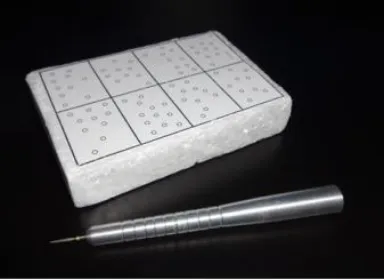
Thus, as part of these modifications, two devices were developed specifically for the fine motor skill test for pre-clinical restorative dentistry training: the test cube and the straight handpiece simulator. The test cube was rectangular in shape (7.5 cm in length by 12.5 cm in width and 2.5 cm thick). It was divided into eight sections and contained a total of 82 circular targets that were 2.3 mm in diameter and randomly placed on the sheet (Fig. 1).
The straight handpiece simulator was developed in order to simulate a micromotor with a handpiece and a bur. It was fabricated with a conical body. It weighed 32.5 g, measured 120 mm in length, with 8 mm in diameter in the active portion and 13 mm in diameter at the base, and it contained 45 mm of groves in the portion that comes in contact with the hand. Its active tip possesses a hole 3 mm in diameter to which the #3195FF bur could be attached (Fig 1). The simulator was created in this way to make it easier for the bur to penetrate the target perpendicularly, and the grooves were added to allow the user to achieve a firmer grip. The #31955 bur was selected because the diameter of its active tip was compatible with the targets on the test sheet, and because its grit measurement allowed for it to be removed from the target without damaging it.
Once the two main devices were created, the test application method was designed. The test consisted of penetrating small targets printed on paper using a fine-tipped bur, a process which simulates the bur's penetration of a small carious lesion.
Fig. 1. Front and side view of the test cube and straight handpiece simulator with a #3195 diamond bur
In the test development process, we realized the need for the researcher responsible for the application of the test to be trained on how to demonstrate the test to the subjects.
As Bowers et al. [16] note and as our initial experiments corroborated, it is important for the test subjects to practice the test prior to their completion of the tests in which the results were measured. With practice tests, any errors in performance can be corrected and subjects’ questions can be answered. After the practice tests, it was determined that a period of 5 minutes was sufficient for the subjects to learn how to take the test.
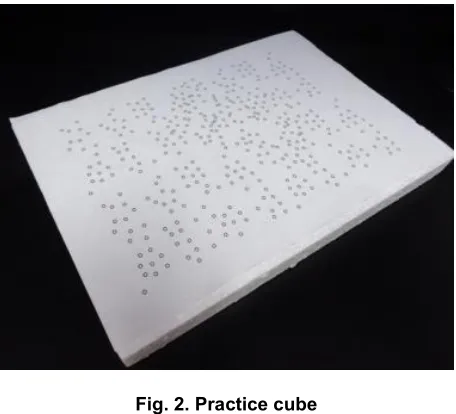
For the practice tests, a practice cube was created (Fig 2). It consisted of an A4 label sheet stuck to a 2.5 cm-thick styrofoam cube with a number of targets that were the same diameter as those used on the test cube.
To enable the consistent execution of the test proposed, a list of instructions was created for subjects to read before being assessed. The instructions read as follows: “This is a test that has been developed to assess your fine motor skills. Before beginning, you will be told what to do and will then have the opportunity to practice for 5 minutes. Make sure you understand exactly what to do. With your dominant hand, pick up the straight handpiece simulator containing the #3195FF bur and hold it in such a way that the bur can penetrate all of the targets on the test cube perpendicularly to the surface and so that it can accurately penetrate the center of each target without touching the edges of the targets. Begin when I say ‘begin.’ When you are done, say ‘I'm done.’
After the DMDAs are completed, the test cubes must be evaluated by the examiner to determine the final scores on the test, in accordance with Bowers et al. [16]. Scores for each target ranged from 0 to 3 points, with 0 being the least accurate and 3 being the most accurate. The scores are assigned according to the accuracy of the penetration, with 3 points for penetrations completely inside the target, 2 points for penetrations that touched the edge of the target and covered more than 50% of the target, 1 point for penetrations that touched at the edge of the target and covered less than 50% of the target, and 0 points for penetrations that were completely outside of the target (Table 1).
Because the test cube had 82 targets, each subject could achieve a maximum score of 246 points. After the scores were calculated, it was decided that the final score would be adjusted to be expressed as a percentage to allow for a classification of levels of manual dexterity in these percentages: very low manual dexterity (0% to <25%), low manual dexterity (25% to <50%), moderate manual dexterity (50% to <75%), and high manual dexterity (75% -100%).
The subjects were also given a percentage-based assessment of the time they required to complete the dexterity test: very fast (0% to <25%), fast (25% to <50%), moderate (50% to <75%), and slow (75 -100%), scores which were based on the longest time period required by a subject (T=260 seconds).
2.3 Applying the Test
Fig. 2. Practice cube
Table 1. Scores attributed to penetrations of the targets on the test cube (adapted from Bowers et al., 2010)
A score of 3 – Completely within the target and in the center A score of 2 – Within the target but touching the edge of the target A score of 1 – Outside the target but touching the edge of the target A score of 0 - Completely off target
in the fifth and final year of their undergraduate program in dentistry at the School of Dentistry of São Paulo State University (UNESP), Araraquara, who had given informed consent to participate in the study.
The students were instructed on how to perform the test and advised that the time taken to undertake the task was being monitored. The performed test was timed and which the students took at a specific site with standardized lighting and working Table.
2.4 Data Analysis
After the development of the method, its reliability was evaluated in an intra-examiner and inter-examiner reproducibility study. To reproducibity study two examiners evaluated twenty subjects’ test cubes in duplicate under the naked eye and using an X-ray view box and determined the subjects’ final scores on the DMDA. They waited a week between their two scoring sessions, which were referred to as the first assessment and the second assessment. The intra- and inter-examiner reproducibility study was performed using an intra class correlation coefficient (ρ). In this study,
consistencies established as “good” or better (ρ≥0.71) were considered reliable [17].
A descriptive statistical analysis was performed, and the prevalence of the level of manual dexterity and the time required to complete the test were estimated using a point estimation and a 95% confidence interval.
3.RESULTSANDDISCUSSION
Table 2 shows the results of the intra- and inter-examiner reproducibility study on the final scores for the DMDA.
Fig. 3 presents the prevalence of manual dexterity levels as estimated using point estimation and a 95% confidence interval.
A high prevalence of manual dexterity levels classified as “high” were observed among the subjects evaluated.
Table 2. Intra- and inter-examiner reproducibility of the final scores for the manual dexterity test for pre-clinical restorative dentistry (DMDA)
Examiner ICC (ρ) Classification
Intra-examiner 1 0.892 Good consistency
Intra-examiner 2 0.938 Excellent consistency
Inter-examiners – First assessment 0.914 Excellent consistency
Inter-examiners – Second assessment 0.813 Good consistency
Fig. 3. Prevalence of manual dexterity levels as estimated using point estimation and a 95% confidence interval
Fig. 4. Prevalence of the classifications of the time periods required to complete the manual dexterity test as estimated using point estimation and a 95% confidence interval
There was a high prevalence of subjects whose time required to complete the manual dexterity test was classified as "fast.”
Manual dexterity is particularly important in dentistry. For this reason, dental students should be screened as early as possible-ideally, at the start of their pre-clinical training [4]. To do so, a
test that is appropriate for educational purposes should be selected.
also be considered. The dexterity tests available are often costly and, when applied in the field of dentistry, are typically used to predict student performance rather than to evaluate manual dexterity development over time [4].
This study was therefore performed and the assessment tool created in an attempt to meet an academic need, since there is a lack of adequate standardized instruments for evaluating manual dexterity specifically in dentistry [4]. The DMDA was developed to evaluate manual dexterity among dental students within the context of restorative dentistry. This test can be used to screen students to determine their motor skills and to tailor their learning process based on the difficulties they exhibit.
The DMDA consists of a quantitative dexterity score that is qualified using a percentage-based classification system and also considers the time required to complete the test. This test is affordable and easy to apply. It can be implemented in an academic setting to evaluate and monitor students’ manual dexterity. Though it is an individual analysis, it can be applied to many students at once by a single examiner. When applied prior to pre-clinical training in restorative dentistry, it is hoped that this test will enable the diagnosis of more substantial difficulties so that strategies can be implemented to help students reach the level of skill required for this phase of the program. Other studies are being performed, and if this hypothesis is confirmed, the periodic (once a semester or once a year) application of this test can be recommended as a way to monitor student progress, identify persistent difficulties, and aid in improving pre-clinical training.
An adequate test provides precise and reliable data. Thus, in the application of an instrument of this nature, proper examiner training, and measurement consistency are essential for the variables being assessed to be properly measured [13,19,20]. In this study, a reliability analysis was performed on the test through a reproducibility study. The MDT [21], the PMD test [16], the MRMT, and the PP test [13] were similarly analyzed. There is no information on the validation or reliability processes applied to the O’Connor finger dexterity test [13].
As Table 2 shows, both intra-examiner reproducibility (examiners 1 and 2) and inter-examiner reproducibility (first and second assessments) were classified as “good” and
“excellent” [13]. The literature recommends that instruments of this nature present reproducibility that as classified as “good” or higher to minimize error [22]. Thus, this assessment was found to be both reliable and easy to apply. However, it is recommended that the examiners be properly trained to analyze the penetration of the targets on the test cube and that the examiners’ reproducibility be classified as “good” or higher. Most of the students who served as subjects in this study were found to exhibit dexterity that was classified as “high” and to complete the test in a period of time classified as “fast” or "very fast.” These findings are explained by the fact that the sample consisted of students who were at the end of their academic program and who had already had a long period of training to develop these skills and competencies. Therefore, the high performance seen in this sample was to be expected. However, more studies should be conducted with dental students in their initial years to observe its manual dexterity with this method.
Given the importance of manual dexterity in the field of dentistry, these results suggest that the assessment tool proposed herein may meet academic needs in this field. However, this is a preliminary study in which only the reliability of the test was evaluated. Because promising results were obtained, other studies are being performed to validate this assessment tool.
4.CONCLUSION
The Dental Manual Dexterity Assessment (DMDA) is a simple and reliable tool for measuring manual dexterity among dental students.
CONSENT
An experimental study was performed on a sample of 92 students in the fifth and final year of their undergraduate program in dentistry at the School of Dentistry of São Paulo State University (UNESP), Araraquara, who had given informed and written consent to participate in the study.
ETHICALAPPROVAL
ACKNOWLEDGEMENTS
This study was financed in part by the Coordenação de Aperfeiçoamento de Pessoal de Nível Superior - Brasil (CAPES) - Finance Code 001.
COMPETING INTERESTS
Authors have declared that no competing interests exist.
REFERENCES
1. Bakker DR, Deng DM, Wesselink PR, Vervoorn JM. Effect of student`s determination of testing time on their test performance. Eur J Dent Educ. 2017; 21(3):137-141.
DOI: 10.1111/eje.12192.
2. Gal GB, Weiss EL, Gafni N, Ziv A. Preliminary assessment of faculty and student perception of a haptic virtual reality simulator for training dental manual dexterity. J Dent Educ. 2011;75(4):496-504.
PubMed PMID: 21460270.
3. Lundergan WP, Lyon L. Research on hand dexterity and the practice of dentistry. J Am Coll Dent. 2007;74(3):15-6.
PubMed PMID: 18303711.
4. Neves TC, Garcia PPNS. Use of Manual dexterity tests in dental education. JAMMR. 2018;27(12):1-7.
DOI: 10.9734/JAMMR/2018/44916. 5. Al-Saud LM, Mushtaq F, Allsop MJ,
Culmer PC, Mirghani I, Yates E, Keeling A, Mon-Williams MA, Manogue M. Feedback and motor skill acquisition using a haptic dental simulator. Eur J Dent Educ. 2017; 21(4):240-247.
DOI: 10.1111/eje.12214.
6. Urbankova A, Engebretson SP. The use of haptics to predict preclinic operative dentistry performance and perceptual ability. J Dent Educ. 2011;75(12):1548-57. Pub Med PMID: 22184593.
7. Duong JK, Gardner K, Rucker LM. Development and retention of fine psychomotor skills: implications for the aging dentist. J Can Dent Assoc. 2010;76:a25.
Pub Med PMID: 20633335.
8. Koo S, Kim A, Donoff RB, Karimbux NY. An initial assessment of haptics in preclinical operative dentistry training. J Investig Clin Dent. 2015;6(1):69-76. DOI: 10.1111/jicd.12065.
9. Lundergan WP, Soderston EJ, Chambers DW. Tweezer dexterity aptitude of dental students. Journal of Dental Education. 2007;71(8):1090-7. Pub Med PMID: 17687091.
10. Dimitrijevic T, Kahler B, Evans G, Collins M, Moule A. Depth and distance perception of dentistis and dental students. Oper Dent. 2011;36(5):467-77.
DOI: 10.2341/10-290-L.
11. Berger MA, Krul AJ, Daanem HA. Task specificity of finger desterity tests. Appl Ergon. 2009;40(1):145-7.
DOI: 10.1016/j.apergo.2008.01.014. 12. Andersen Hammond ER, Shay BL, Szturm
T. Objective evaluation of fine motor manipulation - a new clinical tool. J Hand Ther. 2009;22(1):28-35.
DOI: 10.1197/j.jht.2008.06.006.
13. Yancosek KE, Howell D. A narrative review of dexterity assessments. J Hand Ther. 2009;22(3):258-69.
DOI: 10.1016/j.jht.2008.11.004.
14. Lafayette Instrument Company, USA. O’Connor finger dexterity test (Model 32021). Accessed 14 August 2018 Available:https://www.ncmedical.com/imag es/pdf/nc70015_oconnor_finger_dexterity_ tes _020718.pdf
15. Lafayette Instrument Company, USA. The Minnesota Dexterity Test (Model 32023). Accessed 14 August 2018.
Available:https://meetinstrumentenzorg.blo b.core.windows.net/testdocuments/Instrum en 141/141_2_N.pdf
16. Bowers DJ, Glickman GN, Solomon ES, He J. Magnification’s Effect on Endodontic Fine Motor Skills. Clinical Research. 2010;36(7):1135-8.
DOI: 10.1016/j.joen.2010.03.003.
17. Fermanian J. Measurement of agreement between 2 judges. Qualitative cases. Rev
Epidemiol Sante Publique.
1984;32(2):140-7. PubMed PMID: 6484261.
function. J Hand Ther. 1998;11(4):266–77. Pub Med PMID: 9862265.
19. Kirshner B, Guyatt G. A methodological framework for assessing health indices. J Chronic Dis. 1985;38(1):27-36. Pub Med PMID: 3972947.
20. Kimberlin CL, Winterstein AG. Validity and reliability of measurement instruments used in research. Am J Health Syst Pharm. 2008;65(23):2276-84.
DOI: 10.2146/ajhp070364.
21. Gansky AS, Pritchard H, Kahl E, Mendoza D, Bird W, Miller AJ, Graham D. Reliability and validity of a manual dexterity test to predict preclinical grades. J Dent Educ. 2004;68(9):985-94.
PubMed PMID: 15342660.
22. Campos JADB, Oliveira ALBM, Domingos PAS, Botta AC, Garcia PPNS. Laboratory tests with quality data in Dentistry. Journal of Research in Dentistry. 2013;1:288- 297.
_________________________________________________________________________________ © 2020 Neves et al.; This is an Open Access article distributed under the terms of the Creative Commons Attribution License (http://creativecommons.org/licenses/by/4.0), which permits unrestricted use, distribution, and reproduction in any medium, provided the original work is properly cited.
Peer-review history: