ISSN: 2319-8753
I
nternational
J
ournal of
I
nnovative
R
esearch in
S
cience,
E
ngineering and
T
echnology
(An ISO 3297: 2007 Certified Organization)
Vol. 3, Issue 5, May 2014
Copyright to IJIRSET www.ijirset.com 12214
Experimental studies and Development of
Modelling equation of
Quercetin from
Raphanus Sativus
using Soxhlet Extractor
Meena Vangalapati
1, Gnana Madhuri Y
2, Vidya Sagar T
3, Ravi Raju V
4and Satyadev L K
51. Associate professor, Dept of chemical Engineering, AUCE (A), Andhra University, A.P, India
2. B.Tech. Student, Dept of Chemical Engineering, AUCE (A), Andhra University, A.P, India.
3
. B.Tech. Student, Dept of Chemical Engineering, AUCE (A), Andhra University, A.P, India.
4.
B.Tech. Student, Dept of Chemical Engineering, AUCE (A), Andhra University, A.P, India.
5.
B.Tech. Student, Dept of Chemical Engineering, AUCE (A), Andhra University, A.P, India.
Abstract: The radish (Raphanus sativus) species belongs to Brassicaceae family. Different parts of radish including roots, seeds and leaves are used for medicinal purposes. The objective of this work was extraction of phenolic compounds from radish and to develop a modelling equation to describe quantitatively the extraction phenomena. The present study was intended to optimization of extraction of Quercetin and its various physico-chemical parameters have been studied. For the extraction of Quercetin the optimum results were observed for the effect of different solvents, soaking time, extraction time with hexane, particle size, different solvent percentages, different volumes of hexane with methanol as solvent and pH where the results showed up are respectively methanol, 1day, 1 hr, 200 particle mesh size, 80% (v/v), 1:1 ratio and 6.0. The highest Quercetin concentration for optimized condition was 45µg/ml. Soxhlet extraction was carried out using methanol for different extraction time periods to verify the mathematical model proposed in this work. The final form of proposed model was Es= 1.525(1-e-0.9033t) for Quercetin, where Es = yield extract (mg of quercetin/gm of dried sample) and t= extraction time (min). The model showed good agreement with the experimental data by generating average absolute relative deviation ( AARD) of about 1.217+- 13.23% mg of quercetin per 1 gm of dried sample.
Key words: Radish, Quercetin, Soxhlet extractor, modelling equation, methanol
I. INTRODUCTION
ISSN: 2319-8753
I
nternational
J
ournal of
I
nnovative
R
esearch in
S
cience,
E
ngineering and
T
echnology
(An ISO 3297: 2007 Certified Organization)
Vol. 3, Issue 5, May 2014
Copyright to IJIRSET www.ijirset.com 12215 antioxidants. It shows pharmacological activiyies like anti-fungal [3], anti-diabetic [4], anti-oxidant [5], anti-inflammatory[6] and anti cancer activities [7] etc.
II. MATERIALS AND METHODS
Chemicals and reagents:
Methanol, ethanol, ethyl acetate, distilled water, hexane, aluminium chloride, potassium acetate.
Equipment:
Soxhlet extractor, colorimeter, pH meter
Collection of the plant material:
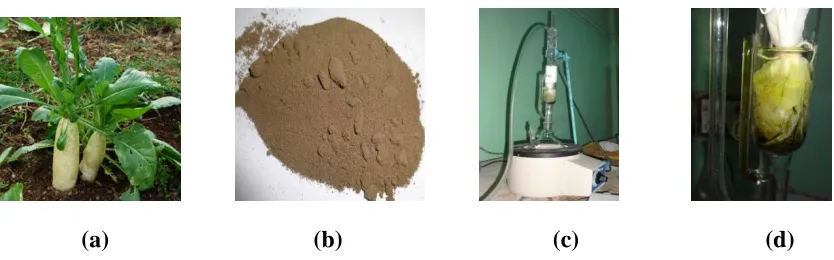
The radish leaves are collected from local market at Visakhapatnam, Andhra Pradesh, India.
Processing of the plant material:
The leaves are cleaned, dried under shade and powdered. The powder is then screened in different mesh sizes (50,100,150,200) and the different fractions obtained are stored in an air-tight container.
Extract preparation:
2 gm of powder is added to 50 ml methanol (80 %) in a conical flask. The solution is soaked for 1 day. After the soaking time, the solution is filtered using Whatman filter paper no:1 and the filtrate is heated at 65 oC so that the solvent which is taken in glassware is evaporated. The resultant solution is cooled and make up to 25 ml with distilled water. This solution is added to 25 ml of hexane taken in a separating funnel. Incubate the solution of methanolic extract for 1 hr.
Determination of Quercetin
0.5 ml of methanolic extract is taken in a test-tube from the extract phase of the separating funnel. To this 1.5 ml of methanol, 0.1 ml of 10% AlCl3, 0.1 ml of 1M Potassium acetate and 2.8 ml of distilled are added. This mixture was allowed to stand for 30 min. The absorbance of the reaction mixture was measured at 450 nm using colorimeter. The concentration of Quercetin was determined by using calibration curve.
Solvent extraction using Soxhlet extractor
ISSN: 2319-8753
I
nternational
J
ournal of
I
nnovative
R
esearch in
S
cience,
E
ngineering and
T
echnology
(An ISO 3297: 2007 Certified Organization)
Vol. 3, Issue 5, May 2014
Copyright to IJIRSET www.ijirset.com 12216
Modelling of Extraction of Quercetin using Soxhlet Extractor Apparatus
In order to describe the Quercetin transfer from radish leaf powder to the bulk of the solvent the following hypothesis were used. The mass transfer coefficient is constant. The solvent in the extractor is perfectly mixed, while the transfer resistance in the liquid phase is negligible and the Quercetin concentration in the solvent depends only on time. The transfer of the Quercetin was a diffusion phenomenon and independent of time. The final form of the modelling equation[8] was obtained from the extraction of Quercetin by using Soxhlet extractor[9].
Es = B (1 - e-Dt)
where
Es = mg of Quercetin per gram of dried sample (mg/g), t = extraction time (min) and B & D = equation constants.
III. RESULTS AND DISCUSSION
(a) (b) (c) (d)
Fig .1: (a)Raphanus sativus (b) Dried leaf powder (c) Soxhlet extractor (d) Quercetin extraction
A. EFFECT OF PROCESS PARAMETERS:
1. Effect of different solvents on extraction of quercetin :
ISSN: 2319-8753
I
nternational
J
ournal of
I
nnovative
R
esearch in
S
cience,
E
ngineering and
T
echnology
(An ISO 3297: 2007 Certified Organization)
Vol. 3, Issue 5, May 2014
Copyright to IJIRSET www.ijirset.com 12217 Fig. 2. Effect of different solvents on extraction of quercetin
2. Effect of soaking time on extraction of quercetin:
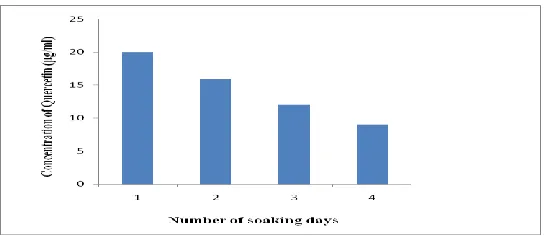
For the extraction of Quercetin from radish leaf powder, the samples were incubated for different time periods viz.,1 , 2, 3 and 4 days. It was observed that, soaking for 1 day gave the best result and the concentration of quercetin obtained was 20 μg/mL (Fig. 3)
Fig. 3. Effect of soaking time on extraction of quercetin
3. Effect of extraction time with hexane on extraction of quercetin :
ISSN: 2319-8753
I
nternational
J
ournal of
I
nnovative
R
esearch in
S
cience,
E
ngineering and
T
echnology
(An ISO 3297: 2007 Certified Organization)
Vol. 3, Issue 5, May 2014
Copyright to IJIRSET www.ijirset.com 12218 Fig. 4. Effect of extraction time with hexane on extraction of quercetin
4. Effect of differtent particle mesh sizes on extraction of quercetin:
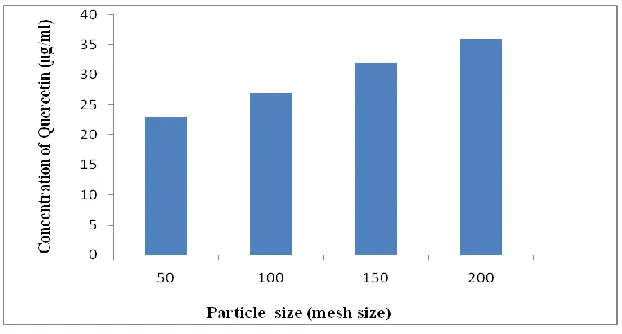
Different particle mesh sizes viz., 50,100,150, 200 were used to find the optimum conditions for quercetin. In this investigation, the particles of 200 mesh size are found to be the optimum size for the quercetin extraction and quercetin’s concentration is found to be 36 μg/ml.(Fig. 5)
Fig. 5. Effect of differtent particle mesh sizes on extraction of quercetin
5. Effect of different solvent compostion on the extraction of quercetin:
ISSN: 2319-8753
I
nternational
J
ournal of
I
nnovative
R
esearch in
S
cience,
E
ngineering and
T
echnology
(An ISO 3297: 2007 Certified Organization)
Vol. 3, Issue 5, May 2014
Copyright to IJIRSET www.ijirset.com 12219 Fig. 6.Effect of different solvent compostion on the extraction of quercetin
6. Effect of different volumes of hexane on the extraction of quercetin:
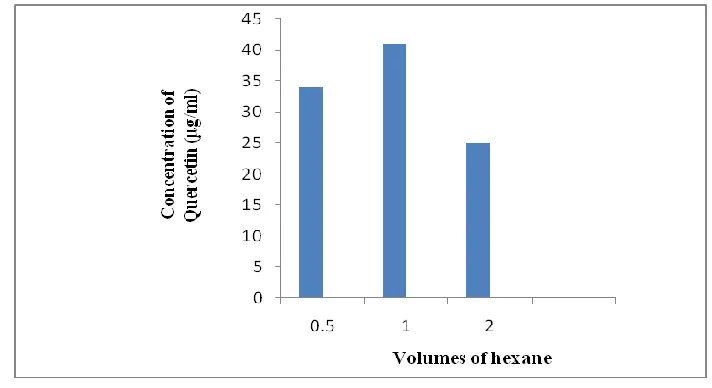
Different volumes of hexane with solvent in different ratios such as 1:1, 1:2, and 2:1 are used for the extraction of quercetin. The optimum value is observed with the ratio 1:1 and the concentration of quercetin is found to be 41μg/ml.(Fig. 7)
Fig. 7.Effect of different volumes of hexane on the extraction of quercetin
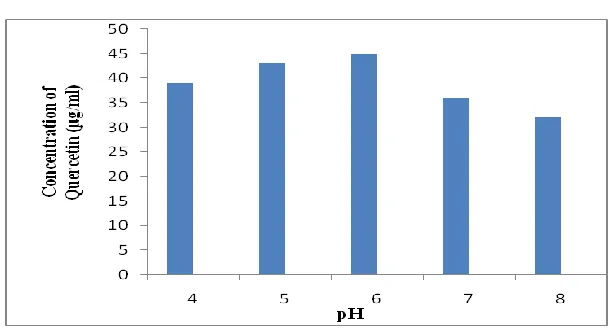
7. Effect of ph on extraction of quercetin:
ISSN: 2319-8753
I
nternational
J
ournal of
I
nnovative
R
esearch in
S
cience,
E
ngineering and
T
echnology
(An ISO 3297: 2007 Certified Organization)
Vol. 3, Issue 5, May 2014
Copyright to IJIRSET www.ijirset.com 12220 Fig. 8Effect of ph on extraction of quercetin
B. RESULT OF MODELLING OF EXTRACTION OF QUERCETIN USING SOXHLET EXTRACTOR
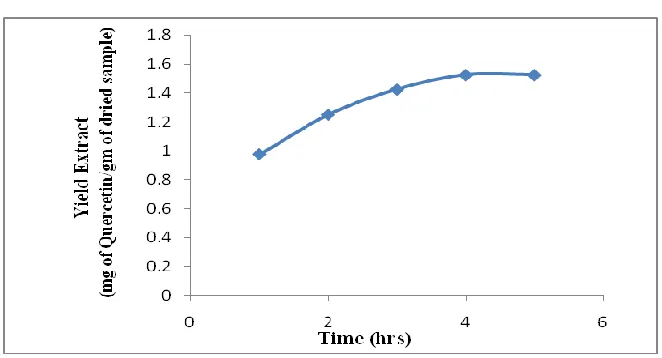
In comparison to non- polar solvents, polar solvents could extract quercetin at higher yield except water, where hydrolysis and thermal degradation might occur. Non-polar solvents were almost unable to extract quercetin. Methanol was found to be the best solvent for the extraction of quercetin. The highest amount of quercetin extracted is from 80% methanol concentration solution. The final form of the proposed model equation for quercetin was
Es= 1.525(1-e
-0.9033t)
where Es = yield extract (mg of quercetin/gm of dried sample and t= extraction time (min). The model showed good agreement with the experimental data by generating average absolute relative deviation ( AARD) of about 1.217+- 13.23% mg of quercetin per 1 gm of dried sample.
Table : Effect of Yield extract with extraction time on Quercetin: (Fig 9)
S.No Time (hr) Yield extract
(mg of Quercetin/gm of dried sample)
1
1
0.975
2
2
1.25
3
3
1.425
4
4
1.525
ISSN: 2319-8753
I
nternational
J
ournal of
I
nnovative
R
esearch in
S
cience,
E
ngineering and
T
echnology
(An ISO 3297: 2007 Certified Organization)
Vol. 3, Issue 5, May 2014
Copyright to IJIRSET www.ijirset.com 12221 Fig. 9 Effect of Yield extract with extraction time on Quercetin
IV. CONCLUSION
The present study was intended for the optimization of extraction of Quercetin and its various physico- chemical parameters have been studied. For the extraction of Quercetin the optimum results were observed for the effect of different solvents, soaking time, extraction time with hexane, particle size, different solvent percentages, different volumes of hexane with methanol as solvent and pH were methanol, 1day, 1 hr, 200 particle mesh size, 80% (v/v), 1:1 ratio and 6.0 respectively. The highest Quercetin concentration for optimized condition was 45µg/ml.
Methanol was found to be the best solvent for the extraction of Quercetin from radish by soxhlet extractor. This Solvent extraction using soxhlet extractor was conduct to verify the mathematical model proposed in this work. The final form of proposed models were Es= 1.525(1-e-0.9033t) for Quercetin, where Es = yield extract (mg of quercetin/gm of dried sample and t= extraction time (min). The model showed good agreement with the experimental data by generating average absolute relative deviation ( AARD) of about 1.217 +_ 13.23 % mg of quercetin per 1 gm of dried sample.
REFERENCES
[1] Rosa Martha Perez Gutierre and Rosalinda Lule Perez, “Raphanus sativus (Radish): Their Chemistry and Biology”, The Scientific World Journal. Vol.4: pp 811–837, 2004.
[2] Ali Ghasemzadeh, Maryam Azarifar, Omid Soroodi and Hawed Z. E. Jaafar, “ Flavonoid compounds and their antioxidant activity in extract of some tropical plants”,J. Medicinal Plants Research.Vol. 6(13): pp 2639-2643, 2012.
[3] Aerts AM, Francois IE, Meert EM, Li QT, Cammue BP and Thevissen K, “The anti-fungal activity of RsAFP2, a plant defensin from Raphanus sativus, involves the induction of reactive oxygen species in Candida albicans”, J Mol Microbial Biotechnol. Vol.13(4): pp 243-247, 2007.
[4] Farzaneh Dehghani, Monireh Azizi and Mohammad Reza Panjeshahin,“The effects of aqueous extract of Raphanus sativus on blood glucose, tri-glyceride and cholesterol in diabetic rats”, Iranian Journal of Pharmacology and Therapeutics. Vol.10: pp 66-70, 2011.
[5] Jalila Ben Salah-Abbès Samir Abbès, Zouhour Ouanes, Zohra Houas, Mosaad A. Abdel-Wahhab,
Hassen Bacha and Ridha Oueslati ,“Tunisian radish extract (Raphanus sativus) enhances the antioxidant status and protects against oxidative stress induced by zearalenone in Balb/c mice”, J. Appl.Toxicol.Vol 28:pp 6–14,2008.
[6] Shobha Kamble, Md. Zubair Ahmed, S.Ramabhimaiaha and Prabhakar Patil, “Anti-Inflammatory activity of Raphanus sativus L in Acute and Chroniv Experimental Models in Albino Rats”, Biomedical and Pharmacology Journal. Vol.6(2):pp 315-320, 2013.
ISSN: 2319-8753
I
nternational
J
ournal of
I
nnovative
R
esearch in
S
cience,
E
ngineering and
T
echnology
(An ISO 3297: 2007 Certified Organization)
Vol. 3, Issue 5, May 2014
Copyright to IJIRSET www.ijirset.com 12222
[8] D V Surya Prakash, N Sree Satya and Meena Vangalapati, “Extraction of Chebulinic acid fromTerminalia Chebula sp. Soxhlet extractor - An experimental and modeling studies”, Asian Journal of Biochemical and Pharmaceutical Research.Vol.2(3): pp 170-176, 2012.
[9] G.P. Choudhary, “Wound healing activity ethanolic extract of Terminalia Chebula ”, International Journal of Pharma and Biosciences.Vol. 2(1), pp 48-52, 2011.
BIOGRAPHY
Dr.Meena Vangalapati M.Tech., Ph.D, Associate Professor, Department of Chemical Engineering, Andhra University College of Engineering (A), Andhra University, Visakhapatnam, Andhra Pradesh, India. She has 13years of teaching experience and published 60 more Papers published in National and International Reputed Journals, published 7 monographs/Books.
E-mail id : [email protected].
Gnana Madhuri .Y B.Tech, Department of Chemical Engineering,
Andhra University College of Engineering (A), Andhra University, Visakhapatnam, Andhra Pradesh,India. She has attended 4 more National and International conferences.
e-mail id : [email protected].
Vidya Sagar .T B.Tech, Department of Chemical Engineering,
Andhra University College of Engineering (A), Andhra University, Visakhapatnam, Andhra
Pradesh,India. He has attended 6 more National and International conferences. He has 1paper published in International Reputed Journal.
e-mail id : [email protected].
Ravi Raju. V B.Tech, Department of Chemical Engineering,
Andhra University College of Engineering (A), Andhra University, Visakhapatnam, Andhra Pradesh,India. He has attended 6 more National and International conferences.
e-mailid:[email protected]
Satyadev L .K, B.Tech, Department of Chemical Engineering,
Andhra University College of Engineering (A), Andhra University, Visakhapatnam, Andhra Pradesh,India. He has attended 5 more National and International conferences.