The Role of ICT to Make Teaching-Learning
Effective in Higher Institutions of Learning in
Uganda
Guma Ali
1, Faruque A.Haolader
2, Khushi Muhammad
3P.G student, Department of TVE, Islamic University of Technology (IUT), Dhaka, Bangladesh¹
Assistant Professor, Department of TVE, Islamic University of Technology (IUT), Dhaka, Bangladesh²
Professor, Department of TVE, Islamic University of Technology (IUT), Dhaka, Bangladesh³
Abstract: The use of ICT in teaching-learning process is a relatively new phenomenon and it has been the educational researchers' focus. The effective integration of this technology into classroom practices poses a challenge to teachers and administrators. This empirical study aimed at finding out the factors influencing use of ICT to make teaching-learning effective in higher institutions of teaching-learning in Uganda and identifying the innovations that ICT has brought into teaching-learning process, particularly in higher institutions of learning in Uganda. A survey was employed and in order to empirically investigate the study. The findings of this study revealed that teaching staff and administrators had a strong desire to integrate ICT into learning processes. The innovations that ICT has brought in teaching-learning process include: E-teaching-learning, e-communication, quick access to information, online student registration, online advertisement, reduced burden of keeping hardcopy, networking with resourceful persons, etc. However, the presence of all these factors increased the chance of excellent integration of ICT in teaching-learning process. Therefore, the training of teaching staff in the pedagogical issues and administrators in administration should be increased if teachers and administrators are to be convinced of the value of using ICT in their teaching-learning process and administration.
Keywords: ICT, Teaching-Learning, Effective, Higher Institutions of learning
I. INTRODUCTION
Uganda like other developing countries is still in the initial stages of integrating ICT in teaching-learning process. Though it is limited by a number of barriers, there are many factors influencing the use of ICT to make teaching-learning effective in higher institutions of teaching-learning in Uganda.
ICT is an „electronic means of capturing, processing, storing, communicating information. The use of ICT in the classroom teaching-learning is very important for it provides opportunities for teachers and students to operate, store, manipulate, and retrieve information, encourage independent and active learning, and self-responsibility for learning such as distance learning, motivate teachers and students to continue using learning outside school hours, plan and prepare lessons and design materials such as course content delivery and facilitate sharing of resources, expertise and advice. This versatile instrument has the capability not only of engaging students in instructional activities to increase their learning, but of helping them to solve complex problems to enhance their cognitive skills [1]. Reference [2] defines ICT as technologies used to communicate in order to create, manage and distribute information. She adds that a broad definition of ICTs includes computers, the internet, telephone, television, radio and audio-visual equipment. She further explains that ICT is any device and application used to access, manage, integrate, evaluate, create and communicate information and knowledge. Digital technology is included in this definition as services and applications used for communication and information processing functions associated with these devices.
process. Therefore, they must be able to prepare young people for the society in which the competency to use ICT to acquire and process information is very important [3].
II. THE IMPORTANCE OF USING ICT IN TEACHING-LEARNING PROCESS
Several studies argue that the use of new technologies in the classroom is essential for providing opportunities for students to learn to operate in an information age. It is evident, as [5] argued that traditional educational environments do not seem to be suitable for preparing learners to function or be productive in the workplaces of today's society. She claimed that organizations that do not incorporate the use of new technologies in institutions cannot seriously claim to prepare their students for life in the twenty-first century. This argument is supported by Grimus [6], who pointed out that “by teaching ICT skills in higher educational institutions the students are prepared to face future developments based on proper understanding” (p. 362). Similarly, reference [7] reported that “what is now known about learning provides important guidelines for uses of technology that can help students and teachers develop the competencies needed for the twenty-first century” (p. 206). ICT originally is applied to serve as a means of improving efficiency in the educational process [8]. Furthermore, it has been shown that the use of ICT in education can help improve memory retention, increase motivation and generally deepens understanding [9]. ICT can also be used to promote collaborative learning, including role playing, group problem solving activities and articulated projects [10]. ICT allow the establishment of rich networks of interconnections and relations between individuals [11].
Some authors maintain that technology has the power to change the ways students learn and professors teach [12]. Still other authors posit that technology can “revolutionize” the learning process [13]. In other words, ICT extend professors‟ and students‟ capabilities, and their well determined use can transform roles and rules in the classroom [14]. Many people recognize ICTs as catalysts for change; change in working conditions, handling and exchanging information, teaching methods, learning approaches, scientific research, and in accessing information. Lecturers could use ICT to facilitate learning, critical thinking and peer discussions. Reference [15], recognize that technology-based teaching may not be essential in all classes but generally it is most facilitative as a result of providing relevant examples and demonstrations; changing the orientation of the classroom; preparing students for employment; increasing flexibility of delivery; increasing access; and satisfying public demands for efficiency. "The whole purpose of using technology in teaching is to give better value to students”[15]. This better value should also impact the learners/students‟ performance. Reference [16], argue that ICT holds much promise for use in curriculum delivery. Thus, technology can effectively improve teaching and learning abilities, hence increasing learners‟ performances. As [17] and [18] posit, ICT has the means to aid in the preparation of learners by developing cognitive skills, critical thinking skills, information access, evaluation and synthesising skills. In addition, ICT provides fast and accurate feedback to learners [19]. It is also believed that the use of ICTs in education could promote „deep‟ learning and allow educators to respond better to different needs of different learners [20]. According to [21], ICT-supported learning environments could be beneficial to a constructivist teaching approach.
III. FACTORS INFLUENCING USE OF ICT TO MAKE TEACHING-LEARNING EFFECTIVE IN HIGHER INSTITUTIONS OF LEARNING
education level, level of ICT training, proximity from a town centre, government policy on ICT literacy, period of experience with ICT. Therefore, these factors may assist teachers and educators to use ICT in teaching-learning process and become successful technology adopters.
There are many factors influencing the use of ICT to make teaching-learning effective in higher institutions of learning in Uganda which include the following:
Teachers’ attitudes
Attitude is a predisposition to respond favorably or unfavorably to an object, person, or event [31]. To successfully initiate and implement educational technology in school‟s program depends strongly on teachers‟ support and attitudes. Among the factors that influence successful integration of ICT into teaching are teachers‟ attitudes and beliefs towards technology [32] and [33]. If teachers‟ attitudes are positive toward the use of educational technology then they can easily provide useful insight about the adoption and integration of ICT into teaching and learning processes. The strong relationship between computer related attitudes and computer use in education has been emphasized in many studies [34] and [26]. Attitudes toward computers influence teachers‟ acceptance of the usefulness of technology, and also influence whether teachers integrate ICT into their classroom [35][36].
Many theorists (e.g., van Braak, 2001b; Vannata & Fordham, 2004) have maintained that teachers' attitudinal factors have a strong impact on technology integration in schools. For example, [37] reported that factors related to the nature of the teacher's personality are considered crucial to the integration and development of technology in education. Attitudes toward technology are expected to predict one's uses of technology [38]. Thus, attitude toward the computer or technology is also one of the most researched factors. It has been found to be a major predictor of teachers' technology use in instructional settings. Studies have clearly shown that the likeliness of teachers integrating technology, and its effective use and implementation, was very much related to the users' attitudes toward the computer or technology [39]. Some researchers [40][37][41] find that teachers who placed a more positive value on computers tend to use computers more frequently in their instruction. That is, beliefs about the value of technology greatly enhanced teachers' perceptions about the effectiveness of technology for teaching and learning. Research has shown that teachers‟ attitudes towards technology influence their acceptance of the usefulness of technology and its integration into teaching, [36]. Teachers‟ computer experience relates positively to their computer attitudes. The more experience teachers have with computers, the more likely that they will show positive attitudes towards computers [42]. Positive computer attitudes are expected to foster computer integration in the classroom [26]. According to [43], for successful transformation in educational practice, user need to develop positive attitudes toward the innovation.
ICT Competence
Computer competence is defined as being able to handle a wide range of varying computer applications for various purposes [26]. According to [44], teachers‟ computer competence is a major predictor of integrating ICT in teaching. Evidence suggests that majority of teachers who reported negative or neutral attitude towards the integration of ICT into teaching and learning processes lacked knowledge and skills that would allow them to make “informed decision” [45]. According to [46], teachers with more experience with computers have greater confidence in their ability to use them effectively. To conclude, [47] reported that teachers competence relate directly to confidence. Teachers‟ confidence also relate to their perceptions of their ability to use computers in the classroom, particularly in relation to their children‟s perceived competence.
Computer Self-Efficacy
Gender
Gender differences and the use of ICT have been reported in several studies. However, studies concerning teachers‟ gender and ICT use have cited female teachers‟ low levels of computer use due to their limited technology access, skill, and interest [51]. Research studies revealed that male teachers used more ICT in their teaching and learning processes than their female counterparts [52][53]. Reference [54] conducted a study on teachers‟ integration of ICT in schools in Queensland State. Results from 929 teachers indicated that female teachers were integrating technology into their teaching less than the male teachers. However, some studies revealed that gender variable was not a predictor of ICT integration into teaching [55]. In a research conducted [52], he found that male teachers had relatively higher levels of computer attitude and ability before computer implementation, but there was no difference between males and females regarding computer attitude and ability after the implementation of the technology. He claims that quality preparation on technology can help lessen gender inequalities.
Teaching Experience
Though some research reported that teachers‟ experience in teaching did not influence their use of computer technology in teaching [56], most research showed that teaching experience influence the successful use of ICT in classrooms [57][58][59]. Reference [60] reported that teacher experience is significantly correlated with the actual use of technology. In her study, she revealed that effective use of computer was related to technological comfort levels and the liberty to shape instruction to teacher-perceived student needs. Also, [61] claimed that experienced teachers are less ready to integrate ICT into their teaching. Similarly, in United States, the (U.S National Centre for Education Statistics, 2000) reported that teachers with less experience in teaching were more likely to integrate computers in their teaching than teachers with more experience in teaching. The reason to this disparity may be that fresh teachers are more experienced in using the technology.
Several studies have been conducted that addressed the relationships between selected demographic variables such as teaching experience and subjects taught and usage of computer. One such study was [62] who found weak relationship existed between years of teaching with computer usage. Meanwhile, a meta-analysis and review of 81 research studies by [63] concluded that teachers teaching experience does not eliminate computer phobias and many experienced teachers display some wariness, discomfort and/or mild anxiety in relation to computers.
Education level
Reference [64] observe that individuals with less than upper-secondary education are significantly less likely to use computers for a range of purposes and this pattern is most pronounced in Italy and Bermuda. In addition, scales that measure individuals‟ use of computers and the internet and attitudes toward computers, tend to increase with the literacy proficiency of individuals [65]. According to the National Centre on Adult Literacy Technical Report (2005) one study in Britain found that people with more education have higher ICT skills, but suggests that more educated people tend to work with computers, making it difficult to differentiate whether education or employment has the biggest impact on ICT skill levels.
Professional development
attitudes towards technology. Educators who integrate technology with new teaching practices gained through professional training can transform the performance of the students [72]. Teachers who are committed to professional development activities gain knowledge of ICT integration and classroom technology organization [73]. Clearly, it is imperative to allow teacher trainees to apply ICT in their programs when in school in order to be able to use the technology to supplement their teaching activities. Teachers when given time to practice with the technology, learn, share and collaborate with peer, it is likely that they will integrate the technology into their teaching. Training programs for teachers that embrace educational practices and strategies to address beliefs, skills and knowledge improve teachers‟ awareness and insights in advance, in relation to transformations in classroom activities [74].
Accessibility
Access to ICT infrastructure and resources in schools is a necessary condition to the integration of ICT in education [75]. Effective adoption and integration of ICT into teaching in schools depends mainly on the availability and accessibility of ICT resources such as hardware, software, etc. Obviously, if teachers cannot access ICT resources, then they will not use them. Therefore, access to computers, updated software and hardware are key elements to successful adoption and integration of technology. A study by [76] found that access to technological resources is one of the effective ways to teachers‟ pedagogical use of ICT in teaching.
Technical Support
Reference [47] reported that the breakdown of a computer causes interruptions and if there is lack of technical assistance, then the regular repairs of the computer will not be carried out which resulting in teachers not using computers in teaching. Similarly, [77] said it is also crucial to provide the schools with technical support with regard to repair and maintenance for the continue use of ICT in schools. Therefore, if there is no technical support for teachers, they become frustrated resulting in their unwillingness to use ICT [78]. Even though, lack of technical support discourages teachers from adopting and integrating technology in classrooms, a study by [79] revealed that schools in Britain and the Netherlands have appreciated the significance of technical support to help teachers to integrate technology into their teaching. They argued that ICT support in schools influence teachers to apply ICT in classrooms without wasting time troubleshooting hardware and software problems.
Leadership Support
Though infrastructure support is imperative, school technology leadership is a stronger predictor of teachers‟ use of computer technology in teaching [80]. Reference [81] believe that a leader who implements technology plans and also shares a common vision with the teachers stimulate them to use technology in their lessons. Schiff and Solmon suggest that for effective utilization of ICT by teachers, there is the need for a strong leadership to drive a well-designed technology plans in schools [82]. Becta report on the effect of ICT on teaching in basic schools in United Kingdom also stressed on significance of good leadership [82]. In addition Becta identified five factors that were essential to be present in schools if ICT was to be utilized properly [82]. These factors were ICT resources, ICT teaching, ICT leadership, general teaching and general school leadership. According to the report:
“Although ICT opportunities are typically provided by the classroom teachers, the quality of leadership and management of ICT in a school is crucial to the provision of good ICT learning opportunities. As the quality of ICT leadership improves, so does the percentage of schools providing good quality ICT learning opportunities” (Lai & Pratt, 2004, p.462).
Reference [57] conducted a study on factors that influenced transformational integration of ICT in eight schools in Hong Kong and Singapore. The study revealed that leadership promotion of collaboration and experimentation and teachers dedication to student-centred learning influenced effective ICT transformation. Also studies have shown that various levels of leadership such as principal, administrative leadership and technology leadership influence successful use of ICT in schools [80]. This aspect of leadership will help the principal to share tasks with subordinates while focusing on the adoption and integration of technology in the school. Institutions exemplified by executive involvement and decision-making, strengthened by ICT plan, effectively adopt ICT integration curriculum.
Pressure to use Technology
into their teaching practices [85]. Thus, it is important for teachers to know how to cope effectively with the pressure because the teacher is the key to effective integrate technology in classrooms [43]. Researchers e.g., [83], [86] have found that when teachers feel pressure to use technology, they were more likely to use it to deliver instruction, to have their students use technology during class time, to create products using technology, and to a lesser degree, use technology for class preparation. In the use, support, and effect of instructional technology (USEIT) study, [83] claim that perceived pressure to use technology is positively associated with teachers' technology use for delivering instruction, for creating products, and for class preparation. On the same time, there are critical perspectives of pressure. For example, [87] insists that if teachers feel pressured to change their pedagogy in order to accommodate new technologies, they are more likely to resist adopting technology altogether.
Government policy on ICT literacy
Policy and planning are important in identifying the aims of using ICT in education and in determining priorities in allocating resources [88]. He further points out that education authorities and the centres for which they are responsible have key tasks related to enabling, implementing and monitoring the use of ICT for learning and teaching. Reference [2] points out that countries rated low on appreciation of ICT have ICT policies that merely recognize the strategic role of ICT for growth and development. She further notes that while the availability of computers is limited, the cost of internet is high and the ratio of computers to population is insufficient; she cites the example of Sri Lanka and the Pacific Islands. Countries rated high in appreciation of ICT have ICT policies that go beyond measures that support ICT initiatives, for instance Australia, Malaysia and Japan. These countries have a high economic status and provide adequate ICT resources to their people.
Technological Characteristics
Technology characteristics influence the diffusion processes of an innovation and are significant factors impacting an innovation adoption. Evidence suggests that innovation attributes: relative advantage, compatibility, complexity, trialability and observability as perceived by individuals influence the rate of adoption [22]. He stresses the need to understand the perceptions of an innovation, as this has strong influence on future prediction of adoption of specific innovation. Understanding educators‟ perceptions of innovation is key to successful adoption of technology in learning, which according to [56] is a particular kind of instructive innovation. Reference [89] asserts that when teachers integrate ICT into teaching, they operate as innovators. A number of recent studies on these areas have been studied. Examples include studies on students ‟ perceptions of educational technology in tertiary education [90], perceptions of pre-service teachers, perceptions of asynchronous discussion boards [91], teachers‟ perceptions of learning technologies [92] and perceived attributes of the internet to predict the adoption of the internet as a learning tool [93]. These studies found observability and trialability as the two most significant elements. Further, recent study by [94], confirmed that perceived usefulness and perceived ease of use were predictors of user acceptance of computer technology. In addition, [96] reported that relative advantage, complexity, observability, and image are the most significant factors in predicting student teachers‟ intentions to make use of technology. According to [96], “innovations that offer advantages, compatibility with existing practices and beliefs, low complexity, potential trialability and observability will have a more widespread and rapid rate of integration”. Therefore, if teachers perceive that an innovation has an advantage over the existing technology, compatible with their social needs, ease to adopt, it can be tried before use and finally the results can been seen, it is likely that teachers will adopt and integrate it quickly.
IV. OBJECTIVES
The specific objectives of the study wereto:
Determine factors influencing use of ICT to make teaching-learning effective in higher institutions of learning in Uganda.
Identify the innovations that ICT has brought in teaching-learning process in higher institutions of learning in Uganda.
V. METHODOLOGY
higher institutions of learning in Uganda. A questionnaire was designed and divided into two parts. The first part contained direct questions yes/no and multiple choice items. The second part contained the questions regarding opinions of the respondents on the factors influencing the use of ICT to make teaching-learning effective in higher institutions of learning in Uganda. Out of this, 101 (61.2%) fully completed questionnaires were returned, of which 70 (77.8%) were filled by teachers and 31 (41.3%) by administrators respectively. This gave a response rate of 61.2%. The analysis was carried out at the institutional level. Chi square test and weighted average were used to analyse and interpret the data.
VI. ANALYSIS AND INTERPRETATION OF DATA
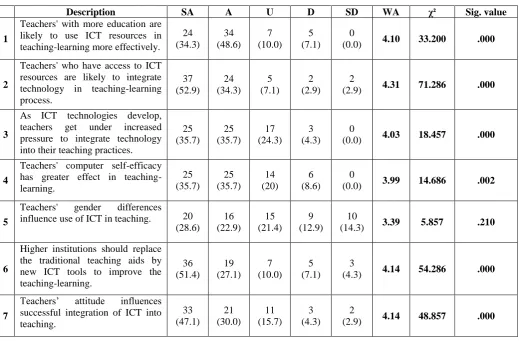
The factors influencing use of ICT to make teaching-learning effective in higher institutions of learning have been presented in the following two tables, Table 1 and Table 2.
Table 1: Opinion of teachers regarding the factors influencing use of ICT to make teaching-learning effective in higher institutions of learning
Description SA A U D SD WA χ² Sig. value
1
Teachers' with more education are likely to use ICT resources in teaching-learning more effectively.
24 (34.3) 34 (48.6) 7 (10.0) 5 (7.1) 0
(0.0) 4.10 33.200 .000
2
Teachers' who have access to ICT resources are likely to integrate technology in teaching-learning process. 37 (52.9) 24 (34.3) 5 (7.1) 2 (2.9) 2
(2.9) 4.31 71.286 .000
3
As ICT technologies develop, teachers get under increased pressure to integrate technology into their teaching practices.
25 (35.7) 25 (35.7) 17 (24.3) 3 (4.3) 0
(0.0) 4.03 18.457 .000
4
Teachers' computer self-efficacy has greater effect in teaching-learning. 25 (35.7) 25 (35.7) 14 (20) 6 (8.6) 0
(0.0) 3.99 14.686 .002
5
Teachers' gender differences influence use of ICT in teaching. 20
(28.6) 16 (22.9) 15 (21.4) 9 (12.9) 10
(14.3) 3.39 5.857 .210
6
Higher institutions should replace the traditional teaching aids by new ICT tools to improve the teaching-learning. 36 (51.4) 19 (27.1) 7 (10.0) 5 (7.1) 3
(4.3) 4.14 54.286 .000
7
Teachers‟ attitude influences successful integration of ICT into teaching. 33 (47.1) 21 (30.0) 11 (15.7) 3 (4.3) 2
(2.9) 4.14 48.857 .000
All statements, except statement 6, in Table 1 have sig. value of less than .05. Therefore, it was statistically significant to say that teachers strongly agree that the given factors influence use of ICT to make teaching-learning effective in higher institutions of learning except the teachers‟ gender difference which had a sig. value of greater than .05 which is not statistically significant.
Description SA A U D SD WA χ² Sig. value
1
Government has a good policy to improve the present condition of ICT in higher institutions.
12 (38.7) 12 (38.7) 5 (16.1) 1 (3.2) 1
(3.2) 4.06 19.806 .001
2
Leadership is strongly related to teachers‟ use of computer technology in teaching.
9 (29.0) 17 (54.8) 2 (6.5) 3 (9.7) 0
(0.0) 4.03 18.419 .000
3
The university supports lecturers and administrators in ICT training. 13 (41.9) 11 (35.5) 5 (16.1) 2 (6.5) 0
(0.0) 4.13 10.161 .017
4
Training workshops in ICT need to be improved if integration of ICT in teaching is to be achieved. 26 (83.9) 4 (12.9) 1 (3.1) 0 (0.0) 0
(0.0) 4.81 36.065 .000
All the statements given in Table 2 have sig. value of less than .05. Therefore, it was statistically significant to say that administrators strongly agree that the given factors influence use of ICT to make teaching-learning effective in higher institutions of learning.
VII. RESULTS AND DISCUSSION
According to the findings,
The institutions provide Computer, Multimedia Projector, Whiteboard facilities to support teaching-learning process. This therefore made it easy for them to integrate the use ICT for teaching-learning process.
Majority of the teaching staff used computers for teaching-learning mostly to prepare lesson plan and they are familiar with the software so they were able to teach the students easily. Some of the software they used include: Tally, Microsoft Office, and other programming languages.
The teaching staff have ICT knowledge and are able to integrate it in teaching-learning, they also encouraged their students to use ICT for learning for that they become proficient in it and able to wide their knowledge.
Most of the institutions have internet facility to support teaching-learning process this thus made it easy for the teaching staff and administrators to integrate ICT in education thus improving students and their knowledge.
The teaching staff and administrators need training on ICT in order to integrate ICT effectively in teaching-learning, thus many institutions today provide training to teachers and administrators so that they can improve their skills in use of ICT for teaching-learning and their administrative work.
ICT is very much needed for the development of higher institutions. This is because it makes easy administrative work for administrators and teaching-learning process for teachers thus making the running of the institutions smoothly.
ICT is very much helpful for improving the techniques of teaching-learning process in higher institutions. Because it is easy for them to integrate ICT in teaching-learning process.
Higher institutions should replace the traditional teaching aids by new ICT tools to improve the teaching-learning. This is because ICT is very important in education and should be integrated in teaching-learning process.
Students will be more motivated to learn if ICT tools are used in higher institutions. This can only be through introduction of many ICT courses and opening modern ICT facilities. Therefore, since majority of the institutions had ICT tools, the students were highly motivated to study.
Majority of the administrators regularly used ICT facility in administration. This made their administrative work easy. Therefore, it is suggested that for effective administration, the institutions must use ICT in order to facilitate their administrative work.
management and standards for hardware and software and improve the existing ones for quality ICT services in institutions.
The level of awareness of ICT knowledge by administrators of higher institutions in Uganda is moderate. Therefore, this calls for more training on ICT to the administrators so that they can easily integrate it in administration.
The innovations that ICT has brought in teaching-learning process in higher institutions of learning in Uganda
It was found that most of the respondents strongly agreed that ICT is necessary in teaching–learning process and identified are some of the innovations brought by ICT in teaching-learning process in higher institutions which include the following:
ICT has introduced new method of learning called E-learning (Electronic learning) where students study while they are at home or work place without going to the school. This makes many workers or employees to enroll and upgrade themselves easily.
It has also made communication easy through the internet e.g. E-mail, chatting, Skype, teleconferencing, video conferencing, etc.
ICT led to easy and quick access to information which are stored in the server or remote computers. This saves the users time compared to file system which is time consuming.
Most respondents also agreed that ICT has reduced burden of keeping hardcopy since most of the data or files are kept in soft form.
ICT also exposed teachers and administrators to modern world through searching, reading and connecting with resourceful people throughout the world with the help of the internet.
It has also improved quality of work in the office since most of the teachers and administrators use software and management information systems to do most of their work.
ICT has made it possible for administrators and teachers to register the students online and for students to access their records online.
It has made it easy for the teachers to update teaching-learning materials by reading and learning more about the latest materials which improves their work.
ICT made it easy for the administrators to advertise the institution so that students can enroll for courses and advertise for vacant positions that need staff electronically.
ICT has also provided security to teachers‟ and administrators‟ confidential information.
VIII. CONCLUSIONS
The rapid growth in ICT has brought remarkable changes in the twenty-first century, as well as affected its adoption and integration by teachers in teaching-learning process. The effective integration of technology into classroom practices poses a challenge to teachers and administrators. The findings of this study indicate that teachers and administrators have strong desire for the integration of ICT into education but they encountered many barriers to it. These findings therefore have implications for training the teachers to become regular users of ICT focusing on acquiring basic ICT skills.
For successful integration of ICT into teaching-learning process, it can be concluded that the factors that positively influenced teachers‟ and administrators‟ use of ICT in education include teachers‟ attitudes, ICT competence, computer self-efficacy, teaching experience, education level, professional development, accessibility, technical support, leadership support, pressure to use technology, government policy on ICT literacy, and technological characteristics. However, the presence of all factors increases the probability of excellent integration of ICT in teaching-learning process. Therefore, the training of teachers in the pedagogical issues should be increased if teachers are to be convinced of the value of using ICT in their teaching-learning process.
IX. RECOMMENDATIONS
continuous professional development in a workplace environment and as part of a culture of lifelong and peer learning, Building up a clear political will and invest in ICT consolidation, More ICT tools should be provided to each higher institution, Motivation and rewarding teachers to use ICT, Integrating the ICT strategy into the institution‟s overall strategies, and Transformation of positive attitudes towards ICT into efficient widespread practice.
REFERENCES
[1] Jonassen, D.H., & Reeves, T.C. “Learning with Technology: Using Computers as Cognitive Tools”. In D.H Jonassen (Ed.), Handbook of
research for educational communication and technology (pp. 693-719). New York: Simon and Schuster, 1996
[2] Pernia, E.E. (2008). Strategy Framework for Promoting ICT Literacy.
[3] Plomp, Tj., ten Brummelhis, A.C.A., &Rapmund, R. “Teaching and Learning for the Future”. Report of the Committee on Multimedia in Teacher
Training (COMMITT). Den Haag: SDU, 1996
[4] Drent, M., & Meelissen, M. “Which Factors Obstruct or Stimulate Teacher Educators to Use ICT Innovatively?”. Journal of Computers &
Education, (ARTICLE IN PRESS), 2007
[5] Yelland, N. “Teaching and learning with information and communication technology (ICT) for numeracy in the early childhood and primary
year of schooling”. Australia: Department of Education, training and Youth Affairs, 2001
[6] Grimus, M. “ICT and multimedia in the primary school”. Paper presented at the 16th conference on educational uses of information and
communication technologies, Beijing, China, 2000
[7] Bransford, J. D., Brown, A. L., & Cocking, R. R. “How People Learn: Brain, Mind, Experience, and School”: Expanded Edition. Washington,
D. C.: National Academy Press, 2000
[8] Jones, G. &Knezek, G. (1993). Non-commercial radio-satellite telecommunications: affordable options for technology educators.
[9] Dede “Learning with Technology”. Yearbook of the Association for Supervision and Curriculum Development (Alexandria, VA: ASCD),
199-215, 1998
[10] Forcheri, P. &Molfino, M. T. “ICT as a tool for learning to learn”. Boston, MA: Kluwer Academic. pp 175-184, 2000
[11] Rifkin, J. “The age of access”. Ken Tarcher/Putnam, 2000
[12] Kozma, R. B. “Designing and developing effective educational software”: Lessons from the EDUCOM Award Winners. EDUCOM Annual
Conference, San Diego, CA, 1991
[13] Schank, Roger. C. “Lessons in learning, eLearning, and training: Perspectives and guidance for the enlightened trainer”. San Francisco: Pfeiffer,
2005
[14] Breuleux, A., Laferrière, T., &Bracewell, R.J. “Networked learning communities in teacher education”. In S. McNeil, J. D. Price, S. Boger.,
Mehall, B. Robin, & J. Willis (Eds.), Proceedings of SITE „98, the 9thInternational conference of the Society for information technology and
teacher education (pp. 1170‐1175). Charlottesville, VA: ACCE, 1998
[15] Miller, J., W., Martineau, L., P. & Clark, R., C. “Technology Infusion and Higher Education: Changing Teaching and Learning, Innovative
Higher Education”, Vol. 24, No. 3, Spring 2000.
[16] Louw, J., Muller, J. &Tredoux, C. “Time-on-task, technology and mathematics achievement”. Evaluation and Program Planning 31 41–50,
2008
[17] Castro, C., (2003), Education in the Information Age: Promises and Frustrations, [Online] Available:
http://www.iadb.org/sds/doc/Edu&Tech2.pdf [2005, April 07]
[18] Cawthera, A, “Computers in Secondary Schools in Developing Countries: Costs and Other Issues”, The department for international
development, world links for development, and the human development network of the World Bank, 2000
[19] Becta.(2003). A review of the research literature on barriers to the uptake of ICT by teachers. Retrieved from:
http://partners.becta.org.uk/page_documents/research/barriers.pdf.
[20] Lau & Sim. “Exploring the extent of ICT adoption among Secondary school teachers in Malaysia”. International Journal of Computing and ICT
Research, vol. 2, no. 2, pp. 19-36, 2008 Retrieved Nov 2, 2011 from http://www.ijcir.org/volume2 number2/article 3.pdf.
[21] Newhouse, P. “The impact of ICT on learning and teaching”, Perth, Western Australia: Department of Education, 2002
[22] Rogers, E.M. “Diffusion of innovations”. New York: Free Press, 2003
[23] Stockdill, S.H., &Morehouse, D. L. “Critical factors in the successful adoption of technology: A checklist based on the findings”. Educational
Technology, vol. 32, no. 1,pp. 57-58, 1992
[24] Balanskat, A., Blamire, R., &Kafal, S. (2007). A review of studies of ICT impact on schools in Europe European Schoolnet
[25] Chen, C. H. “Why do teachers not practice what they believe regarding technology integration?” The Journal of Educational Research, vol. 102,
no.1, pp. 65-75, 2008
[26] Tondeur, J., Valcke, M., & van Braak, J. “A multidimensional approach to determinants of computer use in primary education: Teacher and
school characteristics”. Journal of Computer Assisted Learning, vol. 24, pp. 494–506, 2008
[27] Lim, C. P., & Chai, C. S. “Teachers‟ pedagogical beliefs and their planning and conduct of computer-mediated classroom lessons”. British
Journal of Educational Technology, vol. 39, no. 5, pp. 807–828, 2008
[28] Clausen, J. M. “Beginning teachers‟ technology use: First-year teacher development and the institutional context‟s affect on new teachers‟
instructional technology use with students”. Journal of Research on Technology in Education, vol. 39, no. 3, pp. 245–261, 2007
[29] Sherry, L., & Gibson, D. “The path to teacher leadership in educational technology”. Contemporary issues in technology and teacher education,
vol. 2, no. 2, pp. 178-203, 2002
[30] Charles, B. "Factors influencing Teachers‟ adoption and integration of information and communication technology into teaching". International
Journal of Education and Development using Information and Communication Technology (IJEDICT), 136-155, 2012
[31] Ajzen, I. “Attitudes, personality, and behaviour”. Chicago: Dorsey Press, 1988
[32] Hew, K. F., & Brush, T. “Integrating technology into K-12 teaching and learning: current knowledge gaps and recommendations for future
[33] Keengwe, J., &Onchwari, G.“Computer technology integration and student learning: Barriers and promise”, Journal of Science Education and
Technology, vol. 17, pp. 560–565, 2008
[34] Sang, G., Valcke, M., van Braak, J., &Tondeur, J. “Student teachers‟ thinking processes and ICT integration: Predictors of prospective teaching
behaviour with educational technology”, Computer & Education, 54, 103-112, 2010
[35] Akbaba, S., &Kurubacak, G. “Teachers‟ attitudes towards technology”. Computers in the Social Studies, 7(2), 833–836, 1999
[36] Huang, H. M., &Liaw, S. S. “Exploring users‟ attitudes and intentions toward the Web as a survey tool”. Computers in Human Behaviour, vol.
21, no. 5, pp.729-743, 2005
[37] Paraskeva, F., Bouta, H., &Papagianna, A. “Individual characteristics and computer self-efficacy in secondary education teachers to integrate
technology in educational practice”. Computers & Education, 50(3), 1084-1091, 2008
[38] Bai, H., &Ertmer, P.A. “Teacher educators‟ beliefs and technology uses as predictors of preservice teachers‟ beliefs and technology attitudes”.
Journal of Technology and Teacher Education, 16(1), 93‐112, 2008
[39] Knezek, G. & Christensen, R. “Impact of New Information Technologies on Teachers and Students”. Education and Information Technologies,
vol. 7, no. 4, p. 369–376, 2002
[40] Becker, H. “Internet use by teachers”. Irvine, CA: Centre for Research on Information Technology and Organizations, University of California,
Irvine, 1999 Available (retrieved July 1, 2002): www.crito.uci.edu/TLC/FINDINGS/internet-use/back
[41] Zhao , Y., & Frank , K. A. “Factors affecting technology uses in schools”. An ecological perspective, 2003
[42] Rozell, E.J., & Gardner, W.L. “Computer-related success and failure: a longitudinal field study of the factors influencing computer-related
performance”. Computers in Human Behaviour, vol. 15, no. 1, pp. 1-10, 1999
[43] Woodrow, J. E. “The influence of programming training on the computer literacy and attitudes of pre-service teachers”. Journal of Research on
Computing in Education, vol. 25, no. 2, pp.200-219, 1992
[44] Bordbar, F. “English teachers‟ attitudes toward computer-assisted language learning”. International Journal of Language Studies, vol. 4, no. 3,
pp. 27-54, 2010
[45] Al-Oteawi, S. M. (2002). The perceptions of Administrators and teachers in utilizing information technology in instruction, administrative work,
technology planning and staff development in Saudi Arabia. (Doctoral dissertation, Ohio University, 2002).
[46] Peralta, H., Costa, F.A. “Teachers‟ competence and confidence regarding the use of ICT”. Educational Sciences Journal, vol. 3, pp. 75-84. The
clearing house, vol. 82, no .2, pp. 70-74, 2007
[47] Jones, A. “A Review of the Research Literature on Barriers to the Uptake of ICT by Teachers”. British Educational Communications and
Technology Agency, 2004. Retrieved May 20, 2010 from http://www.becta.org.uk
[48] Bandura, A. “Self-efficacy: The exercise of control”. New York: Freeman,1997
[49] Liaw, S., Huang, H., & Chen, G. “Surveying instructor and learner attitudes toward ELearning. Computers & Education”, vol. 49, no. 4, pp.
1066-1080, 2007
[50] Yuen, A. H. K., & Ma, W. W. K. “Exploring teacher acceptance of E-learning technology”. Asia-Pacific Journal of Teacher Education, vol. 36,
no. 3, pp. 229-243, 2008
[51] Volman M. and van Eck, E. “Gender equity and information technology in education: The second decade”. Review of Educational Research,
vol. 71, no. 4, pp. 613-634, 2001
[52] Kay, R. “Addressing gender differences in computer ability, attitudes and use: The laptop effect”. Journal of Educational Computing Research,
vol. 34, no. 2, pp. 187-211, 2006
[53] Wozney, L., Venkatesh, V., &Abrami, P.C. “Implementing computer technologies: Teachers' perceptions and practices”. Journal of Technology
and teacher education, vol. 14, no.1, pp.173-207, 2006
[54] Jamieson-Proctor, R. M.,Burnett, P. C., Finger, G., & Watson, G. “ICT integration and teachers' confidence in using ICT for teaching and
learning in Queensland state schools”. Australasian Journal of Educational Technology, vol, 22, no. 4, pp. 511-530, 2006
[55] Norris, C., T., Sullivan, J., Poirot. &Soloway, E. “No access, no use, no impact: Snapshot surveys of educational technology in K-12”, Journal
of Research on Technology in Education, vol. 36, no. 1, pp. 15-27, 2003
[56] Niederhauser, D.S. &Stoddart, T. “Teachers' instructional perspectives and use of educational software”. Teaching and teacher education, vol.
17, pp.15-31, 2001
[57] Wong, E.M.L. & Li, S.C. “Framing ICT implementation in a context of educational change: a multilevel analysis”. School effectiveness and
school improvement, 19(1), 99-120, 2008
[58] Giordano, V. “A professional development model to promote internet integration into P-12 teachers' practice”: A mixed method study.
Computers in the schools, vol. 24, no.3/4, pp.111-123, 2007
[59] Hernandez-Ramos, P. “If not here, where? Understanding teachers‟ use of technology in Silicon Valley schools”. Journal of Research on
Technology in education,vol. 38, no. 1, pp.39-64, 2005
[60] Gorder, L. M. “A study of teacher perceptions of instructional technology integration in the classroom”. Delta Pi Epsilon Journal, vol. 50, no. 2,
pp. 63-76, 2008
[61] Baek, Y.G., Jong, J., & Kim, B. “What makes teachers use of technology in the classroom? Exploring the factors affecting facilitation of
technology with a Korean sample”. Computers and Education, vol.50, no. 8, pp. 224-234, 2008
[62] Zidon, S., & Miller, H. “Affiliations of attitudes and experience with need for learning computer skills”. Journal of Research on Computing in
Education, 35(2), 180-193, 2002
[63] Rosen, L.D. & Maguire, P.D. “Myths and realities of computerphobia: A meta-analysis”.Anxiety Research, 3, 175-191, 1990
[64] Veenhof, B., & Cindy, L. “Are Internet users tuning out traditional media?” Innovation Analysis Bulletin. Statistics Canada Catalogue no.
88-003-XIE. Vol. 8, no. 3, 2006. http://www.statcan.ca/bsolc/english/bsolc?catno=88-003-X20060039533
[65] Borghans, L., &ter Weel, Bas,. "Are computer skills the new basic skills? The returns to computer, writing and math skills in Britain," Labour
Economics, Elsevier, vol. 11(1), pages 85-98, 2004.
[66] Bauer, J., & Kenton, J. “Toward technology integration in the schools: Why it isn‟t happening”. Journal of Technology and Teacher
Education,vol. 13, no. 4, pp. 519–546, 2005
[67] Franklin, C. “Factors that influence elementary teachers‟ use of computers”. Journal of Technology and Teacher Education,vol. 15, no. 2, pp.
[68] Plair, S. “Revamping professional development for technology integration and fluency”. The clearing house, vol. 82, no .2, pp. 70-74, 2008
[69] Sandholtz, J. H., & Reilly, B. “Teachers, not technicians: Rethinking technical expectations for teachers”. Teachers College Record, 106(3),
487–512, 2004
[70] Brinkerhoff, J. “Effects of a long-duration, professional development academy on technology skills, computer self-efficacy and technology
integration beliefs and practices”. Journal of Research on Technology in Education, vol. 39, no. 1, pp. 22-43, 2006
[71] Diehl, D.E. “A study of faculty-related variables and competence in integrating instructional technologies into pedagogical practices”.
Unpublished doctoral dissertation. Texas Southern University, 2005
[72] Lawless, K., & Pellegrino, J. “Professional development in integrating technology into teaching and learning: Knowns, unknowns and ways to
pursue better questions and answers”. Review of Educational Research, vol. 77, no. 4, pp. 575-614, 2007
[73] Wepner, S., Tao, L., &Ziomek, N. “Broadening our view about technology integration: Three literacy educators‟ perspectives”. Reading
Horizons, vol. 46, no. 3, pp. 215-237, 2006
[74] Levin, T., &Wadmany, R. “Teachers‟ views on factors affecting effective integration of information technology in classroom: Developmental
scenery”. Journal of Technology and Teacher Education,vol. 16, no. 2, pp. 233-236, 2008
[75] Plomp, T., Anderson, R. E., Law, N., & Quale, A. “Cross-national information and communication technology: policies and practices in
education”. Charlotte, N.C.: Information Age Publishing, 2009
[76] Yildirim, S. “Current Utilization of ICT in Turkish Basic Education Schools: A Review of Teacher's ICT Use and Barriers to Integration”.
International Journal of Instructional Media, vol. 34, no.2, pp. 171-86, 2007
[77] Yilmaz, N.P. “Evaluation of the Technology Integration Process in the Turkish Education System”. Contemporary Educational Technology,
vol.2, no.1, pp. 37-54, 2011
[78] Tong, K.P., &Triniada, S.G. “Conditions and constraints of sustainable innovative pedagogical practices usingtechnology”. Journal of
International Electronic for leadership in learning, vol. 9, no.3, pp. 1-27, 2005
[79] Korte, W.B., &Husing, T. “Benchmarking access and use of ICT in European schools 2006: Results from Head teacher and a classroom
surveys in 27 European countries”, eLearning papers, vol. 29, no. 10, pp. 1-6, 2007
[80] Anderson, R. E., & Dexter, S. “School technology leadership: An empirical investigation of prevalence and effect”. Educational Administration
Quarterly, 41(1), 49-82, 2005
[81] Yee, D. L. “Images of school principals' information and communication technology leadership”. Technology, Pedagogy and Education, vol. 9,
no. 3, 2000
[82] Lai, K.W., Pratt, K. “Information Communication Technology (ICT) in secondary schools: The role of the computer coordinator”. British
Journal of Educational Technology, vol. 35, no. 4, pp. 461-475, 2004
[83] O‟Dwyer, L. M., Russell, M., &Bebell, D. J. “Identifying teacher, school, and district characteristics associated with elementary teachers‟ use
of technology: A multilevel perspective”.Education Policy Analysis Archives, 12(48), 2004. Retrieved November 14, 2009, from http://epaa.asu.edu/epaa/v12n48/
[84] Williams, M. D. “Technology integration in education. In Tan, S.C. & Wong, F.L. (Eds.), Teaching and Learning with Technology”, pp. 17-31:
An Asia-pacific perspective. Singapore: Prentice Hall, 2003
[85] Girod, M. & Cavanaugh, S. “Technology as an agent of change in teacher practice”. Technology Horizons in Education (T.H.E. Journal), 28(9),
40-47, 2001
[86] Russell, M., Bebell, D., O‟Dwyer, L. & O‟Connor, K. “Examining teacher technology use: Implications for preservice and in service teacher
preparation”. Journal of Teacher Education, vol. 54, no. 4, pp. 297-310, 2003
[87] Ertmer, P. A. “Teacher pedagogical beliefs: The final frontier in our quest for technology integration?”Educational Technology Research and
Development, 53(4), 25-39, 2005
[88] Omwenga E.I., Waema T. M., &Eisendrath G.E. “Modelling an E-learning Infrastructure with a Content Calibrator within a
Resource-constrained Environment”. Proceedings of the 8th International Conference on Technology Supported Learning and Instruction
(Online-Educa-Berlin), Nov 27th. : East African Educational Publishers Ltd, 2002
[89] Groff, J. &Mouza, C. “A framework for addressing challenges to classroom technology use”. AACE Journal, vol. 16, no. 1, pp. 21-46, 2008
[90] Parker, R. E., Bianchi, A., &Cheah, T. Y. “Perceptions of instructional technology: Factors on influence and anticipated consequences”.
Educational Technology & Society, vol. 11, no. 2, pp. 274-293, 2008
[91] Ajayi, L. “An exploration of pre-service teachers‟ perceptions of learning to teach while using asynchronous discussion board”. Educational
Technology & Society, vol.12, no. 2, 2009
[92] Cope, C., & Ward, P. “Integrating learning technology into classrooms: The importance of teacher‟ perceptions”. Educational Technology &
Society, 5(1), 67-74, 2002
[93] Martins, C., Steil, A., &Todesco, J. “Factors influencing the adoption of the Internet as a teaching tool at foreign language schools”. Computers
& Education, vol. 42, no. 4, pp. 220-237, 2004
[94] Smarkola, C. “Technology acceptance predictors among student teachers and experienced classroom teachers”. Journal of Educational
Computing Research, vol. 37, no.1, pp. 65-82, 2007
[95] Yi, M. Y., Jackson, J. D., Park, J. S., &Probst, J. C. “Understanding information technology acceptance by individual professionals: Toward an
integrative view”. Information& Management, vol. 43, pp. 350-363, 2006
[96] Dillon, A., & Morris, M. G. “User Acceptance of Information Technology: Theories and Models”. Annual Review of Information Science and
BIOGRAPHY
Guma Ali holds a Master of Science in Technical Education (MScTE.) with Specialization in Computer Science and Engineering (CSE) from Islamic University of Technology (IUT), Dhaka - Bangladesh. He also holds a Bachelor of Information Technology from Islamic University in Uganda (IUIU), Mbale - Uganda.