Is
There Selection on RFLP Differences in Mitochondrial DNA?
Loredana Nigro* and Timothy Proutt
*Dipartemento di Biologia, Universitci degli studi di Padova, Padova, Italia, and TDepartment $Genetics, University of Cal$ornia,
Davis, Cal$ornia 9561 6
Manuscript received November 15, 1989 Accepted for publication March 30, 1990
ABSTRACT
Experimental populations of Drosophila simulans were established for the purpose of detecting the presence or absence of selection on a restriction fragment length polymorphism in mitochondrial DNA (mtDNA). It was then discovered that the founding strains differed with respect to the Rickettsia- mediated incompatibility system in this species, which is maternally transmitted together with the mtDNA differences. A population model was constructed using the known fitness effects of the incompatibility system, with the result that the population trajectories can be completely explained by the effects of the microorganism with no need to invoke selection on mtDNA. T h e strong conclusion
is that in this case we can rule out the strong selection proposed by MacRae and Anderson to explain the “dramatic mtDNA changes” in their Drosophila pseudoobscura populations. T h e population theory used for the experiments is discussed in the context of natural populations. Estimated parameters include the possibility that with two populations, one with the organism and one without it, there may be no bias as to which will invade the other, which in turn suggests no global tendency for the infection to spread or decline.
M
AcRAE a n d ANDERSON (1988) have recently reported evidence for selection on restriction fragment length polymorphism (RFLP) differences in mitochondrial DNA (mtDNA). For this purpose they exploited the mtDNA differences between Drosophilapseudoobscura pseudoobscura a n d Drosophila pseudoob-
scura bogotana. In experimental populations de-
scended from a cross between these subspecies the
mtDNA differences were apparently subject to selec- tion. In reciprocal crosses these two subspecies exhibit partial incompatibility due to some form of maternal
effect (PRAKASH 1972; DOBZHANSKY 1974; ORR
1988).
W e wish to report the results of a similar experiment with Drosophila simulans. Experimental populations were initiated with the objective of investigating the presence or absence of selection on mtDNA differ- ences. Subsequent to the start of t h e e x p e r i m e n t s HOFFMAN, TURELLI a n d SIMMONS (1986) and HOFF-
MAN a n d TURELLI (1 988) described an incompatibility system in this species mediated by a maternally trans- mitted Rickettsia. We t h a n d e t e r m i n e d th a t o u r founding strains, upon reciprocal crossing, exhibited this incompatibility difference, thus creating a similar- ity between our experiment and those of MACRAE a n d ANDERSON.
W e simply wish t o r e p o r t t h a t all o f t h e m t D N A frequency changes we observed can be adequately explained by the incompatibility system and that there
is no need to invoke any selection on the mtDNA.
C.enetica 125: 551-5.55 (July, 1990)
MATERIALS AND METHODS
Two strains of Drosophila simulans were used. These were collected in 1985, one in Padova (Veneto), strain P, and the other in Cortona (Toscana), strain C. There are mtDNA restriction fragment differences between the strains when their mtDNA is digested with endonuclease HpaII. Two sets of population cages were established: three replicate cages had the initial frequency of the C mtDNA type of 0.80, the “high lines,” and three had an initial frequency of the C type of 0.20, the “low lines.” The cages were made of plexiglass and of dimensions 12 X 24 X 28 cm with 10 openings for 4 X 1 I-cm bottles with medium made with sucrose, agar, brewer’s yeast and nipagin mold inhibitor. A continuous population was maintained by exchanging 5 bottles with fresh medium for the set of 5 older bottles every 20 days. T h e populations were kept at 22”. In order to randomize the mtDNA differences with any nuclear genetic differences, reciprocal crosses were made using 100
females from each strain. T h e progeny lines from these two crosses were then expanded and the populations were founded with 700 nonvirgin females of the appropriate mix for the high and low lines.
Samples of 40 females were then taken on days 18, 80, 130, 250 and 400. From each female an enriched fraction of mtDNA was extracted by the method of COEN, THODAY and DOVER (1 982). This DNA was then digested with HpaII and the digests subjected to electrophoresis using 8% aga- rose gels in T B E buffer (pH 8.3) and stained with ethidium bromide.
For the incompatibility tests between the two strains single females were placed in individual vials together with two males and allowed to mate and lay eggs for 2 days. All resulting progeny were counted. One-day-old males were used for one set of crosses and 4-day-old males used for the other set.
RESULTS
T h e C a n d P strains were tested by HOFFMANN a n d
552 L. Nigro and T. Prout
TABLE 1
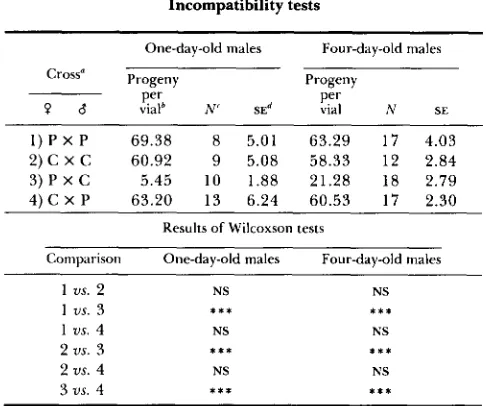
Incompatibility tests
One-day-old males Four-day-old males Cross“ Progeny Progeny
0 6 vlal Perb N‘ S E ~ Per vial N SE 1) P X P 69.38 8 5.01 63.29 1 7 4.03 2) C X C 60.92 9 5.08 58.33 12 2.84 4) C X P 63.20 13 6.24 60.53 17 2.30
Results of Wilcoxson tests
Comparison One-day-old males Four-day-old males 3 ) P X C 5.45 10 1.88 21.28 18 2.79
1 us. 2 NS NS
1 us. 3 * * * * * *
1 us. 4 NS NS
2 us. 3 * * * * x *
2 us. 4 NS NS
3 us. 4 * * * * * a
a P and C 5 mtDNA types.
’
Mean number of progeny per vial. ‘ N = number of vials.SE = standard error. * * * = P < 0.001.
and “W” strains established by HOFFMANN, TURELLI
and SIMMONS with the result C
=
R and P W. This result is reported in HOFFMANN and TURELLI where our C strain is identified as “Tuscany” in their Table2 (on page 437) and their statement “W populations also occur in Europe” on the same page refers to our “P” strain.
HOFFMANN, TURELLI and SIMMONS showed that “R” is cured by tetracycline, and electron microscope stud- ies by BINNINCTON and HOFFMANN (1989) demon- strated the presence of the Rickettsia Wolbachia, sp. in R but not W strains. Electron microscopy by LOUIS and NICRO (1989) shows that the C strain has the Wolbachia but not the P strain. Table 1 shows the results of crosses to test for unidirectional incompati- bility between the original C and P strains. Wilcoxon significances tests are given. T h e semisterility of the PQ X C$ cross, with less sterility of the older males, is characteristic of the R,W pattern.
Figure 1 shows the results of sampling the three repiicate high lines and three low lines. Tests for heterogeneity among the three replicates gave only one significant G test with 0.01
<
P<
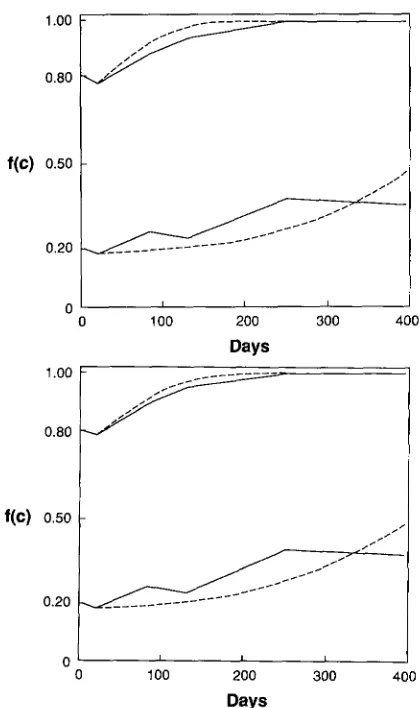
0.025 so the replicates were combined as shown in Figure 2 to- gether with a predicted trajectory to be discussed presently. On day 400 at the end of the experiment100 isofemale lines were established. Females from these were crossed to males from the original C stock, and also the mtDNA type was determined for each line. Thirty-two lines had C mtDNA and the females were fully fertile with C stock males. Of the 68 lines with P mtDNA, 66 were semisterile with C stock males, but two lines show the high fertility character-
0 100 200 300 400
Days
FIGURE 1 .-Results of sampling populations. f ( C ) the relative frequency of mtDNA type C.
istic of a compatible cross. These had apparently ac- quired the microorganism.
ANALYSIS AND CONCLUSIONS
Ideally the C mtDNA type should serve to monitor the incidence of the microorganism because both are transmitted matroclinously. However, HOFFMANN and TURELLI have evidence for a low frequency of trans- mission through males. Thus in a PQ x Cd cross, among the small number of resulting progeny approx- imately 1.4% acquire the infection. These individuals would be of the kind observed at the end of the experiment and are here denoted PI, to indicate P
mtDNA infected with microorganism. HOFFMANN and TURELLI also tested for spontaneous curing and found none. This result is also supported in our case by the finding that at the end of the experiment where females from all of the C mtDNA isofemale lines were compatible with C stock males. This means that in our population initiated with C infected and P not infected only a third type should appear, namely PI, although our monitoring could not distinguish between P and Pi. T h e appearance of PI we here call “leakage.”
Table
2
sets forth a discrete generation model for the three types withf(C)=
P I , f(P) =: P s and f(P1) Ep 3 .
Recurrence equations (2) refer to an age structured version to be discussed presently. There are three parameters: U the fitness effects of the microorganism on its carriers as compared to those not carrying it; V, the fertility of the incompatible cross and L , the leak- age rate or the conditional frequency of infected individuals among the V individuals from the incom- patible cross. With low leakage, L , andf(P1) small as at the start of the experiment whenf(P1) = 0 there is an unstable equilibrium atf(C) = 61 = (1-
U)/1-
V).TABLE 2
Model
0 ’ I
I I I
0 100 200 300 400
Days
0 100 200 300 400
Days
FIGURE 2.-(A) Solid lines are means of three replicas shown in Figure 1. Dashed lines are the trajectories given by the model. Parameters given in the text. ( B ) Solid lines as in (A). Dashed lines are the model trajectories assuming an “8-day week” with parame- ters given in the text.
served for f ( C ) us. f(P)
+
f(P1) in the experimental population.HOFFMANN and TURELLI determined that there is a significant fitness effect of the microorganism amounting to U = 0.781 (SE = 0.046). T h e results shown in Table 1, although not statistically significant, are consistent with the HOFFMANN and TURELLI val- ues. T h e ratio of the mean productivity of C X C and
C? X PS crosses to that of P X P gives
U
= 0.894 for 1-day-old males and U = 0.939 for 4-day-old males. This “productivity” fitness does not resolve the fertil- ity and viability components. With strictly matrocli- nous transmission with no intervening Mendelism these two components collapse so that it makes no difference whether the net fitness is formally treated as fertility as in Table 2 or viability. T h e only place inthis system where the two components should be resolved is in the
PO
x SC cross where L of the offspring are infected. However, this is of such rare occurrence that treating the fitness as fertility when it might be viability or both would have very little effect. T h e productivity of the incompatible cross com-Mating Offspring X IT
P X 8 Frequency C P PI
c x c
p :up;
P X P p % p f
PI x PI p3
up
;
C X P PIP2 UPlP,!
c
x PI PIP, up1p3P x PI p 2 p 3 V(1
-
L)pYp, VLpzp,P X C P 2 P I V(1 - L ) p ! p l VLPZP,
PI x
c
P 3 P lup,p
IPI x P P 3 P 2 up3p2 Where, P I =f(C), P ? =f(P), P , =f(Pd
Recurrence equations ( 1 )
= plm“ (1A)
P I 2 =
[p,
+
V(1-
L)P,(l-
PP)]W” (2B)p ’ , = [UP,
+
VLPZ(1 - P 2 ) l W ” (3C)m
= pH+
( 1 - p2)U+
P2(1-
P2)VApproximate equilibrium with small L and the population initiated at p , = 0
p = -
1 - u
1 - v
Recurrence equations (2) for age structure,
p ‘ , = (Up1)W-l (2‘4)
p ’ 2 =
(j,&
+
V(1-
L)p2 ( 1 - &))W”l ( 2 B )p . 3 = 1 - p ’ l - p ‘ , P C )
w = p 2 & + u ( 1
- j 2 ) + V j 2 ( 1-&)
where
classes at time t.
p ‘ l , P I 2 , p‘, a r e in eggs o f t
+
1 produced by the three adult agep , = mean over three age classes weighted by 0.40, 0.45, 0 . 1 5 , as
p , mean over three age classes weighted by 0 . 5 5 , 0.33, 0 . 1 2 , as
explained in the text.
explained in the text.
-
pared to P X P gives V = 0.078 for 1-day-old males and 0.33 for 4-day-old males. These are comparable to but a little larger than the values of HOFFMANN and TURELLI, and HOFFMANN, TURELLI and SIMMONS, which are near zero for 1-day-old males, 0.12 for 3-
4-day-old males and 0.26 for 7-8-day-old males. When using parameter values in the range of the above in discrete-generation iterations, and 2 or 3
weeks for the generation time, the model indicates generally that the frequencies should accelerate more than the observed values.
sumption of 2 weeks’ duration for egg to emergence and a maximum of 3 weeks for adult survival. Stable age distribution was assumed with 1-week time inter- vals. Based on the data of GOWEN and JOHNSON and ROBERTSON and SANCE the following additional as- sumptions were made. T h e relative composition of
adult age classes are assumed to be 0.55 for adults between emergence and 1 week of age, 0.33 between 1 and 2 weeks of age, and 0.12 between 2 and 3 weeks of age and also, the values used for the females’ contribution to eggs, “relative lxmx,” for the same set of ages were 0.40,0.45 and 0.15, respectively. Assum- ing the fitness effects are all in the fertility component, the contribution of adults at time, t , to eggs at t
+
1, was obtained by using the matings in Table 2 such that the contributions of females were weighted by the “relative l,m,” above after they had mated to males weighted by the age class composition given above. This procedure results in the recurrence equa- tions (2) in Table 2 for eggs at time t+
l from adults at time, t .There were six age classes: eggs, pupae, newly emerged adults and the three additional adult age
classes, each containing the three types C , P and PI in frequencies
P I ,
p 2 and p s as defined in Table 2. T h emating of the adults at time, t , determined the fre- quencies in the eggs at time t
+
1, and the other frequencies were moved up one age class for t+
1. T h e frequencies of the C types, $ 1 , in the three adultage classes were weighted by the age class composition and the resulting mean for each week provided the trajectory to be compared with the data.
Using parameters closer to the Table 1 values rather than to HOFFMANN and TURELLI a reasonable fit can be obtained. Using a fitness of U = 0.92, fertility of V
= 0.30, assuming a negligible standing frequency of young males, and leakage L = 0.14 from HOFFMANN and TURELLI the result is the trajectory plotted to- gether with the experimental data in Figure 2A. In Figure 2B is shown the result when assuming an “8- day week” with U = 0.92 and V = 0.30. T h e parame- ters of Figure 2A predict that at the end of the experiment leakage should have resulted in PI with frequency
p 3
= 0.02 1. This agrees well with the find- ing of two PI lines out of the 100 isofemale lines testedat the end of the experiment. T h e unstable point for these parameters is = 0.1 14. T h e HOFFMANN and TURELLI parameters of U = 0.781 and using V = 0.20 give an unstable point of f i l = 0.274, which is higher
than our initial frequencies. It is unfortunate that our initial frequencies were not low enough for our ex- perimental conditions to provide a qualitative test of
the model by demonstrating the unstable point. How- ever, the principle reason for publishing these data is to demonstrate that our results can be adequately explained by known fitness effects of the incompati-
bility system, meaning that there is no need to invoke selection on mtDNA differences. This is in contrast to the work on Drosophila pseudoobscura by MACRAE and ANDERSON (1988) where they observed, to use their words, ”dramatic mtDNA frequency changes” which they attribute to fitness effects resulting from the interaction of nuclear and mtDNA.
T h e incompatibility between the two D . pseudoob-
x u r a subspecies is different from ours in that it results
in F1 male sterility rather than reduced egg hatch.
Also, the maternal effect appears not to be transmitted to subsequent generations as in the microorganism in o u r case (ORR 1989). Other details are discussed by MACRAE and ANDERSON (1990). Nevertheless, it is clear that experiments of this type seeking selection on mtDNA should be done without such complica- tions.
In addition to reporting the results above we take this opportunity for some observations concerning the natural occurrence of the infected individuals, or R types as opposed to W types using the HOFFMANN and TURELLI notation. With such a low unstable point of, in our case,
fi
= 0.1 1, or using the HOFFMANN and TURELLI parameters, $ = 0.27, this would not consti- tute a substantial barrier to invasion and spread of the R types. HOFFMANN and TURELLI suggest that R types may, in fact, be spreading pointing to their finding of low levels of polymorphism with some R types in a W population, but they also found some W types in an R population.We have some simulation results of migration in a very simple discrete generation model which might suggest how the parameters could be governing this system. There are two populations, one initially com- posed of R types and the other of W types, which, after mating within the populations, exchange mi- grants such that each population is composed of a fraction, m, from the other population. These two populations could be regarded as local populations at the border of the R and W ranges.
If m is less than a critical migration rate, m * , then R will not invade and a stable equilibrium will result in each population. For the HOFFMANN and TURELLI parameters above, m * = 0.018. If m exceeds this value R will invade the W population, but if, for example, m = 0.01 there will be a stable equilibrium with 0.04 R types in the W population and 0.01 W types in the R population.
In this system when the fitness, U , decreases and V
appear to be consistent with the HOFFMANN and TUR- ELLI observations.
If we speculate that the fitness might be lower in the natural environment than under laboratory con- ditions then when U decreases the system shows a qualitative change. If U is lowered to U = 0.16, keep- ing V = 0.30, then when m
>
m* = 0.050 it is the W type which invades the R population. This is so even though in an isolated population these parameters give the unstable point atfi
= 0.50 implying ambiguity as to which type will invade. If the fitness is raised toU = 0.675 (V = 0.30, still) it is approximately at this point that the situation becomes ambiguous as to which type will invade when m
>
m*.
This is close to the lower confidence limit above. Here m* is a maxi- mum andfi
= 0.464 in an isolated population.This model, as opposed to the one used above to fit the data, we regard as an instructive metaphore for the much more complex processes occurring in natu- ral populations.
Little is known about long distance migration in Drosophila populations, but the fact of the present localized occurrence of R populations, and also the world wide Adh and inversion clines in D. melanogaster
(OAKSHOTT et al. 1982) where no strong selection has been detected suggest that migration is not so great as is commonly believed.
T h e final answer to these questions concerning the interaction of fitness effects and migration on popu- lation dynamics can be investigated directly by moni- toring the boundaries between R and W regions which is now being done on the transect between Northern California (W) and Southern California (R) by HOFF-
MANN and TURELLI.
We wish to thank BRUCE RISKA for helpful discussions about models and NORMAN EATON for writing the computer programs. The experimental work was supported by a grant from the Italian Ministry of Education.
LITERATURE CITED
BINNINGTON, K. C . , and A. A. HOFFMANN, 1989 Wolbachia-like organisms and cytoplasmic incompatibility in Drosophila simu- lans. J. Invertebr. Pathol. 54: 344.
COEN, E. S., J. THODAY and G. DOVER, 1982 Rate of turnover of structural variants in the rDNA gene family of Drosophila melanogaster. Nature 295: 564-568.
DOBZHANSKY, TH., 1974 Genetic analysis of hybrid sterility within the species Drosophila pseudoobscura. Hereditas 77: 8 1-88. GOWEN, J. W., and L. E. JOHNSON, 1946 Section on genetics and
evolution on the mechanism of heterosis. I. Metabolic capacity of different races of Drosophila melanogaster for egg production. Am. Nat. 80: 149-179.
HOFFMANN, A , , M. TURELLI and G. SIMMONS, 1986 Unidirec- tional incompatibility between populations of Drosophila simu- lans. Evolution 4 0 692-701.
HOFFMANN, A. A , , and M. TURELLI, 1988 Unidirectional incom- patibility in Drosophila simulans: inheritance, geographic vari- ation and fitness effects. Genetics 119 435-444.
LOUIS, C., and L. NIGRO, 1989 Ultrastructure evidence of Wol- bachia rickettsales in Drosophila simulans and their relationship with unidirectional cross-incompatibility. J. Invertebr. Pathol.
54: 39-44.
MACRAE, A. F., and W. W. ANDERSON, 1988 Evidence for non- neutrality of mitochondrial DNA haplotypes in Drosophila pseu- doobscuru. Genetics 1 2 0 485-594.
MACRAE, A. F., and W. W. ANDERSON, 1990 Can mating prefer- ences explain changes in mtDNA haplotype frequencies? Ge- netics 1 2 4 995-997.
OAKSHOTT, J. G., J. B. GIBSON, P. R. ANDERSON, W. R. KNIBB, D.
G . ANDERSON and G. K. CHAMBERS, 1982 Alcohol dehydro- genase and glycerol-3-phosphate dehydrogenase clines in Dro- sophila melanogaster on different continents. Evolution 36: 86- 96.
ORR, A . H., 1989 Genetics of sterility of hybrids between two subspecies of Drosophila. Evolution 43: 180-189.
PRAKASH, S., 1972 Origin of reproductive isolation in the absence of apparent genic differentiation in a geographic isolate of
Drosophila pseudoobscura. Genetics 72: 143-1 55.
ROBERTSON, F. W., and J. H . SANG, 1944 T h e ecological deter- minants of population growth in Drosophila culture. I. Fecund- ity of adult flies. Proc. R. SOC. Lond. B 132: 258-277.