ISSN 2286-4822 www.euacademic.org
Impact Factor: 3.1 (UIF) DRJI Value: 5.9 (B+)
Building an Automatic System to Construct
a Thesaurus for Arabic Language Words
HASAN HUSSEIN RASHAIDEH
Prince Abdullah Bin Ghazi Faculty of IT University of Al-Balqa’ Applied, Salt
Jordan
IMAN HUSSEIN AL-QINANI
Education College University of Al-Mustansiriyah, Baghdad Iraq
SALEH AL OQEILI
University of Al-Balqa’ Applied, Salt Jordan
Abstract:
Constructing an automatic thesaurus for Arabic is a very challenging and difficult task due to several reasons. In this paper we proposed new method to constructing an automatic system thesaurus for Arabic language words. In order to achieve this objective, we have selected and tested a new approach for building an automatic system to construct a thesaurus for Arabic language words. We have applied the suggested approach on Al Wasit database (Al Wasit dictionary), where the most frequent words and the meaningless ones are cancelled. This research has relied upon the statistical instead of the linguistics methods in building the system. In addition, it have offered several alternatives to be used in the case of improper results of the program, such as re-ranking the results, adding unavailable word in dictionary or supporting the word definition which is found in the dictionary through entering an article relevant to the entered topic of the word.
Key words: Thesaurus, Arabic language, Al Wasit dictionary, Stopword, Rank.
1. Introduction
Technology has touched every aspect of our lives. Literally, it changed the way we live and conduct our daily activities. People rely heavily on technology in their homes, school, and work place. Reading books has become through digital media and looking up words from a dictionary or thesaurus has become electronic as well (Al-Qabbany, et al., 2009; Turban, et
al., 2002).
The study of the constructing a thesaurus for Arabic language words gaining importance because it tries to keep pace with technology of NLP (Al-Qabbany, et al., 2009; Turban, et al., 2002). Nowadays, people do not have time to spend on looking up a word in a dictionary or thesaurus. Thus, they rely on technology to maximum extent (Turban, et al., 2002). Most of them carry pocket size electronic dictionaries or thesaurus which can fulfill their need instantly (Turban, et al., 2002). Constructing an automatic thesaurus for Arabic in particular is a very challenging and difficult task due to several reasons: Thesaurus for Arabic language is very rare whereas most of the studies, research and thesaurus construction approaches are conducted and designed for the English language (Zaidi, et al., 2005). As a result, before examining a thesaurus constructing approach, this research will deal with the Arabic language limitation’s such as lack of database for words of similar meaning and how to apply a construction method such as Soergel 1974 (William, et al., 1992) or Grefenstette’s syntactical contexts (Senellart, et al., 2008) and others which have been designed for building a thesaurus for English and how to apply them on the Arabic language.
references. As a result, constructing a thesaurus is a challenging task. The study is restricted to the spoken Arabic or the easy version of it since most of the inside and outside of Arabs do not know the meaning of old Arabic literature vocabulary and philology (Khafajeh, et al., 2010). Arabic language lacks the databases that contain a large volume of Arabic vocabulary. As a result, gathering and categorizing words similar in meaning is a very challenging task.
Many researchers will be conducted about the similarities between the English and the Arabic terms in order to reveal the closest approach of building a thesaurus and its application in the Arabic language. At the same time, a comparison will be conducted between the manual approach (Senellart, et al., 2008; William, et al., 1992) and the automatic one (Al-Qabbany, et al., 2009; Hsinchun, et al., 1995; Khafajeh, et al., 2010; Senellart, et al., 2008; William, et al., 1992) in order to declare which one of them is more appropriate to construct a thesaurus for Arabic language words. However, The study of this subject has few limitations such as Arabic letters being different from other language letters (Khafajeh, et al., 2010) because Arabic letters are subject to: Alkasrah, Dammah, Fathah and sukun according to these mark the letter is pronounced (Khafajeh, et al., 2010; Zaidi, et al., 2005):
[ َن ، ْن
ن ، ُن ،
]
(Zaidi, et al., 2005) presented a method to describe a web–based multilingual tool for Arabic information retrieval based on ontology in the legal domain. They started with the manual construction of the ontology and its editing via protégé 2000. The study used (UN: United Nations) Arabic and query expansion for Arabic documents. Query expansion is achieved through using a semantic word thesaurus – Word net; Results showed that there is a significant improvement in the recall and the precision.
(AL-Qabbany, et al., 2009) proposed an improvement to the similarity thesaurus construction method used for query expansion in information retrieval as “MEAN” method; the proposed improvement of about 3.3% over the SUM method. Results “MEAN” method more accurate than the “SUM” method and it can discover and eliminate the outlier. Source data used the France Press Agency news as the document collection. Number of documents (208,596), number of terms (435,846), number of terms occurrences (30,415,222), number of processed terms (248,311), average number of words per document (69.78).They have choose twenty general topics to use for the evaluation process.
(Khafajeh, et al., 2010) discussed a major problem of modern Information Retrieval (IR) systems, which is the vocabulary problem that concerns the discrepancies between terms used for describing documents and the terms used by the researchers to describe their information need. Using a thesaurus is one way to overcome vocabulary problem. (242) Arabic texts were used and 59 Arabic queries. All of it involved computer science and information system. The main objective of the paper is to design and build automatic Arabic thesaurus. They used term-term similarity and association techniques for every field and domain. Results showed that the association thesaurus improved the recall and precision over the similarity thesaurus.
2. Proposed Methodology
2.1 Obtaining Al Wasit Data
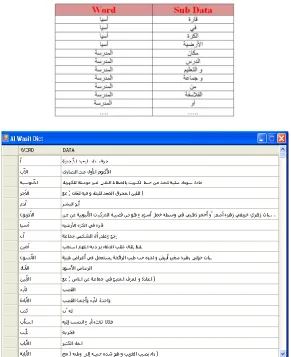
In this step, we aim at inserting Al Wasit dictionary data word file into excel file with two columns: the first column contains the word and the second column contains the definition of the word. The two columns are in Arabic language as the examples showed in Table1.
Table 1: Al Wasit Data in Excel File
2.2 Create Table in Oracle Database
The second step to create database table in Oracle SQL based on Al Wasit dictionary excel file taken from the previous step that has been inserted in (Data table). At the end of this step, we have Al Wasit data in Oracle database. as shown in the examples in Figure 2.
2.3 Data Analysis
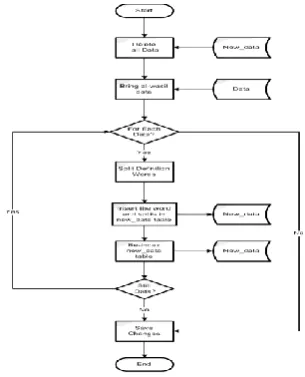
Third step is to separate the word and its definition in simple table automatically, and to insert the process data in it (New Data table). The separation has been made based on space character between definition words which makes (609551 Sub Data) as shown in the example in Table 2.
Table 2: New_Data Table
2.4 Remove Remarks
Now, we have to remove all the unwanted characters and replace them with null value in Sub Data. For example: (",","!","","؟","(",")",";","\","/",":","&","<",">","^","9","8","0","1","2"," 3","4","5","6","7",…etc).
2.5 Remove Stopword and Maximum Repetitions Words
Stopword means the words which are very frequent and they are considered as weak to be distinguished, we cannot distinguish the content of a text depending on them. These words are removed and not indexed in order to save both space and time (Khafajeh, et al., 2010). Here, Stopword includes: (demonstrative pronouns, relative pronouns, Arabic letters, names and verbs, interjection verbs, conditional pronouns, interrogative pronouns, etc.). It is shown in the examples given in Table 3.
At this step, we create two tables: the first is named
(Stopword Table) which contains most of the popular
stopword in Arabic and it contains about (14,000 words), they were obtained from the World Wide Web. Removing and Reducing thousands of stopword will speed up the search in the algorithm.
The second table is named (Maximum Repetitions
Words Table) which contains the most frequent words in (sub
data column) in Table 2 as shown in Table 4. The words repeated more than 200 times in sub data column in Table2 have been included in Maximum Repetition Words Table.
2.6 Obtaining word definition
Table 3: (A) Stopword Table. (B) Maximum Repetitions Words Table. (C) Statistics for Max Repetitions Words Table.
2.7 Search Algorithm
For searching synonyms of any given word, search algorithm look about the input word on Word column for Table 2 ( New_Data Table) and when it found it return the corresponding word in the sub data column, otherwise the new word will insert in the table with some identification about it (this can happen for new or updates words. The result table will be rearrange to remove all the redundant words.
The system gives the user some other choices such as ranking the result and the rank mark insert in the rank table. The user can also give feedback, new word and its definition, or both in algorithm. The user can Re-Rank the result and change the algorithm result if there is an undesired result.
2. 7.1 Other Choices Result Process
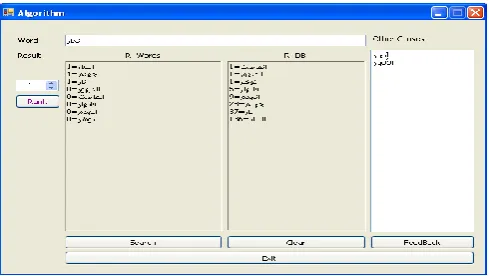
forms (ِ ،ج ،خ) and the letter (ٖ) which can be written in the forms (ئ ،ٖ ،٘). This procedure aims at processing the forms of the following letters (ٖ ،ؤ ،خ ،ا) as well as defining the word with article (لا) or subtracting it from the word. Then, all the possible forms of the letter in the inserted word are created as shown in the example given in Figure 3.
Figure 3: Example for Other Choices Result Process
2. 7.2 Feedback Process
The goal of this procedure is to clarify the process whether the user has entered a certain synonym into the feedback domain. Several updates shall occur through this entry, such as accrediting the new word in word_ feed table as well as the Ranking and approving of the synonym within the results.
2. 7.3 Rank up/down Button Process
Rank, which means that synonymous produced by the system relative of the original word (synonyms arrangements which the system produces are closer to the meaning.). High rank means closer synonymous to original word, rank start numbering from 0 to infinite. Using this procedure, processing occurs if the user presses the Rank Button. By doing so, the user changes the rank of the word; thus, the rank will update. In addition to that, update of the word_ feed table occurs too, as the example shows in the Figures 9.
2.8 Algorithm Application Mathematically
Algorithm applicable in the form of mathematical equations:
Where: X is the input word, O(X) is the other choices for the input word such as (ٌاًٚإ ,ٌاًٚآ,ٌاًٚاَ,ٌاًٚأ: ٌاًٚا)}, F(X) is the feedback,
which is the closest synonym to the user input word almost entered by the language expert, DB is the words collection that we got from New_Data Table, R(X): is the words collection that we got from F(X) and DB, Distinct (R(X)) delete the repeated words form R(X).
NR(X): Find R(X) for each synonym result from (R(X) for input word)
Rank Result Matrix: find rank of the synonyms by intersect
(R(X) forinput word) with NR(X).
2.9 Example for search Algorithm
Table 5: Create R(X) for Word [ةسردملا]
Table 6: NR(X) for Word [ةسردملا]
Table 7: f(X) for Word [ةسردملا]
3. Experimental Results
3.1 Validity of Study's Tool
Validity of the study's tool has been obtained through submitting it to a panel of arbitrators who are experts in the field and are specialized in the Arabic language. an example for System Results for Words of the Questionnaire that it distributed over to a group of experts to assessment shown in the Table 8.
Table 8: example for System Results for Words of the Questionnaire
3.2 Procedures for Assessment Questionnaire Analysis
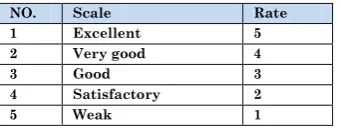
For the purpose of SPSS analysis of the data collected from the members of study's sample, responses are given the following scale (excellent, very good, good, satisfactory, weak). Each selection is given the rate as it is shown in the Table 9.
Means of the responses of the participants are obtained through conducted SPSS program for the purpose of results discussion, obtained scores are distributed on three levels as it is shown in the Table 10:
Table 9: The Scale and the Rate
Table 10: Scores and Assessment Level
NO. Scale Rate
1 Excellent 5
2 Very good 4
3 Good 3
4 Satisfactory 2
5 Weak 1
NO. Level Scale Assessment Level
Level 1 1 to 2. 33 Low
Level 2 2.34 to 3.66 Medium
Range level is computed through the following computation steps:
- The highest rate (Excellent) - lowest rate (weak) = (5-1) = 4
- The division of the product on the number of levels which the study has determined namely three levels: (Low, Medium, and High).
4 / 3 = 1.33 the product is the level’s length then addition the product to the lowest rate that is: 1+1.33= 2.33 thus, first level (low level) is (1 to 2.33),
2.3+ 1.33 = 3.66 thus, second level (medium level) is (2.34 to 3.66).
3.66 + 1.33 = 4.99 Thus, the rate exceeds 3.66 is high which is the third level.
3.3 Assessment Analysis
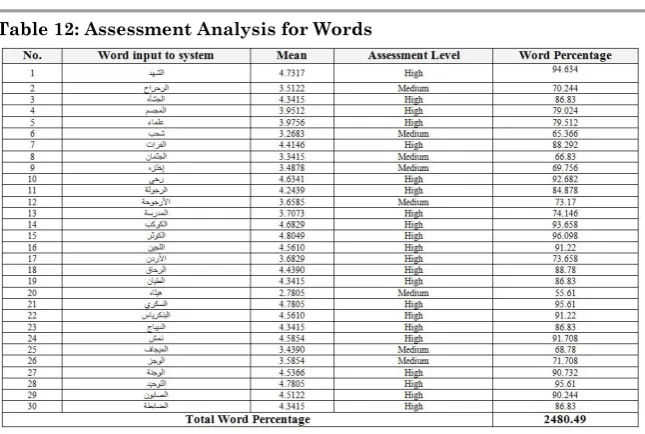
Means of the responses of the study’s participants are calculated through statistical analysis. The results showed that most words in the assessment paper have means higher than (3.66) which they fill in the third level (High). This indicates that the order of synonyms which the system produces is close to a higher rate as showed in table 13.
Means of the responses of the study’s participants are calculated through SPSS analysis as in the example of
[ذٓشنا]:
Table 11: SPSS analysis for word[دهشلا]
Accumulative Multiplication Scale = 35*5 + 3*4 + 2*3 + 0*2 + 1*1 = 194 Mean = 194 / 41 = 4.7317, Word Percentage = (4.7317/5)*100= 94.634
Word Excellent 5
Very good 4
Good 3
Satisfactory 2
Weak 1
Mean Word Percentage
Table 12: Assessment Analysis for Words
The word percentage is given the ratio of acceptance for each word in the questionnaire by a group of experts.
Finally, the Total Word Percentage (T.W.P.) = 2480.49, the average percentage (AVG.) of whole questionnaire can be calculated using:
AVG. = (T.W.P. / No of Word) = (2480.49/30) = (82.683) so the accuracy of the questionnaire will be (83%)
3.4 Comparison
Compare this study with other papers for Building an Automatic System to Construct a Thesaurus for Arabic Language Words:
1. Other studies specialized in just one area as a legal, medical, while this study general.
2- This study searched for synonyms for the word using dictionary that Arabic words database in the event was word modern such as globalization ( حًنٕعنا ), computer( بٕساح) and (حٛطاشقًٚد) will add an article about this words to extract synonyms.
3. Using dictionary and articles as well as enter of expert user the near synonym to the word (feedback).
4- We have not used diacritized texts; however, we have attempted to remedy the forms of the letters that cause the user to make an error or that give the word a different meaning such as the letters ( ٖ ,ؤ ,خ ,ا ).
4. Conclusions
We have to go to the original source of work; i.e. a database of Arabic words taken from Al Wasit Dictionary. This database is processed in several steps to constitute an automated thesaurus. As a part of the research, statistical intersection approach is used to obtain the very close synonymy to the original word.
first, Feedback techniques are simple and give good results. The second, changed ranking for the result return and re-order are completed easily. Third, Fast algorithm to process and get the result within less than a second for each search operation. Fourth, optimal memory usage no redundant data because database concept applies as database of the dictionary and other data. Contributions of this study: first,the study is important because it discusses an important subject that is constructing a thesaurus for Arabic language words. There is no accredited thesaurus for Arabic, even in its traditional form as a book or printed dictionary. Those unaccredited thesauruses do not include all the Arabic words that Arab speakers use. Second, the significance of this study can be employed in many Linguistic applications as Information Retrieval.
The disadvantages of the system used in this study are: first, Data relationship reflects intersected results: if data contains good definitions, the result will be perfect and near 100%; and if not, the results will be poor. Second, the algorithm needs time for the first initialization, only the first time to calculate the relationships. The third, using not full and partial diacritized texts.
REFERENCES
Al-Qabbany, A., Al-Salman, A., & Almuhareb, A.(2009). An Automatic Construction of Arabic Similarity Thesaurus. 3rd International Conference on Arabic Language Processing (CITALA2009), PP: 31-36, Rabat, Morocco.
Holy Quran. (n.d.).
Hsinchun, C., Yim, T., & Fye, D.(1995). Automatic Thesaurus
Generation for an Electronic Community System.
Khafajeh, H., Yousef, N., & Kanaan, G. (2010). Automatic Query Expansion for Arabic Text Retrieval Based on
Association and Similarity Thesaurus. European,
Meditrranean & Middle Eastern Conference on Information Systems (EMCIS 2010) Global Information Systems Challenges in Management. PP: 1-16, Leroyal Meridien Abu-Dhabi, UAE.
Senellart, P. & Blondel, V.(2008).Automatic Discovery of
Similar Word. in: Survey of Text Mining ii (B. M.W.,
Ed.). Springer-Verlag, pages: 25-44, London.
Turban, E. F., Lee, J., King, D., Warkentin, M., & Chung, H.(2002). Electronic Commerce (2 Ed.). A Managerial Perspective. Upper Saddle River, NJ: Prentice Hall. Hardcover: 914 pages, London, UK.
William, B. F., & Yates, R. B. (1992). Information Retrieval:
Data Structures and Algorithms (1 Ed.). Prentice Hall,
Hardcover: 473 pages.
Zaidi, S., Laskri, M., & Bechkoum, K. (2005). A Cross-language Information Retrieval Based on an Arabic
Ontology in the Legal Domain. The International
Conference on Signal-Image Technology & Internet– Based Systems (SITIS05), PP: 86-91, Morocco.
Iman AL-Qinani. University of Al-Mustansiriyah, Education College, Baghdad, IRAQ. She received BSc in computer science from AL-Mustansiriyah University, and MSc in computer science from Al-Balqa’ Applied University, worked in university. She has many published papers in the computer science field. Her research interests are in image processing, biomedical, and Artificial Intelligence, She’s Associate Teacher in Computer Science at the University of Mustansiriyah – Baghdad, IRAQ. E-mail: [email protected]
![Table 4: Example for Word Processing [ةسردملا]](https://thumb-us.123doks.com/thumbv2/123dok_us/7756479.1272205/10.439.60.380.468.602/table-example-for-word-processing-srdmla.webp)
![Table 5: Create R(X) for Word [ةسردملا]](https://thumb-us.123doks.com/thumbv2/123dok_us/7756479.1272205/11.439.62.379.284.500/table-create-r-x-for-word-srdmla.webp)
![Table 7: f(X) for Word [ةسردملا]](https://thumb-us.123doks.com/thumbv2/123dok_us/7756479.1272205/12.439.60.380.61.298/table-f-x-for-word-srdmla.webp)
![Table 11: SPSS analysis for word[دهشلا]](https://thumb-us.123doks.com/thumbv2/123dok_us/7756479.1272205/14.439.52.391.449.527/table-spss-analysis-for-word-dhshla.webp)