Situation of Child Labour: Its Causes and Effects-- A Case Study
Amarender Kadian M.D.U. Rohtak (Hr.)
ABSTRACT:
Children are the future of nation or we can say that children are the most important assets of the
society and future of nation depend upon how the children are educated and trained and how their mental
and physical development is taken care of. On of the most important causes of child labour is poverty and
unemployment particularly in the unorganized and rural areas which comples every member of the family,
including children, to work to supplement the family income. So child labour is a multi-dimensional
problem. Poverty, caste, tradition, size of family, labour scarcity, wage rates, illiteracy, ignorance,
schooling facilities etc., are the major factor for the major factor for the occurrence of child labour.
Present paper also seeks to given brief explanation of child labour situation in town.
Keywords: Child Labour, Physical Development, Schooling Facilities
INTRODUCTION:
Children are important assests of any nation as they are the future of citizens. But in recent decades child labour is organized as serious problem in the world today. It is a widespread phenomenon involving a significant number of children for whom work is an ordeal, a source of suffering exploitation. The problem of child labour in under developed and developing countries is the quite high abnormal. In our country the problem of child labour has assumed very alarming position. Despite enactment of various laws expressing deep concern over this issue by social activists, academicians, the magnitude of the problem on not been set aside rather went on increasing. According to factory Act-A person below the age of 15 years is to be regarded as a child. There fore any physical labour undertaken by a child of below 15 years either under compulsion or voluntarily in an organized or under organized sector, qualities to be called an child labour.
The problem of child labour in India may seem to result from traditional attitudes,
urbanization,, industrialization, migration, lack of school and reluctance of parents send their children to school and so on (Prasad 2001). The recent International Labour Organization (ILO) estimate shows that there are nearly 250 million child workers aged 5 to 14 all over the world. A recent survey conducted by the ILO states that out of these 61 per cent are in Asia, 32 per cent in Asia and 7 percent in Latin America.
OBJECTIVES
The main objective of the study is to find out the main reason of child labour and their contribution to their families.
DATABASE AND METHODOLOGY
The present study is based on primary data which collect through the help of questionnaire.
STUDY AREA
Rohtak city is an important headquarters of the district Rohtak and divisional headquarter of Rohtak division of the state, Haryana, it has about 444819 including 235920 males and 208899 females. the male literacy rate is 88.82 per cent and female literacy rate is 77.68 percent.
The concept of child labour is not uniform all over the world. It is also not the same in all statutes that refer to the employment of children. However, the working child who is below the age of 14 and who is paid either in cash or kind is normally considered as child labour.
RESPONSIBLE FACTORS FOR CHILD
LABOUR
Poverty
Poverty is often stated as the single most important factor responsible for child labour. It works in two ways: first, a need for augmenting meagre family income often compels families to put their children to work. Second poverty also implies a lack of ability on the part of households to allocate necessary resource of education.
Family Size
Even through there is considerable change in the attitude of the families norms, there has not been any majority change. The needs of family are dependent on the size of the family. When the needs goes up there is bound to be an in crease in the expenditure. This leads to the burden of earning more which has to be borne by all the family members irrespective of age. Then this is when children get engaged in work.
Lack of parental interest
This is applicable largely in the rural areas. The rural folk who are away from areas exposed to education are unaware of benefit of that education reaps. They do not have Faith in the educational system. With this perception, they are bound to send their children for labour because in their opinion education has not practical use.
Lack of educational attainment
Education always plays a vital role in the socio-economic and cultural development of any society. Hence there exists a high positive correlation between the level of educational attainment and socio-economic standard of community life. But our education system perpetuates the domination of privileged few over the entire society while the children of poor people continue to remain uneducated. It is commonly found that the level of parents‟
education and aspiration are closely associated with children labour.
Community
Community or caste has remained one of the forceful determinants of child labour. Children belonging to communities like scheduled caste we found to work as child labourers in large numbers
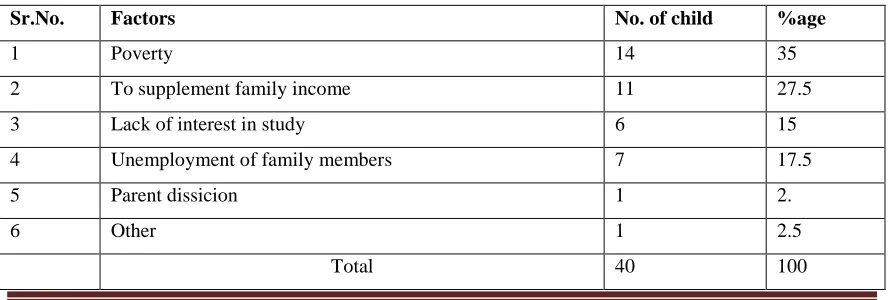
Table 1.1 : Main causes of child labour
Sr.No. Factors No. of child %age
1 Poverty 14 35
2 To supplement family income 11 27.5
3 Lack of interest in study 6 15
4 Unemployment of family members 7 17.5
5 Parent dissicion 1 2.
Sources: Field Survey
Chart: 1 Causes of child labour
Table 1 and chart 1 shows that out of 40 respondents as high as 35 per cent indicated that poverty was the main reason for accepting work. 27.5 per cent opined that they were working to supplement their family income. While 17.5 per cent are directly blamed their unemployed family members. 15 per cent showed lack of interest in study. 2.5 per cent say they were obeying their
family decision and 2.5 per cent gave some other causes such as loss parents etc. On the basis of these findings it may be said that there are various circumstances like poverty, low family income lack of interest in study, unemployment are some cause which leads children to work at
any age.
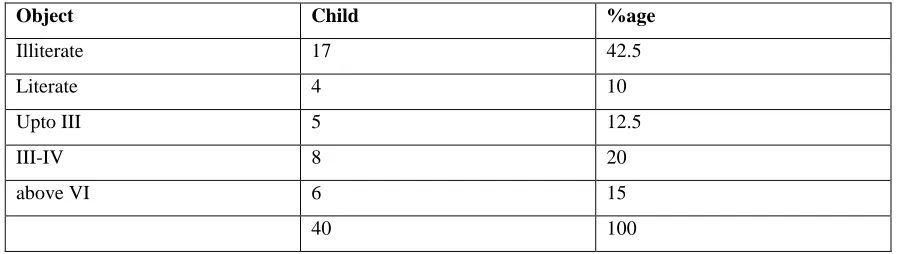
Table: 1.2 : Educational Status of child labour
Object Child %age
Illiterate 17 42.5
Literate 4 10
Upto III 5 12.5
III-IV 8 20
above VI 6 15
40 100
Source: Field Survey
Table 1.2 observed that out of 40 respondent 42.5 per cent are illiterate, 10 per cent literate, 12.5 per cent are up to class III. It shows that for poor families the question is of immediate supplementary income children are sent to work and are not allow to complete their schooling. As 20 per cent of the children attending school only
Table 1.3 Child labour engaged in different work
Parameters No. of child Percentage
Hotels 9 22.5
Construction 12 30
Garage 6 15
Private shops 7 17.5
Casual labour 6 15
Total 40 100
Table 1.3 shows that out of 40 responses, as high as 30 per cent child labourers are engaged in construction work and 22.5 per cent in hotels /
restaurants. 17.5 per cent are engaged in private shops 15 per cent of the total reported to be
engaged in garage.
Table 1.4 working hours of child labourer
Working Hours No. of Child %age
0-4 2 5
4-8 11 27.5
8-12 27 67.5
Total 40 100
Sources: Field Survey
The problem of exploitation of child labour is more dangerous than employing child labours as is repeatedly made out by many experts. The extent of working hours is one way of exploitation of child labour. The study reveals
0-6 hours of work in 2 cases, i.e. 5 per cent of the total 6 to 8 hours of work is reported 27.5 per cent and remaining 67.5 per cent are working continuously 8 to 12 hours daily.
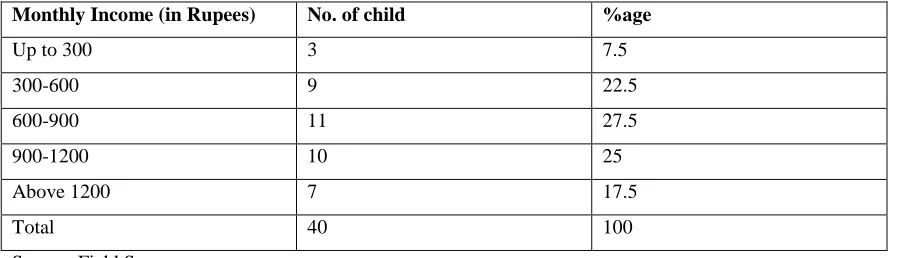
Table 1.5 monthly working wages of child labour
Monthly Income (in Rupees) No. of child %age
Up to 300 3 7.5
300-600 9 22.5
600-900 11 27.5
900-1200 10 25
Above 1200 7 17.5
Total 40 100
It is revealed from the data contained in table 1.5 that nearly 57.5 per cent child get wages below Rs. 900 per month while 25 per cent get between Rs. 900 to 1200 per month. The remaining only
17.5 per cent child are get Rs. 1400 and above. So table shows that the earnest wages are very low according to their work.
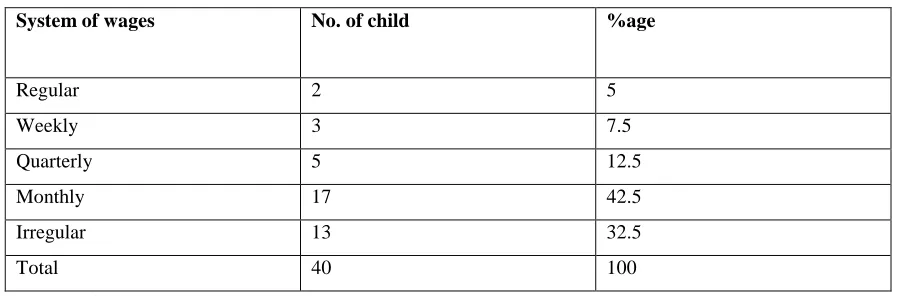
Table 1.6 systems of child wages
System of wages No. of child %age
Regular 2 5
Weekly 3 7.5
Quarterly 5 12.5
Monthly 17 42.5
Irregular 13 32.5
Total 40 100
Source: Field Survey
The table 1.6 reveals regular payments only for 5 per cent cases, whereas irregular and partly regular payments are associated with the rest of 90 per cent cases. Similarly, the payment system is mostly monthly (42.5 per cent) and 32.5 per cent are afford irregular bases.
After discuss over all study we find that child labour is a grave problem in the town. The principal reason for the prevalence of child labour is economic. Poverty comples the low income and poor households to depend primarily on children‟s work and wages to support the
family.
SUGGESTION
Planning for a better future has to take
cognisance of their likely growth in numbers and their demands on the nation‟s resources.
It is also need to decide the priorities for
children belonging to weaker sections
of communities living in ecologically disturbed areas.
It is suggested that wide publicity be
given to the evil of child labour and the parents be made aware of the problem of child labour.
Article 45 of the constitution be strictly
enforced by providing mid day meals, free supply of books, uniforms and other necessaries so that school going children do not depend upon their parents.
As an effective approach to eliminating
and preventing child labour, compulsory education which is provided for in the constitution and the state legislations should be enforced for all children below 14 years.
The child labour related (Prohibition
strictly implemented. The conditions of work including hours of work and wages need be strictly monitory whether at home or in industrial units out side home.
Inadequacy of education facilities and
non-functioning educational institutions specially in rural areas is a major factor discouraging children from getting educated. It needs to be taken care of.
Government or NGOs should take some
steps and help the parents of the working children, the help must be in the form of sufficient employment on condition that their children will quit the labour market and go to school.
Primary education should be made
compulsory especially for these types communities which are economically and socially backward.
The parents of working children should
be drawn into family planning and made aware of the benefit of a small family. They should also be persuaded to come out of superstitions and develop scientific approach.
CONCLUSION
Children are future of nation and it the nation‟s responsibility to nurture them through
various stages of their development to enable them to realise their full human potential. Every child has a right to enjoy its childhood. It is the mandatory job of the government to take all possible steps to put an end to the problem of child labour.
But child labour problem is a multidimensional one hence combined effort of
the government, non-government organizations, public participation alone can solve the problem and help to established a child labour free society in the coming generation. It is also a grim reminder of the fact that a tremendous efforts has to be made in order to overcome the pernicious practice of employment of child labour.
REFERENCES:
Premi, K.K. (1994), „Working children
and universalization of elementory education‟, Journal of Educational Planning and Administration, Volume 4, No. 1, January, p. 4
Kaldante S. (1997), “Restoring child labour rights to child labour”, Social
Change, Sept.-Dec., Volume 27, No. 3-4, pp. 6-7.
Sen R.K. and Dargupta A. (2003), “Problems of child labour in India”,
Deep & Deep Publications, New Delhi.
Lieten, G.K. (2000), “Children, work
and education-1 : Genral Parameters,‟ Economic and Political Weekly, Vol. XXXV, No. 24, June, pp. 2037-44.
Mishra, G.P. and Pande, P.N. (1995), “Supply of Child labour : An investigation,” Labour and
Development, Volume 1, July – Dec. 1995, pp. 15-21.
Basu, K. (1999). “Child Labour cause
consequence and care with remarks on international labour standards”, Journal
of Economic Literature, Sep. 1083-1119.
Deep & Deep publication, New Delhi, pp. 1.
Ahmed I. (1999), “Geeting Rid of Child Labour”, EPW, Volume XXXIV, No.
17, pp. 1815-22.
Singh, A.N. (1990), “Child Labour in
India, Shipra Publications, Delhi, Chapter X, p. 154.
Kulshreshtra, J.C. (1978), “Child Labour in India”, Anish Publishing
House, New Delhi, Chapter 3, p. 50.
Sharma, R. and Sharma, R.K. (1997), „Education and Child Labour : The
Case of Glass Bangle Industry of Firozabad,” the Indian Journal of
Labour Economics, 40 (4), Oct.-Dec., pp. 869-875.
Manickram, S. and Sivasamy, D. (1997), „Child Labour in powerloom factories‟, The Indian Journal of Labour
Economics, Volume 40, No. 4, Oct.-Dec., pp. 902.
Kitchlu, T.N. (1994), “Child Labour :
Current Scenario”, Yojana, Volume 38, No. 9, May, pp. 22-24.
Chaudhuri, D.P. (1997), „A Policy
prospective on child labour in India with pervasive gender and urban Bias in school education”, The Indian Journal
of Labour Economics, Volume 40, No. 4, pp. 789-808.
Madhok, A. (1996), „Child Labour : Eradicating the evil”, Yojana, Volume
40, No. 1, pp. 59-61.
Rajaretnam (1889), „Child labour in Tamil Nadu and its districts”, Journal of
Institute of Economic Research, Vol. 24, No. 1, pp. 29-32.
Alain Morice (1981), “The exploitation
of children in the informal sectors, perposal for research; in Garry Roaders and Guy Standing (ed.), Child work poverty and under development ILO Geneva, pp. 136
Myron W. (1991), “The child and the state in India”, Oxford university press,
New Delhi, pp. 4.
Thorat, S.K. (1990), “Poverty caste and
child labour in India: The plight of Dalit and Adivasi Children‟s‟, Kalus Volume