A Method for System Order Reduction based
on Genetic Algorithm and FFT
Farzin Asadi1, Nurettin Abut2
Student, Institute of Applied Science and Technology, Kocaeli University, Kocaeli, Turkey.1
Professor, Dept. of Electrical Engineering, Kocaeli University, Kocaeli, Turkey.2
ABSTRACT: Modelling a complicated system, generally needs a high order differential equation. Designing or analysing based on such a high order equaion is cumbersome and time consuming. One idea is to use system order reduction techniques. Reduced order model must preserve original systems characteristics. Plenty of methods are proposed in the recent 50 years.
Here, a method based on Genetic algorithm(GA) and Fast Fourier Transform(FFT) is suggested to the problem of system order reduction.
First, a reduced order model structure must be chosen. Then, GA change Parameters of chosen model, i.e. coefficients of transfer function, in order to reach the best response(minimum cost function).
In this paper a new cost function based on FFT coefficients are defined. Using this cost function and GA optimum coefficients of chosen reduced order transfer function are find.
Proposed method can be used to reduce order of controllers designed byH method due to the large order of such controllers.
KEYWORDS: FFT analysis, Genetic Algorithm, Model Reduction.
I. INTRODUCTION
A scientific model seeks to represent empirical objects, phenomena, and physical processes in a logical and objective way. Today, complicated systems are modelled with the aid of complex high order models. When model order increases analysis and design become cumbersome.
One of the best approaches to overcome these problems is model reduction. In the recent 50 years model reduction problem has been studied by many researchers.
In 1966, Davison suggested a state space based method for order reduction[1]. In 1967 and 1969, some modifications was suggested for Davison approach[2,3].In 1968, frequency domain expansions were used[4]. In 1970, Wilson suggested optimised model reduction[5,6]. His approach was the first approach which based on optimisation of a model.
In 1980, Eitelberg suggested a suitable low order model of large scale systems based on error equation minimisation[7]. In the late 1980, Anderson and Liu suggested a method named SP which has more better accuracy for low frequencies[8].In 1955, Fledmen and Frond proposed a method based on Pade approximation[9]. In 2003, a balanced structure based method was suggested by Zadegan and Zilouchian[10].
In the recent decade, using evolutionary algorithms for model order reduction increased significantly[11-15].In this paper, GA and FFT are used for model order reduction. Simulations were done in Matlab®. Simulation results shows the excellence of proposed method.
II. GENETIC ALGORITHM
search problems. As they are based on biological evolution, they use techniques that are emulated from the concepts of
inheritance, mutation and selection.
Genetic algorithms explore a parameter space while optimizing a function. The problem is broken down into a ‘population’ of candidate solutions which are refined over a number of ‘generations’.
A single candidate solution is represented by a ‘chromosome’ which essentially encodes all of the optimizable parameters into a single entity. Each candidate is ranked using a fitness function and those with the best fitness score are selected for further refinement. The refinement stage then operates on each of the chromosomes by
I) ‘breeding’ - a process where a new population of improved candidates are generated using the present generation’s population, and
II) ‘mutation’ - in which chromosomes are modified in some way.
Both of these operations permit the parameter space to be more effectively explored. The whole process is iterated for many generations where the candidate solutions can be seen to evolve and, hopefully, converge towards a single solution. The use of natural evolution method for the optimization of control system has been of interest for the researchers since a long time.
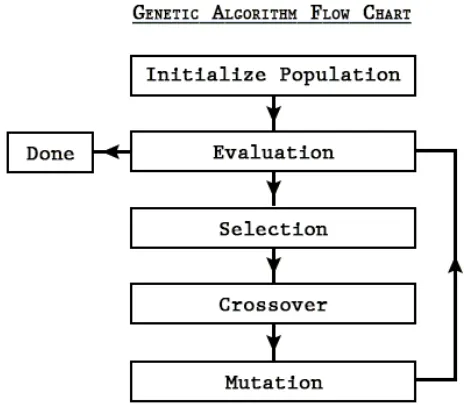
Figure 1, illustrate the GA flowchart:
Fig. 1 GA flowchart.
III. METHOD
Here, we describe the method with the aid of an example taken from Parmer[16]. Assume a transfer function given as equation 1: ) 1 ( 40320 109584 2 118124 3 67284 4 22449 5 4536 6 546 7 36 8 40320 185760 2 222088 3 122664 4 36380 5 5982 6 514 7 18 ) ( s s s s s s s s s s s s s s s s G
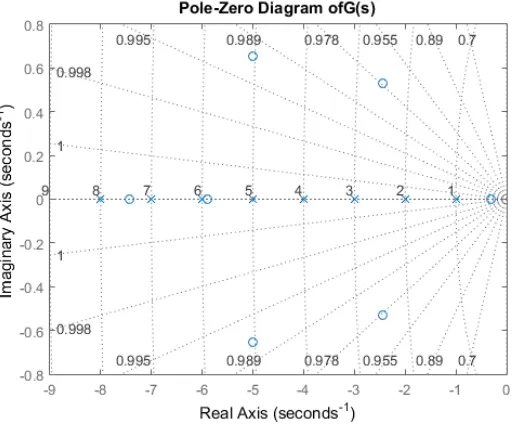
G(s) poles are in the Left Half Plane(LHP) so G(s) is a stable transfer function(see figure 3). Assume that we want a second order approximation of this transfer function. H(s) is the desired reduced order transfer function:
Where a, b, c and d are unknowns that must be found. G(s) is stable(see Figure 3) so we want the reduced transfer function to be stable. Applying Routh-Hurwitz criterion lead to c>0 and d>0 for stability of H(s).
We take 1024 point FFT of impulse response of G(s). We want to find a, b, c and d such that of difference of FFT coefficients of High order model and reduced order model is minimised. This cost function can be written as equation 3.
) 3 ( 1024
1
) ( ) (
k
k H F k G F J
Where FG(k) and FH(k) shows the FFT coefficients of impulse response of G(s) and H(s) respectively.
So, order reduction problem can be formulated as the following optimization problem:
0 ,
: , , ,
) 4 ( )
1024
1
) ( ) ( (
d c
to Subject
d c b a
k
k H F k G F Min
IV. RESULTS AND DISCUSSION
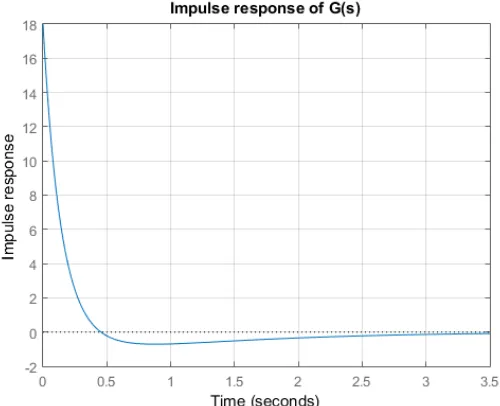
Figure 2, shows the impulse response of high order system , G(s). Poles of G(s) are shown in figure 3. All the poles have negative real part so G(s) is a stable transfer function.
Figure 3 Pole-Zero diagram of G(s)
Solving the optimization problem 4 with the aid of GA leads to the following transfer function:
031 . 5 39 . 7 2
031 . 5 795 . 17 ) (
s s
s s
H ( 5 )
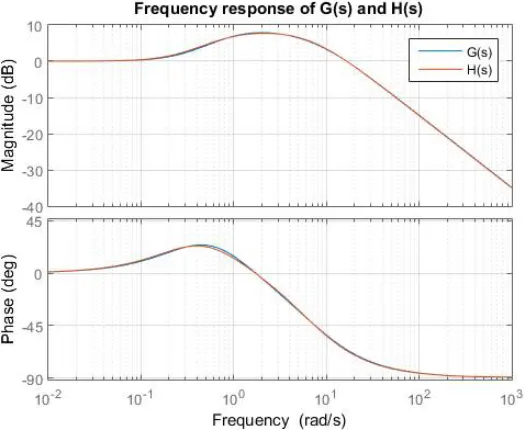
Figure 4 and 5, shows the impulse response and frequency response of G(s) and H(s) simultaneously:
Figure 5 Frequency response of G(s) and H(s).
As shown in Figure 4 and 5 reduced order system can approximate the original system very well.
V.CONCLUSION
Complicate systems, are generally describe by a complicate, high order differential equation. Analysing or designing based on high order equations are cumbersome. Plenty of methods have been proposed to reduce the order of a given systen. In this paper, system order reduction problem is converted to an optimization problem. A new cost function based on FFT coefficients of impulse response is introduced. Then, using GA this cost function is minimized.
Using this method a system of order 8 is reduced to a second order system.
REFERENCES
[1] Davison, E.J., “A method for simplifying linear dynamical systems,” IEEE trans. Autom. Control, Vol. 11,pp. 93-101,1966. [2] Chidambara, M.R., “Further comments by M.R. Chidambara,” IEEE Trans. Autom. Control, Vol. 1,pp. 799-800,1967. [3] Chidambara, M.R., “Two simple techniques for the simplification of large dynamic systems,” Proc. JAAC, pp. 669-674,1969. [4] Chen, C.F., Shieh, L.S., “A novel approach to linear model simplification,” Int. J. Control, Vol. 8,pp. 561-570,1968. [5] Wilson, D.A., “Optimal solution of model reduction problem,” Proc. IEE, Vol. 117,1970.
[6] Wilson, D.A, “Model reduction for multivariable systems,” Int. J. Control, Vol. 20,pp. 57-64,1974. [7] Eitelberg, E., “Model reduction by minimizing the error,” Int. J. Control Vol. 34,No 6,pp. 1113-1123, 1981.
[8] Liu, Y., Anderson, B.D.O, “Singular perturbation approximation of balanced systems,” Int. J. Control, Vol 50,pp.1379-1405,1989.
[9] Feldman, P., Freund, R.W., “Efficient linear circuit analysis by Pade approximation via a Lanczos method,” IEEE Trans. Computer Aided Des. Vol. 14, pp.639-649,1995.
[10] Zadegan, A., Zilouchian, A., “Controller order reduction using frequency domain balanced structure,” Proc. World Auto. Congress,Orlando, pp. 163-168,2002.
[11] Cheng, S.L., Hwang , C., “Optimal approximation of linear systems by a differential evolution algorithm,” IEEE Trans. Systems, Man and Cybernetics, Part A:Systems and Humans, Vol. 31, No. 6,pp. 698-707,2001.
[12] Satakhshi, S., Mukherjee, S., Mittal, R.C., “Order reduction of linear discrete systems using a genetic algorithm,” Applied Mathematical Modelling, Vol. 29,565-578,2005.
[13] Kumar ,D.,Prasad, R., “Mixed evolutionary techniques to reduce order of linear interval systems using generalized Routh array,” Int. J. Engineering Science and Technology, Vol. 2,No. 10, pp.5197-5205,2010.
[14] Chen, Y., Balakrishnan, V., Koh, C.K., Roy, K. “Model order reduction in the time domain using Lagurre polynomials,” Proc. of Design, Automation and Test in Europe Conference and Exhibition,Paris,pp.931-935,2002.
[15] Wang, X.L., Jiang, Y.L., “Model order reduction methods for coupled systems in the time domain using Lagurre polynomials,” Journal of Computers and Mathematics with Applications, V. 62 No. 8,pp.3241-3250,2011.