826 | P a g e
A Note on Square Sum Difference Product Prime Labeling
Sunoj B S
1, Mathew Varkey T K
21
Department of Mathematics, Government Polytechnic College, Attingal
2Department of Mathematics, T K M College of Engineering , Kollam 5
ABSTRACT
Square sum difference product prime labeling of a graph is the labeling of the vertices with {0,1,2---,p-1} and
the edges with absolute difference of the sum of the squares of the labels of the incident vertices and product of the
labels of the incident vertices. The greatest common incidence number of a vertex (gcin) of degree greater than one
is defined as the greatest common divisor of the labels of the incident edges. If the gcin of each vertex of degree
greater than one is one, then the graph admits square sum difference product prime labeling. Here we investigate,
splitting graph of star, double graph of star, triangular book, tensor product of star and path, tadpole graph,
friendship graph and helm graph for square sum difference product prime labeling.
Keywords: Graph Labeling, Greatest Common Incidence Number, Square Sum, Prime Labeling.
I INTRODUCTION
All graphs in this paper are simple, finite and undirected. The symbol V(G) and E(G) denotes the vertex set and edge set of a graph G. The graph whose cardinality of the vertex set is called the order of G, denoted by p and the cardinality of the edge set is called the size of the graph G, denoted by q. A graph with p vertices and q edges is called a (p,q)- graph.
A graph labeling is an assignment of integers to the vertices or edges. Some basic notations and definitions are taken from [2],[3] and [4] . Some basic concepts are taken from [1] and [2]. In [5] , we introduced the concept, square sum difference product prime labeling and proved that some path related graphs admit this kind of labeling. In [6] and [7], we extended our study and proved that the result is true for some trees and some cycle related graphs. In this paper we investigated square sum difference product prime labeling of splitting graph of star, double graph of star, triangular book, tensor product of star and path, tadpole graph, friendship graph and helm graph.
Definition: 1.1
Let G be a graph with p vertices and q edges. The greatest common incidence number (gcin) of a827 | P a g e
II MAIN RESULTS
Definition 2.1
Let G = (V(G),E(G)) be a graph with p vertices and q edges . Define a bijectionf : V(G) {0,1,2,3,---,p-1} by f(vi) = i , for every i from 1 to p and define a 1-1 mapping :
E(G) set of natural numbers N by = |{f(u)}2 +{f(v)}2 – f(u)f(v)|.The induced function is
said to be square sum difference product prime labeling, if for each vertex of degree at least 2, the greatest common incidence number is 1.
Definition 2.2
A graph which admits square sum difference product prime labeling is called a square sumdifference product prime graph.
Theorem 2.1
Splitting graph of star K1,n admits square sum difference product prime labeling.Proof: Let G = S'(K1,n) and let a,b,v1,v2,---,vn,u1,u2,---,un are the vertices of G
Here |V(G)| = 2n+2 and |E(G)| = 3n.
Define a function f : V {0,1,2,3,---,2n+1 } by
f(vi) = i+1 , i = 1,2,---,n.
f(ui) = n+i+1 , i = 1,2,---,n.
f(a) = 0, f(b) = 1 Clearly f is a bijection.
For the vertex labeling f, the induced edge labeling is defined as follows
) = (i+1)2, i = 1,2,---,n.
) = i2+i+1, i = 1,2,---,n.
) = (n+i+1)2, i = 1,2,---,n.
Clearly is an injection.
gcin of (vi) = gcd of { ) , ) }
= gcd of { i2+2i+1, i2+i+1} = gcd of {i , i2+i+1}
= 1, i = 1,2,---,n.
gcin of (a) = 1.
gcin of (b) = 1.
So, gcin of each vertex of degree greater than one is 1.
828 | P a g e
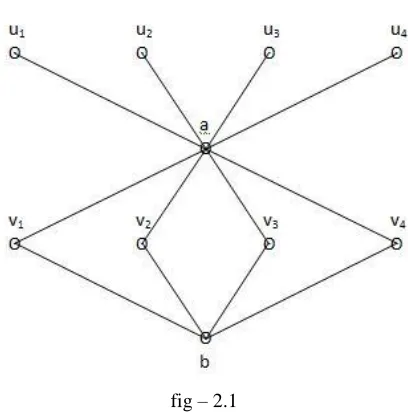
Example 2.1
G = S'(K1,4)fig – 2.1
Theorem 2.2
Double graph of star K1,n admits square sum difference product prime labeling.Proof: Let G = D(K1,n) and let a,b,v1,v2,---,vn,u1,u2,---,un are the vertices of G
Here |V(G)| = 2n+2 and |E(G)| = 4n.
Define a function f : V {0,1,2,3,---,2n+1 } by
f(vi) = i+1 , i = 1,2,---,n.
f(ui) = n+i+1 , i = 1,2,---,n.
f(a) = 0, f(b) = 1 Clearly f is a bijection.
For the vertex labeling f, the induced edge labeling is defined as follows
) = (i+1)2, i = 1,2,---,n.
) = i2+i+1, i = 1,2,---,n.
) = (n+i+1)2, i = 1,2,---,n.
) = (n+i+1)2 -(n+i+1) +1, i = 1,2,---,n.
Clearly is an injection.,
gcin of (ui) = gcd of { ) , ) }
= gcd of {(n+i+1)2, (n+i+1)2 -(n+i+1) +1} = gcd of {(n+i+1), (n+i+1)2 -(n+i+1) +1}
= 1, i = 1,2,---,n.
829 | P a g e
gcin of (b) = 1.So, gcin of each vertex of degree greater than one is 1.
Hence D(K1,n) , admits square sum difference product prime labeling.
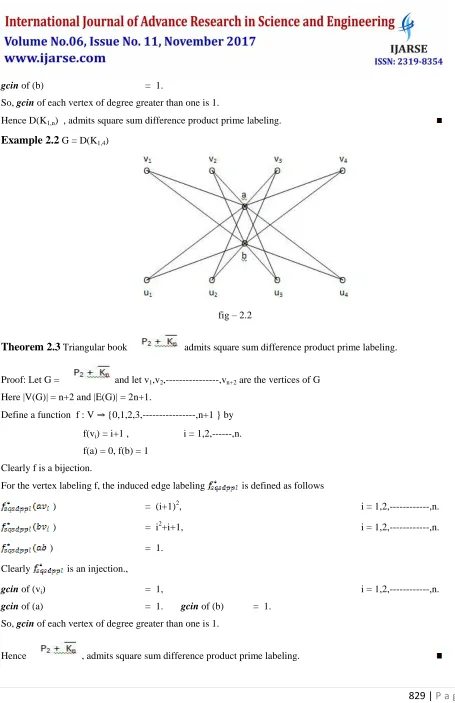
Example 2.2
G = D(K1,4)fig – 2.2
Theorem 2.3
Triangular book admits square sum difference product prime labeling.Proof: Let G = and let v1,v2,---,vn+2 are the vertices of G
Here |V(G)| = n+2 and |E(G)| = 2n+1.
Define a function f : V {0,1,2,3,---,n+1 } by
f(vi) = i+1 , i = 1,2,---,n.
f(a) = 0, f(b) = 1 Clearly f is a bijection.
For the vertex labeling f, the induced edge labeling is defined as follows
) = (i+1)2, i = 1,2,---,n.
) = i2+i+1, i = 1,2,---,n.
) = 1.
Clearly is an injection.,
gcin of (vi) = 1, i = 1,2,---,n. gcin of (a) = 1. gcin of (b) = 1.
So, gcin of each vertex of degree greater than one is 1.
830 | P a g e
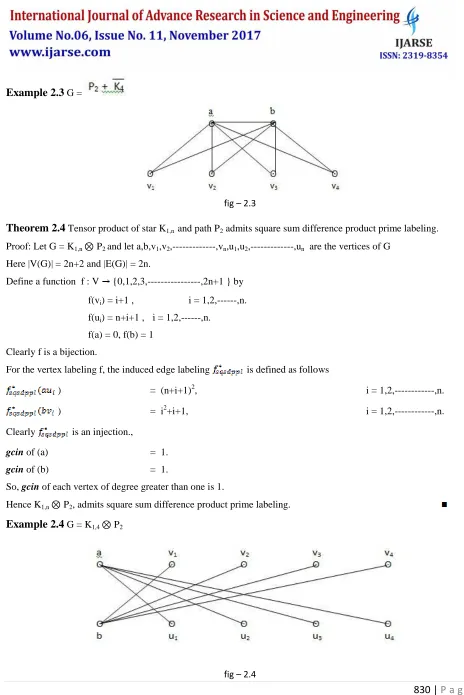
Example 2.3
G =fig – 2.3
Theorem 2.4
Tensor product of star K1,n and path P2 admits square sum difference product prime labeling.Proof: Let G = K1,n ⊗ P2 and let a,b,v1,v2,---,vn,u1,u2,---,un are the vertices of G
Here |V(G)| = 2n+2 and |E(G)| = 2n.
Define a function f : V {0,1,2,3,---,2n+1 } by
f(vi) = i+1 , i = 1,2,---,n.
f(ui) = n+i+1 , i = 1,2,---,n.
f(a) = 0, f(b) = 1 Clearly f is a bijection.
For the vertex labeling f, the induced edge labeling is defined as follows
) = (n+i+1)2, i = 1,2,---,n.
) = i2+i+1, i = 1,2,---,n.
Clearly is an injection.,
gcin of (a) = 1.
gcin of (b) = 1.
So, gcin of each vertex of degree greater than one is 1.
Hence K1,n ⊗ P2, admits square sum difference product prime labeling.
Example 2.4
G = K1,4 ⊗ P2831 | P a g e
Theorem 2.5
Tadpole graph Cn(Pm) admits square sum difference product prime labeling.Proof: Let G = Cn(Pm) and let v1,v2,---,vn+m-1 are the vertices of G
Here |V(G)| = n+m-1 and |E(G)| = n+m-1.
Define a function f : V {0,1,2,3,---,n+m-2 } by
f(vi) = i-1 , i = 1,2,---,n+m-1.
Clearly f is a bijection.
For the vertex labeling f, the induced edge labeling is defined as follows
) = i2-i+1, i = 1,2,---,n+m-2.
) = (n-1)2.
Clearly is an injection.,
gcin of ( ) = gcd of { ), )}
= gcd of {1, (n-1)2} = 1.
gcin of ( ) = 1, i = 1,2,---,n+m-3.
So, gcin of each vertex of degree greater than one is 1.
Hence Cn(Pm), admits square sum difference product prime labeling.
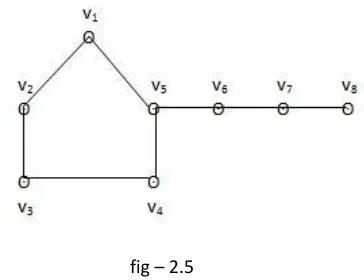
Example 2.5
G = C5(P4)fig – 2.5
Theorem 2.6
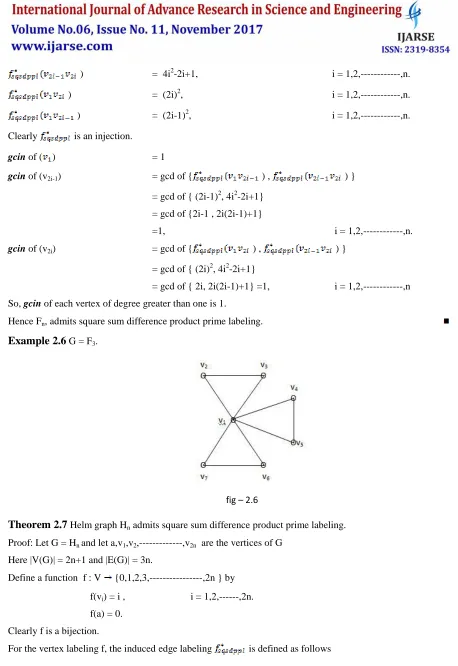
Friendship graph Fn admits square sum difference product prime labeling.Proof: Let G = Fnand let v1,v2,---,v2n+1 are the vertices of G
Here |V(G)| = 2n+1 and |E(G)| = 3n.
Define a function f : V {0,1,2,3,---,2n } by
f(vi) = i-1 , i = 1,2,---,2n+1.
Clearly f is a bijection.
832 | P a g e
) = 4i2-2i+1, i = 1,2,---,n.
) = (2i)2, i = 1,2,---,n.
) = (2i-1)2, i = 1,2,---,n.
Clearly is an injection.
gcin of ( ) = 1
gcin of (v2i-1) = gcd of { ) , ) }
= gcd of { (2i-1)2, 4i2-2i+1} = gcd of {2i-1 , 2i(2i-1)+1}
=1, i = 1,2,---,n.
gcin of (v2i) = gcd of { ) , ) }
= gcd of { (2i)2, 4i2-2i+1}
= gcd of { 2i, 2i(2i-1)+1} =1, i = 1,2,---,n So, gcin of each vertex of degree greater than one is 1.
Hence Fn, admits square sum difference product prime labeling.
Example 2.6
G = F3.fig – 2.6
Theorem 2.7
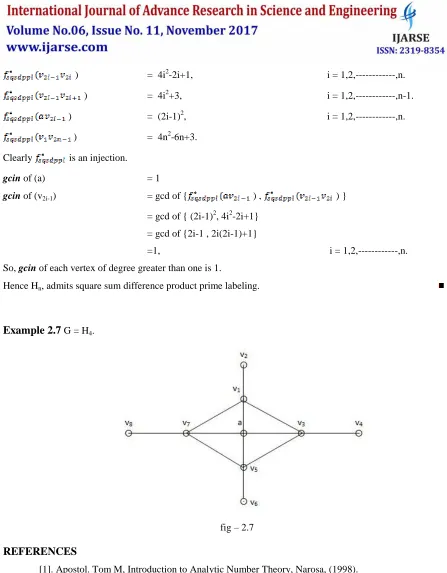
Helm graph Hn admits square sum difference product prime labeling.Proof: Let G = Hn and let a,v1,v2,---,v2n are the vertices of G
Here |V(G)| = 2n+1 and |E(G)| = 3n.
Define a function f : V {0,1,2,3,---,2n } by
f(vi) = i , i = 1,2,---,2n.
f(a) = 0. Clearly f is a bijection.
833 | P a g e
) = 4i2-2i+1, i = 1,2,---,n.
) = 4i2+3, i = 1,2,---,n-1.
) = (2i-1)2, i = 1,2,---,n.
) = 4n2-6n+3.
Clearly is an injection.
gcin of (a) = 1
gcin of (v2i-1) = gcd of { ) , ) }
= gcd of { (2i-1)2, 4i2-2i+1} = gcd of {2i-1 , 2i(2i-1)+1}
=1, i = 1,2,---,n. So, gcin of each vertex of degree greater than one is 1.
Hence Hn, admits square sum difference product prime labeling.
Example 2.7
G = H4.fig – 2.7
REFERENCES
[1].Apostol. Tom M, Introduction to Analytic Number Theory, Narosa, (1998).
[2]. F Harary, Graph Theory, Addison-Wesley,Reading, Mass, (1972)
[3]. Joseph A Gallian, A Dynamic Survey of Graph Labeling, The Electronic Journal of Combinatorics(2016), #DS6, pp 1 – 408.
[4]. T K Mathew Varkey, Some Graph Theoretic Generations Associated with Graph Labeling, PhD
834 | P a g e
[5]. Sunoj B S, Mathew Varkey T K, Square Sum Difference Product Prime Labeling of Some Path Related Graphs, International Journal for Research in Applied Science and Engineering Technology, 5(10),
2017 ,1404-1408 .
[6]. Sunoj B S, Mathew Varkey T K, Square Sum Difference Product Prime Labeling of Some Tree Graphs, International Journal on Future Revolution in Computer Science and Communication Engineering, l3(11), 2017, 17-19 .