Western University Western University
Scholarship@Western
Scholarship@Western
Electronic Thesis and Dissertation Repository
11-10-2010 12:00 AM
Object and Relations Uncertainty: Two Components of Perceived
Object and Relations Uncertainty: Two Components of Perceived
Environmental Uncertainty
Environmental Uncertainty
Anthony Francolini
University of Western Ontario
Supervisor Rowe, W Glenn
The University of Western Ontario Graduate Program in Business
A thesis submitted in partial fulfillment of the requirements for the degree in Doctor of Philosophy
© Anthony Francolini 2010
Follow this and additional works at: https://ir.lib.uwo.ca/etd
Part of the Business Administration, Management, and Operations Commons, and the Organizational Behavior and Theory Commons
Recommended Citation Recommended Citation
Francolini, Anthony, "Object and Relations Uncertainty: Two Components of Perceived Environmental Uncertainty" (2010). Electronic Thesis and Dissertation Repository. 42.
https://ir.lib.uwo.ca/etd/42
This Dissertation/Thesis is brought to you for free and open access by Scholarship@Western. It has been accepted for inclusion in Electronic Thesis and Dissertation Repository by an authorized administrator of
OBJECT AND RELATIONS UNCERTAINTY:
TWO COMPONENTS OF PERCEIVED ENVIRONMENTAL UNCERTAINTY
(Spine Title: Object & Relations Uncertainty: Two Uncertainty Components)
(Monograph Format)
Tony Francolini
Graduate Program in Business Administration Richard Ivey School of Business
A dissertation submitted in partial fulfillment of the requirements for the degree of
Doctor of Philosophy
The School of Graduate and Postdoctoral Studies The University of Western Ontario
London, Ontario, Canada
THE UNIVERSITY OF WESTERN ONTARIO School of Graduate and Postdoctoral Studies
CERTIFICATE OF EXAMINATION
Supervisor:
______________________________ Dr. W. Glenn Rowe
Richard Ivey School of Business, UWO
Examiners:
______________________________ Dr. Allison Konrad
Richard Ivey School of Business, UWO
______________________________ Dr. Michael Rouse
Richard Ivey School of Business, UWO
______________________________ Dr. Barbara Pierce
King‟s College, UWO
______________________________ Dr. Richard Priem
Texas Christian University
The thesis by Tony Francolini
entitled:
OBJECT AND RELATIONS UNCERTAINTY:
TWO COMPONENTS OF PERCEIVED ENVIRONMENTAL UNCERTAINTY
is accepted in partial fulfillment of the requirements for the degree of
Doctor of Philosophy
Date__________________________ _______________________________
ABSTRACT
I contend that perceived environmental uncertainty should be divided into a new pair
of uncertainty components, which I label object and relations uncertainty. Object
uncertainty is defined as an actor‟s inability to predict the future accurately due to a lack
of information about object items (i.e., tangible, reducible, asocial items). Relations
uncertainty is defined as an actor‟s inability to predict the future accurately due to a lack
of information about relations items (abstract, reduction-resistant, social items).
I contend that the object-relations uncertainty component-set is supported by
uncertainty research and categorization theory. First, these two components are supported
by the works of a variety of prominent organizational and decision-making theorists who
portray uncertainty with both object-like and relations-like qualities. Second, this
component-set is supported by categorization theory, which identifies the object and
relations categories as a fundamental pair of superordinate categories that individuals
activate as they make sense of their certain and uncertain environments.
To validate this new component-set I conducted two studies on two different samples.
In the first, respondents compared multiple uncertainty statements that expressed
different degrees of object and relations uncertainty. I found that respondents perceived
object and relations uncertainty as distinct. Without any priming, respondents rated
uncertainties from the same component (i.e., object-to-object or relations-to-relations
comparisons) as similar, while they rated uncertainties from different components (i.e.,
object-to-relations comparisons) as dissimilar. Moreover, these respondents ordered the
uncertainties along an axis based on the degree of object or relations component they
perceived.
uncertainty and asked to rate the appropriateness of a variety of uncertainty responses. I
found that respondents who perceived object uncertainty preferred different responses
than respondents who perceived relations uncertainty. For instance, respondents
presented with object uncertainty preferred augmenting the gathering and processing of
information, while respondents presented with relations uncertainty preferred to alter the
coordination metrics that guided their relationship with transactors.
In summary, I find that object and relations uncertainty are perceived as a set of
uncertainty components, and account for actor-response variance that is not otherwise
accounted for by the more traditional explanatory variable „degree of uncertainty‟.
Keywords
ACKNOWLEDGMENTS
I am reminded of a T-shirt slogan (philosophy of the god‟s) that seems particularly
suited to describe the path this dissertation has taken. The slogan reads, “NOT ALL
THOSE WHO WANDER ARE LOST”… To all those who allowed me to wander, I
extend a heart-felt thank you. Your seemingly unlimited patience was a contribution
equal to all others.
Angie „WE‟ have done it. Yes, „WE‟ ... You put as much effort in supporting me as I
put into this dissertation. You continue to earn my love and respect.
Wil and Jo, I hope this endeavor is an example to you. There is no such thing as
destiny for the smart. They are found wanting as often as others are. It is hard work – that
quality that your mother exhibits in spades – that is to be treasured more than
intelligence. Granted, intelligence is nice to have and to develop.
Of course, I would like to give a nod to the other members of my proposal and
dissertation committees that directed me towards a final product that has been deemed
worthy. Everyone had valuable thoughts that are part of this work – thank you.
Dissertation Committee:
Supervisor: Glenn Rowe, Richard Ivey School of Business
Internal Members: Allison Konrad, Richard Ivey School of Business
Michael Rouse, Richard Ivey School of Business
UWO Member: Barbara Pierce, King‟s College
External Member: Richard Priem, Texas Christian University
Proposal Committee:
Supervisor: Glenn Rowe, Richard Ivey School of Business
Internal Members: Chris Higgins, Richard Ivey School of Business
David Loree, Richard Ivey School of Business Michael Rouse, Richard Ivey School of Business
Glenn, above all else, I thank you for two things. First, thank you for cleaning up the
program. You were the only one who was remotely comfortable with the fact that I was
only able to apply a part-time commitment to this study. Second, your advice was always
appreciated. I learned more about generating a study from my time spent with you than I
did from the rest of my experiences in the PhD program.
David, I would like to thank you for continuing to serve on my proposal committee
despite being justified in feeling that I let you down by not buckling down and getting
this dissertation completed during your term as my advisor. David, OT was an
inspirational class – one that has influenced this work as well as my teaching style.
Richard, you were so kind to fill in for Leonard Love. Having such an accomplished
researcher, with a history with the uncertainty construct – commend me on this document
was the highlight of the dissertation defense. Your thoughts, even more than the pass/fail,
were what I was anticipating the morning of the defense. It is rewarding to be validated
by someone with a background in uncertainty.
Michael, I truly appreciate that fact that you sat on both the proposal and dissertation
committees. Moreover, I believe the guidance you provided during the proposal
preparation stage was invaluable. You helped me shed many of the non-vital ideas that I
had been foolishly trying to keep around – ideas that were mudding the early versions of
this work.
Barbara, I tried to make your tenure within the PhD program look expeditious. I only
hope someone offers me he same kindness. I want you to know that I had your
dissertation open more than a few times as I wrote mine. I tried to emulate the manner in
which you conveyed a complex argument so simply.
to me, at the Grad Pub, that kept me from being my own worst enemy. When I admitted
that I was holding off sending drafts in to my committee, you laughed and stated, “Just
get it done, they only want to sign it and get you off the books”. You so succinctly
reminded me that this work was a demonstration of my education. That was a turning
point for the production of this dissertation.
Allison, I have not always felt that I had the support of the OB group during the past
several years. It was generous of you to step in and be their witness in my defense,
despite the fact that this topic was outside your normal purview. P.S., after the questions
you directed at me, I do not think I am likely to count sheep the next time I am trying to
sleep. Instead, I am likely to recite the validity types: (i) construct (convergent,
discriminant), (ii) internal, (iii) external, (iv) criterion (predictive, concurrent), (v)
conclusion, and back to (i) again....
Finally, I would also like to announce to everyone that the completion of this
document also marks another milestone. With the submission of this document, I start a
TABLE OF CONTENT
Certificate of Examination ... ii
Abstract ... iii
Keywords ... iv
Acknowledgments ... v
Table of Content ... i
List of Tables ... iii
List of Figures ... v
List of Appendices ... vii
Section I: Overview ... 1
Chapter 1: Introduction to Object and Relations Uncertainty ... 2
Object and Relations Uncertainty Defined ... 4
Assertion #1 – Distinct Perceptions ... 5
Assertion #2 – Unique Responses ... 7
Assertion #3 – Contribution of a Non-Aggregate Measure of Uncertainty ... 8
An Illustration of Object and Relations Uncertainty ... 9
Outline of Dissertation ... 12
Section II: Perception-Hypotheses ... 17
Chapter 2: Hypothesis Development ... 18
Literature Review: Existing Uncertainty Component-Sets ... 19
Literature Review: Object and Relations Uncertainty in Organizational Theory ... 33
Literature Review: Object and Relations Categories in Categorization Theory ... 44
Implication of Three Literature Reviews ... 48
Perception-Hypotheses ... 49
Chapter 3: Methodology ... 52
Instrument ... 52
Uncertainty Statements ... 58
Sample ... 63
Statistical Tests ... 67
Summary of Methodology ... 71
Chapter 4: Results ... 74
Test #1: MDS – The Perceptual Map ... 74
Test #2: Confirmation of MDS Results Using Validation Scores ... 90
Test #3: Construct Validity of Uncertainty Statements ... 95
Section Summary ... 107
Section III: Response-Hypotheses ... 110
Literature Review: Responses to Uncertainty ... 111
Hypothesis Development ... 131
Chapter Summary ... 137
Chapter 6: Methodology ... 139
Methodology Overview ... 139
Instrument ... 140
Uncertainty Statements ... 145
Response Statements ... 149
Sample ... 151
Statistical Tests ... 154
Chapter 7: Results ... 156
Loadings of Response Variables ... 157
Confirm Manipulation of Degree of Uncertainty ... 160
Confirm Manipulation of Object and Relations Uncertainty ... 166
Evaluating Respondents‟ Responses to Uncertainty ... 172
1. Information Augmentation Responses ... 173
2. Avoidance Responses ... 181
3. Options Responses ... 186
4. Limiting Internal Behaviour Responses ... 194
5. Limiting External Behaviour Responses ... 201
Summary of Response Findings ... 207
Test for Autocorrelation ... 211
Section Summary ... 213
Section IV: Summary ... 216
Chapter 8: Contributions / Limitations / Future Research ... 217
Conclusion ... 217
Contribution to Component of Uncertainty Research ... 225
Contribution to Organizational Theory ... 231
Implication for Education ... 234
Practical Contribution ... 234
Limitations ... 235
Appendices ... 238
Bibliography ... 281
LIST OF TABLES
Chapter 1: Introduction to Object and Relations Uncertainty ... 2
Table 1.2: Uncertainty Scenario ... 10
Chapter 2: Hypothesis Development ... 18
Table 2.1: Existing Uncertainty Component-Sets ... 21
Table 2.2: Depictions of Object-like and Relations-like Uncertainty ... 36
Chapter 3: Methodology ... 52
Table 3.1: Uncertainty Statements used in Similarity Ratings ... 59
Table 3.2: Uncertainty Statements Found in Literature ... 62
Table 3.3: Experience Variables ... 65
Chapter 4: Results ... 74
Table 4.1: MDS Goodness-of-Fit Scores ... 77
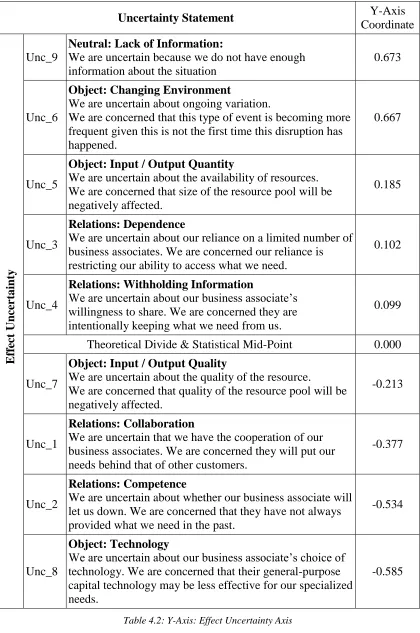
Table 4.2: Y-Axis: Effect Uncertainty Axis ... 80
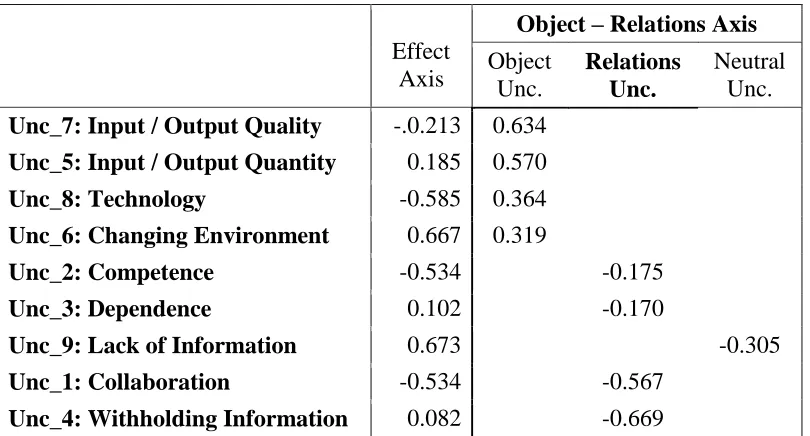
Table 4.3: X-Axis: Relations-Object Uncertainty Axis ... 83
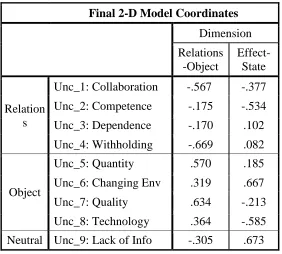
Table 4.4: MDS: Final Coordinates ... 83
Table 4.5: Stress by Uncertainty Variable ... 84
Table 4.6: MDS Goodness-of-Fit Scores w/o Unc_9 ... 84
Table 4.7: MDS: Support for Perception-Hypotheses ... 86
Table 4.8: Relations Uncertainties Sorted by Object-Relations Coordinates ... 87
Table 4.9: Object Uncertainties Sorted by Object-Relations Coordinates ... 87
Table 4.10: All Uncertainties Sorted by Object-Relations Coordinates ... 88
Table 4.11: Distance Scores: Communality of Factors ... 91
Table 4.12: Distance Scores: Final Factor Loadings ... 92
Table 4.13: Factor Analysis: Support for Perception-Hypotheses ... 94
Table 4.14: Validation of Relations Uncertainty Statements ... 98
Table 4.15: Validation of Object Uncertainty Statements ... 102
Table 4.16: Validation of Neutral Uncertainty Statement ... 106
Chapter 5: Hypothesis Development ... 111
Table 5.1: Information Augmentation Responses ... 113
Table 5.2: Options Responses ... 116
Table 5.3: Avoidance Responses ... 118
Table 5.4: Limiting Internal Behaviour Responses ... 121
Table 5.5: Limiting External Behaviour Responses ... 123
Chapter 6: Methodology ... 139
Table 6.1: Development of Uncertainty Statements ... 145
Table 6.2: Relations Uncertainty Statement ... 147
Table 6.3: Object Uncertainty Statement ... 148
Table 6.4: Neutral Uncertainty Statement ... 148
Table 6.5: Response Statements ... 150
Table 6.6: Collected Experience Variables ... 154
Chapter 7: Results ... 156
Table 7.1: Response Items: Communality of Factors ... 158
Table 7.3: Response Statements by Factor Loading ... 160
Table 7.4: Degree Validation Scores by Uncertainty ... 162
Table 7.5: Degree Validation Score Box-Plot ... 163
Table 7.6: Degree Validation Scores for Collaboration ... 164
Table 7.7: Degree Validation Scores for Withholding Information ... 164
Table 7.8: Degree Validation Scores for Input / Output Quantity ... 165
Table 7.9: Degree Validation Scores for Input / Output Quality ... 165
Table 7.10: Degree Validation Scores for Lack of Information ... 166
Table 7.11: Component Validation Score by Component of Uncertainty ... 169
Table 7.12: Component Validation Scores for all Uncertainties ... 171
Table 7.13: Response Items in Information Augmentation ... 174
Table 7.14: Corrected Model for Information Augmentation ... 176
Table 7.15: Component Descriptives for Information Augmentation ... 177
Table 7.16: Degree Descriptives for Information Augmentation ... 178
Table 7.17: Component x Degree Descriptives for Information Augmentation ... 180
Table 7.18: Response Items in Avoidance ... 181
Table 7.19: Corrected Model for Avoidance ... 183
Table 7.20: Component Descriptives for Avoidance ... 184
Table 7.21: Degree Descriptives for Avoidance ... 185
Table 7.22: Response Items in Options ... 187
Table 7.23: Corrected Model for Options ... 189
Table 7.24: Component Descriptives for Options ... 191
Table 7.25: Degree Descriptives for Options ... 192
Table 7.26: Component x Degree Descriptives for Options ... 193
Table 7.27: Response Items in Limiting Internal Behaviour ... 194
Table 7.28: Corrected Model for Limiting Internal Behaviour ... 197
Table 7.29: Component Descriptives for Limiting Internal Behaviour ... 198
Table 7.30: Degree Descriptives for Limiting Internal Behaviour ... 199
Table 7.31: Component x Degree Descriptives for Limiting Internal Behaviour ... 200
Table 7.32: Response Items in Limiting External Behaviour ... 201
Table 7.33: Corrected Model for Limiting External Behaviour ... 203
Table 7.34: Component Descriptives for Limiting External Behaviour ... 204
Table 7.35: Degree Descriptives for Limiting External Behaviour ... 205
Table 7.36: Component x Degree Descriptives for Limiting External Behaviour... 206
Table 7.37: Summary - Significance of Principal Explanatory Variables ... 207
Table 7.38: Summary: Degree as Explanatory Variable ... 209
Table 7.39: Summary: Components as Explanatory Variable ... 210
Table 7.40: Summary - Secondary Explanatory Variables ... 211
Table 7.41: Autocorrelation Results ... 212
Chapter 8: Contributions / Limitations / Future Research ... 217
LIST OF FIGURES
Chapter 1: Introduction to Object and Relations Uncertainty ... 2
Chapter 2: Hypothesis Development ... 18
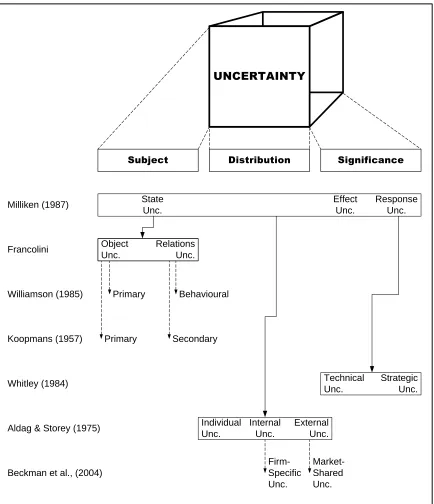
Figure 2.1: Mapping of Multiple Component-Sets ... 32
Chapter 3: Methodology ... 52
Figure 3.1: Example of Similarity Rating ... 57
Figure 3.2: Respondents by Age and Gender ... 65
Figure 3.3: Example of Similarity Rating ... 71
Chapter 4: Results ... 74
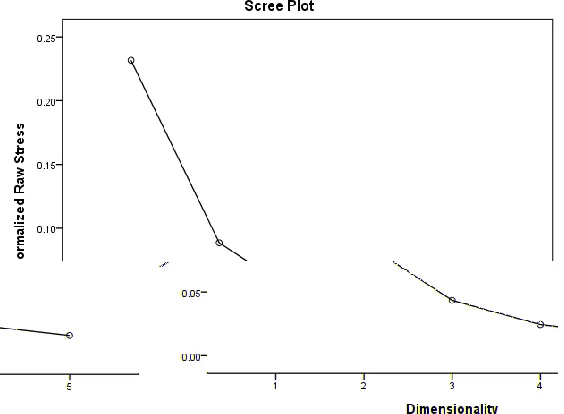
Figure 4.1: MDS Scree Plot ... 75
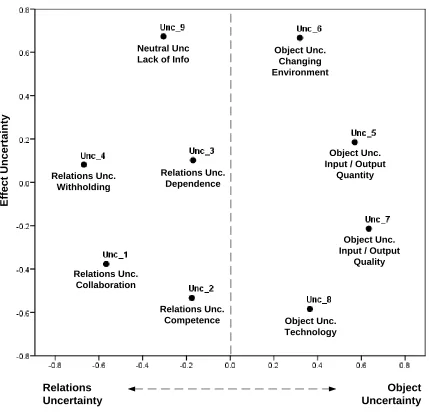
Figure 4.2: MDS: 2D Perceptual Map ... 78
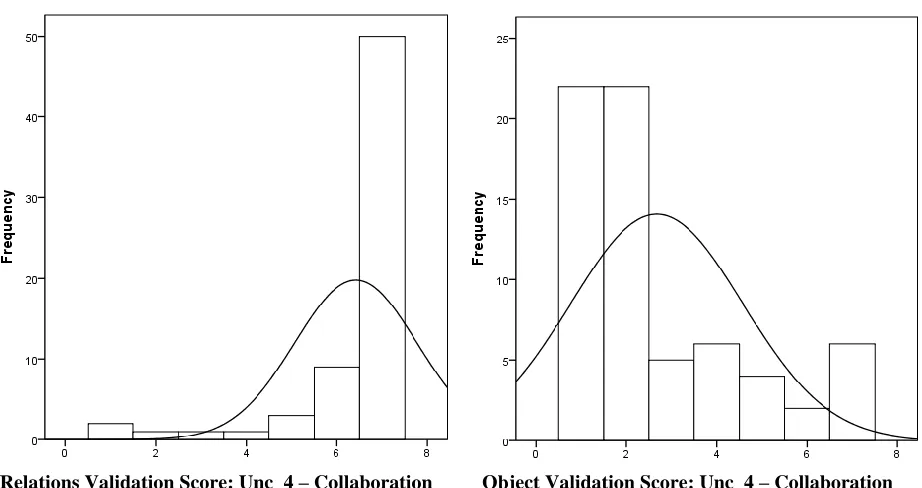
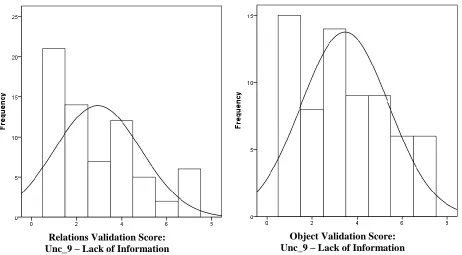
Figure 4.3: Validation of Relations Uncertainty Statements... 100
Figure 4.4: Validation of Object Uncertainty Statements ... 105
Figure 4.5: Validation of Neutral Uncertainty Statement ... 106
Chapter 5: Hypothesis Development ... 111
Figure 5.1: Governance Structures ... 125
Chapter 6: Methodology ... 139
Figure 6.1: Uncertainty Preview on Page 1 of Worksheet ... 143
Figure 6.2: Respondents by Age and Gender ... 153
Chapter 7: Results ... 156
Figure 7.1: Component Validation Scores Box-Plot by Uncertainties ... 170
Figure 7.2: Uncertainty Box-Plot for Information Augmentation ... 175
Figure 7.3: Component Plot for Information Augmentation ... 177
Figure 7.4: Degree Plot for Information Augmentation ... 178
Figure 7.5: Component x Degree Plot for Information Augmentation ... 179
Figure 7.6: Uncertainty Box-Plot for Avoidance ... 182
Figure 7.7: Component Plot for Avoidance ... 184
Figure 7.8: Degree Plot for Avoidance ... 185
Figure 7.9: Uncertainty Box-Plot for Options ... 188
Figure 7.10: Component Plot for Options ... 190
Figure 7.11: Degree Plot for Options ... 191
Figure 7.12: Component x Degree of Uncertainty Plot for Options ... 193
Figure 7.13: Uncertainty Box-Plot for Limiting Internal Behaviour ... 196
Figure 7.14: Component Plot for Limiting Internal Behaviour ... 198
Figure 7.15: Degree Plot for Limiting Internal behaviour ... 199
Figure 7.16: Uncertainty Box-Plot for Limiting External Behaviour ... 202
Figure 7.17: Component Plot for Limiting External Behaviour ... 204
Figure 7.18: Degree Plot for Limiting External Behaviour ... 205
Chapter 8: Contributions / Limitations / Future Research ... 217
Figure 8.1: Degree and Object Manipulations ... 223
Figure 8.2: Degree, Object, and Relations Manipulations ... 224
Figure A1.1: Uncertainty Related Constructs ... 238
Figure A1.2: Factors Influencing Uncertainty Perception / Response ... 243
Figure A1.3: Degrees of Uncertainty ... 245
LIST OF APPENDICES
Appendix 1.1: Uncertainty Constructs ... 238
Appendix 1.2: Uncertainty Research Factors ... 243
Appendix 3.1: Rejected Individual-Level Control Variables... 249
Appendix 3.2: Questionnaire – Instruction ... 252
Appendix 3.3: Questionnaire – Relations Validation ... 253
Appendix 3.4: Questionnaire – Object Validation ... 254
Appendix 3.5: Pretesting Uncertainty Statements ... 255
Appendix 3.6: Participation Request ... 256
Appendix 3.7: Participation Reminder ... 257
Appendix 3.8 Participation „Thank You‟ ... 258
Appendix 3.9: Distribution of Compensation ... 259
Appendix 3.10: Histograms: Experience Variables ... 261
Appendix 4.1: MDS Matrix of Dissimilarity ... 266
Appendix 4.2: MDS: Raw 3D and 2D Perceptual Maps ... 267
Appendix 6.1: Questionnaire – Consent ... 268
Appendix 6.2: Questionnaire – Demographics ... 269
Appendix 6.3: Questionnaire - Instructions ... 270
Appendix 6.4: Questionnaire – “Your Role” ... 271
Appendix 6.5: Questionnaire – “The Context” ... 272
Appendix 6.6: Questionnaire – Worksheet ( Pg 1 of 3) ... 273
Appendix 6.7: Questionnaire – Worksheet ( Pg 2 of 3) ... 274
Appendix 6.8: Questionnaire – Worksheet ( Pg 3 of 3) ... 275
Appendix 6.9: Participation Request ... 276
Appendix 7.1: Frequency of Degree of Uncertainty Scores by Statement ... 277
Appendix 7.2: Box-Plots of Deographic Variables ... 278
SECTION I: OVERVIEW
CHAPTER 1: INTRODUCTION TO OBJECT AND RELATIONS
UNCERTAINTY
Several researchers – e.g., Aldag and Storey (1975), Beckman, Haunschild, and
Phillips (2004), Koopmans (1957), Milliken (1987, 1990), Whitley (1984), and
Williamson (1985) – divide perceived environmental uncertainty1 into components of
uncertainty2.
These researchers justify dividing uncertainty into components based on three
assertions. First, they assert that actors3 do not necessarily perceive the same uncertainty
even when they perceive uncertainty from a same single uncertainty-generating source.
Rather, actors may perceive different components of uncertainty as a consequence of the
manner in which they use filters to make sense of their environment (Gerloff et al., 1991;
Milliken, 1990). For example, in the most recognized component-set, Milliken (1987,
1 Hereafter the term uncertainty will be used synonymously with perceived environmental uncertainty unless noted otherwise. This statement is important because the concept of uncertainty is not a singular one and the term uncertainty is used loosely to refer to multiple constructs such as objective uncertainty, environmental uncertainty, perceived uncertainty, ignorance, absence, ambiguity, etc., (Lipshitz & Strauss, 1997; Smithson, 1989).
Many of these constructs are often conflated because each of the constructs concerns the lack of information (Klein, 1999; Lipshitz & Strauss, 1997; Smithson, 1989). Within appendix 1.1, I provide a brief glossary to identify many of the constructs that are conflated with uncertainty. It is important to distinguish perceived environmental uncertainty, the form of uncertainty with which I am concerned, from other uncertainty or uncertainty-like constructs.
2
Uncertainty Components is a term used by Gerloff, Muir and Bodensteiner (1991), whereas Types of Uncertainty is a term used by Milliken (1987). Gerloff et al., (1991) refer to components to reflect the fact that each is one part of the whole uncertainty that one may perceive from one source. I believe the latter term expresses a relationship between each partial perception of uncertainty, which improves the understanding of the topic.
Components of uncertainty, the topic of this dissertation, is one of eight control factors researchers use to explain how actors develop unique perceptions of environmental uncertainty (PEU) despite the fact that these actors may share the same environment. These factors explain why actors attend to different information, have an unequal ability to discern patterns from the environment, and/or apply a different level of information gathering and/or processing. As an optional item, appendix 1.2 reviews these eight factors.
3
1990) finds that actors perceive state uncertainty, effect uncertainty, or response
uncertainty4 as they filter uncertainty through three sequential stages of sense making –
i.e., scanning, interpreting, and enacting.
Second, these researchers assert that actors who perceive different components of
uncertainty will be prone to undertake different responses. Actors undertake different
responses because different responses are understood to be uniquely suited to resolve
different components of uncertainty (Aldag & Storey, 1975; Milliken, 1987; Whitley,
1984). For example, Milliken (1987, 1990) finds that actors who perceive effect
uncertainty are more likely to increase threat and opportunity analysis than they are to
scan the environment for more information or begin a program of imitating successful
competitors – as they would if they perceived state or response uncertainty, respectively.
Third, based on the previous two assertions, researchers contend that accounting for
components of uncertainty is important because it might alter some of the relationships
that have been established between an aggregate measure of uncertainty and the observed
actions of individuals or organizations. Aggregate measures of uncertainty, such as the
scales developed by Duncan (1972), and Lawrence and Lorsch (1967), which treat all
perceptions of uncertainty as a single construct, are considered inappropriate if the intent
is to capture how actors will respond differently to nuances in the environment and
organizational contexts (Lorenzi, Sims, & Slocum, 1981). The use of aggregate measures
will mask differences in perception of, and response to, uncertainty (1975; Conrath, 1967;
Downey, Hellriegel, & Slocum, 1975; Gerloff et al., 1991; Milliken, 1987, 1990).
Prescriptively, these uncertainty researchers advocate that general researchers evoking
the uncertainty construct should (a) group actors‟ responses to uncertainty based on the
specific uncertainty component that the actors perceive (Aldag & Storey, 1975; Milliken,
1987; Whitley, 1984), and (b) understand that their research designs might evoke a
component of uncertainty that differs from the component that was evoked in an alternate
study to which the current study‟s results are to be contrasted (Aldag & Storey, 1975;
Milliken, 1987).
Within this dissertation, I argue for the formal recognition of a new uncertainty
component-set. More specifically, I argue that uncertainty should be divided into two
components that I label object uncertainty and relations uncertainty.
Object and Relations Uncertainty Defined
I define object uncertainty as an actor‟s inability to predict the future accurately due to
a lack of information about object items. Object uncertainty is uncertainty about the
attributes of concrete items. It is a lack of information about such attributes as quantity,
quality, size, shape, etc.. In an exchange between transactors, object items are the items
being passed between the transactors – e.g., goods, services, knowledge, money, etc..
I define relations uncertainty as an actor‟s inability to predict the future accurately due
to a lack of information about relations. Uncertainty about relations may be a lack of
information about one‟s transactors and/or a lack of information about the processes that
govern one‟s relationship with those transactors. If relations uncertainty is related to
one‟s transactors, the actor is uncertain about the transactor‟s competence, intent,
motivation, etc.. If relations uncertainty is related to the processes that govern the actor‟s
governance structures, methods of communication, etc..
I contend that if actors perceive the uncertainty as being concrete, reducible, and
asocial in nature – qualities of object items – they are more likely to perceive object
uncertainty. They perceive a component of uncertainty that is traditionally examined by
economists, risk analysts, organizational behaviourists, and cognitive psychologists who
view uncertainty as missing cues or messages that can be gathered, processed, and
rationally reduced to rank-orderings or representative values that are used to make
preference judgments (Dequech, 2001; Gifford, Bobbitt, & Slocum, 1979; Lipshitz &
Strauss, 1997).
In contrast, if actors perceive the uncertainty as being abstract, reduction-resistant, and
social in nature – qualities of relations items – they are more likely to perceive relations
uncertainty. They perceive a component of uncertainty that is traditionally examined by
organizational theorists and sociologists. These researchers view uncertainty as a lack of
information about the appropriateness of an actor‟s interactions with transactors (Achrol
& Stern, 1988; 1996, 1998; Eriksson & Sharma, 2003; Paswan, Dant, & Lumpkin, 1998;
Uzzi, 1997) or as a lack of information about the interdependence that exists between the
transactors (Aldrich & Mindlin, 1978; Koopmans, 1957; Kreiser & Marino, 2002;
Thompson, 1967; Williamson, 1985).
Assertion #1 – Distinct Perceptions
In keeping with the first assertion, as identified above, I contend that actors will
perceive object and relations uncertainty as independent constructs. More specifically, I
contend actors will perceive object and relations uncertainty as distinct components. They
sense of an uncertain environment.
When linked, three facts about the process of categorization explain how the process
of categorization acts as an uncertainty filter encouraging actors to perceive uncertainty
to be about either an object item or a relations item. First, the process of categorization is
relevant to how persons make sense of uncertainty. In a process that Macrae and
Bodenhausen (2000) labels “giving temporary representation”, actors apply the qualities
(i.e., mental images, attributes, properties, beliefs, norms, expectancies, and object
exemplars) that have been previously associated with predictable and known items as
proxies for the qualities of uncertain items. These temporary representations sensitize
actors to the uncertain stimuli and provide them with clues to the environment‟s possible
states (Macrae & Bodenhausen, 2000; Medin, Lynch, & Solomon, 2000).
Second, actors search for these predictable and known proxies within categories of
items that they have classified during previous experiences. During this search, actors
will open and close (i.e., activate) categories using a process analogous to moving
through a decision tree. The activation process begins with opening superordinate
categories before proceeding to open categories (Medin et al., 2000). Which
sub-categories are activated is determined by which superordinate category is deemed the
winning category (i.e., the category that provided the most relevant proxies).
Sub-categories of the winning superordinate category may be opened. However,
sub-categories of losing superordinate sub-categories are far less likely to be opened (Frishammar,
2003).
Third, according to category researchers, the most common superordinate level
categories (Medin et al., 2000). That is, actors universally differentiate items based on
whether they are object items or relations items (Medin et al., 2000; Mevis & Rosch,
1981).
Assertion #2 – Unique Responses
In keeping with the second assertion, I contend that actors will seek to resolve object
and relations uncertainty by adopting different responses.
In the process of giving temporary representation, when actors perceive uncertainty to
be concerned with either an object or a relations item, and deem one of these two
superordinate categories as the winning category, it has implications for how actors
respond to uncertainty. Specifically, not only does the „winning‟ superordinate category
guide the activation process but it also guides an actor‟s choice of responses. The
responses associated with the predictable and known items in the „winning‟ category are
retained for use in devising a suitable response for the uncertain item. In contrast,
responses associated with items in the „losing‟ categories are inhibited (Frishammar,
2003).
I contend that actors will be more prone to undertake responses that seek to augment
information gathering and processing when they perceive object uncertainty. These
actions are aimed at reducing the uncertainty from unknown states with unknown
probabilities into a limited range of possible states with identifiable probabilities. In
contrast, I contend that actors will be more prone to undertake responses that limit their
own behaviour or the behaviour of their transactors in response to relations uncertainty.
These latter responses are aimed at limiting behaviours to those within a set that (a) has
that facilitate behaviour that is predictable.
Assertion #3 – Contribution of a Non-Aggregate Measure of Uncertainty
In keeping with the third assertion, I contend that accounting for object and relations
uncertainty will inform the use of the uncertainty construct within management theory.
Currently, various management theories contend that there is a positive relationship
between the degree of uncertainty and the likelihood of an actor enacting various types of
responses aimed at resolving uncertainty. Decision-making theorists contend that actors
are more likely to increase information gathering and/or processing as the degree of
uncertainty rises (Dequech, 2000; Smithson, 1989). Decision-making theorists also
contend that actors are more likely to seek alternative options (Beach, 1997b; Courtney,
Kirkland, & Viguerie, 1999; Wernerfelt & Karnani, 1987) and/or take experimental
actions (Conrath, 1967; Wernerfelt & Karnani, 1987) as the degree of uncertainty rises.
Contingency theorists contend that actors are more likely to modify internal coordination
logics as the degree of uncertainty rises (Donaldson, 2001; Pennings, 1992; Scott, 2003).
Additionally, resource dependence and transaction cost economics (TCE) theorists
contend that actors are more likely to modify external coordination logics between
transactors as the degree of uncertainty rises (Beckert, 1996; Granovetter, 1985; Scott,
2003).
In contrast, while I maintain that the degree of uncertainty plays a significant role, I
contend that the object / relations components of uncertainty play an independent role
that has not been identified by research that has traditionally used an aggregate measure
of uncertainty (i.e., one that does not account for components of uncertainty). I contend
a positive relationship on an actor‟s likelihood of (a) augmenting the gathering and
processing of information, and (b) generating options. I also contend that regardless of
the degree of uncertainty, the perception of relations uncertainty will have a positive
relationship on an actor‟s likelihood of modifying internal or external coordination
models.
An Illustration of Object and Relations Uncertainty
To illustrate the nature of object and relations uncertainty and the three assertions
mentioned above, I have inserted the following short scenario.
Base Scenario – Source of Uncertainty
You are the procurement manager for a rice importing company. You supervise two buyers who deal directly with your foreign supplier. These two buyers have approached you with the same news. A weather disaster has impaired this year‟s rice production. The foreign supplier indicates that they are in the process of determining how best to meet the needs of their customers.
Addendum - Buyer Perceptions and Responses
Buyer #1 Buyer #1 indicates that she is uncertain about the extent of the crop impairment. She is uncertain what the expected crop yield will be, whether the impairment will affect delivery dates, and how the cost of the rice will be affected.
Buyer #1 recommends that the firm designate a special committee to research the extent of the crop impairment. She argues that after statistical studies and scenario development, this committee can determine the likely quantity of rice the firm might expect. This action will allow the firm to alter production and sales pricing to match.
Buyer #2 Buyer #2 indicates that he is uncertain how the foreign supplier will choose to divvy up the rice that is produced amongst its customers. He is uncertain whether his firm will be considered a preferred or a subordinate customer should the supplier decide to allocate the available rice.
Table 1.2: Uncertainty Scenario
This scenario depicts principles that are fundamental to any component of uncertainty
argument. First, the scenario illustrates how actors might perceive different components
of uncertainty from the same single uncertainty-generating source. In this case, buyer #1
and buyer #2 receive the same information from the same supplier concerning the same
event. Yet, the two buyers are clearly uncertain about two different items. Buyer #1
perceives object uncertainty while buyer #2 perceives relational uncertainty. Buyer #1
associates the uncertainty with a deficiency of information about the rice deliveries –
information that in a more certain context would be available and passed between the
transactors. In contrast, buyer #2 associates the uncertainty about information about the
nature of the coordination logic that exists between the buying and the supplying firms.
Second, the scenario illustrates how actors may respond uniquely to different
components of uncertainty. Each buyer proposes a different response that is suited to his /
her respective perception of the uncertainty. Buyer #1, who perceives object uncertainty,
seeks to reduce the uncertain rice forecasts that hinders effective decision-making by
using augmented information gathering and processing techniques. In contrast, buyer #2,
who perceives relational uncertainty, which signals that the manner in which the two
parties transact may be problematic, seeks to alter the logic of the exchange so that the
supplier may no longer independently allocate the rice without giving the buyer the
consideration he feels entitled.
Lastly, this scenario illustrates why researchers contend that flawed conclusions can
result if studies do not account for components of uncertainty. Consider that the
include (a) only buyer #1‟s perceptions, (b) only buyer #2‟s perceptions, or perhaps (c)
only the base scenario – i.e., the scenario without the addendum that describes the buyers‟
differing perceptions. This last option is an important point considering that the base
scenario, as shown, provides the level of uncertainty description that is typically found in
script-based studies where a researcher would test the relationship between uncertainty
and a dependent variable of interest. Studies do not typically (a) provide uncertainty
statements that are specific to one component of uncertainty, and/or (b) ask respondents
to score the scripts provided to determine which components of uncertainty they perceive
to have been evoked5. Thus, this scenario suggests that one needs to consider that without
an understanding of which component each study-respondent perceives, researchers may
improperly evaluate the rationale behind the responses that are selected.
This last point is the rationale behind the argument for components of uncertainty.
Researchers argue that it is important to distinguish between components of uncertainty
and an aggregate measure of uncertainty. The use of aggregate measures will mask
differences in perception of, and response to, uncertainty (1975; Conrath, 1967; Downey
et al., 1975; Gerloff et al., 1991; Milliken, 1987, 1990). Thus, researchers contend that
there would be a stronger empirical link between uncertainty and actors‟ responses if
researchers were to (a) identify which component of uncertainty the studied actors
perceive, and/or (b) understand that their research designs might evoke a category of
uncertainty that differs from the category evoked in an alternate study to which the results
are intended to be contrasted (Aldag & Storey, 1975; Milliken, 1987; 1990).
Outline of Dissertation
In order to examine the merit of dividing uncertainty into its object and relational
components it is necessary to tackle two research questions. The first research question is
related to the assertion that actors may perceive distinct components of uncertainty from
the same source of uncertainty. The second research question is related to the assertion
that the component of uncertainty an actor perceives will influence the responses the
actor identifies as appropriate. I tackle these research questions in distinct sections.
Section II examines research question #1. Section III examines research question #2.
Section II – Perception Hypotheses
Research Question #1: From the same source of uncertainty, do actors perceive object and relations uncertainty as distinct components?
Section II is made up of three chapters. Chapter 2 provides a literature review and
develops the perception-hypotheses. Chapter 3 describes the methodology conducted to
test the perception-hypotheses. Finally, Chapter 4 outlines the support found for the
perception-hypotheses.
In Chapter 2, three different literature reviews are provided. First, a review of
uncertainty literature identifies five existing uncertainty component-sets and articulates
the criteria that unite them. This review illustrates that the object-relations component-set
fills a gap left by other component-sets – none of which makes a complete distinction
between the transactors and the objects the transactors are exchanging. Second, a review
of uncertainty in management literature establishes that I am not the first to observe that
characteristics is found within management literature, even if they are not labeled as
object and relations uncertainty. Third, a review of categorization theory provides
background on why the object and relations components are relevant to the perception of,
and response to, uncertainty. Categorization theory explains that, under conditions of
uncertainty, actors (a) derive distinct meanings from the category to which an item
belongs or is compared, and (b) derive meaning from whether an item is perceived as
being from an object or relations category (Macrae & Bodenhausen, 2000; Medin et al.,
2000; Mevis & Rosch, 1981).
Also in Chapter 2, six hypotheses are developed, which I label the
perception-hypotheses. The principal perception-hypothesis is a reaffirmation of the assertion that
actors may perceive distinct components of uncertainty from the same source of
uncertainty.
Perception-Hypothesis #1: Actors will categorize uncertainty according to the degree that it concerns missing information related to object items or missing information related to relations items.
The test instrument, which is detailed in Chapter 3, asks respondents to rate the
similarity of nine uncertainty statements that express either object uncertainty, relations
uncertainty, or neutral uncertainty (i.e., uncertainty without sufficient detail to express
object or relations uncertainty). Each of the ratings a respondent gives will be gathered in
a matrix of item-item ratings, from which I will determine whether actors perceive object
uncertainty, relations uncertainty, and neutral uncertainty as distinct components. In
subordinate perception-hypotheses, I hypothesize that actors will (a) perceive similarity
between uncertainty statements that express the same component-type (i.e.,
object-to-object and relations-to-relations comparisons), while (b) expressing dissimilarity between
object-to-neutral, and relations-to-neutral comparisons).
In Chapter 4, using multidimensional scaling (MDS), I show the tests results, which
provide strong support for the perception-hypotheses. MDS was used because it (a) is
uniquely capable of dealing with similarity ratings, and (b) has proven a useful method
for discovering what mental representations of the items respondents use to judge when
an item belongs to a category (Steyvers, 2002). The model produced by MDS shows that
respondents used an object-relations categorization to separate and order the uncertainties
that they were presented.
Section III – Response Hypotheses
Research Question #2: Do actors respond differently to object uncertainty than they do to relations uncertainty?
Section III consists of three chapters. Chapter 5 provides a literature review and the
hypotheses. Chapter 6 describes the methodology used to test the
response-hypotheses. Finally, Chapter 7 outlines the support found for the response-response-hypotheses.
Chapter 5 consists of one literature review – i.e., a review of the responses that actors
typically take in reaction to uncertainty. These responses are divided into five groups: (a)
responses that seek to reduce uncertainty through information gathering and processing
(i.e., Information Augmentation response), (b) responses that seek to avoid uncertainty
(i.e., Avoidance response), (c) responses that seek to expand the options available to cope
with uncertainty (i.e., Options response), (d) responses that seek to limit the range of
behaviour for organizational actors (i.e., Limiting Internal Behaviour response), and (e)
responses that seek to limit the range of behaviour for inter-organizational actors
involved in the transaction (i.e., Limiting External Behaviour response).
response-hypotheses. The first is based on current theory that posits that the responses an actor
favours will be related to the degree of uncertainty.
Response-Hypothesis #1: The degree to which an actor finds a response to uncertainty appropriate is related to the degree of uncertainty.
The second response-hypothesis is a reaffirmation of the assertion that the object and/or
relations components of uncertainty that actors perceive will influence the response an
actor selects.
Response-Hypothesis #2: The degree to which an actor finds a response to uncertainty appropriate is related to whether the actor perceives object or relations uncertainty.
Response-hypotheses #1 and #2 are broken down into five sub-hypotheses – one for each
of the five responses identified within the chapter. In brief, I hypothesize that, regardless
of the degree of uncertainty, actors who perceive object uncertainties will be prone to
select Information Augmentation and Options responses, while actors who perceive
relations uncertainty will be more prone to select Internal and External
Behaviour-Limiting responses. I contend that an actor‟s selection of the Avoidance response will be
unaffected by the component of uncertainty perceived.
In the test instrument, which is detailed in Chapter 6, respondents (a different set of
respondents from those who completed the first instrument) will be presented with an
uncertainty statement that (a) expresses object, relations, or neutral uncertainty, and (b)
expresses a high or low degree of uncertainty. Respondents will also be presented eleven
responses that represent the five groups of responses (i.e., Information Augmentation,
Avoidance, Options, Limiting Internal Behaviour, and Limiting External Behaviour
responses). Respondents will be asked to indicate how appropriate each response might
whether specific responses and response groups are correlated to the degree of
uncertainty, the components of uncertainty, and/or perhaps an interaction of the degree
and component of uncertainty.
In Chapter 7, I show the tests results, which provide strong support for the
response-hypotheses. The primary testing was done with GLM Univariate analysis. I found that
respondents who perceived object uncertainty preferred different responses than
respondents who perceived relations uncertainty. For instance, respondents presented
with object uncertainty preferred Information Augmentation and Option, while
respondents presented with relations uncertainty preferred Limiting External Behaviour.
In summary, I find that the perception of object and relations uncertainty accounts for
actor-response variance that is not otherwise accounted for by the more traditional
explanatory variable „degree of uncertainty‟.
Section IV – Conclusion, Discussion, Limitations
This dissertation concludes with Section IV, which contains a conclusion, a discussion
SECTION II: PERCEPTION-HYPOTHESES
CHAPTER 2: HYPOTHESIS DEVELOPMENT
This chapter contains three literature reviews, which, when taken together, support the
contention that actors distinguish between object uncertainty and relations uncertainty.
First, I review the existing uncertainty component-sets. While I may be the first to
draw upon categorization theory to justify the division of uncertainty into object and
relational components, I am not the first to observe that uncertainty should be divided
into components. Aldag and Storey (1975), Milliken (1987), Williamson (1985), and
others divide uncertainty into component-sets. In this portion of the literature review, I
gather these component-sets and articulate the criteria that unite them.
Second, I review object-like and relations-like descriptions of uncertainty in
management theory. While I am the first to suggest that an object and relational
component-set should be created, I am not the first to observe that uncertainty has both
object-like and relations-like characteristics. Pairing of object-like and relations-like
uncertainty are found within the descriptions of uncertainty within management literature,
even if they are not (a) labeled as object uncertainty and relations uncertainty, or (b)
identified as a component-set. Organizational theorists, such as Aldrich and Mindlin
(1978), Donaldson (2001), Koopmans (1957), Kreiser and Marino (2002), Thompson
(1967), Williamson (1985), refer to actors who encounter a lack of information that
leaves an actor unable to develop the representative values needed to predict the future
(i.e. object uncertainty) and a lack of information that leaves them unable to gauge the
appropriateness of their interactions with transactors (i.e. relations uncertainty).
Third, I review the object and relations categories that are described in categorization
explains that, under conditions of uncertainty, actors (a) derive distinct meanings from
the category to which an item belongs or is compared (Cowan, 1986; Fiske & Linville,
1980), and (b) derive meaning from whether an item is perceived as being from an object
or relations category (Macrae & Bodenhausen, 2000; Medin et al., 2000; Mevis & Rosch,
1981). Actors, when they examine an uncertainty they encounter, first examine whether
the information they are lacking more closely resembles object-item categories or
relations-item categories before they proceed to activate sub-categories to make further
sense of the uncertainty.
Subsequent to the literature reviews, I present a set of hypotheses that I label the
perception-hypotheses. These hypotheses describe the actions I suggest actors need to
exhibit if their actions are to be used as proof that actors perceive object or relations
uncertainty as a consequence of how they use the process of categorization, as a filter,
when making sense of an uncertain environment.
Literature Review: Existing Uncertainty Component-Sets
Several uncertainty researchers assert that uncertainty should be divided into
components. Herein, I identify five component-sets. Aldag and Storey (1975) divides
uncertainty into external uncertainty, internal/structural uncertainty, and individual
uncertainty. Beckman, Haunschild, and Phillips (2004) divide uncertainty into
firm-specific uncertainty and market-shared uncertainty. Milliken (1987) divides uncertainty
into state uncertainty, effect uncertainty, and response uncertainty. Whitley (1984)
divides uncertainty into strategic uncertainty and technical uncertainty. And, Williamson
(1985) and Koopmans (1957) divide uncertainty into primary uncertainty and behavioural
detail in table 2.1.)
Component Perception Differences Response Differences
Aldag & Storey (1975): Level of Introspection For Cause-Effect Relationships External
Uncertainty
Actor is prohibited from effectively processing information because information from the external turbulent or variable environment is lacking
Alter intra-transactor coordination: requires greater flexibility,
boundary spanning, social capital, networking
Internal (structural) Uncertainty
Actor is prohibited from effectively processing information from the external environment because of internal organizational structures
Alter organizational structures: requires heightened degree of structure – impose effective
techniques over boundedly rational structures
Individual Uncertainty
Actor is prohibited from effectively processing information from the external environment because of individual traits
Impose heightened degree of structure over personnel – impose role clarity over boundedly rational personnel.
Beckman, Haunschild, Phillips (2004): Degree of Isolation Firm-specific
(Actor-specific) Uncertainty
Actor unable to predict the future due to information that is perceived to be lacking to oneself
Exploration: Actor broadens / diversifies ties beyond present transactors seeking new / novel information
Market-shared Uncertainty
Actor is unable to predict the future due to information that is perceived to be lacking to a larger set of actors within the environment
Exploitation: Actor strengthens ties with current transactors. Status quo is preferable to accessing new transactors who may also be
afflicted with uncertainty and a lack of knowledge or direction
Milliken (1987) : Stages of Interpretation State
Uncertainty
Actor is unable to predict meaning from perceived changes in the
environment or to comprehend causes and rate of these changes
Increase (a) scanning and
forecasting (b) non-linear modeling (c) use of „non-rational‟ decision-making structures (d) organizational slack or buffers
Effect Uncertainty
Actor is unable to predict what impact (timing, severity, or
likelihood) the environment will have on the organization
Increase (a) threat and opportunity analysis, (b) breadth of options in strategic planning, (c) efforts to reduce managements‟ threat rigidity Response
Uncertainty
Actor is unable to identify suitable responses or the potential
consequences of those responses
Whitley (1984) : Nature of Task Problem Technical
Uncertainty
Actor is unable to understand work techniques or how they can produce reliable results
More dependence on tacit knowledge and fluidity of workforce
Strategic Uncertainty
Actor is unable to perceive a consensus about the importance and/or priority of goals
Greater reliance on hierarchy and shared measures to unify effort
Williamson (1985), Koopmans (1957):Role of Transactors in theCause of Information Unavailability
Primary Uncertainty
An actor‟s inability to make decisions due to a lack of information about to the changing nature of the
environment
Actors will seek to improve information gathering and processing
Behavioural or Secondary Uncertainty
An actor‟s inability to make decisions due to a lack of information that is being withheld innocently or strategically by one‟s transactors
Actors deal with transactor
dependence. Where the relationship is characterized by asset specificity, actors will look to vertical
integration. Where it is not, actors will seek to replace the transactor Table 2.1: Existing Uncertainty Component-Sets
I contend these component-sets share a set of six criteria.
Criterion #1: Resulting from the Use of Sense making Filter
Each component-set is based upon a unique sense making filter that the theorists
contend actors utilize to make sense of, and derive meaning from, their environment.
These filters provide the relevance by which actors define their perceptions of uncertainty
and divide their perceptions into different components (Gerloff et al., 1991; Milliken,
1990).
The filter that frames Milliken‟s component-set is „stages of environmental
interpretation‟. She draws this filter from Daft and Weick (1984) who suggest actors
develop perceptions and response options based on meanings they derive as they pass
interpreting, and enacting. Milliken‟s three components – i.e., stage, effect, and response
uncertainty – are a function of actors‟ inability to complete a stage of environmental
interpretation because of a lack of information (Gerloff et al., 1991; Milliken, 1990).
Within the scanning stage, actors experience state uncertainty if they lack the information
required to determine the possible states of the environment. Within the interpreting
stage, actors experience effect uncertainty if they cannot construe how the possible states
will affect them. In the enacting stage, actors experience response uncertainty if they
cannot construe the possibility of success associated with the responses they are
considering.
Aldag and Storey‟s (1975) component-set (i.e., external, internal, and individual
uncertainty) is premised on actors filtering the uncertainty according to an introspective
cause-effect judgment. If actors perceive the uncertainty to be caused by a lack of
relevant information in the external environment, then they perceive external uncertainty.
In contrast, if the actors perceive the uncertainty to be caused by their inability to gather
or process readily available information, they perceive either structural or individual
uncertainty. With structural uncertainty, the inability to gather/process information is the
result of organizational designs or decision-making processes. With individual
uncertainty, the inability to gather/process information is related to the actors‟ own faults
(e.g., biases, ineffective heuristics, cognitive limitations, etc.). Choo (1998a) echoes this
division; he argues that the external environment is about information availability, while
the internal / structural environment is about information processing.
market-share uncertainty6) is premised on the degree to which actors perceive uncertainty to be
shared with others. If actors perceive their uncertainty is not shared by others, they
perceive firm-specific uncertainty. In contrast, if actors perceive uncertainty as shared by
others, they perceive market-share uncertainty.
Whitley‟s (1984) component-set (i.e., technical and strategic uncertainty) is premised
on actors filtering the uncertainty according to the nature of the task problem. If actors
perceive the uncertainty to be related to techniques used in the production of their goals
then the actors perceive technical uncertainty. In contrast, if the actors perceive the
uncertainty to be related to their inability to develop goals that are suitable and/or
agreeable to transactors then the actors perceive strategic uncertainty. With strategic
uncertainty, actors cannot determine the course upon which to proceed. With technical
uncertainty, actors cannot determine the method by which to proceed upon a selected
course.
Lastly, Williamson (1985) and Koopmans‟ (1957) component-set (i.e., primary and
behavioural uncertainty) is premised on the role of transactors as the cause of the
information unavailability. With primary uncertainty, the actor‟s own abilities prevent the
actor from gathering and processing information. In contrast, with behavioural
uncertainty, the actor is prevented from gathering or processing relevant information by
one‟s transactors who are withholding the information either innocently or strategically
(on purpose with guile)7.
6
Beckman, Haunschild, and Phillips‟ (2004) component-set is strongly influenced by Podolny who investigates the effect of egocentric uncertainty (Podolny, 2001) and market uncertainty (Podolny, 1994) on network structures.
Criterion #2: Perceptions from a Single Source of Uncertainty
Each uncertainty component-set is meant to represent the uncertainty an actor might
perceive from a single uncertainty-generating source. For instance, when Milliken (1987)
identifies state, effect, and response uncertainty, she is not proposing that actors will
perceive each of these uncertainties from different sources found throughout the entire
environment. Rather, Milliken is proposing that actors, within the same context and
importantly perceiving the same source of uncertainty, will perceive one of the different
components of uncertainty. “What differentiates these types of uncertainty from one
another is the type of information that an organization‟s administrators perceive lacking”
(Milliken, 1987, p. 138).
Accordingly, it is important to distinguish between perceptions of uncertainty that
actors derive from one source and those that actors derive from multiple sources
(Milliken, 1987). The study of the perception of uncertainty from multiple sources of
uncertainty is another dimension of uncertainty research8. Researchers studying multiple
sources of uncertainty contend that different responses to uncertainty will be required
based upon which constituent is the source of uncertainty (Buchko, 1994; Duncan, 1972;
Emery & Trist, 1965; Miles & Snow, 2003; Priem, Love, & Shaffer, 2002). These
constituents can be external (e.g., competitors, suppliers, government, customers,
financial supporters, etc.), internal (e.g., individual, department, or organizational), or
Koopmans (1957). The latter uncertainty assumes the information is being withheld innocently by one‟s transactors. In contrast, with behavioural uncertainty, the assumption is that information may be being withheld innocently or strategically (with guile) by one‟s transactors.
societal (e.g., cultural, political). For instance, when Jones et al. (1997) state they are
studying different „types‟ of uncertainty (i.e., supply and demand uncertainty9
), they are
studying different sources of uncertainty and not components of uncertainty.
Criterion #3: Representing the Entire Range of Uncertainty Perceived
Each component-set, as a collection of components, is meant to represent the range
(i.e., all types) of uncertainty actors may perceive from a single source, presuming that all
actors are using the same filter. In other words, it is presumed that there is a component in
each component-set that can describe any actor‟s perceptions about a single source of
uncertainty.
Moreover, each of the uncertainty component-sets is meant to represent the range of
uncertainty that an actor might perceive from a source that is found within any
environment – even those found outside of a business context. For instance, Whitley
(1984) applies his strategic / technical component-set to show that these two components
can be used to explain the contrasting organizational structures exhibited by academic
organizations across the humanitarian, economic, and natural science fields of academic
research.
Criterion #4: Interaction between Components
Each component of uncertainty within each component-set is considered an
independent construct (Gerloff et al., 1991; Miller & Shamsie, 1999; Milliken, 1987;
Whitley, 1984). As such, different components of uncertainty may be perceived at the