Article
Evaluation of Cloud Services: A Fuzzy Multicriteria
Group Decision Making Method
Santoso Wibowo 1, Hepu Deng 2,3 and Wei Xu 3,4,*
1 School of Engineering & Technology, CQ University, Melbourne, Victoria 3000, Australia; [email protected]
2 School of Business IT & Logistics, RMIT University, Melbourne, Victoria 3000, Australia; [email protected]
3 Smart City Research Center, Renmin University of China, Beijing 100872, China 4 School of Information, Renmin University of China, Beijing 100872, China * Correspondence: [email protected]
Abstract: This paper formulates the performance evaluation of cloud services as a multicriteria group decision making problem, and presents a fuzzy multicriteria group decision making method for evaluating the performance of cloud services. Interval-valued intuitionistic fuzzy numbers are used to model the inherent subjectiveness and imprecision of the performance evaluation process. An effective algorithm is developed based on the technique for order preference by similarity to ideal solution method and the Choquet integral operator for adequately solving the performance evaluation problem. An example is presented to demonstrate the applicability of the proposed fuzzy multicriteria group decision making method for solving the multicriteria group decision making problem in real world situations.
Keywords: performance evaluation; cloud services; group decision making; multicriteria decision making; fuzzy sets
1. Introduction
With the rapid development of the information and communication technologies and the increasing growing of globalization, cloud computing has evolved as a popular and universal paradigm for service-oriented computing in which computing infrastructure and solutions are delivered as a service [1]. Clouds are next-generation data-storage and computing systems with virtualization as the core, enabling available technologies to interconnect and manage distributed computers where resources are dynamically provisioned on the demand [2]. The use of clouds greatly helps organizations create and maintain their competitive advantages and improve their overall performance in the marketplace. It often brings organizations with numerous benefits including (a) the reduction in the cost of managing and maintaining an organization’s information technology systems, (b) the increased productivity, (c) the improved collaboration inside the organization, and (d) the provision for flexibility to individual employees in their work practices [3].
With the proliferation of a range of cloud services over the Internet, efficient and accurate service discovery and selection based on user-specific requirements has become a significant challenge for decision makers in various organizations [1,3]. Often, there are numerous trade-offs between different functional and non-functional requirements fulfilled by different cloud services. This makes it difficult to evaluate the overall service level of different cloud services in an objective manner such that the required quality, reliability and security of an application can be ensured. As a result, it is critical for organizations to evaluate the performance of the available cloud service alternatives so that the most suitable cloud service can be selected for implementation.
subjectiveness and imprecision inherent in the human decision making process [2], and (c) the need to adequately consider the interest of multiple decision makers in a comprehensive manner.
Much research has been done on the development of numerous methods for dealing with the cloud service performance evaluation and selection problem [3,5,6]. Garg et al. [3], for example, use the analytic hierarchy process method to evaluate the performance of cloud service alternatives in an organization. This process comprises three main steps including (a) problem decomposition, (b) priority judgment, and (c) priority aggregation. In the first phase, a hierarchy structure of the evaluation problem is developed for modelling the relationship between the goals of the cloud service selection, the quality of service criteria, and the service alternatives. In the second phase, pairwise comparisons are conducted to determine the relative importance of the criteria and the performance rating of the cloud service alternatives. In the third phase, the overall rankings of these cloud services alternatives across all the evaluation criteria are determined based on an effective aggregation of the criteria weightings and the performance ratings in a specific situation.
Saripalli and Pingali [5] apply the simple additive weighting (SAW) method for dealing with the cloud service performance evaluation and selection problem. A Delphi method is used to assess the relative weightings for each criterion through an expert interview. The SAW method is then employed to determine the overall performance of each alternative across all the criteria based on the ratings of each alternative for finalizing the ranking of the cloud service alternatives.
Menzel et al. [6] present an integrated method using the analytic network process (ANP) and zero-one goal programming for evaluating the performance of cloud service alternatives. The ANP is used to obtain a set of suitable weightings for the evaluation and selection criteria involved. The information obtained from the ANP is then used in the zero-one goal programming method for determining the final ranking of the available cloud services alternatives.
The methods above have shown their applicability in solving various clod services evaluation and selection problem from different perspectives under various circumstances. There are, however, some specific issues and concerns that stop them from effective use in solving this kind of problems including (a) the failure to adequately handle the various requirements of the decision makers, (b) tedious and complex mathematical computation required, and (c) cognitively very demanding on the decision makers [7–9].
To overcome the shortcomings of these methods as above, this paper formulates the performance evaluation of cloud services as a multicriteria group decision making problem, and presents a fuzzy multicriteria group decision making method for evaluating the performance of cloud services. Interval-valued intuitionistic fuzzy numbers are used to model the inherent subjectiveness and imprecision of the performance evaluation process. An effective algorithm is developed based on the technique for order preference by similarity to ideal solution (TOPSIS) method and the Choquet integral operator for adequately dealing with the performance evaluation problem. An example is presented to demonstrate the applicability of the proposed fuzzy multicriteria group decision making method for solving the multicriteria group decision making problem in real world situations.
2. The Cloud Service Performance Evaluation and Selection Problem
Recent predictions by Gartner [16] and Manyika et al. [17] suggest that there is an upward trend in the adoption of cloud computing and it will be a multi-billion dollar industry in the coming years. A survey by KPMG [18] reveals that 81% of organizations are either planning their initial forays, are in the early stage of implementation, or have a full implementation of cloud computing. This is due to the benefits of cloud computing adoption including the cost savings, speed of deployment, scalability and better alignment between technology and business, decreased efforts in managing technology, and environmental benefits [2,4,14].
Due to such business benefits offered by cloud computing, many organizations have started building applications on the cloud infrastructure and making their businesses agile by using flexible and elastic cloud services [4]. However, moving applications and data into the cloud is not a straightforward process. This is because numerous challenges exist to leverage the full potential that cloud computing has to offer. These challenges are often related to the fact that existing applications have specific requirements and characteristics that need to be adequately meet by cloud service providers.
With the growth of public cloud services offerings, it has become increasingly difficult for cloud services customers to decide which provider(s) can fulfil their requirements for quality cloud services [1]. For example, each cloud service might offers similar services at different prices and performance levels with different sets of features. While one provider might be cheap for storage services, they may be expensive for computation. Given the diversity of cloud service offerings, it is an important challenge for organizations to discover the suitable cloud providers who can satisfy their requirements. There may be trade-offs between different functional and non-functional requirements fulfilled by different cloud services providers. As a result, it is not sufficient to just discover multiple cloud services. It is important to determine the most suitable cloud service through a comprehensive performance evaluation in a specific situation [3].
The performance evaluation of available cloud service alternatives with respect to a set of specific criteria is complex [19]. This is due to the presence of the multi-dimensional nature of the evaluation process and the presence of vagueness of the decision making process [20]. To effectively deal with this problem, an overall evaluation of individual cloud service alternatives is desirable.
In order to adequately measure the performance of the available cloud service alternatives, it is important to firstly define the suitable criteria for ensuring that the evaluation and selection process produces an accurate and effective outcome for specific organizations. This is because not every criterion is relevant to the requirements of a specific organization in a specific circumstance [7,9].
Much research has been done on identifying the relevant criteria for evaluating the performance of cloud service alternatives [1,3,5,6,8,11–21]. A review of the related literature leads to the classification of the critical criteria into (a) Security, (b) Performance, (c) Accessibility, (d) Usability, (e) Scalability, and (f) Adaptability. Fig. 1 shows the hierarchical structure of the cloud service performance evaluation problem.
Security is one of the major concerns for organizations when they consider moving their business to the cloud environment. Security (C1) refers to the ability of the cloud service to protect
Julisch and Hall [23] state that due to the concept of resource pooling with other clouds, the clients’ data is available both to the third party cloud and the cloud in use. As a result, the security of the data is a critical component in cloud services to ensure that the data is available and access is permitted only to authorized users. These views are shared by Park and Kim [24] who state that an acceptance of the cloud services is largely affected by the security, the perceived mobility, the quality of the service, the connectedness, and the satisfaction of individual users in the evaluation and selection process.
Fig. 1 The hierarchical structure of the cloud service performance evaluation problem.
There are many different solutions offered by cloud services for addressing the needs of different organizations. This means that it is important for individual organizations to understand how their applications perform on the different clouds and whether these application deployments meet their expectations [3,5,25]. Performance (C2) refers to a set of parameters for measuring the
quality of the service that the cloud provides. Martens and Teuteberg [26] show that organizations need to understand how their applications perform on different clouds and whether these applications meet their expectations and requirements for achieving the competitive position in the market place. Zeng et al. [27] claim that the performance of the cloud service is important for improving the operational effectiveness of an organization.
Service accessibility and usability(C3) refers to the ease of use of a cloud service for supporting
the business operations. The easier to use a cloud service is, the faster an organization can switch to it [5,20]. Limam and Boutaba [28] state that the cloud service needs to enhance the accessibility to many information resources which are locked either in proprietary or inaccessible desktop applications. Quinton et al. [29] believe that the usability of a cloud service should include multiple factors such as accessibility, learnability, and operability of the cloud.
Scalability (C4) refers to the ability of a cloud service to fit a problem as the scope of that
problem increases. It depends on the automatic resizing and reconfiguration of cloud resources [6]. The focus here is on how the cloud service has the ability to make a good use of available resources at different workload levels to avoid an excessive delay and unproductive consumption of organizational resources. Garg et al. [3] state that the scalability of a cloud service is an important quality measure for an organization who wants to move to the cloud. This is because the costs of using a cloud service increase, particularly at peak times if the cloud does not allow an application to scale well vertically. Saripalli and Pingali [5] believe that the cloud service should have the ability to be scaled up to easily meet the demand through replication and distribution of the requests across a pool or farm of available servers in a specific situation.
Adaptability (C5) reflects on the ability of the cloud service to adjust the services based on
applications. Such resources can be brought online or torn down to meet the demand of the organization in a given situation.
Giving the evaluation criteria identified as above, the available cloud service alternative have to be evaluated by multiple decision makers to determine the most suitable cloud service alternative for implementation. With the multi-dimensional nature of such an evaluation problem, the use of a multicriteria group decision making methodology is appropriate and necessary.
3. The Fuzzy Multicriteria Group Decision Making Method
Evaluating the performance of the available cloud service alternatives with respect to multiple, usually conflicting criteria in a specific situation is always challenging due to (a) the availability of multiple cloud service alternatives, (b) the multi-dimensional nature of the decision making problem, (c) the involvement of multiple decision makers, and (d) the presence of subjectiveness and imprecision involved in the decision making process [33]. To overcome these concerns, this paper presents a fuzzy multicriteria decision making method based on the fusion of several concepts including (a) the TOPSIS method, (b) the Choquet integral operator, and (c) the intuitionistic fuzzy numbers.
Modelled as a multicriteria group decision making problem, the performance evaluation of available cloud service alternatives involves in (a) discovering all the alternatives, (b) identifying the evaluation criteria, (c) assessing the alternatives’ performance ratings and the criteria weightings by individual decision makers, (d) aggregating the alternative ratings and criteria weightings for producing an overall performance value for each alternative across all the criteria, and (e) selecting the best alternative in the given situation [34].
To model the subjectiveness and imprecision of the human decision making process, interval-valued intuitionistic fuzzy numbers are used by the decision maker for assigning the weightings of the evaluation criteria. Interval-valued intuitionistic fuzzy numbers [35] are the generalization of the intuitionistic fuzzy numbers. The values of the membership function and non-membership function of interval-valued intuitionistic fuzzy numbers are represented as intervals rather than exact numbers.
In many real situations, it is often difficult to define the membership grade of an element because decision makers often do not agree on the same membership grade for an element. To effectively deal with this situation, hesitant fuzzy set is introduced [34] as a generalization of fuzzy sets.
For the multicriteria group decision making problem, let A = {A1, A2, . . . , An} be the set of n
alternatives, C = {C1, C2, . . . , Cm} be the set of m criteria and D = {D1, D2, . . . , Ds} be the set of decision
makers. The performance of the alternative Ai(i= 1, 2, …, n) with respect to criteria Cj (j = 1, 2, …, m)
which is assessed by individual decision makers Dk (k = 1, 2, …, s) is measured by an interval-valued
intuitionistic hesitant fuzzy element.
In this paper, an interval-valued intuitionistic hesitant fuzzy Choquet integral operator [37] is introduced for dealing with the hesitant fuzzy multicriteria decision making problem in an efficient and effective manner. The procedure for the adoption of the interval-valued intuitionistic hesitant fuzzy Choquet integral operator in the fuzzy multicriteria group decision making process includes the following steps:
Step 1. Construct an interval-valued intuitionistic hesitant fuzzy decision matrix Z =(hij)n×m.
where
{
}
, , , .
∈
= ∈
= ij ij ij −ij +ij −ij +ij ij ij
ij h h
h α α μα μα να να α denotes an interval-valued intuitionistic hesitant fuzzy element, and alternative Aiis evaluated by each decision maker Dk with respect to
criteria Cj. The hesitant fuzzy decision making matrix for each decision maker Zk can be represented
= k nm k n k n k m k k k m k k k h h h h h h h h h Z ... ... ... ... ... ... ... 2 1 2 22 21 1 12 11 (1)
Step 2. Obtain the overall interval-valued intuitionistic hesitant fuzzy decision matrix by averaging the fuzzy assessments made by individual decision makers as given in (1).
= nm n n m m h h h h h h h h h Z ... ... ... ... ... ... ... 2 1 2 22 21 1 12 11 (2)
Step 3. Determine the fuzzy measures of the criteria set given as in (2) as follows:
∏
= + = + m i i x 1 ) ( 1 ( 1 λμ λ (3)Step 4. Calculate the preference of one permutation to others based on the score function S(h) by using (4).
∈= hS h
h S
α (α)/# )
( (4)
where #h is the number of the elements in h.
Step 5: Aggregate all interval-valued intuitionistic hesitant fuzzy elements [hij]n×m into hi(i= 1,
2, …, n) of the alternative Ai as in (5).
( ) ( 1) ( ) ( 1)
( ) ( )
( ) ( 1) ( ) ( 1)
( ) ( )
1 1
1 2
1 1
(1) (1) ( )
( ) ( ) ( ) ( )
( ) , ( ) ,
( ) ( ) ( ) ( )
( , ,..., ) 1 (1 ) ,1 (1 )
,...
i i i i
i i
i i i i
i i m m i i m m m i i m
A A A A
A A A A
IVIHFCI h h h
h h σ σ σ σ σ σ σ σ σ σ σ σ α α α α σ σ σ μ μ μ μ μ μ μ μ μ μ ν ν α α − − − − − + = = − + = = − − ∏ ∏ − − = −∏ − −∏ −
× ∈ ∈ σ( )m
(5)
where (σ(1), σ(2),… σ(m)) is a permutation of (1, 2, …, m), such that hσ(1)≥hσ(2)≥....hσ(m).
Step 6. The interval-valued intuitionistic hesitant fuzzy positive-ideal solution (h+) and
interval-valued intuitionistic hesitant fuzzy negative-ideal solution (h−) are given as in (6) and (7).
Here B and C indicate the benefit and the cost criteria respectively.
[
][
]
(
)
)
[
][
]
(
)
)
∈ ∈ = − + − + + − + − + C B h ij ij ij ij ij ij ij ij ij ij α ν ν μ μ α ν ν μ μ α α α α α α α α max , max , min , min , min , min , max , max (6)[
][
]
(
)
)
[
][
]
(
)
)
∈ ∈ = − + − + + − + − − C B h ij ij ij ij ij ij ij ij ij ij α ν ν μ μ α ν ν μ μ α α α α α α α α min , min , max , max , max , max , min , min (7) +α and α− represent the largest and the smallest interval-valued intuitionistic fuzzy values respectively and are denoted as follows:
[
][
]
(
− + − +)
+ = ij ij ijij α α α
α μ ν ν
μ
[
][
]
(
− + − +)
−=
ij ij
ij
ij α α α
α μ ν ν
μ
α min ,min ,max ,max
where α+ =([1,1],[0,0] and α−=([0,0],[1,1]).
Step 7. Calculate the distances d(Ai,α+) and d(Ai,α−) between the alternative Ai and the
interval-valued intuitionistic hesitant fuzzy positive-ideal solution (h+) and the interval-valued
intuitionistic hesitant fuzzy negative-ideal solution (h−) respectively by using the interval-valued
hesitant fuzzy Euclidean distance [23] by using (8) and (9) respectively.
=+ + + +
+
− + −
=
m
j
i m ij j ij j
A d
1
2 2
2 1 ) ,
( α μα μα να να (8)
=− − − −
−
− + −
= m
j
i m ij j ij j
A d
1
2 2
2 1 ) ,
( α μα μα να να (9)
Step 8. Compute the closeness coefficient value for each alternative across all the evaluation criteria by using (10) as follows
) , ( ) , (
) , (
− +
−
+ =
α α
α
i i
i i
A d A
d
A d
CC (10)
where i= 1, 2, …, n.
Step 9. Rank all the alternatives Ai(i= 1, 2, …, n) based on the descending order of the closeness coefficient values. The larger the closeness coefficient value is, the more preferred the alternative Ai. 4.An Example
To demonstrate the applicability of the proposed fuzzy multicriteria group decision making method above for solving the cloud service evaluation and selection problem, a problem of evaluating and selecting the most suitable cloud service in a specific situation is presented.
Company A is an e-learning content and services provider with more than 50 employees located in Taiwan. The company’s main activities include e-learning content development and delivery business through direct marketing. As the e-learning content is the most precious corporate asset, content security and piracy are the company’s top concerns. Company A is particularly worried about its e-learning content being pirated on the Internet as it could cause a devastating business loss to the company. Up till now, Company A still has not found a suitable Digital Rights Management solution to resolve the data security and piracy issue on the Internet. As a result, Company A is seeking for a suitable cloud service that is capable of customizing a private e-learning platform to suit the company’s specific purposes.
To start with the cloud service performance evaluation process, the team has identified several cloud service alternatives and the evaluation criteria through a comprehensive investigation. Four potential cloud service alternatives and five criteria are determined for evaluating the performance of the most suitable cloud service alternative. The five most important criteria that are relevant for the performance evaluation of cloud service alternatives are used including Security (C1),
Performance (C2), Service accessibility and usability (C3), Scalability (C4), and Adaptability (C5). The
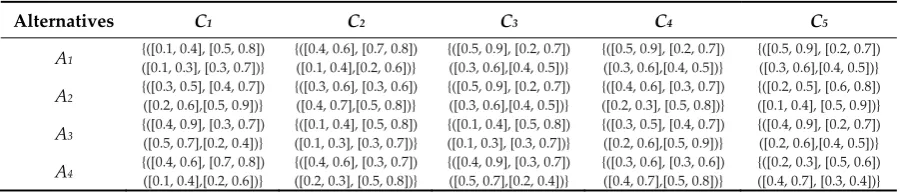
Step 1. Construct an interval-valued intuitionistic hesitant fuzzy decision matrix by each decision maker. In the evaluation process, it is necessary for the decision makers to provide their own evaluation in relation to all the available alternatives. Tables 1–3 show the evaluation of each decision maker Dk for all the alternatives Ai(i= 1, 2, …, n) with respect to the criteria Cj (j = 1, 2, …, m).
Table 1. The interval-valued intuitionistic hesitant fuzzy decision matrix for decision maker 1.
Alternatives C1 C2 C3 C4 C5
A1 {([0.4, 0.5],[0.6, 0.9])
([0.1, 0.3],[0.2, 0.6])}
{([0.4, 0.6], [0.3, 0.7]) ([0.2, 0.3], [0.5, 0.8])}
{([0.3, 0.6], [0.3, 0.6]) ([0.4, 0.7],[0.5, 0.8])}
{([0.4, 0.6], [0.7, 0.8]) ([0.1, 0.4],[0.2, 0.6])}
{([0.3, 0.6], [0.5, 0.8]) ([0.5, 0.8],[0.6, 0.7])}
A2 {([0.2, 0.3], [0.5, 0.6])
([0.4, 0.7], [0.3, 0.4])}
{([0.3, 0.5], [0.4, 0.7]) ([0.2, 0.6],[0.5, 0.9])}
{([0.6, 0.7], [0.4, 0.8]) ([0.1, 0.5],[0.3, 0.6])}
{([0.4, 0.9], [0.3, 0.7]) ([0.5, 0.7],[0.2, 0.4])}
{([0.2, 0.6], [0.5, 0.6]) ([0.4, 0.7],[0.5, 0.7])}
A3 {([0.5, 0.9], [0.2, 0.7])
([0.3, 0.7],[0.4, 0.9])}
{([0.1, 0.4], [0.5, 0.8]) ([0.1, 0.3], [0.3, 0.7])}
{([0.5, 0.9], [0.3, 0.7]) ([0.3, 0.7], [0.1, 0.2])}
{([0.3, 0.8], [0.2, 0.7]) ([0.4, 0.7],[0.6, 0.9])}
{([0.5, 0.9], [0.2, 0.7]) ([0.3, 0.6],[0.4, 0.5])}
A4 {([0.3, 0.4], [0.5, 0.8])
([0.1, 0.5],[0.6, 0.8])}
{([0.2, 0.5], [0.4, 0.7]) ([0.1, 0.6], [0.6, 0.8])}
{([0.5, 0.8], [0.1, 0.4]) ([0.3, 0.4], [0.5, 0.7])}
{([0.2, 0.4],[0.6, 0.9]) ([0.3, 0.7],[0.4, 0.8])}
{([0.2, 0.5], [0.6, 0.8]) ([0.1, 0.4], [0.5, 0.9])}
Table 2. The interval-valued intuitionistic hesitant fuzzy decision matrix for decision maker 2.
Alternatives C1 C2 C3 C4 C5
A1 {([0.1, 0.4], [0.5, 0.8])
([0.1, 0.3], [0.3, 0.7])}
{([0.5, 0.9], [0.2, 0.7]) ([0.3, 0.6],[0.4, 0.5])}
{([0.4, 0.9], [0.3, 0.7]) ([0.5, 0.7],[0.2, 0.4])}
{([0.5, 0.9], [0.2, 0.7]) ([0.3, 0.7],[0.4, 0.9])}
{([0.2, 0.3], [0.5, 0.6]) ([0.4, 0.7], [0.3, 0.4])}
A2 {([0.4, 0.6], [0.7, 0.8])
([0.1, 0.4],[0.2, 0.6])}
{([0.2, 0.5], [0.6, 0.8]) ([0.1, 0.4], [0.5, 0.9])}
{([0.1, 0.4], [0.5, 0.8]) ([0.1, 0.3], [0.3, 0.7])}
{([0.1, 0.4], [0.5, 0.8]) ([0.1, 0.3], [0.3, 0.7])}
{([0.2, 0.5], [0.6, 0.8]) ([0.1, 0.4], [0.5, 0.9])}
A3 {([0.4, 0.9], [0.3, 0.7])
([0.5, 0.7],[0.2, 0.4])}
{([0.2, 0.3], [0.5, 0.6]) ([0.4, 0.7], [0.3, 0.4])}
{([0.5, 0.9], [0.2, 0.7]) ([0.3, 0.6],[0.4, 0.5])}
{([0.6, 0.7], [0.4, 0.8]) ([0.1, 0.5],[0.3, 0.6])}
{([0.4, 0.6], [0.7, 0.8]) ([0.1, 0.4],[0.2, 0.6])}
A4 {([0.5, 0.9], [0.2, 0.7])
([0.3, 0.6],[0.4, 0.5])}
{([0.6, 0.7], [0.4, 0.8]) ([0.1, 0.5],[0.3, 0.6])}
{([0.5, 0.9], [0.2, 0.7]) ([0.3, 0.7],[0.4, 0.9])}
{([0.4, 0.9], [0.3, 0.7]) ([0.5, 0.7],[0.2, 0.4])}
{([0.4, 0.9], [0.3, 0.7]) ([0.5, 0.7],[0.2, 0.4])}
Table 3. The interval-valued intuitionistic hesitant fuzzy decision matrix for decision maker 3.
Alternatives C1 C2 C3 C4 C5
A1 {([0.1, 0.4], [0.5, 0.8])
([0.1, 0.3], [0.3, 0.7])}
{([0.4, 0.6], [0.7, 0.8]) ([0.1, 0.4],[0.2, 0.6])}
{([0.5, 0.9], [0.2, 0.7]) ([0.3, 0.6],[0.4, 0.5])}
{([0.5, 0.9], [0.2, 0.7]) ([0.3, 0.6],[0.4, 0.5])}
{([0.5, 0.9], [0.2, 0.7]) ([0.3, 0.6],[0.4, 0.5])}
A2 {([0.3, 0.5], [0.4, 0.7])
([0.2, 0.6],[0.5, 0.9])}
{([0.3, 0.6], [0.3, 0.6]) ([0.4, 0.7],[0.5, 0.8])}
{([0.5, 0.9], [0.2, 0.7]) ([0.3, 0.6],[0.4, 0.5])}
{([0.4, 0.6], [0.3, 0.7]) ([0.2, 0.3], [0.5, 0.8])}
{([0.2, 0.5], [0.6, 0.8]) ([0.1, 0.4], [0.5, 0.9])}
A3 {([0.4, 0.9], [0.3, 0.7])
([0.5, 0.7],[0.2, 0.4])}
{([0.1, 0.4], [0.5, 0.8]) ([0.1, 0.3], [0.3, 0.7])}
{([0.1, 0.4], [0.5, 0.8]) ([0.1, 0.3], [0.3, 0.7])}
{([0.3, 0.5], [0.4, 0.7]) ([0.2, 0.6],[0.5, 0.9])}
{([0.4, 0.9], [0.2, 0.7]) ([0.2, 0.6],[0.4, 0.5])}
A4 {([0.4, 0.6], [0.7, 0.8])
([0.1, 0.4],[0.2, 0.6])}
{([0.4, 0.6], [0.3, 0.7]) ([0.2, 0.3], [0.5, 0.8])}
{([0.4, 0.9], [0.3, 0.7]) ([0.5, 0.7],[0.2, 0.4])}
{([0.3, 0.6], [0.3, 0.6]) ([0.4, 0.7],[0.5, 0.8])}
{([0.2, 0.3], [0.5, 0.6]) ([0.4, 0.7], [0.3, 0.4])}
Step 2. The overall interval-valued intuitionistic hesitant fuzzy decision matrix is obtained by averaging the fuzzy assessments made by individual decision makers as in (1).
Step 3. The fuzzy measures of criteria C is determined as shown below by using λ=0.5.
1 2 3 4 5
(C ) 0.6, (C ) 0.5, (C ) 0.3, (C ) 0.2, (C ) 0.2
μ = μ = μ = μ = μ =
Step 4. The preference of one permutation to others is obtained below by using the score function derived in (4).
S(h11) = 0.638, S(h12) = 0.532, S(h13) = 0.581, S(h14) = 0.359, S(h15) = 0.214.
Step 5: Aggregate all interval-valued intuitionistic hesitant fuzzy elements [hij]n×m into hi(i= 1,
2, …, n) of the alternative Ai by using (5). The results are calculated as:
h1 = {([0.62,0.77],[0.12,0.15])([0.41,0.52][0.38,0.48])([0.43,0.55],[0.27,0.42])([0.32,0.39],[0.58,0.65])([0.37,0.26],[0.48,0.52])}
h2 = {([0.48,0.56],[0.24,0.31])([0.46,0.49][0.27,0.48])([0.11,0.17],[0.63.0.82])([0.13,0.25],[0.56,0.72])([0.28,0.39],[0.37,0.64])}
h3 = {([0.27,0.36],[0.52,0.61])([0.32,0.43][0.39,0.48])([0.32,0.41],[0.45.0.64])([0.38,0.49],[0.34,0.52]) ([0.36,0.54],[0.49,0.55])}
h4 = {([0.14,0.24],[0.53,0.74])([0.22,0.38][0.48,0.63])([0.21,0.28],[0.46,0.73])([0.17,0.26],[0.48,0.68]) ([0.29,0.36],[0.43,0.48])}
Step 6. The interval-valued intuitionistic hesitant fuzzy positive-ideal solution (h+) and
interval-valued intuitionistic hesitant fuzzy negative-ideal solution (h−) are given as:
h+= {([1,1],[0,0])([1,1],[0,0])([1,1][0,0])([1,1][0,0])([1,1][0,0])}
Step 7. The distance between the alternative Ai from the interval-valued intuitionistic hesitant
fuzzy positive-ideal solution (h+) and the interval-valued intuitionistic hesitant fuzzy negative-ideal
solution (h−) are calculated by using (8) - (9).
, ,
1 1
, ,
2 2
, ,
3 3
, ,
4 4
( ) 0.571, ( ) 0.439 ( ) 0.526, ( ) 0.435 ( ) 0.492, ( ) 0.479 ( ) 0.548, ( ) 0.371
d A h d A h
d A h d A h
d A h d A h
d A h d A h
+ −
+ −
+ −
+ −
= =
= =
= =
= =
Step 8. By using (10), the closeness coefficient value of each alternative can be calculated as shown in Table 4.
Step 9. The ranking of each alternative can be determined based on the closeness coefficient obtained in Table 4. Table 4 also shows that alternative A4 is the best performing cloud service alternative, as compared to the other alternatives as it has the highest closeness coefficient value of 0.739.
Table 4. The closeness coefficient of the cloud service alternatives and their rankings.
Alternatives Value Ranking
A1 0.714 2
A2 0.653 3
A3 0.628 4
A4 0.739 1
5. Conclusion
The cloud service performance evaluation process is challenging due to (a) the availability of multiple cloud service alternatives, (b) the multi-dimensional nature of the decision problem, (c) the involvement of multiple decision makers, and (d) the presence of subjectiveness and imprecision involved in the decision making process. This paper has presented a fuzzy multicriteria group decision making method for evaluating the performance of cloud services. The inherent subjectiveness and imprecision of the evaluation process is modelled by using interval-valued intuitionistic fuzzy numbers. An effective algorithm is developed based on the TOPSIS method and the Choquet integral operator for adequately dealing with the cloud services performance evaluation problem. The result shows that the fuzzy multicriteria group decision making method is capable of effectively and efficiently solving the multicriteria group decision making problem in the real world setting.
Acknowledgements: This research is financially supported by the Fundamental Research Funds for the Central Universities, and the Research Funds of Renmin University of China (No. 15XNLQ08).
References
1. Zheng, Z.; Wu, X.; Zhang, Y.; Liyu, M.; Wang, J. QoS ranking prediction for cloud services. IEEE Trans. Parall. Distrib. Syst. 2013, 24, 1213-1222.
2. Sun, L.; Dong, H.; Hussain, F.K.; Hussain, O.K.; Chang, E. Cloud service selection: State-of-the-art and future research directions. J. Netw. Comput. Appl. 2014, 45, 134-150.
3. Garg, S.K.; Versteeg, S.; Buyya, R. A framework for ranking of cloud computing services. Future Gener. Comput. Syst. 2013, 29, 1012-1023.
4. Chang, V.; Walters, R.J.; Wills, G.B. Organisational sustainability modelling - An emerging service and analytics model for evaluating cloud computing adoption with two case studies. Int. J. Inform. Manage. 2016, 36, 167-179.
6. Menzel, M.; Schonherr, M.; Tai, S. (MC2)2: Criteria, requirements and a software prototype for cloud infrastructure decisions. Softw. Pract. Exp. 2013, 43, 1283-1297.
7. Wibowo, S.; Deng, H. Consensus-based decision support for multicriteria group decision making. Comput. Ind. Eng. 2013, 66, 625-633.
8. Yeh, C.H.; Deng, H.; Wibowo, S.; Xu, Y. Multicriteria group decision support for information systems project selection. LNAI, 2009, 5579, 152-161.
9. Ma, B.; Tan, C.; Jiang, Z.; Deng, H. Intuitionistic fuzzy multicriteria group decision for evaluating and selecting information systems projects. Inform. Technol. 2013, 12, 2505-2511.
10. Godse, M.; Mulik, S. An approach for selecting software-as-a-service (SaaS) product. In Proceedings of the CLOUD, Bangalore, 2009.
11. Creeger, M. CTO roundtable. Commun. ACM, 2009, 52, 50.
12. Armbrust, M.; Stoica, I.; Zaharia, M.; Fox, A.; Griffith, R.; Joseph, D. A view of cloud computing. Commun. ACM, 2010, 53, 50-58.
13. Cusumano, M. Cloud computing and SaaS as new computing platforms. Commun. ACM, 2010, 53, 27-29. 14. Katz, R. Tech titans building boom. IEEE Spectr. 2009, 40-54.
15. Hoberg, P.; Wollersheim, J.; Krcmar, H. The business perspective on cloud computing: A literature review of research on cloud computing. In Proceedings of theAMCIS, Washington, USA, 2012.
16. Gartner. Gartner says cloud computing will become the bulk of new IT spend by 2016. Available online: http://www.gartner.com/newsroom/id/2613015 (accessed on 04 May 2016).
17. Manyika, J.; Chui, M.; Bughin, J.; Dobbs, R.; Bisson, P.; Marrs, A. Disruptive technologies: Advances that will transform life, business, and the global economy. The McKinsey Global Institute, 2013, pp. 1-176. 18. KPMG. Clarity in the cloud: A global study of the business adoption of cloud. KPMG, 2011, pp. 1-48. 19. Wibowo, S; Deng, H. Intelligent decision support for effectively evaluating and selecting ships under
uncertainty in marine transportation. Expert Syst. Appl. 2012, 39, 6911-6920.
20. Arpaci, I.; Kilicer, K.; Bardakci, S. Effects of security and privacy concerns on educational use of cloud services. Comput. Hum. Behav., 2015, 45, 93-98.
21. Avram, M. Advantages and challenges of adopting cloud computing from an enterprise perspective. Proc. Technol. 2014, 12, 529-534.
22. Hung, S.H.; Shih, C.S.; Shieh, J.P.; Lee, C.P.; Huang, Y.H. Executing mobile applications on the cloud: Framework and issues. Comput. Math. Appl. 2012, 63, 573-587.
23. Julisch, K.; Hall, M. Security and control in the cloud. Inform. Secur. 2010, 9, 299-309.
24. Park, E.; Kim, K.J. An ıntegrated adoption model of mobile cloud services: Exploration of key determinants and extension of technology acceptance model. Telemat. Inform. 2014, 31, 376-385.
25. Iosup, A.; Ostermann, S.; Yigitbasi, Y.; Prodan, A.; Fahringer, T.; Epema, D. Performance analysis of cloud computing services for many-tasks scientific computing. IEEE Trans. Parall. Distrib. Syst. 2011, 22, 931-945. 26. Martens, B.; Teuteberg, F. Decision-making in cloud computing environments: A cost and risk based
approach. Inform. Syst. Front. 2012, 14, 871-893.
27. Zeng, W.; Zhao, Y.; Zeng, J. Cloud service and service selection algorithm research. In Proceedings of the ACM SIGEVO, Shanghai, China, 2009.
28. Limam, N.; Boutaba, R. Assessing software service quality and trustworthiness at selection time. IEEE Trans. Softw. Eng. 2010, 36, 559-574.
29. Quinton, C.; Romero, D.; Duchien, L.Automated selection and configuration of cloud environments using software product lines principles. In Proceedings of the 7th IEEE CLOUD, Alaska, 2014.
30. Menzel, M.; Ranjan, R. Cloud genius: Decision support for web server cloud migration. In Proceedings of the 21st WWW, Lyon, France, 2012.
31. Balasooriya, P.; Wibowo, S.; Wells, M. Green cloud computing and economics of the cloud: Moving towards sustainable future. In Proceedings of the 7th Annual International Conference on ICT: Big Data, Cloud and Security, Singapore, 2016.
32. Karim, R.; Ding, C.; Miri, A. An end-to-end QoS mapping approach for cloud service selection. In Proceedings of the IEEE 9th SER-VICES, Santa Clara, CA, 2012.
33. Wibowo, S.; Deng, H. Multi-criteria group decision making for evaluating the performance of e-waste recycling programs under uncertainty. Waste Manage., 2015, 40, 127-135.
34. Wibowo, S; Deng, H. A fuzzy rule-based approach for screening international distribution centres.
35. Atanassov, K.; Gargov, G. Interval-valued intuitionistic fuzzy sets. Fuzzy Sets Syst. 1989, 31, 343-349. 36. Tora, V. Hesitant fuzzy sets. Int. J. Intell. Syst. 2010, 25, 529-539.
37. Joshi, D; Kumar, S. Interval-valued intuitionistic hesitant fuzzy Choquet integral based TOPSIS method for multi-criteria group decision making. Eur. J. Oper. Res. 2016, 248, 183-191.