1542 |
P a g e
Segmentation Based Optical Character Recognition for
Handwritten Marathi characters
Madhav Vaidya
1, Yashwant Joshi
2,Milind Bhalerao
3Department of Information Technology
1Department of Electronics and Telecommunication
2Shri Guru Gobind Singhji Institute of Engineering and Technology,
Vishnupuri, Nanded-431606 (M. S.), India.
ABSTRACT
Valuable ancient documents like historical books, old scripts etc. are available in specific regional languages. Problems occur when those documents have to be preserve in digital form or to modify them. Optical Character Recognition is used to convert the scanned document word, notepad or any other format, so that we can easily edit that document. A complete OCR system for handwritten Devanagari document has been studied and we explore our work on segmentation technique. Literature survey on feature extraction and classification process has been completed. Finally directions for future research are suggested.
Index Terms – Devanagari Script, Preprocessing, Segmentation, Feature Extraction, Classification.
I. INTRODUCTION
Devanagari Script is most popular in India. It has been used by more than 300 million people.
1543 |
P a g e
Devanagari has been used as base for many languages in India and Abroad. Origin of this script is 'Brahmi'which is purely Indian in nature. Constitutionally 22 languages are recognized in India. Devanagari Script is
different from Roman script, it is phonetic script. This script occurs in the composition of vowels and modifiers as it
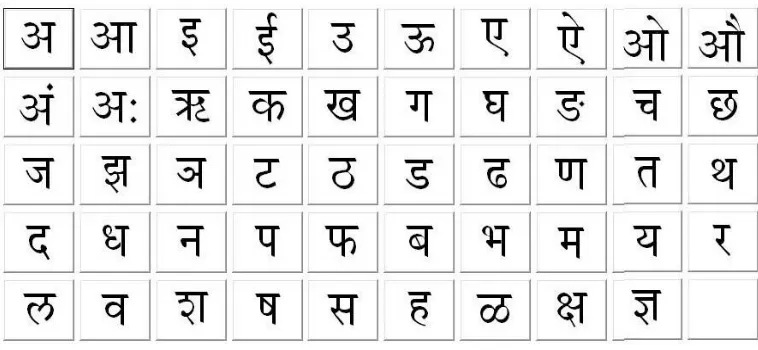
has 13 vowels and 36 consonants i.e. overall 49 basic characters. There exists a horizontal line at the upper part
called 'Shirorekha' or header line. It divides the word into three major zone: lower strip, middle strip and upper strip.
The upper strip denotes the portion above the headline, middle zone covers the portion of composition of vowels and
components, lower modifiers are present in lower strip.
Recognition of handwritten Devanagari script is more difficult than printed, because there are variation in
writing style of each person. It depends upon the alignment and different forms of handwritten strokes and variations
are geometrical. Handwritten characters of Devanagari script are cursive and unconstructed in nature, so
segmentation and recognition is critical part. For getting high accuracy of recognition good feature extraction is one
of the important factor.
This paper presents the detail study of Devanagari OCR for handwritten document. Section II describes
Data Acquisition and preprocessing steps as preprocessing is needed for removing the noise from document. Section
III is about the implementation of segmentation technique which we are using. Section IV discusses the Feature
Extraction and Classification process from survey. The references include the most relevant papers recently
published as well as some old papers, which gives a comprehensive outline of the developments in the field of
research.
II. METHODOLOGY
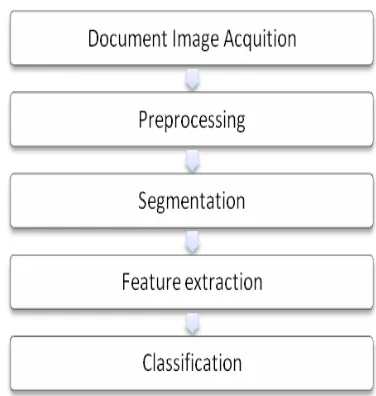
In this approach first the image is scanned and made suitable for further processing by preprocessing. After
preprocessing line, word and character segmentation is performed. Features of segmented characters are extracted
for classification purpose.
1544 |
P a g e
III. PREPROCESSING
In preprocessing stage we will the input image from the scanner as shown in figure 2.
FIGURE 3: Sample Document Image
There may be some noise and other things may be present in this input image rather than text of Devanagari text.
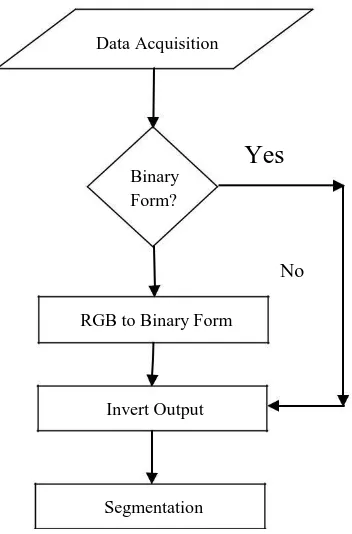
Preprocessing stage is needed to remove the noise and convert the original scanned RGB image into binary form.
Noise introduced by optical scanning devices or image capturing instruments cause errors in segmentation, noise
reduction eliminates these imperfections as it is necessary for recognition. RGB image is converted into binary
format, i.e., only two value matrix of image is produced.
Data Acquisition
Binary
Yes
Form?
No
RGB to Binary Form
Invert Output
Segmentation
FIGURE 4: Preprocessing Flowchart
Binary image is inverted and the pixels of each character in input are represented by value 1 that is in white color as
shown in Fig. 5. Noise reduction, Normalization of data, Compression in the amount of data to be retained are main
1545 |
P a g e
FIGURE 5: Binary Image
IV. SEGMENTATION
For recognition of individual characters and convert it into standard format, the separation of paragraphs, text
lines, words, and characters is to be carried out for effective feature extraction. Segmentation is one of the hardest,
crucial, and time consuming phase. In image processing the segmentation approaches falls broadly in Pixel
classification, Edge based Segmentation, and Region based categories. For document segmentation pixel
classification and region based classification are used.
Algorithm presented by Bansal and Sinha [1] for the segmentation of machine-printed composite characters into
their constituent symbols used a two-pass algorithm. Two-pass algorithm extensively used structural properties of
the script. Words are segmented into easily separable or composite characters in first pass. For the identification of
whether a character box is composite, statistical information about the height and width of each separated box is
used. The hypothesized composite characters are further segmented in second pass. Depending on the context the
regions of image for further segmentation is selected based on statistical analysis of height or width. Kompalli et al.
proposed a method foe determination of the Shirorekha using projection profile and run length [9]. Upper modifiers
above the Shirorekha are isolated as ascenders. The top middle and bottom strips are identified easily after removing
the Shirorekha. For feature extraction and classification each of these components is then scaled to a standard size.
A fuzzy multi-factorial analysis presented by Garain and Chaudhuri [10] for identification and segmentation of
touching machine-printed Devanagari characters. This technique developed a predictive algorithm for selecting
possible cut columns for segmenting the touching characters effectively in the same.
Instead of segmenting word into characters, the holistic approach is used to recognize the entire words as single
one entity. It is the segmentation-free approach as there is no attempt to identify characters invidiously and
recognition is globally performed on whole image of words. This approach eliminates the issue of finding individual
characters by considering words as atomic units of recognition.
Proposed Technique for Segmentation
We used the isolated characters approaches for segmenting individual characters from whole document,
considering the Shirorekha with words. Shirorekha is used to determine the upper strip, middle strip, and lower strip
but we are not eliminating the Shirorekha because the database we create also have Shirorekha in each vowels and
consonants. The propose method is 100% efficient for the segmentation of line and word. The segmentation of
characters from word is critical, as single word may contain composite characters i.e. combination of vowels and
1546 |
P a g e
i. Line segmentation
ii. Word segmentation
iii. Character segmentation
Line segmentation divides the A4 size page document into number of images equal to the lines present in page.
That individual image is again segmented which is word segmentation and it gives separated words from single
straight lines. Word segmentation is easier than line segmentation and character segmentation. Words are segmented
by the projection based method. Each word is saved in new image and further it is segmented in characters.
Algorithm:
Input - Binary complementary image of document (A4 size page).
[1] Rotate image with 270 degree.
[2] Plot the vertical histogram projection.
[3] Find out minima‘s of histogram by taking row-wise summation.
[4] Crop image(s) for consecutive white pixels.
[5] Save the new segmented lines as separate image.
[6] Repeat above steps up to last line.
[7] Take image of separated single line.
[8] Plot the vertical projection of line.
[9] Find out column wise sum, get the minima's.
[10]Each individual word has different values in histogram obtained from it and the
histogram has consecutive zero value is the blank space between two words.
[11]Crop image.
[12]Save the each word as new image.
[13]Repeat above step up-to last pixel in line.
[14]Get the new image of separated word.
[15]Repeat steps from 8 to 14 but here in histogram will have some value at the end of
characters because of presence of Shirorekha.
1. Line from Document
2. Segmented Words
1547 |
P a g e
1. Image obtained after Preprocessing
2. Vertical Segmentation
3. Segmented Letters
FIGURE 6: Result of Character Segmentation
V. FEATURE EXTRACTION AND CLASSIFICATION
Feature extraction is challenging task as it proves to be successful in one application domain may turn out not to be
very useful in another domain. Feature extraction pick out the different features from single character and it helps to
distinguish between various classes for further classification. Extracting features from raw data which are relevant
for classification purposes and enhancing that between-class pattern variability is nothing but the feature extraction.
Sandhya Arora et al. [12], proposed a method which used four different techniques for feature extraction. They have
taken the three different features by performing scaling of image of character. After performing thinning, generating
one pixel wide skeleton of character image and segmenting the image into 16 segments, 32 intersection features are
extracted in First type of feature. From eight octants of the character image, 16 shadow features are extracted in
second type of feature. Detecting the contour points of original scaled character image and dividing the contour
image into 25 segments, 200 chain code histogram features are obtained in third type of feature. For finding
Shirorekha, vertical bar (Spine) in handwritten Devanagari characters cannot be done very efficiently by simple
histogram method. A two stage classification method is proposed again by S. Arora et al., in which they got 89.12%
success. First stage was for structural properties like Shirorekha, spine in character and second exploits some
intersection features of characters which are fed to a feed forward neural network. Following are the various
methods which can be used for extraction; it requires some mathematical computation and calculations [5]:
Fourier Transforms: Fourier transform is used to identify the position-shifted characters after discovering the
magnitude spectrum in feature extraction. Magnitude spectrum of the measurement vector can be chosen as the
features in an n-dimensional Euclidean space.
Gabor Transform: Gabor Transform varies from FT where window is used defined by Gaussian function.
Wavelets: It is used get different levels of resolution of image and signal. Separated characters obtained by
segmentation are represented by wavelet coefficients corresponding to various levels of resolution. Coefficients
1548 |
P a g e
Moments: Central moments, Legendre moments, and Zernike moments, make the process of recognizing an objectscale, translation, and rotation invariant. original image can be completely reconstructed from the moment
coefficients as series expansion representation.
Govinda Raju et al. [9] used the gradient features computed using a Sobel operator measures the magnitude and
direction of intensity changes in a small neighborhood of each pixel. A threshold is considered to map gradient
feature is computed by retaining gradient magnitudes. The gradient vectors of the constituent blocks are used to
construct the feature vector. Gradient, structural, and concavity (GSC) features are used in method proposed by
Kompalli et al. [8], for OCR of printed and multi-font Devanagari text.
After extracting the features, the pattern is needed to be classified according to the predefined classes. Classification
used in OCR falls in category of Supervise learning. It is totally based of the patterns or classes that have already
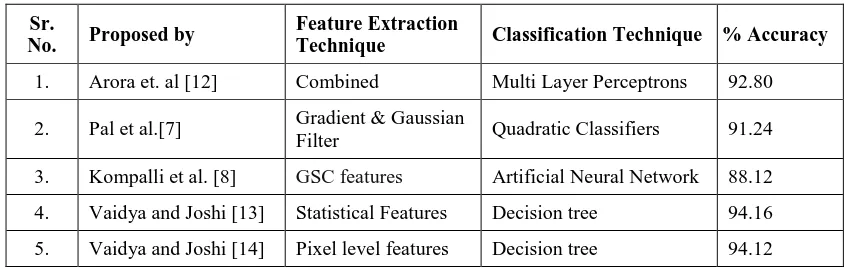
been classified. Table I presents an abstract view of various techniques of feature extraction and classification which
have been used by different researches we referred.
TABLE I: Results of Feature Extraction Obtained From Study.
Sr.
No. Proposed by
Feature Extraction
Technique Classification Technique % Accuracy
1. Arora et. al [12] Combined Multi Layer Perceptrons 92.80
2. Pal et al.[7] Gradient & Gaussian
Filter Quadratic Classifiers 91.24
3. Kompalli et al. [8] GSC features Artificial Neural Network 88.12
4. Vaidya and Joshi [13] Statistical Features Decision tree 94.16
5. Vaidya and Joshi [14] Pixel level features Decision tree 94.12
VI. CONCLUSION
Converting handwritten document into editable form is not a single step procedure, as it requires multiple processes like
preprocessing, segmentation, feature extraction and classification. Recognition of handwritten document is more difficult
task than printed one. Data acquisition can be done by scanner or any image capturing devices. For recognition of whole
document, separation of character is necessary which gives the result of segmentation step. Dividing whole word into
individual characters the holistic approaches can be used to avoid the segmentation of word into character. We used
the histogram projection method for segmentation which gives 99% accuracy in result of segmentation of line and
segmentation of word. Various techniques are listed and studied for feature extraction and classification as our
future work.
REFERENCES
[1] Bansal V, Sinha R. M. K., "Integrating Knowledge Resources in Devanagari. Text recognition system",
1549 |
P a g e
[2] P. S. Deshpande, Latesh Malik, "Fine Classification & Recognition of Hand Written Devnagari Characterswith Regular Expressions & Minimum Edit Distance Method", Journal of Computers, Vol. 3, No. 5, pp.
11-17, May 2008.
[3] Nafiz Arica, Fatos T. Yarman-Vural, "An Overview of Character Recognition Focused on Off-Line
Handwriting", IEEE Transactions on Systems, Man, and Cybernetics— Part C: Applications and Reviews,
Vo. 31, issue 2, May 2001.
[4] Agnihotri, Ved Prakash, "Offline Handwritten Devanagari Script Recognition", International Journal of
Information Technology and Computer Science, 2012, Vol. 4, No. 8, pp. 37-42, 2012.
[5] R. Jayadevan, Satish R. Kolhe, Pradeep M. Patil, and Umapada Pal, "Offline Recognition of Devanagari
Script: A Survey", IEEE Transactions on Systems, Man, and Cybernetics—Part C: Applications and
Reviews, Volume 41, Issue 6, November 2011.
[6] Mahesh Jangid, "Devanagari Isolated Character Recognition by using Statistical features", International
Journal on Computer Science and Engineering (IJCSE), Vol. 2, No 3, pp. 2400-2407, 2011.
[7] U. Pal and B. B. Chaudhuri, "Indian script character recognition: A survey", Pattern Recognition., Volume
37, pp. 1887–1899, 2004.
[8] S. Kompalli, S. Setlur, and V. Govindaraju,"Devanagari OCR using a recognition driven segmentation
framework and stochastic language models." Int. J. on Document Analysis and Recognition, Vol. 12, no. 2,
pp. 123-138, 2009.
[9] V. Govindaraju, S. Khedekar, S. Kompalli, F. Farooq, Setlur and Vemulapati, "Tools for enabling digital
access to multi-lingual Indic documents", In Proc. 1st International Workshop on Document Image
Analysis for Libraries, pp. 122-133, 2004.
[10] U. Garain and B. B. Chaudhuri, "Segmentation of touching characters in printed Devnagari and Bangla
scripts using fuzzy multifactorial analysis", IEEE Transactions on Systems, Man, and Cybernetics—Part C:
Applications and Reviews, Vol. 32, Issue 4, pp. 449–459, 2002.
[11] U. Pal, P. P. Roy, N. Tripathy and J. Llados, ―Multi-oriented Bangla and Devnagari text recognition",
Pattern Recognition., Volume 43, Issue 12, pp. 4124–4136, 2010.
[12] Sandhya Arora, Debotosh Bhattacharjee, Mita Nasipuri, "Combining Multiple Feature Extraction
Techniques for Handwritten Devnagari Character Recognition", 3rd IEEE International conference on
Industrial and Information Systems, pp. 1-6, 2008.
[13] M. Vaidya and Y. Joshi, "Marathi Numeral Recognition using statistical distribution features", In: Proc.
IEEE conference on Information processing, pp. 586-591, 2015.
[14] M. Vaidya and Y. Joshi, "Handwritten Numeral Identification System Using Pixel Level Distribution
Features", In: Proc. 2nd International Conference on Information and Communication Technology for