On the relation between pole and running heavy quark
masses beyond the four-loop approximation
A. L.Kataev1,2,∗and V. S.Molokoedov1,2,3,∗∗
1Institute for Nuclear Research of the Russian Academy of Sciences, 60th October Anniversary prospect 7a, Moscow, 117312, Russia 2Moscow Institute of Physics and Technology,
Institusky per. 9, Dolgoprudny, Moscow region, 141700, Russia
3Landau Institute for Theoretical Physics of the Academy of Sciences of Russia, Akademika Semenova avenue 1-a, Chernogolovka, Moscow Region, 142432, Russia
Abstract.The effective charges motivated method is applied to the relation be-tween pole and MS-scheme heavy quark masses to study high order perturbative QCD corrections in the observable quantities proportional to the running quark masses. The non-calculated five- and six-loop perturbative QCD coefficients are estimated. This approach predicts for these terms the sign-alternating expansion in powers of number of lighter flavorsnl, while the analyzed recently infrared renormalon asymptotic expressions do not reproduce the same behavior. We emphasize that coefficients of the quark mass relation contain proportional to π2effects, which result from analytical continuation from the Euclidean region, where the scales of the running masses and QCD coupling constant are ini-tially fixed, to the Minkowskian region, where the pole masses and the running QCD parameters are determined. For thet-quark the asymptotic nature of the non-resummed PT mass relation does not manifest itself at six-loops, while for theb-quark the minimal PT term appears at the probed by direct calculations four-loop level. The recent infrared renormalon based studies support these conclusions.
1 Introduction
It is well-known that the masses of charm, bottom and top-quarks are one of the most impor-tant QCD parameters, which are relevant for processing different data, obtained at LHC and
Tevatron. The pole and MS-scheme running heavy quark masses are the generally accepted definitions for these parameters. The first ones are determined by the position of pole of the renormalized fermion propagator at Minkowskian regionk2 =M2
q. The scale-dependence of
the second ones are defined from the solution of the following renormalization-group equa-tion:
mq(s)
mq(µ2) =exp as(s)
as(µ2) γm(x)
β(x) dx
. (1)
∗e-mail: [email protected] ∗∗e-mail: [email protected]
Heremq(µ2) are the running masses of heavy quarks, normalized at the Minkowskian scale
µ2,as(µ2)=αs(µ2)/πis the renormalized QCD coupling constant in the MS-scheme,sis the
energy time-like variable. The RGβ-function and anomalous mass dimensionγmare defined
as:
µ2∂as
∂µ2 =β(as)=−
∞
n=0
βnans+2, µ2
∂log(mq)
∂µ2 =γm(as)=−
∞
n=0
γnans+1. (2)
Their five-loop approximations in the MS-scheme can be found in works of [? ? ] and [? ] correspondingly. It is worth to emphasize that the renormalization scaleµ2 in Eqs.(??,??) may be initially defined in the Euclidean region. As was shown in [? ? ? ? ? ? ] the pole quark mass relation is sensitive to the long-distance infrared renormalon (IRR) effects. This
IRR sensitivity leads to theO(ΛQCD) renormalon ambiguity in the determination of heavy quark masses, which is related to the firstδ=1/2 IRR pole in theδ-plane of the Borel transform
for the PT QCD relation between pole and running heavy quark masses [? ]. Therefore, the significant attention is paid to the determinations of masses in the MS-scheme, which do not imply the need for knowledge of the long-distance contributions. Indeed, their definition within dimensional regularization presumes taking into account of the UV divergent poles only. Therefore sometimes the running MS heavy quark masses are called the short-distance masses, which unlike pole masses have nothing in common with the IRR effects.
In view of all mentioned above it is of interest to consider the relation between pole and running masses of heavy quarks:
Mq=mq(m2q) ∞
n=0 tM
nans(m2q). (3)
The choiceµ2=m2qcorresponds to the commonly accepted way of fixation of the
renormal-ization scale in the Minkowskian region, wherein coefficientstnMare polynomials in powers
of the number of massless flavorsnl
tM
n =
n−1
k=0 tM
nknkl (4)
with the initial conditiontM
0 =1. Note that we consider the approximation when heavy flavor numbernf of active quarks are defined asnf =nl+1. The results of calculations of one, two
and three-loop corrections to (??) were obtained in [? ], [? ? ? ], [? ? ] respectively. The four-loop contributionstM
43andt42M are known from the analytical calculations, performed in [?]. The restO(a4
s)-corrections, namelyt41Mandt40M-terms, are not yet computed in analytical form, but are evaluated numerically with the corresponding theoretical uncertainties. The total expressions for thetM
4 -term at fixed numbers of massless flavorsnl=3,4,5 were evalu-ated in [? ]. Using these numerical results, supplemented with the analytical information on tM
43andt42M-terms, the authors of Ref.[? ] presented the first estimates of the unknown previ-ouslytM
41andtM40-coefficients by means of the renormalon-inspired approach. Independently, the numerical values of these terms were determined in [? ? ] with the help of mathemat-ically self-consistent least squares (LS) method, which is well-defined procedure of solving the overdetermined system of linear equations with the fixation of theoretical inaccuracies of the central values of the obtained results. Recently the updated results of the numerical eval-uation oftM
4 -terms were obtained by means of the Monte-Carlo methods in [?] not for three values ofnlonly but at extra 18 values as well, which corresponds to the additional points in
with considerably smaller uncertainties than the ones, presented in [?]. This prompted us to reconsider the results of [? ] and to get new values oftM
41,t40M-terms and their uncertainties using the same LS method [?]. The central values of new results have changed slightly (see the Note added to [? ] as well). This is related to slight change of the central values of the improved more precise numbers from Ref.[?]. Moreover, thanks to the increase of the num-ber of analyzed by LS method equations, fixed by the results from [? ], which have smaller numerical errors than the outcomes of previous calculations [? ], the obtained in [? ] solu-tions of larger system of linear equasolu-tions turned out to be drastically more precise than the ones, obtained previously in Ref.[? ]. This feature is in agreement with general property of the mathematical LS approach. Leaving the discussions of the technical issues of this method aside we will return now to the consideration of the asymptotic structure of Eq.(??).
Due to the manifestation of the IRRs in the Borel image for the pole-running heavy quark mass relation, it is possible to conclude that the mass conversion formula of Eq.(??) is asymp-totic one with the sign-constant factorially growing high order PT coefficientstnM. This means
that at some orders of PT the series in (??) start to diverge. Indeed, from the results of direct calculations, performed at the two-loop level in the works [? ? ? ] and at the three-loop level in Refs.[? ? ] it is possible to conclude that the perturbative QCD relation between pole and running charm-quark mass diverges from the second (or the third) order of PT. The situation with the mass conversion formula for theb-quark is more delicate. Indeed, its PT high-order contributions decrease up to four-loop level, although quite slowly. The four-loop contribution, numerically evaluated in [? ?], is very close to its three-loop term. This allows to affirm that the renormalon nature of the PT series for the MS-on-shell mass relation for
bottom-quark is manifesting itself from theO(a4
s) contribution. However, in the case of the
pole-running top-quark mass relation the perturbative outburst of the corresponding series is not manifesting itself at the four-loop level. In order to understand when the truncated per-turbative series can be still used for case of thet-quark pole mass, it is necessary to estimate high-order corrections to its relation. This problem is analyzed by us below.
2 The effective-charges motivated method: from the Euclidean to
Minkowski region
Let us now apply the used in [?] approach for estimations of the high-order PT QCD correc-tions to the relation between different definitions of heavy quarks. This approach is following
the lines of the developed in [? ] method of probing the values of high-order perturbative corrections to the renormalization-group invariant quantities, which in its turn is based on the concepts of the effective-charges (ECH) of Ref.[? ]. The considered in [? ] approach was
already used in [? ] for estimating four-loop PT QCD corrections to the expression between pole and MS running heavy quark masses, numerically evaluated later on in [? ]. As was shown in Refs.[? ? ], from general grounds it is more theoretically justified to use the ECH-motivated procedure to the physical quantities, defined in the Euclidean space-time region, and then, if necessary, to translate the expressions of the corresponding PT corrections to the Minkowskian region. This leads to the appearance of the proportional to powers ofπ2-terms in the coefficients of the PT series, which relate the quantities, defined in the Minkowskian
region. In our case these quantities are the pole and running heavy quark masses.
To clarify how this procedure is working we start from the following formal dispersion representation for the pole masses of the heavy quarks, first considered in [?]:
Mq = 1
2πi
−mq(m2
q)+i
−mq(m2
q)−i
ds ∞ 0
T(s)
(s+s)2ds. (5)
The function T(s) has the meaning of the spectral density and it is defined as T(s) =
mq(s)∞n=0tnMans(s), where coefficientstnM coincide with the ones, which enter Eqs.(??) and (??). The expression (??) is similar to relation between the determined in the Euclidean re-gion thee+e−annihilation Adler function and the Minkowskian time-like ratioR(s), which
is one of the main characteristics of thee+e− annihilation to hadrons process. The used in
Ref.[? ] dispersion relation of (??) leads to the conclusion that the analogue of the Adler function, namely the Euclidean quantityF(Q2) may be defined as
F(Q2)=Q2 ∞
0
ds T(s)
(s+Q2)2 . (6)
Within PT QCD it is expressed through the following series
F(Q2)=m q(Q2)
∞
n=0 fE
nans(Q2). (7)
Taking into account the scale dependence of the MS-scheme coupling constant and of the running heavy quark masses and using expansions (??-??), we can fix the relations between the coefficients of the Minkowskian seriestnMand the determined in the the Euclidean region
terms fE
n as:
fE
n =tMn + ∆n. (8)
In accordance with equation (??)∆n-contributions contain the proportional toπ2 effects of
the analytical continuation. Their detailed derivation at the six-loop level is given in [? ]. Here we present the numerical expressions of these contributions for the case ofS U(3) color gauge group only. They have the following form:
∆0=0, ∆1 =0, (9)
∆2=5.89434−0.274156nl,
∆3=105.6221−10.04477nl+0.198002n2l ,
∆4=2272.002−403.9489nl+20.67673n2l −0.315898n3l ,
∆5=56304.639−13767.2725nl+1137.17794nl2−37.745285n3l +0.427523n4l ,
∆6=1633115.62±347.65+(−518511.694±56.723)nl+(61128.1666±4.7791)n2l
+(−3345.0818±0.1371)n3l +85.37937n4l −0.818446n5l.
The analytical expressions for∆0−∆4-terms can be found in [? ? ], whereas the analytical
expressions for ∆5 and ∆6 were obtained in [? ]. The uncertainties, which enter in the numerical expression for∆6-term are determined by the corresponding inaccuracies of the four-loop numericaltM
41 andt40M-contributions to Eq.(??), fixed in [? ] by the LS method. Using Eqs.(??) one can find that the numerical values of the∆n-terms increase considerably
with the growth of the ordernof PT.
At the next stage of application of the ECH-motivated approach we fix the effective charge
ae f fs (Q2) for the introduced in (??) Euclidean quantityF(Q2)/mq(Q2)
F(Q2) mq(Q2) = f
E
0 +f1Eae f fs (Q2), ae f fs (Q2)=as(Q2)+ ∞
n=2
whereφn= fnE/f1E. The coefficients of the ECHβ-function, which is defined asβe f f(ae f fs )=
−n≥0βe f fn (ae f fs )n+2, are related to the coefficients βn determined in the MS-scheme
β-function of Eq.(??) by the following renormalization-scheme invariant equations:
βe f f0 = β0, β1e f f =β1, βe f f2 =β2−φ2β1+(φ3−φ22)β0, (11a)
βe f f3 = β3−2φ2β2+φ22β1+(2φ4−6φ2φ3+4φ32)β0, (11b)
βe f f4 = β4−3φ2β3+(4φ22−φ3)β2+(φ4−2φ2φ3)β1 (11c)
+ (3φ5−12φ2φ4−5φ23+28φ22φ3−14φ42)β0,
βe f f5 = β5−4φ2β4+(8φ22−2φ3)β3+(4φ2φ3−8φ32)β2 (11d)
+ (2φ5−8φ2φ4+16φ22φ3−3φ23−6φ42)β1
+ (4φ6−20φ2φ5−16φ3φ4+48φ2φ23−120φ32φ3+56φ22φ4+48φ52)β0.
The starting point of the ECH-motivated estimating procedure of Ref.[? ] is the ansatz
βe f fn =βn, which should be applied separately at each order of PT beginning from the
three-loop one. In the case of the QCD relation between different definitions of heavy quark masses
it was used at the three-loop level in Refs.[? ? ] and allowed to get the estimates for the coefficientsφ3= f3E/f1Efrom Eq.(??). Further application of the relation (??) with the given in Eq.(??) numerical expressions for the typical to the Minkowski region term∆3 leads to
good agreement of the obtained in [? ? ] approximate expression for thetM
3-coefficient (we denote it astM,ECH
3 ) with the explicit three-loop result, obtained in [? ? ]. It turned out later that the estimated in Ref.[?] by the similar way values of the coefficientt4M,ECHatnl=3,4,5
are also in reasonable agreement with the results of the numerical calculations, performed in [?] (see the work of Ref.[? ] as well).
These facts serve a-posteriori arguments in favor of the applicability of this ECH-inspired method, supplemented with the explicit expressions for the proportional toπ2 effects of
an-alytical continuation, at higher orders of PT as well. In Ref.[? ], which is summarized in brief here, we applied the conditionsβe f f4 =β4andβe f f5 =β5for Eqs.(??) and (??) and got the numerical estimates for the coefficientstM,5 ECHandt6M,ECH after taking into account the
analytical continuation contributions∆5and∆6. The concrete numerical results are presented
and discussed in Sec.5. Here we only note, that while getting the estimate for the coefficient
tM
6 from Eqs.(??) and (??) in addition to the theoretical ansatzβe f f5 = β5, which of course has definite unfixed theoretical uncertainties, the obtained by the ECH-motivated method at the five-loop level estimate for fE
5-coefficient was used. Its application at the six-loop order leads to the additional theoretical ambiguity of the estimated value of theO(a6
s)-correction
to the pole-running heavy quark masses relation, which is not possible to fix. However, in order to study whether there may be extra theoretical ambiguities in the results of applica-tions of the widely spreaded IRR approach, recently used in [? ] to analyze the uncertainties of the asymptotic QCD predictions for the coefficients of heavy quark masses relation, we
will compare in Sec.5 its outcomes with the five and six-loop estimates of the same terms, obtained by means not related to the IRR-approach ECH-inspired methods.
3 The effective-charges motivated method: direct application in the
Minkowski region
Since the pole masses of heavy quarks are defined in the Minkowski region, it is also worth to consider the predictions of the coefficients in the pole-running heavy quark mass relation
done in [? ] (see [? ] as well) constructing the Minkowskian analogs of Eqs.(??-??) for the spectral function of Eq.(??)
T(s)=mq(s) ∞
n=0 tM
nans(s). (12)
Defining the ECH ae f fs (s) for the quantity T(s)/mq(s) and the corresponding ˜βe f f(ae f fs
)-function with coefficients ˜βne f f, fixed by the replacementsφn → φMn = tnM/t1M in Eqs.(?? -??), one can get the estimates for coefficientstnM,ECH directof pole-running heavy quark mass
relation directly in the Minkowskian region after using the ansatz ˜βe f fn = βn atn ≥ 2. In
Ref.[? ] it was noticed that the numerical expressions of the third and fourth coefficients
tM,ECH direct
3 andt4M,ECH direct of the relations between pole and running charm, bottom and
top-quark masses are in satisfactory agreement with the values oft3M,ECHandt4M,ECH-terms, obtained as described above in Sec.2 (for the detailed comparison see [? ]). The estimated five- and six-loop terms, obtained in the Minkowski region directly, have the following form
t5M,ECH direct ≈3β 1
0(t1M)3
3tM
2(t1M)3β3+t3M(t1M)3β2−4(t2MtM1)2β2 (13a)
+2t3Mt2M(t1M)2β1−t4M(t1M)3β1+12t4MtM2(t1M)2β0+5(t3Mt1M)2β0
+14(t2M)4β0−28t3M(t2M)2t1Mβ0
tM,ECH direct
6 ≈
1 12β2
0(t1M)4
48tM
4t3M(t1M)3β02+72tM4(t1Mt2M)2β20+12t2M(tM1)4β0β4 (13b)
+136(t2M)5β20−200tM
3 t1M(t2M)3β20−20t4Mt2M(t1M)3β0β1−(t1M)3(tM3)2β0β1
+48t3M(tM1t2M)2β0β1−10t1M(t2M)4β0β1−44t2M(t1Mt3M)2β02+6t3M(tM1)4β0β3
+36(t1M)3(tM2)2β0β3−56(tM1)2(t2M)3β0β2+2t4M(tM1)4β21−4tM
3t2M(t1M)3β21
+8t3Mt2M(t1M)3β0β2−6tM2(t1M)4β1β3−2t3M(tM1)4β1β2+8(t1M)3(t2M)2β1β2
and like the two-, three- and four-loop analogs can be expressed as
tM,ECH direct
n = fnE−∆˜n . (14)
The made in Refs.[? ?] observations thattM,ECH direct
3 ≈tM,3 ECHandt4M,ECH direct ≈t4M,ECH
mean that∆3 ≈∆˜3and∆4 ≈∆˜4, where terms in the l.h.s. are the exactly calculable
analyt-ical continuation effects. The presented in Sec.5 comparison of five- and six-loop estimates,
obtained within both approaches, demonstrates that the above mentioned approximate equal-ity remains true at the 5 and 6-loops level as well. This demonstrates compatibilequal-ity of the estimates for heavy quark mass relations coefficients, obtained by applying ECH-inspired
procedure both in the Euclidean and Minkowskian regions.
4 The estimates by the IRR-based approach
which makes the coefficients of this relation growing factorially with the increase of order
of PT. Therefore it is important to analyze the region of applicability of the corresponding asymptotic PT series. For this aim we consider the IRR-based formula [? ], which predicts the following factorial behavior of the coefficientstMn:
tM,r−n n
n→∞
−−−−→πNm(2β0)n−1Γ(n+b)
Γ(1+b)
1+
3
k=1
sk
(n+b−1). . .(n+b−k)+O(n
−4), (15)
whereΓ(x) is the Euler Gamma-function,b = β1/(2β20) and the values of the sub-leading coefficientsskcan be found in [? ?]. Note that our notations and normalizations differ from
those introduced in Refs.[? ? ? ]. In the presented below discussions the coefficients of the
RGβ-function depend on (nl−1) numbers of flavors.
The normalization factor Nm in Eq.(??) is the function ofnl and of the ordern of PT.
Unfortunately, its explicit form is not known. Moreover, the way of fixation ofNm-values is
different in various works on the subject (see e.g. [? ? ? ] and the detailed work [? ]). This
fact introduces the important uncertainty in the IRR-based analysis. In our analysis we use the given in Table 1 numerical results fornl-dependence ofNm, obtained in the process of
four-loop analysis of Ref.[?]1:
Table 1.Thenldependence ofNmat the the fourth order of PT.
nl 3 4 5 6 7 8
Nm 0.54 0.51 0.46 0.39 0.28 0.06
In the next section we will study whether the application of thisnl-dependent value ofNm
is allowing to get IRR-based estimates, which agree with the five- and six-loop coefficientst5M
andtM
6 , evaluated within both Euclidean and Minkowskian ECH-motivated approaches, and respect the following from the largeβ0-expansion sign-alternating behavior of their represen-tation through powers ofnl. In order to find the answer to this problem we should estimate
the expressions fortM
5 andtM6-coefficients not only for the physical numbers of light flavors nl=3,4,5, which corresponds to the cases of consideration of the charm, bottom at top-quark
masses, but for unphysical values of "light" flavors 6≤nl≤8 as well.
5 Numerical results and their interpretation
We now summarize theoretical discussions of Sec.2-Sec.4 by comparing the estimated expressions for the five and six-loop coefficients in the the relation between pole and
MS-scheme running heavy quark masses, obtained by the defined in the Euclidean and Minkowskian regions ECH-motivated methods and by the IRR-based asymptotic formula of Eq.(??), which is supplemented with thenl-dependent value of the normalization factor
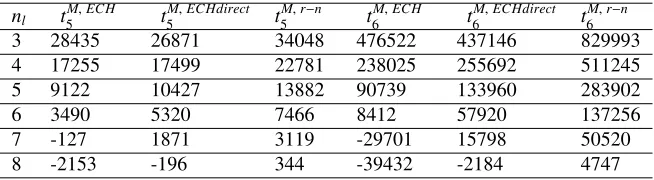
Nm. The concretenl-dependent results for the numerical estimates oft5MandtM6-contributions
to (??), obtained with the help of the discussed above three methods, are given in Table 2. One can first observe that for the physical valuesnl=3, 4, 5 the estimates for the coeffi
-cientstM
5 andt6M, obtained by two different realizations of the ECH-based technique, are in reasonable agreement2. However,it is surprising that the IRR-based approach with taken
1Note that in [? ] while applying the asymptotic expression of Eq.(??) for estimates of the five and six-loop corrections to the MS-on-shell mass relation for charm, bottom and top-quarks the same approximate average value Nm≈0.5 was fixed, which in fact is too far from the result, obtained in Refs. [? ?].
2It is worth emphasizing that our ECH-inspired results fortM
5-coefficient atnl =4 agree rather well with the approximate value of this term, independently obtained in Ref.[? ] as one of the outcomes of the global fits of characteristics of the bottomonium spectrum studied in non-relativistic QCD up to N3LO.
Table 2.The estimates oftM
5 andtM6-contributions by three considered methods.
nl t5M,ECH t5M,ECHdirect t5M,r−n t6M,ECH t6M,ECHdirect t6M,r−n
3 28435 26871 34048 476522 437146 829993
4 17255 17499 22781 238025 255692 511245
5 9122 10427 13882 90739 133960 283902
6 3490 5320 7466 8412 57920 137256
7 -127 1871 3119 -29701 15798 50520
8 -2153 -196 344 -39432 -2184 4747
from [?]four-loop values of Nmdoes not reproduce thesupported by largeβ0-approximation sign-alternating nl-dependence structure [?] of the corresponding estimated expression for
tM
5 andt6M-coefficients , obtained within both realizations of the ECH-approach. Indeed, com-bining the values fortM
5 (nl) as given in three first columns of Table 2 with the representation of Eq.(??), we obtain the following expressions:
t5M,ECH=2.5n4l −136nl3+2912n2l −26976nl+86620, (16a)
t5M,ECHdirect =1.2n4l −77nl3+1959n2l −20445nl+72557, (16b)
tM,r−n
5 =−22n4l +416n3l −1669n2l −11116nl+72972. (16c)
The similarsurprising featureis observed at the six-loop level, namely:
tM,ECH
6 =−4.9n5l +352n4l −9708n3l +131176n2l −855342nl+2096737, (17a)
tM,ECHdirect
6 =−2.2n5l +148n4l −4561n3l +71653n2l −538498nl+1519440, (17b)
tM,r−n
6 =99n5l −2903n4l +30109nl3−99563n2l −305378nl+2040263. (17c)
This paradox of application of the IRR asymptotic formula of Eq.(??) is not clear to us.
Let us now consider the asymptotic structure of the relation between pole and running masses of real heavy quarks. One can see from Table 2 that fornl = 3,4,5 three methods
of estimates of high-order corrections give comparable values for the five-loop coefficients,
while the six-loop large coefficients, estimated by the ECH-motivated approaches, are lower
than the existing asymptotic IRR-renormalon predictions by the factor 2 only. Since for rather approximate estimate we do not consider this difference seriously, we will use these
estimated by three methods numbers as inputs of our numerical studies. We fix the values of the the running masses ofc,bandt-quarks following the presented in [? ] considerations as mc(m2c) =1.275 GeV,mb(mb2) =4.180 GeV,mt(m2t) =164.3 GeV and take the following
values of the MS-scheme strong coupling constant, normalized at these running masses, viz αs(m2c)=0.3947,αs(mb2)=0.2256,αs(m2t)=0.1085. Taking into account the known results
PT expressions for the pole masses of charm, bottom and top-quarks has the following form: Mc
1 GeV ≈1.275+0.214+0.208+0.295+0.541 (18a)
+
1.135+2.389
ECH
; 1.072 +2.192
ECH direct
; 1.359 +4.162
IRR, Nm=0.54
,
Mb
1 GeV ≈4.180+0.400+0.200+0.146+0.137 (18b)
+
0.137+0.137
ECH
; 0.140 +0.147
ECH direct
; 0.182 +0.293
IRR, Nm=0.51
,
Mt
1 GeV ≈164.300+7.566+1.614+0.498+0.196 (18c)
+
0.074+0.025
ECH
; 0.084 +0.037
ECH direct
; 0.112 +0.079
IRR, Nm=0.46
.
Based on these results we conclude that five-loop corrections to pole mass of charm-quark are rather close in all three considered estimate methods. However, the six-loop corrections, predicted with help of the IRR technique, differ significantly from the ones, obtained by
the both ECH procedures. With reference to theb-quark pole mass the situation is more interesting. Indeed, the ECH-motivated method that takes into account the transition from the Euclidean to Minkowskian regions demonstrates output to some kind of plateau (four, five and six-loop corrections coincide), whereas the direct ECH and the IRR approaches indicate the growth of these corrections. These facts testify to the unconditional manifestation of the asymptoticity of the corresponding PT series for bottom-quark starting with five-loop order. For case oft-quark all three considered estimate procedures outline the decrease of the five and six-loop corrections. This means that the asymptotic structure of this PT series is not yet manifesting itself at these levels. Therefore the conception of pole mass of top-quark can be safely used even at theO(a6
s) level.
6 Conclusion
We apply three approximate methods for estimation of the five and six-loop corrections to the MS-on-shell heavy quark mass relation, namely two ECH-motivated methods, defined in the Euclidean and Minkowskian regions correspondingly, and the infrared renormalon based ap-proach. By means of these methods we determine flavor dependence of the considered contri-butions in theO(a5
s) andO(a6s) orders. Wherein the IRR-based technique with normalization
Nm-factor, taken in the four-loop approximation, does not give questionablenl-dependent
results while the both ECH approaches predict not only close values of the corresponding coefficients but reproduce the sign-alternating structure of these corrections in expansion in
powers of massless flavors. The numerical studies of all estimate procedures indicate the growth of the five and six-loop corrections to the pole mass of charm-quark. Whereas the ECH Euclidean method forb-quark pole mass leads to effect of plateau and the rest two
methods outline also the increase of these corrections. In the case oft-quark the asymptotic nature of the corresponding PT series is not observed even at six-loop level. Therefore the concept of the pole mass of top-quark is applicable up to 6 order of PT for sure.
7 Acknowledgments
International Workshop “Calculation for Modern and Future Colliders (CALC2018)” (22 July-1 August, JINR, Dubna). We would like to thank organizers of both these events for creating inspiring atmosphere for scientific discussions. The authors wish to thank K.G. Chetyrkin, L. Dudko and S. Moch for useful discussions at “Quarks-2018” Seminar and A. G. Grozin for valuable comments, made after the talk at CALC-2018 Workshop, We are also grateful to V.M.Braun for hellpful discussions. The work of A.K. is supported in part by the Russian Science Foundation grant No. 14-22-00161, while the work of V.M. and his stay in Valday was supported by the Russian Science Foundation grant No. 16-12-10151.
References
[1] P. A. Baikov, K. G. Chetyrkin and J. H. Kühn, Phys. Rev. Lett.118, no. 8, 082002 (2017) [arXiv:1606.08659 [hep-ph]].
[2] F. Herzog, B. Ruijl, T. Ueda, J. A. M. Vermaseren and A. Vogt, JHEP1702, 090 (2017) [arXiv:1701.01404 [hep-ph]].
[3] P. A. Baikov, K. G. Chetyrkin and J. H. Kühn, ’ JHEP1410, 076 (2014) [arXiv:1402.6611 [hep-ph]].
[4] I. I. Y. Bigi, M. A. Shifman, N. G. Uraltsev and A. I. Vainshtein, ’ Phys. Rev. D50, 223 (1994) [hep-ph/9402360].
[5] M. Beneke and V. M. Braun, Nucl. Phys. B426, 301 (1994) [hep-ph/9402364].
[6] M. Beneke, Phys. Lett. B344, 341 (1995) [hep-ph/9408380].
[7] M. Beneke and V. M. Braun, Phys. Lett. B348, 513 (1995) [hep-ph/9411229].
[8] P. Ball, M. Beneke and V. M. Braun, Nucl. Phys. B452, 563 (1995) [hep-ph/9502300].
[9] M. Beneke,’ Phys. Rept.317, 1 (1999) [hep-ph/9807443].
[10] R. Tarrach, Nucl. Phys. B183, 384 (1981) .
[11] N. Gray, D. J. Broadhurst, W. Grafe and K. Schilcher, Z. Phys. C48, 673 (1990). [12] L. V. Avdeev and M. Y. Kalmykov, Nucl. Phys. B502, 419 (1997) [hep-ph/9701308].
[13] J. Fleischer, F. Jegerlehner, O. V. Tarasov and O. L. Veretin, Nucl. Phys. B539, 671 (1999) Erratum: [Nucl. Phys. B571, 511 (2000)] [hep-ph/9803493].
[14] K. Melnikov and T. v. Ritbergen, Phys. Lett. B482, 99 (2000) [hep-ph/9912391].
[15] K. G. Chetyrkin and M. Steinhauser, Nucl. Phys. B573, 617 (2000) [hep-ph/9911434].
[16] R. Lee, P. Marquard, A. V. Smirnov, V. A. Smirnov and M. Steinhauser, JHEP1303, 162 (2013) [arXiv:1301.6481 [hep-ph]].
[17] P. Marquard, A. V. Smirnov, V. A. Smirnov and M. Steinhauser, Phys. Rev. Lett.114, no. 14, 142002 (2015) [arXiv:1502.01030 [hep-ph]].
[18] Y. Kiyo, G. Mishima and Y. Sumino, JHEP1511, 084 (2015) [arXiv:1506.06542 [hep-ph]].
[19] A. L. Kataev and V. S. Molokoedov, Eur. Phys. J. Plus 131, no. 8, 271 (2016) [arXiv:1511.06898 [hep-ph]].
[20] A. L. Kataev and V. S. Molokoedov, J. Phys. Conf. Ser. 762 no.1, 012078 (2016) [arXiv:1604.03485 [hep-ph]].
[21] P. Marquard, A. V. Smirnov, V. A. Smirnov, M. Steinhauser and D. Wellmann, Phys. Rev. D94, no. 7, 074025 (2016) [arXiv:1606.06754 [hep-ph]].
[22] A. L. Kataev and V. S. Molokoedov, “Multiloop contributions to the MS-on-shell mass relation for heavy quarks in QCD and charged leptons in QED and the asymptotic structure of the perturbative QCD series", ’ INR-TH-2018-15, arXiv:1807.05406 [hep-ph]. [23] K. G. Chetyrkin, B. A. Kniehl and A. Sirlin, Phys. Lett. B 402, 359 (1997)
[24] A. L. Kataev and V. V. Starshenko, Mod. Phys. Lett. A 10, 235 (1995) [hep-ph/9502348].
[25] G. Grunberg, Phys. Rev. D29, 2315 (1984)
[26] A. L. Kataev and V. T. Kim, Phys. Part. Nucl.41, 946 (2010) [arXiv:1001.4207 [hep-ph]].
[27] M. Beneke, P. Marquard, P. Nason and M. Steinhauser, Phys. Lett. B775, 63 (2017) [arXiv:1605.03609 [hep-ph]].
[28] M. Beneke and V. I. Zakharov, Phys. Rev. Lett.692472 (1992).
[29] D. J. Broadhurst, A. L. Kataev and C. J. Maxwell, Nucl. Phys. B592, 247 (2001) [hep-ph/0007152].
[30] A. L. Kataev, “Light quark masses and renormalons"; CERN-TH-2001-030; hep-ph/0102223; in Proc. of 11th International Seminar Quarks-2000, Pushkin, Russia, May
13-21, 2000; Eds. G.B. Pivovarov, V.A. Matveev and V.A. Rubakov ; INR Press; Moscow 2002, pp.35-52.
[31] A. Pineda, JHEP0106, 022 (2001) [hep-ph/0105008].
[32] F. Campanario, A. G. Grozin and T. Mannel, Nucl. Phys. B663, 280 (2003) Erratum: [Nucl. Phys. B670(2003) 331], [hep-ph/0303052].
[33] C. Ayala, G. Cvetiˇc and A. Pineda, JHEP1409045 (2014) 045 [arXiv:1407.2128 [hep-ph]].
[34] C. Ayala, G. Cvetic and A. Pineda, J. Phys. Conf. Ser. 762 no.1, 012063 (2016) [arXiv:1606.01741 [hep-ph]].