Suitability of obfuscation methods for different
categories of context
R.S. Peterson
ABSTRACT
Context aware services need context of a certain quality to pro-vide their services. The quality of context can be described using the Quality of Context (QoC) concept. There are five parameters, or dimensions, to describe the QoC: precision, freshness, tempo-ral resolution, spatial resolution and probability of correctness. There is a relation between QoC and privacy sensitivity, because if the QoC is higher, the privacy sensitivity is typically higher. To influence the privacy sensitivity, context can be obfuscated in one or more QoC dimensions. We identify different categories of context. For each category the importance of the QoC parameters on the privacy sensitivity is examined. Obfuscating the probabil-ity of correctness gives the user plausible deniabilprobabil-ity and reduces the privacy sensitivity of context in all categories. Furthermore, obfuscating context in the precision dimension reduces the QoC in all categories.
Keywords
Context aware, Quality of Context, Obfuscation, Privacy, Cate-gorization
1.
INTRODUCTION
A context aware service is a service which uses context to adopt its behavior to a changing user environment. For example, when the application automatically puts the phone on silence when a user is in a meeting, except for when his pregnant wife calls. Con-text aware services can be of great use for many people. They are able to aid people in their business, providing them with feed-back, information etc, usually without the user explicitly having to make a request.
With these novel type of services, new privacy threats have ar-rived. How these privacy threats are addressed will have great impact on the success of context aware services. If users experi-ence a few privacy violations, this can lead to distrust in context aware services. As a result of this distrust they could refuse to further use any context aware services. Thus privacy protection is needed for a user to be able to trust a context aware service [1, 2].
Privacy has different meanings to different people in different sit-uations. Therefore, there is not one privacy definition which is widely adopted [3]. Westin [4] stated that privacy is”the claim of individuals, groups or institutions to determine for themselves when, how and to what extent information about themselves is
Permission to make digital or hard copies of all or part of this work for personal or classroom use is granted without fee provided that copies are not made or dis-tributed for profit or commercial advantage and that copies bear this notice and the full citation on the first page. To copy otherwise, or republish, to post on servers or to redistribute to lists, requires prior specific permission.
9thTwente Student Conference on IT, Enschede 23thJune, 2008
Copyright 2008, University of Twente, Faculty of Electrical Engineering, Mathe-matics and Computer Science
communicated to others”. For this paper we use this definition, since it describes the risk of the new context aware services. That is, to what extent can context be used for purposes the user did not intend it to be.
Within the scope of this paper we are concerned about the con-text on human users. Sheihk et al. [5] state that user concon-text is
”Information that describes the situation of a human user either directly or indirectly”. We use this definition for user context, because we are concerned about a user using a context aware ser-vice and the information that is communicated about this user. This information can either be direct, for example the location of a user, or indirect, for example the bandwidth available to the user’s mobile device.
The information that describes a situation of a human can be of varying quality. Quality of Context (QoC) is the concept that de-scribes the quality of this information. Sheikh et al. [5] state that there are several parameters of context which can be used to measure the QoC namely: precision (Pr), freshness (Fr), tem-poral resolution (TR), spatial resolution (SR) and probability of correctness (PoC).
There is a relation between QoC and privacy sensitivity of con-text. Our definition of privacy describes that individuals should be able to determine how much information is used and to what extent. When reducing the QoC, by reducing one or more QoC parameters, less information is provided.
This reduction can, for example, be done by using obfuscation techniques. Obfuscation techniques make data contain less infor-mation. For example, obfuscation can be achieved by reducing the significant figures of a number.
This results in the question”Which Quality of Context parame-ters are suitable for obfuscation and how should this obfuscation be done?”. To answer this question we first identify different cat-egories of context in section 2. How the QoC concept works is explained in section 3. After that we investigate which obfusca-tion methods are known for which data type in secobfusca-tion 4. Then we make our contribution, by combining the QoC concept with the different categories of context, section 5. This illustrates which QoC parameters of context should be obfuscated. Then we know in which dimension we should obfuscate. To see how to do this, we describe each QoC parameter and explain how obfuscation in this dimension can be done, section 6. In section 7 we show how the gained insights can be used. Related work is discussed in section 8. We conclude with the conclusion in section 9. Future work is discussed in section 10.
2.
CONTEXT CATEGORIZATION
There are various ways to categorize context. Here we describe the categorization method which is most suitable for our
pur-poses. The other categorization methods we identified in our re-search can be found in appendix A.
Dey et al. [6] propose to divide context into a two-tiered sys-tem. The first tier consists of four categories, namely: location, identity, time and activity. The second tier consists of all types of context, this tier has a relationship with the first tier. Context can either have a relationship with one primary context or have multiple. An example of a single relation is a phone number: if a person’s identity is known, we can retrieve his phone number. A relation with multiple primary context categories is needed for e.g. a weather forecast since a time and a location are needed to predict the weather.
The categories proposed by Dey can be reformulated into four ’W’ questions, see table 1. This reformulation must not be taken too literally. For example, a service requests an email address than this information is also related to the person’s identity and thus it is a request from the identity category. Another example is, who someone’s friends are. This is also related to identity.
Table 1: ’W’ questions Dey W question Identity Who? Location Where? Time When? Activity What?
We use this categorization method for two reasons. First, the four categories reflect four ’basic’ questions. We expect that for these questions different QoC parameters are important. Second, the others can be derived to Dey et al., see Appendix A.
3.
MEASURING QUALITY OF CONTEXT
Sheihk et al. [7] state that there are five different parameters in-dicating Quality of Context. These parameters are Precision , Freshness, Spatial Resolution, Temporal Resolution and Proba-bility of Correctness. Their paper provides reasoning why other QoC concepts are not as good as theirs. In our research we did not identify more QoC concepts than Sheihk et al. [7]. The following sections explore the QoC parameters.
3.1
Precision
Precision is defined as:granularity with which context informa-tion describes a real world situainforma-tion.
This thus represents how precise context is. For example, the GPS coordinate 52.0349426269531,6.34299325942993 defines a square on the earth with an edge of less than a meter, while the GPS coordinate 52.0,6.3 defines a square with an edge of more than 15 km [8].
3.2
Freshness
Freshness is defined as:the time that elapses between the deter-mination of context information and its delivery to a requester. For example, if an activity stopped at May 8thand the informa-tion is requested on May 10ththe freshness is 2 days.
3.3
Spatial Resolution
Spatial resolution is defined as:the precision with which the phys-ical area, to which an instance of context information is applica-ble, is expressed.
This area can for instance, be a room a building or a city. If there is less physical space included in the area the spatial resolution is higher, and vice versa. This is illustrated in figure 1.
Figure 1: Spatial Resolution Sheihk et al. [5]
3.4
Temporal Resolution
Temporal resolution is defined as: the period of time to which a single instance of context information is applicable. For example, Chris left his work at 16 : 32 the resolution is in minutes, however if we only know that he left his work on May 9ththe resolution is in days. Parallel to spatial resolution, a temporal resolution in days is lower than in minutes.
The difference between temporal resolution and freshness is sub-tle. Freshness is, as said, the time that is elapsed between deter-mination of the context and delivery to the requester. If some-thing is measured every 30 seconds the temporal resolution is 30 seconds. When this information is requested later, the freshness depends on, how much later the information is requested. The temporal resolution remains 30 seconds. This is illustrated in fig-ure 2.
3.5
Probability of Correctness
Probability of correctness is defined as: the probability that an instance of context accurately represents the corresponding real world situation, as assessed by the context source, at the time it was determined. For example, the location of a person is re-quested. This person has just logged into a building with a secu-rity pass, but his telephone is located at home. When his location is requested, it is not 100% sure where he is located.
4.
OBFUSCATION TECHNIQUES
This section explains different obfuscation techniques. To see what kinds of obfuscation are possible we first draw a scenario about Chris and Alice. From this scenario we derive three dif-ferent ways of obfuscation namely: refusal, falsification and ab-straction. Since we are mostly interested in abstraction we only briefly mention refusal and falsification.
Figure 2: Freshness versus Temporal resolution Sheihk et al. [5]
Alice and Chris know each other and they are both shopping independently. Alice is calling Chris and she is telling that she is in the city in a bookshop. Af-ter that she asks where he currently is. At this point Chris has several options and he will, most likely, choose one depending on his mood and relationship with Alice.
Chris might not want to tell Alice that he is also shopping, maybe because he is in a hurry or he is getting a gift for Alice. To achieve this he can, for ex-ample, tell her that he doesn’t want to tell her where he is, refusal. He can also tell her that he is at home instead of shopping, falsification. Both refusing and falsification can result in unwanted situations. If Chris refuses to tell Alice what he is doing Alice will sus-pect Chris from withholding private information and if they accidently meet down town, while shopping, the falsification results in an awkward situation. Instead of not telling where he is, Chris can also not tell Alice exactly what he is doing. He can for exam-ple tell her that he is shopping and not mention the location or he can say that he is outside. Both these things are true, if he is not in a shop, but Alice will not be able to retrieve exactly what he is doing and where he is. This is called abstraction.
In the following two sections we give a brief description of how refusal and falsification can and should be applied. After that, a description of the abstraction methods which we identified in our research is given. These methods are categorized by data type. Next to the data type based abstraction methods we discuss the k-anonymity method, since quite some research has been done in this method. To conclude we discuss possible vulnerabilities.
4.1
Refusal
As seen in the example, Chris could say to Alice that he does not want to answer a question. In practice people almost never say explicitly that they do not want to answer a question. They typically ignore the question or make sure that the question is not asked, polite blocking. For example, when a user doesn’t want to chat on an instant messenger, the user puts his status on
invisible or ’appear offline’. That way no one can see that the user is online, and thus no one will start a chat. This is in contrast with putting the status on ”I don’t want to chat”.
Context aware systems can use the same mechanism. They can ignore the question if the user has stated that he does not want to share the requested information. However if the services shared this type of context in the past, it is strange if the service now refuses.
4.2
Falsification
Another option is to decide not to give the correct answer, falsi-fication. The main problem with falsification is that it must be done in a consistent and reasonable way. If we don’t falsify in a consistent way we might reveal the secrets that we try to hide. We want the receiver to believe our falsification, therefore falsi-fication needs to be done in a reasonable way. There are various techniques which can produce consistent lies. One of these tech-niques is called polyinstantiation [9]. This technique generates cover stories. By doing this, the technique produces consistent lies. These lies therefore do not reveal the secrets. The problem of reasonable lying still exists.
4.3
Abstraction
In the scenario about Chris and Alice we saw examples of ab-straction. This section describes abstraction based obfuscation techniques for various data types. We discuss the techniques which we identified in literature. The data types discussed are: boolean, incremental set, numbers and hierarchical trees. For each data type we examine how the obfuscation techniques work. Furthermore, we examine how the QoC parameters are repre-sented in the data type. After doing this we discuss the string data type, for this data type we did not identify any obfuscation method.
4.3.1
Boolean
It is impossible to obfuscate a boolean by abstraction, since the value is either true or false. For example, the question ”is Chris at his work?” can only be answered with yes or no. It is not possible to give another, boolean, answer. There are however two things which can be done. We can state that the PoC is lower than 100%, or we can adjust the context value depending on the desired PoC. This, for example, results in the following calculations. Someone requests if Alice is currently at her work. The service is allowed to answer this question with 70% certainty. Alice is currently shopping, and she doesn’t work in a shop. The service should now, with a chance of 70%, choose false as an answer. True must be selected as an answer with the remaining 30% chance. The included probability of correctness must be 70%. This can be seen as falsification rather than abstraction.
4.3.2
Incremental Sets
Incremental sets can be used for values which consist of more than one part, each part adding more detail. For example, some-one describes a location as The Netherlands, Enschede or Maten-weg. The first part represents the countries name, the second part a city and the third represents a street. To obfuscate such a set we leave out more detailed data.
For an incremental set the precision parameter is implicit. The precision depends on how many items are returned. The services need to negotiate, in advance, which level of the set corresponds
to which precision level. This is not always obvious. The other parameters are available as meta information to each item in the set and can be obfuscated depending on their data type.
4.3.3
Numbers
This section describes obfuscating techniques which apply to num-bers. They have been split up into a section about points with a radius and a section about single numbers.
4.3.3.1
Point with a radius
Ardagna et al. [10] identify three ways of obfuscation a point with a radius namely: obfuscation by enlarging the radius, shift-ing the center and reducshift-ing the radius.
By enlarging the radius the privacy sensitivity of, for example, a location can be reduced. If however the requester knows that the service is simply enlarging the radius, the service can calculate the center of the circle and then know the ’real’ location. This can be solved by using the second technique proposed. With this technique the center point is shifted. By doing this, the chance that the users location is somewhere in the circle, is uniformly divided, that is if the new point with a radius includes the users location. This final parameter can be captured with the PoC pa-rameter of the QoC. The third technique proposed is reduction of the radius. This technique results in a smaller chance that the user is actually in the circle, so the QoC decreases. However, if a very precise measurement technique is used the user will stay in the area, even for small radii. For Cell-ID technology this technique might work since Cell-ID’s generally have a range varying from 1-3 km in urban areas to 3-20 km in suburban/rural areas [10]. A combination of either increasing or decreasing the radius and shifting the center can also be used to achieve obfuscation.
4.3.3.2
Single numbers
For single numbers, the number of, significant figures can be re-duced. This results in a lowered QoC, the precision parameter is obfuscated. By reducing the number of significant figures we are creating a grid, in which the real value is positioned somewhere. This technique also is applicable to sets of multiple numbers, for instance a latitude and longitude GPS coordinate combination. By reducing the number of significant figures the precision of the location is reduced. Another application is time, if the time of a day is represented with a number between 0 and 1 the number of significant figures can be lowered to achieve a lower QoC.
4.3.4
Hierarchical tree
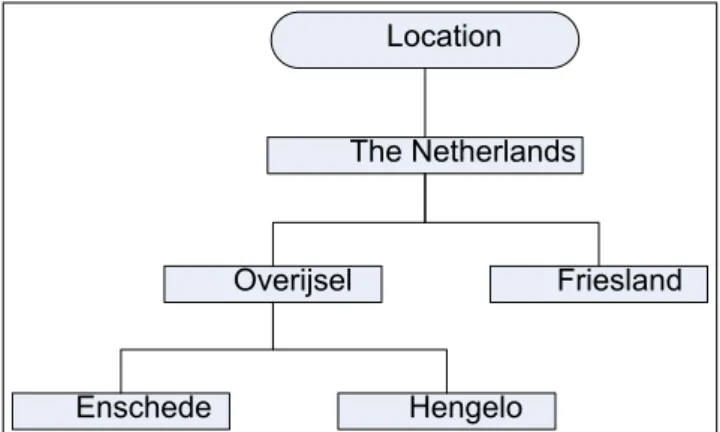
In a hierarchical tree, different levels of the tree represent diff er-ent levels of privacy sensitivity. These levels are typically ordered from less privacy sensitive at the top to more privacy sensitive at the bottom. Wishart et al. [11] identify two kinds of hierarchical trees. The first one exists of valid instances as nodes, see figure 3. This means that when enough leaves are removed, to reach the desired QoC the tree can be send to the requester. The sec-ond kind does not have valid instances as nodes. In this kind of trees general concepts are hierarchical ordered. An example of such a tree is shown in figure 4. When obfuscating a tree without valid instances it can be impossible to retrieve a valid instance. In such a case one must keep in mind never to return more detailed information.
In trees precision is implicit. This parameter is represented in the hierarchy of the tree. Therefore obfuscating this parameter can
The Netherlands
Location
Friesland
Overijsel
Enschede
Hengelo
Figure 3: Hierarchical tree with valid instances
Country
Location
Province
City
Figure 4: Hierarchical tree without valid instances
be done by removing leaves from the tree until the desired preci-sion is achieved. The other QoC parameters are available as meta information and can be obfuscated by selecting the appropriate obfuscation method depending on the data type representing the QoC parameter.
4.3.5
String
In this section we discuss the QoC parameters regarding the string data type. Obfuscating in the precision dimension can, for exam-ple, be achieved by removing characters. This however, does not necessarily result in a lower precision. When only a few charac-ters are removed the receiver typically is able to reconstruct the original string. Reconstructing, the original string, can only be done when a limited number of characters are obfuscated.
For obfuscation of a string in the precision dimension it might be a good idea to translate the meaning, of the string, into a hierar-chical tree. This tree can be used to derive more abstract repre-sentations of the original string. The other QoC parameters are available as meta information and can be obfuscated by selecting the appropriate obfuscation method depending on the data type representing the QoC parameter.
4.4
K-anonymity
K-anonymity is an obfuscation technique used in databases with different people to protect the identity of a single person. The K in K-anonymity stands for the number of persons which must stay indistinguishable from each other when information is requested. The information selecting criteria is called a quasi identifier. How it works is best shown by example. The example is based on Heerde’s thesis [2].
Table 2: 2-Anonymity example
Year of Birth Gender Activity
1975 man Running 1975 man Tennis 1984 woman Basketball 1984 woman Tabletennis 1983 man Basketball 1983 man Soccer
Table 2 shows a list of year of births and genders with activities. In this example a combination of year of birth and gender is the quasi identifier. When selecting with this quasi identifier we want it to resolve to at least two different activities. With this restriction we can never discover exactly what activity someone is doing. Each selection of year of birth and gender, in the example, results in a minimal number of two activities, so this is a 2-anonymity example.
4.5
Vulnerabilities
The number techniques discussed above suffer from a major draw-back. If the information requestor has multiple samples of mation, there is a chance that he or she can deduce more infor-mation than allowed. For example, a person has a lot of GPS coordinate samples with some radius, within a reasonable time window. That person can take the intersection of those points and deduce a smaller area of where someone is probably located, see figure 5.
With a grid the same problem arises. Consider the situation that someone is on the edge of a grid cell and a service is requesting multiple samples. Since the person is on the edge alternating grid cells can be returned. These alternating grid cells reveal a loca-tion line. This most likely occurs because of measurement faults when someone is on the edge, because than the grid can alternate easily between two cells. When the grid cells are relative big to the measurement error the chance of this occurring is relative low. The other possibility of an alternating grid cell is when someone is actually moving.
This problem can be solved by keeping a history of what infor-mation has been provided. For example, as long as a person stays within a certain range of the point which is send the first time the same information will be send again. Only after a certain amount of time or ’major’ location changes the grid or circle must be ad-justed. This introduces the problem that services need to keep track of what context has been sent to who and when.
User
Figure 5: Retrieved user location from multiple samples
5.
ANALYSIS OF QOC PARAMETERS AND
CATEGORIES OF CONTEXT
In this section we join the categories of context with the five QoC parameters. We list each context category and reason which QoC parameters are good candidates for obfuscation. The criterion for a parameter to be a good candidate is: when the context is obfuscated in that dimension it typically results in less privacy sensitive context.
For context from other categories than identity we assume the identity is known. Otherwise the information cannot be privacy sensitive. This follows from our definition of privacy. From this we can conclude that identity is the most important category re-gards privacy. This results in a hierarchy within the context cate-gories, see figure 6.
After describing which QoC parameters are good obfuscation candidates for a ’single’ category request we reason about how to combine various categories.
Identity
Activity Location
Time
Figure 6: Category hierarchy
5.1
Identity
If identity is known with high precision and probability, the in-formation typically is very privacy sensitive. This is, because denying becomes impossible and information about individuals typically is more privacy sensitive than information about groups.
There is a relationship between historical information about some-one and the legitimacy of this information. For example, a user has been using an email address for several years, it is safe to as-sume the user still uses the email address. Thus the QoC parame-ters regarding time are also important for identity. The precision
and PoC parameters however are more important since these im-ply plausible deniability. The results are summarized in table 3.
In general it is very hard to obfuscate a person’s identity. In many situations it can be derived from other context. For example, if a location is known very precise and the information is new, some-one could travel to the location and see who are there. To counter this, the PoC must be obfuscated. If the PoC is not 100% the per-son involved can always deny being there or doing something at that specific location. If someone travels to the location it could very well be wrong, resulting in the person not being there. If there is an entity that is all knowing, the k-anonymity technique, section 2, can be used to protect someone’s identity.
Table 3: Identity QoC Imp Reason
Pr ++ Information about a specific person is more pri-vacy sensitive, for that person, than information about groups
Fr + Old information can be changed
TR + Information which was applicable for a long time probably still is
SR - - When requesting identity information the loca-tion does not matter. If localoca-tion would have been important, that category would also be re-quested
PoC ++ A less than 100% PoC provides the user with plausible deniability
5.2
Location
For location information three parameters are good candidates for obfuscation namely: precision, spatial resolution and PoC. A relationship exists between spatial resolution and precision, be-cause if the spatial resolution is lower the precision is also typi-cally lower, and vice versa. These parameters are important for privacy sensitivity since if the location is known more precise, more facts can be derived from it. The time parameters are not important since if time is important the context request would also be from the time category. The results are summarized in table 4.
5.3
Time
For time related context three parameters are good candidates for obfuscation namely: precision, temporal resolution and PoC. A relation exists between precision and temporal resolution for time concerned context. This is because if the temporal resolution is higher the precision is typically also higher and vice versa.
Freshness can be a good obfuscation candidate, users typically have the opinion that new information is more privacy sensitive compared to old data. This is, because the information has more potential to be used for purposes the user didn’t intend. For ex-ample, the context information can be used for advertising. It is however not always a good obfuscation candidate since some-times the requested information remains privacy sensitive, even if it is old. The results are summarized in table 5.
Table 4: Location QoC Imp Reason
Pr ++ If decreased less information is given, thus pri-vacy sensitivity decreases
Fr - - Location information has nothing to do with time so this parameter is not important TR - - Location information has nothing to do with
time so this parameter is not important SR ++ If decreased less information is provided, this
parameter is closely related to the precision pa-rameter
PoC ++ A less than 100% PoC provides the user with plausible deniability
Table 5: Time QoC Imp Reason
Pr ++ If decreased less information is given, thus pri-vacy sensitivity decreases
Fr + If information is older it is, more often than not, less privacy sensitive
TR ++ A higher resolution typically reveals more in-formation and thus is more privacy sensitive SR - - Does not influence time information and
there-fore not a good obfuscation candidate
PoC ++ A less than 100% PoC provides the user with plausible deniability
Table 6: Activity QoC Imp Reason
Pr ++ If the activity is more abstract it reveals less in-formation about the user and thus is less privacy sensitive
Fr + If the measurement is from a few days ago the QoC typically is lower than if the information was measured only a moment ago
TR + If the context was applicable a moment ago, there is a good chance that the activity is still going on
SR - - When requesting only activity information the location does not matter, if location would have been important information from that category would also be requested
PoC ++ A less than 100% PoC provides the user with plausible deniability
5.4
Activity
For activity, besides precision and PoC, freshness and temporal resolution are good obfuscation candidates. Freshness is a good candidate, because if the activity was going on a moment ago it is likely it still is. Temporal resolution is a good candidate, because if the context was applicable a few moments ago, it is likely that the activity is still going on. The results are summarized in table 6.
5.5
Multiple context category requests
We saw which QoC parameters are good candidates for obfuscat-ing one specific category of context. In practice however, context is often requested from more than one category. To determine which QoC parameters are good obfuscation candidates we com-bine the different tables, each time picking the highest value. For example, we combine a request about identity and location, by also requesting location the spatial resolution parameter also gets a good candidate for obfuscation.
6.
HOW TO OBFUSCATE CONTEXT
Obfuscation can be done in different QoC dimensions. In the previous section we saw which QoC parameters are good obfus-cation candidates for each context category. In this section we outline how obfuscating context in different QoC dimensions can be done.
6.1
Precision
Which methods are applicable for obfuscation in the precision dimension, highly depends on the data type. Methods for ob-fuscating context of different data types have been mentioned in section 4.
6.2
Freshness
The freshness parameter can be obfuscated in three different ways. The first one is by using an older sample. This results in older in-formation and thus obfuscation. The second way is to just state that the information has a different freshness than known. This last method however only works if the requesting service cannot retrieve that it is just stated that the information is older. Finally if the freshness is represented as a number, obfuscation methods identified in section 4 can be applied.
6.3
Temporal resolution
The main idea to obfuscate the temporal resolution is, to make the time window to which the context applies bigger. By do-ing this one cannot retrieve the specific moment the context oc-curred. This can be done by combining sensor information, to either make an average of a time window or count them together. For example, the average temperature of a building during a week is requested. To answer this query all measurement samples of the whole week need to be averaged. If the TR is represented as a number significant figures can be removed to achieve obfusca-tion.
6.4
Spatial resolution
Spatial resolution can be lowered by combining multiple sensor information. By combining this information the precise knowl-edge is gone and thus the information becomes less privacy sen-sitive. For example, when the number of people in a building is requested and the service knows how many people there are in every room. The service can count all the different rooms in the
building and return the total, with the a spatial resolution of the building. This in contrast with returning the number of people in all rooms separately.
6.5
Probability of Correctness
The PoC can be altered in two ways. The first and simplest way is by just stating that the probability is lower than known. The other way is by selecting ’wrong’ data with a certain chance. By doing this the PoC decreases and thus the privacy sensitivity decreases.
6.6
Relation between PoC and the other
pa-rameters
By obfuscating a QoC parameter other than PoC, typically the PoC parameter increases. When this obfuscation is done, ranges typically get bigger. This results in an increased chance that the real value lays within the range and in that case, a higher PoC is obtained.
7.
USE CASE: CARCOACH
CarCOACH [12] is a system that can be used to monitor the driv-ing skills of a driver. The system provides feedback to the driver about how he or she is performing. The driver can use these com-ments to improve his driving skills. Driving errors that are identi-fied are for example: turning without indicating direction, erratic steering, accelerating and breaking abruptly.
In our case, we consider that the system logs all these events. These logged events can be dispersed to several organizations. The government can, for example, use the information to decide if a public campaign for specific driving errors is needed, or not. The leasing company can use the gathered information to make a bill or identify car abuse.
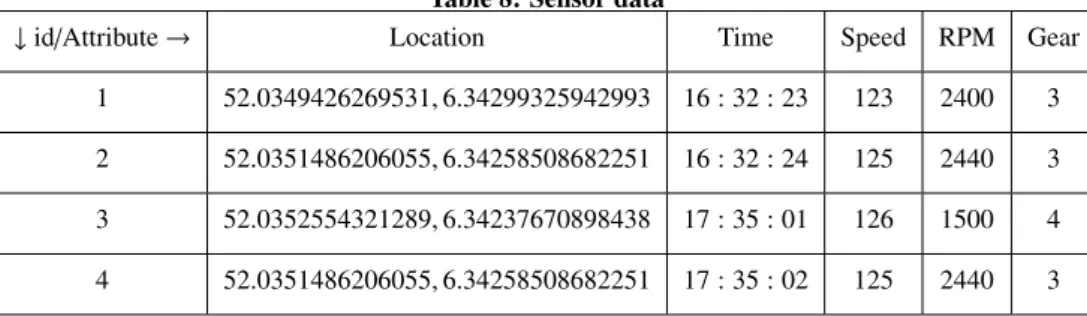
We use the following data: table 7 for the error data, table 8 for sensor data.
Table 7: Driving error data
↓id/Attribute→ Time Error Steer
1 16 : 32 : 23 No blinking 45
2 16 : 40 : 24 Abrupt breaking −45
3 16 : 45 : 25 No blinking 40
We first describe some requests that can be made, after that we evaluate how the dimension selection and obfuscation has worked.
7.1
Context requests
7.1.1
Speeding
The government is interested in where people, with a carcoach, exceeded 120km/h. This request consists of two categories of context, location and activity. Therefore the following QoC pa-rameters are good obfuscation dimensions: Pr, SR and PoC and in lesser degree Fr and TR. By obfuscating in the Pr dimension the SR also decreases and exact retrieval of the location is not possible anymore. By selecting the first row from table 8 we, for example, obfuscate the GPS coordinate to 52.03. Furthermore, obfuscation in the PoC dimension provides the user with plausi-ble deniability. This can be done by stating a lower PoC.
Table 8: Sensor data
↓id/Attribute→ Location Time Speed RPM Gear
1 52.0349426269531,6.34299325942993 16 : 32 : 23 123 2400 3 2 52.0351486206055,6.34258508682251 16 : 32 : 24 125 2440 3 3 52.0352554321289,6.34237670898438 17 : 35 : 01 126 1500 4 4 52.0351486206055,6.34258508682251 17 : 35 : 02 125 2440 3
7.1.2
Blinking
The government wants to know how many times, in the last week, cars did not use their blinker while changing direction. This con-text request is from the time and activity category. Therefore the Pr, PoC, TR and, in lesser degree, the Fr are good obfuscation di-mensions. The TR is in seconds but only a resolution of a week is needed. Therefore the system must combine the sensor informa-tion until a TR of a week is reached. In this case there have been 2 cases of forgetting to blink, in the last week. After that, obfus-cation in the Pr and PoC dimension can be applied, both further reduce the QoC and thus the privacy sensitivity.
7.1.3
Leasing billing
To determine the bill a leasing company wants to know how far each of their cars have been driving. This request is from the con-text categories identity and location, because the distance can be determined from where the car has been. The identity cannot be obfuscated, since than the leasing company cannot send the bill to the correct person. To protect the privacy the leasing company does not need to know the exact location where the cars have been, only the total distance traveled. For the location category we see that the SR together with the Pr and PoC are the best ob-fuscation dimensions. Obob-fuscation in the PoC dimension is im-possible since the leasing company needs to know for sure how far the car has traveled. Obfuscation in Pr dimension is probably also limited since the leasing company uses, for example, billing for each km traveled. The SR therefore is the best dimension. The application must gather all the location information needed to calculate the distance and send the total distance to the leasing company.
7.2
Evaluation
In all cases obfuscation in the selected dimensions resulted in less privacy sensitive data. The main remark that has to be made is that if we would have adopted the minimal disclosure princi-ple, this would have resulted in almost the same obfuscation. The difference with the minimal disclosure is that we add obfuscation in the PoC dimension to provide users with plausible deniability. Furthermore, we saw that it is not always possible to obfuscate in a certain dimension because the information than becomes use-less to the requester.
8.
RELATED WORK
Lederer et al. [13] propose to use four levels of abstraction for context. These levels are: precise, approximate, vague and undis-closed. This set is limited by its four levels. In practice it is not always possible to give enough options. To quote an example from Wishart et al. [11]:”For example, assume exact location,
the building the user is currently in, the suburb, and the city in which the user is located are provided as the four levels of ob-fuscation. A user not wanting to provide her exact location, but wanting to give a more specific value for her location than the building, such as a floor number, cannot do so.”
Wishart et al. [11] propose to obfuscate context using hierar-chical trees. They provide good reasoning about trees regarding obfuscation. The main issue is that not all information can be represented in a tree.
Anciaux et al. [14] propose to use a timely degradation of pre-cision as time passes by. This reflects the mechanism of people forgetting details. We have not used this technique because of two reasons. First, the technique is aimed at databases with con-text info about many people and we are not interested in these databases. Furthermore this technique can be simulated by re-ducing the freshness and the precision.
Sheikh et al. [5] propose a QoC concept. In this paper we have used this concept. We extended their work by investigating the relation between QoC parameters and Dey et al. [6] context cate-gories.
9.
CONCLUSION
To protect a user’s privacy, obfuscation of context is needed. Ini-tially we have researched the Quality of Context (QoC) concept. After that we investigated several obfuscation methods. The third research was aimed at categorizing context. We categorized con-text information into Dey’s categories, namely: Identity, Loca-tion, Time and Activity. We concluded that the identity category is needed for data to be privacy sensitive.
Table 9: Summary of QoC and Context Categories
↓CC/QoC→ Pr Fr TR SR PoC
Identity ++ + + - - ++
Location ++ - - - - ++ ++
Time ++ + ++ - - ++
Activity ++ + + - - ++
We used the performed research to combine the categories of con-text with the QoC concept. A summary of this research is given in table 9. From this table we conclude that probability of
correct-ness and precision are always good obfuscation candidates. If the category of a request is determined, one can determine which QoC candidates are good obfuscation dimensions.
When the obfuscation candidates are determined, the context can be obfuscated in one or more of these dimensions. Freshness can be obfuscated by using old information. Context can be obfus-cated in the temporal resolution or spatial resolution by combin-ing information from different sensors. The probability of cor-rectness can be obfuscated by selecting false data with a certain chance or by stating that the correctness is lower. Obfuscating in the precision dimension is done by using one of the abstraction methods. These abstraction methods can also be used to obfus-cate the other dimensions if they are represented in a data type for which an obfuscation method is available.
10.
FUTURE WORK
Future work can be a user study on how users would like to en-ter their privacy preference. A possible hypothesis is that users prefer to enter location information for a tree based model.
Further research can be done into how to obfuscate other data types e.g. strings, unordered sets.
It is a good idea to perform research on the connection between, how the relation is between people and how much information they want to share. If a user, for example, is requesting infor-mation about another user, one might recognize a pattern in how much information someone is willing to reveal. A hypothesis is that people are willing to share information one level of a hierar-chical tree below their relationship level. For example, a random colleague from work is wondering what you are doing. If that person is at work, he can only see what project you are currently working on. If some friend, who is not related to your work, is asking what you are doing, he is only allowed see that you are currently working. Furthermore, if some colleague from the same project is wondering what you are doing, that colleague is allowed to know exactly what you are doing at work. This will most likely be in contrast with when you are sporting, than he is only allowed to see that you are relaxing.
ACKNOWLEDGEMENTS
I would like to thank everyone who played a significant role in making this research possible, providing useful information and/or reviewing my work. Especially I would like to thank Maarten Wegdam, Tom Broens and Marten van Sinderen my supervisors in this research.
REFERENCES
[1] X. Jiang and J. A. Landay, “Modeling privacy control in context-aware systems,”IEEE Pervasive Computing, vol. 1, no. 3, pp. 59–63, 2002.
[2] v. H. Heerde, “Life-cycle privacy policies for the ambient intelligence,” Master’s thesis, 2006.
[3] S. Lederer, J. I. Hong, A. K. Dey, and J. A. Landay, “Personal privacy through understanding and action: five pitfalls for designers,”Personal and Ubiquitous Computing, vol. 8, no. 6, pp. 440–454, Nov. 2004.
[4] W. G. Ryan, “Privacy and freedom : Alan f. westin atheneum publishers,”Business Horizons, vol. 10, no. 4, pp. 106–106, 1967.
[5] K. Sheikh, M. Wegdam, and M. Sinderen,
“Quality-of-context and its use for protecting privacy in context aware systems,”Journal of Software, vol. 3, no. 3, pp. 83–93, March 2008.
[6] G. D. Abowd, A. K. Dey, P. J. Brown, N. Davies,
M. Smith, and P. Steggles, “Towards a better understanding of context and context-awareness,” inHUC ’99:
Proceedings of the 1st international symposium on Handheld and Ubiquitous Computing. London, UK: Springer-Verlag, 1999, pp. 304–307.
[7] K. Sheikh, M. Wegdam, and M. Van Sinderen, “Middleware support for quality of context in pervasive context-aware systems,” 2007, pp. 461–466.
[8] “Gps latitude and longitude distance calculator (2008, june 6).” [Online]. Available:
http://www.csgnetwork.com/gpsdistcalc.html
[9] J. Biskup, “For unknown secrecies refusal is better than lying,”Data Knowl. Eng., vol. 33, no. 1, pp. 1–23, 2000. [10] C. A. Ardagna, M. Cremonini, E. Damiani, S. D. C.
Di Vimercati, and P. Samarati,Location privacy protection through obfuscation-based techniques, 2007, vol. 4602 LNCS.
[11] R. Wishart, K. Henricksen, and J. Indulska, “Context obfuscation for privacy via ontological descriptions,” vol. 3479, 2005, pp. 276–288.
[12] E. Arroyo, S. Sullivan, and T. Selker, “Carcoach: a polite and effective driving coach,” pp. 357–362, 2006. [13] S. Lederer, J. Mankoff, A. Dey, and C. Beckmann,
“Managing personal information disclosure in ubiquitous computing environments,” 2003.
[14] N. L. G. Anciaux, L. Bouganim, H. J. W. van Heerde, P. Pucheral, and P. M. G. Apers, “Instantdb: Enforcing timely degradation of sensitive data,” inProceedings of the 24th International Conference on Data Engineering, Cancun, Mexico. Los Alamitos: IEEE Computer Society Press, April 2008.
[15] D. Petrelli, E. Not, C. Strapparava, O. Stock, and M. Zancanaro, “Modeling context is like taking pictures,” 2000.
[16] J. Gwizdka, “What’s in the context?”Computer Human Interaction (CHI), 2000.
[17] A. Schmidt, M. Beigl, and H.-W. Gellersen, “There is more to context than location,”Computers and Graphics, vol. 23, no. 6, pp. 893–901, 1999.
[18] M. Razzaque, S. Dobson, and P. Nixon, “Categorisation and modelling of quality in context information,” inIJCAI 2005 Workshop on AI and Autonomic Communications, 2005.
APPENDIX A:
CONTEXT CATEGORIES
Petrelli et al. [15] developed audio tours for museums. While developing these applications they recognized the following two categories of context: material context and social context. Material context includes the place of use, the device and the available infrastructure. The social context includes all the social aspects, like if the user is alone and if not, who are the people in his neighborhood, what is the attitude towards those people etc. According to Petrelli et al., both aspects are equally important in determining how the service should adept to the user’s behavior.
Gwizdka et al. [16] developed an almost similar concept to categorize context. Gwizdka makes a distinction based on whether the context is internal or external to the user. Examples of internal context are: Current work project, project team, emotional state, personal events. These personal events are internalized external events. When context is about the environment of the user it is revered to as external context, for example location, distance to other objects, the outside weather.
Schmidt et al. [17] divides context into two primary categories, human factors and physical environment. Each of these categories consists of three subcategories.
Human Factors: • User • Social environment • Task Physical environment: • Physical condition, • Infrastructure • Location
When taking a close look at these categories and comparing them with Dey’s categories we see that User and Social Environment refer to identity. Task refers to activity and Physical conditions, Infrastructure and Location are combined by Dey’s to the context category Location. The time aspect is omitted in this categorization, but this is an important aspect.
Razzaque et al. [18] propose two broad viewpoints to categorize context, conceptual viewpoint and the measurement viewpoint. The conceptual point of view uses questions like who, what, where to categorize context. A complete list of categories with examples can be found in table 10. When comparing table 1 with table 10 we see that Dey and Razzaque are categorizing context in similar ways.
Table 10: Conceptual Categorization
Category Semantics Examples
User context Who? identification,
rela-tion with others, to do list
Physical context Where? humidity,
tempera-ture, noise level
Network context Where? connectivity,
band-width, protocol Activity context What occurs, when? enter, go out
Device context What can be used? identification, loca-tion, battery lifetime Service context What can be obtained? file format, display
The measurement categorization viewpoint takes a look at the data types which can be used. These categories are: Continuous context, Enumerative context, State context, Descriptive context. Since the quality of context concept we uses very different criteria to measure the QoC this categorization is not suitable for our research.