B
L
U
E
P
R
INT
Guides for Managing
Lead Control Programs
In Construction
• Engineering & Work Practice Controls
• Blood Lead Monitoring
• Exposure Assessment
• Respiratory Protection
• Safety Meetings
• Toolbox Talks
By Nancy Clark, Mark Goldberg, Katya Wanzer, Norman Zuckerman
Mount Sinai-Irving J. Selikoff Center for Occupational & Environmental Medicine, Construction Hygiene and Ergonomics Program
and
Hunter College, Urban Public Health Program, CUNY
Acknowledgements
The Blueprint Guides are the product of a joint research project of the Mount Sinai Irving J Selikoff Center for Occupational and Environmental Medicine Construction Hygiene and Ergonomics Program (CHEP) and the Urban Public Health Program, Hunter College, City University of New York (CUNY). This endeavor has been supported by a grant from the National Institute for
Occupational Safety and Health (NIOSH) through the Center to Protect Worker's Rights (CPWR).
The Guides could not have been written without the cooperation and assistance of many people and organizations. We give special thanks to:
Members of the International Association of Bridge, Structural, Ornamental and Reinforcing Iron Workers, Locals 40 & 361
Joint Apprenticeship & Trainee Committee, Ironworkers Locals 40 & 361 Kevin Gorham, Director
Members of Laborers International Union of North America, Local 731 Members of Laborers International Union of North America, Local 60 Members of International Union of Operating Engineers, Local 137 Yonkers Contracting Co., Inc.
John Koloya, PE, Vice President Tom Smith, Corporate Safety Director Wes Griffin, Senior Site Safety Manager Kiska Construction Corporation
John Antonopoulos, Corporate Safety Director M.A. Angelidis Inc.
Harry Monuidis, Corporate Safety Director OSHA
Diana Cortez, Area Director, Tarrytown Area Office Laura Kenny, Labor Liaison, Region 2
Philip Peist, Area Director, Parsippany Area Office The Construction Safety Council
Tom Broderick, Executive Director
Hunter College Program in Urban Public Health Susan Klitzman, DrPH, Director
Guides for Managing Lead Control Programs in Construction
© 2004
by The Mount Sinai – Irving J. Selikoff Center for Occupational and
Contents
Introduction
Guide for Managing
Engineering & Work Practice Controls...A-1
Guide for Managing
Blood Lead Monitoring...B-1
Guide for Managing
Exposure Assessment...C-1
Guide for Managing
a Respiratory Protection Program...D-1
Guide for Managing
Safety Meetings...E-1
Guide for Managing
Toolbox Talks...F-1
Resources...G-1
Introduction
Guides for Managing
Lead Control Programs in Construction
The Blueprint Guides are designed to aid construction managers in planning, implementing and integrating health hazard control programs for lead into the day-to-day operations of infrastructure rehabilitation projects. They are designed with the following principles in mind:
•
Reliance on occupational health best practices•
Incorporation of health hazard control into the project from beginning to end•
Compatibility with current OSHA standards and owner specifications•
Integration of training and experience of labor into managing controls This binder contains a series of individual “how-to” guides for managing major elements of lead control programs, e.g. respirators, exposure assessment. Each individual guide begins with step-by-step instructions and explanatory notes on planning, implementing and evaluating key program components, followed by sections containing checklists, sample forms, and useful topical information.How to use the guides
Interdependence of the guides
Each guide is arranged in a logical fashion that follows the sequencing of events at a “typical” infrastructure rehabilitation site. At the same time, activities in one guide often depend upon the completion of tasks outlined in another guide and therefore refer the user to specific sections of other guides whenever necessary or helpful. For instance, selecting the correct respirators, described in the guide on managing a respiratory protection program, depends upon results of expo-sure assessment, described in the guide for managing that activity.
Using the guides
Every attempt is made to explain terms that might be unfamiliar to the user. Step-by-step instructions are accompanied by hints and suggestions on how to proceed through the sometimes seemingly complex requirements of health hazard control. The checklists and sample forms can be copied and used as is, or they can be modified to fit site-specific conditions.
Assignment of personnel
It is suggested that a manager be appointed to oversee the program activities described in each guide, e.g. lead program manager, respirator program manag-er. The idea is not to create an abundance of program managers, but to empha-size a fundamental principle of program management: someone must be in charge of daily program activities and be accountable for the program’s
i
implementation. It is up to the company to select the individual or individuals according to company policies; indeed one person may wear all the hats. Of course, a person who manages one or all aspects of a lead program must be knowledgeable about lead hazards and have decision-making authority within the management structure at the site.
What the guides are not
The guides are not a substitute for understanding and implementing the OSHA Lead Exposure in Construction standard. In short, the guides do not include all components of a lead program or cover all OSHA requirements. We have focused on those components of hazard control that we think offer the greatest challenge to construction managers: exposure assessment, respiratory
protection, engineering and work practice controls, blood lead monitoring, safety meetings, & toolbox talks. While these are crucial to protecting workers and complying with OSHA, there are additional, important requirements not addressed in the guides. For instance, although worker training is a key element of implementing many of the requirements of the OSHA standard and is mentioned in several of the guides, there is no specific guide on worker training. Similarly, while there is a guide for managing control programs, there is none for writing a compliance program. In the future, such guides might be produced if users express an interest or need.
The guides are not a program. They include pointers on how to plan and implement health hazard control programs, but do not substitute for a program. It is also important to note that the guides are not training curricula, although they can be used in conjunction with training. As stated above, companies need to refer to OSHA standards and compliance directives for a comprehensive list of requirements.
Use of the guides is no guarantee that a health hazard control program will be managed effectively. That depends much more upon the commitment to health and safety of the company from top management down. Effective management is a reflection of the training of the individual selected to manage the program, and their ability to successfully implement the program at the site.
In Summary
The guides represent the distillation of practical experience of many individuals, organizations and companies. They have been reviewed and revised a number of times. Nonetheless, this is an ongoing process. Because construction companies and sites are so varied, it is difficult, if not impossible, to reflect the needs of every construction manager and worker in one document, or to provide definitive advice on how to manage health hazard controls. We expect that the guides will be adapted to company management structures and that the reader or user will offer comments and any ideas on how the guides can be improved. While focused on infrastructure projects, we believe the guides can be easily adapted to other construction environments and to other hazards.
iii
Guides for Managing Lead Control Programs in Construction
Questions or comments?
Please contact us at the Construction Hygiene and Ergonomic Program 212-241-7573, or via email at [email protected]
Guide for Managing
Engineering & Work Practice
Controls for Lead
Overview...A-2
Project Timetable...A-3
Section 1: Planning...A-5
•
Who is Responsible for Planning•
What Plans Need to be Made•
When to Plan•
Lead Controls Selection ChartSection 2: Writing a Site Specific
Compliance Program...A-7
Section 3: Implementing...A-9
•
Managing the Control Plan•
Making the Control Plan WorkSection 4: Evaluating...A-11
Section 5: Infosheets for
Commonly Used Controls...A-13
Section 6: Checklists...A-21
Checklist 1: Site Inspection (for all controls)
Checklist 2: Cleaning Up Debris with HEPA Vacuum
Checklist 3: Paint Removal Chemical Stripper/Shrouded Tool Miniaturized Checklist 1: Site Inspection
A-1
Overview
Why institute an engineering and work practice control program?
•
Worker exposure can be reduced or eliminated by:°
engineering controls, such as a process change (e.g. mechanical dismantling of steel structures instead of torch cutting or using tools fitted with a vacuum attachment).°
work practice controls (e.g. removing paint before using an oxyacetylene torch).°
a combination of engineering and work practice controls.•
The OSHA Lead in Construction Standard requires that:°
contractors use engineering and work practice controls to reduce exposure to the lowest practical level.°
all lead disturbing tasks and selected controls are documented in a written compliance program.•
Owners may require a lead control program be included in project submittal documents.Overview of the Tasks
— This Guide will elaborate on these tasks —
A-2 Engineering & Work Practice Controls for Lead
1. Planning
a) Select a Lead Program Manager b) Identify lead disturbing tasks c) Select control methods
d) Develop a lead compliance program
2. Writing a site specific program 3. Implementing
a) Managing the control plan b) Making the control plan work
4. Evaluating
Engineering and Work Practice
Control Project Timetable
Owner issues bid documents with specifications for worker protection from lead.
Bid awarded; contract includes provisions for lead control plan. Contractor develops initial compliance program.
Project starts. Interim controls in place; contractor develops site-specific lead health & safety program; engineering and work practice controls in place.
Owner and contractor Lead Program Manager (LPM) review blood lead and air monitoring results. Lead Competent Person makes frequent and regular site inspections.
Contractor assesses effectiveness of controls and tries other strategies if necessary. Updates compliance program.
Project complete. LPM reviews effectiveness of controls. Owner modifies specifications for future projects, if necessary.
A-3
Planning
Planning the engineering and work practice control program is part and parcel of project planning. A timeline for the planning stage looks something like this:
Owner issues bid documents with specifications for worker protection from lead.
Bid awarded; contract includes provisions for lead control plan. Contractor develops initial OSHA compliance program.
Who is responsible for planning
•
Can be any of the following:°
Project planners°
Managers°
Company health and safety officer°
Lead Program Manager (LPM)°
Lead Competent Person°
Union superintendentWhat plans need to be made
•
Assign a LPM/competent person to organize and run the program (usually assigned by central office or project manager)•
Identify lead disturbing tasks•
Select one or several control options for each task. See the Lead Control Selection Chart below°
On most rehabilitation projects a combination of controls may be necessary. For instance, abrasive blasting might be used for paint removal in areas where mechanical removal is not effective.°
When selecting controls consider site-specific factors and schedules.For instance: chemical strippers must be left to work for a specified amount of time before they are removed; some chemical strippers may not be effective in cold weather.
•
Prepare a Compliance ProgramEngineering & Work Practice Controls for Lead
Instituting an engineering and work practice control program goes to the heart of how the work is done. Such a program must be integrated into day-to-day operations. For instance, if paint is to be removed from beams before they are torch cut, paint removal must be sched-uled before torch cutting and be reflected in the project timeline.
The OSHA Lead Standard requires that a “competent person” make frequent and regular inspections of job sites, materials, and equipment. It makes sense that the LPM is the competent person.
OSHA defines a lead competent person as an individual that can identify lead hazards in the work place and has the authority to take correc-tive action.
S
E
CTI
O
N
1
A-5When to plan
•
Selection of lead controls should be included in project design phase•
OSHA requires that the compliance program be in place before lead disturbing activities beginLead Controls Selection Chart
A-6 Engineering & Work Practice Controls for Lead
Task Control Options
Torch Cutting
•
Remove paint before torch cutting•
Substitute mechanical dissembling when feasible•
Use hydraulic/pneumatic shears or chop saw when applicable•
Distancing Rivet Busting•
Remove paint before rivet busting•
Encapsulate paint•
Clean surfaces and surrounding areas with HEPA vacuumsSurface Preparation
•
Remove paint•
Use vacuum shrouded tools•
Clean surfaces and surrounding areas with HEPA vacuumsInstallation Activities
•
Clean surfaces and surrounding areas with HEPA vacuum•
Remove paint before using pneumatic tools which may spread the dustWriting a Site Specific
Compliance Program
The compliance program describes the engineering and work practice controls used at the site and includes records of compliance activities. The written pro-gram should include:
•
Introduction:Project description, scope and schedule of work, location.•
Personnel:Project Manager, Lead Program Manager and/or Lead Competent Person, industrial hygienist.•
Lead-emitting activities:Describe tasks, equipment, materials used, work crew.•
Engineering and work practice controls:Describe type of control, equipment, use and maintenance procedures. Include rationale for selecting each control and alternative technologies considered.•
Personal air monitoring results: Provide industrial hygiene reports and air sampling results for lead disturbing activities. Refer to the Guide for Managing Exposure Assessment•
Schedule:Provide timetable for implementing compliance program.•
Interim controls:Describe respiratory protection and other controls that will be used for each task. Refer to the Guide for Managing Respiratory Protection•
Hygiene procedures:Describe protective clothing and equipment, housekeeping, clean areas, showers, and hand washing stations.•
Worker rotation schedule:(if applicable).•
Notification procedures:Informing other employers on site regarding potential exposure risks.Attach the following programs and records:
•
Respirator Program:Provide written program and identify program administrator, include respirator selected for each task, records for training, fit testing, and medical clearance.•
Training & Information:Training schedule, topics and records.•
Medical Surveillance Program:Include blood lead monitoring schedule and results.•
Medical Removal Procedures:Include lead-free work assignments, medical evaluations and return to work criteria.Engineering & Work Practice Controls for Lead
Information on controls is available from a variety of sources - see the
Resources List
The written Compliance Program must be revised and updated periodically to reflect the current sta-tus of the program
S
E
CTI
O
N
2
A-7Implementing
Managing the Control Plan
Each of the activities listed below requires periodic inspection of controls and site tours by the LPM. A timeline for control implementation looks something like this:
Project starts. Interim controls in place; contractor develops site-specific lead health & safety program; engineering and work practice controls in place.
Owner and contractor LPM review blood lead and air monitoring results. Lead competent person makes frequent and periodic site inspections.
Making the control plan work:
•
Check that control equipment and supplies are on site before lead disturbing tasks begin.•
Train workers and supervisors on how to use control equipment.•
Check that tasks such as paint removal have been performed on schedule and properly.•
Inspect site frequently to ensure that controls are:°
present at the location where the tasks will be conducted on any given day°
in operating order°
being used when they should be°
being used properly (provide for additional training if necessary)°
effective (that is controlling dust emissions)Section 5 contains brief descriptions of commonly used controls for steel-structure rehabilitation.
Section 6 contains Checklists that can be used by the LPM or Lead Competent Person when conducting daily inspections of the site, as required by OSHA.
Engineering & Work Practice Controls for Lead
Selecting a control is the first step in protecting workers from lead - making it work is the second. A control program must be closely managed to be effective. For each control selected, the LPM should consider exposure factors, work procedures and should evaluate the effectiveness of the con-trol. Weekly toolbox talks are a good time to review the use of new tools or controls.
Caution: Lead disturbing activities in an enclosed or confined space may greatly increase exposure.
S
E
CTI
O
N
3
A-9Evaluating
Evaluating the control program is an ongoing activity as shown in the time line below.
Contractor assesses effectiveness of controls and tries other strategies if necessary. Updates compliance program.
Project complete. LPM reviews effectiveness of controls. Owner modifies specifications for future projects, if necessary.
There are 3 ways to evaluate whether the control program is working:
•
Site inspections of the controls – use Checklists in Section 6•
Monitoring worker exposure to airborne lead dust or fume while a control is being used (see Guide for Managing Exposure Assessment).•
Blood lead monitoring (see Guide for Managing Blood Lead Monitoring).If the evaluation indicates a potential problem with a control check these possibilities:
•
Control is not appropriate for the job. Seek an alternate control.•
Control is not functioning properly.•
Workers are not using control properly.Engineering & Work Practice Controls for Lead
Upon completion of the project, it is advisable to prepare a final effective-ness report for future projects.
S
E
CTI
O
N
4
A-11Infosheets
Commonly Used Controls
Distancing
Alternative Demolition Options Paint Removal: Chemical Stripping Paint Removal: Power Tools Encapsulation
HEPA Vacuum
Engineering & Work Practice Controls for Lead
S
E
CTI
O
N
5
A-13Distancing
Distancing is a work practice control where the worker "distances" the point of lead emissions from his/her breathing zone: for example an ironworker standing upwind during torch cutting. Distancing is also achieved by using a long demolition torch (up to 6' in length) that positions the worker's breathing zone further away from the cut.
Work procedures:
•
Maintain body position upwind.•
Use demolition (long) torch whenever possible.•
Monitor this control very carefully and be sure that appropriate air-supplied respirators are used.A-14 Engineering & Work Practice Controls for Lead
Potential Problems Possible Solutions
Change in wind direction or work position may change exposure
Don adequate respiratory protection
May expose workers downwind of torch cutting
All workers in vicinity must use adequate respiratory protection Burners and those working in vicinity should be monitored for exposure
Alternative Demolition Options
for Structural Steel Projects
Mechanical removal of steel is an alternative to torch cutting. Steel members are disassembled by reversing installation procedures - removing rivets and bolts first and then uninstalling steel beams. Also, chop saws, hydraulic shears, or metal cutters can be used.
Work Procedures:
•
Remove or encapsulate paint in areas where steel will be cut or unbolted.•
When cutting, stay in the center of cut lines that have been stripped or encapsulated with protective tape.•
Saw cutting operations work best on flat surfaces with good access. Train personnel in proper operating and safety practices.A-15
Engineering & Work Practice Controls for Lead
Potential Problems Possible Solutions
Disassembly slower than torch cutting
Schedule should reflect time required for safe demolition activities
Chop saw, shears not effective on thicker metal
Chop saws good only for thinner gauge metal. For thicker metal, use hydraulic shears or torches if necessary
Ergonomic issues, e.g. work position with saw
Conduct toolbox talks to review proper use Avoid using tool in awkward positions Safety issues: chop saw Machine guarding, never use with guard
blocked in open position.
Use proper PPE (e.g. eye protection) Use only as per manufacturers instructions Ensure all workers are trained in proper use; provide periodic review during toolbox talks.
A-16 Engineering & Work Practice Controls for Lead
Paint Removal: Chemical Stripping
Stripper is applied to steel surface and left in place for 1-24 hours. Paint and stripper are scraped off and residues are wiped away. Some strippers require neutralization.
Work procedures:
•
Layout cut lines and areas to be treated at least 4" on all sides of the cut. Wider strips are even better.•
Coordinate location and stripping of cut lines with demolition cut requirements.•
Cut lines should match front and back side of steel.•
Inspect work prior to demolition activities to ensure that cut lines are prepared•
Train personnel in proper operating and safety practicesPotential Problems Possible Solutions
Worker exposure to caustic chemicals
Train workers Use proper PPE
Review MSDS before using
Contact manufacturer if there are any questions (manufacturers contact information included in MSDS)
Scheduling Initial schedule should reflect time required for safe application and removal
May not be applicable in all circumstances e.g. weather, manpower
A-17
Engineering & Work Practice Controls for Lead
Paint Removal: Power Tools
Lead paint is removed with power tools equipped with dust collectors prior to other lead-emitting activities. Small lead particles are collected by a HEPA vacuum system as they are released by the tools.
Work Procedures:
•
Layout cut lines and areas to be treated at least 4" on all sides of the cut. Wider strips are even better.•
Select appropriate tool based on type of surface to be treated.•
Follow manufacturer's instructions for the tools.•
Keep tool shroud flush with the surface for effective results.•
Coordinate paint removal with demolition cut locations and other requirements of ironwork.•
Inspect work prior to demolition activities to ensure that paint is removed as specified.Potential Problems Possible Solutions
Workers may be exposed to elevated lead levels if HEPA tools not operated properly
Train workers
Consult manufacturer or vendor for information and/or help with worker training classes Incomplete removal of
painted surfaces. Difficulty cleaning irregular surfaces
Consult manufacturer or vendor for information e.g. special attachments for corners and/or help with worker training classes
Equipment must be maintained properly e.g. replace worn parts, seals, needles in needle gun etc
May need to consider alternative paint removal technique.
Encapsulation
Rivet heads and steel members are treated with an elastomeric coating (plastic dip) prior to rivet busting. Duct tape has been used as an encapsulant for sawcutting. In either case, the coating or tape holds the paint together and reduces dust generation at point of impact.
Work procedures:
•
Coordinate encapsulation with demolition activities.•
Application of encapsulant may be weather dependent.A-18 Engineering & Work Practice Controls for Lead
Potential Problems Possible Solutions
Encapsulation is not a control for torch cutting or welding. Heat from sawing or torch cutting may ignite encapsulant causing fire and/or release of toxic vapors
Use different controls for different operations
May become brittle and break into small respirable dust particles
Use different encapsulant
HEPA Vacuum
HEPA vacuum is used for:
•
Keeping work areas clear of debris and dust that can become airborne during work activities.A-19
Engineering & Work Practice Controls for Lead
Potential Problems Possible Solutions
Vacuum line clogs up and/or vacuuming ineffective
Use vacuum for smaller size debris and paint chips only, a shovel should be used for larger pieces that may clog the vacuum
Maintain adequate vacuum capacity Operate vacuum according to manufacturer instructions, make sure HEPA vacuum capacity adequate for the intended operation
Use prefilters to extend the service life of HEPA filters
Ergonomic problems, e.g. bending, squatting
Use wide mouthed and rigid pole attachments to reduce stooping and bending
Potential exposure hazard during vacuum bag disposal
Train personnel in proper operating and safety practices
Checklists
Suggestion on using checklists: since these lists are short, they can be made smaller and placed or pasted into small field notebooks. For instance, Checklist 1 could be miniaturized - see example at end of checklists. They can also be programmed onto a PDA (Personal Digital Assistant).
CHECKLIST 1. SITE INSPECTION ( for all controls )
CHECKLIST 2. CLEANING UP DEBRIS WITH HEPA VACUUM
S
E
CTI
O
N
6
A-21Engineering & Work Practice Controls for Lead
Y/N Problem noted (describe) Problem fixed (describe)
Controls are:
Available at work location In operating order
Used when they should be Used properly
(workers trained in their use) Effective in controlling dust emissions
Location and cleaning of cut lines coor-dinated with demolition requirements
Y/N Problem noted (describe) Problem fixed (describe)
Vacuum is operated as per manufacturer's instructions Large pieces of debris have been picked up with shovel prior to use of vacuum (so that vacuum doesn’t get clogged).
Adequate vacuum capacity maintained Prefilters in place
Wide mouthed attachments and rigid wands in use. Workers able to operate vacuum without stooping over Collection bags in place, bags disposed of properly
A-23
Engineering & Work Practice Controls for Lead
Y/N Problem noted (describe)
Problem fixed (describe) Controls are:
Available at work location In operating order Used when they should be Used properly
(workers trained in their use) Effective in controlling dust emissions Location and cleaning of cut lines coordinated with demolition requirements
MINIATURIZED CHECKLIST 1. SITE INSPECTION ( for all controls )
Y/N Problem noted (describe) Problem fixed (describe)
(For chemical stripping) workers applying and removing stripper use appropriate PPE
(For vacuum shrouded tools) shroud maintained close to surface
Shroud effective in controlling visible dust emissions
Area cleaned at least 4” on either side of the cut line
Cut lines matching front and back side of steel
After cleaning is lead paint visible on surface, how much?
Guide for Managing
Blood Lead Monitoring
Overview...B-2
Section 1: Planning...B-3
•
When to Plan•
Who Does the Planning•
What Plans Need to be Made•
Blood Lead Monitoring TimetableSection 2: Implementing...B-5
•
Managing the ScreeningSection 3: Managing
& Responding to Results...B-7
•
Managing the Results•
Responding to Elevated ResultsSection 4: Infosheets,
Sample Forms, & Further Information...B-9
Infosheet 1: Questions to Ask When Hiring a Medical ServiceInfosheet 2: Information to Provide the Medical Testing Service About the Project
Table 1: Blood Lead Level Triggers Sample Recordkeeping Form
Sample Blood Lead Monitoring Results Form Sample Blood Lead Monitoring Results Graph
B-1
Overview
Blood Lead Monitoring (BLM)measures the quantity of lead a worker has absorbed into the blood stream.
Why perform Blood Lead Monitoring (BLM)?
•
It is required by OSHA•
Required by some owner specifications•
Elevated blood lead levels signal an increased health risk to workers•
An increase in blood lead levels over time can be an indicator of a problem with engineering and work practice controls and/or respirator use.Overview of the Tasks
— This Guide will elaborate on these tasks —
B-2 Blood Lead Monitoring
1. Planning
a) Designate a Lead Program Manager b) Identify all potentially exposed workers c) Hire a medical service to perform BLM d) Establish schedule for testing
2. Implementing
a) Establish sanitary area for the testing b) Organize BLM with supervisors, foreman
and workers
c) Provide information to medical service
3. Managing and Responding to Results
a) Review the results of BLM b) Respond to elevated results c) Provide results to workers d) Maintain records of results
B-3
S
E
CTI
O
N
1
Blood Lead Monitoring
Planning
When to plan
•
Before workers begin lead disturbing tasks at the siteWho does the planning
•
Corporate safety office (where applicable) or management at the site begins the planning and chooses the Lead Program Manager (LPM).°
The LPM needs to be trained in lead hazards and their control Resources (G-1).What plans need to be made
•
Identify workers performing lead disturbing tasks or who work in an area where these tasks are being or might be performed•
Hire a medical service that provides BLM – See Infosheet 1: Questions to Ask When Hiring a Medical Service (B-11)•
Establish a screening schedule°
beginning of work day°
same time of the month°
preferably not after holidays or weekends•
Develop a procedure for BLM for new hires•
Set up spreadsheet to keep records of BLM results - Use Sample Recordkeeping Form (B-17)•
Plan for potential elevations in Blood Lead Levels – Read Section 3: Managing & Responding to Results•
Establish monitoring timetable – refer to Blood Lead Monitoring Timetable below for more specific informationBlood Lead Monitoring Timetable
*New York City Department of Transportation - an example of local owner specifications. #mcg/m3 =micrograms/cubic meter
‡mcg/dl= micrograms/deciliter of blood
Test number OSHA NYCDOT* Specs
1 (Baseline) Within 48 hours of exposure Prior to exposure
2-4
Every other month for the first 6 months if exposure level is above the airborne Action Level of 30 mcg/m3#
Every month
5 and thereafter
Every 6 months – or every two months for any individual(s) at or above 40 mcg/dl‡
see Table 1: Blood Lead Level Triggers
Every month
At end of job or when worker leaves the job
Implementing
Organizing BLM is an important activity. The goal is to help the medical service do the best possible job with the least disruption to the project. The following is an outline of the tasks of the LPM in implementing blood lead monitoring and a few pointers on how to do it.
•
Establish sanitary area for screening (if it is to be conducted on site and service has no mobile testing vehicle).°
Use the field office.°
Ensure that wash up stations are available (workers may need to clean up before blood can be drawn).•
Organize BLM with supervisors, foreman and workers°
Figure out with medical service how many workers can efficiently be tested in a given time frame to ensure that the screening is executed with minimum disruption to medical team, workers and productivity.°
Give one person responsibility for organizing the flow of crewsespecially at complex work sites.
°
Notify workers and foremen of BLM date and time as soon as possible prior to screening.•
Provide necessary information to medical service before screening°
See Infosheet 2: Information to Provide the Medical Testing ServiceAbout the Project (B-13)
Blood Lead Monitoring
S
E
CTI
O
N
2
B-5Note: BLM results are usu-ally measured in micro-grams of lead per deciliter of blood (mcg/dl). The OSHA standard also requires that blood sam-ples be analyzed for either zinc protoporhyrin (ZPP) or free erythrocyte proto-porhyrin (FEP). There are no OSHA trigger levels for ZPP/FEP.
Graphing workers’ results over a period of time helps them visualize their levels - See Sample Graph (B-21).
Although OSHA states that employers need not main-tain records for employees working less than one year as long as they are given their medical records when they leave the company, it is advis-able to keep them.
Managing & Responding
To Results
After the results are received from the medical service, the LPM has responsibili-ties for reviewing and responding to results, informing workers and keeping records. The following is an overview of these activities.
Managing the Results
•
Review BLM results°
Enter the results into a spreadsheet – use Sample Recordkeeping Form (B-17)°
Compare results to trigger levels – See Table 1: Blood Lead Level Triggers (B-15)°
Compare results to prior screenings. Look for trends within individuals and groups, for instance workers engaged in torch cutting activities.°
Initiate response if necessary – see next page “Responding to ElevatedResults”.
•
Provide results, in writing, to each employee within 5 days of receiving them°
Use the Sample Blood Lead Monitoring Results Form (B-19)°
Distribute during weekly toolbox talk or with paycheck°
Maintain confidentiality when returning results to workers•
Comply with legal notifications (e.g. Local/State Department of Transportation, Department of Health, Local/State Lead Registry)°
Make sure that any information that can identify an individual(last name, SS#) be given only when legally necessary
•
Maintain Records of the Results°
Employers must maintain employee’s medical records for the length of their employment plus 30 years•
Plan a safety meeting/toolbox talk to explain and discuss results. Ask medical service if they would attend safety meeting/toolbox talk to explain results.Blood Lead Monitoring B-7
S
E
CTI
O
N
3
Responding to Elevated Results
Elevated Blood Lead Levels indicate a problem with engineering and work practice controls or with respiratory protection. Consult the Guides for Managing Engineering & Work Practice Controls, Exposure Assessment and Respiratory Protection for further guidance on troubleshooting. The following points summarize the main steps to be taken:
•
Check out the control equipment to ensure that it is being used and functioning correctly.•
Talk to the workers, ask them:°
if they are familiar with the controls°
if they think that controls are working properly°
if they have any suggestions for improving existing controls°
if they use the controls and, if not, why not°
what they do when the equipment isn’t working properly•
Hold a safety meeting with managers and a toolbox talk with workers about the controls. It is possible that the controls are not suited to the particular application. If so, an investigation of other possible control options is in order.•
Ensure that the types of respirators worn by the workers are sufficiently protective and are being used correctly.•
Review hygiene facilities and housekeeping.Infosheets, Sample Forms
& Further Information
Infosheet 1: Questions to Ask When Hiring a Medical Service
Infosheet 2: Information to Provide the Medical Testing Service About the Project Table 1: Blood Lead Level Triggers
Sample Recordkeeping Form
Sample Blood Lead Monitoring Results Form Sample Blood Lead Monitoring Results Graph
B-9
S
E
CTI
O
N
4
Infosheet 1: Questions to Ask When Hiring a Medical Service
B-11
Blood Lead Monitoring
•
Procedures are supervised by a physician familiar with provisions of the OSHA Lead in Construction Standard (preferred)•
Capability of providing follow up medical evaluations (preferred)•
Capability of performing blood tests on site (preferred)•
Capability of providing service at nights or weekends (if necessary)•
Service is well staffed and capable of completing the BLM on all of the workers in the allotted time (preferred)•
Lab analysis performed in OSHA approved facility (required)•
Results provided in a timely fashion•
Results can be transmitted to you electronically•
Capability of keeping recordsB-13
Blood Lead Monitoring
Infosheet 2: Information to Provide the Medical Testing Service About the Project
•
Start date for initial screening•
Frequency of screenings•
Duration of project•
Approximate number of workers to be tested per screening•
Location of screening, how to get there•
Description of space where testing will be conducted, including provision for privacy, wash-up stations, size, electrical outlet availabilityB-15
Blood Lead Monitoring
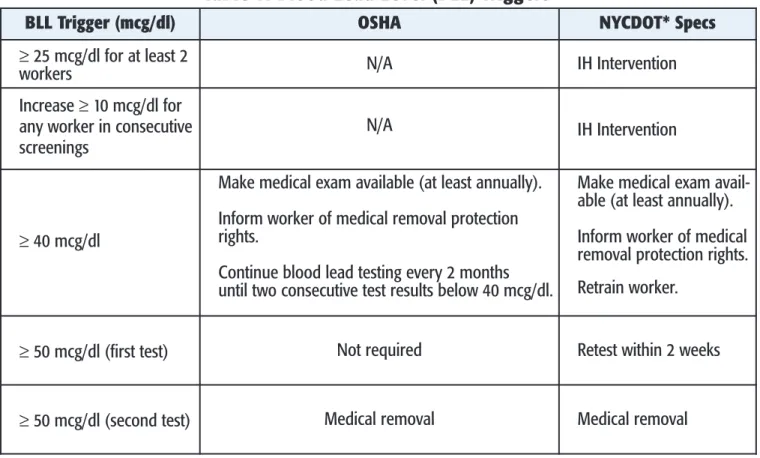
Table 1: Blood Lead Level (BLL) Triggers
* An example of local specifications. Check requirements in your area.
BLL Trigger (mcg/dl) OSHA NYCDOT* Specs
≥25 mcg/dl for at least 2
workers N/A IH Intervention
Increase ≥10 mcg/dl for any worker in consecutive screenings
N/A IH Intervention
≥40 mcg/dl
Make medical exam available (at least annually). Inform worker of medical removal protection rights.
Continue blood lead testing every 2 months until two consecutive test results below 40 mcg/dl.
Make medical exam avail-able (at least annually). Inform worker of medical removal protection rights. Retrain worker.
≥50 mcg/dl (first test) Not required Retest within 2 weeks
B-17
Blood Lead Monitoring
SAMPLE RECORDKEEPING FORM
First Name Last Name D.O.B. Date Z P P/ F E P (mcg/dl) B LL (mcg/dl)
B-19
Blood Lead Monitoring
SAMPLE BLOOD LEAD MONITORING RESULTS FORM
Employee name Date of Test
BLL mcg/dl ZPP/FEP mcg/dl Medical Service
Blood lead results are usually given as micrograms of lead per deciliter of blood (mcg/dl). The blood lead level (BLL) reflects the amount of lead an individual has absorbed during the two weeks or so before the blood test was performed. It tells us very little about the lead absorption before that time. Average BLLs for adults in major urban areas are less than 10 mcg/dl.
FEP (sometimes called ZPP) shows us how much lead has been absorbed during the 90 - 120 or so days before the test, but tells us very little about exposure during the most recent two weeks. FEP levels below 35 are consid-ered normal. The FEP level usually does not increase unless the blood lead level rises above 50 mcg/dl.
B-21
Blood Lead Monitoring
SAMPLE BLOOD LEAD MONITORING RESULTS GRAPH
Guide for Managing
Exposure Assessment for Lead
Overview...C-2
Section 1: Planning...C-3
•
When to Plan•
Who Does the Planning•
What Plans Need to be MadeSection 2: Implementing...C-5
•
Suggestion Box: When to Schedule MonitoringSection 3: Managing
& Responding to Results...C-7
•
Managing the Results•
Responding to Elevated ResultsSection 4: Infosheets,
Sample Forms, & Further Information...C-9
Infosheet 1: Hiring an Industrial Hygiene ConsultantInfosheet 2: Project Information for the IH Checklist 1: Reporting Results to Workers Table 1: Air Monitoring Action Trigger Levels Sample Recordkeeping Form
Sample Air Monitoring Results Reporting Form (Individual) Sample Air Monitoring Results Reporting Form (Group)
C-1
Overview
Exposure assessment, or monitoring,measures workers’ exposure to airborne contaminants during the performance of their jobs.
Why perform monitoring?
•
It is required by OSHA•
Required by some owner specifications•
The exposure level determines what has to be done to protect workers, including:°
the need for engineering controls°
the effectiveness of engineering controls°
the type of respirators required on the job°
the need for blood lead monitoringOverview of the Tasks
— This Guide will elaborate on these tasks —
C-2 Exposure Assessment for Lead
1. Planning
a) Designate a Lead Program Manager (LPM) b) Identify lead generating tasks
c) Hire IH consultant
2. Implementing
a) Select tasks to be monitored b) Schedule monitoring
c) Prepare personnel for monitoring d) Organize day of monitoring
3. Managing and Responding to Results
a) Review IH report and results of monitoring b) Respond to elevated results
c) Provide results to workers d) Maintain records of results
Selecting an IH you can work with is important. The IH provides informa-tion that determines the level of worker protection. OSHA or the owner may review this information at any time. Also, the IH can help interpret the OSHA standard.
Planning
When to plan
•
At the same time the project is being planned•
No later than during job mobilization•
If job has started, or lead disturbing tasks have begun, plan fast to do what has to be done!Who does the planning
•
Corporate safety office or management at the site begins the planning and appoints the Lead Program Manager (LPM) who assists in project planning.°
LPM should be trained in lead hazards and their controlWhat plans need to be made
•
Identify tasks/trades with potential for generating lead dust and fume.°
LPM needs to be familiar with scope of work throughout the course ofthe project since tasks or intensity of work often vary during the life of the project.
•
Hire an Industrial Hygiene (IH) Consultant – See Infosheet 1 (C-11)•
Supply IH consultant with information to help him/her gain an understanding of the project – See Infosheet 2 (C-13)°
To do their job well, they will have to have a sense of such items as the scope of work, the tasks being performed, and the number of workers engaged in these tasks.°
In the meantime: OSHA requires that employees must be protected with respirators as soon as lead disturbing work begins. Refer to 1.3.b “OSHA Presumed Exposure Level for Selected Tasks” (D4-Guide for Managing a Respiratory Protection Program)C-3
S
E
CTI
O
N
1
The LPM has a detailed knowledge of the site (exposures/tasks). His job is to communicate relevant information to the IH so he/she can do the best possible job.
Implementing
The IH performs the monitoring; the LPM organizes things so that the IH can do the job with the least disruption to the project.
Select tasks to be monitored
•
Review all lead generating tasks•
Conduct walkthrough of site with IH°
Make sure IH sees all lead tasks°
Orient IH to safety issues at siteSchedule monitoring – See Suggestion Box on the next page
•
Determine work schedule with project manager•
Select day when activities are going to be representative of an average workday•
Call IH consultant and schedulePrepare personnel for monitoring
•
Arrange with site supervisor/foreman the day before - the fewer surprises the better•
Inform workers and unions that monitoring is taking place°
A toolbox talk on what to expect and an explanation of monitoring the week before is suggestedOrganize the day of monitoring
•
Review sampling plan with IH°
Ensure all tasks and highest exposures are selected°
Ensure IH has access to site and workers°
Review with IH tasks/locations/workers to be monitored°
Accompany IH to sampling locations°
Introduce IH to workers and supervisorsSummarize day with IH
•
Meet with IH at end of work shift for a quick review of the day’s activities. Ask if there were any problems that could affect results or any situations in need of immediate response.C-5
S
E
CTI
O
N
2
Suggestion Box: When to Schedule Monitoring
C-6 Exposure Assessment for Lead At a minimum, follow OSHA’s monitoring schedule:
•
Beginning of job (to make an initial determination)•
At least every six months if exposure is between the action level (AL) of 30 micrograms (30 mcg/m3) and the permissible exposure level (PEL) of 50 micrograms (50 mcg/m3)•
At least every three months if exposure is above the PELAny major variation in the work process can reduce or increase exposure levels. Remonitor whenever changes occur.
•
New tasks and/or tools are introduced•
Crew size increases•
Work configuration changes significantly (enclosure, confined area)•
Increase in number of hours workedEven with the best intentions, things go wrong. Here are some scheduling pitfalls that managers have to deal with:
•
Monitoring cannot be conducted as planned due to such factors as:°
Weather°
Change in work plans for the day°
Equipment breakdown•
Monitoring begins but cannot be finished because of above•
A worker who is being monitored is assigned to another task•
Work is unusually light and it is difficult to get a representative sample If such things happen, reschedule as soon as possibleManaging & Responding
To Results
The LPM has responsibilities for reviewing the IH’s report, informing workers and keeping records. These tasks are described below.
Managing the Results
Review IH report and results of monitoring.
•
Compare results to OSHA Action Level (AL) and Permissible Exposure Level (PEL) – See Table 1 Air Monitoring Action Trigger Levels on page C-17•
Review IH recommendations•
Initiate response if necessary – See Responding to Elevated Results, on next page.Provide results in writing to each monitored workers within 5 days of receipt of results.
•
See Sample Air Monitoring Results Reporting Form (Individual) C-21•
Distribute during weekly toolbox talk or with paychecks Provide results to all workers potentially exposed to lead.•
See Air Monitoring Results Reporting Form (Group) C-23•
Post prominently in change room or distribute to workers•
See Checklist 1: Reporting Results to Workers (C-15)°
Attach to front of group results file folder•
Prepare and schedule a toolbox talk to review the results Maintain records of results•
Use Sample Recordkeeping Form (C-19)C-7
S
E
CTI
O
N
3
Responding to Elevated Results
Monitoring results above the PEL might indicate a problem with engineering and work practice controls. Consult the Guide for Managing Engineering & Work Practice Controls for further guidance on troubleshooting. The following points summarize the main steps to be taken:
•
Make sure there are controls in place•
Check out the equipment to make sure it is functioning.•
Talk to the workers, to find out if:°
engineering controls are working properly°
they are familiar with the equipment°
they have any suggestions for improving existing controls°
they use the controls and, if not, why not°
what they do when the equipment isn’t working properly•
Hold a safety meeting with managers and a toolbox talk with workers about the controls.•
Investigate with them if the controls are suited to the site and the particular application. An investigation of other controls may be in order.•
If problems are found and corrected, reschedule monitoring.•
Given the measured exposure, ensure that the types of respirators worn by the workers are sufficiently protective and are being used properly.C-8
OSHA requires that the way to protect workers from exposure to lead is first by engineering and work practice controls. If the controls employed are state-of-the art, and the monitoring results show workers are exposed above the PEL, then the controls must be supple-mented with respiratory protection.
Infosheets, Sample Forms &
Further Information
Infosheet 1: Hiring an Industrial Hygiene Consultant Infosheet 2: Project Information for the IH
Checklist 1: Reporting Results to Workers Table 1: Air Monitoring Action Trigger Levels Sample Recordkeeping Form
Sample Air Monitoring Results Reporting Form (Individual) Sample Air Monitoring Results Reporting Form (Group)
C-9
S
E
CTI
O
N
4
Infosheet 1: Hiring an Industrial Hygiene Consultant
The information gathered from different consultants can be used to choose the best one
C-11
Exposure Assessment for Lead
•
IH consultant has construction experience (preferable)•
IH consultant has a supervisory Certified Industrial Hygienist (CIH) (preferable)•
Sample analyzed by accredited laboratory (necessary)•
Request sample report°
Is it well written (do you understand it)?°
Are results presented as 8-hour time weighted averages? (they should be)•
Compare costs to those of several other consultantsC-13
Exposure Assessment for Lead
Infosheet 2: Project Information for the IH
It is recommended that the LPM have this information ready at hand when speaking with the consultant
•
Scope of work lead generating tasks•
Approximate project timetable•
Approximate number of workers engaged in lead generating tasks•
Trades and tasks of workers, focusing on lead generating tasks•
Location of project and accessibility•
Description of controls used (engineering, administrative, respirators)•
Copy of Respiratory Protection Program•
Details on site safety hazardsC-15
Exposure Assessment for Lead
CHECKLIST 1: REPORTING RESULTS TO WORKERS
Results reviewed then copied to recordkeeping table or spreadsheet
Results copied into form for reporting to workers and dated (Group and Individual reporting form)
Individual results given to monitored workers
•
Group form posted in area where all workers can view them orC-17
Exposure Assessment for Lead
TABLE 1: OSHA AIR MONITORING ACTION TRIGGER LEVELS*
* Note: there are parts of the OSHA standard that do not depend upon air sampling results, for instance, housekeeping. Refer to the standard for more information.
If initial air monitoring results are: Lessthan the AL, then:
•
Not required to repeat monitoring unless there is a change in equipment, process, controls, task or personnelGreaterthan the AL but less then the PEL initial determination, then as per the OSHA standard, employers are required to conduct:
•
Blood lead monitoring•
Worker training in lead•
Representative monitoringGreater than PEL, then:
•
Implement entire standardGreater than PEL (subsequent monitoring), then:
C-19
Exposure Assessment for Lead
SAMPLE RECORDKEEPING FORM
First Name Last Name Monitoring Date Tasks R esults 8-hr T W A (mcg/m 3 ) Exceed the P E L (Y/ N) W ork ers
given results (Y/
N)
Action Tak
C-21
Exposure Assessment for Lead
AIR MONITORING RESULTS REPORTING FORM (Individual)
This report presents your results for personal air monitoring for lead exposure conducted on ___/___/___ Contractor’s Name__________________________
Employee name Work Site/Location
Description of engineering /administrative controls at the site
Job Description Monitoring Result
PEL Exceeded (Circle One) Yes / No
These results represent exposure levels during the time and date the task was performed and the conditions present at the time the monitoring occurred. The Occupational Safety and Health Administration (OSHA) Permissible Exposure Limit (PEL) for lead represents the highest level of lead dust or fume to which a worker should be exposed to over an 8-hour work-shift. If exposure exceeds the PEL employers must supplement engineering controls with proper respiratory protection.
C-23
Exposure Assessment for Lead
AIR MONITORING RESULTS REPORTING FORM (Group)
This report presents results for personal air monitoring for lead exposure conducted on ___/___/___ Contractor’s Name__________________________
Employee name Work Site/Location
Description of engineering /administrative controls at the site
These results represent exposure levels during the time and date the task was performed and the conditions present at the time the monitoring occurred. The Occupational Safety and Health Administration (OSHA) Permissible Exposure Limit (PEL) for lead represents the highest level of lead dust or fume to which a worker should be exposed to over an 8-hour work-shift. If exposure exceeds the PEL employers must supplement engi-neering controls with proper respiratory protection.
The OSHA PEL 8-hour TWA for lead is 50 micrograms/m3 (50 mcg/m3)
Monitor
Worker Job Description/ Location
Monitoring Results 8-hour TWA mcg/m3 PEL Exceeded? Y/N #1 #2 #3 #4 #5 #6
Guide for Managing
a Respiratory Protection
Program for Lead
Overview...D-2
Section 1: Planning for Respirator Use...D-3
1.1 Appointing a Respirator Program Manager
1.2 Writing a Site Specific Respirator Program
1.3 Selecting the Right Respirator for the Task
Section 2: Mobilizing at the Work Site...D-9
2.1 Medical Evaluations
2.2 Training
2.3 Fit Testing
2.4 Ordering Respirators and Supplies
Section 3: Day-to-Day Practices...D-17
3.1 Managing Respirator Use
3.2 Maintaining Respirators
Section 4: Records & Evaluation...D-21
4.1 Recordkeeping
4.2 Evaluating the Site Specific Program
Section 5: Checklists, Sample Forms
& Further Information...D-23
Sample Site-Specific Respiratory Protection ProgramSample Respirator Selection Worksheet
Infosheet 1: Information to Gather When Hiring a Medical Service Job/Task Information Form for PLHCP
Medical Evaluation Questionnaire (English) Medical Evaluation Questionnaire (Spanish)
Employee Instructions for Filling Out Respirator MEQ Checklist 1: Suggested Respirator Training Topics Respirator Fit Test Record
Checklist 2: Respirator Supplies Infosheet 2: Respirator Use Practices Sample Record Summary Spreadsheet
Checklist 3: Evaluation of Site-Specific Respirator Program
D-1
Overview
This guide outlines the steps for planning and managing a respirator protection program for workers exposed to lead dust or fume during construction activities. It covers all the components of a respirator program as required by OSHA. The guide will be helpful to anyone with respirator program responsibilities; it can be used in its entirety or by section.
Why do you need a respirator protection program?
•
It is required by OSHA whenever respirators are used.•
Respirators must be used when engineering and work practice controls fail to reduce lead exposure below the Permissible Exposure Limit (PEL).Overview of the Tasks
— This Guide will elaborate on these tasks —
D-2 Respiratory Protection for Lead
1. Planning
a) Appoint a respirator program manager b) Write a site specific respirator program c) Select the right respirator for each lead
generating activity
2. Mobilizing
a) Set up medical clearance evaluations b) Train respirator users and supervisors c) Make sure the respirator fits correctly d) Order respirators and supplies
3. Day-to-Day Practices
a) Manage respirator use b) Maintain respirators
4. Records and Evaluation
a) Maintain records of respirator program activities b) Evaluate respirator program regularly
Note:The most labor-intensive tasks are found in Sections 1 & 2. Once you get through the planning and mobilizing phases, you will be in good shape to manage the use of respirators at your site, maintain records, and conduct periodic program evaluations.
The respirator program needs to be in place before workers use respirators for the first time. Like any other construction activity, using respirators will go a lot smoother if time and effort are put in upfront to plan and mobilize.
Planning for Respirator Use
There are three major tasks in setting up a respirator program: 1.1 Appointing a respirator program manager
1.2 Writing a site specific respirator program
1.3 Selecting the right respirator for each lead generating task
1.1 Appointing a Respirator Program Manager (RPM)
•
Appointed by higher management°
Position can be assigned to a site safety officer, project engineer, or other competent construction manager•
RPM must be qualified by training and/or experience with the respirators used at the site°
Arrange respirator training if needed (see Resource List).•
A qualified worker can be assigned day-to-day program tasks such as:°
fit testing°
training°
maintenance/cleaning°
assisting in program evaluation1.2 Writing a site specific respirator program
•
Program can be written by RPM, company safety officer or IH consultant•
The Program can be adapted from:°
company-wide program°
previous project°
OSHA model program°
commercially available program•
The Program must address the following items:°
respirator selection°
medical evaluation°
use of respirators°
training°
fit testing°
maintenance°
record keeping°
evaluationS
E
CTI
O
N
1
D-3•
The Program must be site specific. It must address the use of respiratory protection under the conditions present at the site.°
The site-specific program is an open-ended document that isupdated as respirator needs change at the site.
°
The Sample Program in Section 5, D-25, represents the program updated after exposure monitoring and respirator selection have been completed. You can adapt this sample program to your site’s conditions and needs.1.3 Selecting the right respirator for the task
1.3.a. Selecting a respirator before monitoring results are known:
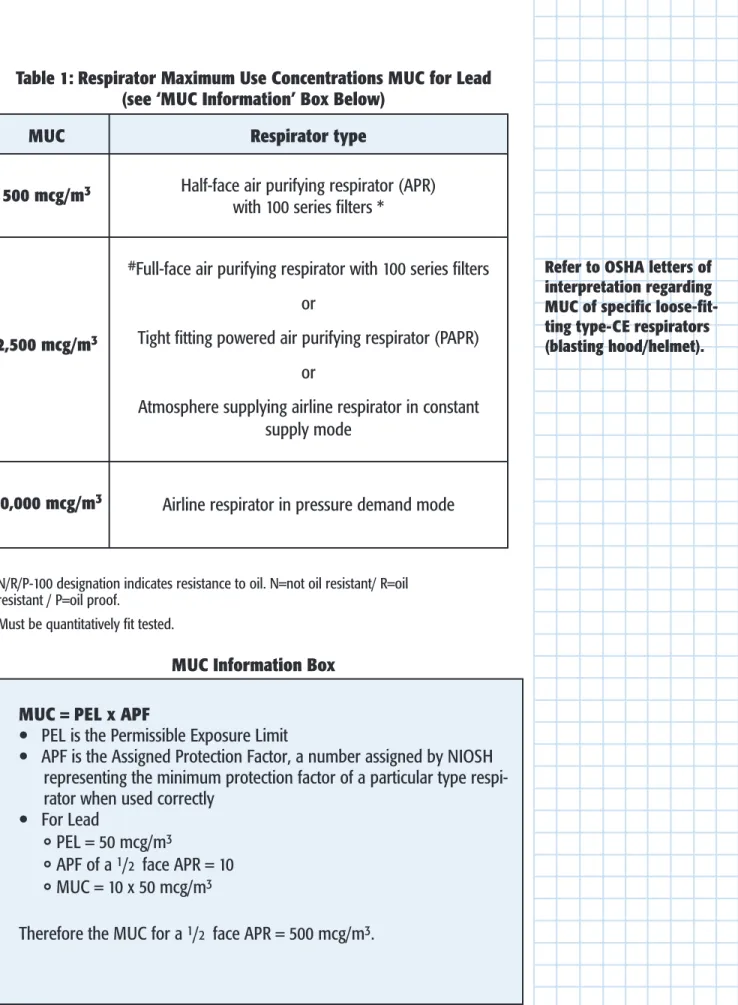
OSHA requires that workers be protected by respirators as soon as lead disturbing tasks are performed. To select the right respirator, OSHA provides presumed exposure levels for each task – see 1.3.b below. After the presumed exposure level is found, use Table 1, D-6 to select the required respirator. For additional information, refer to the OSHA standard.
1.3.b. OSHA Presumed Exposure Level for Selected Tasks
•
Less than 500 mcg/m3°
Manual demolition°
Power tool cleaning with dust collection systems°
Dry manual sanding°
Dry manual scraping•
Between 500 and 2,500 mcg/m3°
Movement and removal of the abrasive blasting enclosure°
Rivet busting°
Power tool cleaning without dust collection systems°
Cleanup of dry expendable abrasive blasting jobs°
Lead burning°
Using lead-containing mortar•
> 2,500 mcg/m3°
Abrasive blasting°
Welding°
Oxy-acetylene torch cuttingD-4
It is recommended that the program and records be kept together in a loose-leaf binder
1.3.c. Selecting a respirator after monitoring results are known:
•
Use the Respirator Selection Flow Chart below to select the correct respirator for each activity. An example of a completed worksheet follows on the next page.•
Complete the blank Worksheet in Section 5 (D-35).Respirator Selection Flow
D-5
Respiratory Protection for Lead
Review respirator selec-tion worksheet with job foremen, stewards, and workers and attach it to the written program. Post a copy in the project office, supply station, and worker shanties. It can also be reviewed during training sessions, safety meetings and toolbox talks.
Step 1: List all activities that generate lead dust or fume. Seek input from job foremen, stewards, and workers.
Step 2: Identify workers and supervisors who do these activities or may be working nearby.
Step 3: List air monitoring results as an 8-hour Time Weighted Average (TWA). See Guide for Managing Exposure Assessment for Lead.
Step 4: Compare the air monitoring results with the Maximum Use Concentrations (MUC) in Table 1 (D-6).
Step 5: Select a respirator with a MUC greater than the monitoring result.
Step 6: Include respirator selection worksheet in your site specific respirator program.