Prize Allocation and Entry in Ideation Contests
Pavel Kireyev∗ Harvard Business School
September 20, 2015
JOB MARKET PAPER Abstract
Contests are a popular mechanism for the procurement of creative innovation. In market-ing, firms often organize contests online, offering prizes to encourage competition and solicit high-quality ideas for ads, new products, and even marketing strategies from participants. I empirically investigate the impact of the number of prizes, prize amount and submission limit on participation and quality outcomes in ideation contests using data from a popular marketing crowdsourcing platform. I develop a structural model of participant entry and sponsor choice in contests with multiple prizes and heterogeneous participants. The structural model allows for multiple equilibria in the participant entry game and a flexible specification of participant information sets. Counterfactual simulations reveal the impact of design parameters on partic-ipation and quality outcomes: multiple prizes discourage stronger participants and encourage weaker participants but do not have a substantial impact on outcomes in contests that attract a large number of submissions; a larger prize increases expected total and maximum idea quality but may not substantially increase participation; a submission limit increases the number of entrants but reduces expected total and maximum idea quality. The results provide guidance for the optimal design of ideation contests.
Keywords: crowdsourcing; ideation; contest design; structural estimation; static discrete games; information structures; partial identification.
∗
Address: Morgan Hall, Soldiers Field Road, Boston, MA 02163, e-mail: [email protected]. I thank my committee, Elie Ofek, Sunil Gupta and Ariel Pakes for their support. I thank Karim Lakhani, Robin Lee, Donald Ngwe, Daniel Pollmann, Thomas Wollmann and participants of the Harvard IO Lunch and the HBS Marketing Unit Seminar for helpful discussions. I thank James DeJulio and Eugene Retunsky for providing insight into the data and sharing useful information about the business of crowdsourcing.
1
Introduction
Contests have a rich history as a mechanism for the procurement of innovation in design and technology. With the growth of the internet, firms have begun using contests to procure ideas for advertising, new products and marketing strategies. For example, when motorcycle manufacturer Harley-Davidson split with its ad agency of 31 years, it turned to the crowd to create its next generation of advertising (Klaassen 2011). With the help of a crowdsourcing firm, Harley organized anideation contest - fans of the brand could submit short ad ideas for a chance to win a cash prize. The winning submissions motivated a series of popular Harley marketing campaigns. Contests carry many advantages over the traditional ad agency model of advertising procurement: brands can expect a large number of ideas at a relatively low cost; participants tend to be actual end users of the product; and contests build awareness by engaging consumers in conversation with the brand (Pickering 2011, Kirby 2013).
Harley is not alone in adopting the contest model of ideation. Government agencies and firms in the private sector across a variety of industries have implemented ideation contests. For example, Challenge.gov, a government operated ideation platform, solicits ideas from participants for projects organized by different federal agencies, such as DARPA and NASA. Innocentive, a popular platform for scientific innovation, hosts ideation contests for companies such as Ford, GlaxoSmithKline and MasterCard. The crowdsourcing studio Tongal organizes advertising ideation contests for AT&T, Deloitte, General Electric, LEGO and Proctor & Gamble, among others.1
The success of an ideation contest hinges on its design - the choice of how to structure prizes and contest entry regulations. In this research, I empirically examine the impact of three broadly applicable design decisions - how many prizes to award, how much money to award per prize, and how many submissions to accept per participant - on contest participation and idea quality outcomes, such as expected total and maximum submission quality.
Prior research has explored how incentives affect ideation from an agency theory perspective (Toubia 2006, Girotra et al. 2010), but few papers have empirically examined the use of contest mechanisms for the procurement of ideas. I develop and estimate a structural model of ideation
1
Some of the earliest ideation contests in marketing date back to the 1950s and 1960s (Kirby 2013). Popular brands would organize contests through newspapers and specialized publications to obtain ideas for ads, commercial jingles and new product names from consumers.
contests to assess the impact of different design parameters on contest outcomes. The model captures both participant and sponsor decision processes. Participants choose whether or not to enter a contest and how many ideas to submit based on their expected returns and costs of effort. The sponsor then ranks submissions by quality and rewards the winners.
Participants may differ in their abilities and costs. Ability heterogeneity reflects the notion that idea quality may differ across participants. Ideation contests attract a wide array of entrants with different backgrounds and experiences. Certain participants may submit higher quality ideas than others. For example, we may expect a Harley veteran to generate higher quality ideas for a motorcycle ad than someone with limited riding experience. Cost heterogeneity allows for partici-pants to differ in how easy or difficult it is for them to think of ideas for a particular contest. For example, individuals with more outside commitments may have less time to participate in online contests, increasing their costs of making submissions. I allow for abilities and costs to differ by participant and contest. Moreover, participants can select into contests based on an unobservable (to the researcher) component of costs.
I use data from crowdsourcing platform Tongal to estimate the model in two stages. First, data on sponsor rankings of winning submissions identify participant abilities as a function of observable participant characteristics, such as demographics, past contest experience, and browsing behavior. The first stage amounts to a random-coefficients rank-ordered logit model, which I estimate using hierarchical Bayesian methodology. Second, participant submission decisions identify the costs of ideation. I estimate the second stage as an empirical discrete game, where participants choose how many ideas to submit to a given contest to maximize their expected payoffs. I use moment inequalities to partially identify the average cost function. This methodology allows for multiple equilibria, a non-parametric cost unobservable, and yields estimates that are robust to different specifications of participant information sets.
Counterfactual simulations reveal the impact of alternative prize allocation and submission limit decisions on contest outcomes under different assumptions about the information sets of participants. I experiment with two information structures, which I label complete and incomplete information. In the complete information scenario, participants know their own characteristics, as well as sponsor preferences and the characteristics of their competitors. In the incomplete information scenario, participants do not know sponsor preferences or competitor characteristics,
but are aware of the joint density of these variables conditional on contest structure. I find that both information structures imply similar counterfactual outcomes on average across contests. However, the outcome of each individual contest may differ depending on the informational assumption.
First, I investigate the impact of offering a single prize instead of multiple prizes. I find that although multiple prizes motivate lower ability participants and demotivate higher ability partici-pants, the number of prizes, holding fixed total award, has a negligible impact on participation and quality - the change in expected marginal returns to most participants is small compared to sub-mission costs. Second, I explore the impact of increasing prize money. I find that a strong response from higher ability participants leads to an increase in idea quality but may not lead to a substantial increase in the total number of entrants. Finally, I examine the effect of reducing the maximum number of submissions allowed per participant. This policy benefits lower ability participants who would have otherwise been discouraged from entry by the presence of higher ability participants who submit multiple times to the same contest. A more stringent submission limit restricts higher ability participants, increasing the number of entrants but reducing expected quality outcomes.
The remainder of this paper is organized as follows. Section 2 summarizes the relevant theoreti-cal and empiritheoreti-cal literature on contest design. Section 3 presents the data and descriptive evidence of the importance of prize allocation. Section 4 outlines the structural model and Section 5 details the two-stage estimation routine. Section 6 examines the impact of counterfactual contest designs and presents practical implications. Section 7 concludes.
2
Contest Design
A contest is a game in which players invest costly effort in an attempt to win a prize. Throughout, I refer to players who consider entering a contest asparticipants. Of all participants, those who enter the contest are referred to as entrants, and the rest, as non-entrants. The sponsor organizes the contest and ultimately selects winners and awards prizes. Effort in the contest literature is typically viewed as a non-negative continuous decision variable. I view effort as the discrete number of idea
submissions a participant makes to a given contest.2
2
The ideation contests I study require participants to submit 140 character ideas for ads. Each participant can submit at most 5 ideas to a single contest. Section 3.1 and Appendix A.2 show evidence that the number of submissions is a good measure of participant effort - submissions react in expected ways to changes in prize allocation.
Traditionally, contests have been modeled as either imperfectly discriminating (Tullock 1980), all-pay auctions (Baye et al. 1994), or rank-order tournaments (Lazear and Rosen 1981). Imper-fectly discriminating contests and rank-order tournaments typically allow for uncertain outcomes - the participant exerting the highest effort is not guaranteed to win. However, a higher effort in-creases the participant’s chances of winning. In all-pay auctions, highest effort typically guarantees victory. Ideation contests share similarities with imperfectly discriminating contests and rank-order tournaments - participants who submit the most ideas are not guaranteed to win, and in contests with multiple prizes, submissions are ranked in order of the sponsor’s preferences.
A key aspect of ideation contests is participant heterogeneity. Participants, with different levels of skill and experience, can freely join the platform and enter contests. Although a greater number of entrants improves the sponsor’s chances of obtaining an extreme-value, high quality idea, especially in contests with significant participant uncertainty about sponsor preferences (Boudreau et al. 2011), increased participant asymmetries typically result in reduced effort (Baye et al. 1993, Stein 2002). Intuitively, participants with a low chance of winning are discouraged and “give up,” which in turn reduces the level of competition for participants with a high chance of winning, resulting in a lower level of effort from all types. However, an appropriate choice of prize allocation can mitigate this concern.3
Theory literature has examined the impact of prize allocation on the effort of heterogeneous participants. Moldovanu and Sela (2001) explore the impact of multiple prizes on effort in all-pay auctions. The authors show that, holding fixed total award, a greater number of prizes encourages weaker participants, as they have a chance of winning one of the lower ranking prizes. On the other hand, stronger participants exert less effort, as with multiple prizes, the payoff from “losing” increases. The optimality of offering multiple prizes depends on participant heterogeneity and the convexity of their costs of effort. If costs are sufficiently convex, a smaller number of prizes will not encourage stronger participants to increase effort by enough to compensate for the reduced effort of weaker participants, and the sponsor may find it optimal to offer multiple prizes. Szymanski and Valletti (2005) argue that stronger participants may increase effort in response to multiple prizes in imperfectly discriminating contests. The added uncertainty of winning may motivate
3
Fullerton and McAfee (1999) argue that restricting entry can also benefit sponsors. By imposing an appropriate entry auction mechanism that encourages higher ability participants to enter, the sponsor can expect greater effort while minimizing the costs of procurement.
stronger participants to react to increasing competition from weaker participants. Few papers have examined the impact of prize allocation on outcomes other than effort. Terwiesch and Xu (2008) consider expected maximum and average quality outcomes in imperfectly discriminating innovation contests and all-pay auctions. The authors similarly show that multiple prizes may be optimal in contests with heterogeneous participants, but a single prize works best for contests with ex-ante identical participants.4 Overall, the effect of multiple prizes on effort is ambiguous and depends on participant heterogeneity and cost function shape.5 I contribute to the literature by presenting
estimates of different prize allocation policies on participation and quality outcomes, and suggesting practical implications for ideation contest design.
Although the question of how many submissions to accept per participant is unique to contests where participants can make multiple submissions, researchers have investigated the related aspect of restricted bidding in all-pay auctions. Che and Gale (1998) consider the impact of caps on investments in political lobbying in an all-pay auction with one high-valuation (strong) player and one low-valuation (weak) player. The authors find that bid caps can increase total spending by limiting the strong participant and encouraging the weak participant. Che and Gale (2003) similarly show that handicapping a stronger participant in research contests can improve the contest outcome. I investigate the impact of restricting the number of submissions per participant - a relevant and easy to implement policy in the context of ideation contests. My results show that submission limits constrain higher ability participants and increase overall entry. However, I find that a more stringent submission limit may reduce expected total and maximum idea quality.
Substantial progress in the empirical literature on contests has been achieved with the increasing availability of online data. Boudreau et al. (2015) examine the impact of competition on the effort of heterogeneous participants in the context of the popular TopCoder platform for programming contests. The authors examine a number of contest design policies but do not focus on the question of how many prizes to award or how many submissions to accept per participant. Furthermore, the authors adopt the all-pay auction model of contests (Moldovanu and Sela 2001), whereas I focus on
4See Sisak (2009) for a survey of the theoretical literature on multiple prizes in contests. 5
Apart from heterogeneity, participant risk-aversion may also motivate the adoption of multiple prizes. Kalra and Shi (2001) show that in rank-order sales tournaments with sufficiently risk-averse homogeneous participants, multiple prizes may increase effort. However, experimental research suggests that risk-averse participants are less likely to enter tournaments altogether (Eriksson et al. 2009, Dohmen and Falk 2011). Throughout, I focus on contests with risk-neutral, heterogeneous participants.
the imperfectly discriminating framework (Stein 2002, Szymanski and Valletti 2005), which I find more relevant for ideation contests where the outcome depends heavily on idiosyncrasies in sponsor preferences. Yoganarasimhan (2015) presents a model of beauty contest auctions, or procurement auctions with uncertain outcomes. The author estimates the model using data from a freelance marketplace. In beauty contest auctions, participants bid a dollar fee, and the winner receives her fee as compensation from the sponsor. Ideation contests differ in that participants invest costly effort to think of ideas, and the winners receive pre-announced prizes. In the setting of online design contests, research has explored the impact of feedback and entry visibility on participation and submission quality (Wooten and Ulrich 2011, 2013) as well as the effects of competition on experimentation (Gross 2014). I present an estimable model of ideation contests with multiple prizes, participant heterogeneity, and the possibility of selection into contests based on costs of effort. I contribute to the empirical literature by presenting estimates of the impact of a number of key design parameters, such as the number of prizes, prize amount, and submission limit, on participation and idea quality outcomes. Furthermore, I address a recent call in literature to allow for more flexibility in the information structures of empirical games (Borkovsky et al. 2015) and derive contest outcome predictions that are robust to different informational assumptions.
3
Data
I use data from Tongal, a popular crowdsourcing platform. Tongal organizes contests for brands across a variety of product categories, including consumer packaged goods, body care and health products, electronics, pet supplies, and toys.
Ideation contests on the Tongal platform operate as follows. Tongal and the contest sponsor jointly decide on how many prizes to offer and how much money to offer per prize. The sponsor presents participants with the contest prize allocation, rules and regulations, and a description of the ideation topic. Participants can then enter the contest by submitting at least one 140 character idea for an ad based on the topic suggested by the sponsor. Each entrant can submit at most 5 ideas to a single contest. After the contest ends, the sponsor reviews the content of each submission without knowledge of the identity or characteristics of its creator. Winning submissions are ranked and their creators receive prize money. The platform does not display the identities or actions of
participants during the contest period. Only after the sponsor selects winners does the platform make public the list of winning submissions.
I focus on a sample of 181 ideation contests that ran from 2011 to 2015 (the platform was founded in 2009) and a set of 8,875 participants who entered at least one of these contests. For each contest, I observe the number of submissions made by each entrant, the number of prizes awarded and total prize amount. All contests divide prizes evenly among winners. For example, each winning submission receives $250 if a contest offers 4 prizes with a total award of $1,000.
An important aspect of many contests is that not all participants who consider entering choose to do so. I use browsing data to define the set of likely non-entrants, or participants who considered entering a contest but chose not to. Specifically, participants who did not enter the contest but viewed the contest page more than once and were active in the past 3 months are considered likely non-entrants. I restrict non-entrants to this subset to avoid including participants who were simply “surfing” the site without seriously considering entry into the contest. This procedure yields a total of 9,732 instances of non-entry by likely non-entrants. On 35,011 occasions, participants make at least one submission.
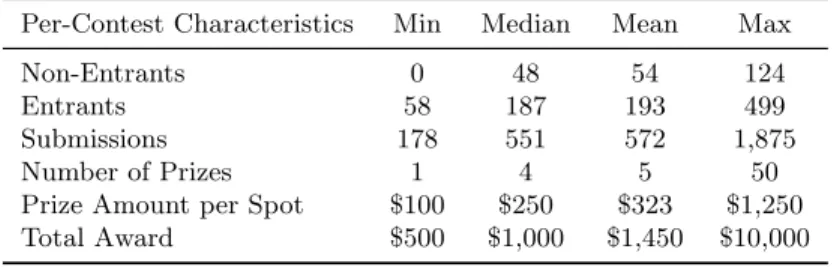
Table 1: Summary of Contest Characteristics
Per-Contest Characteristics Min Median Mean Max
Non-Entrants 0 48 54 124
Entrants 58 187 193 499
Submissions 178 551 572 1,875
Number of Prizes 1 4 5 50
Prize Amount per Spot $100 $250 $323 $1,250 Total Award $500 $1,000 $1,450 $10,000
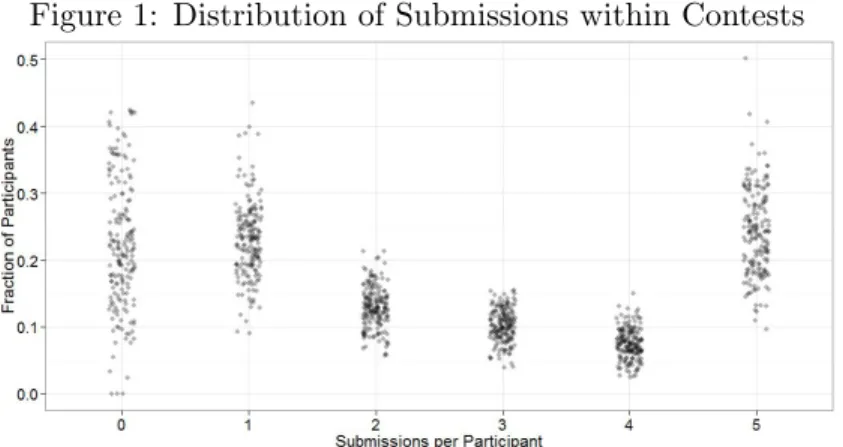
Table 1 presents summary statistics for the contests considered. The contests tend to attract a high number of entrants and submissions, with the average contest securing 193 entrants and 572 submissions. There is also substantial variation in prize allocation across contests, with the number of prizes ranging from 1 to 50 and prize amount per winning spot ranging from $100 to $1,250. Figure 1 presents a plot of the distribution of submissions per participant with a contest for all 181 contests in the data. A significant proportion of participants does not enter, submits once, or makes the maximum number of submissions allowed.
For each one of the 8,875 participants, in addition to browsing data, I observe a set of charac-teristics collected by the platform. These include: demographic variables such as age, gender, and
Figure 1: Distribution of Submissions within Contests
Note: An observation is a contest. Plot shows the fraction of partici-pants who madedsubmissions within each contest, whered∈ {0, ...,5}.
country; platform-user characteristics, such as registration date and whether or not the user has a profile picture; and past performance variables, such as past victories and earnings. Appendix A.1 presents summary statistics for the observed participant characteristics and draws comparisons between the characteristics of participants who won and participants who did not win.
3.1 Descriptive Evidence
Is there evidence in the data that participants change their actions in response to different prize allocations? Such evidence would suggest that prize allocation is an important design parameter that can alter behavior. I run fixed effects regressions to investigate the impact of the number of prizes and prize amount on the number of submissions made by participants.
First, consider the impact of the number of prizes on submissions. Contests offering the same total award are grouped into a single category. I compare the number of submissions made by the same participant across contests with a different number of prizes within the same category. The regression equation is given by
Yit=αXt+γZit+ξiCt +it, (1)
where Yit is the number of submissions made by participant i in contest t, Xt = 1 if a contest
offers a larger number of prizes than the average within its category, and Xt = 0 otherwise. The
Zit term and the associated parameter vectorγ capture the impact of contest-varying participant
earnings at the start of the contest. Participant-category specific fixed effects ξiCt control for
unobserved participant heterogeneity, where Ct denotes the category of contest t. Finally, α is the
parameter of interest and it is an error term.
I label participants as either heavy orlight users. Heavy users enter in more than three contests in the data. Light users enter at most three contests. I expect heavy users to have lower costs or higher abilities and a greater chance of winning than light users. The extent to which heavy and light users behave differently will shed light on the importance of participant heterogeneity in assessing the impact of different prize allocation decisions.
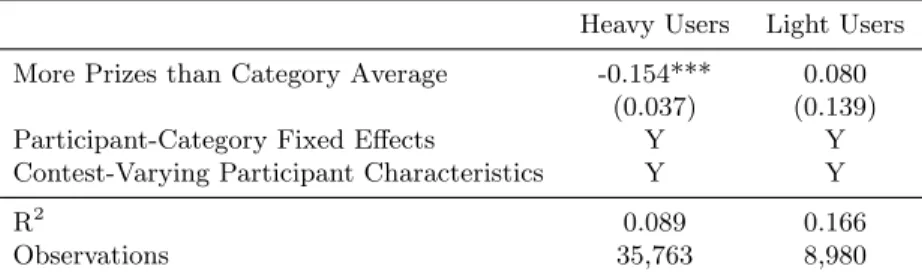
Table 2 presents the parameter estimates for Regression 1, estimated separately for heavy and light users. The results suggest that heavy users submit less to contests with a greater number of smaller prizes. Although I do not find a significant effect for light users, the regression estimates for heavy users are consistent with the predictions of theoretical models such as Moldovanu and Sela (2001). Higher ability entrants may be discouraged by multiple prizes.
Table 2: Regression of Submissions on Number of Prizes
Heavy Users Light Users More Prizes than Category Average -0.154*** 0.080
(0.037) (0.139) Participant-Category Fixed Effects Y Y Contest-Varying Participant Characteristics Y Y
R2 0.089 0.166
Observations 35,763 8,980
Note: An observation is a contest-participant pair. “More Prizes than Category Average” is an indicator for whether or not the contest offers more prizes than the average for its categoryCt. All contests within the same category offer the same
total award. Contest-varying participant characteristics include the participant’s page views and total earnings at the start of the contest. Robust standard errors in parentheses. *** p<0.01, ** p<0.05, * p<0.1.
Although Regression 1 allows for unobserved heterogeneity across participants and across cate-gories for the same participant, it does not capture sources of unobserved heterogeneity correlated withXt across contests within the same category. For example, contests that offer multiple prizes
may require more creativity and have a higher difficulty level, resulting in a reduced number of submissions from heavy users. However, I focus only on 140 character ad ideation contests, which require completion of substantially similar tasks from participants, mitigating concerns about dif-ferences in difficulty across contests.
as follows. Group all contests offering the same number of prizes into the same category and let Ct denote the category of contest t. Let Xt equal the total award for contest t. Now, the
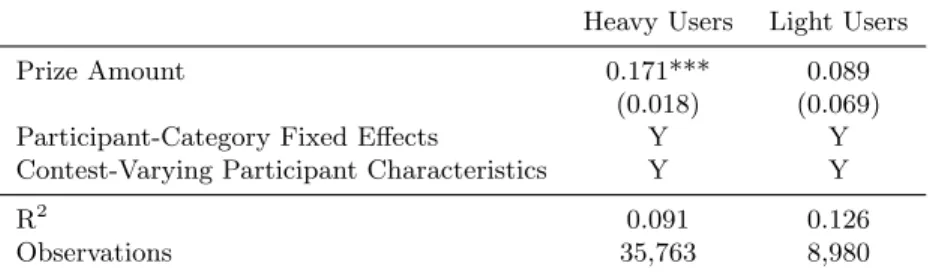
identifying variation comes from differences in submission decisions made by the same participant for contests offering the same number of prizes but different prize amounts. Table 3 summarizes the regression results. Increasing prize amount appears to increase submissions from heavy users, but no significant increase is found for light users, consistent with the predictions of theoretical contest models with heterogeneous participants, such as Stein (2002). Higher ability entrants have a greater chance of winning a prize, and hence, may be more heavily influenced by changes in prize amount.
Table 3: Regression of Submissions on Prize Amount
Heavy Users Light Users
Prize Amount 0.171*** 0.089
(0.018) (0.069) Participant-Category Fixed Effects Y Y Contest-Varying Participant Characteristics Y Y
R2 0.091 0.126
Observations 35,763 8,980
Note: An observation is a contest-participant pair. “Prize Amount” refers to the total prize money awarded in thousands of dollars. All contests within the same category offer the same number of prizes. Contest-varying participant character-istics include the participant’s page views and total earnings at the start of the contest. Robust standard errors in parentheses. *** p<0.01, ** p<0.05, * p<
0.1.
The descriptive evidence presented in this section suggests that submission decisions respond to changes in prize allocation. In Appendix A.2, I present further evidence that the results are not sensitive to different regression specifications and different characterizations of heavy and light users.
To assess the impact of contest design on quality, a variable not observed in the data, I require a structural model of sponsor preferences. Furthermore, a model of participant submission decisions would enable an analysis of the impact of submission limits, a variable that remains unchanged across contests in the data (all contests allow for at most 5 submissions per entrant). I proceed to suggest a structural model that would enable the derivation of precise predictions as to how different types of participants react to changes in prize allocation and entry restrictions.
4
Model
I model each ideation contest as an independent game consisting of two stages. First, participants considering entry decide on how many submissions to make given their costs and expected payoffs. I consider a trial-and-error model of ideation, whereby participants sample from a quality distribution with each submission in an attempt to generate an idea of high quality for the sponsor. This approach is common in models based on the statistical view of innovation in new product design (Dahan and Mendelson 2001, Loch et al. 2001) and in models of research contests with uncertain outcomes (Taylor 1995, Fullerton and McAfee 1999, Terwiesch and Xu 2008). Second, the sponsor reviews all submissions and ranks the top submissions by quality. Most sponsors in the data offer only one contest. Sponsors who offer multiple contests tend to focus on different products and ideation topics across contests. I use sponsor and contest interchangeably and denote both byt.
The model will capture three key features of ideation contests. First, participant abilities may differ across contests. If two participants make the same number of submissions, the participant with the higher ability has a larger expected payoff. Ability heterogeneity captures the notion that the “fit” between a participant and a contest may depend on the participant’s background and the contest ideation topic. Second, participants exhibit cost heterogeneity and may select into contests they find most convenient based on an unobservable component of costs. If two participants have the same ability but different costs, the participant with the lower cost may increase her expected payoff by making a larger number of submissions. Cost heterogeneity accounts for the possibility that certain participants may be busier than others at different times, or find it more difficult to think of ideas for certain contests. Third, participants may view their own abilities, the number of competitors, competitor abilities and competitor actions with uncertainty and form expectations of their own expected payoffs given their information sets.
I work backwards and first present the model for the second stage sponsor decision (Section 4.1), followed by the model for participant entry decisions (Section 4.2). The empirical implementation of the two stages is presented in Section 5.
4.1 Sponsor Choice Model
Consider the sponsor’s decision process after it receives a set of submissions. From the perspective of the sponsor, submissionsby participant iin contestt has quality
qst =βtXit+st,
whereXit is a vector of participant characteristics, βt is a vector of the sponsor’s preferences, and
st is a mean-zero quality shock to submission s. Let ait = βtXit denote participant i’s ability
in contest t. Participants with a higher ability will tend to make higher quality submissions than
participants with a lower ability. Moreover, if a participant has a high ability in one contest, she may not necessarily have a high ability in a different contest. For example, a participant based in North America may submit higher quality ideas for ads targeted at North American audiences but may not perform as well in contests for European brands. The interaction of heterogeneous sponsor preferencesβt and participant characteristicsXit reflects the differences in participant submission
quality across contests.
The shock st captures all heterogeneity in submission quality that cannot be explained by
abil-ity. Participantidraws a separate shock for each submission. The average quality of a participant’s
submissions is simply ait, but each submission may be of higher or lower quality than the average
depending on the participant’s draws of quality shocks. I assume that the participant knows the distribution ofst before she chooses to submit but never learns of the realizations of herst draws.
As a result, the participant may choose how much to submit based on her abilityait but must form
expectations of her payoffs with respect to the distribution of quality shocks.
The sponsor observes qst for each s and ranks submissions by quality. Only the best Nt
sub-missions receive a ranking, where Nt is at least as large as the number of prizes.6 In other words,
the sponsor chooses a rankings(1), ..., s(Nt) such thatqs(1)t≥qs(2)t≥...≥qs(Nt)t≥qkt, whereqktis
the quality of any other submission knot ins(1), ..., s(Nt).
6The number of submissions that recieve a ranking varies across contests but is usually equal to the number of prizes.
4.2 Participant Entry Model
Risk-neutral participants form expectations of their contest payoffs with respect of the distribution of quality shocks and their perceptions of competitor actions and abilities. Suppose that a total of
It participants consider entering contest t. Participanti with ability ait =βtXit chooses to make
dit∈ {0,1, ..., D} submissions in contestt, where D is the submission limit. Expected payoffs are
given by
πit=E[Rt(dit, d−it;ait, a−it)|Jit]−cit(dit).
The expected returns functionRt(dit, d−it;ait, a−it) captures the expected winnings of a participant
with ability ait who makesdit submissions, given competitor abilities a−it and actions d−it.7 The
expected returns function depends on participant and competitor characteristics, sponsor prefer-ences, the distribution of quality shocks, the number of prizes, and the prize amount offered by the sponsor. Participants know their own Xit and the contest prize structure but may view
spon-sor preferences, the number of competitors, competitor characteristics and competitor actions as random variables because of incomplete information. A participant forms an expectation of her expected returns function given her information setJit.
I specify the cost function as
cit(dit) = (θ1+νit)dit+θ2d2it,
where νit is a mean-zero participant-contest specific cost unobservable, and θ1 and θ2 are cost
parameters. Prior to entry, each participant observes her cost shock νit and chooses how many
submissions to make to maximize expected payoffsπit. She may also choose to make no submissions
and obtain zero payoffs.
5
Estimation
Estimation proceeds in two stages. I first estimate the sponsor choice model using hierarchical Bayesian methodology. Given the first stage results, I estimate the participant entry model using
7
For example, in a contest with one prize, the expected winnings of a participant are simply equal to the prize amount, multiplied by the probability that the participant generates at least one submission of higher quality than all other submissions, given the participant’s ability and action, and competitor abilities and actions.
moment inequalities. The underlying game is likely to have multiple equilibria because of the discrete action space. The moment inequalities methodology allows for multiple equilibria, does not require explicit specification of participant information sets, and permits a flexible distribution of cost unobservables. In the second stage, I follow the estimation procedure for discrete games with ordered choices suggested by Ishii (2008) and Pakes et al. (2015).
5.1 First Stage: Sponsor Choice Model
I use data on sponsor ranking decisions and participant characteristics to estimate the sponsor choice model. To proceed, I must specify the distribution of quality shocks.
Assumption 1 The independent and identically distributed quality shocks st follow a demeaned
type 1 extreme value distribution and are not known to participants before they make submission decisions.
With each submission, the participant makes an independent draw from an extreme value quality shock distribution. The average quality of submissions made by the participant is given by the participant’s ability. Assumption 1 ensures that participants cannot select into contests based on a component of ability unobserved to the researcher and reduces the complexity of the estimation routine.8 Although participants cannot select into contests based on unobservable components of their abilities, the participant entry model allows for selection based on cost unobservables.
Next, I require an assumption on the distribution of sponsor preferences. Across all contests, sponsors rank a total of 905 submissions, whereas for each contest, I observe on average 5 ranking decisions (equal to the average number of prizes per contest). Absent a distributional assumption, it is not possible to recover sponsor-specific preferences with sufficient precision.
Assumption 2 Sponsor preferencesβt follow a multivariate normal distribution with mean µand
covariance matrix Σ.
This assumption implies that estimates of βt will depend on the sample of contests used in
estimation, and furthermore, that different types of sponsors do not strategically select to post a
8To test the impact of this assumption, I estimated the model and re-ran counterfactuals after excluding the most significant observable component of participant abilities. Estimates changed, but the counterfactual implications remained qualitatively similar. Furthermore, in Section 5.1.4, I illustrate that observable participant characteristics can explain a significant portion of the variance in contest winners.
contest on the platform. It is straightforward to augment the model to allow for sponsor preferences to depend on contest characteristics.
5.1.1 Identification
Identification relies on rankings data and heterogeneity in participant characteristics. Sponsors face submissions from participants with different characteristics and choose rankings based on these choice sets. Variation in sponsor decisions for different sets of entrant characteristics identifies components of the mean population preference vector µ. Rankings data yield multiple decision
instances per sponsor. For example, if the sponsor ranks two submissions, each ranking can be viewed as an independent choice. The sponsor assigns first rank to the highest quality submission out of the set of all submissions. Then, the sponsor assigns second rank to the highest quality submission out of the set of all submissions excluding the first-ranked submission. Identification of the covariance of sponsor-specific preferences Σ is aided by the availability of multiple decision instances per sponsor.
5.1.2 Likelihood
The likelihood of observing a rankings(1), ..., s(Nt) is
Lt s(1), ..., s(Nt)|βt = Nt Y r=1 exp{βtXs(r)t} Nt P j=r exp{βtXs(j)t}+ P k∈∅ exp{βtXkt} ,
where Nt is the number of ranked submissions, ∅ is the set of all unranked submissions, and
Xst =Xit if submission sbelongs to participant i. Integrating over βt yields the likelihood of the
data, corresponding to the likelihood of a random-coefficients rank-ordered logit model:
L= Z T Y t=1 Lt s(1), ..., s(Nt)|βt f(β)dβ.
Prior research has used rank-ordered logit models (also known as exploded logits) to recover pref-erences from rankings in consumer survey data (Beggs et al. 1981, Chapman and Staelin 1982). In my setting, a structural model of sponsor choice generates a statistical rank-ordered logit model
that can be estimated with random coefficients using data on sponsor rankings of contest winners. I use hierarchical Bayesian methods to estimate the model. Posterior densities of the parameters are obtained using Markov-Chain Monte Carlo (MCMC) integration. In my application, the hierar-chical Bayesian estimation technique has an advantage over classical alternatives, such as simulated maximum likelihood (SML). Namely, the MCMC procedure recovers sponsor-level parametersβtas
a byproduct of the estimation routine, whereas in SML, individual sponsor preferences are treated as nuisance parameters and integrated out (Rossi et al. 2012). I require sponsor-specific preferences for the participant entry model to obtain an expression forRt(dit, d−it;ait, a−it) for each participant
iand contestt. As a result, I choose to employ a hierarchical Bayesian estimation methodology in
the first stage.
5.1.3 Participant Characteristics
I use a set of characteristics collected by the platform to account for possible sources of ability het-erogeneity. Variables in the set of characteristics Xit include demographics, participant-platform
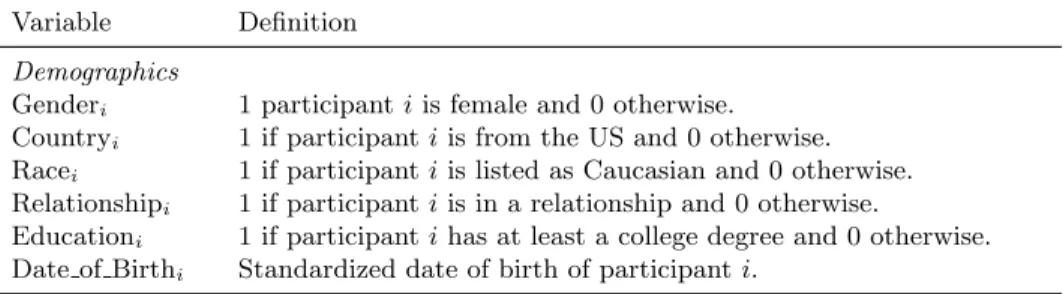
characteristics, and measures of skill and interest in the contest. Demographics consist of indica-tors for gender, country, race, relationship status and education, and a continuous age variable. Participant-platform characteristics include indicators for adoption date, light user status, whether or not the participant was referred to the platform, and whether or not the participant had a profile picture. Skill and interest is summarized by indicators for whether or not the participant previ-ously entered a contest or joined during the current contest, producer status, and functions of page views and past earnings. These characteristics should be interpreted not as variables that have a causal effect on participant abilities but rather as variables that proxy for sources of heterogeneity in participant ability that is invariant to contest design. Otherwise, contests may no longer be treated as independent games. Table 4 presents the definitions for all variables used in estimation.
5.1.4 Ability Estimates
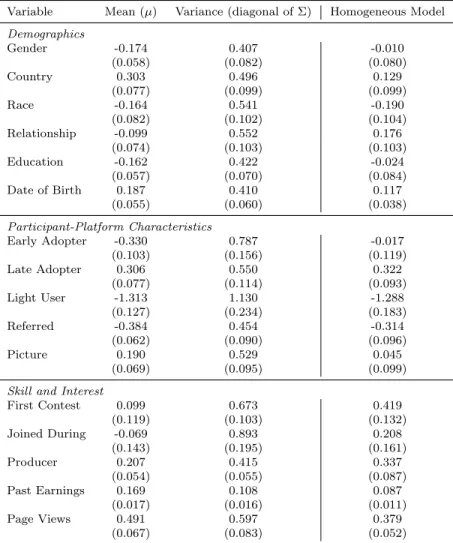
The leftmost columns of Table 5 present parameter estimates from the heterogeneous sponsor choice model. Not surprisingly, heavy users perform better in contests and have higher abilities than light users. Participants who view the contest page more and who have higher past earnings also have higher abilities. Producers, or participants with film-making experience, perform better
Table 4: Description of Participant Characteristics
Variable Definition Demographics
Genderi 1 participantiis female and 0 otherwise. Countryi 1 if participantiis from the US and 0 otherwise. Racei 1 if participantiis listed as Caucasian and 0 otherwise. Relationshipi 1 if participantiis in a relationship and 0 otherwise.
Educationi 1 if participantihas at least a college degree and 0 otherwise. Date of Birthi Standardized date of birth of participanti.
Participant-Platform Characteristics
Early Adopteri 1 if participantijoined before the end of 2011 and 0 otherwise. Late Adopteri 1 if participantijoined after the start of 2013 and 0 otherwise. Light Useri 1 if participantientered no more than 3 contests and 0 otherwise. Referredi 1 if participantiwas referred to the platform and 0 otherwise. Picturei 1 if participantihas a profile picture and 0 otherwise. Skill and Interest
First Contestit 1 iftis participanti’s first contest and 0 otherwise. Joined Duringit 1 if participantijoined during contesttand 0 otherwise. Produceri 1 if participantihas video production skills and 0 otherwise. Past Earningsit Logarithm of 1 plus participanti’s winnings up to contestt. Page Viewsit Logarithm of 1 plus participanti’s page views of contestt.
in ideation contests. A profile picture is also a strong sign that a participant has a high ability. A participant with a profile picture may be more invested in the platform than a participant with no profile picture. Interestingly, participants referred to the platform perform worse, perhaps because participants who join on their own initiative have a greater interest in ideation. The variance column of Table 5 shows evidence of significant heterogeneity in sponsor preferences across contests. The MCMC method yields estimates for sponsor preferences at the level of each contest. I recover the posterior means for each sponsor and obtain estimates of participant abilities in each contest. Overall, the estimates of sponsor preferences point to a high level of heterogeneity in participant abilities, both within and across contests.
For comparison, the rightmost column of Table 5 lists the estimates obtained from a model with no unobserved heterogeneity in sponsor preferences. I investigate the explanatory power of each model by looking at how many winners are excluded from consideration if I rank participants in each contest by their ability (based on each model) and exclude a fraction of the lowest ranking participants. The higher the explanatory power of the model, the lower the number of actual winners that are filtered out. Figure 2 shows the results. Interestingly, the abilities implied by the heterogeneous model identify winners very accurately. If 50% of all participants are excluded based on their abilities, the set of remaining participants includes over 90% of the actual winners. If 90%
Table 5: Posterior Means of Sponsor Choice Model Population-Level Parameters
Variable Mean (µ) Variance (diagonal of Σ) Homogeneous Model
Demographics Gender -0.174 0.407 -0.010 (0.058) (0.082) (0.080) Country 0.303 0.496 0.129 (0.077) (0.099) (0.099) Race -0.164 0.541 -0.190 (0.082) (0.102) (0.104) Relationship -0.099 0.552 0.176 (0.074) (0.103) (0.103) Education -0.162 0.422 -0.024 (0.057) (0.070) (0.084) Date of Birth 0.187 0.410 0.117 (0.055) (0.060) (0.038) Participant-Platform Characteristics Early Adopter -0.330 0.787 -0.017 (0.103) (0.156) (0.119) Late Adopter 0.306 0.550 0.322 (0.077) (0.114) (0.093) Light User -1.313 1.130 -1.288 (0.127) (0.234) (0.183) Referred -0.384 0.454 -0.314 (0.062) (0.090) (0.096) Picture 0.190 0.529 0.045 (0.069) (0.095) (0.099)
Skill and Interest
First Contest 0.099 0.673 0.419 (0.119) (0.103) (0.132) Joined During -0.069 0.893 0.208 (0.143) (0.195) (0.161) Producer 0.207 0.415 0.337 (0.054) (0.055) (0.087) Past Earnings 0.169 0.108 0.087 (0.017) (0.016) (0.011) Page Views 0.491 0.597 0.379 (0.067) (0.083) (0.052)
Note: Standard deviations in parentheses. “Homogeneous Model” column shows estimates obtained from a rank-ordered logit model with homogeneous coefficients.
of all participants are excluded (which amounts to an elimination of roughly 80,000 submissions), the set of remaining participants includes over half of all winners. The homogeneous model does not perform as well, but does outperform the baseline scheme of randomly selecting and excluding participants. These results suggest that observable participant characteristics do well in explaining which submissions win or lose in my sample of contests, and moreover, that unobserved sponsor preference heterogeneity plays an important part in increasing the explanatory power of the model. To test whether the estimated abilities are reasonable, I plot densities of abilities for participants who submitted more than twice and participants who submitted no more than twice, standardized at the level of each contest. Figure 3 shows that participants who submit more than twice in a single contest tend to have higher abilities than participants who submit no more than twice in
Figure 2: Explanatory Power of Sponsor Choice Model
the same contest, consistent with theoretical predictions. A Kolmogorov-Smirnov test rejects the null hypothesis that the density of abilities for participants who submit less does not stochastically dominate the density of abilities for participants who submit more with a p-value less than 0.01.
Figure 3: Distribution of Standardized Abilities by Number of Submissions
Note: Abilities standardized within contests.
5.2 Second Stage: Participant Entry Model
I use moment inequalities to partially identify cost parameters θ1 and θ2. Pakes et al. (2015)
for discrete choice games where agents make ordered choices. With moment inequalities, I need not explicitly specify an equilibrium selection mechanism. Furthermore, the methodology allows for a flexible distribution of cost unobservables and yields estimates that are robust to different specifications of participant information sets. However, parameters will typically be set identified and not point identified. In other words, moment inequalities yield a set of parameters as opposed to a point, and confidence bounds must be obtained taking this into account.
The participant entry model can be rewritten as follows. I define the expectational error ωitdit
as the difference between a participant’s expected and actual returns based on the sponsor choice model: ωitdit =E[Rt(dit, d−it;ait, a−it)|Jit]−Rt(dit, d−it;ait, a−it). Sources of expectational error
may include participant uncertainty about competitor actions (as a function of costs) and abilities, and may also incorporate optimization mistakes made by the participant in evaluating her expected returns. Then, the payoff equation can be written as
πit=Rt(dit, d−it;ait, a−it)−cit(dit) +ωitdit.
I require that the expectational errors ωitdit are mean-zero conditional on the participant’s
infor-mation set and, at this stage, place no additional restrictions on their distribution.
I proceed by first deriving a lower bound for marginal costs, where I take into account the possi-bility that participants who made the maximum number of submissions may have had particularly low costs. Then, I derive an upper bound for marginal costs, where I use a selection correction technique to account for the possibility that non-entrants may have had particularly large costs. Additional assumptions about the distributions of ωitdit and νit are introduced as they become
relevant.
5.2.1 Lower Bound
First, consider the derivation of the lower bound for marginal costs. Define a function of the difference in observable returns from making one additional submission as
∆R∗it(dit+ 1, dit) = Rt(dit+ 1, d−it, ait, a−it)−Rt(dit, d−it, ait, a−it), ifdit <5, 0, ifdit = 5,
and letωitdit+1,dit =ωitdit+1−ωitdit. By revealed preference, for a participant who made less than
5 submissions,
∆R∗it(dit+ 1, dit) +ωitdit+1,dit
| {z }
expected marginal return
≤θ1+θ2(2dit+ 1) +νit
| {z }
marginal cost
,
as the expected marginal return from making one additional submission must be no greater than the marginal cost of making one additional submission. Otherwise, the participant would have made dit+ 1 instead of dit submissions. For a participant who made 5 submissions, the expected
marginal return from making one additional submission is likely an overestimate of the marginal cost of doing so, as the participant may have chosen to make more submissions under a more lenient submission limit. I make the assumption that the marginal cost of making one additional submission is at least zero for entrants who made the maximum permitted number of submissions.
Assumption 3 The condition θ1+θ2(2dit+ 1) +νit≥0 holds for entrants with dit= 5.
Letzitk be a positive variable, known to the participant at the time of submission and orthogonal
to the participant’s cost unobservable, such that E[ωitdit |z k
it] = E[νit |zkit] = 0. I refer to zitk as the value of instrument k for participant i in contest t. Any participant or contest characteristic
in the participant’s information set that is not correlated with the participant’s cost unobservable will qualify as an instrument. Taking the expectation over participants, it must be the case that
E θ1+θ2(2dit+ 1) | {z } marginal cost −∆R∗it(dit+ 1, dit) | {z } marginal return |zitk ≥0.
Conditional onzitk, the expectational errorsωitdit+1,dit average out to zero becausez k
it is an element of the participant’s information set and participants are correct on average. The cost unobservables
νit average out to zero because the expectation does not condition on the participant’s action. The
ability to take an expectation over cost unobservables for all participants, regardless of their action, is crucial for the unbiased (or at least conservative) estimation of bounds on cost parameters.
An empirical analogue for the lower bound for marginal costs can be written as
mLk(θ) =−1 T T X t=1 √ It It It X i=1 g(zitk)∆r∗it(dit+ 1, dit;θ),
where T is the total number of contests used in estimation, g(zitk) is any positive-valued function
of the variablezitk, the vector θ= (θ1, θ2), and
∆r∗it(dit+ 1, dit;θ) = ∆Rit∗(dit+ 1, dit)−θ1−θ2(2dit+ 1).
I weight contest averages by the square-root of the total number of participants, as the averages for larger contests may exhibit less noise. Anyθ that satisfiesmLk(θ)≥0 must lie in the identified
set of cost parameters.
In practice,Rt(dit, d−it;ait, a−it) is not analytically tractable in contests with many prizes but is
required as an input to ∆rit∗(dit+ 1, dit) in the definition ofmLk(θ). To obtain expected returns, it is
necessary to consider the probability of observing all possible combinations of winning submissions from the set of all submissions. For contests with multiple prizes and hundreds of submissions, this expression can be analytically intractable. I use simulation to obtain the an approximation of the expected returns function for each participant in every contest.9 Furthermore, participant abilities
ait must be approximated with the ability estimates based on the posterior means of sponsor
preferences obtained through the sponsor choice model. Given the limited data available for each individual sponsor, it is not possible to obtain consistent estimates of participant-contest specific abilities. However, given that sponsors differ significantly in their preferences, ability estimates obtained from a random coefficients model will perform better than ability estimates obtained from a homogeneous model.10
5.2.2 Upper Bound
Next, consider the upper bound for marginal costs. For entrantsiin Lt={i:dit>0}, define the
difference in observable returns from making one less submission as
∆Rit(dit, dit−1) =Rt(dit, d−it, ait, a−it)−Rt(dit−1, d−it, ait, a−it).
9
It can be shown that simulation error averages out in the moment inequalities framework. 10To test the impact of using possibly biased ability estimates in Rt(dit, d
−it;ait, a−it), I estimated the cost parameters using abilities implied by both the homogeneous and the heterogeneous sponsor choice models. I found that despite the significant inherent bias, the homogeneous model abilities generated a very similar but slightly larger identified set.
Then, by revealed preference, fori∈Lt,
∆Rit(dit, dit−1) +ωitdit,dit−1
| {z }
expected marginal return
≥θ1+θ2(2dit−1) +νit
| {z }
marginal cost
.
In other words, the expected marginal return of increasing submissions from dit−1 to dit must
have been greater than the associated marginal cost. Otherwise, entrants would have made one less submission than they actually did.
The above condition holds only for participants who submitted at least once. I must take into account the possibility that non-entrants, or participants with dit = 0, may have had particularly
large cost unobservables. If an empirical analogue, only for entrants, is developed based on the above inequality, the estimated upper bound on costs may be too low. Pakes et al. (2015) suggest using symmetry of the νit distribution to obtain an upper bound on the νit for non-entrants.
Intuitively, the negative of the lowest lower bound forνit can be used as the highest upper bound
for the negative of the νit of non-entrants. This result also holds as long as the νit density is not
skewed left.
Assumption 4 For each contest, the cost unobservablesνit follow a mean-zero distribution that is
not skewed left.
For exposition, I derive all subsequent inequalities assuming that the νit follow a symmetric
distribution, which will yield conservative inequalities if the actual distribution is skewed right. Assumption 4 allows for the cost unobservables to correlate with participant characteristics but requires that contests do not differ in difficulty level. In my analysis, I only consider similar contests for 140 character ideas. Furthermore, the relative dispersion of submissions is 0.84 on average within contests and 0.82 pooled across all contests, suggesting the absence of substantial similarity in actions within contests and mitigating concerns about heterogeneity in contest difficulty levels.11,12 The symmetry property of the νit distribution can be used to implement the selection correction
technique suggested by Pakes et al. (2015) and obtain upper bounds for the unobserved costs of
11Relative dispersion is defined as the ratio of the standard deviation to the mean number of submissions (Yoga-narasimhan 2015).
12As a robustness check, I also tested for differences across contests offering different prize amounts by estimating the participant entry model separately for contests offering a total award of no more than $1000 and contests offering a total award greater than $1000. I did not find evidence of a difference in cost parameters (the identified sets overlapped).
non-entrants. As long as the number of entrants exceeds the number of non-entrants for a given contest, the negatives of the lowest lower bounds on cost unobservables over all participants can be used as upper bounds for the negatives of the cost unobservables of non-entrants.
For a given contest, the moment conditions can be developed as follows. First, rank all entrants by grkit =−g(zitk)∆rit∗(dit+ 1, dit;θ) so that grk(1)t ≤grk(2)t ≤...≤grk(It)t. Next, construct a set of
size equal to the number of non-entrants, such that Utk = {i : grkit ≥ grk(n
t+1)t}, where nt is the
number of entrants in contest t. The negative lowest lower bounds forνitg(zitk) become the upper
bounds for the−νitg(zitk) of non-entrants. Define the moment
mUk(θ) = 1 T T X t=1 √ It It X i∈Lt g(zkit)∆rit(dit, dit−1;θ)− X i∈Uk t g(zkit)∆r∗it(dit+ 1, dit;θ) , where ∆rit(dit, dit−1;θ) = ∆Rit(dit, dit−1)−θ1−θ2(2dit−1)
is the difference in observable profits from making one less submission.
Consider the expectational error ωitdit. The lowest lower bounds on cost unobservables used
as part of the selection correction technique originate from a selected subset of participants. I require an assumption on the joint density of expectational errors and cost unobservables to ensure that participants with the lowest costs do not consistently underestimate their expected marginal returns. Otherwise, the upper bounds I obtain for non-entrants may be too low. This assumption would only affect the observations used in constructing mUk(θ) for participants in Utk with dit <5
because the inequality condition for participants with dit = 5 does not contain an expectational
error term (Assumption 3). I find that this applies to less than 5% of all participant entry occasions and, as a result, does not have a consequential impact on estimated identified set of cost parameters. I provide the exact condition for the joint density of expectational errors and cost unobservables in Appendix A.3. The proof that ifmU
k(θ)≥0, then θ lies in the identified set of cost parameters follows naturally from the proof presented in Pakes et al. (2015) and is reproduced in Appendix A.3 for completeness.
5.2.3 Identified Set
The identified set for parametersθ= (θ1, θ2) is defined as
{θ:mLk(θ)≥0 and mUk(θ)≥0,∀k}.
Identification of the cost parameters follows naturally from the restrictions imposed by the moment inequalities. Note that a participant’s action is a function of her cost unobservable, and hence, will necessarily be correlated with her cost unobservable, so that E[νit|dit] 6= 0. As a result,
the instrument 1 can be used to partially identify the linear cost parameter θ1, but additional
instruments correlated with the participant’s action are required to identify the quadratic cost parameterθ2. I make the following assumption to obtain instruments for participant actions:
Assumption 5 The cost unobservableνit is not correlated withPast Earningsit, Page Viewsit and
Registrationi, where Registrationi is a positive-valued function of participant i’s registration date.
I find it necessary to impose the stringent covariance restrictions onνitdescribed in Assumption
5 to obtain an informative identified set. However, it is possible to relax these restrictions by making an assumption about the shape of the cost function instead.13
By Assumption 5, I can construct three instruments - 1, Past Earningsit, and (Page Viewsit × Registrationi). This yields three lower bounds and three upper bounds for a total of six moment inequalities. To obtain the identified set, I search over a two-dimensional grid and accept all values that do not violate the six moment inequalities. It is possible that no θ satisfies all six moment
inequalities, simply because of sampling error in the moments. I find this not to be the case and report an identified set for theθ1 and θ2 parameters.
5.2.4 Cost Estimates
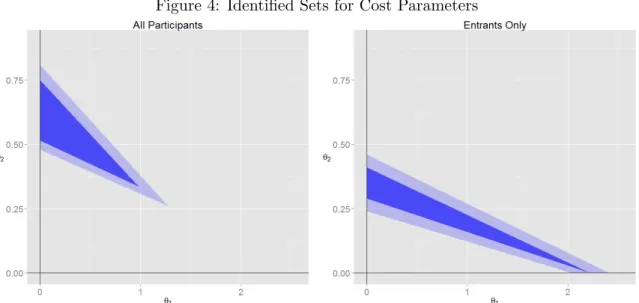
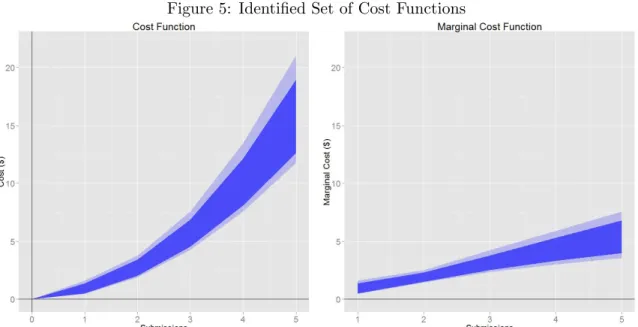
The left panel of Figure 4 presents a visualization of the identified set of cost parameters and Figure 5 shows the implied cost and marginal cost functions. The confidence set includes the true cost parameters 95% of the time and is obtained using a procedure suggested by Andrews and
13
For example, Assumption 5 can be replaced with the assumption thatθ1= 0, so thatcit(dit) =νitdit+θ2d2it. In this case, I allow for flexibility in the covariance of cost unobservables and participant characteristics by restricting the shape of the cost function.
Soares (2010).14 Intuitively, the procedure consists of simulating via bootstrap the distribution of a criterion function that penalizes violations of the moment inequalities. The simulated distribution is used to obtain a critical value, which is compared to the actual value of the criterion function in the observed sample. Points where the value of the criterion function falls below the critical value are included in the confidence set. The above procedure, first described by Chernozhukov et al. (2007), may produce very conservative confidence sets, primarily because of the influence of very positive moments that satisfy the inequality restrictions by a wide margin. Andrews and Soares (2010) suggest a moment selection procedure that yields more precise coverage by excluding very positive moments before simulating the criterion function.
Figure 4: Identified Sets for Cost Parameters
Note: Identified set {θ: mL
k(θ) ≥0andmUk(θ)≥ 0,∀k} is illustrated in the left panel. Right panel shows the
identified set obtained using data only on entrants and ignoring selection. Parametersθ1 and θ2 restricted to be
positive. 95% confidence sets obtained using Andrews and Soares (2010). First stage estimation error not taken into account. One contest excluded from estimation because number of non-entrants exceeded the number of entrants.
The estimated cost parameters suggest that on average, participants incur a cost of $0.50-0.80 for producing the first submission. This cost estimate captures the cognitive and mental effort required to think of a 140 character idea as well as the opportunity cost of time that could have been spent elsewhere. Costs increase in a convex manner, with the average cost of making a fifth submission in the range of $4-8. Participants require a substantial amount of additional effort to think of a large number of ideas.
For comparison, the right panel of Figure 4 shows the estimated identified set using data only
14The cost estimates do not take into account error from the first stage estimation of participant abilities. I found that estimating the full model for a re-sampled set of contests did not substantially change the cost estimates.
Figure 5: Identified Set of Cost Functions
Note: Identified set and confidence set of cost functions as implied by the cost parameters in the left panel of Figure 4 is illustrated.
on entrants and ignoring the issue of selection into contests. The upper bound of the identified set is noticeably lower than in the left panel, implying costs roughly half as large and possibly a smaller degree of convexity. This highlights the importance of taking selective entry into account. The estimates obtained using data on entrants only would overestimate the counterfactual response of entrants and ignore the possibility of submissions from non-entrants.
6
Counterfactuals
Although moment inequalities allow for flexible information sets in estimation, I require an explicit specification of the information sets of participants to simulate counterfactuals. I experiment with two specifications, which I refer to ascomplete information andincomplete information.
In the complete information setup, I assume that participants play a Nash equilibrium in submis-sion strategies and know the prize structure of the contest, sponsor preferences, the number of com-petitors they face, their own characteristics, as well as competitor characteristics and actions. For-mally, participanti’s information set in contest tis given byJCI
it ={dit, d−it, Xit, X−it, It, Mt, βt}, whereMt represents the prize structure of contesttand includes the prize amount and number of
prize spots. As before, I assume that participants know the density of quality shocks, F. These
identified set and highlight the key incentives at work. For a uniformly sampled point in the iden-tified set, I recover bounds on cost unobservables for each participant. These bounds ensure that at the sampled parameter vector, the observed decisions constitute an equilibrium. I uniformly sample cost unobservables that satisfy the bounds for each participant and compute equilibrium actions under alternative contest designs. I repeat the procedure for different sample parameters and cost draws, and recover bounds on the outcome of interest across simulations. Details of the counterfactual simulation procedure are provided in Appendix A.4.1.
The complete information assumption may require a high level of participant sophistication. Tongal reveals neither the identities nor the submissions of competitors. Furthermore, participants may not have a good sense of sponsor preferences. In the incomplete information scenario, I allow for participant uncertainty with regards to sponsor preferences and the quantity, characteristics and actions of competitors. Participanti’s information set in contesttis given byJII
it ={dit, Xit, Mt}, and the participant knows the density of quality shocks F, the conditional joint density of the
number of participants and sponsor preferences H(It, βt|Mt) and the conditional joint density of
competitor actions and characteristics G(d−it, X−it|It, Mt, βt). I assume that participants play
a Bayes-Nash equilibrium in submission strategies and that the same equilibrium is played in the data conditional on Mt. To simulate counterfactuals, I use an iterative procedure similar to
Yoganarasimhan (2015), described further in Section 6.2 and Appendix A.4.2.
Equipped with participant ability estimates, cost functions, and an assumption about the infor-mation structure of the game, I run simulations of alternative contest designs. I focus on a number of outcome metrics. The total number of entrants PIt
i=11{dit>0}and total submissions
PIt i=1dit
are important metrics for the data provider. Increasing entry cultivates participant engagement with the platform and allows for sponsors to communicate with a large number of potential con-sumers and build brand awareness. Quality outcomes are also important if the goal of the sponsor is to implement the best idea or to incorporate information from all submitted ideas into its marketing strategy. I consider expected total quality (defined as ability-weighted submissions) PIt
i=1eaitdit and maximum quality logPIt
i=1eaitdit
. A sponsor may be interested in total quality if it wishes to combine data from all submissions to create an ad or improve its product offerings. Maximum quality becomes more important for a sponsor interested in implementing only the best idea.
organized by a large toy manufacturer. Section 6.3 presents the impact of the counterfactual policies across contests under both complete and incomplete information scenarios.
6.1 Designing a Contest
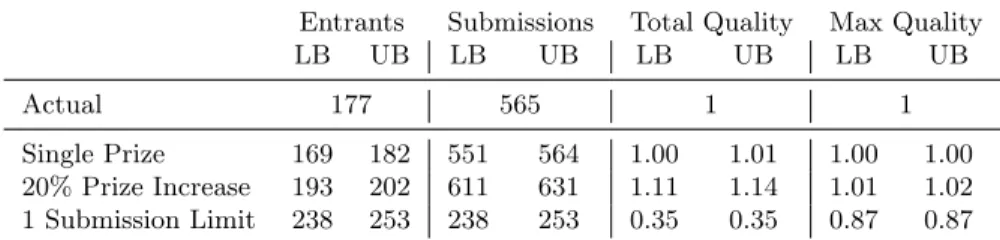
To demonstrate the effects of different design parameters, I focus on an ideation contest sponsored by a popular toy manufacturer and assume that participants have complete information. The contest offered 50 prizes of $100 for a total award of $5,000 and attracted a total of 254 participants, of whom 177 entered and made 565 submissions. Table 6 shows the impact of counterfactual policies on contest outcomes.
Table 6: Counterfactual Design Outcomes for a Sample Contest
Entrants Submissions Total Quality Max Quality
LB UB LB UB LB UB LB UB
Actual 177 565 1 1
Single Prize 169 182 551 564 1.00 1.01 1.00 1.00 20% Prize Increase 193 202 611 631 1.11 1.14 1.01 1.02 1 Submission Limit 238 253 238 253 0.35 0.35 0.87 0.87
Note: Expected total and maximum quality normalized to 1 for actual outcome. Partici-pants assumed to have complete information.
6.1.1 Number of Prizes
In this counterfactual, I reduce the total number of prizes to 1. Instead of offering 50 prizes of $100, the sponsor now offers a single prize of $5,000. The expected payoff of participantican simply be
written as πitSingle Prize= e aitd it PIt j=1eajtdjt ×5,000−(θ1+νit)dit−θ2d2it. (2)
Figure 6 illustrates the change in expected marginal returns experienced by participants of different ability levels in the contest. Consistent with the structural model, higher ability participants prefer a single prize and experience an increase in expected marginal returns, whereas lower ability participants prefer multiple prizes and experience a decrease in expected marginal returns. Higher ability participants may submit more, whereas lower ability participants may submit less.
The row of Table 6 labeled “Single Prize” illustrates the impact of reducing the number of prizes on contest outcomes. I compare the simulated outcomes to the outcomes observed in the data. Overall, the effects are not very large. This can be explained as follows. An increase in
Figure 6: Impact of Reducing Number of Prizes on Expected Marginal Returns
submissions from higher ability participants is balanced out by a decrease in submissions from lower ability participants. Also, few participants alter their actions because the expected marginal returns from doing so are low (on the order of $2 for the highest ability entrant). As higher ability participants already tend to make multiple submissions (recall Figure 3), the cost of making an additional submission likely exceeds the expected return. This result suggest that for contests that attract a substantial number of submissions, the number of prizes may not significantly affect the contest outcome, holding fixed total award.
6.1.2 Prize Amount
Consider the impact of increasing the total prize award. I use Equation 2 to simulate a 20% increase in total award and report the impact relative to the outcome of a single prize contest. Figure 7 displays the impact of the policy on the expected marginal returns of participants. As expected, all participants appear to prefer a larger prize, although higher ability participants reap more benefits from it. The row of Table 6 labeled “20% Prize Increase” illustrates the counterfactual impact on outcome metrics. I observe a significant increase in the number of entrants (↑9-14%), submissions (↑8-12%) and expected total quality (↑11-14%). Higher ability participants predominantly account for the increase in expected total quality. Expected maximum quality does not change substan-tially (↑1-2%), which is not surprising given that the contest already attracts a large number of submissions.
Figure 7: Impact of 20% Prize Increase on Expected Marginal Returns
6.1.3 Entry Limits
The platform requires that all participants can submit at most five times to each contest. What if participants could submit at most once? Higher ability participants would be restricted by a lower submission limit as they tend to make more submissions (recall Figure 3). The final row of Table 6 shows that the submission limit increases the number of entrants quite significantly (↑34-43%) but naturally reduces the number of submissions (↓55-58%). In particular, every participant who considered the contest chooses to enter but submits only one idea. Higher ability participants with low costs no longer crowd out other potential entrants. However, by significantly reducing the number of submissions, the platform reduces expected total quality (↓65%) and expected maximum quality (↓13%). Although high ability entrants who submitted more than once can no longer submit as much, high ability non-entrants with high costs can now enter the contest, together with low ability non-entrants, which may potentially balance out the impact on expected quality outcomes. However, as the set of non-entrants for this contest consisted mostly of lower ability participants, a more stringent submission limit resulted in higher entry but a larger proportion of lower quality submissions, reducing expected total and maximum quality.