Step up to Saxion.
Learning to innovate
10 different honors programs; 10 unique
student profiles?
Janina Banis-den Hertog MSc
University of Twente (Prof. dr. A.J. Groen) School of Strategic HRM Saxion (Dr. ir. M.J. van Riemsdijk)
Kom verder. Saxion.
Researchgroup
Dr. Mark Gellevij Coördinator Simone van der Donk MSc
Jolise ‘t Mannetje MSc Evaluation study Janina Banis-den Hertog MSc Student profile Dr. Karin Truijen Teacher profile
Overview
• Honors at Saxion
• Research goal
• Relevance
• Methods
• Results
• Conclusions
• Discussion
Kom verder. Saxion.
Honors at Saxion
• 11 programs, 9 of which are honors programs (HP’s) • Start 2nd year
• Duration 3 years • Extra curricular
• Some disciplary, some interdisciplinary • 2011-2012: 9 HP’s
• 2012-2013: 13 HP’s • 2013-2014: 9 HP’s • 146 students
• ABO Excelleren is ondernemen
• TFNL Talents for Natural Leadership
• ABR Sapere aude! Durf te denken
• LED Life Science, Engineering & Design
• MIM Marketing & International Management
• APO Academic Teacher training College
• HP Energie of the future/Factory of the future
• LA&S Liberal Arts & Science
• AMM/AGZ Health Care & Social Work
• ROB Changing Cities: People, Places and Choices
• FEM Excellence in Finance & Management
Kom verder. Saxion.
Research goal
Compare honors students to
‘regular’ students. Compare students
from different programs on relevant
Kom verder. Saxion.
The world is changed,
I feel it in the water,
I feel it in the earth. I smell it in the air
"People can be divided into three groups: Those who make things happen, those who watch things happen, and those who wonder
what happened."
- Nicholas Murray Butler (1862-1947) – Nobel Peace Prize winner
Kom verder. Saxion.
An excellent professional is an
innovative professional
“An organization that depends solely upon its blueprints of prescribed behavior is a very fragile social system”
(Katz, 1964, p. 132).
Innovation takes a central role in the survival of
organizations (Amabile, 1998; Cummings & Oldham, 1997; Seibert, Crant, & Kramer, 1999)
It is innovative behavior of employees that is crucial for attaining organizational success (Axtell, Holman, Unsworth, Wall, & Waterson,
2000; Conti, Coon, & Amabile, 1996; Gatignon, Tushman, Smith, & Anderson, 2002; Unsworth & Parker, 2003; West & Farr, 1989; Woodman, Sawyer, & Griffin, 1993).
Innovative behavior
“Innovation is the successful implementation of creative ideas
within an organization” (Theresa M. Amabile, 1996, p. 1).
Innovative behavior can be separated in two different but related processes, the generation of a useful idea and the implementation
of an idea (Axtell et al., 2000)
‘Creativity’ is referred to as the generation of ideas (Hennessey & Amabile, 2010) and in fact is often described in many studies with innovation
simultaneously (Theresa M. Amabile, 1996).
‘Proactivity’ is: “taking initiative in improving current circumstances or creating new ones; identifying opportunities to improve things,
challenging the status quo and creating favorable conditions” (Crant, 2000, p. 436).
Kom verder. Saxion.
Predicting innovative
behavior
innovative behavior
Big five: Conscientiousness, openness and extraversion are
more strongly related to proactive behavior concepts than
neuroticism and agreeableness (Tornau & Frese, 2013)
Locus of control : High confidence is important for creativity
(Barron & Harrington, 1981) and persistence for proactive behavior (Parker et al. 2006).
Proactive personality predicts creative (T. Kim, Hon, & Lee, 2010) and
Kom verder. Saxion.
Methods
• Quasi-experimental longitudinal
design
Kom verder. Saxion.
Survey
Response
Kom verder. Saxion.
10 Different HP’s
Kom verder. Saxion.
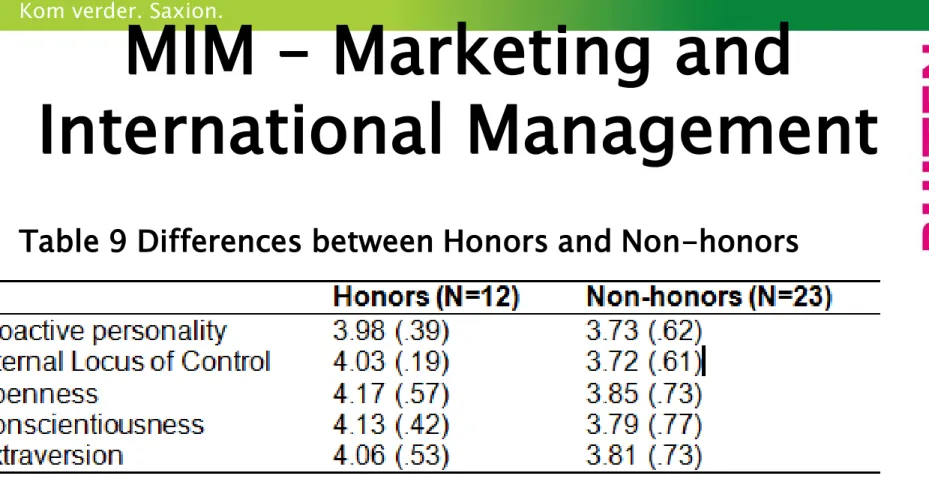
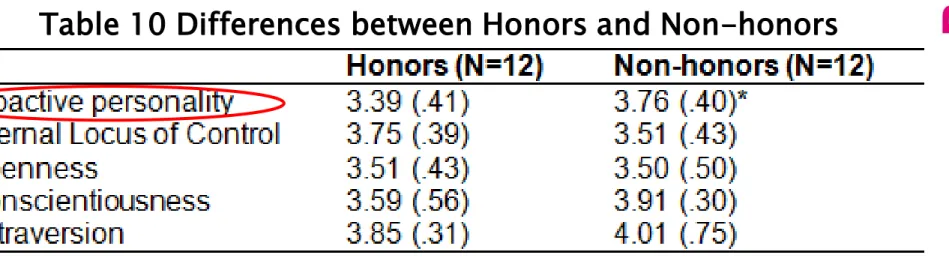
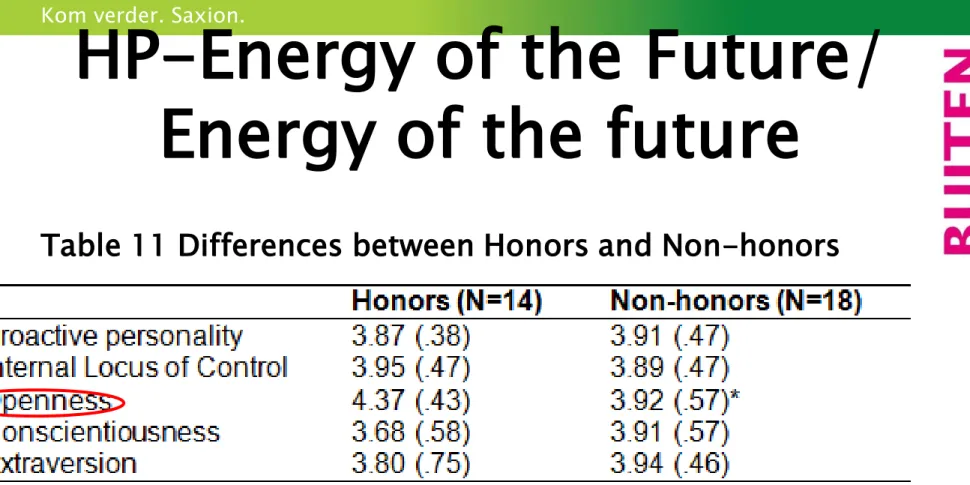
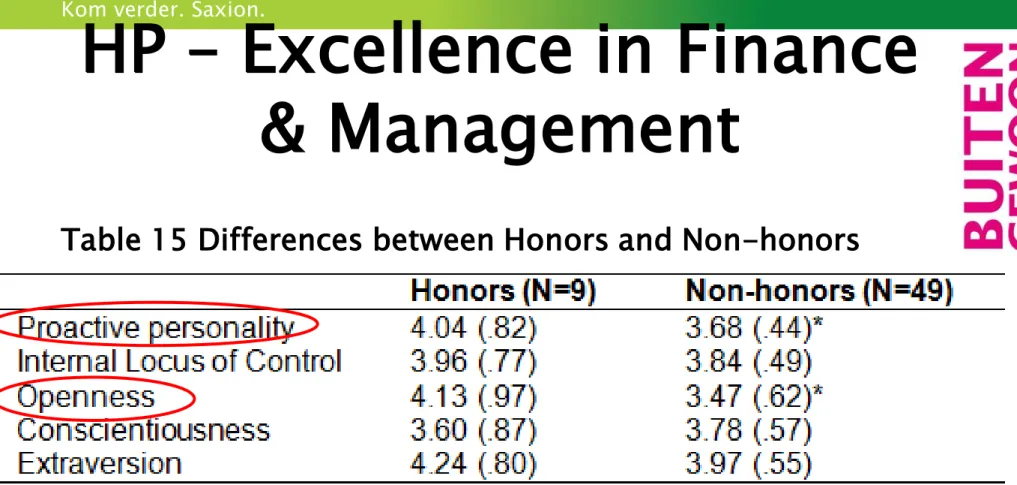
Honors students different from
Non-honors?
ondernemen
Kom verder. Saxion.
ABO-Talent for Natural
Leadership
denken
Kom verder. Saxion.
MIM – Marketing and
International Management
degree
Kom verder. Saxion.
HP-Energy of the Future/
Energy of the future
Work
Kom verder. Saxion.
HP – Excellence in Finance
& Management
Conclusions
• Honors students differ from
Non-honor students
(Proactive personality, locus ofcontrol, openness and conscientiousness)
• Honors students do not seem to
differ much from one program to
the other
• Honors students have higher
potential to be innovative (?)
Kom verder. Saxion.
Discussion
An Excellent Professional is an
Innovative Professional
Contact
Subject Name E-mail
Student profile Janina Banis-den Hertog [email protected] Teachers profile Karin Truijen [email protected] Evaluation study Jolise ‘t Mannetje
Simone van der Donk [email protected] [email protected] Coördination Mark Gellevij [email protected]
• Thursday October 3rd 11.30-12.45 room RD 3.23 ‘Development of a framework for teaching competencies in honors education’ Karin
Truijen
• Friday October 4th 11.15-12.30 hrs. Room 1D1.61 ‘Capturing the effectiveness of honors programs’ Simone van der Donk and Jolise ‘t Mannetje