adfa, p. 1, 2011.
© Springer-Verlag Berlin Heidelberg 2011
The RISCOSS Platform for Risk Management in
Open Source Software Adoption
X. Franch1, R. Kenett2, F. Mancinelli3, A. Susi4, D. Ameller1, M.C. Annosi5, R. Ben-Jacob2, Y. Blumenfeld2, O.H. Franco1, D. Gross4, L. Lopez1, M. Morandini4,
M. Oriol1 and A. Siena4
1
Universitat Politècnica de Catalunya (UPC), Spain {franch,dameller,llopez,ohernan,moriol}@essi.upc.edu 2 KPA, Israel {ron,ronb,yehudablu}@kpa-group.com 3 XWiki, France [email protected] 4
Fondazione Bruno Kessler (FBK), Trento, Italy {susi,gross,morandini,siena}@fbk.eu
5
TEI - Ericsson, Italy
Abstract. Managing risks related to OSS adoption is a must for organizations that need to smoothly integrate OSS-related practices in their development processes. Adequate tool support may pave the road to effective risk management and ensure the sustainability of such activity. In this paper, we present the RISCOSS platform for managing risks in OSS adoption. RISCOSS builds upon a highly configurable data model that allows customization to several types of scopes. It implements two different working modes: exploration, where the impact of decisions may be assessed before making them; and continuous assessment, where risk variables (and their possible consequences on business goals) are continuously monitored and reported to decision-makers. The blackboard-oriented architecture of the platform defines several interfaces for the identified techniques, allowing new techniques to be plugged in.
Keywords: Open Source Projects, Open Source Software, OSS, Open Source Adoption, Risk Management, Software Platform.
1
Introduction
Risk management is a necessary and challenging task for organisations that adopt open source software (OSS) in their products and in their software development pro-cess [1][2]. Risk management in OSS adoption can benefit from the huge amounts of data that are publicly available about the adopted OSS components, as well as data that describes the behavior of OSS communities. The complexity and heterogeneity of the involved data sources, the need to integrate this data with contextual information
related to the organisation and its ecosystem, and the convenience of combining dif-ferent expertise involved in the assessment, call for adequate tools in support of all the phases of risk assessment, from data gathering, to data statistical analysis, to the cor-relation of these data to the organisational strategic and business risks and assets.
In this paper, we present RISCOSS (www.riscoss.eu), a platform and related as-sessment methodology for managing risks in OSS adoption [3]. It defines several interfaces to a portfolio of identified measurement and risk management techniques, allowing new techniques to be plugged in if they implement these interfaces and fol-low well-documented protocols. RISCOSS builds upon a highly configurable data model that allows customization to several types of scopes to support different risk assessment perspectives. It implements two working modes: exploration, where the impact of decisions may be assessed in advance; and continuous assessment, where risk variables (and their consequences on business goals) are monitored, analysed and reported. This allows RISCOSS to support a holistic decision making process inside the adopter organisation.
2
Related Work
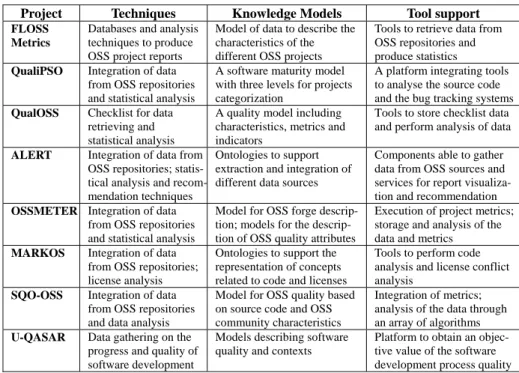
Several long-term projects, corporate programs and research initiatives have similar aims than the approach supported by RISCOSS. In Table 1 we summarize the charac-teristics of the most related European projects that propose methodological approach-es and tool support for measuring several aspects of OSS projects, mainly to evaluate the quality of the OSS components and the communities behind them. In particular we refer to the projects with objectives:
FLOSSMetrics (www.flossmetrics.org): constructing, publishing and analysing a
large scale OSS database with metrics on OSS development;
QualiPSO (qualipso.icmc.usp.br/OMM/): improving the quality & maturity of
OSS projects;
QualOSS (www.libresoft.es/research/projects/qualoss): defining a method to
assess the robustness and evolvability of OSS projects;
ALERT (www.alert-project.eu): improving the quality of the software acting on
the overall bug resolution process in OSS collaborative environments;
OSSMETER (www.ossmeter.com): supporting the process of discovering,
com-paring, assessing and monitoring the health, quality, and activity of OSS;
MARKOS (www.markosproject.eu):provides an integrated view on OSS projects,
focusing on software functional, structural and license aspects.
SQO-OSS (www.sqo-oss.org): proposing methods and a supporting platform for
OSS code quality and community measurement and analysis.
U-QASAR (www.uqasar.eu): providing a quality assurance methodology to assess
the quality of software development projects for Internet applications.
All these approaches and platforms focus on the gathering and analysis of OSS data but they are not specifically oriented to inform about the risks derived from these data nor to suggest possible mitigation strategies at the technical and business level.
Table 1: European projects focusing on OSS data analysis
Companies and other organizations may also implement similar programs in their development cycles. For instance, we can refer to Codeface, an extensible platform developed by Siemens (http://siemens.github.io/codeface) that aims at gathering data from different OSS sources, to analyse them and to present them to the analyst in a configurable dashboard to support decision-making. The Black Duck suite (https://www.blackducksoftware.com) provides a set of tools for the automated gov-ernance and compliance of OSS across the application development lifecycle. From the quality assessment point of view, we can mention the Software Quality Assurance and Trustworthiness (SQuAT) programme at the OW2 consortium aimed at enhancing the perceived reliability of near 50 mature projects in the OW2 code base (http://www.ow2.org/view/About/SQuAT). Some approaches target specific aspects as license assessment, e.g. Palamida (http://www.palamida.com), which provides tools to verify if there is any intellectual property violation in a project adopting OSS; White Source (http://www.whitesourcesoftware.com) provides a solution for companies that need to manage their open source assets to ensure license compliance and reduce risk.
Several recent works face with mining and analysis of OSS projects mainly to as-sess or predict their quality. For example, in [4] the GHTorent project is presented that had the purpose of collecting data related to different aspects of the quality of the source code for all public projects available on Github. In the area of defect prediction for quality improvement, Peters et al. [5] introduce guidelines to be used in the build-ing of software quality predictors in case of scarcity of data while D’Ambros et al. present a comparison between the different prediction approaches [6]. Zhang et al.
Project Techniques Knowledge Models Tool support
FLOSS Metrics
Databases and analysis techniques to produce OSS project reports
Model of data to describe the characteristics of the different OSS projects
Tools to retrieve data from OSS repositories and produce statistics
QualiPSO Integration of data from OSS repositories and statistical analysis
A software maturity model with three levels for projects categorization
A platform integrating tools to analyse the source code and the bug tracking systems
QualOSS Checklist for data retrieving and statistical analysis
A quality model including characteristics, metrics and indicators
Tools to store checklist data and perform analysis of data
ALERT Integration of data from OSS repositories; statis-tical analysis and recom-mendation techniques
Ontologies to support extraction and integration of different data sources
Components able to gather data from OSS sources and services for report visualiza-tion and recommendavisualiza-tion
OSSMETER Integration of data from OSS repositories and statistical analysis
Model for OSS forge tion; models for the descrip-tion of OSS quality attributes
Execution of project metrics; storage and analysis of the data and metrics
MARKOS Integration of data from OSS repositories; license analysis
Ontologies to support the representation of concepts related to code and licenses
Tools to perform code analysis and license conflict analysis
SQO-OSS Integration of data from OSS repositories and data analysis
Model for OSS quality based on source code and OSS community characteristics
Integration of metrics; analysis of the data through an array of algorithms
U-QASAR Data gathering on the progress and quality of software development
Models describing software quality and contexts
Platform to obtain an objec-tive value of the software development process quality
present in [7] a study for the specification of a universal defect predictor. Gamaliels-son et al. [8] define the health of an open source ecosystem as an important decision factor when considering the adoption of an OSS component. In [9] the trustworthiness of OSS projects are predicted through the study of the Elementary Code Assessment. RISCOSS can benefit from these studies since it can integrate such quality models and techniques in the risk analysis platform. Adhering to the position defended by Noll et al. [10], RISCOSS calls for human-based qualitative analysis as a necessary component. Some authors define several risks that are associated with adopting an OSS component: project health [11], economic loss and adverse effects on the busi-ness processes of the organizations [12], the lack of effective and timely OSS com-munity support for dealing with possible integration problems [13]. Hauge et al. [14] discuss several risks related to OSS adoption and identifies steps for reducing several of these risks. RISCOSS has a holistic perspective that integrates all of these elements in a platform to managing risks related to OSS adoption.
3
RISCOSS Main Functionalities
The main objective of the RISCOSS platform is that of facing the problem of manag-ing risks in a holistic way, supportmanag-ing the data gathermanag-ing from the environment of the adopting organisation and from the organisation itself, the analysis of this data for the purpose of OSS risks identification and impact analysis, and the presentation of the data for decision making [3]. Moreover, the RISCOSS platform is designed to support two main operative modes. On the one side, it supports the analyst in performing an explorative analysis and assessment of the OSS ecosystem (in terms of communities and components), for example assessing the convenience of integrating an OSS com-ponent in the solution. On the other side, the platform implements a continuous as-sessment cycle that allows detecting the emerging risks related to OSS choices once, for example, an OSS component has been integrated inside a project.
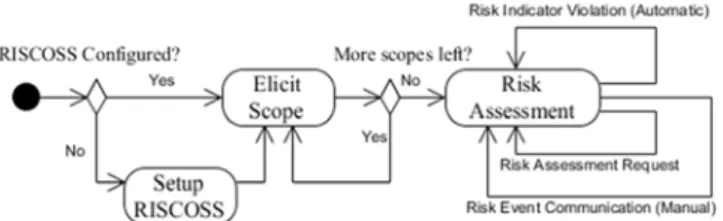
Based on these basic requirements, some functionalities are proposed which are linked according to the workflow depicted in Fig. 1:
Set up of the risk management platform. When an organization decides to adopt
RISCOSS, the platform gathers the needed information to set up a risk manage-ment plan (in particular, to determine the key risk indicators), in order to config-ure the platform infrastructconfig-ure to the organizational needs. This functionality al-lows initialising all the knowledge base of RISCOSS having it tailored for the particular organisational environment, including the representation of the busi-ness ecosystem where the organisation lives.
Identification of the risk assessment level and perspective (Elicit scope). This use case offers the possibility to define a new scope of risk management (see Section 4). Every time one such scope is modified (remarkably, when it is created, e.g. a new project starts, a new OSS component is adopted), it is necessary to set up an organisational view and risk management resources and functionalities for it.
Risk assessment. At any moment, the user may require explicitly risk assessment
alterna-tives end u Reac cur, k alerts and e platf tecte make traini the p
4
R
We defin Some org to assess term, our is impor RISCOSS coming f ple, we c tion; not resources the level Fig. 2 cations, w ganizatio tion, an o commerc uct, but o source. P ject, for e ing the n OSS comp just in mo , deeper analy up with a chan ction to somekey risk indic s are triggered eventually sol form itself by d to be inacti ers, experts or ing). Anyhow platform follow
RISCOSS Sc
ne scope as a ganizations mathe risks rela r platform sho rtant to struc S. If we refer from the adop can have risks delivering so s than expecte of the project
shows a gene which are cur onal unit, that
organisational cialized by the of course nee Process (servic example, addin necessary step ponent that is onitoring som
ysis of risk ind nge of scope in key risk indic cators may be d when this ha lve these situa measuring ke ve), some oth r analysts (e.g w, this function wing the chan
Fig. 1. Workf
copes
any unit of anay want to mo ted to the ado ould be able to cture the kn r to risks, eve ption of some as: losing cu ome release in ed at the level ; incorrect sel eral view of th
rently five (i. wants to sup unit can be s e company; it
ds to have so ce) such as, p ng a new feat ps to deploy a s the finest-gr me adopted OS dicators [15], in order to sup cator violation violated. RIS appens. Then, ations. Some o ey risk indica hers must be c g., some deve nality allows f nges in the org
flow for RISCO
nalysis that ca onitor the full option of a pa o cover this en nowledge (an
ery scope may OSS strategy urrent market n time at the l l of the proces lection at the l he concept of .e., we have f ervise a comp seen as a depa t does not nec ome software product manuf ture to the cur a bespoke com rained case, an SS component
etc. Risk asse pport a holistic n. As projects SCOSS monito risk analysis of the events ators (e.g., a c communicated eloper gets a r for the evoluti ganisation and
OSS use cases.
an be put und business; som articular OSS
ntire spectrum d associated y have its dif y at several le position at th level of the p ss; exceeding level of the OS f scope, its rel five types of p plete portfolio artment. Produ cessarily have part that is p facturing or p rrent release o mponent in a nd an organiz , belonging to essment may e c risk detectio s evolve and e ors these viola is performed t will be captur community m d explicitly by relevant certif ion of the kno the related ec der RISCOSS me others may component. In m. The concep actions) ma fferent set of vels/scopes. F e level of the roduct; involv the allocated SS componen lationships and predefined sco o; in a typical uct, a commer to be a softw partially or tot product delive f a componen an OSS comm ation may be o a community eventually on. events oc-ations and to analyse red by the may be de-y decision fication or owledge of cosystem. S’ control. y just want n the long pt of scope anaged in risks, e.g. For organiza-ving more d budget at nt. nd its reifi-opes). Or-l organisa-rcial good ware prod-tally open ering. Pro-nt, or mak-munity. An interested y.
The class ization is associatio a project In Fig Developm the produ field. Th (AAA), a (AAASR residence “Producin ferent typ OSS web stat”, a c ponent is “R comm organisat that are p part of th zation is n Fig. s diagram show s “incomplete on allows to b may include p . 3, we show ment Unit of a uction of resea e organization an environme R) that is a sys es. The organi ng release 2” pes of compo b content mana omplex statis used only in munity” releas tion wants to part of some co he project man not interested Fig. 2. Gene 3. An instantia ws how scope ”, so that new build arbitrary products, whil an instantiatio a Research ins arch prototype n is focusing ental monitori tem for monit zation is curre and “Fixing b onents, and fo agement syste tical package, the release 2. ing new statis restrict the sc ommercialized nagement (e.g
in it.
eral RISCOSS s
ation of the RIS es are highly c w types of sc y hierarchies o lst in other a p on of the scop stitution has a es and pre-com g on two prod ing platform, toring health c ently running bugs in releas or OSS comp em developed , deployed by The Research stical procedu cope of analy d product, i.e. g., a version c scope model. COSS scope m configurable, cope may be of scopes, so th product may in pe structure in an OSS busine mpetitive prod ducts: “Ambi and “AAA f conditions of two projects se 1.6”. The p ponents it ado d by the “XWi y “R commun h institution w ures to the com sis of project . if an OSS co control manag model. because: 1) th added; 2) the hat in one org nclude project n which the Re ess strategy in ducts to be tes ent Aware A for Social Re patients living in parallel for products are m opts “XWiki C ki community nity”. This sec would also lik mmunity. Mor s’ component omponent is ju ement tool) th he special-e rspecial-eflspecial-exivspecial-e ganization, ts. Research & n place for sted on the Assistance” esidences” g in social r AAASR, mixing dif-CMS”, an y”, and “R cond com-ke to affect reover, the ts to those ust used as he
organi-5
Tool Architecture
The section introduces the basic RISCOSS platform architecture (see Fig. 4). The central element is a content management tool, XWiki, which is the unifying element of the platform and covers three basic responsibilities: (i) Offering an interface to the user for dialoguing with the RISCOSS platform: as such, XWiki offers and organizes the required forms and dashboards, maintains documents, and supports, as a wiki tool, collaborative work as needed. (ii) Integrating other tools that perform functionalities required by the platform: XWiki is the umbrella that coordinates these tools, gathering the results of their computation to feed internal data structures, accessible from the tools in a blackboard architecture fashion, and allowing other tools to initialise their calculations. (iii) Accessing the reusable knowledge of the platform, namely the mod-el patterns, data, form templates created by experts. The platform defines families of tools that are integrated into XWiki by means of well-established interfaces:
Questionnaire tool. The tool gathers from decision-maker and experts of a given
organisation the information related to the characteristics of the organisation and the initial scopes.
Goal and risk modelling tools. The questionnaires are used, among other things,
to create models that represent the ecosystem of the organization, with organiza-tional goals stated using i* [16], and risks models bound to them considering risks that are related to software quality, community behaviour or OSS licenses. This allows making explicit the consequences of risks in the OSS ecosystem.
Risk reasoning engines. In particular:
- Logical reasoning tools. These tools perform model analysis and reasoning in
order to allow for risk identification and management. The reasoning tool cur-rently implements model label propagation [17] techniques and disjunctive lo-gic algorithms [18] in order to identify and mitigate the risks that can occur given specified environmental situations
- Statistical reasoning tools. RISCOSS relies, among others, on the implementa-tion of Bayesian Network based components that are used to reason about the correlation between the measures obtained by the analysis of the OSS commu-nities and the strategic and business risks of the OSS adopters. These tools rely on a strong interaction with experts and analysts to allow for an assessment and revision of the correlations between the identified measures and the strate-gic and business risks.
Measuring and monitoring framework composed of several Risk Data Collectors.
These tools measure risk indicators and feed XWiki with the obtained values, and also monitor, detect and communicate anomalous situations from the risk man-agement point of view. To do so, this framework needs to: 1) obtain data from the selected data sources (such as license or code quality analysis tools or blogs, fo-rums and mailing lists of the communities); 2) implement basic statistical analy-sis, for example to compute statistical distributions of data [19], analysis of OSS communities structure and behaviour [20],
OSS Risk Dashboard. This element collects the output of the risk assessment
the p mean the a proce In additio platform, It is w platform for future Fig. 5 nents pre The R by using for opera tools imp these too e.g. new API inter the tool t its initiali the persi XWiki Pl for manip XWiki Pl nent will ponent o RISCOSS interact w of the an possibility to e ns to show the adoption of a ess. on to these to for instance, worth to mentio knowledge ba e and continuo shows a com sent in the RI RISCOSSPlatfo
the APIs prov ating the RISC plementing the ols are the wa risk analysis rface and requ to ask, in a sta ization. The R stence and re latform that w pulating it. Th latform via a expose the re of the XWik S Platform in with it. The us nalysis perfor enter in the de e risk exposur particular OS Fig. 4. RISC ools we can en estimation co on that XWiki ase). In this re ous assessmen mponent-orient SCOSS platfo orm-XWiki co vided by XWi COSS Platform e Tool API in ay for extendi tools. A Tool uires the Tool andard way, c RISCOSSPlat etrieval of thi will store this he RISCOSSP component im elevant metho ki Platform th order to prov ser interface w rmed, and the
etails of the s re of the organ SS componen
COSS platform nvision some ost tools to bin i manages a re epository, we nt, such as patt ted view that orm and how t omponent imp iki. This comp m on top of th n order to perf
ing the RISC l component, lConfiguration configuration tform-XWiki c his information information a Platform impl mplementing ods of the RIS that allows i vide to the end will be also us e content of ingle informa nisation with r nt, or the resu logical view. other types t nd risks to proj epository of re store the artif terns for goal highlights th they are interc plements the R ponent provide
he XWiki Pla form the actua COSSPlatform on the other h nProvider AP parameters th component is n. This will and will also lementation is the ScriptSer SCOSSPlatfor nvoking the d user a user i sed to show th the collected ation. Here we respect to, for ult of a what-if
to be added la ject cost estim eusable know facts that can and risk mode e main type o connected.
RISCOSSPlat es all the busi atform. It requ al analysis. In with new ca hand, provides I interface. Th hat might be n responsible t be managed provide a ded s made availa rvice API. Thi rm API to the functionalitie interface throu he status and t d information e envisage r example, if analysis ater in the mation. wledge (the be reused dels. of compo-tform API iness logic uires some particular apabilities, s the Tool his allows needed for to manage using the dicated UI able to the his compo-e UI com-es of the ugh which the results n (i.e., the
RISCOSS ing data p
6
D
The platf of the se interactio platform chitecture with the other serv increasing via quest this user k In the from OSS ment sch ent users knowledg cific insta the organ that is the that can communi7
C
In the pap in OSS a whole de sources, S Knowledge persistently iniscussion
form is curren t of main com on and risk anare those rela e is highly mo help of the co vices for the a g the possibil tionnaires and knowledge in line of facilita S communitie emas have be that can crea ge collected b allation, that nization. The e creation of a be reused an ity around the
onclusions
per we presen adoption. The ecision makin to the risk in base). The St n a DBMS that Fig. 5. RISCO ntly in active mponents for nd business an ated to OSS l odular and allooordination of analyst. In par ity of the deci d the impleme a more intera ating the use es to small an een considered ate their own w by the platform can be also w first solution a large and ev d extended b building of n
ted the RISCO peculiar aspe g process: fro ndicator identi torage compo t supports the OSS platform de evolution. Th the different nalysis tools. licenses violat ows for the de f the XWiki C rticular, a pos ision-maker to entation of ne active way. of the platform nd large comp d, from a web workspace an m from the di web-based, bu n implicitly al volving Busine by other analy new knowledg OSS platform ect of the platf om the gather ification, to th
nent will prov JDBC API.
eployment view
he part already tool orchestr The risks cur toin and to so efinition of sev CMS platform sible direction o interact with ew reasoning m in different anies adoptin b-based instal nd, at the same fferent users, ut that is confi
llows for anot ess and Risk m ysts, so prom ge about risks. supporting ri form is that it ring of the da he modelling
vide the mean
w. y implemente ration and a s rrently addres oftware quality veral possible m can easily i n of evolution h the reasonin engines able t organizationa g OSS, severa lation where t e time use the to an organiz fined in the pr ther point of models knowl oting the crea
sk assessment t aims at supp ata from heter and assessme ns for stor-ed consists set of user ssed in the y. The ar-e tools that implement n is that of ng engines to exploit nal settings al deploy-the differ-e common zation spe-remises of extension ledge base ation of a t activities porting the rogeneous ment of the
impact of the risks to the strategic and business goals of the organisation. We are currently deploying the platform in several contexts (large company with complex organizational structure, public administration, SME IT provider, and a community hosting ca. one hundred OSS projects) to improve its functionalities and knowledge.
Acknowledgement. This work is a result of the RISCOSS project, funded by the EC
7th Framework Programme FP7/2007-2013, agreement number 318249.
8
References
1. J. Li et al. “A State-of-the-Practice Survey of Risk Management in Development with Off-the-Shelf Software Components”. IEEE TSE 34(2), 2008.
2. O. Hauge et al. “Risks and Risk Mitigation in Open Source Software Adoption: Bridging the Gap between Literature and Practice”. OSS 2010.
3. X. Franch et al. “Managing Risk in Open Source Software Adoption”. ICSOFT 2013 4. G. Gousios. “The GHTorent Dataset and Tool Suite”. MSR 2013.
5. F. Peters, T. Menzies, A. Marcus. “Better Cross Company Defect Prediction”. MSR 2013. 6. M. D'Ambros, M. Lanza, R. Robbes. “An Extensive Comparison of Bug Prediction
Approaches”. MSR 2010.
7. F. Zhang, A. Mockus, I. Keivanloo, Y. Zou. “Towards building a Universal Defect Prediction Model”. MSR 2014.
8. J. Gamalielsson, B. Lundell, B. Lings. “The Nagios Community: An Extended Quantitative Analysis”. OSS 2010.
9. L. Lavazza, S. Morasca, D. Taibi, D. Tosi. “Predicting OSS trustworthiness on the basis of elementary code assessment”. ESEM 2010.
10. J. Noll, D. Seichter, S. Beecham. “A Qualitative Method for Mining Open Source Software Repositories”. OSS 2012.
11. J. Piggot, C. Amrit. “How Healthy Is My Project? Open Source Project Attributes as Indicators of Success”. OSS 2013.
12. E. Petrinja, A. Sillitti, G. Succi. “Comparing OpenBRR, QSOS, and OMM Assessment Models”. OSS 2010.
13. C. Ayala, D. Cruzes, A. Nguyen, R. Conradi, X. Franch, M. Höst, M. Babar. “OSS Integration Issues and Community Support: An Integrator Perspective”. OSS 2012. 14. Ø. Hauge, D. Cruzes, R. Conradi, K. Velle, T. Skarpenes. “Risks and Risk Mitigation in
OSS Adoption: Bridging the Gap between Literature and Practice”. OSS 2010.
15. O.S. Ligaarden, A. Refsdal, K. Stolen. “ValidKI: A Method for Designing Key Indicators to Monitor the Fulfillment of Business Objectives”. BUSTECH 2011.
16. E.S.K. Yu. Modelling Strategic Relationships for Process Reengineering. PhD thesis, University of Toronto, Canada, 1995.
17. N.J. Nilsson. Problem-solving Methods in Artificial Intelligence. McGraw-Hill, 1971. 18. N. Leone et al. “The DLV System for Knowledge Representation and Reasoning”. ACM
Transactions on Computer Logic, 7(3), 2006.
19. R.S. Kenett, S. Zacks. Modern Industrial Statistics: with applications in R, MINITAB and JMP, 2nd Edition. John Wiley and Sons, 2014. With contributions by D. Amberti
20. M. Salter-Townshend, A. White, I. Gollini, T.B. Murphy. “Review of Statistical Network Analysis: Models, Algorithms, and Software”. Stat. Analysis and Data Mining, 5(4), 2012.