Burden-sharing
Multi-level Governance:
A Study of the
Danielle A. Zach, D. Conor Seyle, and Jens Vestergaard Madsen
A One Earth Future and Oceans Beyond Piracy Report byA Study of the Contact Group on Piracy
off the Coast of Somalia
A One Earth Future and Oceans Beyond Piracy Report by
Danielle A. Zach, D. Conor Seyle, and Jens Vestergaard Madsen
Abbreviations . . . .6
Introduction . . . .7
The “Scourge” of Piracy off Africa’s Horn: Trends and Costs . . . .8
Why Piracy? “Root Causes” and Enabling Conditions . . . .10
Counter-piracy Challenges: Multi-level Governance Gaps . . . .11
Knowledge Gaps . . . .12 Legal Gaps . . . .13 Political Gaps . . . .14 Institutional Gaps . . . .14 Compliance Gaps . . . .15 Emergence of the CGPCS . . . .16
Brief History of the CGPCS’s Birth . . . .16
Work and Outcomes of the CGPCS . . . .21
Working Group 1 . . . .21
Working Group 2 . . . .22
Working Group 3 . . . .24
Working Group 4 . . . .26
Working Group 5 . . . .26
The Trust Fund . . . .27
Impact of International Efforts on Filling Gaps . . . .27
Knowledge of the Problem and Challenges . . . .27
Legal Developments at the International and Domestic Levels . . . .29
Generating Political Will to End Impunity . . . .30
Institutional Development . . . .31
Compliance Mechanisms . . . .33
Lessons of the CGPCS . . . .34
Issue and Geographical Focus . . . .34
Actualized Threat with Cross-cutting Impact . . . .35
Like-minded Coalition of the Willing to Lead . . . .35
Non-state Actors, Part of the Solution . . . .35
Bringing in the UN . . . .36
Flexibility . . . .37
Challenges for the CGPCS . . . .38
Lessons for Global Governance . . . .40
Conclusion . . . .41
Appendix 1 . . . .43
Appendix 2 . . . .44
Notes . . . .45
Figures
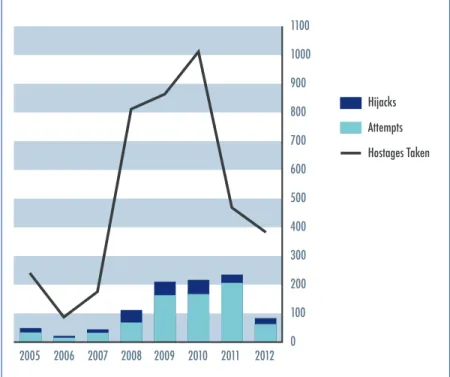
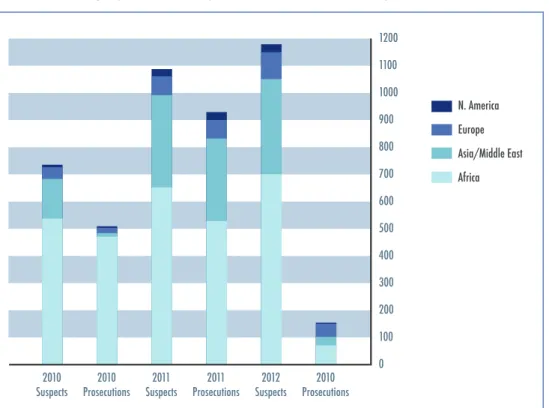
Figure 1: Somalia-based Pirate Attempts, Hijacks, and Hostages Taken, 2005–2012 . . . 8 Figure 2: Total cost of Somalia-based piracy (in billions), 2010-2012 . . . 9 Figure 3: Geographic and Temporal Distribution of Piracy Prosecutions . . . 30
Tables
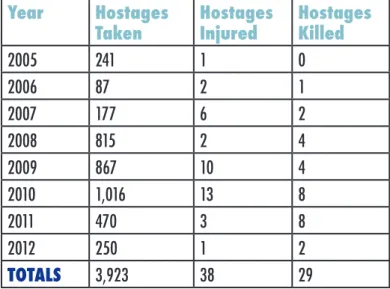
Table 1: Somalia-based Hostages Captured, Injured, and Killed, 2005–2012 . . . 9 Table 2: The Development of the CGPCS in UN System Resolutions . . . 16
AMISOM African Union Mission in Somalia
CGPCS Contact Group on Piracy off the Coast of Somalia
CTF Combined Task Force
EU NAVFOR European Union Naval Force
ICS International Chamber of Shipping
IGO intergovernmental organizations
IMB International Maritime Bureau
IMO International Maritime Organization
INTERPOL International Criminal Police Organization
MARAD Maritime Administration (United States)
MARLO Maritime Liaison Office (United States)
MSC-HOA Maritime Security Centre – Horn of Africa
NATO North Atlantic Treaty Organization
NGO nongovernmental organization
OBP Oceans Beyond Piracy
ROK Republic of Korea
SHADE Shared Awareness and Deconfliction
SUA Convention on the Suppression of Unlawful Acts Against the Safety of Maritime Navigation
TFG Transitional Federal Government (Somalia)
UAE United Arab Emirates
UKMTO United Kingdom Maritime Trade Operations
UNCLOS United Nations Convention on the Law of the Sea
UNDP United Nations Development Programme
UNDPA United Nations Department for Political Affairs
UNODC United Nations Office on Drugs and Crime
UNOLA United Nations Office of Legal Affairs
UNPOS United Nations Political Office on Somalia
The world confronts many threats with transnational dimensions that transcend the capacity of states,
individually or collectively, to address. While the United Nations and other intergovernmental organizations (IGOs) can mitigate obstacles to international cooperation, such institutions at present are unable to fill governance gaps at the global level, as they are oftentimes under-resourced by their member states, lack compliance mechanisms, and are procedurally hidebound. Today’s challenges require novel approaches that include diverse stakeholders. The subject of this study is one such initiative: the Contact Group on Piracy off the Coast of Somalia (CGPCS), which emerged with a UN Security Council imprimatur in January 2009.1 The CGPCS is a voluntary mechanism
for states to collectively address maritime piracy emanating from Somalia as a threat to regional stability, trade, and energy security and has increasingly embraced nongovernmental actors as necessary partners. The aim of this paper is twofold: first, to analyze the contact group’s historical development, its efforts to fill governance gaps in the anti-piracy regime, and the challenges it faces; and second to evaluate the CGPCS’s utility as a model mechanism for solving complex transnational problems. It seeks to engage policy and academic specialists concerned with maritime crime and global governance more broadly.
This study begins with a brief examination of the contemporary development of piracy and armed robbery at sea in the Horn of Africa. This review details trends in their occurrence and success as well as their economic and human costs. It then analyzes governance gaps as they relate to these maritime crimes. It subsequently examines the international community’s response to what governments have called a “scourge” in the Gulf of Aden and Western Indian Ocean, documenting the CGPCS’s historical development, dissecting its institutional configuration and output, and assessing the effectiveness of its efforts on land and at sea to suppress piracy off Somalia’s coast. It concludes with a critical analysis of the value of this mechanism as a model global governance initiative. The study finds that the CGPCS has indeed fostered the emergence of an anti-piracy community. Given that piracy is a cross-cutting issue area involving multiple ministries/departments within governments (e.g., defense, transportation, foreign affairs, finance), the contact group has cultivated horizontal linkages among national bureaucracies. The mechanism has also fostered the development of counter-piracy institutions in various countries and in international organizations, including UN agencies.
The CGPCS is most remarkable for its flexibility and inclusiveness of a broad range of states, relevant IGOs, and private industry actors. While somewhat constrained by diplomatic norms and processes, the group’s informal structure has allowed it to adapt its working methods, extend participation to non-state actors, and circumvent procedural constraints that can hamstring creativity and efficiency in finding solutions to problems. The trade-off, however, is limited visibility and inclusiveness in agenda-setting and decision-making processes. The CGPCS is almost as state-centric as its counterpart UN and regional organizations—undeniably power lies with states, and particularly the most resourced among them.
This analysis suggests that the CGPCS will be a useful model for collective efforts that address problems requiring fast and adaptive responses to changing situations on the ground, and on issues where power imbalances between actors will not scuttle the collaborative execution of collective goals. However, the CGPCS’s applicability as a model for other issue areas is limited by the scope conditions that allow for its effectiveness: a convergence of state interests—particularly among powerful states, some of whom are unlikely bedfellows—to suppress the problem; a coalition of the willing able to bear costs; and a very circumscribed geographic area of concern. One broad lesson that can be garnered from the CGPCS is that large global governance dilemmas are perhaps best addressed in small pieces. Another lesson is that problem solving can be more effective when state and non-state actors are encouraged to assume responsibility for tasks in which they have a comparative advantage.
The “Scourge” of Piracy off Africa’s Horn: Trends and Costs
The nearly unchecked growth of piracy in the Gulf of Aden and Western Indian Ocean during the first decade of the twenty-first century generated significant concerns from the commercial shipping industry and among states within the region and beyond. In 2009, the CGPCS was formed to suppress piracy off of Somalia’s coast. This section provides a brief historical review of this “scourge” and its associated economic and human costs.
In the early 2000s, incidents of piracy attacks surged dramatically, increasing five-fold over the course of 2008 alone. According to the International Chamber of Commerce’s International Maritime Bureau (IMB), there were 293 attacks in total, 49 ships hijacked, and 889 hostages in that year.2 A large part of this increase
was concentrated off the coast of Somalia, a country that for two decades had lacked a functioning central government. In 2008, UN Security Council resolution 1816 formally stated that piracy was exacerbating “the situation in Somalia which continues to constitute a threat to international peace and security in the region.”3 The following year Somali pirates were responsible for over half, or 218, of the 406 incidents of
piracy and armed robbery at sea that occurred worldwide.4 The maritime industry did not fare much better
in 2010, with 219 successful or attempted attacks and more than 1,000 seafarers held hostage,5 leading the
New York Times East Africa correspondent to exclaim, “The Pirates are Winning!”6
Alongside this surge, the economic and social impact of piracy began to climb. Somali piracy is predicated on the capture and ransom of a ship and crew as a package, a model that has allowed pirates to command enormous sums of money. These sums sharply increased as piracy developed. The average ransom in 2005 was $150,000;8 by 2011, this figure had risen to $5 million.9 According to the UK-led International Piracy Ransoms
Task force, between 2008 and 2012 an estimated $300 million in total had been paid to Somali pirates.10 To put
this into perspective, these payments are almost twice the combined amount of humanitarian assistance and development aid that Somalia received during this period.11 Ransoms are just one piece of the global economic
0 100 2005 2006 2007 2008 2009 2010 2011 2012 200 300 400 500 600 700 800 900 1000 1100
FIGURE 1: Somalia-based
Attempts
,
Hijacks
, &
Hostages Taken 2005-2012
7Hijacks Attempts Hostages Taken
impact. An assessment by the One Earth Future Foundation’s Oceans Beyond Piracy (OBP) project estimated that the costs of Somali piracy, when all factors were considered, amounted to approximately $6 billion in 2012, down from nearly $7 billion in 2011 and an estimated $7–12 billion in 2010.12 Figure 2 shows the total cost of
Somalia-based piracy from 2010–2012.
In addition to the economic costs, piracy has also exacted significant human costs. The numbers of victims are sobering. In 2011, 3,863 seafarers were aboard ships that were fired upon by pirates. Nearly 970 seafarers were aboard ships that were boarded by armed pirate gangs. That year, 470 new hostages joined the 645 who had already been captured, while eight died in captivity.14 Moreover, the average length of captivity for hostages is
five months and some have been held for almost three years.15 Beyond the individual seafarers, these incidents
brought anguish to family members and whole communities. Table 1 shows the numbers of hostages taken, injured, and killed since 2005. This impact fell disproportionately on seafarers from the developing world: 93 percent of all hostages were from non-OECD (Organisation for Economic Co-operation and Development) countries, with the largest numbers from the Philippines (17 percent), China (9 percent), and India (8 percent).16
Table 1: Somalia-based
Hostages Captured, Injured, and Killed
, 2005–2012
17Year Hostages
Taken Hostages Injured Hostages Killed
2005 241 1 0 2006 87 2 1 2007 177 6 2 2008 815 2 4 2009 867 10 4 2010 1,016 13 8 2011 470 3 8 2012 250 1 2 TOTALS 3,923 38 29
FIGURE 2: Total Cost of Somalia-based Piracy (In Billions) 2010-201213
2010 1 2 3 4 5 6 7 8 9 10 11 12 13
*light teal denotes high range of cost estimate $7 - $12 Billion $7 - $12 Billion 2011 2012 $6.6 - $6.9 Billion $5.7 - $6.1 Billion
Why Piracy? “Root Causes” and Enabling Conditions
As piracy exploded and exacted significant economic and human costs on a diverse array of actors, businesses and affected states began to develop a variety of counter-piracy strategies and activities. These necessarily engaged the question of why Somali piracy had developed, which has typically been approached from two angles: the “root causes” of piracy, entailing assumptions about individual motives; and enabling conditions. Piracy can be analyzed from either starting point.
Regarding the first approach, two hypotheses have been advanced about so-called root causes: greed and grievance. In cautioning the use of the very term “root causes,” US counter-piracy and maritime security
coordinator Donna Hopkins emphatically asserts that the “root cause of piracy off the coast of Somalia is human greed; it is not poverty . . . [but rather] the willingness of some . . . to victimize others for their own personal gain. Saying that poverty ‘causes’ piracy seriously disrespects the millions of honorable Somalis whose own poverty has not led them to engage in extortion, kidnapping, and murder of innocent seafarers.”18 The greed
motivation is obvious: weapons and boats in Somalia are easily accessible, so the initial costs are relatively low while, as noted above, the pay-off is potentially staggering for investors and pirates alike.
It is unsurprising that pirate organizers have not been lacking for recruits given the dire economic context of Somalia, a country that ranked fifth from the bottom on the UNDP’s Human Development Index (HDI) in 2010.19 Although the kingpins of piracy are well-connected elites within Somalia and abroad,20 the UNDP’s
2012 report speculates that foot-soldiers are mostly unemployed males. The UNODC estimates that one ransom payment is potentially the equivalent of a salary earned in two to three years as an employee of an international humanitarian agency, and these agencies generally provide much higher wages than local sources of employment.21 According to a 2013 World Bank report, the prevailing earnings for unskilled/low-skilled labor
are $859/year, which pale in comparison to a payout of $10,500 for a successful attack or even the $400/month average wage an armed guard aboard a hijacked ship can earn.22
The grievance narrative adopted by pirates and armed robbers to justify crime is based on perceptions of exploitation. They have claimed that illegal fishing vessels as well as illegal toxic dumping in Somali waters were damaging livelihoods and prompted local fishermen to “police” the coast and extract “taxes” from foreign vessels. It is not only pirates who have couched piracy within this injustice framing: the prime minister of Somalia’s transitional government, Abdiweli Mohamed Ali, for example, publicly blamed poaching by international trawlers in Somali waters as pushing local fishermen to undertake desperate measures.23
Which of these explanations is the “root cause” remains contentious. The UN Monitoring Group on Somalia and Eritrea has asserted that “exploitation of Somali marine resources is a reality, but it is by no means a preoccupation of Somali pirates or their backers.”24 Similarly, as Stig Hansen’s analysis of the targets of pirate
attacks from 1998–2008 found, the most frequent target of pirate attacks were “generally not trawlers fishing illegally but ordinary cargo ships and bulk carriers just passing through Somali, Yemeni or international waters.”25
The activities of pirates would suggest that their motives are more economic than protective, but the coast-guarding rationale may provide an important way for pirates to gain local support.
The second approach to analyzing piracy trends emphasizes the collapse of local institutions within Somalia. A crucial function of a state is to provide internal order with its borders. Yet since the fall of Said Barre’s dictatorship in 1991, Somalia has experienced the near complete uncoupling of centralized coercive authority and territorial jurisdiction. In the 2000s, many areas within Somalia lacked any form of local policing or judicial institutions, allowing pirates to operate with impunity. With few restraints imposed by a central state or even local institutions, legal risk was virtually nonexistent. During the Supreme Council of Islamic Courts’ (SCIC) brief
rule, which banned piracy as against Islam in 2006, piracy effectively collapsed. Yet after the repressive SCIC was ousted, piracy rebounded and became more virulent than before.26
The capture and ransom of ships and their crews are possible in part because of the government’s lack of control over its own ports and coastal areas. Maritime criminals in Somalia can operate without having to be concerned with government policing—a luxury that few other pirates have elsewhere around the globe.27 At the same time,
Somalia suffers from endemic corruption. According to the watchdog, Transparency International, Somalia ranks at the very bottom of its 2012 corruption index alongside North Korea and Afghanistan. This has meant that some authorities in the fragmented country profit from piracy, thereby aiding and abetting maritime crime from Somali shores. In early 2009, UN Secretary-General Ban Ki-moon noted to the Security Council reports of “complicity” by authorities in piracy activities.28 A 2013 World Bank report further argued that pirates need tacit support from
key local leaders in order to maintain moored vessels offshore and conduct lengthy ransom negotiations.29 Hence,
weak state capacity and rule of law create conditions within which maritime crime can thrive.
These explanations of trends have underpinned counter-piracy initiatives—which have included the deployment of naval forces to the region; self-protection measures for ships transiting high-risk areas; regional judicial capacity development; and messaging to discourage local support within Somalia. Before fleshing out the details of these efforts, it is important to note that the pre-2009 global response was piecemeal and uncoordinated— not uncommon problems in global governance generally. The next section therefore situates piracy within a larger theoretical framework developed to assess “governance gaps.”
Counter-piracy Challenges: Multi-level Governance Gaps
As piracy surged, a variety of stakeholders sought to actively suppress the growing threat to their national and commercial interests. These diverse actors, however, held different views on the problem’s scope and causes and how best to approach it, leading to a hodgepodge of uncoordinated responses that were incomplete and potentially overlapping and contradictory. Collective action is an inherent dilemma in a world system that lacks supranational authority. To borrow a metaphor from Kishore Mahbubani, the current international system is akin to a listing boat with “193 captains and crews, each claiming exclusive responsibility for one cabin. However, it has no captain or crew to take care of the boat as a whole.”30 This reality presents substantial challenges for
cooperation in a world with increasingly common threats that require robust and timely responses. Piracy in the East African context, however, is not only an issue of collective responsibility for the global commons—for the metaphorical boat as a whole—as are some other overarching issues such as climate change, for example. It has become one, but it is also another symptom of inadequately governed territorial space that falls within the recognized jurisdiction of a fragmented government.
In the case of piracy, burden-sharing governance at the problem’s source and affected areas of the high seas is necessary to at least suppress it. Yet domestic governance problems that spill over into the global commons must be solved within the existing normative framework underpinning world order—state sovereignty and its corollary principle of noninterference. The task for those seeking to eradicate maritime crime emanating from these “high-risk” areas is twofold: generating political will and active participation from private-sector stakeholders to solve the problem collectively (i.e., overcoming the “free rider” problem); and skillfully
navigating potential constraints imposed by state sovereignty, while building state capacity in the long term. At the same time, state actors must also reconcile such efforts with robust international human rights norms. Its founding member states created the GCPCS to resolve or at least ameliorate gaps in the overall response to piracy. Each of its initial four, later five working groups were tasked with addressing a specific issue area:
1. naval and capacity-building coordination and information sharing; 2. legal and judicial issues;
3. shipping industry self-protection;
4. messaging and public information efforts, and;
5. disruption of the pirate enterprise ashore, through identifying and disrupting the financial networks of pirate leaders and their financiers
These practical issues can be situated and analyzed within general governance dilemmas identified by international relations scholars. In order to facilitate comparison between the CGPCS and other mechanisms, this section analyzes the challenges of counter-piracy through a modified application of Thomas G. Weiss and Ramesh Thakur’s analytical framework of global governance gaps. It examines counter-piracy gaps in the areas of knowledge, law, political will, institutions, and compliance.31 This paper will subsequently return to these gaps to
assess the extent to which the CGPCS’s efforts have closed them on this issue area. In doing so the analysis aims to draw out lessons for global problem-solving initiatives.
Knowledge Gaps
A prerequisite to collective action is a shared understanding that a particular threat even exists, as well as an understanding about its characteristics, causes, and consequences. As with many other issue areas, there were significant knowledge gaps about piracy when attacks sharply increased over the first decade of the twenty-first century. Peter Hinchliffe, secretary-general of the International Chamber of Shipping (ICS), noted that while there had been low-level piracy in the region for many years, the hijacking of ships signaled the start of a new business model. The ICS faced the challenge of generating attention from the international community. As he explains, “It was becoming of such great concern . . . ICS became involved in trying to engage the interest of governments in understanding first of all there was a problem, and secondly understanding that the problem had an impact on world trade because it was going to influence the routing of ships.”32
First and foremost, fundamental information was unavailable. Despite the existence of several voluntary reporting mechanisms, such as the IMB Piracy Reporting Center, established in 1992 in Kuala Lumpur, precise and real-time figures on the very frequency and location of incidents of piracy and armed robbery at sea were hard to come by. Moreover, data on the economic impact was not widely available, as evidenced by the methodological challenges faced by OBP in its very first cost report published in 2010. The absence of basic facts made it difficult to accurately measure the magnitude of the problem, to identify patterns of violence, and thus to develop a strategy to counteract the threat.
Second, there was a lack of clarity about the very international legal framework in existence to address the problem. Indeed there was debate about the relevance of existing international conventions and treaties, some of which were premised on outdated assumptions about piracy or on other concerns such as terrorism. As Danish Ambassador Thomas Winkler noted, “In 2009. . . we had all the delegates looking at one another and asking, ‘What is piracy from a legal perspective, and how do we deal with it?’ And there were very few answers at the time.”33
Third, there was dispute over the driving force of piracy—greed or grievance. In addition to the obvious issue of poverty, those championing the latter explanation, including some Somali officials, claimed that illegal fishing and toxic waste dumping by foreign vessels were key factors in fueling the phenomenon. Others remained unconvinced that external exploitation played any causal role, arguing that piracy was purely a greed-driven phenomenon. Despite disputes over motivations, however, there was a broad consensus that the lack of a central government in Somalia and state incapacity enabled maritime crime within the country’s coastal waters and on the high seas. Yet the way forward was hardly clear.
Fourth, in addition to Somalia the capacity weaknesses among neighboring countries that were adversely affected by piracy stemming from Somali shores, such as Kenya, Seychelles, and Yemen, were yet to be
identified. These states were implicated in the response to piracy, but little was known about their enforcement and judicial capabilities to counter growing maritime crime in and around their coastal waters.
Fifth, there was a dearth of knowledge about the financers of pirate operations and sources of weaponry and technological equipment. In this regard, perhaps the only obvious dimension to this aspect of the problem was that the Security Council’s decade-and-a-half old arms embargo on Somalia was being systematically violated.34
Moreover, the actual flows of cash from ransom payments were unknown. Similarly, the linkages between maritime crime and other criminal operations such as human trafficking and smuggling remained opaque.
Legal Gaps
For centuries piracy has been seen as an enemy of humankind—hostis humani generis. Unlike other issue areas, such as human rights or environmental sustainability, there has long existed normative consensus about piracy. The relevant legal framework in place to address it, however, was complex and fragmented.35 The key elements
included the International Convention against the Taking of Hostages (1979); UN Convention of the Law of the Sea (UNCLOS, 1982); and the Convention on the Suppression of Unlawful Acts Against the Safety of Maritime Navigation (SUA,1988).
Among these, UNCLOS alone directly dealt with piracy. UNCLOS’s framework only covers the high seas where the convention provides universal jurisdiction, granting any state the right to arrest and prosecute, but imposing no obligation for any to do so. As such, the convention provides no guidance on how to deal with pirates who operate and/or find safe haven in territorial waters. Moreover, the UNCLOS paragraphs dealing with piracy do not obligate any state to enact national laws to deal with piracy. As a result, a number of relevant states did not have anti-piracy laws in place that would enable them to prosecute suspected pirates, even if they had the political will to do so. Even in cases where national codes included anti-piracy laws, moreover, evidentiary standards were highly inconsistent across countries, as were laws about the treatment of suspects. UNCLOS has other shortcomings as well: it is vague about the meaning of intent to commit piracy and on the issue of incitement/conspiracy.36 Geiß and Petrig note that prosecution “requires the existence of a substantive
criminal norm defining the prohibited conduct and threatening it with punishment. In the case of piracy, it is a controversial question whether such a norm exists.”37
SUA, by contrast, requires states to make offenses punishable and to prosecute or extradite suspects to states with a nexus to the crime. In this way, it fills some legal gaps. As two analysts explain: “SUA permits states with nexus to reach into the domestic territory of another state. It largely does not depend on the municipal laws of another state to operate.” Yet there was debate about the relevance of SUA as piracy is not specifically referred to in the agreement, which is concerned largely with terrorism. Moreover, “unlike UNCLOS, SUA has not achieved the force of customary international law.”38 That SUA rarely is invoked by states, they suggest, is a
reflection of a privileging of territorial sovereignty above other concerns. While the “real gaps” may be largely political, there were quite a number of thorny legal issues that remained.
The legal challenges were significantly complicated by the complex structure of the maritime sector. It is not uncommon for a ship to be owned by a national of one country, crewed by nationals of a second, registered to a third state, and carrying cargo owned by nationals of a fourth. When one considers that the pirates attacking this cosmopolitan vessel may then be captured by navies from yet a fifth state, the question of which state should take responsibility for prosecution lacks an obvious answer. While UNCLOS and SUA addressed this by the declaration of universal jurisdiction in the first case and establishing the criteria for nexus in the second, the practical execution of prosecution under these circumstances is challenging. Even in cases where national codes included anti-piracy laws, moreover, evidentiary standards were highly inconsistent across countries, as were laws about the treatment of suspects.
Political Gaps
If piracy is a crime of opportunity, then an absence of political will to suppress it is a key component of the challenge in mounting a concerted effort to inhibit it. When asked to elaborate on industry’s most difficult issues, Hinchliffe categorically asserted: “The most critical factor . . . was getting governments to engage on the issue . . . and I still regard that as one of the most critical issues . . . governments have other things on their priority list.”39
Aiming to mobilize action from governments within the region, the International Maritime Organization (IMO) launched and advocated for the Djibouti Code of Conduct, which by February 2009 had been adopted by 17 states and initially signed by 9: Djibouti, Ethiopia, Kenya, Madagascar, Maldives, Seychelles, Somalia, Tanzania, and Yemen. These regional states, along with another 11 later signatories,40 committed to investigating and
prosecuting piracy, sharing information, and working with outside militaries. A trust fund was established to assist with practical implementation with Japan assuming a lead role. While a widely recognized step forward for a long-term solution, the efforts of such countries alone could not decrease piracy in the short term.
To this end assorted naval warships, as part of multinational forces and independently, had assumed protective roles for WFP (World Food Programme) and AMISOM (African Union Mission in Somalia) shipments as well as merchant ships transiting the high risk area. Despite their robust disruption and apprehension capabilities, more often than not patrolling militaries released suspected pirates, even in instances when there was ample evidence for conviction, as states were unable and/or unwilling to try and imprison them in accordance with their
respective national laws. The “catch and release” policy, according to some observers, was driven by the lack of desire of countries to bear costs, including potential asylum claims that could, in turn, provide incentive for such criminal undertakings. An estimated 90 percent of all pirates captured at sea were released.41
Meanwhile, industry worked with other stakeholders to develop self-protection guidelines, known as the Best Management Practices (BMPs) to help ships avert successful attacks. However, there was little interest in endorsing international naval efforts to monitor and identify those not implementing the BMPs.
Institutional Gaps
Regarding institutions, gaps existed both at the domestic and international levels to address piracy. Somalia, as well as other states in the region such as Kenya, Seychelles, and Yemen simply lacked coastal patrol and judicial capacity to grapple with maritime crime in and around their territorial waters. In 2009, the IMO-led Djibouti Code of Conduct aimed to partially fill the gap within the region with establishment of anti-piracy information sharing centers in Kenya, Tanzania, and Yemen, as well as a training center in Djibouti. Domestic capacity-building would take time, however, while the problem of piracy called for an immediate and direct response from other states and international institutions. However, a similar lack of institutionalization existed at this level, albeit for different reasons.
Among states with strong internal capacity, many national bureaucracies were simply not prepared to confront the issue of piracy and lacked internal coordination mechanisms to effectively deal with what is a cross-cutting issue area entailing multiple agencies within governments. Denmark’s Ambassador Winkler noted that within his government “most departments were thrown into the issue when it began. And there was not a sort of existing competence that we could draw from. We had to start from scratch.”42 Similarly Carl P. Salicath, senior advisor
at the Norwegian Ministry of Foreign affairs, explained that piracy was part of the ministry’s counterterrorism portfolio and that not much time had been devoted to the issue as it was considered a routine matter. After August 2008, he noted, “we scrambled, like many others, to decide what to do about it.”43
The UN system was also not prepared to confront piracy. The existing machinery dealt with aspects of piracy but not in any comprehensive way. The IMO is the specialized agency responsible for issues pertaining to commercial
shipping; the UN Office of Legal Affairs Division of Ocean and Affairs and the Law of the Sea (UNOLA DALOS) provides legal and technical advice regarding UNCLOS; and the UNODC, a self-described “global leader in the fight against . . . international crime,” did not have a counter-piracy program when piracy first surged in the region. Given the multiple problems that piracy invoked, none of these UN bodies had a clear-cut mandate to address all the aspects of piracy. The UN’s Department of Political Affairs, the parent office of the Nairobi-based UN Political Office on Somalia (UNPOS), ultimately was given the responsibility for the file, and an interagency committee was established after some disagreement with the Department of Peacekeeping Operations (UNDPKO), which sought the lead role on the basis that piracy was a security issue.44
However, when the UN Security Council requested that the secretary-general to consider the UN’s role in countering piracy, Ban Ki-moon asserted in his report pursuant to resolution 1846 that: “The magnitude and complexity of the various military operations currently conducted off the coast of Somalia and in the Gulf of Aden in the fight against piracy and armed robbery at sea evidently require a lead role and coordination arrangements that go beyond the operational capacity and resources of the United Nations Secretariat.”45
Various countries, as noted above, had deployed military assets in the early years of the piracy boom to temporarily police the high seas and Somali waters. However, until 2008 there existed no coordinating mechanism to make effective use of naval assets among multinational forces and independent deployers. To this end, the Bahrain-based Combined Maritime Forces (CMF) with the European Union Naval Force (EU NAVFOR) and North Atlantic Treaty Organization (NATO) took the initiative to establish the Shared Awareness and Deconfliction (SHADE) mechanism in December 2008—which began, according to one interviewee, as a few military officers sitting around a table.46
There were also a number of reporting centers to assist commercial ships: EU NAVFOR’s Maritime Security Centre–Horn of Africa (MSC-HOA), the United Kingdom’s Maritime Trade Operations (UKMTO), the NATO shipping center, and the US Navy’s Maritime Liaison Office (MARLO), as well as the IMB. Thus there was a patchwork of military and civilian institutions interfacing with shipping, leading to issues of overlap and duplication. There were also some differences in practices of how to respond to reports of attacks from ship masters.
The glaring institutional gaps pertaining to information sharing, leadership, and coordination among relevant actors at the international level imposed serious constraints on mounting an effective response. These gaps were compounded by existing gaps in enforcing compliance.
Compliance Gaps
One of the biggest challenges of global governance revolves around the lack of compliance mechanisms to ensure that actors indeed take action to further collective goals. There is no supranational authority that can enforce compliance with maritime security standards or ensure that states implement appropriate laws in accordance with their obligations under SUA. As Scott Barrett notes, “organized volunteerism” is often the only available option to confront many global problems, including ones that require military responses.47
While the UN Security Council can act under Chapter VII of the Charter, which is binding on member states, it must beg and borrow troops and equipment from willing national governments. According to one UN official, there were debates within the Security Council about deploying naval “blue hats” to the region up until early 2012:
Who will provide naval assets? Who will support it? …It’s not just about sending blue-hatted
personnel. There are very complex organizational issues . . . such as naval personnel contribution from Member States, deployment of naval assets under UN command, recruitment of support staff, medical clearance, salary, rest and recuperation breaks, et cetera. Generally the UN even now faces difficulties
getting assets; for example transport helicopters are not forthcoming, and here we are talking about very expensive naval ships. Up until late last year, there were some advocating for UN blue helmets.” [In February 2012, India had called for a blue-hatted navy. By November 2012] with 40 countries debating in the Security Council, no one country called for blue-hatted peacekeepers. People realized it would be very, very expensive. Then these warships could be used by others. They realized gradually. There is no longer any demand for a blue-hatted navy.48
As noted above, the naval enforcement duties fell to national and international military forces, whose missions, timelines, and rules of engagement varied significantly. It was in this context that then US Secretary of State Condoleezza Rice noted before the UN Security Council in late 2008 that the international response at that time was less than the sum of its parts.49
Emergence of the CGPCS
Over the course of 2005 through 2008, various UN bodies generated resolutions calling for international action and cooperation on anti-piracy efforts while the UN secretary-general became engaged on the matter. At the same time, the issue of piracy had moved up on the agenda within national bureaucracies, in some countries as a result of domestic lobbying by the maritime industry to address the problem, in others as a result of concern for the interests of directly affected allies. This context meant that there was increasing national and international political interest in counter-piracy operations, appreciation of the complexity of issues relating to piracy, and acknowledgement of the need for a coordinating body to bring together all of the different actors to engage in collective problem solving. This section examines the initiatives that gave rise to the CGPCS.
Brief History of the CGPCS’s Birth
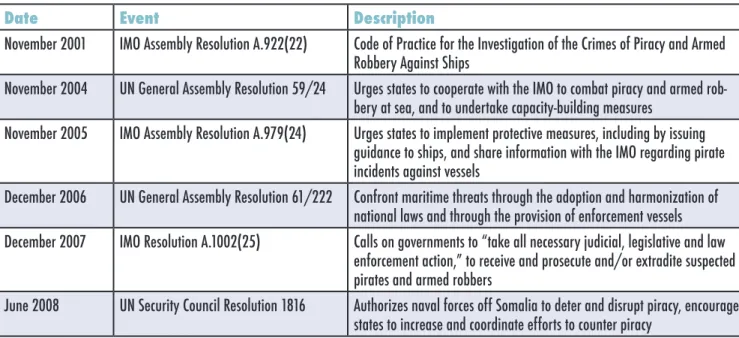
During the first decade of the twenty-first century, UN bodies had become increasingly engaged in the issue of piracy and armed robbery at sea. Beginning with an IMO Assembly resolution in 2001 establishing a code of practice in investigating piracy, and culminating in 2008 with the establishment of the CGPCS pursuant to a UN Security Council resolution, the UN and associated bodies took a series of formal steps to develop and encourage effective systems to combat piracy. Table 2 shows relevant IMO, UN General Assembly, and Security Council resolutions that demarcate the development of interest and concern in the issue and the ultimate formation of the CGPCS.
Table 2: The Development of the CGPCS in UN System Resolutions
Date Event Description
November 2001 IMO Assembly Resolution A.922(22) Code of Practice for the Investigation of the Crimes of Piracy and Armed Robbery Against Ships
November 2004 UN General Assembly Resolution 59/24 Urges states to cooperate with the IMO to combat piracy and armed rob-bery at sea, and to undertake capacity-building measures
November 2005 IMO Assembly Resolution A.979(24) Urges states to implement protective measures, including by issuing guidance to ships, and share information with the IMO regarding pirate incidents against vessels
December 2006 UN General Assembly Resolution 61/222 Confront maritime threats through the adoption and harmonization of national laws and through the provision of enforcement vessels December 2007 IMO Resolution A.1002(25) Calls on governments to “take all necessary judicial, legislative and law
enforcement action,” to receive and prosecute and/or extradite suspected pirates and armed robbers
June 2008 UN Security Council Resolution 1816 Authorizes naval forces off Somalia to deter and disrupt piracy, encourages states to increase and coordinate efforts to counter piracy
October 2008 UN Security Council Resolution 1838 Calls on states to suppress piracy and reaffirm UNCLOS
December 2008 UN Security Council Resolution 1846 Calls on states to criminalize piracy and to implement their obligations under SUA
December 2008 UN Security Council Resolution 1851 Encourages all States and regional organizations fighting piracy and armed robbery at sea off the coast of Somalia to establish an international cooperation mechanism to act as a common point of contact between and among states, regional and international organizations on all aspects of combating piracy and armed robbery at sea off Somalia’s coast
January 14, 2009 First CGPCS Plenary Session Defined six focus areas and created four working groups to address them July 14, 2011 Ninth CGPCS Plenary Session Established WG5 to focus on and coordinate efforts to disrupt the pirate
enterprise ashore, under the chairmanship of Italy
The UN General Assembly, which passed resolution 59/24 in November 2004,50 urged states to cooperate with
the IMO to combat piracy and armed robbery at sea, and to undertake capacity building measures such as enforcement training. In December 2006, the assembly again called on states to act in confronting maritime threats in resolution 61/222, including through the adoption and harmonization of national laws and through the provision of naval vessels.
Among specialized agencies, it was the IMO—the UN body tasked with promoting maritime safety—that was at the forefront of sounding the international alarm on maritime crime. The organization had already began circulating counter-piracy guidelines to both governments and industry beginning in the early 1990s,51 launched an
anti-piracy project in 1998, generated a code of practice for the criminal investigation of piracy and armed robbery in 2001, and also began passing resolutions urging states to take decisive action. In November 2005, IMO assembly resolution A.979 (24) strongly urged states to implement protective measures, including by issuing guidance to ships, and share information with the IMO regarding pirate incidents against vessels. It also requested its Secretary-General to transmit the resolution to the UN Secretary-General so that he could bring the matter to the attention of the UN Security Council. IMO resolution A.1002 (25) of December 2007 noted again the assembly’s “grave concern” regarding incidents of piracy off the coast of Somalia, which it attributed to “a lack of lawful administration and the inability of the authorities to take affirmative action against perpetrators, which allows the ‘pirate command centres’ to operate without hindrance at many points along the Somali coast.”52 Drawing on the
2005 report of UN’s Monitoring Group on Somalia and Eritrea to the Security Council, it further noted violations of the UN’s arms embargo. In this regard, it called on governments to “take all necessary judicial, legislative and law enforcement action” to receive and prosecute and/or extradite suspected pirates and armed robbers.53
In 2007, the IMO Secretary-General sent two letters to the UN Secretary-General, briefed him on the situation, and released a joint communiqué with the WFP, which linked growing food insecurity in Somalia to piracy and armed robbery off of the country’s coast.54 By the end of the year, Kofi Annan transmitted a letter to the Security
Council president, which noted the TFG’s desire for international assistance to combat piracy.
By June 2008, the United States and France put the issue squarely on the Security Council’s agenda, which produced resolution 1816 on the issue of piracy and armed robbery off of Somalia’s coast. Invoking Chapter VII of the UN Charter, the council condemned piracy, noting its role in exacerbating instability in Somalia as a threat to international peace and security, and authorized “all necessary means” to suppress it. While novel in that the resolution included armed robbery as within the scope of international jurisdiction,55 the resolution expressly
affirmed Somalia’s sovereignty, required permission from the TFG for states to pursue suspected pirates into Somalia’s territorial waters, and explicitly stated that the authorization applied only to Somalia and that it should not be interpreted as customary law.56 The inclusion of that caveat was to palliate objections from Indonesia,
which also struggled with piracy in its archipelago, about the authorization of international action within a country’s domestic jurisdiction.”57
The resolution was quickly followed by four more that year: 1838 (October); 1844 (November); 1846 (December); and 1851 (December). Kraska notes that many operative paragraphs of resolution 1838 were influenced by a meeting commissioned by the special representative of the secretary-general, Ambassador Ahmedou Ould-Abdallah, in the fall of 2008. Convened in Nairobi with the participation of diverse actors, the ensuing report suggested creating ship-rider agreements with countries situated to conduct investigations and prosecution, the enactment of legal structures in regional states such as Kenya, and the creation of an intelligence network.58
Meanwhile, resolution 1846 urged states to fully implement their obligations under SUA. By endorsing SUA the Security Council “resolved any doubt about the application of SUA to antipiracy enforcement off the coast of Somalia,”59 a call that was also made in the US National Security Council’s Action Plan to counter piracy.60 The
Security Council also explicitly engaged the UN Secretariat by requesting that the secretary-general report on ways to ensure long-term security off Somalia’s coast and “a possible coordination and leadership role for the United Nations in this regard to rally Member States and regional organizations.”
Two weeks later, the Security Council called for an integrated approach of efforts on land and at sea, and passed resolution 1851, which authorized the use of “all necessary measures,” including on operations on Somali soil with the TFG’s permission. By this time three multinational naval operations were underway led by the Combined Maritime Forces, EU NAVFOR and NATO—along with such independent deployers as India and Russia. To facilitate the coordination of military and other counter-piracy efforts, resolution 1851 also encouraged “all States and regional organizations fighting piracy and armed robbery at sea off the coast of Somalia to establish an international cooperation mechanism to act as a common point of contact between and among states, regional and international organizations on all aspects of combating piracy and armed robbery at sea off Somalia’s coast.”61 With the passage of resolution 1851 in December 2008, Secretary of State Rice announced
before the Security Council the intent of the United States to “work with partners to create a Contact Group on Somali Piracy.” In her statement before the council, Rice noted three impediments to suppress the threat: weak state capacity, particularly among regional states; lack of political will; and an absence of coordination.62
The institutional configuration of what would become the Contact Group on Piracy off the Coast of Somalia has its roots in the US government’s counter-piracy Action Plan. The hybrid-actor mechanism clearly reflects the George W. Bush administration’s 2005 US National Strategy for Maritime Security: “Maritime security,” it asserted, “is best achieved by blending public and private maritime security activities on a global scale into an integrated effort that addresses all maritime threats.”63 The report further highlighted the conditions
under which piracy and armed robbery at sea thrived: areas with significant commercial activity; high levels of political and economic instability; and weak maritime law enforcement capacity.64 Two years later, Bush
issued an internal memorandum articulating a policy for the repression of piracy that emphasized interagency coordination within the US government and international cooperation, including by enhancing the repressive capacity of other states.65
As efforts were emerging within various UN bodies, the US Department of State began to actively develop an implementation plan to counter piracy in 2008, in the wake of Bush and Rice’s attendance at an OPEC
(Organization of the Petroleum Exporting Countries) meeting during which they had been apprised of the threat of piracy to oil carrying nations.66 Then Assistant Secretary of State for Political and Military Affairs Mark Kimmitt
was asked to develop an approach to the problem, and he and other senior State Department officials decided to set up an international contact group on the issue.
Diplomats began reaching out to like-minded partners—France, Germany, and the United Kingdom—which together organized the initial conference and invited participation from states that were making concerted efforts, including through the deployment of military personnel/assets, or giving high-level attention to the issue. As Hopkins asserted, “The original intention was to involve only those countries that were willing to put
resources into the problem.” 67 Among those already active on the issue was Spain, which had conducted a
high-level meeting with France in 2008 to push forward an EU response to attacks on WFP ships, and subsequently set up a joint naval operation culminating in EU NAVFOR’s Operation Atalanta in November 2008. 68 The Republic
of Korea (ROK) was also actively engaged, providing “strong support to the related resolutions adopted in the UN Security Council.” The Korean government also hosted the Seoul High-Level Meeting on Piracy off the Coast of Somalia in June 2008, which included participation from 34 states and 16 international organizations. Thus “when the United States of America designed the establishment of the CGPCS in 2008,” recalled Ambassador Hayong Moon, “the ROK was invited to the group as a contributor.”69
The selection process thus created a coalition of actors that not only had a common interest—initially the suppression of piracy and soon thereafter “the elimination of the scourge”—but also those that had demonstrated their willingness to actively contribute. As Hopkins notes, “It subsequently expanded to a whole universe of others who were interested in or affected by [the problem] . . . and international organizations.”70
Denmark’s Ambassador Winkler explained how his government became involved: “There were contacts from the US to us and of course also to others. There were some very informal discussions in New York; it was a classic diplomatic maneuver. The Security Council told us to get our act together . . . to coordinate better, and the US took the lead in that situation and called in a number of states that were either affected by piracy or had other interests in fighting piracy off the coast of Somalia.”71
Broader engagement with other countries soon followed. At its first plenary session held in January 2009, a total of 24 states attended along with three regional organizations (African Union, EU, and NATO) and two UN bodies (the UN Secretariat and IMO). Actors from the region included: Djibouti, Egypt, Kenya, Oman, Saudi Arabia, the TFG, the United Arab Emirates, and Yemen.
The CGPCS was consistent with Security Council resolutions in its framing of the problem as a symptom of Somalia’s weak state capacity. The CGPCS saw itself as a forum to facilitate discussion and coordination of actions to suppress piracy, a goal that was couched within broader international effort to “secure peace and stability in Somalia.”
It noted five problems for the international community resulting from piracy: 1. disruption of critical humanitarian aid deliveries to Somalia;
2. increases in shipping insurance premiums to near-prohibitive levels; 3. damages to littoral economies from vessel diversion;
4. increased risk of environmental disaster, and; 5. threat to regional stability72
Six focus areas were identified as pertinent to the group’s work:
1. “improving operational and information support to counter-piracy operations; 2. establishing a counter-piracy coordination mechanism;
3. strengthening judicial frameworks for arrest, prosecution and detention of pirates; 4. strengthening commercial shipping self-awareness and other capabilities;
5. pursuing improved diplomatic and public information efforts, and; 6. tracking financial flows related to piracy”73
The program of action, according to Hopkins, “was based largely on the White House National Security Council Countering Piracy Action Plan because the US had already started thinking internally about how we were going to organize ourselves to deal with this problem.”74 The program of work is clearly evident in the December 2008
US Partnership and Action Plan, which articulated “five essential implementation pillars—improving operational and intelligence support to counter-piracy operations; strengthening judicial frameworks for detention and prosecution of pirates; disrupting pirate financial operations; strengthening commercial shipping self-defense capabilities; and pursing diplomatic and public information efforts to discourage piracy.”75
In order to accomplish these goals, the CGPCS established four working groups (WGs). The structure, explains Hopkins, “is very closely aligned with our own US government internal organization.”76 WG1 was tasked with
military and operational coordination and information sharing as well as the establishment of a regional coordination center; WG2 was to handle the judicial aspects of piracy with assistance from the UN Office on Drugs and Crime (UNODC); WG3 was to further self-awareness and self-prevention measures within the shipping industry with the assistance of the IMO; WG4 was assigned the role of improving diplomatic and public information efforts.
Although the idea for a fifth working group to address the financing of piracy had existed, it was not
implemented at that time due to opposition from some states because of the sensitivity of sharing intelligence, which was thought to be a precondition for its work.76 WG5 was eventually established in 2011 at the contact
group’s ninth plenary session, following an ad-hoc meeting held by the United States.
The communiqué for the first meeting noted that the CGPCS had agreed to establish a small secretariat,
although no further details were provided as to staff, location, or oversight in this communiqué or any following. Ultimately a team within the US Department of State’s Political-Military Affairs Bureau would serve as the de facto secretariat along with each of the chairs of the working groups and the plenary chairs.
At the second CGPCS meeting in 2009, which had expanded to include 28 states and the Arab League alongside the African Union, the EU, and NATO, it was agreed that decisions would be made by consensus, that the working groups would not make decisions but rather recommendations through chairs’ summaries that would be considered by the group as a whole. Chairmanship of the plenary sessions, moreover, would be rotated on a voluntary basis. The venue of those meetings was agreed to be UN headquarters, while a timetable was not established for meetings as these would be held on an ad hoc basis depending on the group’s needs. Beyond these elements, there are few procedural guidelines for the CGPCS’s conduct, including for “participation.” Indeed, the group began with “membership” and two criteria as to who could join: those states that had committed resources, such as naval assets; and regional states that were affected by Somali piracy. After the second CGPCS plenary in Cairo, these criteria were abolished, and any state with UN standing that was interested in joining could do so. There was also a discursive shift from “membership” to “participation,” which was a means to sidestep thorny diplomatic issues, such as clashes between traditional rivals over the inclusion of a contested territory. At the same time, the abandonment of criteria also allowed non-regional states that were affected, including large seafaring countries such as the Philippines, to have a voice in the group. Winkler explains, “We have a procedure, developed more or less through custom, that if you as a state or organization want to apply, you should write to the chairman of the contact group, and the chairman will put it at the next meeting so we know who is joining.”78 The inclusion of non-state actors, however, would prove far more
contentious, as discussed below.
The CGPCS’s only public documentation on its agreements and deliberations are the plenary session
communiqués. These are made available by a website, developed by the Republic of Korea with assistance from the United States and the United Kingdom, which is the group’s means of informing wider publics of its efforts to counter piracy. The CGPCS also has an official logo, proposed by the United States in 2009. The logo would come to symbolize the group’s authority on this issue area and provide a stamp of legitimacy for the group in its program of work, which was both ambitious and far reaching.
Work and Outcomes of the CGPCS
While the CGPCS’s agenda is set by a small cohesive group that includes the chair of a particular plenary session, its practical work is carried out in the individual working groups. Participation at the working group level is very informal and access by particular actors is decided by the individual WG chairperson. WG2 chair, Ambassador Winkler, explained it in this way: “The states and organizations who believe they can contribute to the discussions are welcome in my working group. We don’t have a formal list of participants . . . If a state comes to me or an organization can present a reasonable argument of why they can contribute and what they can contribute, then they are invited to be there.”79
As noted above, each WG was tasked with a delimited scope of issues. Hester Somsen of the Security Policy Department of the Netherlands explained: “these quite clear issues and questions that all of our countries had because we were in this military operation . . . that gave it some kind of impulse and working power that is quite unknown. . . . The persons who have been heading the working groups, they had a tremendous drive to get things done.” With a focus on what needed to be accomplished in the short term, the groups were “process and outcome oriented,” she noted.80 This section unpacks the evolution of each WG’s tasks and accomplishments as
well as the establishment of the Trust Fund.
Working Group 1
WG1, chaired by the United Kingdom and largely hosted by the IMO at their London headquarters, was initially tasked with coordinating naval operations and soon adopted capacity building as its second main area of concern. The group brought together military, industry, and government representatives, providing a forum for the exchange of views and concerns between naval forces and civilian actors. WG1, according to its current chairman James Hughes, regularly gets about a hundred people at a meeting. He noted that the majority of CGPCS country participants attend WG1 gatherings alongside IGO and industry representatives. Of key importance to WG1 activities is the regular participation of military officials from SHADE.81
The SHADE mechanism, which the Combined Maritime Forces launched in December 2008, ultimately evolved into the de facto forum for naval coordination, with the CGPCS acting as a venue for briefing by SHADE tactical and operational commanders and as a source of political support. SHADE includes military and civilian representatives from 27 countries, 14 intergovernmental organizations, and the shipping industry. The development of SHADE, however, was “not a foregone conclusion,” as WG1’s first chair Ambassador Chris Holtby explained. “Some partners did not want to be involved in the joint patrolling,” he noted, and there was “real resistance to joint command and control.”82 WG1, however, provided a forum for various military actors to
share their activities and plans, which in turn fostered trust-building. China, for example, had early on advocated the creation of an alternative to the Internationally Recommended Transit Corridor (IRTC), on a separate route and with protection provided by convoys rather than by area patrolling, but recognized the advantages of cooperation through SHADE and joined before long. The structure of the SHADE mechanism was designed to be sensitive to the concerns about sharing command and control activities. As the name itself makes clear, it is a process designed to reduce duplication or mission conflict through information sharing. It is a mechanism for shared awareness—not joint military operations.
Over time, WG1 and SHADE would mutually influence each other’s development.83 As Hopkins explained,
SHADE “became the center of gravity for naval coordination, because it needed less political support over time.” “One of the great successes of the whole contact group,” she remarked, “was how it politically supported the development and evolution of the SHADE mechanism for operational coordination.”84
According to Holtby, WG1 recognized early on the need to develop a forward-looking approach, and the group took on an additional role, namely, maritime security capacity-building in Somalia and other littoral states.
During the working group’s very first session, regional capacity-building was deemed to be the “most sustainable solution” to the phenomenon of piracy.85 In order to achieve this aim, an assessment of need was generated
so that donors could target their efforts effectively. An important role of WG1 was to identify gaps and monitor progress on program implementation. In June 2009, the United Kingdom unveiled an assessment of coastguards, naval/military structures, and judicial and penal detention centers. The UK-led and funded this initiative in coordination with the IMO, European Commission, UNODC, UNPOS, Somali authorities, regional governments, and a number of other CGPCS participants.
According to the initial assessment, although Somali land-based governance/law and order structures and economic/alternative livelihood programs fell “beyond the sole direct responsibility of the CGPCS . . . close coordination/cooperation/deconfliction with planning/activity in these areas is essential to the greater effectiveness/success of counter-piracy related programs.”86 Despite significant bilateral efforts including the
production of an interactive matrix of needs that mapped current and planned activities and helped ensure a core objective of transparency, action was not fully coordinated and prioritized. In the meantime, the EU had moved to implement EUCAP NESTOR, the civilian complement to its military deployment, which focused on building maritime capacity among five countries in the Horn of Africa and the Western Indian Ocean.87
Under the chairmanship of James Hughes, WG1 has set up the Capacity-Building Coordination Group (CBCG), facilitated jointly by the EU, IMO, and a regional organization on a rotational basis. The aim is to replicate SHADE’s informal and non-bureaucratic working methods and facilitate information sharing among those people and institutions working on capacity building. By meeting regularly the CBCG intends to avoid effort overlap, to flag and fill gaps in ongoing and planned capacity-building activities, and to provide an opportunity for regional beneficiary countries and Somali regions to define their needs directly to donors and implementing organizations. Its interfacing with WG1 would provide a source of political support.
To give impetus to the project, the role of creating an online coordination platform was entrusted to a non-state actor, OBP. The idea was to replace the existing paper-based WG1 Regional Counter-Piracy Capability Development Needs Assessment Matrix with a more interactive, online tool. OBP developed the WG1 Capacity-Building Coordination Platform in close cooperation with key capacity-building organizations, donor countries, and beneficiary states and officially launched prior to the WG1 meeting in Addis Ababa in March 2013 after a period of preliminary testing in the fall of 2012 and early 2013. Hughes explained that the dynamic online interface that facilitates examination of needs, current plans, and executed projects has facilitated greater use of the WG1 matrix, thus furthering the goal of coordination.88
Working Group 2
WG2, chaired by Denmark, set out to examine the existing legal basis for combating piracy. As Winkler noted, “From the outset there was actually a quite good legal basis in international law, but we still needed to identify it, interpret it, to get a common approach to what was actually in the legal framework.” However, he noted, that “some answers we have found in international law but most answers have to be found in national law.”89 WG2
thus set out to investigate how national criminal procedural norms and rules hamper criminal prosecution. WG2 examined practical impediments to prosecution (e.g., collection of evidence to meet evidentiary standards) and developed a “checklist” of proactive measures that states could take to ensure their ability to prosecute suspects. It gathered information on “relevant national legal systems,” working closely with UNODC’s Counter-piracy Programme (CPP), which was launched in May 2009 and is devoted to the construction and modernization of prisons and courtrooms in Kenya, Seychelles, Mauritius, and Somalia and the overall facilitation of judicial processes.90
The group functioned as a forum for an exchange of lessons learned in the areas of evidence collection and handling, securing testimony from witnesses, and issues related to detention. An early WG2 accomplishment was the creation of a “legal toolbox” containing guidance on various legal aspects of counter piracy activities. This collection of documents includes templates for ship-rider agreements, guidelines for the collection of evidence, and templates for bilateral pre-trial and post-trial transfer agreements (discussed below).
In addition to clarifying the existing international legal framework and providing practical legal guidance, a core issue for the group to tackle was to find a solution to the problem of detaining, prosecuting, and incarcerating pirates. An early preoccupation was deciding whether or not to create an international tribunal or a regional mechanism to fill the gap in domestic capacity. By early 2010, WG2 had considered “the most feasible model would be a specialized or dedicated piracy chamber―with or without international elements―established within the existing domestic criminal justice system of one or more states and in one or more states willing and able to undertake prosecution.”91
Yet the issue of appropriate mechanisms to address the issues of imprisonment and prosecution continued to be debated. In June 2010, France re-launched a Portuguese proposal from November 2009 for a special Somali court that would be located in a state in the region and be supported internationally.92
In June 2010, the UN Security Council took action on the issue and in resolution 1918 requested the UN secretary-general to produce a report detailing possible options, which would take into account the CGPCS’s work. In his July 2010 report, the secretary-general presented seven options, including special domestic chambers, the establishment of a Somali court situated in another state in the region, a regional tribunal, and an international tribunal established under Chapter VII of the UN Charter. The report weighed the advantages and disadvantages of each option, noting that an international tribunal would “not likely to be among the most cost-effective.” Moreover, as Annex II of that report regarding CGPCS discussions noted “the crime of piracy is of a different nature and scope to the serious international crimes normally dealt with by international tribunals, and that suspected pirates brought before any such new international tribunal would be unlikely to meet the criterion of being the ‘most responsible’ for the crimes in question, which is a threshold applied by most of the current international tribunals.”93 Other options raised by the CGPCS were considered infeasible. They included
amending the Rome Statute of the International Criminal Court, an amendment to the International Tribunal, and the amendment to the statute of the African Court on Human and Peoples’ Rights.
The report’s summary highlighted some success of the already ongoing efforts of its first option—the
enhancement of UN assistance to build capacity in regional states to prosecute and imprison pirates. The report concluded that any of the other six options would require consideration of “the need for sufficient political and financial commitment among States, in difficult economic times, not only to establish a new judicial mechanism, but also to sustain it . . . . Such a mechanism would face ongoing criminal activity and potentially a large
caseload, with no predictable completion date.”94
In November 2010, states participating in WG2 agreed the international community should proceed with option 1, although it would continue to consider possible mechanisms with the UN secretary-general’s newly appointed special advisor on legal issues related to piracy off of Somalia’s coast, Jack Lang.
In his 2011 report to the UN Security Council, Lang proposed “implementing a legal system that [would] include the establishment of a Somali extraterritorial jurisdiction court in Arusha and two special courts— one in Puntland and the other in Somaliland—and, finally, the construction of three prisons in Somaliland and Puntland,” which France publicly supported.95 According to media reports, Somalia objected to a court
in Tanzania, while others expressed concerns about the viability of a Puntland-based court owing to alleged connections between local authorities and pirate bosses.96