Evaluate Your Business
Continuity Management:
A step towards a more resilient company!
Joakim Almén
Anders Rosqvist
Department of Fire Safety Engineering and Systems Safety Lund University, Faculty of Engineering, Sweden
Brandteknik och Riskhantering Lunds tekniska högskola Lunds universitet Report 5265, Lund 2008
Evaluate Your Business Continuity Management:
A step towards a more resilient company!
Joakim Almén
Anders Rosqvist
Joakim Almén Anders Rosqvist SUPERVISORS
Ulf Paulsson School of Economics and Management, Lund University Per-Axel Nilsson Marsh AB
Maria Fröberg Marsh AB
Report 5265 ISSN: 1402-3504
ISRN: LUTVDG/TVBB--5265--SE Number of pages: 151
KEYWORDS
Business continuity management, business continuity planning, BCM Evaluation Model, emergency response, crisis management, business recovery, enterprise risk management, supply chain disruption, crisis preparedness, risk, crisis.
ABSTRACT
Major businesses today involves complex supply chains with world-wide sourcing and marketing which create new risks for both the individual enterprise and the society at large. Supply chain disruptions are seen as the primary threat to a company’s revenue driver. To be able to cope with undesired events, companies need to review their business continuity management (BCM).
To increase the knowledge of effective BCM, this thesis develops and presents a model for evaluating the level of BCM within a company, The BCM Evaluation Model. The model is a self-assessment questionnaire to be used at site level which can give management and insurance companies an indication of what needs to be improved to reduce the potential negative business profit impact from a disruption somewhere in the supply chain.
The study involves a lens with factors based on a literature survey. Documented cases were then examined through the lens to find key factors for effective BCM. The model was validated through a test on six company affiliates together with expert opinions.
© Copyright: Brandteknik och Riskhantering, Lunds tekniska högskola, Lunds universitet, Lund 2008.
Department of Fire Safety Engineering and Systems Safety
Lund University P.O. Box 118 SE-221 00 Lund Sweden [email protected] http://www.brand.lth.se/english Telephone: +46 46 222 73 60 Fax: +46 46 222 46 12 Brandteknik och Riskhantering
Lunds tekniska högskola Lunds universitet Box 118 221 00 Lund [email protected] http://www.brand.lth.se Telefon: 046 - 222 73 60 Telefax: 046 - 222 46 12 Telefon: 046 - 222 73 60
A
CKNOWLEDGEMENTS
Throughout the progress of this thesis, several persons have been invaluable to us. We want to give a special thanks to our tutor, Ulf Paulsson from the Department of Business Administration, Lund University, who from his years of experience has given us many hints and helped us to get from idea to reality.
We also want to thank Maria Fröberg and Per-Axel Nilsson at Marsh AB who inspired us to explore this topic and gave us many comments and hints on how to think regarding BCM and how the final model should be constructed for good applicability.
The possibility to test The BCM Evaluation Model at Cardo was much appreciated in our strive towards validity for the model. For this opportunity we would like to thank Mats Hedberg who made this possible.
We would also like to thank Kenneth Miger, Lennart Edström, Magnus Bergh, Thomas Granström, Matti Seiman, Lisa Ekstig, Mats Lindgren, Aon Risk Services, Christel Gunnarson and Solveig Nilsson who gave their expert opinions which were of great importance for us when finalising The BCM Evaluation Model.
Our opponent Birgir Viðarsson deserves thanks for his work with giving us feedback to make the final product better.
For their encouragement and support during this period we would also like to thank our families and partners.
Finally we would like to thank the personnel at the Department of Combustion Physics for their welcoming atmosphere and great coffee.
Enjoy your reading! Joakim Almén Anders Rosqvist
E
XECUTIVE SUMMARY
The development of modern enterprises goes toward more complex supply chains with many links and worldwide sourcing and marketing which create new risks for enterprises. In recent years there have been a number of crises resulting in significant economic loss and in the worst cases, a loss of market shares for the enterprise involved. Several of these crises could have been avoided with better preparedness. Therefore, satisfactory business continuity management (BCM) to cope with a crisis situation would be of great value to any organisation. The purpose of this thesis is to give corporate management the ability to reduce the potential negative business profit impact from a disruption somewhere in the supply chain and thereby increase the knowledge of effective BCM. To fulfil this purpose, the main objective is the development of a model for evaluating the level of business continuity management within a company.
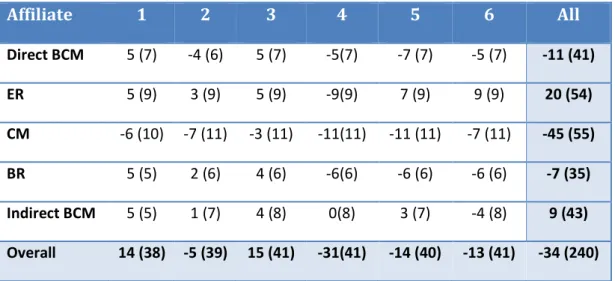
The first part of this thesis was a literature survey on the topics of risk management and BCM. Based on this survey, a framework to use as a lens for analysing documented cases was developed. The lens was then applied on documented cases to reveal a pattern of key factors for effective BCM. Based on the above lens and documented cases, a preliminary model was developed for evaluation of a company's level of BCM. The preliminary model was validated through a test on six affiliates in the Cardo Group and through a survey with expert opinions. The last stage was revising the model based on the outcome of the validation.
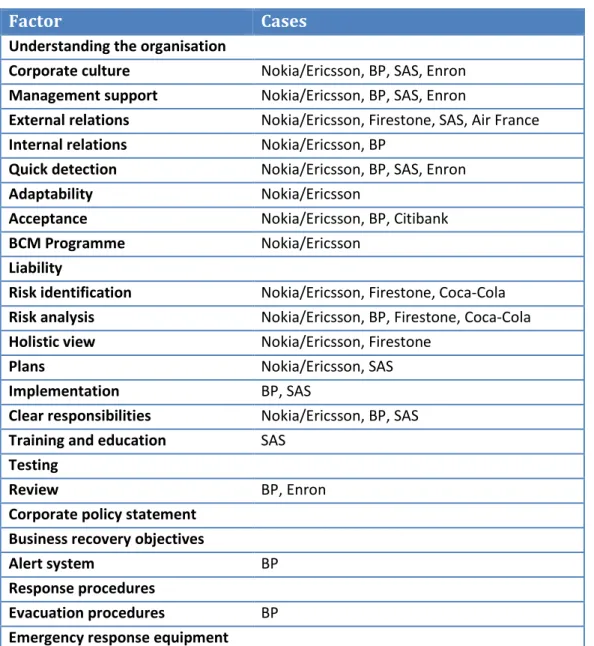
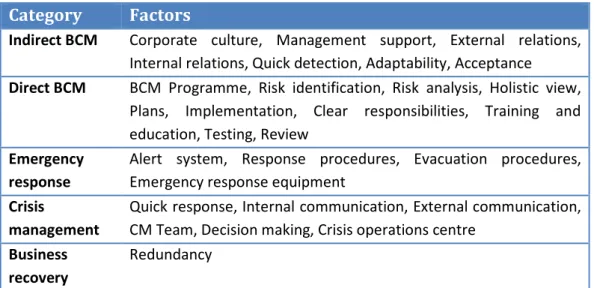
Since the first step in the construction of the lens was to study the literature to find previous material on the topic, a clarification of perceptions in connection with BCM was needed. This was made through a structure of existing risk concepts. The expressions found in the literature were then placed in factors under the five different areas: indirect BCM, direct BCM, emergency response (ER), crisis management (CM) and business recovery (BR). The lens was then used on eight documented cases which were chosen based on a number of criteria. Factors found in half or more of the documented cases were given extra priority in The BCM Evaluation Model.
The factors retrieved from the lens, when constructing The BCM Evaluation Model, were factors which were found in the cases and/or had more than one source in the literature. Questions related to all of the retrieved factors were formulated to give the answer “yes”, “no” or “not applicable”. The questions were organised into five categories (direct BCM, ER, CM, BR and indirect BCM) to be able to see results not only for the whole, but also for each respective part of the continuity work. Even though the results in the company validation gave roughly the expected values, improvements were made following the results of both the company validation and the expert opinions. Some hints on things to remember when using the model was also presented together with the final model.
The last chapter discusses whether the purpose and objectives have been achieved and how to use the results of The BCM Evaluation Model. As a result of the purpose, the model will give an indication on the level of BCM but a maximum score does not mean that improvements cannot be made. The model was developed for businesses in general. Hence, it does not include factors for specific businesses e.g. pharmaceutical companies. Suggestions on further research to develop the results in this thesis were made.
S
AMMANFATTNING
Till följd av att företagsvärlden idag utvecklas mot mer komplexa flödeskedjor med många länkar och världsomfattande handel skapas nya risker för de inblandade företagen. Under senare år har ett antal kriser resulterat i ekonomisk förlust och, i de värsta fallen, förlorade marknadsandelar. Flera av dessa kriser kunde ha undvikits med bättre beredskap. Detta innebär att tillfredställande business continuity management1 (BCM) är av stort värde för alla organisationer. Syftet med denna uppsats är att öka kunskapen om effektiv BCM genom att hjälpa företagsledningar att minska den potentiella förlusten från ett avbrott någonstans i flödeskedjan. För att uppfylla detta syfte kommer huvudmålet med uppsatsen vara att utveckla en model för att utvärdera nivån på BCM i ett företag.
Den första delen av rapporten är en litteraturgenomgång inom området. Baserat på denna genomgång skapades sedan ett ramverk, att användas som en lins, för att utvärdera tidigare inträffade kriser. Linsen tillämpades sedan på tidigare fall för att identifiera ett mönster av faktorer som är viktiga för effektiv BCM. Av resultaten från fallstudien tillsammans med litteraturunderlaget utvecklades sedan en första utvärderingsmodel. Denna validerades sedan mot sex dotterbolag i Cardokoncernen samt genom expertutlåtanden från nio experter. Det sista steget var att revidera den ursprungliga modellen efter de resultat som valideringen gav.
Eftersom det första steget i framställandet av linsen var att studera tidigare litteratur inom BCM, behövdes olika uppfattningar i anslutning till BCM klargöras. Detta gjordes genom en strukturering av existerande riskbegrepp. De BCM-uttryk som hittades i litteraturen placerades sedan under fem olika områden: indirect BCM, direct BCM, emergency respons2 (ER), crisis management3 (CM) and business recovery4 (BR). Linsen användes sedan för att underöka åtta case som valdes utifrån ett antal kriterier. De faktorer som hittades i hälften av casen, eller mer, gavs extra prioritet i The BCM Evaluation Model.
De linsfaktorer som fick vara kvar, när modellen gjordes, var faktorer som hittades i casen och/eller hade mer än en källa i litteraturen. Frågor för att mäta de kvarvarande faktorerna framställdes så att de ger svaret “ja”, “nej” eller ”inte tillämpbart”. Frågorna organiserades i fem grupper (direct BCM, ER, CM, BR and indirect BCM) så att resultat kan erhållas för respektive del. Resultatet från företagsvalideringen överrensstämde till stor del med det väntade resultatet. Modellen reviderades därför både till följd av företagsvalideringen och expertutlåtandena. Några tips på saker som kan vara bra att komma ihåg i samband med användandet av modellen presenterades också tillsammans med den slutliga modellen.
Det sista kapitlet diskuterar om syftet och målen har uppnåtts och hur resultaten av modellen kan användas. Till följd av syftet kommer modellen att ge en indikation av nivån på BCM men det går att vidareutveckla arbetet även om resultatet av modellen är maximalt. Modellen utvecklades för att vara generell. Detta innebär att den inte innehåller faktorer för specifika företagstyper. Förslag på ytterligare forskning för att utveckla resultaten gavs i slutet av denna rapport.
1 ”Krisberedskap för företag”. 2 ”Nödberedskap”. 3 ”Krishantering”. 4 ”Återhämtningsförmåga”.
A
CRONYMS
BCI Business Continuity Institute BCM Business Continuity Management BCP Business Continuity Planning BIA Business Impact Analysis
BR Business Recovery
CM Crisis Management
ER Emergency Response
N/A Not Applicable
NRI Negative Result Impact
RI Result Impact
D
EFINITIONS
RISK“A risk event is an uncertain event or set of circumstances that, should it occur, will have an effect on the achievement of one or more of the project’s objectives” (APM PRAM Guide, 2006, p. 17).
CRISIS
“A situation which is harmful and disruptive, is of high magnitude, is sudden, acute and demands a timely response and is outside the firm’s typical operating frameworks” (Reilly, 1993, p. 116).
BUSINESS CONTINUITY MANAGEMENT
“A holistic management process that identifies potential threats to an organisation and the impacts to business operations that those threats, if realised, might cause, and which provides a framework for building organisational resilience with the capability for an effective response that safeguards the interests of its key stakeholders, reputation, brand and value-creating activities” (British Standards, 2008a).
SUPPLY CHAIN
“Life cycle processes supporting physical, information, financial and knowledge flows for moving products and services from suppliers to end users” (Ayers, 2000, p. 6).
RESILIENCE
“The ability of an organisation, staff, system, network, activity or process to absorb the impact of a business interruption, disruption and/or loss and continue to provide a minimum acceptable level of service” (BCI, 2008).
EMERGENCY RESPONSE
Actions taken to protect people, the environment and assets (based on Nilsson, 2008). CRISIS MANAGEMENT
Organised management of undesired events through decisions on strategical and tactical questions and the handling of internal and external communication (based on Nilsson, 2008).
BUSINESS RECOVERY
Service to customers, alternative production, restore processes and supply chain management (based on Nilsson, 2008).
DIRECT BCM
Direct BCM is the planning for ER, CM and BR (Almén & Rosqvist, 2008, see chapter 4.1). INDIRECT BCM
Indirect BCM means that the factor influences the outcome of BCM without being a plan for or the execution of ER, CM and BR (Almén & Rosqvist, 2008, see chapter 4.1).
C
ONTENTS
1 Introduction ... 1
1.1 Background ... 1
1.2 Theoretical background ... 2
1.3 Purpose and objectives ... 3
1.4 Target groups ... 4
1.5 Delimitations ... 4
1.6 Chapter overview ... 5
2 Methodology ... 6
2.1 Scientific approach... 6
2.2 The research process ... 6
2.3 Research philosophy ... 6
2.4 Research approaches ... 7
2.5 Research strategies ... 7
2.6 Time horizons... 8
2.7 Reliability and validity ... 8
2.8 Objectivity ... 9
2.9 Sources ... 9
2.10 Working method ... 10
3 Theory survey ... 11
3.1 Risk management terminology ... 11
3.1.1 Risk management ... 11
3.1.2 Business continuity management ... 13
3.1.3 Crisis management & crisis preparedness ... 17
3.1.4 Supply chain management ... 18
3.2 Chain of events ... 19
3.3 Structuring the concepts ... 20
4 Learning from documented cases ... 21
4.1 The construction of a lens ... 21
4.2 Choosing the cases ... 22
4.3 Documented cases ... 24
4.3.1 The Nokia/Ericsson disruption ... 24
4.3.2 The explosion at BP Texas City refinery ... 28
4.3.3 The Firestone recall of Ford Explorer tires in USA ... 32
4.3.4 The SAS Dash 8 Q400 incidents ... 35
4.3.5 Enron bankruptcy ... 38
4.3.7 Citibank Japan ... 42
4.3.8 Coca-Cola’s UK Dasani withdrawal ... 43
4.4 Lessons from the documented cases ... 45
5 The BCM Evaluation Model ... 47
5.1 Developing the preliminary model ... 47
5.1.1 Factors retrieved from the lens ... 47
5.1.2 Formulation of questions ... 48 5.1.3 Field of application ... 49 5.2 Model validation ... 49 5.2.1 Company validation ... 49 5.2.2 Expert validation ... 51 5.3 Model revision ... 53
5.4 The final model ... 57
5.5 Application of The BCM Evaluation Model ... 57
5.5.1 Benefits ... 58
5.5.2 Working procedure ... 58
6 Results ... 59
6.1 Meeting the objectives ... 59
6.2 Fulfilling the purpose ... 60
6.3 Discussing the applicability of The BCM Evaluation Model ... 60
6.4 Future research ... 60
7 References ... 62
7.1 Written references ... 62
7.2 Internet sources ... 66
Appendices ... 69
A. The final model ... 70
B. Classification of factors ... 77
C. Marsh presentation ... 96
D. Complete list of documented cases... 99
E. Company validation ... 103
1
I
NTRODUCTION
“The only guarantee is that bad things will happen to good companies5”.
This thesis is the final part of the Master of Science in Risk Management and Safety Engineering programme at Lund University, Faculty of Engineering, Sweden. The Swedish insurance broker and risk advisor Marsh AB inspired the authors to explore business continuity management (BCM). To ensure the quality of this thesis the Department of Business Administration, Marsh AB and the Department of Fire Safety Engineering and Systems Safety acted as supervisors.
1.1
B
ACKGROUNDThe development of modern enterprises goes toward more complex supply chains with many links and worldwide sourcing and marketing which create new risks for enterprises (Sheffi, 2005; Brannen & Cummings, 2005). In recent years there have been a number of crises resulting in significant economic loss and, in the worst cases, a loss of market shares for the enterprise involved (Sheffi, 2005). The majority of the worst cases involve disruptions in the supply chain which is also seen as the primary threat to a company’s revenue driver (Brannen & Cummings, 2005). This aspect is further demonstrated by Hendricks and Singhal (2005) who show that the stock return decreased by nearly 40 % in average from 827 supply chain disruption announcements.
Furthermore, there has been an increase in the demands put on today’s enterprises. Legislation, terrorism threats and change in customer demands are just to name a few factors that contribute to risk management as a factor of competition. (Hutchins & Gould, 2004)
The business world has seen examples of crises that could have been avoided with better preparedness. An example that displays both good and bad BCM is the fire in a semiconductor factory in Albuquerque, USA which in the end led to Nokia taking market shares from Ericsson (Latour, 2001). Another example is the Johnson & Johnson Tylenol case in 1982 which accounted for hundreds of millions of dollars of forgone sales and added costs (Mitchell, 1989). These cases further show the importance of BCM as a part of the enterprise risk management programme.
Furthermore, mitigation of all risks is unrealistic as it is impossible to identify all risks and it would also result in all too great costs. Therefore, the authors’ opinion is that a satisfactory BCM to cope with a crisis situation would be of great value to any organisation. One part to preserve the continuity in a business is a well organised and prepared crisis management team within the enterprise (Chong, 2004). If the key factors for good BCM can be identified, this may, as a result of the importance for the enterprise risk management, give the company the resilience to go through tough conditions and the opportunity to remain as the main contender for market shares as
5
less prepared companies struggle when disaster strikes. This leads to the conclusion that a model to evaluate whether an enterprise has a satisfactory level of BCM or not should be in the interest of many.
1.2
T
HEORETICAL BACKGROUNDKaplan and Garrick (1981) are known as the ones who define risk as a triplet that answers the three questions: What can happen? How likely is it to happen? And, if it happens, what are the consequences? This thesis will focus on the ability to reduce consequences in those triplets that have high consequence on the achievement of objectives and low probabilities as these are normally “outside the firm’s typical operating frameworks and harmful, disruptive and of high magnitude” which, according to Reilly (1993, p. 116), characterises a crisis.
There can always be a discussion on the matter whether worst case scenarios should be valued as more important to manage than high probability incidents with lower consequences. Slovic et al. (1982) have shown that many individuals perceive a greater threat from high consequence risks even if the probabilities should make these risks less important if Kaplan and Garrick’s risk definition is used. Therefore, a way to minimise the total perceived risk in an organisation could be to concentrate on worst case scenarios. Furthermore, many companies are prepared with routines to manage frequent incidents but often express denial, sure that their business is not large enough, important enough or geographically situated to be concerned with severe consequence threats (Mitroff, 2005).
To be able to mitigate and manage potential threats, a BCM programme is of great importance (Terry, 2004; Knight & Pretty, 2002). BCM comprises three phases, emergency response (ER), crisis management (CM) and business recovery (BR) (Nilsson, 2008). ER focuses on the acute phase of an accident and includes life-saving, environment protection and property protection measures. CM focuses on maintaining critical functions in the company during a crisis while BR is actions taken to restore the business activities to the original level. This thesis will focus on BCM and the actions taken by the organisation to reduce the consequences of a crisis situation.
Earlier cases show that one important aspect of BCM is to consider the supply chain in which the company exists (Paulsson, 2007). A supply chain risk structure model has been developed by Peck et al. (2003) to create resilient supply chains and thus mitigate that large consequence incidents appear as a result of a disruption in the supply chain. Peck et al.’s model will also include preparedness to react to unpredictable change. This thesis will focus on measures to reduce the potential costs of a supply chain disruption.
The supply chain is by many authors divided into three main flows. These are a) the material flow, which flows upstream from the supply to the demand side, b) the cash flow, which flows downstream and c) the informational flow, which flows in both directions within the supply chain. (Ayers, 2000; Lambert et al., 1998; Sheffi, 2005)
Cavinato (2004) has taken it two steps further and divides the supply chain into five sub-chains which are physical, financial, informational, relational and innovational. It’s easy to see the similarities to the main flows, however Cavinato adds relational, “the linkage between a supplier, the organisation and its customers for maximum benefit” and innovational, “the processes and linkages across the firm, its customers, suppliers and resource parties for the purpose of discovering and bringing to market product, service and process opportunities”.
The above are different ways of explaining a supply chain network. In this thesis the ambition is to demonstrate key factors, affecting all of these sub-chains.
In the theoretical background of corporate CM Mitroff (2001) has developed a best practice model for CM which involves preparing for at least seven different types of risks, examine the important mechanisms in the actual crisis management, examine how different systems coexist in the organisation, building relationships with stakeholders prior to crisis and glue the previous four together with scenario training. In municipal CM the importance of the responsibility, likeness and nearness principles is mentioned by Fredholm and Göransson (2006). These principles are centred on the fact that during a crisis situation, the responsibility should stay the same within the affected activity, the organisation and localisation should be the same as during normal circumstances and that the crisis should be managed at the lowest level possible.
In supply chain risk management, different strategies to reduce consequences are an integral part of Peck et al.’s (2003) framework for the resilient supply chain. Regarding CM, Mitroff (2001) has developed a best practice model to prepare for crisis while Fredholm & Göransson (2006) have expressed the need for three principles. Different approaches have been used regarding crisis in supply chains, BCM and municipal CM. This thesis will try to merge those different views into a broader view.
1.3
P
URPOSE AND OBJECTIVESThe purpose of this thesis is to give corporate management the ability to reduce the potential negative business profit impact from a disruption somewhere in the supply chain and thereby increase the knowledge of effective BCM.
To fulfil this purpose, the main objective is the development of a model for evaluating the level of business continuity management within a company.
To achieve the above objective, the following sub-objectives are required to be fulfilled:
• Identify, in the literature, the key factors involved in BCM which are related to supply chain disruptions.
• Investigate if previous corporate crises reveal a pattern of factors that are more significant than others for a risk to turn into a crisis or a crisis to be managed well.
• Discuss how to measure the key factors and structure them into BCM areas which then can be evaluated.
• Based on knowledge from the above, develop a user-friendly and cost-effective model for the evaluation of an enterprise’s BCM and thereby give hints on which areas to improve.
1.4
T
ARGET GROUPSThis report is targeted at both academia and corporate management teams. In academia, risk management students can benefit from this thesis through the extensive methodology that includes both documented cases and the development of a model. They may also be helped by the theory on BCM and the list of documented cases which may give ideas for future studies.
Corporate management teams within all business activities can benefit from the model as this may be a good tool to get a hint on the status of the BCM within the company.
1.5
D
ELIMITATIONSTo allow this project to be undertaken during a 20-week time period, the following delimitations are required:
• This thesis will look at preparations taken to achieve effective BCM. Hence, if Kaplan and Garrick’s (1981) definition of risk is used, this means that the focus will be on preparations to manage the consequences of a crisis and not the process to minimise the probability for a crisis to occur. However, as BCM is a proactive activity, it often affects the scenario and likelihood while reducing the consequences.
• One way of evaluating key factors in an enterprise will be presented in The BCM Evaluation Model. To prevent the model from becoming too extensive and time consuming, it does not cover all aspects of each factor.
1.6
C
HAPTER OVERVIEW This thesis is structured inThe final version of the BCM evaluation model, and whether the purpose and objectives were Based on the results from the documented cases, combined with the findings in the literature, a
BCM evaluation model will be developed, validated and revised.
4. Learning from documented cases
Factors from the literature survey are put into a lens which is applied on documented cases to reveal key factors that are more prominent than others for the outcome of a crisis situation. Introduces different approaches to RM & BCM and presents a structure for how these concepts
HAPTER OVERVIEW
structured into the chapters shown in Figure 1.
Figure 1. Chapter overview.
6. Results
The final version of the BCM evaluation model, and whether the purpose and objectives were achieved, will be discussed in this chapter.
5. The BCM evaluation model
Based on the results from the documented cases, combined with the findings in the literature, a BCM evaluation model will be developed, validated and revised.
4. Learning from documented cases
Factors from the literature survey are put into a lens which is applied on documented cases to reveal key factors that are more prominent than others for the outcome of a crisis situation.
3. Theory survey
Introduces different approaches to RM & BCM and presents a structure for how these concepts relates to each other.
2. Methodology
Describes the working method and underlying methodology.
1. Introduction
Includes background and purpose & objectives.
The final version of the BCM evaluation model, and whether the purpose and objectives were
5. The BCM evaluation model
Based on the results from the documented cases, combined with the findings in the literature, a BCM evaluation model will be developed, validated and revised.
4. Learning from documented cases
Factors from the literature survey are put into a lens which is applied on documented cases to reveal key factors that are more prominent than others for the outcome of a crisis situation. Introduces different approaches to RM & BCM and presents a structure for how these concepts
2
M
ETHODOLOGY
“Next week there can’t be any crisis. My schedule is already full
While methodology refers to the theory of how research should be undertaken, methods are tools and techniques used to gath
methodological issues are taken into account when methods are chosen it is easier to understand which method will give the best resu
2.1
S
CIENTIFIC APPROACHA quantitative approach will try to describe and explain a
approach will try to gain a deeper understanding and describe the holistic view (Holme & Solvang, 1997). This thesis is written in a semi
time limits the amount of cases that may be
towards the qualitative approach the final model in this thesis will not aspects of each factor.
2.2
T
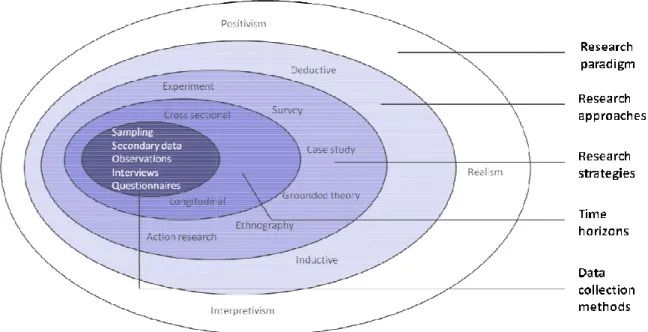
HE RESEARCH PROCESSThe research process can be described as an onion ( be considered before a scientific process may begin.
Figure 2. The research process onion according to
2.3
R
ESEARCH PHILOSOPHYThere are three different philosophies that dominate interpretivism and realism. When using
assumed and used as an objective view
idea that the world may not be simplified down to observable social reality without
6
Kissinger, H., Obtained from Jones, 1973
Next week there can’t be any crisis. My schedule is already full6”.
the theory of how research should be undertaken, methods are tools and techniques used to gather and analyse data. If the underlying methodological issues are taken into account when methods are chosen it is easier to understand which method will give the best result (Saunders et al. 2003).
A quantitative approach will try to describe and explain a subject while a qualitative deeper understanding and describe the holistic view (Holme & Solvang, 1997). This thesis is written in a semi-quantitative approach as imits the amount of cases that may be investigated. As this tends to lean towards the qualitative approach the final model in this thesis will not involve all
HE RESEARCH PROCESS
The research process can be described as an onion (Figure 2) where all layers need to scientific process may begin.
. The research process onion according to Saunders et al. (2003, p. 83).
ESEARCH PHILOSOPHY
rent philosophies that dominate the literature: positivism, When using positivism an observable social reality is assumed and used as an objective view of the problem. Interpretivism involves the idea that the world may not be simplified down to observable social reality without
Kissinger, H., Obtained from Jones, 1973
the theory of how research should be undertaken, e data. If the underlying methodological issues are taken into account when methods are chosen it is easier to
while a qualitative deeper understanding and describe the holistic view quantitative approach as to lean involve all
need to
ositivism, an observable social reality is involves the idea that the world may not be simplified down to observable social reality without
losing the complexity which gives the situation in the first place. Realism assumes that some interpretations affect people so that a reality is created. The main difference between realism and positivism is that realism “recognises the importance of understanding people’s socially constructed interpretations and meaning, or subjective reality, structures or processes that influence, and perhaps constrain, the nature of people’s views and behaviours”. (Saunders et al., 2003)
In this thesis the authors strive towards a positivistic research philosophy but will also use an interpretive philosophy when the different concepts will be examined to find where different views are today.
2.4
R
ESEARCH APPROACHESThere are two different research approaches, deductive and inductive. The deductive approach develops a theory and hypothesis which later is tested while an inductive approach gathers information which develops a theory. (Saunders et al., 2003) In this thesis both the deductive and the inductive approach will be used as information from the literature will be gathered to form the lens which then will be tested on documented cases to see if it is correct.
2.5
R
ESEARCH STRATEGIESThe research strategy is the way, through clear objectives, to answer the scientific question in the research. There are numerous different research strategies including experiments, surveys, case studies, grounded theory, ethnography and action research. (Saunders et al., 2003)
The experiment is commonly used and will typically involve a definition of a theoretical hypothesis, a selection of different samples, or an introduction, measurements or control of variables. The survey is usually associated with a deductive approach and often in the form of a questionnaire as this enhances the possibility of comparing a big sample. The case study involves empirical investigation of a problem and can often give the answer on why something happened. The grounded theory is a deductive and inductive approach which starts without an initial theoretical framework and then develops theory through observation. The next step is to test the prediction in further observations which may, or may not, confirm the prediction. Ethnography is an inductive approach, originated from anthropology, which has the purpose to interpret the social world in the same way as the research objects do. Action research is focused on promoting change in an organisation which includes several steps of evaluation and revision of the initial idea as the idea is tested. (Saunders et al., 2003)
In this thesis, a grounded theory strategy will be used as it is not based on any hypothesis for a model but the lens will be based on literature studies. Then the lens will be a prediction for what important factors to look for in earlier documented cases. These documented cases will give additional information regarding which factors to retrieve from the lens. Then the preliminary evaluation model will be
tested through a survey in a company to see if it measures business continuity management (BCM) in a correct way.
2.6
T
IME HORIZONSResearch can either have a cross-sectional approach, which means that a snapshot is taken at a certain time, or a longitudinal approach, where the object of the study is followed over time. (Saunders et al., 2003)
This thesis will try to make a model for cross-sectional use to examine a company’s current status of BCM. During the process a longitudinal approach will be used to examine earlier cases as there will be difficulties to draw conclusions out of a snapshot of a certain time in a crisis.
2.7
R
ELIABILITY AND VALIDITYReliability means that a certain study will show the same results if it is conducted multiple times while validity means that the right matter is being measured (Ejvegård, 2003). Yin (2003) means that if reliability should be achieved in a case study the procedure must be well documented. Regarding case studies Yin further implies that validity should be divided into three different parts: construction validity, internal validity and external validity.
In this thesis construction validity will be addressed, during data collection, by the use of multiple sources and the establishment of a chain of evidence through the use of documented cases. This will, apart from construction validity, also bring reliability to the study. During the composition of the report, reviews will make it possible to know whether or not the presentation delivers a valid conclusion.
A case study with good internal validity have drawn the right conclusions concerning that a factor leads to the results. If internal validity is low there may be other factors, which actually lead to the result, which are missed (Yin, 2003). As information regarding crises is not easily apprehended there is a risk that conclusions may be drawn incorrectly due to confounding factors.
Patton (2002) means that when a qualitative method is used it is important to select information-rich cases as this, along with the observational/analytical capabilities of the researchers, gives validity and meaningfulness to the research. Yin (2003) means that in order to generalise case studies there should be a strive towards theorisation so that the theory later can be checked in other cases. In this thesis theorisation is made prior to the study with the objective to modify the theory with regard to results from the study. When cases are chosen, an important point is that they consist of enough information so that an evaluation can be made. The results from the documented cases will be available for others to evaluate.
When conducting multiple case studies, replication logic should be used. This can be either literal replication, which means that the second case will give the same results,
or theoretical replication which will give contradictory results for a predictable reason. (Yin, 2003)
In this thesis the replication logic may be hard to achieve since major crises are not common. As Mitroff (2001) has divided crises into seven different categories and as supply chain disruptions and physical crises are among these, the focus will be to achieve literal replication in the supply chain disruption area.
2.8
O
BJECTIVITYScience objectivity means striving towards a minimum of personal opinions which normally is achieved through the assessment of different views in the area (Ejvegård, 2003). This thesis will achieve objectivity through the literature study as this method makes it possible to obtain many views and through these see different angles. A literature study of scientific articles also makes it probable that these articles have been checked so that the opinions are based on argumentation thus making them more valuable than interviews or questionnaires.
In this thesis there may exist some potential personal interpretation when cases are reviewed but this will be counter measured by the fact that the authors of this thesis are two and that the procedures and ways to draw conclusions will be accounted for.
2.9
S
OURCESIn science the ambition is to use primary sources instead of secondary sources which are an interpretation of the primary data (Ejvegård, 2003). In this thesis the use of secondary sources, as means to evaluate earlier documented cases, is inevitable. This matter will be dealt with by finding as many sources as possible to see which interpretation is most common but also which interpretation seem to be the most correct.
2.10
W
ORKING METHODThe above has concluded in a working method described below.
Literature
studies
•The first part is a literature study on the topic of BCM. Information
concerning emergency response, crisis management and business recovery will be assessed to find important factors for effective BCM.
The Lens
•Based on the literature study, a framework to use as a lens for analyzing documented cases will be developed.
Documented
cases
•The lens will be applied to analyse major cases to achieve an
understanding of which factors are of key importance for the outcome of a crisis. The aim is to reveal a pattern of factors that are more significant than others for a crisis situation to be managed well.
Preliminary
model
•Based on the above lens and study of documented cases, a preliminary model will be developed for the evaluation of a company's level of BCM.
Model
validation
•The preliminary model will be validated in two ways. Firstly it will be tested on six affiliates to see if adjustments are required. Secondly, it will be validated through expert opinions.
Final model
•The last stage will be revising the model based on the outcome of the validation and present and discuss the final version of the model.
B B B B B B
The above has concluded in a working method described below.
The first part is a literature study on the topic of BCM. Information
concerning emergency response, crisis management and business recovery will be assessed to find important factors for effective BCM.
Based on the literature study, a framework to use as a lens for analyzing documented cases will be developed.
The lens will be applied to analyse major cases to achieve an
understanding of which factors are of key importance for the outcome of a crisis. The aim is to reveal a pattern of factors that are more significant than others for a crisis situation to be managed well.
Based on the above lens and study of documented cases, a preliminary model will be developed for the evaluation of a company's level of BCM.
The preliminary model will be validated in two ways. Firstly it will be tested on six affiliates to see if adjustments are required. Secondly, it will be validated through expert opinions.
The last stage will be revising the model based on the outcome of the validation and present and discuss the final version of the model. The first part is a literature study on the topic of BCM. Information
concerning emergency response, crisis management and business recovery will be assessed to find important factors for effective BCM.
Based on the literature study, a framework to use as a lens for analyzing
The lens will be applied to analyse major cases to achieve an
understanding of which factors are of key importance for the outcome of a crisis. The aim is to reveal a pattern of factors that are more significant
Based on the above lens and study of documented cases, a preliminary model will be developed for the evaluation of a company's level of BCM.
The preliminary model will be validated in two ways. Firstly it will be tested on six affiliates to see if adjustments are required. Secondly, it will be
The last stage will be revising the model based on the outcome of the validation and present and discuss the final version of the model.
3
T
HEORY SURVEY
“Each enterprise is only as resilient as the weakest link in its supply chain7”.
Theory that needs to be examined before commencing the study of documented cases is the clarification of risk management terminology and earlier literature on the business continuity management (BCM) topic. The results of this study will later help to form the lens, through which documented cases will be examined.
3.1
R
ISK MANAGEMENT TERMINOLOGYRisk management terminology is surrounded by ambiguity to the extent that British Standards (2008a) recommends organisations to create their own glossary as a part of their risk management process. There are numerous definitions of risk management, BCM and crisis management (CM) and some are quite far apart. To be able to understand how these expressions are linked together, the following section will present a few of the definitions and give a conclusion of the coupling between the different expressions. Note that no new definitions will be formulated in this chapter.
3.1.1 RISK MANAGEMENT
RISK
Answers the three questions: • What can happen? • How likely is it to happen?
• If it happens, what are the consequences? (Kaplan & Garrick, 1981, p.13) “A risk event is an uncertain event or set of circumstances that, should it occur, will have an effect on the achievement of one or more of the project’s objectives” (APM PRAM Guide, 2006, p. 17).
“Effect of uncertainty on objectives” (ISO/IEC Guide 73, 2007, p. 2).
“The chance of something happening, measured in terms of probability and consequences. The consequence may be either positive or negative. Risk in a general sense can be defined as the threat of an action or inaction that will prevent an organisation’s ability to achieve its business objectives. The results of a risk occurring are defined by the impact” (BCI, 2008).
RISK MANAGEMENT
“Coordinated activities to direct and control an organisation with regard to risk” (ISO/IEC Guide 73, 2007, p. 3).
7
“The culture, processes and structures that are put in place to effectively manage potential opportunities and adverse effects. As it is not possible or desirable to eliminate all risk, the objective is to implement cost effective processes that reduce risks to an acceptable level, reject unacceptable risks and treat risk by financial interventions i.e. transfer other risks through insurance or other means, or by organisational intervention i.e. Business Continuity Management” (BCI, 2008).
“The culture, processes and structures that are put in place to effectively manage potential negative events. As it is not possible or desirable to eliminate all risk, the objective is to implement cost effective processes that reduce risks to an acceptable level, reject unacceptable risks and treat risk by financial interventions i.e. transfer other risks through insurance or other means, or by organisational intervention” (British Standards, 2008a).
“Enterprise risk management is a process, effected by an entity’s board of directors, management and other personnel, applied in strategy setting and across the enterprise, designed to identify potential events that may affect the entity, and manage risk to be within its risk appetite, to provide reasonable assurance regarding the achievement of entity objectives” (COSO, 2003, p. 3).
“The systematic application of management policies, procedures, and practices to the tasks of analysing, evaluating, controlling, and communicating about risk issues” (CSA, 1997, p. 3).
“A structured approach to managing uncertainty related to a threat, through a sequence of human activities including: risk assessment, strategies development to manage it, and mitigation of risk using managerial resources” (Wikipedia, 2008a). CONCLUSION
Based on the definitions above, risk management within a company/organisation is about:
• Coordinating activities to control risk.
• Implementing cost-effective processes that reduce risks to an acceptable level.
• Realising potential opportunities whilst managing adverse effects.
• Identifying, analysing, evaluating, controlling, communicating and mitigating risks.
However, to be able to understand the term risk management, at first, the meaning of risk has to be understood. According to the definitions above, risk is:
• The likelihood of something happening and the following consequences. • An uncertain event that affects the achievement of objectives.
• The probability and consequences of something happening.
This means that risk is about probability and consequences which in turn means that there are two ways of managing risk after identification: to minimise either the
probability or the consequences of an undesired event. If possible, the risk may also be avoided completely by e.g., in the process industry, exchange a hazardous chemical for a non hazardous chemical.
Furthermore, it is possible to conclude that a risk is something that has not yet happened (what can happen? how likely? if it happens, should it occur, uncertainty, chance of something happening, the threat of an action or inaction). This means that risk management is exercised before an event occurs to identify, analyse and mitigate risks. If a risk becomes reality, it is no longer a risk. It has become a certain event with the potential to form a crisis situation.
Regarding enterprise risk management, this is simply a level within risk management where it is exercised i.e. risk management within an enterprise. Another example is supply chain risk management which is managing risks in the supply chain (see section 3.1.4).
3.1.2 BUSINESS CONTINUITY MANAGEMENT
BUSINESS CONTINUITY
“A pro-active process which identifies the key functions of an organisation and the likely threats to those functions” (British Standards, 2008a).
“A progression of disaster recovery, aimed at allowing an organisation to continue functioning after (and ideally, during) a disaster, rather than simply being able to recover after a disaster” (Wikipedia, 2008b).
“An ongoing process supported by senior management and funded to ensure that the necessary steps are taken to identify the impact of potential losses, maintain viable recovery strategies, recovery plans, and continuity of services” (NFPA 1600, 2007, p. 1600-4).
BUSINESS CONTINUITY MANAGEMENT
”A holistic management process that identifies potential impacts that threaten an organisation and provides a framework for building resilience with the capability for an effective response that safeguards the interests of its key stakeholders, reputation, brand and value creating activities” (BCI, 2008).
“A holistic management process that identifies potential impacts that threaten an organisation and provides a framework for building resilience with the capability for an effective response that safeguards the interests of its key stakeholders, reputation, brand and value creating activities. Also the management of the overall programme through training, rehearsals, and reviews, to ensure the plan stays current and up to date” (British Standards, 2008a).
“A holistic management process that
• identifies potential threats against the activity
• gives a framework for resilience in a crisis
• gives requirements and possibilities to act efficiently in a crisis in order to
o protect people, the environment and assets
o protect the cash flow
o protect image and brand name
o keep the customers” (Nilsson, 2008).
FM Global uses the Business Continuity Institute’s definition but Stuart Selden, assistant vice president and manager, FM Global’s Business Risk Consulting Group (BRCG) further defines BCM as:
“A business culture rather than a project—a continual effort by all members of an organisation to help build resilient processes. It’s a framework that combines various elements of risk management and related disciplines, which can ultimately lead to an action oriented document called the business continuity plan, or BCP”. (Reason Magazine, March 2007, p. 18)
“Business continuity management provides the availability of processes and resources in order to ensure the continued achievement of critical objectives” (Gibson et al., 2004, p. 2).
“A tool that can be employed to provide greater confidence that the outputs of processes and services can be delivered in the face of risks. It is concerned with identifying and managing the risks which threaten to disrupt essential processes and associated services, mitigating the effects of these risks, and ensuring that recovery of a process or service is achievable without significant disruption to the enterprise” (Gibb & Buchanan, 2006, p. 129).
• “The ongoing management of the business continuity plan to ensure that it is always current and available and
• the ongoing management of operational resilience and process availability within an organisation, with the aim of ensuring that the organisation experiences the minimum possible day-to-day disruption” (Continuity Central, 2008).
BUSINESS CONTINUITY PLANNING
”The advance planning and preparations that are necessary to identify the impact of potential losses; to formulate and implement viable recovery strategies; to develop recovery plan(s) which ensure continuity of organisational services in the event of an event/incident/crisis; and to deliver a comprehensive training, testing and maintenance programme” (BCI, 2008).
“The advance planning and preparations which are necessary to identify the impact of potential losses; to formulate and implement viable recovery strategies; to develop recovery plan(s) which ensure continuity of organisational services in the event of an emergency or disaster; and to administer a comprehensive training, testing and maintenance programme” (British Standards, 2008a).
Eric Jones, assistant vice president and manager, BRCG’s U.S. operations defines business continuity planning as:
“Business continuity planning, or a BCP, is just one element of business continuity management. A BCP is drawn from information-gathering and risk assessments, and involves assigning responsibilities to key individuals, who then create recovery strategies based on specific objectives” (Reason Magazine, March 2007, p. 18). CONCLUSION
According to the above, BCM is:
• A holistic management process. • Identifying potential impacts. • Provides a framework for resilience. • Effective response.
• Safeguarding stakeholders, reputation, brand and value creating activities. • Keeping the customers.
• Training, rehearsals and reviews to keep plans up to date. • Leads to a business continuity plan.
• Ensures the continued achievement of critical objectives. • Minimising and managing disruption risks.
Again, as in the risk management case, it is important to know what business continuity is to be able to understand BCM which in accordance with the definitions above is:
• A pro-active process.
• Identifying threats to key functions. • A progression of disaster recovery.
• The continuation of functions during and after a disaster. • Maintain viable recovery strategies.
Both sets of definitions say it is a management process and both bring up the identification of threats and the response to these. The authors’ conclusion from the above is that business continuity and BCM has the same meaning. From what this study has found, it is only British Standards who defines both concepts. This together with the fact that the Business Continuity Institute defines BCM but not BC and that the National Fire Protection Association defines BC but not BCM further strengthens this argument.
Organisational crises are in the literature often divided into three phases (British Standards, 2008b; Nilsson, 2008). At first an acute phase where the focus is on saving lives, the environment and property. Secondly a semi-acute phase with a focus on the continuation of critical business functions. The last phase is the recovery phase which aims to put the business back to the state as it was prior to the crisis. Marsh AB has named these phases, emergency response (ER), crisis management (CM) and business recovery (BR) as shown in Figure 3 below.
Figure 3. Business continuity management at Marsh AB (Nilsson, 2008).
So when is BCM exercised? Looking at the definitions again, BCM involves a process, identification, response, management, maintenance of plans etc. This means that although BCM predominantly involves the response, management and recovery of a crisis, it is also exercised prior a crisis situation to fabricate and train the three business continuity plans, one for each phase.
Regarding business continuity planning (BCP) it is described as: • Planning and preparations.
• Identify the impact of potential losses.
• To formulate and implement recovery strategies. • The development of continuity and recovery plans. • Training, testing and maintenance.
• A business continuity plan. • One element of BCM.
So what is the difference between BCM and BCP? A comparison of the definitions of the two terms shows that there is none or very little difference. BCP may be seen as the physical plans that come out of the BCM process. It is possible to say that BCP is one level of BCM like the levels of risk management discussed above. Every company
should develop one plan for each phase, an ER plan, a CM plan and a BR plan (Nilsson, 2008).
Another conclusion is that BCM strive towards organisational preparedness rather than the mitigation of risks. BCM focuses on the minimisation of the consequences following an undesired event but it does not aim to reduce the probability of an undesired event even though this may be achieved in the process.
3.1.3 CRISIS MANAGEMENT & CRISIS PREPAREDNESS CRISIS
“A situation which is harmful and disruptive, is of high magnitude, is sudden, acute and demands a timely response and is outside the firm’s typical operating frameworks” (Reilly, 1993, p. 116).
“An occurrence and/or perception that threatens the operations, staff, shareholder value, stakeholders, brand, reputation, trust and/or strategic/business goals of an organisation” (BCI, 2008).
“A critical event, which, if not handled in an appropriate manner, may dramatically impact an organisations profitability, reputation, or ability to operate. Or, an occurrence and/or perception that threatens the operations, staff, shareholder value, stakeholders, brand, reputation, trust and/or strategic/business goals of an organisation” (British Standards, 2008a)
CRISIS MANAGEMENT
“Organisational crisis management is a systematic attempt by organisational members with external stakeholders to avert crises or to effectively manage those that do occur” (Pearson & Clair, 1998 p. 61).
“The process by which an organisation manages the wider impact of a Business Continuity event/incident/crisis until it is either under control or contained without impact to the organisation or the Business Continuity Management Plan is invoked as a part of the Crisis Management process” (BCI, 2008).
“The overall coordination of an organisations response to a crisis, in an effective, timely manner, with the goal of avoiding or minimising damage to the organisation’s profitability, reputation, and ability to operate” (British Standards, 2008a).
NFPA 1600 (2007, p. 1600-4) defines disaster/emergency management as “an ongoing process to prevent, mitigate, prepare for, respond to and recover from an incident that threatens life, property, operations or the environment.
PREPAREDNESS
“Activities, tasks, programmes, and systems developed and implemented prior to an emergency that are used to support the prevention of, mitigation of, response to and recovery from emergencies” (NFPA 1600, 2007, p. 1600-5).
CRISIS PREPAREDNESS
“A state of corporate readiness to foresee and effectively address internal or exogenous adversary circumstances with the potential to inflict a multidimensional crisis, by consciously recognis
occurrence” (Sheaffer & Mano-Negrin, 2003 CONCLUSION
CM as defined above is about preventing and managing crisis situations. Again, comparing CM and BCM, one conclusion is
Furthermore, objectives of this process is to foresee and effectively respond to a crisis situation which means that if a company has a well established programme, it is prepared to handle a crisis.
preparedness and BCM can be seen as the same
3.1.4 SUPPLY CHAIN MANAGEME
Over the last decade, supply chain management
logistics to a proactive, strategic and corporate approach. aim to insulate the business from the
suppliers immediately upstream, engaged with buffer stock assessments to the consequences of such a disruption.
is due to more complex supply chains. Looking
supply chain (see Figure 4) it is easy to see a linear relationship from suppliers to customer. However, the reality is much more
Figure 4. Schematic image of a company's supply chain.
Often supply chains encompass first, second and third tier suppliers and/or first, second and third tier distributors or customers. Each o
suppliers and distributors. This means that there may be a large number of organisations involved in a company’s supply chain why the term network is often used. The focus of SCM is on the organisations whose
to be critical. It is now a more proactive activity overseeing a complex network of upstream and downstream organisations to “enhance the competitive advantage, added value, lean operations, agility and profitability at the same time as managi more complex interaction of risks” (Zsidisin & Ritchie,
interaction of risks is something which Peck et al. (2003) points towards. Peck et al. mean that there are four levels of risk. The first level
may be seen quite as an end to end as in Infrastructure Dependencies, the third
Networks and the fourth – The Environment are not as easy to see in the end to end chain. These are rather risks which may interact in the more complex way
the supply chain and form a crisis situation. Tier 1 Tier 2 Supplie
“A state of corporate readiness to foresee and effectively address internal or exogenous adversary circumstances with the potential to inflict a multidimensional sing and proactively preparing for its inevitable Negrin, 2003, p. 575).
as defined above is about preventing and managing crisis situations. Again, , one conclusion is that CM is one part of the BCM process. e, objectives of this process is to foresee and effectively respond to a crisis situation which means that if a company has a well established
, it is prepared to handle a crisis. Hence, in a company, crisis can be seen as the same matter.
UPPLY CHAIN MANAGEMENT
Over the last decade, supply chain management (SCM) has gone from a focus on logistics to a proactive, strategic and corporate approach. Previously, SCM had
to insulate the business from the risks of supply chain disruptions, primarily from suppliers immediately upstream, engaged with buffer stock assessments to reduce the consequences of such a disruption. Today SCM is more demanding which mainly is due to more complex supply chains. Looking at a schematic image of a company’s
it is easy to see a linear relationship from suppliers to customer. However, the reality is much more complex. (Zsidisin & Ritchie, 2009)
. Schematic image of a company's supply chain.
encompass first, second and third tier suppliers and/or first, second and third tier distributors or customers. Each of these may in turn involve suppliers and distributors. This means that there may be a large number of organisations involved in a company’s supply chain why the term network is often used. The focus of SCM is on the organisations whose products or services are likely to be critical. It is now a more proactive activity overseeing a complex network of upstream and downstream organisations to “enhance the competitive advantage, added value, lean operations, agility and profitability at the same time as managi more complex interaction of risks” (Zsidisin & Ritchie, 2009, p. 3). The complex interaction of risks is something which Peck et al. (2003) points towards. Peck et al. mean that there are four levels of risk. The first level - Process/Value Stream whi may be seen quite as an end to end as in Figure 4. The second level – Assets and Infrastructure Dependencies, the third – Organisations and Inter-organisational The Environment are not as easy to see in the end to end chain. These are rather risks which may interact in the more complex way to disrupt the supply chain and form a crisis situation.
Supplie r Manufa cturer Distribu tor Retailer
“A state of corporate readiness to foresee and effectively address internal or exogenous adversary circumstances with the potential to inflict a multidimensional ring for its inevitable
as defined above is about preventing and managing crisis situations. Again, process. e, objectives of this process is to foresee and effectively respond to a crisis situation which means that if a company has a well established BCM crisis
has gone from a focus on Previously, SCM had the risks of supply chain disruptions, primarily from reduce Today SCM is more demanding which mainly company’s it is easy to see a linear relationship from suppliers to
encompass first, second and third tier suppliers and/or first, f these may in turn involve suppliers and distributors. This means that there may be a large number of organisations involved in a company’s supply chain why the term network is often s are likely to be critical. It is now a more proactive activity overseeing a complex network of upstream and downstream organisations to “enhance the competitive advantage, added value, lean operations, agility and profitability at the same time as managing a The complex interaction of risks is something which Peck et al. (2003) points towards. Peck et al. Process/Value Stream which Assets and organisational The Environment are not as easy to see in the end to end to disrupt
Custom er
3.2
C
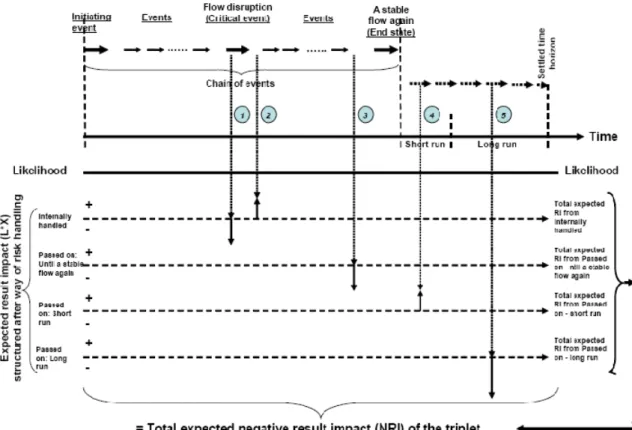
HAIN OF EVENTSDisruptions are often caused by a series of undesired events. It is possible that the initial events occur at a site not belonging to the most affected company. The complexity of today’s SCM often results in that one undesired event leads to another which finally leads to a critical event. Also, the critical event may be different for different companies, both in time and range. Even though the BCM organisation focuses on management of the critical event, effective BCM may be able to deal with the threat before it turns into a critical event. These different stages of a disruption and the chain of events are explained in Figure 5 below.
Furthermore, not all critical events lead to the activation of all of the three business continuity plans. E.g. in non life-threatening situations, like a disruption of deliveries from a supplier, there may be no need for ER.
Figure 5. Negative result impact of a disruption (Paulsson, 2007).
Consider a disruption in deliveries from the supplier of the critical component X. 1. Usage of alternative suppliers but at a higher price.
2. There is no supply of component X; hence no payment to the supplier is needed during this period.
3. Loss of sale revenues for the duration of the disruption.
4. In the short term, due to the lack of deliveries, customers will buy more than usual to restock items.
5. In the long run, revenues will fall as the market no longer regards the company as an equally reliable supplier as before the disruption.
3.3
S
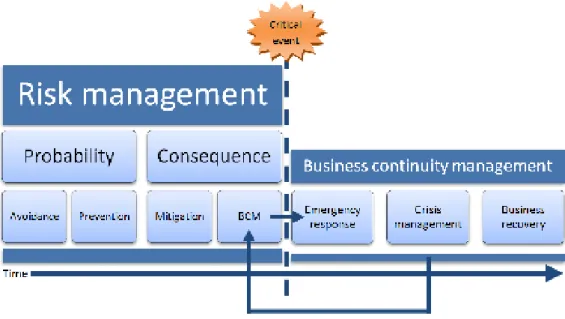
TRUCTURING THE CONCEPTSThe conclusion of the above discussion has resulted in the following model:
Figure 6. Risk management terminology.
Figure 6 shows the linkage of the different risk management terms and a hint on when they are exercised. It is to be noted that these elements often blur into each other, for example there are factors of probability reduction in BCM even though the main objective is to minimise the consequences. BCM can be seen as one part of risk management but there are some differences.
Applying risk management on Kaplan & Garrick’s definition of risk, it can be divided into minimising probability or consequence. The probability can be reduced by either avoiding the risk completely e.g. to withdraw a risk-prone product from the market or by preventing the risk from happening e.g. multiple sourcing to reduce the probability of supply disruptions. The consequence can be reduced by mitigating the risk by e.g. installing sprinkler protection in warehouses. This will not reduce the probability of a fire but will likely reduce the consequence of a fire.
When exercising risk management a company deals with specific risks that in one way or another have been identified during the process. If there is a cost-effective solution to deal with the risk, it will be managed accordingly e.g. sprinklers, safety equipment etc. However if a risk has not been identified it cannot be managed, or can it? This is where BCM steps in. Although identification is involved in BCM it aims to deal with any crisis situation disregarding of what risk has caused it to happen.