A University of Sussex DPhil thesis
Available online via Sussex Research Online:
http://sro.sussex.ac.uk/
This thesis is protected by copyright which belongs to the author.
This thesis cannot be reproduced or quoted extensively from without first
obtaining permission in writing from the Author
The content must not be changed in any way or sold commercially in any
format or medium without the formal permission of the Author
When referring to this work, full bibliographic details including the
author, title, awarding institution and date of the thesis must be given
Please visit Sussex Research Online for more information and further details
Expression and genetic manipulation of Bacillus thuringiensis toxins for improved toxicity and development of a protocol for in vivo selection of
toxin variants with improved activity
ZENAS OKON GEORGE
SUBMITTED FOR THE AWARD OF DEGREE OF DOCTOR OF PHILOSOPHY
DEPARTMENT OF BIOCHEMISTRY SCHOOL OF LIFE SCIENCES
UNIVERSITY OF SUSSEX
Declaration
WORK NOT SUBMITTED ELSEWHERE FOR EXAMINATION
I hereby declare that this thesis has not been submitted in whole or in part to this or any other University for the award of a degree.
--- Zenas Okon George
Abstract
Bacillus thuringiensis (Bt) and its insecticidal toxins have been used in pest
control for decades but there is a great concern about its future as a successful pest control agent due to the development of insect resistance and the narrow spectrum of activity of the toxins. To ensure the continuous relevance of Bt toxins in pest control, projects aimed at isolating novel Bt strains expressing toxins with improved activity are vigorously pursued and the genetic manipulation of existing toxins to improve their activity and overcome resistance is also undertaken. The aim of this project was to genetically manipulate the genes encoding Cry1Ah and Cry1Ie for improved activity aimed at countering resistance evolved by populations of Plutella xylostella. The project was also
aimed at expressing cry30Ea and cry40Da genes cloned from highly
mosquitocidal Bt strains S2160-1 and S2196 respectively and at developing a protocol for the in vivo selection of toxin variants with improved activity. Cry1Ah was successfully expressed in E. coli JM109 under the control of a cry1Ac
promoter and ribosome binding site and in Bt IPS/78/11 under the control of the
cyt1Aa promoter while Cry1Ie was also expressed in E. coli JM109. The
expressed Cry1Ah and Cry1Ie toxins were found to be toxic to both susceptible (G88) and Cry1A resisitant (KARAK) populations of Plutella xylostella though there was significant cross resistance to Cry1Ah in KARAK. A genetically manipulated hybrid toxin CryAIA aimed at creating a novel toxin that captures the relatively broad spectrum of Cry1Ah but overcoming KARAK resistance was
expressed but found to be non-toxic. Attempts to express cry30Ea and cry40Da
were also not successful despite utilising different hosts and expression vector
systems that have successfully been used in expressing other cry genes.
Meanwhile, the strategy designed to enrich for more toxic Bt strains in vivo in from a mixed treatment in fact found that the non-toxic R128M strain dominated the toxic 431 strain.
Acknowledgement
Special thanks to Dr. Neil Crickmore my main supervisor who has been outstanding in his guidance and support during this project. I also thank him for the opportunities he has given me to acquire experience from collaborating laboratories which has contributed immensely to the success of this project. My thanks also goes to my second supervisor Dr. Darren Thompson who has been supportive with very useful advice. I am also grateful to Dr. Ben Raymond for his input to the project and examination of this thesis.
Many thanks to Dr. Jie Zhang of Institute of Plant Protection, Beijing, China who has supplied most of the genes that have been used in this project. My thanks also goes to Changlong Shu and Dr. Fuping Song for their support while I was in Institute of Plant Protection, Beijing, China to carry out part of this project. The contribution of other collaborators like Dr. Sun Ming, Dr. Xuanjun Fang and Wenfei Zhang who supplied some of the genes used in this project is also appreciated.
My special thanks goes to my precious wife Mrs Uduak-Abasi George and my brilliant son Akwaeno-Abasi George whose support and encouragement have contributed immeasurably to the success of this project.
I am also indebted to Akwa Ibom State University of Technology (AKUTECH) for accepting to sponsor my studies at the University of Sussex.
Thanks to Vidisha, Ruchir, Dr. Ali Sayyed and Dr. Paul Johnston for their various contributions to the success of this project.
Dedication
I dedicate this project to Almighty God who has been immeasurably merciful to me and the family He has given me.
List of abbreviations
BBMV---Brush Border Membrane Vesicle bp---base pairs
BSA---Bovine Serum Albumin Bt---Bacillus thuringiensis o C---Degrees Celsius Cry---Crystal Cyt---Cytolytic kDa---kilo Dalton DNA---Deoxyribonucleic Acid DTT---Dithiothreitol
E. coli---Escherichia coli
g---gram
IPTG---Isopropyl β-D-1-thiogalactopyranoside L---Litre
LB---Luria Broth
LC50---Fifty percent Lethal Concentration
PAGE---Polyacrylamide Gel Electrophoresis PCR---Polymerase Chain Reaction
SDS---Sodium Dodecyl sulphate tRNA---transfer Ribonucleic Acid
List of tables and figures List of tables Table Number Title Page Number
2.1 PCR master mix recipe 46
3.1 Recipe of ligation mix for pGEM1AcP1Ie 61
3.2 The number of dead and live larvae from the
synergism studies between Cry1Ie and Cry1Ac toxins
64
3.3 Recipe for the ligation of DNA fragments to form
pGEM1AcPIAI expression vector
67
3.4 Recipe for ligation of DNA fragments to form
plasmid pSV21AcPIAI
71
3.5 Recipe for ligation of DNA fragments to form
plasmid pSVP271AcRBSIAI
74
3.6 Toxicity testing of Cry1Ie, Y442H, A522V and
Y442H+A522V against G88
89
4.1 Recipe of ligation mix for pGEM1AcP1Ah 98
4.2 Recipe for ligation of DNA fragments to form
plasmid pSVP271AcRBS1Ah
100
4.3 The number of dead and live larvae from the
synergistic studies between Cry1Ah and Cry1Ie toxins
105
4.4 Tabular presentation of primer pair and their PCR
product name and size including the template they are amplified from
List of tables continued
4.5 Recipe for the ligation of DNA fragments to form
pGEM1AcPAIA and pGEM1AcPIAA expression vectors
108
4.6 Recipe for ligation of DNA fragments to form
plasmid pSV21AcPIAA
115
4.7 Recipe for ligation of DNA fragments to form
plasmid pSVP271AcRBSIAA
118
5.1 BLASTP 2.2.24+ programme pair wise alignment
results of Cry30Ea1 deduced protein sequence with sequences of five members of Cry30 Cry toxins that has been heterologously expressed
127
5.2 BLASTP 2.2.24+ programme pair wise alignment
results of Cry40Da1 deduced protein sequence with sequences of two members of Cry40-toxins that have been heterologously expressed
128
5.3 Recipe of ligation mixes for pGEM1AcP30Ea or
40Da
130
5.4 Recipe for ligation of DNA fragments to form
plasmids pET3aBam30Ea and pET3aBam40Da
134
5.5 Summary of the changes in IPTG concentration,
temperature of growth after IPTG induction and
time of growth after IPTG induction and
characteristics of expressed proteins
141
5.6 Recipe for ligation of DNA fragments to form
plasmids pSV21AcP30Ea and pSV2AP40Da
143
5.7 Recipe for ligation of DNA fragments to form
plasmids pSVP271AcRBS30Ea and pSVP271AcRBS40Da
List of tables continued
5.8 Recipe for the ligation of Bam30Ea and Bam40Da
respectively to BamHI linearized p101Bam for the
formation of p101BamBam30Ea and
p101BamBam40Da plasmids
153
5.9 Recipe for ligation of DNA fragments to form
plasmids pET3a30Ea-4Aa and pET3a40Da-4Aa
158
5.10 Summary of the changes in IPTG concentration,
temperature of growth after IPTG induction and
time of growth after IPTG induction and
characteristics of expressed proteins
164
6.1 Quantification of spores/crystals in Cry+HD73/SV2,
Cry-HD73/SV2, Cry+HD73/pUBpUC, Cry
-HD73/pUBpUC
173
6.2 Types of Plutella xylostella treatment including
strains and quantity of spores/ml in each sample
174
6.3 Strains and number of cells recovered from
exposed larvae of Plutella xylostella
175
6.4 Dilutions of spore/crystal mixes of 431 and R128M 178
6.5 Tabular representation of the spores recovered
from larvae of Plutella xylostella exposed to varying concentrations of 431 or R128M
179
6.6 Tabular presentation of strains of Bt spores
recovered from dead larvae of Plutella xylostella infected with 431 and R128M at the ratios of 10,000:50,000 and 50,000:10,000
181
6.7 Tabular presentation of strains of Bt spores
recovered from dead larvae of Plutella xylostella infected with 431 and R128M at the ratios of 20,000:100,000 and 100,000:20,000
List of tables continued
6.8 Tabular presentation of strains of Bt spores
recovered from dead larvae of Plutella xylostella infected with 431 and R128M at the ratio of 5,000:5,000
183
6.9 Tabular presentation of strains of Bt spores
recovered from dead larvae of Plutella xylostella infected with 431 and R128M at the ratio of 10,000:10,000
184
6.10 Tabular presentation of strains of Bt spores
recovered from dead larvae of Plutella xylostella infected with 431 and R128M at the ratio of 100,000:100,000
185
6.11 Tabular presentation of strains of Bt spores
recovered from dead larvae of Plutella xylostella infected with 431 and R128M at the ratio of 200,000:200,000
186
6.12 Tabular presentation of strains of Bt spores
recovered from dead larvae of Plutella xylostella infected with 431 and R128M at the ratio of 1,000,000:1,000,000
187
6.13 Sum of all the spores of 431 and R128M recovered
from the different ratios of treatment
188
6.14 Display of the number of dead and live larvae from
the synergism studies between spores of 431,
R128M, Cry-IPS 78/11, Cry-HD73 and E. coli
JM109 expressed Cry1Ca
191
6.15 Tabular presentation of the expected and observed
mortality from the spore/crystal synergistic
experiments and the calculated P-values with their statistical significance
List of figures
Figure Number
Title Page
Number
1.1 3-D structure of Cry8Ea determined at 2.20Ǻ 27
1.2 Crystal structure of a monomer of Cyt2Ba
determined at 1.80Ǻ
28
1.3 Model of the mode of action of Cry1A toxins 31
3.1 Schematic of pGEM1Ac plasmid showing cry1Ac
coding sequence (green arrow), cry1Ac-ribosome
binding site (blue block) and promoter (red oval), origin of replication in E. coli (pink block) and ampicillin resistance gene (brown block)
59
3.2 Schematic of plasmid pETB-1IE 59
3.3 Schematic of the construction of the plasmid
pGEM1AcP1Ie
60
3.4 Gel picture showing the purified PCR fragments
of cry1Ie, pGEM1AcP and digestion of
pGEM1AcP1Ie extracted from E. coli JM109 with
EcoRI
62
3.5 Expressed Cry1Ie and its alkaline solubility and
trypsin activation characterisation
63
3.6 Multiple sequence alignment of segments of
Cry1Ie, Cry1Ia, Cry1Ba, and Cry1Ea protein sequences using ClustalW software
66
3.7 Schematic illustrating the construction of
pGEM1AcPIAI plasmid from 1AhDII and GEM1Ie DNA fragments
List of figures continued
3.8 Gel picture showing PCR products GEM1Ie,
1AhDII and confirmation of the presence of DNA fragment 1AhDII in pGEM1AcPIAI
69
3.9 Schematic showing the construction of the
plasmid pSV21AcPIAI
72
3.10 Schematic showing the construction of the
plasmid pSVP271AcRBSIAI
75
3.11 Multiple sequence alignment of Cry1Ab, Cry1Ac,
Cry1Aa and Cry1Ie protein sequences for determination of protease recognition sites after helix α-1 segments of their domain I
77
3.12 Schematic for the construction of the plasmid
pGEM1AcP1Ie∆
78
3.13 Gel picture of PCR product ligated to form the
plasmid pGEM1AcP1Ie∆ and confirmation of its formation by digesting a representative plasmid with EcoRI restriction enzyme
89
3.14 Expressed Cry1Ie∆ and its solubility and trypsin
characterization
80
3.15 SWISS-MODEL predicted 3D structure of Cry1Ie 82
3.16 Comparison of the secondary structures around
Y442H mutation in Cry1Ie and the corresponding region in Cry8Ea using PSIPRED programme
84
3.17 Comparison of the secondary structures around
Y442H mutation in Cry1Ie and the corresponding region in Cry8Ea using PSIPRED programme
85
3.18 3D structure of Cry1Ie showing the position of
Tyrosine-442
86
3.19 3D structure of Cry1Ie showing the position of
Alanine-522
List of figures continued
3.20 Gel picture of expressed Y442H, A522V and
Y442H+A522V
87
3.21 Gel picture of alkaline solubility and protease
digestion characterization of expressed Y442H, A522V and Y442H+A522V
88
4.1 Schematic representation of the plasmid
pSXY422-1Ah
96
4.2 Schematic for construction of plasmid
pGEM1AcP1Ah
97
4.3 Schematic showing the construction of the
plasmid pSVP271AcRBS1Ah
101
4.4 Gel picture showing the purified PCR fragments
of cry1Ah, pGEM1AcP, purified BamHI linearized
pSVP27, purified 1Ac-Ribosome binding
site/cry1Ah with BamHI overhangs, EcoRI
digested pGEM1AcP1Ah and
pSVP271AcRBS1Ah
102
4.5 Gel picture of Cry1Ah expressed in E. coli and Bt
and their alkaline solubility and trypsin activation
103
4.6 Multiple sequence alignment of segments of
Cry1Ah, Cry1Ia, Cry1Ba, and Cry1Ea protein sequences using ClustalW software
106
4.7 Schematic illustrating the construction of
pGEM1AcPAIA plasmid from 1IeDII and
GEM1Ahe DNA fragments
109
4.8 Gel picture showing PCR products GEM1Ah,
1IeDII, GEM1IeDI, 1AhDII_III, digestion of pGEM1AcPAIA and pGEM1AcPIAA plasmids to confirm the presence of DNA fragment 1IeDII in pGEM1AcPAIA and 1AhDII_III in pGEM1AcPIAA
List of figures continued
4.9 SDS-PAGE gel picture of expressed CryAIA, total
protein from E. coli JM109 strain harbouring plasmid pGEM1AcPIAA, alkaline solubility test and trypsin digestion of CryAIA
112
4.10 Schematic showing the construction of the
plasmid pSV2APIAA
116
4.11 Schematic showing the construction of the
plasmid pSVP271AcRBSIAA
119
4.12 Multiple sequence alignment of Cry1Ab, Cry1Ac,
Cry1Aa and Cry1Ah protein sequences for determination of protease recognition sites after helix α-1 segments of their domain I
121
4.13 Schematic for the construction of the plasmid
pGEM1Ah∆
122
5.1 Schematic illustrating the construction of
pGEM1AcP30Ea or pGEM1AcP40Da plasmids from the ligation of the PCR products of pGEM1AcP and 30Ea or 40Da
129
5.2 Picture of gel showing 30Ea, pGEM1AcP, EcoRI
digestion of pGEM1AcP30Ea, 40Da, EcoRI
digestion of pGEM1AcP40 plasmid
131
5.3 Picture of gel showing proteins from E. coli
JM109 harbouring plasmids pGEM1AcP30Ea or
pGEM1AcP40Da and total protein from E. coli
JM109 without the plasmids
132
5.4 Fused DNA sequence of the T7 leader peptide
and BamHI cloned Cry30Ea (A) and Cry40Da (B)
sequences and their corresponding amino acid sequences
List of figures continued
5.5 Schematic illustrating the construction of
plasmids pET3aBam30Ea or pET3aBam40Da
from ligation of BamHI linearised pET3a and
Bam30Ea or Bam40Da DNA fragments
135
5.6 Gel picture showing Bam30, Bam40, pET3a,
EcoRI digestion of pET3aBam30Ea and
pET3aBam40Da
136
5.7 SDS-PAGE gel picture of the induced and
non-induced strains of E. coli BL21 (DE3) harbouring plasmids pET3aBam30Ea and pET3aBam40Da
138
5.8 SDS-PAGE Gel picture showing alkaline
solubility and protease activation characterisation of the ~62kDa protein band
139
5.9 Schematic showing the construction of the
plasmids pSV2AP30Ea and pSV2AP40Da
144
5.10 Picture of gel showing total proteins from Bt IPS
78/11 strains harbouring pSV21AcP30 or
pSV21AcP40Da plasmids
145
5.11 Schematic showing the construction of the
plasmids pSVP271AcRBS30Ea and
pSVP271AcRBS40Da
148
5.12 Schematic for the construction of
p101BamBam30Ea and p101BamBam40Da
152
5.13 Gel picture showing the PCR products of
cry30Ea(2111bp), cry40Da(2020bp) and
p101Bam(6086bp) from primer pairs
Cry30_40F/Cry30_40R and
p101BamF/p101BamR
List of figures conttinued
5.14 Gel picture confirming the successful construction
of the plasmids p101Bam, p101BamBam30Ea and p101BamBam40Da
155
5.15 Picture of SDS-PAGE gel showing total proteins
from E. coli JM109 strains harbouring plasmids p101BamBam30Ea or p101BamBam40Da
156
5.16 Multiple sequence alignment indicating the ends
of Cry30Ea and Cry40Da and beginning of Cry4Aa C-terminal used in the fusion protein construction
157
5.17 Schematic illustrating the strategy used in the
construction of plasmids pET3a30Ea-4Aa or pET3a40Da-4Aa from ligation of pET3a30Ea or pET3a40Da to Cry4Aa C-terminal (4Aa)
160
5.18 SDS-PAGE picture of the induced and
non-induced strain of E. coli BL21 (DE3) harbouring the plasmid pET3a30Ea-4Aa
161
5.19 SDS-PAGE Gel picture showing the ~134kDa,
alkaline solubility and protease activation test
163
6.1 A bar graph for percentage of 431 and R128M
spores recovered from cacarvers of insects exposed to spore ratios of 1:1, 1:5 and 5:1
Table of contents Title page………1 Declaration……….2 Abstract………...3 Acknowledgement………...4 Dedication………..5 List of abbreviations………6
List of tables and figures………7
Chapter 1: Literature review, objectives and background to project...…...22
1.1 Literature review...22
1.1.1 Bacillus thuringiensis……….22
1.1.1.1 Discovery and habitat……….22
1.1.1.2 Growth and response to biotic and abiotic factors………22
1.1.1.3 Virulence and reproduction in insect host………...23
1.1.2 Bacillus thuringiensis insecticidal toxins……….24
1.1.2.1 Production, types and classification……….24
1.1.2.2 Structure of insecticidal toxins………..27
1.1.2.3 Mechanisms of action of Bacillus thuringiensis toxins…………..29
1.1.2.4 Toxicity to insect pests and application as biological control agent………32
1.1.2.5 Development of resistance and cross-resistance by insect pests to Bt toxins……….33
1.1.3 Strategies for improving toxicity and overcoming insect pests resistance Bt toxins………...35
1.1.3.1 Use of synergistic proteins, other toxins and spores………35
1.1.3.2 Domain and loop swapping………...36
1.1.3.3 Site directed mutagenesis……….37
1.1.3.4 Directed evolution………...38
1.1.3.5 Production of truncated toxins………..38
1.2 Objectives………...39
1.2.1 Overall objective……….…39
1.2.2 Specific objectives………..39 1.2.2.1 Design of expression systems for cry1Ah,cry1Ie,
cry30Ea and cry40Da genes……….…39
1.2.2.2 Assay the heterologously expressed toxins for insecticidal activity………..40
1.2.2.3 Genetical manipulation of the expressed toxins for desired activity………40
1.2.2.4 Using toxin pairs to conduct bioassay to check for synergism….40 1.2.2.5 Develop an in vivo protocol for enriching for Bt strains expressing more active toxins………41
1.3 Background to project……….………..41
Chapter 2: Materials and Methods………44
2.1 Materials……….44
2.1.1 Plasmids……….44
2.1.2 Bacterial strains……….44
2.1.3 Insect populations……….………….45
2.1.4 Culture media and insect food……….45
2.2 Methods………..45
2.2.1 Design of primers for DNA amplification……….…………45
2.2.2 PCR amplification of DNA……….…45
2.2.3 Purification of DNA from agarose gels………46
2.2.4 Transformation of Bacterial strains with plasmids……….47
2.2.4.1 Transformation of E. coli strains...…...47
2.2.4.2 Transformation of Bt strains………...………..47
2.2.5 Rapid size screening of E. coli transformants………48
2.2.6 Extraction of plasmid DNA from transformed bacterial strains………...49
2.2.6.1 Extraction of plasmid from E. coli transformants………..49
2.2.6.2 Extraction of plasmid from Bt transformants………..49
2.2.7 Digestion of extracted plasmid DNA with restriction enzymes…………50
2.2.8 Expression and harvesting of protein and quantification of protein and spores……….…..50
2.2.8.1 Expression and harvesting of protein from E. coli JM109………50
2.2.8.2 Expression and harvesting of protein from E. coli BL21 (DE3)…51 2.2.8.3 Expression and harvesting of protein from Bt…………….51
2.2.8.5 Quantification of spores……….52
2.2.9 Characterisation of expressed proteins……….53
2.2.9.1 Alkaline solubility………53
2.2.9.2 Protease activation………53
2.2.10 Preparation of insect diets………..54
2.2.11 Maintenance of Plutella xylostella populations on artificial diets and cabbage (Brassica pekinensis) plants………..…55
2.2.12 Bioassay of expressed proteins (toxins) and or spores against Plutella xylostella……….………..55
2.2.12.1 Leaf dip assays………...55
2.2.12.2 Diet dip assays………56
Chapter 3: Expression, manipulation and characterization of Cry1Ie toxin……….57
3.1 Introduction……….57
3.2 Results……….58
3.2.1 Construction of a plasmid for the expression of the cry1Ie gene…...…58
3.2.2 Expression and characterisation of Cry1Ie protein………..62
3.2.3 Toxicity testing of Cry1Ie against populations of Plutella xylostella…..63
3.2.4 Synergistic studies between Cry1Ie and Cry1Ac toxins………..63
3.2.5 Mutagenesis of Cry1Ie………..65
3.2.5.1 Swapping domain II of Cry1Ie with domain II of Cry1Ah………..65
3.2.5.2 Truncation of N-terminal α-helix………76
3.2.5.3 Site directed mutagenesis……….81
3.3 Discussion………..89
Chapter 4: Expression, manipulation and characterization of Cry1Ah toxin...94
4.1 Introduction……….94
4.2 Results……….95
4.2.1 Construction of plasmid for expression of Cry1Ah in E. coli…….……..95
4.2.2 Construction of plasmid for expression of Cry1Ah in Bt………………..98
4.2.3 Expression and characterisation of Cry1Ah protein………...102
4.2.5 Synergistic studies between Cry1Ah and Cry1Ie toxins………104 4.2.6 Manipulation of Cry1Ah for improved activity………..105 4.2.6.1 Swapping domain II of Cry1Ah with domain II of Cry1Ie
and domain I of Cry1Ah with domain I of Cry1Ie………...105 4.2.6.2 Truncation of N-terminal α-helix………120 4.3 Discussion………123
Chapter 5: Attempting expression of coding sequences for cry30Ea
and cry40Da toxin genes………..126
5.1 Introduction………...126 5.2 Results………..126 5.2.1 Bioinformatics analysis of cry30Ea and cry40Da DNA and
deduced amino acid sequences………126 5.2.2 Exploring different expression vector systems and hosts……….128 5.2.2.1 Utilizing native cry1Ac-promoter with pGEM vector
backbone and E. coli JM109 as host………128
5.2.2.2 Utilising pET3a vector and E. coli BL21 (DE3) as host………..132
5.2.2.3 Utilising cry1Ac-promoter with Bt shuttle vector pSV2
backbone and IPS 78/11 acrystalliferous Bt as host………….142 5.2.2.4 Utilising cyt1A-promoter of plasmid pSVP27 and IPS 78/11
acrystalliferous Bt as host………..…….………146
5.2.2.5 Replacing ORF-2 of cry41A operon with the coding sequence of cry30Ea or cry4Da with E. coli JM109
as host………149 5.2.2.6 Coupling the coding sequence of cry30Ea and cry40Da
at the C-terminal end to the C- terminal of cry4A to make a hybrid gene using the pET3aBam30Ea or
pET3aBam40Da plasmids and E. coli BL21 (DE3) as host…..156 5.2.2.7 Attempting co-expression of cry30Ea and cry40Da
genes in crystal toxin producing strain of Bt……….165
5.3 Discussion………166
Chapter 6: Development of a protocol for in vivo selection of toxin
variants with improved activity………...169
6.1 Introduction………...169 6.2 Single and mixed treatment of Plutella xylostella with crystal
and non-crystal producing Bt strains and selection of spores
from dead and living larvae………..172 6.3 Single and mixed treatment of Plutella xylostella with toxic and
non-toxic crystal producing Bt strains and selection of spores
from dead and living larvae………..176
6.4 Synergism between spores from 431 and E. coli expressed Cry1Ca;
spores from R128M and E. coli expressed Cry1Ca; spores from Cry
IPS 78/11 and E. coli expressed; Cry-HD73 and E. coli expressed
Cry1Ca………..190 6.5 Discussion………192
Chapter 7: General discussion and further work………196
7.1 General discussion……….196 7.2 Further work……….199
References………200
Appendices………...242 Appendix 1: BLASTP 2.2.24+ pairwise alignment between
Cry8Ea and Cry1Ie sequences….………242 Appendix 2: SWISS-MODEL secondary structure predictions
for Cry1Ie and 3eb7B……….……….244 Appendix 3: Pairwise sequence alignments between Cry30Ea
and other Cry30 toxins………247 Appendix 4: Pairwise sequence alignments between Cry40Da
Chapter 1: Literature review, objectives and background to project 1.1 Literature review
1.1.1 Bacillus thuringiensis
1.1.1.1 Discovery and habitat
Bacillus thuringiensis (Bt) was originally discovered in 1902 by a Japanese
biologist Shigetane Ishiwatari who isolated it from diseased silkworm, Bombyx
mori, but it was formally characterised in 1915 by Ernst Berliner of Germany
who isolated it from diseased larva of Ephestia kuhniella (flour moth caterpillars) in Thuringia province and linked it to the cause of a disease called Schlaffsucht (Milner 1994). Bacillus thuringiensis is a Gram positive spore forming bacteria
grouped into the Bacillus cereus group of Bacilli which produces proteinaceous
insecticidal crystals during sporulation which is the distinctive feature between it and other members of the Bacillus cereus group (Read et al., 2003, Rasko et al., 2005).
The habitat of Bacillus thuringiensis is not distinct but ubiquitous as the bacteria has been isolated from soil (Hernández-Rodríguez and Ferré, 2009, Muleta et al., 2009, Patel et al., 2009, Saadaoui et al., 2009, Vidal-Quist et al., 2009, Baig
et al., 2010, Bozlaǧan et al., 2010, Gobatto et al., 2010), faecal material of
herbivorous animals (Maheswaran et al., 2010), phylloplanes (Bizzarri and Bishop, 2008, Tilquin et al., 2008, Noda et al., 2009, Zhang et al., 2009, Zhang
et al., 2010), food material (De Santis et al., 2008, Ankolekar et al., 2009),
rhizozphere (Muleta et al., 2009), dust (Hernández-Rodríguez and Ferré, 2009),
insects (Gobatto et al., 2010) and sea sediment (Baig and Mehnaz, 2010).
1.1.1.2 Growth and response to biotic and abiotic factors
Bacillus thuringiensis readily proliferates when environmental conditions like
temperature and nutrients availability are favourable whilst the formation of spores have been shown to be triggered by internal and external factors including signals for nutrient starvation, cell density, and cell cycle progression (Hilbert and Piggot, 2004). The life cycle of Bt can be divided for convenience into phases and these are Phase I: vegetative growth; Phase II: transition to sporulation; Phase III: sporulation; and Phase IV: spore maturation and cell lysis (Hilbert and Piggot, 2004, Berbert-Molina et al., 2008). Though strains of
proliferation in these samples is rather unclear as the most prevailent form
isolated from most of these sources are dormant spores (Ankolekar et al., 2009,
Muleta et al., 2009, Vidal-Quist et al., 2009, Baig et al., 2010, Baig and Mehnaz, 2010, Bozlaǧan et al., 2010, Gobatto et al., 2010, Lietze et al., 2010).
It has been shown that Bt is a pathogen in its own right and that its primary
means of reproduction is in insect cadavers (Raymond et al., 2010). Outside its
primary means of reproduction (insect cadavers) Bacillus thuringiensis has been shown to be a poor competitor with other bacteria. Bizzarri and Bishop, (2008), demonstrated that Bt strains isolated in the vegetative form from the phylloplane of clover, 2810-S-4, and a laboratory strain, HD-1, were able to colonize clover to a density of about 1000 CFU/g of leaf when seeds were sown in sterile soil but only to a density of about 300 CFU/g of leaf in nonsterile soil showing about two-third reduction in population density. In another example,
Pseudomonas fluorescens had the most significant antagonistic effect on the
proliferation of Bacillus thuringiensis among seven other native soil bacterial isolates out of ten that showed various antagonistic effect on Bt (Rojas-Ruíz et al., 2010). Jarosz, 1970 demonstrated that gut bacteria of Galleria mellonella
larva, mainly dominated by Streptococcus faecalis, suppressed the proliferation
of bacteria ingested with food (including Bacillus thuringiensis) through the production of bacteriocin. Takatsuka and Kunimi, 2000 showed that Bacillus
thuringiensis was only able to proliferate in the gut of oriental tea tortrix,
Homona magnanima Diakonoff when reared aseptically but fail to proliferate in
normally reared larval cadavers. Raymond et al., 2008b demonstrated that
Bacillus thuringiensis showed an increased growth in the larva of Plutella
xylostella when its groups member Bacillus cereus was present and further
showed that the antibiotic producing Bacillus cereus strains suppressed the growth of other Plutella xylostella gut flora.
1.1.1.3 Virulence and reproduction in insect host
Bacillus thuringiensis has been tagged ‘an impotent pathogen’ because of its
opportunistic pathogen behaviour under appropriate conditions based on the fact that Bt strains have been isolated from environments where their target insect are not normally associated with (Raymond et al., 2010) and the supposed need for gut flora in Bt toxicity (Broderick et al, 2009). Nevertheless,
Bt is well equipped as a pathogen that is capable to single handedly bypass the barriers posed by insects against bacterial infection (Ha et al., 2005a, Ha et al., 2005b, Vallet-Gely et al., 2008). It has been shown that Bt produces virulence factors like phospholipases C (Palvannan and Boopathy, 2005, Martin et al., 2010b), proteases (Hajaij-Ellouze et al., 2006, Brar et al., 2009, Infante et al., 2010) and hemolysins (Gominet et al., 2001, Nisnevitch et al., 2010). The virulence factors listed above are controlled by the pleiotropic regulator PlcR
and it has been demonstrated that cytotoxicity of Bt is PlcR dependent
(Ramarao and Lereclus, 2006). Deletion of the plcR gene has been shown to result in a drastic reduction in the virulence of Bt in orally infected insects (Salamitou et al., 2000). The production of virulence factors by Bt is necessary but not enough for Bt to be called a pathogen (Fedhila et al., 2003) but its production of proteins that have been proved beyond doubt to be independently insecticidal justifies it’s name as an insect pathogen (Frankenhuyzen, 2009).
Bacillus thuringiensis exerts its toxicity through a multistep process that involves
the solubilisation of Bt insecticidal crystal toxin in the insect midgut to release protoxins leading to the N-terminal and C-terminal cleavage of the protoxin by midgut proteases yielding an activated protease resistant core of about 60-70kDa (Bravo et al., 2007). The activated toxin now bind to specific receptors which induces toxin insertion into the midgut epithelium columnar cells (Gomez
et al., 2007). Toxin insertion leads to the formation of lytic pores in microvilli of
apical membranes (Bravo et al., 2007). Subsequently, cells lyse and disruption
of the midgut epithelium releases the cell content providing Bacillus
thuringiensis spores a germinating medium leading to a severe septicaemia and
insect death (de Maagd et al., 2001, Bravo et al., 2007).
1.1.2 Bacillus thuringiensisinsecticidal toxins 1.1.2.1 Production, types and classification
The life cycle of Bt has been shown to proceed through Phase I: vegetative growth; Phase II: transition to sporulation; Phase III: sporulation; and Phase IV: spore maturation and cell lysis (Hilbert and Piggot, 2004, Berbert-Molina et al., 2008) and the production of insecticidal proteins deposited in crystals in the mother cell have been shown to mainly start from the onset of sporulation (Sedlak et al., 2000, Xia et al., 2005, Guidelli-Thuler et al., 2009, Pérez-García
et al., 2010). cry-genes have been shown to be transcribed from two overlapping promoters BtI and BtII by RNA polymerase that contain sporulation dependent sigma factors σE and σK (Sedlak et al., 2000, Hilbert and Piggot,
2004) and a mutation in the consensus region of σE has been shown to inhibit
transcription from BtI and BtII promoters (Sedlak et al., 2000). It has also been shown that some Bt insecticidal proteins are produced and secreted into the
culture medium during vegetative growth (Estruch et al., 1996, Donovan et al.,
2001, Shi et al., 2004, Bhalla et al., 2005, Leuber et al., 2006, Milne et al., 2008, Singh et al., 2010a, Abdelkefi-Mesrati et al., 2011).
It has been shown that in some strains of Bt, the crystal proteins are localised
on the surface of spores of mother cells (Wojciechowska et al., 1999) while others are released from the mother cell spores after sporulation. Du and Nickerson, 1996 demonstrated that purified spores from a strain producing Cry1Ac toxin was able to cross-react with antibodies raised using a 65kDa protease activated core protein of Cry1Ac. Purified spores from crystal producing strains of Bacillus thuringiensis have been found to be lethal to insect pest though at a lower degree compared to the lethality of the crystal protein
(Johnson and McGaughey, 1996, Tang et al., 1996, Johnson et al., 1998).
The insecticidal proteins in the crystalline bodies produced during sporulation have been shown to contain two types of insecticidal proteins namely Cry toxins and Cyt-toxins and there are between one to five Cry toxins produced and packaged into a single crystal or multiple crystals by a Bt strain (de Maagd et al., 2001). The Cry toxins acquired the mnemonic Cry from the fact that they are found in the crystal while the Cyt-toxins acquired the mnemonic Cyt because of their in vitro cytolytic activity (Crickmore et al., 1998).
Schnepf and Whiteley, 1981, confirmed that the insecticidal ability of Bt is as a result of the proteins that it produces by cloning and heterologously expressing the first toxin gene in E. coli which showed insectidal activity to Manduca sexta just as the wild type Bacillus thuringiensis var. kurstali HD-1 that it was cloned from did. Since this discovery, a great number of other genes have cloned and expressed and the process of Bt toxin gene discovery is still ongoing. In order to
differentiate between one Bt insecticidal gene and the other, the discoverers of
the genes gave them arbitrary names like 4.5, 5.3 and 6.6-kb-class genes (Kronstad and Whiteley, 1986), bta gene (Sanchis et al., 1989), cry gene
(Donovan et al., 1988) and Type A and Type B (Hofte et al., 1988) among others. With a steady growth in the number of cloned and characterised novel insecticidal genes coming through, an attempt was made to organise the ever growing data. The first attempt to produce an organised systematic
nomenclature of Bt insecticidal genes was dependent on the insecticidal activity
of the protein they code for to assign a primary rank to the gene and with this system, genes that encode proteins toxic to lepidopteran insects were called cryI genes, while lepidopteran and dipteran protein genes were called cryII
genes, cryIII genes were those ones that encoded proteins toxic to coleopterans
and cryIV genes encoded proteins toxic to dipterans alone (Hofte and Whiteley,
1989). Though this system provided a framework for naming newly cloned novel toxins, it was short of a robust system of nomenclature that is able to accommodate new genes without ambiguity. The discovery of wild type gene like cryIB that code for toxins that are toxic to both lepidoptera and coleoptera (Bradley et al., 1995) throw the system off balance as it did not have room to accommodate a toxin with such spectrum of activity. Also, toxins like CryIC that had toxicity to both dipterans and lepidopterans (Smith and Ellar, 1994) did not have a place in the (Hofte and Whiteley, 1989) system of nomenclature.
With the difficulty of accommodating newly discovered genes in the (Hofte and Whiteley, 1989) nomenclature system arising, there was a need to come up
with a robust system of nomenclature and Crickmore et al., 1998 came up with
a system that is based on sequence similarity rather than function based. In the Crickmore et al, system, the mnemonic root was combined with a series of numerals and letters assigned in a hierarchical fashion to indicate degrees of phylogenetic divergence which was estimated by phylogenetic tree algorithms.
The mnemonic Cyt was used for parasporal crystal proteins from Bacillus
thuringiensis that exhibits hemolytic activity or any protein that has obvious
sequence similarity to a known Cyt protein and mnemonic Cry was assigned to a parasporal crystal proteins from Bacillus thuringiensis that exhibits some experimentally verifiable toxic effect to a target organism, or any protein that has obvious sequence similarity to a known Cry protein. With this system for naming Cry and Cyt proteins widely accepted, it has also been adopted for the naming of the vegetatively produced Bacillus thuringiensis toxins and this family
cyt and vip cloned genes has been established and is frequently updated as new genes are discovered.
1.1.2.2 Structure of insecticidal toxins
The 3-D crystal structure of Cry-proteins including coleopteran specific Cry8Ea1
(Guo et al., 2009), Cry3Aa (Li et al., 1991) and Cry3Bb (Galitsky et al., 2001),
dipteran specific Cry4Aa (Boonserm et al., 2006) and Cry4Ba (Boonserm et al.,
2005), lepidopteran specific Cry1Aa (Grochulski et al., 1995),
lepidopteran/dipteran specific Cry2Aa (Morse et al., 2001) have been resolved through X-ray crystallographic methods of their activated forms. Also, the 3-D structure of Cyt-proteins have been resolved including activated Cyt2Ba (Cohen
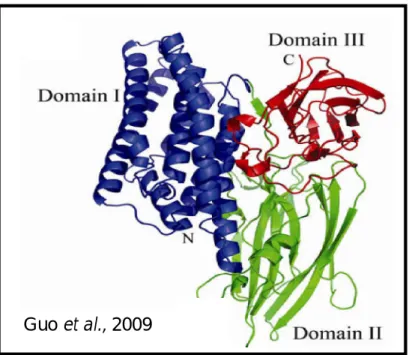
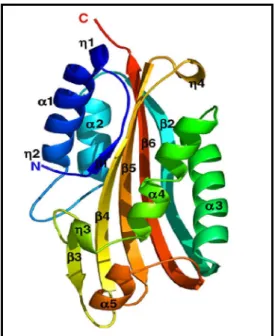
et al., 2008) and unprocessed Cyt2Aa (Li et al., 1996). Figure 1.1 is the crystal
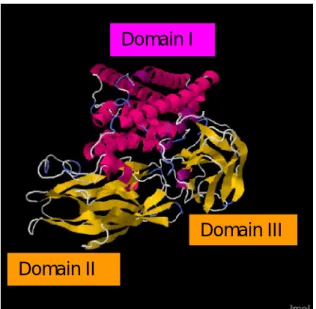
structure of Cry8Ea1 (Guo et al., 2009) showing the three domain organisation
typical of all resolved 3-D structures of Cry toxins while figure 1.2 is the 3-D structure of Cyt2Ba which shows overall similarity to 3-D structure of Cyt2Aa that had previously been resolved.
Figure 1.1: 3-D crystal structure of Cry8Ea determined at 2.20Ǻ (PBD ccode: 3EB7). The three domains of the protein are represented with different colours with domain I coloured blue, domain II coloured green while domain III is coloured red
Figure 1.2: Crystal structure of a monomer of Cyt2Ba determined at 1.80Ǻ (PDB code: 2RCI). The ‘rainbow’ colouring scheme is used in colouring the molecule starting with blue at the N-terminal and ending with red at the C-terminal
Though different Cry toxins have been shown to have specific targets in their insecticidal activity, the overall 3-D fold of many of them has been shown to be
the same (see figure 1.1) , comprising of three domains (de Maagd et al., 2003).
Domain I has been shown to compose of seven α-helices in which the central helix-α5 is hydrophobic and is encircled by six other amphipathic helices. The helical domain I has been shown to share structural similarities with other pore forming bacterial toxins like cytolycin A (Mueller et al., 2009), diphtheria toxin and colicin A (Parker and Pattus, 1993). Each of the outer helices of domain I is known to be amphipathic in nature and most of the helices are longer than 30Ǻ in length (Pigott and Ellar, 2007). Domain II is made up of three antiparallel β-sheets packed together to form a β-prism with pseudo three-fold symmetry (Li
et al., 1991). Two of the sheets are composed of four strands in a Greek key
motif and are solvent exposed (Boonserm et al., 2006). The third sheet packs against domain I and is arranged in a Greek-key-like motif with three strands and a short alpha-helix (Pigott and Ellar, 2007). The structure of domain II has been compared to those of other β-prism proteins with carbohydrate-binding
properties (de Maagd et al., 2003), including vitelline (Shimizu et al., 1994) and
Maclura pomifera agglutinin (Lee et al., 1998) and it reveals a great topological
similarity. Domain III has been shown to contain two antiparallel β-sheets that adopt a β-sandwich fold with the jelly roll topology (Boonserm et al., 2006). Both sheets are composed of five strands, with the outer sheet facing the solvent and the inner sheet packing against domain II. Two long loops extend from one end of the domain and interact with domain I (Grochulski et al., 1995). Domain III shows less structural variability than domain II, and the main differences are
found in the lengths, orientations, and sequences of the loops (Boonserm et al.,
2005). Domain III has been compared to other carbohydrate-binding protein domains and it shows great degree of similarity (de Maagd et al., 2003) and similarity of domain III was also found with those of domain 4 of the pore-forming toxin aerolysin which is involved in maintenance and stability of the heptameric toxin complex (Lesieur et al., 1999).
1.1.2.3 Mechanisms of action of Bacillus thuringiensis toxins
Proposed mechanisms of action of Cry and Cyt toxins from Bt include pore formation in which Bt toxins induce cell death by forming ionic pores following insertion into the membrane, causing osmotic lysis of midgut epithelial cells in their target insect (Knowles and Ellar, 1987, Haider and Ellar, 1989, Grochulski
et al., 1995, Schnepf et al., 1998, Bravo et al., 2004, Rausell et al., 2004). Also,
a relatively new mechanism of action of Cry toxins have been proposed which involves the activation of Mg2+-dependent signal cascade pathway that is triggered by the interaction of the monomeric 3-domain Cry toxin with the primary receptor, the cadherin protein BT-R1 (Zhang et al., 2005, Zhang et al.,
2006, Soberón et al., 2009). The trigerring of the Mg2+-dependent pathway has
a knock-on effect and initiates a series of cytological events that include membrane blebbing, appearance of nuclear ghosts, and cell swelling followed
by cell lysis (Zhang et al., 2006). The Mg2+-dependent signal cascade pathway
activation by Cry toxins have been shown to be analogous to similar effect imposed by other pore forming toxins on their host cells when they are applied at subnanomolar concentration (Parker and Pattus, 1993, Nelson et al., 1999, Menzies and Kourteva, 2000, Soberon et al., 2009, Porta et al., 2011).
Though the two mechanisms of action seem to differ, with series of downstream events following on from toxin binding to receptors on target cell membranes, they all agree to the fact that the toxins initially would have to be solubilised in an alkaline environment in vivo (Aronson et al., 1991, de Maagd et al., 2001, Soberon et al., 2009) or in vitro (Lambert et al., 1992, Bradley et al., 1995, Zhang et al., 2005, Zhang et al., 2006) and activated by proteases before (Zhang et al., 2005, Zhang et al., 2006) or after binding (Gómez et al., 2002, Bravo et al., 2004, Jiménez-Juárez et al., 2007, Soberon et al., 2009) to receptors like cadherins. The midgut of lepidopteran and dipteran insects have been shown to be alkaline (Berebaum, 1980, Gringorten et al., 1993) and it enhances the solubility of Cry toxins (Bravo et al., 2004, Soberon et al., 2009) and those of coleopteran are neutral or slightly acidic and in vitro solublisation of Cry1Ba (Bradley et al., 1995) and Cry7Aa (Lambert et al., 1992) has been shown to enhance their activity to Leptinotarsa decemlineata.
With the pore forming model (Knowles and Ellar, 1987, Haider and Ellar, 1989, Grochulski et al., 1995, Schnepf et al., 1998, Bravo et al., 2004, Rausell et al., 2004), an ingested crystal toxin is solubilised in the alkaline environment of the insects midgut releasing protoxins which are initially processed by midgut proteases. The initial cleavage of the protoxin by the gut proteases results in the removal of the the C-terminal half and about 30 amino acid residues from the N-terminal thus releasing active toxin monomers which bind to receptors such as cadherin (Atsumi et al., 2008, Bel et al., 2009, Chen et al., 2009, Fabrick et al., 2009a, Muñóz-Garay et al., 2009, Obata et al., 2009, Pacheco et al., 2009a, Arenas et al., 2010) or proteins anchored to the membrane by GPI-anchored
proteins such as aminopeptidase N (Arenas et al., 2010). The initial binding of
the activated toxins to receptors results in their conformational changes which facilitates a second cleavage that removes the N-terminal helix α-1, by membrane-bound protease. The removal of helix α-1 results in the formation of
oligomers that are the membrane insertion competent (Bravo et al., 2004). The
binding of Cry toxins to the cadherin-like receptors have been shown to involve specific interactions of the variable loop regions in domain II and III with cadherin epitopes (Nair et al., 2008, Chen et al., 2009, Pacheco et al., 2009a, Soberon et al., 2009).
The oligomerised activated toxin that is bound to membrane receptors then insert the central hydrophobic helix α-4 and 5 (Nair et al., 2008) into the apical membrane of midgut cells causing osmotic shock, bursting of the midgut cells and finally ending in the insect death (Knowles and Ellar, 1987, Haider and Ellar, 1989, Grochulski et al., 1995, Schnepf et al., 1998, Bravo et al., 2004, Rausell
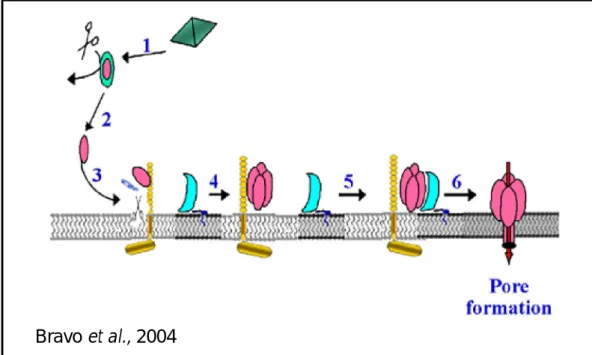
et al., 2004). The pore formation model as proposed by Bravo et al., 2004 for
Cry1A toxins is presented in figure 1.3.
Figure 1.3: Model of the mode of action of Cry1A toxins 1: Crystal toxin solubilisation
2: Initial cleavage by gut proteases
3: Active toxin monomer binding to receptors and second cleavage by membrane bound proteases
4: Membrane insertional competent oligomer formation 5: Binding of oligomeric toxin to receptors
6: Lytic pore formatio Bravo et al., 2004
Cyt-toxins have also been shown to effect killing of its insect targets through unspecific binding to midgut membrane lipids followed by membrane insertion which leads to pore formation and insect death (Li et al., 1996, Cohen et al., 2008, Zhao et al., 2009, Rodriguez-Almazan et al., 2011).
The activation of Mg2+-dependent signal cascade pathway that is triggered by the interaction of the monomeric 3-domain Cry toxin with the primary receptor, the cadherin protein (Zhang et al., 2005, Zhang et al., 2006, Soberón et al., 2009) has been shown to trigger a pathway involving stimulation of the stimulatory G protein α-subunit and adenylyl cyclase (AC), increased cyclic adenosine monophosphate (cAMP) levels, and activation of protein kinase A (PKA). Activation of the AC/PKA signalling pathway initiates a series of cytological events that include membrane blebbing, appearance of nuclear ghosts, and cell swelling followed by cell lysis (Zhang et al., 2005, Zhang et al., 2006).
1.1.2.4 Toxicity to insect pests and application as biological control agent
With specific insecticidal effect of Bt toxins to insect pests in the orders Coleoptera (beetles and weevils) (López-Pazos et al., 2010, Sharma et al., 2010), Diptera (flies and mosquitoes) (Pérez et al., 2007, Roh et al., 2010), Hymenoptera (bees and wasps) (Garcia-Robles et al., 2001, Sharma et al., 2008), Lepidoptera (butterflies and moths) (Baig et al., 2010, Darsi et al., 2010) and non-insect species such as nematodes (Cappello et al., 2006, Hu et al., 2010), Bt toxins have taken centre stage as the major biological control agent
because genetically modified crops expressing Bt toxins and insectides
formulated from Bt products are widely used and accepted. As published in the
International Service for the Acquisition of Agri-biotech Applications (ISAAA), website (http://www.isaaa.org/), there is an increase to more than 1 billion hectres of accumulated GM crops between 1996 that they were commercialised to 2010 that the findings was published.
The increased popularity of biological control agents over synthetic chemicals because of the unselective lethal effect of chemical insecticidal agents (Moser and Obrycki, 2009, Kristoff et al., 2010, Shah and Iqbal, 2010, Eriksson and Wiktelius, 2011, Stevens et al., 2011) and the development of resistance
(Ahmad et al., 2008) has led to intense research in the isolation of new Bt strains, cloning of novel insecticidal protein genes and manipulation of existing ones to cope with emerging concerns on the future of Bt as biological control agent like the development of resistance (Pereira et al., 2008, Gong et al., 2010) or cross-resistance (Sayyed et al., 2008, Xu et al., 2010) and its narrow spectrum of activity (Kao et al., 2003, Shu et al., 2009).
Currently, about 600 insecticidal genes have been cloned from various Bt
strains and deposited at the Bt toxin nomenclature website
(http://www.lifesci.sussex.ac.uk/home/ Neil_Crickmore/Bt/) and out of these, a greater number have been heterologously expressed and found to be either independently (Song et al., 2003, Gonzalez-Cabrera et al., 2006, Ibargutxi et al., 2008, Xue et al., 2008, Hu et al., 2010) or in combination (Sharma et al., 2010) toxic to insect species in one or more orders.
Bacillus thuringiensis and its insecticidal toxins have been used directly in the
form of sprays (Ali et al., 2010) or transgenic plants (Barton et al., 1987, Vaeck
et al., 1987, Qaim and Zilberman, 2003, Walter et al., 2010, Chen et al., 2011)
or indirectly (Hutchison et al., 2010) as pesticidal agents to improve yields of agricultural crops.
Various assessments have been carried out to check for the safety of Bt toxins
from sprays or transgenic plants to non-target species in the environment and it has been shown to be mostly environmentally friendly without known adverse effects (Kapur et al., 2010, Walter et al., 2010, Chen et al., 2011, Randhawa et al., 2011) though there is a laboratory observation that seem to implicate a commercial Bt strain aizawai in the reduction of reproduction in bumblebee
(Bombus terrestris) workers when applied at a concentration of 0.1% through
sugar water and pollen (Mommaerts et al., 2010).
1.1.2.5 Development of resistance and cross-resistance by insect pests to toxins
The continuous relevance of Bt toxins in the control of insect and non-insect pests is threatened by the development of resistance by the pests in the field (Sayyed et al., 2004) and laboratory reared populations (Pereira et al., 2008, Fabrick et al., 2009b). There have also been reports of insect populations resistant to a particular toxin showing resistance to other toxins that they have
not previously been exposed to a term known as ‘cross-resistance’ (Pereira et al., 2008, Sayyed et al., 2008, Gong et al., 2010, Xu et al., 2010).
The development of resistance to a toxins in the Cry1A group is of great
economic importance because most commercialised Bt based insecticides
contains Bt strains that naturally expressed Cry1A toxins or are engineered to do so (Ahmedani et al., 2008).
There have been a number of proposed modes of resistance of insect pests to Bt toxins including reduction of binding of toxins to receptors in the midgut of insects, reduced solubilisation of protoxin, alteration of proteolytic processing of protoxins and toxin degration and or precipitation by proteases (Bruce et al.,
2007). The understanding of the mechanism of action of Bt toxins (Knowles and
Ellar, 1987, Haider and Ellar, 1989, Grochulski et al., 1995, Schnepf et al., 1998, Bravo et al., 2004, Rausell et al., 2004) have enhanced the experimental verification of some of the modes.
The most studied and experimentally verified mode of resistance is ‘mode 1’ which is characterized by recessive inheritance, resistance to and reduced binding by at least one Cry1A toxin, and negligible cross-resistance to Cry1C (Tabashnik et al., 1998, Sayyed et al., 2004, Heckel et al., 2007). Cry1Ac and Cry1Ab toxins were shown to have a specific binding of 8 and 15% respectively to brush border membrane vesicles from a Cry1A toxin sensitive population of
Plutella xylostella (LAB-UK) but these specific bindings were reduced to 0.6 and
1% respectively with brush border membrane vesicles prepared from a field population of Plutella xylostella (Karak) that has developed resistance to Cry1Ac toxin (Sayyed et al., 2004). In another example of Plutella xylostella development of resistance to Bt toxins through reduced binding of toxins to
receptors on its brush border membrane vesicles, Tabashnik et al., 1994
demonstrated that a Cry1Aa, Cry1Ab, Cry1Ac, Cry1Fa and Cry1Ja resistant
population of Plutella xylostella (NO-QA) showed a reduced binding to Cry1Ac.
Kranthi, et al, 2006 demonstrated that a Cry1Ac sensitive strain of cotton bollworm, Helicoverpa armigera SUS-G was able to inherit resistance from
Cry1Ac resistant strains RES-Bt and RES-Ac. Gonzalez-Cabrera et al, 2003
showed that brush border membrane vesicles from Cry1Ac resistant pink bollworm (Pectinophora gossypiella) did not bind to Cry1Ab which has been shown to have a common binding site as Cry1Ac. There have been other
reports implicating alteration in midgut proteins that bind to Cry toxins mutating
and resulting in reduced binding (Jurat-Fuentes and Adang, 2006, Wang et al.,
2007, Fabrick et al., 2009a).
Alteration of protease profile in the midgut of Cry1Ac resistant Helicoverpa
armigera affected the proteolytic processing of Cry1Ac resulting in the
production of 95 and 68kDa toxin as opposed to the active 65kDa toxin produced by midgut protease from susceptible population (Rajagopal et al., 2009) is an evidence of linkage between improper processing of Bt toxin and development of resistance. Sayyed et al., 2005 demonstrated that a field
collected resistant population of Plutella xylostella (SERD4) which was
subsequently selected in the laboratory using Cry1Ab and named Cry1Ab-SEL were more sensitive to trypsin-activated Cry1Ab compared to Cry1Ab protoxins. The brush border membrane vesicles from laboratory selected population of
Ostrinia nubilalis resistant to Cry1F was found to be unaffected in its binding to
the toxin and no differences in activity of luminal gut proteases or altered proteolytic processing of the toxin were observed in the resistant strain compared to the sensitive strain (Pereira et al., 2010). With failure to implicate binding proteins or toxin processing proteins in the midgut of resistant strains of insects as the source of resistance, the full understanding of the mechanism of insect resistance to Cry toxins still have much to be discovered in years ahead.
1.1.3 Strategies for improving toxicity and overcoming insect pests resistance to Bt toxins
1.1.3.1 Use of synergistic proteins, other toxins and spores
Apart from resistance by pests being a major threat to the future of Bt spores and its insecticidal toxins as biological control agent, the problem of efficacy and spectrum of acitivity (Regev et al., 1996, de Maagd et al., 2001) are other problems that are associated with Bt toxins. Only a small minority of a single toxin show activity that spans two to three insect orders like Cry1Ba which shows toxicity to Coleopterans, Dipterans and Lepidopterans (Zhong et al., 2000). Most of the toxins cloned have narrow spectrum of activity (Kao et al.,
2003, Shu et al., 2009) while some expressed toxins like Cyt1Aa show a weak
toxicity to Dipteran like mosquito on their own but show synergistic activity when
To boost the efficacy of Bt insecticidal toxins and overcome resistance posed by insect pests, the use of other proteins like cadherin fragments have been shown to be a successful strategy (Chen et al., 2007, Abdullah et al., 2009, Pacheco et al., 2009b, Park et al., 2009a, Peng et al., 2010). The use of a toxic compound, gossypol derived from cotton plant has also been used in combination with Cry1Ac to boost its efficacy against resistant population of Helicoverpa zea (Anilkumar et al., 2009). Coexpression of chitinase a protein that is known to disrupt chitin which is a physical barrier in the peritrophic membrane in the midgut of insects have been shown to have an enhanced effect on the efficacy
of Cry1Ac against Helicoverpa armigera (Ding et al., 2008) and Cry1C against
Spodoptera littoralis (Regev et al., 1996). Also, the combination of Cry toxins
have proven to be a very useful strategy employed in boosting efficacy and fighting resistance and this is called gene stacking or pyramiding (Jurat-Fuentes
et al., 2003, Kaur, 2006, Avisar et al., 2009). The combination of Cry1Ac and
Cry2Ab showed a synergistic effect to Helicoverpa armigera (Ibargutxi et al., 2008).
It has also been shown that a mixture of crystal protein and spores from the same strain in a bioassay results in a synergistic insecticidal activity (Johnson and McGaughey, 1996, Tang et al., 1996, Johnson et al., 1998).
1.1.3.2 Domain and loop swapping
With insights gained into the structure of Cry toxins (Li et al., 1991, Grochulski
et al., 1995, Galitsky et al., 2001, Morse et al., 2001, Boonserm et al., 2005,
Boonserm et al., 2006) and their mechanism of action, (Zhang et al., 2005, Zhang et al., 2006, Bravo et al., 2007, Gomez et al., 2007, Pacheco et al., 2009a) through molecular genetics studies of the interaction between the insect host and the toxins, specificity of toxins can be altered or broadened. Herrero et
al, 2004 demonstrated that replacing single residues in loops 2 and 3 of domain
II with and residues 541–544 in domain III of Cry1Ca with alanine resulted in lower toxicity to Spodoptera exigua while their toxicity to Manduca sexta was not affected which underscores the detailed understanding of the importance of these residues to insect specificity providing a great tool for toxin manipulation. Swapping domain III of Cry1Ac, Cry1Ba and Cry1Ea which has low or no
toxicity to Spodoptera exigua with domain III of Cry1Ca have shown an improved toxicity to Spodoptera exigua (de Maagd et al, 2000).
Abdullah et al, 2003 remodelled domain II loops of Cry4Ba to resemble that of
Cry4Aa and generated mutants that show improved toxicity to Culex
quinquefasciatus and Culex pipiens up to >700-fold and >285-fold respectively.
In a similar study, Cry19Aa, a mosquitocidal toxin with specificity toward
Anopheles stephensi and Culex pipiens but with no measurable activity against
Aedes aegypti, was made more than 42,000-fold more toxic to Aedes aegypti
by engineering putative domain II loops 1 and 2 to resemble that of Cry4Ba (Abdullah and Dean, 2004). Also, Liu and Dean 2006 introduced mosquitocidal activity to Cry1Aa through rational design to the sequence of loops 1 and 2 based on a sequence alignment with Cry4Ba, a naturally occurring mosquitocidal toxin.
Replacement of domain III of Cry1Ba with that of Cry1Ac resulted in an improved activity to Heliothis virescens (Karlova et al., 2005). Naimov et al, 2001 created a hybrid protein by replacing domain II of Cry1Ba with that of Cry1I which resulted in activity against Colorado Potato Beetle that is comparable to that of Cry3Aa.
1.1.3.3 Site directed mutagenesis
This is the use of cDNA technology to generate a point mutation at a
predetermined position in a gene (Cammack et al, 2006) and DNA sequence of
interest like promoters (Fleming et al., 2010, Moustafa et al., 2010). To effect an informed site directed mutagenesis, the sequence information and the structure of the protein targeted must be known at least to a reasonable extent and Cry toxins DNA and structural information is well studied and understood to a reasonable extent (de Maagd et al., 2001, de Maagd et al., 2003).
The understanding of the domain structure and function of Cry1Ac enhanced the use of site directed mutagenesis by Kim et al, 2008 to effect changes to
domain I and II that resulted in mutants that showed improve activity to Ostrinia
furnacalis and Plutella xylostella.
A triple mutant (N372A, A282G and L283S) in domain II loop of Cry1Ab resulted in a 36-fold increase in toxicity to Lymantria dispar and this correlated with an increased binding affinity of greater than 18-fold to brush border membrane