http://researchcommons.waikato.ac.nz/
Research Commons at the University of Waikato
Copyright Statement:
The digital copy of this thesis is protected by the Copyright Act 1994 (New Zealand). The thesis may be consulted by you, provided you comply with the provisions of the Act and the following conditions of use:
Any use you make of these documents or images must be for research or private study purposes only, and you may not make them available to any other person. Authors control the copyright of their thesis. You will recognise the author’s right
to be identified as the author of the thesis, and due acknowledgement will be made to the author where appropriate.
You will obtain the author’s permission before publishing any material from the thesis.
1
INDIGENISING THE NATIONAL CENSUS?
A Global Study of the Enumeration of Indigenous Peoples,
1985-2014
A thesis submitted in fulfilment of the requirements for the degree
of
Master of Social Science in Demography
at
The University of Waikato
by
MARAEA-TRACY TE KOKIRI KIHIRINI MULLANE-RONAKI
i
ABSTRACT
While the last decade has seen a growing academic interest in how states count and classify Indigenous peoples in the national census, most research has been limited to small case studies. In contrast, this study examines key patterns of Indigenous enumeration worldwide spanning the period 1985 to 2014. This comparative perspective is valuable because it theorises practices of ethnic counting and classification as a phenomenon positioned with a broader social context rather than a parochial practice that can only be explained by unique historical or political factors within states. Two key questions illuminate this study: how widespread is Indigenous enumeration in national censuses globally over the focal period (1985 to 2014); and, how have forms of classification of Indigenous peoples in the census changed. To explore these questions I utilise data from a unique time-series database from the Ethnicity Counts? Project which combines information about civic and ethnic questions asked in national censuses, with data on countries’ social, economic and political characteristics. The research findings show the number of states employing some form of Indigenous enumeration in censuses has increased over the focal period. Furthermore strategies of enumeration have shifted, with ethnicity type questions becoming more prevalent over time. Despite the observed increase in Indigenous enumeration over the focal period, the majority of Indigenous peoples are not counted in their national census. Ultimately this study provides new empirical findings regarding patterns of state enumeration of Indigenous populations which highlight the need for improved coverage and quality of data on Indigenous peoples.
ii
ACKNOWLEDGEMENTS
Ehara taku toa i te toa takitahi engari he toa takitini taku toa
My strength does not come from my individuality, my strength comes from many
This whakatauki undoubtedly applies to the effort required to undertake and complete this thesis. Although my name is on the front cover, I cannot take sole credit.
I wish to sincerely thank my supervisor, Professor Tahu Kukutai. I have appreciated your patience, realism, encouragement, generosity and humour along this journey. This would not have been possible without you.
To my whānau – mum, dad, my brothers Te Kokiri-Kane and Ngatoa-Kelemete, and my sister Nai-Vikoca, thank you for supporting me in everything I do. Thank you mum for exemplifying strength and resilience – these characteristics have certainly come in handy over the past few years. Finally to my partner, Stephen, it has been a long and hard journey and your love and embrace have been unwavering. E kore e ea i te kupu taku aroha mōu.
iii
TABLE OF CONTENTS
ABSTRACT ... i ACKNOWLEDGEMENTS ... ii LIST OF TABLES ... v LIST OF FIGURES ... viCHAPTER ONE: INDIGENOUS PEOPLE AND THE CENSUS - AN INTRODUCTION ... 1
1.1 Introduction ... 1
1.2 Thesis Purpose ... 3
1.3 Rationale ... 5
1.4 Thesis Outline ... 6
CHAPTER TWO: TOWARDS A THEORETICAL UNDERSTANDING OF INDIGENOUS ENUMERATION ... 8
2.1 Introduction ... 8
2.2 Defining Indigenous Peoples ... 9
2.3 Science and power in the national population Census ... 18
2.4 Ethnic classification and counting in the Census ... 21
2.5 Factors affecting the enumeration of Indigenous peoples in the Census ... 23
2.6 Toward a Global Understanding of Indigenous Enumeration ... 29
2.7 Conclusion ... 30
CHAPTER THREE: INDIGENES, ABORIGINALS, NATIVES - A REVIEW OF CASE STUDY LITERATURE ON THE COUNTING AND CLASSIFICATION OF INDIGENOUS PEOPLE IN THE CENSUS ... 32
3.1 Introduction ... 32
3.2 Settler States ... 34
3.3 Scandinavia ... 43
3.4 South America ... 44
3.5 New Caledonia ... 45
3.6. Indigenous enumeration in other regions ... 46
iv
CHAPTER FOUR: METHODOLOGY, DATA AND RESEARCH QUESTIONS . 53
4.1 Introduction ... 53
4.2 Research methodology ... 53
4.3 Ethnicity Counts? database ... 54
4.4 Coverage ... 58
4.5 Forms of Indigenous identification in the census ... 60
4.6 Potential correlates of Indigenous identification in the census ... 62
4.7 Methods of data analysis ... 65
4.8 Research Questions and Hypotheses ... 65
CHAPTER FIVE: RESULTS ... 70
5.1 Introduction ... 70
5.2 Descriptive Analysis: Global patterns of Indigenous enumeration ... 70
5.3 Regional trends ... 79
5.4 Bivariate Analysis ... 80
5.5 Conclusion ... 83
CHAPTER SIX: INDIGENISING THE CENSUS - CONCLUSIONS AND IMPLICATIONS ... 85
6. 1 Introduction ... 85
6.2 Goals of this study ... 85
6.3 Indigenous non-recognition in the census: A global problem? ... 86
6.4 To count or not to count, what are the factors? ... 87
6.5 What does this mean for Indigenous people? ... 88
6.6 Future directions ... 89
APPENDIX A ... 91
APPENDIX B ... 101
APPENDIX C ... 107
v
LIST OF TABLES
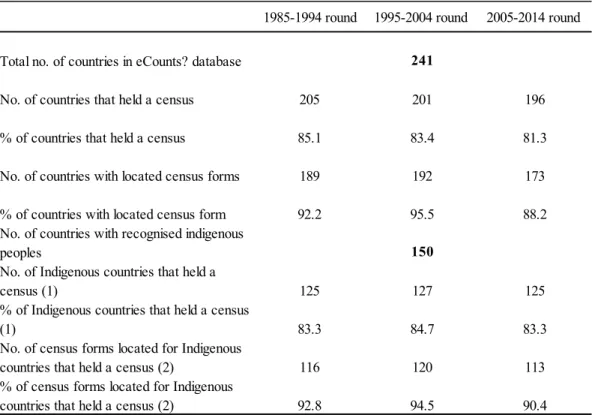
Table 4.1 Number and percentage of countries with located census forms, by census round
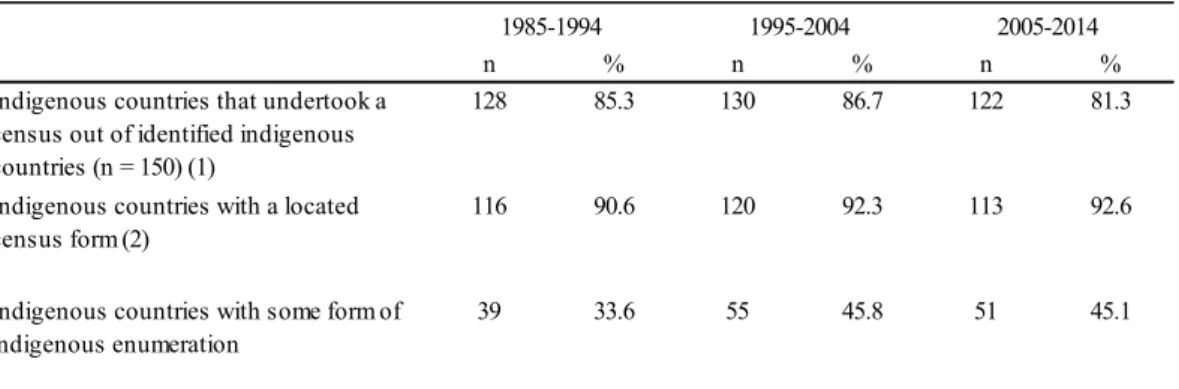
59 Table 5.1 Number and percentage of countries with some form of
Indigenous identification in the census, by census round
71 Table 5.2 Number and percentage of countries with shifting patterns of
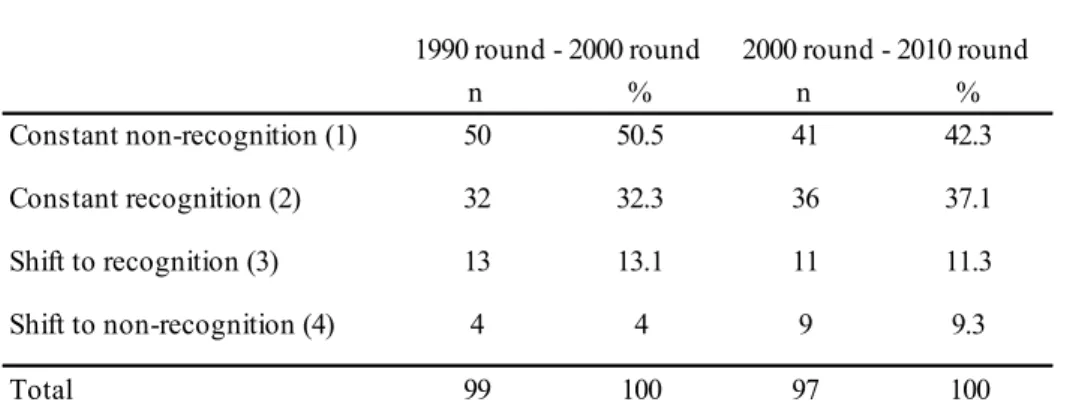
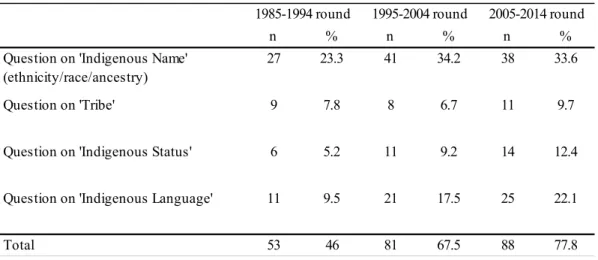
indigenous recognition between census rounds 72 Table 5.3 Form of Indigenous recognition, by decennial census round 73 Table 5.4 Number of census questions using ethnic, racial or ancestry
nomenclature
76 Table 5.5 Number and percentage of countries with multiple forms of
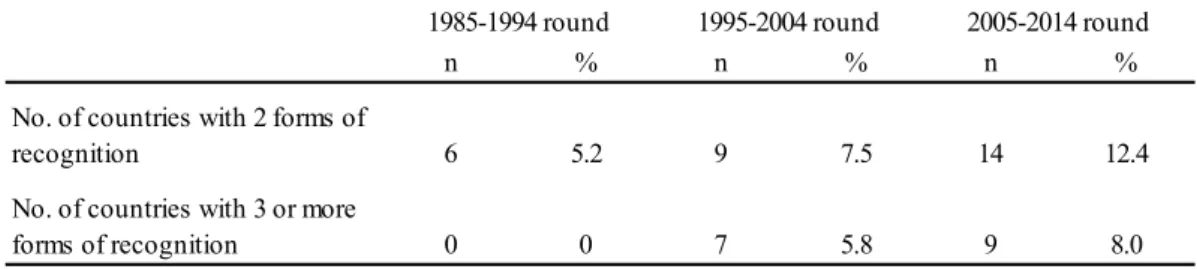
Indigenous recognition in the census, by census round
78 Table 5.6 Number and percentage of counties with some form of
Indigenous enumeration, by region and census round
79 Table 5.7 Number and percentage of sovereign states (old and new), by
type of Indigenous enumeration approach taken in the 2005-2014 census round
81
Table 5.8 Gross Domestic Product by type of Indigenous enumeration approach taken in the 2005-2014 census round
81 Table 5.9 Number and percentage of migrant receiving and
non-migrant receiving countries by type of Indigenous
enumeration approach taken in the 2005-2014 census round 82
Table 5.10 INGO membership by type of Indigenous enumeration approach taken in the 2005-2014 census round
82 Table 5.11 State ICERD status by type of Indigenous enumeration
approach taken in the 2005-2014 census round
vi
LIST OF FIGURES
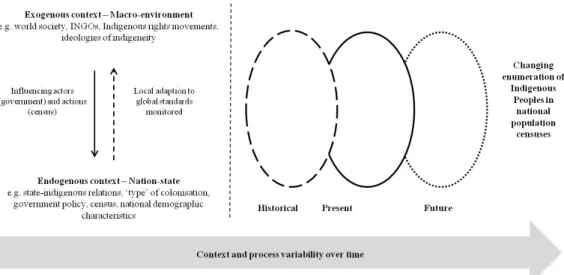
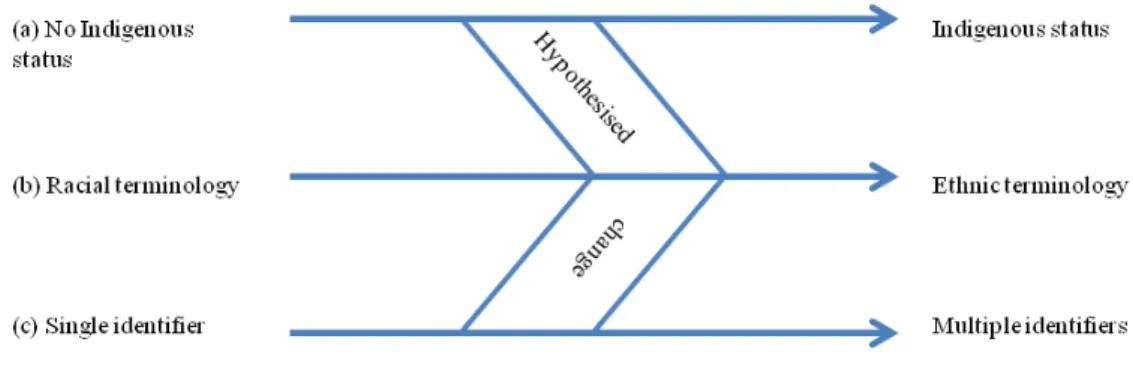
Figure 2.1 Theoretical framework 30 Figure 4.1 Distribution of Indigenous countries (n=150) 56 Figure 4.2 Hypothesised change of state approaches to
1
CHAPTER ONE
INDIGENOUS PEOPLE AND THE CENSUS: AN
INTRODUCTION
1.1 Introduction
Since the 1970s the rights and interests of Indigenous peoples have been given much greater visibility internationally (Niezen, 2003). While a great deal of this can be attributed to the collective action of Indigenous peoples themselves, the establishment of the United Nations Permanent Forum on Indigenous Issues (UNPFII)1 in 2000, and the
adoption of the Declaration on the Rights of Indigenous Peoples (UNDRIP) by the United Nations General Assembly in 2007 have been key instruments to raise global awareness of Indigenous rights and issues (Niezen, 2003, 2005). Although the UNDRIP is a non-enforceable human rights instrument (Mayer, 2013), it has been critical to draw attention to the historical grievances, contemporary challenges and socio-economic, political and cultural aspirations of Indigenous peoples, and their right to self-determination. The UNDRIP represents the interests of between 300 and 370 million Indigenous peoples whose customary homelands include all of the world’s continents (Gracey & King, 2009; Hall & Patrinos 2012). There are a number of major challenges in enforcing the UNDRIP (Hanna & Vanclay, 2013; Wiesser, 2009); one of these is the lack of adequate information to identify and monitor the circumstances of Indigenous peoples around the world. Indeed, the United Nations has identified “inadequate data collection and disaggregation concerning Indigenous peoples as a major methodological challenge” (United Nations, 2006). But just how visible (or invisible) are Indigenous peoples in national data collections? This question might seem an obvious one, but there is presently little evidence to assess the extent of Indigenous peoples’ visibility, let alone the complexities of how and why Indigenous peoples are counted and classified in different contexts.
This study addresses this question and the larger issue of Indigenous data disaggregation through a global study of census enumeration practices, by exploring how Indigenous peoples are enumerated in national population censuses. National governments use the census to periodically enumerate and compile demographic, social, economic and other
1 “The United Nations Permanent Forum on Indigenous Peoples is a high level advisory board to
the Economic and Social Council. The Forum was established on 28 July 2000 by resolution 2000/22, with the mandate to deal with Indigenous issues related to economic and social
2
such data about the population (Arel, 2002; Kertzer & Arel, 2002; Bycroft, 2013; Nobles, 2000; Perlmann & Waters, 2002; Petersen, 1997). Census data is used to inform government information needs and social and public policy approaches. The census is the pre-eminent source of data for global monitoring instruments such as the United Nations Sustainable Development Goals (United Nations, 2016). The census also plays a key role in constructing and representing collective identities within the nation state. As Kertzer and Arel argue, the “census does more than simply reflect social reality; rather, it plays a key role in the construction of that reality” (2002, p. 2). Similarly, the inclusion or exclusion of Indigenous peoples and identities within the census is indicative of how governments define who belongs to the nation. This notion is reflected in numerous studies that show how the social and cultural representations of Indigenous peoples in the census have been constructed in ways that reflect the values and priorities of dominants groups and governments, rather than those of Indigenous peoples themselves (Kukutai & Walter, 2015; Walter, 2005, 2009, 2010; Ittman et al, 2010). Studies that critique the census as a tool of the state assert that within the context of colonisation, the census was indispensable to the political project of colonisation (Foucault, 1982; Itmann et al, 2010). Due to the link between the census and colonialism, Indigenous peoples have often viewed the census with distrust and suspicion (Walter, 2010, 2013; Walter & Andersen, 2013). Despite the fraught historical experiences Indigenous peoples have faced, there is consensus amongst Indigenous peoples and advocacy groups that the ability of the census to statistically identify Indigenous peoples and their conditions is critically important to contemporary Indigenous issues. This view is based on the rationale that there is a need to identify and address the shared position of socio-economic and cultural and political marginalisation that most, if not all, Indigenous people experience (Anderson et al, 2016). Indigenous peoples consistently experience some of the poorest life outcomes in the world. Gracey and King’s (2009) study on Indigenous health suggests that, regardless of national context, there are persistent disparities between Indigenous peoples and non-Indigenous populations. These include lower life expectancy, higher rates of cardiovascular disease, suicide and type 2 diabetes (Gracey & King, 2009). Significant disparities have also been observed in relation to educational achievement, language attainment, and economic status (Anderson et al, 2006; Armitage, 1995; Cooke et al, 2007; Gracey & King, 2009). At an international governance level, the United Nations agrees that the problematic state of Indigenous peoples’ health, education, socio-economic status relative to general populations warranted the adoption of the UNDRIP, and specific references to Indigenous peoples in global strategies such as the 2030
3
Agenda for Sustainable Development (United Nations, 2016). In many countries, particularly Anglo-settler states of North America and Australasia, there are also ongoing efforts to seek redress for historical wrongdoings relating to forced assimilation (including the removal of children), land alienation and ongoing discrimination (Niezen, 2000; Stamatopoulou, 1994; Waldron, 2002). As records of past and present government policies, official statistics are important for contemporary processes of redress. In Aotearoa New Zealand, for example, the iwi/tribal affiliation question was first asked in the 1991 census. The accompanying Iwi Statistical Standard2 was initially developed to identify iwi, within the context of the Treaty of Waitangi Fisheries claim. At the time it facilitated a process of redress for Māori.
The primary focus of this study is to examine how governments’ statistically classify Indigenous peoples in their respective countries and territories, and how enumeration practices have changed over time. The focal period covers three decennial census rounds, from 1985 through to 2014 (see Kukutai et al, 2015). I examine the different ways in which Indigenous peoples are counted and classified, whether there are clear spatial or temporal patterns, and if there is a common conceptual basis upon which Indigenous peoples are classified. Having described state enumeration practices and change over time, I then explore possible explanatory causes. For example, are countries with high levels of immigration and ethnic diversity more likely to recognise Indigenous peoples in official statistics than those which are relatively ‘closed’ to migration? To what extent is the recognition of Indigenous peoples in official statistics related to governments’ commitment to support Indigenous rights in global forums such as the United Nations, or addressing socio-economic disadvantage through domestic policies? This study provides a beginning point for examining these questions which have received little attention in the literature. I explore these questions through an empirical analysis of data from the Ethnicity Counts? project.
1.2 Thesis Purpose
This study has several key objectives. The first is to develop a theoretical understanding
2 The definition of Iwi for statistical purposes was established in the 1989 discussion paper Towards a Standard Classification of Iwi (Māori tribes). Iwi is defined as the focal economic and political unit of the traditional Māori descent and kinship based hierarchy of: Waka (founding canoe), Iwi (tribe), Hapū (sub-tribe), Whānau (family) (Statistics New Zealand, 1989). The classification of Iwi is hierarchical and comprises of two levels: level 1 (14 categories) represents Iwi region, level 2 (128 categories) shows individual iwi (Statistics New Zealand, n.d.). Iwi statistics are need to allow government to monitor its own performance of Treaty of Waitangi obligations; assist allocating funds and resources to iwi; inform and assist iwi social and economic development; assist the Waitangi Tribunal with decisions on ownership and fishing rights (Statistics New Zealand, n.d).
4
of how Indigenous peoples are counted and classified in the census. To achieve this, I examine theories of the census, theories of ethnic and racial classification, and the literature on critical Indigenous demography (Arel, 2002; Kertzer & Arel, 2002; Nobles, 2000; Perlmann & Waters, 2002; Petersen, 1997; Walter, 2010; 2013; Walter & Andersen, 2013). There is broad recognition that the counting and classification of all populations is an inherently political act, especially when it involves Indigenous peoples, or ethnic and racial minorities (Arel, 2002; Andersen, 2008; Hirschman, 1987; Kukutai, 2012; Kukutai & Broman, 2015; Nobles, 2000; Rodriguez, 2000). As enumeration practices are influenced by the political, social and historical context, the extent of Indigenous identification in the census, and the conceptual underpinnings, are likely to vary significantly across time and place (Axelsson, 2011; Kertzer & Arel, 2002; Rallu et al, 2006; Simon et al, 2015). One line of theorising that is particularly useful for this study is world society theory. In world society theory the structure and behaviour of individuals and nation-states is shaped by global institutions through transnational interaction, essentially leading to global social change (Meyer, 2010; Meyer et al, 1997). Developed by John W. Meyer, world society theory provides a sociological account of global relations. Utilising world society theory for this study is fitting given the emphasis on investigating Indigenous enumeration practices globally. World society theory contrasts with predominant case-study approach of previous studies.
A second contribution of this study is to describe what census-based enumeration practices look like for Indigenous peoples globally, and the changes that have occurred in recent decades. There is surprisingly little academic research on the extent of Indigenous enumeration in the census. Studies by Morning (2008) and Peters (2011) provide useful insights into ethnic and, to some extent, Indigenous census enumeration. Morning’s (2008) global study of ethnic-racial classification in the 2000 census round (1995-2004) shows significant diversity in how ethnic and racial groups are enumerated. Morning found that ‘Ethnicity’ was used in 56 per cent of questionnaires, ‘Nationality’ was used in 23per cent of cases, 15per cent of census questionnaires asked about a respondents race, and the same percentage asked for a respondents ‘Indigenous Status’. On the other hand, Peters (2011) study solely focused on Indigenous peoples, by investigating the patterns of coverage of Indigenous peoples in censuses. Peters looked at censuses from 231 countries from a fixed period and found that relatively few enumerated their Indigenous residents. This study expands on both studies through a comprehensive analysis of the census-based enumeration of Indigenous peoples globally over a 30 year period. Previous research on this subject is sparse and has only examined fixed periods (such as Peters, 2011), or
5
primarily focused on ethnic and racial markers in the census, with ‘Indigenous status’ as a peripheral topic of interest. Prior to the development of the Ethnicity Counts? database there was no readily available way to quantify the extent of Indigenous visibility in the census and changes over time. Studies such as Peters (2011) and Morning’s (2008) relied on one off data collections and coding of census forms which are not readily available as open data.
Thirdly, this study makes a modest attempt to move from simply describing Indigenous enumeration to developing an explanation for the observed patterns. Using bivariate analysis, I look at potential factors internal and external to states that may influence their approach to Indigenous enumeration. As a comprehensive analysis of explanatory factors is beyond the scope of this study, the findings of this study will provide the basis for a more detailed research to be undertaken at a later date.
1.3 Rationale
There are two rationale for undertaking this study. One is to contribute to the small, albeit growing body of knowledge pertaining to the counting and classification of Indigenous peoples. Despite the advancing technologies of census instruments and the continued government prioritisation of population data, robust and reliable population data specific to Indigenous peoples continues to be scarce (UNPFII, 2006). The United Nations views the collection of reliable and relevant Indigenous data as being of critical importance, thus: “… special measures and measurements are needed, if we should not again leave Indigenous peoples behind. For proper monitoring, we need disaggregated data and indicators that uphold Indigenous peoples human rights” (Tauli-Corpuz, 2015). The UNPFII also identifies the development of statistical and other meaningful measures as being crucial to the process of realisation of the participation, non-discrimination, empowerment and accountability of and for Indigenous peoples.
The second rationale, linked to the first, is to identify the extent to which Indigenous peoples have been recognised within nation-state census as providing a basis for action. Nation-states use the census to generate ‘evidence’ which is used to inform the distribution of resources and address equalities. Numerous studies show that Indigenous peoples are among the world’s most marginalised population groups across a range of health and socio-economic indicators (Coimbra et al, 2013; Stephens et al, 2006; United Nations, 2007; World Health Organisation, 2007, 2010). Census data in the so-called CANZSUS states (Canada, Australia, Aotearoa New Zealand, United States, see Meyer 2012) provide indicators with which to compare health outcomes domestically and in a
6
cross-national context (Cooke et al, 2007). A common pattern prevails in these countries in that Indigenous health is significantly worse than the health of other population groups across a slew of indicators. However, large data insufficiencies in other parts of the world mean quantifying the magnitude of Indigenous disadvantage elsewhere is difficult. In some countries it is not even possible to identify the size and location of Indigenous people (Peters, 2011). This indicates the lack of accurate national population statistics impedes any useful method of evaluating Indigenous health indicators.
Furthermore, if the classification and collection methods used to count Indigenous peoples do not reflect principles recommended by the United Nations such as self-identification, participation, and diversity the question arises, how likely is it that the information will translate into meaningful outcomes for Indigenous peoples? By examining Indigenous enumeration practices globally, this study endeavours to bring attention to regions and or practices that are not meeting the recommendations as set out by the United Nations, and not meeting the needs of Indigenous peoples.
The United Nations recommendations regarding the collection and dissemination of Indigenous peoples are detailed. They note in Ethnicity: A Review of Data Collection and Dissemination “Ethnic data is useful for the elaboration of policies to improve access to employment, education and training, social security and health, transportation and communications, etc. It is important for taking measures to preserving the identity and survival of distinct ethnic groups” (2003, p. 2). In the same vein, the United Nations claim Indigenous enumeration in the census is “relevant for economic, social and health policies, but it has also been used as a tool for Indigenous communities to become more visible and to reinforce their identities” (2003, p. 7). Morgan (2007) recognises that “the global Indigenous movement has developed close relation to the UN system”, “where it is engaged in an ongoing struggle to write new norms of Indigenous rights into international law” (p. 276).
The objective of self-determination of Indigenous peoples globally extends well beyond ethnic and racial enumeration in the census. Indigenous specific issues such as recognition of cultural distinctiveness, inherent rights to self-government, and state treaty obligation are also intrinsically linked to any debate regarding state enumeration of Indigenous peoples (Niezen, 2000).
1.4 Thesis Outline
This thesis is arranged in six chapters. This chapter has highlighted the challenges relating to the collection and dissemination of Indigenous people in the census. Chapter
7
two provides the theoretical framework for understanding Indigenous enumeration. It begins by addressing the often contentious issue of how to define Indigenous people. In undertaking an extensive review of the literature, I propose a definition that is useful for the purpose of this study, and which can be used for the statistical analysis. Having considered definitional issues, I then consider theoretical perspectives relating to the census as an instrument of power, influenced by the state as well as other factors. I then propose a theoretical framework for theorising and studying state enumeration of Indigenous peoples, and the context within which enumeration occurs.
In the third chapter I establish this study as a novel approach to examining state enumeration of Indigenous peoples, which has otherwise been examined through case studies of specific countries or regions. I undertake a thorough review of the case study literature with the objective of identifying different ways which Indigenous peoples have been enumerated in the censuses. The case studies suggest that while there are distinct political contextual differences between Indigenous peoples, there has been a general shift in enumerative practices towards recognising Indigenous peoples in the census and that there has been a shift away from racial or blood quantum type classification, to ethnic self-identification.
Chapter four discusses the methodology and methods and the fifth chapter reports on the descriptive and bivariate empirical findings.
Chapter six, the concluding chapter, discusses the research findings and relates these back to the key themes of the study. In particular, I discuss what the findings imply about state recognition of Indigenous people, and the implications of these findings for the issue of data collection and dissemination of Indigenous peoples.
8
CHAPTER TWO
TOWARDS A THEORETICAL UNDERSTANDING OF
INDIGENOUS ENUMERATION
2.1 Introduction
This chapter discusses key theoretical approaches in relation to the definition of indigeneity and Indigenous peoples, the politics of census-taking and ethnic-racial enumeration. I examine the problem of how to define Indigenous people, tracing the emergence of ‘Indigenous people’ as a global political category. Defining what makes a people Indigenous is both contested and complex, but is a critical task for this study. In order to study how Indigenous peoples are counted and classified in the census, I first needed to identify which countries have an Indigenous people or peoples. In previous studies (Morning, 2008; Peters, 2011), there has been no attempt to restrict the study sample to include only those countries which are home to at least one Indigenous people. Following a review of international, academic and Indigenous definitions of Indigenous people, I argue for a more flexible approach to defining Indigenous people that is not tied to criteria relating to demographic or political dominance. I then consider the role of the census in the classification of people, and the factors which may influence how the census as a government instrument enumerates Indigenous people. I conclude the chapter with the development of a conceptual framework to guide the empirical analysis. This combines the aspects of world society theory (Meyer, 1992, 1997, 2010) and social constructivism (Cornell, 1996; Nagel, 1994, 1995) in an attempt to explain the counting and classifying Indigenous peoples.
2.2 The emergence of Indigenous peoples as a global political category
While Indigenous peoples have occupied their ancestral homelands for millennia, the use of the term ‘Indigenous people’ is relatively recent (Walters & Andersen, 2013). The term
Indigenous people began to be widely used during the twentieth century to describe a legal category used by national and international governance bodies in various policy and legislation (Anaya, 2004). Over time the use of the term Indigenous people has been prevalent, however, first peoples, aboriginal peoples, tribal peoples and native peoples is used interchangeably in different national contexts (e.g. for Australia, see Martin & Taylor, 2004, for Canada see Saku, 1999).
9
2.2 Defining Indigenous Peoples
Having briefly described the emergence of the term Indigenous people, what does it mean and to whom does it apply? The definition of Indigenous people is complex and, at times, contested, but is essential to the feasibility of this study.
The emergence of an international agenda for Indigenous rights in legal and political settings has resulted in the creation of a number of global policies and instruments, each of which have different definitions of Indigenous people (Kingsbury, 1998; Maaka & Flera, 2009; Merlan, 2009; Niezen, 2000; Walters & Andersen, 2013). Many of the definitions studies have been subject to acceptance, rejections, and replication. Likewise, the various regulatory, legal, and academic definitions of Indigenous people also vary in terms of the criteria employed.
Given the cross-national focus of this study, I focus primarily on international definitions of indigeneity rather than state-specific definitions. In doing so I use Merlan’s (2009) distinction between definitions that are either criterial or relational; criterial definitions suggest some set of criteria, or conditions, that facilitate identification of the ‘Indigenous’ as a global ‘kind’. This approach aligns with the international focus of this study. By contrast, relational definitions emphasise the differences between Indigenous peoples and non-Indigenous ‘others’. Definitions of this type are better suited to the analysis of specific national contexts, for the purpose of investigating inter-population disparities. While I focus primarily on how Indigenous peoples are identified in international contexts, I also consider academic definitions, along with the understandings of Indigenous peoples themselves. I conclude this section by identifying the criteria of Indigenous people used in this study to select the countries that will be included for the empirical analysis.
Definitions of Indigenous peoples in international contexts
Key international forums and texts that refer to the concept of Indigenous peoples include the United Nations Permanent Forum on Indigenous Issues (UNPFII, 2007); the United Nations Declaration of the Rights of Indigenous People (United Nations, 2008; and the International Labour Organization’s (ILO) Indigenous and Tribal Peoples Convention 1989 (no. 169)3. Given the incredible diversity between Indigenous peoples, the prevailing view among Intergovernmental Organisations (IGO) such as the United
3 The International Labour Organization Convention’s Indigenous and Tribal Peoples Convention 1989 (no. 169) is concerned with the rights of Indigenous peoples within respective nation-states and the responsibilities of these governments to protect these rights (International Labour Office Geneva, 2013, p. 1).
10
Nations is that it is redundant to assign a universal definition (UNPFII, n.d.). For practical purposes, each IGO designates an organisational ‘understanding’, of the criterial nature, that identifies rather than defines Indigenous peoples. Such understandings are connected with identity, and are used to guide common and topical issues of Indigenous peoples, such as recognitive (cultural), distributive (economic), and reparative (compensatory) claims.
Among criteria conditions, the ILO Indigenous and Tribal Peoples Convention (ILO Convention no.169) was the first international instrument which attempted to identify a global understanding of Indigenous people. The Convention was adopted by the ILO to serve as an instrument dedicated to improving living conditions of Indigenous peoples worldwide (International Labour Office Geneva, 2013). The Convention provides two criteria, both subjective and objective, to identify the peoples concerned. These include:
● Subjective criteria: self-identification as belonging to an Indigenous people.
● Objective criteria: descent from populations, who inhabited the country or geographical region at the time of conquest, colonisation or establishment of present state boundaries. They retain some or all of their own social, economic, cultural and political institutions, irrespective of their legal status (International Labour Organisation, n.d).
The Martinéz-Cobo Report to the United Nations Sub-commission on the Prevention of Discrimination of Minorities (1986) used a similar set of criteria to define Indigenous peoples. José R. Martinéz-Cobo, the Special Rapporteur on Discrimination against Indigenous Populations, defined Indigenous communities, peoples and nations as those which:
having a historical continuity with pre-invasion and pre-colonial societies that developed on their territories, consider themselves distinct from other sectors of the societies now prevailing on those territories, or parts of them. They form at present non-dominant sectors of society and are determined to preserve, develop and transmit to future generations their ancestral territories, and their ethnic identity, as the basis of their continued existence as peoples, in accordance with their own cultural patterns, social institutions and legal system (United Nations, 2004, p. 2).
Martinéz-Cobo’s approach emphasises the role of colonisation but avoids any reference to the duration of occupation, perhaps aiming to reflect the variation in the historical continuance of Indigenous peoples around the world. In the Oceanic region, for example, the earliest Māori ancestors are thought to have arrived in Aotearoa New Zealand sometime in the 14th century (Howe, 2003), while Indigenous Australians have occupied
11
their lands for tens of thousands of years (Kershaw, 1986).
Another international definition of Indigenous peoples can be found in the 1999 Declaration on the Health and Survival of Indigenous Peoples (the Declaration) developed by the World Health Organization. Although the focus of the Declaration was on defining Indigenous concepts of health, rather than Indigenous peoples, it is useful because it highlights the importance of concepts that reflect Indigenous perspectives. The Declaration states that:
Indigenous peoples' concept of health and survival is both a collective and an individual inter-generational continuum encompassing a holistic perspective incorporating four distinct shared dimensions of life. These dimensions are the spiritual, the intellectual, physical, and emotional. Linking these four fundamental dimensions, health and survival manifests itself on multiple levels where the past, present and future co-exist simultaneously (cited in United Nations, 2002, p. 3).
This definition is differs from those developed by the ILO and Martinéz-Cobo in that it does not refer to characteristics of non-dominance or historical continuity, but rather points to the importance of spirituality, holistic relationships, and the influence of the past on the present.
Conversely, the United Nations Permanent Forum for Indigenous Issues (2004) draws on a range of criteria to provide the most comprehensive definition of Indigenous peoples. These are:
● self-identification as Indigenous peoples at the individual level and accepted by the community as their member;
● historical continuity with pre-colonial and/or pre-settler societies;
● strong link to territories and surrounding natural resources;
● distinct social, economic or political systems;
● distinct language, culture and beliefs;
● form non-dominant groups of society;
● resolve to maintain and reproduce their ancestral environments and systems as distinctive peoples and communities (UNPFII, n.d, p. 1).
This definition clearly emphasises self-identification, community recognition and dominance - although it not clear whether it refers to demographic or political non-dominance, or both.
The United Nations Declaration on the Rights of Indigenous Peoples (2007) recognises that the characteristics and situations of Indigenous peoples varies across different
12
national contexts and avoids prescribing a tight definition. Rather it states that, “The situation of Indigenous peoples varies from region to region and from country to country and that the significance of national and regional particularities and various historical and cultural backgrounds should be taken into consideration” (p. 4).
Academic definitions of Indigenous peoples
Aside from the definitions developed and employed by INGOs, definitions of Indigenous peoples have been constructed for studies undertaken by anthropologists, sociologists, legal scholars, demographers, and other social scientists (Barnard, 2006; Maaka & Fleras, 2005; Haveman, 1999; Abernathy, 2000; Kymlicka, 2007; Miller, 2003). This section provides an overview of the key academic definitions of indigeneity. Because of the importance of what Walter and Andersen (2013) call ‘standpoint’, which is a researcher’s methodological approach and social positioning, I distinguish between perspectives that are conceptually grounded in a mainstream approach, and those that are from an explicitly Indigenous worldview. The latter are described in a separate section that follows.
Wilmer (1997) provided one of the earliest social science definitions of Indigenous peoples her study of how the Indigenous voice in world politics changes discourse within the international communities. Wilmer’s definition refers to Indigenous peoples as groups with tradition-based culture who were politically autonomous before colonisation and who, in the aftermath of colonisation, “continue to struggle for the preservation of their cultural integrity, economic self-reliance, and political independence by resisting the assimilationist policies of nation-states” (1993, p. 97).
Historical continuity of a geographic territory is not explicitly stated in Wilmer’s interpretation, but is implied as cultures that are “politically autonomous before colonisation” have to be settled in order for the process of colonisation to occur. In this approach Indigenous peoples are defined in relation to colonisation and the negative impacts that consequently affect them.
In contrast to Wilmer, Anaya (1996) emphasises ancestral origins as a key feature of what makes a people Indigenous. According to Anaya (1996, p. 3), the term Indigenous concerns living descendants of pre-invasion inhabitants of lands dominated by others. He claims that:
Indigenous peoples, nations, or communities are culturally distinctive groups that find themselves engulfed by settler societies born of the forces of empire and conquest… They are Indigenous because their ancestral roots are embedded in the lands in which they live,
13
or would like to live, much more deeply than the roots of more powerful sectors of society living on the same lands or in close proximity. Furthermore, they are peoples to the extent they compromise distinct communities with a continuity of existent and identity that links them to communities, tribes or nations of their ancestral past.
Anaya’s definition provides more substance than Wilmer’s in that it explicitly acknowledges the distinctiveness of ancestral roots, connection to land, and culture. Like Wilmer, he highlights the shared experience of colonisation in both historical and contemporary contexts as dominating and continuing to dominate Indigenous territories. As such, his definition appears to be restricted to settler states such as Māori in Aotearoa New Zealand; Inuit, Métis and First Nations in Canada; and Aborigines in Australia. It exclude contexts where there is a general belief that all members of the respective national populace are ‘Indigenous’, as is the case in large parts of Africa and Asia , as well as in some of the Pacific nations (Hodgson, 2002). Anaya’s definition is moderately inclusive in that it captures a sub-group of Indigenous peoples (those hosted by settler states), but not those who occupy countries where the majority are not settler descendants. While Anaya’s (1996) and Wilmer’s (1993) definitions of Indigenous peoples accurately capture the experiences and characteristics of many Indigenous peoples, they are too restrictive and do not provide adequate flexibility to be used as criteria for this study. In seeking a balance between definitions that are too inclusive or too narrow, Kingsbury (1998) proposed a definition that included ‘essential requirements’. These are:
● self-identification as a distinct ethnic group;
● historical experience of, or contingent vulnerability to severe disruption, dislocation or exploitation;
● a long connection with the region; and,
● the wish to retain a distinct identity.
Characteristics which he defined as ‘strong indicia’, or in other words essential characteristics of Indigenous peoples were:
● non-dominance in the national (or regional) society (ordinarily required);
● close cultural affinity with a particular area of land or territories (ordinarily required); and,
● historical continuity.
Less critical criteria which he called ‘other relevant indicia’ included:
14
● distinct objective characteristics such as language, race, and material or spiritual culture; and,
● being regarded as Indigenous by the ambient population or treated as such in legal and administrative arrangements.
The latter criteria reflect Kingsbury’s intention to develop a “flexible” “constructivist” approach to defining Indigenous peoples (p. 418). In so doing he extended the definition beyond states dominated by European settlement – the Americas, Australasia, and the Nordic countries – to include the Asian and African continents where the concept of Indigenous peoples is very complex and highly contested (see Colchester & Emi, 1999; He, 2011; Ho, 1998 for Asian examples. See Alcorn, 1993; Ohenjo et al, 2006 for African examples).
Although the historical experience of disruption is an essential requirement, Kingsbury does not explicitly reference colonisation. He broadens the interpretation of what constitutes a colonial experience, while still accounting for the unique circumstances of Indigenous peoples. Under this definition, authochonous peoples in the Pacific Island nations that form the political and demographic majority, such as Samoa and Tonga, are considered Indigenous. The legacies of colonial pasts are still felt in those countries, albeit that the extent of cultural disruption and dislocation varies. Where post-colonial societies continue to be economically dependent on colonial powers, the notion of ‘neo-colonialism’ applies (Frazer & Bryant-Tokalau, 2006). Kingsbury argues that the application of his criteria is contingent on the “dynamic processes of negation, politics, legal analysis, institutional decision making and social interaction” (1998, p. 458)
Most mainstream perspectives of indigeneity, as well as race and ethnicity, take a social constructivist approach. In contrast to primordial approaches which treat ethnicity and race as fixed, immutable characteristics that are inherited at birth, social constructivism treats ethnicity and race as socially created and historically contingent (see, for example, Kingsbury, 1998; Merlan, 2009; Walter & Andersen, 2013). Social constructivism derives from constructivist epistemology which sees knowledge as historically and culturally positioned, and formed through social processes and interactions (Burr, 2003). Knowledge is viewed as subjective and contextual rather than reflecting an objective, pre-existing, and universal reality (Kingsbury, 1998). Constructivism emphasises the interconnected nature of social categories, and the key role of social relations in constructing and sustaining them.
15
Andersen, 2013) and ethnic examples (Cornell & Hartmann, 1998; Nagel, 1995) to demonstrate the ways in which the internationalised Indigenous identity is built, transformed and changed over time.
How does this relate to Indigenous identity? In an international context who is seen or recognised as an Indigenous people is the product of power relations, dominant norms, and interactions. This condition can be described by Maturin’s phrase “a reciprocal fluxion” (in Cornell & Hartmann, 1998, p. 72). This refers to the way in which collective identities change through processes involving groups’ claims about themselves (assertion), and the claims that others make about them (assignment).
According to Kingsbury (1998) the international concept of Indigenous peoples is best treated as a constructivist approach. The concept of Indigenous is not subject to “perfect positivist coherence”, but rather embodies:
continuous process in which claims and practices in numerous specific cases are abstracted in the wider institutions of international society, then made specific again at the application in the political, legal and social processes of particular cases and societies (p. 415).
Kingsbury contrasts this understanding of indigeneity with a positivist approach which has rigid and precise requirements. Like Kingsbury, Merlan (2009) also sees the global concept of Indigenous peoples as a social construction, and suggests that while constructed identities may change over time, changes may occur only in some places but not others. Thus, while the concept of Indigenous people is well understood and generally accepted in the liberal democracy settler states of Aotearoa New Zealand and Australia, this is not the case in less developed and more politically unstable countries such as Malaysia and India.
Within the constructivist model, Indigenous people are also recognised as exercising agency in terms of their own self-definition (Kingsbury, 1998). These points resonate with facets of Indigenous revitalisation, particularly within the CANZSUS states and the enduring efforts of Indigenous communities to define themselves within the context of legislation, policy, communities or the national population census.
Essentially, there are four persistent criteria that form a global criteria for Indigenous people, as identified by INGO and mainstream academics:
● historical precedence;
● non-dominance;
16
● self-identification.
Definitions of Indigeneity by Indigenous scholars
Indigenous scholars have been critical of the ways in which ’others’ have sought to identify and circumscribe Indigenous peoples. Māori scholar Linda Tuhiwai Smith (2005) cautions against general definitions, arguing that Indigenous communities are not homogenous despite efforts by governments to treat them as such. Likewise Kanien’kehaka (Mohawk) scholar Taiaiake Alfred notes the “demands for precision and certainty disregard the reality of the situation: the group identity varies with time and place” (cited in Alfred & Corntassel, 2005, p. 600). Alfred’s point introduces a concept not yet addressed by previous definitions in that he accounts for the dynamic nature of being Indigenous. It is unsurprising then that an examination of Indigenous perspectives of indigeneity evokes different set of ‘core’ criteria.
The common assertion (Alfred & Wilmer, 1997; Wilmer, 1993) that the colonial experience is a major unifying factor among Indigenous peoples, and is a principal reason for ‘getting together’ within an international context does not feature prominently in Indigenous scholarly discourse. Rather, the focus is on common epistemologies, ‘Indigenous knowledge’ and the attachment of these knowledge traditions to traditional environmental contexts. These understandings are well articulated by Durie who writes that:
All Indigenous peoples have a tradition of unity with the environment and the tradition is reflected in song, custom, subsistence, approaches to healing, birthing, and the rituals associated with death. The defining characteristic of Indigenous peoples is therefore not necessarily premised on colonisation or sovereignty or a prior claim to settlement, but on a longstanding relationship with land, forests, waterways, oceans and the air. In this sense, indigeneity can be conceptualised as a state of fusion between Indigenous peoples and their accustomed environments (2004, p. 4,).
Smith (2005, p. 36) also emphasises self-identification , noting that the “…desire by the native to be self-defining and self-naming can be read as the desire to be free, to escape definition, to be complicated, to develop and change, and to be regarded as fully human.” In Smith’s (1999, p. 7) seminal work Decolonizing Methodologies: Research and Indigenous Peoples, she suggests that the term Indigenous peoples has “internationalised the experiences, the issues and the struggles” of peoples who have been subjugated to similar experiences.
17
indigeneity as serving a transformative role in enabling Indigenous people to consider the terms of their ‘belonging’ to the nation state with reference to their own aspirations. His view of Indigenous peoples emphasises the inherent rights and the unique constitutional status of Indigenous peoples as original inhabitants. O’Sullivan asserts that integral to these rights is that of ownership of land and resources, protection of language, culture and identity, the right to self governance, and the rights to Indigenous models of self-determination.
Rather than framing Indigenous peoples as subjects of colonisation, Indigenous scholars identify Indigenous peoples as members of distinct political communities who stand to retain land, identity, and political representation.
Definition of Indigenous peoples used in this study
In light of the criterial definitions of Indigenous people constructed by IGOs, mainstream academics and Indigenous scholars which advocate for open participation and self-ascription, I use the following criteria to examine how the global category of Indigenous peoples intersects with formal categorisations of Indigenous people by national population censuses.
1. Self-identification
A shared feature of indigeneity across the UNDRIP, and the mainstream and Indigenous literature, is the criterion was self-identification as Indigenous peoples. Self-identification indicates the ability for groups to define their own parameters using criteria that resonate with them.
2. Historical experience of, or contingent vulnerability to severe disruption, dislocation or exploitation
The second criteria relates to the historical experience of colonialism. It is deliberately used as a means to include Indigenous groups that have formally undergone the process of ‘decolonisation’ (e.g. Samoa and Tonga) and/or are politically dominant, but are still considerably impacted by the ‘aftermath’ of colonialism. It promotes a more inclusive approach compared to other criteria that centralise the settler state as a reference point for indigeneity.
In selecting the countries and territories for the empirical analysis conducted for this study I use the two foregoing criteria to identify which countries are eligible of counting and classifying actual Indigenous populations residing in their nations’ boarders. To achieve this study’s main objectives, it is not logical to include in this analysis those
18
countries and territories where no recognisable Indigenous peoples exist. Including countries which do not have Indigenous populations would assumedly lead to higher levels of non-recognition, thus distorting the realities of the prevalence of Indigenous enumeration globally.
2.3 Science and power in the national population Census
Having established criteria of Indigenous peoples for this study, this section considers the forum where Indigenous identities are enumerated – the national population census. The census is the most well-known and widely practiced form of population enumeration in the world. It refers to the “total process of collecting, compiling, evaluating, analysing and publishing or otherwise disseminating demographic, economic and social data pertaining at a specified time, to all persons in a country or in a well delimited part of a country” (United Nations, 1998, para. 1.1.).
The census was one of the principle statistical practices in the ancient world, with the first known census though to be conducted around 3800 BC (Magnello et al, 2013). Since this early time census-taking has been intrinsically linked to the exercise of power as empires and states sought to assess their populations and their production. This point is inherent in the word “census” which originated from the Latin word censere, literally meaning “to tax” or “assess value” (Ezeah, Iyanda & Nwangwu, 2013). There is evidence of census-taking in pre-colonial Indigenous societies. For example, in ancient Mexico a twelfth-century census recorded the migration of 3.2 million people into the Valley of Mexico, in the area now known as Mexico City (Magnello et al, 2013).
The national census in a modern times was first undertaken in the United States in 1790 and spread to other parts of the New World by the latter part of the nineteenth century (Kertzer & Arel, 2002, p. 7). This ‘diffusion’ was stimulated by the 1857 Statistical Congress resolutions of Canada which detailed how jurisdictions should produce census abstracts according to a standard form (Curtis, 2002). Ventresca (2003, p. 19) describes these actions as being motivated by the desire of nations to undertake comparisons for “progress and social amelioration” and argues that it marked the start of the “extensive global culture and formal organizational arrangements” of intergovernmental organisations, national agencies and bureaus (Ventresca, 2003, p. 4).
Since 1958, the United Nations has sought to universalise and standardise the census as a global instrument of enumeration, with a key activity being the publication of principles and recommendations for population and housing censuses (United Nations, 2007, p. 6). The census has five defining features:
19
● sole government sponsorship;
● a defined territory;
● nominal count of all persons,
● individual as the unit of enumeration; periodic and,
● regular; and, public and timely dissemination of census results (Ventresca, 2003). The traditional census model typically involves taking a whole of population count through the collection of questionnaires undertaken at a specific point in time. In more recent decades, alternative census models have emerged including the use of sample surveys, rolling surveys, and population register and administrative data (Kukutai et al, 2015). The Ethnicity Counts? dataset used in this study includes all countries undertaking a census; regardless of the specific approach used (this is covered in more detail in chapter four).
Historical and contemporary accounts of the census reveal that a variety of motivations underpin census taking activities. Broadly speaking, there are two distinct ways of understanding state processes of counting and classifying populations and the subsequent use of the data. The first is that the census is an impartial, scientific instrument for inquiry (Nobles, 2000; Ventresca, 1995, 2002). This understanding derives from the epistemological approach of positivism which holds that ‘objective social reality’ can be examined and described empirically (Blum in Kertzer & Arel, 2000). As the dominant paradigm that prevailed at the genesis of the modern census (19th century), positivism infused census taking activities by states who saw themselves as undertaking scientific and objective measurements of the populace (Anderson, McEldowney, & Shuttleworth, 2004). The census was seen to produce accurate knowledge of the population to inform state agendas of national building, progress, and development. It is unsurprising then that modern governments hold similar views of the census as a universal model of objective and scientific inquiry (Ventresca, 2002). Kertzer and Arel (2000) argue that the claim of ‘objectivity’ is relatively unproblematic when considering census question such as age. However, the claim to objectivity is clearly fraught when addressing questions of identity. Labbe (in Kertzer and Arel, 2000, p. 19) calls this reductionist approach to census-taking ’statistical realism’ which reflects the “notion that cultural categories can be reduced to an objective core.”
Social scientists typically refute the notion that the census is an objective instrument of inquiry (Kukutai et al, 2014). Such perspectives view the census as first and foremost a political process, where influence is exerted from the ‘top down’ and (in more recent decades) the ‘bottom up’ (Kertzer & Arel, 2000; Nobles, 2000; Rallu et al, 2006). Kertzer
20
and Arel state, “Censuses do more than reflect social realities, they also participate in the social construction of these realities” (2002, p. 2). Censuses reflect and assist in the shaping of a nation’s political and social order (Kertzer & Areal, 2000; Morning, 2008; Simon, 2005; Ventresca, 2009). The modern census may be seen as a source of political power that not only seeks to “describe, observe, and map” but also to “shape a people and landscapes” (Scott in Kertzer & Arel, 2002, p. 3). This critique of the census has obvious links with the work of French theorist Michel Foucault, and specifically his theories of governmentality and technologies of surveillance (1980; 1991; 2002). Foucault (and others, see Axelsson, 2010; Curtis, 2002) argue that the role of statistics as a technology of surveillance is to make the social relations of populations visible in order to make them governable. In his analysis of the Métis categories used in the Canadian census, Andersen (2008, p. 2) draws on Foucault to argue that the representation of Métis is fixed in a “hierarchically organised colonial order of things” where differential state policies are used to organise various segments of the state’s Indigenous populations. Consequently, Métis have been constructed nationally as a ‘mixed’ race, rather than as an Indigenous nation. Walter and Andersen (2013) use Foucauldian concepts of ‘governmentality’ and ‘bio-power’ to contextualise the suspicion of Indigenous peoples and researchers towards quantitative methodologies within the context of official statistics. They see this distrust as having its genesis in colonial times, through a range of colonial schemes that advanced colonial agendas of nation-building, while marginalising and displacing Indigenous peoples. Ittmann et al (2010) draw on Foucault’s notion of governmentality in their study of colonial census taking in Africa. They note that “Foucault’s oeuvre opened an avenue….to reconsider and re-present the relationship between state exercises in quantitative measurement exemplified by the census-usually presented to the public as objective, empirical knowledge-and the visible and invisible political and institutional and agenda behind their use” (p. 5).
The census (and official statistics) remains a centralised technology of the state (Walter & Andersen, 2013; Taylor, 2013). However this power is not always characterised by the ‘top down’ model. According to Kertzer and Arel (2000), changing power relations in some contexts means that enumeration is also being shaped from the ‘bottom-up’, particularly where minority groups have successfully lobbied to influence their enumeration in official statistics. Thus, in some countries the census has come to be seen as a potential tool to address inequalities rather than a mechanism for retaining them (Morning & Sabbagh, 2005). An Indigenous example includes the addition of ‘Native Hawaiian’ in the U.S. census as an outcome of Native-Hawaiian activists seeking
21
recognition as Indigenous peoples within the census. Prior to the change Native Hawaiians, or Kānaka Maoli, were enumerated within an aggregated ‘Pacific Islander’ category (Snipp, 2003).
2.4 Ethnic classification and counting in the Census
This section identifies the current approaches towards theorising state practices of ethnic and racial enumeration in the census, before considering the specific case of Indigenous enumeration. A large number of case studies on ethnic classification have been undertaken in the last 20 years (Andersen, 2008; Kukutai in Axelsson & Skold, 2013; Nobles, 2000; Snipp, 2003; Taylor, 2011). Most of these have been case studies focused on a specific national context or period.
Morning’s (2008) paper examining ethnic enumeration in the 2000 census round (1995-2004) is unusual in that it is genuinely cross-national, including 141 countries. Morning’s study examines multiple aspects of ethnic enumeration in the census – government approaches to ethnic enumeration, and content analysis of the language of census ethnicity items. Morning’s study is novel in that it covers considerable ground by offering theoretical, applied, and policy orientated insights into ethnic enumeration. The study’s main finding shows that 63 percent of national censuses included some form of ethnic enumeration, but the questions and answer formats portray various conceptualisations of ethnicity such as ‘race’ and ‘nationality’ (results were discussed in greater detail in chapter one). Further, she found that these concepts follow regional patterns, e.g. race was more often found in the Americas, and ethnic nationality in Eastern Europe In addition to the concepts used, Morning also explored the ways in which questions were asked in terms of their formats (e.g. closed or open-ended questions). Her concluding remarks argue that any proposal for a standardised strategy of ethnic enumeration must contend with the fundamentally political process of changing and reconstructing census categories.
In their study of the use of ethnicity in the field of demography Rallu et al (2006) identify four main strategies of ethnic enumeration:
● counting to dominate (enumeration for political control);
● not counting to unify and assimilate (non-enumeration in the name of national integration);
● counting or not counting in the name of multiculturalism (discourse of national hybridity); and,
22
The first approach of ‘counting to dominate’ characterises the historical practices associated with colonialism. Various scholars have noted that colonial censuses were undertaken for the purpose of assembling systematic information in the interest of taxing and/or the assimilation of Indigenous populations (Ittman et al, 2010; Axelsson & Skold, 2011). This exercise was akin to stocktaking for the economic progression of the colonial state. In some countries it was a widely held view of the colonisers that Indigenous peoples would eventually become ‘extinct’ through conquest, disease, and/or the march of ‘civilisation’. In the context of Australia Rowse argues that the colonial objectives of gathering information on Aborigines was limited to “knowing where they were from a security point of view and whether they were under threat from they were under threat from the processes of occupation” (2009, p. 195). There are many other examples of how the census was used as an object of surveillance, analysis, and intervention on Indigenous peoples (Andersen, 2008; Kukutai, 2012; Kukutai & Taylor, 2012; Pool, 2015; Smith et al, 2008).
The second model of ‘not counting to unify and assimilate’ is linked to contexts where national identity is privileged as part of the nation-building project. France is an often cited example of this enumeration approach (Simon, 2003). This does not mean that ethnic or racial differences do not matter, or that inequalities are not socially significant. Rather that the identification of national identities are preferred and prioritised. In countries where there are Indigenous peoples, the rejection of ethnicity as a basis for social stratification has the effect of rendering Indigenes invisible in official statistics, essentially acting as a mode of assimilation (Rallu et al, 2006). An exemplar of this approach can be seen in the 2004 New Caledonia census (Palayret, 2003). Having previously collected ethnicity data, the government moved to withdraw the ethnicity question from the 2004 census after a visit from French President Jacques Chiraq. The decision was justified on the grounds that all French citizens where viewed by the state as French (Peters, 2011; Vinding, 2005). The state discourse of national hybridity is largely associated with Latin American countries where racial mixing tends to be viewed positively, although there are still marked racial inequalities (Nobles, 2000, 2002). The final model refers to more recent approaches in countries where the enumeration of ethnic and racial minorities is undertaken with a view to addressing inequalities, and where census data serves as a tool to contest discrimination, and promote positive policy initiatives (Ketzer & Arel, 2002). Nagel (1994) points out the “enormous power to shape patterns of ethnic identification” when resources are distributed on the basis of ethnicity (p. 158). The clearest example of ethnic enumeration undertaken to address inequalities is