Demonstrating the Implicit Processing of
Visually Presented Words and
Pseudowords
C. J. Price, R. J. S. Wise, and R. S. J. Frackowiak
Wellcome Department of Cognitive Neurology, Institute of Neurology, London WC1N 3BG, United Kingdom
This study demonstrates that even when subjects are instructed to perform a nonlinguistic visual feature detection task, the mere pres-ence of words or pseudowords in the visual field activates a wide-spread neuronal network that is congruent with classical language areas. The implication of this result is that subjects will process words beyond the functional demands of the task. Therefore, contrast-ing brain activity in a word task that explicitly requires a cognitive function with a word task in which the function is activated implicitly will not necessarily isolate the brain area of interest Furthermore, in most brain regions, we found that pseudowords, which have unfamil-iar phonological associations and no associated semantic association, produce greater activation than words. Greater brain activity associ-ated with pseudowords illustrates that unfamiliar stimuli that are un-able to access word associations may activate the neuronal network more strongly than familiar words for which access occurs with ease. A number of functional imaging studies have investigated the brain areas associated with auditory and visual word process-ing usprocess-ing positron emission tomography (PET; e.g., Petersen et al., 1988, 1990; Wise et al., 1991; Demonet et al., 1992; Howard et al., 1992). These studies are usually designed to identify the anatomical substrates of the individual compo-nents of word processing models. Often, stimulus conditions are chosen on the assumption that successive word tasks will engage one more component of the word processing model and that categorical comparisons between tasks will identify the component of interest. The expectation is that there will be more neuronal activity in functionally specialized areas when a task demands the explicit involvement of the pertain-ing function than when it does not. For instance, in the pio-neering study by Petersen et al. (1988), anatomical areas en-gaged by visual and auditory word processing were investi-gated by comparing the cerebral blood flow distribution dur-ing different word tasks within a three-level subtractive hierarchy. The first level of the hierarchy was a silent word viewing condition and comparison of flow in this task with flow when viewing a fixation point (the baseline task) was intended to isolate sensory input and involuntary word-form processing. The second level of the hierarchy was reading aloud and comparison of flow to that during silent word view-ing aimed to isolate speech output processes.The third level of the hierarchy was a verb generation task (saying an appro-priate verb in response to a seen noun) and comparison of flow in this task to that during reading aloud aimed to isolate semantic processing.
In a subsequent PET study designed by Petersen et al. (1990), the areas activated during visual word processing were investigated further by comparing brain activity during silent viewing of real words, pseudowords (e.g., FLOOP), con-sonant letter strings (e.g., JVJFQ, false font
and visual fixation. The brain activity during silent viewing of each stimulus type was compared to visual fixation. Words
have legitimate word forms with semantic and phonological representations; related activity was detected in the left me-dial extrastriate visual cortex and a left prefrontal area. Pseu-dowords have legitimate word forms from which phonologi-cal but not semantic associations can be computed; related activity was detected in the left medial extrastriate cortex but not in the left prefrontal cortex. Consonant letter strings and false fonts do not have stored word associations and did not activate either the left medial extrastriate cortex or the left prefrontal cortex. These results were interpreted as evidence that the left medial extrastriate cortex was activated by legit-imate word forms and the left prefrontal region was activated by stimuli with semantic associations. No area of activity was associated with phonological processing.
The assumption behind both Petersen et al.'s studies (1988, 1990), that is, that some word tasks elicit very limited pro-cessing responses by the brain, has been challenged by Wise et al. (1991) and Price et al. (1994). Referring to the Petersen et al. (1988) article, Wise et al. (1991) suggested that both word generation and word repetition engage semantic pro-cessing and therefore the activity in the left frontal cortex seen when these conditions were compared primarily related to processes involved in word generation. The association of the left frontal region with intrinsic generation is consistent with the studies by Frith et al. (1991a,b), which showed that the left dorsolateral prefrontal cortex is activated in genera-tion tasks even when subjects have to produce responses oth-er than words.
There is ample evidence from the psychological literature that the presentation of familiar words during silent or re-peating tasks will automatically activate semantic and pho-nological representations even when subjects are not in-structed to access these processes explicitly (e.g., Van Orden et al., 1988; Macleod, 1991; Coltheart et al., 1994). Further, the obligatory activation of these processes affects subsequent or concurrent language tasks. For instance, when subjects are required to name the physical color of a word, they respond faster if the phonological representation of the word is the same color as the physical color of the word (e.g., the word RED printed in red ink), and they respond more slowly if the phonological representation is a different color to the physi-cal color (e.g., the word RED printed in green ink)—the Stroop effect (see Macleod, 1991, for a review). Consistent with these theories, Price et al. (1994) showed that when subjects viewed words silently, activity relative to false font was detected in a widespread network of language areas in-volving bilateral posterior temporal cortices, the left inferior frontal cortex, the left inferior parietal cortex, both sensori-motor cortices, and the supplementary sensori-motor area (SMA). These areas are known to be essential for word processing from both lesion studies (see Mesulam, 1990, for a review) and from previous PET studies, which explicitly explored ac-tivation of semantic and phonological processing (Wise et al., 1991; Demonet et al., 1992). Activity during silent viewing in the sensorimotor cortex and the SMA suggested that there
was subvocal outflow to the muscles responsible for articu-lation even though subjects were not instructed to speak.
In order to explain why this network of activity was not detected in the Petersen et al. (1990) study where the same conditions were compared, Price et al. (1994) suggested that the critical differences in the studies were (1) the increased sensitivity inherent in the introduction of 3-D image acquisi-tion, and (2) the development of newer PET analysis tech-niques employed in the more recently conducted Price et al. (1994) study. However, another possibility is that subjects in the different studies may have been responding to the words in different ways. In the Petersen et al. (1990) study, subjects were simply instructed to look at the monitor and fix their gaze on a central fixation point. In the Price et al. (1994) study, the subjects were instructed to look directly at the words and may have sounded out the word internally, although not in-structed to do so.
The present article investigates the implicit activation of language areas by engaging subjects in a nonlinguistic visual feature detection task with a button-press response while ei-ther words or nonwords were presented in the visual field. The task and the instructions to the subjects remained con-stant in all conditions and did not involve reading the words. The only variable was the type of stimulus on which the sub-ject performed the task. The stimuli were chosen to match those used in the Petersen et al. (1990) study described above, that is, familiar words, pseudowords, consonant letter strings, and false font. Any differences detected between conditions can be attributed to word processing while subjects were engaged in an irrelevant, nonlinguistic task.
Materials and Methods
During each PET scan, subjects performed one task—"the feature detection task." For this, subjects were familiarized with the distinc-tion that some letters have ascenders (e.g., b,d,l,t,f) while others do not (e.g., a,e,g,p) and instructed to press a mouse key with their right index finger when they detected one or more ascenders within a stimulus. When no ascender -was detected in a stimulus, they made no response. An Apple Mac Plus computer running the PSYCHLAB pro-gram (Bub and Gum, 1988) controlled the presentation of stimuli to subjects at a rate of one per 1.5 sec (1.0 sec exposure time, 0.5 sec interval) and measured reaction times and accuracy of the feature detection task.
While the task remained constant in all activation conditions the one variable was the type of stimulus presented. There were four types of stimulus: (1) real words (single nouns, with access to both phonological and semantic representations) printed in lowercase— in half the words one or more letters had an ascender (e.g., toad) and in the other half there were no ascenders present (e.g., grass); (2) pseudowords (which have corresponding phonological but not semantic representations) constructed by rearranging the letters of the words in condition 1 into pronounceable letter strings (e.g., grass to sargs, toad to dato), thereby matching the letters in the word and pseudoword conditions; (3) consonant letter strings (which have nei-ther phonological nor semantic associations) constructed to be as unword-like as possible (e.g., hlgb) since word-like letter strings (e.g., pxnt) might result in high levels of lexical-semantic activation (Rum-melhart and McLelland, 1981); (4) false fonts (which contain no lin-guistic features) constructed by substituting letters in the real words of condition 1 with 26 nonletters matched for size, ascenders, and descenders to give them the same overall shape as the words
A fifth baseline condition was also included in the design. This was a resting condition with eyes closed, during which time the subjects were instructed to empty their minds. This condition was included to allow us to measure the activity specifically associated with the task of feature detection.
The five different conditions were incorporated into three differ-ent experimdiffer-ents with three conditions repeated four times within each experiment. The conditions for experiment 1 were (a) rest, (b) false font, and (c) words; for experiment 2 were (a) false font, (b)
consonant letter strings, and (c) words; and for experiment 3 were (a) pseudowords, (b) consonant letter strings, and (c) words.
Incorporating the five different conditions into three separate ex-periments with'four repetitions of each condition within an experi-ment allows us to examine the results of individual subjects while a meta-analysis over the three experiments gives us maximum statisti-cal power for group results. The order of presentation of conditions for each experiment was ABCCBAABCCBA. There were four subjects in the first and second experiments and six subjects in the third experiment. All were English-speaking, right-handed volunteers, with no history of neurological disorders, and each gave informed consent to participate in consecutive measurements of rCBF with an effective dose equivalent of < 7.2 mSv (approved by the Administration of Radioactive Substances Advisory Committee of the Department of Health (UK). The protocol was approved by the research ethics com-mittee of the Hammersmith Hospital.
Data Acquisition
Scans were performed on a Siemens 953B (Erlangen, Germany) ded-icated head scanner with retracted septa (Spinks et al., 1992) using injected radiolabeled water (H2"O) as the tracer of perfusion (rCBF).
For each scan approximately 555 MBq of H2"O in 3 ml of normal
saline were flushed into the subject over 20 sec at a rate of 10 ml/ min by an automatic pump. After a delay of approximately 35 sec, counts were detected in the head, peaking 30-40 sec later (depend-ing on individual circulation time). The interval between successive H2"O administrations was 10 min. Data were acquired in one 90 sec
scan frame, beginning 0-5 sec before the rising phase of the head curve (Silbersweig et al., 1993).
Correction for attenuation was made by performing a transmis-sion scan with an exposed 6sGe/MGa external source at the beginning
of each study. Images were reconstructed in 3-D by filtered back projection (Harming filter, cutoff frequency of 0.5 Hz), giving a trans-axial resolution of 8-5 mm full width at half-maximum. The recon-structed images contained 128 X 128 pixels, each 2.05 X 2.05 X 2.00 mm in size.
Image Analysis
Image analysis was performed on a SPARC STATION II (Sun Micro-systems Europe Inc., Surrey, UK), using an interactive image display software package (ANALYZE, Biodynamic Research Unit, Mayo Clinic, Rochester, MN; Robb and Hanson, 1991) and statistical parametric mapping (Frackowiak and Friston, 1994; SPM software, MRC Cyclotron Unit, London, UK). Calculations and image matrix manipulations were performed in PRO MATLAB (Mathworks Inc., Sherborn, MA).
The distribution of rCBF in the brain was indexed by the accu-mulated counts over the scanning period, which reliably reflects flow in the physiological range (Mazziotta et al., 1985; Fox and Mintun, 1989). These data were reoriented parallel to the intercommissural line (Friston et al., 1989), then standardized for brain size and shape (Friston et al., 1991b). When stereotactically normalized, one voxel in the transformed image represented 2 mm in the x and y dimen-sions and 4 mm in the z dimension, which corresponds to the di-mensions of the atlas of Talairach and Tournoux (1988). The stan-dardized images were smoothed with a Gaussian filter 20 mm in width to account for variation in gyral anatomy and individual vari-ability in structure-function relationships, and to improve signal-to-noise ratio. As a result, each voxel rCBF equivalent value corresponds to a weighted mean rCBF centered in a spherical domain of about 20 mm in diameter.
Global variance between conditions was removed by a previously described method (Friston et al., 1990), using analysis of covariance (ANCOVA). This analysis generated maps of adjusted mean values of rCBF for each of the experimental conditions with corresponding associated adjusted error variance maps required for comparison of these means. The differences between conditions were assessed by formal comparisons of the condition specific rCBF maps. Adjusted condition means and variances were compared on a pixel-by-pixel basis by weighting the condition means by an appropriate contrast (Friston et al., 1991a). The resulting map of t values constituted the t statistical parametric map [SPM(0], which indicates the sites of sta-tistically significant change in relative blood flow distribution asso-ciated with the differences between the compared conditions. With so many voxel by voxel comparisons, many t values reach conven-tional levels of significance by chance. Therefore, the significance
c
o
N TR
O
L R Ff T L Ps WTASK
Ff L Ps
4 subjects j ^ ^ ^ ^ ^ ^ ^ ^ ^ J ^ ^ ^ ^ ^ ^ ^ ^ H 16 X 16 scam | ^ ^ H ^ ^ ^ ^ ^ ^ | ^ ^ ^ | Exp. 1 ^ ^ ^ ^ ^ ^ ^ ^ ^ ^ ^ ^ H ^ ^ ^ ^ ^ ^ H 4 subjects ^ ^ H ^ ^ H ^ ^ ^ ^ H ^ H 16X16 scans ^ ^ ^ ^ ^ ^ H| ^ ^ ^ H Exp. 2 ^ ^ ^ H |
^ ^ ^ ^ ^ ^ ^ ^ | 6 subjects Not ^ ^ ^ ^ ^ ^ ^ ^ 1 ^ ^ ^ ^ ^ H 24X24 scam compared ^ ^ ^ ^ ^ H ^ ^ ^ H ^ ^ ^ ^ H Exp. 3 ^ ^ ^ ^ ^ | ^ H 6 subjects ^ ^ I ^ ^ ^ ^ H ^ ^ ^ ^ ^ H 24X24 scans | ^ H | ^ ^ H 8 subjects 32 X 32 scans Exps. 1 & 2 10 subjects 4 0 X 4 0 scans Exps. 2 & 3 6 subjects 2 4 X 2 4 scans Exp. 3 W 4 subjects 1 6 X 1 6 scans Exp. 1 8 subjects 32 X 32 scans Exps. 1 & 2 10 subjects 4 0 X 4 0 scans Exps. 2 & 3 6 subjects 24 X 24 scans Exp. 3mMMm
• •
jmm
Table 1Activity associated with feature detection task Location
Cortical
Posterior fusiform gyrus
Posterior lingual gyrus' Middle fusiform gyms
Middle/inferior temporal junction Middle/superior temporal junction Posterior parietal-occipital junction
Deep inferior parietal lobe Inferior frorrtal/premotor
junction (44/6) Primary sensory motor
cortex (3/4| Subcortical
Midbrain'
Lateral geniculate nuclei
Thalamus' Left Right Left Right Left Right Left Right Left Left Left Left Right
Coordinates of peak and Z score
False font - rest
- 2 8 , - 8 8 , - 1 2 +24, - 9 2 , - 8 - 8 , - 7 8 , - 4 - 4 0 , - 5 4 , - 1 2 +40,-52,-12 +56, -44, +8 -26, -64, +36 +26,-64,+24 -36,-36,+48 -38,-30,+56 + 2 , - 1 6 , - 8 - 2 6 , - 2 6 , - 4 +16,-24,-4 + 2 . - 8 , + 8 il 83 8.0 19 8J 11 17 5£ 8.0 5J 17 3.4 11 4.0 Words - rest -28,-82,0 +22,-32.-8 +2,-78,0 -42, -54, -12 +40,-46.-16 -48,-20,-12 -34, -64, +36 +26.-62,+24 -38, -36, +44 -36,0,+32 -40,-28,+56 + 6 , - 1 6 , - 8 -24, -24, - 4 +18,-20,-4 - 2 , - 1 0 , + 8 6.4 8.4 6.4 3£ 7J) 5.4 W 19 6J 17 US 4.1 18 13 19
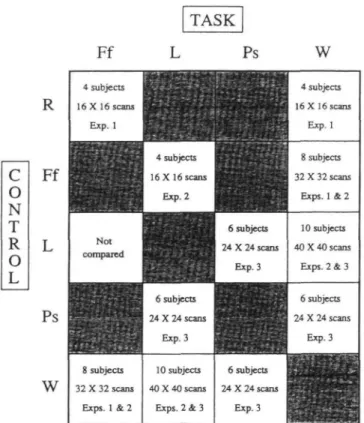
Figure 1. The contrasts between task and control are illustrated with the number of
subjects and scans per contrast and the experiments from which the subjects were recruited. /?, rest Ff, false font; L, letters; Ps, pseudowords; W, words.
threshold was adjusted to Z = 3.0,/) < O.OO1 to protect from false positives (Bailey et al., 1991a). The results were displayed in the stan-dard anatomical space of Talairach and Tournoux (1989).
Figure 1 shows the comparisons that were made, with the num-ber of subjects and scans for each comparison. Although subjects were recruited across experiments for certain comparisons, such comparisons were only made when each subject had performed both the activation and control tasks. No intergroup comparisons were made because of the inherent reduction in sensitivity.
Results
Analyses of the reaction times to the feature detection task were based on the mean response of each subject for each condition. Responses to false font stimuli were found to be significantly faster than to word stimuli, but there were no significant differences between responses to words, conso-nant letter strings, or pseudoword stimuli. Eight subjects per-formed the task on both word and false font stimuli (four from experiment 1 and four from experiment 2); mean re-sponses were 462 msec for false font and 531 msec for words rX7) = 8.2,^> < 0.001]. Ten subjects performed the task on both word and consonant letter strings (four from experi-ment 2 and six from experiexperi-ment 3); mean responses were 542 msec for words and 530 msec for letters [/(9) = 1-92,^ = 0.09]- Six subjects performed the task on both word and pseudowords (experiment 3); mean responses were 557 msec for words and 569 msec for pseudowords [f(5) = 1.6, p = 0.17].
The faster responses to the false font stimuli may be be-cause the false font ascenders were slightly more distinctive than those in letters. The implications of this are that there may be more activity associated with the feature detection task in the stimuli composed of letters than the stimuli com-posed of false font. However, since there was no significant difference in the reaction times to consonant letter stings,
Data are the location coordinates and Z scores for the areas of peak activity for the contrasts false font - rest and words - rest The location coordinates are according to the stereotactjc adas of Talariach and Tournoux 11388) and reported in the order x ( - is left, + is right), y (— is posterior to the anterior commissure line, + is anterior to the anterior commissure line), z [ - is inferior to the intercommissural line (AC-PC line), + is superior to the AC-PC line] and the associated Z score, which is printed in boldface.
• Peak close to midline—separate left and right peaks not resolved.
pseudowords, and words, contrasts between these conditions should only reflect activity associated with •word processing. Activation associated with the feature detection task, letter processing, word processing, and pseudoword processing will be presented, in turn, followed by presentation of the deac-tivation associated with •word processing.
Activation Associated with Explicit Task of Feature Detection
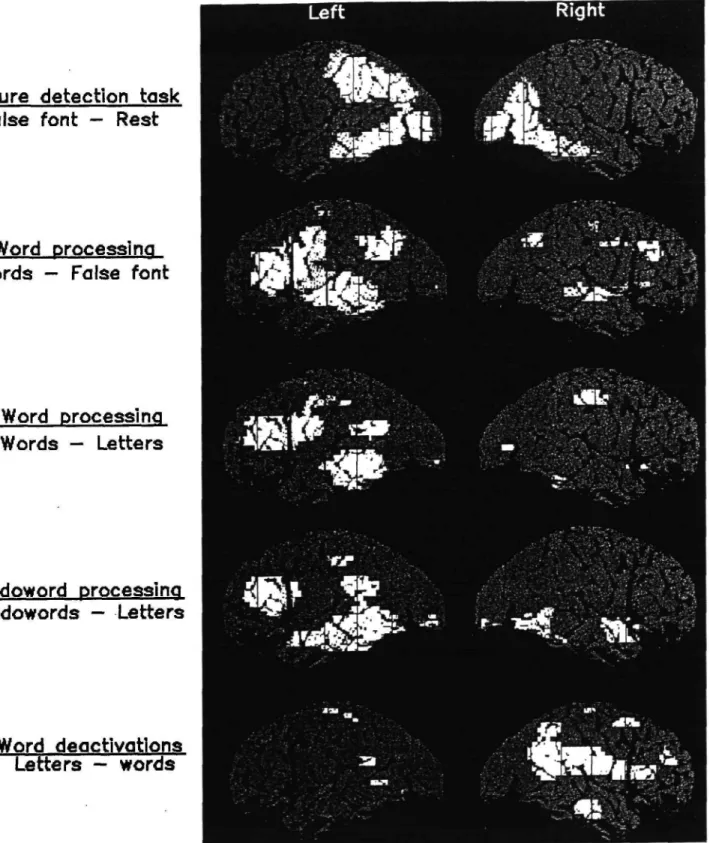
The areas of the brain that were recruited for the visual fea-ture detection task with the finger-press response were iden-tified by contrasting the conditions when subjects performed the task with the conditions when subjects were resting with their eyes closed (see Table 1). Retinal projections to the lat-eral geniculate nuclei and to midbrain structures were reflect-ed in peaks in these areas. No separate peaks in the striate cortex were identified, but there was extensive bilateral activ-ity in the extrastriate cortex lateral to the cuneus, which peaked in the posterior fusiform gyri •with a separate peak in the posterior lingual gyrus. In both hemispheres, there was activation of the midfusiform gyri (on the ventral surface of the temporal and occipital lobes) and the junction of the pos-terior parietal and occipital lobes (see Fig. 2). The separation of projections from striate and prestriate cortex into two streams, ventral and dorsal, which serve different functions, has recently been reviewed by Goodale and Milner (1992); feature detection in arrays of letters or letter-like symbols seems to activate both these streams.
The thalami were activated, possibly in the dorsomedial nuclei, although the spatial resolution of the technique pro-hibits precision about the precise region. The finger-press re-sponse -with the right hand was associated with a left
senso-Feature detection task
False font - Rest
Word processing
Words — False font
Word processing
Words - Letters
Pseudoword processing
Pseudowords — Letters
Word deoctivations
Letters - words
Figure 2. The regions where there were significant changes in cerebral blood flow during feature detection, word processing, and pseudoword processing are illustrated in white on green models of the left and right hemispheres of the brain.
rimotor signal that merged with a left anterior parietal lobe signal, but became apparent at about 56 mm above the inter-commissural line.
Areas that were only activated in the word condition were located in the ventral part of the left middle temporal gyrus and the junction of the left inferior frontal and precentral gyri (Brodmann's area 44/6). For false font, there was activity in
the dorsal part of the right middle temporal gyrus that was not present for words.
Activation Associated with Implicit Letter Processing
The areas of the brain recruited during presentation of letters were identified by contrasting the conditions when subjects performed the feature detection task on consonant letter
Table 2
Activity associated with letter processing
Location
Coordinates of peak and Z score: Letters - false font
Cortical
Posterior fusiform gyrus Middle fusiform gyms Extrastriate cortex Deep inferior parietal lobe Inferior/middle frontal junction Middle frontal gyrus
Left Left Left Left Right Right Right - 3 0 , - 7 6 . - 1 2 -34, -50, - 1 2 - 2 8 , -30, + 4 -36, -34, +28 +32, -56, +36 +38,+46,0 +36, +34, +32 U 11 17 13 10 18 10
Data are the location coordinates and Z scores for the areas of peak activity for the contrasts letters - falsefont. For details see Table 1 note.
strings (which have no semantic or phonological associa-tions) with the conditions when the same subjects performed the feature detection task on false font. The results are shown in Table 2. Three areas became active for letters that were not active for the false font — rest comparison (Table 1); these were located in the right prefrontal cortex (two peaks) and the right parieto-occipital junction. However, letters also re-sulted in significantly greater activity than false font in the left posterior fusiform gyrus, the left lateral extrastriate cortex throughout the inferior occipital gyrus, the left anterior fusi-form gyrus, and deep in the left anterior parietal lobe.
Activation Associated with Implicit Word Processing
Direct comparison of words with false font and consonant letter strings were made to reveal whether words that have both phonological and semantic associations produced acti-vation of language areas even when subjects were engaged in a nonlinguistic task. Data for the contrast words — false font were from the eight subjects in experiments 1 and 2; data for the contrast •words — consonant letter strings were from the 10 subjects in experiments 2 and 3- These compar-isons will be more sensitive than the results of the words — rest and false font — rest contrasts shown in Table 1 because (1) there were at least twice as many scans involved (see Fig. 1), and (2) analysis of the data did not include the rest con-dition during which intersubject variability may be high, as subjects are free to attend to random thoughts. The results are detailed and illustrated in Table 3 and Figure 2. They dem-onstrate involvement of the cuneus (extrastriate cortex), the left posterior temporal lobe, the left inferior parietal lobe, and the left inferior frontal gyrus, which strongly suggests implicit word processing.
There were also mesial frontal activations. The cingulate gyral loci were quite widely separated in the two contrasts, possibly because of the different demands of the feature de-tection task in the two control states (reaction times to the ascenders in false font were faster than to the ascenders in all the other stimuli; see above). A small mesial premotor ac-tivation was just apparent in words — false font. This was associated with the activation in the left primary sensorimo-tor cortex close to the insula (where the muscles of articu-lation are represented) and more dorsally, close to the motor representation for muscles of expiration (Ramsay et al., 1993)—voluntary control of expiration is important in artic-ulation. In the comparison of words with letters, there was also primary sensorimotor activation, which was bilateral and close to the representation for muscles of expiration. During die scans the subjects were not asked to articulate the word stimuli, but the primary sensorimotor activations would sug-gest subvocal articulation during visual presentation of word stimuli (Price et al., 1994).
Table 3
Activity associated with word processing
Location
Coordinates of peak and Z score Words - false font Words - letters Cortical Cuneus' Middle/inferior temporal junction Middle/superior temporal junction Superior temporal/inferior parietal junction Posterior parietal/ occipital junction Primary sensorimotor cortex
Inferior frontal gyrus Inferior frontal premotor
junction (44/6) Middle frontal gyrus (91 Anterior cingulate gyrus' Premotor cortex (6) Subcortical Thalamus* Subthalamus Lentiform nucleus Left Left Right Left Left Right Left Left Right Left Left Right Right Left -10,-96,0 -48,-42.-12 -48,-18,-4 +44,-28,0 -34, -56, +36 +44.-56, +40 -50, - 8 , + 8 -52, - 8 , +32 4J) 15 U 1 6 U 14 16 11 - 2 , - 9 0 , +8 -46,-36,-8 17 -38.+20,+12 6J -34. - 4 2 , +20 18 -46,-10,+48 11 +44,-16,+48 tO -42, +28, +20 a -48, +8, +32 +36, +32, +32 0,-10,+28 +2,+12,+6 -8, -8, +16 +24,-14,-4 -14,-30,0 5J 4.1 4 i 11 IS 4.4 4J -40, +4, +28 +12.+16.+40 4J 14
Data are the location coordinates and Z scores for the areas of peak activity for the contrasts letters - falsefont and words - letters. For details see Table 1 note.
• Peak close to midline—separate left and right peaks not resolved.
The contrast of words with false font also revealed activity in thalamic and subthalamic regions and in areas of the right temporal lobe, the right parieto-occipital junction, and the right middle frontal gyrus diat •were not identified when words were contrasted with consonant letter strings. Activity in the right middle frontal gyrus and the right parietal-occip-ital junction was also identified when consonant letter strings were contrasted with false font, consistent with these areas being equally activated by words and letters.
The precise location of peak activity within each region, in particular, activity in the parietal lobes, does not corre-spond exactly between die different groups of subjects. We believe this discrepancy is most likely to be due to individual differences in subject anatomy, which could not be accom-modated by the stereotactic normalization procedure (see Steinmetz and Seitz, 1991, for a review of die problem of individual variability in neuroimaging of language processes). This hypothesis is currendy being investigated in a further study in which each subject is treated as an individual, widi coregistration of functional activity detected by PET with die individual's MRI. It is also possible that since we are measur-ing differences in word processmeasur-ing while subjects are in-volved in an explicit task, diere will be variability in die ex-tent to which implicit word processing proceeds.
The areas associated widi word processing in die present study correspond to diose associated with word processing in the Price et al. (1994) study when subjects "passively" viewed words presented for 981 or 150 msec. The Price et al. (1994) study demonstrated diat activity in die frontal and temporal cortices was more extensive during 150 msec ex-posure durations than during 981 msec. In the present study, subjects were engaged in die feature detection task for less than 600 msec, leaving approximately 400 msec for "passive" word viewing; die increased activity associated widi words in die left frontal and temporal cortices under these conditions was more extensive dian during silent viewing with 981 msec
Table 4
Activity associated with pseudowords
Location Cortical Posterior fu- siform/lin-gual junc-tion Cuneus-Medial tem-poral lobe Inferior tem-poral gy-ms Middle tem-poral gy-rus Superior temporal/ inferior parietal junction Anterior infe-rior insula Orbital fron-tal cortex Mi(4,J|a | _ . _ Miouie tron-tal gyrus Right Left Left Right Left Right Left Right Left Left
Coordinates of peak and I score Pseudowords -+28,-88,-12 - 4 , -96, +8 +2, -86, +28 - 1 8 , - 1 6 , - 1 2 - 4 6 , - 5 2 , - 1 2 +48, -62, - 8 -44, -26, - 8 +56,-46,0 -30, -40, +24 +26,+10,-12 -42. +34, +24 letters 3.7 12 19 15 6.4 18 14 11 6.0 12 U Pseudowords -+24, -94, - 4 +32, -78, - 4 - 2 0 , - 1 6 , - 1 2 +48, -62. - 4 +50,-50,-12 +54, -44, +4 -24, -42, +28
words Words - pseudowords
4.6 17 10 14 11 16 5.6 -22, +24, - 8 3.4 -26, +46, +28 4.1 Table 5
Deactivations associated w i t h words
Location Cortical
Middle occipital gyrus Posterior lingual gyrus Inferior/middle temporal
junc-tion
Superior temporal/inferior pari-etal junction
Deep inferior parietal lobe Posterior parietal/occipital
junction
Anterior parietal operculum Posterior frontal operculum Middle/superior frontal cortex Medial superior frontal gyrus
Anterior cingulate gyrus Posterior cingulate gyrus Precuneus Subcortical Caudate nucleus Midbrain Right Right Right Right Right Right Right Right Right Right Right Right Right Right
Coordinates of peak and / score False font - words
+42, -70, +4 + 5 2 , - 5 6 , - 4 + 14,+44, +32 +12,+54,+24 +4, +38, +8 -12,-64,+16 - 2 . - 6 2 , + 4 0 +16,+2,+16 4.1 17 4.1 a 13 4.0 19 13 Letters - words +12,-52.+4 +30,-38,+16 +38,-38,+28 +40, -54, +28 +38,-16,+24 +38, +2, +16 +28, +48, +24 +16,+38,-12 + 10,+56,+24 + 14,+26,+56 -12, -54, +24 +6.+2.+12 + 2 , - 1 6 , - 4 12 18 14 15 4.8 17 16 14 13 14 14 3.7 13
Data are the location coordinates and Z scores for the areas of significant decreases for the contrasts words versus false font and words versus letters. For details see Table1 note.
Data are the location coordinates and Z scores for the areas of peak activity for the contrasts pseu-dowords - letters, pseupseu-dowords - words, and words - pseupseu-dowords. For details see Table 1 note. • Peak close to midline—separate left and right peaks not resolved.
exposure durations in the Price et al.(1994) study. The greater activity in the left frontal and temporal regions in association with word processing with the feature detection task may relate to the reduction in time available to view the words "passively" (see Price et al., 1994). The feature detection task may also help the subjects to attend to the stimuli.
Activation Associated with Presentation of Pseudowords
The areas of the brain recruited during presentation of pseu-dowords in contrast to consonant letter strings (experiment 3) are detailed in Table 4 (Pseudowords - letters). Although pseudowords (e.g., floop, peesh, rennid, ryfer) are pronounce-able, they have no associated meaning. Nevertheless, in this contrast, the anterior and posterior regions associated •with word processing were found to be active. Furthermore, in many areas, there was more activity associated with pseudo-words than with real pseudo-words evident from direct comparisons between pseudowords and words (Table 4, Pseudowords — words). For pseudowords compared to words there was ad-ditional activity in posterior regions with peaks in the extras-triate cortex, left and right temporal regions, and the left in-ferior parietal lobe. For words compared with pseudowords, there was some additional activity in anterior regions, which peaked in the left inferior and middle frontal gyri (Table 4, Words — pseudowords).
Deactivations Associated with Word Processing
Table 5 shows the reversed comparisons to Table 3 in order to show the areas of the brain where there were decreases in activity during word presentation in contrast to false font and consonant letter strings. These deactivations are particu-larly interesting because they are largely confined to the right hemisphere. In particular, the right middle temporal, inferior
parietal, and middle frontal regions, which increased in the word — false font contrast but not in the words - letters contrast (see Table 3), are shown to be less active for words than for consonant letter strings (see also Fig. 2). We also know that the right middle frontal gyrus and the right inferior parietal lobe are significantly more active for letter strings than for false font (see Table 2), and that pseudowords acti-vated the right extrastriate and temporal cortices more than words (Table 4). Over experiments, these results demonstrate that regions in the right hemisphere are more active for let-ters than words, and false font, more active for pseudowords than for words and more active for words than false font.
Discussion
Several new results have emerged from this study. First, we have demonstrated that even when subjects are engaged in a nonlinguistic task, the mere presence of words in the visual field can activate a widespread network of language areas in the left hemisphere. Second, this network of language areas is also activated by die presence of pseudowords, suggesting that even though pseudowords have no stored semantic rep-resentation, they engage much the same brain areas as real words. Third, the results show that while a network of lan-guage areas in the left hemisphere are activated, a correspond-ing network in the right hemisphere is deactivated by -word stimuli in contrast to nonword letter strings. The implications of each of these results will be discussed in turn.
Activation of the Left Hemisphere Language Network
In this study, subjects were instructed to perform a simple visual feature detection task on word and nonword stimuli. The only variable between scans was the type of stimulus on which they performed the task. We are therefore measuring differences in processing functions that are unrelated to the explicit task. The results have shown highly significant differ-ences in the distribution of blood flow when subjects were performing the explicit task on words and pseudowords rel-ative to consonant letter strings and false fonts.
Words and pseudowords activated the medial extrastriate cortex, the left posterior temporal cortex, the left inferior pa-rietal cortex, and the left prefrontal cortex. These areas are known to be related to visual and auditory word processing from (1) previous PET studies that explicitly activated seman-tic and phonological processes (e.g., Petersen et al., 1988, 1990; Wise et al., 1991; Demonet et al., 1992; Howard et al., 1992; Price et al., 1994), and (2) lesion studies on patients with specific language deficits (for reviews on this subject, see Ellis and Young, 1988; Shallice, 1988; MacCarthy and War-rington, 1989; Mesulam, 1990).
The activation of the language network even when sub-jects are engaged in a nonlinguistic task is consistent with psychological studies that have demonstrated that visual word processing is obligatory to the extent that it can inter-fere with the explicit task a subject is asked to perform (e.g., Lupker, 1985; Van Orden et al., 1988;Macleod, 1991;Coltheart et al., 1994). The classic demonstration of obligatory word processing is the Stroop effect, but many "priming" studies have shown that even when subjects are unaware of a visually presented word the occurrence of the word influences ex-plicit semantic and phonological processing of subsequendy presented words (e.g., Marcel, 1983; Humphreys et al., 1987; Neely, 1991). We cannot confirm from the present experi-mental design whether some subjects deliberately read the words while performing the feature detection task or wheth-er the obswheth-erved activity we detected •when words •wwheth-ere pre-sented was entirely a consequence of obligatory word pro-cessing. Although the different degrees of regional activation across experiments suggests that the subjects may have re-sponded in different ways, the overall results show that lan-guage areas are engaged even when the task does not neces-sitate their involvement. Such implicit word processing means that the subcomponents of language will not necessarily be revealed by contrasting word tasks that selectively engage a component to tasks where the component is activated im-plicitly. This applies particularly to a contrast such as reading aloud versus reading silently, in which it might be assumed that reading aloud requires retrieval of phonological repre-sentations but reading silently does not; if subjects retrieve phonological representations even when viewing words si-lendy, comparison of the conditions will not isolate areas re-lated to phonological retrieval. To some degree, this problem can be overcome by selecting tasks that weight processing heavily to a particular component (e.g., Demonet et al., 1992; Zatorre et al., 1992). However, these complex monitoring tasks encounter a different problem in that the tasks, instruc-tions, attentional demands, and strategies employed by the subjects cannot necessarily be kept constant across condi-tions and therefore the additional variables will influence dif-ferences in brain activity between conditions.
Interpretation of Differences in Activity Related to Processing Real Words and Pseudowords
The network of language areas activated by real words was also activated by pseudowords in comparison to consonant letter strings and in all regions except the left prefrontal cor-tex, activity was greater during presentation of pseudowords than during presentation of words—in other words, pseudo-words activate the language network more strongly than words. In particular, presentation of pseudowords generated significantly more activity than words deep in the left inferior parietal cortex, a finding that is consistent with several studies that have shown that activity in the left inferior parietal cor-tex is associated with phonological tasks. For instance, Law et al. (1991) found significantly greater activity in the left inferior parietal cortex when Japanese subjects were reading Kana words than when they were reading Kanji words. This result
indicated that regions within the left inferior parietal cortex were dedicated to phonological recoding because Kana words—like pseudowords—rely on translation of their char-acters into the corresponding phonological code. The coor-dinates of this region are similar to the region that Paulesu et al. (1993) associated with the phonological store in a visual-verbal short-term memory task.
Although most areas of the language network detected in die present study were activated more by pseudowords than real words, two areas within the left prefrontal cortex were more active for words than for pseudowords. Petersen et al. (1990) also found an active inferior frontal region during "pas-sive" viewing of words but not during "pas"pas-sive" viewing of pseudowords. They associated diis area with semantic pro-cessing of real words, and supportive evidence from neuro-psychological studies was given, which suggested that seman-tic priming tasks are preferentially affected by frontal lesions (Milberg et al., 1987; Sartori et al., 1987).
We have attempted to identify the functions of brain regions that are differentially activated by the different stimuli according to the hypothesis that a direct comparison of words and pseudowords should reveal the area of the brain associated with semantic processing because real words have specific semantic associations but pseudowords do not (Pe-tersen et al., 1990). However,diis hypothesis does not explain why we found that most brain areas were more active in die presence of pseudowords than words. A possibility is that pseudowords activate semantic representations more strongly than real words because a more prolonged search for the "missing" representations occurs. Similarly, pseudowords may activate phonological processes more strongly than real words because the phonological associations are unfamiliar and therefore less readily retrieved. The dilemma is whether we are measuring activity associated with accessing stored representations or activity associated with a search for miss-ing representations. Connectionist models of word process-ing, for example, the interactive activation model of word pro-cessing proposed by McClelland and Rumelhart (1981), would predict that passive presentation of pseudowords will create more activity in the word recognition network than familiar words. McClelland and Rumelhart (1981) argued diat activation of feature, letter, and •word representations does not occur in a discrete fashion within the hierarchy. As features are extracted activation accumulates simultaneously for let-ters and words consistent with the input. Active word and letter representations inhibit competing responses at all levels of the hierarchy until the system converges on a single inter-pretation. For pseudowords, the system will take longer to converge on an interpretation because there are no connec-tions to specific representaconnec-tions; dierefore, there "will be more activity in the network due to less inhibition of competing responses.
Right Hemisphere Activity
Activity in regions of the right hemisphere that are homolo-gous to those associated with die left hemisphere language network was detected when words and consonant letter strings were contrasted to false font (see Tables 2, 3). How-ever, when words were contrasted to letters and pseudo-words, right hemisphere regions were significandy more ac-tive for letters and pseudowords dian real words (Tables 4, 5). Overall, right hemisphere regions were most active for letters, widi progressively decreasing activity for pseudo-words, followed by words and least activity for false font. One possible explanation for diese results is tihat die degree of right hemisphere activity is inversely related to the ease with which word associations are accessed. Another possibility is that a right hemisphere language network is initially activated
by the presence of letters but inhibited by the computation of word associations. Further studies that investigate these hypotheses directly are required.
Conclusions
Our results have shown that when subjects are asked to per-form a simple task on word stimuli processing of the word beyond that required for the task occurs. A consequence of this finding is that the anatomical region associated with a function of interest will not necessarily be revealed by con-trasting brain activity in tasks that explicitly activate a speci-fied function with tasks where the function is not required explicitly but activated implicitly. The second difficulty we face when interpreting blood flow differences between pas-sive presentation of words and pseudowords is whether rel-ative increases in activity are related to the ability of words to access their stored representations or the inability of pseu-dowords to find stored representations. These issues can be resolved to some extent by using paradigms that actively en-gage subjects in attention-demanding tasks. However, as the task becomes more demanding, subjects may adopt internal strategies that have little to do with normal everyday pro-cessing of language stimuli. Ultimately, our knowledge of the functions of different language areas will depend on acquiring and collating data from several different approaches. Notes
Cathy Price was funded by the McDonnell Pew Program, Grant 91-23, and the Stroke Association. Our thanks to Chris Frith, Karalyn Patterson, David Howard, Elizabeth Warburton, and Eraldo Paulesu for their helpful contributions to this article, to Graham Lewington and the radiochemists at the MRC Cyclotron Unit for their help in per-forming the studies, and to Ruth Ellis and Brian Wharton for their help in recruiting normal volunteers.
Address correspondence to Dr. Cathy Price, Wellcome Depart-ment of Cognitive Neurology, Institute of Neurology, Queen Square, London WC1N 3BG, UK.
References
Bailey DL, Jones T, Friston KJ, Colebatch JG, Frackowiak RSJ (1991a) Physical validation of statistical mapping. J Cereb Blood Flow Me-tab ll[Suppl 2]:S150.
Bub D, Gum T (1988) PSYCHIAB experimental software. Montreal: Mc-Gill University.
Coltheart V, Patterson K, Leahy J (1994) When a ROWS is a ROSE: phonological effects in written word comprehension. Q J Exp Psychol 47A:917-955.
Demonet J-F, Chollet F, Ramsay S, Cardebat D, Nespoulous J-D, Wise R, Rascol A, Frackowiak RSJ (1992) The anatomy of phonological and semantic processing in normal subjects. Brain
115:1753-1768.
Ellis AW, Young AW (1988) Human cognitive neuropsychology. Lon-don: Erlbaum.
Fox FT, Mintum MA (1989) Non-invasive functional brain mapping by change distribution analysis of average PET images of H2"O tissue activiry.J Nucl Med 30:141-149.
Frackowiak RSJ, Friston KJ (1994) Functional neuroanatomy of the human brain: positron emission tomography—a new neuroana-tomical technique.J Anat 184:211-225.
Friston KJ, Passingham RE, Nutt JG, Heather JD, Sawle GV, Frackowiak RSJ (1989) Localization in PET images: direct fitting of the inter-coimnissural line (AC-PC) line. J Cereb Blood Flow Metab 9:690-695.
Friston KJ, Frith CD, Liddle PF, Dolan RJ, Lammertsma AA, Frackowiak RSJ (1990) The relationship between global and local changes in PET scans. J Cereb Blood Flow Metab 10:458-466.
Friston KJ, Frith CD, Liddle P F, Frackowiak RSJ (1991a) Plastic trans-formation of PET images. J Comput Assist Tomogr 15:634-639. Friston KJ, Frith CD, Liddle PF, Frackowiak RSJ (1991b) Comparing
functional (PET) images: the assessment of significant change. J Cereb Blood Flow Metab 11:690-699.
Frith CD, Friston KJ, Liddle PF, Frackowiak RSJ (1991a) A PET study of word finding. Neuropsychologia 29:1137-1148.
Frith CD, Friston KJ, Liddle PF, Frackowiak RSJ (1991b) A Willed action and the prefrontal cortex in man: A study with PET. Proc R Soc Lond [Biol] 244:241-246.
Goodale MA, Milner D (1992) Separate visual pathways for percep-tion and acpercep-tion. Trends Neurosci 15:20-25.
Howard D, Patterson K, Wise R, Brown WD, Friston K, Weiller C, Frackowiak RSJ (1992) The cortical localization of the lexicons: positron emission tomography evidence. Brain 115:1769-1782. Humphreys GW, Evett LJ, Quinlan PT, Besner D (1987) Orthographic
priming: qualitative differences between priming from identified and unidentified primes. In: Attention and performance, XII: The psychology of reading (Colheart M, ed), pp 105-125. London: Erl-baum.
Law I, Kannao I, Fujita H, Miura S, Lassen N, Uemura K (1991) Left supramarginal/angular gyri activation during reading of syllabo-grams in the Japanese language. J Neurolinguist 6:243-251. Lupker SJ (1985) Relatedness effects in word and picture naming:
parallels, differences and structural implications. In: Progress in the psychology of language I (Ellis AW, ed), pp 109-142. London: Erlbaum.
Macleod CM (1991) Half a century of research on the Stroop effect: an integrative review. Psychol Bull
109:163-203-Marcel AJ (1983) Conscious and unconscious perception: experi-ments in visual masking. Cognit Psychol 15:197-237.
Mazziotta JC, Huang SC, Phelps ME, Carson RE, MacDonald NS, Ma-hony K (1985) A non-invasive positron computed tomography technique using oxygen-15 labelled water for the evaluation of a neurobehavioural task battery. J Cereb Blood Flow Metab 5:70-78.
McCarthy RA, Warrington EK, eds (1989) Cognitive neuropsycholo-gy: a clinical introduction, pp 122-151. San Diego: Academic. McClelland JL,Rumelhart DE (1981) An interactive activation model
of context effects in letter perception. 1. An account of basic findings. Psychol Rev 88:375-407.
Mesulam MM (1990) Large scale neurocognitive networks and dis-tributed processing for attention, language and memory. Ann Neu-rol 28:597-613.
Milberg W, Blumstein SE, Dworetzty B (1987) Processing of lexical ambiguities in aphasia. Brain and Language 31:138.
Monsell S, Doyle MC, Haggard PN (1989) Effects of frequency on visual word recognition tasks: where are they? J Exp Psychol
[Gen] 118:43-71.
Neely JH (1991) Semantic priming effects in visual word recogni-tion: a selective review of current findings and theories. In: Basic processes in reading: visual word recognition (Besner D, Hum-phreys GW, eds), pp 264-336. Hillsdale, NJ: Erlbaum.
Paulesu E, Frith CD, Frackowiak RSJ (1993) The neural correlates of the verbal component of working memory. Nature 362:342-344. Petersen SE, Fox FT, Posner MI, Mintum M, Raichle ME (1988) Posi-tron emission tomographic studies of the cortical anatomy of sin-gle word processing. Nature 331:585-589.
Petersen SE, Fox PT, Synder AZ, Raichle ME (1990) Activation of extrastriate and frontal cortical areas by words and word-like stim-uli. Science 249:1041-1044.
Price C, Wise R, Watson J, Patterson K, Howard D, Frackowiak R (1994) Brain activity during reading: the effects of task and ex-posure duration. Brain 117:1255-1269.
Ramsay SC, Adams L, Murphy K, Corfield DR, Grootnoonk S, Bailey DL, Frackowiak RSJ, Guz A (1993) Regional cerebral blood flow during volitional expiration in man: a comparison with volitional inspiration.J Physiol (Lond) 461:85-101.
Robb RA, Hanson DP (1991) A software system for interactive and quantitative visualisation of multidimensional biomedical images. Aust Phys Eng Sci Med 14:9-30.
Sartori G, Masterson J, Job R (1987) Direct route reading and the locus of lexical decision. In: The cognitive neuropsychology of language (Coltheart M, Sartori G, Job R, eds), pp 59-77. London: Erlbaum.
Shallice T (1988) From neuropsychology to mental structure. New York: Cambridge UP.
Silbersweig DA, Stern E, Frith CD, Cahill C, Schnorr L, Grootoonk S, Spinks T, Clark J, Frackowiak R, Jones T (1993) Detection of thir-ty-second cognitive activations in single subjects with positron emission tomography: a new low-dose H2"O regional cerebral
blood flow three-dimensional imaging technique. J Cereb Blood Row Metab 13:617-629.
Spinks TJ, Jones T, Bailey DL, Townsend DW, Grootoonk S, Bloom/ield PM, Gilardi M-C, Casey ME, Sipe B, Reed, J (1992) Physical per-formance of a positron tomograph for brain imaging with retract-able septa. Phys Med Biol 37:1637-1655.
Steinmetz H, Seitz RJ (1991) Functional anatomy of language pro-cessing: neuroimaging and the problem of individual variability. Neuropsychologica 29:1140-1161.
Talairach J, Tournoux P (1988) A co-planar stereotactic atlas of the human brain. Stuttgart: Thieme.
Van Orden GC, Johnston JC, Hale BL (1988) Word identification in reading proceeds from spelling to sound to meaning. J Exp Psy-chol [Hum Learn] 14:371-386.
Wise R, ChoUet F, Hadar U, Friston K, Hoffner E, Frackowiak R (1991) Distribution of cortical neural networks involved in word com-prehension and word retrieval. Brain 114:1803-1817.
Zatorre RJ, Evans AC, Meyer E, Gjedde A (1992) Lateralisation of phonetic and pitch discrimination in speech processing. Science 256:846-849.