GUIDELINES
FOR THESIS/DISSERTATION/PROJECT
PREPARATION
The Graduate School
5755 Stodder Hall – Room 42
Revised November 2015
ii
GUIDELINES FOR THESIS/DISSERTATION/PROJECT PREPARATION
The Graduate School The University of Maine
November 2015
The policies, format and style requirements in this manual reflect The University of Maine’s standards for scholarship and quality of work. It is the student’s responsibility to follow and meet the requirements when writing a dissertation, thesis or a master project. Whenever there is reference to the word “thesis”, we are also referring to a dissertation, and/or master project. The guidelines are reviewed and updated periodically to reflect the dynamic nature of scholarship. Students should not follow the format of a previously written thesis, nor should they rely on a former version of this manual. If clarifications are needed, students should consult with the Graduate School. Manuscripts that do not fully comply with the guidelines will not be accepted.
iii
TABLE OF CONTENTS
LIST OF TABLES ... vii
LIST OF FIGURES ... viii
CHAPTER 1 INTRODUCTION ... 1
1.1. The Thesis Committee ... 1
1.2. The Graduate School Thesis Consultants ... 2
1.3. Legal and Ethical Issues and Regulations Regarding Research Methods... 2
1.3.1. Copyright ... 3
1.3.1.1. Obtaining Copyright for One’s Own Thesis ... 3
1.3.1.2. Using Copyrighted Materials... 4
1.3.2. Thesis Containing a Patentable Discovery ... 4
1.3.3. Electronic Doctoral Dissertations ... 5
1.3.4. Resources on Campus ... 5
1.4. Style Manuals for Thesis Format ... 5
1.5. Thesis in a Foreign Language ... 6
1.6. Master Projects ... 6
1.7. Deadlines... 7
1.8. Forms ... 7
1.8.1. The Application for Graduation ... 7
iv
1.8.3. The Final Thesis Acceptance Form ... 8
1.8.4. The Completion of Requirements Form ... 8
1.8.5. The Survey of Earned Doctorates ... 8
1.8.6. The PQIL Doctoral Dissertation Agreement Form ... 9
1.9. Thesis Submission ... 9
1.9.1. Tentative Thesis Submission ... 9
1.9.2. Final Thesis Submission ... 9
1.10. Electronic Thesis ... 10
1.10.1. Electronic Theses Submission Option ... 11
1.10.2. The ETD Database ... 11
1.10.3. Long Term Archiving ... 12
CHAPTER 2 PARTS OF THE MANUSCRIPT ... 13
2.1. Order of the Manuscript ... 13
2.1.1. Title Page ... 13
2.1.2. Thesis Acceptance Statement ... 14
2.1.3. Copyright Notice ... 14
2.1.4. Library Rights Statement ... 15
2.1.5. Abstract and Lay Abstract ... 15
2.1.6. Acknowledgments ... 16
v
For information on how to have the Table of Contents within the same document as the
manuscript, watch this video http://www.youtube.com/watch?v=NGzz2ZmLrFw. ... 17
Learn how to align page numbers in the TOC. ... 17
2.1.8. List of Tables, Figures, Theorems, Symbols, Abbreviations, Definitions... 17
2.1.9. Text of the Manuscript ... 19
2.1.10. Bibliography ... 19
2.1.11 Appendices ... 20
2.1.12. Biography of the Author ... 20
CHAPTER 3 STYLE AND FORMAT REQUIREMENTS ... 21
3.1. Paper Quality ... 21 3.2. Print Requirements ... 21 3.3. Margins ... 22 3.4. Oversized Material ... 22 3.5. Pagination ... 22 3.6. Spacing ... 24 3.7. Widows/Orphans ... 24 3.8. Documenting Sources ... 24
3.8.1. Formats for In-text and Bibliography Citation ... 25
3.8.2. Citing Internet Sources ... 26
3.8.3. Footnotes and Endnotes ... 27
vi
3.10. Thesis Compiled from Two or More Articles ... 27
BIBLIOGRAPHY ... 29
APPENDIX A: SAMPLE PAGES ... 30
APPENDIX B: FACING PAGE SAMPLE ... 52
vii LIST OF TABLES
Table 3.1. Pagination Example...23 Table 3.2. Citation Resources...25 Table 3.3. On-line Citation Resources...26
viii LIST OF FIGURES
Figure B.1. Graduate School Lobby Entrance...54
1 CHAPTER 1 INTRODUCTION
A thesis is the culmination of a graduate student's career, and it represents original scholarly research and writing. It is a contribution to knowledge and will be available to other scholars in the Fogler Library, and with the student’s permission, on the World Wide Web through the Fogler Library and/or Dissertation Abstracts International. Its content and style reflect on the author, the faculty members who have guided the research, and The University of Maine. Hence, the guidelines of the Graduate School have been developed to ensure high, professional, and ethical standards for research writing at The University of Maine. THE
MANUSCRIPT AUTHOR IS RESPONSIBLE FOR MEETING THE GRADUATE SCHOOL REQUIREMENTS SET FORTH IN THIS MANUAL. To avoid delays or disappointment, students should contact the Graduate School early in the writing process to be sure they understand all requirements.
1.1. The Thesis Committee
The thesis will be reviewed by the thesis committee for content and research accuracy. The role of the thesis committee is to guide the student through the research and writing process by providing suggestions and feedback as to the contents, direction, timeline, style, citations and other aspects of the research. The thesis draft submitted to the Graduate School should be a product of this negotiation between student and committee. Even though the committee’s recommendations may have significant impact on the thesis’ final form, it is the student who is ultimately responsible for the content and style of the thesis.
Master's thesis committees are comprised of at least three graduate faculty members; doctoral dissertation committees are comprised of at least five. Graduate faculty are appointed by the Graduate School upon the recommendation of the appropriate department. The
2
University of Maine does not use the term "reader" for any member of the committee; each committee member is a full, voting member. A student wishing to recognize someone as a “reader” can do so in the Acknowledgements.
1.2. The Graduate School Thesis Consultants
The Graduate School will review the thesis for correct format and consistency. The Graduate School should receive the tentative manuscript of the thesis 5 or more business days before the defense. A Graduate School consultant will check the draft to be sure that it adheres strictly to the requirements set forth in this manual. The student will be notified by email that the thesis has been reviewed and is ready to be picked up. If this is not possible, it is the student’s responsibility to make arrangements to have the manuscript delivered or mailed to him/her. A checklist of required revisions will be provided. If students have questions about the revisions, they should make an appointment with a Graduate School consultant. It is the
student’s responsibility to make all of the changes indicated on the checklist provided before submitting the final copy. The final copy of the thesis will also be reviewed to ensure that all required components, forms and dissertation fees have been received.
1.3. Legal and Ethical Issues and Regulations Regarding Research Methods
Complying with the various federal and state regulations regarding research methods and ethics is a joint responsibility of the student researcher, the thesis advisor and The
University of Maine. Prior to initiating a research project involving human subjects, animal care, radiation, recombinant DNA, legend drugs and/or hazardous materials/wastes, the writer must receive clearance from the respective authorities. Evidence of such approval must be noted on the student’s Final Thesis Acceptance Form or the Graduate School will not accept the final thesis. The full text of the respective policies and regulations and any additional
3
information can be obtained from the Office of Research and Sponsored Programs. All graduate students in a master’s or doctoral program performing research must receive one credit of Responsible Conduct of Research (RCR) training. Please review the Policies and Regulations on the Graduate School website (umaine.edu/graduate) for additional information.
1.3.1. Copyright
Although the Graduate School does not require theses to be copyrighted, students should be concerned about copyright law both in using the work of others and in protecting their own work. Information about the various issues surrounding copyrights can be found in Kenneth D. Crew’s Copyright and Your Dissertation or Thesis: Ownership, Fair Use, and Your Rights and Responsibilities. A regularly updated version of the text can be found on-line at: http://media2.proquest.com/documents/UMI_CopyrightGuide.pdf.
Doctoral dissertations submitted to ProQuest Information and Learning (PQIL) for microfilming have the potential to become “commercial” publications; hence, PQIL looks for copyright compliance when it accepts manuscripts. Note: If there is a delay in receiving a copyright approval, the student can still submit the manuscript and graduate on time.
The use of copyrighted materials can be mentioned in the Acknowledgments page. Any copyright permission letters related to the manuscript should be included in an appendix. 1.3.1.1. Obtaining Copyright for One’s Own Thesis
Students have full rights as authors from the moment they create their work; hence, they can acknowledge their privileges by including a copyright notice in their manuscripts even if they have not filed for registration. Still, obtaining formal copyright protection may have the following advantages. First, it will allow the student to file an infringement lawsuit and claim
4
“statutory damages” and attorneys’ fees if someone copies the work beyond “fair use.” Eventually, it may also allow the work to be added to the Library of Congress Collection. Students, whose research has been externally funded, should review the terms of that support to see if they are allowed to claim ownership of the results of the research. If
manuscripts are written in collaboration with other authors and/or published in any form, they may be subject to copyright regulations. In these cases, the text of the copyright notice included in the thesis should meet the policies outlined in the funding or publishing agreement.
Doctoral candidates can authorize PQIL to act as their agent with the Library of Congress Copyright Office. For a fee, PQIL will prepare the application in the student’s name, submit the application fee, and deposit the required copy(ies) of the manuscript. The Doctoral Dissertation Agreement form in the PQIL booklet Publishing Your Dissertation: How to Prepare Your
Manuscript for Publication has a section that describes PQIL’s and the student’s rights with regard to distribution of the student’s work.
1.3.1.2. Using Copyrighted Materials
For additional information regarding the use of copyrighted materials please visit the U.S. Copyright Office website at http://www.copyright.gov.
1.3.2. Thesis Containing a Patentable Discovery
Upon the student’s request, a thesis containing a patentable discovery can be held by the Graduate School before being bound or published. The student must submit to the Graduate School a written request co-signed by the thesis advisor stating that a patent application has been filed. The request will be sent to the Vice President of Innovation and Economic Development and, if approved, will be held from publication in the Graduate School for the
5
specified time. Having the thesis on hold at the Graduate School for this reason does not prevent the student from graduating on time.
1.3.3. Electronic Doctoral Dissertations
The University of Maine maintains a liaison with ProQuest Information and Learning (PQIL) to make knowledge acquired through doctoral research available to the public. PQIL publishes the Dissertation Abstracts International journal and other publications, and distributes microfilm copies of dissertations.
Access of dissertations may be ordered by the public. Authors receive a 10% royalty on ALL sales excluding purchases of their own dissertation. Signing the PQIL agreement which allows the company to make and distribute copies of the work in no way interferes with the student’s rights as the author.
For questions about the process, PQIL can be contacted at 789 East Eisenhower Parkway, Ann Arbor, MI 48108-3218; 1-800-521-0600 (U.S. and Canada),
[email protected], www.proquest.com. 1.3.4. Resources on Campus
The UMaine online Graduate Catalog http://gradcatalog.umaine.edu/ describes various research resources available on campus or affiliated with the University. For other services available on campus please visit http://www.umaine.edu/directory/.
1.4. Style Manuals for Thesis Format
Upon the recommendation of their committee, students may follow the style manual of a leading journal or of a professional association for the use of field-specific terminology, formulas, signs, and other features of the text, as well as formats for documenting sources.
6
FORMAT REQUIREMENTS OF THE GRADUATE SCHOOL MUST BE SATISFIED FIRST, even if they depart from the style manual that has been adopted. Papers which have been published in a journal or other publication and are being included in the thesis must be re-formatted to adhere to these guidelines.
1.5. Thesis in a Foreign Language
Upon the recommendation of their advisory committee, only students in a graduate program related to the study of a foreign language, such as the MA program in French and Spanish, can write a thesis in a foreign language. The title page of such a manuscript must be in English, with the exception of the title of the thesis which should appear first in the foreign language, followed by the English translation on a line of its own. The Library Rights Statement should be in English only. The full text and titles of the Table of Contents, Abstract, and the Biography of the Author must be provided in both languages first in the foreign language, followed by the English version. The texts should appear continuously on the respective pages, (i.e., the two versions of the Table of Contents, Abstract, and the Biography of the Author should not be separated by a page break).
1.6. Master Projects
The Graduate School requires that students in the Liberal Studies program submit a copy of their Master Project to be held in the Graduate School. Students in professional programs that wish to have their project held in the library must submit a second copy that adheres to the guidelines outlined within. However, if the project is unique in structure, a copy of the Title Page, Abstract, Table of Contents, and Biography of the Author with an explanation of where the project is being held may be submitted. Questions relating to project submission should be directed to the Graduate School.
7 1.7. Deadlines
Checklist packets for students who are preparing to graduate can be found on the Graduate School’s website at http://www.umaine.edu/graduate/. These checklists indicate final dates to:
• apply for graduation
• schedule an oral defense (2 weeks prior to the defense) • submit the tentative thesis for review by the Graduate School • submit the final thesis to the Graduate School
• graduation date / Commencement
The checklists also include program and Graduate School requirements, ETD submission information, as well as additional requirements for doctoral students.
1.8. Forms
As students approach graduation, certain forms with approval signatures are required to facilitate the graduation process. With the exception of the Application for Graduation found in MaineStreet, the remaining forms can be found at https://umaine.edu/graduate/current-students/graduation/.
1.8.1. The Application for Graduation
The application for graduation indicates that the student plans to graduate in May, August, or December of a given year and must be submitted electronically on MaineStreet. After logging into MaineStreet navigate to: Student Self-Service > Student Center. Then choose “Apply for Graduation: from the “other academic…” drop-down menu. No student (thesis or non-thesis) will be allowed to graduate without completing the application for graduation. The deadlines for each semester are:
• May – March 15 • August – July 15
8 1.8.2. The Tentative Thesis Acceptance Form
This form indicates that the thesis is ready to be defended. It is submitted along with the thesis, at least 5 business days before the thesis defense, to be checked for format and
consistency by the Graduate School. The form must be signed by the Chair(s) of the committee on behalf of the committee members. If it is not possible to submit the original form, it is acceptable for the Committee Chair(s) to send an email to the Graduate School. The email must include the following statement:
“Acting on behalf of the Committee members, I certify that they have read the tentative manuscript and agree that it is sufficiently complete for the student to undertake the final oral examination.”
1.8.3. The Final Thesis Acceptance Form
This form must be signed by the advisory committee and the Graduate Coordinator of the program. It must indicate that the final copy is accepted by the department, in addition to the Committee Chair granting electronic access to the approved thesis. This form must
accompany the final thesis submitted to the Graduate School for binding. The thesis cannot be accepted without the completed final thesis acceptance form.
1.8.4. The Completion of Requirements Form
This form must be completed and signed by the Graduate Coordinator and should indicate that the student has met all of the requirements for the degree. A student's diploma and final transcript will not be issued without this form.
1.8.5. The Survey of Earned Doctorates
The University of Maine is a participant in this national survey each year and requests that all doctoral candidates submit this form which can be found at:
9
https://umaine.edu/graduate/current-students/graduation/ under “Survey of Earned Doctorates (PhD’s only)”.
1.8.6. The PQIL Doctoral Dissertation Agreement Form
All candidates for doctoral degrees must complete the Doctoral Dissertation Publishing Agreement form and return it with the appropriate fee to the Graduate School. This form authorizes ProQuest Information and Learning (PQIL) to create and electronic version of the thesis, distribute it through the Dissertation Abstracts International journal, and make it available to the public. The PQIL form can be found at:
https://umaine.edu/graduate/current-students/graduation/ under “ProQuest Dissertation Publishing (PhD/EdD’s only)”.
1.9. Thesis Submission
Both the tentative and final copies of the thesis must be complete and include all parts of the manuscript at the time of submission.
1.9.1. Tentative Thesis Submission
The TENTATIVE copy of the thesis submitted to the Graduate School prior to the oral defense may be printed on ordinary paper but must be unbound and printed single-sided. Students should allow 5 business days for its review. It should be placed in a manila envelope with an additional title page taped to the outside of the envelope. While it is expected that after the oral defense there may be changes made to the thesis, the tentative manuscript should represent the completed product of the student's research, ready for final printing. 1.9.2. Final Thesis Submission
The FINAL copy of the thesis will also be reviewed by the Graduate School. It will be checked to ensure that all required components, forms, and dissertation fees are included. The
10
manuscript must be submitted in a manila envelope with an additional copy of the title page taped to the outside of the envelope. Departmental requisites vary as to the numbers of copies needed for committee members. The Graduate School requires a single copy of the "final" or "original" thesis. This copy must be on plain white, 25% cotton, bond paper (includes a watermark) and must be letter-quality print. Doctoral dissertations are sent first to ProQuest Information and Learning (PQIL) for digitizing and then returned to Fogler Library for binding. Master’s theses are not digitized through ProQuest. Although students are strongly encouraged to submit a copy of their thesis electronically, ETD submission alone does not fill the thesis requirements. A paper copy which fully meets the format and print requisites specified in these guidelines will be kept in the Special Collections Department of Fogler Library.
1.10. Electronic Thesis
The University of Maine Electronic Theses and Dissertations (ETD) project is a joint effort of the Fogler Library and the Graduate School. The goals of the project are “to improve graduate education, increase sharing of knowledge, help universities build their information
infrastructure, and extend the value of digital libraries”. These goals are in line with the objectives of the Networked Digital Library of Theses and Dissertations (NDLTD), at
http://www.ndltd.org/, a national initiative of which The University of Maine is a member. The ultimate goal of the NDLTD project is the creation of a freely accessible, international digital library and database of theses and dissertations.
The student benefits from electronic publications when other researchers in the field are able to use and cite text from the thesis. Another important advantage of the ETD project is that theses with hypertext or software applications will be more easily stored, retrieved, and
11
used. As more universities participate in the NDLTD initiative, students will be able to access, free of charge, the research of others in their field.
All master’s and doctoral students in a thesis program are required to submit electronic copies of their theses.
1.10.1. Electronic Theses Submission Option
Students that opt to submit an electronic version of their thesis to Fogler Library through Digital Commons, http://digitalcommons.library.umaine.edu. Instructions on the process of uploading a thesis are available at
http://www.library.umaine.edu/speccoll/theses_instructions.htm. Electronic access will be granted jointly with the advisor by use of the Final Thesis Acceptance Form and the student during the upload process.
Note: ETD submission alone does not fill the thesis requirements, a paper copy on bond paper is also essential for archival purposes.
1.10.2. The ETD Database
The ETD database which was originally begun as a pilot project, includes records and/or full text of selected University of Maine Master’s theses and doctoral dissertations beginning in 1998. Users are able to browse the database as well as search by keyword in the title, abstract, author, name, and department fields. Those theses and dissertations approved for release may be viewed in their entirety. The ETD database is currently available through the Digital
12 1.10.3. Long Term Archiving
At present, print copies of theses are archived in the Special Collections department in the Fogler Library. In addition, electronic copies of the most recent theses are available at Fogler Library through the Digital Commins@UMaine at http://digitalcommons.library.umaine.edu/. ProQuest Information and Learning (PQIL) also archives all doctoral dissertations electronically.
13 CHAPTER 2
PARTS OF THE MANUSCRIPT
2.1. Order of the Manuscript
The following is a list of the required parts of the thesis in the order in which they should appear in the manuscript. See “Appendix A” for samples on content and appearance requirements.
Title Page
Thesis Acceptance Statement
Copyright Notice (optional)
Library Rights Statement
Abstract
Dedication/Preface (optional)
Acknowledgments (optional)
Table of Contents
List of Tables (if any)
List of Figures (if any)
List of Abbreviations, Plates, Equations, Theorems, Symbols, Definitions etc. (if any)
Text of the Manuscript
Endnotes (if any)
Bibliography (or References, or Works Cited)
Appendix or Appendices (if any)
Biography of the Author 2.1.1. Title Page
The Title Page is the first page of the manuscript. It is considered page “i”, but the number does not appear on the page. Two copies of the title page must be submitted with the final manuscript.
The following should be CENTERED included on the title page:
Title of thesis in ALL CAPS, bold, and inverted pyramid format
The student’s full name as it appears in University records
Previous degree(s) earned
14
Institution name: The University of Maine
Institution name: The University of Maine
The month and year of the student’s graduation date
The advisory committee members (single space & left justify if necessary to keep on one page)
Note: The first name(s) listed is the Advisor’s (or Co-Advisors’) and their title(s) followed by the names and titles of the remaining committee members. Do not include degrees such as “Dr.” on the title page. This page is to acknowledge committee members exclusively, “Readers” are recognized in the Acknowledgements.
2.1.2. Thesis Acceptance Statement
The following statement, on a separate sheet paginated as “ii” shall be signed by the committee chair and included in the bound (final) copy of every thesis.
On behalf of the Graduate Committee for <student name> I affirm that this manuscript is the final and accepted <thesis/dissertation/project>. Signatures of all committee members are on file with the Graduate School at the University of Maine, 42 Stodder Hall, Orono, Maine.
<Chair’s name, & Title> <Date> 2.1.3. Copyright Notice
Unless the manuscript has been formally registered (copyrighted), this page is optional. If the student chooses to acknowledge his or her rights as author, a copyright notice should be placed as the sole text on a page immediately following the title page. The page is numbered but does not appear on the Table of Contents. The copyright notice is centered vertically and horizontally within the margins. Unless there are special terms under which the work has been copyrighted the text of the notice may take either of these two forms:
15
Copyright 2016 Student’s name
or
© 2016 Student’s name All Rights Reserved 2.1.4. Library Rights Statement
A Library Rights Statement (not paginated) must accompany the manuscript. The following statement must be signed, dated, and follow the same format as that of the thesis. Doctoral students who submit a dissertation should substitute ‘thesis’ for dissertation in the Library Rights Statement.
In presenting this thesis in partial fulfillment of the requirements for an advanced degree at the University of Maine, I agree that the Library shall make it freely available for inspection. I further agree that permission for “fair use” copying of this thesis for scholarly purposes may be granted by the Librarian. It is understood that any copying or publication of this thesis for financial gain shall not be allowed without my written permission.
Signature:
Date: 2.1.5. Abstract and Lay Abstract
An abstract (not paginated), which is a clearly written, concise summary of the thesis, must be included in the manuscript. It describes the problem, the procedures or methods used, and the results and conclusions of the research. Since doctoral abstracts are included in
16
Dissertation Abstracts International, it is extremely important to write accurately. Formulas, diagrams or other illustrations are not included in the abstract.
Master’s abstracts should not exceed 500 words. The maximum length for doctoral abstracts is 350 words (to comply with PQIL). The heading is not counted in the 350-word limit for dissertation abstracts. When submitting the final thesis, two copies of the abstract are required for a Master's thesis, and three copies for a doctoral dissertation.
The heading of the abstract should be centered and include:
• Title of the thesis in ALL CAPS, bold, and inverted pyramid format • The author's full name
• The name of the thesis advisor (including degree “Dr.”)
• A statement that the thesis is fulfilling requirements for a degree sought in a particular department
• The month and year of the student’s graduation date
Students are also required to submit a lay abstract in .doc format electronically to the Graduate School using the “Create Lay Abstract” Form. The lay abstract may be bound with the thesis at the student’s request.
2.1.6. Acknowledgments
This page is for the author to express professional and/or personal indebtedness. Permission(s) to use previously copyrighted materials, receipt of grant funds, recognition of “readers”, etc. is acknowledged on this page. Students must be consistent with the use of the third ("the author") or first person throughout. This page is optional, but if included, it is paginated (lower case Roman numerals) and listed in the Table of Contents.
17 2.1.7. Table of Contents
The Table of Contents is a topic outline of the manuscript. It functions as an index to the work and must fully and accurately reflect the organization of the manuscript. It is highly recommended that students using the “Automatic Table of Contents” feature in Microsoft Word wait until all final edits to all parts of the manuscript are complete. All chapter divisions and subsections must be included in the Table of Contents (TOC) and labeled exactly as they appear in the text. Other points:
• The Thesis Acceptance Statement Page, Copyright Page, Table of Contents, Abstract, and Library Rights Statement are NOT listed in the TOC.
• All chapter divisions and subsections must be listed in the TOC. Regardless of the system of headings being used for organizing the text of the manuscript (headings system or decimal system) all sub-divisions should be indented appropriately in the Table of Contents.
• One system (either headings or decimal) should be used consistently throughout the entire manuscript to define the chapter divisions and subsections.
• Each Appendix must be listed by its title and page number. If there is only one
Appendix, it is listed by the name “Appendix” and its title. Therefore, an Appendix “A” should not be listed unless there is an Appendix “B”.
• Leader dots must be used to connect the chapter divisions/subsection headings to their respective page numbers. A minimum of 5 leader dots between the chapter
divisions/subsections and the page numbers is required (i.e. the text of the headings should not extend into the area where the page numbers are placed).
• The Biography of the Author page is the LAST page of the thesis.
For information on how to have the Table of Contents within the same document as the manuscript, watch this video http://www.youtube.com/watch?v=NGzz2ZmLrFw. Learn how to align page numbers in the TOC.
18
A TABLE is a columnar arrangement of information organized to save space and convey relationships at a glance. A FIGURE is a graphic illustration (chart, graph, diagram, photo, map or plate). Figures may be professionally prepared or drawn by the author. In either case, they must be of letter-quality print.
The List of Tables and the List of Figures (if any) appear as individual pages. A List of Tables/Figures is necessary even if there is only one table or figure.
If the text of the manuscript contains a consistent set of theorems, symbols, abbreviations or definitions, those should be listed in a List of Theorems, Symbols,
Abbreviations, or Definitions respectively. These lists are included in the Table of Contents. All words on tables/figures must be typed (not hand written.) The only exception to this rule would be if the original author has hand written notes in a figure/table that has been scanned and included in the student’s thesis. Computer-generated figures are acceptable if they are of letter-quality print and large enough to be readable on microfilm. (Note: if color is used, it will not reproduce on microfilm.) Other points:
• Tables/figures must be numbered and titled. Further explanatory information provided in a caption that is not part of the title should not appear on the List of Tables/Figures. The title, caption, and key (if used to assist in interpreting the figure), should be placed on the same page as the table/figure. If this is not possible, a facing page is used. • The tables/figures are numbered separately from each other. Each group is numbered
consecutively throughout the entire manuscript or by chapter using a decimal numbering system (e.g., the third table in chapter two will be Table 2.3., the third figure in chapter two will be Figure 2.3.). The same system should be used for numbering figures AND tables.
• All tables/figures must fit into the required page margins. (Exception: see guidelines for including oversized tables/figures).
• The title and caption of the table/figure are part of the text and must be the same font size and style of the manuscript. It is acceptable for the font within the table/figure to be as small as 9 point.
19
• Tables/figures must be placed in the text as they are mentioned. If the Table/Figure is larger than one-half of the page it must be placed on a page of its own.
• Appendix tables/figures must be numbered separately (e.g., the third table in Appendix A would be numbered Table A.3.) and must be included in the List of Tables.
• If using photographs they must be originals or high-quality reproductions. Doctoral students should be aware that color does not reproduce on microfilm. All photographs must have captions.
2.1.9. Text of the Manuscript
Since a thesis is usually of considerable length, a uniform organizational scheme should be applied to the whole text so that a reader can tell at a glance what is of greater importance. Breaking the text into too many small parts should be avoided.
The text may be divided into chapters, parts, or other types of sections and the
principles of division must be consistent throughout. Two popular arrangement schemes are the headings system and the decimal system.
2.1.10. Bibliography
The full publication information of all sources cited in the manuscript should be provided in a Bibliography following the text and preceding the Appendix(ces) or Biography of the Author. The layout as well as the title of the Bibliography (Works Cited, References) depends on the style manual that is being followed. If the thesis has been compiled from a series of articles, the references must still be combined into a single, comprehensive Bibliography.
Students may choose to include references at the end of each chapter, however they are considered part of the text, therefore they need to formatted as such and cannot replace the comprehensive Bibliography.
20 2.1.11 Appendices
The appendices contain material that is pertinent to the text, but not directly included (raw data, questionnaires, consent forms, etc.). If there is only one appendix, it is called "APPENDIX" (not Appendix A) and is given a title. If there are two or more appendices, each is labeled “A”, “B”, “C” etc., given a title, and entered on a new page. The titles of the appendices are listed in the Table of Contents. NOTE: If the data in your appendix(ces) goes on for many pages, it is acceptable to copy the data on a CD to be placed in a pocket on the inside of the back cover. In such a case, the appendix is listed on the Table of Contents by title with leader dots followed by the word POCKET instead of the page number (see Appendix A sample).
Pagination from the text must continue throughout the appendices. If display pages are used, they are counted in the pagination. The margins and font size used in the appendices should be the same as in the text. A reduced copy of material may be included in an appendix; however, the title and caption of such material must be the same font size and style as the manuscript.
2.1.12. Biography of the Author
A biography of the candidate must be included in the thesis. It must be written in the third person and include the following information: place of birth, place of high school graduation, place and date of college graduation with degree(s) and major(s), professional or employment experience, scholarly publications, and memberships in professional or honorary societies. The last sentence must state, "S/He is a candidate for the---degree in --- from The University of Maine in Month Year."
21 CHAPTER 3
STYLE AND FORMAT REQUIREMENTS
3.1. Paper Quality
It is acceptable to print the tentative manuscript on multipurpose copy paper. The final manuscript must be:
• Plain white 8 ½" x 11” paper • 16-20 pound weight
• At least 25% cotton (rag) content
3.2. Print Requirements
Each page is printed on one side only (tentative and final). All print styles must be clear, sharp, and of uniform darkness. The tails on letters such as "p" and "q" must descend clearly. This requisite also applies to the page numbers and to scanned or photocopied images. A print sample may be brought to the Graduate School in advance for pre-approval.
The same font size and style must be used throughout the manuscript, including the page numbers, footnotes/endnotes. The font size should be between 11 and 12 point
throughout the manuscript. Exception: the font size within a table/figure and for footnotes can be reduced to 9 point. Italic print is used for emphasis, titles, foreign languages, scientific names, quotes and special circumstances but not to identify subsections in the manuscript or figure/table captions.
22 3.3. Margins
Margins on each page MUST be at one and a half inches on the left (this allows for proper binding), one inch on the right, top, and bottom of the page. All tables, figures,
appendices, and other illustrative material must conform to the margin specifications. If facing pages are included, reverse the left and right margins.
3.4. Oversized Material
• When tables/figures are printed landscape, place the page number in the same location as all other page numbers in the manuscript.
• The text within the table/figure may be reduced but must be legible (9 point minimum). The title and caption font must be the same size and style as the manuscript.
• If a table/figure fits within the margins of a page, but the title and caption do not, a facing page must be used (reverse margins). It immediately precedes the table/figure and “faces” it (page is face down in comparison to the other pages) and is printed on one side only. Facing pages are numbered consecutively within the text, as are all pages. • If oversize materials are included, they must be folded to fit in a 6” x 8” inch pocket that
will be attached to the back cover of the binding. The Table of Contents must indicate that such material is “In Pocket”.
• When using fold-out pages, please consult with the Graduate School for appropriate folding technique.
3.5. Pagination
The Title Page is counted as page “i” but the number does not appear on the page. Excluding the Library Rights Statement and Abstract, all other pages of the thesis are numbered including display (optional) pages. The preliminary pages, starting with the Thesis Acceptance Page, are marked by lower case Roman numerals (ii, iii, iv, v, vi etc.). Beginning with the first page of the text, all pages including the appendices, are numbered consecutively with Arabic numerals (1, 2, 3, 4 etc.). The following table displays proper pagination of all parts of the thesis and which pages should be listed on the Table of Contents.
23 Table 3.1 Pagination Example
Preliminary Pages Page Numbers Page is
Counted
Number is Typed on Page
Listed on the Table of Contents
Title Page (i)
Thesis Acceptance Statement ii Copyright Notice (Optional) iii Library Rights Statement (not paginated)
Abstract (not paginated) Dedication/Preface
(Optional)
lower case Roman
numerals
Acknowledgments
(Optional)
lower case Roman
numerals
Table of Contents lower case Roman
numerals
List of Tables (If any) lower case Roman
numerals
List of Figures (If any) lower case Roman
numerals
Body Pages Page Numbers Page is
counted Number is typed on the page Listed on the Table of Contents
Text of Manuscript Arabic numerals
Headings & All Subheadings
Endnotes (If any) Arabic numerals Bibliography/References Arabic numerals Appendix(ces) Arabic numerals Biography of the Author (last
page) Arabic numerals
24
Page numbers appear either on the top right or bottom center of the page. Page numbers need not fall within the required margins of the text, yet they must not appear closer than half an inch from the top and one inch from the right, or half an inch from the bottom edge of the page. The location and the font style of the page numbers must be consistent throughout the manuscript; when using fold-out pages, please consult with the Graduate School.
3.6. Spacing
The text of the thesis must be double-spaced. Depending on the style manual followed, spacing may vary for footnotes, endnotes, and appendix material. The Bibliography is single spaced within the citation and double-spaced between citations (see Appendix A).
3.7. Widows/Orphans
Paragraphs composed of 3 lines or fewer must be kept together on the same page. This rule also applies to references listed in the Bibliography and titles included in the Table of Contents. The first or last lines of a paragraph or a block of text must not appear alone on the bottom (orphans) or top of a page (widows). Students are advised to use “Widow/Orphan control” or the “Keep Text Together” feature available in most word processors.
Chapter divisions and subsections appearing at the bottom of the page must be followed by text must or moved to the next page.
3.8. Documenting Sources
Certain disciplines may prefer a specific citation style. As the Graduate School does not prescribe any particular method for documenting sources, it is advised that students follow consistently the guidelines of the style manual recommended by their department. Style manuals are also available at the Fogler Library.
25
If the thesis is created from a series of articles, these must be combined under a uniform style for documenting sources. The manuscript must also include a single, comprehensive Bibliography.
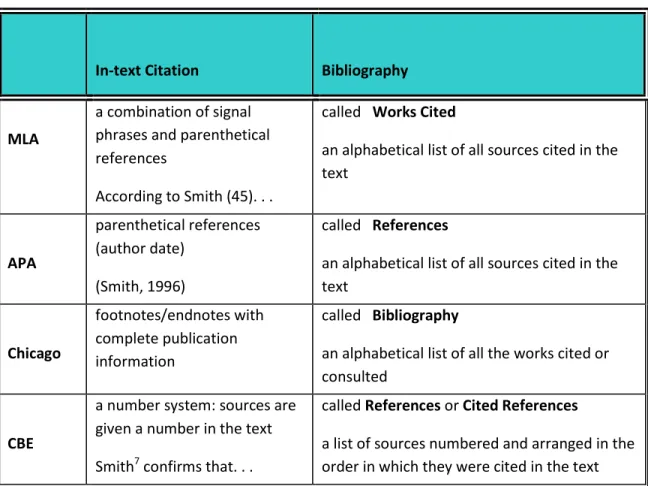
3.8.1. Formats for In-text and Bibliography Citation
All sources mentioned or used in the manuscript should be documented fully. This is achieved by including references in the text, and then providing full information of the source in the Bibliography.
Table 3.2. Citation Resources
In-text Citation Bibliography
MLA
a combination of signal phrases and parenthetical references
According to Smith (45). . .
called Works Cited
an alphabetical list of all sources cited in the text APA parenthetical references (author date) (Smith, 1996) called References
an alphabetical list of all sources cited in the text Chicago footnotes/endnotes with complete publication information called Bibliography
an alphabetical list of all the works cited or consulted
CBE
a number system: sources are given a number in the text Smith7 confirms that. . .
called References or Cited References
a list of sources numbered and arranged in the order in which they were cited in the text
26 3.8.2. Citing Internet Sources
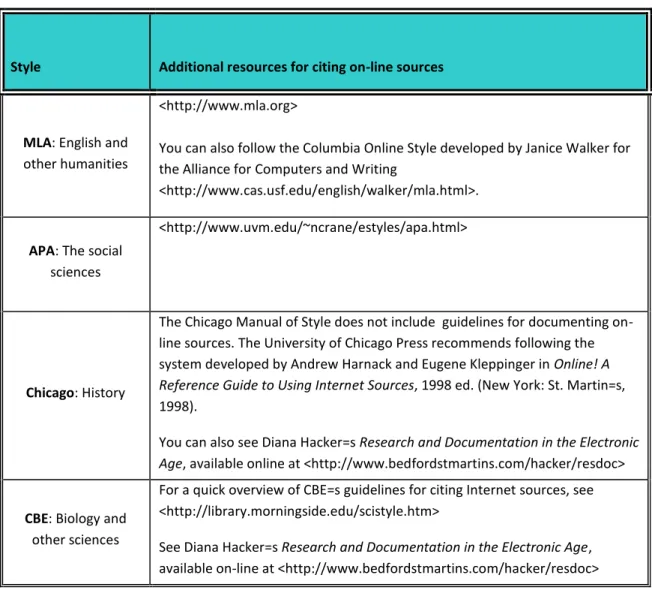
Internet sources such as websites, reference works, e-books, e-poems, government documents, news articles, newsgroups, etc., should be fully documented. The Fogler library maintains a virtual reference desk that provides links to style guides and information about citing electronic resources. The service is available on the library’s web page:
http://www.library.umaine.edu/virtualref/citations.htm. Table 3.3. On-line Citation Resources
Style Additional resources for citing on-line sources
MLA: English and other humanities
<http://www.mla.org>
You can also follow the Columbia Online Style developed by Janice Walker for the Alliance for Computers and Writing
<http://www.cas.usf.edu/english/walker/mla.html>.
APA: The social sciences
<http://www.uvm.edu/~ncrane/estyles/apa.html>
Chicago: History
The Chicago Manual of Style does not include guidelines for documenting on-line sources. The University of Chicago Press recommends following the system developed by Andrew Harnack and Eugene Kleppinger in Online! A Reference Guide to Using Internet Sources, 1998 ed. (New York: St. Martin=s, 1998).
You can also see Diana Hacker=s Research and Documentation in the Electronic Age, available online at <http://www.bedfordstmartins.com/hacker/resdoc>
CBE: Biology and other sciences
For a quick overview of CBE=s guidelines for citing Internet sources, see <http://library.morningside.edu/scistyle.htm>
See Diana Hacker=s Research and Documentation in the Electronic Age, available on-line at <http://www.bedfordstmartins.com/hacker/resdoc>
27 3.8.3. Footnotes and Endnotes
All sources mentioned in the notes should be fully documented in the Bibliography. Endnotes CANNOT REPLACE A BIBLIOGRAPHY.
Footnotes appear at the bottom of the page or at the end of a chapter; endnotes appear on a separate page at the end of the text before the Bibliography. The notes are numbered consecutively throughout the text by a raised Arabic numeral (e.g. 12) which corresponds to the number of the note at the bottom of the page or at the end of the text.
The font size of the footnotes and endnotes must NOT be smaller than 10 points to allow for proper microfilming. Apart from that, the content and layout of the notes depends on the style manual that is being followed.
3.9. Two-Volume Thesis
If a thesis is 500 or more pages, or over 2 1/2" thick, inclusive of all material, it must be bound in two volumes. The break between the two volumes must be at the end of a chapter. The volumes should be approximately equal in size. EACH VOLUME CONTAINS A TITLE PAGE AND A TABLE OF CONTENTS.
The title page for each volume specifies the volume and chapters included in that volume. The Table of Contents for Volume I lists the material contained in the entire thesis (both volumes). The pagination is continuous from Volume I to Volume II. The Title Page and Table of Contents pages in Volume II are assigned Arabic numerals.
3.10. Thesis Compiled from Two or More Articles
A manuscript that is compiled from two or more articles previously written by the student for publication or presentation must be reformatted to conform to the Graduate
28
School’s Thesis Guidelines. Such a thesis should have one comprehensive abstract and one comprehensive Bibliography. The separate articles should be reorganized as chapters and listed in an overall Table of Contents.
The individual abstracts of the articles, if included, are listed in the Table of Contents as chapter subsections titled “chapter abstract” or “chapter summary.” The List of Tables/Figures should cover all tables/figures in the manuscript. The tables/figures should be titled and numbered continuously and in a uniform style. The font style and the text organization style of the combined manuscript should be consistent throughout.
29 BIBLIOGRAPHY
American Psychological Association. (1993). Publication manual (3rd ed.). Washington DC: Author.
Association for Support of Graduate Students. (1999). ASGS services and sources of information and support for graduate students [Online]. Available: http://www.asgs.org (1999, June 30).
Bell & Howell Information and Learning. (1999). Dissertation services [Online]. Available: http://wwwbellhowell.infolearning.com/hp/Support/DServices (1999, July 27). Council of Graduate Schools. (1991). A policy statement: The role and nature of the doctoral
dissertation. Washington DC: Kay Hancock.
Crews, K. D. (1992). Copyright law and the doctoral dissertation: Guidelines to your legal rights & responsibilities. Ann Arbor, MI: UMI/Bell & Howell.
Gibaldi, J. (1995). MLA handbook for writers of research papers (4th ed.). New York: MLA. Hacker, D. (1999). Research and documentation in the electronic age (2nd ed.). Boston:
Bedford/St. Martin’s.
Lӧfgren, K. (2008). Word 2007: Page numbers starting from a specific page. Available: http://www.youtube.com/watch?v=NGzz2ZmLrFw.
Miller, J.I., & Taylor, B.J. (1987). The thesis writer’s handbook. McMinnville, OR: Alcove.
Tennessee Technological University. (1998). Guide to the preparation of theses and dissertations [Online]. S. Kendrick (Ed.). Available: http://www.tntech.edu/www/acad/grad/thesis/ (1999, June 28).
30
APPENDIX A: SAMPLE PAGES
Appendix A contains samples of required elements of the thesis. Students are advised to read through this appendix thoroughly for proper formatting.
Sample of a Dissertation Title Page ... 31
Sample of a Master’s Thesis Title Page ... 32
Sample of a Thesis Acceptance Statement Page ... 33
Sample of a Library Rights Statement ... 34
Abstract Display Page ... 35
o Sample of an Abstract ... 36
Table of Contents Display Page ... 38
o Sample of a Table of Contents using the Headings System ... 39
o Sample of a Table of Contents using the Decimal System ... 41
List of Tables/Figures Display Page ... 43
o Sample of a List of Tables ... 44
o Sample of a List of Figures ... 45
Organizing the Text of the Manuscript by the Headings and Decimal Systems
Display Page ... 46
o Sample of the Text of the Manuscript using the Headings System ... 47
o Sample of the Text of the Manuscript using the left justified Decimal
System ... 49
o Sample of the Text of the Manuscript using the indented Decimal System ... 50
Sample of the Bibliography ... 51
31
DOCTORAL DISSERTATION’S TITLE CENTERED, BOLD AND IN AN INVERTED PYRAMID FORMAT
By John Doe
B.A. Somename College, 2001 M.A. University of Someplace, 2004
A THESIS
Submitted in Partial Fulfillment of the Requirements for the Degree of
Doctor of Philosophy (in Chemical Engineering)
The Graduate School The University of Maine
December 2010
Advisory Committee:
‖ Marilyn Monroe, Professor of Chemical Engineering, Advisor ‖ Cinderella Glass-Slipper, Professor of Chemical Engineering ‖ Merlin Wizard, Associate Professor of Chemical Engineering ‖ Robin Hood, Assistant Professor of Wood Science and Technology ‖ Alice Wonderland, Associate Professor of Statistics
32
MASTER’S THESIS’ TITLE CENTERED AND IN AN INVERTED PYRAMID FORMAT
By Jane Doe
B.S. University of Someplace, 1997
A THESIS
Submitted in Partial Fulfillment of the Requirements for the Degree of
Master of Science
(in Food Science and Human Nutrition)
The Graduate School The University of Maine
May 2000
Advisory Committee:
Tom A. Jerry, Professor of Food Science and Human Nutrition, Advisor Elmer Fudd, Associate Professor of Food Science and Human Nutrition Bugs Bunny, Assistant Professor of Human Development
33
THESIS ACCEPTANCE STATEMENT
On behalf of the Graduate Committee for <student name> I affirm that this manuscript is the final and accepted <thesis/dissertation/project>. Signatures of all committee members are on file with the Graduate School at the University of Maine, 42 Stodder Hall, Orono, Maine.
Chair’s Name, Full Title <Date>
34
LIBRARY RIGHTS STATEMENT
In presenting this thesis in partial fulfillment of the requirements for an advanced degree at The University of Maine, I agree that the Library shall make it freely available for inspection. I further agree that permission for "fair use" copying of this thesis for scholarly purposes may be granted by the Librarian. It is understood that any copying or publication of this thesis for financial gain shall not be allowed without my written permission.
Signature: Date:
35
ABSTRACT DISPLAY PAGE
The layout of the Abstract page is the same for doctoral dissertations as it is for Master’s theses. The attached sample contains tips for writing academic abstracts.
36
TITLE OF THE THESIS/DISSERTATION CENTERED, BOLD AND IN AN INVERTED PYRAMID FORMAT
THIS PAGE IS NOT PAGINATED By John Doe
Thesis Advisor: Dr. Bugs Bunny
An Abstract of the Thesis Presented in Partial Fulfillment of the Requirements for the
Degree of Master of Arts (in Communication)
August, 2009
The abstract should be a condensation of the substance of the student’s work, and not an introduction nor a text version of the Table of Contents. Within the space limit of 350 words (doctoral dissertations) or 500 words (Master’s theses), the writer should convey to the reader concisely and accurately the significance of the work, the boundaries of space and time that it encompasses, the method of inquiry, as well as the claim to generality (if any) made in the research. The abstract should be well balanced to reflect not only the eye-catching or original elements of the thesis/dissertation, but the overall spirit and structure of the work. This balance is achieved if the abstract and the manuscript make sense without one another.
Depending on the type of research format that the thesis/dissertation has followed, the abstract may include information about some or all of the following elements: purpose, scope, method, results, recommendations, and conclusions. It should become clear from the abstract what the main idea of the research project is what is the central question that the author is trying to answer, why this question is important, what has been discovered, why this discovery is significant, and who could benefit from the findings. Summarizing the scope of the research
37
should provide the reader with an idea about the author’s focus in the work and the motifs behind that focus. A brief description of the method should explain what kinds of evidence have been provided and how the author has attempted to prove their validity. A succinct analysis of the results of the research should reveal the consequences of the discoveries that have been made, so that the recommendations or solutions offered by the author are given a relevant context. The summary of the conclusions of the research may specify whether the author claims any “cause and effect” relationships and/or whether the problem or central issue of the project has been resolved. An effective abstract uses well developed, coherent, concise and unified paragraphs with the elements of the research being discussed in logical order. Double caution must be used to make sure that there are no spelling or grammar mistakes. An abstract should not add any new information but should simply summarize the manuscript. A good abstract will also be intelligible to a wide audience.
Abstracts are recycled in electronic and abstracts journals, and they are an efficient way for scholars to keep up with the on-going research in their fields. Therefore, the more clearly the abstract portrays the substance of the research project, the better chance there is that the author’s contribution to the field will be acknowledged.
38
TABLES OF CONTENTS DISPLAY PAGE
The first sample in this appendix shows a Table of Contents for a thesis/dissertation with four levels of headings and subheadings. The second sample Table of Contents reflects a
manuscript organized with the decimal system of headings.
The Table of Contents page(s) are paginated by lower case Roman numerals. These should appear in the same location as the page numbers in the rest of the manuscript (i.e. if the page numbers in the text appear in the top right corner of the page, so should the page
numbers of the preliminary pages, including the Table of Contents). Hence, the sample pages attached here would have belonged to a manuscript paginated in the top right corner of the page.
39
TABLE OF CONTENTS
ACKNOWLEDGMENTS ... ii
LIST OF TABLES ... vi
LIST OF FIGURES ...vii
LIST OF EQUATIONS ... viii
LIST OF ABBREVIATIONS ...ix
Chapter 1. CHAPTER HEADING ... 1
First Level Heading ... 3
Second Level Heading ... 8
Third Level Heading ... 10
Fourth Level Heading ... 10
Fourth Level Heading ... 10
Third Level Heading ... 12
Second Level Heading ... 13
First Level Heading If the title of this section does not fit on one line, it should be split into two or more lines so that at least five leader dots (...) are left between the text and the page number ... 21
Second Level Heading ... 29
2. CHAPTER HEADING ... 70
First Level Heading ... 70
First Level Heading ... 86
40
REFERENCES ... 90
APPENDICES ... 94
Appendix A. Title ... 95
Appendix B. Title ... 101
Appendix C. Title ... POCKET BIOGRAPHY OF THE AUTHOR ... 123
41
TABLE OF CONTENTS
DEDICATION ... iii
ACKNOWLEDGMENTS ... iv
LIST OF TABLES ... vii
LIST OF FIGURES ... viii
Chapter 1. CHAPTER HEADING ... 1
1.1. First Level Heading ... 1
1.1.1. Second Level Heading. If the title of a heading is too long to fit on one line, it should be split into two or more lines so that at least 5 leader dots (...) are Left between the text and the page number ... 2
1.1.1.1. Third Level Heading ... 5
1.1.1.2. Third Level Heading ... 5
1.1.2. Second Level Heading ... 6
1.2. First Level Heading ... 7
1.2.1. Second Level Heading ... 12
1.2.2. Second Level Heading ... 39
42
2.1. First Level Heading ... 53
2.2. First Level Heading ... 59
BIBLIOGRAPHY ... 80
APPENDIX. Title ... 72
43
LIST OF TABLES/FIGURES DISPLAY PAGE
The List of Tables and the List of Figures should include the numbers, titles and page numbers of the Tables and Figures that appear in the text and appendix(ces). The first sample list in this appendix illustrates tables which have been numbered according to the chapters in which they appear as well as tables which have been included as appendix material. The second sample list shows figures which have been numbered consecutively throughout the manuscript. This list also includes figures from the appendix. If a manuscript includes both tables and figures, each group should be organized by the same system: either according to the chapter where they appear, or continuously throughout the manuscript.
The page numbers on the List of Tables/Figures should appear in the same place as in the rest of the manuscript. The sample lists shown in this Appendix would have belonged to a manuscript paginated in the top right corner of the page. As all preliminary pages, a List of Tables/Figures is paginated by lower case Roman numerals.
44 LIST OF TABLES
Table 3.1. Title of the only table in Chapter 3 ... 17
Table 4.1. Title of the first table in Chapter 4 ... 25
Table 4.2. Title of the second table in Chapter 4 ... 37
Table 5.1. Title of the first table in Chapter 5 ... 55
Table 5.2. Title of the second table in Chapter 5 Titles which are too long to fit on one line without interfering with the column of page numbers on the right should be split into two or more lines so that at least 5 leader dots (...) are left between the text of the title and the page number ... 62
Table A.1. Title of the only table in Appendix A ... 82
Table C.1. Title of the first table in Appendix C ... 89
Table C.2. Title of the second table in Appendix C ... 90
45 LIST OF FIGURES
Figure 1. Title of the First Figure in the Thesis ... 4
Figure 2. Title of the Second Figure in the Thesis ... 7
Figure 3. Title of the Third Figure in the Thesis ... 16
Figure 4. Title of the Fourth Figure in the Thesis ... 23
Figure 5. Title of the Fifth Figure in the Thesis ... 32
Figure 6. Title of the Sixth Figure in the Thesis ... 33
Figure A.1. Title of the First Figure in the Appendix ... 71
Figure A.2. Title of the Second Figure in the Appendix ... 72
46
ORGANIZING THE TEXT OF THE MANUSCRIPT BY THE HEADINGS AND DECIMAL SYSTEMS DISPLAY PAGE
The following samples illustrate ways for arranging the text of the manuscript. The first sample shows text organized by the “headings system” in which sections and subsections are distinguished by the style of their headings. If using this system, students should be careful to remain consistent in all chapters. The levels of subheadings should be reflected in the Table of Contents.
The second sample is organized by the “decimal system”. In this arrangement, subdivisions are grouped by number. Students may choose to indent the headings of the subsection as shown in the sample here, or they may place all headings and subheadings to the far left.
47 CHAPTER 1 CHAPTER TITLE
A chapter starts on a new page. The chapter heading may be followed by some introductory text as shown here. Or, the first chapter subdivision may appear right away, as shown in the next sample. The current sample shows text organized with four levels of
subdivision. The style of the headings may vary from those shown here, yet every effort should be made to have the organizational scheme clear at a glance. Italics cannot be used for headings or subheadings. Bold styles, underlining, and/or different levels of indentation can be used.
First Level Heading
Text text text text text text text text text text text text text text text text text text text text text text text text text text text text text text text text text text text text text text text text text text text text text text text text.
Second Level Heading
Text text text text text text text text text text text text text text text text text text text text text text text text text text text text text text text text text text text text text text text text text text.
Third Level Heading. Text text text text text text text text text text text text text text text text text text text text text text text text text text text text text text.
Fourth Level Heading. Text text text text text text text text text text text text text text text text text text text text text text text text text text.
48
Fourth Level Heading. Text text text text text text text text text text text text tex text text text text text text text text text text text text text text text text text text text text text text t text text text text text text text text text text text text text.
Third Level Heading. Text text text text text text text text text text text text text text text text text text text text text text text text text text text text text text text text text text text text text text text text text text text text text text text text text text text text text text text text text text. Second Level Heading
Text text text text text text text text text text text text text text text text text text text text text text text text text text text text text text text text text text text text text text text.
First Level Heading
Text text text text text text text text text text text text text text text text text text text text text text text text text text text text text text text text text text text text text text text.
Second Level Heading
Text text text text text text text text text text text text text text text text te text text text text text text text text text text text text text text text text text text text text text text text text text text text text text text text text text text text text text text text text text text text text xt text text.
49 CHAPTER 1
CHAPTER TITLE
1.1. First Level Heading
Text text text text text text text text text text text text text text text text text text text text text text text text text text text text text text text text text text text text text text text.
1.1.1. Second Level Heading
Text text text text text text text text text text text text text text text text text text text text text text text text text text text text text text text text text text text text text text text.
1.1.1.1. Third Level Heading. Text text text text text text text text text text text text text text text text text text text text text text text text text text text text text text text.
1.1.1.2. Third Level Heading. Text text text text text text text text text text text text text text text text text text text text text text text text text text text text text text text.
1.1.2. Second Level Heading
Text text text text text text text text text text text text text text text text text text text text text text text text text text text text text text text text text text text text text text text.
1.2. First Level Heading
Text text text text text text text text text text text text text text text text text text text text text text text text text text text text text text text text text text text text text text text.
50 BIBLIOGRAPHY
American Psychological Association. (1993). Publication manual (3rd ed.). Washington DC: Author.
Association for Support of Graduate Students. (1999). ASGS services and sources of information and support for graduate students [Online]. Available: http://www.asgs.org (1999, June 30).
Bell & Howell Information and Learning. (1999). Dissertation services [Online]. Available: http://wwwbellhowell.infolearning.com/hp/Support/DServices (1999, July 27). Council of Graduate Schools. (1991). A policy statement: The role and nature of the doctoral
dissertation. Washington DC: Kay Hancock.
Crews, K. D. (1992). Copyright law and the doctoral dissertation: Guidelines to your legal rights & responsibilities. Ann Arbor, MI: UMI/Bell & Howell.
Gibaldi, J. (1995). MLA handbook for writers of research papers (4th ed.). New York: MLA. Hacker, D. (1999). Research and documentation in the electronic age (2nd ed.). Boston:
Bedford/St. Martin’s.
Miller, J.I., & Taylor, B.J. (1987). The thesis writer’s handbook. McMinnville, OR: Alcove.
Tennessee Technological University. (1998). Guide to the preparation of theses and dissertations [Online]. S. Kendrick (Ed.). Available: http://www.tntech.edu/www/acad/grad/thesis/ (1999, June 28).
University of Delaware. (1998). Thesis and dissertation manual. [Online]. Available: http://www.udel.edu/provost/thesismanual/htmlformat/ (1999, July 27).
Wagenen, R. K.V. (1991). Writing a thesis: Substance and style. Englewood Cliffs, NJ: Prentice Hall.
51
BIOGRAPHY OF THE AUTHOR
Jane Doe was born in Bradley, Maine on June 14, 1973. She was raised in Milford, Maine and graduated from Old Town High School in 1990. She attended the University of Notre Dame and graduated in 1994 with a Bachelor’s degree in Mathematics. She returned to Maine and entered the Civil Engineering graduate program at The University of Maine in the fall of 1995. After receiving her degree, Jane will be joining B & B Co., an international infra-structure developer, to begin her career in the field of bridge construction. Jane is a candidate for the Master of Science degree in Civil Engineering from The University of Maine in December 2010.
52
APPENDIX B: FACING PAGE SAMPLE
A facing page can be used to include the title and/or caption of an oversized
table/figure. The left and right margins are reversed, i.e. the left margin on this page is 1" and the right margin is 1.5" to allow for proper binding. If the whole manuscript is paginated in the bottom center of the page, so is the facing page. If the whole manuscript is paginated in the upper right corner of the page, the page number of the facing page should appear in the upper left corner.