Is Tax Harmonization Useful?
Wolfgang Eggert and Bernd Genser
∗this version; July 31, 2000
Abstract
It is a widely acknowledged result of the literature on capital tax competition that underprovision of public goods can only be avoided if tax coordination between governments is intensive and residence-based capital taxation can be enforced. In this paper we use a model where commodity and factor taxes are available and we show that governments competing for tax bases will choose a globally efficient tax structure. In contrast to previous conclusions, we also show that the availability of a destination-based commodity tax or a labor tax is necessary to mitigate the problem of inefficient Nash equilibria and thus reduces the necessity of supranational tax harmonization or coordination.
JEL Classification: F21, H21, H87
Address: Bernd Genser (corresponding author) Wolfgang Eggert, University of Konstanz, University of Konstanz, Department of Economics, Department of Economics,
PO Box D 133, PO Box D 133,
D–7 84 57 Konstanz, D–7 84 57 Konstanz,
Germany. Germany.
E-mail: Bernd.Genser@uni–konstanz.de Wolfgang.Eggert@uni–konstanz.de ∗We thank Andreas Haufler for useful suggestions and comments.
1
Introduction
The past two decades are characterized by a rapid increase of international capital mobility that raised concerns worldwide about the sustainability of capital income tax-ation. Distortions of economic activities caused due to fiscal competition have led to numerous calls for international tax coordination to eliminate ”unfair tax competi-tion” [cf. European Commission (1998)]. However, tax coordination measures may be hampered by lacking incentives, since countries are required to support the collection of revenues that benefit their neighbor countries. Moreover, isolated measures in an economic union, as for example the EU, generally have little or no effect in the pres-ence of a world-wide capital market. Hpres-ence, the relevant policy question is whether tax competition is harmful and a global (second-best) optimum is only attainable by tax coordination measures. This paper extends the previous literature on capital tax competition and considers the tax competition equilibrium with factor taxes and com-modity taxes. We show in one scenario that the inclusion of comcom-modity taxes is able to eliminate the suboptimal provision of public goods even in the absence of residence-based capital taxation, but only if wage taxation is possible. However, in realistic (second-best) scenarios either destination-based commodity taxation or wage taxation and a residence-based capital tax must be available to decentralize a second-best allo-cation.
One of the general results of the literature on commodity tax competition on the one hand and the capital tax competition literature on the other hand is that govern-ments engaged in international tax competition choose inefficiently low origin-based commodity taxes or source-based capital taxes. Inefficiency occurs since competition in origin-based commodity taxes or source-based capital taxes creates an externality on tax revenue in other countries [cf. Mintz and Tulkens (1986), Razin and Sadka (1991)]. In contrast to competition on private markets, competition between countries for mo-bile tax bases distorts the incentive of government to efficiently provide public goods [cf. Sinn (1997)].
The literature on capital tax competition has proposed several solutions to over-come the inefficiencies caused by decentral fiscal decision-making. One obvious solution is to tax capital income at a harmonized rate according to the source principle. How-ever, source-based capital taxes lead to capital flight and only a worldwide agreement would create substantial efficiency gains [cf. Sørensen (1999), Mintz (1999)]. A second solution, based on Bucovetsky and Wilson (1991), is to rigorously enforce the residence principle.
In principle, open borders create similar problems in collection of destination-based taxes which can be undermined by cross-border shopping [cf. Mintz and Tulkens (1986)]. However, empirical evidence shows that the downward pressure on commodity taxation due to cross-border shopping is relatively weak [cf. FitzGerald, Johnston and Williams (1995), Ratzinger (1998)].
Whereas there exists an extensive literature on both capital and commodity tax competition much less work has been done to combine both strands. Haufler (1996) studies the mix between destination and origin-based commodity and source-based cap-ital taxes in a specific factor model with international capcap-ital mobility, but he excludes residence-based capital and wage taxation, since they would be lump-sum under the assumption that world endowment of production factors is fixed. Genser and Haufler (1996) discuss the interaction between factor and commodity taxes in a framework with imperfectly mobile firms and consumers and conclude that a destination-based com-modity tax dominates an origin-based comcom-modity tax if a wage tax and a profit tax are applied. However, both papers do not address the normative question whether taxes are set efficiently and are thus not comparable to the literature cited above. Richter (2000) studies the effects of decentralized commodity taxation in a Tiebout framework with mobile firms and households. The basic insight that consumption taxation is generally preferable to taxes on production parallels a result of the present analysis which, however, focuses on the effects of taxes on factor supply decisions.
The main conclusion of this paper is that public goods are provided efficiently when governments have access to a destination-based commodity tax and a residence-based capitale tax. This result is robust with respect to model extensions. Decentral fiscal decisions also do not cause international fiscal externalities when additionally an origin-based commodity tax and a source-based capital tax are in the set of available tax instruments.
However, the model also corroborates the result of previous literature that public goods are provided efficiently when a residence-based capital tax and a wage tax are simultaneously available for governments. To pinpoint the tax assumption responsible for inefficient tax setting we additionally consider the case when the wage tax is not available and replicate Bucovetsky and Wilson’s (1991) conclusion that an efficient provision of public goods can be obtained by double-taxation of capital. But it is shown that this result is sensitive to model extensions. Efficiency can no longer be obtained, even in the presence of a residence-based capital tax if an origin-based commodity tax is available as a third tax instrument. The intuition for this puzzling result is that tax
competition in these three taxes leaves room for harmful tax competition and creates fiscal externalities, whereas tax competition in two taxes does not.
The paper is organized as follows. The following section 2 introduces the model. Tax regimes without a destination-based commodity tax are considered in section 3. Tax competition in scenarios with a destination-based commodity tax are analyzed in section 4. Section 5 gives our conclusions.
2
The Model
The analysis uses a two-period model of symmetric tax competition between identical small countries which compete on international capital and commodity markets and take as given world prices for capital and the consumption good. In contrast to previous contributions, which consider either capital tax or commodity tax competition, our objective is to focus on the interaction between factor and commodity taxation in an international setting. We hence consider a set of five different taxes: an origin-based commodity tax, a destination-origin-based commodity tax, a source-origin-based capital tax, a residence-based capital tax and a wage tax. Let R denote the given world interest rate, w the gross wage, r the gross interest rate and normalize the world price of the universal commodity to unity. Producer and consumer prices of the commodity in the small country are determined by the world price of unity and the tax rates chosen by the government. Taxation introduces the following wedges
to = 1−p origin-based commodity tax,
td=q−1 destination-based commodity tax,
ts =r−R source-based capital tax, (1)
tr =R−ρ residence-based capital tax,
tw =w−ω wage tax.
In (1) variablepis the national producer price and q is the national consumer price of the commodity. Variablesρandω denote the net interest rate and the wage rate, both net of taxes. Governments set taxes at the beginning of the first period, which remain valid in both periods.
We wish to provide a framework simple as possible in which factor and commodity taxation can be analyzed. First, turn to the production side. Production takes place under conditions of perfect competition with a strictly concave and constant returns-to-scale production technologyf(ki, li), whereki andli are capital and labor inputs in
periodsi∈ {1,2}.1 Applying the implicit-function theorem to the zero-profit condition
p f(ki, li)−[1 +r] ki−w li = 0 and using the first-order conditions for optimal factor
demand determines the slopes of the factor-price frontier
wr =− ki li <0, wp = f(ki, li) li >0, wrr =− ∂ki/li ∂r >0, wpp= ∂f(ki, li)/l ∂p <0, (2) wrp =− ∂ki/li ∂p = ∂f(ki, li)/li ∂r =wpr,
where derivatives here and in the following are denoted by subscripts, and the last line in (2) holds as an application of Young’s theorem. Notice that (2) links the gross wage to the equilibrium level of per-capita investment and per-capita production.
The representative consumer in each country maximizes a well-behaved utility function u(ci, li;g). Variable ci denotes consumption and li labor supply in periods
i∈ {1,2},g is the provision level of a national public good.2 The time structure of the
model is as follows. The consumer receives an endowment in the first period which can either be consumed or invested in a universal financial asset. In period 2, the consumer receives the principal plus interest income. The consumer supplies labor endogenously in both periods and, thus, the consolidated budget constraint is
[1 +ρ] [e+ωl1] +ωl2−q[c2+ [1 +ρ]c1] = 0, (3a)
e+ωl1+ ˜ωl2−qc1−qc˜ 2 = 0, (3b)
where ˜q:=q/[1 +ρ] and ˜ω :=ω/[1 +ρ]. Inspection of (3a) shows thattdandtw leave
unaffected the price ratio between first and second period consumption and, hence, both taxes do not allow to control the savings decision of residents. Maximizing the direct utility function u(ci, li;g) w.r.t. (3) yields the Marshallian functions ci(q, ω, ρ, e) :=
˜
ci(q,q, ω,˜ ω, e˜ ) and li(q, ω, ρ, e) := ˜li(q,q, ω,˜ ω, e˜ ). The Marshallians and the direct
utility function define the indirect utility functionv(q, ω, ρ, e;g). Recall from (3b) that,
1 We can suppress the time index in the wage ratewdue to international factor-price equalization.
Rewriting the zero-profit condition in per capita terms yieldspf(ki)−wi−[1+r]ki= 0, withki =Ki/Li
andrdefined in (1). Differentiating w.r.t.kiwe obtain first-order conditionpfki = 1 +rfor the firm.
The first-order condition and (1) imply k1 = k2, given world return to capital R. Moreover, from
wi=pfki−pfkiki, the gross wage is linked tok1=k2 thusw1=w2.
2 The utility function is separable between public and private consumption. This specification,
as an implication of utility maximization, Marshallian functions are homogeneous of degree 0 inq,q, ω,˜ ω˜ and e
qc˜iq+ ˜q˜ciq˜+ω˜ciω + ˜ωc˜iω˜ +e˜cie = 0 ∀i∈ {1,2}, (4a)
ql˜iq+ ˜q˜liq˜+ω˜liω + ˜ωl˜iω˜ +e˜lie = 0 ∀i∈ {1,2}. (4b)
Using the chain rule to differentiate ci(q, ω, ρ, e) and li(q, ω, ρ, e) w.r.t. q, ω and using
the resulting expressions in (4) shows
qliq+ωliω +elie = 0 ∀i∈ {1,2}, (5a)
qciq+ωciω +ecie = 0 ∀i∈ {1,2}. (5b)
According to (5), a proportional increase in q, ω and eleaves consumption unaffected. Hence, the consumption tax td is equivalent to a tax on wage income tw plus a tax on capital endowment levied at the rate td/
1 +td
, a result that is also obtained by dividing (3a) throughq= 1 +td.
The government maximizes utility of the representative residentv(q, ω, ρ, e;g) sub-ject to the revenue requirement
tre+ 2 X i=1 [1 +R]i−1tr[wli−ci] +tof(ki, li) +tdci+twli+tski =g. (6)
We define c := c1[1 +R] +c2 and l := l1[1 +R] +l2 for notational simplicity and
substituting out forf(ki, li) and ki using (2) in (6) to obtain the Lagrangian
L=v(q, ω, ρ, e;g) +λhg−tr[e+wl(q, ω, ρ, e)−c(q, ω, ρ, e)] +tdc(q, ω, ρ, e)
+αl(q, ω, ρ, e)i. (7)
In (7) variableλdenotes the Lagrange parameter and α:=tow
p(p, r) +tw−tswr(p, r)
can be interpreted as the effective tax on labor income. Normalizing the marginal utility of private income to unity we can now derive the first-order conditions of the optimization problem using Roy’s identity, the tax definitions in (1) and the symmetry of the model, which implies that, in each country, savings e−c+wl must equal the equilibrium level of capital investmentk and ci =f(ki, li). After differentiation of the
consumption functions we can use equations (2) to substitute out fork andf(ki, li) to
obtain the following set of first-order conditions
Ltw =−β+λ h −l+tr[wlω−cω] +tdcω+αlω i = 0, (8a) Ltr =βwr+λ h lwr+tr[wlρ−cρ] +tdcρ+αlρ i = 0, (8b) Ltd =−βwp+ λ q h −lqwp+e tr[wle−ce] +tdce+αle +ω[tr[wlω−cω] +tdcω+αlω i = 0, (8c) Lts =βwr+λ h trwr[wlω−cω] +l[wr−towrp+tswrr]−wr tdcω+αlω i = 0, (8d) Lto =−βwp+λ h trwp[wlω−cω]−l[wp−towpp+tswrp] +wp tdcω+αlω i = 0, (8e) Lg =vg +λ= 0, (8f)
where we defined β :=l1[1 +ρ] +l2, which denotes aggregated labor supply in terms
of the second period, and we used (5) and the definition given after (6) to substitute out for cq, lq, ciq and liq in (8c). Tax policy in the Nash equilibrium is determined by
first-order conditions (8) and the government budget (6). In the following sections we consider tax scenarios which differ in the set of available taxes. If the government has only a restricted set of taxes available, the corresponding first-order condition of the missing tax is discarded and the tax rate is set zero in the other first-order conditions. It will prove helpful for the following analysis to make use of the Slutsky relationship between Marshallian and Hicksian functions. Let us denote Hicksian compensated functions by superscript c. Since countries are symmetric, k =s holds in each period and we obtain
φi =kiliω−li liρ =ki lciω−li lciρ=−li
wrliωc +l c iρ ∀i∈ {1,2}, (9) ψi =kiciω−li ciρ =ki cci1ω−li cci1ρ=−li wrcciω+cciρ ∀i∈ {1,2}, (10) where both φi >0 and ψi > 0 under the assumption that consumption is a Hicksian
substitute with leisure. We again make use of the terminology introduced above and define φ := φ1 + [1 +R]φ2 and φ := φ1 + [1 +R]φ2 in the following for notational
simplicity.
3
Tax competition without destination-based taxes
First consider the case in which each government is constrained to impose source-based taxes: a tax on wage income, a source-based capital and an origin-based commodity
tax. Since the destination-based commodity tax and the residence-based tax on capital income are zero, the consumer price is equal to the world priceq = 1 and the net interest rate is equal to the world interest rateρ=R. We show that, under this scenario of tax competition, taxes are set inefficiently in the Nash equilibrium. To prove this result we first solve the model for the nationally optimal tax rates:
Proposition 1. The source-based capital tax and the origin-based commodity tax are
zero in the Nash equilibrium and the wage tax is the only source of government revenue.
Proof. The tax structure in the Nash equilibrium is determined by relevant first-order conditions (8a), (8d) and (8e). We obtain
Lts =−wr Ltw −λ[tolwrp −tslwrr] = 0, (11) Lto = wp Ltw +λ[tolwpp−tslwrp] = 0. (12)
With tw chosen optimally by governments in the Nash equilibrium, L
tw = 0 in (11)
and (12). For λ < 0 [from (8f)] the only solution of (11) and (12) is to = ts = 0.
Observe that the wage tax is used to meet the budget requirement in (6).
The message of Proposition 1 is that production taxes which reduce the return on an internationally mobile factor of production should not levied in a small open economy, given the existence of a tax on an internationally immobile factor, however inelastic the immobile factor is in supply. Proposition 1 reproduces the results from the previous literature on capital tax competition that source-based capital taxes should not levied when unrestricted wage taxation is possible [Razin and Sadka (1991), Huizinga and Nielsen (1997)], and shows that this conclusion is also valid in the presence of an origin-based commodity tax [Haufler (1996)]. If production taxes are zero, then the marginal rate of substitution between public and private goods equals the marginal resource costs in the production of the public goodandthe economy is on the [perceived] consumption possibility frontier. The tax structure given by (11) and (12) is nationally efficient, given the additional constraint that the international capital market imposes on the optimization problem of the government. However, the tax structure in the Nash equilibrium generally must not be efficient from a global perspective since the slope of the perceived consumption possibility frontier must not coincide with the slope of world’s consumption possibility frontier.
This brings us to the normative issue whether the tax structure in the Nash librium also is globally efficient. The next Proposition establishes that the Nash equi-librium is globally inefficient, given the available taxes.
Proposition 2. Starting from the Nash equilibrium, national utility can be increased, if wage taxation, origin-based commodity taxation and source-based capital taxation is coordinated internationally.
Proof. Suppose, starting from the symmetric Nash equilibrium with tax rates given by (11) and (12), a social planner aims at increasing utility through a simultaneous change of taxes in all countries. From symmetry, the problem is fully described by (7). In contrast to national authorities, however, the global social planner takes into account the effects of tax coordination onR. Differentiating (7) we obtain the following set of first-order conditions for the social planner
Lti R=const.+LRRti = 0 ∀t i ∈ { tw, to, ts}. (13)
From (8a), (8d) and (8e) follows that, starting from the Nash equilibrium, coordination has a zero first-order impact on utility, thusLti = 0 in (13). But a coordinated change in
taxes has an effect on the equilibrium level ofR, affecting utility by the induced change in consumption. This second-order effect is given by terms LRRti. As inspection of
condition (13) shows, the social planner will only be unable to increase utility ifLR= 0
already as a consequence of tax competition. We form LR, substitute out liρ and ciρ
using (9) and (10) in the resulting expression to obtain
LR =λl[tswrr−towrp] +α
φ
l. (14)
Recalling λ < 0 from (8f), the definition of α given below (7) and tw > 0, ts =to = 0
from Proposition 1 we see that LR 6= 0 in the Nash equilibrium as required by the
Proposition.
The explanation for the result of inefficient tax setting in the Nash equilibrium is based on two observations. (i) First, since there is no motive for trade in the model due to symmetry, the best coordinated policy can do is to replicate the closed-economy equilibrium, in which no distinction exists between a source-based capital tax and a residence-based capital tax on the one hand, and between an origin-based commodity tax and a destination-based commodity tax on the other hand. Hence, under coordination, the government in a given country has a full set of optimal taxes available, implying that there exists one tax instrument for each price in the consumer’s budget constraint, henceto 6= 0 andts 6= 0. Since both taxes fall on consumption under coordination, they both are used to ensure that the world economy is on the world consumption possibility frontier. (ii) Secondly, the assumption of identical countries is useful to abstract from issues of an optimal international income distribution, but
is not a simplification if such issues are taken aside. Despite the fact that there is no motive for trade in the model, a government competing for tax bases perceives
that taxes affect the international resource allocation. This is the crucial factor in the government’s best response function [cf. Zodrow and Mieszkowski (1986), Wilson (1986) and Wildasin (1989)]. In an open economy, source-based capital and origin-based commodity taxes are, however, no longer equivalent to taxes that directly affect consumer prices. Hence, those taxes are not used under tax competition, but they should be used from global efficiency. To sum up, there is a welfare gain from tax coordination, if countries compete for mobile tax bases and have to rely on origin-based commodity, source-origin-based capital and wage taxation.
Tax competition with residence-based capital taxes
The results and the intuition given above may appear conflicting with the results of Bucovetsky and Wilson (sec. 4) who prove that the tax competition equilibrium, in which only source-based and residence-base capital taxes exist, is efficient. The important lesson of Bucovetsky and Wilson is that the absence of a wage tax must not cause inefficiently low levels of taxation, but the absence of a residence-based capital tax will cause such an inefficiency. Although our model framework departs from Bucovetsky and Wilson since we also have a labor supply decision in the first period, we can shortly reproduce their conclusion in order to describe the relation between their result and the results in the present paper. Let us turn to their tax scenario and therefore assume that only the two capital taxests andtr exist. We rewrite (8d) using (9), (10) and (8b) as Lts =Ltr −λ tr[ψ−wφ] +ts lwrr−wr φ l = 0. (15)
A government will choose tr as to fulfill L
tr = 0. To determine the chances of an
increase in utility from coordination we proceed as in the proof of Proposition 2 and get from the first-order condition of the global planner
LR =tr[ψ−wφ] +ts lwrr−wr φ l . (16)
It is straightforward to check that the nationally optimal tax structure (15) implies
LR = 0. Hence, the symmetric Nash equilibrium in source-based and residence-based
capital taxes is efficient. A coordinated tax change will not increase utility and this is Bucovetsky and Wilson’s (1991, sec. 4) result.
The economic intuition behind is that the source-based capital tax is a strategic substitute for the missing wage tax. To confirm this intuition analytically consider the effects of introducing a wage tax as an additional third tax instrument.
Proposition 3. If source-based capital taxes, residence-based capital taxes and wage
taxes are available, then the resulting Nash equilibrium is efficient and ts= 0.
Proof. We rewrite first-order condition (8d)
Lts =−wr Ltw +tsλlwrr = 0, (17)
where we assumed that both capital taxes and the wage tax are chosen nationally optimal. From (17) follows that the source-based capital tax is zero in the Nash equilibrium. Using ts = 0 and (9)-(10) we form wrLtw + Ltr and obtain the tax
structure in the Nash equilibrium
twφ=tr[ψ−wφ]. (18)
Next, we evaluateLR, substitute out liρ and ciρ using (9) and (10). Applying (18) in
the resulting expression to substitute out fortw andtr showsL
R= 0. Thus an increase
in utility is not possible as required by the Proposition.
Evidently, the source-based capital tax will not be used when the government has a direct tax which controls the margin of substitution in the utility function. However, efficiency under both tax regimes, with or without a wage tax, does not imply that the wage tax is not required. Constrained efficiency in the Bucovetsky and Wilson world simply tells us that coordination does not improve the competitive equilibrium. With wage taxes in the tax policy toolkit, national welfare will be higher in the Nash equilibrium, although still constrained, and the production tax ts is no longer needed,
since the wage tax directly controls the margin of substitution without distorting pro-duction efficiency. As an implication, efficiency in the scenario when only tr, ts are available requires that wage taxation is internationally harmonized at leveltw = 0. To
shed further light on the scope of the Bucovetsky and Wilson result it is instructive to investigate next how sensitive the result of a globally efficient equilibrium in capital taxes is.
We argue that the result is not robust with respect to the introduction of an origin-based commodity tax as a third tax instrument.
Proposition 4. If source-based capital taxes, residence-based capital taxes and
origin-based commodity taxes are available, but not wage taxation, then the resulting Nash equilibrium is inefficient.
Proof. The proof involves two steps. First, we describe the tax structure in the Nash equilibrium. We formLts − Ltr and use (9)-(10) to obtain
tr[wφ−ψ] =l2[towrp−tswrr] +φ[tswr−towp], (19)
which isolates those effects of the source-based capital tax that cannot replicated by the residence-based capital tax. Of course, (19) coincides with (15) for to = 0. Next, we form wp Ltr +wrLto, use (9)-(10) and yield
trwp[wφ−ψ] =l2[towpp−tswrr] +φ[tswr−towp], (20)
which isolates those effects of the residence-based capital tax that are not replicated by the origin-based commodity tax. In the second step we the identify whether the tax structure in the Nash equilibrium is compatible with global efficiency and evalu-ate LR = 0. Solving the resulting expression for ts and using (9)-(10) shows
tr[wφ−ψ] =l2[towrp−tswrr] +φ[tswr−towp]. (21)
We can then compare (19) with (21) and find both are equal. However, (20) and (21) do not coincide. Since both (19) and (20) are fulfilled with strict equality in the Nash equilibrium, the tax structure obtained in a competitive environment is not compatible with global efficiency as postulated by the Proposition.
The explanation for the result of Proposition 4 is that the government cannot control factor supply decisions of residents in the presence of both production taxes. Above, we argued that the source-based capital tax acts as a strategic substitute for the missing wage tax when the based commodity tax is absent. In contrast, if the origin-based commodity tax is available, then the source-origin-based capital tax loosens its function as an implicit tax on wages. The intuition is that the origin-based commodity tax is equivalent to a tax that falls on wages and the return of domestic capital investment. Thus,tslooses its role as an indirect tax on wage income and Proposition 4 shows that this role cannot be adopted by to. The implication is that countries do not have the
necessary set of tax instruments available to independently control labor and capital supply and engage in wasteful tax competition. Tax competition leads to an inefficient use of taxes, even in the presence of residence-based capital taxation.
The puzzling lesson of Proposition 4 is that a richer set of instruments can lead to an inefficient use of taxes. This may appear to contradict the basic insight from second-best theory that the introduction of an additional tax instrument, which is used in the optimum, will increase welfare of residents. However, one should be careful to
interpret Proposition 4 this way. In contrast, the basic message is that a richer set of tax instruments does not necessarily eliminate the incentives for countries to engage in wasteful tax competition, even if such strategic incentives do not exist with a less extensive set of tax instruments. The argument here is that the introduction ofto does
not lower utility compared to the utility level achieved in the Bucovetsky and Wilson world, but utility is higher under coordination when to is in the set of available taxes. The conclusion hence is that there exist situations in which tax coordination becomes useful when additional tax instruments are introduced. In the fiscal scenario analyzed, double taxation of capital income does not eliminate the negative consequences of tax competition in the presence of an origin-based commodity tax.
4
Tax competition with destination-based taxes
The previous section ruled out destination-based commodity taxation. We can now complete our analysis of different tax scenarios by introducing destination-based com-modity taxation. The tax scenarios considered here are interesting for two reasons. The VAT in the European Union is a tax on consumption raised according to the Common-Market Principle, which indeed is a hybrid system that has elements of both the origin and the destination principle. Lockwood, de Meza and Myles (1994) show, however, that a consumption-type origin-based tax (i.e. purchases of intermediate goods and capital inputs are deductible from the tax base) and destination-based consumption taxation are equivalent in our framework with one production good. Hence, we can understandtd as a comprehensive approximation of the system of commodity taxation
in practice.
Turning to factor taxation, the source-based capital tax replicates some properties of a more sophisticated corporate income tax and most commentators agree that portfolio capital is effectively taxed at source due to the missing mutual assistance between tax administrators. It hence is an interesting task to analyze the effects of destination-based commodity taxes in a tax competition framework in which, among other taxes, also source-based capital taxes exist and to relate our discussion to the results we obtained in the previous section.
It will prove helpful for the analytical discussion to introduce a fictious (lump-sum) tax on capital endowmentte = [1 +ρ]−e. This tax is fictious since it should not be
understood as an independent instrument. We will subsequently show, however, that one can synthetically design the lump-sum tax by use of distortionary taxation. Adding
the tax yield ofte to the budget constraint (6) in the Lagrangian (7) we straightforward
obtain the first-order condition
Lte =−1 +λ h
−1 +tdce−tr[le−ce] +αle
i
= 0. (22)
We can then use (22) and the first-order condition of the wage tax (8a) to rewrite the first-order condition of the destination-based commodity tax (8c) as
Ltd =−lwp+λ −lwp+ e q Lte + 1 λ + 1 +ω q Ltw + 1 λ + 1 = 0. (23)
A short inspection of (23) reveals that the government can use the destination-based commodity and the wage tax to synthetically design a lump-sum tax on the initial en-dowmentte. Of course, this result is suggestive from the description of the equivalence
properties of taxes in section 2 above. From (23) immediately follows that a first-best allocation is compatible with decentral fiscal decisions if wage taxes and destination-based commodity taxes are available and the tax base of the non-distortionary element of td is sufficiently large to finance public good provision, i.e. that net capital en-dowment e = [1 +ρ]−te > 0 in the optimum. In this case the destination-based
commodity tax and the wage tax are efficiency generating complements. To see this analytically note that a first-best allocation requires that Lte = 0 and λ = −1 hold
simultaneously, since the shadow price of tax revenue equals the marginal utility of private income (normalized to equal one) with non-distortionary taxation. When the wage tax is optimally set, i.e. Ltw = 0, then λ = −1 and Lte = 0 is compatible with Ltd = 0. From this argument it is immediately clear that the first-best allocation
can be established in tax competition and that the residence-based capital tax is not needed.
The surprising result that a first-best allocation can be decentralized in a world in which only distorting taxes exists has an intuitive explanation. Both taxestdandtware
not independent instruments due to the interaction of commodity and factor taxation. This dependence itself depicts a main argument for the usefulness of wage taxation and destination-based commodity taxation, since the dependence is constitutional to design a non-distortionary tax system in which the (second-best) residence-based capital tax is not necessary to eliminate the negative consequences of tax competition.3 A crucial question is, however, how large the exogenous income sources e modelled here are in practice, i.e. how sure it is that e > 0 in the optimum. Sinn (1987, Ch. 11) and
3Note that not only the residence-based capital tax is not used in the presence of wage taxation and
a destination-based commodity tax. It is also straightforward to show that the source-based capital tax and the origin-based commodity tax are zero in the presence of a (synthetic) lump-sum tax.
Frenkel, Razin and Sadka (1991, Ch. 4) for example argue that the capital stock that is in place at the time when the tax is levied is substantial. If it is true that the tax yield of the synthetically designed lump-sum tax te is large enough to finance public good provision then tax competition is indeed innocent, even in the absence of a residence-based capital tax. However, one should be careful drawing general policy conclusions from the above result, since the combination of a wage subsidy and the destination-based commodity that would reproduce a tax on the initial capital stock is perhaps unrealistic.
Let us now return to scenarios in which we assume that the government can levy bothtd and tw, but assume that the lump-sum element of the destination-based
com-modity tax does not suffice to finance public good provision at the margin. We hence eliminate the incentives of governments to design a lump-sum tax synthetically in order to exclude the interesting but perhaps not very realistic case discussed above.
We now analyze the outcome of tax competition in a scenario when wage taxation is constrained and destination-based commodity, source-based capital and origin-based commodity taxes are in the set of tax instruments. We argue that public good provision is not (constrained) efficient in the presence of a destination-based commodity tax, a source-based capital tax and an origin-based commodity tax.
Proposition 5. The Nash equilibrium is inefficient if the lump-sum element of td is
already exhausted and the destination-based commodity tax, the wage tax, the source-based capital tax and origin-source-based commodity tax are in the set of available taxes.
Proof. Use−te=e= 0 in (23) and the proof of Proposition 2.
The explanation for inefficiency of tax competition is that the destination-based commodity tax is equivalent to a wage tax if the lump-sum element is zero. The destination-based capital tax does not allow a government to independently control the savings decision of residents and Proposition 5 shows that this role cannot be adopted by the source-based capital tax or the origin-based commodity tax. Of course, with the information given here, this basic insight is related to the discussion of the Nash equilibrium in wage taxation and production taxes in the previous section. We empha-size two implications. Firstly, the tax structure in the Nash equilibrium is inefficient even in the presence of a based commodity tax. Secondly, the destination-based commodity tax and the wage tax are not efficiency generating complements in a second-best situation.
Let us now combine the first-order conditions of the government which is engaged in tax competition in five tax instruments. In a first step we derive the tax structure in tax competition.
Proposition 6. If the wage tax, the source-based capital tax, the origin-based
com-modity tax, the destination-based comcom-modity tax and the residence-based capital tax are available then the government will not use both the source-based capital tax and the origin-based commodity tax in the Nash equilibrium.
Proof. It is seen from the relevant first-order conditions (8a), (8d) and (8e) that one replicates equations (11)-(12), since the additional terms that capture the effects of the destination-based commodity tax are contained in each of the three first-order conditions. It is then straightforward that the source-based capital and the origin-based commodity tax are not used by the government.
Proposition 6 corroborates the conjecture of Richter (2000) with respect to commod-ity taxation namely that the destination-based commodcommod-ity tax has a distinct allocative advantage over the origin-based commodity tax, which is therefore not used. The next Proposition validates that government use of available taxes is efficient.
Proposition 7. When destination-based commodity taxation and wage taxation is
possible and e = 0 then the Nash equilibrium is globally efficient in the presence of residence-based capital taxation. The destination-based commodity tax and the wage tax are efficiency generating substitutes.
Proof. The proof can be separated in two parts. In a first step we combine first-order conditions (8b) and (8a) to form wrLtw +Ltr using to = ts = 0 from Proposition 6.
Dividing the resulting expression trough λ we use (9) and (10) to obtain
tr[ψ−wφ]−twφ−tdψ = 0. (24)
Next, we form [wrLtd+wpLtr]/λ. Usingto =ts= 0, the Slutsky relationship from (9)
and (10) and definingb :=qwp/ω we obtain
wr[b−1] tr[cω−wlω]−twlω −tdcω +b tr ψ l −w φ l −twφ l −t dψ l = 0. (25)
From (2) and the private budget constraint ω = qwp holds under our assumption
that the lump-sum element in td is exhausted. Thus b = 1 and inspection of (24)
and (25) shows that both are equal in the Nash equilibrium. Hence, there is one degree of freedom for the government to choose the ratio between tw and td in a second-best
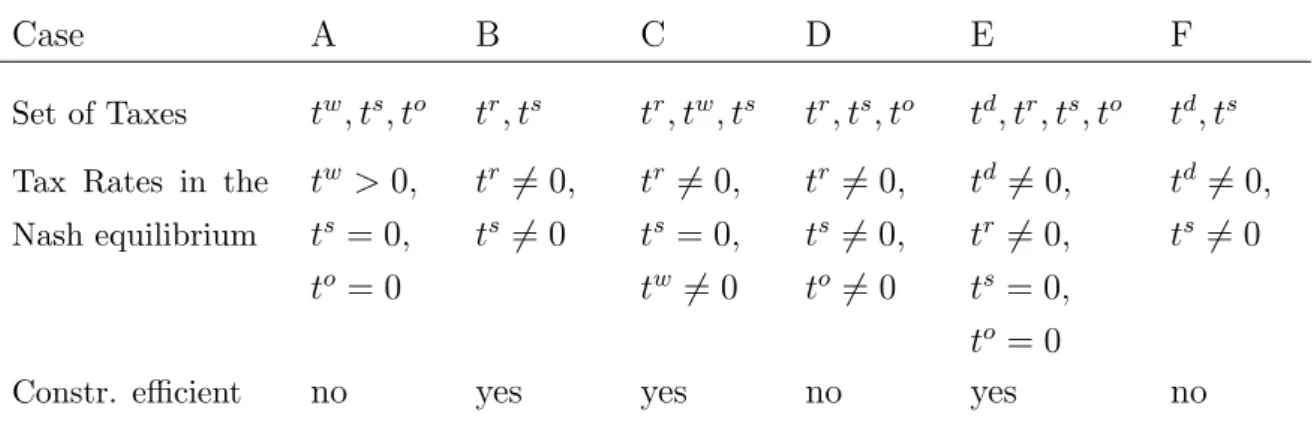
Case A B C D E F
Set of Taxes tw, ts, to tr, ts tr, tw, ts tr, ts, to td, tr, ts, to td, ts
Tax Rates in the Nash equilibrium tw >0, ts = 0, to = 0 tr 6= 0, ts6= 0 tr 6= 0, ts = 0, tw 6= 0 tr 6= 0, ts 6= 0, to 6= 0 td 6= 0, tr 6= 0, ts = 0, to = 0 td6= 0, ts6= 0
Constr. efficient no yes yes no yes no
Table 1: Summary of results
situation as required by the second part of the Proposition. In the second step we show that the tax structures given by (24) and (25) are compatible with global efficiency and evaluate LR= 0. Solving the resulting expression and using the Slutsky equation
we get (24) as required by the first part of the Proposition.
The result also has an intuitive explanation. Governments have a full set of taxes available that, through the change in the equilibrium levels of ρ and ω, allows to optimally control both the savings and labor supply decision of the resident. Thus, from the production efficiency theorem, a combination of the destination-based commodity tax with the wage tax eliminates inefficient forms of decentralized fiscal decisions. The overall conclusion of Proposition 7 thus is that countries have no incentive to engage in wasteful tax competition in a second-best situation if either destination-based commodity taxes or labor taxes are available and residence-based capital taxation is possible additionally.
The results of the present paper can be summarized in three main conclusions [ta-ble 1]. (i) The restriction to a destination-based commodity tax and a source-based capital tax does not eliminate inefficient use of taxes in tax competition [case F]. Hence, commodity tax harmonization and capital tax harmonization are not efficiency gener-ating policy substitutes in this tax scenario. (ii) However, we also have shown that an appropriate variation of the destination-based commodity and the wage tax allows to decentralize the first-best efficient allocation since, in the presence of (synthetically de-signed) lump-sum taxation, the government must not control labor and capital supply decisions. A first conclusion in this tax scenario thus is that an appropriate utilization of destination-based commodity and wage taxation allows a government to effectively insulate the country against the fiscal externalities caused by tax competition, even
in the absence of based capital taxation. As a second conclusion, residence-based capital and both destination-residence-based commodity or wage taxation are efficiency generating in second-best situation, since the economic effects of residence-based cap-ital taxation cannot be replicated by an appropriate variation of a destination-based commodity tax and a wage tax [case E].
The model also confirms the result of previous contributions, which state that tax competition does not destroy efficiency when residence-based capital taxes are available, even in the presence of source-based capital taxation [case A vs. case B]. An efficient allocation is also established if residence-based taxation of capital income is effectively enforced and wage taxes are optimally set [case C]. The intuition is that the source-based capital tax falls on labor in the presence of a residence-source-based capital tax, and, in analogy to the argument in the previous cases, the government has the necessary set of tax instruments available to independently control domestic labor and capital supply. (iii) The result that double taxation of capital income leads to an efficient resource allocation, however, critically hinges on the assumption that additional taxes do not exist. We have shown that the source-based capital tax loses its function as an implicit tax on wage income in the presence of origin-based commodity taxes [case D]. Hence, whereas we obtain efficiency when only both capital taxes exist, the tax competition equilibrium in three taxes is no longer efficient, even in the presence of residence-based capital taxes. However, a destination-based commodity or a wage tax would heal that inefficiency and would result in an efficient Nash equilibrium in which production taxes are not used.
5
Concluding remarks
In this paper we have attempted to clarify the role of factor and commodity taxation for efficiency under tax competition in a unified framework. In a model that allows for both commodity and factor taxation, destination-based commodity taxation and residence-based capital taxation eliminates the negative fiscal externalities of tax competition. The presence of td, tr or tw, tr allows a national government to manipulate the price wedges in the resident’s budget constraint independently. Hence, labor and capital supply decisions can be effectively controlled by the government. Since fiscal exter-nalities do not exist, decentral fiscal decisions lead to a globally efficient (second-best) allocation. However, a first-best allocation can be decentralized by use of commodity and wage taxation, even in the absence of residence-based capital taxation, if the initial capital stock is sufficient to finance public good provision.
The model also replicates the Bucovetsky and Wilson result that tax competition in both source- and residence-based capital taxation leads to a constrained efficient al-location, even in the absence of wage taxation. However, since efficiency in three taxes
tr, tw, ts requires that the source-based capital tax is not used, efficiency in the
Bucov-etsky and Wilson world requires that wage taxation is harmonized at a rate of zero. A positive source-based capital tax is not compatible with efficiency in the presence of wage and residence-based capital taxation. Moreover, we have shown that the Bucov-etsky and Wilson result is sensitive with respect to model extensions. In a framework that also allows for origin-based commodity taxation governments are not able to con-trol the price wedges in the resident’s budget constraint independently and the Nash equilibrium thus is inefficient.
The present analysis suggests that the debate about capital tax competition should not neglect the role of destination-based commodity taxation. Destination-based com-modity taxation generally eliminate any tendency for governments to underprovide public goods if either a wage tax or a residence-based capital tax is also present, and this result is proved to be robust with respect to the introduction of production taxes. Since taxes that directly affect prices in the consumer’s budget constraint dominate origin-based commodity and source-based capital taxes, the latter are not used by a government. As a result, the present analysis revealed some insights for the struc-ture of taxation that is useful to eliminate the negative consequences of capital tax competition.
References
Bucovetsky, S., and J. Wilson (1991) ‘Tax competition with two tax instruments.’
Regional Science and Urban Economics 21, 333–350
European Commission (1998) ‘Proposal for a council directive to ensure a minimum of effective taxation of savings income in the form of interest payments within the Community.’ Document COM (98) 295 Brussels
FitzGerald, J., J. Johnston, and J. Williams (1995) ‘Indirect tax distortions in a Europe of shopkeepers.’ Working Paper 56, Dublin: The Economic and Social Research Institute
Frenkel, J.A., A. Razin, and E. Sadka (1991) International taxation in an integrated world (London: Massachusetts Institute of Technology Press)
Genser, B., and A. Haufler (1996) ‘On the optimal tax policy mix when consumers and firms are imperfectly mobile.’Finanzarchiv 53, 411–433
Haufler, Andreas (1996) ‘Optimal Factor and Commodity Taxation in a Small Open Economy.’International Tax and Public Finance 3, 425–442
Huizinga, H., and S. Nielsen (1997) ‘Capital income and profit taxation with foreign ownership of firms.’ Journal of International Economics42, 149–165
Lockwood, B., D. de Meza, and G. Myles (1994) ‘When are origin and destination regimes equivalent?’ International Tax and Public Finance 1, 141–162
Mintz, J. (1999) ‘The role of allocation in a globalized corporate income tax.’ University of Munich. Paper presented at the conference “Capital Income Taxation: Policy Requirements for Europe”
Mintz, J., and H. Tulkens (1986) ‘Commodity tax competition between member states of a federation: Equilibrium and efficiency.’Journal of Public Economics29, 133– 172
Ratzinger, J. (1998) ‘Die Bedeutung privater Direktimporte f¨ur die G¨uterbesteuerung in der Europ¨aischen Union.’ M¨unchen: Ifo-Studien zur Finanzpolitik
Razin, A., and E. Sadka (1991) ‘International tax competition and gains from tax harmonization.’Economics Letters 37, 69–76
Richter, W. (2000) ‘An efficiency analysis of consumption and production taxation with an application to value-added taxation.’ International Tax and Public Finance
7, 23–41
Sinn, H.-W. (1987) Capital Income Taxation and Ressource Allocation (Amsterdam: North-Holland)
(1997) ‘The selection principle and market failure in systems competition.’Journal of Public Economics 66, 247–274
Sørensen, P. (1999) ‘The case for international tax coordination reconsidered.’ Univer-sity of Copenhagen
Wildasin, D.E. (1989) ‘Interjurisdictional capital mobility: Fiscal externality and a corrective subsidy.’Journal of Urban Economics 25, 193–212
Wilson, J.D. (1986) ‘A theory of interregional tax competition.’ Journal of Urban Economics19, 296–315
Zodrow, G.R., and P. Mieszkowski (1986) ‘Pigou, Tiebout, property taxation and the underprovision of local public goods.’Journal of Urban Economics 19, 356–370