Planning for the Security Assistance Organization:
Or How Do We Get There From Here?
By
Gary Taphorn
Defense Institute of Security Assistance Management
If you have served in a security assistance organization (SAO), the actions outlined above, whether in writing or expressed orally, should sound familiar. The common theme in all of the taskers above from Colonel Shawkinaugh is that they are short-term in nature, the so-called 50-meter targets. As with any other organization, the SAO inevitably becomes pre-occupied with near-term issues. While there is nothing wrong with this, focusing on these actions to the exclusion of long range issues can potentially be fruitless - or worse - counterproductive. In today’s environment where an increasing number of SAO personnel are serving one-year unaccompanied tours, a ten-week suspense to prepare for the arrival of Major Kumming might seem like a mid-term action, when in reality it is a mere blip on the radar scope. The SAO must be equally concerned with the so-called 400-meter targets, those goals or actions which will likely not happen on his watch, but on that of his successor, or even his successor once or twice removed.
This is the crucial planning function of the SAO, in which it helps to shape the organization and capabilities of the host nation military, as well as its capability and willingness to work with the United States on issues of regional or global security.
Planning Guidance
Fortunately, the system has plenty of safeguards and guidance to aid Colonel Shawkinaugh in his planning responsibilities. Both the Department of State (DoS) and Department of Defense (DoD) have, over time, developed planning processes which apply uniformly and globally to all embassies and SAOs. Moreover, since the onset of the Global War on Terror, DoS and DoD have more closely
MEMO FOR: All Personnel
Offi ce of Defense Cooperation American Embassy Bandaria FROM: Colonel Butch Shawkinaugh
Chief, ODC
SUBJECT: Summary of Taskers from Weekly ODC Staff Call
1. Urge Bandarian Air Force to sign Amendment 2 to BN-C-YCY before it expires on the 28th of the month.
2. Work with Bandarian Training Directorate to identify an English language qualifi ed fi eld grade offi cer to attend U.S. Army Command and General Staff
School before we lose the quota.
3. Set up hotel reservations and rental car arrangements for the HMMWV maintenance mobile training team (MTT) coming next week.
4. Take the necessary actions with embassy housing, the international school, and the combatant command budget folks to accommodate inbound Major I. M. Kumming, the replacement for Major Nuisance, who will arrive in ten weeks with four children.
coordinated their goals and programs. To this end, and for the fi rst time, the two departments convened a two-day security cooperation summit in Washington in April 2006.
This article examines the four planning processes for the SAO chief, one with DoS and three within DoD. It also describes the resultant documents and explains their benefi t to the SAO and to the bilateral relationship with the host nation. Each planning process was developed independently and in response to separate requirements and each operates on its own annual cycle. Collectively, however, they make for a complete matrix of planning guidance for the SAO chief. The four processes are as follows:
• The Mission Performance Plan (MPP)
• The country component of the Theater Security Cooperation Strategy (TSCS) • The Combined Education and Training Program Plan (CETPP)
• The foreign military fi nancing (FMF) and International Military Education and Training (IMET) Budget Formulation and Submission Web Tool
The Mission Performance Plan
From personal experience as a Defense Institute of Security Assistance Management (DISAM) instructor, the author can attest that most students bound for SAO billets are well aware of the combatant commander’s theater security cooperation strategy (TSCS). However, strikingly few have heard of the Mission Performance Plan (MPP) for their embassy.
In fact, the MPP is more important. It is the single planning document within the U.S. government that defi nes our national interests in any given foreign country. The MPP coordinates the efforts and establishes the performance measurement among all U.S. government agencies represented on the embassy country team (including the SAO and the defense attaché offi ce) or which otherwise have interests in that country. The MPP is not intended to limit the scope of the activities of federal agencies. Rather, it creates a framework for all agencies to defi ne priorities, articulate the goals and objectives of their programs, and directly relate program accomplishments to agency-specifi c and government-wide strategic goals. The MPP process is thus a truly interagency activity.
At each U.S. embassy, the plan is created by the country team under the leadership of the chief of mission, normally the ambassador. Guidance provided to members of the country team stresses the importance of congruity between the MPP and each agency’s strategic plan (for DoD, the country component of the TSCS). The MPP addresses not only foreign policy and national security issues, but also establishes benchmarks for internal embassy administration, staffi ng, and budget effi ciencies. Finally, the MPP acts as a transmission document for the request of appropriated funds under the DoS-managed foreign operations budget. Of key interest to SAO chiefs are the requests for FMF and IMET funding.
Upon approval by the ambassador, the MPP is sent to the DoS where it undergoes interagency review. All concerned agencies, including DoD, then have the opportunity to review and comment on each individual country MPP. Each of the more than 180 DoS missions around the world executes this process annually. The MPPs for fi scal year 2008 were submitted to DoS for review in February, 2006. In part, this is to meet the timelines for the submission of the foreign operations budget request to the Congress. Timelines are discussed in more detail below.
Individual MPPs are typically unclassifi ed documents, but are marked Sensitive But Unclassifi ed (SBU), the DoS equivalent of For Offi cial Use Only (FOUO) and, as such, must be controlled. MPPs follow a standardized and highly structured format and are organized to refl ect how an embassy supports DoS’s four broad, enduring strategic objectives and its twelve strategic goals, as refl ected in
the fi scal years 2004 through 2009 Department of State and USAID Strategic Plan. (This document can be found at http://www.state.gov/s/d/rm/rls/dosstrat/2004/).
The chart below outlines these objectives and goals. While Colonel Shawkinaugh and his fellow SAOs support at least indirectly most or all of DoS’s twelve strategic goals, their work most directly impacts on regional stability and counterterrorism.
The Theater Security Cooperation Strategy
Since the end of World War II, United States military forces have been continuously involved in a myriad of peacetime missions and activities to help shape the strategic environment. For decades, however, most of this was done on an ad hoc basis, with no overarching guidance on prioritization of partner countries and use of DoD resources. It was not until 1998 that DoD formalized its peacetime engagement process and strategy. It did so by establishing the requirement for geographic combatant commands to develop and implement theater engagement plans (TEPs) that would shape the environment in their areas of responsibility.
Under Secretary of Defense Rumsfeld’s tenure, the TEPs were renamed security cooperation plans, and now security cooperation strategies. Secretary Rumsfeld’s personal stamp on the process is seen primarily through the Security Cooperation Guidance (SCG), which was issued initially in
State Department Mission
Create a More Secure, Democratic, and Prosperous World for the Benefit of the American People
and the International Community
Achieve Peace and Security Advance Sustainable Development and Global Interests Promote International Understanding Strengthen Diplomatic and Program Capabilities
Regional Stability Democracy and Human Rights Public Diplomacy and Public Affairs Management and Organizational Excellence Counterterrorism Economic Prosperity
and Security
Homeland Security Social and Environmental Issues Weapons of Mass Destruction Humanitarian Response International Crime and Drugs American Citizens Strategic Objectives Strategic Goals
Figure 1. Department of State four strategic objectives and twelve strategic goals, as outlined in the fi scal years 2004-2009 Department of State and USAID Strategic Plan. Security assistance supports primarily the strategic objective of Achieve Peace and Security.
April 2003 and followed by a more robust version in November 2005 (and amended in June 2006). The SCG provides the basis for all further security cooperation planning and activities within DoD. This document acts as the foundation for all DoD interactions with foreign defense establishments and supports the president’s National Security Strategy and the Secretary of Defense’s National Military Strategy. The requirement to produce a security cooperation strategy now extends to all combatant commanders (both geographic and functional), as well as to secretaries of the military departments and directors of Defense agencies. The SCG makes reference to four ways in which we accomplish our strategic objectives, as articulated in the March 2005 National Defense Strategy. They are:
• Assure allies and friends • Dissuade potential adversaries
• Deter aggression and counter coercion • Defeat adversaries
The SCG then identifi es a total of nineteen objectives which collectively support the four goals above. As geographic combatant commands develop their theater security cooperation strategies, they align their programs, activities and priorities with these SCG goals and objectives. The TSCS is comprised of various sections, including strategies for sub-regions within the combatant commander’s (COCOM) area of responsibility (known as regional strategies) and strategies of the COCOM component commands. However, for Colonel Shawkinaugh and other SAO chiefs, the key component of the TSCS is the country-specifi c portion of the document, now typically called a country campaign plan (although the name varies among the COCOMs) and enclosed as an appendix. While the country campaign plan is drafted by the COCOM J5, it is utilizing input from the other COCOM directorates, the component commands, and above all the SAO. Indeed, the SAO becomes the unoffi cial “point man” for the development and execution of most of the country-level portion of the TSCS. As the de facto expert within the COCOM on his partner nation, the SAO is in the best position to recommend the nature of peacetime engagement and the types of activities which will yield optimal benefi ts to both the United States and the host nation, and with the most effi cient expenditure of resources. The SAO and other players within the COCOM utilize a classifi ed data base called Theater Security Cooperation Management Information System (TSCMIS) to schedule, track, and assess specifi c security cooperation activities and events.
In summary, just as the MPP is the ambassador’s document, so is the Theater Security Cooperation Strategy the document of the area combatant commander. While the SAO is not the lead agency in either process, it has a key role to play in both formulating and executing the plan and strategy. In rare instances, the SAO may detect confl icting guidance or priorities between his ambassador’s MPP and the combatant commander’s TSCS. In such cases, the SAO chief must seek clarifi cation or resolution at the fi rst opportunity. While the SAO chief is in the occasionally diffi cult position of responding to two masters, he is also uniquely positioned to understand both the combatant command and the embassy, balance their respective priorities, and leverage their resources.
The Combined Education and Training Program Plan
The Security Assistance Management Manual (SAMM, para C10.4.1) is the genesis of this third planning requirement. Specifi cally, it requires that:
SAOs in coordination with host country counterparts (author’s italics) develop a Combined Education and Training Program Plan (CETPP).
The same paragraph specifi es that the CETPP is part of the SAO input to the budget process, including the ambassador’s MPP and the combatant commander’s TSCS. The format of the CETPP is spelled out by SAMM Figure C10.F1.
The CETPP is the SAO chief’s “deliverable” for the annual Training Program Management Reviews (TPMRs), hosted each spring by the combatant commands. The country plans created for the spring 2006 TPMR cycle are for budget year 2007 and beyond. The SAO is required to prepare the CETPP as an unclassifi ed document and upload it to the Security Assistance Network (SAN) for review prior to the TPMR. (Beginning in 2005, the CETPPs migrated to the SAN web). More than any of the other planning documents, the CETPP illustrates the requirement for the SAO to coordinate its planning with that of the host nation. Put differently, if Colonel Shawkinaugh’s training offi cer (or foreign service national employee) returned to Bandaria from the TPMR and announced that all training requested on the CETPP was approved, it would be no surprise to Bandarian counterparts. Since it is not always possible that all requested training will be approved, or otherwise become available, the SAO must also work closely with the host nation on alternative plans. For example, if Bandaria requests a senior service school, such as the U.S. Army War College, through its IMET program, an alternative plan must in place in the event that Bandaria does not receive an invitation to the course.
The CETPP is required to address the execution of all training with DoD, regardless of the source of funding. In theory, the host nation has unlimited ability to request training through FMS cases which are paid with customer funds. At this point, the constraint may be DoD training resources. However, the reality remains that many countries are so limited in budgets that, unless the U.S. pays for both the cost of the training course (i.e., tuition), as well as the associated travel and living allowances, they can not afford the training at all. Most nations receive at least some U.S. appropriated funds for training. The IMET program alone provided training funds to at least 135 countries in fi scal year 2006. Other U.S.-funded sources of training include, for example, the Combating Terrorism Fellowship Program (CTFP) and International Narcotics and Law Enforcement (INCLE). Finally,
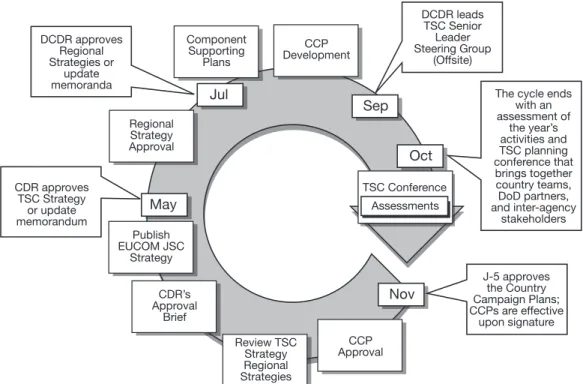
Figure 2. Like the MPP, the TSCS utilizes an annual cycle. The above diagram depicts European Command’s annual planning cycle. The country campaign plan (CPP) is the key document for engagement with each country. As of 2006, COCOMs are required to submit a formal assessment to the Joint Staff and OSD within sixty days after the end of each fi scal year. DCDR approves Regional Strategies or update memoranda CDR approves TSC Strategy or update memorandum Regional Strategy Approval Publish EUCOM JSC Strategy CDRÕs Approval Brief Component Supporting Plans CCP Development DCDR leads TSC Senior Leader Steering Group (Offsite)
The cycle ends with an assessment of the yearÕs activities and TSC planning conference that brings together country teams, DoD partners, and inter-agency stakeholders TSC Conference J-5 approves the Country Campaign Plans; CCPs are effective upon signature Review TSC Strategy Regional Strategies CCP Approval Jul May Sep Oct Nov Assessments
the new authority for the President under section 1206 of the fi scal year 2006 National Defense Authorization Act (commonly referred to as “building partner capacity” or simply “1206 authority”) also provides for U.S.-funded training.
The Foreign Military Financing and International Military Education and Training Budget Formulation and Submission Web Tool
The fi nal planning document is the Defense Security Cooperation Agency’s FMF and IMET Budget Formulation and Submission Web Tool. This document differs from the other three planning tools in that it applies only to countries which receive (or are proposed to receive) IMET and/or FMF as assistance. This excludes the so-called purely “cash customers” such as traditional North Atlantic Treaty Organization (NATO) allies and miscellaneous other high income countries ranging from Australia and South Korea to Kuwait and the United Arab Emirates. The web tool has become the automated successor to the older Annual Integrated Assessment of Security Assistance (AIASA), in which embassies submitted their annual requests by cable narrative to the DoS. The web tool is managed by DSCA on a password-protected web site in which the access of the various DoD users is customized according to their position (SAO, combatant command, etc.). DSCA reminds SAOs that budget requests should be consistent with the objectives and priorities in the Secretary of Defense’s
Security Cooperation Guidance.
Web tool submissions by SAOs work their way through the combatant commands, the Joint Staff and Offi ce of Secretary of Defense (OSD) level offi ces before being used by OSD and DSCA in discussions with DoS. Depending on the justifi cation by Colonel Shawkinaugh, the importance of his host nation to U.S. foreign policy and national security, and numerous other factors, the original SAO submission may be endorsed, reduced, or (rarely) increased at the combatant command level
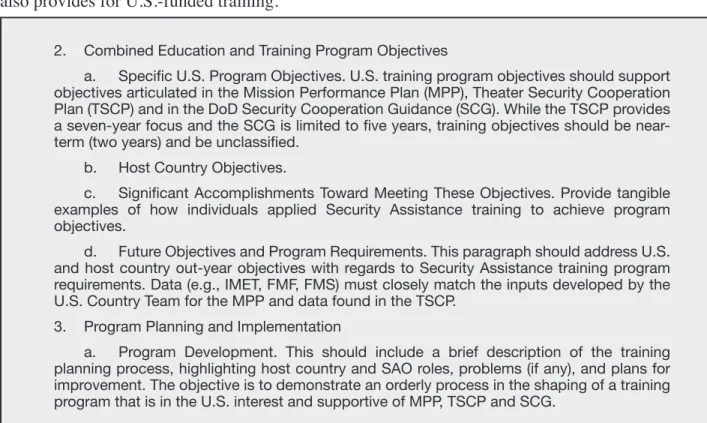
2. Combined Education and Training Program Objectives
a. Specifi c U.S. Program Objectives. U.S. training program objectives should support objectives articulated in the Mission Performance Plan (MPP), Theater Security Cooperation Plan (TSCP) and in the DoD Security Cooperation Guidance (SCG). While the TSCP provides a seven-year focus and the SCG is limited to fi ve years, training objectives should be near-term (two years) and be unclassifi ed.
b. Host Country Objectives.
c. Signifi cant Accomplishments Toward Meeting These Objectives. Provide tangible examples of how individuals applied Security Assistance training to achieve program objectives.
d. Future Objectives and Program Requirements. This paragraph should address U.S. and host country out-year objectives with regards to Security Assistance training program requirements. Data (e.g., IMET, FMF, FMS) must closely match the inputs developed by the U.S. Country Team for the MPP and data found in the TSCP.
3. Program Planning and Implementation
a. Program Development. This should include a brief description of the training planning process, highlighting host country and SAO roles, problems (if any), and plans for improvement. The objective is to demonstrate an orderly process in the shaping of a training program that is in the U.S. interest and supportive of MPP, TSCP and SCG.
Figure 3. An extract of Part One of the CETPP format, as found in the SAMM, Figure C10.F1. It emphasizes the importance of the training program meeting both U.S. and host nation objectives. While the SAMM indicates that the CETPP should be limited to two years, combatant commands now consider the CETPP a multi-year document, with the number of “out-years” variously defi ned.
or higher. The end result of this process is the annual Congressional Budget Justifi cation (CBJ), submitted in January at the beginning of each session of Congress. The FMF and IMET budget process within DoD channels is outlined in the fi gure below.
The lengthy timelines associated with this process are symptomatic of what some would call the cumbersome nature of security assistance. For example, DSCA initiated the budget cycle input for
fi scal year 2009 with a call-up message on September 29, 2006. That tasker required SAOs to submit their IMET and FMF requests and justifi cation by 10 November to meet a DoS deadline of March 30, 2007. The administration uses the next ten months for interagency discussions, including with the Offi ce of Management and Budget (OMB), to fi nalize the budget request before submission to Congress the following January. Congress typically requires typically a full annual session or more before passing the resultant foreign operations appropriations bill. As often as not, this spending bill is part of an omnibus package after a series of continuing resolutions early in the following fi scal year. Effectively, then, the SAOs are being asked to make budget requests for fi scal year 2009 when Congress has not yet acted on even the fi scal year 2007 budget and the 2008 budget request has not yet even been submitted to Congress. By this author’s calculation, Colonel Shawkinaugh can now expect a turn-around time of 26 to 28 months between his submission on the Web Tool and eventual allocation of funds to Bandaria. By that time, Colonel Shawkinaugh has likely moved to his fi rst or
Figure 4. The annual fl ow of SAO requests for country FMF and IMET is depicted here, as per DSCA’s FMF and IMET Budget Formulation and Submission Web Tool. SAOs made their submission for fi scal year 2009 in October and November of 2006.
SAOs COCOM JCS DSCA State OSD
SAOs enter budget data through the FMF/IMET Budget Web Tool. SAOs have the capability to modify their data prior to submitting it to their respective Combatant Command. Once submitted, the budget data if locked from changes, but can be viewed at any time.
Each Combatant Command (COCOM) is notified by email when their respective SAOs submit budget input. The COCOM can review these budget submissions and revise or edit its version of the data. Once the COCOM completes its budget recommendation, it submits it to the Joint Staff (JS). Once submitted, the COCOM budget data is locked from changes, but can be viewed at any time.
The Joint Staff (JS) is notified by email when each COCOM makes their budget submissions. The JS can review these budget submissions and revise or edit its version of the data. Once the JS completes its budget recommendation, it submits it to DSCA. Once submitted, the JS budget data is locked from charges, but can be viewed at any time.
DSCA is notified by email when the JS makes its budget submission. DSCA, in conjunction with the OSD, formulate a budget based on the JS submission. The DSCA can review these budget submissions and revise or edit its version of the data. Once the budget recommendation is completed, DSCA formally submits it to the OSD for approval. Once submitted, the DSCA budget data is locked from changes but can be viewed at any time.
The State Department is notified by email when DSCA submits the DoD budget recommendation. State reviews the DoD FMF/IMET budget submission, makes revisions, and submits a budget request to the Office of Management and Budget (OMB).
Based on OSD comment, DSCA revises or edits the OSD version of the data. Once the DoD budget recommendation is completed DSCA formally submits it to the State Department. Once submitted, the DoD budget data is locked from changes but can be viewed at any time.
even second follow-on assignment while his successor (possibly once removed) must live with the results. The DSCA chart below illustrates the complete budget cycle.
In fairness, the budget submission through the web tool is only slightly longer (perhaps ninety days) than that through the Mission Performance Plan. DSCA is cognizant of the diffi culties that these timelines impose on the SAO. It provides as much guidance to SAOs as possible by including in the web tool the current recommended levels of funding within the administration for the interim years (in this case, fi scal year 2007 and fi scal year 2008). However, the lengthy budget process continues to impede the ability of SAOs and combatant commands to react swiftly to changing realities and emerging challenges in their regions. This is a primary reason why DoD has asked for (and received) from the Congress the authority to “build partner capacity,” as outlined in the fi scal year 2006 National Defense Authorization Act (section 1206).
There is no formal DSCA requirement that SAO funding requests for FMF and IMET be identical in both the MPP and the web tool. However, the combatant commands realize the importance of coordinating both efforts and in general are now ensuring that SAO input into both processes is consistent. It should be mentioned that the annual FMF and IMET submission is actually a four-year plan. In this case, the fi scal year 2009 submission is actually for fi scal years 2009 through 2012. In part, this is designed to meet a Congressionally-mandated requirement for a national security assistance strategy.
The fi nal fi scal year 2006 appropriation for FMF, after a one percent rescission, was $4,464,900,000. Of this amount, Congress earmarked certain amounts to specifi c countries. These earmarks, as in prior years, were almost entirely for the three Middle East peace partners, specifi cally, $2,280,000,000 for Israel, $1,300,000,000 for Egypt, and $210,000,000 for Jordan. There were also approximately $40 million in earmarks for nine other countries, of which $30 million was for the
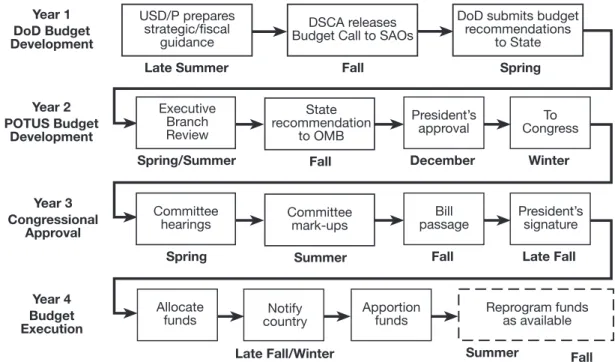
Year 1 DoD Budget Development USD/P prepares strategic/fiscal guidance DSCA releases Budget Call to SAOs
DoD submits budget recommendations
to State
Late Summer Fall Spring
Year 2 POTUS Budget Development Executive Branch Review Spring/Summer State recommendation to OMB Fall PresidentÕs approval December To Congress Winter Year 3 Congressional Approval Committee hearings Spring Committee mark-ups Summer Bill passage Fall PresidentÕs signature Late Fall Year 4 Budget Execution Allocate
funds countryNotify
Late Fall/Winter
Apportion
funds Reprogram fundsas available
Summer Fall
Figure 5. The complete budget cycle for traditional security assistance funding and most other categories of foreign aid. The President’s annual Congressional Budget Justifi cation (CBJ) is enacted by the Congress through the Foreign Operations Appropriations Act approximately one year later.
Philippines. Even excluding the smaller earmarks, the FMF dedicated by Congress for the big three alone amounts to 84 percent of the total. This means that Colonel Shawkinaugh and the vast majority of his SAO chief counterparts are effectively competing for less than $700 million of the entire FMF pie.
A word about execution of FMF is appropriate here. For obvious reasons, the SAO should work closely with the host nation to promptly commit FMF monies through the FMS process. The ever-present factor of infl ation alone should drive early commitment of funds, under the premise that the same articles and services will almost certainly cost more six months or a year from now. However, the increasing scrutiny of resources at all levels, from the combatant command to the State Department, is also a factor. If the Bandarians “sit” on their FMF for a year or so after its allocation, it will sooner or later make Colonel Shawkinaugh’s job harder to justify continued funding for the Bandarian country program.
To summarize the four processes just discussed, a notional SAO planning calendar is provided below. The timelines indicated are for calendar year 2006.
The Assessment Environment
A decade or so ago, it was not unusual for FMF and/or IMET funding within individual country programs to “cruise” at the same level for a number of years with only casual scrutiny in Washington. For most countries, however, those days are long gone as both the executive branch and the Congress are more closely examining the “bang for the buck” in foreign operations appropriations. Congress has played a key role here through the Government Accountability and Results Act (GPRA) of 1993. This law requires most federal agencies, including the Department of State, to complete three plans, which can be summarized as follows:
1. A strategic plan of at least fi ve years in duration. In response to this requirement, Department of State and the United States Agency for International Development (USAID) produced their Strategic Plan for Fiscal Years 2004 through 2009, which was referenced above.
Event Or Function Mission Performance Plan Theater Security Cooperation Strategy FMF & IMET Budget Web Tool Combined Education and Training Program Plan (CETPP)
Jan Feb Mar Apr May Jun July Aug Sep Oct Nov Dec
Assist COM & Country Team with FY 08 MPP (due to State 1 Feb 06)
Obtain access to special DSCA web site at https://63.97.161.12/ thru DSCA desk officer. 2005 suspense for SAOs
was 18 Nov 2005.
Prepare CETPP (Jan Ð Mar) for FY 2007. Go to http://www.disam.dsca.mil/itm/ and see instructions. Attend COCOM TPMR (Mar Ð
May). Suspenses vary by COCOM Draft (2-star level)
COCOM TSCS due to JS by 15 Apr Inter-agencey roundtable (COCOMs, DSCA, OSD, State) on FY 08 Request Final TSCS published by 1 Aug Assessments of completed TSCS Submit request for FY 09-14 SA funds (FMF and IMET) to COCOM
2. A performance plan on an annual basis, designed to refl ect performance based on the budgetary resources for that year. Performance goals and indicators are to be expressed in an objective and quantifi able manner. The DoS’s current performance plan also produced with USAID was published in February 2006 and is titled Fiscal Year 2007 Joint Performance Summary. It is on-line at http://www.state.gov/s/d/rm/rls/ perfplan/2007/.
3. A performance report, also on an annual basis, which reviews the success of achieving the previous year’s performance goals, identifi es any causes of failure in meeting those goals, and evaluates the current year’s performance plan in light of last year’s successes or failures. DoS satisfi es this requirement with its Performance and Accountability Report (PAR), the most recent (2005) of which can be found at http:// www.state.gov/documents/organization/58402.pdf.
In its 2005 performance report, DoS rated itself “on target” for all twelve strategic goals, including regional stability and counterterrorism. However, when evaluating the 195 performance indicators supporting the strategic goals, only 78 percent of them were considered “on target” or above. Put differently, 43 performance indicators were rated “below target” or “signifi cantly below target”. Additionally, the performance report summarized the results of surveys by the Offi ce of Management and Budget (OMB) using its Program Assessment Rating Tool (PART). OMB uses this tool to assess all federal programs against performance-related criteria. Of the 39 PART reviews conducted of DoS programs (as of the 2005 performance report), 22 were rated effective, fi ve as moderately effective, and twelve as adequate. All four of the assessments directly involving security assistance were considered effective. An extract of these from the 2005 report is below.
Score and Rating as of Strategic Goal State Bureau Program Name October 2005
Regional Stability African Affairs Security Assistance 97% – Effective
Sub-Saharan Africa
Regional Stability South Asian Affairs Security Assistance 93% – Effective
Regional Stability Western Hemisphere Security Assistance 90% – Effective
Affairs (WHA)
Regional Stability International Contributions to 86% – Effective
Organization Affairs International
Peacekeeping Activities
In its 2007 performance plan, DoS identifi ed seven initiatives and programs under its strategic goal of regional stability. Of these, two were directly related to security assistance. The fi rst of these focused on the number of foreign military personnel receiving training under the IMET program and the second on U.S. military training for African units deployed in peacekeeping operations.
Separately, the geographic COCOMs have been submitting annual assessments to the OSD annually since 2004. As of 2006, that requirement is extended to the military departments, defense agencies, and the functional combatant commands. All such DoD entities have sixty days after the end of the fi scal year to submit a report to OSD. These assessments are designed to evaluate the effectiveness of their security cooperation functions and activities, help shape the future use of
resources for maximum effectiveness, and lastly identify constraints that can be fi xed by changes in law and/or policy.
The point of this discussion is to emphasize that, whether at the global, regional, or country level, the degree of oversight of foreign operations programs is steadily increasing. The lesson for Colonel Shawkinaugh is that his plans for utilizing FMF, IMET, and other appropriations and resources must be well-justifi ed, fully coordinated with the host nation, and fully supported by both the ambassador and the combatant commander.
From their fi rst days in uniform, military personnel are taught the importance of teamwork. SAO personnel in particular, who work largely in small offi ces, understand this concept. But the transient nature of personnel serving in SAO billets, the lengthy timelines associated with budget processes, and the complex nature of equipping and training any military organization all combine to add a new dimension to teamwork for the SAO. The SAO team includes those U.S. personnel who have not yet been identifi ed for the assignment, or perhaps not yet even promoted to the appropriate grade, and who will not arrive in Bandaria for another two, three, or fi ve years. Only by carefully following the planning processes described here, and working closely with counterparts, will Colonel Shawkinaugh ensure the continued success of the SAO team.
About the Author
Mr. Gary Taphorn is an assistant professor at DISAM and a retired U.S. Army offi cer. He previously served in two security assistance offi ces and currently manages the Security Cooperation Offi cer Overseas (SCM-O) course.