Angular Margin Centroid Loss for Text-independent Speaker Recognition
Yuheng Wei
1, Junzhao Du
1, Hui Liu
11
School of Computer Science and Technology, Xidian University, China
[email protected], [email protected], [email protected]Abstract
Speaker recognition for unseen speakers out of the training dataset relies on the discrimination of speaker embedding. Re-cent studies use the angular softmax losses with angular mar-gin penalties to enhance the intra-class compactness of speaker embedding, which achieve obvious performance improvement. However, the classification layer encounters the problem of di-mension explosion in these losses with the growth of training speakers. In this paper, like the prototype network loss in the few-short learning and the generalized end-to-end loss, we op-timize the cosine distances between speaker embeddings and their corresponding centroids rather than the weight vectors in the classification layer. For the intra-class compactness, we im-pose the additive angular margin to shorten the cosine distance between speaker embeddings belonging to the same speaker. Meanwhile, we also explicitly improve the inter-class separabil-ity by enlarging the cosine distance between different speaker centroids. Experiments show that our loss achieves compara-ble performance with the stat-of-the-art angular margin softmax loss in both verification and identification tasks and markedly reduces the training iterations.
Index Terms: speaker recognition, intra-class compactness, inter-class separability, angular margin, embedding
1. Introduction
Speaker recognition (SR) [1] includes two types of tasks, verifi-cation (SV) and identifiverifi-cation (SID). Given utterances from an unknown speaker, SV determines whether the speaker matches his/her claimed identity, while SID classifies the speaker as one of enrollment speakers. SR is also classified into text-dependent and text-independent methods, depending on whether the spo-ken contents are constrained into a specific lexical set.
A typical SR framework consists of two major components: a frond-end modeling speakers and a back-end discriminating them based on a similarity measure. The classical SR paradigm is the combination of i-vector [2] and probabilistic linear dis-criminant analysis(PLDA) [3], which has dominated the SR field over the past decade. With the rise of deep learning, deep neural network (DNN) as a powerful tool is used for SR and achieves incredible performance. The main usage of DNN is to extract speaker representations (speaker embeddings) from raw utterances, which replace i-vectors to model speakers in form of compact vectors. Deep speaker embedding gradually outper-forms i-vector especially when dealing with short utterances, benefiting from the large scale of training data, the exquisite structures of DNN and the well-designed loss functions.
The loss functions used to learn speaker embedding in the DNN training can be roughly branched into two categories: classification and end-to-end. Softmax Loss is the most typi-cal classification loss which trains DNN to predict the speaker labels for training samples. In this case, speaker embeddings such as D-vector [4] and X-vector [5] are derived from the ac-tivations of the last hidden layer before the classification layer,
which are abundant in speaker characteristics. SR tasks usually face a open-set circumstance in which testing speakers may not appeared in the training dataset. This means the speaker embed-dings should be discriminative enough for unseen speakers, but the softmax loss only makes speaker embeddings roughly sepa-rable. To address this issue, the end-to-end losses based on deep metric learning are proposed to directly optimize the speaker embedding and the similarity metric at the same time, such as Contrastive Loss [6] and Triplet Loss [7][8]. The popular triplet loss optimizes speaker embeddings so that the distance between the same speaker is smaller than the distance between the differ-ent speakers over a threshold. However, the triplet loss has two drawbacks: (1) The number of triplets explosively grows with the training dataset scale. (2) It relies on a complicated triplet mining strategy to search effective triplets.
Recently, several softmax variants are proposed to boost the discriminative power of face representations in the face recognition field, including SphereFace [9], CosFace [10] and ArcFace [11], which are also introduced into the SR field [12][13][14][15]. These methods project the representations as well as the class weight vectors onto a hypersphere by L2-normalization, so that the classification result depends on the angle between the representation and the class weight vector. Furthermore, a margin penalty is imposed into the target logit before softmax normalization to concentrate the speaker em-beddings belonging to the same identity together, which encour-ages the intra-class compactness. However, one major draw-back of above softmax variants is that the size of the weight ma-trix in the classification layer linearly increases with the number of training speakers.
Generalized end-to-end (GE2E) loss [16] is an enhanced constrative loss, which directly optimizes the cosine distance between speaker embeddings and their centroids without a com-plicated sample selection procedure like the triplet loss or a classification layer like the softmax loss. The alike method is also studied in [17], which adopts the Prototype Network Loss [18] proposed in the few-shot learning field [19] to optimize the Euclidean distance between embeddings and centroids. How-ever, these losses are still not discriminative enough for unseen speakers. In this paper, we introduce an additive angular margin penalty between the speaker embeddings and their centroids to shrink the intra-class angular distance, so that the speaker em-beddings belonging to the same speaker tightly gather around their centroid. As analyzed in RegularFace [20], the explicit consideration of the inter-class discrepancy is crucial to the face representation discrimination. Inspired by this, We also push the embedding centroids far away from each other by increas-ing the cosine distances between centroids. Our contributions are summarized as follows:
1. We propose Angular Margin Centroid (AM-Centroid) Loss to directly optimize the cosine distances between speaker embeddings and their corresponding centroids with an additive angular margin, which learns more
dis-INTERSPEECH 2020
criminative speaker embeddings by explicitly enhancing the intra-class compactness and the inter-class discrep-ancy simultaneously.
2. We compared the AM-Centroid Loss with the start-of-the-art losses widely-used in the SR filed, such as the additive angular margin softmax loss, the triplet loss and the GE2E loss. Experiment results demonstrate the ef-fectiveness of the proposed loss.
This paper is arranged as follows. In Section 2, we review the angular softmax loss and the GE2E loss ,which are the start-of-the-art losses used in SR methods. And then we illustrate our AM-Centroid loss. In Section 3 and Section 4, we give the experiment details and results. In Section 5, a conclusion of this paper is given.
2. Proposed Approach
Our AM-Centroid loss is inspired by the angular softmax loss with the additive angular margin penalty and the GE2E loss. We firstly revisit them and then introduce the AM-Centroid loss.
2.1. Additive Angular Margin Softmax Loss
Letxi∈Rdrefer to thed-dimensional speaker embedding be-longing to theyi-th speaker class.Wjdenotes thej-th column
of the classification matrixW ∈Rd×n. The number of speaker classes isnand the mini-batch size isK. The standard softmax loss is defined as follows:
L1=−1 K K X i=1 log e WyiTxi Pn j=1e WT jxi (1)
The angular softmax loss fixeskxik= 1andkWjk= 1by
L2-normlization. Andkxikis re-scaled tos, so thatWjTxi =
scos (θi,j)whereθi,j is the angle betweenxiandWj. This
forcesθi,yito be smaller thanθi,j(j6=yi). To further enhance
the intra-class compactness, an additive angular margin penalty
mis used to penalize the largeθi,yi. The additive angular
mar-gin softmax is presented as follows:
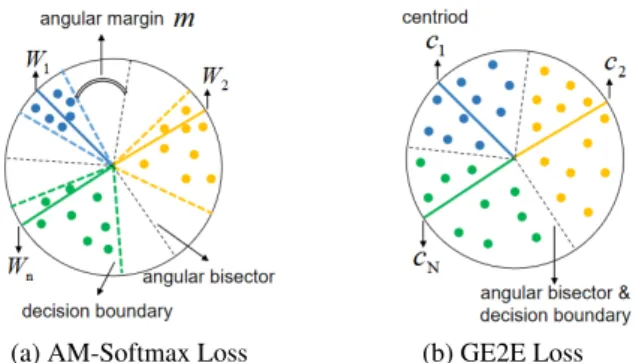
L2=−1 K K X i=1 log e s(cos(θi,yi+m)) es(cos(θi,yi+m))+Pn j=1,j6=yie scosθi,j (2) As illustrated in Figure 1(a), the additive margin penalty compresses the speaker embeddings and the cosine distance be-tween decision boundaries of different speakers is linearly con-trolled by the hyper-parameterm.
2.2. Generalized End-to-end Loss
Let a mini-batch consist ofN speakers andM utterances per speaker. We usexij(1≤i≤N,1 ≤j≤M)to denote the
speaker embedding extracted from speakeriutterancej. The embedding centroid of speakerkis defined as follows:
ck= 1 M M X j=1 xkj. (3)
The GE2E loss defines the similarity matrixSij,kto
repre-sent the scaled cosine similarity between each speaker embed-dingxijand all centroidsck(1≤i, k≤Nand1≤j≤M)
as follows:
Sij,k=w·cos(θxij,ck) +b, (4)
(a) AM-Softmax Loss (b) GE2E Loss Figure 1:Illustration of speaker embeddings learned by differ-ent loss functions, circle dots in color represdiffer-ents differdiffer-ent iden-tities. Black dotted lines are the angular bisectors between (a) weight vectors (b) centroids.
wherew, bare learnable parameters andθxij,ckrefers to the
an-gle betweenxijandck. Then the softmax activation function is
used to normalize each row ofS consisting of{Sij,k}(k =
1,2,· · ·, N). The GE2E loss wants sof tmax(Sij,k) = 1
wheni=k, otherwisesof tmax(Sij,k) = 0, so it is defined as
follows: L3=− 1 N×M X i,j log e Sij,i PN k=1e Sij,k. (5)
2.3. Angular Margin Centroid Loss
As shown in Figure 1(b), although GE2E loss encourages the embeddings belonging to speakerkto be closer to their own centroidckthan other centroids, there still exists a large
intra-class distance. Inspired by the concept of margin penalty pro-posed in the angular softmax loss, we want to penalize the an-gle between each speaker embedding and its corresponding cen-troid if the angle is large, so we redefine the similarity matrix
Sij,kby replacingwwith a scalar values, settingb = 0and
adding a angular penaltymto the target angle as follows:
Sij,k=
s·cos(θxij,ck+m) ifi=k;
s·cos(θxij,ck) otherwise.
(6) Note that a training trick to guarantee the stable conver-gence in [16] is to removexijwhen calculating its
correspond-ing embeddcorrespond-ing centroid as in Equation (7). We also integrate this into our loss, so the losses for a batch and for a embedding
xijare defined by Equation (8) and Equation (9), respectively.
c(k−j)= 1 M−1 M X h=1,h6=j xkh (7) L4= 1 N×M X i,j l(xij) (8) l(xij) =−log e s·cos(θ xij ,c(i−j) +m) e s·cos(θ xij ,c(i−j) +m) +PN k=1,k6=ie s·cos(θxij ,ck) (9) The intra-class compactness and the inter-class separability are two key factors which are contributed to the distinguishabil-ity of speaker embedding. The additive angluar margin penalty
takes effect by mainly influencing the former factor. We fur-ther consider the latter factor by enlarging the angle distance between different centriods{ck},(k = 1,2,· · ·, N). To do
this, we impose a repulsive force on the embedding centroids to push them far away from each other. This repulsive force is formulated by Equation (10). L5= N×(N−1) 2 N−1 X k=1 N X g=k+1 cos (θck,cg) (10)
The AM-Centroid loss is combined by (8) and (10) as Equa-tion (11),where λbalances the intra-class loss and the inter-class loss. As illustrated in Figure 2, the AM-Centroid loss takes a batch as input, and calculates the embedding centroid for each speaker in the mini-batch. The lossL4focus on com-pressing the speaker embeddings from the same speaker to ap-proach their centroid with the additive angular marginm, while the lossL5makes the centroids far apart. This joint effect can result in more discriminative speaker embeddings.
L6=L4+λL5 (11)
Figure 2:The details of the AM-Centroid Loss.
3. Experiments
3.1. Dataset
LibriSpeech [21] is a publicly available speech dataset which encompasses sufficient utterances annotated with speaker la-bels. We use thetrain-clean-360subset to train speaker models, which consists of 921speakers, averaged25minutes speech per speaker and approximate360hours in total. We divide the train-clean-100subset containing251speakers and about100 hours speech into two parts: a SID testing set and a SV testing set, with125and126speakers respectively.
We use fixed-length speech segments extracted from utter-ances of different speakers to build training mini-batches to en-sure comparability of results, and use variable-length utterances for testing, which is a universal practice in most of the SR stud-ies.
3.2. Evaluation Protocol
The evaluation follows the standard protocol: extracting speaker embeddings and calculating their cosine similarity to determine speaker identities. We report the accuracy (ACC) for SID and the equal error rate (EER) for SV.
3.3. Implementation Details
Input Features:We extract40-dimensional log mel-filterbank energies for each speech frame of width20 msand step10 ms. The training speech segments are set to2 sand this generates
a spectrogram with the size of 198×40for each segment. The mean-and-variance normalization over a3 swindow is per-formed on each spectrogram.
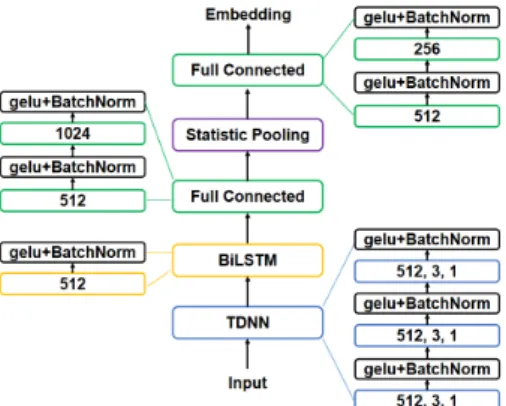
Neural Network Architecture: The DNN architecture used to extract speaker embedding is constructed based on [22] with several modifications, as depicted in Figure 3. Three time delay neural network (TDNN) layers are stacked to learn short-term temporal context, which have the parameters (the num-ber of filters,the filter size,the dilated factor). A bidirectional LSTM layer with512neural units is followed to capture long-term temporal dependence in the frame-level feature sequence. Next two full connected layers change the feature dimension to512and1024successively. We use a statistic pooling layer to generate the utterance-level feature vector by calculating the mean and standard deviation of input feature sequence and con-centrating these statistics together. Final two fully connected layers with512and256nodes project the utterance-level fea-ture vector into the256-dimensional speaker embedding. We chooseGELU[23] activation function and use batch normal-ization [24] to accelerate training. Note that another fully con-nected layer with921nodes is attached to the last layer of this structure to act as the classification layer when training DNN with the angular softmax loss.
Figure 3: The details of deep neural network used to extract speaker embedding.
Training Setting: Experiment codes are implemented by Tensorflow[25]. The Adam algorithm[26] is used to optimized deep neural networks. We use a initial learning rate of1e−3 to train the softmax, AM-Softmax (m= 0.0) and GE2E losses. The models trained by the AM-Softmax (m = 0.0) loss and the GE2E loss are respectively used as pre-trained models to train the AM-Softmax (m > 0.0) loss and the AM-Centroid loss, and the learning rate is changed to1e−4. The mini-batch size is set to128for the softmax loss and the AM-Softmax loss. When training the Triplet loss, GE2E loss and AM-Centroid loss, each batch contains64speakers with10speech segments per speaker. For the Triplet loss, we use the batch hard[27] strategy to generate triplets for training.
4. Results
4.1. Speaker Verification and Speaker Identification
We firstly explore the recognition performance for different losses on both the SID and SV testing sets constructed in Sec-tion 3.1. For SID, we randomly picked 30 K utterances as enrollment utterances and selected10evaluation utterances (1 positive sample and9negative samples) for each enrollment
ut-terance. For SV, we randomly generated18 Kpositive pairs and 18 Knegative pairs.
In the experiments, we train different losses based on the same DNN described in Section 3.3 for fair comparison. For the GE2E loss, the learable parameterswandbare initialized to10and−5respectively as in [16]. For the triplet loss, we use the cosine distance as the similarity metric and set the margin
αto0.1. For the angular softmax loss and the proposed loss, we set the embedding scalesto40. The balance factorλin our loss is set to0.1. The value of angular marginmsignificantly influences the recognition performance and the difficulty level of the convergence of the training process, so we tired multiple angular margin settings, including0.3,0.4and0.5. The values larger than0.5make the training process fail to converge well, so we don’t list the corresponding evaluation results.
Table 1: Speaker verification EER (%) and speaker identifica-tion accuracy (%).
Loss EER Accuracy
Softmax 10.43 80.51
Triplet Loss (cosine,α= 0.1) 8.41 82.62
GE2E Loss 8.30 83.74 AM-Softmax (m= 0.0) 11.36 79.12 AM-Softmax (m= 0.3) 9.85 81.53 AM-Softmax (m= 0.4) 8.01 84.61 AM-Softmax (m= 0.5) 7.38 85.28 AM-Centroid Loss (m= 0.3) 7.72 85.14 AM-Centroid Loss (m= 0.4) 6.59 86.37 AM-Centroid Loss (m= 0.5) 6.14 86.51
Table 1 shows the evaluation results, whereAM-Softmax refers to the angular softmax loss with the additive angular mar-gin penalty andAM-Centroiddenotes the proposed loss. When
m = 0, the AM-Softmax loss reduces to the angular softmax loss without any angular margin penalty, which achieves the worst performance in our experiment. Compared to the soft-max loss and the triplet loss, the GE2E loss shows its superior-ity which potentially learns how to classify speakers based on the cosine similarity between speaker embeddings. However, the AM-Softmax loss (m > 0.3) surpasses the performance of the GE2E loss, which demonstrates the effectiveness of the angular margin penalty. The AM-Centroid loss considers the inter-class discrepancy and the intra-class density explicitly at the same time, which obtains the best performance on both the SV and SID trials whenm= 0.5.
4.2. Angle Distributions
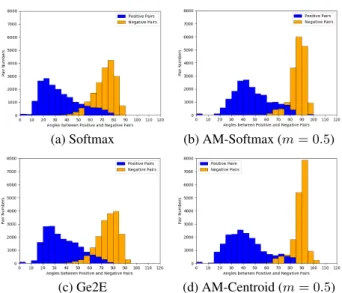
In order to intuitively understand the discrimination of speaker embedding. We give the detailed angle distributions of both positive pairs and negative pairs on the SV testing set. As in Figure 4, the verification performance is determined by the size of the overlap area between the intra-class and inter-class an-gles. The angular margin effectively makes them away from each other. The inter-class angles of the AM-Centroid loss trend to be larger than that of the AM-Softmax loss due to explicitly increasing the cosine distance between different speaker cen-troids during training.
4.3. Training iterations
Figure 5 illustrates the training iterations required by model convergence when using the the AM-Softmax (m= 0.3) loss
(a) Softmax (b) AM-Softmax (m= 0.5)
(c) Ge2E (d) AM-Centroid (m= 0.5)
Figure 4: Angle distributions of both positive and negative pairs. Orange bars denotes the angles between positive pairs, while blue bars indicates that between negative pairs. The X-axis is the angle presented in degree and the Y-X-axis is the count of corresponding pairs.
and the AM-Centroids (m= 0.3) loss. The AM-Centroids loss makes the training procedure more effective, because it handles a large number of utterances in a mini-batch at once.
(a) (b)
Figure 5:The number of training iterations when using different losses. (a) Am-Softmax (m= 0.0) and GE2E. (b) Am-Softmax (m= 0.3) and Am-Centroid (m= 0.3)
5. Conclusions
In this paper, we propose the Angular Margin Centroid Loss (AM-Centroid Loss), which effectively enhances the inter-class separability and the intra-class compactness of speaker embed-ding simultaneously for text-independent SR when dealing with unseen speakers. We conducted comprehensive experiments to evaluate the performance of the proposed loss. Experiment re-sults demonstrate that our loss outperforms other losses in per-formance and has the advantage of faster convergence.
6. Acknowledgements
This work is supported by the Fundamental Research Funds for the Central Universities, the Innovation Fund of Xidian Univer-sity, National Key Research&Development Program of China (#2018Y F B1003605),Open Fund of State Key Laboratory of Computer Architecture (#CARCH201704).
7. References
[1] J. P. Campbell, “Speaker recognition: A tutorial,”Proceedings of the IEEE, vol. 85, no. 9, pp. 1437–1462, 1997.
[2] N. Dehak, P. J. Kenny, R. Dehak, P. Dumouchel, and P. Ouellet, “Front-end factor analysis for speaker verification,”IEEE Trans-actions on Audio, Speech, and Language Processing, vol. 19, no. 4, pp. 788–798, 2010.
[3] S. J. Prince and J. H. Elder, “Probabilistic linear discriminant anal-ysis for inferences about identity,” in2007 IEEE 11th Interna-tional Conference on Computer Vision. IEEE, 2007, pp. 1–8. [4] E. Variani, X. Lei, E. McDermott, I. L. Moreno, and J.
Gonzalez-Dominguez, “Deep neural networks for small footprint text-dependent speaker verification,” in2014 IEEE International Con-ference on Acoustics, Speech and Signal Processing (ICASSP). IEEE, 2014, pp. 4052–4056.
[5] D. Snyder, D. Garcia-Romero, G. Sell, D. Povey, and S. Khudan-pur, “X-vectors: Robust dnn embeddings for speaker recognition,” in2018 IEEE International Conference on Acoustics, Speech and Signal Processing (ICASSP). IEEE, 2018, pp. 5329–5333. [6] G. Heigold, I. Moreno, S. Bengio, and N. Shazeer,
“End-to-end text-dep“End-to-endent speaker verification,” in2016 IEEE Interna-tional Conference on Acoustics, Speech and Signal Processing (ICASSP). IEEE, 2016, pp. 5115–5119.
[7] C. Li, X. Ma, B. Jiang, X. Li, X. Zhang, X. Liu, Y. Cao, A. Kan-nan, and Z. Zhu, “Deep speaker: an end-to-end neural speaker embedding system,”arXiv preprint arXiv:1705.02304, 2017. [8] H. Bredin, “Tristounet: triplet loss for speaker turn embedding,”
in2017 IEEE international conference on acoustics, speech and signal processing (ICASSP). IEEE, 2017, pp. 5430–5434. [9] W. Liu, Y. Wen, Z. Yu, M. Li, B. Raj, and L. Song, “Sphereface:
Deep hypersphere embedding for face recognition,” in Proceed-ings of the IEEE conference on computer vision and pattern recognition, 2017, pp. 212–220.
[10] H. Wang, Y. Wang, Z. Zhou, X. Ji, D. Gong, J. Zhou, Z. Li, and W. Liu, “Cosface: Large margin cosine loss for deep face recogni-tion,” inProceedings of the IEEE Conference on Computer Vision and Pattern Recognition, 2018, pp. 5265–5274.
[11] J. Deng, J. Guo, N. Xue, and S. Zafeiriou, “Arcface: Additive angular margin loss for deep face recognition,” inProceedings of the IEEE Conference on Computer Vision and Pattern Recogni-tion, 2019, pp. 4690–4699.
[12] S. Yadav and A. Rai, “Learning discriminative features for speaker identification and verification,” in Proc. Inter-speech 2018, 2018, pp. 2237–2241. [Online]. Available: http://dx.doi.org/10.21437/Interspeech.2018-1015
[13] M. Hajibabaei and D. Dai, “Unified hypersphere embedding for speaker recognition,”arXiv preprint arXiv:1807.08312, 2018. [14] S. Novoselov, A. Shulipa, I. Kremnev, A. Kozlov, and
V. Shchemelinin, “On deep speaker embeddings for text-independent speaker recognition,” arXiv preprint arXiv:1804.10080, 2018.
[15] Z. Huang, S. Wang, and K. Yu, “Angular softmax for short-duration text-independent speaker verification.” inInterspeech, 2018, pp. 3623–3627.
[16] L. Wan, Q. Wang, A. Papir, and I. L. Moreno, “Generalized end-to-end loss for speaker verification,” in2018 IEEE Interna-tional Conference on Acoustics, Speech and Signal Processing (ICASSP). IEEE, 2018, pp. 4879–4883.
[17] J. Wang, K. Wang, M. T. Law, F. Rudzicz, and M. Brudno, “Centroid-based deep metric learning for speaker recognition,” pp. 3652–3656, 2019.
[18] J. Snell, K. Swersky, and R. S. Zemel, “Prototypical networks for few-shot learning,” pp. 4077–4087, 2017.
[19] Y. Wang, Q. Yao, J. T. Kwok, and L. M. Ni, “Generalizing from a few examples: A survey on few-shot learning,”arXiv: Learning, 2019.
[20] K. Zhao, J. Xu, and M.-M. Cheng, “Regularface: Deep face recognition via exclusive regularization,” inProceedings of the IEEE Conference on Computer Vision and Pattern Recognition, 2019, pp. 1136–1144.
[21] V. Panayotov, G. Chen, D. Povey, and S. Khudanpur, “Lib-rispeech: an asr corpus based on public domain audio books,” in2015 IEEE International Conference on Acoustics, Speech and Signal Processing (ICASSP). IEEE, 2015, pp. 5206–5210. [22] D. Snyder, D. Garcia-Romero, D. Povey, and S. Khudanpur,
“Deep neural network embeddings for text-independent speaker verification.” inInterspeech, 2017, pp. 999–1003.
[23] D. Hendrycks and K. Gimpel, “Gaussian error linear units (gelus),”arXiv preprint arXiv:1606.08415, 2016.
[24] S. Ioffe and C. Szegedy, “Batch normalization: Accelerating deep network training by reducing internal covariate shift,”arXiv: Learning, 2015.
[25] M. Abadi, P. Barham, J. Chen, Z. Chen, A. Davis, J. Dean, M. Devin, S. Ghemawat, G. Irving, M. Isardet al., “Tensorflow: A system for large-scale machine learning,” in12th{USENIX}
Symposium on Operating Systems Design and Implementation ({OSDI}16), 2016, pp. 265–283.
[26] D. P. Kingma and J. Ba, “Adam: A method for stochastic opti-mization,”arXiv preprint arXiv:1412.6980, 2014.
[27] A. Hermans, L. Beyer, and B. Leibe, “In defense of the triplet loss for person re-identification,” 2017.