SECURITY FOR XML
MESSAGES
EAN·UCC Implementation Guidelines
ebMethodology Group
Working Group 4 - WG4
DOCUMENT STATUS: DISCUSSION
XML ARCHITECTURE – ebMethodology
EXECUTIVE SUMMARY
1 2 3 4 5 6 7 8 9 10 11 12 13 14 15 16 17 18 19 20 21 22 23 24 25 26 27 28 29 30 31The purpose of this document is to provide the basis for discussion within Working Group 4 (WG4) of the ebMethodology Group of EAN-UCC to include digital signature and encryption functionalities (hereafter also referred as security solutions) to XML messages based on EAN-UCC standards. This document should be used as a reference by members of WG4 to help them complete their work to an appropriate quality level.
The information contained hereinafter is not a final approved deliverable, yet the status of the document is "under discussion". The recommendations and models contained within the document may be modified partially or totally in future versions although no major changes are expected in the forthcoming final recommendations.
Included within the document are descriptions of the following issues:
1. Security solutions to avoid the common threats to electronic documents and exchanges. 2. Digital Signature specifications for XML according to W3C consortium.
3. Encryption specifications for XML according to W3C consortium.
4. Requirements for applications and parsers to implement these security solutions.
These bases will be used and discussed by all members of WG4 in following meetings throughout the standardisation process being carried out.
Section 2.- of this document is addressed to professionals who are willing to know about security countermeasures available for XML messages and transactions. The rest of the document is addressed to professionals who are experts in the day-to-day XML and technological security solutions and to those who will be responsible for providing the technical solutions to cater for the business needs (e.g., information technology managers, computer programmers, etc.).
31 32 33 34 35 36 37 38 39 40 41 42 43 44 45 46 47 48 49 50 51 52 53 54 55 56 57 58 59 60 61 62 63 64 65 66 67 68 69 70 71 72 73 74 75 76 77 78
DISCLAIMER
The work associated with this report has been carried out in accordance with the highest technical standards and the authors have endeavoured to achieve the degree of accuracy and reliability appropriate to the work in question. However since the authors have no control over the use to which the information contained within the report is to be put by any other party, any other such party shall be deemed to have satisfied itself as to the suitability and reliability of the information in relation to any particular use, purpose or application, under no circumstances will any of the authors, their servants, employees or agents accept any liability whatsoever arising out of any error or inaccuracy contained in this report (or any further consolidation, summary, publication or dissemination of the information contained within this report) and/or the connected work and disclaim all liability for any loss, damage, expenses, claims or infringement of third party rights.
XML ARCHITECTURE – ebMethodology
TABLE OF CONTENTS
79 80 81 82 83 84 85 86 87 88 89 90 91 92 93 94 95 96 97 98 99 100 101 102 103 104 105 106 107 108 109 110 111 112 113 114 115 116 117 118 119 120 121 122 123 124 125 126 127 128 129 130 131 1.- INTRODUCTION ... 61.1 ABOUT THE DOCUMENT... 7
1.2 GENERAL CONSIDERATIONS... 7
2.- SECURITY THREATS AND SOLUTIONS... 8
2.1 CRYPTOGRAPHIC PRINCIPLES... 10
2.1.1 Symbols and Abbreviations ... 10
2.1.2 Symmetric Cryptographic technique (secret key)... 10
2.1.3 Asymmetric Cryptographic Technique (Public and Private Keys)... 11
2.1.4 Hash or Digest functions... 12
3.- APPLYING SECURITY TO XML MESSAGES ... 14
3.1.1 Protocol level ... 14 3.1.2 SOAP envelope ... 14 3.1.3 XML message ... 14 3.1.4 Digital Certificates ... 16 4.- DIGITAL SIGNATURE ... 18 4.1 OBJECTIVE... 18 4.2 GENERAL CONSIDERATIONS... 18
4.2.1 Canonical representation of XML messages ... 19
4.3 XML SIGNATURE SPECIFICATION (TAGS AND FORMATS) ... 20
4.3.1 XML signature schema... 20
4.3.2 The SignedInfo element... 23
4.3.2.1 The CanonicalizationMethod element ... 23
4.3.2.2 The SignatureMethod element... 23
4.3.2.2.1 HMAC – Keyed-Hashing for Message Authentication... 23
4.3.2.3 The Reference element... 24
4.3.2.3.1 The Transforms element... 24
4.3.2.3.2 The DigestMethod element ... 25
4.3.2.3.3 The DigestValue element ... 25
4.3.3 The SignatureValue element ... 25
4.3.4 The KeyInfo element... 26
4.3.4.1 The KeyName element... 26
4.3.4.2 The KeyValue element ... 26
4.3.4.2.1 The DSAKeyValue element ... 26
4.3.4.2.2 The RSAKeyValue element ... 26
4.3.4.3 The RetrievalMethod element... 27
4.3.4.4 The X509Data element ... 27
4.3.5 The Object element ... 27
4.4 CREATE AND VALIDATE DIGITAL SIGNATURES (PROCESSING RULES)... 27
4.4.1 Create an XML Signature... 27
4.4.2 Validate an XML Signature ... 28
4.5 USING CERTIFICATES... 28
4.6 EXAMPLES... 29
4.6.1 Enveloping Signature DSA without included certificate (referenced certificate)... 30
4.6.2 Enveloping signature RSA-SHA-1 without included certificate (referenced certificate)... 31
4.6.3 Signature DSA with included certificate ... 31
4.6.4 Signature RSA-SHA-1 with included certificate ... 32
4.6.5 Signature DSA without included certificate (RetrievalMethod) ... 33
4.6.6 Enveloped signature example 1... 34
4.6.7 Enveloped signature example 2... 35
4.6.8 Partially signed document... 36
4.6.9 Certificate chain example (included chain certificate)... 38
132 133 134 135 136 137 138 139 140 141 142 143 144 145 146 147 148 149 150 151 152 153 154 155 156 157 158 159 160 5.- ENCRYPTION ... 41 5.1 OBJECTIVE... 41 5.2 GENERAL CONSIDERATIONS... 41
5.3 XML ENCRYPTION SPECIFICATION (TAGS AND FORMATS) ... 41
5.3.1 XML encryption schema ... 43
5.3.2 The EncryptedKey element... 44
5.3.2.1 The ReferenceList element ... 44
5.3.3 The EncryptionMethod element ... 44
5.3.4 The ds:KeyInfo element... 45
5.3.5 The CipherData element... 45
5.4 ENCRYPTING AND DECRYPTING DATA (PROCESSING RULES)... 45
5.4.1 Encryption ... 45
5.4.2 Decryption... 46
5.5 EXAMPLES... 46
5.5.1 Element encryption 3DES and key transport RSA1_5... 46
5.5.2 Element encryption 3DES and key transport RSA OAEP (Digest SHA-1) ... 47
5.5.3 Element encryption AES128 and key transport RSA1_5 ... 49
5.5.4 Element encryption AES128 and key transport RSA OAEP (Digest SHA-1) ... 50
5.5.5 Content encryption AES256 and key transport RSA OAEP (Digest SHA-1)... 51
6.- SIGNATURE AND ENCRYPTION ... 53
6.1 SIGNATURE URI IDENTIFIERS... 53
6.2 ENCRYPTION URI IDENTIFIERS... 54
6.3 EXAMPLES... 55
6.3.1 Enveloping signature and encryption (whole document) ... 55
6.3.2 Enveloped signature and encryption (part of the document) ... 57
ANNEX I.- BASE64 TRANSFORM ... 59
ANNEX II.- GLOSSARY ... 69
XML ARCHITECTURE – ebMethodology
1.- INTRODUCTION
161 162 163 164 165 166 167 168 169 170 171 172 173 174 175 176 177 178 179 180 181 182 183 184 185 186 187 188 189 190 191 192 193 194 195 196 197 198 199 200 201 202 203 204 205 206 207 208 209 210 211 212This document describes the XML-syntax and application functionalities to secure –digital signature and encryption- electronic transactions based on XML messages.
The motivation of this document arises, on one hand, from the need to develop a common framework to protect electronic transactions from those threats they are exposed to and recommends a set of standardized countermeasure solutions, and on the other hand, this document provides to electronic information exchanged between parties with the necessary security measures so as to comply with new European regulations that will legalise electronic transactions.
Economic tendencies towards electronic business carried out over non-secure networks (such as Internet) require the use of additional measures to protect the information being sent and received. In order to successfully conduct any business activity over the net, a company should be considered by the consumers as a trusted entity that protects their identity and personal data (i.e. home address, credit card number, …). The use of the digital signature, and optionally encryption techniques, within business boundaries and activities, constitutes a true value added tool and service that provides end-users with enough degree of confidence towards the transactions they are involved in.
The use of the digital signature and encryption techniques in XML messages brings forward different value-added services, notably:
1. Regarding to the electronic exchange over the net, these techniques represent a real countermeasure and security solution to protect the information against most common threats. The use of the digital signature avoids:
- modification of the message content
- insertion of unwanted messages by unauthorised parties
- repudiation of the messages responsibility by its sender or its receiver
The digital signature ensures the integrity of the message, the authentication of the involved parties and the non-repudiation of the message.
Additionally, encryption techniques protects the information from unauthorised disclosure and ensures that only the sender and receiver will be able to read and process that message.
2. Regarding to legal issues, the digital signature will provide electronic transactions with enough degree of confidence to comply with European regulations on the matter of electronic invoicing, once the European directives have been approved by the European Commission and properly translated to each member states’ regulations by their respective local governments.
The decision of using digital signature solutions and/or encryption techniques will depend, ultimately, on the type of information that is going to be exchanged and the number of potential threats that intentionally or accidentally might damage the transmitted information. This document is organised as follows. In section 2.- a brief introduction to security threats to which any electronic transaction might be exposed is presented, as well as their security
213 214 215 216 217 218 219
solutions. There is also a description of the basic concepts related to cryptography, hash functions, certificates and digital signatures. The reader who is not familiar with these concepts is invited to read carefully this section. Section 3.- describe how to apply digital signature and encryption to XML messages from high level point of view. Sections 4.- and 5.- are devoted to describe in detail the digital signature and encryption methods, respectively, for XML messages. Finally, a table summarising these recommendations can be found in 6.-. 1.1 About the document
220 221 222 223 224 225 226 227 228 229 230 231 232 233 234 235 236 237 238 239 240 241 242 243
This handbook specifies the XML schemas and tags that must be used to protect XML messages with digital signature and cryptographic techniques in order to guarantee the integrity, authentication, confidentiality and non-repudiation of the information exchanged. It also defines all application functionalities that must be implemented to provide XML messages with the aforementioned security solutions.
Sections 4.-, 5.- and 6.- summarise all technical specifications needed to embed a digital signature in a message and to cipher a block of data. Both security solutions are implemented on a message-by-message basis, hence if a transaction composed of several messages is to be secured by digital signature means, all the messages belonging to that transaction must be signed independently one of each other. Moreover, as far as the signed/encrypted information is embedded and managed within the message itself, the solutions proposed in this document are protocol independent and may be implemented to send data over any network using any protocol (SMTP, HTTP, …).
However, the recommendations contained herein are non-restrictive. These means that it is possible to effectively combine them with other security measures (i.e. an encrypted and digitally signed XML message following this recommendations could be sent over any network using any security protocol -SSL, TLS, S-MIME,…- to provide the message with an additional level of confidence). This is possible since in this document the security functionalities are placed on the application level.
1.2 General Considerations 244 245 246 247 248 249 250 251 252
The key words "MUST", "MUST NOT", "REQUIRED", "SHALL", "SHALL NOT", "SHOULD", "SHOULD NOT", "RECOMMENDED", "MAY", and "OPTIONAL" in this document are to be interpreted and used as described in RFC 2119 when they appear in capital letters.
For the sake of clarity and completeness of the document we include the definition of these terms in ANNEX IV.-
XML ARCHITECTURE – ebMethodology
2.- SECURITY THREATS AND SOLUTIONS
253 254 255 256 257 258 259 260 261 262 263 264 265 266 267 268 269 270 271 272 273 274 275 276 277 278 279 280 281 282 283 284 285 286 287 288 289 290 291 292 293 294 295 296 297 298 299 300 301 302 303
The most common threats to electronic transactions and electronic documents exchanged between one or several partners over a telecommunications network can be summarised as follows:
• The unauthorised disclosure of message content • The intentional insertion of unwanted messages • The duplication, loss or replay of messages • The modification of the message content • The deletion of messages
• The repudiation of messages responsibility by its sender or its receiver
These threats may be intentionally perpetrated, as with the unauthorised manipulation of message content, or unintentionally perpetrated, as with a communication error resulting in the modification of the message.
The digital signature, combined with encryption algorithms, is an effective technological tool that protects any piece of information (i.e. a whole message or any part of it) against those threats. The decision to use digital signatures and encryption techniques and its application will depend on the level of security and confidence required for the message, depending on the potential harm that might affect the message content caused by intentional threats or communications errors inherently present in telecommunication links. For instance, banks are generally concerned with the integrity and the repudiation of the message responsibility by its sender or its receiver. Government agencies and the health care sector are particularly concerned with the unauthorised disclosure of message content, that is confidentiality.
The capacity of the digital signature to check the integrity of the message content prevents any third unauthorised agent from including, extracting or modifying any piece of information contained in the message, and additionally it constitutes a check-sum mechanism to detect possible errors occurred during the transmission due to noisy channel conditions.
The necessary steps to secure an electronic transaction and validate it at the receiver side are listed below. In all cases, security is achieved in a two-step process that involves both, the sender and the receiver of the message. The former applies the security to the information, the latter validates that it is correct:
- The sender of the message outputs a sequence of security data (digital signature) by means of mathematic algorithms that use the information to be secured (message) and a block of data that is unique and that belongs to and it is only known by the sender (digital signature generation data or private key information).
- The receiver of the message uses the digital signature and the message to validate the integrity of the information. In order to verify the identity of the sender (authentication), the receiver uses the data contained in a digital certificate.
If data is to be encrypted, the sender of the message is responsible to encipher the message content using specific algorithms and the public key of the receiver. Once the receiver receives the message, he deciphers the cipher data using his private key.
• Message sequence integrity 304 305 306 307 308 309 310 311 312 313 314 315 316 317 318 319 320 321 322 323 324 325 326
This solution protects against the duplication, addition, loss or replay of a message. The sender applies a message sequence number and a temporal reference, time stamp, that are later checked by the receiver. Additionally, the message sender could ask for an acknowledgement from the receiver.
• Content Integrity
This solution protects against modification of the data exchanged.
The sender applies an algorithm to the message before sending it to obtain an integrity control value that is included with in the message. The receiver applies the same algorithm to the received message (following the corresponding instructions) and the result must match the integrity value sent.
• Origin Authentication
This solution protects the receiver against processing the data from a party claiming to be another party.
Authentication codes are transmitted within the message to the receiver to ensure the identity of the sender. These authentication codes (digital certificate) are generated by 327
a third authorised and trusted agent (Authority of Certification) and SHOULD be 328
exchanged between the trading partners before any transaction takes place. The receiver validates that the digital signature values that match the authentication codes contained in the digital certificate.
329 330 331 332 333 334 335 336 337 338 339 340 341 342 343 344 345 346 347 348 349 350 351 352 353 354 355 • Non-repudiation of Origin
This solution protects the receiver of the message from the sender’s denial of having sent the message.
The sender digitally signs the message. The receiver uses the check code contained in the digital signature and the certificate associated to the sender to validate the message. Hence, if the message is valid, the sender must have sent it. There is no possibility that another party had generated that message without getting an error during the verification process.
• Non-repudiation of Receipt
This solution protects the sender of a message from the receiver’s denial of having received the message.
The sender must request an acknowledgement from the receiver that the message has been received. The receiver should include with the acknowledgement a digital signature to guarantee the integrity of the acknowledge message and to authenticate the receivers identity.
XML ARCHITECTURE – ebMethodology
This solution protects the content of the message against being read, copied or exposed to unauthorised parties.
356 357 358 359 360 361 362 363 364 365 366
Protection can be achieved by encrypting the data. The message is essentially scrambled (e.g. substituting one character for another character) by the sender using an available algorithm and decrypted or unscrambled by the receiver using the appropriate code and algorithm.
Note that any of these security solutions can be implemented independently. However, the digital signature provides integrity, origin authentication and non-repudiation of origin at once. 2.1 Cryptographic principles 367 368 369 370 371 372 373 374 375 376 377 378 379
Before explaining how to apply these security solutions to XML messages it is important to explain the concept of secret, private and public keys. These techniques are used to generate the digital signature and to encrypt the information, and are fundamental concepts to secure electronic transactions. Their use must be well understood by users, especially regarding to the private key, which must never be sent to anyone.
2.1.1 Symbols and Abbreviations
The following symbols and abbreviations are used in the examples in the following sections:
Abbreviation/Symbol Description A, B Identifiers of entities
CA Certification authority
CertA Entity A’s public certificate
KAB Secret key for symmetric
cryptosystem.
KprA Entity A’s private key
KprB Entity B’s private key
KpuA Entity A’s public key
KpuB Entity B’s public key
M Message ME Encrypted Message MS Signed message 380 381 382 383 384 385 386
2.1.2 Symmetric Cryptographic technique (secret key)
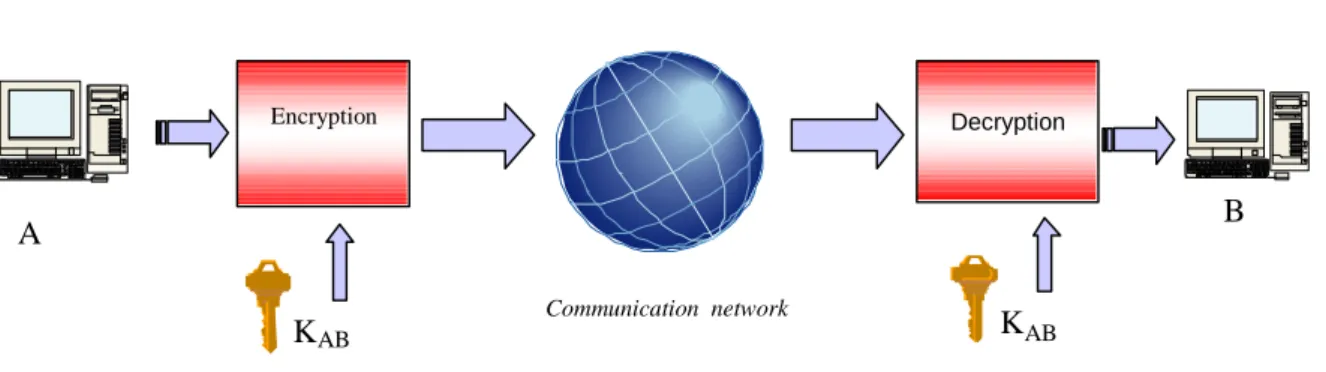
This is a technique where trading partners share a unique secret key (KAB) to secure the
KAB Encryption KAB Decryption Communication network A B
Figure 1: Symmetric encryption-decryption scheme 387 388 389 390 391 392 393 394 395 396 397 398 399 400 401 402 403 404
To guarantee the integrity of the content of the message the sender uses the secret key to generate an integrity sequence value by using an appropriate mathematic algorithm. The receiver applies the same algorithm to the received message and checks if both integrity sequences match. To protect the content of the message against unauthorised access (confidentiality) the same secret key can be used as the seed for the encryption algorithm. The major obstacle of symmetric cryptographic scenarios comes up when communicating the secret key from one partner to the other. The system is robust against threats but it assumes that the secret key is shared between trading partners. However it does not specify a secure way to communicate the secret key before the message is sent.
2.1.3 Asymmetric Cryptographic Technique (Public and Private Keys)
In this scenario each partner has two different keys: public key (Kpu) and private key (Kpr). These two keys define two different transformations to the message: a public transformation defined by the public key and a private transformation defined by the private key.
KpuB Encryption KprB Decryption Communication Network A B
Figure 2: Asymmetric encryption-decryption scheme 405 406 407 408 409 410 411 412 413 414 415 416 417 418
The private key is kept and must be ONLY known by the owner: it must never be communicated to other users. The public key is available to all trading partners and it is administered by a trusted third party, certification authority (CA). The certification authority is a trusted and authorised agent that generates a data sequence (certificate) that uniquely links the identity of a person or company to its public key, such that it is possible to guarantee the identity of any partner by properly combining the certificate information and the digital signature.
The main disadvantage of this technique is the high computational burden required by asymmetric cryptographic algorithms compared to symmetric ones.
Asymmetric cryptography techniques are based on complex algebraic fields and mathematic principles. Nevertheless, we should understand that both, public and private keys, constitute
XML ARCHITECTURE – ebMethodology 419 420 421 422 423 424 425 426 427 428 429 430 431 432 433 434 435 436 437 438 439 440 441 442 443 444 445 446 447 448 449 450 451 452 453 454 455 456 457 458 459 460 461 462 463 464 465 466 467 468 469 470
a single entity. In other words, a public key is uniquely associated to a private key, and vice versa. In this way, a secured document using one of these keys can only be read by applying the other key to the document. It depends on the security solution that should to be applied to the message on how these keys will be combined, as described below.
• Non-repudiation of origin and origin authentication
The sender of the message generates the digital signature using its private key (origin authentication) and the message body. The receiver can only validate the digital signature by applying the public key associated to the private key of the sender (non-repudiation of origin). The certification authority provides a sender’s certificate to the receiver to guarantee that the public key really belongs to the sender (origin authentication).
The main disadvantage is the complexity burden required to apply the private key to the message, especially if it is large. To solve it, the private key to generate the digital signature is applied to a short version of the message, that is, a special function is performed before signing the document: hash or digest transformation (section 2.1.4).
• Confidentiality
To secure the content of the message from unauthorised access, the sender encrypts the content to be transmitted by using the public key of the receiver, which has been obtained through a digital certificate of the receiver. Then, only the authorised receiver will be able to decrypt the message by applying its secret key.
The computational burden required by the cryptographic algorithms is very cost inefficient. The most efficient way to apply confidentiality is to use a combination of symmetric techniques (secret key) and asymmetric techniques (public and private key). The message is encrypted and decrypted using the symmetric technique (secret key), which does not involve high complex computational algorithms. Asymmetric techniques are used to communicate with security confidence level the secret key between trading partners before the transmission of the encrypted message.
2.1.4 Hash or Digest functions
The digest or hash functions generate a short sequence of data uniquely related to a message in a way that this sequence can be used to create the digital signature to validate the integrity, origin authentication and non-repudiation of message responsibility by its sender.
The digest functions are low complexity mathematical algorithms that must fulfil the following properties:
- A hash function applied to any document, regardless of its size, must generate a fixed and constant length output sequence.
- Given any original document, the hash function must require low complexity operations.
- One-way function property: it must not be possible to restore the original document from the hash sequence.
- Uniqueness: it is not allowed that two different documents generate the same hash result if the same algorithm is applied.
471 472 473 474 475 476 477 478 479 480 481 482
The most commonly used hash algorithms are: MD5 (outputs a sequence of 128 bits), SHA-1 (outputs a sequence of 160 bits) and RIPEMD (outputs a sequence of 128 bits or 160 bits), although there exist some other algorithms such as GOST, HAVAL or CRC32.
The result of a hash function applied to binary sequences must be filtered to avoid information losses when mapping the hash sequence to a set of characters. This function is called filter. A filter transforms a sequence of characters over a defined alphabet to another sequence of characters defined over another alphabet. The UTF-8 character set must be used for signature operations.
XML ARCHITECTURE – ebMethodology
3.- APPLYING SECURITY TO XML MESSAGES
483 484 485 486 487 488 489 490 491 492 493 494 495 496 497 498 499 500 501 502 503 504 505 506 507 508 509 510 511 512 513 514 515 516 517 518 519 520 521 522 523 524 525 526 527 528
This section is intended to introduce the application level at which security must be managed. Firstly, a brief discussion of all possibilities is presented: security at protocol level, at transaction level or at application level. In section 3.1.3 the flow chart diagram of a complete secured message exchange is described and explained. Section 3.1.4 introduces the concept of digital certificate and it should be taken as an introductory explanation about certificates, although it is not the scope of this specifications to define the certificates format, syntax nor content.
3.1.1 Protocol level
The first approach to secure an electronic transaction is based on placing the securing functionalities on the protocol level. Internet file exchanges over SSL, TLS or S-MIME protocols are examples of protocols securing transactions.
There are advantages and disadvantages on this approach. On one hand the application is independent on the security solution to be implemented as it is placed on the protocol level but, on the other hand, different security solutions must be considered if the messages can be sent over different network paths, as it undergoes different protocols.
3.1.2 SOAP envelope
The SOAP envelope constitutes a second approach to place the security of an XML electronic transaction. In this case, the security is placed in an upper level from the protocol one, hence a unified solution can be implemented in all possible transmission scenarios. However, the SOAP envelope might include in a multi-part MIME more than one message. This imply that the digital signature, and in extension any other securing solution, will be generated for all the messages involved in a transaction at the same time (i.e. we are securing the transaction), but it would be not possible to secure some messages and some others not. Taking into account the legal implications of the digital signature, that is to say that messages digitally signed will have legal validity once the proper legislation is approved, we need to bring about a securing solution capable of signing a single message independently of the others.
3.1.3 XML message
Finally, the security can be placed on the application level: the security is contained within the message boundaries and is managed and administrated by the end-to-end application. This is the proposed scenario recommended in this handbook. Following this approach it is possible to secure messages independently, to place different levels of security on different messages in the same transaction, and to specify a standardised and unified solution that it is protocol independent.
The digital signature is embedded within the message body, as well as the necessary information to validate the signature at the receiver side. Encryption and decryption is also performed at the front-end user application.
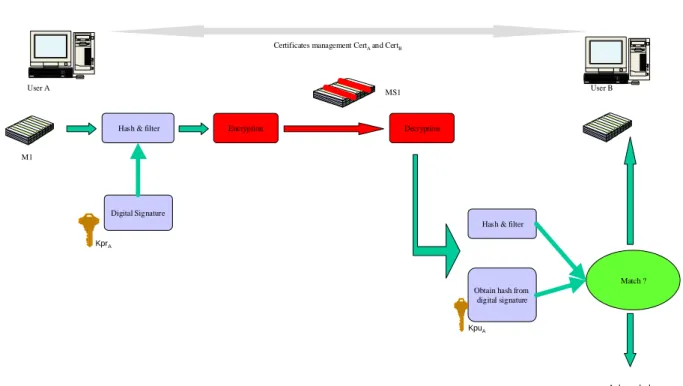
User A User B M1
Hash & filter Digital Signature
KprA
MS1
Hash & filter Obtain hash from
digital signature
KpuA
Match ? Certificates management CertA and CertB
Encryption Decryption
Acknowledge
Figure 3: Asymmetric encryption-decryption scheme 529 530 531 532 533 534 535 536 537 538 539 540 541 542 543 544 545 546 547 548 549 550 551 552 553 554 555 556 557 558 559 560
In this handbook the signature generation and verification are described from a syntax and processing point of view. The signature is based on an asymmetric cryptographic system applied to a digest function of the data to be signed. The encryption and decryption functionalities are also detailed. Digital certificates are used for authentication and key verification operations.
Let us consider the scenario depicted in the previous figure as a representative and generic architecture of all the scenarios undertaken in this guide. First of all, user A calculates the digest function of the data he wants to sign. The result (or digest value) is digitally signed by applying a mathematical transform operation on it, combined with the private user A key. The signed document is (optionally) encrypted to protect the content of the data.
This process (signature generation) is performed for each document.
Once B receive the messages, he decrypts the encrypted data and passes the decrypted message to the signature verification process block. User B computes the digest value over the document and compares it against the digest value embedded within the digital signature. If both sequences match one to each other, the signature validation is positive and the messages has been received correctly (integrity of the content). If digest values do not mach an error signalling must be output by the validator. To guarantee origin authentication a digital certificate is used. Optionally, an acknowledge message could be sent to ensure non-repudiation of recipient.
This guideline complies with the W3C consortium specifications to implement the digital signature and encrypt XML messages and follows the schemas and namespaces defined therein. This handbook also follows the URIs detailed in the W3C recommendations. It is OPTIONAL defining internal XML entities or using namespaces prefix.
Implementing the XML security solution as described in this document is a MUST. However, it is OPTIONAL to include additional protection on the transmitted data by incorporating extra security solutions at any other level of the transaction (i.e. SOAP envelope, protocol level).
XML ARCHITECTURE – ebMethodology
Applications MUST support the digital signature and encryption methods described in this guideline, and MAY implem
561
ent other security solutions that shall be negotiated at the 562
eginning of the transaction. 563
564
f the present document. Signature and encryption 565
rocesses are detailed in next sections. 566
567 b
The following assertion sets the basis o p
The recommendation of this guide is to generate an enveloping signature to sign the 568
entire document -this is a MUST requirement of this guide- and (optionally) encrypt 569
after signature generation the whole document previously signed. 570 571 .1.4 Digital Certificates 572 573 574 575
s to be another partner. It can be understood as the passport in the new 576 chnologies age. 577 578 579 580 581
ssage with the public key of the recipient of the message to provide 582
onfidentiality. 583
584 585
ible to concatenate several certificates, 586
ach one certifying the identity of the previous one. 587 588 589 590 591 592 593 594 e 595
ertificate includes the algorithms and methods used to create it and required to validate it. 596
597 598
3
A digital certificate is a sequence of data that specifies a unique relation between a trading partner (person or company) and its public key. Using digital certificates it is not possible that a third agent claim
te
There are two major usages of certificates: on one hand, using the certificate of the sender at the receive side we can authenticate the sender’s identity and ensure the non-repudiation of the origin. On the other hand, using the receiver’s certificate at the transmission side we can encrypt the me
c
The Certification Authority (CA) is an independent, trusted party by all the trading agents, that generates and manages the certificates. It is poss
e
The content of a certificate may vary from one CA to another. It will include, at least, the public key and the name of the owner, the expedition date and the validity period, a serial number and all the necessary information about the CA. The content that a certificate should include shall be specified in local states legal regulations. The most important characteristic of any certificate is that it is, in turn, digitally signed by the CA (in this way no one can supplant the identity of a CA). To access to the content of a certificate we must first validate that the certificate is correct, that is, the digital signature of the certificate is valid. Th c
The certificate content structure is defined by the ITU international standard ITU-T X.509, which sets a Public Key Infrastructure, PKI, to manage the contents of any certificate. This 599
document recommends the use of certificates based on X.509v3, additional information can be found in RFC2459. Certificates man
600
agement are described in next section (4.5): there are 601
ifferent solutions to be implemented: 602
603
-
604
nges only a reference to that 605
certificate will be detailed (i.e. certificate serial number). 606 607 - 608 609 610 ublic key, so a 611
different digital certificate must be used during the validation process. 612
d
It is RECOMMENDED that users exchange their certificates as a first step before any transaction takes place. On forthcoming electronic excha
It is RECOMMENDED to support the inclusion of the certificate within the signature (and by extension within the message) itself. This would be an appropriate solution in those cases where a certificate exchange already took place, but for the particular message being sent it is desired to digitally sign it using a different p
XML ARCHITECTURE – ebMethodology
4.- XML DIGITAL SIGNATURE [XMLDIGSIG]
614 615 616 617 618
This chapter provides the recommendation to include digital signature functionalities into XML messages. It defines schemas as well as URIs and syntax specifications. Some examples are provided at the end of the chapter.
4.1 Objective 619
620
he objective of the digital signature is to ensure the integrity, origin authentication and non-621 622 623 624 625 626 T
repudiation of message responsibility by the sender in an XML message exchange. To achieve these security solutions a public-private key cryptographic technique is used in combination with digital certificates provided by a third trusted party conforming to X.509v3 certificate recommendations.
4.2 General Considerations 627
628
he digital signature syntax and process complies with W3C specification for XML 629
630 631 632 633
The i the XML message and it is managed at an
634
app a ty, although MAY implement
635 ext s 636 637 XM ect), such as XML or HTML 638 pag , .-) or XML files. 639 XM i different parts of 640 diff n 641 be n 642 thes s 643 are 644 ide ie ent). 645 646
The XM nd Processing specifications underlie three usages of the digital 647
sign u XML signature
648
is i lf a child element of the data object); an
649
env o 650
XML signature structure (signature is a parent element of the data object); a detached 651
ignature is a signature where the signed entities (data objects) and the signature are 652
he same 653
ocument as sibling elements). 654 655 656 657 658 659 660 661 T
messages. The XML namespace URI that MUST be used is: xmlns=”http://www.w3.org/2000/09/xmldsig#”
d gital signature is embedded within
lic tion level. Applications MUST support this functionali ra ecurity algorithms.
L signatures can be applied to any digital content (data obj
es binary-encoded data such as GIF, XML encoded data (see section 5 hole document, L s gnatures may sign parts of the same document, the w
ere t documents and entire different documents in the same digital signature. The data to sig ed can be in the same document or distributed elsewhere. The key point to achieve
pread usage
e is the use of a reference element in which all data objects to be signed referenced via URIs (if objects are placed outside de document) or via fragment ntif rs (if the data to be signed is local data contained in the same docum
L Signature Syntax a
at re: an enveloped signature is a signature of a document, where the tse embedded within the document (signature is
el ping signature is a signature where the signed data is actually embedded within the s
separate from each other (external network resources or data contained in t d
These handbook sets the following issues:
- Only enveloped and enveloping signatures MUST be supported by the application.
- The entire document MUST1 be signed by an enveloping signature.
1
- Parts of the document MAY also be signed as enveloped or enveloping signatures. 662
663
hat is, this recommendation leaves open how to add additional signatures to the document 664
(we may sign parts of the document or the whole one, we may apply several signatures one 665
ed in 4.3 it is mandatory to use the 666
redefined schemas and processes to generate/validate the digital signature (whatever it 667
668 669 670 671
The tion of an XML message allows a transformation to compare 672
docum or XML documents which are
673
equiv tent, …) for the purposes of many applications
674
to dif mple, they may differ in their entity structure,
675
attrib s. This is a major drawback for
676
imple many of these “physical representation” characteristics 677
are p ned documents could fail during the verification process 678
due t ment.
679 680
A can ocument is a method for determining whether two documents 681
are identical (in the sense of structure and contents). A canonical form of an XML document 682
is a physical representation of the document where the following changes have been applied: 683 684 685 686 687 688
ced by their character content 689
declaration (DTD) are removed 690
691 692 693
ace within character content is retained 694
• Attribute value delimiters are set to quotation marks (double quotes) 695
• Special characters in attributes values and character content are replaced by 696
character references 697
• Superfluous namespace declarations are removed from each element 698
• Default attributes are added to each element 699
• Lexicographic order is imposed on the namespace declarations and attributes of each 700
element 701
702
The reader is referred to [3] for further information on this canonicalization method. 703
704
A digital signature over the canonical form of an XML document or document subset would 705
allow the signature digest calculations to be oblivious to changes in the original document's 706
physical representation, provided that the changes are defined to be logically equivalent by 707
the XML 1.0 or Namespaces in XML. During signature generation, the digest is computed 708
over the canonical form of the document. The document is then transferred to the relying 709
party, which validates the signature by reading the document and computing a digest of th 710
canonical form of the received document. The equivalence of the digests computed by the 711
712 T
after the other or even in parallel), however as it is explain p
signs the whole document or part of it). However, special care must be placed when implementing enveloped signatures to avoid signing the signature itself !
4.2.1 Canonical representation of XML messages canonical representa
ents form a logical point of view. It is possible f alent (in the sense of tree structure, con
fer in physical representation. For exa
ute ordering, character encoding and white space s
menting the digital signature a g arser dependents. Hence, si o “wrong” white space treat
onicalization of an XML d
• The document is encoded in UTF-8
• Line breaks normalised to #xA on input, before parsing • Attribute values are normalised
• Character and parsed entities are replaced • CDATA sections are repla
• XML declaration and document type
• Empty elements are converted to start-end tag pairs
• White space outside of the document element and within start and end tags is normalised
• All white sp
e signing and relying parties (and hence the equivalence of the canonical forms over which
XML ARCHITECTURE – ebMethodology
they were computed) ensures that the information content of the document has not been 713
altered since it was signed. 714
715
4.3 XML signature specification (tags and formats) 716
717
XML signatures are applied to arbitrary digital content (data objects) via an indirection 718
(reference). Data objects are digested, the resulting value placed in an element (with other 719
information) and that element is then canonicalized, digested and digitally signed. XML digital 720
signatures are represented by the Signature element which has de following structure2: 721 722 <Signature Id?> 723 <SignedInfo> 724 <CanonicalizationMethod/> 725 <SignatureMethod/> 726 (<Reference URI?> 727 (<Transforms>)? 728 <DigestMethod> 729 <DigestValue> 730 </Reference>)+ 731 </SignedInfo> 732 <SignatureValue> 733 (<KeyInfo>)? 734 (<Object Id?>)* 735 </Signature> 736 737
The Id attribute value/name may co-exist with other elements with Id attributes in a 738
single XML document and should be chosen such that there are no subsequent 739
collisions with other Id attributes: they must be unique. 740
4.3.1 XML signature schema 741
742
The schema for the XML signature provided by the W3C consortium is listed below. Note that 743
this schema supports all signatures functionalities and capabilities, some of them not used in 744 this handbook. 745 746 747 2
where “?” denotes zero or one occurrence; “+” denotes one or more occurrences; and “*” denotes zero or more occurrences.
748
XML ARCHITECTURE – ebMethodology 750
752 753
.3.2 The SignedInfo element 754
the information that is actually signed. It includes the 755
anonicalization algorithm, the signature algorithm and one or more references to the data 756
obj s .
757 758
he validation process consists of two mandatory processes: validation of the signature and 759
760 761
A SignedInfo element can be signed and referenced by other objects via the Id attribute. 762 763 764 ation. 765 766
calization method is: 767 768 769 ”http://www.w3.org/TR/2001/REC-xml-c14n-20010315” 770 4.3.2.2 d element 771
his le SignedInfo element
772
into e bines a digest algorithm and a key
773 depend 774 775 he ig e supported are: 776 777 • 778 /xmldsig#dsa-sha1” 779 780 • 781 4
The SignedInfo element contains c
ect that are signed T
validation of each reference digest values (see section 4.4.2).
4.3.2.1 The CanonicalizationMethod element
This element specifies the algorithm used to canonicalize the SignedInfo element before it is digested during the signature generation oper
The only accepted canoni
• Canonical XML (omits comments) Algorithm=
The SignatureMetho
T e ment specifies the algorithm used to convert the canonicalized th SignatureValue. The signature generation com
ithm. ent algor
T s nature identifiers that MUST b DSA – SHA1 Algorithm=”http://www.w3.org/2000/09 RSA – SHA1 Algorithm=http://www.w3.org/2000/09/xmldsig#rsa-sha1 782 783 784 .org/2001/04/xmldsig-more/rsa-ripemd160
• RSA – RIPEMD160 (non-normative, see reference [5]) Algorithm= http://www.w3
785 786
SignedInfo element and hence it is also signed. By 787
788 789 790
This element is included within the
doing so extra security is placed on the digital XML signature because the algorithm names can resist attacks on them.
4.3.2.2.1 HMAC – Keyed-Hashing for Message Authentication
Additionally to the aforementioned signature elements (RSA and DSA), Message Authentication Codes (MAC) of type "hash function-based" (RFC2104) SHOULD be implemented according to W3C specifications on XML Signature Syntax and Processing. MAC algorithms are authentication schemes based on symmetric keys, unlike digital signatures which are based on asymmetric key pairs. Clearly this algorithms are useless for the purposes of this do
791 792 793 794 795 796
cument (which attempts to digitally sign de data via asymmetric 797
lgorithms). However, W3C specifies that an application MUST support these functionalities. 798 a
XML ARCHITECTURE – ebMethodology
The u ly truncated) of a chosen
799 digest ) of 800 e SignatureMethod element. 801 802
he identifier that must be used is: 803 804 • 805 sig#hmac-sha1” 806 807 808 809 810 811
ta that will be signed via URIs identifiers or local fragments 812 813 814 815 816 817 818 819
o tput of the HMAC algorithm is ultimately the output (possib
algorithm. The truncation length is specified in a child element (HMACOutputLength th
T
HMAC-SHA1
Algorithm=”http://www.w3.org/2000/09/xmld
The reader is referred to XML Signature Syntax and Processing for a complete specification of this algorithm.
4.3.2.3 The Reference element
Each of this elements (it may occur one or more times) include a reference (in the Algorithm attribute) to the object da
identifiers.
Examples of URI usage:
• Identify an internal element within the XML resource (the document) with Id= infotosign.
(used to reference the object to be signed for enveloping signatures)
URI=”#infotosign”
820 821 822 823
• Identify the node-set that contains the signature (used for enveloped signatures)
824 825 826
URI=””
• Identify an external resource
URI=”http://www.example.com/document.xml”
827 828
• Identify an element in an external resource 829
URI=”http://www.example.com/document.xml#infotosign”
830 831
The t value calculated over
832
the refe the digest operation, it
833
also detailed within this element. 834
4.3.2.3
Reference elements also specify the digest method and the diges renced object data. If a transformation is to be applied before is
.1 The Transforms element 835
he Transforms element specifies (using the Algorithm attribute) a list of processing steps 836
renced by the Algorithm attribute of the 837
838 839
not consider the use of the Transforms element unless enveloped 840
Signature element of an enveloped signature to 841
ure transform remove it prior the digest is applied. 842
843
e whole Signature element containing that Transform element T 844 845 846 847 848 849 T
that must be applied to the resources refe Reference element before the digest calculation. This handbook does
signatures are used. In order to prevent the be itself signed, the enveloped signat
More concisely, an enveloped signature transformation referenced in an element Transforms T, remove th
from the digest calculation of the Reference element (via Algorithm attribute) containing Transforms element T.
• Enveloped Signatures Transform
Algorithm=”http://www.w3.org/2000/09/xmldsig#enveloped-signature” 850
851 852
For enveloping signatures the Transform element is not used. 853
854
Transform element to decrypt encrypted data: 855 856 857 858 859 860
ly decrypted. This Candidate 861 862 863 864 865 866
signature and encryption elements in a two 867
he seller), all encrypted elements 868
buyer during the generation of the document. Hence, the 869 870 871 872 873 874 by an XPath transformation. 875 Algorithm="http://www.w3.org/2001/04/decrypt#"
This algorithm for transforms is specified in the W3C Candidate Recommendation "Decryption transform for XML Signatures". The objective of this transform is to inform the
ignature validation parser that data must be previous s
Recommendation also specifies an Except element to indicate which EncryptedData elements must not be decrypted before signature generation (i.e. those elements that were "encrypted-then-signed").
In this guide, however, we propose to always "sign-then-encrypt" the data elements. As it is not expected that additional parties include
trading partners relationship (a buyer sends an Order to t will be those introduced by the
receiver (seller) decrypts all encrypted elements and then validate the signature. If this is assumed as the default process, the above transform algorithm is not necessary. Anyway, it is OPTIONAL to indicate it.
A transform can be accomplished 4.3.2.3.2 The DigestMethod element 876
This element specifies the digest algorithm applied to the data object referenced in the 877
nce element that must be used to compute the 878
879 880
he digest algorithms supported are: 881
882
ignature Syntax and Processing) 883 884 885 886 887 888
Algorithm attribute of the Refere DigestValue.
T
• SHA1 (URI defined in XML S
Algorithm=”http://www.w3.org/2000/09/xmldsig#sha1”
• RIPEMD-160 (URI defined in XML Encryption Syntax and Processing) Algorithm=”http://www.w3.org/2001/04/xmlenc#ripemd160”
4.3.2.3.3 The DigestValue element 889
This element contains the encoded value of the digest. The digest is always encoded using 890
891 892
digital signature. It is always encoded using 893
894
"XML-Signature Syntax and Processing" and 895
dditional information on the content of this 896
897 898
f two octet-streams that respectively result from 899
base64 (ANNEX I.-)
4.3.3 The SignatureValue element
his element contains the actual value of the T
base64 (see ANNEX I.-).
n Please, refer to W3C recommendatio
ference contained therein (RFC2437) for a re
element for DSA and RSA algorithms (section 6.4.1 and 6.4.2 respectively). For example, the DSA output pair of integers parameter (r,s) are placed in the signature value as the result of the base64 encoding of the concatenation o
XML ARCHITECTURE – ebMethodology
the octet-encoding of the values r and s in that order. Integer to octet-stream conversion done according to the I2OSP operation defined in the RFC 2437 specification with a ter equal to 20. 900 must be 901 l parame 902 903 904
names. The usage of this element to 905
906
e the key reference and signature algorithm parameters for 907
SA and RSA signature methods (KeyValue element). The rest of the elements that might 908
con n in this handbook.
909 910
is OPTIONAL for the user to include a Reference element that references the KeyInfo 911
ele n nature generation. Note that there are no undesirable side effects 912
by doin ment and the Signature
913
alidation will validate the signed information using the KeyInfo element as parsed (they are 914
orthogonal validation processes to KeyInfo). 915
916
This element contains a string value which may be used to communicate a key identifier to 917
tains an identifier related to the key pair used to sign the data 918
919 920
.3.4.2 The KeyValue element
921 922
elements of KeyValue element. 923
4.3.4 The KeyInfo element
The KeyInfo element indicates the key to be used to validate the signature. It might include a certificate, a serial or reference number or key
include digital certificates is explained in detail in section 4.5 (element X509Data). Herein this section we describe how to includ
D
tai the KeyInfo element are not used It
me t to sign it during sig
g so: the Reference Validation will validate the KeyInfo ele V
4.3.4.1 The KeyName element
the recipient. Typically, it con
objects, but it also may contain other indirect identifiers that specify the pair of keys used (examples could be a simple string name, an email address and a key index).
4
It contains the key information required to validate the signature. DSA and RSA values are defined via DSAKeyValue and RSAKeyValue as child
4.3.4.2.1 The DSAKeyValue element 924
925 926 927
s the P value of the DSA, 928
929
is part of the private key and not made public) 930
931
Add 932
< ration counter <pgenCounter>. 933 lea , 934 refe 935 (section 936 4.3.4.2
DSA public key values are specified in this element using the following child elements (fields):
<P> contain
<Q> contains Q value of the DSA. <Y> result of G**X mod P (where X
itional DSA values can be the G value <G>, the seed prime generator value <seed>, the J J> and the DSA prime gene
value
P se refer to W3C recommendation "XML-Signature Syntax and Processing" and rence contained therein for additional information on this element and its parameters
4.4.2.1 and 6.4.1).
.2 The RSAKeyValue element
ublic key values have two values which are sp 937
RSA p ecified in this element using the
938
following child elements 939 940 <Modul 941 <Expon 942 943 rb r 944 def 945 (fields):
us> contains the Modulus value, ent> contains Exponent value.
A itra y-length integers (such as RSA modulus) are represented in XML as octet strings as ined in CryptoBinary type (ANNEX I.-).
4.3.4.3 Please, refer to W3C recommendation "XML-Signature Syntax and Processing" and
946 947
2).The RetrievalMethod element
948
This element within KeyInfo element may be used to identify a reference to KeyInfo 949 informa 950 a X509 951 is carrie 952
This element can also be used to reference a single X.509 certificate. The Type attribute 953 should 954 955 • 956 ype=”http://www.w3.org/2000/09/xmldsig#rawX509Certificate” 957 958 X509Data element 959 960 961 4.3.4.4 962 It conta 963 4.3.5 ct element 964
data objects within the signature element. It is used for 965
ct to be signed is placed within the object element. 966
967 968
dditional XML security URIs for signature methods, digest functions and HMAC algorithms 969
can 970
reference contained therein for additional information on this element and its parameters (section 4.4.2.2 and 6.4.
tion stored outside the Signature element. This would allow, for instance, to identify certificate chain already stored remotely outside the XML resource. The identification
d out by URIs reference in an URI attribute. take the following values:
Indicate a binary X.509 certificate T
•
Type=”http://www.w3.org/2001/04/xmlenc#X509Data”
The X509Data element
ins identifiers of keys or X509 certificates. It is described in 4.5. The Obje
It is an optional element for including enveloping signatures. The data obje
A
be found in (draft document) are detailed in [5]. 4.4 C
971 972
Here is 973
apply t nd enveloped signatures (they could even apply to detached 974 signatures). 975 4.4.1 976 977 1)
reate and Validate Digital Signatures (Processing Rules)
an overview of how to create an XML signature and how to validate it. These steps o both, enveloping a
Create an XML Signature
Determine which resources are to be signed and identify them through a Uniform 978
Resource Identifier (URI): 979
980
2) Calculate the digest of each resource and construct the Reference element by 981
982 983 984
t on the Reference element itself. 985
986
tion, it 987
e Transforms element. It is not considered in this guide the 988
lement for enveloping signatures, and only one transformation is 989
allowed for enveloped signatures (section 4.3.2.3.1) 990
991
llect the Reference elements within a SignedInfo element.
specifying each resource in the Algorithm attribute and place its digest in the DigestValue element. Include the proper information used by the digest function in the DigestMethod element. Note that the digest is calculated on the identified resource and no
If a transformation is to be applied to the resource before the digest calcula must be identified in th
use of Transforms e
3) Co Add the
992
SignatureMethod and CanonicalizationMethod elements. 993
XML ARCHITECTURE – ebMethodology
4) Canonicalize and calculate the SignatureValue over SignedInfo based on 994
995
ithms specified in SignedInfo. algor 996 997 h 998 XML from is obt 999
digest. Put the s 1000
1001
that the alg o included in
1002
m element is outside the SignedInfo,
1003
n 1004
1005
5) Generate the key information using the element.
First compute t e canonicalization of the SignedInfo element. Once this canonical ained, calculate the digest of the canonized SignedInfo and sign the ignature in a SignatureValue element.
Note orithms used in calculating the SignatureValue are als ation while the SignatureValue
the signed infor
which in turn co tains the signature methods. KeyInfo 1006
1007
6) Construct the Signature element that includes SignedInfo, SignatureValue, 1008
ts. KeyInfo and, optionally, the Object elemen 1009 1010 1011 1012 1013 1014 4.4.2 XML Signature 1015 1016 The 1017 1018 1)
The Signature element comprises the XML signature.
If the signature is an enveloping signature, then include the data objects referenced within the Object element. If it is an enveloped signature do not include the Object element.
Validate an
verification process of the XML signature is a REQUIRED 2-step process: Signature Validation: Validate the signature of the SignedInfo element. 1019
1020 1021 1022
the canonical form of the SignedInfo using the CanonicalizationMethod 1023 1024 1025 1026 1027 1028
he digest of the canonical form of the SignedInfo element. 1029
1030
lidate the DigestValue of each Reference elements. Use the KeyInfo element to gather key and certificate information.
Obtain
element information.
Recalculate the digest of the canonical form of the SignedInfo element using the digest-signature algorithm specified in the SignatureMethod element and use the public verification key to verify that the value of the SignatureValue element is correct for t 2) Reference Validation: Va 1031 1032 1033 1034 1035 1036 1037 1038
If the SignedInfo element verification succeeds, recalculate the digests of the references contained within the SignedInfo element using the DigestMethod specified in each Reference element, and compare them against the DigestValue element data.
If both steps give positive validation, then the XML signature is verified and validated. 4.5 Using Certificates
The certificates information is conveyed in the X509Data element of the KeyInfo (parent) element.
1039 1040 1041 1042
At least one element from the following set of elements must be present (multiple elements within a X509Data elements are allowed if and only if each of them is related to the same certificate):
1043 1044 1045 1046
<X509IssuerSerial> Contains the issuer name and serial number of the X.509 certificate. the serial number in the <X509SerialNumber>.
< bject name. < e of a X.509v3 < < 1047 A . 1048 1049
In e possibilities are considered: 1050
1051
X509Data element in 1052
ions the certificate is embedded in the 1053
t. This would allow easy management of different certificates by the 1054
ssage (each time the certificate being used in sent), since it would 1055
artners’ 1056
1057 1058
rence the certificate using the X509SubjectName and/or X509IssuerSerial 1059
lies that users and trading partners have 1060 1061 1062 1063 s to be 1064 1065 1066 W e same 1067 X f these 1068
c could also be possible to
1069
u d element to identify the X.509 certificate chain located in a local 1070
s 1071
The name is contained in the child element <X509IssuerName> and X509SubjectName> Contains an X.509 su
X509SKI> Contains the base64 encoded plain valu SubjectKeyIdentifier extension.
X509Certificate> Contains a base64 encoded certificate.
X509CRL> Contains a base64 encoded certificate revocation list. ll information regarding a certificate must be grouped in a single X509Data element
this handbook thre 1. Include the certi
Info parent element. In all transact
ficate (X509Certificate element) within the the Key
signature elemen of the me sender
not be the responsibility of the receiver to store and maintain a list of his p certificates.
2. Only refe
elements. This implementation imp
d their certificates before any transaction. Each user maintains an updated exchange
list of the certificates associated to his partners in his local informatics’ infrastructure. 3. Use the RetrievalMethod to reference the external stored certificate that ha
used.
henever multiple certificates occur (certificate chain), they are all included within th nts. At least one o 505Data element in successive X509Certificate eleme
contain the public key that verifies the signature. It ertificates must se the RetrievalMetho torage medium. 4 1072 1073
E section to clarify the use of the digital signature. Most of the 1074
e this guide.
1075
A arts of the document
1076
a purposes.
1077 1078
T 4.6.1 to 4.6.4 are key usage examples and clarify the use of the digital 1079 s d by the 1080 re 1081 p 1082
a ions than the first ones (i.e. to sign the whole
1083
document using many references 4.6.8). The examples 4.6.9 and 4.6.10 are usage examples 1084
o n management.
1085 1086
.6 Examples
xamples are provided in this
xamples are enveloping signatures, since they are a MUST specification of dditional examples of enveloped signatures and signatures signing p
mation resources for clarification re provided as additional infor
he examples from
ignature as recommended in this guide. The following examples are also supporte
commendations given in this guide, however they require higher processing then the revious ones (i.e. enveloped signatures require an enveloped-signature transformation 4.6.6 nd 4.6.7) or implement more complex solut
XML ARCHITECTURE – ebMethodology
Note that all the examples contained herein are not real, that is: the certificates, digest 1087
values and signature values are not real values obtained from applying the corresponding 1088 1089 elemen 1090 4 te (referenced certificate) 1091 1092
algorithm to the data, and they should be understood as merely examples of signature ts usage.
.6.1 Enveloping Signature DSA without included certifica <?xml version="1.0" encoding="UTF-8"?> 1093 <Signature xmlns="http://www.w3.org/2000/09/xmldsig#"> 1094 <SignedInfo> 1095 <CanonicalizationMethod Algorithm="http://www.w3.org/TR/2001/REC-xml-c14n-1096 20010315" /> 1097 <SignatureMethod Algorithm="http://www.w3.org/2000/09/xmldsig#dsa-sha1" /> 1098 <Reference URI="#object"> 1099 <DigestMethod Algorithm="http://www.w3.org/2000/09/xmldsig#sha1" /> 1100 <DigestValue>60NvZvtdTB+7UnlLp/H24p7h4bs=</DigestValue> 1101 </Reference> 1102 </SignedInfo> 1103 <SignatureValue> 1104 qUADDMHZkyebvRdLs+6Dv7RvgMLRlUaDB4Q9yn9XoJA79a2882ffTg== 1105 </SignatureValue> 1106 <KeyInfo> 1107 <KeyValue> 1108 <DSAKeyValue> 1109 <P> 1110 2iY3w062sDB3/DIlLWOeG9+4UpmDZ0dyqRk9dLlNQ6qaXI7tOrjdIhm6n/eOw45A 1111 QtuYSp6spCt9cQcNBAj22KvygvfJIIXX9sSQrugfGqifeSvY3VX5Sd1j+z0MSZ/n 1112 5jNt88uh2C11SAqX6nrXTY/1RwkoWRN23SYhOlaG0hU= 1113 </P> 1114 <Q> 1115 9B5ypLY9pMOmtxCeTDHgwdNFeGs= 1116 </Q> 1117 <G> 1118 MuGAlqeB1ax+vyO2+Osubjhl7pHxLu47RIH+/M52DjESA9KMSrwzsYx8yNR2WooB 1119 yrE0t6fu0VncK7UK8olO4t7wpv2z4AFQPRVCKFwo0qgn5aKIkICGMlrRy81avb27 1120 wGcWothx3iPPMtFXtoDqK0JItaI9R8zc1msFhM1GKMY= 1121 </G> 1122 <Y> 1123 ctA8YGxrtngg/zKVvqEOefnwmViFztcnPBYPlJsvh6yKI4iDm68fnp4Mi3RrJ6bZ 1124 AygFrUIQLxLjV+OJtgJAEto0xAs+Mehuq1DkSFEpP3oDzCTOsrOiS1DwQe4oIb7z 1125 Vk/9l7aPtJMHW0LVlMdwZNFNNJoqMcT2ZfCPrfvYvQ0= 1126 </Y> 1127 </DSAKeyValue> 1128 </KeyValue> 1129 <X509Data> 1130 <X509SubjectName> 1131
CN=Merlin Hughes,O=Baltimore Technologies\, Ltd.,ST=Dublin,C=IE 1132 </X509SubjectName> 1133 <X509IssuerSerial> 1134 <X509IssuerName> 1135
CN=Test DSA CA,O=Baltimore Technologies\, Ltd.,ST=Dublin,C=IE 1136 </X509IssuerName> 1137 <X509SerialNumber>970849936</X509SerialNumber> 1138 </X509IssuerSerial> 1139 </X509Data> 1140 </KeyInfo> 1141 <Object Id="object"> 1142
<invoicxml creationDate="2002-01-31" documentStatus="ORIGINAL" 1143
contentVersion="AECOCv1.0" documentStructureVersion="1.0" lastUpdateDate="2002-01-1144
24"> 1145
...the rest of the document... 1146 </invoicxml> 1147 </Object> 1148 </Signature> 1149 1150