Original research papers
Evaluation of a Masters programme in medical education
1Rohini de Alwis Seneviratne, 2Sean McAleer, 3 Margery Davis
Introduction
There is increasing demand for training in education for health professions’ educators. Few studies, however, have focussed on the effectiveness of such training. This paper evaluates a Masters programme in medical education offered by the Centre for Medical Education, University of Dundee, Scotland, United Kingdom.
Methodology
A postal questionnaire was sent to 68 Masters graduates worldwide who graduated between 1989 and 1998 and 53 (78%) replied. The mean time from graduation to completing the questionnaire was 4.2 years. They were asked a series of questions about the impact of the Masters on various aspects of their personal and professional development, research and teaching roles.
Results
Graduates had taken on new posts and responsibilities, perceived a positive
influence on their personal and professional development, undertook new teaching roles at undergraduate and postgraduate levels and had became involved in educational research. Many reported an impact at institutional and some at national level.
Discussion
This is the first publication to show the perceived impact of a Masters qualification in medical education on career development. The study complements the findings of others on changes in teaching, but additionally found increased motivation for educational research. Teacher training can be delivered effectively through distance learning and this approach may be more efficient than providing multiple individual institutional programmes repeated many times over.
Key words: evaluation; Masters; health
professions’ teachers/educators; personal/professional development; teaching effectiveness.
Introduction
Medical education is becoming more sophisticated in terms of the demands it makes on the teacher, the student and the institution and teaching standards need to be assured. In the UK, the Postgraduate Medical Education and Training Board
1
Faculty of Medicine, University of Colombo,Sri Lanka
2
Centre for Medical Education, University of Dundee, Dundee, Scotland, United Kingdom
3
Centre for Medical Education, University of Dundee, Dundee, Scotland, United Kingdom
Correspondence:
Rohini de Alwis Seneviratne,Centre for Medical Education,484 Perth Road, Dundee DD2 1LR,Scotland,United Kingdom
Telephone: 01382 386801 Fax: 01382 645748
Email: [email protected]
(PMETB) has been assigned the responsibility to establish and raise standards and quality in postgraduate medical education and training and a new PMETB quality assurance framework has been launched (PMETB 2007a and 2007b).
The media spotlight, however, regularly highlights the dissatisfaction expressed by the public with the products of health care training programmes. The basis for such a negative view stems from the inability of graduates to perform adequately within the health care system that employs them. The finger of blame is not surprisingly pointed in the direction of the teachers and teaching. Another reason for the spotlight to be directed towards training arises from the radical curriculum changes that are commonplace in medical schools (GMC, 1993 & 2003; Howe et al. 2004; William &
Lau, 2004) and postgraduate training (Calman et al., 1999; Donaldson, 2002). The need to facilitate rather than teach, to encourage independent, life-long learning rather than passive teacher-dependent short-term learning, and to introduce innovative and objective methods of assessment rather than traditional methods are strong reasons for the further enhancement of teaching skills.
It is no longer prudent to ignore the fact that many “doctors tend to teach as they themselves were taught” (Irby, 1996). Staff development must address the needs of institutional programmes, policies and personnel (Webb, 1996) and teacher training is high on this agenda. Hitchcock
et al. (1993) reviewed the literature and
resources relating to faculty development in the health professions and concluded that teaching skills were a prominent feature, a viewpoint shared by several others (Glenn & Harden, 1985; Webb, 1996; Irby, 1996; Towle, 1998). Since then other areas of focus for faculty development have emerged such as educational leadership, teaching and assessment of professionalism and clinical skills, effective assessment methods, educational evaluation and research, and best evidence medical education (Wilkes & Bligh, 1999; Steinert, 2000; Belfield et al., 2001; Goldstein et al., 2006; Gruppen et al., 2006).
There is no doubt that the job of teacher entails the wearing of many “caps” (Hesketh et al., 2001). Harden and
Crosby (2000) identified 12 roles of the medical teacher: (1) lecturer, (2) clinical or practical teacher, (3) resource material creator, (4) study guide producer, (5) course organiser, (6) curriculum planner, (7) curriculum evaluator, (8) student assessor, (9) mentor, (10) learning facilitator, (11) on-the-job role model and (12) teaching role model. Effectiveness in each of these roles requires the development of key teaching competencies.
Programmes offering qualifications in education for health care professionals are proliferating (Steinert et al., 2005; Allery et al., 2006; Gruppen et al., 2006). Towle
(1998) provides case studies exemplifying the types of training on offer. The UK government has sought to remedy the lack of teacher training in higher education
through the establishment of the Institute of Learning and Teaching in Higher Education now a part of the Higher Education Academy (HEA, 2007) the organization for all who teach in higher education. New lecturers in the UK are required to undertake training in teaching and are encouraged to become members or associate members of the Higher Education Academy. The question that has yet to be answered however, is how effective are such teacher training programmes.
The current study evaluates the Masters degree course in medical education at the Centre for Medical Education, University of Dundee. This course is part of a linked programme of study that has been specifically designed to meet the needs of staff working in the health care professions. It allows participants to progress from an introduction to medical education, through the award of a postgraduate certificate and diploma to Masters level. Participants may exit at any one of these four levels with an award that may be included in their curriculum vitae or portfolio. The programme relates practical aspects of education to the relevant underpinning educational principles and concepts. There are core topics that must be studied by all participants. The participants can select additional topics from a wide range of options. The course themes are: curriculum development, teaching and learning, assessment, research methods and special options. The final component of the Masters degree is a project documented as a dissertation that focuses on an issue directly of importance to the participant. The Dundee Masters course attracts participants from a range of health care professions at various levels of seniority from all over the world. The programme is offered via distance learning, although a few participants undertake face-to-face study in Dundee. This evaluation was carried out to shed light on the impact of formal training in education. The research concentrated on the following questions. What are the benefits of a Masters qualification? Do Masters graduates make progress in the field of research? Do they make an impact at institutional and national level? What effect has the degree had on their teaching, in terms of Harden and Crosby’s
(2000) 12 roles of the teacher? The impact of the course was assessed from the perspective of the graduates. Other potential beneficiaries, for example, students and institutions, were not included for reasons of practicability.
Methods
The study population consisted of all 85 Masters students who graduated between 1989 and 1998. Specialist groups who were funded for a particular educational purpose (n=14) were excluded from this study as they had participated in evaluation elsewhere. Current addresses were found for 68 of the remaining 71 graduates. Twenty nine were from the United Kingdom and 39 from the rest of the world.
The questionnaire was pre-tested on 6 international Masters graduates. After the pre-test the question rating teacher as a role model was removed because of the difficulty of self perception of role model. The questionnaire contained 17 questions (both open and closed), of which the first five collected demographic details. Three further questions addressed the issues of personal and professional development. Graduates were requested to give information on what happened to them career-wise since completing the Masters degree. Details of new posts and responsibilities were sought. There was also a section on changes in their teaching role based on Harden and Crosby’s (2000) 12 roles of the teacher. This section required participants to identify their involvement in undergraduate and postgraduate teaching before and after graduation using a five point rating scale (5 full time to 1 never), in relation to the different roles of the teacher. The remaining eight questions collected data pertaining to educational research activities and academic publications in educational areas, satisfaction with the course and achievements at institutional and national levels.
A mailed questionnaire approach was used in view of the wide geographical spread of graduates. The data were coded, entered, edited and analysed using SPSS Version 8. Wilcoxon Signed Ranks test was used to determine the significance of the difference between the scores for the teaching involvement before
after the Masters. The handwritten information from open-ended questions was transcribed verbatim, and analysed by clustering, categorising and identifying themes that emerged.
Results
The questionnaire was mailed to 68 participants drawn from United Kingdom (31), Tanzania (7), Thailand (5), Zimbabwe (4), Canada (3), Kenya (3), Australia (2), and 1 each from Brazil, Colombia, Finland, Indonesia, Palestine, Latvia, New Zealand, Nigeria, Papua New Guinea, Portugal, Sudan, United Arab Emirates and Zambia. Fifty three graduates (78%) responded to the questionnaire. Of these, 30 were doctors and 23 came from other health care professions: health profession education (8); nursing (4); physiotherapy (3); environment health (3); radiography (2); and one each from occupational therapy, pharmacy, and chiropractice. Twenty nine of the 39 overseas graduates representing 19 countries responded and 24 of the 29 UK graduates replied. Thirty four (64%) of the respondents were distance learners and 19 had studied face to face. Respondents completed the questionnaire between 1 and 10 years after gaining the qualification (mean=4.2 years). Thirty four respondents (64%) had graduated during the period 1994-98 and 19 between 1989-93. There were no significant differences between the 53 respondents and 15 non respondents in respect of country of residence (p=0.4), study mode (p=0.2), or profession (p=0.5).
All but one of the respondents reported that their career had been influenced in some way by the Masters qualification. Fifty one percent had taken on new posts after graduating, while 38% had taken on new responsibilities within the same position. The new posts acquired were: director/programme manager/department head (15); consultant (5); member of educational committee (5); senior lecturer/lecturer (4); professor of medical education (1) and journal editor (1). Respondents were able to indicate more than one newly acquired post.
Graduates were asked to describe how the Masters award had influenced their career. The qualification had instilled
confidence in their abilities within the broad area of education and more specifically in relation to teaching,
research supervision and curriculum development work. It also gave them credibility and earned them the respect of their peers. In terms of personal characteristics, flexibility, understanding and tolerance were commonly mentioned as being enhanced. Table 1 shows the five general aspects most commonly mentioned.
Table 1. Top five areas in which the Masters award had a positive
influence 1 Professional development 2 Self confidence 3 Increased knowledge base 4 Research capabilities 5 Curriculum development
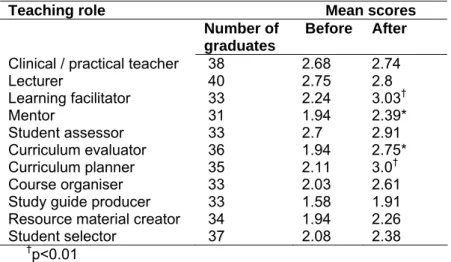
The qualification had provided a substantial knowledge base and awareness of a vast field of education outside medicine. Some respondents described how they were being given more responsibility for ‘teacher training’ and had become more innovative and better able to carry out research in medical education. Table 2 shows the mean ratings for involvement in undergraduate teaching before and after graduation.
Statistically significant differences were found in the following roles:
Learning facilitator (p<0.01), curriculum planner (p<0.01), mentor (p<0.05) and curriculum evaluator (p<0.05). Teaching at postgraduate level increased after obtaining the Masters qualification.
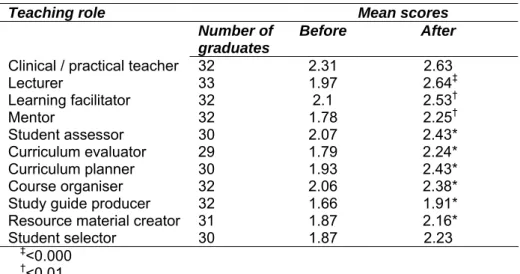
Table 3 shows the mean scores statistically significant differences were found in the following roles: lecturer (p<0.000), learning facilitator (p<0.01), mentor (p<0.01), student assessor (p<0.05), curriculum evaluator (p<0.05), curriculum planner (p<0.05), course organiser (p<0.05), study guide producer (p<0.05) and resource material creator (p<0.05).
The responses to the open-ended questions described how the Masters award influenced the ability of respondents to teach and better facilitate learning; adopt a more learner-centred and focused approach to teaching; and give more autonomy to students to plan their own learning. They were appreciative of the confidence they had developed and the theory they had acquired to support the methods used. They were able to use new assessment methods in their own context. The qualification provided skills such as the ability to co-ordinate the undergraduate medical course assessment committee.
Table 2. Mean scores for involvement in undergraduate teaching before and after graduation
Teaching role Mean scores
Number of
graduates
Before After Clinical / practical teacher 38 2.68 2.74
Lecturer 40 2.75 2.8 Learning facilitator 33 2.24 3.03† Mentor 31 1.94 2.39* Student assessor 33 2.7 2.91 Curriculum evaluator 36 1.94 2.75* Curriculum planner 35 2.11 3.0† Course organiser 33 2.03 2.61 Study guide producer 33 1.58 1.91 Resource material creator 34 1.94 2.26 Student selector 37 2.08 2.38 †p<0.01
Table 3. Mean scores for involvement in postgraduate teaching before and after graduation
Teaching role Mean scores
Number of
graduates
Before After
Clinical / practical teacher 32 2.31 2.63
Lecturer 33 1.97 2.64‡ Learning facilitator 32 2.1 2.53† Mentor 32 1.78 2.25† Student assessor 30 2.07 2.43* Curriculum evaluator 29 1.79 2.24* Curriculum planner 30 1.93 2.43* Course organiser 32 2.06 2.38* Study guide producer 32 1.66 1.91* Resource material creator 31 1.87 2.16* Student selector 30 1.87 2.23
‡<0.000 †<0.01 *p<0.05
Twenty eight (55%) of the 51 graduates who responded to this question had carried out educational research since the award of the degree. There was no statistically significant difference between the numbers in relation to the UK and overseas graduates (p=0.2). Table 4 shows the top five research topics ranked in terms of frequency of reporting.
Among the 28, who had carried out educational research, 15 graduates reported having published in peer-reviewed journals, 9 had published abstracts and presented posters and 9 had given papers at conferences or workshops.
Thirty five respondents (66%) claimed to have made an impact at institutional level and 23 (43%) at national level.
Activities mentioned at the institutional level were development of new courses,
models for curriculum design, and teaching workshops. Respondents were being consulted about assessment, evaluation, development of courses, and participating in review of medical curricula. They were helping to create new qualifications. They provided leadership in educational activities such as assessment, teaching/learning, clinical skills, examination in postgraduate courses and orienting teachers at training institutes to learner-centred methods. They had initiated faculty development activities in areas of clinical teaching, evaluation, basic research and medical ethics.
At national level the respondents identified having introduced a national system of quality assurance; influencing review of curricula in training institutes; and participating in curriculum design and training activities within their own countries.
Table 4. Research topics ranked by frequency of reporting (n=28)
Topic Number
Education and training in general 22 Evaluation and quality assurance 16 Methods of teaching and learning 8
Student assessment 6
Table 5. Graduate satisfaction with the course
Strongly Agree
Agree Uncertain Disagree Strongly Disagree
The course met my needs (n=51) 43% 55% 2% - - I am now able to cope better with the
educational aspects of my job (n=52) 59% 33% 6% 2% - I would recommend the course to my
colleagues (n=51) 59% 33% 4% 4% -
Table 5 illustrates the level of satisfaction with the Masters course. The vast majority of graduates felt the programme had enhanced their job skills and fully met their needs and 92% of the respondents would recommend the course to colleagues. The higher degree was felt necessary by the respondents to develop confidence; learn more about educational theory; and have better opportunity to get a new post. These needs were met.
In an open–ended question seven respondents commented on distance learning, highlighting the need to be self – directed; importance of supervision; learner support; and the usefulness of a second mentor close to home. Several appreciated the high quality supervision provided and the easy access and the approachability of all staff at the Centre for Medical Education.
Discussion
The extent to which the course seemed to contribute to career development in the form of obtaining promotion is interesting. It is, however, important to point out at the onset that the findings relate to “self perceived” benefits and promotion may have occurred in the absence of the Masters qualification. Our study is retrospective and suffers from the drawbacks of this form of research. Steinert et al. (2006) in a systematic
review of 53 faculty development initiatives to improve teaching effectiveness in medical education point out that questionnaires have been the most popular method of data collection and a majority of the programmes rely on self reported rating of teaching skills.
Much has been written about the need for relevant staff development programmes (Nathan & Suddaby, 1999; Rowland,
1999; Steinert, 2000; Gruppen et al., 2006). The Dundee Masters course seems to provide a major input into not only increased knowledge about education issues such as curriculum development, but also into areas such as professional development and self-confidence.
The increase in the involvement in teaching was significant for the relatively new roles that are expected of teachers i.e. learning facilitator, curriculum planner, curriculum evaluator, course organiser, study guide producer, mentor and resource material creator. Steinert et al.
(2006) summarise the teaching effectiveness outcomes which tend to be supported in their review of faculty development initiatives under four major areas: positive changes in attitudes towards faculty development and towards teaching; increased knowledge of educational concepts and principles and how to apply them, and various aspects of teaching (for example, specific teaching strategies, a more learner centred approach, assessing learner needs, promoting reflection); self perceived changes in teaching behaviour; and in a few studies, changes in organizational practice and student learning such as greater involvement in new educational activities and the establishment of new and improved networks of teachers.
The Masters qualification had an effect on the research output of graduates, meeting the need identified by Bligh (2000) for Masters programmes that develop research capacity in their graduates. This is encouraging, as carrying out relevant and methodologically rigorous studies is important for the continuing advancement of medical education (Davis & Ponnamperuma, 2006). The need for
research skills in medical education and the future directions for research have been identified by authors who have
highlighted the variety of contributions made by research to improving the process and outcomes in medical education and as well as health care outcomes (Norman, 2002; Schuwirth & Cantillon, 2005; Tamblyn et al., 2005;
Steinert et al., 2006).
The confidence to use their new training is reflected in the impact graduates feel they have made at both institutional and national level. Leadership in medical education is needed to enhance health care training in the future. The Masters programme appears to have contributed significantly to the professional development of health care teachers throughout the world. Often faculty will look to their own institute to develop a programme suited to their teachers needs (Allery et al., 2006) and the number of new
institutional postgraduate certificate courses is burgeoning. An alternative approach would be to look at what is on offer in terms of distance learning courses. It may be both effective and efficient to enrol key staff on such courses rather than to provide educational training for health professionals through multiple individual institutional programmes.
References
Allery, L., Brigley, S., MacDonald, J. & Pugsley, L. (2006) Degrees of difference. Final report of an independent study into the masters and doctorate programmes in medical education in the United KIngdom. (Association for the Study of Medical Education, United Kingdom).
Belfield, C., Thomas, H., Bullock, A., Eynon, R. & Wall, D. (2001) Measuring effectiveness for best
evidence medical education: a discussion. Medical
Teacher, 23 (2), pp. 164-70.
Bligh, J. (2000) Developing research capacity.
Medical Education, 34, pp. 2-3.
Calman, K.C., Temple, J.G., Naysmith, R., Cairncross, R.G. & Bennett, S.J. (1999) Reforming higher specialist training in the United Kingdom – a step along the continuum of medical education.
Medical Education, 33, pp. 28-33.
Davis, M.H. & Ponnamperuma, G.G. (2006) Medical
education research at the crossroads. Lancet, 367,
pp. 377-8.
Donaldson, L. (2002) Unfinished business. Proposals for reforms of the senior house officer grades. A report by Sir Liam Donaldson, Chief Medical Officer for England. A paper for consultation. (Department of Health, London).
http://www.mmc.nhs.uk/download_files/Unfinished-Business.pdf (accessed 22 June 2007).
General Medical Council. (1993) Tomorrow’s doctors. London, GMC.
General Medical Council. (2003) Tomorrow’s doctors. Recommendations on undergraduate medical education. London, GMC.
Glenn, J.M. & Harden, R.M. (1985) Academic staff
development. Editorial 2. Medical Teacher, 7 (3/4),
pp. 251-5.
Goldstein, E.A., Maestas, R.R., Fryer-Edwards, K., Wenrich, M.D., Oelschlager, A.A., Baernstein, A. & Kimball, H.R. (2006) Professionalism in medical
education: an institutional challenge. Academic
Medicine, 81 (10), pp. 871-6.
Gruppen, L.D., Simpson, D., Searle, N.S., Robins, L., Irby, D.M. & Mullan, P.B. (2006) Educational fellowship programs: common themes and
overarching issues. Academic Medicine, 81 (11), pp.
990-4.
Harden, R.M. & Crosby, J. (2000) The good teacher is more than a lecturer – the twelve roles of the
teacher. AMEE Education Guide No 20. Medical
Teacher, 22 (4), pp. 334-47.
Hesketh, E.A., Bagnall, G., Buckley, E.G., Friedmann, M., Goodall, E., Harden, R.M., Laidlaw, J.M., Leighton-Beck, L., McKinlay, P., Newton, R. & Oughton, R. (2001) A framework for developing
excellence as a clinical educator. Medical Education,
35, pp. 555-64.
Higher Education Academy. Background. http://www.heacademy.ac.uk/3115.htm (accessed 28 June 2007).
Hitchcock, M.A., Stritter, F.T. & Bland, C.J. (1993) Faculty development in the health profession:
conclusions and recommendations. Medical
Teacher, 14 (4), pp. 295-309.
Howe, A., Campion, P., Searle, J. & Smith, H. (2004) New perspectives - approaches to medical education at 4 new UK medical schools. BMJ, 329, pp. 327-31. Irby D.M. (1996) Models of faculty development for
problem-based learning. Advances in Health
Science Education, 1, pp. 69-81.
Nathan, J. & Suddaby, G. (1999) Introducing mandatory professional development for academic
staff: a case study. HERDSA News, March, pp.
17-20.
Norman, G. (2002) Research in medical education
three decades of progress. BMJ, 329, pp. 1560-2.
Postgraduate Medical Education and Training Board. http://www.pmetb.org.uk/, (accessed June 2007a). PMETB Quality Assurance Framework. Postgraduate Medical Education and Training Board.
http://www.pmetb.org.uk/fileadmin/user/QA/QAF_Co nsultation (accessed June 2007).
Rowland, S. (1999) The role of theory in a
pedagogical model for lecturers in higher education.
Studies in Higher Education, 24 (3), pp. 303-14.
Schuwirth, L. & Cantillon, P. (2005) The need for outcome measures in medical education complex educational interventions demand complex and
Steinert, Y. (2000) Faculty development in the new millennium: key challenges and future directions.
Medical Teacher, 22 (1), pp. 44-50.
Steinert, Y., Cruess, S., Cruess, R. & Snell, L. (2005) Faculty development for teaching and evaluating professionalism: from programme design to
curriculum change. Medical Education, 39, pp.
127-136.
Steinert, Y., Mann, K., Centeno, A., Dolmans, D., Spencer, J., Gelula, M. & Prideaux, D. (2006) A systematic review of faculty development initiatives designed to improve teaching effectiveness in
medical education: BEME Guide No. 8. Medical
Teacher, 28 (6), pp. 497-526.
Tamblyn, R., Abrahamowicz, M., Dauphinee, D., Girard, N., Bartlett, G., Grand’Maison, P. et al. (2005) Effect of a community oriented problem based learning curriculum on quality of primary care
delivered by graduates: historical cohort comparison
study. BMJ, 331, pp. 1002-8.
Towle, A. (1998) Staff development in UK medical
schools. In: B. Jolly, L. Rees (Eds), Medical
Education in the Millennium, (Oxford Press, Oxford).
Webb, G. (1996) Introduction - Understanding Staff Development. (The Society for Research into Higher Education and the Open University Press).
Wilkes M., & Bligh J. (1999) Evaluating educational
interventions. BMJ, 318 (8 May), pp. 1269-72.
Williams, G. & Lau, A. (2004) Reforms of undergraduate medical teaching in the United Kingdom: a triumph of evangelism over common