Symptoms of Posttraumatic Stress Disorder
and Borderline Personality Disorder
in Veterans of Operation Desert Storm
Seth R. Axelrod, Ph.D.
C. Andrew Morgan III, M.D.
Steven M. Southwick, M.D.
Objective: The present report is part of a follow-along investigation focusing on the evolution of trauma-related symptoms in veterans of Operation Desert Storm. The goal of the current report was to examine three hypotheses on the relationship between severity of war-related trauma, symptoms of posttraumatic stress disorder (PTSD), and symptoms of borderline per-sonality disorder with a mixed retrospec-tive/prospective design.
Method: Ninety-four National Guard reservists completed self-administered measures of combat-related trauma, PTSD symptoms, and borderline personality dis-order features after their Gulf War duty. Results: Consistent with study hypothe-ses, prewar features of borderline
per-sonality disorder predicted variability in postwar PTSD symptoms beyond that predicted by combat exposure, combat exposure predicted variability in postwar features of borderline personality disor-der, and PTSD severity assessed shortly after combat exposure accounted for ad-ditional variability in subsequent features of borderline personality disorder. Conclusions: Taken together, the present findings suggest that trauma, symptoms of PTSD, and features of borderline personal-ity disorder are related to one another in a complex fashion that may exceed simple linear models. Clinical and research impli-cations for the relationships among trauma, PTSD, and borderline personality disorder are discussed.
(Am J Psychiatry 2005; 162:270–275)
A
number of studies have reported high rates of bor-derline personality disorder or features in combat veter-ans with posttraumatic stress disorder (PTSD) (1–4). There are several possible explanations for these high rates. First, preexisting features of borderline personality disorder may serve as a risk factor for the development of PTSD. Gunderson and Sabo (5) suggest that individuals with bor-derline personality disorder have limited resources for dealing with traumatic events, which leaves them more vulnerable toward developing PTSD. Second, it may be that trauma, in and of itself, causes enduring changes in character. This explanation is consistent with a large body of evidence showing high rates of childhood trauma in adults with borderline personality disorder (6–9). In fact, Herman and van der Kolk (10) view borderline personality disorder, like PTSD, as a stress-related disorder. Third, it could be that borderline features develop in response to living with the core symptoms of PTSD rather than to trauma per se (1). For example, nightmares and sleep dep-rivation can lead to irritability, intense anger, and affective instability—symptoms commonly associated with bor-derline personality disorder.Past efforts to clarify the nature or direction of relation-ships among trauma, PTSD, and borderline personality disorder have been hindered by limitations in research methods. To date, cross-sectional approaches have been
used to investigate the comorbidity of PTSD and border-line personality disorder, and as a result, issues regarding causality have not been adequately addressed. Further, in-vestigation of traumatic stressors in the etiology of border-line personality disorder has primarily relied on retrospec-tive accounts from adult clinical samples (6–9), which may be affected by subject selection and potential reporting bi-ases (11, 12). More recent investigations have used pro-spective designs for examining trauma in the develop-ment of borderline personality disorder (13, 14) but have not included assessment of pretrauma personality func-tioning for comparison.
The present report is part of a follow-along investigation focusing on the evolution of trauma-related symptoms in veterans of Operation Desert Storm. Desert Storm veter-ans recruited from Connecticut National Guard units filled out self-administered questionnaires at multiple time points after their return from the Gulf. The goal of the current report was to examine the relationship among the severity of war-related trauma, symptoms of PTSD, and borderline personality disorder features in veterans of Desert Storm.
This report uses a mixed retrospective/prospective de-sign to address some of the limitations of prior research. Pretrauma borderline personality disorder features were assessed retrospectively and used to predict postwar PTSD
symptoms, and PTSD symptoms measured shortly after return from the Gulf were used to predict subsequent bor-derline personality disorder features. The study hypothe-ses were as follows:
Hypothesis 1: prewar borderline personality disorder features will account for variability in postwar PTSD symptoms (beyond the effects of combat exposure) (5).
Hypothesis 2: 1) combat exposure will predict increased postwar borderline personality disorder features (beyond variability that can be accounted for by prewar borderline personality disorder features), and 2) younger age at com-bat exposure will predict additional variability in postwar borderline personality disorder features (15–17).
Hypothesis 3: combat-related PTSD symptoms will pre-dict postwar borderline personality disorder features (be-yond variability accounted for by hypothesis 2) (1).
Method
Study ParticipantsNinety-four participants were part of a prospective study de-signed to examine the longitudinal course of trauma-related symp-toms in veterans of the Gulf War. The participants were 73.4% male, their ages ranged from 19 to 53 years (mean=29.0, SD=9.5), and they attended an average of 13.7 years of school (SD=1.8). Their ra-cial/ethnic background was 78.7% Caucasian, 10.6% African Amer-ican, 6.4% Hispanic AmerAmer-ican, and 4.3% Asian American. After a complete description of the study to the participants, written in-formed consent was obtained.
Procedures
Much of the current methodology has been used in a number of previous reports involving Desert Storm veterans (18, 19). The par-ticipants completed a battery of self-administered questionnaires at 1 month and at 6 months after their return from the Gulf. The present study focuses on three of these questionnaires, including the Desert Storm Trauma Questionnaire (18), that were completed 1 month after their return from the Gulf, a PTSD symptom scale (18) completed at 1 month and again at 6 months after their re-turn, and the Personality Diagnostic Questionnaire (20), which was completed 6 months after their return. For the purposes of this study, we instructed participants to apply the standard Per-sonality Diagnostic Questionnaire instructions to each question for two time periods: the 6 months before their deployment to the Gulf and the 6 months after their return from the Gulf. The partic-ipants recorded these ratings on the same page as the Personality Diagnostic Questionnaire items by entering their responses in col-umns labeled “6 Months Before the War” and “Past 6 Months.” Measures
The Desert Storm Trauma Questionnaire (18) is composed of 19 items dealing with stressors that were experienced by many Desert Storm personnel. These include extreme threats to personal safety, seeing others killed or wounded, the death of a close friend, sitting with the dying, being stationed close to enemy lines, and witnessing bizarre disfigurement of bodies as a result of wounds.
The total Desert Storm Trauma Questionnaire score is the num-ber of positive responses. The PTSD symptom scale (18) is based on the DSM-III-R criteria (largely unchanged in DSM-IV). The de-gree of severity of each symptom during the preceding month was rated on a scale in which 0=none, 1=slight, 2=moderate, 3=consid-erable, and 4=extreme. A total PTSD score was calculated by sum-ming the ratings for each symptom.
The Personality Diagnostic Questionnaire (20) was designed to assess the 11 personality disorders included in the DSM-III. Psy-chometric data for the Personality Diagnostic Questionnaire Re-vised for DSM-III-R suggest that the personality disorder scales have good 3-month test-retest reliability (21) and excellent sensi-tivity with respect to a semistructured interview but only modest specificity (22). For these reasons, the Personality Diagnostic Questionnaire is best used for screening personality disorders or for studying personality disorders dimensionally. At the sugges-tion of the Personality Diagnostic Quessugges-tionnaire’s author (Hyler, personal communication), we measured DSM-IV borderline per-sonality disorder features by selecting Perper-sonality Diagnostic Questionnaire items that best captured DSM-IV borderline per-sonality disorder (reflecting the changes made in the borderline personality disorder criteria since DSM-III). We identified Per-sonality Diagnostic Questionnaire items to represent eight of the nine DSM-IV borderline personality disorder criteria (all but fran-tic efforts to avoid abandonment). In order to avoid inflated cor-relation of borderline personality disorder and PTSD because of similarity in diagnostic criteria, we excluded Personality Diagnos-tic Questionnaire content related to anger. Borderline personality disorder features were then measured as the sum of the seven cri-teria assessed (scores ranging from 0 to 7).
Data Analysis
The three study hypotheses were examined with hierarchical regression modeling. Hypothesis 1 was examined by including PTSD symptoms as the dependent variable and entering the Desert Storm Trauma Questionnaire score and borderline features in separate steps as independent variables. Support for hypothesis 1 would be indicated if borderline features significantly contrib-uted to PTSD symptom variability beyond that accounted for by the Desert Storm Trauma Questionnaire score. This analysis was conducted for PTSD symptoms at 1 month and at 6 months.
Hypothesis 2 was examined by treating postwar borderline personality disorder features as the dependent variable. Here pre-war borderline personality disorder features were entered as an independent variable in the first step, the Desert Storm Trauma Questionnaire score was entered as a second step, and age at combat exposure was entered as a third step. Hypothesis 2 would be supported if Desert Storm Trauma Questionnaire score vari-ability accounted for postwar borderline personality disorder fea-tures beyond variability that could be accounted for by prewar borderline personality disorder features. Additional support would be provided if a younger age (at the time of the trauma) was associated with borderline personality disorder features.
Hypothesis 3 is an extension of Hypothesis 2 and was exam-ined by entering PTSD symptoms at 1 month as an additional in-dependent variable in a fourth step. Hypothesis 3 would be sup-ported to the extent that PTSD symptoms at 1 month accounted for variability in borderline personality disorder features at 6 months postwar beyond the variability that could be accounted for by prewar borderline personality disorder features, Desert Storm Trauma Questionnaire score, and age.
Results
Desert Storm Trauma Questionnaire scores ranged from 0 to 11, with a mean of 3.3 (SD=2.8). The PTSD symptom scale had a mean of 8.7 (SD=9.7) 1 month after the veter-ans’ return from the Gulf and 12.0 (SD=12.1) at 6 months after the return. Borderline personality disorder features for the 6 months before their return from the Gulf ranged from 0 to 5, with a mean of 1.5 (SD=1.3), and borderline personality disorder features for the 6 months after their
return to the Gulf ranged from 0 to 6, with a mean of 1.7 (SD=1.5).
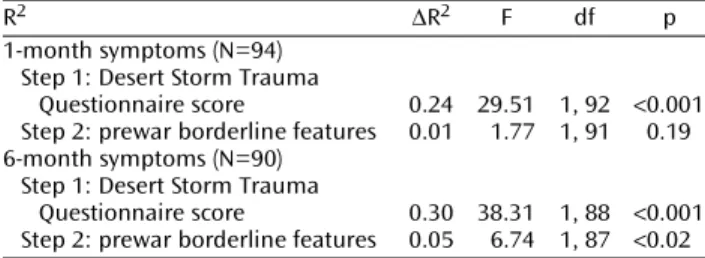
Table 1 presents the regression models evaluating hy-pothesis 1. Desert Storm Trauma Questionnaire score ac-counted for 24% of the 1-month PTSD symptom variabil-ity (p<0.001) and 30% of the 6-month variability (p<0.001). Prewar borderline personality disorder features ac-counted for an additional 1% of the 1-month PTSD symp-tom variability (p=0.19) and 5% of the 6-month variability (p<0.02), beyond the variability accounted for by the Desert Storm Trauma Questionnaire.
Table 2 presents the regression models examining hy-potheses 2 and 3. Prewar borderline personality disorder features were entered in the first step of the model and ac-counted for 40% of the variability of the postwar border-line personality disorder features (p<0.001). To analyze hy-pothesis 2, Desert Storm Trauma Questionnaire score was entered in a second step and accounted for 10% of the variability in postwar borderline personality disorder fea-tures (p<0.001), and age was entered in a third step and ac-counted for 3% of the variability (p<0.02). Finally, to ana-lyze hypothesis 3, 1-month PTSD symptoms were entered in a fourth step, accounting for an additional 11% of vari-ability (p<0.001).
Discussion
In the present report on Operation Desert Storm veter-ans, prewar features of borderline personality disorder predicted variability in postwar PTSD symptoms beyond that predicted by combat exposure, combat exposure pre-dicted variability in postwar features of borderline person-ality disorder, and PTSD severity assessed shortly after combat exposure accounted for additional variability in subsequent features of borderline personality disorder. The findings support each of the three study hypotheses and point to a complex relationship among trauma, PTSD symptoms, and borderline personality disorder features.
Prewar borderline personality disorder features ac-counted for a significant amount of variance in PTSD symptoms at 6 months postwar (5%) but did not signifi-cantly account for PTSD symptoms at 1 month postwar. The finding with regard to 6-month PTSD is consistent with Gunderson and Sabo’s suggestion (5) that individuals with borderline personality lack adequate coping
mecha-nisms and are therefore vulnerable to posttraumatic stress reactions after trauma. It is also possible that individuals with borderline personality disorder features, such as dan-gerous impulsivity and uncontrolled anger, are more likely to engage in situations where they are exposed to trauma, putting them at increased risk for developing PTSD. How-ever, our data did not find a significant correlation be-tween prewar borderline personality disorder features and combat exposure (r=0.12, p=0.26). Other personality fea-tures that have been reported as risk factors for the de-velopment of PTSD include neuroticism, extraversion, ex-ternal locus of control, and poor self-esteem (23, 24). Neuroticism, external locus of control, and poor self-es-teem share variability with borderline personality disorder features, but extraversion does not (25). Additional re-search may identify other personality disorder traits that create a vulnerability to PTSD.
The second hypothesis was supported in that level of Desert Storm trauma exposure accounted for 10% of the variability in postwar borderline personality disorder fea-tures beyond the variability accounted for by prewar bor-derline personality disorder features. Exposure to early life trauma, such as childhood physical, sexual, and emo-tional abuse, has long been considered a risk factor for the development of borderline personality and has been sup-ported by prospective research (13, 14). However, trau-matic exposure during late adolescence and early adult-hood has not typically been associated with symptoms of this disorder.
The third hypothesis was also supported because PTSD symptoms at 1 month accounted for 11% of the variability in borderline personality disorder features at 6 months above and beyond the contributions from prewar border-line personality disorder features, war trauma (Desert Storm Trauma Questionnaire score), and age. Herman (15) has suggested that the DSM-IV “simple” PTSD symptoms of intrusiveness, avoidance, and hyperarousal are typical stress responses to acute traumatic experiences but that when individuals experience prolonged or repeated trauma, they also develop “complex PTSD” responses (also called disorders of extreme stress not otherwise specified), including borderline personality disorder-like symptoms. She described the nature of prolonged stress, such as being subjugated to coercion, and the adjustments that individuals make that result in complex PTSD symp-toms. Our data indicate that the development of “simple” TABLE 1. Regression Models Predicting 1-Month and
6-Month Symptoms of Posttramatic Stress Disorder in Veter-ans of Operation Desert Storm
R2 ∆R2 F df p
1-month symptoms (N=94) Step 1: Desert Storm Trauma
Questionnaire score 0.24 29.51 1, 92 <0.001 Step 2: prewar borderline features 0.01 1.77 1, 91 0.19 6-month symptoms (N=90)
Step 1: Desert Storm Trauma
Questionnaire score 0.30 38.31 1, 88 <0.001 Step 2: prewar borderline features 0.05 6.74 1, 87 <0.02
TABLE 2. Regression Model Predicting Postwar Borderline Personality Disorder in 94 Veterans of Operation Desert Storm
R2 ∆R2 F df p
Step 1: prewar borderline
features 0.40 60.50 1, 92 <0.001 Step 2: Desert Storm Trauma
Questionnaire score 0.10 17.35 1, 91 <0.001 Step 3: age 0.03 6.44 1, 90 <0.02 Step 4: 1-month symptoms of
PTSD symptoms in and of themselves may create chal-lenges that require personality adjustments. “Simple” PTSD symptoms, such as hypervigilance to cues, emo-tional detachment, and chronically disturbed sleep, are often highly disruptive and debilitating. Living with these symptoms may lead to a number of experiences com-monly associated with borderline personality disorder, in-cluding marked affective instability, unstable and intense interpersonal relationships, and inappropriate intense anger. We believe that living with “simple” PTSD symp-toms provides an additional component to the etiology of complex PTSD, as described by Herman (15).
The current findings suggest that adulthood traumatic experiences and posttraumatic stress sequela may contrib-ute to the development of borderline personality disorder features. The onset of borderline personality disorder symptoms in adulthood is consistent with two diagnostic categories that were considered for the DSM-IV but not in-cluded. In addition to complex PTSD/disorders of extreme stress not otherwise specified, which was ultimately added to the associated features text of DSM-IV PTSD (26, 27), the ICD-10 diagnosis of enduring personality change after cat-astrophic experience was considered for DSM-IV inclusion (28). If the current findings are extended by additional re-search linking adult trauma exposure to borderline person-ality disorder-like personperson-ality changes that cause clinically significant distress or impairment, then further consider-ation should be given to adding these trauma-related diag-nostic categories to DSM-V.
Common neurobiological features related to affect dys-regulation, impulsivity, and stress reactivity may contribute to the high rate of co-occurrence of borderline personality disorder and PTSD. Examples of this shared pathophysiol-ogy include decreased platelet α2-adrenergic receptor
number (29, 30), hypothalamic-pituitary-adrenal axis hy-perresponsivity to pharmacologic challenge (31, 32), ele-vated CSF corticotrophin-releasing hormone (33, 34), re-duced hippocampal volume (35, 36), and exaggerated amygdala activation in response to stressful stimuli (37, 38). Of course, further research will be necessary to identify po-tential relationships among neurobiological alterations, symptom development, and the possible direction of influ-ence between borderline personality disorder and PTSD.
There are a number of limitations in the current study. First, participants were non-treatment-seeking and did not exhibit high rates of psychopathology (18). Therefore, the relationships among trauma, PTSD symptoms, and borderline personality disorder features may not replicate with treatment-seeking patients. On the other hand, given the low rates of pathology, it is unlikely that the self-re-ports of these participants would have been compromised by disability or compensation claims, and in fact, we were unaware of any participants pursuing such claims, and no participants requested to have study assessments released for such purposes. Also, given that the study hypotheses were supported within the restricted range of pathology of
this sample, it would be reasonable to expect the relation-ships to be maintained in samples with greater variability. Future prospective investigations with larger military samples are necessary to examine these relationships in participants that develop full PTSD and/or borderline per-sonality disorder conditions.
Second, the current data are limited to self-report mea-sures of combat trauma, PTSD symptoms, and borderline personality disorder features. Objective measurement of combat experience is not available to assess the criterion validity of the Desert Storm Trauma Questionnaire self-report, and there is some indication that self-reported ac-counts of combat exposure are not perfectly reliable. In a previous study that used many of the same participants from the current study (39), we found that self-reported accounts of combat exposure did not remain perfectly consistent across time, particularly when attending to re-sponses on individual exposure items. However, the par-ticipants’ total number of types of exposure (or Desert Storm Trauma Questionnaire total scores) was fairly con-sistent, changing on average by less then one type of expo-sure (39). The present analyses relied upon Desert Storm Trauma Questionnaire total scores and are therefore not likely to have been significantly affected by inconsistent reporting of combat exposure.
Third, the Personality Diagnostic Questionnaire scales have demonstrated low diagnostic thresholds, thus over-diagnosing personality disorders (22). Therefore, it would not be appropriate to use the Personality Diagnostic Ques-tionnaire to estimate rates of borderline personality disor-der in this group. However, low diagnostic thresholds are advantageous for examining dimensional relationships of personality disorder features in healthy samples because more stringent criteria would not yield sufficient variabil-ity for use in a nonclinical sample.
Fourth, prewar and postwar borderline personality disorder features, as measured by Personality Diagnostic Questionnaire items, correlated at 0.62. Had these measures been given prospectively, a correlation of this magnitude might have suggested only modest test-retest reliability. However, each Personality Diagnostic Ques-tionnaire item was completed by the participants for the two intervals at the same time (literally marked on the same page), indicating that any difference in scores was a deliberate reflection of the participants’ change in self-perception between the two intervals and not due to a lack of reliability in the self-report measure. On the other hand, the retrospective account of prewar personality function-ing is a significant limitation of this data. It will be impor-tant to conduct prospective assessments of prewar and postwar personality functioning in future investigations, although such investigations will obviously require signif-icant resources.
Finally, given the nature of the military strategies em-ployed in Operation Desert Storm (i.e., strong reliance on missiles and air assaults and limited ground
confronta-tion), it might be presumed that the degree of combat ex-posure would have been insufficient to result in posttrau-matic stress reactions. Nonetheless, most participants were confronted with multiple combat-related stressors. Participants in this study were frequently exposed to in-coming SCUD missile attacks, and some participants were reportedly stationed as guards at the entrance to their compound and were prevented from taking refuge in bun-kers during missile attacks. In addition, some soldiers were exposed to enemy small-arms fire (many partici-pants from one unit witnessed the deaths of a physician and a nurse), and several participants reported seeing burned and charred bodies and flattened corpses.
The findings of this study have a number of potential implications. First, for individuals choosing or hiring for professions that involve a high risk of becoming trauma-tized, such as military or law enforcement, it is important to consider that features of personality may serve as po-tential risk factors for developing PTSD. Second, when diagnosing borderline personality disorder features in adulthood, clinicians should consider the contribution of adulthood trauma as well as childhood trauma. Further, when one is treating traumatized individuals with PTSD and comorbid features of borderline personality disorder, lessening the symptoms of PTSD may, over time, help to reduce coexisting borderline personality disorder fea-tures. Alternatively, targeting borderline personality disor-der-related problems, such as affective dysregulation and impulsivity (e.g., reference 40), might be necessary before patients will be able to fully benefit from treatments fo-cused on resolving PTSD symptoms (e.g., reference 41). Finally, the presence of personality disorder features can alter the way in which PTSD patients are viewed and/or treated by clinicians, researchers, and disability claim ad-justers. For example, patients with symptoms of border-line personality disorder may be avoided or labeled as problematic, and traumatized individuals may be denied disability claims, despite the fact that trauma appears to contribute to borderline personality disorder features, as well as PTSD.
Taken together, the present findings suggest that trauma, symptoms of PTSD, and features of borderline personality disorder are related to one another in a com-plex fashion that may exceed simple linear models. The features of borderline personality disorder appear to be both a risk factor for the development of PTSD symptoms and a potential consequence of living with PTSD symp-toms. In addition, it appears that trauma can contribute to changes in personality, even in adulthood. Future pro-spective investigations are necessary to clarify the role of military trauma and other adult traumas in the develop-ment of borderline personality disorder symptoms in adulthood. Longitudinal investigations may reveal a posi-tive feedback loop between PTSD symptoms and border-line personality disorder features that helps to maintain both conditions over time.
Presented in part at the 155th annual meeting of the American Psychiatric Association, Philadelphia, May 18–23, 2002; and at the 110th annual meeting of the American Psychological Association, Chicago, Aug. 22–25, 2002. Received Feb. 12, 2003; revision received Jan. 30, 2004; accepted April 23, 2004. From the Department of Psy-chiatry, Yale University School of Medicine; and the National Center for PTSD, VA Connecticut Healthcare System, Newington, Conn. Ad-dress correspondence and reprint requests to Dr. Axelrod, Yale University School of Medicine, 425 George St., New Haven, CT 06511; [email protected] (e-mail).
Supported by the National Center for PTSD and the Yale Borderline Personality Disorder Research Center.
The authors thank Paula Schnurr, Ph.D., and Martha Dillon, M.A., for their contributions.
References
1. Southwick SM, Yehuda R, Giller EL Jr: Personality disorders in treatment-seeking combat veterans with posttraumatic stress disorder. Am J Psychiatry 1993; 150:1020–1023
2. Sherwood RJ, Funari DJ, Piekarski AM: Adapted character styles of Vietnam veterans with posttraumatic stress disorder. Psy-chol Rep 1990; 66:623–631
3. Hyer L, Woods MG, Boudewyns PA: A three tier evaluation of PTSD among Vietnam combat veterans. J Trauma Stress 1991; 4:165–194
4. Shea TM, Zlotnick C, Weisberg RB: Commonality and specificity of personality disorder profiles in subjects with trauma histo-ries. J Personal Disord 1999; 13:199–210
5. Gunderson JG, Sabo AN: The phenomenological and concep-tual interface between borderline personality disorder and PTSD. Am J Psychiatry 1993; 150:19–27
6. Herman J, Perry JC, van der Kolk BA: Childhood trauma in bor-derline personality disorder. Am J Psychiatry 1989; 146:490– 495
7. Ogata S, Silk KR, Goodrich S, Lohr NE, Westen D, Hill EM: Child-hood sexual and physical abuse in adult patients with border-line personality disorder. Am J Psychiatry 1990; 147:1008– 1013
8. Paris J, Zweig-Frank H, Guzder J: Risk factors for borderline per-sonality disorder in male outpatients. J Nerv Ment Dis 1994; 182:375–380
9. Zanarini MC, Gunderson JG, Marino MG, Schwartz EO, Franken-burg FR: Childhood experiences of borderline patients. Compr Psychiatry 1989; 30:18–25
10. Herman JL, van der Kolk BA: Traumatic antecedents of border-line personality disorder, in Psychological Trauma. Edited by van der Kolk BA. Washington, DC, American Psychiatric Press, 1987, pp 111–126
11. Paris J: Childhood trauma as an etiological factor in the person-ality disorders. J Personal Disord 1997; 11:34–49
12. Paris J, Zweig-Frank H: A critical review of the role of childhood sexual abuse in the etiology of borderline personality disorder. Can J Psychiatry 1992; 37:125–128
13. Johnson JJ, Smailes EM, Cohen P, Brown J, Bernstein DP: Associ-ations between four types of childhood neglect and personal-ity disorder symptoms during adolescence and early adult-hood: findings of a community-based longitudinal study. J Personal Disord 2000; 14:171–187
14. Johnson JG, Cohen P, Brown J, Smailes EM, Bernstein DP: Child-hood maltreatment increases risk for personality disorders during early adulthood. Arch Gen Psychiatry 1999; 56:600–606 15. Herman JL: Complex PTSD: a syndrome in survivors of pro-longed and repeated trauma. J Trauma Stress 1992; 5:377–391 16. van der Kolk BA: The complexity of adaptation to trauma self-regulation, stimulus discrimination, and characterological de-velopment, in Traumatic Stress. Edited by van der Kolk BA,
Al-exander C, McFarlane LW. New York, Guilford, 1996, pp 378– 397
17. van der Kolk BA, Hostetler A, Herron N, Fisler R: Trauma and the development of borderline personality disorder. Psychiatr Clin North Am 1994; 17:715–730
18. Southwick SM, Morgan CA, Nagy LM, Bremner D, Nicolaou AL, Johnson DR, Rosenheck R, Charney DS: Trauma-related symp-toms in veterans of Operation Desert Storm: a preliminary re-port. Am J Psychiatry 1993; 150:1524–1528
19. Southwick SM, Morgan CA III, Darnell A, Bremner D, Nicolaou AL, Nagy LM, Charney DS: Trauma-related symptoms in veter-ans of Operation Desert Storm: a 2-year follow-up. Am J Psychi-atry 1995; 152:1150–1155
20. Hyler SE, Rieder RO, Williams JBW, Spitzer RL, Hendler J, Lyons M: The Personality Diagnostic Questionnaire: development and preliminary results. J Personal Disord 1988; 2:229–237 21. Trull TJ: Temporal stability and validity of two personality
in-ventories. Psychol Assess 1993; 5:11–18
22. Hyler SE, Skodol AE, Kellman HD, Oldham JM, Rosnick L: Valid-ity of the PersonalValid-ity Diagnostic Questionnaire, Revised: com-parison with two structured interviews. Am J Psychiatry 1990; 147:1043–1048
23. Bremner JD, Southwick SM, Charney DS: Etiological factors in the development of posttraumatic stress disorder, in Does Stress Cause Psychiatric Illness? Edited by Mazure CM. Washing-ton DC, American Psychiatric Press, 1995, pp 149–185 24. Schnurr PP, Friedman MJ, Rosenberg SD: Premilitary MMPI
scores as predictors of combat-related PTSD symptoms. Am J Psychiatry 1993; 150:479–483
25. Watson DC: The relationship of self-esteem, locus of control, and dimensional models to personality disorders. J Soc Behav Pers 1998; 13:399–420
26. Roth S, Newman E, Pelcovitz D, van der Kolk B, Mandel F: Com-plex PTSD in victims exposed to sexual and physical abuse: re-sults from the DSM-IV field trials. J Trauma Stress 1997; 10:539– 555
27. van der Kolk BA, Roth S, Pelcovitz D, Mandel F: Complex PTSD: Results of the PTSD Field Trials for DSM-IV. Washington, DC, American Psychiatric Press, 1993
28. Shea MT: Enduring personality change after catastrophic expe-rience, in DSM-IV Sourcebook, Vol 2. Edited by Widiger TA. Washington, DC, American Psychiatric Press, 1996, pp 849–860 29. Southwick SM, Yehuda R, Giller EL, Perry BD: Altered platelet alpha-2 adrenergic receptor binding sites in borderline person-ality disorder. Am J Psychiatry 1990; 147:1014–1017
30. Perry BD, Giller EL, Southwick SM: Altered platelet alpha 2-ad-renergic binding sites in posttraumatic stress disorder. Am J Psychiatry 1987; 144:1511–1512
31. Yehuda R, Southwick SM, Krystal JH, Bremner D, Charney DS, Mason JW: Enhanced suppression of cortisol binding following dexamethasone administration in post-traumatic stress disor-der. Am J Psychiatry 1993; 150:83–86
32. Rinne T, De Kloet ER, Wouters L, Goekoop J, De Rijk R, Van den Brink W: Fluvoxamine reduces responsiveness of HPA axis in adult female borderline personality disorder patients with a history of sustained childhood abuse. Neuropsychopharmacol-ogy 2003; 28:126–132
33. Lee RL, Coccaro EF: Childhood trauma and alterations in adult CRF in personality disorders, in 2002 Annual Meeting New Re-search Program and Abstracts. Washington, DC, American Psy-chiatric Association, 2002, number 468
34. Bremner JD, Licinio J, Darnell A, Krystal JH, Owens MJ, South-wick SM, Nemeroff CB, Charney DS: Elevated CSF corticotropin-releasing factor concentrations in posttraumatic stress disor-der. Am J Psychiatry 1997; 154:624–629
35. Bremner JD, Randall P, Scott TM, Bronen RA, Seibyl JP, South-wick SM, Delaney RC, McCarthy G, Charney DS, Innis RB: MRI-based measurement of hippocampal volume in patients with combat-related posttraumatic stress disorder. Am J Psychiatry 1995; 152:973–981
36. Driessen M, Herrmann J, Stahl K, Zwaan M, Meier S, Hill A, Os-terheider M, Petersen D: Magnetic resonance imaging volumes of the hippocampus and the amygdala in women with border-line personality disorder and early traumatization. Arch Gen Psychiatry 2000; 57:1115–1122
37. Rauch SL, Whalen PJ, Shin LM, McInerney SC, Macklin ML, Lasko NB, Orr SP, Pitman RK: Exaggerated amygdala response to masked facial stimuli in posttraumatic stress disorder: a functional MRI study. Biol Psychiatry 2000; 47:769–776 38. Herpertz SC, Dietrich TM, Wenning B, Krings T, Erberich SG,
Willmes K, Thron A, Sass H: Evidence of abnormal amygdala functioning in borderline personality disorder: a functional MRI study. Biol Psychiatry 2001; 15:292–298
39. Southwick SM, Morgan CA III, Nicolaou AL, Charney DS: Consis-tency of memory for combat-related traumatic events in veter-ans of Operation Desert Storm. Am J Psychiatry 1997; 154:173– 177
40. Linehan MM: Cognitive Behavioral Treatment of Borderline Personality Disorder. New York, Guilford, 1993
41. Foa EB, Keane TM, Friedman MJ (eds): Effective Treatments for PTSD: Practice Guidelines From the International Society for Traumatic Stress Studies. New York, Guilford, 2000