School “Choice”
&
Freshman Year
in Philadelphia
RESEARCH FOR ACTION
FEBRUARY 2010
Transition to
High School
RESEARCH FOR
ACTION
Research for Action (RFA) is a Philadelphia-based, nonprofit organization engaged in policy and evaluation research on urban education. Founded in 1992, RFA seeks to improve the education opportunities and outcomes of urban youth by strengthening public schools and enriching the civic and community dialogue about public education. For more information about RFA, please go to our website, www.researchforaction.org.
Learning from Philadelphia’s School Reform
This report is one of a series on Philadelphia high schools. For education researchers and advo-cates, supporting and improving our public high schools is one of the most critical goals, as well as one of the most daunting challenges. RFA is committed to conducting research that can help identify the strategies that can make the biggest difference for high schools. Through mixed method, multi-year studies we examine: initiatives to improve persistently low-performing high schools, efforts to increase teacher effectiveness, supports for struggling learners, and access and readiness for college and career. RFA’s work on high schools is supported by grants from the William Penn Foundation, the Carnegie Corporation, and the Ford Foundation. This report is available for free on the RFA website—www.researchforaction.org—or in hard copy, $5 per copy shipping and handling. The policy briefs based on this report are available for free on the website. Other recent RFA publications focused solely or in part on high schools include: Christman, J. B., Brown, D., Burgess, S., Kay, J., Maluk, H. P., & Mitchell, C. (2009). Effective organizational practices for middle and high school grades: A qualitative study of what’s helping Philadelphia students succeed in grades 6-12. Philadelphia: Research for Action.
Gold, E., & Evans, S. A. (2008). Blueprint for secondary education in Philadelphia: The planning process, 2006-2008. Philadelphia: Research for Action.
Hartmann, T. A., Reumann-Moore, R. J., Evans, S. A., Haxton, C., Maluk, H. P., & Neild, R. C. (2009). Going small: Progress and challenges of Philadelphia's small high schools. Philadelphia: Research for Action.
Acknowledgements
The authors of this report wish to thank the many individuals and institutions that
contributed to and supported this research. The research would not have been possible without the financial support of the William Penn Foundation. In addition, we are deeply appreciative of the time that central office, regional, and school leaders spent with us, sharing their insights about Philadelphia high schools. We owe special thanks to the School District of Philadelphia’s accountability and research offices for providing us with district data sets important to this study.
RFA colleagues were critical to bringing this report to fruition. Jolley Bruce Christman and Sukey Blanc assisted with data collection and analysis. Senior RFA staff provided feedback to an early draft, and RFA interns Maggie Larson, Stephanie Rosen, and Meagan Steiner assisted with data management, coding and transcription. Judy Adamson, RFA Managing Director, directed design and production of this report.
Feedback from three anonymous external reviewers contributed significantly to refining and clarifying the report findings. The authors alone, however, are responsible for any shortcomings in the report.
Finally, thanks to our editor, Nancy Bouldin, who assisted in making this report clearer and more accessible, and to Judy Lamirand of Parallel Design for her contribution to the design of the report.
Copyright
©
2010 Research for ActionEva Gold
Research for Action
Shani Adia Evans
Research for Action
Clarisse Haxton
University of PennsylvaniaHolly Maluk
Research for ActionCecily Mitchell
Research for ActionElaine Simon
University of PennsylvaniaDeborah Good
Research for ActionTransition to High School
School “Choice”
&
Freshman Year in Philadelphia
Abstract
The School District of Philadelphia’s tiered system of selective, nonselective, and charter high schools, and the process for high school choice, has created real variation in the degree to which high schools can successfully meet the needs of ninth graders. Research has shown that the ninth grade year is critical in determining a student’s likelihood of graduating from high school. This mixed-methods study examines the transition to high school in
Philadelphia, which we define as including the eighth grade high school selection process and students’ experience in their ninth grade year.
In our analysis of eighth grade applications to district-managed high schools for the 2007-08 school year, we found that most District eighth graders participated in the high school selection process, but fewer than half of them were admitted and enrolled in any of their chosen schools. Further, comparing across types of high schools, we found first, that the choice process contributes to system stratification, with low-income students, Black and Latino students, students who need special supports, and boys concentrated in nonselective neighborhood high schools and Whites, Asians, and girls concentrated in special admission high schools. Second, we learned that the choice process creates distinct challenges to the neighborhood schools’ ability to support ninth graders. Enrollment at neighborhood high schools does not settle until the school selection process settles in late summer, and then continues to shift through the fall due to geographic mobility and returns from the juvenile justice system or other schools. Late enrollments undercut the ability of the neighborhood high schools to prepare for incoming classes, and contribute to changes in course schedules and teacher assignments after the school year begins, which cost important instructional time.
Finally, we found that despite widespread acknowledgement of the
importance of the freshman year, competing district agendas often mean it is not a priority in district and school planning. Freshman year interventions are often implemented piecemeal, without the professional support teachers need to adopt new practices, and without the assessments needed to know if they are effective. We argue that if low-performing neighborhood high schools are going to “turn around” or improve, it will require not only building school capacity but also implementing changes to the broader systems of district policy and practice in which these schools function, including the high school selection process.
Table of Contents
Abstract
Introduction: Transition to High School 1
The Importance of Freshman Year Transition 2
Transition to High School in Philadelphia: A Closer Look 3
About this Study 4
Relevant Timing for Philadelphia and the National Debate 7
Chapter 1: Context of the School District of Philadelphia 9
History of High School Choice and the Development of a Tiered System of High Schools 9 Ninth Grade Interventions: The Talent Development High School Reform Model 12
Redefining the High School Transition 15
Chapter 2: High School “Choice” in Philadelphia 16
The Philadelphia Application and Admissions Process 18
Application Patterns and Enrollment Outcomes in Philadelphia’s Selection System 22
Entering Ninth Grade 28
How Students and Parents Experience High School Selection 31
Conclusion 48
Chapter 3: Interventions to Support Ninth Graders 50
How Selection Practices and Enrollment Patterns Impact Interventions 52
Intervention 1 - Student Orientations: Establishing a Single School Culture 54
Intervention 2 - Ninth Grade Academies and Ninth Grade Teacher Teams 58
Intervention 3 - Double Dosing of Math and English: Accelerating Student Learning 65
Intervention 4 - Use of Individual Student Data 74
Intervention 5 - Strategically Assigning Strong Teachers to Ninth Grade 86
Conclusion 92
Chapter 4: Conclusion 94
Reforming the High School Selection Process 95
Other School Conditions and Freshman Year Interventions 97
Recommendations 99
References 103
Appendix A: Philadelphia’s Tiered System of High Schools 109
Appendix B: Differences Among High Schools by Admissions Type 111
Appendix C: Methodology 112
Sample Selection for Qualitative Data Collection 112
Qualitative Research Methods and Analysis 116
Quantitative Research Methods and Analysis 117
Quantitative Sample Size 118
Variables Examined 119
At a Glance: Philadelphia High Schools by Admissions Category
31 Neighborhood High Schools Audenried Bartram Carroll Edison Fels FitzSimons Frankford Franklin, Benjamin Furness Germantown GratzHigh School of the Future Kensington Business Kensington CAPA Kensington Culinary King Lamberton Lincoln Northeast Olney East Olney West Overbrook Rhodes Roxborough Sayre South Philadelphia Strawberry Mansion University City Vaux Washington West Philadelphia 13 Citywide Admission High Schools Bok Communications Technology Constitution Dobbins Douglas Mastbaum Motivation
Philadelphia HS for Business & Technology Philadelphia Military Academy at Elverson Philadelphia Military Academy at Leeds Randolph Robeson Swenson 16 Special Admission High Schools Academy at Palumbo Arts Academy at Rush Bodine
CAPA (Creative and Performing Arts) Carver
Central
Franklin Learning Center
GAMP (Girard Academic Music Program) Lankenau
Masterman
Parkway Center City Parkway Northwest Parkway West
Philadelphia High School for Girls Saul
Science Leadership Academy
27 Charter Schools with High School Grades
Arise Academy
Boys' Latin of Philadelphia CHAD (Charter High School for
Architecture and Design) Community Academy of Philadelphia Delaware Valley Charter
Eastern University Academy Esperanza Academy Franklin Towne Charter Freire Charter School Hope Charter School Imhotep Institute Charter Mariana Bracetti Academy Maritime Academy Charter School Mastery – Lenfest Campus Mastery – Pickett Campus Mastery – Shoemaker Campus Mastery – Thomas Campus
Mathematics, Civics, and Sciences Charter Math, Science, and Technology
Community Charter Multi-Cultural Academy New Media Technology Philadelphia Academy
Philadelphia Electrical and Technology Preparatory Charter School of Mathematics,
Science, Technology and Careers Sankofa Freedom Academy
Truebright Science Academy World Communications
Education reformers, city officials, and citizens across the nation are raising alarm about the “graduation rate crisis” in urban high schools. One large-scale study of nearly all public high schools nationwide has found that “high schools with the worst promoting power are concentrated in a subset of the nation’s cities.”1 Philadelphia, where 41% of entering ninth graders in 2004 failed to complete high school by 2008, is one such city.2 Although Philadelphia’s four-year graduation rate has improved in recent years—almost 10 points higher for the class of 2008 than for the class of 2006—the overall graduation rate of 59% is still low.3 Not only can researchers point to particular cities with low graduation rates and consequently high rates of student dropout, but they have also found that the dropout problem is concentrated in about 15% of the nation’s schools, with school poverty level being the strongest predictor of dropout.4 In Philadelphia as well as across the country, many of these high-poverty schools are neighborhood or com-prehensive high schools, which serve all students regardless of their academic record. Balfanz and Legters found that “there is a near perfect linear relationship between a high school’s poverty level and its tendency to lose large numbers of students between the ninth and twelfth grades.”5
Nonetheless, there is a convergence of evidence that, regardless of socio-economic background or other disadvantages students may have, schools can play a signifi-cant role in reversing the rate of dropout by helping youngsters make a successful transition into high school. As longtime observers of the dropout problem, Ruth Curran Neild and colleagues believe that “the inner city dropout epidemic cannot be ameliorated unless high schools organize themselves to help students through
the transition to high school” (emphasis added).6 Elaborating further, Neild and
Farley state that, “ultimately, the best dropout-prevention programs may be those designed to help students make the transition into the high school environment, with its more demanding curriculum, new social opportunities and pressures, and comparatively greater freedom.”7
1
Introduction
Transition to High School
1Balfanz, R., & Legters, N. (2004). Locating the dropout crisis: Which high schools produce the
nation’s dropouts? In G. Orfield (Ed.), Dropouts in America: Confronting the graduation rate crisis (pp. 57-84). Cambridge: Harvard Education Press, p. 64.
2Socolar, P. (2009, Spring). District graduation rates show an upward trend. Philadelphia Public School Notebook, 16(3), 16.
3Socolar, 2009, Spring.
4Balfanz, R., & Legters, N. (2006). Closing ‘dropout factories’: The graduation-rate crisis we know,
and what can be done about it. Education Week, 25(42), 42-43.
5Balfanz & Legters, 2006, p 42.
6Neild, R. C., Stoner-Eby, S., & Furstenberg, F. (2008). Connecting entrance and departure: The
transition to ninth grade and high school dropout. Education and Urban Society, 40, 543-569, p. 559.
7Neild, R. C., & Farley, E. (2004). Whatever happened to the class of 2000? The timing of dropout
in Philadelphia’s schools. In G. Orfield (Ed.), Dropouts in America: Confronting the graduation rate crisis (pp. 207-220). Cambridge: Harvard University Press, p. 218.
Regardless of
socio-economic
background or other
disadvantages
students may have,
schools can play a
significant role in
reversing the rate of
dropout by helping
youngsters make a
successful transition
into high school.
The Importance of Freshman Year Transition
Research over the past decade has shown that among the strongest indicators of being “on track” to graduation are whether a ninth grader attends school, passes his or her courses, and proceeds to tenth grade.8Studies that explore why the transition to high school is so critical to students staying “on track” span numer-ous disciplines and offer multiple explanations for why the transition is so chal-lenging. These challenges include issues of adolescent development and differ-ences in preparation for high school made in eighth grade, as well as discrepan-cies in community and family resources.9For many adolescents the freshman transition results in the loss of academic momentum. While this setback does not doom all students, it is especially difficult to overcome for youth with multi-ple disadvantages and scant access to support systems.10
Philadelphia, where all but a few neighborhood high schools serve largely stu-dents of color and high-poverty populations, has been highlighted in multiple studies of the student dropout problem. One study points out that, “at most of [Philadelphia’s] neighborhood high schools, the proportion of freshmen without any risk factors for non-promotion is extremely low.”11Historically, about one third of first-time freshman in the School District of Philadelphia (the District) do not pass ninth grade.12The highest degree of ninth grade retention occurs in the District’s neighborhood high schools where the average ninth grader enters with academic skills several years below grade level.13In the absence of strong, coherent interventions to support these students catching up and successfully making the transition to high school, ninth grade retention increases the likeli-hood that they will ultimately drop out of school.14
In this report we
take a hard look at
issues of high school
transition in
Philadelphia, with a
particular focus on
the conditions for
transition at the
nonselective
neighborhood
high schools.
8Neild, Stoner-Eby, & Furstenberg, 2008; Allensworth, E., & Easton, J. Q. (2005). The on-track indicator as a predictor of high school graduation. Chicago: Consortium on Chicago School Research; Allensworth, E., & Easton, J. Q. (2007). What matters for staying on-track and gradu-ating in Chicago public high schools. Chicago: Consortium on Chicago School Research.
9Grossman, J. B., & Cooney, S. M. (2009). Paving the way for success in high school and beyond: The importance of preparing middle school students for the transition to ninth grade.
Philadelphia: Public/Private Ventures; Neild, R. C. (2009). Falling off track during the transi-tion to high school: What we know and what can be done. The Future of Children, 19(1), 53-76.
10Grossman & Cooney, 2009; Neild & Farley, 2004. See also: Newberg, N. (1991). Bridging the
gap: An organizational inquiry into an urban school district. In D. A. Schön (Ed.), The reflective turn: Case studies in and on educational practice (pp. 65-83). New York: Teachers College Press. 11Neild, R. C., & Balfanz, R. (2006). An extreme degree of difficulty: The educational
demo-graphics of urban neighborhood high schools. Journal of Education for Students Placed at Risk, 11(2), 123-141, p. 137.
12Neild & Balfanz, 2006. 13Neild & Balfanz, 2006. 14Allensworth & Easton, 2007.
Transition to High School in Philadelphia: A Closer Look
In this report we take a hard look at issues of high school transition in
Philadelphia, with a particular focus on the conditions for transition at the non-selective neighborhood high schools. Our goal is to identify implications of exist-ing policies, practices, and processes for Philadelphia’s students and for the District’s and city’s efforts to improve low-performing schools.
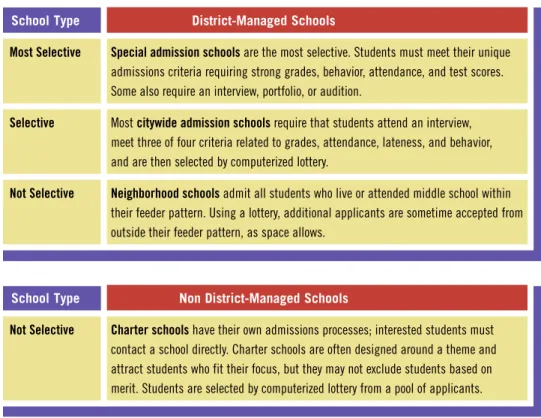
To fully understand issues of transition in Philadelphia, we began by looking at the process of high school selection in the eighth grade and the supports for transition available to freshmen in various types of high schools. In Philadelphia there are four types of public high schools each with different admissions crite-ria.15Special admission and citywide admission high schools are selective in their admissions criteria and therefore students must apply to be accepted at these schools. Neighborhood high schools are nonselective and any student who attended a feeder middle school or who lives within the feeder pattern can auto-matically attend one of the “default” neighborhood high schools. Finally, charter schools are public schools but are not managed by the District. Students apply separately to charter schools, are frequently screened through an interview process, and then go into a lottery to determine acceptance.
The type of high school to which a student is accepted is likely to have a signifi-cant influence on that student’s educational experience and future opportuni-ties. As the table inAppendix Ashows, with few exceptions the District’s neighborhood high schools have the lowest graduation rates and highest dropout rates while the special admission high schools have the highest gradu-ation rates and lowest dropout rates.
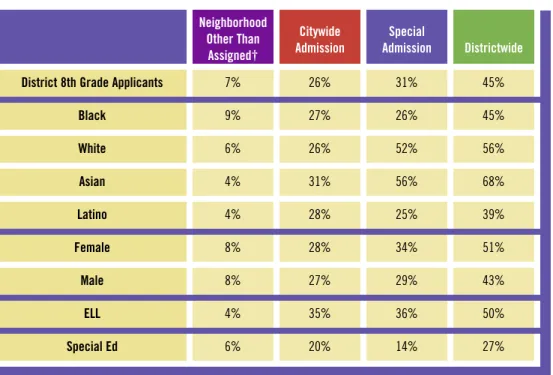
Our data reveal that for the 2007-08 school year the majority of District eighth grade students tried to select a high school that was not their neighborhood school, submitting a list of up to five preferred District high schools.16At the end of a lengthy application and selection process, however, fewer than half of those participating in the District’s selection process were admitted and enrolled at a school of their choice. Despite a growing number of high school options, the majority of Philadelphia’s eighth graders ended up attending their nonselective neighborhood high schools.
We also found that, although all types of Philadelphia high schools offered a similar range of freshman year interventions, neighborhood high schools faced a unique set of challenges in implementing these interventions due to their sta-tus as “default” schools. To a significant extent, these challenges are artifacts of 15We use the same nomenclature to categorize the different high schools that is used by the
School District of Philadelphia in its directories of high schools and other public communica-tions.
16There is no limit to the number of charter schools to which a student may apply. Charter
school applications are made through a separate process described in Chapter Two.
For the 2007-08
school year the
major-ity of District eighth
grade students tried to
select a high school
that was not their
neighborhood school.
the process of high school selection. Neighborhood high schools, however, are the very schools that most require strong, strategic, and well-coordinated stu-dent supports.
Our investigation of high school choice and freshman year interventions reveals that choice and opportunity are embedded within an interconnected system of schools. Whether the District adopts incremental improvement or quicker “turnaround” strategies, as U.S. Secretary of Education Arne Duncan is pro-moting, our study indicates that looking simply at individual school capacity, while important, is not sufficient.17To improve student outcomes, it is also important to consider the broader ecology in which any school functions. The District has long been aware of the particular challenges experienced by neighborhood high schools serving vulnerable populations. In fact, as detailed in Chapter One of this report, Philadelphia has been a pioneer in several attempts to reform neighborhood high schools. In the subsequent chapters of this report, we demonstrate that these reforms have been minimally sustained.
About this Study
Our examination of Philadelphia high schools is guided by the significant exist-ing body of work on high school transition and student dropout. We have
17A guide published by the U.S. Education Department’s Institute of Education Sciences (IES)
notes that “School turnaround work involves quick, dramatic improvement within three years while school improvement is marked by steady, incremental improvement over a longer period of time,” as cited in Viadero, D. (2009). Research doesn’t offer much guidance on turnarounds. Education Week, 28(37), 10.
Whether the District
adopts incremental
improvement or
quicker “turnaround”
strategies, our study
indicates that looking
simply at individual
school capacity, while
important, is not
sufficient. To improve
student outcomes,
it is also important to
consider the broader
ecology in which any
school functions.
The broad research questions that guided this study were:
• What does the high school transition — high school selection and freshman year supports — look like in Philadelphia? – How is the high school selection process implemented and
experienced in Philadelphia? What are the implications of the process for access and equity?
– What interventions do high schools use to help students through their ninth grade transition year? What challenges do high schools face in organizing themselves to support freshman year students?
• What are the implications of the policies, practices, and process-es for high school selection and frprocess-eshman year supports for efforts in Philadelphia to improve or “turn around” low-perform-ing high schools? What are the lessons for other urban districts?
widened the usual lens for viewing transition, however, to include the system-wide eighth grade high school selection process, in addition to school-level ninth grade supports designed to help students meet the challenges of high school. Our research questions reflect this expanded view of what constitutes the tran-sition to high school (see box on page 4).
To answer these research questions, we analyzed both qualitative and quantita-tive data collected primarily during the 2007-08 school year. Please see the box below for an overview of our research methods.
5 Transition to High School is a mixed methods study. We
collected the qualitative data between May 2007 and August 2008, including interviews, observations, and document review. Our quantitative data included relevant information about eighth grade selection from the 2006-07 school year, as well as data about student demographics, high school enrollment, and student outcomes from the 2007-08 school year. We also analyzed the 2007-08 District teacher and student surveys for questions relevant to this study.
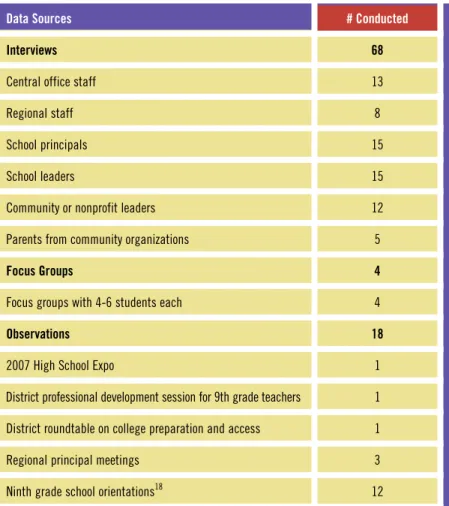
Our data collection and analysis focused on issues of high school transition at multiple system levels: central, regional, and school level. Our school-level data were from a sample of schools that reflect the variety of types of high schools found across the District. The sample included 15 District-managed schools (referred to as District high schools in this report), which represent three categories of Philadelphia high schools: neighborhood, citywide admission, and special admission high schools. We also included four charter high schools (governed by independent boards, not the District), a growing sector in Philadelphia. (See Table 1.1 Study Data Sources on next page.) In our analysis we sought to understand patterns in applications
and enrollment, demographics, and outcomes indicated in the quantitative data, as well as perspectives on these patterns and the transition to high school experience as revealed through qualitative central office, regional, and school-level data. In addition, we interviewed parents, students, and leaders of community-based organizations to better understand their perspectives on the admissions process and the basis upon which students and parents selected their preferred schools. (A detailed description of our data collection and analysis is in Appendix C.)
18Our observations of 12 ninth grade orientations include seven observations done for a
differ-ent RFA study: Christman, J. B., Brown, D., Burgess, S., Kay, J., Maluk, H. P., & Mitchell, C. (2009). Effective organizational practices for middle and high school grades: A qualitative study of what's helping Philadelphia students succeed in grades 6-12. Philadelphia: Research for Action.
6
Table 1.1
Study Data Sources
Qualitative Research
Data Sources # Conducted
Interviews 68
Central office staff 13
Regional staff 8
School principals 15
School leaders 15
Community or nonprofit leaders 12 Parents from community organizations 5
Focus Groups 4
Focus groups with 4-6 students each 4
Observations 18
2007 High School Expo 1
District professional development session for 9th grade teachers 1 District roundtable on college preparation and access 1
Regional principal meetings 3
Ninth grade school orientations18 12
Quantitive Research
Data Sources Valid Cases
Student Outcomes Data for 7th graders N=17,490 (2005-06)
Student Demographic and Outcomes Data N=14,274 for first-time 9th graders (2007-08)
Application and Enrollment Data for entering 9th graders N=12,806 (2007-08)
School District's Annual Teacher Survey N=2,006 (2007-08, high school only)
School District's Annual Student Survey N=10,573 (2007-08, high school only)
19Neild, 2009.
20Christman, J. B., Cohen, J., & MacPherson, P. (1997). Growing smaller: Three tasks in
restructuring urban high schools. Urban Education, 32,146-165; Christman, J. B. &
Macpherson, P. (1996). The five school study: Restructuring Philadelphia’s comprehensive high schools. Philadelphia: Philadelphia Education Fund; Luhm, T. (2000). Children achieving in Philadelphia high schools. Unpublished internal report, Consortium for Policy Research in Education, Philadelphia.
21Luhm (2000) makes reference to resistance to District attempts to alter the selection system. Despite the mounting empirical evidence that a fundamental rethinking of the structure and content of secondary education is necessary to create the conditions for learning,19neighborhood high schools have proven to be durable institutions resistant to change. This study seeks to add to the very important conversation about urban high schools that is taking place both locally and nationally. This conversation also harkens back to earlier high school reform research in Philadelphia that likewise pointed to the impor-tance of school organization, instructional quality, and system-level change as crucial in any effort to make schools engaging, effective places of
learning.20By defining “transition” to include the high school selection process, we show how this process, in the context of Philadelphia’s tiered system of high schools, affects the ability of different types of high schools to organize themselves to provide freshman year supports. Specifically, we are able to identify the systemic processes connected to high school transition that appear to make improvement at the school level—and particularly improving the ninth grade experience in low-performing neighborhood schools—so elusive.
Relevant Timing for Philadelphia and the National Debate
This research provides a view of current high school realities in Philadelphia as new District leadership prepares to implement its strategic plan, which by necessity includes a strong focus on high schools. Its publication also occurs at a moment when city leaders and nonprofit actors are galvanized around the need to reduce the rate of student dropout.
What needs to occur, we believe, is a reconsideration of the system in which neighborhood high schools function—with attention to what reinforces and what inhibits the ability of neighborhood high schools to organize themselves to support new ninth graders. Unless the systemic challenges that neighbor-hood high schools face are addressed, we believe that efforts to build school capacity will prove a frustrating undertaking. This means opening a dia-logue about the high school selection process and how it works within the context of the city’s stratified high school system, regardless of how hard such a conversation is bound to be.21If neighborhood high schools are truly to change, school conditions such as scale, leadership, teacher incentive sys-tems, school and District capacity to implement interventions, and the need for strategic focus on the freshman year transition must also be considered.
Without both systemic and school-level reforms, improvement is likely to fall short of the kind of difference Philadelphia students, families, and education reformers desire—a difference that can ensure that all students graduate, that graduates are ready for post-secondary education or employment, and that they can contribute to the economic, political, and social future of the city and the nation.
At a time when school choice is expanding in countless cities across the coun-try, we hope that this report also contributes to the growing knowledge base available to educators and policymakers. Through empirical study we show the perhaps unintended, but nevertheless inequitable, conditions created when school choice is constructed in a way that stacks the deck against the success of nonselective schools.
Overview of Chapters
•Chapter 1 presents an orientation to the broader context of high school reform
in Philadelphia, including a brief history of how the system has evolved to its present form.
•Chapter 2 provides an in-depth description of how the high school selection system works, including its limitations in creating choice for high
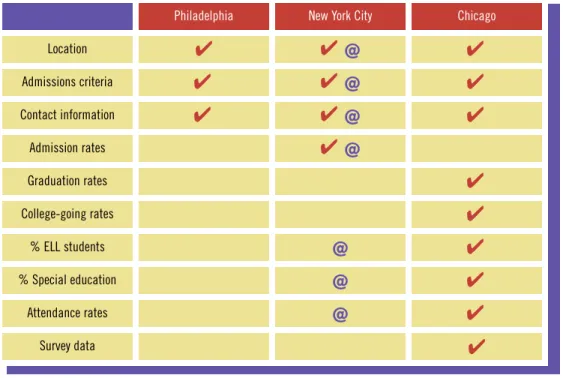
school students and families. The chapter also briefly compares Philadelphia's school selection process to those used in other cities, in order to explore other models and ideas that might inform Philadelphia's system.
•Chapter 3 turns to the array of transition interventions for students across
dif-ferent school types when they enter ninth grade and examines the challenges to implementation. Our research shows that in all school types there can be challenges to implementing these interventions, but in neighborhood high schools in particular these interventions fall short of being able to substantially address the needs of ninth graders whose academic skills, on average, are several years below grade level.
•Chapter 4 considers the implications of the current system for school
reform policy and practice in Philadelphia's system of high schools and summarizes key conclusions and recommendations. These impli-cations have national relevance as well. The importance of a broader, more coherent and unifying strategic focus is examined to increase the efficacy of ninth grade interventions across District schools. Recommendations are offered to: (1) make the process of high school selection more equitable, so that school choice becomes more meaningful, and (2) improve the quality of education in
Philadelphia's vitally important neighborhood schools, so that these schools become desirable options for both students and teachers.
Philadelphia has pioneered numerous high school reform initiatives over the past four decades. The pattern has been for high school reforms to wax and wane, with vestiges of the efforts remaining in schools, but often disconnect-ed from their original impetus or rationale. A close examination of
Philadelphia high schools reveals evidence of multiple past reform initia-tives, one layered on the other without the benefit of a unifying strategic vision. Furthermore, varying high school reform initiatives over time have supported the development of a highly stratified public school system of selective, nonselective, and charter high schools. In this chapter, we provide a brief history of high school reform in Philadelphia in order to understand the context in which the District’s system of high school choice and ninth grade transition interventions have developed.
History of High School Choice and the Development of a Tiered System
of High Schools
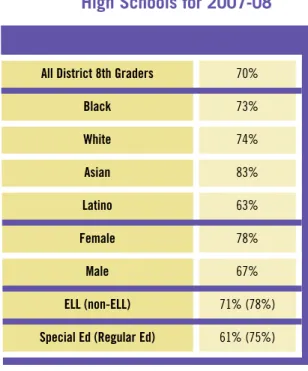
The notion of high school choice has become normalized in Philadelphia. In this study, we found that 70% of eighth grade students in District schools participated in the school selection process for the 2007-08 school year by submitting an application to attend a District high school other than their own neighborhood high school.22A look at the origins of Philadelphia’s high school options indicates that the choices that now exist evolved over several decades through the layering of different kinds of school reforms, each with somewhat different rationales and purposes. The cumulative effect has resulted in a tiered system of 60 District selective and nonselective admis-sion high schools as well as 27 charter high schools.23
Philadelphia’s Selective Schools
Central High School, which dates from 1838 and which was the second pub-lic secondary school in the nation, and Philadelphia High School for Girls, which dates from 1848 and was the first public secondary school for women in Pennsylvania, are today among Philadelphia’s 16 special admission high schools.24They and the other special admission high schools, many intro-duced in the 1970s, maintain stringent academic and behavioral criteria for
9 22Based on School District of Philadelphia 2006-07 data. This is an increase since 1995-96, when
Neild found that 65% of eighth graders in the District participated in high school choice by apply-ing to attend a District high school outside their own neighborhood. See: Neild, R. C. (2005). Parent management of school choice in a large urban district. Urban Education, 40, 270-297.
23As of September 2009 (see Appendix A).
24Central High School is the the second-oldest public high school, other than contemporary public
schools that were formerly private. It was an all-boys school until September 1983. See:
http://centralhigh.net/pages/about/history. Philadelphia High School for Girls was known as “The Girls Normal School” prior to 1893. In the early 1930s, the school began to identify itself as a high school for academically talented young women. For more on Philadelphia High School for Girls, see http://webgui.phila.k12.pa.us/schools/g/girlshigh/.
Chapter One
Context of the School District of Philadelphia
A look at the origins
of Philadelphia’s
high school options
indicates that the
choices that now exist
evolved over several
decades through the
layering of different
kinds of school
reforms.
25The eight CTE high schools are: Bok, Communications Technology, Dobbins, Edison,
Mastbaum, Randolph, Saul, and Swenson. All are citywide admission except for Saul, a special admission high school, and Edison, a nonselective neighborhood high school. In addition to the District’s eight full-time CTE schools, CTE “programs of study” are offered by a number of high schools across admission categories. See: Philadelphia Youth Network (2009, March).
Strengthening career and technical education and 21st century skills in Philadelphia. Philadelphia: Author.
26Although we frequently distinguish between special and citywide admission schools, we
some-times refer to them together as “selective” schools.
27Included in our count of neighborhood high schools is the District’s one hybrid-admissions
high school, High School of the Future, which admits 75% of its students from the neighborhood, and 25% of its students via citywide admissions criteria. See Appendix A for a full description of how our count of special admission, citywide admission, and neighborhood high schools differs slightly from the District’s high school directories.
28Mezzacappa, D. (2009, Spring). Reforming Philadelphia’s troubled high schools – what’s been
tried. Philadelphia Public School Notebook, 16(3), 20.
admissions. In addition, Philadelphia has a history of citywide admission schools, dating from the first vocational schools in the 1930s. Today, there are 13 citywide admission schools, including six of the District’s eight CTE (Career and Technical Education) schools; these schools are selective but usually have less stringent admissions criteria than special admission schools.25 Standing in contrast to these selective schools26are Philadelphia’s 31 nonselective neighborhood schools, which must accept all students within their designated feeder pattern and are considered the “default” schools for any student in the District’s school selection process.27
The 1960s: Diversification and Options
The decade of the 1960s was a period in which diversification of high schools and high school programs flourished in Philadelphia as well as in many other cities. Numerous high school options developed, many of which required students to apply to be admitted. Some options were located inside of the nonselective neighborhood high schools. For example, in 1962 the first magnet program within a neighborhood high school—an aerospace acade-my—was initiated. In 1963, at another neighborhood high school, a Motivation program opened which provided access to college preparatory activities for some students who could not meet the criteria for the most selective options. Eventually, there would be Motivation programs at nine neighborhood high schools. In 1967, the District created the first “school without walls” in the country, where students designed their own learning program and used the city’s cultural institutions and businesses as class-rooms. Then in 1969, Philadelphia High School Academies, Inc. was founded as a nonprofit organization that, working in partnership with industry, began establishing themed business and vocational or career programs in neighborhood high schools. Today, there are 30 such programs in 17 middle and high schools in Philadelphia.28
29Luhm, 2000.
30Keefe, C., Scher, L., Sparks, A., & Weinbaum, E. (2002, April). School choice in Philadelphia.
Paper presented at the American Educational Research Association Annual Meeting, New Orleans, LA. This definition of “universal choice” varies from its more common usage in which zoning based on residential location is eliminated and all schools within a given district are des-ignated as choice (magnet or alternative) schools. In the more common scenario, the concept of a neighborhood school no longer exists and all parents must choose a school for their children. See: Marschall, M. (2000). The role of information and institutional arrangements in stemming the stratifying effects of school choice. Journal of Urban Affairs, 22(3), 333-350.
31At the high school level, some charter schools in Philadelphia house high school grades only,
while others include middle and high school grades together and still others are K-12. Thus, some rising ninth graders in charter schools may choose to bypass the high school admissions process by remaining at the same charter school where they attended eighth grade.
1970s through 1990s: Magnet Schools and Small Learning Communities
The 1970s brought an expansion of the selective admission schools with the establishment of four new magnet schools. Created in response to a continu-ing desegregation lawsuit, these schools were intended to help attract and retain white and middle class students to the city’s high schools, thus assist-ing in achievassist-ing racial integration in the District. In the late 1980s, the District with the Philadelphia Schools Collaborative began restructuring large neighborhood schools into small learning communities (SLCs) with support from the Pew Charitable Trusts. The admissions process and criteria for SLCs was determined school by school. Although there were a few mag-net SLCs that drew students from across the city, students mostly came from within the high school’s feeder pattern. However, a tiered system devel-oped within many schools, with some SLCs having criteria for admissions and others not having any.29
In the 1990s, SLCs were scaled up districtwide (81 SLCs in the District’s 22 neighborhood high schools) and one study called this a period of “univer-sal choice” because the expectation was that all students would apply either to one of the two types of selective schools or to the SLC they wanted to attend.30SLCs, however, were not sustained, and thus the period of “univer-sal choice” was brief.
Late 1990s and Early 2000s: Charter Schools and Small High Schools In 1997, the state legislature approved charter school legislation, which led to additional high school options and their consequent impact on the selection process for Philadelphia students and schools. Students must apply to charter high schools directly, and each charter school has its own admissions process.31 Once a student has applied to a charter school—a process which often includes an interview to ensure a match between the student and the charter school—a lottery randomly determines which applicants are accepted.
Between 2003 and 2008, the District created 26 small high schools, in addi-tion to the six small special admission schools already in existence.32These new small high schools spanned selective (special and citywide admission) and nonselective (neighborhood) admissions categories.
This account of the development of school options in Philadelphia is not exhaustive, but it shows the evolution of a tiered system of selective and non-selective schools in which the idea of “choice” has historically been embedded. It is against this historical backdrop that Chapter Two explores in more depth school choice in Philadelphia, including the ways in which the high school selection process works and its implications for access and equity.
Ninth Grade Interventions: The Talent Development High School Reform
Model
In addition to reflecting past efforts to provide school choice, Philadelphia high schools today show evidence of multiple past reform interventions, a number of which have been focused on the ninth grade. Many of these date back to the Philadelphia Schools Collaborative (1988-1995) and the Talent Development High School Model.33In the mid-1990s, with federal funding available to support whole-school reform models and SLCs nationwide, a partnership between Johns Hopkins University and the Philadelphia Education Fund brought the Talent Development model to Philadelphia, where several middle schools adopted the model followed by seven high schools.34From 1999 to 2005, Philadelphia became the primary site for the Talent Development High School Model.
The Talent Development High School Model was designed to improve the organizational structure and educational process in large, public, nonselec-tive high schools, recognizing that these were the schools where dropout was endemic, and where even those who stayed in school often performed poor-ly.35The model focused on freshman year supports, further recognizing the critical nature of the transition juncture to improving graduation rates.36
32Hartmann, T. A., Reumann-Moore, R. J., Evans, S. A., Haxton, C., Maluk, H. P., & Neild, R.
C. (2009). Going small: progress and challenges of Philadelphia’s small high schools.
Philadelphia: Research for Action. Small high schools are defined by the District as having 700 or fewer students. Our count of small high schools does not include high schools which are cur-rently “small” due to under-enrollment.
33Christman & MacPherson, 1996; Luhm, 2000.
34The Talent Development comprehensive reform model was developed by the Center for
Research on the Education of Students Placed At Risk (CRESPAR), now called the Center for the Social Organization of Schools (CSOS), at Johns Hopkins University.
35Kemple, J. J. & Herlihy, C. M. (2004). The Talent Development High School Model: Context, components, and initial impacts on ninth-grade students’ engagement and performance. New York: MDRC; Kemple, J. J., Herlihy, C. M., & Smith, T. J. (2005). Making progress toward grad-uation: Evidence from the Talent Development High School Model, New York: MDRC.
36See Chapter Three for more on ninth grade Talent Development supports.
Philadelphia high
schools today show
evidence of multiple
past reform
interventions, a
number of which
have been focused
on the ninth grade.
Despite evidence that the Talent Development model was resulting in improved student outcomes among ninth graders—including attendance, academic course credits earned, tenth-grade promotion, and algebra passing rates—in 2005 the District severed formal ties to the initiative, which was competing with other District priorities for funding.37When the District cut its ties with Talent Development, then-Deputy Chief Academic Officer Al Bichner noted that it was the intention of the District to utilize selected interventions from the model, particularly the intensive supports for ninth grade students districtwide.38
When the District talked about its intention to scale up selected practices from the Talent Development model, James Kemple, an author of the MDRC study that demonstrated the model’s effectiveness, expressed doubts about whether the interventions would be effective if they were disconnected from an overall strategy intended to alter students’ high school experience
through substantive changes to school culture, organization, curriculum, and instruction. “[Talent Development] really is [an] intervention with multiple interlocking components. It is the combination of those components. We don’t know what happens if you take the model apart and what the result of doing one component from another, without the package, would be,” stated
Kemple.39
High schools in the District have clearly been shaped by the Talent
Development model. Principals and teachers at a number of high schools in our study referred to their prior participation in the Talent Development program. However, they also reported that they had stopped the interven-tions associated with it when the program ended.40Nonetheless, at several schools we observed vestiges of Talent Development interventions, although in most cases they were no longer articulated as part of a coordinated strate-gy of “interlocking components” intended to alter school culture and climate. These interventions also lacked the professional development and coaching support that were components of the original model.
13 37Kemple, Herlihy, & Smith, 2005; Simmons, S. (2005, June). Advocates question termination of
Talent Development program. [Electronic version]. Philadelphia Public School Notebook. Retrieved January 16, 2009 from http://www.thenotebook.org/newsflash/2005/june/talent.htm
38Simmons, 2005.
39Simmons, 2005, para. 35.
40With funding from a Department of Labor grant, one neighborhood high school in
Philadelphia: School Choice — A Mixed Legacy
Philadelphia has a long history of admirable school innovation and reform, including initiatives aimed at increasing school choice and providing interventions to assist freshman year students in making the tran-sition to high school. A brief survey of key milestones may help educators, policymakers, and community leaders better understand the context in which today’s selection process and interventions take place.
•1838 Philadelphia opens the nation’s second public secondary school. Today, that school, Central High School, is one of the District’s 16 special admission high schools, with highly selective admissions criteria.
•1930s Philadelphia establishes its first vocational schools, precursors of today’s eight CTE (Career and Technical Education) schools. Six of these are now among Philadelphia’s 13 citywide admission high schools, which are selective, but with less stringent admissions criteria than special admission high schools.
•1960s This is a period of strong diversification of high schools and programs, with many new options created.
•1962 The city’s first magnet program in a neighborhood high school initiates an aerospace academy.
•1963 Motivation programs are established to provide college preparatory activities for students in neighborhood high schools, eventually expanding to nine neighborhood schools. A few of these programs are precursors to today’s small high schools.
•1967 Philadelphia introduces the first “school without walls” in the country. The “Parkway” schools still exist today, but the curriculum is no longer regarded as alternative.
•1969 Philadelphia High School Academies, Inc., a nonprofit organization, creates business and vocational or career programs based in neighborhood schools. The model has been copied nationwide and continues today.
•1970s Four new magnet high schools — Masterman, Creative and Performing Arts (CAPA), Carver Engineering and Science, and Bodine High School for International Affairs — are established, all selective high schools.
•1980s Small learning communities (SLCs) are created within large neighborhood high schools, focused around topics or subjects of common interest. The admissions process and criteria are established at the school level.
•1990s SLCs are expanded districtwide, with 81 in the District’s 22 neighborhood high schools. This period represents one of “universal choice” where every student chooses a selective school or SLC for high school. SLCs, however, are not sustained, and thus the period of universal choice is brief.
•Mid-1990s The Talent Development High School Model is introduced and adopted by seven District neighborhood high schools. Despite evidence of improved outcomes, the model is discontinued in 2005 due to fund-ing priorities.
•1997 Charter schools are approved by the Pennsylvania state legislature. Charter high schools, which num-ber 27 in fall 2009, have a separate application process and criteria, but by law may not exclude stu-dents based on merit.
•2000s Twenty-six “small” high schools are created across all District school types — special admission, city-wide admission, and neighborhood.
•2009-10 Philadelphia has 60 District high schools: 31 neighborhood high schools (including one hybrid high school that is three-fourths neighborhood and one-fourth citywide admission), 13 citywide admission high schools, and 16 special admission high schools.
Redefining the High School Transition
We have defined transition as beginning with Philadelphia’s now well-estab-lished process of having eighth grade students participate in high school selection. As this report will show, ninth graders’ high school experience is shaped in part by the high school application and admissions process and the extent to which they, as eighth graders, attempted to exercise choice and were successful in achieving admission to one of their chosen schools. In other words, the high school experience is shaped by the type of high school a student attends. We also show that, despite Philadelphia’s experience in leading reform initiatives aimed at improving outcomes for ninth graders, especially for those attending large neighborhood high schools, these inter-ventions today appear fragmented and weak. They have become disconnect-ed from larger high school reform initiatives which had a strategic focus on the ninth grade. In the next two chapters we discuss in greater depth what the transition to high school looks like in Philadelphia, and what challenges the District faces in trying to improve the likelihood of students persisting to graduation.
In this chapter we examine the School District of Philadelphia’s high school application and admissions process. We consider the ways in which this District process facilitates or inhibits support for students as they make the transition to high school, paying particular attention to issues of equity and access. Policies that allow families to apply to schools other than the one to which they are assigned are typically referred to as “school choice” policies; however, it is more accurate to describe Philadelphia as having a system of “high school selection.”
“Choice” does not accurately describe the Philadelphia system for two reasons. First, Philadelphia high schools generally receive more applications than they can accommodate and cannot accept every student who applies. In some choice systems, oversubscribed schools randomly select students by lottery, but in Philadelphia’s system of high school selection, most schools use a variety of cri-teria to determine which students to admit. As a result, we found that schools actually have more influence over where students attend than do students and parents. Second, because there are not enough desirable options to meet stu-dent demand, many stustu-dents fail to access any of their “chosen” schools. In fact, we found that more than half of ninth graders attend a high school for which they have expressed no preference. For these reasons it is inaccurate to refer to Philadelphia as having a system of choice; this may also be the case for other cities that claim to have a system of high school choice. We argue that a system is not one of “choice” unless a significant majority of students do in fact choose which high school they will attend.
School choice is a highly debated policy that refers to a diverse set of concepts including vouchers, charter schools, and magnet programs. Proponents argue that choice creates an education marketplace that pushes all schools to improve as they compete for students. In addition, choice is said to provide more options for low-income parents and students who, through the act of choosing, become empowered agents in the educational marketplace.41
Opponents maintain that school choice increases racial and economic segrega-tion and exacerbates inequalities in the public educasegrega-tion system.42For exam-ple, families have been found to express their racial preferences through their school choices. In addition, higher-income families are often most successful at learning about and gaining access to the best school choices. Research on
“Choice” does not
accurately describe
the Philadelphia
system... . More than
half of ninth graders
attend a high school
for which they have
expressed no
preference.
Chapter Two
High School “Choice” in Philadelphia
41Chubb, J. E. & Moe, T. M. (1990). Politics, markets, and America’s schools. Washington, DC:
Brookings Institution; Coleman, J. S. (1990). Equality and achievement in education. Boulder, CO: Westview Press; Wong, K. K. (1992). Choice in public schools: Their institutional functions and distributive consequences. In K. K. Wong & T. N. Clark (Eds.), Research in urban policy (Vol. 4): Politics of policy innovation in Chicago (175-198). Greenwich, CT: JAI Press. 42Elmore, R. F. (1990, December). Working models of choice in public education. New
Brunswick, NJ: Consortium for Policy Research in Education; Henig, J. (1994). Rethinking school choice: Limits of the market metaphor. Princeton, NJ: Princeton University Press; Wells, A. S. (1993). The sociology of school choice: Why some win and others lose in the educational marketplace. In E. Rassel & R. Rothstein (Eds.), School choice: Examining the evidence (29-48). Washington, DC: Economic Policy Institute.
school choice has consistently found a positive relationship between family socioeconomic status, information access, and school admissions.43
There is no single theory of action underlying the Philadelphia District’s high school selection system. In interviews, District staff provided a range of objectives for high school choice. These included: 1) providing students with more options; 2) attracting and retaining middle class families; and 3) allow-ing students to access schools that are appropriate to their interests. Despite these varying objectives, what we consistently heard from District personnel was an assumption that a choice system would, by definition, give students and parents greater ability to direct their educational futures. However, as this chapter will show, we found that the assumed agency that choice can offer students is not realized by the District’s implementation of high school selection. High school selection has failed to empower or provide high school options to the majority of students. One senior District administrator called the selection system one of “haves and have nots,” explaining:
More times than not, youngsters are not being well served at the [neigh-borhood] high schools in Philadelphia. They’re the kids that got left. Those who could, who are savvy, who had the support of parents, elect-ed to go somewhere else.
Godwin and Kemerer have argued that the outcomes and influence choice policies have on schools and students depend upon the institutional struc-tures that characterize the choice program.44It is critically important to con-sider the structure of Philadelphia’s high school selection system because it has implications for students as they enter their pivotal ninth grade year. By determining which of the 60 District high schools each student may attend, the high school selection system has the potential to seriously influence a student’s high school environment, likelihood of graduation, and future aca-demic and career opportunities. Moreover, our research suggests that the selection system has exacerbated stratification in the District. Previous stud-ies, as well as our own, have found that students with the highest need are concentrated in Philadelphia’s neighborhood high schools.45Additional longi-tudinal research is needed to explore exactly how the expansion of high school choice is affecting the distribution of high-need students across school types. Nonetheless, our findings indicate that as the District’s system of high schools has expanded over time to include a broader set of options,
neighbor-17
By determining
which of the 60
District high
schools each
student may
attend, the high
school selection
system has the
potential to
seriously
influ-ence a student’s
high school
environment,
likelihood of
graduation, and
future academic
and career
opportunities.
43Marschall, 2000; Lareau, A., & Saporito, S. (1999). School selection as a process: The multiple
dimensions of race in framing educational choice. Social Problems, 46(3), 418-439; Neild, R. C. (1999). Same difference: School choice and educational access in an urban district (Doctoral dis-sertation, University of Pennsylvania, 1999). Dissertation Abstracts International, 60, 2441.
44Godwin, K., & Kemerer, F. R. (2002). School choice tradeoffs: Liberty, equity, and diversity.
Austin, TX: University of Texas Press.
45Neild, R. C. (2004). The effects of magnet schools on neighborhood high schools: An
examina-tion of achievement among entering freshmen. Journal of Educaexamina-tion for Students Placed at Risk,9(1), 1-21; Neild, R. C. & Weiss, C. (1999). The Philadelphia Education Longitudinal Study (PELS): Report on the transition to high school in the School District of Philadelphia.
hood high schools have been further disadvantaged by conditions which result from the selection process. It appears that the selection system con-tributes to a unique set of challenges in Philadelphia’s neighborhood high schools that inhibit the implementation of interventions meant to support students’ transition to high school.
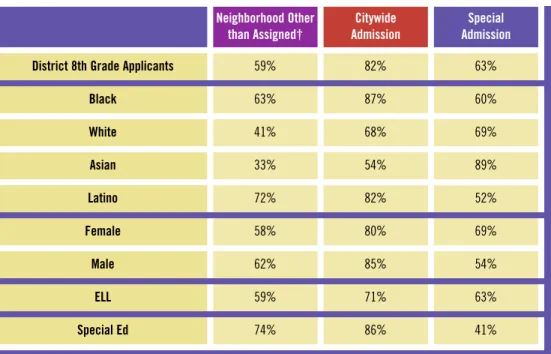
In this chapter, therefore, we provide an overview of Philadelphia’s high school selection process, including data on patterns in eighth grade students’ application decisions and enrollment outcomes. We then compare ninth grade enrollment across school types by race, gender, special needs status, socioeconomic status, and English language learner (ELL) status. The second part of the chapter describes how students and parents experienced the high school selection process, and how inequities in information access and social networks resulted in an inequitable pattern in admissions.
The Philadelphia Application and Admissions Process
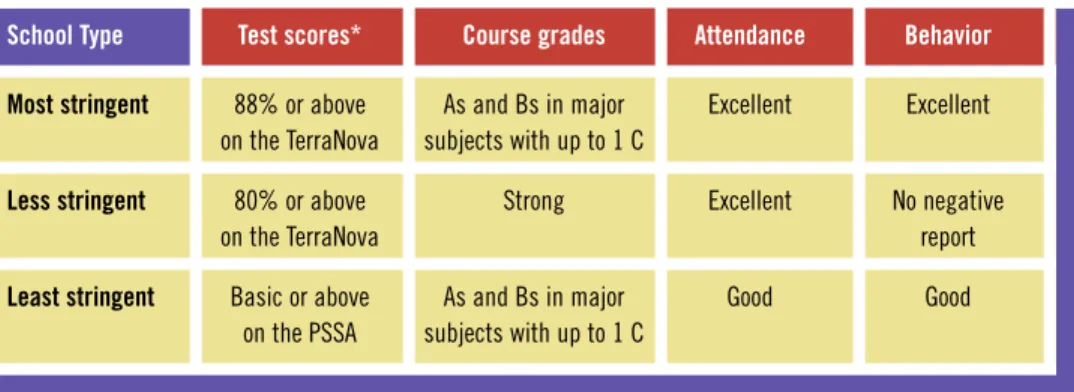
46Every fall, eighth graders participate in the District’s high school application and admissions process, vying for spots in a variety of public high schools across the city, including special admission, citywide admission, and neigh-borhood schools.47 Special admission high schools require that students meet admissions criteria that include a strong record of grades, test scores, behav-ior, and attendance in seventh grade. Citywide admission high schools are generally less selective than special admission high schools, requiring that 46This section describes the application and admissions process for students entering ninth
grade in the 2007-08 school year.
47In addition to eighth grade students in District-managed schools, students from independent,
private, and charter schools can submit high school applications. However, our analysis is limit-ed to applications from District eighth graders.
Data Sources
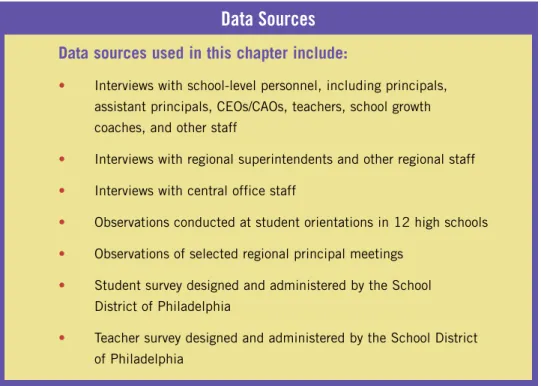
Data sources used in this chapter include:
• Interviews with principals and guidance counselors
• Interviews with regional superintendents and other regional staff
• Interviews with central office staff at the School District of Philadelphia
• Interviews and focus groups conducted with eighth and ninth grade students and parents
• Interviews with staff at community-based organizations (CBOs) with programs serving eighth grade students
• High school application data, fall 2006, and enrollment data for 2007-08
applicants meet at least three of four criteria related to grades, attendance, lateness, and behavior. Some special and citywide admission high schools also have additional admissions requirements, including writing an essay, presenting a research project, or attending an interview or audition. Any stu-dent who does not apply or is not admitted to another school of his or her choice is assigned to one of the District’s 31 neighborhood high schools, based on his/her middle school feeder pattern. Students may also apply to attend neighborhood schools other than the one to which they are assigned; admis-sion to these schools is based on a lottery and the number of available spots that remain after enrolling students from the feeder pattern.
To make matters more complex, charter schools are public schools that are not included in the District’s application process. Students interested in attending a charter school must apply to it directly. Each charter school has its own application form, process, and timeline. Pennsylvania charter schools may not exclude students based on academic merit but they may “establish reasonable criteria to evaluate prospective students.”48For example, many charter high schools have required parents to attend an information session in order for their child to be considered for admission. The expanding num-ber of charter high schools has influenced the selection system and its out-comes. However, because the District does not collect charter school admis-sions data, this chapter focuses exclusively on data from District-managed high schools in operation during the time of this study.
19
Any student who does
not apply or is not
admitted to another
school of his or her
choice is assigned to
one of the District’s 31
neighborhood high
schools, based on
his/her middle school
feeder pattern.
48See Pennsylvania state charter school law:
http://www.pde.state.pa.us/charter_schools/cwp/view.asp?a=146&Q=47379
Table 2.1
Admissions Criteria by School Type
School Type District-Managed Schools
Most Selective Special admission schoolsare the most selective. Students must meet their unique admissions criteria requiring strong grades, behavior, attendance, and test scores. Some also require an interview, portfolio, or audition.
Selective Mostcitywide admission schoolsrequire that students attend an interview, meet three of four criteria related to grades, attendance, lateness, and behavior, and are then selected by computerized lottery.
Not Selective Neighborhood schoolsadmit all students who live or attended middle school within their feeder pattern. Using a lottery, additional applicants are sometime accepted from outside their feeder pattern, as space allows.
School Type Non District-Managed Schools
Not Selective Charter schoolshave their own admissions processes; interested students must contact a school directly. Charter schools are often designed around a theme and attract students who fit their focus, but they may not exclude students based on merit. Students are selected by computerized lottery from a pool of applicants.
The year-long high school application and admission process begins in the fall of students’ eighth grade year.Figure 2.1presents the steps in this process in Philadelphia.
Figure 2.1
Approximate Timeline of High School Application
and Admission Process in Philadelphia
Month Process
September Counselors distribute high school application form & materials to eighth graders.
September - October Families do research on schools.
Late October or •Students return application form to counselors, having selected up to 5 schools. early November49 •The form must be signed by a parent.
•The eighth grade counselor enters information from the application forms into a networked computer system.
December •High schools begin to evaluate applications.
•Selective schools (i.e., special and citywide admission) “deselect” some of the applicants based on information in the students' applications.
December - January Some selective schools invite the remaining students for an interview or audition. Each school has its own rubric for assessing students.
January - February Selective schools “deselect” those students who did not do well on or did not attend the interview and/or audition.
March - April •Special admission schools accept some students and some schools also maintain a waitlist.
•Remaining citywide admission school applicants are entered into a lottery, conducted by the District Office of Student Placement, which takes a number of factors into account.
April First round of notification letters are sent to students who received multiple acceptances. Letters state where students have been approved, waitlisted, or disapproved.
April - May If students are approved for more than one school (i.e., receive multiple acceptances), they and their families choose a school from among their options and submit a form with their choice to the middle school counselor.
April - September •After “multiple acceptance” students make decisions about where they will attend, new spaces open up and students who were originally waitlisted or disapproved are reconsidered for admission.
•Additional letters are then sent to remaining applicants, informing them of subsequent admissions decisions. In this round of letters, students are admitted to only one school.
49In 2006, 2007, and 2008, application forms were due in November. In 2009, the deadline for