UNDERSTANDING COMPULSIVE USE OF FACEBOOK
THROUGH THE REINFORCEMENT PROCESSES
Cheung, Christy M.K., Department of Finance and Decision Sciences, Hong Kong Baptist
University, Kowloon Tong, Hong Kong, HKSAR, [email protected]
Lee, Zach, W.Y., Department of Finance and Decision Sciences, Hong Kong Baptist
University, Kowloon Tong, Hong Kong, HKSAR, [email protected]
Lee, Matthew, K.O., Department of Information Systems, City University of Hong Kong,
Kowloon Tong, Hong Kong, HKSAR, [email protected]
Abstract
With over 1 billion active users, Facebook is possibly the biggest phenomenon of the Internet. For the majority of individuals, Facebook represents an incredible social platform for social connection and information sharing. For others, however, the use of Facebook can lead to significant behavioural or psychological problems. Despite a rising concern over this emerging global issue, the theoretical understanding of the problematic use of technologies is lacking in the IS literature. Therefore, the main objective of this study is to propose a research model to theoretically explain the development of compulsive use of Facebook. We tested our research model using an online survey with 209 active Facebook users. Our results suggested that compulsive use of Facebook is mainly determined by negative reinforcement motive (i.e., feeling of withdrawal), but not the positive reinforcement motive (i.e., need for mood alteration). Preference for online social interaction is also found important in determining compulsive use of Facebook. This study provides a theoretical explanation of compulsive use of Facebook, and the results help clinicians, educators, and parents understand the main drivers of Facebook compulsive use.
Keywords: Compulsive use of Facebook, Social networking sites, Problematic use of IS/IT, Reinforcement processes, Need for mood alteration, Feeling of withdrawal, Preference for online social interaction.
1
Introduction
The use of social networking sites (SNSs), as exemplified by Facebook, has exploded in recent years to become entrenched as a part of our daily lives. Facebook users can create their own personal profile and connect and communicate with friends through instant chatting, email-like messages, and posts. They can also receive status updates through automatic notification functions. Recently, over 1 billion users signed up to Facebook and over half of them log on to it every day (Facebook, 2012). For the majority of individuals, Facebook represents an incredible social platform for social connection and obtaining information. For others, however, the use of Facebook can lead to significant behavioural or psychological problems. For instances, some people have a compulsion to use Facebook to constantly check their friends’ profiles and status updates for hours on end. In addition, some people start to prefer socializing with online friends over “real” friends (Kuss & Griffiths, 2012).
Problematic use of Internet-based technology has been identified as a national problem not only in the United States but also in other countries including China, Germany, South Africa, South Korea, Taiwan, and United Kingdom, where government intervention has also grown in response to battle this psychological disorder (Young & Nabuco de Abreu, 2010). To date, the issue of problematic use of information technology, including SNSs, is relatively new in the IS literature, and scientific understanding of this issue is still evolving (e.g., Turel, Serenko, & Giles, 2011). In addition, most existing studies on IS adoption and use have traditionally emphasized the positive and productive values of system interaction and usage, and assumed that the use of an information system will create benefits to users (e.g., Bhattacherjee, 2001; Burton-Jones & Gallivan, 2007; Venkatesh, Morris, Davis, & Davis, 2003). Recognizing that little theoretical and empirical attention has been given to examining this critical issue in the IS discipline, the aim of this study is to advance our theoretical understanding of the development of problematic SNS use. Specifically, we propose a theoretical model to explain how positive and negative reinforcement motives determine the development of problematic SNS use. We also explore the role of preference for online social interaction in the problematic use of SNSs.
The remainder of this paper is organized as follows. In the next section, we provide a review of prior literature on addiction theories and the problematic use of IS/IT. In the third section, we present our research model and hypotheses. In the fourth section, we describe our research study. In the fifth section, we report the data analysis. In the final section, we conclude our paper with the discussion on the theoretical and practical implications.
2
Literature Review
Prior literature provides us with a rich foundation on which to build a research model to examine compulsive Facebook use. In this section, we first provide a review of theories of addiction, and an overview of research on the problematic use of IS/IT. We then summarize prior studies on problematic use of SNSs.
2.1
Theories of Addiction
Addiction is one of the most important concepts in clinical and behavioural science (Marlatt et al. 1988). Clinicians view addiction as a clinical disorder and use diagnostic criteria to determine whether an individual needs treatment. One of the most commonly used sets of criteria, the fifth edition of the Diagnostic and Statistical Manual of Mental Disorders (DSM-V) (American Psychiatric Association 2013), identifies a number of symptoms of addiction. In contrast, psychologists and behavioural pharmacologists focus on theories explaining the development, maintenance, and treatment of addictive behaviour. Though there is little theory-based studies on IS/IT addiction (See Section 2.2), we notice a wide range of different perspectives on the development of addictive behaviour in prior literature. For instance, Robinson and Berridge (2003) identified three major theoretical explanations
of the development of substance addiction. For instance, opponent process theory of addiction describes the underlying positive and negative affective processes of addiction. Addictive behaviour is performed initially simply to achieve pleasant feeling, and after addiction, to escape unpleasant withdrawal. Aberrant learning theories focus on the role of learning in the transition to addiction. Specifically, this line of studies emphasizes how over-learned habits essentially become compulsive. Incentive-sensitization theory explains how the effect of sensitization on incentive salience guides compulsive behaviour. There are also some psychological approaches towards understanding addiction, including affective models, motivational models, and the cognitive information processing models (West 2001).
2.2
Problematic Use of IS/IT
Though growing attention has been paid to the problematic use of information technologies in the academic fields, the field is still culturally diverse. Terminology in the academic literature referring to the issue has varied from “Internet addiction” to “problematic Internet use”, “compulsive Internet use”, “pathological Internet use”, and “pathological computer use”. Furthermore, the issue of problematic use of IS/IT is relatively new in the IS literature, and scientific understanding of this issue is still evolving (Turel et al., 2011). Most of the existing technology-related addiction studies are found in the psychology and clinical psychology literature.
Young (1996) was the first to bring clinical attention to the problematic Internet use and raised a cautionary tale of the psychological harm of using the Internet. Since then, research on the problematic Internet use has grown substantially. Researchers have further investigated and characterized the subtypes of Internet-based problems, such as cybersex (Delmonico & Griffin, 2010), Internet gambling (Griffiths, 2010), online game addiction (Charlton & Danforth, 2007), and online auction (Turel et al., 2011). Most recently, the diagnosis of "Internet Use Disorder” has been included by the American Psychiatric Association (APA) in the appendix of the draft DSM-V for consideration. Consistent with studies on other types of addictive behaviour, existing studies focused mostly on identifying dimensions and developing the measurement instruments, and understanding diagnoses, psychosocial risk factors, and symptom management and treatment strategies (Marlatt, Baer, Donovan, & Kivlahan, 1988; Shapira et al., 2003; Young, 1998). In addition, there are a limited number of theory-guided studies on Internet-based technologies addiction (Widyanto & Griffiths, 2006).
2.3
Problematic Use of SNSs
With the growth and public popularity of SNSs, we have witnessed a significant number of studies explaining the reasons why individuals adopt and use SNSs (Cheung, Chiu, & Lee, 2011; Ellison, Steinfield, & Lampe, 2007). Consistent with the tradition of IS literature, most studies have focused on the positive and desirable use and interaction with SNSs. Research on the problematic use of SNSs remains scarce (Kuss & Griffiths, 2011). To date, only a limited number of empirical studies on the problematic (compulsive) use of SNSs have been conducted and published in peer-reviewed journals. Our review of prior literature also showed that there are very few published papers examining the problematic use of SNSs as well as its antecedents and consequences. In addition, most published studies tended to be exploratory in nature (e.g., Cheak et al. 2011; Karaiskos et al. 2010; Machold et al. 2011; Yu et al. 2012), only a limited number of studies provided a theoretical explanation on SNSs problematic use. For example, Turel and Serenko (2012) used neutral sensitization theory to explain how perceived enjoyment affects the development of SNSs addiction. Pelling and White (2009) adopted theory of planned behaviour and explored the impact of self-identity and belongingness on addictive tendencies. Wilson et al. (2010) used the five-factor personality model to explain addictive tendencies of SNSs use.
3
Research Model and Hypotheses
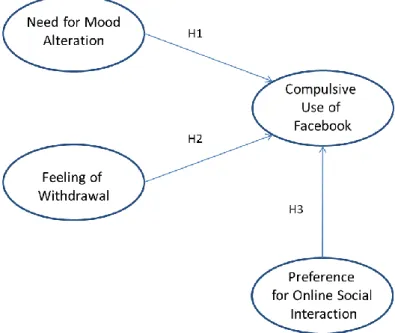
A review of prior literature found that compulsive behaviours occur in various domains, such as gambling, food disorders, buying, and alcoholism, and they share a number of common features. These include physical and/or psychological dependence on the substance or activity, loss of control regarding the behaviour, and negative consequences related to everyday life (Anderson & Brown, 1984; Miller, 1980; Russell, 1979). For example, O'Guinn and Faber (1989) defined compulsive consumption as a response to an uncontrollable drive to obtain, use, or experience a feeling, substance, or activity that leads an individual to repetitively engage in a behaviour and may result in negative consequences. Building on this line of research, we define compulsive use of Facebook as the lack of control of Facebook use and accompanied with feelings of guilt about time spent on Facebook. The compulsive use of Facebook becomes excessive and appears irrational or out of control, even in the person’s own eyes. In addition, the Facebook usage needs only to be excessive relative to the individual’s own prior usage patterns rather than in absolute terms. In this study, we aim at proposing a theoretical model to explain the development of compulsive use of Facebook. Specifically, we adopt the reinforcement mechanism to explore how positive and negative reinforcement motives determine compulsive use of Facebook (See Figure 1).
Figure 1. Research model
3.1
Positive and Negative Reinforcement Motives
Expectancy-based models of learning describe addictive behaviour (e.g., compulsive behaviour) as an interactive product of social learning in a situation involving physiological events as they are interpreted, labelled, and given meaning by the individual (Marlatt et al. 1988). In the initial stage, individuals may acquire their beliefs about the use of Facebook. These early expectancies appear to be powerful predictors of Facebook use (Cheung et al. 2011). The actual usage of Facebook may further reinforce and stabilize these beliefs. For compulsive users, they tend to generate an expectation or anticipation that the use of Facebook will produce specific effects, such as pleasure, mood enhancement, relaxation or relief. The addiction literature further argue that substance dependence is derived from reinforcements in which reward-based learning processes will give rise to compulsive levels of engagement (Brewer & Potenza, 2008). Reward-based learning experiences include both mood enhancement and gratification (positive reinforcement), as well as a relief from discomfort and feeling of withdrawal (negative reinforcement). Both positive and negative reinforcement motives are
found to associate with the likelihood of an individual repeating a particular action (Solomon & Corbit, 1973). Building on the addiction literature, our research model has been developed. Particularly, we expect that both positive and negative reinforcement motives (i.e., need for mood alteration and feeling of withdrawal) will be positively associated with the compulsive use of Facebook.
As suggested by the extant literature on problematic technology using behaviours, need for mood alteration refers to the motivation to use certain technologies for modifying one’s mood (Caplan, 2002). Behaviours that give us feelings of pleasure are more likely to build our motivation to continue the behaviours (Brown, 1997). Some researchers even argued that mood modifier or way of feeling good is one of the major motives for addictive behaviour (Peele, 1985). Greenfield (2010) further argued that positive reinforcement is the most significant factor in contributing to the addictive nature of the Internet and other information technologies. He argued that Internet functions support unpredictable and variable reward structures. For example, when we log onto Facebook, the all-in-one master homepage (“wall”) is a place where people can spend a lot of time to surf and check ones’ social world. The instant texting component allows people to post pictures and videos, play games and quizzes (applications), and follow the every move, decision, feeling, and random thought of everyone in countless networks. The saliency and desirability of the content (posts, pictures, videos), as well as the time and frequency with which that content can be obtained on the wall, all create positive usage experience with Facebook. Positive usage experience derived from Internet uses (e.g., Internet gaming) led to good mood alteration effects (Snodgrass et al., 2012). This positive reinforcement encourages people to use their Facebook compulsively.
H1: Need for mood alteration will be positively associated with compulsive use of Facebook
Feeling of withdrawal involves a heightened state of psychological and physiological arousal and discomfort when separated from the addictive substance or activity (Greenfield, 2010). Denti et al. (2012) found that over 20% of respondents would feel “ill at ease” if they were unable to check their Facebook account for any length of time. Young and Nabuco de Abreu (2010) also found that users become obsessive when they do not receive notifications, such as Facebook alert. In the current study, we expect that the unpleasant feeling that occurs when the use of Facebook is discontinued or suddenly reduced creates negative reinforcement that will increase the probability that users will compulsively use their Facebook.
H2: Feeling of withdrawal will be positively associated with compulsive use of Facebook
3.2
Preference for Online Social Interaction
Caplan (2003) argued that preference for online social interaction (POSI) is a cognitive individual-difference construct. The construct is characterized by the belief that one would feel safer, more efficient, more confident, and more relaxed when pursuing social interaction online instead of via traditional face-to-face social interaction. Facebook provides online spaces where individuals can create a profile and connect it to others’ profiles to construct a personal network. In addition, Facebook offers a set of applications that allow people to share and exchange personal stories, photos, and videos of events with their friends. Caplan (2003, 2010) have already shown that interactivity through online communication and applications can be a major source of problematic Internet use. In this study, we believe that individuals with a higher degree of POSI are more likely to develop the compulsive use of Facebook.
H3: Preference for online social interaction will be positively associated with compulsive use of Facebook
4
Research Method
Facebook (www.facebook.com), one of the most popular social networking sites today, was used in the current investigation to examine compulsive use of SNSs. We believe that Facebook is appropriate for the current study as it surged in global popularity since its introduction. Moreover, its social and
interactive features encourage users to create their own online networks. It is a good example of new generation of social networking sites which is highly interactive and bewitching. In this study, we sent an invitation messages with URL to the online questionnaire to university students through emails and Facebook events. To encourage participation, an incentive of shopping vouchers was offered as lucky draw prizes.
4.1
Measures
The constructs of interest to this study included Compulsive Use of Facebook, Preference for Online Social Interaction, Need for Mood Alteration, and Feeling of Withdrawal. The measures of the constructs in this study were borrowed from previous literature (See Appendix A). All constructs were measured using multi-item perceptual scales. That means each construct was measured by a few items for construct validity and reliability.
4.2
Sample Profile
Participants were recruited from of a university in Hong Kong. We only included current Facebook users as the research subjects as we believe that they have a better understanding of Facebook. A total of 209 useful online questionnaires were collected in this study. Among the 209 respondents, 47 % were male and 53% were female. A majority of the respondents (85%) aged 16-25. Around half (45%) users visited Facebook 2-5 times every day, 22 per cent visited 6-10 times, and 17 per cent of users even visited more than 10 times a day. Eighty-two per cent users spent less than an hour each visit, 13 per cent spent 2-5 hours, and the heaviest group of users (5%) spent over 5 hours per visit. The top three most-frequently activities on Facebook were viewing friends’ statue updates (89%), chatting with friends (48%), and playing applications and games (36%).
5
Data Analysis and Results
Data analysis was performed in a holistic manner using Partial Least Squares (PLS) method. PLS possesses the ability in modeling latent constructs under condition of non-normality and manipulate small to medium size samples well. PLS is also highly compatible in analyzing highly complex predictive models, and provided data for validating and interpreting the measurement model and structural model (Chin, 2005; Chin & Gopal, 1995; Compeau & Higgins, 1995).
5.1
Measurement Model
The convergent validity and discriminant validity of the constructs in our model were examined. Convergent validity indicates the degree to which the items of a scale that are theoretically related are also related in reality. It was examined by the use of composite reliability (CR) and average variance extracted (AVE). The critical values for CR and AVE are at least 0.70 and 0.50 respectively (Fornell & Larcker, 1981). As shown in Table 1, all CR and AVE values fulfilled the recommended levels, with CR ranging from 0.90 to 0.94 and the AVE ranging from 0.76 to 0.84. The results suggested an adequate convergent validity of all measurements.
Discriminant validity is the degree to which the measurement is not a reflection of some other variables. It is indicated by low correlations between the measure of interest and the measure of other constructs (Fornell & Larcker, 1981). Evidence of discriminant validity can be demonstrated when the squared root of the average variance extracted (AVE) for each construct is higher than the correlations between it and all other constructs. As summarized in Table 2, the square root of AVE for each construct was greater than the correlations between them and all other constructs. The results suggested an adequate discriminant validity of all measurements.
Constructs Item Loading t-value Mean Standard Deviation Need for Mood Alteration MA1 0.90 39.79 3.86 1.52 CR = 0.90; AVE = 0.76 MA2 0.91 45.23 4.05 1.54 MA3 0.80 18.81 3.74 1.54
Feeling of Withdrawal WI1 0.90 54.27 3.98 1.66
CR = 0.92; AVE = 0.79 WI2 0.91 60.12 3.13 1.75 WI3 0.87 33.45 3.69 1.82
Preference for Online Social Interaction POSI1 0.87 30.14 3.62 1.57 CR = 0.94; AVE = 0.84 POSI2 0.95 116.53 3.46 1.59 POSI3 0.93 75.13 3.39 1.69
Compulsive Use CU1 0.93 84.92 3.72 1.71
CR = 0.92; AVE = 0.80 CU2 0.94 99.99 3.66 1.75 CU3 0.81 26.40 3.70 1.68
Table 1. Psychometric properties of measures
Notes: CR—Composite Reliability, AVE—Average Variance Extracted.
MA WI POSI CU
Need for Mood Alteration (MA) 0.87
Feeling of Withdrawal (WI) 0.46 0.89
Preference for Online Social Interaction (POSI) 0.61 0.48 0.92
Compulsive Use (CU) 0.39 0.61 0.43 0.89
Table 2. Correlation matrix and psychometric properties of key constructs
Notes: Bolded diagonal elements are the square root of AVE for each construct. Off-diagonal elements are the correlations between constructs.
5.2
Structural Model
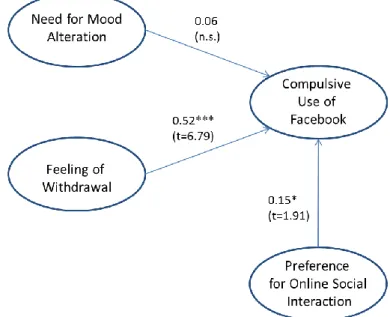
The structural model analysis was assessed based on the test of the hypothesized effects in our research model. Figure 2 shows the results of the hypothesized structural model test, including the variance explained (R2 value) of the dependent variables, estimated path coefficients with significant paths indicated by asterisks, and associated t-values of the paths. Bootstrap resampling procedure was used to perform the significant testing for each path based on our sample (n=209) and a 1000 bootstrap subsamples. An examination of the R2 values demonstrated that the current research model explains a substantial amount of variance in the outcome variables. In our model, it explains 40% of variance in compulsive use of Facebook. Feeling of withdrawal and preference for online social interaction are significant factors determining compulsive use of Facebook, with path coefficients at 0.52 and 0.15 respectively. The result of this study provides support to H2 and H3.
Figure 2. Result of the research model Note: *p<0.10, **p<0.05, ***p<0.01
6
Discussion
The purpose of this study is to advance our theoretical understanding of the development of compulsive use of Facebook. The research model is built on the positive-negative reinforcement mechanism and consists of four major constructs, including compulsive use of Facebook, preference for online social interaction, need for mood alteration, and feeling of withdrawal. In this study, our measurement model is confirmed with adequate convergent validity and discriminant validity of all measures. The structure model explains 40% of the variance. Except the path between need for mood alteration and compulsive use of Facebook, all the hypotheses are statistically supported.
Surprisingly, compulsive Facebook use is only driven by negative reinforcement motive (i.e., feeling of withdrawal), but not positive reinforcement motive (i.e., need for mood alteration). Indeed, the result can be explained in terms of the traditional view of drug addiction. According to opponent process theory, addictive behaviour is performed initially simply to achieve pleasant feeling, and after addiction, to escape unpleasant feeling of withdrawal (Robinson & Berridge, 2003). Thus, when a person is having a problematic use of Facebook, the major driver of his/her compulsive behaviour is related to the avoidance of unpleasant feeling of withdrawal symptoms. We also found that preference for online social interaction plays an important role in determining compulsive use of Facebook. A number of studies indicated that over 30% of Facebook users are more confident about their online personas than they are about their real-life selves (Gaudin, 2012). This group of Facebook users may prefer to use Facebook to interact with others and thus become addictive to this online social platform.
6.1
Implications for Research and Practice
Research on the problematic use of IS/IT remains new and receives little attention from IS researchers (Turel et al., 2011). This study enriches existing IS literature by addressing a previously underexplored issue. Specifically, we proposed a research model of compulsive use of Facebook and explained its development through the positive-negative reinforcement mechanism (i.e., need for mood alteration and feeling of withdrawal). Though only negative reinforcement motive has found important in the current study, we believe that this study adds to the limited research done with the problematic Facebook use, and allows future studies to be based on. In addition, we empirically validated measures that are specific to the problematic use of Facebook.
The results of this study also help raise public and professional awareness of the dark side of Facebook usage. With the rapid development of mobile technologies as well as the seemingly exponential growth of smartphone usage, people can access Facebook anytime and anywhere. When they are not able to use portable devices to access their Facebook for updated information or stalking others’ profiles, they may suffer from the feeling of withdrawal symptoms. The avoidance of this unpleasant feeling becomes the key driver of their compulsive use of Facebook.
6.2
Limitations and Future Research Directions
The reported results support most of the hypotheses, but several limitations in the current investigation deserve our attention. The first limitation is pertinent to student sample used which may limit the contribution of the study. Though university students are believe to be the most frequent groups of social networking sites user, the inclusion of other frequent and heavy users of social networking sites will help enhance the generalizability of the investigation. Future studies should consider conducting a more comprehensive and sophisticated sampling, such as including participants of various ages and occupations, to increase the representativeness of the results.
Second, though the current research model accounts for 40% variance of compulsive use of Facebook, there is still much variance to be accounted for. Psychological well-being problems, such as low self-esteem, loneliness, and depression, are believed to be critical in the development of problematic behaviours. Future investigations may incorporate different psychological well-being variables into their research model to have the phenomenon examined comprehensively.
Last but not the least, research on problematic information technology uses has drawn increasing attention from scholars, but there is still a lack of consistence in operationalizing and measuring the key constructs related to addictive or problematic usage. Scholars may want to devote more effort elucidating the related constructs and developing reliable and valid scales measuring the problematic uses of IS/IT.
Acknowledgement:
The work described in this paper was partially supported by a grant from the Research Grants Council of the Hong Kong Special Administrative Region, China (Project No. CityU 145912).
References
American Psychiatric Association (2013). The Fifth Edition of Diagnostic and Statistical Manual of Mental Disorders (DSM-5). http://www.dsm5.org/Pages/Default.aspx
Anderson, G., & Brown, I. (1984). Real and Laboratory Gambling, Sensation Seeking and Arousal.
British Journal of Psychology, 75, 401-410.
Bhattacherjee, A. (2001). Understanding Information Systems Continuance: An Expectation-Confirmation Model. MIS Quarterly, 25(3), 351-370.
Brewer, J. A., & Potenza, M. N. (2008). The neurobiology and genetics of impulse control disorders: Relationships to drug addictions. Biochemical Pharmacology, 75, 63-75.
Brown, I. (1997). A Theoretical Model of the Behavioural Addictions - Applied to Offending. In J. Hodge, M. McMurran & C. R. Hollin (Eds.), Addicted to crime? (Vol. The Wiley series in offender rehabilitation, pp. 16-63). Chichester: Wiley.
Burton-Jones, A., & Gallivan, M. J. (2007). Toward A Deeper Understanding Of System Usage In Organizations: A Multilevel Perspective. MIS Quarterly 31(4), 657-679.
Caplan, S. E. (2002). Problematic Internet use and psychosocial well-being: development of a theory-based cognitive–behavioral measurement instrument. Computers in Human Behavior, 18, 553-575.
Caplan, S. E. (2003). Preference for online social interaction: A theory of problematic Internet use and psychosocial well-being. Communication Research 30(6), 625-648.
Caplan, S. E. (2010). Theory and measurement of generalized problematic Internet use: A two-step approach. Computers in Human Behavior, 26(5), 1089-1097.
Charlton, J. P., & Danforth, I. D. W. (2007). Distinguishing addiction and high engagement in the context of online game playing. Computers in Human Behavior, 23(3), 1531-1548.
Cheak,C. A., Goh, G.G., & Chin, S. T. (2011). Online Social Networking Addiction among University Students in Malaysia. International Journal on Social Science, Economics and Art, 2(4), 21-27.
Cheung, C. M. K., Chiu, P. Y., & Lee, M. K. O. (2011). Online Social Networks: Why Do We Use Facebook? Computers in Human Behavior, 27(4), 1337-1343.
Chin, W. W. (2005). PLS is to LISREL as Principal Components Analysis is to Common Factor Analysis. Technology Studies, 2, 315-319.
Chin, W. W., & Gopal, A. (1995). Adoption Intention in GSS: Importance of Beliefs. Data Base Advances, 26, 42-64.
Compeau, D. R., & Higgins, C. A. (1995). Application of Social Cognitive Theory to Training for Computer Skills. Information Systems Research, 6, 118-143.
Delmonico, D. L., & Griffin, E. J. (2010). Cybersex Addiction and Compulsivity. In K. S. Young & C. Nabuco de Abreu (Eds.), Internet Addiction: A Handbook and Guide to Evaluation and Treatment (pp. 113-134): John Wiley and Sons.
Denti, L., Barbopuolos, I., Nilsson, I., Holmberg, L., Thulin, M., Wendeblad, M., Andén, L., & Davidsson, E. (2012). Sweden's largest Facebook study (Vol. 3): Gothenburg Research Institute.
Ellison, N., Steinfield, C., & Lampe, C. (2007). The benefits of Facebook "friends": Exploring the relationship between college students' use of online social networks and social capita. Journal of Computer-Mediated Communication, 12(4), 1143–1168.
Facebook. (2012). Newsroom Retrieved November 15, 2012, from http://newsroom.fb.com/Key-Facts
Fornell, C., & Larcker, D. F. (1981). Evaluating structural equation models with unobservable variables and measurement error. Journal of Marketing Research, 18(1), 39-50.
Gaudin, S. (2012). Women say they're increasingly addicted to Facebook. Retrieved from http://www.computerworld.com/s/article/9179100/Women_say_they_re_increasingly_addicte d_to_Facebook
Greenfield, D. (2010). The Addictive Properties of Internet Usage. In K. S. Young & C. N. d. Abreu (Eds.), Internet addiction: a handbook and guide to evaluation and treatment. Hoboken, N.J: John Wiley & Sons.
Griffiths, M. D. (2010). Gambling Addiction on the Internet. In K. S. Young & C. Nabuco de Abreu (Eds.), Internet addiction: a handbook and guide to evaluation and treatment (pp. 91-111). Hoboken, N.J: John Wiley & Sons.
Karaiskos, D., Tzavellas, E., Balta, G., & Paparrigopoulos, T. (2010). P02-232 - Social network addiction : a new clinical disorder? European Psychiatry, 25, Supplement 1(0), 855.
Kuss, D. J., & Griffiths, M. D. (2011). Addiction to social networks on the internet: A literature review of empirical research. International Journal of Environment and
Public Health, 8, 3528-3552.
Kuss, D. J., & Griffiths, M. D. (2012). Social networking on the Internet: From pastime to excess and addiction. Mental Notes, 6(3), 26-28.
LaRose, R. (2010). Uses and Gratifications of Internet Addiction. In K. S. Young & C. Nabuco de Abreu (Eds.), Internet addiction: a handbook and guide to evaluation and treatment (pp. 55-72). Hoboken, N.J: John Wiley & Sons.
Machold, C., Judge, G., Mavrinac, A., Elliott, J., Murphy, A. M., & Roche, E. (2012). Social networking patterns/hazards among teenagers. Irish medical journal, 105(5), 151-152.
Marlatt, G., Baer, J., Donovan, D., & Kivlahan, D. (1988). Addictive behaviors: Etiology and treatment. Annual Review of Psychology, 39, 223-252.
Miller, P. M. (1980). Theoretical and Practical Issues in Substance Abuse Assessment and Treatment. In W. R. Miller (Ed.), The Addictive Behaviors (pp. 265-290). Oxford: Pergamon Press.
O'Guinn, T. C., & Faber, R. J. (1989). Compulsive buying: A phenomenological exploration. Journal of Consumer Research, 16, 147-157.
Peele, S. (1985). The Meaning of Addiction. Compulsive Experience and Its Interpretation. Lexington: Lexington Books.
Pelling, E. L., & White, K. M. (2009). The Theory of Planned Behavior Applied to Young People's Use of Social Networking Web Sites. CyberPsychology & Behavior, 12(6), 755-759.
Robinson, T. E., & Berridge, K. C. (2003). Addiction. Annual Review of Psychology, 54, 25-53. Russell, G. (1979). Bulimia Nervousa: An Ominous Variant of Anorexia Nervousa. Psychological
Medicine, 9, 429-448.
Shapira, N. A., Lessig, M. C., Goldsmith, T. D., Szabo, S. T., Lazoritz, M., Gold, M. S., & Stein, D. J. (2003). Problematic Internet use: proposed classification and diagnostic criteria. Depression and Anxiety, 17, 207-216.
Snodgrass, J. G., Dengah, H. J. F., Lacy, M. G., Fagan, J., Most, D., Blank, M., Howard, L., Kershner, C. R., Krambeer, G., Leavitt-Reynolds, A., Reynolds, A., Vyvial-Larson, J., Whaley, J., & Wintersteen, B. (2012). Restorative magical adventure or warcrack? Motivated MMO play and the pleasures and perils of online experience. Games and Culture: A Journal of Interactive Media, 7(1), 3-28.
Solomon, R., & Corbit, J. (1973). An opponent-process theory of motivation. II. Cigarette addiction.
Journal of Abnormal Psychology, 81(2), 158-171.
Turel, O., & Serenko, A. (2012). The benefits and dangers of enjoyment with social networking websites. European Journal of Information Systems, 21(5), 512-528.
Turel, O., Serenko, A., & Giles, P. (2011). Integrating Technology Addiction and Use: An Empirical Investigation of Online Auction Users. MIS Quarterly, 35(4), 1043-1051.
Venkatesh, V., Morris, M. G., Davis, G. B., & Davis, F. D. (2003). User acceptance of information technology toward a unified view. MIS Quarterly, 27(3), 425-478.
West R. (2001). Editorial: Theories of addiction. Addiction, 96, 3-13.
Widyanto, L., & Griffiths, M. D. (2006). Internet addiction: A critical review. International Journal of Mental Health and Addiction, 4, 31-51.
Wilson, K., Fornasier, S., & White, K. M. (2010). Psychological predictors of young adults' use of social networking sites. Cyberpsychology, Behavior, and Social Networking, 13(2), 173-177. Young, K. S. (1996). Internet addiction: The emergence of a new clinical disorder. Paper presented at
the the 104th annual meeting of the American Psychological Association, Toronto, Canada. Young, K. S. (1998). Internet addiction: The emergence of a new clinical disorder. CyberPsychology
& Behavior, 1, 237-244.
Young, K. S., & Nabuco de Abreu, C. (2010). Closing Thoughts and Future Implications. In K. S. Young & C. Nabuco de Abreu (Eds.), Internet addiction: a handbook and guide to evaluation and treatment. Hoboken, N.J: John Wiley & Sons.
Yu, S.-C., Hsu, W.-H., Yu, M.-N., & Hsu, H.-Y. (2012). Is the use of Social Networking Sites Correlated with Internet Addiction? Facebook Use among Taiwanese College Students.
Appendix A. Measurement Items (Caplan, 2002, 2010)
Constructs Indicators
Need for mood alteration
I have used the Facebook to talk with others when I was feeling isolated. I have gone Facebook to contact others when I was feeling isolated. I have gone Facebook to make myself feel better when I was down or anxious.
Feeling of withdrawal I miss being on Facebook if I can’t get on it.
I am preoccupied with Facebook if I cannot log on for some time. When not on Facebook , I wonder what is happening there.
Preference for Online Social Interaction
I am treated better in my Facebook relationships than in my face-to-face relationships.
I am more confident socializing in Facebook than I am offline. I feel safer relating to people in Facebook rather than face-to-face.
Compulsive Use I want to, or have made unsuccessful efforts to, cut down or control my use of Facebook.
I have attempted to spend less time in Facebook but have not been able to. I feel guilty about the amount of time I spend on Facebook.