Proceedings of DiGRA 2011 Conference: Think Design Play.
Designing the Designer
Robin Potanin, MA
NHTV University of Applied Sciences Breda, Netherlands
+31 6 31 50 73 84 [email protected]
Oliver Davies, MA
NHTV University of Applied Sciences Breda, Netherlands
+31 6 10 43 23 11 [email protected] ABSTRACT
This paper examines the selection criteria for design roles in the videogame industry and examines the profiles of students undertaking game design studies at NHTV in the expectation of working in the industry. A total of four analyses were conducted: job advertisements for design and production roles; an industry survey; MBTI profiling of a cross-section of IGAD students; and a survey of Design and Production students.
In 2010 NHTV University of Applied Sciences initiated the Design and Production (D&P) specialization within its existing International Game Architecture Design (IGAD) bachelor degree. In preparing the specialization the authors analyzed a range of job advertisements for design and production staff in the videogame development industry and profiled its first intake of students according to gender, age, personality (Myers-Brigg (MBTI), Brainhex) and play preferences. Which students were successful in their first year of game studies? How did they compare to programmers and artists?
In recent years, design positions in the game industry have increased in direct correlation with the focus on producing sequel titles/levels in established franchises. These titles require more design staff, namely game designers, level designers and narrative designers. The need to critically examine the role and personality of a designer in the game industry is vital to replicating them on a scale that surpasses previous production pipelines where one game designer envisioned the game on a macro level and a handful of level designers implemented gameplay on a micro level.
NHTV initiated this first stage of research to gain insight into what the videogame industry needs in terms of design and production skills and personnel and what NHTV, in terms of students and curriculum, is providing. Ultimately the authors hope their research will innovate the game design production pipeline.
Keywords
INTRODUCTION
In 2010, NHTV University of Applied Sciences initiated the Design and Production (D&P) specialization within its existing International Game Architecture and Design (IGAD) bachelor degree. Prior to this time, the degree offered two specializations: Programming and Visual Arts. In proposing the new specialization, the authors analyzed a range of job advertisements for design and production staff in the videogame development industry and game studios were surveyed for their opinion on what skills and knowledge designers and producers needed in order to be successful. A summary of these results is described in this paper.
Since 2008, a proportion of IGAD Programming and Art students have voluntarily undergone personality profiling. These students took the Myers-Briggs Type Indicator (MBTI) online self-assessment test and submitted their MBTI results to their lecturer, Oliver Davies. These results were used as a means to explore class material on demographic design and with a view to their potential future use, in amalgamated form, within a research project. Following the implementation of the new D&P specialization in 2010, approximately one-third of the D&P students voluntarily took the online MBTI self-assessment test and submitted their results to their lecturer, Robin Potanin. As all three curriculum variations of the degree shared subjects in Ludology, the authors compared the grades of the profiled students across the three specializations. The results of this comparative analysis are described in this paper.
The D&P students also anonymously completed a survey detailing their play preferences and underwent additional profiling related to gameplay (Brainhex). While this survey is statistically less reliable than the MBTI comparative analysis, it does provide useful insight into entry-level designers and producers and will provide a base for subsequent surveys as the students progress in their degree. Initial impressions from this survey are presented in this paper.
The authors hope that, in combination, the survey and profiling results will start to paint a picture of a game designer in the expectation that certain traits and skills can be replicated and enhanced. This could have a potential impact on selection procedures not only for the IGAD degree but also for game industry recruitment. The D&P curriculum was initially designed with the industry survey in mind and it will continue to be adapted as this research continues. Further research will also examine the suitability of certain profiles for different stages of game production using Gamelab, a simulated studio environment, as a testbed.
INDUSTRY OVERVIEW
Recently, the game development industry reflects an increase in design and production roles. As videogames become more complex and launch successful franchises the percentage of design and production staff has risen to cope with expanding game content. Call of Duty: Modern Warfare 2 (Activision 2009), the sixth title in a topselling game franchise, employed 30 design and production staff, 30 artists and 17 programmers. Between 2008 and 2010 almost one-third of advertised employment listings in the game industry were in design and production. This trend will continue as the demand for
content within games escalates and the propensity to expand game franchises continues to be profitable.
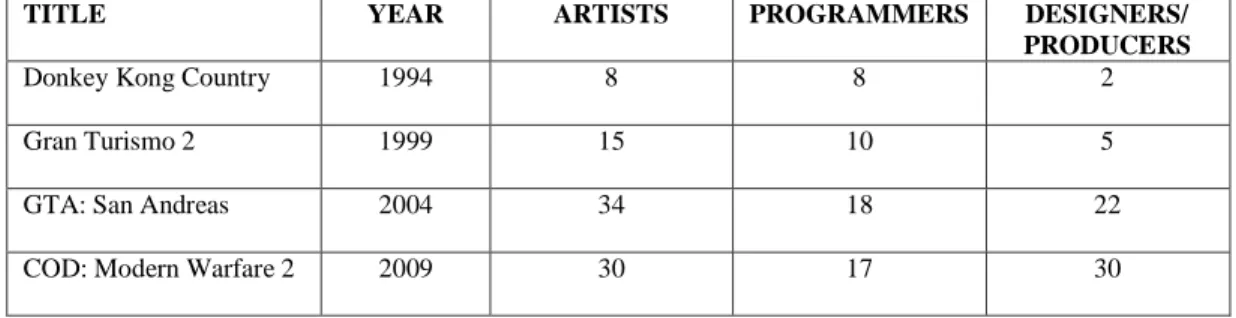
The following table illustrates the number of programming, art and design/production staff on some of the best-selling games of the last fifteen years:
Table 1: Staff breakdown on top-selling game titles
TITLE YEAR ARTISTS PROGRAMMERS DESIGNERS/
PRODUCERS
Donkey Kong Country 1994 8 8 2
Gran Turismo 2 1999 15 10 5
GTA: San Andreas 2004 34 18 22
COD: Modern Warfare 2 2009 30 17 30
As can be seen; the ratio of designers/producers has risen from 11.1% of staff on Donkey Kong Country to 16.7% on Gran Turismo 2 five years later. By 2004, on GTA: San Andreas, this ratio had risen to 29.7% and by 2009, on COD: Modern Warfare 2, this ratio was 38.9%. The latter two titles continue to be profitable game franchises.
In the proposal to launch a Design and Production specialization for the IGAD degree, Oliver Davies took two separate snapshots of the game industry labour market, the first in October 2008 and the second in November 2009, using four game industry websites1. The worldwide economic climate is likely responsible for the overall decline that can be seen in employment listings. The tables below represent the findings.
Table 2: October 2008 Game Industry Job Listings
AREA NUMBER PERCENTAGE
Programming 940 43.6%
Art 605 28.1%
Design and Production 610 28.3%
Table 3: November 2009 Game Industry Job Listings
AREA NUMBER PERCENTAGE
Programming 421 46.6%
Art 266 29.5%
Design and Production 216 24.9%
The advertised design and production positions covered various roles: assistant producer, producer, game designer and level designer. Further analysis was carried out to determine the percentage of available jobs that were suitable for graduates without previous game industry experience. It was determined that 19.2% of production vacancies (17 jobs, November 2009) and 18.4% of game design vacancies (23 jobs, November 2009) would accept applications from graduates.
An analysis of more than two hundred game design and production jobs produced the following amalgamation of skill requirements.
1
Technical Skills
Basic level of proficiency with 3D modelling software Knowledge of scripting languages and/or C/C++
Good knowledge of 3D software, engines and associated tools. Familiarity with hardware platforms
Design Skills
Conceptualise, create and maintain design documentation Gameplay balancing
Game narrative and interactive structures Level and gameplay design – 2D and 3D
Additional Skills
Excellent written English skills Presentation skills
Project Management skills Leadership skills
Good interpersonal skills Quality assurance
As an additional method to better understand the demands and requirements of the game industry, NHTV commissioned the creation of a survey. This was sent out electronically to a number of high profile game studios representing a broad spectrum of company sizes and development platforms.2
Game developers were asked 21 questions relating to the structure of their company regarding design and production staff and hiring preferences. The majority of game developers wished to hire design and production graduates who have:
A broad range of skills, as opposed to being specialised in one area A good understanding of a broad range of game genres
Experience in using industry-standard software packages Experience of working in multi-disciplinary teams
A high standard of writing skills and experience in creating and maintaining documentation
Well developed presentation skills
Familiarity with both current games/trends and the history of videogames The ability to create and integrate narrative within a game
2D and 3D level design skills
The ability to work with scripting languages The ability to prototype
The ability to build levels and environments Good drawing skills
Experience in creating and maintaining project schedules
2
As both the job description analysis and industry survey supported each other, the skills and knowledge specified were integrated into NHTV’s D&P curriculum design. The figure below provides a snapshot of the D&P curriculum.
Ironically, the trend towards increased design and production staff on game titles has coincided with another trend: design replication has predominated over design innovation. Licensed titles have proven so popular that ports3 and sequels have outweighed original videogame titles published on console hardware. Paul Callaghan’s (2009) study of games developed by Melbourne studios in Australia between 2000 and 2009 show 100% original titles were developed in the earlier years, while ports and licensed titles accounted for over two-third of development in the latter years. More content is required for this trend in terms of level art and level design but the gameplay tends to be the same across a license’s titles. As a result, many of our game students have grown up playing licensed titles. Their exposure to original titles is minimal in comparison to that of developers ten years ago. In the first week of their degree, D&P students were asked about their experience with two games: Call of Duty a first-person shooter which is a successful franchise across various platforms and Flower, an experimental title developed in 2009 and available on the PlayStation Network as a downloadable game. 100% of the D&P students had played or had heard of Call of Duty. None had played or knew about Flower. This gap in game experience is rectified in the first year across a range of IGAD courses.
Another trend that has dominated the industry in the past decade has been the predominance of male developers over female developers. IGDA’s 2005 demographic survey revealed almost 90% of game developers were male. In a separate report, Lizzie Haines (2004) concluded that females were least represented in the roles of programming, audio and design (about 10%). It is unsurprising that there were no females identified in
3
Ports refer to multi-platform titles. For example, a game may be released on the console PlayStation 3 and ported to PSP, a portable hand-held platform.
Figure 1 D&P Curriculum Summary GL = Gamelab
Gamasutra’s top 50 game developers for 2010.4
This trend is reflected in NHTV’s IGAD student body. Specifically in the Design and Production specialization, three of the 29 students who started the program were female. It is interesting to note that one of the female design students won the Experimental Game Design slot for Gamelab, a studio simulated development environment.5 All the D&P students participated in a design challenge based on the autobiographical theme of GDC’s 2010 Design Challenge. That year two female US game designers won the challenge at the game developers conference. Heather Kelley and Erin Robinson’s game design was a series of mini-games based on losing one’s virginity. NHTV’s Petra de Pinho’s game addresses the diminishing physical functioning of the player character.
Is it a coincidence that females predominated in experimental game design in both these instances? Demographic and personality types within the industry may influence the type of games being produced. Stuart Hall in his encoding/decoding theory of media production and reception believed encoding a media message occurs during its production and that the production itself shapes the audience’s reading of that message. Ideologies arise from practices of production and become entrenched in the workplace. Profiling developers can give us insight into the production environment of games. NHTV is uniquely placed in its accessibility to both industry and its student body of game developers. This paper documents NHTV’s initial student profile findings.
IGAD STUDENT COMPARATIVE PERSONALITY PROFILE ANALYSIS
A total of 135 IGAD students (122 male, 13 female) voluntarily participated in self-assessed Myers-Briggs profiling from 2008 to 2011:
78 Artists (57.8%) 46 Programmers (34.1%) 11 Designers/Producers (8.1%)
The small number of design and production students reflects the time the D&P program had been active during the analysis (one year) in relation to the Visual Arts and Programming variations (five years) and the fact that the D&P program is restricted to a much smaller intake – 30 designers/producers as opposed to 90 artists in the first year, for example.
Students were asked to complete the Myers-Briggs online test6 and report their MBTI profile to the authors. In the case of the D&P students, the entire class (28 students) was asked to do this in an anonymous survey described later in this paper. Those students who wished to participate in this comparative analysis were asked to supply their results revealing their identities. The authors chose the Myers-Briggs test over more
4‘The Game Developer 50’
http://www.gamasutra.com/view/feature/4323/the_game_developer_50.php 5
Gamelab is integrated in the IGAD curricula. Artists, programmers and designers work in teams to make a game in 14 days. Students spend one day a week in Gamelab.
6
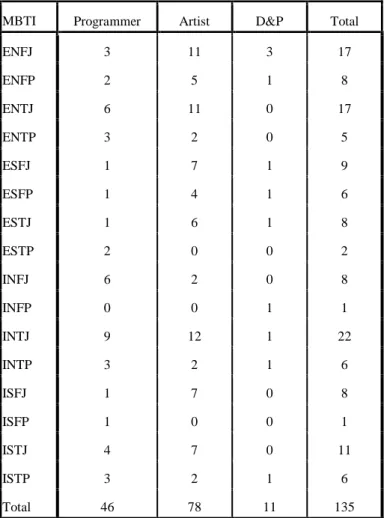
scientifically rigorous profiling tests based on the Five Factor model (such as NEO-IPIP) because of the ease with which the students could participate in the profiling system and receive instant feedback on their results. Additionally, the tests were initially envisaged to give students insight into their own personalities with regards to teamwork and player audiences in the general population. The authors compared the results in 2011. The reasoning being that if a trend could be identified, more statistically rigorous research would be engaged. The following table shows the MBTI profiles for the various students across the three IGAD programs.
Table 4: IGAD MBTI Cross-tabulation
MBTI Programmer Artist D&P Total
ENFJ 3 11 3 17 ENFP 2 5 1 8 ENTJ 6 11 0 17 ENTP 3 2 0 5 ESFJ 1 7 1 9 ESFP 1 4 1 6 ESTJ 1 6 1 8 ESTP 2 0 0 2 INFJ 6 2 0 8 INFP 0 0 1 1 INTJ 9 12 1 22 INTP 3 2 1 6 ISFJ 1 7 0 8 ISFP 1 0 0 1 ISTJ 4 7 0 11 ISTP 3 2 1 6 Total 46 78 11 135
The Myers-Briggs test is derived from Carl Jung’s theory of psychological type and the online version used in the analysis asks 72 yes/no questions. There are four dichotomies within MBTI: Extroversion/Introversion; Sensing/Intuition; Thinking/Feeling; Judging/Perceiving. There are 16 different possible combinations that can be used to label the different personality types. According to MBTI publisher website (www.cpp.com), Extraversion (E) and Introversion (I) differentiates between people who direct their energy outward towards other people and events as opposed to those who focus inwards towards their own thoughts and experiences. Sensing (S) people use the five senses to take in information and are interested in immediate experiences. Intuition (N) relies on hunches and impressions. Such people are more interested in future possibilities. Thinking (T) people make decisions primarily based on logic and objectivity while feeling (F) people rely on personal values and the effects their decisions will have on
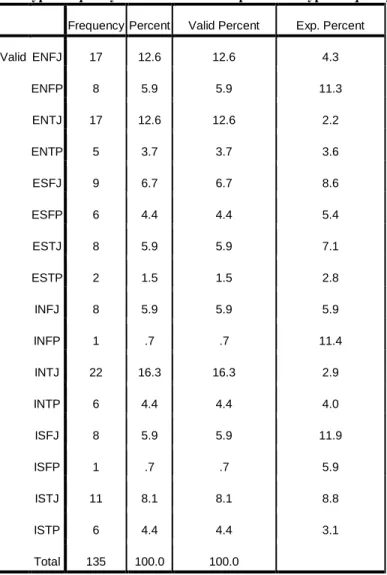
others. Judging (J) people prefer structure, plans, and achieving closure quickly. Perceiving (P) people are flexible, spontaneous, and like to keep their options open. By evaluating the data against random sample data gathered in a large scale MBTI online survey involving over 6,000 participants (BSM Consulting Inc., 2010), it is possible to see that, in the data derived from IGAD students, there are some considerable deviations from what we would anticipate seeing within a random sample. The following table shows the frequencies of the 16 personality types within IGAD against an ‘expected percentage’ as witnessed with BSM Consulting’s large scale online testing:
Table 5: IGAD MBTI Type Frequency versus Random Sample MBTI Type Frequency
Frequency Percent Valid Percent Exp. Percent
Valid ENFJ 17 12.6 12.6 4.3 ENFP 8 5.9 5.9 11.3 ENTJ 17 12.6 12.6 2.2 ENTP 5 3.7 3.7 3.6 ESFJ 9 6.7 6.7 8.6 ESFP 6 4.4 4.4 5.4 ESTJ 8 5.9 5.9 7.1 ESTP 2 1.5 1.5 2.8 INFJ 8 5.9 5.9 5.9 INFP 1 .7 .7 11.4 INTJ 22 16.3 16.3 2.9 INTP 6 4.4 4.4 4.0 ISFJ 8 5.9 5.9 11.9 ISFP 1 .7 .7 5.9 ISTJ 11 8.1 8.1 8.8 ISTP 6 4.4 4.4 3.1 Total 135 100.0 100.0
Of particular interest within the data seen in Table 5, are the large deviations from the expected norm with regard to the most frequently occurring MBTI types. Within a random sample, the four highest frequency types (ISFJ, INFP, ENFP and ISTJ) account for 43.4% of all respondents; within the IGAD survey, these four types accounted for only 20.6% of all respondents. In comparison, the four most frequently occurring types seen within the IGAD survey (INTJ, ENTJ, ENFJ and ISTJ), which account for 49.6% of all respondents, were far less common within the random sample, where they accounted for only 18.2% of all respondents. These discrepancies seem worthy of further
investigation, particular with regard to the potential differences between game developers and game consumers.
Considering the constituent dichotomies in more detail; with regards to Extroversion and Introversion, a bias towards Extroversion was noted in the IGAD survey with 53.3% of the respondents reporting an Extroversion tendency, versus 46.7% of respondents reporting an Introversion tendency. In comparison, the larger scale survey conducted by BSM reported a bias towards Introversion, with the split being 45.3% Extroversion, versus 54.7% Introversion. The results within this category differed considerably between the three degree variations; Programming students were more likely to be introverted (43.9% Extroversion, 56.1% Introversion), Visual Art students were more likely to be extroverted (56.6% Extroversion, 43.4% Introversion) while the Design and Production students reported the highest frequencies of the Extroversion tendency (63.6% Extroversion, 36.4% Introversion).
With regard to Sensing and Intuition, a bias towards Intuition was observed within the results of the IGAD survey, with 62.2% of the respondents reporting an Intuition tendency over 37.8% reporting a Sensing tendency. This, again, contrasts with the results of the BSM survey in which 45.6% of the respondents reported an Intuition tendency versus 54.4% reporting a Sensing tendency. There were only minimal differences noted between course variations within this dichotomy; with Intuition varying between 60.2% (Visual Art students) and 65.9% (Programming students).
With regard to Thinking and Feeling, a bias towards Thinking was noted in the IGAD survey with 57% of the respondents reporting a Thinking tendency and 43% reporting a Feeling tendency. This compares with an anticipated split of 43.1% Thinking and 56.9% Feeling, as predicted by the random sample data. A marked difference between course variations was observed within this dichotomy; while Programming students were heavily biased towards the Thinking tendency (75.6% Thinking, 24.4% Feeling), there was a significant bias in the opposite direction observed within the responses of D&P students (36.4% Thinking, 63.6% Feeling).
With regard to Perceiving and Judging, a significant bias towards Judging was noted in the IGAD survey, with 74.1% of respondents reporting a Judging tendency versus 25.9% of respondents who reported a Perceiving tendency. This marks a reasonably considerable difference from the results derived from the random sample, in which 51.7% of respondents reported a Judging tendency and 48.3% reported a Perceiving tendency. Again, significant differences were noted between degree variations; Visual Arts student were heavily biased towards Judging (81.9% Judging, 18.1% Perceiving) while D&P students, while still Judging biased, came closer to the random sample data (54.6% Judging, 45.4% Perceiving).
As previously noted, in our sample, ENFJs, ENTJs, ISTJs and INTJs dominate. ENFJs are persuasive, inspiring and motivational. ENTJs are natural leaders who focus on efficiency and effectiveness. ISTJs are very practical detail-oriented people. Our largest representative personality type, INTJs, are known as ‘Masterminds’ and are oriented to planning and improvement. These personality types, while common with the IGAD student population are far less common within the random sample data gathered by BSM. Let us explore the predominant personality type in our sample, the INTJ. According to Chris Bateman, the INTJ is one of the best personality types for designing games. His is an anecdotally-based hypothesis; however, it is interesting note the correlation between Bateman’s initial investigation seven years ago and our current findings. Masterminds have a strong desire for autonomy, anarchistic political beliefs and desire to be a master in their workplaces. One can only imagine the type of production environment INTJs would manifest when required to work with each other.
Unfortunately, the INTJ accounts for only one of the Design and Production students in our sample. It will be difficult to monitor this student’s performance as a designer in the Gamelab production environment in any statistically significant way. The authors will, however, continue to profile its D&P students in upcoming years and, through the use of cross-year data, it is anticipated that a more useful sample size will be obtained, allowing the more detailed consideration of how INTJ designers perform.
As explained earlier, the authors’ intention was to consider the relationship, if any, between personality types and performance within the Ludology 1 (LU1) and Ludology 2 (LU2) courses. The following table illustrates the mean LU1 scores of each MBTI type:
I am the INTJ. I am the INTJ! Figure 2 Competing personality types on the game production floor
Table 6: IGAD MBTI Type LU1 Means
MBTI Mean N Std. Deviation
ENFJ 6.9412 17 1.19742 ENFP 7.3750 8 1.76777 ENTJ 6.9412 17 1.19742 ENTP 6.8000 5 1.64317 ESFJ 7.1111 9 1.05409 ESFP 6.8333 6 .98319 ESTJ 5.8750 8 2.69590 ESTP 7.0000 2 1.41421 INFJ 7.3750 8 1.92261 INFP 8.0000 1 . INTJ 6.2273 22 1.74388 INTP 6.1667 6 2.40139 ISFJ 7.6250 8 1.59799 ISFP 8.0000 1 . ISTJ 7.3636 11 .92442 ISTP 6.6667 6 1.96638 Total 6.8593 135 1.60300
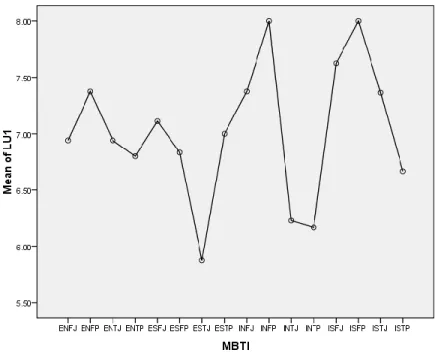
The lowest scoring MBTI type was the ESTJ (mean score of 5.88), while the highest scoring MBTI types were ISFP and INFJ (mean score of 8.00), however both of this types featured only a single respondent. The highest score for a group with multiple respondents was ISFJ (mean score of 7.63). This compares with an overall mean score of 6.86 across all MBTI types.
While Chris Bateman (2005) hypothesized that INTJs would make the best designers, the INTJ respondents were among the worst performers in LU1, which introduces students to game theory and basic game design methodologies and sets students the assignment of designing and prototyping a board game with specific constraints. The INTJ mean score of 6.23 was below the mean score of 6.86. The following figures show our sample’s grades for LU1 and LU2. While there are some interesting trends, there were no results in this preliminary research that were statistically significant (p=0.05), based upon an analysis of the types’ performances, as determined by one-way ANOVA.
Table 7: LU1 means by MBTI type
There was no statistically significant difference between groups as determined by one-way ANOVA (F(15,119) = 0.893, p = .573).
Table 8: LU2 means by MBTI type
There was no statistically significant difference between groups as determined by one-way ANOVA (F(15,119) = 0.938, p = .524).
Comparing the performance in LU1 and LU2 on a degree variation basis shows that the Design and Production students in our sample performed poorly in Ludology compared
to the Visual Art students and the Programming students. The following graphs illustrate the means of LU1 and LU2 performance based upon degree variation. There was a statistically significant difference between LU1 degree variation performances as determined by one-way ANOVA (F(2,132) = 4.347, p = .011). A Tukey post-hoc test revealed that LU1 grade was statistically significantly lower for D&P students (p = 0.037).
Table 9: LU1 means by Course Variation type
There are number of possible explanations for the discrepancies between degree variations. Firstly, while the Ludology lectures and reading material were the same for all
Table 10: LU2 means by Course Variation type
three degree variations, the assessment process differed slightly, with D&P students completing an additional assignment which could go some way to accounting for the disparity. Secondly, the Visual Art and Programing students were allowed to work in pairs whereas the D&P students were required to submit their work individually. Thirdly, in the Ludology courses, designers and producers are assessed at a higher level than Visual Artists and Programmers due to the fact that D&P students were awarded an additional study credit for the subject; the D&P students were also expected to devote one-third more time to the Ludology subjects than the Visual Art and Programming students. Finally, the analysis of Ludology results is derived from four academic years of study; with the only results from the 2010-2011 academic year available within the survey being those for D&P students; thus it is not possible to measure their performance against the mean of LU1 and LU2 results for their year, which would give a fairer reflection of their performance as related to their peers. Unfortunately, the authors will be unable to run this particular comparative analysis again. As of 2011, Ludology assessment will be the same across all IGAD variations. However, the Ludology subjects are not expected to be taught to the Visual Art students unless they request it.
Our evaluation of the comparative analysis was that it was statistically inconclusive. The sampling size, particularly for the D&P students, was too small. In theory comparing the grades for the same Ludology subjects offered over three years seemed a viable approach. In practice, the Ludology subjects were assessed too differently across the groups to be comparable. A prospective industry employer who compared the Ludology grades between students from the three disciplines would understandably be concerned that designers scored lower than artists in game theory and design. Fortunately, this disparity has been rectified in future curricula for IGAD. For the purposes of this paper, however, the comparative approach was flawed and the results were disappointing.
Bateman’s hypothesis that INTJs make good designers was not substantiated by our results vis a vis game theory and design. However, the authors hope to continue and expand their analysis of player personality and design aptitude in future research investigating Gamelab performance and overall student performance in the D&P program.
DESIGN AND PRODUCTION STUDENT SURVEY
At the beginning of the 2010 academic year, 29 Design and Production students were surveyed about their play preferences, age, gender, ethnicity and personality type. The surveys were submitted anonymously. No students were identified, although in the case of the female students, it was obvious from the survey information who each of the three were. For this reason, the authors cannot release detailed results of the survey.
We can, however, summarise the data collected insofar as they do not relate to any obvious identifiers. This summary is at the very least amusing, if not strictly scholarly. For example, a majority of the students identified their race as alternatively ‘Dutch’, ‘white’, Caucasian or interesting combinations of these, rendering this aspect of the survey statistically invalid.
The D&P students were more confident about their age. In this sample, 13 students were under the age of 20 and 16 students were between 20-28 years of age. This was a mature group. In fact, many had been gainfully employed before starting their degree. In several
cases IGAD was their second degree. This indicated to us, their lecturers, the students’ level of commitment to the program.
Without exception, everyone in the sample said they played games; this was unsurprising as the intake procedure for the program screened for this trait. According to Mia Consalvo, a passion for playing games is a common pre-requisite in the games development industry.
Role-Playing (including massively multiplayer) and Shooter (1st and 3rd person) game genres featured highly in the sample’s game preferences, not only for that year but for the students’ entire game-playing history. Only seven students DID NOT include one of these two popular game genres in their all-time game favourites. Of these seven, three were playing either a shooter or role-playing game at the time of the survey. The remaining four people in our sample preferred strategy and action games. Interestingly, few in our sample cited platform games in their play preferences, yet the platform genre is the most often attempted in 1st and 2nd year Gamelab, possibly because platformers are easy to create and complete within the 14-day development period of Gamelab.
Popular shooter titles listed in the survey results were licensed franchises and/or sequel titles: Bioshock 2 Quake 3, 4 Battlefield 2 Counter-Strike Half-Life 2, Saga Left 4 Dead
Halo 2, 3 and Halo Reach Call of Duty: Modern Warfare 2 Team Fortress Classic, 2
Gears of War 2 Bioshock 2
Popular roleplaying titles listed in the survey results included the following: Pokemon Silver, Gold
Persona 3, 4 Final Fantasy 7 Word of Warcraft Kingdom Hearts 1, 2 Dragon Age: Origins League of Legends Guild Wars
Red Dead Redemption Diablo 2
Mass Effect 1, 2 Fable 2
World of Warcraft (Blizzard 2004) was the most frequently cited title in the play preference category. This popular MMORPG has been expanded twice since its online launch: once in 2008 and again in 2010.
Overwhelmingly, 25 out of the 29 respondents said they played games with other people online as well as in the same room. Three said they played online with other people but not in the same room. One person did not play online but played with other people in the same room.
The MBTI personality results of the survey indicated roughly half of the D&P students surveyed showed a tendency towards Introversion and half towards Extroversion. INTJs dominated the former group and ENFJs the latter, neither to any statistical significance. More D&P students in successive yearly intakes will need to be surveyed to achieve statistically valid results.
Chris Bateman developed an online player preference test called Brainhex.7 He categorizes seven player types:
Seeker Survivor Daredevil Mastermind Conqueror Socializer Achiever
The D&P students completed the Brainhex questionnaire and reported their results in the survey. Twelve of the Extroverted personality types reported they were classified as Conquerors and nine of the Introverted personality types reported the same. Brainhex is not regarded as a scholarly rigorous test, yet the predominant ‘conqueror’ classification warrants further investigation. According to Bateman’s website8
Conquerors display an overwhelming desire to beat other players and defeat difficult foes. Is it coincidence that D&P’s first intake of students are highly competitive game players and that all prefer to play with other players online and/or in the same room?
Twenty-nine survey results are not enough to draw any statistically significant conclusions. The authors hope, however, that statistically significant trends will be identified in the Design and Production group in ongoing years.
7
http://survey.ihobo.com/BrainHex/ 8
CONCLUSION
NHTV is a University of Applied Science in the Netherlands. As such its education is focussed on professional training and industry-relevant research. This is exemplified in the imbedding of Gamelab in the IGAD curriculum and IGAD’s contribution to RAAK-funded projects such as Biometric Design of Casual Games. The IGAD degree is the most popular program of its kind in the Netherlands and is unique in continental Europe. In initiating the industry survey, the job advertisement analysis, the comparative personality analysis and the D&P student survey, the authors achieved snapshots of the videogame industry and IGAD’s student body. While our interest is mainly in game design and what aspects of production affect it, there is no reason why this snapshot process cannot be applied to other roles in videogame development and education. NHTV hopes to continue its research to achieve a more comprehensive overview of its IGAD student demographic and corresponding industry demographic.
Our initial student survey research implied there is a correlation between personality type and game genre preference. ‘Conqueror’ types corresponded with a preference for Shooters and RPGs (including MMORPGs). The genre preference could be a result of more of these titles being available in the market or it could indicate these titles appeal to a competitive mind-set and personality type that is motivated to enter games development.
The next stage of our research is to adopt a more rigorous approach to personality analysis and comparison, possibly with the adoption of a Five Factor model and a short-form method that enabled gathering of ordinal, rather than nominal, data in this area. We wish to take a wider sampling across IGAD’s student body and profile the teaching staff, most of whom have worked in game development. Our industry survey indicated the knowledge and skills that development studios find desirable in their design and production staff. We will take our industry investigations one step further and profile individuals in their roles within development teams. This should provide a wider base to observe relationships between personality and performance.
Potanin (2010) and Taylor (2006) have observed the ‘I’ methodology in practice in game development. Developers make the games they like to play. These games appeal to players who are most like the developers. These players become developers and perpetuate a closed loop of production. The production practices and ideologies they perpetuate become entrenched in the videogame industry. Already we have observed that gender representation in IGAD’s student body mirrors that of industry. The ‘I’ methodology of videogame production would appear to affect education as well.
The predominant personality types that represented half of our IGAD sample – ENFJs, ENTJs, ISTJs and INTJs – represent less than 20% of the ‘normal’ population. Are game developers missing out on a lucrative 80% of potential players simply because they are making games for their own personality types?
The underlying ethical question regarding our research is that it could be used to reinforce developer/player stereotypes and sustain dominant game genres/licenses OR it could be used to break stereotypes, diversify developers/players and innovate titles in the game industry. NHTV could use this research to profile its game students before accepting them in a variation of the IGAD program. Not only could this improve the students’ chances of success in the program, it may also enhance their employability. Atypical
personality types could be injected into the industry to make it more representative of the general population. Game development studios could use the information gained from our research to better match developers to genres and/or stages of production to improve a title’s completion rate and/or assure its quality.
ACKNOWLEDGMENT
The authors which to thank the following for their help and support of our initial research:
Stefano Gualeni Hans Bouwknegt IGAD students BIBLIOGRAPHY
Bateman, C. 2005. ‘A model of game designers’ in Only a Game blog
(http://onlyagame.typepad.com/only_a_game/2005/09/a_mod el_of_game.html) BSM Consulting 2010 www.personalitypage.com/html/demographics.html
Callaghan, P. 2009. 'The state of things'. Presentation at Melbourne IGDA chapter 'Reboot' Meeting. (11 November 2009). http://www.paulcallaghan.net/2009/11/the -state-of-things/
Consalvo, M. 2008. ‘Crunched by Passion: Women Game Developers and Workplace Challenges’. Beyond Barbie and Mortal Kombat. Y. Kafai, J. Denner and J. Sun, Ed. MIT Press. Cambridge. MA.
Davies, O., S. Gualeni and R. Potanin 2010. Design and Production: A learning track proposal for International Game Architecture and Design NHTV.
Game Developer. 2008. Game Career Guide Fall 2008. United Business Media. CA. Game Developer. 2009. Game Career Guide Fall 2009. United Business Media. CA. Haines, L. 2004. ‘Why are there so few women working in games?’. MTNW. http://www.igda.org/women/MTNW_Women-in-Games_Sep04.pdf
Hall, S. 1993. ‘Encoding/decoding’. Cultural Studies Reader. S. During, Ed. Routledge. London. 90-103. http://www9.georgetown.edu/faculty/irvinem/theory/SH-Encoding-Decoding.pdf
IGDA. 2005. Game Developer Demographics: An exploration of Workforce Diversity. (October 2005). International Game Developers Association.
Potanin, R. 2010. ‘Forces in Play: The Business and Culture of Videogame Production’ Fun and Games Conference Proceedings Leuvan, Belgium.
Taylor, T.L. 2006. Play Between Worlds: Exploring online game culture. MIT Press. Cambridge. MA.