Thesis 279
Intermodal Airport Access:
A Multiple Case Study Research of a Future Travel Center at
Malmö Airport with Railway Connection
Adam Lunderup
Trafik och Väg
Institutionen för Teknik och Samhälle Lunds Tekniska Högskola
Copyright © Adam Lunderup
LTH, Institutionen för Teknik och samhälle CODEN: LUTVDG/(TVTT-5245)/1-112/2015 ISSN 1653-1922
Tryckt i Sverige av Media-Tryck, Lunds universitet Lund 2015
Preface
This Master thesis has been conducted during the spring of 2015 in collaboration with Swedavia, Malmö Airport. This marks the end of my education and has been my final assignment in Master of Science in Civil Engineering, Faculty of Engineering, at Lund University.Since I came in contact with Swedavia and Malmö Airport, my experience has been highly educational, valuable and unique. I’ve had the opportunity to attend
workshops about airport access, visited various airports within Swedavia and got to know Malmö Airport. I would like express my thanks and gratitude to my supervisors Cecilia Hagert and Henrik Ivre at Swedavia for their guidance, support and feedback throughout my thesis. Further, I would like to thank my supervisor from Faculty of Engineering, at Lund University, Andreas Persson for his continuous feedback and bouncing ideas. I would also like to thank the case study airports, companies and people interviewed.
Finally, a big thank you to all my friends and family who has been a great support throughout my education.
Lund, May 29th 2015
Adam Lunderup
Trafik och väg
Institutionen för Teknik och samhälle Lunds Tekniska Högskola, LTH Lunds Universitet
Box 118, 221 00 LUND
Transport and Roads
Department of Technology and Society Faculty of Engineering, LTH
Lund University
Abstract
Title: Intermodal Airport Access: A multiple case study research on a future travel center at Malmö Airport with a rail connection.
Author: Adam Lunderup
Supervisors: Andreas Persson, Faculty of Engineering, Lund University
Cecilia Hagert, Swedavia AB Henrik Ivre, Swedavia AB
Background: Malmö Airport is inadequate in providing sufficient airport access and struggles with the adjacent and more accessible Copenhagen Airport. Since 1999 there has been ongoing investigations about improving the access at Malmö Airport, which up until today is a work in progress. Malmö Airport has been visited by more than 2.1 million passengers in the year of 2014 and the number of passengers is growing in both domestic and international flights. Since The Öresund-region is known to be a climate-smart and sustainable region, Malmö Airport emphasizes the importance of a better intermodal airport access. An integrated railway connecting Malmö Airport can contribute to a more sustainable and environmentally friendly region.
Purpose: The formulated purpose for this master thesis is:
“Locating and promote a future travel center for an intermodal traffic solution, providing adequate airport access to Malmö Airport”. A number of underlying research questions were also formulated to enhance understanding of this master thesis.
How to obtain sustainable intermodal airport access with various transportation modes
The function and vision of the travel center and simultaneously provide satisfaction amongst users at Malmö Airport
Identify and locate a travel center for optimal airport access with railway connection
Method: The methodology chosen for this master thesis is mainly inspired by a multiple case study method (Yin, 2013). In order to answer the questions from the purpose and the research questions presented, a thorough discussion of method was completed to give the appropriate design for this master thesis. The matter of airport access at Malmö Airport is still hypothetical, which gives no direct data from the now existing airport. However, a multiple case study from two or more airports providing some sort of railway connection, would add clues on how Malmö Airport would operate under such circumstances. In this report, two airports have been studied. Firstly, Göteborg Landvetter Airport, which is now under its planning phase of a railway connection. Secondly, Ängelholm Helsingborg Airport, which will soon have new train station in the airport’s vicinity.
The framework established for the case studies are primarily based on Yin (2013), Trost (2010) and Patel & Davidsson (2011). Further, a multiple case study will provide ideas to this master thesis and approach the matter in order to bring out best results. The addition of qualitative interview will brings more validity of method approach for this thesis. As a final step, the matter of Malmö Airport’s future will of intermodal airport access will be discussed in the analysis chapter 5.
Conclusions: There are motivators to support a future railway connection at Malmö Airport. The growth of the Öresund-region, environment aspects and a more intermodal solution are some of the major motivators. A travel center in the north part of the terminal is the suggested placement. Challenges will be in transferring car travelers to public transportation when a railway connection is operational.
Keywords: Airport access, railway connection, intermodal, transportation mode, travel center
Sammanfattning
Titel: Intermodal flygplatstillgänglighet: En flerfaldig
fallstudieundersökning av ett framtida resecentrum för Malmö Airport med en tåganslutning.
Författare: Adam Lunderup
Handledare: Andreas Persson, Faculty of Engineering, Lund University
Cecilia Hagert, Swedavia AB Henrik Ivre, Swedavia AB
Bakgrund: Malmö Airport har svårigheter att bidra med tillräcklig flygplatstillgänglighet och konkurrerar med den närliggande och mer tillgängliga Copenhagen Airport. Sedan 1999 har det utförs studier om hur man skulle kunna förbättra tillgängligheten till flygplatsen, vilket fram till idag är en utmaning. I nuläget besöktes Malmö Airport av mer än 2.1 miljoner under 2014 och flygplatsen växer stadigt inom både inrikes och utrikesflyg. Eftersom Öresundsregionen är känd för att vara en klimatsmart och hållbar region, betonar Malmö Airport vikten av ett bättre tillgänglighetsalternativ till flygplatsen. En integrerad järnvägsanslutning till Malmö Airport skulle kunna bidra till en mer hållbar och miljövänlig region.
Syfte: Det framtagna syftet för examensarbete är: ”Lokalisera
och främja ett framtida resecentrum för en intermodal trafiklösning som bidrar med en lämplig flygplatstillgänglighet till Malmö Airport”. Ett antal underliggande undersökningsfrågor är utöver syftet formulerade för att ge mer förståelsen för examensarbetet.
Hur man bibehåller en hållbar intermodal flygplatstillgänglighet med olika transportsätt
funktionen och visionen för resecentret som samtidigt uppnår en god kundnöjdhet bland användarna på Malmö Airport
Identifiera och lokalisera resecentret för optimal flygplatstillgänglighet med järnvägsanslutning
Metod: Metodiken som är framtagen för detta examensarbete är främst inspirerat av en flerfaldig fallstudiemetod (Yin, 2013). För att svara på frågorna som togs fram i syftet och undersökningsfrågorna, gjordes en ingående diskussion av metodval för att ge lämplig design av
examensarbetet. Frågan angående
flygplatstillgänglighet till Malmö Airport är fortfarande hypotetisk, vilket gör att ingen data finns tillgänglig från den befintliga flygplatsen. Dock ger en flerfaldig fallstudie från andra flygplatser med järnvägsanslutning ledtrådar om huruvida Malmö Airport skulle fungera under liknande omständigheter. Två utvalda flygplatser kommer att ha fokus i examensarbetets fallstudier. Den första är Göteborg Landvetter Airport, vilket nu är i projekteringsstadiet för en framtida tåganslutning. Den andra är Ängelholm Helsingborg Airport, som snart har en närliggande tågstation vid flygplatsen.
Ramverket för fallstudierna är initialt baserat av Yin (2013), Trost (2010) och Patel & Davidsson (2011). En flerfaldig fallstudie kommer att bidra till idéer för examensarbetet och angripa ämnet på ett sätt som ger trovärdiga resultat. Tillägget av kvalitativa intervjuer ger ytterligare validitet som val av metod. Slutligen kommer Malmö Airport bli analyserat i kapitel 5 för att undersöka dess framtida flygplatstillgänglighet.
Slutsatser: Det finns flera motiveringar för att stödja en framtida järnvägsförbindelse till Malmö Airport. Tillväxten av Öresundsregionen, miljöaspekter och en mer intermodal lösning är några av de viktigaste argumenten för järnvägsförbindelsen. Ett resecentrum i den norra delen av terminalen är den föreslagna placeringen. Utmaningar ligger i att överföra bilresenärer till kollektivtrafik när en järnvägsförbindelse är i drift.
Nyckelord: Flygplatstillgänglighet, järnvägsanslutning, transportsätt, intermodal, resecentrum
Table of Contents
1 Introduction ... 1 1.1 Background ... 1 1.2 Swedavia ... 3 1.3 Problem description ... 4 1.4 Purpose ... 4 1.4.1 Research questions ... 5 1.5 Delimitations ... 5 1.6 Target Audience ... 5
1.7 Structure of the report ... 6
1.7.1 Chapter 1 – Introduction ... 6
1.7.2 Chapter 2 – Methodology ... 6
1.7.3 Chapter 3 – Theoretical framework... 6
1.7.4 Chapter 4 – Empirical study ... 6
1.7.5 Chapter 5 – Analysis ... 7
1.7.6 Chapter 6 – Discussion/Conclusion ... 7
2 Methodology ... 8
2.1 Research strategies ... 8
2.1.1 Choosing strategy ... 9
2.2 Case study research ... 10
2.2.1 Single or multiple-case study ... 11
2.2.2 Case study design ... 12
2.2.3 Theory development ... 14
2.2.4 Quality and validity ... 14
2.3 Selected Methodology Approach ... 16
3 Theoretical framework ... 17
3.1 Definition of Airport access ... 17
3.2 Access problems ... 17
3.3 Access for whom? ... 18
3.3.1 Visitors of Airport Ground Access ... 20
3.4 Access systems ... 25
3.4.1 Access Modes... 27
3.4.2 Airport and access choice ... 31
3.5 Rail Way Systems ... 35
3.5.1 Example Oslo Airport ... 36
3.5.2 Intermodal planning with rail ... 38
3.6 Terminal Design ... 40
3.6.1 Functions of Airport Terminal ... 40
3.6.1 Landside and Airside Interface ... 40
3.6.2 Terminal layout and distribution concepts ... 40
4 Empirical Study ... 42
4.1 Malmö Airport research ... 42
4.1.1 Malmö Airport Today ... 42
4.1.2 National Interest Malmö Airport ... 46
4.1.3 Railway Access Suggestions ... 53
4.1.4 Development of Malmö Airport ... 56
4.2 Case Study I – Göteborg Landvetter Airport ... 58
4.2.1 About the airport ... 58
4.2.2 Research question and propositions ... 58
4.2.3 Collected data ... 58
4.2.4 Analysis of Case I ... 66
4.2.5 Quality and Validity control ... 68
4.3 Ängelholm Helsingborg Airport Case II ... 70
4.3.1 About the Airport ... 70
4.3.2 Research question and propositions ... 70
4.3.3 Collected data ... 70
4.3.4 Analysis of Case II ... 74
4.3.5 Quality and validity control ... 75
5 Analysis ... 77
5.1 Airport choice in the Öresund-region ... 77
5.3 Transportation modes ... 81
5.4 Rail Access Planning ... 82
5.5 Future Malmö Airport ... 84
6 Discussion/Conclusion ... 86
6.1 General discussion ... 86
6.2 Conclusion ... 87
References ... 89
Appendix ... 93
Appendix A – General Interview Guide ... 93
Appendix B – Vision Concept 1 ... 94
Appendix C – Vision Concept 2 ... 95
Appendix D – Tunnel Suggestion ... 97
1 Introduction
This chapter gives an introduction of the master thesis and its underlying questions will be provided. A presentation of the company, the main case and airports will be included. The underlying events which this master thesis is based on will give the reader a clear background of why this investigation was conducted.
1.1
Background
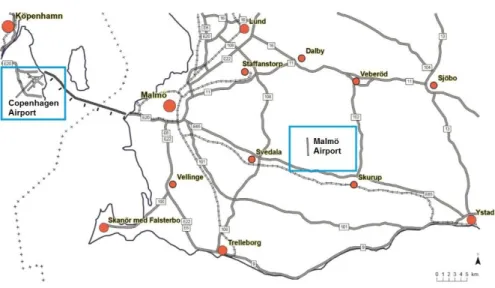
Malmö Airport is the fifth largest airport in Sweden and it is located just outside the major cities of Malmö, Lund and not too far from Copenhagen (Swedavia, About Swedavia, 2015). The Airport first opened in 1972 and is now one of Swedavia’s ten airports. In 2014, Malmö Airport had over 2.1 million passengers and the number of international and domestic flights are increasing. Because of Malmö Airport’s location, in the center of the rapidly growing Öresund-region, the airport could be a strategic gateway to the region and the rest of the world. Thus, only if Malmö Airport was more integrated with the public access system. Since the opening of the rail link between Malmö and Denmark in 2000, which attracted more passengers to Copenhagen Airport, Malmö Airport struggles with airport access.
Figure 1 - Overview of the region (Sturupsaxeln AB, 2005)
“Better infrastructure, including air and rail connections, is an essential requirement for the growth of southern Sweden and the Öresund-region. (Swedavia, 2015)
In the year of 1999, a feasibility study was conducted in order to investigate the possibility of a rail connection at Malmö Airport. This study was completed by
local authorities, adjacent municipalities and the public (Nordgren, 2014). A cooperation named Sturupsaxeln AB, consisting of Malmö city and the municipalities of Svedala and Skurup, was formed to investigate the possibility of railway access. The main goal of the project was to create a fast connection between Malmö Airport and Copenhagen Airport and at the same time, increase the accessibility to the rest of the region (Sturupsaxeln AB, 2005). This cooperation led to another investigation completed in 2005, namely, an environmental impact analysis combined with a railway investigation, which also was partly funded by the EU1. The purpose of this comprehensive study
completed in 2005 was mainly to clarify the conditions for a railway extension to Malmö Airport, from the existing track between Malmö city and Simrishamn. In 2010, Banverket (now part of Trafikverket) turned the project down. The motive of turning it down was financial aspects, which were considered insufficient and unsolved (Nordgren, Sturupspendeln, 2014). According to Nordgren2 (2015), the project about a railway connection came to life again in 2013 and is today in its feasibility-stage and in terms of becoming a part ot the regional plans of infrastructure.
Access to Malmö Airport can only be executed by car, taxi and special airport buses (private company). The investigation alternatives from the Malmö et.al
(2005) consisted of three future potential transportation systems: quick buses, train via side track and a pervading railway connection through the airport. The railway system require certain radiuses, gradients and technical aspects when dealing with high speed. The study examined four various railway corridors, consisting of the alternatives UA1o, UA1v, UA2v4 and UA2o. In figure 2 below, these railway corridors are presented.
1 European Union
Figure 2 - Railway corridors (Sturupsaxeln AB, 2005)
If a pervading railway is to be establish, a tunnel underneath the airport and runways have to be constructed. There are many airports with a train connection and various reports have discussed the benefits with a train station at airports to enhance access (TCRP, 2000;Ashford, Mumayiz, & Wright, 2001).
1.2
Swedavia
Swedavia is a state-owned group that owns, operates and develops ten airports across Sweden. Their main role is to create satisfying access to favor traveling, business and meetings in a sustainable way and to connect Sweden with the rest of the world.
“Swedavia’s vision is to bring the world closer” (Swedavia, 2015)
There were a total of 33,5 million passengers who flew via the airports of Swedavia in 2013. Same year, the group had an estimated revenue of 4,7 billion SEK and had 2500 coworkers. Moreover, Swedavia has two business segments, Aviation and Real estate. In figure 3 below, the company structure is displayed.
Figure 3 - Swedavia's Business model segments
Since environmental impact of aviation is always in focus, Swedavia is working actively with a climate work program including global climate goals established within the aviation branch (Swedavia, 2015). When the Swedish Transport Administration (Trafikverket) released a report in 2011, about increasing the railway capacity in Sweden, Swedavia was positive and added the importance with integrated transportation modes (Trafikforum och Resforum, 2011). Moreover, Torborg Chetkovich, CEO of Swedavia states:
“We must not forget that a more efficient infrastructure creates conditions for higher growth in Sweden. For example, in the Öresund-region, a better integrated rail network will support improved availability, both in Skåne and internationally” (Trafikforum och Reseforum, 2011)
1.3
Problem description
At the heart of this study, challenges will be to provide sustainable and efficient airport access to Malmö Airport. Since airport access investigations has been ongoing since 1999, insight of how the airport will operate in the future are of interest. Especially when a new transportation mode is implemented combined with other modes. I, together with Swedavia and the Faculty of Engineering at Lund University, found it interesting to examine an intermodal travel center with respect of the new rail connection. Furthermore, Swedavia (2015) states that no report has not yet investigated the actual travel center and an operational railway connection, which would be of interest to the company and might be a part of their own master plan for Malmö Airport.
1.4
Purpose
Based on the matter of providing a sustainable and adequate airport access to Malmö Airport, the formulated purpose of this master thesis is:
“Locating and promote a future travel center for an intermodal traffic solution, providing adequate airport access to Malmö Airport”.
The results presented in this thesis can be viewed as general guidelines to intermodal airport access, since it discusses: theories based on various airports
Aviation Aviation Business • Commercial Real Estate Real Estate Activity Swedavia
(and size), case studies and interviews within the aviation industry. However, the analysis will aim to give an insight of Malmö Airport’s future airport access.
1.4.1 Research questions
A number of underlying research questions were also formulated to enhance understanding of the master thesis.
How to obtain sustainable intermodal airport access with various transportation modes
The function and vision of the travel center and to achieve satisfaction amongst passenger at Malmö Airport
Identify and locate a travel center for optimal airport access with rail connection
1.5
Delimitations
This master thesis is limited to only include airport access and intermodal functions of airports. Moreover, focus will first address airports in general and finally Malmö Airport. Since the documentation for the subject today is limited, this master thesis will be based and analyzed on available data and findings from Malmö Airport and other similar projects regarding airport access. In order to enhance validity to the report the case studies will, in the extent possible, try represent airports of equal size compared to Malmö Airport. This was suggested both by me and Swedavia, since larger airports most likely have different conditions (Ivre, 2015)3.This master thesis assume that a travel center with a rail
connection are to be constructed, at Malmö Airport, but with no respect of financial aspects.
1.6
Target Audience
The target audience for this master thesis consist of three major groups. Firstly, the employees in the aviation industry and in first hand my supervisors from both Swedavia and the Faculty of Engineering at Lund University. Secondly, students at Lund University or other higher education specialized in infrastructure. Thirdly, people from other departments in infrastructure or
people in general with less experience but are interested in sustainable infrastructure, aviation et cetera.
1.7
Structure of the report
The structure of this master thesis consists of six major parts, which are presented briefly in figure 4 below.
Figure 4 - Outlay of report
1.7.1 Chapter 1 – Introduction
This chapter gives an introduction of the master thesis and its underlying questions will be provided. A presentation of the company, the main case and airports will be included. The underlying events which this master thesis is based on will give the reader a clear background of why this investigation was conducted.
1.7.2 Chapter 2 – Methodology
This chapter offers a coverage and overview of the methodology selected for this master thesis. Methods along with case study design are discussed to provide suitable approaches regarding the subject. Further, the chapter then describes the investigation process of this master thesis and how it is conducted and analyzed while maintaining quality and validity.
1.7.3 Chapter 3 – Theoretical framework
In this theoretical chapter areas concerning access to airports and other contiguous matters will be covered. An overview of the access market will be discussed thoroughly and connect with parameters such as forecasting demand and terminal design. Further, this chapter highlights some of the theoretical frameworks which are often partly used in the more comprehensive master planning.
1.7.4 Chapter 4 – Empirical study
In this chapter the empirical data will be presented. A combination of interviews and multiple case studies will be discussed and to some extent, be linked with presented theory from chapter three. The methods presented in chapter two are taken in consideration when constructing the cases and they form a foundation
Introduction Methodology Theoretical
framework Empirical data Analysis
Discussion / Conclusion
for the final examination of the Malmö Airport issue. A selection of people were interviewed in this study in order to enhance this master thesis validity.
The outlay of the empirical study will first discuss findings from Malmö Airport. Secondly, the multiple case studies Göteborg Landvetter Airport and Ängelholm Helsingborg Airport will be presented. Finally, empirical input will further be investigation in the analysis chapter four.
1.7.5 Chapter 5 – Analysis
In this chapter all empirical studies and theories from chapter 3 are being studied with respect of Malmö Airport and its possibilities of operating a future intermodal travel center with a rail connection. There lies is a challenge in comparing a hypothetical assumption about an airport and its supposedly future scenario. However, based on the theories, selected airport case studies and other empirical findings, this master thesis should provide illustrative suggestions of Malmö Airport.
1.7.6 Chapter 6 – Discussion/Conclusion
In this chapter the investigation will be discussed by extracting key findings from the analysis, which then are transformed to answer the research questions of the master thesis. An overall quality and validity discussion will also be addressed in this chapter. Finally, suggestions on the future scenario at Malmö Airport will be presented along with my personal reflections regarding the thesis.
2 Methodology
This chapter offers a coverage and overview of the methodology selected for this master thesis. Methods along with case study design are discussed to provide suitable approaches regarding the subject. Further, the chapter then describes the investigation process of this master thesis and how it is conducted and analyzed while maintaining quality and validity.
2.1
Research strategies
There are different types of research strategies and some of the most common have been given definitions to distinguish one from another. Most frequently used strategies are explorative, descriptive and hypothetic methods. Each one is mostly conducted separately depending on the matter (Patel & Davidsson, 2011). The selection of strategy is then based on the problem in question, in order to bring out quality of the research intended (Yin, 2013; Patel & Davidsson, 2011). Explorative research is generally used when filling uncertainties of your knowledge, which provides investigation in the research. The purpose of explorative research is mainly to collect as much knowledge as possible within a subject. This type of research requires creativity when the investigation aims to reach new understanding. This research method consists of many various techniques (Patel & Davidsson, 2011).
Within problem areas where a certain amount of knowledge of your research already exists is namely called descriptive. This research concerns relations connected with the past and the presence. In contrast to explorative research, descriptive focuses on a more thorough and detailed view of the selected phenomenon (Patel & Davidsson, 2011). Since the matter is more detailed when using descriptive methods, the use of technics is narrowed down to usually one. The third research is called hypothesis-testing. This research preferably applies on problem areas where the amount of knowledge is comprehensive and with already developed theories. When doing hypothesis-testing research connections between theories and assumptions of the reality are being conducted (Patel & Davidsson, 2011).
These three variations of research, explorative, descriptive and hypothesis-testing are usually conducted separately (Patel & Davidsson, 2011). Only in larger projects a combination of two or three are used. Examples of research when more than one research is necessary could be when your phenomenon is descriptive but provided with too little knowledge necessary. An explorative
study could then first enlighten knowledge due to its all-round approach and decide how the descriptive study should focus.
Nowadays, research are usually divided into qualitative and quantitative research. The designations are aimed at how we choose to process, generate and analyze gathered information. With qualitative research your data collection focuses on what Yin (2013) calls “soft” data. That could be described as qualitative interviews or interpret analyzes, which intend to be mostly in verbal context. The other method is quantitative research which basically includes measurements with data collections, statistics and analyzing methods. These both research methods are viewed as opposites in figure 5. Despite their differences in approaches they are often combined when doing a research (Yin, 2013). Mainly because research today most likely is somewhere in between these two methods.
Figure 5 - Quantitative and qualitative research displayed as endpoints (Patel & Davidsson, 2011)
Strategies are according to Yin (2013) often misunderstood when finding the appropriate research method for an investigation. A common reasoning amongst case studies is that one might think that they only are suitable for exploratory investigations and that descriptive studies should use surveys. Therefore this misconception of strategy choice can be questioned. Yin (2013) describes various case studies with the approach of not being exploratory ones and therefore case studies are far from being only exploratory.
2.1.1 Choosing strategy
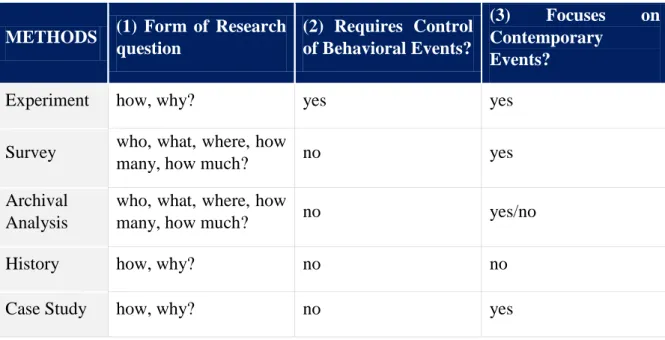
When evaluating strategies for the investigation three conditions combined with five major methods build up a selections of choice (Yin, 2013). The conditions consists of (1) the type of research question, (2) the extent of control over behavioral events, and (3) degree of focus on contemporary events (Yin, 2013). This evaluation strategy is displayed in table 1.
Quantitative reseach Statistic analyzes Qualitative research Verbal analyzes
Table 1 - Relevant Situations for Different Research Methods (Yin, 2013)
METHODS (1) Form of Research
question (2) Requires Control of Behavioral Events? (3) Focuses on Contemporary Events?
Experiment how, why? yes yes
Survey who, what, where, how
many, how much? no yes
Archival Analysis
who, what, where, how
many, how much? no yes/no
History how, why? no no
Case Study how, why? no yes
The importance of defining your research question is a crucial part (Yin, 2013). As shown in table 1 the series of questions is: “who”, “what”, “where”, “how” and “why”. The “what” question can be parted in two types of questions. The first being an exploratory questions, such as “What can we learn from this master thesis”, which preferably demands exploratory methods in order to fulfill its investigation (Yin, 2013). The second type of “what” question takes form into “how many” and “how much” questions. These questions preferably requires survey methods or/and archival studies. However, Yin (2013) argues that an exploratory study can be used over all five questions. In contrary “how” and “why” are more exploratory. It is most suitable to use methods as case study, history or experiment. Further, the definition of a research question is of great importance when choosing research method and one must not forget that an overlap between methods could be useful and often used.
Case study is an optimal choice of research method as it is suitable when examining contemporary events (Yin, 2013). Case studies of an already existing travel centers, with similar airports in the same size as Malmö airport, would benefit the research questions named in chapter 1. Yin (2013) argues that a case study has a unique way of processing varieties of evidence such as: documents, interviews, observations etc.
2.2
Case study research
A case study is a research method focused on a specific group, process, event et cetera (Yin, 2013; Patel & Davidsson, 2011). When conducting a case study
you want to create a clear picture as possible of your whole case. Therefore various information must be studied and processed.
In depth there is a two-part definition of what a case study is. Firstly, a case study is an empirical inquiry. In other words it investigates a contemporary case in depth while its boundaries between contexts are vague (Yin, 2013). This provides our research with understanding of the case selected. Secondly a new definition occurs when our case is not connected with a real-world scenario. Other methods are therefore necessary in a case study in forms of relevant features. For example: more data, multiple sources and having them to converge. Since a case study consist of various methods within itself, a selection of a single case study or a multiple case study must be chosen before initiation of the investigation.
2.2.1 Single or multiple-case study
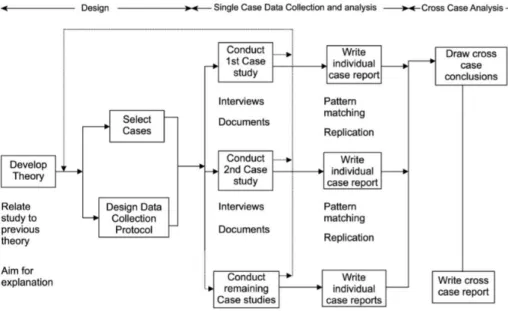
It is argued that a multiple case study is more preferable than a single case study (Yin, 2013). Despite that, most designs of case studies could however be achieved successfully. A multiple case study is less vulnerable than a single case study, meaning that the single case is mostly successful when having a strong argument (Yin, 2013). Moreover, Yin (2013) therefore suggests a multiple case study over a single case study. Firstly, a multiple case study allows us to benefit from more than two cases. That is far more powerful comparing with a single case study. Secondly, when conducting more than two cases your investigation will produce greater effects such as reliability and significance to your case. Moreover, a multiple case study is more comprehensive than a single case study. It requires a more extensive investigation when dealing with multiple cases and this should be considered before choosing, when a multiple case study approach is more time consuming and demanding.
Figure 6 - Multiple-case study method (Yin, 2013)
2.2.2 Case study design
When designing a case study five components are most essential. These components are listed below:
1. A case study’s questions 2. Its propositions, if any 3. Its unit(s) of analysis
4. The logic linking the data to the propositions 5. The criteria for interpreting the findings
The first component consists of what type of study question is used in the investigation. As described earlier in section 2.1.1, a case study with the question “how” and “why” would be most appropriate. To increase relevance of your choice of questions a minor examination of similar case-topics can be useful. Further, this should benefit your imagination when constructing your case questions (Yin, 2013).
The second component is the study propositions, which immediate attention to the propositions intended within the extent of the study (Yin, 2013). For example, if there was a study question: “How and why can train connections collaborate with other intermodal transportations at an airports”? This questions with “how” and “why” addresses a case study, but it is not sufficient enough to address on what you should study. A suggestion from Yin (2013) clarifies that if you could state some propositions along with your question which can navigate towards appropriate evidence, it is a good design. For instance, assume that new flows of passengers emerge with a new train connection. Since passengers have mutual interest independent on what transport they use, how
does this affect the existing terminals? This example directs evidence useful from the main question.
Unit of analysis is the third component out of the five, describing how the case should be studied. In order to fulfill this component one must consider two steps, defining the case and bounding the case. Firstly, when defining the case Yin (2013) explains that a case/individual usually has the focus as the investigations primary unit are to be analyzed. The more information that is given about the topic, questions, propositions, the more feasible your study is (Yin, 2013). Besides that, the other component should be carried out in advance. When dealing with a wide case (as this master thesis) it is important to define the unit of analysis. To avoid your topic being divided in various case studies the questions should always be of your interest and to be bases within your case topic. For example, this master thesis could easily be divided in several case studies. Case study about: optimal train stretch to the airport, geological conditions with a train tunnel under the airport, etc. Since this is a complicated matter, Yin (2013) suggests no closure when deciding your unit of analysis since this might change during the data collections process. A revisit to this component is therefore useful as the investigation moves forward. Asking colleagues is also a great way to prevent incorrectly definition of your unit of analysis.
Secondly, bounding the case becomes essential as it clarifies your case further. The case should be distinguished from what not will be included in the study. The estimation of beginning and ending of the case is desirable within the boundaries of your case. When bounding your case ibid. stresses the importance of comparison with previous research. If possible, comparing similar unit of analysis in your field of focus could help finding appropriate literature (Yin, 2013).
The fourth component is linking data to propositions and explains this process. Analytic techniques used when linking data to propositions are: pattern matching, explanation building, time-series analysis logic models and cross case synthesis. As of this, various techniques can be used and preferably a combination of a selection would be beneficial for your study. Especially helpful is when in the design phase pay attention to the time series analysis. Literature can mark a specific time in your case, and with this attention, literature with the ability to trace change over time is a major strength when conducting a case study. One extra precaution aspect when processing data is to avoid having too much data and not having enough data. This of course requires experience but benefit your case study (Yin, 2013).
The fifth component concerning criteria for interpreting a case study’s finding are commonly connected with quantitative studies, especially when processing statistics (Yin, 2013). However, this is seldom used in a case study and therefore other interpreting methods are being adapted. Interpreting strategies in a case study could be to identify and address rival explanation for your findings. It has been described by ibid. to be most beneficial to address such rivals to interpret your findings and by adding more rivals you address and reject, the stronger findings. During the design process it is therefore important to enumerate rivals, to include such data aside from your data collection, to provide essential fundamentals of your data.
2.2.3 Theory development
Based on these five components described in the previous chapter, we can initiate a theory or theoretical proposition development related to the study. It is supposedly beneficial according to Yin (2013) to make two theories, where one of them is a rival theory. In doing so, you increase the conditions of including your five components. In other words, the rival theory is a statement that describes the opposite or for example “if it does not work”. The theory development is mainly an aid in generalizing your findings in a case study and should therefore be a part of the design process.
2.2.4 Quality and validity
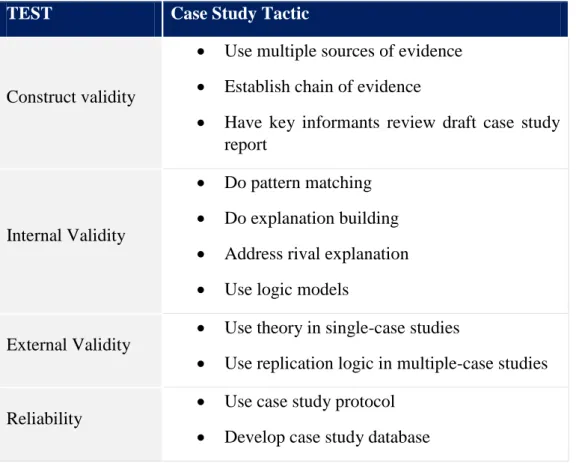
To assure your research design having good quality the quality and validity can be tested. A tactical and an efficient way of examining your research data is can be executed according to a four design test chart displayed in table 2 below (Yin, 2013).
Table 2 - Case Study Tactics for Four Design Tests (Yin, 2013)
TEST Case Study Tactic
Construct validity
Use multiple sources of evidence Establish chain of evidence
Have key informants review draft case study report
Internal Validity
Do pattern matching Do explanation building Address rival explanation Use logic models
External Validity
Use theory in single-case studies
Use replication logic in multiple-case studies Reliability
Use case study protocol Develop case study database
Construct validity is when identifying correct operational measures of concept. According to Yin (2013), this first test is rather difficult in terms of finding the appropriate measures. To increase success of this test a recommendation of tactics is presented, which is shown in table 2 above.
The second test is Internal validity which is beneficial when sorting out how an event x led to event y. This test is only useful when conducting exploratory studies. It is stated by Yin (2013),that for best achievement, this test should be seen as an analytic tactic. Tactics is shown in table 2 above.
The third test is called external validity and deals with findings whether they are generalizable, regardless to the results. It is said to be crucial what type of research question you use in terms of satisfy this test. According to Yin (2013) one must consider having the appropriate research question. It basically helps with “how” and “why” questions combined with good data has shown to be helpful.
The last test is named reliability which focuses on demonstration that the operations of the study can be repeated. The goal however is to minimize the errors in the case study (Yin, 2013). To maximize the reliability it is suggested
to document the data thoroughly to ensure external viewers to rely on your research. Yet again, table 2 above shows the tactics for this test.
2.3
Selected Methodology Approach
This master thesis follows the directions of presented approach of case study methods by (Yin, 2013). Firstly, the research strategy selected is a case study, based on the fact that this master thesis is explorative and will be based on contemporary events, in the extent possible. There will be two case studies conducted in order to maximize the validity of this master thesis, as described in chapter 2.3.1 (Single or multiple-case study). As for the actual design and approach for this thesis, a customization has to be done. The two cases differ from each other have to be altered in order to achieve good information for the analysis. Both cases follows the guidelines of the five components from 2.3.2 (Case study design) as much as possible. The outcome of the cases are then discussed in the empirical data chapter 4 and the theoretical framework in chapter 3 provides theoretical evidence for both cases. Since the subject of the two cases differs, a certain interview method is used to support each case. Interviews have been conducted ongoing and written down, then implemented as data. No interview has been fully transcribed nor recorded since this master thesis is limited in both time and resources. Some claim that the outcome of interviews is better when not having them recorded since a more open dialogue can be obtained (Trost, 2010). Moreover, the notes from the interviews are summarized in notes with key elements and will only be used when writing the report. A general interview guide for this master thesis is displayed in appendix A. Ethical aspects of the interviews follow suggestion from Trost (2010) and consist of an approval from the person being interviewed, before publishing the master thesis. Finally, the analysis of this master thesis then discusses Malmö Airport with respect of gathered theoretical framework, empirical findings and conclusions from the case studies.
3 Theoretical framework
In this theoretical chapter areas concerning access to airports and other contiguous matters will be covered. An overview of the access market will be discussed thoroughly and connect with parameters such as forecasting demand and terminal design. Further, this chapter highlights some of the theoretical frameworks which are often partly used in the more comprehensive master planning.
3.1
Definition of Airport access
The definition of access is described in Ashford et.al (2001) as three major areas, which is commonly used in design and preparation of access systems:
1. Collection and processing, if necessary, of passengers in the central area of the city and other centers of high demand
2. Movement of passengers, cargo, and service traffic to the airport by surface or air vehicles
3. Distribution of access traffic and internal circulation traffic to terminals and gate positions
Since the access trip for each traveler is different it becomes a difficult task for the designer to mark where each trip begins and ends. Therefore, a general approach is used and focuses of the end point of where the traveler arrives in the vicinity of the air terminal. Ashford et.al (2001) also mention the importance of optimal access planning, since it is a main part of passenger’s entire experience, from the point of origin to their final destination.
3.2
Access problems
In the early days of aviation, airport access was considered less of a problem in comparison to today. By comparing the situation around 1920 in the USA with today, costs for air traveling in 1920 was so high that only a few people used existing modes for accessing the airport (Ashford et.al, 2001). During this time it was easy to get around with car without heavy traffic. Around 1965, technology evolved in combination with rapid urbanization and congested roads made an impact on the airport access. This change is further described by Várhelyi (2010), who cliams that this was a trend in both America and Europe. In Sweden, the ownership of a car was essential for ones needs of transportation and the road network developed to be the most crucial network of transportation. There is also a change in short-haul trips over the last 50 years, as shown in figure 7 below. Despite the improvements of jet engines the overall process time has not shortened because of the now longer access time.
Figure 7 - Comparison of short-haul city-center-to-city-center travel, 1950-2010 (Ashford et.al, 2001)
Speculation about future access problems is further described by Ashford et.al (2001), where it is stated that most airports developed over the next 50 years will mostly be connected to the existing transportation infrastructure. A great opposition in both United States and in Europe about exploiting green fields when creating new airports support the fact that already existing airports will develop and expand. Furthermore, this aspect is more debated in Europe, where the population is dense and environmental intrusion of the airport industry Ashford et.al (2001).
“Many of the access problems facing the existing airports will continue well in the future.” (Ashford et.al, 2001)
3.3
Access for whom?
When planning the access system it is crucial to define the users. There is many times a misconception that only air passengers qualify as the only traveler. Moreover, the population of an airport is diverse and consists of various users. Therefore, users must be taken in consideration in the access planning. The common users are listed below (Ashford et.al, 2001;Graham, 2003):
Air travelers
Senders and greeters
Visitors
Employees
Air cargo access personnel
Persons who supply service to airport
Depending on the airports size, location, and functions the population between the listed users varies. However, the majority of the access market share consists mainly of two groups, passengers and airport employees/workers. In table 3 below, an estimated proportion of users are listed based upon various airports (Ashford et.al, 2001).
Table 3 - Proportion of passengers, workers, visitors and greeters/senders at selected airports. (*senders and greeters included). (Ashford et.al, 2001)
As shown in table 3 above, the characteristic of the airport’s ground access is the product of air travel. Moreover, at some airports with non-aeronautic activities (NAI) a wider range of passengers are attracted with the airport ground access. Both Ashford et.al (2001) and TCRP (2000) emphasize the importance of investigating the ground access market of the airport. Especially when designing and choosing appropriate modes of transportation. Air travelers and airport employees make up the largest groups of the airport population. One must define all market segments of an airport to identify the largest group for a service or a product. The greatest challenge is to point out the key groups who will use the services available or the services intended in the future. Each group provides travelling patterns that are useful when designing access modes. Further, there tends to be a service and location attribute that dominates the choice of ground access mode. In depth, the air passenger segments consist of four different groups listed and discussed below (TCRP, 2000).
List of airport passengers:
- Air passenger market
- Resident Business - Resident Non-business - Non-resident Business - Non-resident Non-business - Airport Employee Market
- Airport Employees – Nonflight Crew
- Airport Market Plus
3.3.1 Visitors of Airport Ground Access
Air Passengers Market Resident Business
The resident business traveler is the most frequent traveler amongst the user groups (TCRP, 2000). Due to their frequency in air traveling, it is easy to establish a certain pattern in their access decisions. These travelers are likely the most efficient traveler, meaning that they choose access with care in order to achieve reliability and cost efficiency in their choice of access modes. Typical characteristics of resident business travelers is commonly very little luggage, compared to the nonbusiness traveler, and their duration of the trip, which usually is shorter compared to the nonbusiness traveler. Because of their luggage proportions, resident business travelers are more suitable for public transportation options. However, it is argued that these travelers are cautious when considering public transportation since it is more unreliable to reach their destination in time (Windle & Dresner, 1994). Further, the use of public transportation must also be flawless in peak hours, since the majority of the residential business travelers most likely travel to and from the airport around that time. Finally, reports from TCRP (2000) states that resident business travelers usually access by car and use expensive car parking and are mainly time sensitive.
Resident Nonbusiness
Resident nonbusiness travelers are most likely to have more luggage and longer duration in their trip in contrast to the resident business traveler. They are also more sensitive in costs compared to the business travelers (Harvey, 1987;TCRP, 2000). Moreover, because of their luggage and usually large travel parties, these travelers are more aware of access cost and usually needs help with luggage handling. Compared to the resident business traveler, these nonbusiness passengers have less information about access modes and travel mostly during off-peak hours. Their patterns in access varies slightly more than business air passengers since its more common they travel more seldom. TCRP (2000) also argues that its more likely these travelers are being dropped off or picked up at airports and that they can be candidates for using public transportations, especially if the access is more convenient and adjacent to their point of origin. Finally, there travelers are mainly cost sensitive.
Nonresident Business
Nonresident business travelers differs from the others, since they often are destined for a place of business or hotels. These travelers are therefore often located within city centers or near regional attractions (TCRP, 2000). Depending on the business assigned for the traveler they require more flexibility in comparison to other travelers in terms of transportation. Accordingly, it is further argued that nonresident business air passengers use the most efficient transportation without regard the cost. Most common choice of access mode is taxi or rental cars. However, they could be users of public transportation mode only when it delivers expedience and nearby access to their wanted location without delay and multiple stops.
Nonresident Nonbusiness
Nonresident nonbusiness travelers have least or little knowledge of available access modes at any airport. However, these travelers could make multiple trips within their stay from same or different airports (TCRP, 2000). Air passengers with nonresident nonbusiness purposes are often staying at hotels or a place of resident. This segment tend to choose access options by what is most easy and available for them, such as door-to-door vans, share-ride or taxis. It is possible for this segment to access with public transportation only if it is reliable, convenient and displayed as an alternative. Further, TCRP (2000) claims that this segment could be choosing public transportation regardless, since the airport is unfamiliar.
Airport Employee Market
Airport Employees – Flight Crew
This segment comprises of pilots and flight attendants who are traveling to the airport from a certain city or nearby. Depending on their duty, flight crew employees may be returning home after several days. Based on these characteristics, TCRP (2000) argues that their trip from the airport take place after a few days and may not commute more than maybe once a week to the airport. Because of their infrequent commuting to and from the airport, this segment is not a large market for public transportation. This segment constitute a major market group amongst airport employees and overall, the majority of the flight crew access by car and park them during their trips.
Airport Employees – Nonflight Crew
Airport employees of nonflight crew commute on a more regular basis compared to flight crew employees. This segment on employees have a great variety in terms of work schedule. Since there is jobs spread all out over the airport, car has an advantage over scheduled public transportation. Additionally, using cars is also less expensive, when nonflight employees often have free parking. However, the more inconvenient the parking places are, employees consider other access modes when reaching their required location. If this segment where to use commuting alternatives like public transportation, TCRP (2000) argues that nonflight crew employees are sensitive to cost, since they travel several times during the week. The group of nonflight crew employees who are strong candidates for public transportation is entry-lever and low wage workers. In addition to its potential, difficulties with working hours being outside the public transportation system. Further, since many workers are unable to access by car a public transportation alternative would be most suitable and should be highlighted for this segment of passenger (TCRP, 2000).
Airport Market Plus
In addition to the above listed categories of passengers, a common way of addressing and separating them are namely just, business and non-business/leisure travelers (Harvey, 1987). As mentioned in the airport passenger market segments above, a simple way of characterizing the business and non-business is cost and time. Business travelers are more sensitive to time and are insensitive to costs, since they seldom pay their own travel expense. Nonbusiness travelers are on the other hand more sensitive to cost (Pels et.al, 2001; Harvey, 1987). Further studies conducted by Hess & W. Polak (2005) explained behavior pattern amongst leisure and business travelers. Results showed that access time, in terms of sensitivity, was more randomly spread amongst business travelers. Leisure travelers showed on the other hand less pronounced results (Hess & W. Polak, 2005).
However, the market are constantly changing and more recent studies suggest a more thorough breakdown. Moreover, a rearrangement combined with non-aeronautical passengers can affect the public transport access system. In a case study at Zurich airport all users where divided into two groups, namely: Aeronautically induced (AI) and non-aeronautically induced (NAI) (Orth, Frei, & Weidmann, 2014). The study claimed that (AI) referred to visitors caused by airport activities and (NAI) to visitors generated by non-airport activities. According to the Zurich case study, the public transportation improved by
adding (NAI), resulting a higher passenger numbers and with a more equal distribution during a day.
3.3.2 Swedavia passenger segmentation
When Swedavia entered the aviation business, investigations has been conducted of targeting groups of their airports. A segmentation of passengers has resulted in prioritized target groups which can be useful in establishing improvements the airports (Swedavia, 2012). Moreover, when increasing passenger satisfaction the profit increase as well. The method used in finding the target groups consisted of a comprehensive survey all across the nation and will assume passengers living in Sweden. Moreover, same passengers are most likely to be find outside Sweden as well. The groups consists of 7 types of passengers. Active Cosmopolitans, Effective commuters, Positive Epicurean travelers, Image conscious novices,Confident positive travelers, worried social awareness travelers and Careful inexperienced travelers. The groups with most priority are described below.
The Active cosmopolitan are passengers with airport experience and travels frequently. They are positive traveling with airplanes and enjoy spending time at airport. The airport should be attractive, innovative and provide a wide range of shopping to satisfy active cosmopolitans. There is a tendency of high income amongst these passengers and prefer car access amongst other passenger groups.
Other experienced air travelers are the Effective commuters. These group consists mainly of business travelers and are the most frequent traveler amongst all passengers. Satisfactory factors are effective processes, quite workplaces and wireless internet. Moreover, access time is a crucial factor within this segment. The Positive Epicurean travelers have less frequency in traveling compared to the above mentioned and spend more time at the airport. A wide range of shopping and food is important attribute amongst these travelers.
The final segment is the Image conscious novices’ passengers. They are younger people with less income and have little experience with airports but enjoy flying. These passengers find personal service and signs of direction to be important attributes. Image conscious novices are mainly non-business travelers.
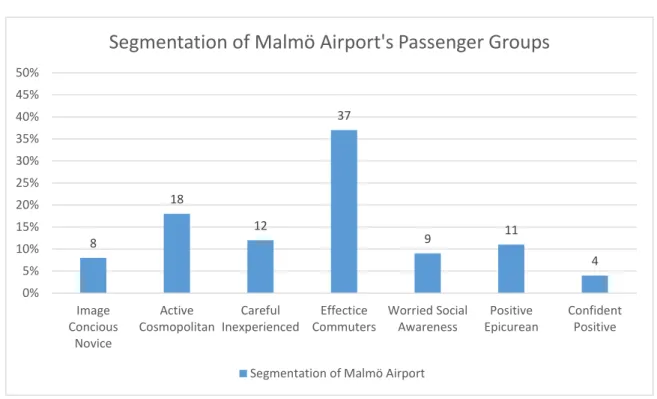
According to the investigation in targeting groups, Malmö Airport showed a majority of the Effective commuters (37 %), followed by Active cosmopolitan (18%) and Careful inexperienced (12%) of the market share in 2012. Figure 8 below displays the segmentation.
Figure 8 - Segmentation of Malmö Airport 2012 (Swedavia, 2012)
In depth, these passenger groups can be displayed in a business and non-business sense. From the report about target groups of Swedavia, a segmentation was performed (Swedavia, 2012). Figure 9 displays each target group in respect of business and non-business purpose.
Figure 9 - Business and Non-business segmentation of Swedavia (Swedavia, 2012)
From figure 9, the groups with a majority of business related travels are Effective Commuters and Active Cosmopolitans.
8 18 12 37 9 11 4 0% 5% 10% 15% 20% 25% 30% 35% 40% 45% 50% Image Concious Novice Active Cosmopolitan Careful Inexperienced Effectice Commuters Worried Social Awareness Positive Epicurean Confident Positive
Segmentation of Malmö Airport's Passenger Groups
Segmentation of Malmö Airport
5 25 8 36 8 10 7 13 17 16 17 14 14 9 0% 5% 10% 15% 20% 25% 30% 35% 40% Image Concious Novice Active Cosmopolitan Careful Inexperienced Effective Commuters Worried Social Awareness Positive Epicurean Confident Positive
Business and Non-business Segmentation of Swedavia's Travelers
Malmö Airport does not only consist of air travelers. Today, Malmö airport provide a total workforce of 1200 employees (Swedavia, 2015).
3.4
Access systems
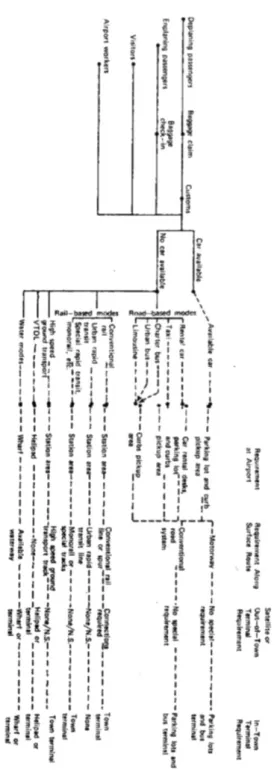
The access system is complex and the demand for the airport facilities varies depending on the existing infrastructure. However, the frequent use of cars all over the world, and especially in America, does not decide whether the airport access should constitute by car-friendly access in majority. According to Ashford et.al (2001), approximately 25% of the American population does not own a car. Therefore, some public transportation are required for provide adequate airport access. In Comparison, 41% of the Swedish population does not own a car (Statistiska Centralbyrån, 2015). Moreover, the access system of any given airport is linked with several attributes, which we will discuss further. In figure 10 below, a simple chart from explains the access system for an individual or group (passenger, employee, visitor et cetera.).
3.4.1 Access Modes
There are different access modes available or to be designed at an airport. A variety of modes is necessary in order to satisfy the need from users traveling to and from the airport. Ashford et.al (2001) states the importance of investigation of different modes in term of planning process. Therefore, each access mode has its advantages and disadvantages, which is why this is worth examining.
Car
The car is the most common mode of airport access in the United States and in the rest of the world. Advantages of this mode is many, from great flexibility, convenient factor of direct origin-destination movement and relatively reliable of getting in time (Ashford et.al, 2001). Other aspects as traveling with luggage, accompanying children, elderly or handicapped are factors proving benefits of using car. Further, since ones destination is not always within the city center a car is more flexible with respect to the origin-destination movement. When travelling during a short time parking is less expensive, especially of the car has more than one traveler (Ashford et.al, 2001).
Disadvantages of this mode is mainly surface congestion and the contribution of raised air pollution (Budd et.al, 2014). When individual airport traveler interact with daily traffic and in association with the infrastructure needed of parking places at the airport congestion is obvious (Ashford et.al, 2001;TCRP, 2000). Because of congestion uncertainties when accessing the airport the reliability of getting to wanted destination decreases. In term of parking opportunities, parking in the vicinity is often highly expensive, causing travelers to use cheaper and more remote parking places. According to Ashford et.al
(2001), remote parking can have negative effect on the overall access time, since it seriously lowers the convenience level for the air passenger.
Taxi
Taxi is frequently used as an access mode to airports. There is a notable increase of frequency difference when an airport has high proportions of business travelers, combined with nearby locations to city centers. Benefits of this mode is described by Ashford et.al (2001) to offer high level of convenience because of different aspects. Taxis provides the traveler with origin-destination access, easy luggage handling and is less expensive, when traveling more than one person. Depending on the circumstances, the overall trip with this mode can be convenient. However, for the single traveler this mode is relatively expensive.
Moreover, Taxi share the same circumstances with surface congestion as the automobile. It is explained by Ashford et.al (2001), that same vulnerabilities occur in non-airport traffic, which makes the trip slower than expected. Another characteristic of congestion concerning taxi is located around the loading and unloading areas. The problem occurs because of the passenger’s low rate and that the road space required is often too small, causing the congestion. Examples of dealing with this type of congestion can be to establish taxi pool areas. A taxi dispatcher summons the taxis when needed for passengers within the terminal. When having taxi pool areas, congestion around the terminal is located at a distant in preventing long lines of passenger waiting and causing congestion at the terminal landside.
Buses
Three types of buses will be addressed in this section. Firstly, the charter buses, which are often when transporting charter passengers. Secondly, urban buses, which stands for the regular commuter bus. Thirdly, special buses will be discussed, which are commonly used in the access market. Finally, bus is a public transportation mode.
Charter buses are commonly used for chartered flights and provide passengers with direct access to their final destinations from and to the airport. This is used in many European countries, Mediterranean and in ski areas. Because of their nonstop access, this mode offers a reasonably high service level (Ashford et.al, 2001). Combined with high loading factors, low access costs and its high number of passenger per vehicle, congestion is seldom caused by charter buses. Disadvantages of this mode is mainly to share access with airport and non-airport traffic. It is described that charted buses are more vulnerable to traffic congestion since delay can cause passenger to wait. Further, this mode deals only with a minor portion of the total access demand and is not available for the general public (Ashford et.al, 2001).
There are some cities, where the airport can be accessed by conventional urban bus service. Airport employee may constitute as a great user of this mode. Employees travel with less or no luggage compared to passengers and could be the most suitable ones. Ashford et.al (2001), emphasizes that one should remember that this only works if employees can be distributed to their workplace, since the majority does not work nearby the terminal. From the airport passenger perspective, urban buses is less convenient. Further, it is explained that passengers who are unfamiliar to the city can experience difficulties when routing for their destination. Luggage is yet another problem,
which can be hard to maneuver, especially when sharing with non-airport travelers during peak hours. Moreover, urban buses are facing major delays compared to the taxi, when buses make multiple stops and vulnerable for congestion. Depending on the city infrastructure, the overall access time varies but is in general fairly low due to its multiple stops and low service. As mentioned, urban buses could be useful for airport employees and thereby make savings in staff car facilities (Ashford et.al, 2001).
Special bus, or sometimes limousine service, is one of the most common access and usually connects airport with city central areas. There are two major advantages for this mode according to Ashford et.al (2001). Firstly, it is fairly cheap, especially for the single traveler and not necessarily cheap when traveling in large parties. Secondly, it offers great level of convenience for travelers destined within the central areas. As discussed previously about ground access, problems are obvious. Limousines and special buses can only serve a selection of locations with non-stop service, which cannot suit everybody. As for every other vehicles, it can be unreliable to use this mode in terms of delays from surface congestion, especially if there is no segregated right-of-way for this mode. Moreover, the congestion aspect is more perplexed if the user is required to access highly dense areas, such as railway stations, where heavy movement of traffic already is palpable (Ashford et.al, 2001).
Conventional Railway
There are only a limited number of airports providing conventional railway for airport access (e.g., Frankfurt, Amsterdam, London-Gatwick and Zurich). This type of railway access often connects with the existing railway network with a short spur line, constructed for the immediate airport access. In terms of only construct a short line of track, costs aren’t necessary expensive, compared to a longer fully city-to-airport connection. Road congestion is reduced since conventional railway is separated from other modes, which marks a huge advantage in order to provide reliability and less delays (Ashford et.al, 2001). Further, a conventional railway is often connected with the city center and generally a higher speed compared to other public transportations. Despite rapid connections due to less stops, it is described that the overall access time is still inadequate. There are several aspects connected with the access time such as where one constitute of the city central stop. Passenger’s origin at the city central faces difficulties when being mix with non-air travelers, especially during peak hours. Further, handling luggage during these circumstances is also an issue linked to overall access. Finally, conventional railway systems in general serve the airport as its best when easy access is provided by an extensive urban distribution system, such as: Urban buses, taxi or urban rapid transit.