2016
Indefinite Delivery/Indefinite Quantity project
selection framework using stochastic techniques
Jorge Andres Rueda Benavides Iowa State University
Follow this and additional works at:https://lib.dr.iastate.edu/etd
Part of theCivil Engineering Commons
This Dissertation is brought to you for free and open access by the Iowa State University Capstones, Theses and Dissertations at Iowa State University Digital Repository. It has been accepted for inclusion in Graduate Theses and Dissertations by an authorized administrator of Iowa State University Digital Repository. For more information, please [email protected].
Recommended Citation
Rueda Benavides, Jorge Andres, "Indefinite Delivery/Indefinite Quantity project selection framework using stochastic techniques" (2016).Graduate Theses and Dissertations. 15078.
Indefinite Delivery/Indefinite Quantity project selection framework using stochastic techniques
by
Jorge A. Rueda-Benavides
A dissertation submitted to the graduate faculty in partial fulfilment of the requirements for the degree of
DOCTOR OF PHILOSOPHY
Major: Civil Engineering (Construction Engineering and Management) Program of Study Committee:
Douglas D. Gransberg, Major Professor H. David Jeong
Shauna Hallmark Yelda Turkan Caroline Krejci
Iowa State University Ames, Iowa
2016
TABLE OF CONTENTS
Page
LIST OF FIGURES ...v
LIST OF TABLES ... vii
NOMENCLATURE ... viii
ACKNOWLEDGMENTS ... ix
ABSTRACT ...x
CHAPTER 1. INTRODUCTION ...1
Content Organization ... 4
CHAPTER 2. BACKGROUND AND MOTIVATION ...7
Background ... 7
NCHRP Synthesis 473 – IDIQ Contracting Practices ... 7
IDIQ Contracting ... 8
IDIQ Terminology and Key Definitions ... 9
IDIQ Generic Models ... 11
IDIQ Advantages and Disadvantages ... 13
IDIQ Types of Work ... 16
Motivation ... 17
Problem Statement ... 18
CHAPTER 3. RESEARCH METHODOLOGY AND VALIDATION ...20
Research Methodology ... 20
Modified Z-Score Method ... 22
ROUT Method ... 23
NCHRP Synthesis 473 – IDIQ Contracting Practices: Research Methodology ... 24
Validation ... 25
CHAPTER 4. US MAJOR TASK ORDER CONTRACTING AND NZ COLLABORATIVE ALLIANCES COMPARISON...26
Abstract ... 26
Introduction ... 26
Background ... 27
Indefinite Delivery/Indefinite Quantity Contracting ... 29
Alliancing Contracting ... 29
Comparison of Case Studies ... 32
General Procurement and Administration Procedures ... 34
Early Contractor Involvement... 38
Incentive and Disincentive Provisions ... 39
Documented Advantages ... 39
Discussion ... 40
Conclusions ... 41
CHAPTER 5. SUITABILITY ANALYSIS OF EXISTING CONSTRUCTION COST INDEXES FOR MINNESOTA DEPARTMENT OF TRANSPORTATION CONSTRUCTION PROJECTS...42
Abstract ... 42
Introduction ... 42
Background ... 45
Construction Cost Index Definition ... 47
Methodology ... 47
Data Collection, Processing, and Analysis ... 47
Analysis and Discussion ... 50
Cost Indexing Practices - Qualitative Analysis ... 50
Cost Indexing Practices - Statistical Analysis ... 54
Conclusions and Recommendations ... 57
Acknowledgments... 58
CHAPTER 6. EFFECTIVE RISK MANAGEMENT STRATEGIES IN CONSTRUCTION AND MAINTENANCE INDEFINITE DELIVERY/INDEFINITE QUANTITY CONTRACTS ...59
Abstract ... 59
Introduction ... 59
Background ... 61
Motivation ... 62
Fundamentals of IDIQ Contracting ... 64
Research Methodology ... 66
IDIQ Risk Management Framework ... 67
1. Higher than Needed Project Administration Costs and Efforts ... 70
2. Disproportion between the Number of Awardees and Quantity of Work ... 70
3. Final Product below Minimum Performance Standards ... 71
4. WO(s) Substantially Deviated from Contract Scope of Work ... 72
5. Erroneous Identification of the Low-Bid ... 73
6. Estimating, Scheduling, and Constructability Errors Found During Construction ... 74
7. Unreasonable Compensation of Mobilization Expenses ... 75
8. Large Contingencies in Price Proposals due to Potential Cost Escalation ... 75
Conclusions ... 77
CHAPTER 7. STOCHASTIC COST-BASED DECISION MAKING FRAMEWORK FOR THE SELECTION OF SUITABLE PROJECTS FOR IDIQ CONTRACTING ...78
Abstract ... 78
Introduction ... 79
IDIQ Contracting ... 85
Design-Bid-Build ... 87
Methodology ... 87
Decision Making Framework – IDIQ vs. DBB ... 90
Scope-Based Decision Analysis ... 90
Data Collection, Cleaning, and Processing ... 91
Use of Construction Cost Estimating Models ... 95
Conclusion ... 103
CHAPTER 8. CONSOLIDATED CONCLUSIONS AND LIMITATIONS ...105
CHAPTER 9. CONTRIBUTIONS AND RECOMMENDATIONS FOR FUTURE RESEARCH ...107
Contributions... 107
Recommendation for Future Research ... 108
REFERENCES ...110
APPENDIX A. MINNESOTA DEPARTMENT OF TRANSPORTATION HISTORICAL BID DATA ...119
APPENDIX B. INDEFINITE DELIVERY/INDEFINITE QUANTITY SAMPLE PROJECTS ...120
B.1 Asphalt Pavement Project ... 121
B.2 Concrete Pavement Project ... 124
B.3 Traffic Barriers Project... 127
B.4 Drainage Project ... 130
APPENDIX C. COST INDEXES AND ADJUSTED PRICES FOR SAMPLE PROJECTS ...133
LIST OF FIGURES
Page
FIGURE 1 IDIQ terminology. ... 10
FIGURE 2 Work order and IDIQ contract classification scheme (Rueda and Gransberg 2014a). ... 11
FIGURE 3 Generic IDIQ contracting models (Rueda and Gransberg 2014a). ... 12
FIGURE 4 IDIQ advantages – survey output. ... 14
FIGURE 5 IDIQ most important advantage for DOTs. ... 15
FIGURE 6 Research methodology and validation... 21
FIGURE 7 Pure alliance agreement (Adapted from Gransberg et al. 2015b). ... 30
FIGURE 8 Competitive alliance agreement (Adapted from Gransberg et al. 2015b). ... 31
FIGURE 9 Collaborative alliance agreement (Adapted from Gransberg et al. 2015b). ... 32
FIGURE 10 AFCAP IV contractors. ... 35
FIGURE 11 Construction cost index classification by usage. ... 46
FIGURE 12 Sawing Bituminous Pavement – bid range determination. ... 49
FIGURE 13 Actual project costs of sample projects – state average. ... 54
FIGURE 14 IDIQ model selection (Gransberg et al. 2015a). ... 65
FIGURE 15 Two-part IDIQ risk management framework. ... 68
FIGURE 16 Design-Bid-Build (Gransberg et al. 2015a)... 87
FIGURE 17 Research methodology. ... 88
FIGURE 18 Decision making framework – IDIQ vs. DBB ... 90
FIGURE 19 Quantitative data processing. ... 92
FIGURE 21 Use construction cost estimating models. ... 96
FIGURE 22 Development of construction cost estimate – DBB. ... 99
FIGURE 23 Development of construction cost estimate – IDIQ. ... 100
FIGURE 24 Comparison of stochastic values. ... 101
LIST OF TABLES
Page
TABLE 1 IDIQ Terminology – Definitions ... 11
TABLE 2 IDIQ Contracting Models Structure and Typical Use (Gransberg et al. 2015a).... 13
TABLE 3 Contracting Advantages of Each IDIQ Model (Rueda and Gransberg 2014a) ... 16
TABLE 4 IDIQ Types of Work – Construction and Maintenance ... 17
TABLE 5 Case Study Summary ... 33
TABLE 6 Non-cost KRAs and Accompanying KPIs (Gransberg et al. 2015b) ... 37
TABLE 7 Documented Advantages in the AFCAP and SCIRT ... 40
TABLE 8 Sawing Bituminous Pavement – Average Unit Price ... 49
TABLE 9 Building and Highway Construction Cost Indexes ... 51
TABLE 10 Average Variation pre Index and Type of Project ... 55
TABLE 11 One-Sample T-Test Summary ... 57
TABLE 12 IDIQ Risk Planning Reference Sheet... 69
TABLE 13 Advantages and Disadvantages in IDIQ Contracting ... 79
TABLE 14 Three-tiered Project Delivery Selection System (Touran et al. 2009) ... 84
TABLE 15 MnDOT Historical Bid Data ... 89
NOMENCLATURE
AFCAP Air Force Contract Augmentation Program AGC Associated General Contractors
ARTBA American Road & Transportation Builders Association CCI Construction Cost Index
CMGC Construction Manager/General Contractor CMR Construction Manager at Risk
DBB Design-Bid-Build
DB Design-Build
DoD Department of Defense DOT Department of Transportation ECI Early Contractor Involvement FAR Federal Acquisition Regulation FHWA Federal Highway Administration IDIQ Indefinite Delivery/Indefinite Quantity KPI Key Performance Indicator
MATOC Multiple-Award Task Order contract MCCI Multi-Level Construction Cost Index MnDOT Minnesota Department of Transportation
NCHRP National Cooperative Highway Research Program NZTA New Zealand Transport Agency
ROUT Robust Regression and Outlier Removal RMP Risk Management Plan
ACKNOWLEDGMENTS
First, I would like to express my sincere gratitude to my committee chair and mentor, Dr. Douglas Gransberg, for his continuous support and invaluable guidance throughout the course of this dissertation. Working with him has greatly and positively impacted my academic, professional, and personal development.
Additionally, I would like to thank my committee members, Dr. David Jeong, Dr. Shauna Hallmark, Dr. Yelda Turkan, and Dr. Caroline Krejci for the time and support they have offered to me.
Finally, thanks to my family, colleagues and friends for their support, especially my wife, Silvia, for her continuous support, encouragement, and patience.
ABSTRACT
The use of Indefinite Delivery/Indefinite Quantity (IDIQ) contracting by state transportation agencies for the procurement of repetitive construction and maintenance services has been growing during the last few years. An IDIQ contract is a multi-project, multi-year mechanism to permit an agency to essentially hire a contractor on a stand-by/as-needed basis to provide a specified set of construction services. A study conducted for the development of the National Cooperative Highway Research Program (NCHRP) Synthesis 473: IDIQ Contracting Practices found that at least 32 departments of transportation (DOT) are using IDIQ contracts for the procurement of construction and/or maintenance projects. As part of the development of Synthesis 473, surveys were sent to all state DOTs asking about their IDIQ contracting practices, their perceived benefits and drawbacks, and the challenges faced during the implementation of this alternative contracting method. The analysis of survey responses showed that state transportation agencies are satisfied with the benefits they are obtaining from IDIQ contracts, but they do not know whether or not they are paying a premium for its benefits. A close look at the issue revealed that the agencies do not have the tools to reliably quantify the cost implication of using IDIQ contracting. This dissertation constitutes the first research initiative intended to address this issue through the development of an IDIQ project selection framework based on the comparison between the estimated costs for a given project if procured under IDIQ versus the costs if traditional Design-Bid-Build (DBB) techniques are used.
The proposed framework combines a qualitative assessment of a candidate project’s scope with a stochastic analysis of its construction costs. Once a transportation project’s scope is deemed a suitable candidate for IDIQ contracting (qualitative assessment), the final decision is made using a comparison between the estimated cost of the IDIQ project and its cost if procured through traditional DBB methods (stochastic analysis). Thus, the decision making framework proposed in this study provides public transportation agencies with a tools to both identify and justify delivering a given scope of repetitive work using IDIQ based on the agency’s perception of a reasonable cost for the benefits offered by IDIQ contracting. This dissertation also describes research efforts conducted to identify
opportunities to improve IDIQ contracting procedures currently in use by state DOTs to increase budget control and optimize project construction costs. It should be noted that many of the findings of this research have already been implemented by the Minnesota DOT and are currently in use in the field.
CHAPTER 1 INTRODUCTION
Government contracts are notorious for needing excessive amounts of time to be developed, advertised, and awarded (Chan and Young 1995; Ahadzi and Bowles 2004). Combining the serial nature of the highway construction procurement process with regulations that mandate full and open competition and the tyranny of the fiscal year funding system, creates an environment that leads to the inefficient use of available public capital and a potential to restrict the amount of needed construction and maintenance that can be accomplished in any given year (Gransberg et al. 2015a). From a typical DOT perspective, the crux of the issue is the pre-contract where a design must be developed and advertised for bids. “Excessive time during the pre-contract stages [may] result in huge cost overruns after award” (Ahadzi and Bowles 2004). Thus, employing an alternative contracting method that allows the DOT to reduce the number of times it has to design, advertise, and award a construction contract for a project type that is known will be repeated frequently over the course of a given fiscal year accrues the benefit associated with a single procurement period and reduces transaction costs for both the DOT and the contracting community (Dixon et al. 2005). IDIQ is just such an alternative contracting method.
Indefinite Delivery/Indefinite Quantity (IDIQ) contracting practices were first used by the newly organized General Services Administration (GSA) by the Federal Property and
Administrative Service Act of 1949. The implementation of these innovative contracting techniques was motivated by a longstanding need to accelerate the acquisition of supplies and services recurrently procured by federal agencies (GAO 1979; Matchette and Danis 1995; US Congress 1951). This method began to be accepted by state and municipal agencies in states like Florida, New York and Missouri around 2005. A number of studies have been initiated by the Congressional Budget Office on the variations of IDIQ in response of repetitive protests claiming contracting agencies were using it to circumvent competitive bidding regulations (Sandner and Snyder 2001). The lack of public confidence in IDIQ and other streamlined contracting approaches led the Congress to enact the Federal Acquisition Streamlining Act (FASA) in 1994, which regulates the use of federal funds with these contracting techniques,
making them more transparent, efficient, and competitive (Sandner and Snyder 2001; US Congress 1994).
Unfortunately, the lessons learned from federal IDIQ experience are not fully transferable to state public owners due to the differences between federal and state contracting regulations as well as the diversity found among the 50 states’ procurement cultures. Therefore, state
departments of transportation (DOTs) have been compelled to individually develop their own IDIQ contracting programs within their current practices, unique requirements and preferences, and applicable state regulations (Rueda and Gransberg 2014a).
As usually occurs with the implementation of any new practices in any type of business or organization, the decision to start using non-traditional contracting methods commonly places DOTs into a challenging process, during which these agencies have to face the risk of the
unknown. IDIQ contracting is just one of the many alternative contracting techniques that have arisen during the last few decades as result of the inadequacy of traditional Design-Bid-Build (DBB) contracts to cope with the tight deadlines and budgets of today’s construction
environment. “The difficulty that [state transportation agencies] face then is how to choose between the more traditional approach and an alternative contracting strategy for a specific contract” (Molenaar et al. 2014). The study conducted for the development of the National Cooperative Highway Research Program (NCHRP) Synthesis 473 (Gransberg et al. 2015a) found that for DOTs, the selection of projects for IDIQ contracting is primarily based on the scope of the projects. As general rule, all projects involving recurrent construction and
maintenance services are suitable for IDIQ contracting. However, by using this rule as the one and only criterion for the selection of projects to be performed using this alternative contracting method, state transportation agencies may be ignoring the cost implications of using IDIQ techniques, hindering their ability to obtain the best value for money from their infrastructure construction and maintenance investments.
NCHRP Synthesis 473 also found three principal factors that motivate the use of IDIQ contracts by DOTs; 1) the reduction of project delivery periods, 2) the greater flexibility in quantity and delivery scheduling, 3) and the suitability of this contracting approach to respond to emergencies (Gransberg et al. 2015a). Likewise, this report mentions two main disadvantages pointed out by DOTs; 1) the lack of experience of agencies and contractors on IDIQ contracting and 2) the limited ability to conduct complete planning, programming, and budgeting procedures
at the contract level. An important observation regarding the benefits and drawbacks perceived by state DOTs in the use of IDIQ contracts was the fact that IDIQ construction costs were not classified as an advantage or a disadvantage by the respondents to the Synthesis 473 survey. It could be inferred from this observation that DOTs believe that either the cost of using IDIQ is roughly the same as the cost of using a traditional contracting approach or that if the cost of IDIQ contracts is higher, the extra cost is justified by the benefits received by these agencies.
However, a deeper look into this issue found the problem is rooted in the facts that DOTs do not have the tools necessary to quantify the cost implication of using IDIQ contracting, and the literature contains very little authoritative research on estimating IDIQ costs. Although most alternative contracting methods are reported to produce “positive results by those who used them, more implementation experience is needed within the transportation industry to determine if they are truly cost-effective in meeting cost performance targets” (Anderson and Damnjanovic 2008).
The main contribution of this dissertation is an IDIQ project selection framework that includes expected construction costs as a selection criterion. In addition to a qualitative analysis of scopes of potential project candidates, this framework includes a comparison between the estimated stochastic cost of these projects if procured under IDIQ and their costs if traditional DBB techniques are used. The framework presented in this dissertation was specifically developed for the IDIQ contracts awarded by the Minnesota DOT (MnDOT), but it could be adapted to other agencies. This framework required the creation of multiple nonlinear regression models to estimated unit prices, for the pay items most commonly used by MnDOT in its
construction projects based on a frequency analysis of bid quantities. The analysis used MnDOT historical bid data from all projects awarded by MnDOT between January 2008 and April 2015, which included 1,713 DBB and 33 IDIQ contracts.
Additionally, the dissertation analyzes the major aspects affecting construction costs in IDIQ contracts and identifies/proposes effective practices to optimize costs and minimize cost uncertainty. The major cost-related aspects studied in this dissertation are as follows:
Early contractor involvement (ECI) and potential effects of increasing integration among different parties involved in the contract, which was analyzed through the comparison of a major IDIQ contracting program implemented by the US Department of Defense
(DoD) and the highly integrated collaborative alliancing agreement used in Christchurch, New Zealand, for reconstruction activities after the earthquakes of 2010 and 2011;
Price escalation over time, which involved the evaluation of the performance of twelve different construction cost indexes (CCIs) in relation to their ability to track changes in construction prices over time; and
Effective risk management strategies, including practices to reduce the probability of occurrence of some cost-risk events and the mitigation of their impact if they actually occur.
Content Organization
This paper-based dissertation consists of the compilation of four archival journal publications reporting the findings of research efforts conducted on different IDIQ contracting areas. The papers are strategically interconnected to provide the proper foundation and
understanding required to develop the major contribution of this dissertation: an IDIQ project selection framework using stochastic techniques.
Chapter 2 furnishes the reader with the background information and relevant terminology necessary to understand the content of the subsequent chapters. Likewise, this chapter explains the facts and issues that motivated this study and clearly defines the problem statement that frames the research efforts behind this dissertation.
Chapter 3 gives and overall description of the methodology and research plan designed and implemented for the development of this dissertation, including a description of the process used to validate the IDIQ project selection framework. More detailed information about the methodology and research tools used in each the publications compiled in this dissertation is presented in their respective chapters (Chapter 4 – 7).
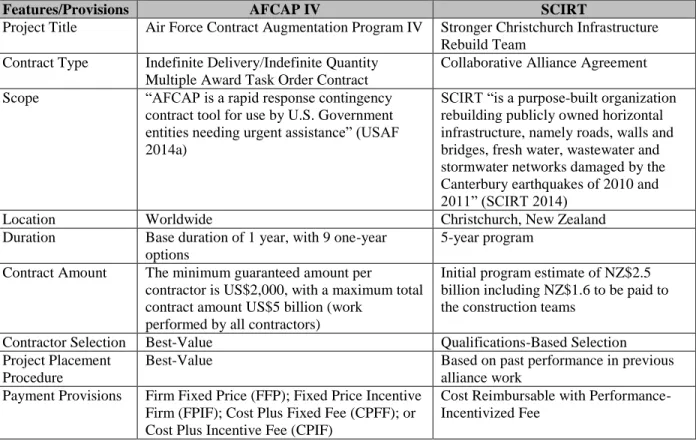
Chapter 4 corresponds to the first paper of this dissertation. This publication makes a comparison between two similar multi-billion contracts, both of them involving a fixed group of contractors competing for multiple projects during a given period of time. The first is the US Air Force Contract Augmentation Program IV (AFCAP IV), a worldwide multiple award IDIQ contract awarded by the Department of Defense (DoD), and the second contract is termed the Stronger Christchurch Infrastructure Rebuild Team (SCIRT). SCIRT comprises a collaborative alliance agreement signed by various public owners and contractors for the reconstruction of
public infrastructure damaged by the Canterbury earthquakes of 2010 and 2011 in New Zealand. The main difference between these two contracting methods lies in the level of integration among the parties involved in the contract. This paper presents a systematic comparison of these two contracts on five different aspects, including two aspects with a direct impact on
construction costs: ECI and incentive/disincentive provisions. The other three comparison aspects are general procurement and administration procedures, dispute resolution aspects, and documented advantages. The analysis of the strengths and weaknesses of each of these two case studies was used by the authors to identify opportunities of improvement in both contracting methods, including opportunities to optimize IDIQ construction costs.
The Chapter 5 paper presents a statistical analysis on the performance of twelve existing CCIs in relation to their ability to track changes in construction prices over time. The analysis was conducted to determine the most suitable CCI for price adjustment and estimating purposes in MnDOT’s IDIQ contracts. However, the analysis determined that the general principles and assumptions associated with the development, maintenance, and use of these indexes make traditional CCIs unsuitable to be used at the project level in IDIQ contracts. Therefore, an alternative construction cost indexing system was designed to overcome the drawbacks found during the analysis of the existing CCIs. The proposed indexing system is called Multi-level CCI and is described in detail in Chapter 7.
Chapter 6 holds the third paper of this dissertation, which describes the use of several risk management strategies as part of a two-phase risk analysis framework for IDIQ contracts. Phases 1 and 2 of the framework correspond to risk planning and monitoring/control, respectively. The effective risk management strategies in this framework are intended to address eight different possible risk situations commonly found in IDIQ contracts that have the potential of affecting final construction costs.
The last article of this dissertation is in Chapter 7. This paper contains the main
contribution of this dissertation: the stochastic IDIQ project selection framework. The proposed framework consists of two parts: an initial qualitative assessment of candidate projects based on the scope of work and a quantitative analysis and comparison of stochastic cost estimates considering the use of IDIQ or DBB techniques for the same specific scope of work. This comparison considers several case scenarios for different distributions of work among various
contract periods. The results of all case scenarios is presented to decision makers as a matrix to facilitate the interpretation of the results.
Chapter 8 consolidates the conclusions and limitations of the research articles presented in Chapters 4 to 7 and analyzes them as a whole. Finally, Chapter 9 summarizes the most important contributions that have resulted from the research efforts and presents
recommendations for future research to improve the IDIQ project selection framework described in Chapter 7 as well as other aspects of IDIQ contracting.
CHAPTER 2
BACKGROUND AND MOTIVATION
This chapter presents and analyzes information obtained through a comprehensive literature review on topics related to this study. The main purpose of this chapter is to complement and support the information and findings presented in the research articles
comprised in Chapters 4 to 7. This chapter provides the reader with a better understanding of the principles of IDIQ contracting and defines some key terms used throughout this presentation. Some of the information and concepts discussed in this chapter are contained in research reports and articles associated with previous research projects in which the author has participated. This chapter begins with a section summarizing NCHRP Synthesis 473 Indefinite Delivery/Indefinite Quantity Contracting Practices (Gransberg et al. 2015a), which describes the IDIQ contracting practices used by DOTs across the country and was used as the foundation for this dissertation. Furthermore, this chapter describes the main reasons that motivated the research efforts
documented in this dissertation and the problem statement framing this study.
Background
NCHRP Synthesis 473 – IDIQ Contracting Practices
The point of departure for this study was the NCHRP Synthesis 473: IDIQ Contracting Practices aimed to compile and evaluate effective IDIQ practices implemented by state DOTs across the country. The main objective of the synthesis is to “identify and synthesize current effective practices that comprise the state-of-the-practice related to the use of IDIQ contracting by public transportation agencies for highway design, construction, and maintenance contracts” (Gransberg et al. 2015a). The synthesis report covers concepts and practices of IDIQ contracting associated with following three main aspects:
1. Legal and contractual issues
2. Procurement policies and procedures, and 3. Contract administration procedures.
Information contained in the report was gathered from the literature and a formal content analysis of IDIQ procurement documents, policy and procedure manuals from 32 different state DOTs, two local transportation agencies, and 20 federal agencies. Additionally, the analysis about legal and contractual issues in IDIQ contracts was conducted using 76 legal cases. This analysis was focused on identifying trends in court decisions under different types of conflicts and common sources of disputes between contract participants.
One of the most important sources of information used in the development of the NCHRP Synthesis 473 were survey responses submitted from 43 DOTs (84% response rate) and 18 general contractors doing business in different parts of the country. This information was supplemented with four face-to-face structured interviews with general contractors and case studies on IDIQ contracts awarded by the Florida, Minnesota, Missouri, and New York State DOTs and the Central Federal Lands Highway Division.
“This study found that IDIQ techniques increase agency capabilities to quickly procure a wide range of recurrent construction and maintenance services” (Gransberg et al. 2015a). IDIQ contracting proved to be a versatile procurement tool with the ability to be combined with different project delivery methods and contracting approaches to address the particular needs of each project. “With an appropriate selection of contracting procedures, agencies could
successfully execute IDIQ contracts for almost all types of projects typically procured by state DOTs” (Gransberg et al. 2015a).
Much of the information presented in the following sections of this chapter were obtained through the literature review, surveys, and interviews conducted for the NCHRP Synthesis 473. It should be noted that the author of this dissertation was the Co-Principal Investigator and co-author of Synthesis 473.
IDIQ Contracting
The Federal Acquisition Regulation (FAR) IDIQ contracting mechanism that “provides for an indefinite quantity, within stated limits, of supplies or services during a fixed period” (FAR 2005). While this definition applies specifically to federally-funded projects, it seems to be accepted by state agencies across the country with one slight difference. The decision on whether or not to establish “stated limits” on the quantities of work to be ordered under an IDIQ contract is optional at the state-level, and depends on either regulatory constraints or agency’s
preferences. Thus, this study defines IDIQ as contracting approaches that involve the procurement of an indefinite quantity of supplies and/or services on as-needed basis using individual orders over a fixed period of time. The unique configuration of IDIQ contracts allows public owners to “reduce the need to conduct multiple procurement actions to deliver technically similar, repetitive projects to a single transaction” (Gransberg et al. 2015a).
IDIQ Terminology and Key Definitions
One of the major issues faced by the author when gathering information about current IDIQ contracting practices used by DOTs across the country was the lack of consistency in the terminology used by these agencies to refer to IDIQ contracts and the work orders issued under them. Several of these terms and their definitions are referred in the NCHRP Synthesis 473 (Gransberg et al. 2015a). The absence of a standard terminology has slowed the evolution of IDIQ contracting practices at the state level by hindering the ability of state transportation agencies to exchange experiences and lessons learned among them. For example, before the publication of the NCHRP Synthesis 473, the Florida DOT did not know that its 6-year-old Push-Button contracting program was similar to the Job Order Contracts the New York State DOT has been awarded by about a decade; therefore, the Florida DOT had not considered the possibility of evaluating the more mature set of contracting practices used by the New York State DOT to improve its own contracting procedures given that it was unknown that both programs were based on the fundamentals of IDIQ contracting.
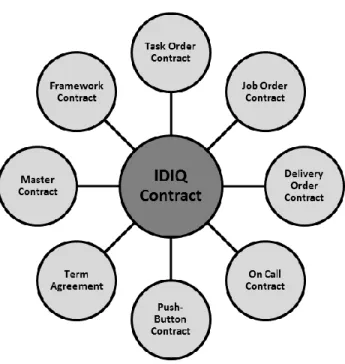
Figure 1 presents the different terms found by the NCHRP Synthesis 473 to refer to IDIQ contracts. Even though some of these terms are slightly different from each other, all of them meet the following definitions at the contract and project level (Gransberg et al. 2015a):
IDIQ: Type of contract that provides for an indefinite quantity of supplies and/or services whose performance and delivery scheduling is determined by placing work orders with one or multiple contractors during a fixed period of time.
Work Order: Every project to be executed within an IDIQ contract is developed under the issuance of a work order. A work order becomes the contract document that determines location, contract time, and scope of work. Moreover, a work order outlines all required pay items, quantities, and unit prices (MnDOT 2014). Also termed Task, Job, or Service Order.
FIGURE 1 IDIQ terminology.
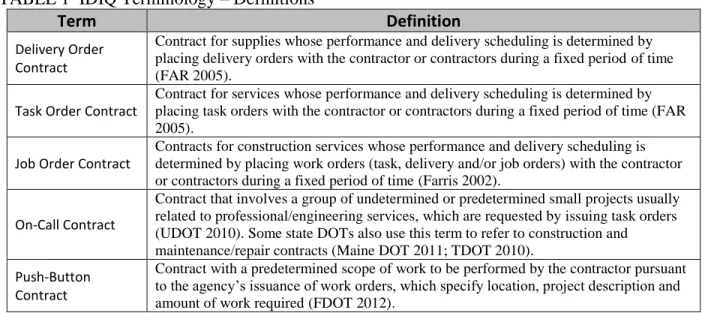
Based on the previous definitions, it can be said that IDIQ is a general concept that covers all terms in Figure 1. The terms in this figure have been either defined in the Federal Acquisition Regulation (FAR), used by other authors, or used by some state transportation agencies to refer to variations of IDIQ contracts with restrictions either in scope, size, and/or number of contractors. Table 1 presents definitions given to some of the contracts contained in Figure 3. It is important to understand that these definitions are merely common descriptions for these terms and do vary among agencies; however, all meet the generic definition for IDIQ stated above.
TABLE 1 IDIQ Terminology – Definitions
Term Definition
Delivery Order Contract
Contract for supplies whose performance and delivery scheduling is determined by placing delivery orders with the contractor or contractors during a fixed period of time (FAR 2005).
Task Order Contract
Contract for services whose performance and delivery scheduling is determined by placing task orders with the contractor or contractors during a fixed period of time (FAR 2005).
Job Order Contract
Contracts for construction services whose performance and delivery scheduling is determined by placing work orders (task, delivery and/or job orders) with the contractor or contractors during a fixed period of time (Farris 2002).
On-Call Contract
Contract that involves a group of undetermined or predetermined small projects usually related to professional/engineering services, which are requested by issuing task orders (UDOT 2010). Some state DOTs also use this term to refer to construction and maintenance/repair contracts (Maine DOT 2011; TDOT 2010).
Push-Button Contract
Contract with a predetermined scope of work to be performed by the contractor pursuant to the agency’s issuance of work orders, which specify location, project description and amount of work required (FDOT 2012).
Figure 2 presents a classification of work orders and IDIQ contracts in accordance with the different types of work and services furnished by each of them. The terminology in Figure 2 is used in this dissertation unless the author is referring to a particular agency, in which case the agency’s corresponding terminology is used. The terminology and classification of different types of IDIQ contracts illustrated in Figure 2 is based on two main aspects: the distinction as outlined by the FAR for supplies (delivery orders) and services (task orders) (FAR 2005), and the wide use of the term “Job Order” for construction services (which may include supplies and services) (Farris 2002; Rueda and Gransberg 2014a).
FIGURE 2 Work order and IDIQ contract classification scheme (Rueda and Gransberg 2014a).
IDIQ Generic Models
Three different IDIQ contracting models used by public owners have been found during a previous research conducted by the author for the development of the MnDOT IDIQ
Implementation Guide (MnDOT 2014). These models are classified in accordance with the number of contractors selected to participate in the contract and the expected number of work
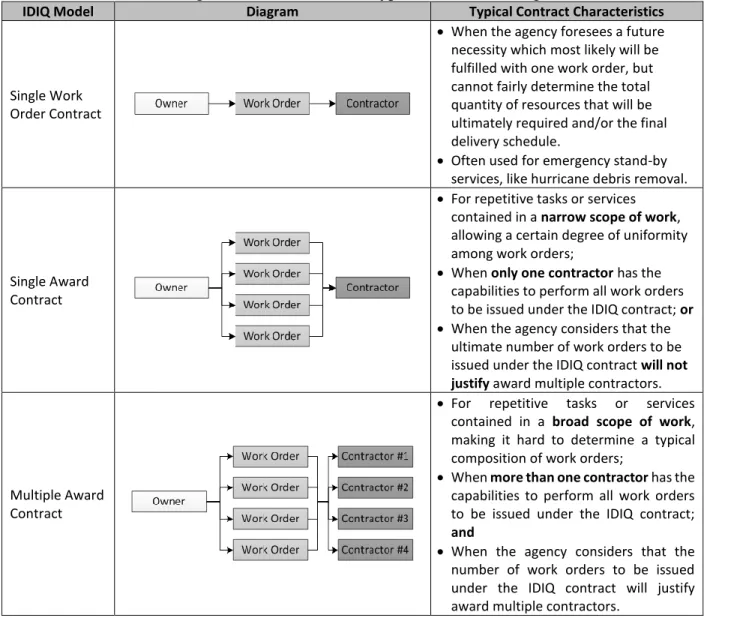
orders to be issued (Rueda and Gransberg 2014a). This classification is illustrated in Figure 3, which also highlights the three different IDIQ contracting models. Furthermore, Table 2
illustrates the structure of each contracting model and describes the most appropriate conditions for successfully using each of them.
FIGURE 3 Generic IDIQ contracting models (Rueda and Gransberg 2014a).
The FAR establishes a clear preference for multiple award IDIQ construction contracts over a single award approach for federally funded projects (this preference does not apply to architectural/engineering (A/E) services) (FAR 2005). The preference for multiple award IDIQ contracts is due to the fact that this type of contract seems to represent more benefits for agencies as a consequence of the highly competitive environment (GAO 1979; OFPP 1997). However, some authors and agencies agree that this is not always the most appropriate approach (DoD 1999), which seems to be the case of state transportation agencies. For most DOTs a single award approach “seems to better fit their procurement methods and limited resources, and even with less apparent benefits, DOTs have perceived an opportunity to improve their contracting practices” (Rueda 2013) by executing single award IDIQ contracts.
TABLE 2 IDIQ Contracting Models Structure and Typical Use (Gransberg et al. 2015a)
IDIQ Model Diagram Typical Contract Characteristics
Single Work Order Contract
When the agency foresees a future necessity which most likely will be fulfilled with one work order, but cannot fairly determine the total quantity of resources that will be ultimately required and/or the final delivery schedule.
Often used for emergency stand-by services, like hurricane debris removal.
Single Award Contract
For repetitive tasks or services contained in a narrow scope of work, allowing a certain degree of uniformity among work orders;
When only one contractor has the capabilities to perform all work orders to be issued under the IDIQ contract; or When the agency considers that the
ultimate number of work orders to be issued under the IDIQ contract will not justify award multiple contractors.
Multiple Award Contract
For repetitive tasks or services contained in a broad scope of work, making it hard to determine a typical composition of work orders;
When more than one contractor has the capabilities to perform all work orders to be issued under the IDIQ contract;
and
When the agency considers that the number of work orders to be issued under the IDIQ contract will justify award multiple contractors.
IDIQ Advantages and Disadvantages
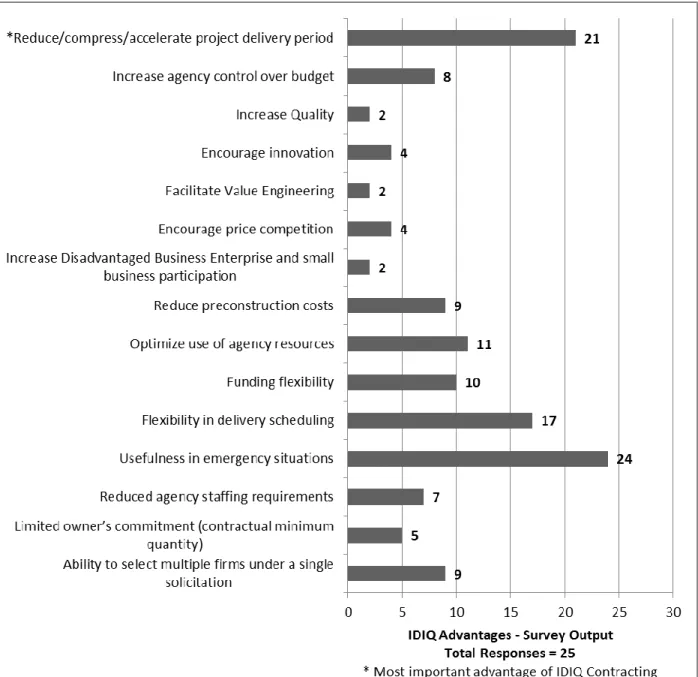
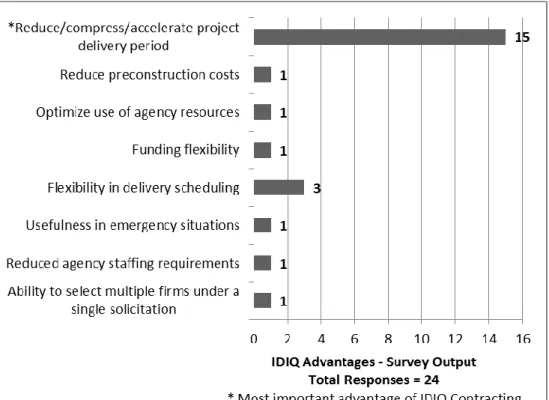
One of the objectives of the NCHRP Synthesis 473 was to understand the reasons that motivate DOTs to implement IDIQ contracting. DOT survey participants were provided with a list of potential benefits offered by IDIQ contracts and were asked to select those benefits (all that apply) that they consider their agencies are receiving from the use of this alternative contracting method. Figure 4 shows the responses to this question.
FIGURE 4 IDIQ advantages – survey output.
Nearly all the DOTs (24 out of 25) recognized that IDIQ techniques provide a quick response during emergency situations. However, when survey participants were asked in a separate question to indicate the single most important benefit of IDIQ contracts, most of them selected acceleration of the project delivery period, followed by flexibility in delivery scheduling (see Figure 5). The difference between the responses illustrated in Figures 4 and 5 is explained by the fact that the ability to effectively use IDIQ contracting for emergency situation is mainly due to the reduction of project delivery periods and the flexibility in delivery scheduling.
FIGURE 5 IDIQ most important advantage for DOTs.
Figures 4 and 5 show a wide range of benefits perceived by DOTs in the use of IDIQ contracting. However, these figures do not show the relationship between these benefits and the contracting practices adopted by these agencies. For example, agencies that selected as an advantage the ability of IDIQ contracts to award multiple contractors under a single solicitation (see Figure 4) may be those that are either currently using multiple award IDIQ contracts or considering this alternative. Different procurement policies and procedures offer different sets of benefits for public owners. A cross-reference analysis of the information collected from the literature review, the results of the content analysis on IDIQ contract documents, and the
information shown in Figures 4 and 5 reveal three different levels of advantages related to IDIQ generic models presented in Table 2. Table 3 shows the three levels of benefits, indicating those attributed to each model. This table also shows how a public owner would benefit as it moves from a single work order approach to a multiple award IDIQ contracting model. It is important to note that the one advantage that single work order and single award contracts have over multiple award IDIQ contracts is the reduced administrative effort for coordinating and supervising a
single contractor versus multiple contractors. Therefore, agencies awarding contracts to single contractors would require fewer resources to manage these contracts, an important distinction in the current environment of shrinking DOT staffs (Molenaar and Yakowenko 2007; Touran et al. 2009).
TABLE 3 Contracting Advantages of Each IDIQ Model (Rueda and Gransberg 2014a) • Owner only has to deal with one contractor
Mul ti p le Aw ar d Singl e Aw ar d Singl e W o rk O rder
• Owner can keep lower inventory levels • Flexibility in quantity and delivery scheduling
• Supplies and services are ordered when they are really needed
• Agencies commit only for a minimum or no amount of work to be ordered • Owner can direct shipments directly to the users
• Shorter project delivery period • Lower preconstruction costs
• Allows contractor involvement in preconstruction activities • Fast use of year-end funding
• Lower cost in future issuance of work orders • Useful contracting option during emergencies • Increase quality and timeliness of delivery • Reduce potential for graft and corruption • Highly competitive
• Lower bid prices
• Larger participation of small-size and disadvantaged business
This study also found two main disadvantages in IDIQ contracts regardless of the model used. As occurs with most alternative contracting methods, the first disadvantage is related to the lack of knowledge and experience of state agencies and contractors to plan, execute, and
administer IDIQ contracts (Farris 2002). The second disadvantage is a consequence of some of the benefits mentioned above. In order to obtain increased flexibility in quantity and delivery scheduling and the possibility of assigning funds on a work order basis, public owner must sacrifice their ability to conduct the traditional planning, programming, and budgeting procedures for each individual work order project in the IDIQ contract.
IDIQ Types of Work
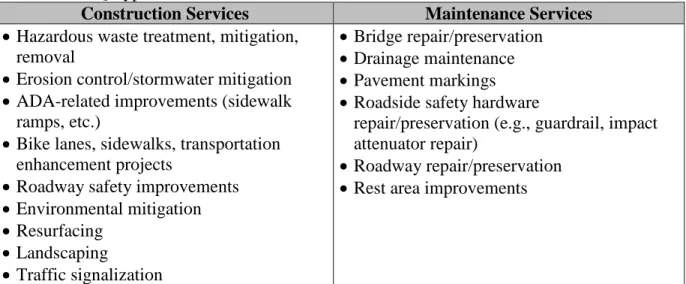
The research efforts comprised in this paper are mainly intended to get a better understanding of IDIQ construction and maintenance contracts as well as to optimize planning, contracting, and contract administration procedures in this type of contracts. In spite of the fact that the NCHRP Synthesis 473 found several state transportation agencies using IDIQ techniques for the
acquisition of design services, contracts for these types of services are not included in the scope of this dissertation. Table 4 presents a list of different construction and maintenance services found in the literature and provided to DOT survey participants to classify the types of work they perform via their IDIQ contracts.
TABLE 4 IDIQ Types of Work – Construction and Maintenance
Construction Services Maintenance Services
Hazardous waste treatment, mitigation, removal
Erosion control/stormwater mitigation
ADA-related improvements (sidewalk ramps, etc.)
Bike lanes, sidewalks, transportation enhancement projects
Roadway safety improvements
Environmental mitigation Resurfacing Landscaping Traffic signalization Bridge repair/preservation Drainage maintenance Pavement markings
Roadside safety hardware
repair/preservation (e.g., guardrail, impact attenuator repair)
Roadway repair/preservation
Rest area improvements
Motivation
The use of IDIQ contracting by state DOTs for the procurement of repetitive construction and maintenance/repair services has been growing during the last few years (Gransberg et al. 2015a). Currently, there are at least 32 DOTs using IDIQ contracts for the procurement of construction and/or maintenance projects (Gransberg et al. 2015a). Previous research conducted on the use of IDIQ contracting has revealed that the principal reason that has led state DOTs to incorporate the use of IDIQ contracting into their procurement practices is the reduction of project delivery periods, following by a great flexibility in quantity and delivery scheduling, and the ability to provide quick response before, during, and after emergency situations (Gransberg et al. 2015a). It should be noted that the literature does not cite potential construction cost savings as a potential benefit, as is the case for other forms of alternative contracting methods like design-build and construction manager/general contractor (Anderson and Damnjanovic 2008; Molenaar and Gransberg 2001), nor is it cited as a disadvantage. It seems that construction cost savings perceived by DOTs are either not substantial. On the other hand, IDIQ construction costs
may actually increase, but the logistical and operational benefits obtained are worth the extra costs. Based on comments collected from DOT project engineers and contractors during the face-to-face interviews conducted for the development of the NCHRP Synthesis 473, the author could identify three different lines of thought in regard to public owners cost implications of using IDIQ contracting:
1. Those who think that the possibility of performing work in more than one project should work as an incentive for contractor to submit lower bid unit prices;
2. Those who consider that this incentive may be lost by a high level of uncertainty inherent to IDIQ contracts, resulting in higher price proposals; and
3. Those who think that this alternative contracting approach has the potential to reduce project costs, but it is actually increasing construction prices as a result of a poor implementation by public owners.
The fact remains that formal research supporting or opposing any of these opinions is almost nonexistent, making the work associated with this dissertation both valuable and timely, given the recent interest shown in expanded use of alternative contracting methods, triggered by the FHWA Every Day Counts Program (Mendez 2010).
Problem Statement
The increasing number of alternative project delivery methods and contracting
approaches in the transportation construction industry is improving the contracting capabilities of state transportation agencies, but it is also bringing new challenges and demanding additional skills from those is charge of selecting the contracting method to be used on a specific project. “To overcome the shortcomings of vital resources, state transportation agencies are adapting by using alternative delivery methods and contracting strategies to design and build major road infrastructure projects. The difficulty that STAs face then is how to choose between the more traditional approach and an alternative contracting strategy for a specific project” (Molenaar et al. 2014). One of these alternative contracting strategies is IDIQ contracting.
The ability to consolidate multiple repetitive projects into a single solicitation, as well as the need for greater flexibility in the procurement of some types of construction services, have triggered the rapid growth in the number of IDIQ contracting programs among DOTs during the
last few years (Gransberg et al. 2015a). Regardless of the benefits provided by IDIQ contracts, these agencies are aware that this is not always the most suitable contracting approach. Due the small size and low complexity of typical IDIQ projects executed by DOTs, the potential use of IDIQ contracting usually competes with traditional DBB techniques. Thus, a major issue faced by IDIQ users, and one addressed in this dissertation is how to decide whether to use IDIQ or a traditional DBB contracting approach for a given project or group of projects.
More specifically, this dissertation addresses an issue that is not only confined to IDIQ contracts. It is the lack of mechanisms to formally determine the cost implications of alternative contracting methods. “[B]ecause no adequate and systematic methods exists to evaluate how project delivery methods and contracting approaches have impacted costs, it is difficult to validate the financial impacts of their use” (Walewski 2001). Current methods used by state transportation agencies for the selection of suitable projects for IDIQ contracting are mainly based on the scope of the projects (Gransberg et al. 2015a). Almost any group of projects that involves repetitive tasks is a good candidate for IDIQ contracting (FAR 2005).Thus, by disregarding the cost-related consequences of this decision, under some circumstances, these agencies may be unwittingly overvaluing the benefits offered by IDIQ contracting by paying unreasonably high construction prices than those that would be obtained using traditional DBB low bid procedures. To address this issue, this dissertation presents an IDIQ project selection framework that combines current scope-based selection techniques with a stochastic cost analysis of the projects under consideration. The framework was developed and validated via the methodology described in the following chapter (Chapter 3 – Research Methodology and Validation).
CHAPTER 3
RESEARCH METHODOLOGY AND VALIDATION
This chapter presents an overall description of the methodology followed in the academic publications in Chapters 4 to 7 and the validation process designed to evaluate to performance of the proposed IDIQ project selection framework. Detailed information about the methodology and research tools used in this study is provided in the methodology sections of the articles compiled into this dissertation. Since this study is based on previous findings obtained from the NCHRP Synthesis 473, there is a section in this chapter that describes the research approach and tools used for the development of this synthesis.
Research Methodology
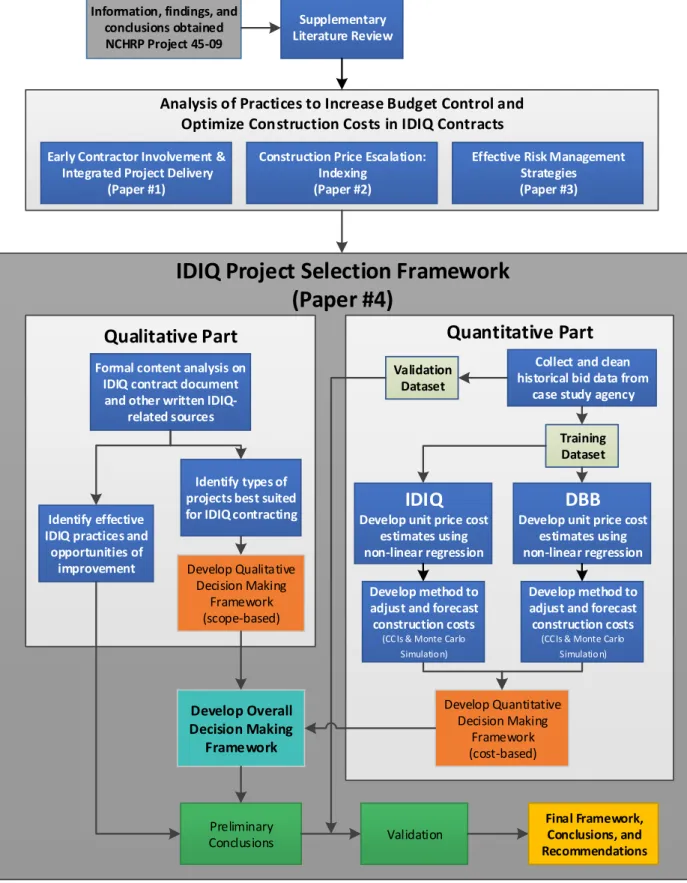
Figure 6 shows the research methodology followed in study comprised in this
dissertation. The study began with a supplementary literature review aimed to collect either new knowledge or any additional information missed or not available when conducting the NCHRP Synthesis 473. Given that the IDIQ project selection framework developed in this study relays on the performance of construction cost estimates for both IDIQ and DBB techniques, the next step in this study was to analysis different aspects and contracting practices that might help DOTs to increase budget control and optimize construction costs.
Subsequently, the process for the development of the IDIQ project selection framework was divided into a qualitative and a quantitative part. The qualitative part identifies and proposes effective IDIQ contracting practices, analyzes current IDIQ contracting techniques, and identifies any improvement opportunities that may help to optimize IDIQ construction costs. On the other hand, during the quantitative part, the author developed construction cost prediction models for IDIQ and DBB projects, allowing a comparison of expected construction costs between these contracting methods. The decision making framework delivered as a result of this study offers the possibility of comparing construction costs for IDIQ and DBB considering several different distributions of work among various contract periods. The quantitative part of this study was be conducted for a case study agency; the Minnesota Department of Transportation (MnDOT). Prediction models were be built and validated using MnDOT historical bid data for all project awarded between January 2008 and April 2015.
IDIQ Project Selection Framework
(Paper #4)
Analysis of Practices to Increase Budget Control and Optimize Construction Costs in IDIQ Contracts
Information, findings, and conclusions obtained NCHRP Project 45-09
Supplementary Literature Review
Formal content analysis on IDIQ contract document
and other written IDIQ-related sources
Identify effective IDIQ practices and
opportunities of improvement
Identify types of projects best suited for IDIQ contracting
Collect and clean historical bid data from
case study agency
IDIQ
Develop unit price costestimates using non-linear regression
DBB
Develop unit price costestimates using non-linear regression Develop Quantitative Decision Making Framework (cost-based) Preliminary Conclusions Validation Final Framework, Conclusions, and Recommendations
Qualitative Part
Quantitative Part
Develop method to adjust and forecast construction costs
(CCIs & Monte Carlo Simulation)
Develop method to adjust and forecast construction costs
(CCIs & Monte Carlo Simulation) Develop Qualitative Decision Making Framework (scope-based) Develop Overall Decision Making Framework
Early Contractor Involvement & Integrated Project Delivery
(Paper #1)
Construction Price Escalation: Indexing
(Paper #2)
Effective Risk Management Strategies (Paper #3) Training Dataset Validation Dataset
The findings and observations obtained from the qualitative and quantitative procedures were analyzed together to create and overall decision making framework, including an initial qualitative assessment (scope-based) for the pre-selection of IDIQ candidates, and a subsequent quantitative analysis (cost-based) of these candidates.
This chapter of the dissertation also includes a further description of two research methods that are not fully explained in the academic publications presented in the following chapter. The the modified Z-score and the robust regression and outlier removal (ROUT) method are two outlier detection approaches used at different stages during the analysis of MnDOT historical bid data.
Modified Z-Score Method
The modified Z-score method is used in an effort to remove unit prices related to unbalanced bids that could compromise the integrity of the study. Unit prices are considered to be unbalanced when “each bid item…fails to carry its proportionate share of the overhead and profit in addition to the necessary costs for the item. The results are understated prices for some items and enhanced or overstated prices for others” (Manzo 1997) Unbalancing is triggered by the owner overstating the bid quantities (Gransberg and Riemer 2009) and is so common that any research involving the use of DOT bid tabulation data must remove potentially unbalanced unit prices from its sample or risk unintentionally skewing the output (FHWA 1988).
The Modified Z-Score method was selected based on the fact that the use of the mean and sample standard deviation to detect and remove outliers in numerical data-sets (commonly used to handle outliers) may not be appropriate for small samples. This is due to the fact that these two indicators may be highly affected by one or few extreme values (Seo 2006). It is important to remember that the sample sizes subjected to this method are driven by the number of bidders in a single project that ranges from 2 to 6 on most MnDOT projects and which has not been larger than 13 in any single project awarded by MnDOT during the last seven years.
Following Iglewicz and Hoaglin’s (1993) recommendations, the modified Z-score method would be a more appropriate method for this study since it works better for small data-sets. Instead of the mean and sample standard deviation, this method uses the median (𝑥̃) and the absolute deviation of the median (MAD) to calculate the modified Z-score (Mi) for each number in the sample as shown below (Seo 2006).
𝑀𝐴𝐷 = 𝑚𝑒𝑑𝑖𝑎𝑛{|𝑥𝑖 − 𝑥̃|} eq.1 𝑀𝑖 = 0.6745(𝑥𝑖−𝑥̃)
𝑀𝐴𝐷 eq.2
Where: 𝑀𝐴𝐷 = Absolute deviation of the median;
𝑥𝑖 = Each number in the data-set;
𝑥̃ = Sample median; and
𝑀𝑖 = Modified Z-score for each number in the data-set.
Following Iglewicz and Hoaglin’s suggestions (1993), all unit prices whose absolute modified Z-score was less than 3.5 (|𝑀𝑖| < 3.5) were removed from the data-set.
ROUT Method
Proposed by Motulsky and Brown (2006), ROUT combines robust regression techniques with outlier removal to optimize non-linear regression methods by discarding extreme values that significantly differ from the other values in the sample. It allows finding curves that better fit the data. In this study, ROUT was used to identify unreasonable low or high unit prices not detected by the modified Z-score method. Extreme values not found by the first outlier filter may appear as a result of unusual contract requirements, forcing all contractors to bid outside the typical unit price ranges, or in contracts that involve only two price proposals. With two-data-point samples, the modified Z-score method always finds both values as valid. Both outlier detection methods assume that values are normally distributed around the mean value.
Unlike the traditional least-squares regression, robust regression techniques assign weights to the observations, decreasing the weights as observations deviate from the region where values are more concentrated. It reduces the impact that potential outliers may have on the regression analysis.
Commonly used outlier detection methods use the typical 95% confidence interval to discard values located on the tails of a Gaussian distribution; however, these methods are also often associated to a larger number of false positives mainly when dealing with large data-sets (Motulsky and Brown 2006). It should be noted that unlike the modified Z-score method, this second outlier filter is to be applied on all bid unit prices recorded for each pay item and included in MnDOT available bid data. In some cases, there are more than 1,500 observations for a single
pay item. To overcome this issue, Motulsky and Brown (2006) proposed a modified version of the False Discovery Rate (FDR) controlling procedure developed by Benjamani and Hochberg (1995) to find and eliminate outliers. The Benjamani and Hochberg’s method requires the establishment of a maximum desired FDR (Q) which works as a parameter to control the
efficiency of the procedure. “If Q is set to 1%, you can expect fewer than 1% of the 'statistically significant' findings (discoveries) to be false positives, while the rest (more than 99%) are real” (Motulsky and Brown 2006).
The proposed adaptation of the FDR method first divides the residual of each observation by the Robust Standard Deviation of the Residuals (RSDR). This ratio is intended to
approximate a t-distribution, which is then used to determine a two-tailed p-value. Subsequently, it uses FDR techniques to identify significant p-values that correspond to outliers. Motulsky and Brown (2006) summarize the ROUT method in three steps:
1. Find the best fitting curve using robust non-linear regression.
2. Identify outliers using the residuals of the robust fit and FDR techniques. 3. Discard identified outliers and perform least squares regression.
NCHRP Synthesis 473 – IDIQ Contracting Practices: Research Methodology
Information used for the development of the NCHRP Synthesis 473 was gathered using the following research instruments:
Literature review
- Comprehensive literature review of previous studies on IDIQ contracting.
- Formal content analysis following the protocol proposed by Neuendorf (2002) of IDIQ related documents from 32 state DOTs, 2 local transportation agencies, and 20 federal agencies from different sectors.
Surveys (surveys were developed using the protocol prescribed by Oppenheim [2000])
- Survey responses from 43 state DOTs (84% response rate).
- Survey responses from 18 members of the Association of General Contractors (AGC) and American Road and Transportation Builders Association (ARTBA).
- Survey responses collected during a previous research project for the development of the MnDOT IDIQ Implementation Guide (this responses were also used in the
NCHRP Synthesis 473). These responses came from 56 contractors and
subcontractors, 54 MnDOT staff members involved in the planning, execution, and closing of IDIQ contracts, and 39 surety companies doing business in Minnesota
Structured interviews (the study used the structured interviewing techniques proposed by the US Government Accountability Office [GAO 1991])
- Four face-to-face interviews with members of the AGC and ARTBA.
- Face-to-face structure interviews with project engineers from Florida, Minnesota, Missouri, and New York State DOTs and the Central Federal Lands Highway Division (CFLHD). These structured interviews were part of case study analyses of IDIQ contracts executed by these agencies - the cases were collected using Yin’s methodology for case study research data collection (1994).
Validation
As illustrated in Figure 6, the historical bid data from all projects awarded by MnDOT between January 2008 and April 2015 is divided into two data-sets; 1) a training data-set used to develop the construction cost estimating models for IDIQ and DBB contracts and 2) a validation data-set use to evaluate the performance of the cost estimating models. Projects awarded between January 2008 and August 2013 constitutes the training data-set, while the remaining projects were used for validation (September 2013 – April 2015). Both data-sets were intentionally grouped placing older projects in the training data-set since the purpose of this validation process is not only to determine the accuracy of the construction cost estimating models, but also the ability of bid data from previous projects to estimate current construction costs. More details and the results of the validation of the IDIQ project selection framework is presented in Chapter 7.
CHAPTER 4
US MAJOR TASK ORDER CONTRACTING AND NZ COLLABORATIVE ALLIANCES COMPARISON
Rueda-Benavides, J.A.,E. Scheepbouwer, and D.D. Gransberg, “US Major Task Order Contracting and NZ Collaborative Alliances Comparison,” CDR-1878, Proceedings, 2015 AACE International Annual Meeting, June 28-July 1, 2015, Las Vegas, NV.
Abstract
Relational contracts which strive to create a project deliver environment that is fully integrated are becoming more prevalent in the US and are touted to be the “magic bullet” to eliminate disputes and maximize collaboration. Similar contracts have been in use in New Zealand for over two decades and are becoming ubiquitous in Australasia for the delivery of complex infrastructure construction projects. Alliancing’s key characteristic is a “no sue” clause that has led US agencies to shy away from it as impossible to implement under US law. This paper argues that the US Department of Defense’s major task order contract is very similar to the collaborative alliance contract currently in use to deliver the massive reconstruction program estimated at approximately NZ$2.5 billion in Canterbury, New Zealand. The paper compares case studies of a US and a New Zealand projects and finds that US public owners can accrue most of the advantages provided through an alliance contract without the need to include a “no sue” clause.
Introduction
Despite the US construction industry efforts to catch up with the global trend for the implementation of more integrated project delivery methods, the adversarial culture and legal regulations framing the business activity of this industry have prevented US public owners from attaining the high level of partnering seen in some infrastructure projects overseas (Weston and Gibson 1993). It implies than US agencies are unable to take advantage of the benefits frequently attributed to fully integrated procurement environments in relation to the achievement of more
efficient procedures and superior performance during the construction of capital infrastructure projects (Barlow 2000; Van den Berg and Kamminga 2006; Duffield et al. 2014; SCIRT 2014).
The inability of public owners to create a “no blame” and “no disputes” procurement environment through “no sue” clauses is one of the principal aspects that prevent US public owners from establishing highly collaborative relationships (Gransberg et al. 2015b). However, as a result of the comparison of case studies of a US and a New Zealand projects, this paper proves that the US has procurement tools that allow federal agencies to accrue most of the advantages provided through collaborative alliancing with the need to include “no sue” clauses. The following are the two case studies compared in this study:
1. Air Force Contract Augmentation Program IV (AFCAP IV): This is an Indefinite
Delivery/Indefinite Quantity (IDIQ) MATOC awarded by the US Department of Defense (DoD) as “a rapid response contingency contract tool for use by US Government entities needing urgent assistance” (USAF 2014a). It include the delivery of engineering and construction services.
2. Stronger Christchurch Infrastructure Rebuild Team (SCIRT): This is a collaborative alliance agreement among public owners and non-owner participants formed for the reconstruction of “publicly owned horizontal infrastructure […] damaged by the Canterbury earthquakes of 2010 and 2011” (SCIRT 2014).
The paper compares these two contracting mechanism on five aspects: (1) general procurement and administration procedures, (2) dispute resolution policies, (3) early contractor involvement (ECI), (4) incentive and disincentive provisions, and (5) documented advantages. Additionally, the paper identifies some key aspects that should be addressed by regulatory policy makers to allow greater collaboration in MATOCs at the level seen in alliance agreements.
Background
Increasing construction costs, aging infrastructures, stricter construction standards and specifications, greater public demands, and limited resources have brought new challenges for public owners worldwide (Thomas et al. 2014; Pakkala 2002); challenges that cannot be efficiently addressed by traditional Design-Bid-Build (DBB) practices (Walewski et al. 2001; Shrestha et al. 2013; Gransberg et al. 2015a). This situation has moved federal and local agencies
to develop and implement alternative project delivery methods and contracting approaches such as Design-Build (DB), Construction Manager/General Contractor (CMGC) (also called
Construction Manager-at-Risk or CMR), and Public Private Partnership (PPP or P3) (West et al. 2012). Rather than finding a single one-size-fits-all procurement method to replace DBB
contracts, these alternative project delivery methods are intended to meet those agencies’ needs that DBB cannot efficiently fulfil. In other words, “public owners have been expanding their procurement toolboxes and increasing their contracting capabilities with flexible sets of
alternatives to adjust acquisition procedures to the unique needs of each project” (Gransberg et al. 2015a). Thus, the selection of the contracting method by the agency or client (in New Zealand contracting terms) is aimed to attain the best value-for-money (SCIRT 2014). In the particular case of the two contracting models analyzed in this paper, multiple award task order contracts (MATOC) and collaborative alliancing, they are specifically intended to procure construction services for large and complex projects (Scheepbouwer and Gransberg 2014), which usually represent higher risks for all stakeholders, demanding advanced procurement strategies and management practices.
Although both the MATOC and collaborative alliance agreement are mechanisms that involve a pool of contractors competing for multiple projects during the contract period, they can be considered philosophically different in terms the nature of the relationships among
stakeholders. While collaborative alliancing promotes a high degree of integration among all contracting parties (Scheepbouwer and Gransberg 2014), the level of interaction between the owner, contractors, and consultants in a MATOC does not differ from that found in other delivery method, depending on the delivery method used at the project level (i.e. DBB, DB, CMGC) (Gransberg et al. 2015a).
In addition to those authors already cited in this paper, other researchers have published their findings highlighting the benefits of alliancing, and similar techniques that promote collaboration and integration among stakeholders, in terms of cost and time savings while improving or maintaining project quality (Scott 1995; Hauck et al. 2004; Fortune and Setiawan 2005; Spang and Riemann 2014). In a more specific study, Rowlinson et al. (2006) highlighted an important aspect that should be taken into consideration when using alliancing techniques. This research team evaluated the implications of “no sue” clauses in an alliancing agreement executed in Queensland, Australia. This study suggests that substantial efforts are required from