On-Board Oxygen
Generation Systems (OBOGS)
PHYSIOLOGY, TECHNOLOGY,
... TOTAL LIFE SUPPORT
Sustaining life
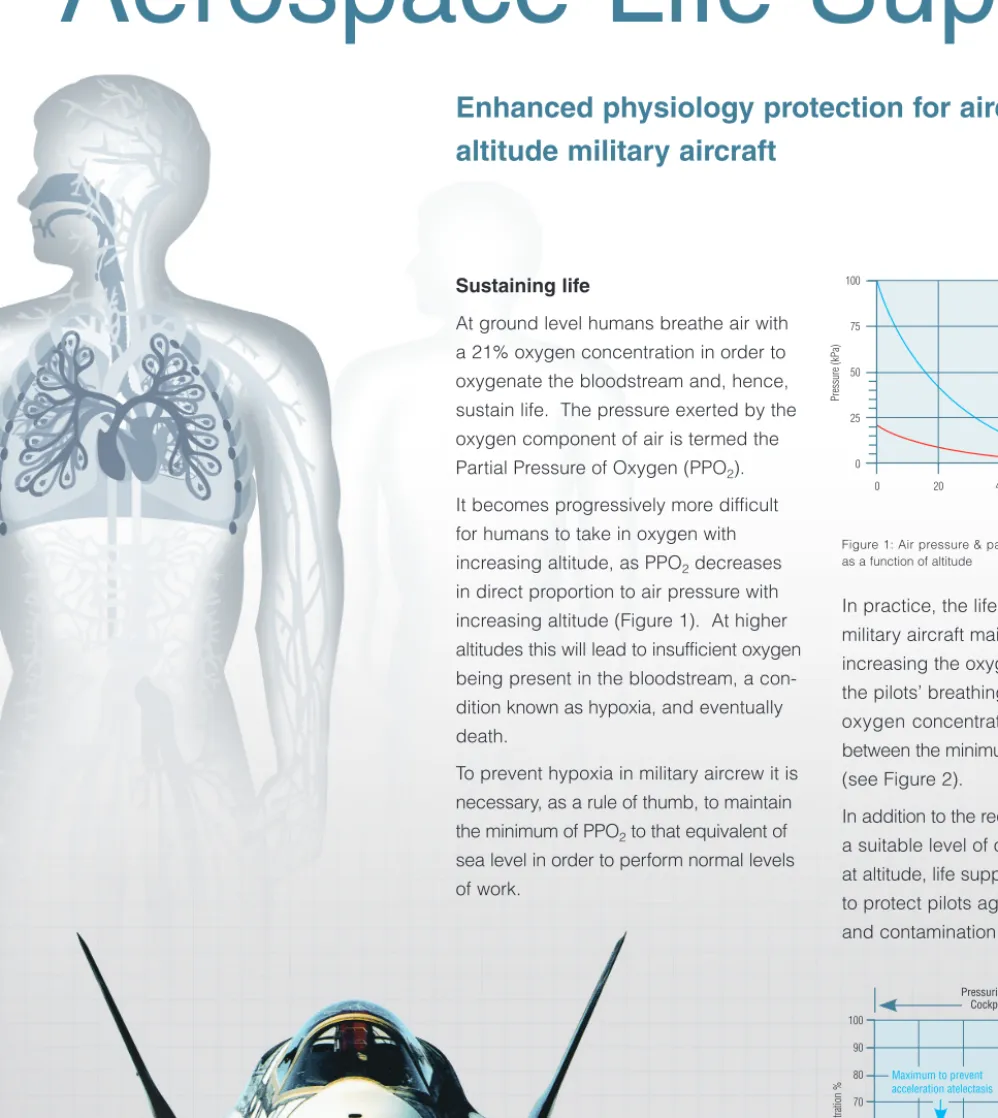
At ground level humans breathe air with a 21% oxygen concentration in order to oxygenate the bloodstream and, hence, sustain life. The pressure exerted by the oxygen component of air is termed the Partial Pressure of Oxygen (PPO2). It becomes progressively more difficult for humans to take in oxygen with increasing altitude, as PPO2decreases in direct proportion to air pressure with increasing altitude (Figure 1). At higher altitudes this will lead to insufficient oxygen being present in the bloodstream, a con-dition known as hypoxia, and eventually death.
To prevent hypoxia in military aircrew it is necessary, as a rule of thumb, to maintain the minimum of PPO2to that equivalent of sea level in order to perform normal levels of work.
Aerospace Life Support
In practice, the life support systems of military aircraft maintain PPO2levels by increasing the oxygen concentration of the pilots’ breathing gas supply, where oxygen concentration is maintained between the minimum and maximum levels (see Figure 2).
In addition to the requirements to maintain a suitable level of oxygen concentration at altitude, life support systems also need to protect pilots against acceleration (G) and contamination.
Enhanced physiology protection for aircrew of high
altitude military aircraft
Figure 1: Air pressure & partial pressure of oxygen (PPO2) as a function of altitude
From
GOX to LOX
liquid form in a cryogenic storage dewar. Storage in liquid form allows approximately five times as much oxygen to be contained in a given volume when compared to GOX. The LOX converter, however, has to be removed from the aircraft to be refilled (replenished).
Limitations of LOX and GOX The principal limitation of both LOX and GOX is the amount of oxygen that can be carried on the aircraft, which limits both mission duration and flexibility. This situ-ation is exacerbated on aircraft that have in-flight refuelling capability, where oxygen becomes the determining factor of mission duration, rather than fuel.
Additionally, LOX systems require consid-erable infrastructure/plant at the operating base to replenish the aircraft system, preventing rapid deployment of aircraft to unprepared frontline bases such as commercial airports.
To overcome these limitations, both GOX and LOX have been replaced for new platforms by systems that generate oxygen continuously during flight. These systems are also being
retrofitted to in-service platforms which began life with GOX or LOX. Gaseous Oxygen (GOX) Systems
The earliest and simplest method of providing oxygen to military aircrew was to store gaseous oxygen (GOX) at high pressure, typically 1800 psi, in metal cylinders or bottles.
Gas from the cylinders is fed via non-return valves to the pilot breathing regulator in the cockpit, after first being reduced to 70-90 psi.
The breathing regulator provides demand regulation, whereby flow is actuated when the pilot breathes in and shuts off when the pilot breathes out. The regulator also dilutes the oxygen with cockpit air to achieve the desired oxygen concentration for a given altitude, also known as ‘air-mix’.
The major limitation of GOX systems is the quantity of gas required for typical missions, which leads to the requirement for large storage cylinders, or a number of smaller cylinders. This has to be considered in conjunction with the available space for installing such cylinders. The shortage of installation space inevitably leads to the mission duration being compromised.
The cylinders are charged (replenished) by means of a charging point on the side of the aircraft, to which an external source of GOX is connected.
Liquid Oxygen (LOX) Systems To allow greater oxygen storage, second generation systems store oxygen in a
The first oxygen systems
for military aircraft used
oxygen stored in
gaseous form at high
pressure in metal
cylinders or bottles.
Primary Gaseous Oxygen (GOX) cylinder Tornado – Liquid Oxygen
On-Board Oxygen Generation Systems (OBOGS)
Honeywell developed OBOGS technology in the 1980’s to allow an aircraft to generate its own oxygen during flight. OBOGS takes advantage of a molecular sieve material, Zeolite, which traps nitrogen molecules when air is passed through it, allowing it to act as a molecular sieve. Figure 3 shows an OBOG concentrator with 2 zeolite-filled beds. The lower zeolite bed is currently producing oxygen. Conditioned engine bleed air enters the lower bed, having first been filtered to remove particulate contaminants, and is
then reduced to a suitable pressure by the Pressure-Reducing Valve.
As the air passes along the zeo-lite bed, the nitrogen
mole-cules within it are adsorbed by the zeolite.
At the far end of the bed, a product gas that is up to 95% oxygen is produced, the balance of the gas being made up of argon. The presence of argon has been widely shown to have no physiological effect on crew/pilots.
Over time, the bed becomes saturated with nitrogen, and oxygen production is switched to another bed that has been purged of nitrogen.
The upper bed in Figure 3 is in the process of having the nitrogen removed, by using part of the product gas from the lower bed to ‘purge’ the nitrogen out of the bed to then be vented overboard. Once the upper bed is clean, oxygen production will be switched to it, whilst regeneration of the now nitrogen full lower bed is carried out, and so the cyclical process continues.
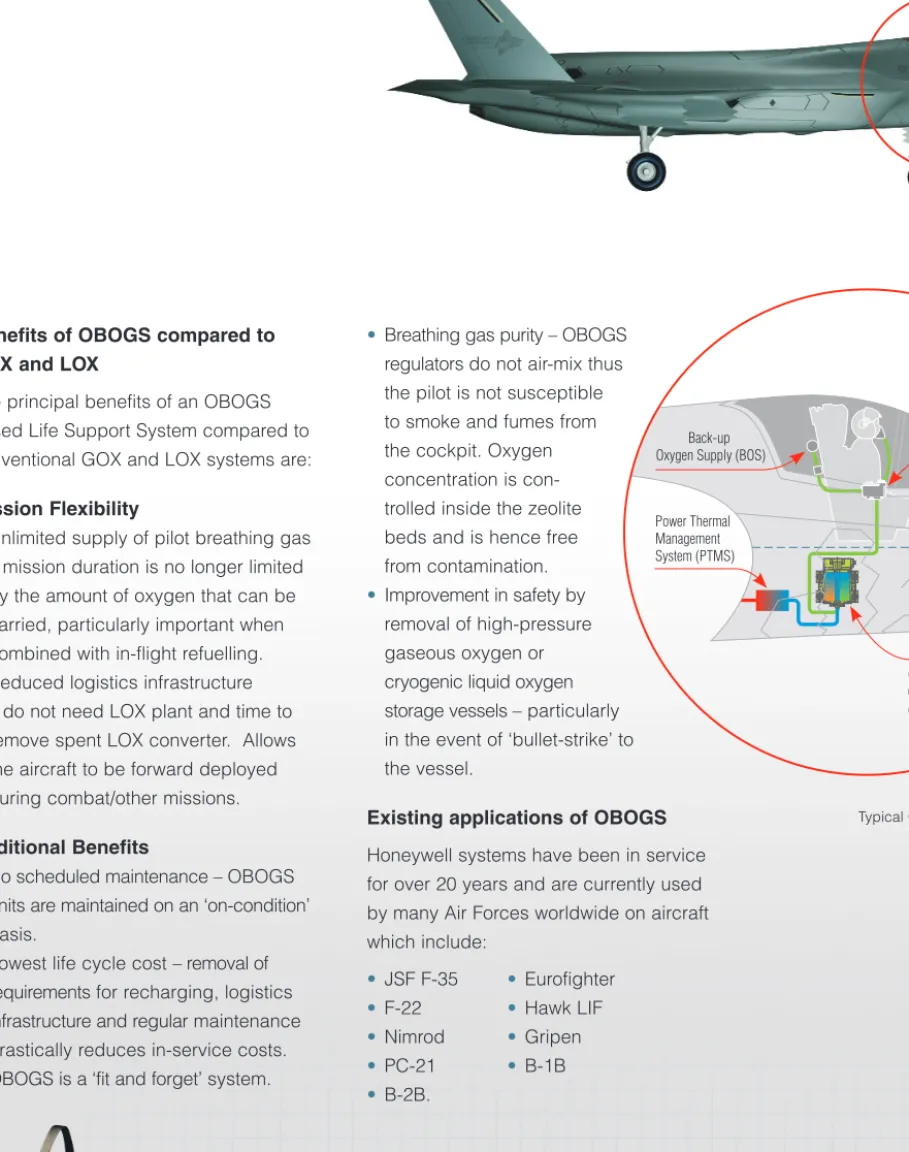
Typical System Architecture A typical system is shown in Figure 4. The OBOGS is controlled by a solid state monitor/controller that monitors the PPO2 level of the OBOGS product gas, and adjusts the cycling of the beds to produce the desired level of oxygen concentration shown in Figure 2. This process is known as concentration control and means that no air-mix, or dilution, of the product gas is required at the regulator.
The breathing gas then passes to the pilot’s breathing regulator, either a console/ panel-mounted, ejection seat-mounted or pilot-mounted device. The regulator is a demand flow regulator like those of GOX and LOX systems, differing only in the fact that they operate at lower pressures and do not air-mix. The final system element is a back-up oxygen cylinder mounted on the ejection seat to provide oxygen during pilot ejection, or in the unlikely event of an interruption in the OBOGS supply.
On-Board Oxygen
Generation Systems
OBOGS offer significant
advantages in reliability,
safety and performance
over older GOX and LOX
systems
Figure 3
Benefits of OBOGS compared to GOX and LOX
The principal benefits of an OBOGS based Life Support System compared to conventional GOX and LOX systems are: Mission Flexibility
• Unlimited supply of pilot breathing gas – mission duration is no longer limited by the amount of oxygen that can be carried, particularly important when combined with in-flight refuelling. • Reduced logistics infrastructure
– do not need LOX plant and time to remove spent LOX converter. Allows the aircraft to be forward deployed during combat/other missions. Additional Benefits
• No scheduled maintenance – OBOGS units are maintained on an ‘on-condition’ basis.
• Lowest life cycle cost – removal of requirements for recharging, logistics infrastructure and regular maintenance drastically reduces in-service costs. OBOGS is a ‘fit and forget’ system.
•Breathing gas purity – OBOGS regulators do not air-mix thus the pilot is not susceptible to smoke and fumes from the cockpit. Oxygen concentration is con-trolled inside the zeolite beds and is hence free from contamination. •Improvement in safety by
removal of high-pressure gaseous oxygen or cryogenic liquid oxygen storage vessels – particularly in the event of ‘bullet-strike’ to the vessel.
Existing applications of OBOGS Honeywell systems have been in service for over 20 years and are currently used by many Air Forces worldwide on aircraft which include: •JSF F-35 •Eurofighter •F-22 •Hawk LIF •Nimrod •Gripen •PC-21 •B-1B •B-2B.
F-22 – On-Board Oxygen Generation System BAE SYSTEMS/Saab Gripen JSF F-35 – On-Board Oxygen Generation System – On-Board Oxygen Generation System
Figure 4 Typical OBOG system architecture
For over 50 years
Honeywell has
designed, developed,
manufactured, qualified
and supported breathing
regulators for military
aircraft. To date more
than 10,000 regulators
have been delivered to
Air Forces worldwide.
Breathing
Regulation
The family of regulators has very low life cycle costs driven by a high level of reliability together with zero scheduled maintenance. Regulators are available as pilot-mounted, console/panel-mounted and ejection seat-mounted devices, each with a high degree of commonality with the others to further reduce costs across mixed fleets of aircraft.
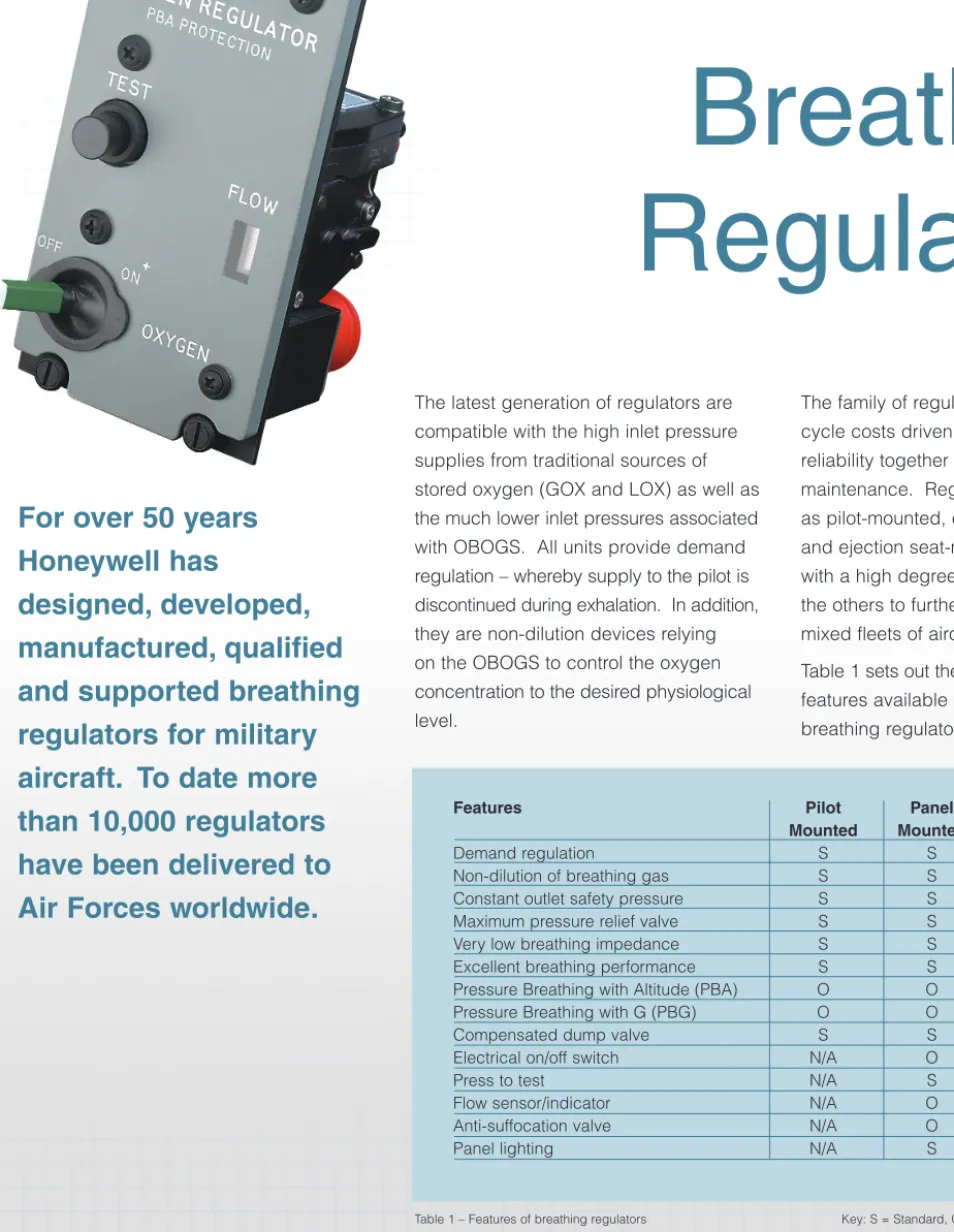
Table 1 sets out the standard and optional features available from Honeywell’s breathing regulators.
The latest generation of regulators are compatible with the high inlet pressure supplies from traditional sources of stored oxygen (GOX and LOX) as well as the much lower inlet pressures associated with OBOGS. All units provide demand regulation – whereby supply to the pilot is discontinued during exhalation. In addition, they are non-dilution devices relying on the OBOGS to control the oxygen concentration to the desired physiological level.
F-22 – Panel mounted Breathing Regulator F/A-18 – Chest mounted breathing regulator BAE SYSTEMS/Saab Gripen – Breathing Regulator & Anti-G
& Anti-G (BRAG) valve (BRAG) valve
Features Pilot Panel Ejection Seat Mounted Mounted Mounted
Demand regulation S S S
Non-dilution of breathing gas S S S
Constant outlet safety pressure S S S
Maximum pressure relief valve S S S
Very low breathing impedance S S S
Excellent breathing performance S S S
Pressure Breathing with Altitude (PBA) O O O
Pressure Breathing with G (PBG) O O O
Compensated dump valve S S S
Electrical on/off switch N/A O O
Press to test N/A S S
Flow sensor/indicator N/A O O
Anti-suffocation valve N/A O O
Panel lighting N/A S N/A
Monitors & Controllers
At the heart of every OBOG system is the monitor/controller that is responsible for sequencing the operation of the OBOG concentrator beds to deliver the desired oxygen concentration to the pilot for the altitude at which the aircraft is flying. The actual level of concentration output from the OBOGS is continuously monitored and its operation adjusted to keep within specified physiological limits. Monitoring is carried out using solid-state zirconia sensing technology. The output of the OBOGS is measured to determine the level of PPO2and this value is then converted into an oxygen concentration level in conjunction with the output from a cabin pressure sensor.
The monitor/controller is partitioned such that a failure of the sensing element would not jeopardise the safety of the system, as the controller will switch to ‘max mode’ and drive the OBOGS to its maximum performance level.
The monitor function is also available as a discrete oxygen concentration sensor, with applications such as On-Board Inert Gas Generation Systems (OBIGGS).
System Elements
& Integration
be ‘flown’ for objective testing - carried out using breathing machines to simulate pilot demand or subjective testing -using human subjects.
The latter, human subject testing is often referred to as ‘man-rating’ and is required by Air Forces to demonstrate that the system delivers the required oxygen concentration to maintain a pilot in good health at altitude, whilst carrying out representative workloads. Honeywell is the only system supplier worldwide to have such man-rating facilities in-house. Cylinders and Components
In addition to OBOG concentrators, controllers and regulators, Honeywell designs and supplies all of the other elements from which an OBOG system is constructed, namely:
•Back-up Oxygen System (BOS) Cylinders •Emergency Oxygen (EO) Cylinders •Regulated Integrated Terminal Block
(RITB) •Pre-coolers
•Pneumatic valves and temperature /pressure sensors
•Water separators and inlet filters •Aircraft seat/pilot interface connectors Integration and Man Rating
Honeywell has comprehensive oxygen development/test facilities with all the resources and infrastructure required to carry out the in-house development and qualification of all of the elements of an OBOG system. This capability allows for considerable reduction in development timescales through concurrent engineering. Honeywell is also able to ‘fly’ complete systems in altitude chambers for formal system level qualification. Systems can
Typical On-Board Inert Gas Generation Back-up Oxygen Supply (BOS) – JSF F-35 &
N61-0333-000-003 January 2008
© 2008 Honeywell International Inc.
Honeywell Aerospace Bunford Lane, Yeovil Somerset BA20 2YD UK Tel: +44 (0)1935 475181 Fax: +44 (0)1935 427600 www.honeywell.com
Applications
/Platforms
Find out more
For more information on Honeywell life support systems, contact Honeywell Aerospace Yeovil on: Tel: +44 (0)1935 475181 or e-mail: [email protected] Lockheed Martin F-35 Eurofighter BAE SYSTEMS Hawk BAE SYSTEMS/ SAAB Gripen Nimrod MRA Mk4 Pilatus PC-21 Lockheed Martin F-22 F-18 Harrier F-14 B-1B B-2B
North America
• Allentown, Pennsylvania • Anniston, Alabama • Dallas, Texas• Fort Lauderdale, Florida
• Greer, South Carolina
• Houston, Texas
• Kingman, Arizona
• Long Beach, California
• Memphis, Tennessee
• Minneapolis, Minnesota
• Montreal, Canada
• Phoenix, Arizona
• Prince Edward Island, Canada
• Rocky Mount, North Carolina
• Savannah, Georgia
• Seattle, Washington
• South Bend, Indiana
• Strongsville & Urbana, Ohio
• Tempe, Arizona
• Toronto, Canada
• Torrance, California
• Tulsa, Oklahoma
• Tucson, Arizona
• Olathe & Wichita, Kansas
Europe, Middle East, Africa,
Asia and the South Pacific
•Basingstoke, UK •Bournemouth, UK •Cologne, Germany •Copenhagen, Denmark •Dublin, Ireland •Feltham, UK •Gauting, Germany •Guam •Hamburg, Germany •Hlubocky-Marianske Udoli, Czech Republic
•Kuala Lumpur, Malaysia
•Luton, UK
•Melbourne, Australia
•Panama
•Pôrto Alegre, Brazil
•Prague, Czech Republic
•Raunheim, Germany
•São Paulo, Brazil
•Shanghai, China
•Singapore
•Stansted, UK
•Subic Bay, Philippines
•Toulouse, France
•Vendôme, France
•Xiamen, China