Microalgae: an alternative source of biodiesel
for the compression ignition (CI) engine
Muhammad Aminul Islam
A thesis submitted in fulfilment of the requirements for the Degree of
Doctor of Philosophy (PhD)
At the
Queensland University of Technology
School of Chemistry, Physics and Mechanical Engineering
Science and Engineering Faculty
i
Statement of original authorship
The work contained in this thesis has not been previously submitted for a degree or diploma at any other education institution. To the best of my knowledge and belief, this thesis contains no material previously published or written by another person except where due reference is made.
Signed: QUT Verified Signature Date: December 2014
ii
iii
Abstract
Interest in finding renewable energy sources is increasing as pollution continues to rise. Regulating authorities around the globe are taking more sustainable approaches to energy than just the use of fossil fuels, with biofuel leading the research as one of the most promising contributors. Microalgae biodiesel is a carbon-neutral biodiesel source that could potentially replace depleting fossil fuels. There is however, a lack of knowledge on the technology for biodiesel production from microalgae and the effect of this type of biodiesel on combustion in modern compression ignition engines.
Primarily, this thesis reports the investigation of the fatty acid profile of several microalgae species and their fuel properties, with a focus on suitable species for biodiesel production. Species selection is an important element in the downstream process of microalgae biodiesel production. Consideration of the growth rate, oil yield, fatty acid composition, cell structure and geographical location of each species can be varied and differences need to be accommodated. A secure, reliable and efficient model for the selection process needs to be selected to analyse commercially viable microalgae species. The PROMETHEE-GAIA is a multi-criteria analyser that is currently a potential model for this selection process and is suitable for assessing biodiesel production and fuel properties.
In the downstream process of biodiesel production from microalgae, an optimal oil extraction process is necessary to reduce the production cost. There are many lab-scale oil extraction processes from microalgae already established in the literature, however, large-scale oil extraction is not yet established and supported with proper experimental evidence. Solvent extraction is one of the most common extraction methods according to recent research, although there are other potential methods that exist at lab-scale, such as supercritical fluid extraction, accelerated solvent extraction (ASE) at high pressure. The supercritical solvent extraction appears highly efficient and less
iv
toxic than other methods as it does not use any organic solvent. Sophisticated technology and high capital costs are the main hurdles for large-scale extraction by supercritical fluid extraction methods, although the ASE method reduces the extraction time at elevated temperature and pressure so the solvent can be recovered and reused. This extraction method can manipulate fatty acid composition and fuel properties with different extraction temperatures and sample dryness, which enhances the possibilities for wider use.
The fuel properties of microalgae methyl ester are highly influenced by its fatty acid composition. Therefore, it has to be in a suitable composition to ensure the biodiesel quality complies with international standards must be determined. The physiochemical properties of microalgae methyl ester and its fatty acid composition are investigated in this study. It was found that the polyunsaturated fatty acids have a negative impact on the cetane number and positive effects on iodine value. It was observed that the kinematic viscosity was negatively influenced by some long chain, polyunsaturated fatty acids, C20:4, C20:5 and C22:6, along with some of the most common saturated fatty acids, C14:0 and C16:0. The average chain length has a positive impact on higher heating value, where as C18:3 was found most unfavourable for cold filter plugging point and oxidation stability. The overall influence of fatty acid composition of individual fatty acids on fuel property is shown using Multi-Criteria Decision Analysis (MCDA) software PROMETHEE (Preference Ranking Organisation Method for Enrichment Evaluation), and is presented in the GAIA (Graphical Analysis for Interactive Assistance) plan.
This thesis advances knowledge in the field of microalgae biodiesel research. The work has developed a methodology for screening microalgae species and for ensuring that the biomass is suitable for biodiesel production. A multiple extraction methods analysis contributes to the development of sustainable large-scale oil extraction. The study of fuel properties and fatty acid composition enhances our understanding about microalgae biodiesel and its potential to supplement global biodiesel demand. Blends of 10% and 20%
v microalgae biodiesel with petroleum diesel, can achieve nearly the same power and brake specific fuel consumption as pure petroleum diesel. However, 50% blends are found to reduce the power output, increase NOx emission and increase brake specific fuel consumption. This experimental investigation of microalgae biodiesel in a compression ignition engine demonstrates its suitability for this purpose.
vi
vii
Keywords
Biodiesel standard Biofuel chain length Degree of saturation Emission Engine performance Extraction Fatty acidFatty acid profile Fuel property Glycerine Lipid Microalgae
Multi-criteria decision analysis Pigment
PROMETHEE GAIA Species selection Transesterification
viii
ix
List of Symbols
Symbol Quantity Unit
BMEP Brake mean effective pressure MPa BSFC Brake specific fuel consumption gkW-1 h-1
BTE Brake thermal efficiency (%)
θ Crank angle degree
ρ Density g cm−3
FMEP Frictional mean effective pressure MPA
HHV Higher heating value MJ kg-1
h Time Hour
IMEP Indicated mean effective pressure MPa
IV Iodine value I2100g-1 fat
υ Kinematic viscosity mm2 s−1
L Volume Litre
NOx Nitrogen oxide gkW-1 h-1
OS Oxidation stability h
SV Saponification value mg KOHg-1
x
List of abbreviations
ASE Accelerated solvent extraction
ASTM American Society for Testing and Materials
CN Cetane number
CNL Canola CS Cottonseed
DHA Docosahexaenoic acid
DW Dry weight
EN European standard
EPA Eicosapentaenoic acid
FAME Fatty acid methyl ester FGB First generation biofuel
GAIA Graphical Analysis for Interactive Assistance GC-MS Gas Chromatography-mass spectrometry HHV Higher heating value
IPA Iso-propanol
IV Iodine value
KV Kinematic viscosity
MCDA Multi-criteria decision analysis MUFA Monounsaturated fatty acid POME Palm oil methyl ester
PROMETHEE Preference Ranking Organisation Method for Enrichment Evaluation PUFA Polyunsaturated fatty acid
SERI Solar energy research institute SFA Saturated fatty acid
SGB Second generation biofuel TAG Triacylglycerol TGB Third generation biofuel WCO Waste cooking oil
xi
List of Publications Arising from This Thesis
Journal Papers:
Islam, Muhammad Aminul, Magnusson, Marie, Brown, Richard J., Ayoko, Godwin A., Nabi, Md. Nurun, & Heimann, Kirsten. Microalgal species selection for biodiesel production based on fuel properties derived from fatty acid profiles. Energies 2013, 6(11), 5676-5702; doi:10.3390/en6115676
Islam, Muhammad Aminul, Brown, R. J., O’Hara, I., Kent, M. and Heimann, K. (2014). "Effect of temperature and moisture on high pressure lipid/oil extraction from microalgae." Energy Conversion and Management 88(0): 307-316..doi: 10.1016/j.enconman.2014.08.038
Islam, Muhammad Aminul, Rahman, M. M., Heimann, K., Nabi, M. N.,
Ristovski, Z. D., Dowell, A., Thomas, G., Feng, B., von Alvensleben, N. and Brown, R. J. (2015). "Combustion analysis of microalgae methyl ester in a common rail direct injection diesel engine." Fuel 143(0): 351-360, I.F. 3.406
Islam, Muhammad Aminul, Brown, Richard J., Brooks, P.R., Bockhorn, H., M.I. Jahirul, Heimann, Kirsten. Investigation of The Effect of Fatty Acid Profile on Fuel Properties Using a Multi-Criteria Decision Analysis (PROMETHEE-GAIA).(In preparation)
Conference papers:
Islam, Muhammad Aminul, Brown, R. J., Heimann, K., Von Alvensleben, N., Brooks, P. R., Dowell, A. and Eickhoff, W. (2014). Evaluation of a pilot-scale oil extraction from microalgae for biodiesel production. International Conference on Environment and renewable Energy, 7-8 May 2014, Paris, France. 3: 133-137.
Islam, Muhammad Aminul, Ayoko, Godwin A., Brown, Richard J., Stuart, Doug, & Heimann, Kirsten (2013). Influence of fatty acid structure on fuel properties of algae derived biodiesel. 5th BSME International
xii
Conference on Thermal Engineering, 21-23 December, 2012, Dhaka, Bangladesh. Procedia Engineering, 56, pp. 591-596.
Bodisco, Timothy A., Pham, Phuong X., Islam, Muhammad Aminul, Brown, Richard J., Masri, Assaad R., & Bockhorn, Henning (2013) Ignition delay of bio-fuels in a common-rail compression ignition engine. In Proceedings of the Australian Combustion Symposium, 6th November 2013, Perth, Western Australia.
xiii
Table of
Contents
Abstract ... iii Keywords ... vii List of Symbols ... ix List of abbreviations ... xList of Publications Arising from This Thesis ... xi
Table of Contents ... xiii
Chapter 1. Introduction 1 1.1. Background and Motivation ... 1
1.2. Hypothesis ... 3
1.3. Research objectives ... 3
1.4. Research questions ... 4
1.5. Research approach ... 5
1.6. Organisation of the thesis ... 8
Chapter 2. Microalgae biodiesel research 11 2.1. Introduction ... 11
2.2. Biodiesel ... 12
2.2.1. Classification of biofuel ... 12
2.2.2. Significance of biodiesel research ... 13
2.3. Microalgae ... 14
2.3.1. Classification of lipids ... 15
2.3.2. Potential of biodiesel production from microalgae ... 17
2.3.3. Challenges in microalgae biodiesel production ... 19
2.4. Oil extraction from microalgae ... 20
2.4.1. Mechanical disruption ... 21
2.4.2. Supercritical fluid extraction ... 21
2.4.3. Solvent extraction ... 22
2.4.4. Thermal liquefaction ... 24
xiv
2.4.6. Discussion ... 25
2.5. Biodiesel production ... 25
2.5.1. Transesterification ... 26
2.6. Discussion ... 26
2.7. Fatty acid composition of microalgae methyl ester and fuel properties ... 27
2.7.1. Higher heating value ... 29
2.7.2. Cetane number ... 29
2.7.3. Oxidation stability ... 30
2.7.4. Cold filter plugging point ... 30
2.7.5. Density ... 31
2.7.6. Kinematic viscosity ... 31
2.8. PROMETHEE-GAIA a multi-criteria decision analysis ... 31
2.9. Biodiesel as an alternative fuel for diesel engine ... 34
2.9.1. Biodiesel engine performance ... 35
2.9.2. Biodiesel exhaust emission ... 36
2.10. Conclusion ... 38
Chapter 3. Microalgal species selection 41 3.1. Introduction ... 44
3.2. Materials and methodology ... 47
3.2.1. Materials ... 47
3.2.2. Lipid Content, Fatty Acid Methyl Ester Analysis ... 49
3.2.3. Calculation of Fuel Properties from Fatty Acid Profiles ... 50
3.3. Results and Discussion ... 53
3.3.1. Lipid Content ... 53
3.3.2. FAME Composition ... 57
3.3.3. Fuel Properties ... 60
3.3.4. Selection of Suitable Algae Species for Biodiesel ... 67
3.4. Conclusions ... 76
Chapter 4. Oil extraction and biodiesel conversion 78 4.1. Introduction ... 81
xv
4.2.1. Sample preparation ... 84
4.2.2. Experiment setup ... 85
4.2.3. Determination of total lipid and fatty acid methyl ester (FAME) content ... 86
4.2.4. Determination of cetane number, kinematic viscosity, higher heating and iodine values ... 87
4.3. Results and discussion ... 88
4.3.1. Impact of ASE process variables on total lipid yields as assessed through pigment content (colour saturation) of the extracts ... 88
4.3.2. Effect of temperature and sample dry biomass water ratio (DBWR) on total lipid and total FAME extraction... 89
4.3.3. Effect of process time on total FAME extraction yields ... 90
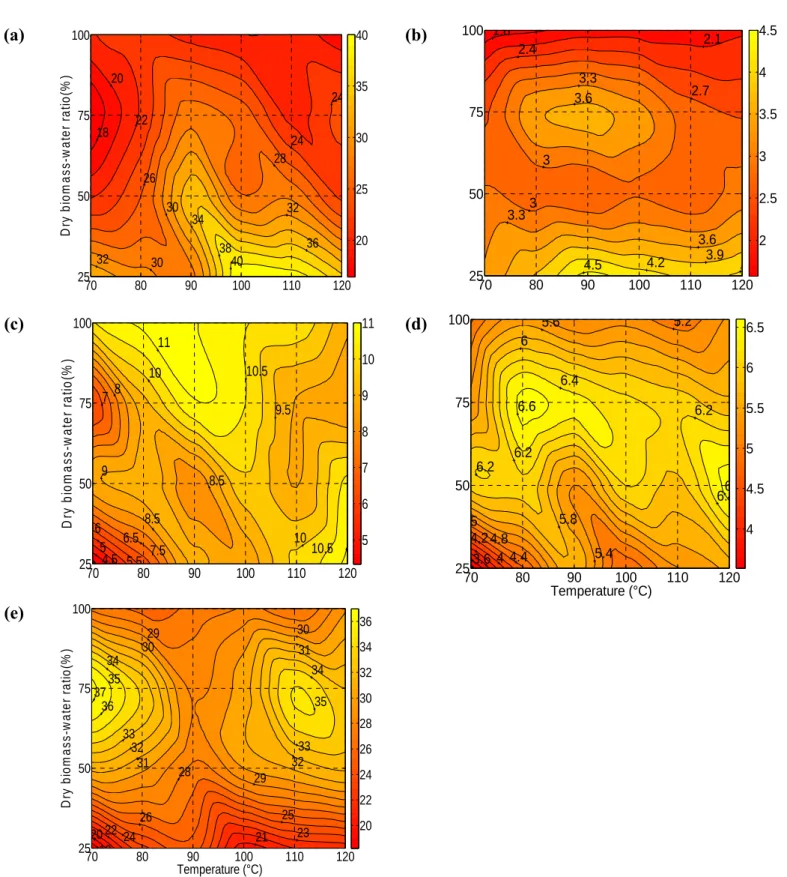
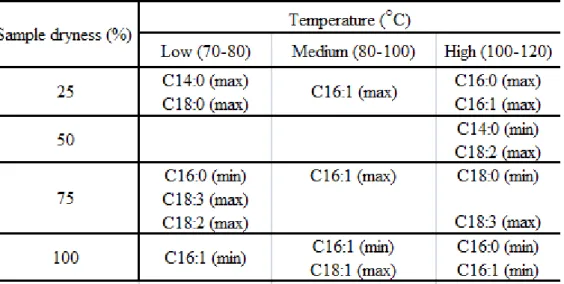
4.3.4. Effect of temperature and sample dry biomass water ratio (DBWR) on individual fatty acid extraction yields ... 91
4.3.5. Comparison of ASE with other selected extraction methods ... 96
4.3.6. Fuel property analysis ... 99
4.4. Conclusion ... 103
4.5. Pilot-scale oil extraction ... 106
4.5.1. Introduction ... 109
4.5.2. Materials and methodology ... 111
4.5.3. Solvent selection ... 112
4.5.4. Static n-Hexane extraction ... 114
4.5.5. Transesterification and FAME profile analyses ... 114
4.5.6. Conclusion ... 117
Chapter 5. Fuel property analysis 120 5.1. Introduction ... 123
5.2. Materials and Method ... 125
5.2.1. Materials ... 125
5.2.2. Methyl ester property analysis ... 125
5.2.3. Fuel property ... 129
5.3. Results and discussion ... 132
xvi
5.3.2. Influence of individual fatty acids on each fuel
properties ... 139
5.4. Conclusion ... 141
Chapter 6. Combustion and emission characteristics 145 6.1. Introduction ... 148
6.2. Materials and Methods ... 150
6.2.1. Preparation of microalgae oil methyl ester ... 150
6.2.2. Experimental test fuels ... 151
6.2.3. Fuel properties ... 152
6.2.4. Experimental setup ... 154
6.3. Results and discussion ... 156
6.3.1. Impact of fatty acids composition on fuel properties ... 156
6.3.2. Impact of biodiesel blends on cylinder pressure ... 157
6.3.3. Impact of biodiesel blends on IMEP, BMEP and FMEP ... 160
6.3.4. Impact of biodiesel blends on BSFC and BTE ... 162
6.3.5. Impact of biodiesel blends on heat release rate ... 163
6.3.6. Impact of biodiesel blends on nitric oxide (NO) and nitrogen oxide (NOx) emission ... 165
6.3.7. Impact of biodiesel blends on hydrocarbon (HC) emission ... 167
6.4. Conclusion ... 168
Chapter 7. Conclusion 171 7.1. Conclusion ... 171
7.1.1. Species selection ... 171
7.1.2. Lipid extraction and biodiesel production ... 172
7.1.3. Fuel property analysis ... 173
7.1.4. Engine performance and emission characteristics ... 174
7.2. Future recommendation/ challenges ... 174
Reference list 177 Appendices 202 Appendix A: PROMETHEE-GAIA model details 204 A.1: Species selection based on fuel properties (Chapter 3) ... 204
xvii A.2: Ranking Nannochloropsis oculata based of growth media
and growth phase (Chapter 3) ... 205 Appendix B: Extraction performance and FAME profile of Tarong poly culture 206
Appendix B.1: Algae to diatomaceous earth (DE) ratios as a
function of dryness (Chapter 4) ... 206 Appendix B.2: Effect of temperature, sample dryness and
process time on total lipid yields from the Tarong
polyculture (Chapter 4) ... 206 Appendix B.3: Dry biomass to water ratio (DBWR) of 100%
and 75% at temperatures from 70-120 ○C for a process time
of 5 min (Chapter 4) ... 207 Appendix B.4: Dry biomass to water ratio of 50% and 25% at
temperatures from 70-120 ○C for a process time of 5 min
(Chapter 4) ... 208 Appendix B.5: Dry biomass to water ratio of 100, 75, 50 and 25
% at temperatures of 80, 100 and 120 ○C for a process time
of 10 min (Chapter 4) ... 209 Appendix B.6: Dry biomass to water ratio of 100, 75, 50 and 25
% at temperatures of 80, 100 and 120 ○C for a process time
of 15 min (Chapter 4) ... 210 Appendix B.7: Effect of temperature, process time DBWR on
total FAME yields from the Tarong polyculture using
high-pressure extraction (Chapter 4) ... 211 Appendix B.8 Figure: Tarong polyculture extracts at 80 °C with
15 min process time for DBWRs of 25%, 50%, 75%, and
100% from left to right, respectively.(Chapter 4) ... 212 Appendix B.9 Figure: Effect of process time and DBWR at
120 ○C on (a) total lipid yields (g 100 g-1 DW) and (b) total FAME yields (mg g-1 DW) from the Tarong polyculture.
(Chapter 4) ... 212
Appendix C: Fuel quality certificate 213
xviii
xix
List of Tables
Table 2.1: Lipid content of some common microalgae species (Chisti 2007; Um and Kim 2009; Mata et al. 2010; Demirbas and Fatih Demirbas 2011) ... 17 Table 2.2: Comparison of some sources of biodiesel (Chisti 2007) ... 19 Table 2.3: Comparison of four extraction techniques using key factors ... 25 Table 2.5: Performance of diesel engine running with a proportion of
biodiesel ... 35 Table 2.6: Engine performance and emission tests with microalgae methyl
ester ... 38 Table 3.1: Growth media, cultivation temperature, total lipid and total fatty
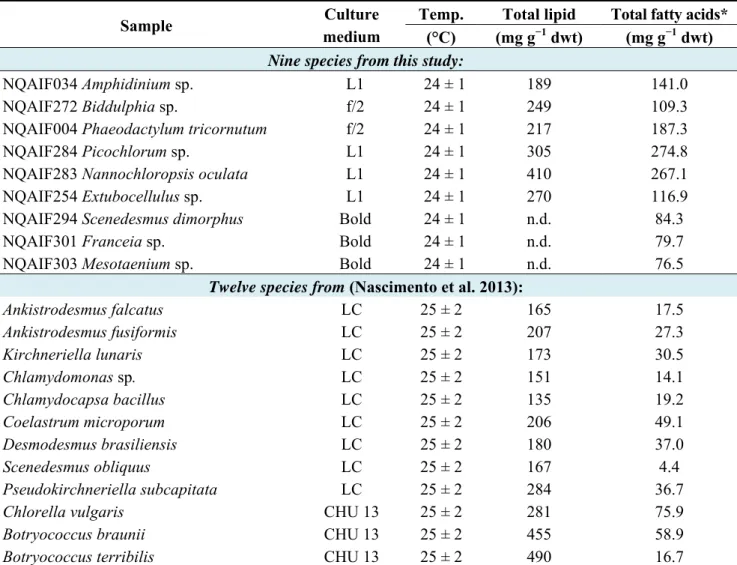
acid content of nine microalgal species from this study and twelve green microalgal species from (Nascimento et al. 2013). .... 48 Table 3.2: Fatty acid methyl ester (FAME) profile of nine microalgal
species (mg g−1 of dry biomass) (this study) ... 59 Table 3.3: Biodiesel properties calculated from the FAME profile of nine
microalgal species (this study) and twelve species from (Nascimento et al. 2013). ... 62 Table 3.4: Effect of growth phase and cultivation media on biodiesel
properties calculated from the FAME profile, total lipid, saturated fatty acids (SFAs), mono-unsaturated fatty acids (MUFA) and polyunsaturated fatty acids (PUFA) contents of Nannochloropsis oculata. ... 66 Table 3.5: Ranking of nine microalgae species from the present study
and twelve from (Nascimento et al. 2013) based on PUFA weightings of 1, 10, 30, 40, and 50. All other fuel properties were ranked as 1. A PUFA weighting of > 50 no longer affected rank order, indicating weighting saturation for this parameter. ... 75
xx
Table 4.1: Extraction performance of some common fatty acids at different temperature (70 -120 ○C) and 4 different levels of sample DBWR ... 94 Table 4.2: Fatty acid composition at highest FAME yield zone (70, 90 and
120○C and sample dryness 50-75%). ... 95 Table 4.3: Comparison of four extraction techniques using key factors ... 98 Table 4.4: Total lipid yields and fatty acid methyl esters (FAME) from
microalgae using different solvents and extraction procedures. .... 113 Table 4.5: Fatty acid methyl ester (FAME) profiles of different extraction
methods and solvents ... 113 Table 4.6: Conversion performance of microalgae biodiesel from extracted
raw oil ... 115 Table 4.7: Fatty acid methyl ester (FAME) content (mg g-1 biodiesel) of
three different batches of biodiesel using static hexane extraction and alkali-catalysed transesterification ... 116 Table 4.8: Microalgae biodiesel fuel properties ... 117 Table 5.1: Fatty acid methyl ester (FAME) profiles of nine biodiesels (g
100 g-1 of FAME) ... 127 Table 5.2: Calculated and measured fuel property of FAMEs. ... 134 Table 6.1: Fatty acid composition (g 100g-1 FAME) of biodiesels ... 152
Table 6.2: Properties of pure fatty acid methyl esters (FAME) and
petroleum diesel and compliance with the requirements of ASTM 6751-12 and EN 14214 biodiesel standards ... 153 Table 6.3: Test Engine specifications ... 154 Table 6.4: Maximum load @2000rpm with different fuel, test condition,
xxi
List of Figures
Figure 1.1: Conceptual flow chart of research approach ... 7 Figure 2.1: A schematics of a typical green microalgae cell (Beer et al.
2009) ... 14 Figure 2.2: The transesterification reaction (Chisti 2007) ... 26 Figure 2.3: Relationships between criteria in the GAIA plane (Espinasse et
al. 1997) ... 33 Figure 3.1: (a) Graphical Analysis for Interactive Assistance (GAIA) plot
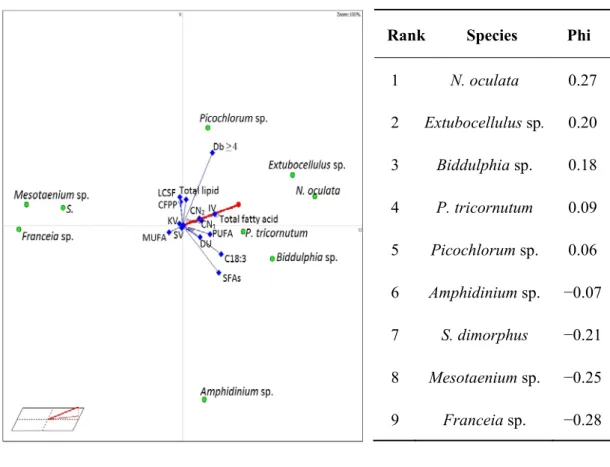
of nine microalgal species from the present study showing 16 criteria (14 biodiesel properties from Table 3.3, total lipid and fatty acid content from Table 3.1) and decision vector; and (b) corresponding ranking of species based on their outranking flow. ... 69 Figure 3.2: (a) GAIA plot of nine microalgal species from the present
study and twelve from (Nascimento et al. 2013) showing 16 criteria (14 biodiesel properties from Table 3.3, total lipid and fatty acid content from Table 3.1) and the decision vector; and (b) Corresponding outranking flow. *: this study. ... 71 Figure 3.3: (a) GAIA plot of the effect of nutrients (media L1, f/2, K) and
growth phase {Logarithmic (Log), Late Logarithmic (LLog), and stationary (Stat)} on *N. oculata (present study) and from (Huerlimann et al. 2010) biodiesel quality showing ten criteria (twelve biodiesel properties and total lipid content from Table 3.4) and the decision vector; and (b) corresponding outranking flow. ... 73 Figure 4.1: Effect of temperature and sample dry biomass water ratio
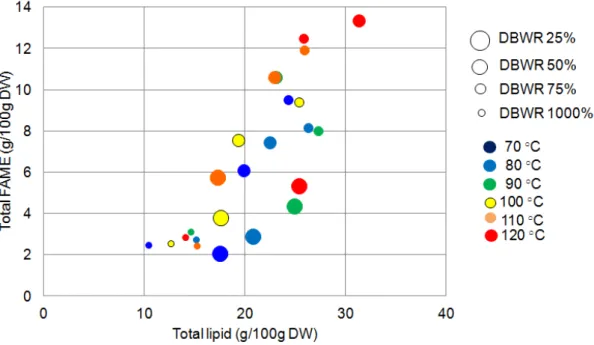
(DBWR) on extraction performance of total lipid (g 100g-1 DW) and total FAME (g 100g-1 DW). ... 89 Figure 4.2: Effect of temperature and sample dry biomass water ratio
(DBWR) on individual fatty acid extraction yields (g. 100 g-1 of FAME) (a) Palmitic acid C16:0 (b) Palmitoleic acid C16:1 (c) Oleic acid C18:1 (d) Linoleic acid C18:2(e) α and γ -Linolenic acid C18:3 of Tarong polyculture ... 93
xxii
Figure 4.3: Effect of temperature and sample dry biomass water ratio (DBWR) on fuel properties (a) Cetane number (CN) (b) Iodine value (IV) (c) Kinematic viscosity (KV) mm2s-1 and (d) Higher heating value (HHV) MJ kg-1 of extracted FAME of the Tarong polyculture. ... 100 Figure 4.4: Effect of temperature and dry biomass-water ratio (DBWR) on
percent of extracted (a) saturated, (b) mono-unsaturated and (c) polyunsaturated fatty acid methyl esters (g 100g-1 of FAME) from the Tarong polyculture ... 102 Figure 4.5: Chronological view of microalgae biodiesel production throug
h transesterification ... 116 Figure 5.1: Correlation analysis of estimated and measured CN and
suitability of (a) PUFA; (b) MUFA and (c) ACL as proxies. ... 135 Figure 5.2: Correlation analysis of estimated and measured KV and
suitability of (a) MUFA; (b) ACL as proxies. ... 136 Figure 5.3: Correlation analysis of estimated and measured biodiesel
density ( ) and suitability of (a) DU and (b) ACL as proxies. .... 138 Figure 5.4: Correlation analysis of estimated and measured HHV and
suitability of (a) DU and (b) ACL as a proxies. ... 139 Figure 5.5: PROMETHEE-GAIA analysis of the influence of individual
FAMEs, fatty acid classes and FAME average molecular weight on fuel properties. ... 141 Figure 6.1: Schematic diagram of test set-up ... 155 Figure 6.2: Variation of cylinder pressures with crank angle at (a) 25%
load, (b) 50% load, (c) 75% load, and (d) 100% loads for petroleum diesel and biodiesel blends ... 158 Figure 6.3: Variation of pressure rise rates with varying engine loads for
petroleum diesel and biodiesel blends ... 159 Figure 6.4: Effect of engine load on the indicated mean effective pressure
(IMEP), brake mean effective pressure (BMEP) and frictional mean effective pressure (FMEP) (a) and their variation (b and c) for petroleum diesel and biodiesel blends ... 161
xxiii Figure 6.5: Variation of brake specific fuel consumption (BSFC) and brake
thermal efficiency (BTE) with engine load for petroleum diesel and biodiesel blends. ... 163 Figure 6.6: Effect of crank angle on the heat release rate at (a) 25%, (b)
50%, (c) 75% and (d) 100% of engine load operated on petroleum diesel and biodiesel blends. ... 165 Figure 6.7: Correlation between exhaust emission (a) nitric oxide NO
(b) nitrogen oxide NOx and brake mean effective pressure (BMEP) for petroleum diesel and biodiesel blends. ... 167 Figure 6.8: Correlation between unburned hydrocarbon (UHC) emission
and brake mean effective pressure for a test engine operated with petroleum diesel and biodiesel blends ... 168
xxiv
xxv
Acknowledgements
My experience as an HDR student at QUT has been more than pleasurable. Whilst this dissertation has a single author, the work involved a great many people, without whom I would not have made it this far. In this section, I will endeavour to name as many of the people who have contributed to this work as possible. To the numerous people who have given me emotional support throughout not only the PhD years, but those that came before it, I give my deepest thanks.
First, I would like to thank my principal supervisor, Associate Professor Richard Brown. Associate Professor Richard Brown is not only the first to be acknowledged, but also the most important contributor to this work. Over the years, we have learnt a great deal and have enjoyed research and teaching together.
From a research perspective, Associate Professor Richard Brown kept me on track whilst allowing me the freedom to really explore ideas. This PhD delved into an area foreign to both of us; instead of diverting me from the direction I had chosen, Associate Professor Richard Brown worked with me to enhance it with his own knowledge. He works tirelessly to ensure that all of his students are well looked after and are achieving their set outcomes. I strongly believe that the quality of this work is attributable to the collaborative nature in which we worked together. It is mostly for this that I give my thanks; having someone believe in you and maintaining your morale is essential in undertaking such study as a PhD. At the end of it I knew for certain that I had had the right supervisor to see me through this process. Once again, I thank Associate Professor Richard Brown, with whom I feel that I have been truly privileged to work.
When I first had the idea about microalgae as a potential source of biodiesel, luck had me knock on Associate Professor Kirsten Heimann’s door. For me,
xxvi
research on microalgae was a very new world, in which she is one of the most prominent persons in microalgae research. Associate Professor Kirsten Heimann then took on the difficult task on teaching me about the biology and chemistry of microalgae. I strongly believe that she is one of the strongest and most dedicated mentors to have taken me up to this level of my microalgae research. I am grateful to her for giving me directions, confidence and valuable advice, and for everything that I have learned from her about microalgae.
Associate Professor Ian O’Hara came late into this process, but has undoubtedly saved me countless months of work. I found myself with many questions about large-scale oil extraction techniques and available facilities, and he came to the rescue. Over the last year he has invested substantial amounts of time guiding me to develop a pilot-scale oil extraction process. An addition to this, Associate Professor Ian O’Hara has had a tremendous effect on the quality of this work and the rate at which it was produced.
Along with Associate Professor Richard Brown, Professor Zoran Ristovski is the other chief investigator on this project. Professor Zoran Ristovski is involved mainly with the emission side of engine research; however, his contribution in terms of experimental design, acquisition of fuel and his general knowledge and leadership are instrumental to the success of the Biofuel Engine Research Facility (BERF) laboratory, in which I worked.
I also wish to thank Professor Godwin Ayoko helping me to develop my model with PROMETHEE-GAIA. Professor Godwin Ayoko spent a tremendous amount of time to teach me the very basics of PROMETHEE-GAIA. I acknowledge the help of Dr Peter Brooks (Sunshine Coast University) and Mr Ashley Dowell (Manager, Southern Cross Plant Science) for making useful contributions to my research by providing me access to their analytical laboratories as well as useful suggestions regarding fuel chemistry. I would like to thank Dr Doug Stuart, from Ecotech Biodiesel, for providing substantial amounts of waste cooking oil biodiesel for testing.
xxvii Throughout my PhD, I had to work with many disciplines, including marine biology, chemistry and mechanical engineering. I would like to acknowledge the help I have received from Stan Hudson (Curator, NQAIF Culture Collection and Laboratory Manager at James Cook University, Townsville) in the very early stages of my research. I would like to thank Mr Shane Russell (Senior Technician, Institute for Future Environments, Science and Engineering, QUT) for his tireless efforts in helping my extraction project to be successful. Finally, I would like to thank the people who looked after our engine lab, Jon James, Noel Hartnett and Scott Abbett, and technologist Anthony Morris, for their valued contribution to this work. I also thank my colleagues and friends, who made my work easy and enjoyable. I am grateful for their suggestions and help in finding solutions, technical or otherwise. I would especially mention Md Jahirul Islam, Md Mostafizur Rahman, Meisam Babai, Dr Timothy Bodisco, Dr Nicholas Surawski and Dr Nurun Nabi for many conversations and laughs, which helped to take the pressure off during stressful times.
Last, and definitely not the least, is my wonderful family. I thank each member of my family, for being understanding and supportive. I am most thankful to my father, Mr MD Shafiqul Islam, and my mother, Mrs Shahera Begum, for their invaluable encouragement. I am grateful to my wife, Sharmin Sultana, and our beautiful son, Areeb Islam. These two people have changed and enriched my life in ways unimaginable. When the work has been hard and stressful, they have provided me with comfort, love and the reason to persevere. I am glad that we have made this important journey together. Although many of you may not understand, nor ever want to understand much of what is written beyond this page, you should at least know that it could not have been done without you.
Muhammad Aminul Islam
Queensland University of Technology (QUT) September (2014)xxviii
1 | P a g e
Chapter 1.
Introduction
1.1.
Background and Motivation
Global energy demand is increasing with increasing population and industrialisation, which mostly rely on fossil fuel. Fossil fuels are already recognised as an unsustainable energy source because of their associated greenhouse gas emissions and depleting supplies, therefore it is becoming increasingly urgent to find alternative sources of fuel that can mitigate greenhouse emissions. The transport sector, for example, is responsible for around 16% of the increasing share of global greenhouse gas emissions affecting the current climate (Gouveia and Oliveira 2009).One of the best options in achieving this would be using renewable biofuel with a lower carbon footprint, as well as producing more fuel-efficient vehicles. Biodiesel sourced from food crops such as rapeseed, soybean, sugar cane, palm oil and animal fat are known as first generation biofuels. These fuels are significantly limited, due to the availability of fresh water and arable land. A significant drawback of growing biofuel feedstock on arable farmland is that it competes with food crops grown for global consumption, thus increasing the price of food-grade oil. This competition creates food security issues, which can increase the cost of producing biodiesel. Second generation biodiesel produced from non-edible plant and woody materials can alleviate the food security issue but production of this is limited to arable land use.
On the other hand, third generation biofuels are sourced from edible and non-agricultural crops such as microalgae, which can grow in fresh or saline water and on non-arable land. The unicellular organism microalgae with large surface-to-volume body ratio, simple cellular structure and suspension in the aqueous medium,
2 | P a g e
allows immediate access to CO2, water and inorganic elements, which results in an increased efficiency of photosynthesis over that of terrestrial plants (Sheehan et al. 1998; Darzins et al. 2010; Demirbas and Demirbas 2010). Microalgae have gained significant attention as a biodiesel feedstock for several reasons including:
Accumulation of larger amounts of lipids due to higher photosynthesis efficiency
Rapid growth rates resulting in microalgae biomass doubling within 24 hours Absence of competition with food crops for land.
However, the technology required to generate biodiesel from microalgae is still in its early stages of development. While there is a considerable amount of literature on the growth of algae, there is significantly less on the different methods used to harvest microalgae, and perform large-scale oil extraction and biodiesel conversion; further, such literature is extremely limited on engine tests.
It is estimated that around 30 000 to 50 000 species have been identified but the total number is still unknown (Borowitzka and Moheimani 2013). Details of lipid content in different microalgae species is given in Table 2.1. The process of large-scale biodiesel production from a selection of microalgae species is crucial and needs to consider their growth rate, lipid content, lipid compositions and growth environment. Harvesting, drying and oil extraction are responsible for 50% of the total production cost, therefore this process needs to be addressed before considering large-scale microalgae biodiesel production.
Literature is already reporting a significant amount of work on laboratory-scale oil extraction from microalgae, such as mechanical disruption, solvent extraction, supercritical fluid extraction and ultrasonic extraction. However, the insufficient literature on large-scale oil extraction and biodiesel conversion of microalgae biodiesel raises questions about the economic viability of biodiesel production.
Finally, the proper exploration of microalgae biodiesel fuel properties and their effect on engine performance and emissions should be researched extensively to establish microalgae biodiesel as an alternative proposition. Investigations on the
3 | P a g e influence of fatty acids on fuel properties are also needed to form an understanding of the fuel performance on the engine. Using the multi-criteria decision analysis (MCDA) software, PROMETHEE-GAIA, the relation of fatty acids to the physiochemical property of biodiesel could be identified.
1.2.
Hypothesis
It is hypothesised that the high content of eicosapentaenoic acid (EPA, C20: 5n-3; five double bonds) and docosahexaenoic acid (DHA, C22: 6n-3; six double bonds) within microalgae, in comparison to other biodiesel feedstock, will increase the density, kinematic viscosity and iodine value, as well as reduce the cetane number of microalgae biodiesel. The engine performance with microalgae biodiesel may slightly decrease, but it will reduce the gaseous emissions in comparison to petroleum diesel. It is also hypothesised that commercial production of microalgae biodiesel is possible through proper optimisation of the extraction and overall downstream process. Furthermore, it is also hypothesised that carrying out experiments published in the literature will not be sufficient to fill the gap and alleviate inconsistencies. The focus of this study was to evaluate a complete downstream process of biodiesel production experimentally, in order to analyse fuel properties and to validate engine performance and emission tests.
1.3.
Research objectives
The current research on microalgae biodiesel for compression ignition (CI) engines, seeks to determine if microalgae biodiesel production can be achieved on a large-scale and if it is suitable for CI engines. It was identified that there is a significant lack of large-scale biodiesel production from microalgae, whileengine performance could not be verified due to both a lack of research and inconsistencies in what is already published. The aim of this study is to assess the oil extraction process from microalgae and develop pilot scale biodiesel production, as well as create a better understanding of the fuel properties and their performance in CI engines. Pilot scale oil extraction from microalgae was carried out and converted to biodiesel by transesterification to support the engine performance test. A full-scale engine performance and emission test was carried out to evaluate microalgae biodiesel.
4 | P a g e
The scientific objectives of this research on microalgae biodiesel are as follows: Select suitable species for biodiesel production
Optimise the oil extraction process to develop pilot scale extraction protocol Develop a model to investigate the physiochemical property of microalgae
biodiesel
Investigate engine performance and emissions from microalgae biodiesel compared to other biodiesel and petroleum diesel
1.4.
Research questions
The following research questions are addressed in this thesis.
This question demands an investigation that is aimed at identifying the main influential parameters on fuel properties for different species. Many researchers have answered this in relation to other biofuels from different feedstock. Microalgae contain more long chain, unsaturated fatty acids, such as C22:6 DHA and C20:5 EPA. Therefore, an explicit investigation with a fatty acid profile of different microalgae needs to be addressed to simplify the selection process. This leads us to the next research question:
There are many oil extraction processes already explained in the literature that are mainly lab-scale. However, large-scale oil extraction from microalgae has not yet been validated. The influence of extraction parameters (extraction solvent, sample moisture content, extraction temperature and pressure, extraction time) on a large-scale needs to be identified and evaluated for commercial biodiesel production. Therefore, another key research question can be proposed as follows:
Q2. What is the best way to extract oil on a commercial-scale and what is the effect
of the extraction conditions on the fatty acid profile and the fuel properties?
Q1. What is the appropriate approach to select microalgae species for biodiesel
5 | P a g e The research and models outlined in the limited experimental studies have partially answered this question. A proper model however, with all standard experimental results, is not yet available for microalgae biodiesel. More specifically one of the most important fuel properties, the cetane number, was not tested in a real cetane-testing engine to validate and determine the exact weight of the microalgae fatty acid profile. Many of the researchers have suggested the cetane number through an estimation process from the fatty acid profile based on vegetable oil, but not with real microalgae biodiesel, which contains a different fatty acid composition in comparison to other vegetable oils.
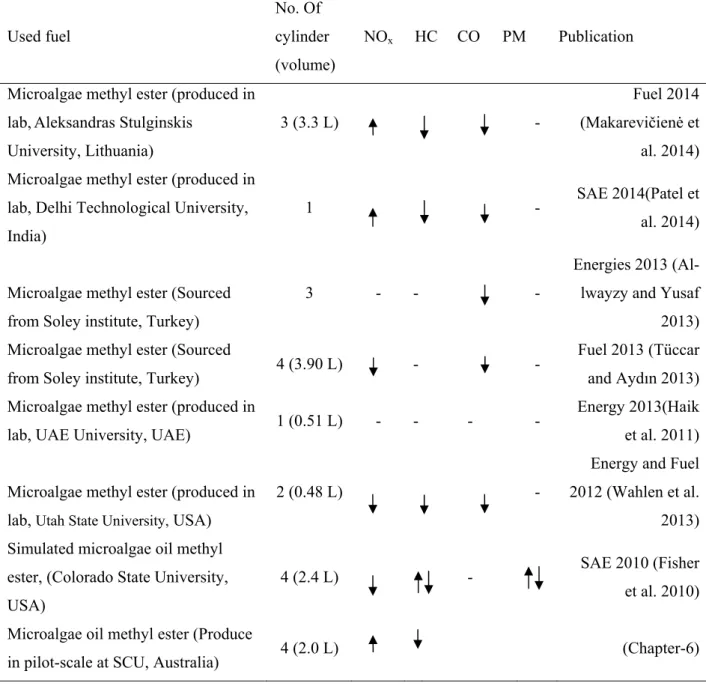
Finally, the least addressed question in the literature is how microalgae biodiesel performs in a regular diesel engine. Only seven examples of literature found (Table 2.5) show an experimental study that has been conducted in regular diesel engines with microalgae biodiesel, due to the limited quantity of this fuel. This causes a major challenge in microalgae biodiesel research to answer, in detail, any questions regarding the experimental investigation and emission levels.
1.5.
Research approach
The experimental research will be a comparative study of the microalgae biodiesel properties and engine performance in comparison to other biodiesel fuels and petroleum diesel. Results from the previous study will be taken as the reference, and new results will be compared. The approach is as follows:
Screen microalgae species based on their lipid content, growth rate, fuel properties and suitability for biodiesel conversion
Analyse different extraction methods and optimise the extraction parameters to develop a pilot scale extraction protocol
Q4. How does microalgae biodiesel perform in a regular diesel engine and what is the emission level?
Q3. What is the suitable way to identify the fatty acid influence on fuel properties
6 | P a g e
Analyse the fatty acid profile and investigate the effects of fatty acid composition on fuel properties using PROMETHEE-GAIA software
Perform engine tests to investigate the performance and emission levels with microalgae biodiesel
The objective of this research is only achievable when enough algal oil can be extracted and processed into biodiesel for the engine test. Engine performance and emission tests are only possible when all other steps in microalgae species selection have been performed, a pilot scale oil extraction method has been proposed, and the fuel property analysed successfully. The details of this research are shown in Figure 1.1:
7 | P a g e Figure 1.1: Conceptual flow chart of research approach
8 | P a g e
1.6.
Organisation of the thesis
The thesis is prepared in the form of a thesis by publication with the development of the research concepts as shown in Figure 1.1. The remaining six chapters contain the relevant papers and are organised as follows:
Chapter 2 begins by introducing the concept of biofuels and microalgae biodiesel. A
literature review based on microalgae characterisation, oil extraction, fuel property analysis and engine performance is presented. The lack of systematic large-scale biodiesel production from microalgae, and the lack of literature about engine performance with microalgae biodiesel are shown. Finally, the irregularities in emission output from the biodiesel engine test are presented. A final approach using the multi-criteria decision analysis software PROMETHEE-GAIA is introduced to investigate the fuel property and fatty acid profile.
Chapter 3 focuses on the microalgae species selection. The fatty acid profiles of
nine different fresh water microalgae species were investigated and compared with 12 more species from the literature, to find the most suitable species for biodiesel production in a subtropical climate. Fuel properties were estimated from the fatty acid profile using a method found in the literature. A novel approach of selection using PROMETHEE-GAIA is presented. A sensitivity analysis of the selecting parameters with different weighting is a unique approach for microalgae selection for biodiesel production. Depending on the location and marketplace, this model can be manipulated for finding the suitable microalgae species for biodiesel production. The work presented in this chapter has been supported with examples, explanations and comparative studies.
Chapter 4 deals with the oil extraction process from microalgae. The importance of
an optimised extraction process on a large-scale is described in Chapter 2. There is no such large-scale oil extraction process for microalgae currently. In this chapter, a high-pressure extraction system known as the Accelerated Solvent Extraction (ASE) method is investigated at different temperatures, with different moisture contents in the sample, to find the most effective combination of extraction parameters for
9 | P a g e biodiesel production. This extraction analysis also provides a summary of the influence of the extraction parameters in relation to individual fatty acids. This could be valuable information for other industries, like the pharmaceutical and biomass industries.
Chapter 5 outlines the influence of the fatty acid profile on the physiochemical
properties of biodiesel. Microalgae biodiesel and seven other biodiesel fuel properties were investigated and the influence of the fatty acid profile in relation to their fuel properties was presented by PROMETHEE-GAIA. Extensive literature review shows the influence of the fatty acid profile on the fuel properties as described in Chapter 2 and indicates that most are estimated. In this chapter, the influences of individual fatty acids are determined based on the estimated and measured values. The influence of the overall degree of unsaturation and average chain length in relation to the fuel properties is also presented in detail, with both estimated and measured values.
Chapter 6 focuses on engine performance and emission tests of microalgae
biodiesel. This chapter provides a detailed analysis of microalgae biodiesel fatty acid composition and fuel properties, in comparison to other biodiesel fuels and petroleum diesel. The performance of microalgae biodiesel in different blends is compared with petroleum diesel and waste cook biodiesel. The gaseous emissions of all microalgae biodiesel blends are also compared with petroleum diesel and waste cook biodiesel. This chapter provides unique information on microalgae biodiesel engine performance. In Chapter 2, it was found that there are an extremely limited number of engine tests performed with microalgae biodiesel. Therefore, this chapter will provide great value in the field of biodiesel research.
Chapter 7 concludes the thesis with a summary of the original contributions and
10 | P a g e
11 | P a g e
Chapter 2.
Microalgae biodiesel
research
Microalgae biodiesel research
2.1.
Introduction
With worldwide concerns over both petroleum prices and climate change, researchers around the world have been dedicated to finding renewable energy sources. Currently fossil fuels provide a large proportion of the global energy demand. Biofuels, such as biodiesel and ethanol, are therefore being developed as alternative fuels. Biodiesel from vegetable oils and animal fats only make up approximately 0.3% of the current demand for transport fuels (Demirbas and Demirbas 2010).
Biodiesel can be produced from renewable sources such as vegetable oils, animal fats and recycled cooking oils (Zagonel et al. 2004). However, these traditional biomass feedstocks are in high demand as food sources or for other use. This increases their price and challenges their potential as a large-scale fuel resource. In contrast, biodiesel from microalgae is recognised as one of the most promising resources for fuel production. Microalgae may also be the only renewable source of fuel that could meet the world’s transport fuel needs (Chisti 2007). Microalgae have four significant potential benefits as fuel feedstock. Firstly, microalgae biomass productivity and oil yield is very high, compared to other oil based feedstock.
12 | P a g e
Secondly, microalgae oil does not compete with food production. Thirdly, algae can be cultivated on non-arable and marginal land, in fresh water or seawater. Fourthly, innovation in microalgae production, may allow both biodiesel and higher value co-products to be produced(Demirbas and Demirbas 2010).
The technology required to generate biodiesel from microalgae at large-scale is still in its early stages of development. There are considerable amounts of research on the growth of microalgae, but a significantly lower number of research studies for harvesting, large-scale oil extraction and how to create biodiesel from microalgae biomass. In this chapter, the current developments and limitations will be explained, using the available literature on microalgae biodiesel.
2.2.
Biodiesel
“Biodiesel is a mono-alkyl ester of long chain fatty acids, derived from vegetable oils or animal fats” (Fernando et al. 2007; Ganapathy et al. 2011). Conventional diesel engines can be fuelled with biodiesel, either in pure form or blended in different ratios with regular petroleum diesel, without significant modification (Ng et al. 2011). Typically, biodiesel contains little or no sulfur, and the cetane number, flash point, viscosity and density are higher than petroleum diesel (Wahlen et al. 2011). The oxygen content and low sulfur content in biodiesel provide sustainability benefits compared to conventional automotive fuels (Jayed et al. 2009).
2.2.1.
Classification of biofuel
Biofuels can be classified as first generation biofuel (FGB), second generation biofuel (SGB) and third generation biofuel (TGB) based on their feedstock or production technologies. First generation biofuels are mainly sourced from food crops such as sugar cane, corn, starch and vegetable oils and animal fats. The production of FGBs are limited in their ability to achieve sustainability targets for petroleum diesel substitution, environmental benefit and economic growth, because of competition with their alternative uses as food products.
13 | P a g e Second-generation biofuels are generally classified as being from non-edible feedstock, such as wheat straw, wood and solid waste. The second-generation biofuels can avoid many of the problems faced by the first generation by producing biofuel from agricultural and forest residues instead of food stocks. However, lack of available source materials in many countries may limit the potential for large-scale petroleum replacement.
Fuels from non-edible and non-agricultural sources make up the third generation biofuels, with microalgae considered to be one of the best options for biodiesel production because of its high oil yield and ability to grow on non-arable land (Demirbas 2009). It has been estimated that microalgae biodiesel production could, potentially, entirely replace petroleum diesel (Chisti 2007).
2.2.2.
Significance of biodiesel research
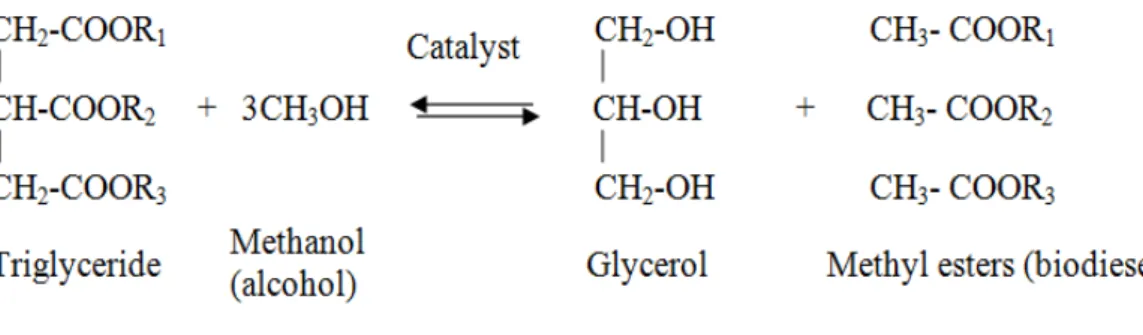
The transport sector is one of the major sources of greenhouse gas (GHG) emissions and also produces many other air contaminants like NOx, SOx, particulate matter (PM) and volatile organic compounds (Hossain and Davies 2012). Long term sustainable reduction in GHG emissions can be achieved by replacing petroleum diesel in internal combustion engines with renewable biofuels (Hossain and Davies 2012). Biodiesel is one such alternative fuel obtained by transesterification of triglycerides (Hossain et al. 2008). Proper energy management and careful development could result in a large contribution to global primary energy supply by (Spitzer and Tustin 2009):
1. Reducing greenhouse gas emissions
2. Improving energy security by producing domestic biomass
3. Providing economic and social development in rural communities
14 | P a g e
2.3.
Microalgae
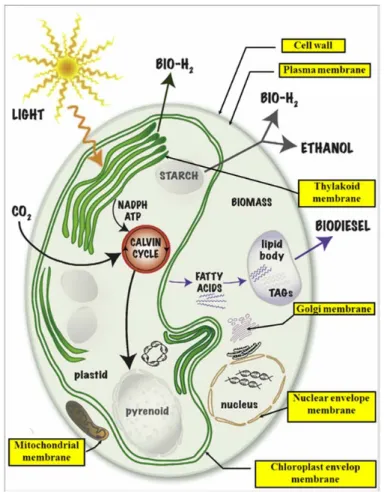
Typically, unicellular autotrophic microalgae can be grown in freshwater, brackish, marine and hyper-saline water, in a range of temperatures (Belarbi et al. 2000; Wang et al. 2008). The size of microalgae, depending on the species, can vary from 1 to 100 micrometers (µm) (Ajav et al. 1999; He et al. 2003). Microalgae do not have roots, stems and leaves like higher plants (Xue et al. 2011). A typical green microalgae is shown schematically in Figure 2.1.
Figure 2.1: A schematics of a typical green microalgae cell (Beer et al. 2009) It is estimated that around 30,000 to 40,000 microalgae species have been identified and classified in groups (Mata et al. 2010; Demirbas and Fatih Demirbas 2011; Borowitzka and Moheimani 2013) such as cyanobacteria (Cyanophyceae), green algae (Chlorophyceae), diatoms (Bacillariophyceae), yellow-green algae (Xanthophyceae), golden algae (Chrysophyceae), red algae (Rhodophyceae), brown algae (Phaeophyceae), dinoflagellates (Dinophyceae) and
‘pico-15 | P a g e plankton’(Prasinophyceae and Eustigmatophyceae) (Sheehan et al. 1998; Hu et al. 2008). However, the actual quantity of species throughout the earth's ecosystem is unknown (Borowitzka and Moheimani 2013).
Only green microalgae is considered for this research, so further reference to microalgae refers to green microalgae only. This type can be found anywhere that has water and sunlight, including soil, ice, lakes, rivers, hot springs and the ocean. Microalgae captures carbon dioxide (CO2) from its surroundings and in the presence of sunlight is able to convert it through cellular activities to carbohydrates, proteins, lipids, vitamins and pigments (Ajav et al. 1998; Belarbi et al. 2000; Amin 2009).
2.3.1.
Classification of lipids
Microalgae lipids are mainly classified into two categories, storage lipids (non-polar lipids) and structural lipids (polar lipids) (Pohl and Zurheide 1979; Guckert and Cooksey 1990; Wada and Murata 2004; Cravotto et al. 2008; Hu et al. 2008). Storage lipids are mainly in the form of triacyl-glycerol (TAG) (Figure 2.1) and consist of saturated and unsaturated fatty acids, which can be transesterified to produce biodiesel (Markley and Markley 1964; Patil et al. 2008; Milledge and Heaven 2013). Structural lipids consist mainly of glycosyl glycerides, enriched in the chloroplast membrane that makes up about 5-20% of their dry biomass. There are also significant amounts of phosphor glycerides, phosphatidyl ethanolamine (PE) and phosphatidyl glycerol (PG) present as polar lipids (Hu et al. 2008; An et al. 2012).
A large amount of TAGs could potentially be a source of metabolic energy through catabolism (Brennan and Owende 2010). In general, TAGs are mostly synthesised in the light, stored in cytosolic lipid bodies and then reutilised for polar lipid synthesis in the dark (Brennan and Owende 2010). Microalgal TAGs are generally a storage of both saturated and monounsaturated FAs. Some oil-rich species have the capacity to build up high levels of long chain, polyunsaturated fatty acids (PUFA) as TAG (Alessandro Schönborn a 2009). PUFA-rich TAG may donate specific acyl groups
16 | P a g e
to monogalactosyldiacylglycerol (MGDG) and other polar lipids to enable rapid adaptive membrane reorganisation (Alessandro Schönborn a 2009).
Polar lipids from microalgae are stored as membrane components and metabolites and can also be used to produce biodiesel. Polar lipids can also be a source of energy under some conditions (Knothe 2008). Recently, microalgae has received considerable attention from researchers and commercial companies as an alternative non-food biodiesel feedstock, because of its high productivity and oil rich characteristics (Deng et al. 2009).
Table 2.1 lists 42 different species of microalgae with their lipid contents reported in the literature (Chisti 2007; Um and Kim 2009; Mata et al. 2010; Demirbas and Fatih Demirbas 2011). Lipid levels range from 5% of dry weight biomass (DWB) in Chlorella vulgaris to 77% of DWB in Schizochytrium sp. Oil content is commonly between 20% and 50% although some microalgae species have been reported to contain levels above 70% of the total dry weight (DWB).
17 | P a g e Table 2.1: Lipid content of some common microalgae species (Chisti 2007; Um and Kim 2009; Mata et al. 2010; Demirbas and Fatih Demirbas 2011)
Microalgae Species Lipid Content (% DWB)
Microalgae Species Lipid Content (% DWB)
Ankistrodesmus sp. 24–31 Nannochloris sp. 20–56
Botryococcus braunii 25–75 Nannochloropsis oculata*. 22–29
Chaetoceros muelleri 33 Nannochloropsis sp. 12–53
Chlamydomonas reinhardtii 21 Neochloris oleoabundans 29–65
Chlorella emersonii 25–63 Pyrrosia laevis 69.1
Chlorella minutissima 57 Pavlova salina 30
Chlorella protothecoides 14–57 Prostanthera incisa 62
Chlorella sorokiniana 19–22 Prymnesium parvum 22-39
Chlorella sp. 10–48 Pavlova salina 30
Chlorella vulgaris 5–58 Prostanthera incisa 62
Crypthecodinium cohnii 20–51 Prymnesium parvum 22-39
Dunaliella salina 6–25 Pavlova lutheri 35
Dunaliella primolecta 23 Phaeodactylum 18–57
Dunaliella tertiolecta 16–71 Scenedesmus obliquus 11–55
Dunaliella sp. 17–67 Skeletonema costatum 13–51
Euglena gracilis 14-20 Scenedesmus dimorphus* 16-40
Ellipsoidion sp. 27 Schizochytrium sp. 50-77
Haematococcus pluvialis 25 Thalassiosira pseudonana 20
Isochrysis sp. 7–33 Isochrysis galbana 7–40
Monodus subterraneus 16 Zitzschia sp. 45-47
Monallanthus salina 20–22 Ankistrodesmus falcatus 16-17
*Used in current study
2.3.2.
Potential of biodiesel production from microalgae
Since the 1950s, microalgae has been cultivated commercially for many different products like proteins, cattle feed and pharmaceuticals. Throughout the 1980s, the US Department of Energy (DOE) and the Solar Energy Research Institute (SERI) initiated the Aquatic Species Program and refined its investigation exclusively to analyse microalgae. The goal was to develop biofuels from microalgae at prices competitive to that of fossil fuels (Sheehan et al. 1998; Chisti 2010).
18 | P a g e
As previously stated, microalgal oils are classified as a third-generation biofuel (Demirbas and Demirbas 2010). As the availability of freshwater and land should be prioritised for food crops, the growth of first-generation biofuel feedstock, such as rapeseed, soybean, sugar cane and palm oil as well as animal fats, are significantly limited. This competition creates food security issues, which can increase the cost of producing biodiesel.
To offset dependence on fossil fuels, the low economic and environmental sustainability issues of first and second-generation biofuels must be resolved. Deforestation caused by cultivating arable land results in adverse environmental effects and is a primary factor contributing to unsustainable biomass production in the same country. An alternative approach is to use microalgae as a source of biofuel because of its environmental, economic and social benefits (Chisti 2007; Borowitzka and Moheimani 2013). Microalgae has gained significant attention as a biodiesel feedstock for several reasons including:
Accumulation of larger amounts of lipids due to higher photosynthesis efficiency (He et al. 2003)
Rapid growth rates resulting in algae biomass doubling within 24 hours (Chisti 2007)
Ability to capture solar energy 10 to 50 times greater than that of terrestrial plants (He et al. 2003).
Absence of competition with food crops for land (Chisti 2010)
Improvements in energy security by producing domestic biomass
Economic and social development in rural communities
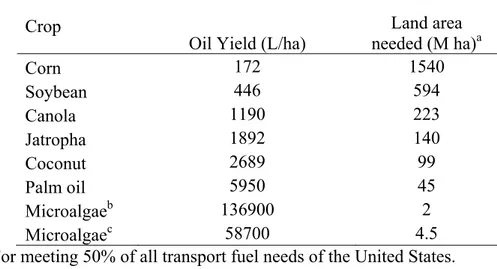
While it is not expected that all current fuel use will be replaced with microalgae biodiesel, conceptual replacement calculations can be instructive. Projections based on the fuel consumption rate of 2007 predict 0.53 billion cubic metres of biodiesel would need to be produced annually to replace all the transportation fuel used in the United States (Chisti 2007). Corn, soybean and canola oil require unrealistic percentages of the existing area for cultivation of total fossil fuel replacement. Palm oil is the highest oil-producing crop (5950 L/ha/year). However, palm oil would still
19 | P a g e require one quarter of the existing global cropping land for cultivation, in order to meet half of the transport fuel requirements. As for microalgae containing 30% and 70% oil content, the percentage of total cropping area is required for total fossil fuel replacement 2.5% and 1.1%, respectively. These values are 10 times less than the area required for palm oil and hence this is why microalgae is seen as having potential for large-scale fuel production.
Table 2.2: Comparison of some sources of biodiesel (Chisti 2007) Crop
Oil Yield (L/ha)
Land area needed (M ha)a Corn 172 1540 Soybean 446 594 Canola 1190 223 Jatropha 1892 140 Coconut 2689 99 Palm oil 5950 45 Microalgaeb 136900 2 Microalgaec 58700 4.5
a For meeting 50% of all transport fuel needs of the United States. b 70% oil (by wt) in biomass. c 30% oil (by wt) in biomass.
2.3.3.
Challenges in microalgae biodiesel production
Microalgae provides various advantages for biodiesel production compared to traditional crops (Chisti 2007). However, it has not been successfully economically cultivated on a commercial scale (Greenwell et al. 2010) and there are many hurdles that affect feasibility on a large scale:
One of the challenges in algal biofuel research is in finding a species that is suitable across a wide range of factors including environmental tolerance, high growth rate, high lipid content, and easy harvesting and extraction (Greenwell et al. 2010).
The biochemical composition of lipids is another barrier compared to other traditional feedstock in relation to biofuel properties. Microalgae oil is quite
20 | P a g e
rich in polyunsaturated fatty acids with more than four double bonds (Belarbi et al. 2000). Examples include eicosapentaenoic acid (EPA, C20: 5n-3; five double bonds) and docosahexaenoic acid (DHA, C22: 6n-3; six double bonds) and these occur commonly in microalgal oils (Chisti 2008). European biodiesel standard EN 14214 placed restrictions on FAME contents with more than four double bonds to a maximum of 1% (mol). This biodiesel standard also limits the linolenic acid methyl ester (C18:3) content to 12% (mol) (Chisti 2007). Due to higher polyunsaturated fatty acids, microalgae biodiesel has a higher iodine value, which is also limited to maximum 120 g I2100g−1of fat by EN14214.
Harvesting and recovery of biomass from microalgae cultures are the most problematic area in algal biofuel production technology. These challenges mainly result in these areas, contributing up-to 50% of the final production cost of microalge systems (Greenwell et al. 2010).
Globally, very few companies are in large-scale production of microalgae biofuels, which in turn limits the quantity of microalgae biodiesel available for downstream processing research.
2.4.
Oil extraction from microalgae
The efficient extraction of oil from algal biomasses can be achieved with the method explained below. An extraction method must be able to extract neutral lipids (TAGs) from the cellular matrix without co-extracting less desirable structural lipids (phospholipids and glycolipids). The most common approaches to achieve this include:
Mechanical disruption Supercritical fluid extraction Solvent extraction
Thermal liquefaction
21 | P a g e Conventionally, wet biomass requires further downstream processing such as thickening, dewatering and drying prior to extraction. However, this process is energy intensive and costly, so alternative extraction methods able to process wet biomass have gained increased attention (Johnson and Wen 2009). Techniques that extract oil from wet algal biomass include direct transesterification and thermo-chemical liquefaction.
2.4.1.
Mechanical disruption
Mechanically disrupting algal cells causes their walls to disintegrate, and extraction of the intracellular material occurs (Agarwal). Disruption methods reduce further chemical contamination that would otherwise be produced from solvents while maintaining the quality of substances within the cell. Common methods include bead milling, homogenisation, and mechanical pressing (Medina et al. 1998; Agarwal). Bead milling occurs as a result of agitation of small glass beads inside a vessel being rotated at high speeds. As a result, disruption occurs as the biomass is rapidly stirred, causing cellular damage (Ajav et al.). Conversely, homogenisation forces biomass through an orifice, and produces a rapid pressure change and high shear stress. A third process is mechanical pressing. This process extracts oil by crushing the cell walls using a press. The amount of disruption caused to the cells is affected by the size, strength and shape of the microalgal cells (Medina et al. 1998; Agarwal). Scaling-up mechanical disruption would only be practical as a pre-treatment process for solvent extraction because of the energy required to produce small quantities of oil (Agarwal).
2.4.2.
Supercritical fluid extraction
Supercritical fluid extraction (SFE) is a process that occurs with a fluid in a state resembling both a liquid and a gas as the temperature and pressure rise above the critical point (Ajav et al. ; Agarwal ; Allen et al.). The fluid's properties are between both states of matter with the viscosity being similar to that of a gas and the density
22 | P a g e
similar to that of liquid. This situation enhances the solvating power and increases the diffusivity to produce faster extraction yields and separation (Agarwal ; Allen et al.). The most commonly researched solvent is carbon dioxide (CO2), given its moderately low critical temperature (31.1°C) and pressure (72.9 atm). Added advantages of using CO2 include chemical inertness, low toxicity, relative pricing, availability and its ability to be handled in large quantities (Ajav et al. ; Agarwal). Supercritical CO2 has a low polarity; as a result, it is less efficient in extracting compounds with moderate to high polarity. To increase solvent polarity and thus lipid extraction, modifiers (co-solvents) such as ethanol are used in combination with CO2 (Allen et al.). One possible disadvantage is the presence of moisture in the biomass that acts as an additional layer over the cells and decreases the diffusion efficiency of CO2 (Agarwal).
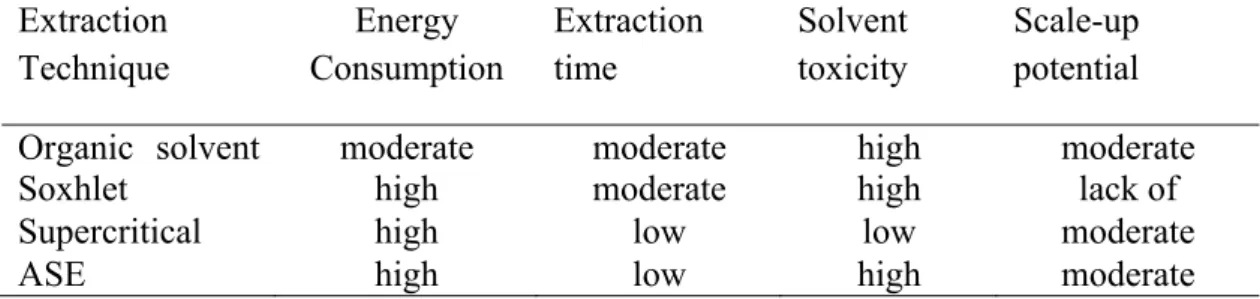
In SFE, after extraction is completed, the temperature and pressure are returned to atmospheric conditions. Carbon dioxide, (gas) at room temperature, is separated from the final product (Ajav et al. ; Agarwal). Supercritical fluid extraction is becoming more widely investigated because it does not leave harmful solvent residues, has a faster extraction time than mechanical disruption and solvent extraction, and is used for thermally sensitive products (Agarwal). In addition, use of co-solvents can enhance the selectivity of extraction of certain compounds in the extract (Halim et al. 2012). However, the pressure vessel installation cost and unfavourable energy requirements, as well as CO2-demand, limit the scalability of supercritical fluid extraction at present (Agarwal ; Halim et al. 2012).
2.4.3.
Solvent extraction
Solvent extraction makes use of specific chemicals to liberate the lipids and separate them from the crude biomass. Possible solvents include benzene, ethanol, hexane or ethanol-hexane mixtures (Amin 2009; Mata et al. 2010). The most widely used solvent however, is hexane, due to its lower cost ready availability and low toxicity, density and boiling point (Medina et al. 1998; Agarwal 2007; Demirbaş 2009).
23 | P a g e Solvent extraction of lipid from microalgae biomass is a process that transfers crude lipids from either a solid or a liquid phase to a second, immiscible phase. Extracted lipids are dissolved in the solvent and form a solution separate to the cell debris (Agarwal). This is due to oil being highly soluble in the organic solvents used in this process (Agarwal). Extraction efficiencies are enhanced when the solvent can penetrate algal cells, hence polarity similar to that of the crude lipids being extracted. Non-polar solvents typically extract non-polar lipids whereas polar lipids; are typically extracted by polar solvents. This connection between polar compounds minimises the co-extraction of non-lipid contaminants (protein and carbohydrates) (Milledge and Heaven 2013). Higher lipid yields can be achieved by either disrupting cells before adding the solvent or using a combination of solvents such as hexane (non-polar), methanol (polar) and water (Medina et al. 1998; Agarwal). Contamination is a major obstacle when using organic solvents, as pigments can be extracted into the product.
An experiment carried out by Halim et al. (Agarwal) examined the lipid yields results from hexane and hexane/isopropanol extraction using Chlorococcum sp. as the algae species. For the hexane extraction, dried powder and wet paste derived from microalgae biomass were used as feedstock. It was found that the hexane extraction using wet algal paste produced a 33% lower yield than dried powder. The combination of n-hexane and isopropanol produced a three-fold increase in lipid yield when compared to hexane extraction from dried biomass. This was because algae cell walls can prevent direct contact between non-polar solvents and their cell membrane to reduce the effectiveness of lipid extraction. The use of alcohol (polar solvent) can disrupt the membrane-based lipid-protein interactions by forming hydrogen bonds with the polar lipids (Agarwal). This allows hexane to extract a larger amount of lipids, and therefore, hexane:alcohol extraction is seen as the most suitable method for industrial scale production.
Solvent extraction at higher temperature and pressure, shown as accelerated solvent extraction (ASE), has been investigated and found to be very efficient with maximal final lipid recovery of 90.21% of total lipids (Halim et al. 2012). ASE can also be