
ISSN 2150-7988 Volume 5 (2013) pp. 445- 453
© MIR Labs, www.mirlabs.net/ijcisim/index.html
MIR Labs, USA
Design Coordination Using Cloud-based Smart
Building Element Models
Anil Sawhney1 and J. Uma Maheswari21 Department of Civil Engineering, Indian Institute of Technology Delhi,
Hauz Khas, New Delhi – 110016, India [email protected]
2 Department of Civil Engineering, Indian Institute of Technology Delhi,
Hauz Khas, New Delhi – 110016, India [email protected]
Abstract: Construction industry involves a multitude of
stakeholders who perform their project-centric work from various dispersed locations. This involvement of numerous stakeholders, which is common in the construction industry compared to the other industries, has led to fragmentation of the design process. The limitations and complexities resulting from this fragmentation can be overcome by proper design coordination.
Shifting from two-dimensional design process, the industry has recently embraced Building Information Models (BIM) that allow an information rich visualization of the facility from the feasibility stage of the project enabling efficient information transfer among the stakeholders. Deploying the BIM on the ‘cloud’ platform or cloud computing (CC) can further enhance the design coordination especially clash detection. While BIM is certainly an improvement compared to the paper-based design process no direct mechanism exists to capture the iterative characteristic feature of the process. It is important to capture the design evolution that emerges as a result of change propagation while resolving any coordination issues requiring a record of the history of design changes.
Very few researchers have investigated the use of building element level versioning using object parameters that can store the design information changes. A conceptual framework using the Industry Foundation Classes (IFC) that allows version and audit history to be retrieved at any instance of time via a cloud-based BIM model server is proposed. The utility of the framework is also discussed with the help of an example.
Keywords: Design Coordination, BIM, CC, IFC, Smart Object, Design Changes
I.
Introduction
Design phase of a construction project requires information exchange from various domains and disciplines throughout the entire design process [1]. From inception to the detailed design phase, with the release of drawings and specifications, design phase involves multiple design domains and is often considered iterative and evolutionary [2]. Moreover, as this inter-disciplinary design is iterative and involves coordination of information flows across multiple teams, it is difficult to structure and plan the design process. Hence, design
engineers always face tremendous challenges in managing the design phase, especially for large and complex projects [3], [4].
It is well known that the construction industry is highly fragmented even today. The fragmentation is further complicated by the fact that project delivery involves several disciplines collaborating for relatively short periods of time with feeble transfer/sharing, of data/information [5]. It has been discussed that in reality, although the fragmentation exists amongst almost all the project specialists, proper adoption of the design coordination can overcome the barriers caused by fragmentation [6]. Coordination is often considered only when something goes wrong and the general understanding is that design mistakes will be corrected in the field [7].
Traditional design offices had the entire design team in the same office to enable easy communication and sharing of information especially during crunch times. Most of the time, the information exchange was in the form of two-dimensional (2D) design drawings and other paper-based formats. Today, as the design teams are scattered across the world, multi-party information exchange is happening in a variety of forms with the advent of new information technologies, especially the Internet and specialized Extranets [8].
The rapid emergence of BIM (Building Information Model) has changed the way AEC (Architecture, Engineering and Construction) project teams think and work in putting their ideas together [6]; leading to enhanced project delivery marked by efficient information exchange, especially to solve problems in clash detection and resolving conflicts [9]. BIM is a data-rich, object-oriented, digital representation of the facility, from where data and views of the facility, appropriate to the designer’s needs can be extracted and analyzed for decision-making [7].
Apart from the advantages of visualizing the facility, minimizing the number/frequency of design and construction errors; modern BIM tools can define objects parametrically [10]. Also, as these 3D objects are machine readable, it becomes practical to use the data for other analysis such as
energy, lighting, and acoustics analysis [11]. Thus building models allow for feasible integration of design phases simultaneously while explorations and analysis of the design can be conducted.
The power of BIM is limited by numerous factors pertaining to people, process and technology. The industry is striving to solve the people and process issues via a variety of strategies that include national BIM standards, standard contractual documents, and implementation roadmaps [12]. On the technology front, CC can provide many fundamental enhancements to the way BIM can be deployed and used in the industry [13].
CC is not a specific technology or a particular software solution but instead, it is an umbrella concept to share information technology resources over the internet [14]. National Institute of Standards and Technology (NIST) in the USA has defined CC as a model for enabling convenient, on-demand network access to a shared pool of configurable computing resources (e.g., networks, servers, storage, applications, and services) that can be rapidly provisioned and released with minimal management effort or service provider interaction [15]. In simple words, CC is a technology used to flexibly access computational services offered via the Internet [6].
CC is ultimately the delivery of computing as a service rather than a product, which can provide computation, software, data access, and storage devices that do not require the user’s knowledge of the utility [16]. As such CC offers three broad services referred as SPI (Software, Platform, and Infrastructure) targeted for end users, developers and engineers respectively as seen in figure 1. Cloud services that deliver infrastructure resources (such as operating system, storage, networking, etc.,) as a service are known as Infrastructure as a Service (IaaS). A Platform as a Service (PaaS) cloud lies directly upon an IaaS layer providing a platform upon which applications and services can be developed and hosted as illustrated in the figure 1. Software as a Service (SaaS) clouds provides software applications using a cloud infrastructure and or platform [17].
With the help of the service models deployed on either a public or private cloud, CC can offer a variety of solutions to overcome the above mentioned barriers in the construction design process seamlessly.
Figure 1. Cloud Service Models (Adapted from [18])
II.
Background
It is a well-known fact that AEC domain is multidisciplinary in nature having numerous experts from several disciplines such as architects, structural engineers, electrical engineers, mechanical engineers, construction managers, acoustical experts, lighting consultants and many more. These experts have their own view of the project [19] leading to differing priority on the project, discipline specific design inputs and outputs [20], and on the execution sequence. Under this circumstance, design coordination issues, also termed as clashes, occur frequently and it is often a challenging task to arrive in a short while at a well-coordinated design solution for the project.
Traditionally, these clashes were identified manually by overlaying of discipline specific 2D drawings and through discussions among all the project team members. This manual process of design coordination consumes more time and becomes ineffective in complex and large-scale projects [21], [22]. It is not uncommon to have designs that are not fully coordinated released for construction. This leads to defects and rework on construction projects that induce waste and significant inefficiencies in the delivery process.
With the emergence of increasing complexities in the projects, identifying the design experts in the same locality/organization is really difficult. As pointed out by W. J. Mitchell, “design is fundamentally a collaborative, interdisciplinary, geographically distributed, multimedia activity” [23]. Thus, the design teams are scattered across the world for most of the projects. The communication between the experts on the projects, the information sharing among the teams, and other issues are being dealt with the recent advancements in the Information and Communication Technology (ICT). Collaborative project extranets, emails, and instant messaging to some extent have been used to overcome spatial dispersion of team members. However, this does not address the core issues of model-based design coordination.
Design coordination and tracking design changes is not new. But, owing to the present demands of the situation prevailing in the industry, this has become a challenging issue today. Researchers have shown that BIM can solve the design coordination issues with considerable improvement in terms of time and cost [24], [25], [26], [27], [28], [29], [30], [31]. Initially, BIM was considered successful only for visualization of the construction process. Recently the industry has embraced BIM as an information rich environment for use in the entire project life-cycle. To some extent this has allowed the stakeholders scattered across the world to exchange design information more efficiently. Although this model and the underlying approach are powerful and useful, still there were practical limitations in using stand-alone BIM for the construction industry.
Deploying the BIM on the ‘cloud’ can further enhance the design coordination as most of the time; experts spend in transfer/exchange of large amounts of design data. So far, limited research work has been conducted in the application of cloud technology in the AEC sector [6].
The foundation of any BIM model rests on objects that represent building/construction elements (both
product-oriented and process-oriented). In their current form these objects (also known as Building Element Models (BEM) or Building Object Models (BOM)) have parametric properties with limited or no intelligence built into them. Smart AEC objects are an evolutionary step that builds upon earlier research and practice in AEC product modeling, intelligent CAD systems, and knowledge based design methods. These Smart AEC objects have the facility to represent several aspects of project information required to support multidisciplinary views of the objects, and the ability to encapsulate “intelligence” and “knowledge” by representing behavioral aspects, design constraints, and life cycle data management features into the objects [32]. These objects have the knowledge of what they are and how to behave or interact with other objects and these objects are parametric and intelligent in nature [33].
Few researchers have already investigated on improving the “smartness” of these objects thereby making objects more parametric and intelligent. Can these smart objects conceptually improve the coordination function of the AEC sector by tracking the design information changes?
III.
Past History
A. Building information modeling
The acronym BIM was coined in early 2002 to define virtual design, construction, and facilities management functions collectively. Information modeling for design is not a new technology in itself. “Early adopters of these production processes and tools, such as Toyota and Boeing, have achieved manufacturing efficiencies and commercial success. If a virtual model of a spacecraft can be done prior to fabrication, in order to diminish flaws, then a model of a building ought to be assembled prior to construction, for the same reason” [7].
According to the US National Building Information Modeling Standard (US NBIMS), “BIM is a data-based digital representation of functional and physical characteristics of a building from earliest conception to demolition. BIM is a collaboration of different stakeholders at various phases of the building life cycle to explore, insert, extract, update or modify building information in the BIM database to support and reflect the roles of that stakeholder” [34]. It can also be defined as a data-rich, object-oriented, intelligent and parametric digital representation of the facility, from which views and appropriate data to various users’ needs can be extracted and analyzed to generate information that can be used to make decisions and to improve the process of delivering the facility [35].
BIM combines information from multiple disciplines allowing for faster and better information exchange that streamlines the design process and has the potential to reduce or eliminate coordination errors [21], [9], [36], [37].
BIM servers are tools that boast the availability of the BIM models on a central server. A vital goal of a BIM server is project synchronization. Among some of the existing BIM servers’ platforms, Graphisoft BIM Server is efficient to serve concurrently multiple clients with relatively small “delta” data packages transmitted through the WAN [7].
In the AEC industry typically one person in each department or consulting team were held responsible for managing versions within the project. The process followed a very simple approach; when the architect or engineer releases an update to the design, it is delivered to the consultant organization for model synchronization [38]. But the process becomes complex as the project grows in size and complexity; this process of file based exchange becomes inefficient when exchanges need to be processed rapidly. Recent trends are changing this approach of managing files with the synchronous and asynchronous management of objects that represent building elements. The technology associated with resolution of these types of data management issues is called a building model repository [7].
BIM repository is a server or database system that brings together and facilitates management and coordination of all project related data. They are distinguished by providing object-based management capabilities, allowing query [39], transfer, updating, and management of model data partitioned [40] and grouped in a wide range of ways to support a potentially heterogeneous set of applications [7].
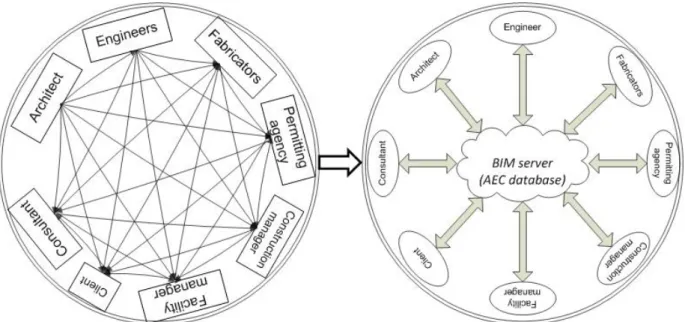
Figure 2 displays the process of interaction amongst project stakeholders in AEC industry both using the traditional approach and the latest BIM server technology. This technology has several advantages such as, model exchange capabilities for remote users, management of unstructured forms of communications (email, meeting notes, phone records, faxes, videos, photographs schedules, etc.), support for product libraries, management of object instances (read, write, delete) based on update transaction protocols, version management, and user access control. Further the main capability of BIM server is project model and information synchronization.
A. Cloud computing
Designers are now able to ‘virtually’ construct a fully documented, three-dimensional facility on a computer before it is actually built on-site. The driving force behind this innovation has been BIM. Apart from visualization [41], the current BIM software allow decision-making on the ‘virtual’ model and provide scope for improvement [42]. When BIM is deployed on a Cloud platform it further enhances the collaborative process that leverages web-based BIM capabilities and traditional document management to improve coordination [43].
From the end-user perspective, there are four fundamentally different approaches to CC, popularized by different companies-Data in the Cloud (The “Amazon” Approach), Software Virtualization in the Cloud (The “Citrix” Approach), Web Applications in the Cloud (The “Google” Approach), Business Logic in the Cloud (The “Apple” Cloud Approach)[14].
National Institute of Standards and Technology (NIST) in the USA has defined cloud computing or infinite computing as a model for enabling convenient, on demand network access to a shared pool of configurable computing resources (e.g., networks, servers, storage, applications, and services) that can be rapidly provisioned and released with minimal management effort or service provider interaction [15].
Dynamic Publishers, Inc., USA Figure 2. Paradigm shift from file based exchange to BIM
In simple words, Cloud Computing is a technology used to access computational services offered via the internet [6]. There are several other benefits of adopting CC technology for BIM in the AEC industry. It helps in collaborating over wide area geography even with outside firms on the same model providing full mobility (i.e., people can run all their office applications anytime, anyplace, just as if they were in their office). It also has an advantage for rendering and animation farm, where in rendering times drops significantly. BIM models are large, complex and highly integrated databases, it is especially important to provide concurrent access to BIM models while maintaining their highly integrated nature but not introducing unnecessary limitations, we have to consider several issues during this condition where CC can play a role.
Under this worldview the authors have envisioned three distinct streams of applications as shown in Figure 3. They are: (1) Model Server: using the CC platform, the central model of the building can be hosted which allows inter- and intra- disciplinary access of the model contents in a seamless fashion; (2) BIM Software Server: current BIM software require significant hardware resources to run which can be deployed in the cloud and shared efficiently between the project participants; and (3) Content Management: CC provides a perfect centralized and secure hosting environment for content in the form of data attributes/libraries needed for BIM usage and deployment.
The authors have created an initial cloud-based experimental setup for testing the three facets of CC based BIM deployment as shown in figures 4, 5 and 6. The figures 4 and 5 captures the architectural and structural BIM mode respectively on the cloud and the figure 6 shows the rendered model on the ‘iPhone’.
Figure 3. Functional Benefits of Cloud Computing A. Smart AEC Objects
An object is defined as an independent procedure that contains both the instructions and data to perform some task, and the programming code necessary to handle various messages that it may receive [48]. Parameters are always a predefined set of properties that the user has to select from, or abide by their rules for the creation or alteration of a new object. Parametric design relies on the ability to change an object’s properties without redrawing it again or in other words, the objects must have knowledge to behave smartly [32]. An object can be made intelligent by adding structural, functional and behavioral characteristics apart from the geometric attributes associated with the object.
Smart AEC objects are an evolutionary step that builds upon earlier research and practice in AEC product modeling, intelligent CAD systems, and knowledge based design methods. These smart objects have the facility to represent several aspects of project information and also have the knowledge of what they are and how to behave or interact with the other objects [32], [33].
Figure 4. Architectural BIM model on the cloud
Figure 5. Structural BIM model on the cloud
Figure 6. Rendering BIM model using cloud computing on “iPhone”
The IFC’s (Industry Foundation Classes) developed by the IAI (Industry Alliance for Interoperability) represents a standard data model which is accepted worldwide to represent these objects. The IFCs, initiated in 1994 has also supported commercial software tools such as Autodesk, Graphisoft, MS Visio and few others. Interoperability can be viewed as a series of data exchanges or transactions between computer applications. While the IFC model standardizes the content of an information exchange transaction, it offers no guidance to the context of these transactions [44].
Some researchers are working on improving the “smartness” of these objects thereby making objects more parametric and intelligent. Among the characteristics of smart objects include the behavioral intelligence and the management of evolution history tracking [33]. The role of these objects to track design information changes on a cloud-based BIM platform has not been explored so far. Hence, the next section describes the proposed framework to achieve this objective.
IV.
Proposed Framework
A. Initiation and Propagation for Changes
Objects can be represented as simple or complex. Whether simple or complex, any object is associated with at least one actor/design expert who can perform a specific responsibility on the object. Any design object has both geometric and non-geometric properties such as material type, quality, specifications, etc. stored along with the object data.
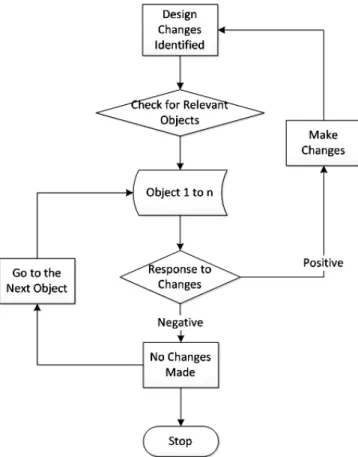
Construction projects are always prone to numerous changes at various times of the project lifecycle. Not all the changes affect all the objects that constitute the virtual model of the project. Whenever a change is initiated, the model checks which object would undergo changes as a result of the design change. Checking of the objects is based on the relevancy rule. Relevancy rule is supported by the “purpose-function-behavior” construct as proposed by Rosenman and Gero [45]. For example a change made by an architect to an internal wall in a building may change the purpose-function-behavior of the beam that the structural designer is designing to support the wall. Smart objects have to be defined in such a manner that the parametric properties fit well into this type of “purpose-function-behavior” construct. Once, the change-prone objects are identified using this approach, the model sends notification to the corresponding objects about the changes made as seen in figure 7.
Figure 7. Information Changes Framework As stated earlier, design is an evolutionary process such that few disciplines would start their design early in the project followed by some that start only at the end of the project. Hence, every time a change is prompted to affect an object, the actor/designer associated with the object decides whether
changes are made at that particular instance of time. Finally, the model stops when no changes are made.
If the actor decides to make the changes on the object, then that particular object will be locked in the central and local model. Then, the changes are recorded on the object and the object is unlocked as soon the relevant changes are made. Now, the model continues to track the responding objects for these modifications to enable the change propagations. This iterative loop goes on until all the changes are identified and either committed or rejected.
B. Tracking a Change
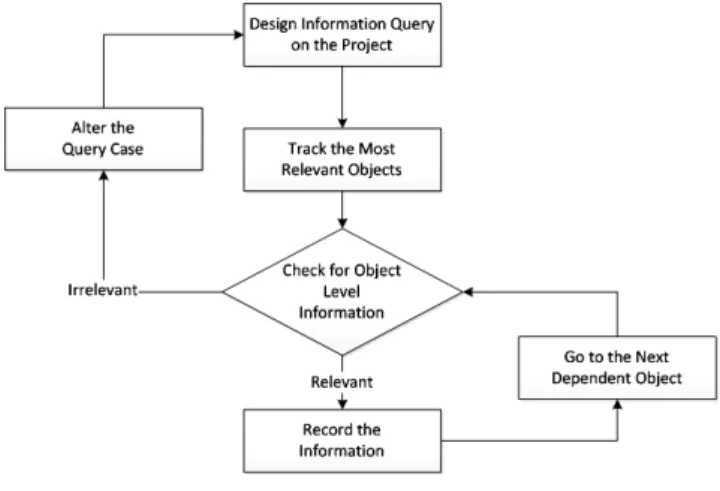
As discussed earlier, any history on design information changes can be tracked both at the project level and object level. Both can be accomplished to some extent using the IFC schemas. The primary IFC element hierarchy is as follows: Project – Site – Building – Discipline – Component –Object Elements. Here, the object (root level) can store the changes (IfcOwnerHistory) along with other properties. Under the IFC specifications each instance of an object has a unique identifier that follows the universal unique identifier (UUID) standard with its implementation as a globally unique identifier (GUID). In an IFC model, the generated GUID is compressed for exchange purpose following a published compression function as Ifc-GUID. Using these owner and unique identifiers the change tracking process can be framed. In this entire change management loop, actors play a key role in making any decision and therefore the query on any particular object is also requested by the actor at the project level as seen in the Figure 8. Based on the query information, the information is tracked to identify the most relevant object. Once the object is identified, the Ifc-GUID and IfcOwnerHistory is tracked to match the query case. If a match is found successful then the information is recorded and the affected/dependent objects are checked further. This process continues on until there is no match between the query case and the recorded history information. At the end of the process, all the collected information is consolidated and is returned back to the actor who initiated the query. On the other extreme, if no objects are identified in the initial step with the query, the model prompts for revisiting the query case as shown in the figure 8.
C. Proposed cloud framework
Our proposed cloud based framework has an http front-end, allowing access to a central server which serves as a host of numerous design and engineering software packages installed into it using BIM as seen in the Figure 9.
As shown in the figure 9, there is a central server for managing the project BIM files at the project level. There are many local servers identified for architectural, structural, etc. for developing their design documents. These files are temporarily stored in the local server and at regular intervals are made to sync to detect the clashes with the help of the central server.
In this whole set up whenever a query is raised by any of the actors (identified at one of the local servers), the query is enabled at the project level hosted at the central server and the above process is continued and the report on the queried information is returned back to the responder.
Figure 8. Information Tracking Framework Due to the lack of adequate data from industry, only preliminary tests were conducted as seen in figures 4, 5 and 6. Research is already in progress with rigorous experimental work with live data from industry.
V.
Summary and Discussions
The generic framework proposed for tracking the history on any design information has been conceptually presented in this study. It is expected that this generic framework can benefit the future BIM industry users to manage the coordination problems more efficiently.
But, still the proposed framework faces some limitations as mentioned in the forthcoming paragraphs:
• As this is a conceptual framework, further improvements can be made to the same by discussing the possible scenarios/ issues with the design experts of various construction projects. Research work is already in progress in this area.
• Further, a simple experimental set-up is already established at the author’s Institute Premises. As shown in the Figures 4, 5, 6 a campus wellness center has been developed with Architect’s and Structural Engineer’s input on the local model. Although the experiment is not yet complete, the initial investigation was quite convincing and proves that there is scope for testing this framework elaborately.
Acknowledgments
The authors would like to acknowledge the contributions of their doctoral student, Amarnath C B, who helped in the experimental setup.
References
[1] M. Chiu, “An organizational view of design communication in design collaboration”, Design studies, Vol. 23 (2), 2002, 187-210.
[2] E. Zaneldin, T. Hegazy, and D. Grierson, “Improving design coordination for building projects, II: A collaborative system”, Journal of construction engineering and management, Vol. 127 (4), 2001, 330-336.
[3] C. B. Tatum, and T. Korman, “Coordinating building systems: process and knowledge”, Journal of Architectural Engineering, Vol. 6 (4), 2000, 116-121
Dynamic Publishers, Inc., USA Central server Project Manager Central model
WAN
User A Local server User A User B User C Architect Structural Engineer MEP Consultant Local model Local model Local model High band width VPN Model cache Work sets Work sets Work sets elements elements elements Exchange virtual serverFigure 9. BIM – Cloud framework [4] P. K. Barton, “Building services integration”, E & FN
Spon, London.
[5] A. Caballero, S. M. Ahmed, S. Azhar, and M. Barcala, “Development of an Information Model to Enhance Integration and Coordination in the Construction Projects”, Proceedings of the 19th (ISARC) International Symposium on Automation and Robotics in Construction, Gaithersburg, Maryland, Sep. 23-25, 2002, 123-128. [6] Y. Arayici and G. Aouad, “Computer integrated
construction : an approach to requirements engineering,” Engineering, construction and Architectural Management, Vol. 12 (2), 2005, 194-215.
[7] Eastman, P. Teicholz, R. Sacks, and K. Liston, BIM Handbook: A Guide to Building Information Modeling for Owners, Managers, Designers, Engineers, and Contractors. Second edi. New Jersey, USA: John Wiley & Sons, Inc., 2002.
[8] Sawhney, “Research and Development plan for the AEC Industry,” Berkeley-Stanford CE&M Workshop, Stanford, CA, 1999.
[9] S. Azhar, A. Nadeem, J. Y. N. Mok, and B. H.Y. Leung, “Building Information Modeling ( BIM ): A New Paradigm for Visual Interactive Modeling and Simulation for Construction Projects,” Proceedings of
First International Conference on Construction in Developing Countries (ICCIDC–I), Advancing and Integrating Construction Education, Research & Practice, Aug. 4-5, Karachi, Pakistan, 2008, 435-446. [10]T. Cerovsek, “A review and outlook for a ‘Building
Information Model’ (BIM): A multi-standpoint framework for technological development”, Advanced Engineering Informatics, Vol. 25 (2), 2011, 224-244. [11]P. S. Brandon and T. Kocaturk, Virtual Futures for
Design, Construction and Procurement, (edited book) Blackwell publishing, 2008.
[12]M. Eastman, Y.-S. Jeong, R. Sacks, and I. Kaner, “Exchange Model and Exchange Object Concepts for Implementation of National BIM Standards,” ASCE Journal of Computing in Civil Engineering, Vol. 24 (1), 2010, 25-34.
[13]Pudney, “STRATUS: A Private Cloud Server Technology for Revit,” AECbytes, Building the Future Article, 1-6, 2011.
[14]V. Várkonyi, “Debunking the Myths about BIM in the ‘Cloud’,” AECbytes Viewpoint # 61, 1-4, 2011.
[15]P. Mell and T. Grance, “The NIST Definition of Cloud Computing”, Recommendations of the National Institute of Standards and Technology, 2011.
[16]G. Briscoe and A. Marinos, “Community cloud computing”, Proceedings of the First international conference on cloud computing, Beijing, China, 2009, 1-4.
[17]J. Hurwitz, R. Bloor, M. Kaufman, and H. Fern, Cloud Computing for Dummies. Indianapolis, Wiley Publishing Inc., 2010.
[18]X. Chen, G. B. Wills, L. Gilbert, and D. Bacigalupo, Using Cloud for Research: A Technical Review, Tecires Report, 2010.
[19]M. A. Rosenman and J. S. Gero, “Modelling multiple views of design objects in a collaborative CAD environment”, Computer-Aided Design, Vol. 28 (3), 1996, 193-205.
[20]S. T. Pektas, and M. Pultar, “Modelling detailed information flows in building design with the parameter-based design structure matrix”, Design Studies, Vol. 27 (1), 2006, 99-122.
[21]Leite, B. Akinci, and J. Garrett, “Identification of data items needed for automatic clash detection in MEP design coordination”, Proceedings of the Constuction Research Congress, 2009, 416-425.
[22]M. D. Gross, E. Y. Do, R. J. McCall, W. V. Citrin, P. Hamill, A. Warmack and K. S. Kuczun, “Collaboration and coordination in architectural design: approaches to computer mediated team work”, Automation in Construction, Vol. 7 (6), 1998, 465-473.
[23]W. J. Mitchell,: in Wojtowicz, J. (ed): Virtual Design Studio, Hong Kong University Press, 1995.
[24]C. Kam, M. Fischer, R. Hänninen, A. Karjalainen, and J. Laitinen, “The product model and Fourth Dimension project”, Journal of Information Technology in Construction (ITcon), Vol. 8, 2003, 137-166.
[25]L. Khemlani, “The Eureka Tower: A case study of advanced BIM implementation”, AECbytes, 2004, http://www.aecbytes.com/feature/2004/EurekaTower.ht ml (accessed August 22, 2010).
[26]Khanzode A., Fischer M., and Reed D. (2008) “Benefits and lessons learned of implementing building virtual design and construction (VDC) technologies for coordination of mechanical, electrical and plumbing (MEP) systems on a large healthcare project”, Journal of Information Technology in Construction (ITcon), Vol. 13, 324-342.
[27]C. Eastman, P. Teicholz, R. Sacks, and K. Liston, BIM Handbook: A Guide to Building Information Modeling for Owners, Managers, Designers, Engineers, and Contractors. Building. Second edi. New Jersey, USA: John Wiley & Sons, Inc., 2008.
[28]W. Kymmell, “Building information modeling: planning and managing construction projects with 4D CAD and simulations”, McGraw-Hill, New York, 2008.
[29]D. J. Gerber, “The Parametric Affect: Computation, Innovation and Models for Design Exploration in Contemporary Architectural Practice”, Design and Technology Report Series, No 2008-2, Harvard Design School, Cambridge MA, 2008.
[30]J. E. Taylor, and P. G. Bernstein, “Paradigm Trajectories of Building Information Modelling Practice in Project Networks”, ASCE Journal of Management in Engineering, Vol. 25 (2), 2009, 69-76..
[31]N. Berente, R. Baxter, and K. Lyytinen, “Dynamics of inter-organizational knowledge creation and information technology use across object words: the case of an innovative construction project”, Construction Management and Economics, Vol. 28 (6), 2010, 569-588.
[32]M. Ibrahim and R. Krawczyk, “The level of knowledge of CAD objects within the building information model”, Proceedings of the ACADIA, Indianapolis, Indiana, 2003. [33]M. Halfawy and T. Froese, “Building Integrated
Architecture/engineering/construction systems using smart objects: methodology and implementation”, ASCE Journal of computing in civil engineering, Vol. 19 (2), 2005, 172-181.
[34]National Building Information Modeling Standard – NBIMS, Version 1.0, 2007.
[35]Sawhney, K. C. Iyer, K.. Sudhir, and Prateek, “Building Information Modeling Driven Construction Project Management”, Proceedings of Project Management Research & Academic Conference (PMIREC 2011), 9-10th December, NICMAR, PUNE, India, 2011. [36]H. Kim, and F. Grobler, “Design Coordination in
Building Information Modeling (BIM) Using Ontological Consistency Checking”, Proceedings of the 2009 ASCE International Workshop on Computing in Civil Engineering, 410-420.
[37]S. Kubicki, A. Guerriero, D. Hanser, and G. Halin, “IT services design to support coordination practices in the Luxembourguish AEC sector”, Proceedings of the 4th International Conference on Cooperative design, visualization, and engineering, 2007.
[38]C. B. Amarnath, A. Sawhney, and J. U. Maheswari, “Cloud Computing to Enhance Collaboration, Coordination and Communication in the Construction Industry”, Proceedings of 2011 World Congress on Information and Communication Technologies (IEEE), 1239-1244, IEEE, 2011.
[39]Borrmann, and E. Rank, “Topological analysis of 3D building models using a spatial query language”, Advanced Engineering Informatics, Vol. 23 (4), 2009, 370-385.
[40]J. Beetz, J. V. Leeuwen, and B. D. Vries, “IfcOWL: A case of transforming EXPRESS schemas into ontologies”, Artificial Intelligence for Engineering Design, Analysis and Manufacturing, Vol. 23 (1), 2009, 89–101
[41]T.-H. Chuang, B.-C. Lee, and I.-C. Wu, “Applying Cloud Computing Technology to BIM Visualization and Manipulation,” Proceedings of 28th ISARC (International Association for Automation and Robotics in Construction), Seoul, Korea, 2011, 1-6.
[42]T. Hartmann, J. Gao, and M. Fischer, “Areas of Application for 3D and 4D Models on Construction Projects,” ASCE Journal of Construction Engineering and Management, Vol. 134 (10), 2008, 776-785,
[43]C. France, “BIM and the Cloud Part 1,” AECbytes, 2010, 1-7.
[44]T. Froese, Future directions for IFC-based interoperability, ITcon, Vol. 8, 2003, 231-
[45]Rosenman, M. A. and Gero, J. (1999) “Purpose and function in collaborative CAD environment”, Reliability Engineering and System Safety, Vol. 64, 1999, 167-179.
Author Biographies
Anil Sawhney is a Professor in the Department of Civil
Engineering at Indian Institute of Technology Delhi since July 2011. He was Professor of Construction Project Management at the University of Technology Sydney before joining his current position. Professor Sawhney is a civil engineer with expertise in the area of construction project management. His research is focused upon built environment modeling and affordable and sustainable housing.
J. Uma Maheswari is Assistant Professor in the
Department of Civil Engineering at Indian Institute of Technology Delhi since Jan 2008. Earlier to this she had worked as a Young Scientist at Indian Institute of Technology Madras. Her major research interests include construction project management, design management, matrix-based tools, automation in design and construction.
![Figure 1. Cloud Service Models (Adapted from [18])](https://thumb-us.123doks.com/thumbv2/123dok_us/1379830.2684779/2.892.71.427.893.1151/figure-cloud-service-models-adapted.webp)
![Figure 9. BIM – Cloud framework [4] P. K. Barton, “Building services integration”, E & FN](https://thumb-us.123doks.com/thumbv2/123dok_us/1379830.2684779/7.892.162.746.118.899/figure-bim-cloud-framework-barton-building-services-integration.webp)
