Reserve Bank of Australia Economic Research Department
RESEARCH
DISCUSSION
PAPER
Competition Between
Payment Systems
George Gardner and
Andrew Stone
George Gardner and Andrew Stone
Research Discussion Paper 2009-02
April 2009
Payments Policy Department Reserve Bank of Australia
We are grateful to Michele Bullock, Christopher Kent, Philip Lowe and colleagues at the Reserve Bank for helpful comments. The views expressed in this paper are those of the authors and are not necessarily those of the Reserve Bank of Australia.
Authors: gardnerg or stonea at domain rba.gov.au Economic Publications: [email protected]
This paper is the first of two companion pieces examining competition between payment systems. Here we develop a model of competing platforms which generalises that considered by Chakravorti and Roson (2006). In particular, our model allows for fully endogenous multi-homing on both the merchant and consumer sides of the market. We develop geometric frameworks for understanding the aggregate decisions of consumers to hold, and merchants to accept, different payment instruments, and how these decisions will be influenced by the pricing choices of the platforms. We also illustrate a new potential source of non-uniqueness in the aggregate behaviour of consumers and merchants which is distinct from the well-known ‘chicken and egg’ phenomenon – and indeed can only arise in the context of multiple competing platforms. Finally, we briefly discuss how this new source of non-uniqueness may nevertheless shed light on the ‘chicken and egg’ debate in relation to the development of new payment systems.
JEL Classification Numbers: D40, E42, L14
Keywords: payments policy, two-sided markets, interchange fees
1. Introduction 1
2. A Model of Competing Payment Systems 5
2.1 The General Model 5
2.2 Notation 6
2.3 Platforms 9
2.4 Consumers 10
2.5 Merchants 12
2.6 Possible Applications of the Model 13
3. Understanding Merchants’ and Consumers’ Card Choices 15
3.1 Merchants’ Card Acceptance Decisions 16
3.2 Consumers’ Card Choices 18
3.3 The Case of the Chakravorti and Roson Model 24
4. Potential Non-uniqueness of Market Equilibria 26
4.1 The Extent and Nature of Non-uniqueness 28
4.2 The Modelling and Other Implications of Non-uniqueness 30
5. Conclusions 32
Appendix A: Derivation of the Geometric Frameworks in Section 3 34
A.1 The Framework for Merchants’ Card Choices 34
A.2 The Framework for Consumers’ Card Choices 35
Appendix B: Platforms’ Pricing Incentives 38
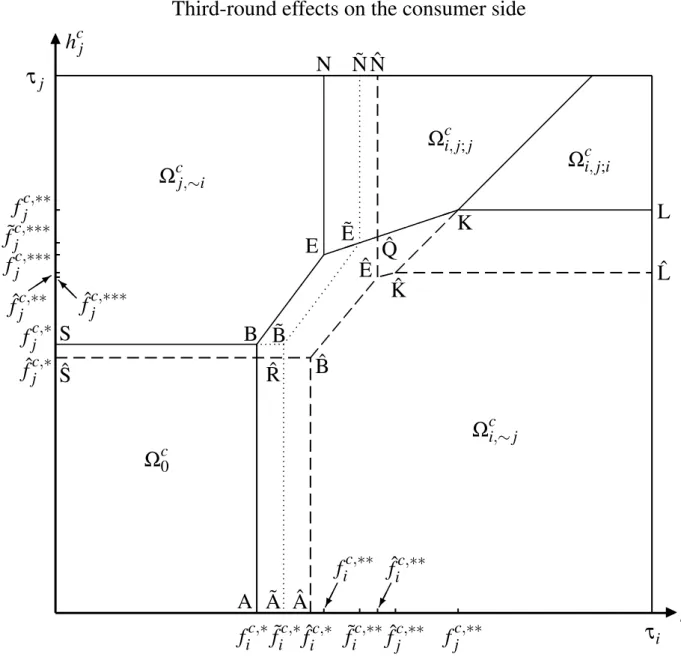
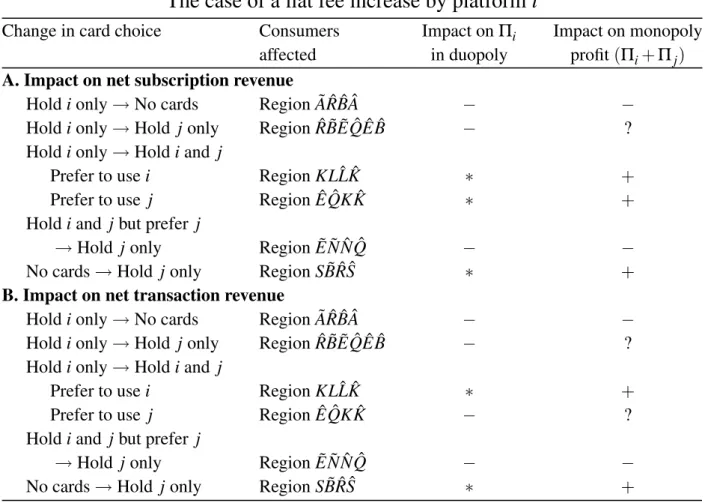
B.1 The Effects of an Increase in a Platform’s Consumer Fee 38 B.2 The Impact on a Platform’s Profits and Incentives 42
References 45
George Gardner and Andrew Stone
1.
Introduction
Over the past decade, analysis of the pricing strategies of payment system operators has been an area of growing interest. Much of this analysis has, however, been conducted in the context of a single payments platform, competing with the default alternative of cash. Only recently has a literature developed examining the more complex, but more realistic, situation of competing payment systems.
Important contributions in this latter area include Rochet and Tirole (2005), Armstrong (2006) and Guthrie and Wright (2007). In these and other papers, considerable progress has been made in identifying key issues influencing platform pricing. However, the complexity of modelling competition between payment systems has typically required such papers to adopt a range of simplifying assumptions, some of which limit the applicability of any findings. One such assumption is that payment platforms levy purely per-transaction fees on both consumers and merchants. Adopting this assumption has the analytical advantage of ensuring that every consumer (merchant) faces the same charge for each transaction on a given platform as every other consumer (merchant). However, in many payments markets competing schemes tend to use annual, rather than per-transaction, fees in their pricing to consumers.1 In such markets, the effective per-transaction fee faced by consumers, rather than being identical for all consumers, varies depending on their propensity to use a given network.
A second assumption commonly adopted relates to the degree to which consumers (merchants) tend to hold (accept) multiple payment instruments – known as multi-homing. In recent years the relative tendency of consumers and merchants to multi-home has emerged as an important potential determinant of platforms’
1 An example is the credit card market in Australia. Of course many credit cardholders in
Australia also receive reward points per dollar spent – equivalent to a negative per-transaction charge. However, they must usually pay an additional annual fee for membership of a rewards program.
allocation of their fees between the two groups. However, allowing for multi-homing on both sides of payments markets significantly complicates analysis of aggregate consumer and merchant behaviour, and hence of platforms’ pricing incentives. It has therefore been common – an example is Chakravorti and Roson (2006), discussed in greater detail below – to assume that multi-homing is allowed only on one side of the market, with participants on the other side permitted to subscribe to at most one platform (single-home).
Finally, three further simplifying assumptions often adopted are: that competing platforms provide identical bundles of payment services to both consumers and merchants; that they face identical costs in providing these services; and that consumers or merchants are homogeneous in the values that they place on the benefits they receive from transacting with each platform. These assumptions considerably ease the task of understanding the mechanics of competition between platforms. They also allow consumers or merchants to be treated as identical in the transactional benefits they receive not only across platforms but across individuals. This dramatically (albeit unrealistically) simplifies modelling of the balancing task each platform faces in trying to get ‘both sides on board’, so as to maximise profit. These assumptions do, however, limit the scope for such analysis to inform our understanding of competition between, say, differenttypes of payment instruments, such as debit versus credit cards.
Against this background, the central goal of this paper is to construct a model of competition between payment systems which relaxes as many as possible of these assumptions. We would also like the model to beimplementable, so as to allow the use of simulation analysis to study the pricing implications of such competition. Much of the literature to date on such competition has tended to be purely analytical – focusing, for example, on deriving the marginal conditions that will be satisfied at a profit-maximising equilibrium (in terms of suitably defined elasticities of consumer and merchant demand) and how these conditions will be affected by underlying features of the two sides of the market. Such analysis is both illuminating and important. However, it can also be valuable at times to be able to study the full solution to a model of any system. Such global solutions – in the current setting comprising each platform’s ultimate pricing choices, their profits, and the final take-up of each platform’s services by both consumers and merchants – can help not only to draw out interesting features of the system
being modelled, but also illustrate how these features may respond as underlying parameters of the system are varied.
With these goals in mind, the model we develop is an extension of Chakravorti and Roson (2006). Their paper considers the case of two payment platforms competing with each other, along with the default payment option of cash.
A desirable feature of the Chakravorti and Roson (CR) model is that each platform, while charging merchants on a per-transaction basis, levies a fixed fee on consumers for joining the platform. Their model thus avoids the first (and arguably most restrictive) of the common limiting assumptions described above. It also explicitly allows for: heterogeneity among both consumers and merchants in the values they place on the transactional benefits provided by each platform; and, in principle at least, variation between the platforms in both the payment services they provide and the costs they incur in doing so.2
Finally, an additional strength of the CR model is that it incorporates the ‘derived demand’ aspect of payments that many generic models of two-sided markets fail to capture. This is the property that payment transactions occur only as a by-product of the desire to undertake some other transaction – namely the exchange of a good or service – rather than being supplied or demanded for their own sake. All of these features contribute to making Chakravorti and Roson’s framework a good starting point for modelling competition between payment systems.3
The CR model does, however, assume that while merchants may choose to accept payments from neither, one or both platforms, consumers may at most
2 In practice, however, it should be noted that for the CR model the analysis of competition in the
case of ‘non-symmetric’ platforms is ‘very complex, and general analytical results cannot be readily obtained’ (Chakravorti and Roson 2006, p 135). This practical limitation carries over to the model we develop in this paper.
3 The CR model does not, however, allow for ‘business stealing’ considerations. This is the
phenomenon – analogous to the well-known ‘prisoner’s dilemma’ – whereby each individual merchant may feel compelled to accept payments from a platform, even if they would prefer (say) to be paid in cash, for fear that if they do not then some consumers who wish to use that platform might transfer their business to a competitor. In developing our extension of the CR model we also do not attempt to allow for business stealing considerations. This is not because we regard them as unimportant, but simply because analysis of them is not a particular goal of this paper – and omitting them simplifies the model, without obscuring those aspects of payments system competition which wedowish to investigate.
subscribe to one platform. It thus incorporates the second of the common limiting assumptions listed earlier. The key extension we make is to remove this restriction on consumers, so as to be able to study the implications of fully endogenous multi-homing on both sides of the market for the pricing strategies of competing payment platforms. This turns out to have substantial ramifications for the behaviour of both consumers and merchants, and hence for platforms’ pricing strategies towards each group.
The remainder of this paper is devoted to describing our extension of the CR model – henceforth referred to as our ECR model (for ‘Extended Chakravorti and Roson’) – and exploring its implications, in theoretical terms, for the behaviour of consumers, merchants and platforms. Section 2 of the paper sets out the details of our ECR model, as well as introducing essential notation. It also discusses possible applications of the model, including to competition between different types of payment instruments. Section 3 then focuses on establishing geometric frameworks for understanding the aggregate decisions of consumers to hold and merchants to accept the competing payment instruments in the model, and how these will be influenced by the pricing choices of the platforms.
In Section 4 we analyse an interesting new potential source of non-uniqueness in the behaviour of consumers and merchants in our model, and explore its possible implications for the ‘chicken and egg’ debate in relation to payment systems (and two-sided markets more generally). Numerical simulation of the model is deferred to the sequel to this paper, where (inter alia) the results of such simulations are used to further investigate the likely effects of competition on platforms’ pricing strategies.4 Conclusions are drawn in Section 5.
4 See Gardner and Stone (2009a). After developing our ECR model we became aware that a
somewhat similar study of the impact of allowing endogenous multi-homing on both sides of the market had already been undertaken in Roson (2005). Indeed, that paper allows, in principle, for additional features which our ECR model does not, such as multi-part (flat and per-transaction) pricing by platforms to both sides of the market, as well as both multi-part costs to platforms and multi-part benefits to consumers and merchants. However, it does not develop the geometric frameworks for understanding consumers’ and merchants’ card choices developed here, nor does it appear to explicitly address the non-uniqueness issues, canvassed in Section 4 of this paper, which can arise in such a model. Our own simulation analysis also suggests that there may be ‘starting-point dependency’ issues associated with the iterative approach used there – as described in Footnote 8 of Roson (2005, p 14) – to generate numerical simulation results.
2.
A Model of Competing Payment Systems
In this section we set out the details of our ECR model of two competing payment systems. To fix ideas, and to simplify the exposition, we take these to be card payment networks. However, there is nothing inherently special about cards. Hence, the analysis which follows applies just as well in principle to non-card payment systems.
2.1 The General Model
The model contains three types of agents: a set ofC consumers, denotedΩc, a set
ofM merchants, denoted Ωm, and the operators of two card payment platforms,i
and j. The platforms offer card payment services to consumers and merchants, in competition with the baseline payment option of cash. We focus primarily on the case where the two platforms are rivals. However, for comparison purposes, we also consider the case where both platforms are operated by a monopoly provider of card payment services.
Every consumer is assumed to make precisely one transaction with each merchant, using either cash or one of the platforms’ cards. By fixing the number of transactions at each merchant, independent of the pricing decisions of the platforms, this assumption is consistent with the ‘derived demand’ aspect of payments discussed earlier. However, as noted, it also explicitly rules out ‘business stealing’ considerations from the model (see Footnote 3).
For a transaction to be made using a particular payment type, two conditions must be satisfied. First, both the consumer and merchant must have access to that instrument; for example, for a transaction to occur on platform i the consumer must hold a card from platformiand the merchant must accept platformi’s cards. All consumers and merchants are assumed to hold/accept cash, so cash is always a payment option.
Second, the decision must be made to select that payment method in preference to all other feasible options. Consistent with most treatments of payment systems, this choice at the moment of sale is assumed to fall to the consumer. Each consumer makes this choice to maximise the net benefit he or she will accrue in making that particular payment transaction.
For simplicity, both consumers and merchants are assumed to receive zero utility if cash is used to make a payment. By contrast, as discussed further below, all consumers are assumed to receive non-negative utility from paying by card – so that consumers who hold either platform’s card will always prefer to pay by card rather than by cash, if possible.
We now describe the incentives facing: platforms in their choice of pricing strategies; merchants in their decisions whether or not to accept the cards of each platform; and consumers in their decisions whether or not to hold the cards of each platform, and to prefer one or the other – if they hold both – when making any given payment. First, however, it is helpful to introduce some further notation.
2.2 Notation
LetΩci denote the subset of consumers who choose to hold the card of platformi,
and letΩci,∼j denote the further subset of these consumers who choose not to hold
the card of platform j. Let Ωcj and Ωcj,∼i be defined correspondingly, and letΩci,j
denote the subset of consumers who choose to hold the cards of both platforms i and j. Finally, letΩc0 denote the subset of consumers who choose to hold no cards
and use only cash. Clearly we then have that
Ωci =Ωci,∼j∪Ωci,j , Ωcj=Ωcj,∼i∪Ωci,j (1)
and
Ωc=Ωc0∪Ωci,∼j∪Ωcj,∼i∪Ωci,j. (2)
Next, among those consumers holding both cards it will be necessary to distinguish also between those who would prefer to use card i over card j, in the event that a merchant accepts the cards of both platforms, and those who would instead prefer to use card jover cardi. LetΩci,j;iandΩci,j;jdenote these two subsets
respectively, so that we then also have, in turn:5
Ωci,j=Ωci,j;i∪Ωci,j;j. (3)
5 For simplicity, and without impact on the model, we assume that any consumers who hold both
cards, and who would be indifferent between using the two if a merchant accepted both, are included in the setΩci,j;i.
Finally, define Dc0 to be the fraction of consumers who choose to hold no cards, and similarly for Dci, Dcj, Dci,∼j, Dcj,∼i, Dci,j, Dci,j;i and Dci,j;j.6 Corresponding to Equations (1) to (3) above we then also have that
Dci =Dci,∼j+Dci,j , Dcj=Dcj,∼i+Dci,j (4) 1=Dc0+Dci,∼j+Dcj,∼i+Dci,j (5) and
Dci,j=Dci,j;i+Dci,j;j. (6) Turning to the merchant side, let Ωm0, Ωmi , Ωmj, Ωi,m∼j, Ωmj,∼i and Ωmi,j denote the
analogous subsets of Ωm (so, for example, Ωmi,∼j is the subset of merchants who
choose to accept the cards of platform i but not of platform j).7 Then, as for the consumer side, we have the following obvious relationships
Ωmi =Ωmi,∼j∪Ωmi,j , Ωmj =Ωmj,∼i∪Ωmi,j (7)
and
Ωm =Ωm0 ∪Ωmi,∼j∪Ωmj,∼i∪Ωmi,j. (8)
If we again defineDm0,Dmi ,Dmj,Di,m∼j,Dmj,∼iandDmi,janalogously to their consumer counterparts, we then also have the corresponding identities:
Dmi =Dmi,∼j+Dmi,j , Dmj =Dmj,∼i+Dmi,j (9) and
1=Dm0 +Dmi,∼j+Dmj,∼i+Dmi,j. (10) For ease of reference, this notation and that introduced in Sections 2.3 to 2.5 below are summarised in Table 1.
6 Thus, for example,Dc 0≡ |Ω
c 0|/|Ω
c| ≡ |
Ωc0|/C, where| · |is used to denote the size of a set. 7 Note that there is no need to define analogues of the subsetsΩc
i,j;iandΩ c
i,j;j, since the choice of
payment instrument at the moment of sale is assumed to fall to the consumer, not the merchant. This makes description of the merchant side somewhat simpler than that of the consumer side.
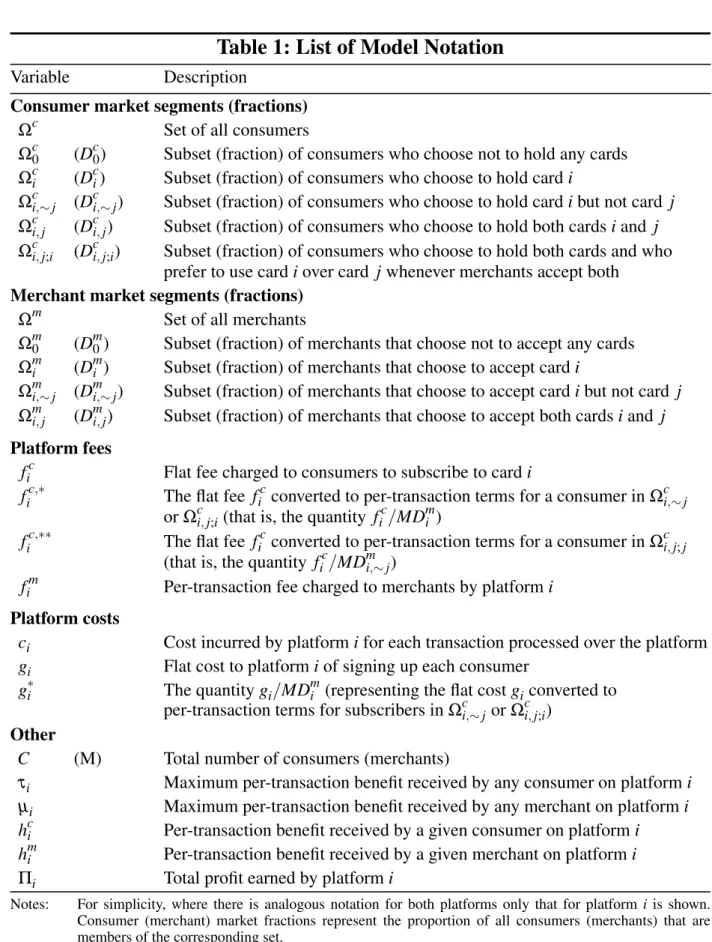
Table 1: List of Model Notation
Variable Description
Consumer market segments (fractions)
Ωc Set of all consumers
Ωc0 (Dc0) Subset (fraction) of consumers who choose not to hold any cards
Ωci (Dci) Subset (fraction) of consumers who choose to hold cardi
Ωci,∼j (Dci,∼j) Subset (fraction) of consumers who choose to hold cardibut not card j Ωci,j (Dci,j) Subset (fraction) of consumers who choose to hold both cardsiand j Ωci,j;i (Dci,j;i) Subset (fraction) of consumers who choose to hold both cards and who
prefer to use cardiover card jwhenever merchants accept both
Merchant market segments (fractions)
Ωm Set of all merchants
Ωm0 (Dm0) Subset (fraction) of merchants that choose not to accept any cards Ωmi (Dmi ) Subset (fraction) of merchants that choose to accept cardi
Ωmi,∼j (Dmi,∼j) Subset (fraction) of merchants that choose to accept cardibut not card j Ωmi,j (Dmi,j) Subset (fraction) of merchants that choose to accept both cardsiand j
Platform fees
fic Flat fee charged to consumers to subscribe to cardi
fic,∗ The flat fee ficconverted to per-transaction terms for a consumer inΩci,∼j
orΩci,j;i(that is, the quantity fic/MDmi )
fic,∗∗ The flat fee ficconverted to per-transaction terms for a consumer inΩci,j;j
(that is, the quantity fic/MDmi,∼j)
fim Per-transaction fee charged to merchants by platformi
Platform costs
ci Cost incurred by platformifor each transaction processed over the platform
gi Flat cost to platformiof signing up each consumer
g∗i The quantitygi/MDmi (representing the flat costgiconverted to per-transaction terms for subscribers inΩci,∼jorΩci,j;i)
Other
C (M) Total number of consumers (merchants)
τi Maximum per-transaction benefit received by any consumer on platformi µi Maximum per-transaction benefit received by any merchant on platformi
hci Per-transaction benefit received by a given consumer on platformi hmi Per-transaction benefit received by a given merchant on platformi Πi Total profit earned by platformi
Notes: For simplicity, where there is analogous notation for both platforms only that for platform iis shown. Consumer (merchant) market fractions represent the proportion of all consumers (merchants) that are members of the corresponding set.
2.3 Platforms
The two platforms are assumed to be profit-maximising and to face per-transaction costs of ci for platform i and cj for platform j. In addition, they incur fixed costs gi and gj respectively for each consumer that they sign up.
In terms of pricing, we assume that the platforms charge flat fees, fic and fcj, to each consumer, but do not levy per-transaction fees on consumers (nor do they offer per-transaction rewards). Conversely, platforms do not impose flat, up-front fees on merchants, but do charge per-transaction fees fim and fmj to merchants for the use of their cards. Thus, for platformi, each consumer that subscribes generates direct revenue fic and cost gi, while each transaction generates revenue of fim from the relevant merchant and incurs a processing cost of ci; and similarly for platform j.
For each platform, profits will be determined by both the number of consumers whom they manage to attract and the volume of transactions subsequently undertaken on the platform. When in competition with one another each platform must, in making its pricing decisions, take into account the expected effects of any fee increases on both consumers and merchants. These effects include causing some consumers (merchants) to abandon the platform in favour of holding (accepting) only cash or the card of the other platform – either as a direct result of the fee impact, or indirectly by reducing the number of merchants prepared to accept the card (consumers wishing to use the card).
Platformi’s profit function can be written explicitly as:
Πi = CDci(fic−gi) +CM(Dci,∼j+Dci,j;i)Dmi (fim−ci)
+CMDci,j;jDmi,∼j(fim−ci)
= CDci(fic−gi) +CMDciDmi −Dci,j;jDmi,j(fim−ci). (11)
The three right-hand-side terms in the top equality of Equation (11) are, respectively: profits from subscriptions; profits from transactions made by cardholders who either only hold card i, or hold both and prefer it over card j; and profits from transactions made by cardholders who prefer card j over card i but hold both.
If we then introduce the further notation – discussed in greater detail below – that fic,∗ ≡ fic/MDmi and g∗i ≡gi/MDmi (12) it is readily checked that Equation (11) may alternatively be written
Πi =CM n (fic,∗−g∗i) + (fim−ci)DciDmi −(fim−ci)Dci,j;jDmi,j o . (13) Platform j’s profit function is then correspondingly given by
Πj =CM n (fc,j ∗−g∗j) + (fmj −cj)DcjDmj −(fmj −cj)Dci,j;iDmi,j o (14) where fc,j ∗≡ fcj/MDmj and g∗j ≡gj/MDmj.
Sections 3.1 and 3.2 below describe, in greater detail, geometric frameworks for understanding the incentives facing profit-maximising platforms in their fee choices, in terms of the impact of these fee choices on consumers’ and merchants’ card holding and acceptance decisions.8
2.4 Consumers
Consumers make their payment choices so as to maximise their utility. They are assumed to receive a per-transaction benefit for paying by non-cash means, equal to hci for payments made over network i and hcj for payments made over network j. Consumers are heterogeneous in their benefits, which are randomly (though not necessarily independently) drawn from distributions over the intervals
[0,τi] for platformiand [0,τj] for platform j.9
In Chakravorti and Roson (2006), and in the sequel to this paper (Gardner and Stone 2009a), these distributions are taken to be uniform, as this represents an interesting case and one which significantly simplifies analysis of the model. Consumers’ draws of benefits for each platform are also assumed to be independent – so that the benefit any individual consumer receives from making a payment over network i is unrelated to the benefit they receive from making a 8 The implications of these incentives for platforms’ pricing are then explored in Appendix B. 9 The pairs of quantities{hc
i,h c
j}thus typically differ from consumer to consumer but, for each
payment over network j. While it may help the reader to adopt these assumptions mentally in what follows, it is important to note that they are not necessary for the model and, other than in Section 4, we do not require them for the remainder of this paper. Indeed, at the end of Section 2.6 we briefly describe a natural setting in which an alternative joint distributional assumption for consumers’ per-transaction benefits might be appropriate.
As noted above, a consumer making a payment over network i or j faces no per-transaction fee. Since each consumer’s per-per-transaction benefit from using either platform is always non-negative, consumers who hold cards will therefore always prefer to pay by card rather than by cash, whenever this is possible. Unlike in Chakravorti and Roson (2006), it is assumed that each consumer can choose to hold no cards, one card or both cards; and, in the event that they sign up to both platforms, can choose to use cardi in preference to card j, or vice versa, where a merchant accepts both.
In assessing their expected utility, each consumer is assumed to have a good understanding of the fraction of merchants who will sign up to each platform, for given platform fees {fic, fim} and {fjc,fmj }. The equations which describe the utility a consumer with per-transaction benefits {hci,hcj} will obtain from each of their possible card holding/use options are thus as follows:
U0c = 0 (15) Ui,c∼j = MhciDmi − fic=MhciDmi − fic/M (16) Ucj,∼i = MhcjDmj − fcj =MhcjDmj − fcj/M (17) Ui,cj;i = MhciDmi,∼j+hcjDmj,∼i+hciDi,mj − fic− fcj = MhciDmi +hcjDmj,∼i− fic/M− fcj/M (18) Ui,cj;j = MhciDmi,∼j+hcjDmj,∼i+hcjDi,mj − fic−fjc = MhcjDmj +hciDmi,∼j− fic/M− fcj/M . (19)
Here, consistent with previous notation, the quantitiesU0c,Ui,c∼j andUcj,∼i denote the utility the consumer would receive, respectively, from choosing to hold neither platform’s cards, the card of platform i only, or the card of platform j only. Similarly, Ui,cj;i and Ui,cj;j denote the utility the consumer would receive from choosing to hold both platforms’ cards and then choosing, respectively, to use cardiover card j, orvice versa, whenever a merchant accepts both.
Finally, before turning to the merchant side, it is useful to compute what the effective charge is, in per-transaction terms, for different consumers who elect to hold each platform’s card. Focusing without loss of generality on the cards of platform i, we see that consumers in the subsets Ωci,∼j and Ω
c
i,j;i of Ω c
i will each
expect to makeMDmi transactions on their platformicards. Hence, such consumers face an effective per-transaction charge for these payments of (fic/MDmi ) ≡ fic,∗. This provides the intuitive interpretation for the quantities fic,∗ and fc,j ∗introduced in Section 2.3.
On the other hand, a consumer in the subset Ωci,j;j ofΩci will expect to make only
MDmi,∼j transactions on their platform i card, since they will use it only when a merchant accepts card i and does not accept their preferred card j. Hence, these consumers face a higher effective per-transaction charge for payments on their platformi cards than consumers inΩci,∼j and Ωci,j;i. This effective charge is
fic,∗∗ ≡ fic/MDmi,∼j ≥ fic,∗. (20) Similarly, consumers in the subset Ωci,j;i face a corresponding effective
per-transaction cost for payments on their platform j card of fc,j ∗∗, where fc,j ∗∗ ≡
fcj/MDmj,∼i ≥ fc,j ∗. As we shall see, the quantities fic,∗, fic,∗∗, fc,j ∗ and fc,j ∗∗ will play an important role in the geometric framework described in Section 3.2 for understanding consumers’ card holding decisions.
2.5 Merchants
Each merchant can choose to sign up to both networks, one network, or neither network, based on the net benefit it will receive from doing so. Like consumers, merchants are assumed to receive a per-transaction benefit for accepting non-cash payments, equal to hmi for those received on network i and hmj for those received on network j. Merchants are also heterogeneous in their benefits, which are randomly (but not necessarily independently) drawn from suitable distributions over the intervals[0,µi]and[0,µj]for platformsiand j.10 If a merchant accepts a payment over networkiit is charged a per-transaction fee of fim, and similarly for 10 As on the consumer side, to fix ideas it may help to focus on the case of uniform and
independent distributions throughout the remainder of this paper. Nevertheless, it should again be noted that there is no reason in principle why non-uniform and/or correlated distributions could not be used here.
platform j. However, merchants do not face any fixed costs in choosing to accept either platform’s cards.
In assessing the benefit it will receive from signing up to one or more platforms, each merchant is once again assumed to have a good knowledge of both: the fraction of consumers who will sign up to each platform, for given platform fees
{fic,fim}and{fcj, fmj }; and the fractions of those choosing to hold both cards who will then prefer to use a particular card at the moment of sale. Given this, the equations which describe the net benefit which a merchant, with per-transaction benefits {hmi ,hmj}, will obtain from each of its possible card acceptance options are as follows:
U0m = 0 (21)
Ui,m∼j = C(him− fim)Dci (22)
Umj,∼i = C(hmj − fmj )Dcj (23)
Ui,mj = C(hmi − fim)Dci,∼j+Dci,j;i +C(hmj −fjm)Dcj,∼i+Dci,j;j . (24) Once again, the quantities U0m, Ui,m∼j, Umj,∼i and Ui,mj denote the net benefit the merchant would receive, respectively, from choosing to accept neither platform’s cards, the card of platform i only, the card of platform j only, or those of both platforms. Note that these equations also rest upon the feature of the model, discussed earlier, that consumers will always prefer to pay by one or other card rather than by cash, if possible.
2.6 Possible Applications of the Model
Having specified our ECR model, the next step is to derive descriptions of the aggregate card holding and acceptance behaviour of consumers and merchants in it. Before doing so, however, it is worth briefly addressing the question: to what real-world situations might the model potentially apply?
Since platforms in the model interact directly with participants on both sides of the market, the obvious application is to competition between rival three-party card schemes, such as American Express and Diners Club. The absence of separate issuers and acquirers in the model makes it appropriate to such a setting.
Despite the absence of distinct issuers and acquirers (and consequent lack of explicit interchange fees), the model could arguably still be used to shed light
on some features of competition between four-party credit card schemes (such as MasterCard and Visa). While clearly less well adapted to this situation, the model nevertheless accurately captures many features of the dynamics of the consumer and merchant sides of the market which would arise in this setting. It might also offer some insights into competing four-party platforms’ likely pricing behaviour, with the tilting of platforms’ price structures in favour of consumers or merchants potentially indicative of their likely interchange fee choices in this setting.
That said, caution would need to be exercised before using our ECR model to draw any firm conclusions about the case of competition between four-party schemes. For example, in the event that the issuing side were dominated by a small number of large institutions, the model’s applicability to this case would be limited, given its lack of a proper treatment of oligopsony effects (in relation to platforms’ pricing behaviour towards such issuers).11
Our ECR model potentially also allows us to draw some inferences about the case of competition between differenttypesof payment instrument, such as debit versus credit cards (or cheques versus either of these). Chakravorti and Roson (2006) emphasised the scope for their model to be used to study such competition – stressing, in this regard, its capacity to handle situations where platforms provide different maximum per-transaction benefits to consumers and/or merchants (so τi6=τj and/or µi6=µj).
Our ECR model also offers scope for such differentiation between platforms based on the maximum per-transaction benefits they provide. However, this is not something which we pursue in the simulation analysis in the sequel to this paper. Rather, there is a more fundamental reason why we believe that our ECR model, like Chakravorti and Roson’s earlier one, plausibly covers the case of competition between different types of instrument – namely, that it allows for heterogeneous benefits, to both consumers and merchants, across the two competing platforms.
11 Another important distinction in the case of competing four-party credit card schemes would
be that annual credit card fees are paid by consumers toissuers, rather than to the schemes. We might expect this distinction to have implications for the transferability of any model results regarding how the use of flat fees to consumers, rather than per-transaction fees, would affect platforms’ pricing. The importance of this distinction in practice, however, would depend on the extent to which schemes might be able to extract some or all of these flat consumer fees from issuers – say through the use of scheme fees to issuers based on subscriber numbers.
Even where consumers’ (merchants’) benefits from transacting on each platform are uniformly distributed, as long as they are not perfectly correlated then some consumers (merchants) will value using platform i more highly than platform j, and vice versa. This is consistent with the fact that in the real world different agents will, for example, place different intrinsic values on using debit and credit cards. Some consumers, for instance, may be particularly averse to taking on debt, and so appreciate the budgeting discipline provided by a debit card. Others, by contrast, may value the flexibility afforded by a credit card relative to a debit card in managing intra-month cash flow constraints.
Finally, by allowing for non-uniform and/or correlated distributions of consumer and merchant per-transaction benefits across platforms, our ECR model potentially even applies to the case of competition between a premium credit or charge card brand and a non-premium one. To the extent that some consumers might value the prestige associated with holding a certain ‘exclusive’ payment card, this could generate an incentive for one platform to target this market segment – hoping to charge higher fees to cardholders and, if possible, to merchants compared to a rival platform focused instead on increasing profit by maximising its subscriber numbers and transaction volumes. The attraction of such a targeted business approach would be greater, the stronger the concentration of consumers placing an asymmetrically high prestige value on transacting with a premium rather than run-of-the-mill payment instrument. This is something which our ECR model could, in principle, incorporate via using a suitable non-uniform distribution for consumers’ per-transaction benefits.12
3.
Understanding Merchants’ and Consumers’ Card Choices
Having described the general model, the next step is to try to understand what fractions of merchants and consumers will choose to sign up to none, one or both platforms, and what factors will influence these proportions. In Section 3.1 we first describe a geometric framework for thinking about merchants’ card acceptance decisions, and for understanding how these decisions will be affected by platforms’ pricing strategies. The more complex geometric framework for 12 In this way our ECR model might represent an appropriate vehicle for investigating both the
presence of premium credit cards in the marketplace alongside more prevalent ordinary credit cards, and the market dynamics of competition between the two.
understanding the analogous decisions on the consumer side is then set out in Section 3.2.13 Details of the derivations of the geometric frameworks described in Sections 3.1 and 3.2 are provided in Appendix A. Finally, in Section 3.3 we show how these frameworks simplify to the versions derived and analysed in Chakravorti and Roson (2006), for the special case considered there.
3.1 Merchants’ Card Acceptance Decisions
Each merchant has some draw of per-transaction benefits {hmi ,hmj} for accepting a payment on platform i or j. It is possible therefore to represent each merchant as a point in hmi ,hmj-space, with the population of all merchants, Ωm, then being
distributed across the rectangle bounded by the points (0,0), (µi,0), (0,µj) and
(µi,µj).14 Recall here that µiand µjdenote the maximum per-transaction benefits which any merchant will receive from processing a payment on network i or j respectively.
Using Equations (21) to (24), it is then possible to subdivide this rectangle into four mutually exclusive regions, corresponding to the subsetsΩm0,Ωmi,∼j,Ωmj,∼iand Ωmi,j (see Appendix A for details). Doing so yields that Ωm may be conveniently
represented geometrically as shown in Figure 1.15
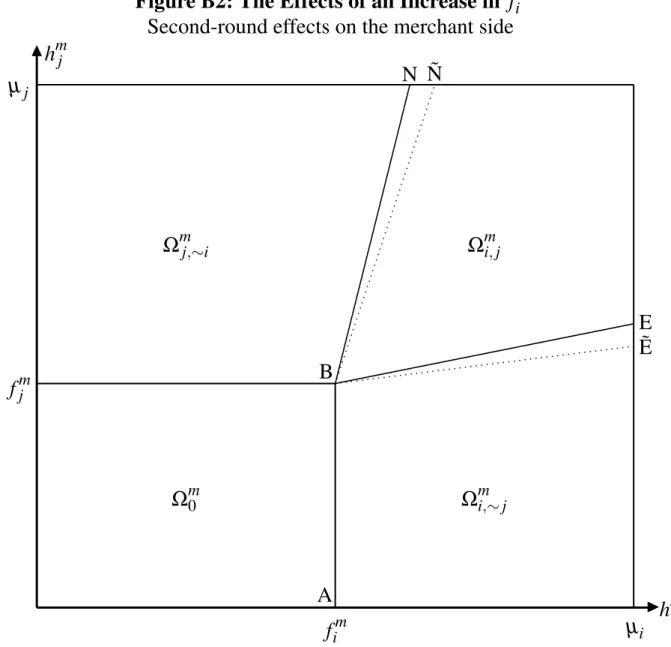
The fact that Line 1 of Figure 1 may be non-horizontal reflects that there may be some merchants who will choose not to accept platform j’s cards, despite the per-transaction benefit they receive from taking a payment on platform j, hmj, exceeding the per-transaction charge they would face for doing so. This is
13 Having established frameworks for understanding agents’ behaviour in aggregate on both the
merchant and consumer sides, these frameworks are then used in Appendix B to discuss, from a theoretical perspective, the incentives facing platforms in their pricing choices.
14 In the event that merchants’ draws of per-transaction benefits are from uniform and independent
distributions then the population of merchants will (on average) be evenly distributed across this rectangle, with concentrationM/µiµj.
15 Without loss of generality, Figure 1 has been drawn with fm
i <µi and f m
j <µj. This reflects
that if either platform were to set its per-transaction fees above these levels it would attract no merchants to accept its cards and so would make no profit.
the phenomenon known as ‘steering’ – discussed, for example, in Rochet and Tirole (2003).16
For these merchants, although the net benefit they would receive from processing a payment on platform j, hmj − fmj , is positive, the net benefit they would receive from processing a payment on platform i, hmi − fim, is greater again. If the difference between these net benefits is sufficiently large then, provided enough consumers who hold card j also hold card i, it may be worthwhile not to accept platform j’s cards. This would see some payments shift to cash (namely, those by consumers in Ωcj,∼i), at some loss to the merchant. However, it would also
steer those consumers holding both cards to pay using the cards of the merchant’s preferred platform, platform i – generating a gain sufficient, for some merchants, to justify declining the cards of platform j.
16 The fact that Line 2 may also be non-vertical reflects corresponding steering of consumers by
some merchants from platform i to platform j. Note that here we use the term ‘steering’ in the sense in which it is generally used in the theoretical literature on payment systems; that is, the refusal by a merchant to accept a platform’s card, so as to force those consumers who multi-home to use a different card preferred by the merchant. This is in contrast to the colloquial sense in which the term is sometimes used, of a merchant trying to influence consumers’ choices through milder means such as signs or verbal suggestions about preferred payment options.
Figure 1: A Geometric Representation of the Population of Merchants N I Ωm0 Ωmj,∼i Ωmi,∼j Ωmi,j fim µi fmj µj hmj hmi Line 1 Line 2
Notes: The figure shows a representation of the population of all merchants in hmi ,hmj-space, subdivided into the four subsetsΩm0,Ωmi,∼j,Ωmj,∼iandΩmi,j. Line 1 passes through the point
(fim,fmj )and has slopeDci,j;j/(Dcj,∼i+Dci,j;j). Line 2 also passes through the point(fim,fmj )
and has slope(Dci,∼j+Dci,j;i)/Dci,j;i.
3.2 Consumers’ Card Choices
Turning to the consumer side, each consumer also has some draw of per-transaction benefits {hci,hcj} for making a payment on platform i or j. Hence, we may also represent the population of all consumers,Ωc, as being distributed across
a rectangle – this time inhci,hcj-space, bounded by the points (0,0), (τi,0), (0,τj) and(τi,τj).17
Using Equations (15) to (19), this rectangle can be subdivided into mutually exclusive regions – now corresponding to the subsets Ωc0, Ωci,∼j, Ωcj,∼i, Ωci,j;i and Ωci,j;j (see Appendix A for the details). Doing so yields that the population of all
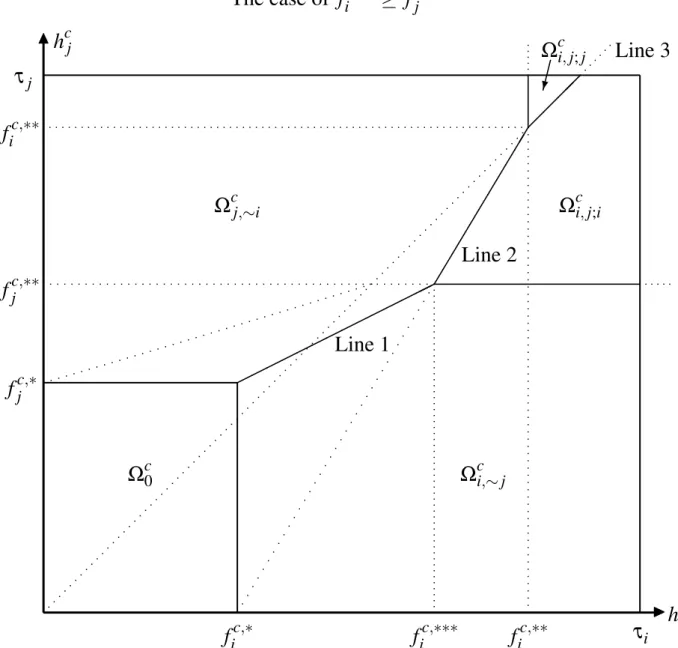
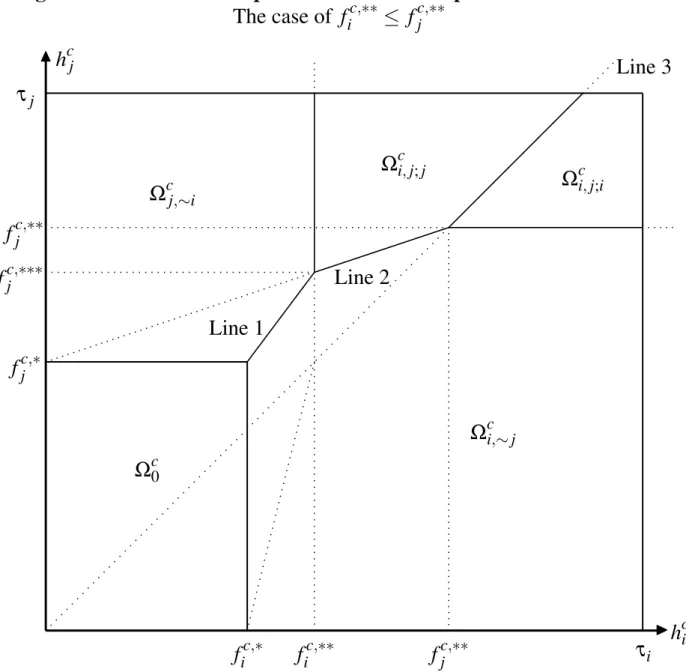
consumers may be represented geometrically inhci,hcj-space as shown in Figures 2 and 3. The added twist here, unlike on the merchant side, is that the breakdown of Ωc turns out to differ depending on whether or not fic,∗∗ ≥ fjc,∗∗. Hence, our
representation of Ωc consists of two separate diagrams, with Figure 2 depicting
the situation if fic,∗∗ ≥ fjc,∗∗ and Figure 3 the situation if the reverse inequality holds. Note also that, in these figures, the further notation fic,∗∗∗ and fc,j ∗∗∗is used to denote the quantities
fic,∗∗∗≡ fic,∗+ Dmi,j Dmi fjc,∗∗ and fc,j ∗∗∗≡ fc,j ∗+ Dmi,j Dmj fic,∗∗. (25)
Regarding the intuition for the subdivisions shown in Figures 2 and 3, the boundaries of the region Ωc0 are straightforward, given the definitions of the
quantities fic,∗ and fc,j ∗ (see Section 2.3). For consumers in this region, the fixed cost of holding either card exceeds the total benefit they would accrue from that card, even if they used it at every merchant that would accept it. Then Line 1, which passes through the point (fic,∗,fjc,∗) and has slope Dmi /Dmj, simply represents the boundary between those consumers not in Ωc0 who would opt to
hold cardi, if they could hold only one platform’s card, and those who would opt to hold card j.
More interesting are the structures of the Regions Ωci,j;i and Ωci,j;j, representing
consumers who choose to hold both platforms’ cards. Focusing without loss of generality on the RegionΩci,j;i in Figure 2, this consists of those consumers for
17 Recall here thatτ
iandτj represent the maximum per-transaction benefits which any consumer
will receive from making a payment on networki or j respectively, as set out in Section 2.4. Also, as on the merchant side, in the event that consumers’ draws of per-transaction benefits,
hci andhcj, are from uniform and independent distributions then the population of all consumers will (on average) be evenly distributed across this rectangle, with concentrationC/τiτj.
Figure 2: A Geometric Representation of the Population of Consumers The case of fic,∗∗ ≥ fc,j ∗∗ N I Ωc0 Ωcj,∼i Ωci,∼j Ωci,j;i Ωci,j;j fic,∗ fic,∗∗∗ fic,∗∗ τi fc,j ∗ fc,j ∗∗ fic,∗∗ τj hcj hci Line 1 Line 2 Line 3
Notes: The figure shows a representation of the population of all consumers inhci,hcj-space, for the case fic,∗∗≥ fc,j ∗∗, subdivided into the five subsetsΩc0,Ωci,∼j,Ωcj,∼i,Ωci,j;iandΩci,j;j. Line 1
passes through the point(fic,∗,fjc,∗)and has slopeDmi /Dmj. Line 2 passes through the point
(fic,∗∗∗,fjc,∗∗)and has slopeDmi /Dmi,j. Line 3 passes through the point(fic,∗∗,fic,∗∗)and has slope 1.
Figure 3: A Geometric Representation of the Population of Consumers The case of fic,∗∗ ≤ fc,j ∗∗ N I Ωc0 Ωcj,∼i Ωci,∼j Ωci,j;i Ωci,j;j fic,∗ fic,∗∗ fjc,∗∗ τi fc,j ∗ fc,j ∗∗∗ fc,j ∗∗ τj hcj hci Line 1 Line 2 Line 3
Notes: The figure shows a representation of the population of all consumers inhci,hcj-space, for the case fic,∗∗≤ fc,j ∗∗, subdivided into the five subsetsΩc0,Ωci,∼j,Ωcj,∼i,Ωci,j;iandΩci,j;j. Line 1
passes through the point(fic,∗,fjc,∗)and has slopeDmi /Dmj. Line 2 passes through the point
(fic,∗∗,fc,j∗∗∗)and has slopeDmi,j/Dmj. Line 3 passes through the point(fc,j∗∗,fc,j ∗∗)and has slope 1.
whom the following three inequalities all hold: hci ≥hcj (26) hcj ≥ fc,j ∗∗ (27) and hcj≤D m i Dmi,j (hci − fic,∗). (28)
The intuition underlying Inequality (26) is obvious. Since consumers face no per-transaction fees, this simply represents the division between those consumers who, if they hold both cards, would prefer to usecard i, and those who would prefer to use card j.
The interpretation of Inequality (27) is also straightforward. Recall that, by definition, fc,j ∗∗ is the (relatively high) effective per-transaction price that a consumer who holds both cards, but who would prefer to use card i over card j, faces for card j transactions. Hence, Inequality (27) is simply capturing that a consumer who would prefer to use cardi over card j will only wish to hold both cards, rather than just cardi, if the per-transaction benefit they would receive from using card jexceeds this price.
The interpretation of Inequality (28), however, is more interesting. This condition captures that, even for a consumer who would prefer to use card i over card j, it may be that he or she would still choose to sign up to platform j ahead of platformi(if, say, far more merchants will accept platform j’s cards than platformi’s). Hence, to wish to hold both platforms’ cards, it is also necessary that theadditional utility for such a consumer from signing up to platformi, if already holding platform j’s card, should exceed the cost of doing so; otherwise such a consumer would be better off holding only the card of platform j. This translates directly to the requirement that
MDmi,∼jhci +MDmi,j(hci −hcj)≥ fic (29) where: the first term on the left-hand side equates to the extra utility a consumer would obtain from being able to pay by card, rather than by cash, at those merchants which accept card i but not card j; and the second term corresponds to the incremental additional utility that a consumer withhci ≥hcj would gain from
being able to switch his or her card payments from platform j to platform i, at those merchants which accept both cards. This condition is then easily confirmed to be equivalent to Inequality (28) above.18
A further complication on the consumer side
Finally, the need to allow for two possible cases rather than one is, unfortunately, not the only added complication with the geometric framework described above for the consumer side, relative to the merchant side. A further one relates to the magnitudes ofτi andτj.
As on the merchant side, we may assume without loss of generality that fic,∗ ≤τi and fc,j ∗≤τj. This reflects that, if either platform were to set its fees so that one or other of these inequalities failed, then that platform would attract no consumers, and hence would make no profit.
However, although for simplicity we have also drawn Figures 2 and 3 with τi≥max{fic,∗∗, fc,j ∗∗}and τj ≥max{fic,∗∗, fc,j ∗∗}, there is nothing which ensures that profit-maximising platforms will necessarily set their fees so that this will be so. Hence, for example, Figure 2 ought really to allow for the possibility that fic,∗ ≤τi < fic,∗∗∗, fic,∗∗∗ ≤τi < fic,∗∗ or fic,∗∗ ≤τi; and also independently for the possibility that fc,j ∗ ≤τj < fc,j ∗∗, fjc,∗∗ ≤τj < fic,∗∗ or fic,∗∗ ≤ τj (and similarly for Figure 3). Figures 2 and 3 really, therefore, each break into nine sub-cases, of which only those corresponding to the situations where τi and τj each exceed max{fic,∗∗,fc,j ∗∗}have been shown.
These additional possibilities do not fundamentally alter thestructureof Figures 2 and 3, since they essentially just alter where the lines hci = τi and hcj = τj sit in relation to the other parts of each diagram. However, they do significantly complicate the task of writing down equations for the fractions Dc0, Dci,∼j, Dcj,∼i,
18 An alternative derivation of Inequality (28), working directly from the utility formulae given by
Dci,j;i and Dci,j;j – even in the special case where consumers’ per-transaction benefits are drawn from uniform and independent distributions.19
3.3 The Case of the Chakravorti and Roson Model
As noted in Section 1, our model is a generalisation of that introduced by Chakravorti and Roson (2006). In their model, the restriction is imposed that consumers may only subscribe to at most one card platform. With this restriction, the geometric frameworks just derived turn out to simplify dramatically.
Considering first the merchant side, in the event thatDci,j;i=Dci,j;j=0 it is easily checked that Lines 1 and 2 in Figure 1 become (respectively) horizontal and vertical. Hence, Figure 1 simplifies to the situation where a merchant will choose to accept the cards of platform i if and only if hmi ≥ fim, and (independently) will accept those of platform j if and only if hmj ≥ fmj . This is consistent with the fact that, when consumers hold the card of at most one platform, merchants have no scope to ‘steer’ consumers in their choice of payment card at the moment of sale, in the manner discussed in Section 3.1.
Similarly, on the consumer side, when consumers are prohibited by fiat from holding the cards of more than one platform then the subsetsΩci,j;iandΩci,j;j must
vanish. Hence, Figures 2 and 3 reduce to the single, far simpler representation given by Figure 4 below.20 Note that this dramatic simplification already hints at how far-reaching the consequences can be, for the modelling of competition between payment systems, of a ‘no multi-homing’ assumption on either side of the market. This is a point to which we return in greater detail in the sequel to this paper (see Section 2.2 and Appendix B of Gardner and Stone 2009a).
19 Of course, as on the merchant side, for the general situation of non-uniform and/or correlated
distributions these equations will be even more complex, with each possible case involving the double integral over the relevant area of an appropriate (non-constant) density function. For the special case where consumers’ and merchants’ per-transaction benefitsaredrawn from uniform and independent distributions, details of the equations for the quantities Dm0, . . . ,Dmi,j
andDc0, . . . ,Dci,j;j are provided in a separate technical annex: see Gardner and Stone (2009b), available on request.
20 Figure 4 is the exact analogue of Figure 1 in Chakravorti and Roson (2006), except that
everything in Figure 4 is shown in per-transaction terms. By contrast, in Figure 1 of Chakravorti and Roson consumers are represented in terms of theiraggregatenet potential benefits (summed across all their transactions) from using the cards of platformior platform j.
Figure 4: A Geometric Representation of the Population of Consumers The special case of the Chakravorti and Roson model
N I Ωc0 Ωcj,∼i Ωci,∼j fic,∗ τi fc,j ∗ τj hcj hci Line 1
Notes: The figure shows a representation of the population of all consumers in hci,hcj-space, subdivided into the three subsetsΩc0,Ωci,∼jandΩcj,∼i, for the special case where consumers
are prohibited from holding the cards of more than one platform. Line 1 passes through the point(fic,∗,fjc,∗)and has slopeDmi /Dmj.
Finally, one further observation is in order regarding our ECR model and the CR model. This is that both may actually be viewed as representing special cases of a still more general model of payment system competition, obtained by incorporating an additional parameter, κ, into our ECR model. This parameter represents the disutility to a consumer from holding more than one card – say, due to the cluttering of their wallet, or the hassle of having to check two periodic
transaction statements rather than one. Formally, its incorporation is accomplished simply by subtractingκ from the right-hand sides of both Equations (18) and (19) in Section 2.4 (the effects of which would, of course, then flow through to alter the frameworks set out in Section 3.2).
For this more general model, our ECR model would correspond to the special case κ =0, while the CR model would correspond to any κ value greater than some threshold, ¯κ, sufficient to deter even the most enthusiastic of consumers from holding more than one platform’s card. While we do not pursue this idea further here, we do take it up in a different but closely related context in the sequel to this paper (see Section 5 of Gardner and Stone 2009a).
4.
Potential Non-uniqueness of Market Equilibria
Sections 3.1 and 3.2 appear to provide complete descriptions of the behaviour of merchants and consumers in our ECR model, for given platform fees. In principle, this should allow us to analyse from a theoretical perspective the factors influencing platforms in their pricing strategies.21 However, before such an analysis can be undertaken, it turns out that there is a significant issue remaining to be clarified about the geometric frameworks just described.
This issue concerns whether or not, for given fee choices by platforms i and j, the resulting merchant and consumer market outcomes are necessarily uniquely determined. Interestingly, the short answer to this – at least for some fee choices – is no! Moreover, non-uniqueness can arise even for the case where merchant and consumer per-transaction benefits on each platform are uniformly and independently distributed, and where the platforms are identical in their fee choices and the maximum per-transaction benefits they provide to both merchants and consumers.
For this symmetric case it is possible to establish the existence of such non-uniqueness, as well as identify its extent and the conditions under which it will arise, purely analytically.22 However, rather than go into the details here we content ourselves with providing a concrete illustration. This is given by Figure 5, 21 One such analysis, focusing on the incentives facing a platform contemplating an increase in
its flat fee to consumers, is presented in Appendix B.
Figure 5: Non-uniqueness of Merchant and Consumer Market Outcomes The caseτi=τj =τ;µi=µj=µ; fic = fjc =0.1τM; and fim= fmj =0.12µ
Panel 1: low steering/multi-homing equilibrium
Panel 2: intermediate steering/multi-homing equilibrium
Panel 3: high steering/multi-homing equilibrium
N N N I I I N N N I I I hmj hmj hmj hmi hmi hmi hcj hcj hcj hci hci hci (((( (((( (((( Ωm0 6 Ωmj,∼i Ωmi,∼j Ωmi,j Ωmi,j Ωmi,j Ωc0 6 Ωcj,∼i Ωcj,∼i Ωcj,∼i Ωci,∼j Ωci,∼j Ωci,∼j Ωci,j;i Ωci,j;j
Notes: Each panel shows the merchant market outcome for that equilibrium on the left, with the corresponding consumer market outcome on the right. Each possible equilibrium also corresponds to a different level of platform profits. For the case gi=gj =0, ci=cj =0 and τ = µ = 1 these profit levels turn out to be: Πi = Πj = 0.101CM in Panel 1; Πi=Πj=0.097CM in Panel 2; andΠi=Πj=0.088CM in Panel 3.
which depicts the case whereτi=τj =τ and µi= µj= µ, and the platforms set fees fic = fcj =0.1τM and fim= fmj =0.12µ. The three panels in the figure show the three alternative market equilibria which, it transpires, could arise in this case. What is the significance of this potential non-uniqueness? We offer two sets of observations. The first set relates to the extent and nature of the non-uniqueness, where it arises. The second concerns its implications for implementing and solving the model numerically, and potentially also for the ‘chicken and egg’ debate about the development of payment systems (and of two-sided markets more generally).
4.1 The Extent and Nature of Non-uniqueness
The first noteworthy feature of the non-uniqueness we observe in our ECR model is that it is not limited to the existence of two possible market equilibria. As Figure 5 demonstrates, at least three (and potentially more) admissible equilibria can arise for some fee choices – even for the case of identical platforms.23
This is of interest in view of the most common intuition for how non-uniqueness in market outcomes might occur in payment systems. Known colloquially as the ‘chicken and egg’ effect, it is relevant even in relation to a single payments platform, not just competing platforms. It posits that feedbacks between the merchant and consumer sides might make both ‘high up’ and ‘low take-up’ outcomes simultaneously possible, for given platform fees. The former configuration would result if (say) many merchants judged that accepting a platform’s cards would be advisable, because of expected high consumer demand. This would then promote exactly the high demand for the platform’s cards among consumers that merchants expected, in turn justifying their widespread acceptance 23 Our theoretical analysis shows that in the symmetric case, for given{fc
i = f c j = f
c
,fim= fmj =
fm}, up to six distinct equilibria are potentially feasible. These consist of one CR solution – by which we mean an equilibrium with no consumers multi-homing – and up to five others determined by admissible roots of a quintic polynomial whose coefficients are functions of fc
and fm. If we focus instead on the number of equilibria for given effectiveper-transactionfees,
{fic,∗= fc,j ∗= fc,∗,fim= fmj = fm}, we can be even more precise. In this case, although for many fee settings there will be a unique equilibrium, for others there can be as many as three distinct equilibria. If(fc,∗/τ)≥(fm/µ)these consist of a CR solution and up to two others
involving some consumer multi-homing, determined by admissible roots of a cubic polynomial whose coefficients are functions of fc,∗ and fm; if (fc,∗/τ)<(fm/µ) they consist of up to
three equilibria involving consumer multi-homing, determined by admissible roots of this same cubic. Full details are provided in Gardner and Stone (2009b).
of these cards. The latter configuration, also internally consistent, would instead see few merchants judging it likely to be worthwhile to accept a platform’s cards, and few consumers choosing to hold these cards, with each side’s decisions validating the other’s.
In its simplest form, however, this intuition provides a potential rationale for just two distinct market equilibria – rather than the three or more which can arise in our model for some fee settings. Moreover, it is not the case, for the equilibria in our model, that high (low) aggregate card holding by consumers and high (low) aggregate card acceptance by merchants go together. For example, the equilibrium in Panel 1 of Figure 5 involves consumers holding an average of 0.99 cards and merchants accepting an average of 1.76 cards; yet the equilibrium in Panel 3, while having a higher average rate of consumer card holding of 1.32, has aloweraverage rate of merchant card acceptance of 1.49.
The non-uniqueness in our ECR model is clearly, therefore, of a different character than ‘chicken and egg’ non-uniqueness. Rather, it reflects non-uniqueness in the dimension of merchant steering/consumer multi-homing – with the three panels in Figure 5 corresponding to low, medium and high rates of steering/multi-homing. Intuitively, the low steering/multi-homing configuration would result if merchants generally expected few consumers to hold multiple platforms’ cards. This would lead few merchants to attempt to steer consumers by refusing acceptance of one or other platform’s cards, which would then promote exactly the sort of single-homing behaviour by consumers that merchants initially expected. On the other hand, for the same platform fees the high steering/multi-homing outcome would result if merchants instead generally expected most consumers to multi-home. In this case merchants would be much more inclined to steer consumers by accepting only their preferred platform’s cards, and this would in turn increase consumers’ propensity to multi-home, as initially expected. In the case of Figure 5, both outcomes would be internally consistent and could arise – with each side’s decisions validating those of the other – as indeed could an intermediate outcome involving a moderate degree of merchant steering coupled with a corresponding moderate degree of consumer multi-homing.
So far as we know, this form of potential non-uniqueness in market equilibria, for given platform fees, is new and has not previously been concretely illustrated in the literature. Unlike the ‘chicken and egg’ effect, it is relevant only in the context