Translating
Combinatory Reduction Systems
into the
Rewriting Calculus
Clara Bertolissi, and Horatiu Cirstea, and Claude Kirchner
INPL & University Nancy II & INRIA & LORIA 615, rue du Jardin Botanique, BP-101
54602 Villers-l`es-Nancy 54506 France
{Clara.Bertolissi,Horatiu.Cirstea,Claude.Kirchner}@loria.fr
Abstract
The last few years have seen the development of therewriting calculus(or rho-calculus,ρCal) that extends first order term rewriting andλ-calculus. The integration of these two latter formalisms has been already handled either by enriching first-order rewriting with higher-order capabilities, like in theCombinatory Reduction Systems, or by adding to λ-calculus algebraic features. The different higher-order rewriting systems and the rewriting calculus share similar concepts and have similar applications, and thus, it seems natural to compare these formalisms. We analyze in this paper the relationship between the Rewriting Calculus and the Combinatory Reduction Systems and we present a translation ofCRS-terms and rewrite rules into rho-terms and we show that for anyCRS-reduction we have a corresponding rho-reduction.
1
Introduction
Lambda calculus and term rewriting provide two fundamental computational paradigms that had a deep influence on the development of programming and specification languages, and on proof environments. Starting from Klop’s ground-breaking work on higher-order rewriting, and because of their complementarity, many frameworks have been designed with a view to integrate these two formalisms. This integration has been handled either by enriching first-order rewriting with higher-order capabilities or by adding to λ-calculus algebraic features. In the first case, we find the works on CRS [15] and other higher-order rewriting systems [22,19], in the second case the works on combination of λ-calculus with term rewriting [1,4,11] to mention only a few.
For example, the Combinatory Reduction Systems (CRS), introduced by J.W.Klop [14] are an extension of first order rewrite systems with a mechanism of bound variables like in theλ-calculus. The meta-language ofCRS,i.e. the language in which the notions of substitution and rewrite step are expressed, is based on
λ-calculus and higher-order matching (matching modulo theβ-rule).
In the same line, the Rewriting Calculus (also calledρCal) [6,7,9], extends first order term rewriting andλ-calculus. Its main design concept is to make all the basic
ingredients of rewriting explicit objects, in particular the notions of ruleapplication andresult. By making the rule application explicit, the calculus emphasises on one hand the fundamental role of matching and on the other hand the intrinsic higher-order nature of rewriting. The Rho Calculus offers a broad spectrum of applications due to the two fundamental parameters of the calculus: the theory modulo which matching is performed and the structure under which the results of a rule application are returned. Adjusting these parameters to various situations permits us to easily describe in a uniform but still appropriately tuned manner different calculi, like, for example, lambda calculus, term rewriting and object calculi.
Since the different higher-order rewriting systems and the rewriting calculus share similar concepts and have similar applications, it seems natural to compare these formalisms. The comparison between different higher-order formalisms, like for example between Combinatory Reduction Systems and Higher-order Rewrite Systems, has already been done [21].
This paper is concerned with the analysis of the relation between the rewriting calculus and higher order rewriting. In particular we study the representation of Combinatory Reduction Systems in the rewriting calculus.
This work of analysis and comparison between the ρCaland the CRSis meant to better understand the behavior of these systems, in particular how the rewrite rules are applied to terms and how term reductions are performed in theCRS. The main contribution of this paper is the definition of a translation of the variousCRS concepts, like terms, assignments, matching etc. to the corresponding notions of theρCal, and, using this translation, the proof that every reduction of aCRS-term can be reproduced in theρCal.
The paper is structured as follows: In Section 2 we briefly present the
ρCal through its components. In Section 3 we give a description of CRSs and we give some examples. In Section4we present a translation fromCRS-terms into
ρ-terms and we state a theorem on the correspondence between CRS-reductions andρ-reductions. Section5concludes the paper and gives some perspectives to this work.
2
The rewriting calculus
We briefly present in what follows the syntax and the semantics of theρCal. For a more detailed presentation the reader can refer to [7,9] and for a typed version of the calculus to [3,8].
2.1 Syntax
In this paper, the symbols t, u, . . . range over the set T of terms, the symbols
X, Y, Z, . . . , x, y, z . . . range over the infinite set X of variables (we usually use capitals for free variables) and the symbols f, g, . . . range over the infinite set F
of constants. All symbols can be indexed. The set ofρ-terms is defined as follows:
T ::= X | F | T _T |[T T].T | T T | T,T
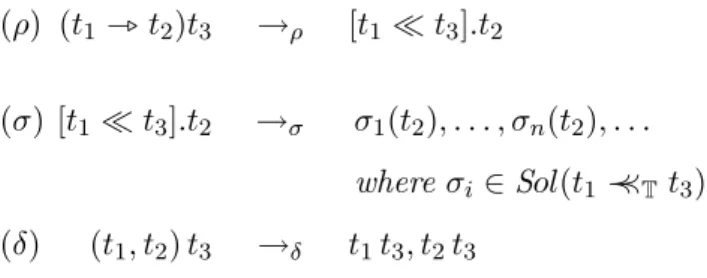
(ρ) (t1 _t2)t3 →ρ [t1 t3].t2
(σ) [t1 t3].t2 →σ σ1(t2), . . . , σn(t2), . . .
whereσi∈Sol(t1 ≺≺T t3)
(δ) (t1, t2)t3 →δ t1t3, t2t3
Fig. 1. Small-step reduction semantics
operators associate to the right. The priority of the application operator is higher than that of “[].” which is higher than that of the “_” which is, in turn, of higher priority than the “,”. By abuse of notation, function application is denoted byt0(t1· · ·tn) instead of t0 t1· · ·tn.
To support the intuition, we mention here that the application of an abstraction
t1 _ t3 to a term t2 always “fires” and produces as result the term [t1 t2].t3
which represents a constrained term where the matching equation is “put on the stack”. The body of the constrained term will be evaluated or delayed according to the result of the corresponding matching problem. If a solution exists, the delayed matching constraint self-evaluates toσ(t3), where σ is the solution of the matching
between t1 and t2. Finally, terms can be grouped together into structures built
using the symbol “,”.
As in any calculus involving binders, we work modulo the “α-convention” of Church [5], and modulo the “hygiene-convention” of Barendregt [2].
We should mention that there are two operators binding variables: in t1 _ t2,
the free variables of t1 are bound in t2 and in [t1 t2].t3, the free variables oft1
are bound in t3 but not int2.
2.2 Semantics
The small-step reduction semantics is defined by the reduction rules presented in Figure1. The central idea of the (ρ) rule of the calculus is that the application of a termt1 _t2 to a termt3, reduces to the delayed matching constraint [t1 t3].t2,
while the application of the (σ) rule consists in solving (modulo the theory T) the
matching equationt1 ≺≺T t3, and applying the obtained result to the termt2. The
rule (δ) deals with the distributivity of the application on the structures built with the “,” constructor.
According to the matching theory specified [7], the application of the (σ) rule can produce an infinite number of substitutions as result. In the following we will restrict to matching theories leading to a finite (and even unitary) set of substitutions. The substitutions obtained as solution of a matching problem has the form σ = {x1/t1. . . xm/tm} where Dom(σ) = {x1, . . . , xm}. The application of a
substitutionσ to a term t, denoted byσ(t) ortσ, can be straightforwardly adapted to deal with the new forms of constrained terms introduced in theρCal(see [9]).
As usual, we introduce the classical notions of one-step, many-steps, and congruence relation of →ρσδ. Let Ctx[−] be any context with a single hole, and let Ctx[t] be the result of filling the hole with the term t. The one-step evaluation
7→ρσδ is defined by the following inference rules:
(Ctx[−]) t1 →ρσδ t2
Ctx[t1]7→ρσδ Ctx[t2]
∀ t1, t2∈ T
where →ρσδ denotes one of the top-level rules of ρCal. The many-step evaluation
7→→ρσδ is defined as the reflexive and transitive closure of 7→ρσδ. The congruence relation =ρσδ is the symmetric closure of7→→ρσδ.
Example 2.1 [Small-step reductions] We take the terms
(f(X)_(3_3)X)f(3) and (f(X)_(3_3)X)f(4)
and we show one possible reduction for each of them (corresponding redexes are underlined and only the used rule (e.g.7→ρ) is shown instead of7→ρσδ):
(i) (f(X)_(3_3)X)f(3)7→ρ(f(X)_[3 X].3)f(3)7→ρ
[f(X)f(3)].([3 X].3)7→σ [33].37→σ 3
(ii) (f(X)_(3_3)X)f(4)7→ρ[f(X)f(4)].((3_3)X)7→σ
(3_3) 47→ρ[34].3
2.3 Two version of the rewriting calculus
The general ρCal can be instantiated to simpler versions when the syntax is restricted and the matching theory used in the (σ) rule is specified [6]. For example, when all the ρ-rules are of the form X _ T and a syntactic matching is used, a version similar to the lambda-calculus, denoted ρCalλ, is obtained.
We denote the reductions in the obtained calculus by →ρλ. Starting from the
corresponding congruence relation =ρλ, we can define the matching theoryTλ such
thatTλ |=t1=t2 iff t1 =ρλ t2.
More powerful versions of the ρCal can be obtained using more elaborated (decidable) matching theories like, for example, pattern matching [16]. Our goal is to define a version of theρCal with an evaluation mechanism similar to that of CRSs and thus using a (pattern) higher-order matching. Therefore, we introduce now the notion of ρ-pattern directly inspired from the CRS-patterns (defined in Section3).
Definition 2.2 [ρ-pattern] Aρ-termpis called aρ-patternif any of its free variables
Z appears in a sub-term ofpof the formZ x1. . . xnwhere the variablesx1, . . . , xn, n≥0, are distinct and all bound in p.
For example, x_ f(Z x) is aρ-pattern while x_ (Z x x) andg(x_ x, Z x) are not.
The ρCal¶ is then obtained as the ρCal whose rules are of the form P _ T, with P the set of ρ-patterns, and using a matching modulo Tλ (denoted ≺≺¶).
Since pattern matching is decidable and unitary [16] the matching involved in the application of the evaluation rule (σ) of theρCal¶ yields a single substitution.
3
Combinatory Reduction Systems
TheCombinatory Reduction Systems (CRS), introduced by J.W.Klop in 1980 [14], are a generalization of first-order term rewrite systems with a mechanism of bound variables like in the λ-calculus. For defining the components of a CRS we refer to [15].
3.1 Syntax
In what follows the symbols A, B, . . . L, P, R, . . . range over the set MT of metaterms, the symbols t, u, . . . range over the set TCRS of terms, the symbols x, y, z, . . . range over the setX of variables, the symbols X, Y, Z . . . range over the setZ of metavariables of fixed arity and the (functional) symbolsf, g, . . .range over the set F of symbols of fixed arity . All symbols can be indexed. We denote by ≡
the syntactic identity of metaterms or substitutions. The set of CRS-metatermsMT, is defined as follows:
MT ::= X | F(MT, . . . ,MT)| Z(MT, . . . ,MT)|[X]MT
The set TCRS ⊂ MT of CRS-terms is composed of all the metaterms without
metavariables.
Comparing to first-order rewrite systems, in the syntax of a CRS we have two new concepts: the symbol [ ] and the metavariables. The operator [ ] denotes an abstraction similar to the λ-abstraction of the λ-calculus such that, in [x]t, the variable x is bound in t. The variables bound by [ ] may be renamed by
α-conversion. Metavariables (inCRSrewrite rules) behave as free variables of first-order rewrite systems. Metavariables cannot be bound by the abstraction operator, but can depend on bound variables by means of their arguments. The set of metavariables of a metaterm A is written MV(A). A metaterm is called closed if all its variables occur bound.
A CRS rewrite rule is a couple of metaterms. Their metavariables define the reduction schemes since they can be instantiated with the value of all possible terms. We consider as left-hand side of the rules only the CRS-metaterms satisfying the pattern definition:
Definition 3.1 [CRS-pattern] A CRS-metaterm P is said to be a CRS pattern if
any of its metavariablesZ appears in a sub-metaterm ofP of the formZ(x1, . . . , xn)
where the variablesx1, . . . , xn,n≥0, are distinct and all bound in P.
Moreover, the usual conditions used in first-order rewriting are imposed and thus, for aCRS rewrite rule L →R we have: L and R are closed, L has the form
f(A1, . . . , An) withA1, . . . , An metaterms andf ∈ F of arityn,MV(L)⊇ MV(R)
and L is a CRS pattern. The last restriction ensures the decidability and the uniqueness of the solution of the matching inherent to the application of the CRS-rules.
corresponds in CRSto the rewrite ruleBetaCRS:
App(Ab([x]Z(x)), Z1)→Z(Z1)
whereApp∈ F of arity 2 andAb∈ F of arity 1 are the encodings for the application operator and the abstraction operator respectively.
3.2 Semantics
Given a rewrite ruleL→Rand a substitutionσ (also called assignment, as defined below), we have σ(L) 7→L→R σ(R) if σL, σR ∈ TCRS. The left-hand side and
the right-hand side of a CRS rewrite rule are metaterms, but the rewrite relation induced by the rule is a relation on terms.
Given a set of CRS rewrite rules R, the corresponding one-step relation 7→R
(denoted also 7→L→R if we want to specify the applied rule) is the context closure
of the the relation induced (as above) by the rules inR. The multi-step evaluation
7→→R is defined as the reflexive and transitive closure of7→R.
The application of substitutions to metavariables is defined at the meta-level of the calculus and uses λ-calculus as meta-language (just for distinguishing it from classical “lambda”). Unintended bindings of variables by theλ-abstractor operator are avoided using α-conversion. The reduction of λ-redexes is performed by the
β-rule of the λ-calculus. We denote by t↓β the β-normal form of the term t. We should point out that aCRS-term is necessarily in β-normal form.
Performing a substitution in aCRScorresponds to applying anassignment(and consequently a set of substitutes) to aCRS-metaterm.
An n-ary substitute [13] is an expression of the form ξ =λx1. . . xn.u where x1, . . . , xnare distinct variables anduis aCRS-term ad its application to ann-tuple
ofCRS-terms (t1, . . . , tn) yields the simultaneous substitution (λx1. . . xn.u)(t1, . . . , tn)↓β
=u{x1:=t1, . . . , xn:=tn}
Definition 3.3 [Assignment] Anassignmentσ={(Z1, ξ1), . . . ,(Zn, ξn)}, is a finite
set of pairs (metavariable, substitute) such that arity(Zi) = arity(ξi)∀i∈ {1, . . . , n}.
The application of an assignment σ to a CRS-metaterm t, denoted σ(t) or tσ, is inductively defined in the following way:
σ([x]t) 4= [x]σ(t)
σ(Zi) 4= ξi if (Zi, ξi)∈σ
σ(f(t1, . . . , tn) 4= f(σ(t1), . . . , σ(tn)) σ(Zi(t1, . . . , tn)) 4= σ(Zi)(σ(t1), . . . , σ(tn))↓β
Therefore the instantiation of rewrite rules in order to obtain an actual rewrite step is defined by replacing each metavariable by a λ-term and by reducing all residuals of β-redexes that are present in the initial term, i.e. performing a development on λ-terms. Since in λ-calculus all developments are finite, the CRS substitution is well-defined. Note that the result of the application of an assignment to a metaterm is indeed a term.
To determine the assignment that applied to a metaterm leads to a given term, the concept of matching is used. CRS uses higher-order matching but the way the assignment is obtained has not been clearly specified until now.
Example 3.4 Given the CRS-term f(t) with t = App(Ab([x]f(x)), a). We ap-ply to the sub-term t the BetaCRS rule (Example 3.2). A solution of the cor-responding matching problem is the assignment σ = {(Z, λy.f y),(Z1, a)} since
when applying it to the the left-hand sideL of the rule BetaCRS, we haveσ(L) =
σ(App(Ab([x]Z(x)), Z1)) =App(Ab([x]σ(Z)(x), σ(Z1)) =App(Ab([x](λy.f y)(x), a))↓β
=App(Ab([x]f(x)), a) =t.
We obtain σ(R) =σ(Z(Z1)) = (σ(Z))(σ(Z1)) = (λy.f y)(a)↓β=f(a) where Ris
the right-hand side of the ruleBetaCRS. Therefore we havet7→L→Rf(a) and thus f(t)7→L→Rf(f(a)).
4
Translating the
CRS
into the Rewriting Calculus
We propose in this section a translation of CRS-(meta)terms intoρ-terms and we show that toCRS-reductions correspondρ-reductions. The assignment application used for performing term reductions in a CRS (and thus the matching the CRS-reduction relies on) is based on λ-calculus. Consequently, to encode all the expressiveness ofCRSinto the rewriting calculus, we need a greater matching power than the syntactic matching and for this reason we use theρCal¶as target calculus. In the following we suppose that the set of constants of the considered ρCal
contains the set of functional symbols of the corresponding CRS and the set of variables of ρCal¶ contains the variables and metavariables of the corresponding CRS.
Definition 4.1 [Translation] The translation of a CRS-metaterm t into aρ-term,
denotedt or< t >, is inductively defined as follows:
• CRS-terms intoρ-terms
x 4= x
[x]t 4
= x_t
f(t1, . . . , tn) 4= f(t1. . . tn) Z(t1, . . . , tn) 4= Z t1. . . tn
• CRSrewrite rules intoρ-terms:
L→R 4= L_R
• CRSsubstitutes into ρ-terms:
λx1. . . xn.u 4= x1 _(x2 _(. . .(xn_u). . .))
• CRSassignments into ρ-substitutions:
{. . . ,(Z, λx1. . . xn.u), . . .} 4= {. . . , Z/ x1_(x2 _(. . .(xn_u). . .)), . . .}
We can observe that the translation of the CRS-abstraction operator “[ ]” corresponds to the ρ-abstraction operator “_”. An n-ary CRS-metavariable (function) corresponds in the ρCal¶ to a variable (constant) applied ton ρ-terms.
Since inρCalrewrite rules are first class objects, aCRSrewrite rule is translated into aρ-term and more precisely into aρ-rule.
The λ-abstraction operator defined at the meta-level of CRS is translated into the ρ-abstraction operator “_”. This means that reductions performed in CRS at the meta-level (using λ) correspond in the ρCal¶ to explicit reductions corresponding to the application of the abstraction operator “_”.
The translation of the abstraction operator and of the rewrite rules of aCRSinto the same abstraction operator of theρCalcorresponds to the uniform treatment of first and higher-order rewriting in theρCal.
Example 4.2 We have already seen how theβ-rule ofλ-calculus can be translated
into a CRS. When translating this BetaCRS rule into the rewriting calculus the following term is obtained:
BetaCRS4=App(Ab(x_(Z x)), Z1)_Z Z1
whereApp, Ab∈ F and x, Z, Z1 ∈ X.
TheCRS-abstraction operator is never directly applied to aCRS-term, since we have no application symbols in the syntax ofCRS. Nevertheless it is translated into the ρ-abstraction operator ensuring that the corresponding variables are bound in the translation and thus, the preservation of the pattern condition by the translation.
Lemma 4.3 Given aCRS-metaterm L. If L satisfies the CRS pattern definition,
thenL satisfies the ρ-pattern definition.
Proof. Follows immediately from Definition4.1and Definition 2.2. 2
Moreover, as a consequence of the definition of the translation, we have that every ρ-term obtained from a CRS-metaterm does not contain any redexes and thus, it is in normal form.
We show in the following that we can expressCRS-derivations in the rewriting calculus using the translation we have proposed above. We state some lemmas and the main theorems and we give an example ofCRS-reduction and its corresponding one in theρCal¶.
First of all we need some notation facilities. For any metaterm A we denote by Pos(A) the set of all possible positions in A. We call the head position of A. A(ω) is the symbol at the position ω in A. A sub-metaterm of A at the position ω ∈ Pos(A) is denoted A|ω and defined by
∀ω.ω0 ∈ Pos(A), ω0 ∈ Pos(A|ω), A|ω(ω0) = t(ω.ω0). We use the notation AdBeω
to signify thatAhas a sub-metatermB at the positionω. To simplify the notation we writeA(ω.in.ω0) for A(ω.(i . . . i)
| {z } n
.ω0).
The positionω of a sub-metatermB in aCRS-metatermAdBeω and the position
of its translationB in theρ-termAare not the same. This is due to the different use of (meta)variables and functional symbols in theCRS- andρ-(meta)terms. Indeed, since ann-ary metavariable and ann-ary function are translated in theρCal¶as a
variable or function applied ton ρ-terms, the n-ary tree of the CRS-metaterm Z }} ||||| CCCC!! C t1 . . . tn
becomes a binary tree inρCal
|| yyyyyy y "" E E E E E E DDDD"" D D D tn ==== = . . . Z t1
The following function tr( , ) defines the changing of position after the translation.
Definition 4.4 [Position transformation] LetAbe aCRS-metaterm andω∈ Pos(A)
a position in the metaterm A. The transformation function tr(ω, A) : Pos(A)× MT 7→ Pos(A) is inductively defined in the following way:
• tr(, A) =
• tr(n−i.ω, Z(A1, . . . , An)) = 1i.2.tr(ω, An−i) wherei∈ {0, . . . , n−1} • tr(n−i.ω, f(A1, . . . , An)) = 1i.2.tr(ω, An−i) wherei∈ {0, . . . , n−1} • tr(i.ω,[x]A) = 1. ifi= 1 and ω=
=i.tr(ω, A) if i= 2 =wrong in all other cases
The correctness of this function w.r.t. the translation can be shown by structural induction on theCRS-metaterm:
Lemma 4.5 Let AdBeω be a CRS-metaterm with a sub-term B at the position ω.
Then:
AdBeω =AdBetr(ω,A)
We show that the translation “preserves” the matching solution, i.e. for every assignment σ permitting the application of a CRS rewrite rule to a CRS-term, the translation of the rule into the ρCal¶ can be applied to the translation of the corresponding term using the corresponding substitution.
Lemma 4.6 Let A be a CRS-metaterm and σ an assignment. Then
σ(A) 7→→ρλ σ(A)
Proof. By structural induction on the termA. 2
As an immediate consequence we obtain as well σ(A) 7→→ρσδ σ(A) and
σ(A) =ρλ σ(A). This result is important since Tλ is the matching theory of
the ρCal¶ and thus, the 7→→ρλ reductions are considered when testing whether a substitution is the solution of a given matching problem.
TheTλ matching theory is effectively used when theCRS-metatermA contains
metavariables of arity different from zero. In that case the application of the assignment involves β-reduction steps performed at the meta-level of the CRS-reduction and these steps correspond to explicitρ-reductions.
Using the above lemmas we can show that starting from a CRS-reduction a corresponding reduction in ρCal¶ can be obtained. For this, a ρ-term encoding the CRS-derivation trace is constructed. When only a one-step CRS-reduction is considered,i.e. only one CRS-rule is applied, the correspondingρ-term depends on the initial term to be reduced and on the applied rewrite rule.
Furthermore, we show that every possibleρ-derivation resulting from the correct initialρ-term terminates and converges to the correct result.
Theorem 4.7 Let t0, t1 be two CRS-terms, L → R a CRS-rule and σ an
assign-ment such that t0dσ(L)eω and t1 ≡ t0dσ(R)eω. Given the ρ-term u0=4t0dxetr(ω,t
0) _
t0dL→R xetr(ω,t
0)
, then, every derivation resulting from u0 t0 terminates and
con-verges tot1:
(u0 t0) 7→→ρσδ¶ t1
Proof. Thanks to the form of theρ-termu0 that permits to apply the rewrite rule
exactly at the needed position, theρ-reduction follows relatively easily. For the sake of readability we only show the case ω=.
(u0 t0) 4 = (x_((L→R) x)) t0 =4 (x_((L→R) x))σ(L) 4 = (x_((L_R) x))σ(L) (By Definition4.1) 7→ρ[x σ(L)].((L_R) x) 7→σ (L_R) σ(L) 7→ρ[L σ(L)].R = [L σ(L)].R(By Lemma 4.6) 7→σ σ(R) 7→→ρσδ σ(R) (By Lemma 4.6) 4 = t1
We use a little abuse of notation when stating that [L σ(L)].R= [L σ(L)].R
due to the fact that, by Lemma 4.6, the two corresponding matching problems
L ≺≺¶ σ(L) and L ≺≺¶ σ(L) have the same solution. The reduction for ω 6= is
similar, the only difference being at the matching level. In this case we also use Lemma4.5when matching against the translation of the left-hand side of the rule.
Another possible reduction is the following one: (u0 t0) 4 = (x_((L→R) x)) t0 =4 (x_((L→R) x))σ(L) 4 = (x_((L_R) x))σ(L) (By Definition4.1) 7→ρ(x_[L x].R)σ(L) 7→ρ[x σ(L)].([L x].R) 7→σ [L σ(L)].R = [L σ(L)].R(By Lemma 4.6) 7→σ σ(R)
7→→ρσδ σ(R) (By Lemma 4.6)
4
= t1
These are the only possible derivations since the translations ofCRS-terms contain no redexes and the matching problemL≺≺¶xin the latter derivation has no solution
sinceLcannot be a variable. 2
We can notice that we have a longer derivation scheme in theρCal¶ than in the CRS. For every rewrite step in the CRS, in the ρCal¶ we have two (ρ)-rule steps plus two (σ)-rule steps for the application of the rewrite rule and some additional steps corresponding to the β-reduction steps performed at the meta-level of the CRS-reduction. These latter steps are performed at the object-level of the ρCal
and their number depends on the arity of the CRS-metavariables in the right-side of the considered rewrite rule. We should point out that the matching performed at the meta-level of the ρCal¶ may involve some derivations but this time performed
inρCalλ.
We can generalize the theorem above and built, using the derivations of a term
t0 in a CRS, aρ-term with a reduction similar to the one of t0 in theCRS.
Lemma 4.8 Let t0, tn be two CRS-terms such that t07→→Rtn and u0, . . . , un the
corresponding derivation trace terms in the ρCal. Then every derivation resulting from(un . . . (u0 t0)) terminates and converges to tn.
Proof. By induction on the number of derivation trace termsu0, . . . , un. 2
We can state thus that we have a complete and correct translation of CRS-reductions to ρ-reductions. Given the simplicity of the translation the properties of the rewrite system, like for example the orthogonality, are preserved. As far as it concerns the corresponding CRS-reductions, properties like the termination and the confluence are also preserved due to the direct correspondence with the
ρ-reductions.
The main difference between the two systems lays in the fact that rewrite rules and consequently their control (application position) are defined at the object-level of the ρCal while in the CRS the reduction strategy is left implicit. The possibility to control the application of rewrite rules is particularly useful when the rewrite system is not confluent or terminant. Moreover, while in the CRS the β-reduction is implicitly included in the application of the assignment, in the
ρCal¶ the corresponding reductions are performed explicitly.
The ρ-terms ui can be built automatically starting from the CRS-reduction
steps as stated in Theorem 4.7. It is obviously interesting to give a method for constructing this terms without knowing a priori the derivation from t0 to tn but
only the set of rewrite rules to be applied. This needs the definition of iteration strategies and of strategies for the generic traversal of terms. This has been done for the initial version of theρCaleither by enriching the calculus with a new operator [6] or by adding an “exception handling mechanism” to the calculus [10]. We conjecture that these approaches that have already been used for encoding first order rewriting can be used for the CRStranslation as well.
the definition of iterators and, as a consequence, allows one to represent reductions in first order rewriting. The use of this method for representing CRS reductions will be the object of a later study.
Example 4.9 Given the CRS-reduction f(App(Ab([x]f(x)), a))7→→Rf(f(a))
pre-sented in Example3.4. In order to obtain a similar reduction in the ρCal¶, we con-sider theρ-term f(y) _ f(BetaCRS y) (with BetaCRS defined in Example 3.2) and we apply it to the translation of the initialCRS-term:
(f(y) _f(BetaCRS y)) (f(App(Ab([x]f(x)), a))) 7→ρ [f(y)f(App(Ab(x_f(x)), a))].f(BetaCRS y) 7→σ f(BetaCRS App(Ab(x_f(x)), a)) ≡f((App(Ab(x_(Z x)), Z1)_Z Z1) App(Ab(x_f(x)), a)) 7→ρ f([App(Ab(x_(Z x)), Z1)App(Ab(x_f(x)), a)].Z Z1) 7→σ f(Z{Z/z_f(z)} Z1{Z1/a}) =f((z_f(z))a) 7→ρf([za].f(z)) 7→σ f(f(a))
One can notice in Example 4.9 that the reductions in CRS and in rewriting calculus lead to the same final term, modulo the translation, but we do not have an one-to-one correspondence between the rewrite steps (the steps from
f((z _ f(z)) a) to f(f(a)) are explicit only in the ρCal). The same behavior
is obtained in the following (more complicated) example.
Example 4.10 [λ-calculus with surjective pairing]
Given aCRS with the following set of rewrite rulesR:
R={P0 : Π0(Π(X1, X2))→X1,
P1 : Π1(Π(X1, X2))→X2,
P : Π(Π0X1,Π1X1)→X1,
BetaCRS}
where X1, X2 ∈ Z0, Π ∈ F2 (pair function), Π0,Π1 ∈ F1 (projections) and
BetaCRS as in Example3.2.
We consider theCRS-termt=App(Ab([z]Π(Π1z,Π0z)),Π(x1, x2)) consisting in
the application of the function Ab([z]Π(Π1z,Π0z)), that swaps the elements of a
pair, to the pair Π(x1, x2).
To reduce theCRS-termtwe first apply the ruleBetaCRSwith the assignment
σ={(Z, λz.Π(Π1z,Π0z),(Z1,Π(x1, x2))} and we obtain:
σ(Z(Z1))= (σ(Z))(σ(Z1))
= (λz.Π(Π1z,Π0z))(Π(x1, x2))↓β
= Π(Π1(Π(x1, x2)),Π0(Π(x1, x2)))
using the assignmentσ0 ={(X1, x1),(X2, x2)}and we obtain the final result:
Π(Π1(Π(x1, x2)),Π0(Π(x1, x2)))7→P1 Π(x2,Π0(Π(x1, x2)))7→P0 Π(x2, x1)
We translate now the example into the ρCal¶. We translate the set of CRS rewrite rules P0 4 = Π0(Π(X1, X2))_X1 P1 4= Π1(Π(X1, X2))_X2 P 4= Π(Π0X1,Π1X1)_X1 BetaCRS 4= App(Ab(x_(Z x))) Z1)_Z Z1
and theCRS-termt:
t4=App(Ab(z_(Π(Π1z,Π0z))),Π(x1, x2))
Starting from the CRS reduction above, we build the following ρ-terms corresponding to the application of theBetaCRS andP0, P1 rules respectively
u1 =BetaCRS andu2 = (Π(x, y)_Π(P1 x, P0 y))
and we build theρ-term: u2 (u1 t). In a more automatic approach we should have
built three terms corresponding to the threeCRS reduction steps.
First of all, we perform the BetaCRS reduction step using the substitution
σ={Z/ z_Π(Π1z,Π0z), Z1/ Π(x1, x2)} and we obtain
σ(Z Z1)= σ(Z) σ(Z1)
= (z_Π(Π1z,Π0z)) Π(x1, x2) 7→ρ[z≺≺Π(x1, x2)].Π(Π1z,Π0z)
7→σ Π(Π1(Π(x1, x2)),Π0(Π(x1, x2)))
Next, we continue reducing theρ-term obtained as intermediary result: (Π(x, y)_Π(P1 x, P0 y)) Π(Π1(Π(x1, x2)),Π0(Π(x1, x2))) 7→ρ[Π(x, y)Π(Π1(Π(x1, x2)),Π0(Π(x1, x2)))].Π(P1 x, P1 y)
7→σ Π(P1 Π(Π1(Π(x1, x2)), P0 Π0(Π(x1, x2)))
The last reduction consists in applying theρ-rulesP0 and P1 using the substitution
σ0={(X
1, x1),(X2, x2)}.
Π(P1 Π(Π1(Π(x1, x2)), P0 Π0(Π(x1, x2)))7→→ρσδ¶Π(x2, x1)
5
Conclusions
The applications of the rewriting calculus are various and numerous. The rewriting calculus is a sufficiently powerful framework allowing one to represent the usual computational formalisms. It contains the complementary properties of first-order rewriting and lambda calculus. Moreover, it permits the description of rewrite based languages and of the object oriented calculi in a natural and simple way.
We have shown in this paper that also higher order rewriting can be represented in theρCal and in particular we have analyzed the relation with theCombinatory Reduction systems. Any reduction of a term w.r.t. a given CRScan be represented by a correspondingρ-term.
This ρ-term can be built automatically starting from the CRS-reduction steps. We conjecture that the different approaches used for the representation of first-order rewriting in the ρCal can be applied here for the construction of an appropriate term only from the set of CRS-rules and without without any knowledge on the reduction steps. In fact, the use of a recent definition of iterators in ρCal for the representation of reduction strategies like innermost and in particular for the representation ofCRS-reductions is a work in progress.
The results of the comparison indicates a certain gap between the two formalisms. “Walking through the context” is done implicitly in the CRS, while additionalρ-terms need to be inserted to direct the reduction in theρCal. Rewrite rules are defined at the object level of the ρCal and they are applied explicitly. The reduction is then performed by the three evaluation rules of theρCal. On the contrary, in the CRS we have a set of rewrite rules that is particular to the CRS considered and the strategy of application is left implicit. Moreover, the evaluation of an assignment is done at the meta-level of theCRSusing metaλ-calculus, while in the ρCal the application of a substitution leads to additional explicit reduction steps. For this reason, we generally have a longer reduction scheme in the ρCal
than in theCRS.
Since we are mainly interested in the expressive power of the ρCal we have proposed in this paper a translation from CRS to ρCal but the translation the other way round has not been explicitly defined here. We believe this translation is possible but maybe not as obvious as one may think since the explicit control of rewrite rules in the ρCal should be somehow simulated in the corresponding CRS rewrite system.
We have considered in this paperCRSsatisfying the pattern condition. However, we believe that the results obtained can be applied also to generalCRSand a similar correspondence between CRS-reductions and reductions in an appropriate version ofρCal can be defined similarly.
Other higher order rewrite systems have already been compared, for example the CRSand the Higher-order Rewrite Systems (HRS) [17,18]. The detailed compari-son can be found in [21] and reveals that the two systems have the same expressive power and therefore they can be considered equivalent. Using this comparison, we can have an indirect representation of theHRS in theρCal¶ composing the trans-lation from theHRS to the CRSas defined in [21] with the translation from CRS to ρCal we have defined in this paper. Some other higher order systems like the Expression Reduction Systems of Khasidashvili [12] (ERS) should be considered. AlthoughCRSandERS are conceptually very similar, their syntax differs in many aspects (for example the restriction in theERStoadmissiblesassignments). There-fore, it may be interesting to analyze also the correspondence between theρCaland theERS or other systems like the Explicit Reduction Systems of Pagano [20].
Acknowledgements.
The authors wish to thank Luigi Liquori for fruitful discussions and comments. We would also like to thank Femke van Raamsdonk for providing an important list of CRS examples.
References
[1] F. Barbanera, M. Fern´andez, and H. Geuvers. Modularity of Strong Normalisation and Confluence in the Algebraicλ-Cube. Journal of Functional Programming, 7(6):613–660, November 1997.
[2] H. Barendregt.Lambda Calculus: its Syntax and Semantics. North Holland, 1984.
[3] Gilles Barthe, Horatiu Cirstea, Claude Kirchner, and Luigi Liquori. Pure Patterns Type Systems. In
Principles of Programming Languages - POPL2003, New Orleans, USA. ACM, January 2003. [4] F. Blanqui.Type Theory and Rewriting. PhD thesis, University Paris-Sud, 2001.
[5] A. Church. A Formulation of the Simple Theory of Types. Journal of Symbolic Logic, 5:56–68, 1941. [6] H. Cirstea and C. Kirchner. The rewriting calculus — Part I andII. Logic Journal of the Interest
Group in Pure and Applied Logics, 9(3):427–498, 2001.
[7] H. Cirstea, C. Kirchner, and L. Liquori. Matching Power. InProc. of RTA, volume 2051 ofLNCS, pages 77–92. Springer-Verlag, 2001.
[8] H. Cirstea, C. Kirchner, and L. Liquori. The Rho Cube. InProc. of FOSSACS, volume 2030 ofLNCS, pages 166–180, 2001.
[9] H. Cirstea, C. Kirchner, and L. Liquori. Rewriting calculus with(out) types. In Fabio Gadducci and Ugo Montanari, editors,Proceedings of the fourth workshop on rewriting logic and applications, Pisa (Italy), September 2002. Electronic Notes in Theoretical Computer Science.
[10] G. Faure and C. Kirchner. Exceptions in the Rewriting Calculus. InProc. of RTA, volume 2378 of
LNCS, pages 66–82. Springer-Verlag, 2002.
[11] J.P. Jouannaud and M. Okada. Abstract Data Type Systems. Theoretical Computer Science, 173(2):349–391, 1997.
[12] Z.O. Khasidashvili. Expression reduction systems. In Proceedings of I. Vekua Institute of Applied Mathematics, volume 36, pages 200–220, 1990.
[13] Z.O. Khasidashvili. Church-rosser theorem in orthogonal reduction systems. Technical report, INRIA Rocquencourt, 1992.
[14] J. W. Klop.Combinatory Reduction Systems. PhD thesis, CWI, 1980.
[15] J.W. Klop, V. van Oostrom, and F. van Raamsdonk. Combinatory Reduction Systems: Introduction and Survey. Theoretical Computer Science, 121:279–308, 1993. Special issue in honour of Corrado B¨ohm.
[16] D. Miller. A logic programming language with lambda-abstraction, function variables, and simple unification. InProc. of ELP, volume 475 ofLNCS, pages 253–281. Springer-Verlag, 1991.
[17] T. Nipkow. Higher-order critical pairs. InProceedings of Logic in Computer Science, pages 342–349, 1991.
[18] T. Nipkow. Orthogonal higher-order rewrite systems are confluent. InProceedings of the International Conference on Typed La mbda Calculi and Applications, pages 306–317, 1993.
[19] T. Nipkow and C. Prehofer. Higher-Order Rewriting and Equational Reasoning. In W. Bibel and P. Schmitt, editors,Automated Deduction — A Basis for Applications. Volume I: Foundations. Kluwer, 1998.
[20] B. Pagano. Des calculs de substitution explicites et de leur application a la compilation des langages fonctionnels. PhD thesis, U. Paris VI, 1997.
[21] V. van Oostrom and F. van Raamsdonk. Comparing combinatory reduction systems and higher-order rewrite systems. Report CS-R9361, CWI, 1993.
[22] D. A. Wolfram.The Clausal Theory of Types, volume 21 ofCambridge Tracts in Theoretical Computer Science. Cambridge University Press, 1993.