Scaffolding Scientific Argumentation Between Multiple
Students in Online Learning Environments to Support the
Development of 21
stCentury Skills
Douglas Clark1, Victor Sampson2, Karsten Stegmann3, Miika Marttunen4, Ingo Kollar3, Jeroen Janssen5, Armin Weinberger6, Muhsin Menekse 1, Gijsbert Erkens5, & Leena Laurinen4
Arizona State University, United States1; Florida State University, United States2; University of Munich, Germany3; University of Jyväskylä, Finland4; Utrecht University, The Netherlands5; University of Twente, The Netherlands6
Abstract
Engaging students in scientific argumentation can support the development of 21st century skills. Unfortunately, opportunities are rare in typical classrooms for students to learn to engage in scientific argumentation. Over the past ten years several online environments have been developed to support students engaging with one another in scientific argumentation. This paper considers how engaging students in scientific argumentation in these online environments could support the development of 21st century skills. More specifically, the paper considers how WISE Seeded Discussions, CASSIS, VCRI, and DREW can support students’ development of Adaptability, Complex Communication Skills, Non-Routine Problem-Solving Skills, Self-Management/Self-Development, and Systems Thinking.
Introduction
This paper considers how engaging students in scientific argumentation in online environments inside and outside the classroom can help promote and support the development of 21st century skills. More specifically, this paper (1) highlights the potential value and challenges of integrating scientific argumentation into school and university curricula, (2) outlines several technology enhanced learning environments that have been developed to support students engaging in argumentation (either scientific argumentation specifically or interpretations of argumentation that align well with many of the core commitments of scientific argumentation), and (3) discusses how the goals and activity structures of these environments can simultaneously support and promote the development of 21st century skills.
Why Scientific Argumentation?
Inquiry is at the heart of current efforts to help students develop scientific literacy (AAAS, 1993; NRC, 2000). True scientific literacy involves understanding how knowledge is generated, justified, and evaluated by scientists and how to use such knowledge to engage in inquiry in ways that reflect the practices of the scientific community (Driver Newton, & Osborne, 2000; Duschl & Osborne, 2002). Scientific inquiry is often described as a knowledge building process in which explanations are developed to make sense of data and then presented to a community of peers so they can be critiqued, debated, and revised (Driver et al., 2000; Duschl, 2000; Sandoval & Reiser, 2004; V ellom & Anderson, 1999). The ability to engage in scientific argumentation (i.e., the ability to examine and then either accept or reject the relationships or connections between and among the evidence and the theoretical ideas invoked in an explanation or the ability to make connections between and among evidence and theory in an argument) is therefore viewed by many as an important aspect of scientific literacy (Driver et al., 2000; Duschl & Osborne, 2002; Jimenez-Aleixandre, Rodriguez, & Duschl, 2000; Kuhn, 1993; Siegel, 1989).
Learning to engage in scientific argumentation is challenging for students. For example, students are often asked to generate an explanation for why or how something happens during activities designed to engage students in scientific argumentation. To do this, students must first make sense of the phenomenon they are studying based on the data available to them. Current research suggests that students struggle with this process (Abell, Anderson, & Chezem, 2000; Kuhn & Reiser, 2005; Sandoval, 2003; V ellom & Anderson, 1999) and often rely on their personal beliefs or past experiences to do so (Berland & Reiser, 2009; Kollar, Fischer & Slotta, 2008; Linn & Eylon, 2006;
Sampson & Clark, 2008). Another challenge that students face involves generating a sufficient and useful
explanation or solution to a problem that is consistent with the types of explanations or solutions valued in science (Carey, Evans, Honda, Jay, & Unger, 1989; Lawson, 2003; Ohlsson, 1992; Sandoval, 2003). Once students have generated a suitable explanation or solution, students also have difficulty justifying their explanation using
appropriate evidence and reasoning from a scientific perspective. Research indicates that students often do not use appropriate evidence, enough evidence, or attempt to justify their choice or use of evidence in the arguments they produce (Bell & Linn, 2000; Erduran, Simon, & Osborne, 2004; Jimenez-Aleixandre et al., 2000; Kuhn & Reiser, 2005; McNeill & Krajcik, in press; Sadler, 2004; Sandoval, 2003). Finally, students often do not evaluate the validity or acceptability of an explanation for a given phenomenon in an appropriate manner. Current research indicates that students often do not use criteria that are consistent with the standards of the scientific community to determine which ideas to accept, reject, or modify (Hogan & Maglienti, 2001; Kuhn & Reiser, 2006) and distort, trivialize, or ignore evidence in an effort to reaffirm a misconception (Clark & Sampson, 2006; Kuhn, 1989). Overall, this literature indicates that students often struggle with many aspects of scientific argumentation in spite of the dexterity they demonstrate when supporting or refuting a viewpoint in everyday contexts (Eisenberg & Garvey, 1981; Schwarz & Glassner, 2003; Stein & Bernas, 1999; Stein & Miller, 1991).
Unfortunately, however, opportunities for students to learn how to engage in scientific argumentation in a productive manner as part of the teaching and learning of science are rare (Newton, Driver, & Osborne, 1999; Simon, Erduran, & Osborne, 2006). It is therefore not surprising that a great deal of research over the last ten years has been devoted to the development of new curricula, instructional practices, and technology-enhanced learning environments that can be used to promote and support scientific argumentation inside the classroom (see Andriessen, Baker, & Suthers, 2003; deVries, Lund, & Baker, 2002; McNeill, Lizotte, Krajcik, & Marx, 2006; Osborne, Erduran, & Simon, 2004; Passmore & Stewart, 2002; Sandoval & Reiser, 2004 for examples). In this paper, we will highlight several examples of technology-enhanced learning environments that have been developed to address this need and discuss the available research that indicates that these environments are effective at improving the ways students engage in scientific argumentation or helping students develop scientific literacy. The technology-enhanced learning environments that we will focus on are WISE Seeded Discussions, CASSIS, VCRI, and DREW .
literacy, these technology-enhanced learning environments also offer a promising context to help students develop 21st century skills. For example, as students learn how to justify an explanation using appropriate evidence and reasoning they also develop complex communication skills. As students learn how to evaluate the validity or acceptability of an explanation they also develop the habits of mind needed to examine a broad span of information. Scientific argumentation can also promote systems thinking by helping students learn how to integrate seemingly unrelated information, recognize patterns, narrow the information needed to reach solution, and diagnose problems. Thus, promoting and supporting the development of scientific argumentation skills using technology-enhanced learning environments can actually help students develop scientific literacy and 21st century skills.
Overview of Four Online Environments Designed to Support Argumentation
Technology-enhanced learning environments can provide opportunities and support for students to learn how to engage with one another in scientific argumentation in a more productive manner by scripting collaboration and activity structures, supporting communication, optimizing group composition, facilitating the co-creation and sharing of artifacts, providing awareness tools, and scaffolding the creation of individual arguments and
contributions. These strategies, we argue, can also foster the development of 21st century skills such as adaptability, complex communication skills, non-routine problem solving, self-management, and systems thinking. Individual environments incorporate various configurations and combinations of these affordances. The following sections provide an overview of four example environments: (1) WISE Seeded Discussions, (2) CASSIS, (3) VCRI, and (4) DREW . We will henceforth refer to these technology-enhanced learning environments that focus on supporting multiple students engaging with one another in argumentation online as "online argumentation environments," or more simply as "environments," for brevity.
WISE (The Web-based Inquiry Science Environment) Seeded Discussions
Overview and Similar Environments. WISE Seeded Discussions focus on grouping students together
with other students who have expressed differing perspectives or stances. This general approach can be referred to as a “conflict schema.” Conflict schemas guide or structure opportunities for learners to engage in and resolve socio-cognitive conflict through formation of heterogeneous groups, providing learners with divergent resources, or suggesting learners to play opposing roles exchanging argument and counter-arguments (Dillenbourg & Jermann, 2007; Kobbe, Weinberger, Dillenbourg, Harrer, Hämäläinen, & Fischer, 2007). ArgueGraph (e.g., Jermann &
Dillenbourg, 2003) and WISE Seeded Discussions represent two different examples of this class of scripts that have proven successful in supporting argumentation (e.g., Clark, 2004; Clark & Sampson, 2005, 2007, 2008; Cuthbert, Clark, & Linn, 2002; Dillenbourg & Jermann, 2007; Jermann & Dillenbourg, 2003).
Environment Features and Activity Structures. WISE Seeded Discussions first engage students in
exploring the phenomenon to be discussed through probe-based labs and virtual simulations. Students are then scaffolded in constructing an explanation for the phenomenon. In order to help students focus on the salient issues, highlight distinctions between the ideas, and articulate clear stances, the environment provides students with an interface of pull-down menus to construct their explanation from sentence fragments identified through research on students’ alternative conceptions (see Figure 1). The predefined phrases and elements in much of the research on WISE Seeded Discussions include components of inaccurate ideas that students typically use to describe heat, thermal equilibrium, and thermal conductivity that were identified through the misconceptions and conceptual change literature (e.g., Clough & Driver, 1985; Erickson & Tiberghien, 1985; Harrison, Grayson, & Treagust, 1999) and an earlier thermodynamics curriculum development project (Clark, 2000, 2006; Clark & Linn, 2003; Lewis, 1996; Linn & Hsi, 2000). In summary, this first component of the script is intended to focus students on salient issues and highlight distinctions between ideas for students by allowing them to explore the specific idea facets at the heart of the seed comments in the subsequent discussion.
Once the students have submitted their explanations, the second component of the personally-seeded script organizes students into discussion groups with other students who have created explanations conceptually different from one another. Discussion groups consist of three to five students. Organizing students with conceptually different perspectives together is intended as a “pedagogical strategy that will both initiate and support argumentation” (Osborne, Erduran, & Simon, 2004, p. 997). This is the core mechanism of the conflict schema approach and increases students’ exposure to alternative interpretations of the phenomenon under discussion. The preset discussion seed comments are tailored from the original sentence fragments to represent an optimized range of student misconceptions. Students participate in an asynchronous online discussion of their explanations where they are encouraged to propose, support, critique, evaluate, and revise ideas. Finally, students reflect on how their ideas have changed through the discussion.
The design rationale for the WISE Seeded Discussions is therefore more elaborate than a less scripted discussion plan that simply directs students to evaluate one another’s ideas. By asking the students to construct
preliminary explanations from sentence fragments based on common misconceptions before joining the discussion, the script attempts to familiarize students with the ideas and distinctions at the heart of the upcoming debate. By grouping students with students who created conceptually different explanations, the script attempts to increase diversity of perspectives in the discussion. Thus, this activity structure is intended to go beyond typical small group work. Rather than viewing small group work as an opportunity to divide up the labor in order to finish a task quicker or as an opportunity to rely on a more knowledgeable peer (Cohen, 1994; Linn & Burbules, 1993), students must engage in genuine collaboration and consensus building.
Figure 1. The explanation construction interface. Students use a pull-down menu to construct an explanation from four sentence fragments that include common misconceptions.
Implementation and Assessment. WISE Seeded discussions have been implemented in a broad range of
public middle school and high school science classrooms as part of the overarching TELS research project. Data collection has focused on implementations with roughly three to six classes of students for each study, although some studies have involved more classes (e.g., Clark, D'Angelo, & Menekse, accepted; Clark, Menekse, D'Angelo, Touchman,& Schleigh, 2008). Initial research assigned treatments to full classes, but later development allowed independent random assignment within classrooms. In the initial studies, assessment focused on analyses of students' participation within the discussions in terms of the structural quality of the argumentation occurring between students (e.g., Clark & Sampson, 2003). Assessment then expanded to investigate conceptual quality and grounds quality as well as structural quality of students' argumentation as described by Clark and Sampson (2005, 2007, 2008). These assessment rubrics have high inter-rater reliability and construct validity as described in those articles, but less is known in terms of other issues of validity and robustness. These rubrics map well onto 21st
century skills in terms of the complex communications skills and non-routine problem-solving skills discussed later in this paper. In more recent studies, analysis of content knowledge gains from pre to post discussion was added to the initial assessments (Clark, Menekse, D'Angelo, Touchman, & Schleigh, 2008; Clark, D'Angelo, & Menekse, accepted).
CASSIS (Computer-supported Argumentation Supported by Scripts - experimental Implementation System)
Overview and Goals of the Environment.CASSIS was designed to facilitate argumentation in
asynchronous online discussions through collaboration scripts. These collaboration scripts specify and sequence collaborative learning activities (see Kollar, Fischer & Hesse, 2006). In CASSIS, these activities were typically clustered to particular roles that were distributed among the members of a group. The scripts that were implemented in CASSIS target several different collaborative learning processes, such as homogenous participation (Weinberger, Fischer, & Mandl, 2001), epistemic activities (i.e. how knowledge is constructed; Weinberger, Reiserer, Ertl, Fischer, & Mandl, 2005), transactivity, (i.e. the degree to which learners operate on others’ reasoning; Teasley, 1997; Weinberger, 2008), and argumentation (Stegmann, Weinberger, & Fischer, 2007). While CASSIS was developed for social science contexts rather than natural science contexts, it can support students engaging in scientific argumentation. Guzdial and Turns (2000) applied a similar approach in their CaMILE environment to support asynchronous online discussions. Other tools, such as the learning protocol-approach by Pfister and Mühlpfordt (2002) or the work of Hron and colleagues (Hron, Hesse, Reinhard & Picard, 1997) involve applications of collaboration scripts in more synchronous scenarios such as chats.
Environment Features and Activity Structures. CASSIS engages small groups of three students in
analyzing problem cases using a specific theory. Usually, the group’s task is to first analyze three problem cases in a collaborative learning phase and then develop a joint solution for each case in a collaborative argument construction phase. An asynchronous, text-based discussion board is built into the environment so group members can
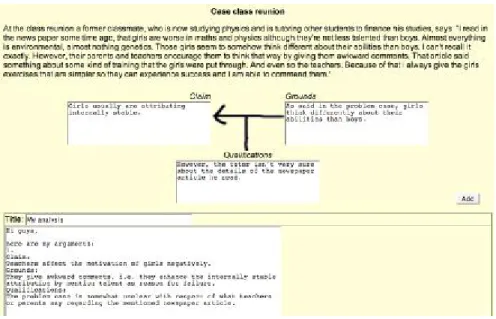
communicate with each other as they work. Different collaboration scripts are implemented to promote and support productive collaboration between the students. A script for the construction of single arguments, for example, is embedded within the interface of the discussion board to help students construct a high quality argument that provides and justifies a solution for each problem case. In accordance with a simplified version of Toulmin’s argument model (1958), this script consists of three text boxes that require students to input a claim, grounds, and qualifications for the co-constructed argument (see Figure 2). In order to improve the ways students engage in
dialogical (or multi-voiced) argumentation, a script for the construction of argumentation sequences is embedded into an asynchronous, text-based discussion board to encourage students to engage in argument-counterargument-integration sequences (based on the work of Leitão, 2000). This is accomplished by automatically labeling each participant’s contribution in the discussion board as an “argument,” “counterargument,” or “integration” depending on the role he or she was supposed to adopt in the discussion.
Figure 2. The script for the construction of single arguments. Students should use the textboxes labeled “Claim”, “Grounds”, and “Qualifications” to construct single arguments. Each single argument could be added to the regular textbox of the online discussion by clicking the button labeled “Add”.
Implementation and Assessments. CASSIS is an experimental online learning environment. It therefore
has not been fully integrated into the entire curriculum of a course. However, several studies have been conducted to examine the impact of CASSIS on student learning in the context of a course on Educational Science at the
University of Munich. So far, several hundred students have participated in a series of experimental sessions that take the place of a three-hour lecture. In each experiment session, the students used CASSIS to develop a solution to three different authentic problem cases using attribution theory (Weiner, 1985).
The individuals’ contributions to the online discussion in CASSIS served as the primary data source for assessing the quality of collaborative argumentation supported by the script for the construction of argumentation sequences in these studies. To assess the quality of these discussions, transcripts were generated and then analyzed using a coding scheme developed by Weinberger and Fischer (2006). This coding scheme requires a discussion to be first segmented into propositional units. These units are then coded with respect to the formal quality of each
argument and with respect to the formal quality of argumentation sequences. The formal quality of a single
argument is based on the share of segments that are coded as claims with grounds and/or qualifications. A sequence analysis is then used to assess the formal quality of argumentation sequences. This is accomplished by first identifying the arguments, counterarguments, and integrations in the discussion. The probability of transitions between the aforementioned message types (argument, counterargument, or integration) for each group of three is then computed using a software tool called MEP A (developed by Erkens, 1998). This coding scheme has high inter-rater reliability and evidence gathered through think aloud protocols suggest it is also a valid way to measure argumentation skills (cf. Stegmann, Wecker, Weinberger, & Fischer, 2007).
VCRI (Virtual Collaborative Research Institute)
Overview and Goals of the Environment. VCRI is a groupware program designed to support
collaborative learning on inquiry tasks and research projects. Students can use VCRI to communicate with each other, access information sources, and co-author texts and essays. While working with VCRI, students share several tools. These tools are designed to support three aspects of the collaborative inquiry process: task-related or cognitive aspects (e.g., writing an essay or constructing an argumentation map), meta-cognitive aspects (e.g., planning and evaluating the inquiry process), and social aspects (e.g., monitoring the collaborative process and supporting communication). The impact of VCRI as a way to improve collaborative learning outcomes has been assessed in several different studies that examine the nature of collaboration and argumentation in different contexts, content areas, and with different age groups (e.g., Janssen, Erkens, Jaspers, & Kanselaar, 2007; Slof, Erkens, & Kirschner, 2008; V an Drie, V an Boxtel, Jaspers, & Kanselaar, 2005). Although this research has not generally focused specifically on science-related content, the features and design of this environment offer much to support scientific argumentation.
Environment Features and Activity Structures. In VCRI, students work on collaborative inquiry
projects that span approximately eight lessons. Students start a project by investigating a topic by reading,
collecting, and summarizing information found in various sources using the sources-tool (see Figure 3). Students are able to discuss the information found in these sources with other group members as they work using the
synchronous chat-tool (see Figure 3). Often, the information sources contain an argument that consists of various facts, data, or other information that is used by the author in order to support or refute a particular viewpoint or position. Students use the debate-tool (see Figure 4) to help them examine and explore these arguments. This tool
enables the students to co-create an argumentative map or a visual representation of the arguments that can be found in a source or across sources, thereby giving them a better overview of a topic or a way to explore the merits of one or more positions. To help streamline this process, students can transfer information they gather using the sources-tool directly to the debate-tool. Students can also manually add supporting or refuting information from sources outside of VCRI to their argumentative maps. Once the argumentative maps are complete, students can transfer the line(s) of reasoning in the argumentative maps to cowriter. Students then use cowriter, which is a text processor that allows simultaneous editing by multiple users (see Figure 3), to write a final report using the line(s) of reasoning identified and highlighted with the debate-tool as a guide.
Figure 3. Screenshot of the VCRI environment showing the chat-tool, the sources-tool, and cowriter.
Figure 4. Screenshot of the debate-tool. This tool enables students to create a visual representation of the argument found within a source or across sources.
In addition, VCRI contains several awareness heightening tools. Through these tools, students are made aware of several important aspects of the collaborative process. The statusbar, for example, gives information to the students about who is online, and who is working with which tool, while the participation-tool gives information about the relative contributions of the group members. These tools enable the students to judge the quantity and the quality of their collaboration. The chat-tool also gives feedback to the students about the kind of discussions they are conducting.
Implementation and Assessments. VCRI has been used and assessed in upper secondary education and in
several different subject areas. Assessment of the impact of VCRI as a way to support the complex nature of collaborative inquiry projects tends to focus on the nature of communication and the collaboration processes that
take place between groups of students as they work. Work by Janssen et al., (2007) and Janssen, Erkens, Kirschner, and Kanselaar (in press), for example, examined the ways student work with VCRI, their ability to co-construct high quality argumentation maps, and the quality of final co-created essays. The quality of the final essay (written using the cowriter) and the quality of the argumentative maps (constructed with the debate-tool), which are both indicators of collaborative achievement, were assessed in these studies by examining the conceptual and grounds quality of the various arguments (see Clark & Sampson, 2008). Collaboration and reasoning processes, however, need to be assessed using several different coding schemes (cf. V an Drie et al., 2005; Janssen et al., 2007) because of the complexities involved. Finally, individual achievement in these studies is measured by administering tests consisting of knowledge and transfer questions before and after collaboration in the VCRI. The reliability of these assessments has proven to be reliable but the validity and fairness of the coding scheme still need to be evaluated.
DREW (Dialogical Reasoning Educational Web tool)
Overview and Goals of the Environment. The DREW environment was developed as part of a European
research project (SCALE) between 2001 and 2004. The DREW environment consists of several different computer tools that are designed to support collaborative activities. These tools include a chat environment, a collaborative writing tool, and an argument diagram tool. Research conducted by Marttunen and Laurinen (2006, 2007) has focused primarily on how secondary and university students use DREW's argument diagram tool. Similar to the
debate-tool in VCRI, this tool enables students to visualize the argumentative content of written materials (e.g. newspaper articles, book chapters, online recourses, etc). The diagram tool in DREW , however, also enables users to diagram the argumentative content of discussions. One of the major goals of the diagram tool is to help students learn how to identify and examine a claim, arguments for the claim, and the criticisms of the claim. This focus is shared by other environments that focus on argument diagramming such as Belvedere (Suthers, Hundhausen, & Girardeau, 2003; Suthers, Weiner, Connelly & Paolucci, 1995) Reason!Able (van Gelder, 2002), TC3 (van Amelsvoort, 2006), and VCRI. The DREW environment may also be used as a discussion forum for an argumentative discussion to help promote and support more productive interactions. DREW (like CASSIS and VCRI) was not developed specifically to help students examine arguments that focus on issues related to science but can support students as the learn how to engage in more productive scientific argumentation.
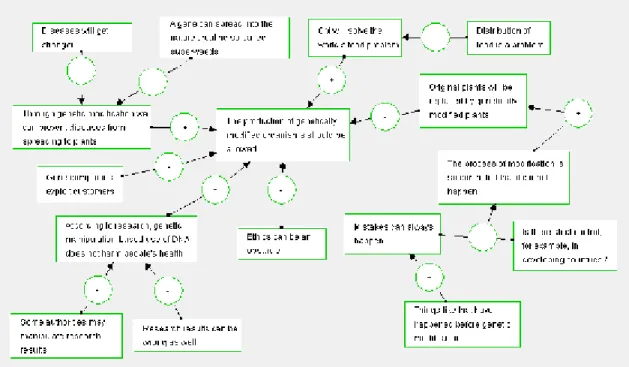
Environment Features and Activity Structures. The argument diagram tool enables users, either
include claims, arguments, and counterarguments. The boxes are connected which each other with arrows indicating whether the content of the box either supports (+ sign) or criticizes (- sign) the content of the box to which the arrow points. The construction of the diagram often proceeds in three phases. First, the main thesis of the text or discussion is defined and written into a box that is then located within the diagram. Second, all of the arguments and
counterarguments that directly link to the main thesis are defined, written into boxes, and labeled with the
appropriate signs. Finally, all the other arguments and counterarguments are defined and put into the diagram. The location of the various arguments and counterarguments depends on whether they support or criticize the main thesis or some other argument or counterargument in the diagram. In addition to writing arguments into boxes, the students can also elaborate on the arguments or counter arguments using “commentary boxes” that are automatically
connected to the appropriate box. A completed diagram depicts the argumentative structure of a text or discussion by indictating the main thesis of the material and showing how the thesis is supported and criticized by illustrating the other arguments and counterarguments and their interconnections. Figure 5 provides an example of an argument diagram that was constructed by secondary school students as part of a study.
Figure 5. An argument diagram on genetically modified organisms created by secondary school students
Implementation and Assessment. The DREW argument diagram tool has been examined in the context of
DREW (Marttunen & Laurinen, 2007; Salminen, Marttunen & Laurinen, 2007), the researchers focused on (1) the ways secondary students working in dyads engaged in chat discussions about current social issues that often involve socio-scientific aspects (e.g., genetically modified organisms, nuclear power, vivisection) and (2) how students analyzed the argumentative structure of their discussions using the argument diagram tool. In a more recent study (Kiili, Laurinen & Marttunen, 2008), secondary schools students utilized the diagram tool in organizing and structuring arguments and counterarguments gathered from different Internet sources to be used in a joint essay-writing task. A study at the university level is also underway. In this study, education students are using the diagram tool in an advanced course on educational psychology to practice their argumentation skills. In this course the students were asked to analyze the argumentative content of two scientific articles by creating argument diagrams using the DREW diagram tool.
Analyses of students’ diagrams focus on size, breadth, depth, branching, and counterargumentativeness in these studies (Marttunen & Laurinen, 2006: Salminen et al., 2007). To assess the size of the diagram, the total number of argument boxes and commentary boxes are tabulated. The breadth of the diagram, on the other hand, is assessed by counting the number of arguments and counterarguments directly linked to the main thesis. One indicator of the quality of argumentation is also the length of argument chains inside the diagram. Chains of arguments are formed by successive arguments and counterarguments. To assess the depth of the argument, the number of arguments and counterarguments successively linked to each other are counted. In addition, when arguments and counterarguments are linked around the main thesis so that they form argument chains, they are re-categorized as a secondary thesis. A secondary thesis refers to all the arguments and counterarguments that are supported by one or more new arguments or opposed by one or more new counterarguments. The branches of the diagram can then be evaluated by counting the number of secondary theses linked to more than one argument or counterargument. Finally, the Counterargumentativeness (Salminen et al., 2007) of a diagram is assessed by comparing the amount of counterarguments and rebuttals with the amount of claims and arguments.
Relationship of Environment Goals and Evidence with 21st Century Skills
The following sections discuss the relationship of the example environments (and several other
environments) to the five categories of 21st century skills: (1) adaptability, (2) complex communication skills, (3) non-routine problem solving, (4) self-management/self-development, and (5) systems thinking. Although these environments were not designed specifically with these skills in mind, these environments can contribute to the
development of these skills because of the significant overlap between the skills needed to engage in productive scientific argumentation and 21st century skills. Each section begins with the quoted definition of one of the five categories of 21st century skills developed through National Academy workshops (National Research Council, 2008). Each section then (1) highlights how online argumentation environments can support and promote the development of that category of 21st century skills and (2) outlines the empirical evidence indicating that online argumentation environments are effective at helping students develop skills relevant to that category of 21st century skills.
Adaptability: "The ability and willingness to cope with uncertain, new, and rapidly-changing conditions on the job, including responding effectively to emergencies or crisis situations and learning new tasks, technologies, and procedures. Adaptability also includes handling work stress; adapting to different personalities, communication styles, and cultures; and physical adaptability to various indoor or outdoor work environments (Houston, 2007; Pulakos, Arad, Donovan, and Plamondon, 2000)."
Relationship to Example Environments. We argue that all of the example environments focus on the
development of skills related to adaptability in at least two senses. First, these environments are designed to help students learn how to adapt their everyday communication skills to align more closely with the values, habits of mind, and criteria involved in scientific argumentation. The development of argumentation skills, in this context, can be viewed as a task that is central to helping individuals learn how to adapt to quickly changing circumstances in their environment. The ability to respond to a counterargument to one’s own claims, for example, is a competence that is of a high value in many everyday situations, both in private and in professional situations (such as
emergencies or crisis situations). The ability to weigh arguments and to evaluate the relevance, significance, or validity of the facts, evidence, and other reasons that people use to support or challenge a claim enable individuals to make better decisions even in scenarios where prior knowledge is low.
Second, students can also develop adaptability skills in these environments as they learn how to
communicate using new technologies and learn about the various affordances or constraints that are associated with them. Students are supported in this process by scripts embedded within these environments that are designed to scaffold students as they collaborate. These scripts help students learn how to participate in an unfamiliar context in a more productive manner and how to transition from one form of communication to another as needed. Scripts can scaffold role rotation, which can guide learners as they assume various roles and perspectives. The environments also have the potential to automatically fade this scaffolding as students become more proficient, which is very important for an internalization of the argumentation strategies (see Pea, 2004).
Evidence from Example Environments. Individuals with highly developed argumentation skills, as noted earlier, are also able to adapt to new problems, new modes of communication, and people or cultures. Individuals with these skills can also propose, support, critique, and refine new ideas. These skills enable individuals to cope with uncertain, new, and rapidly changing conditions or evaluate the merits of new ideas, technologies, and procedures. Empirical evidence indicates that the example environments are effective at fostering these types of skills. Research conducted on DREW (Marttunen & Laurinen, 2006: Salminen et al., 2007), for example, indicates that diagrams help individuals learn how to identify and evaluate the arguments for and against a particular position when investigating an unfamiliar topic. Research conducted by Stegmann and colleagues (Stegmann, Wecker, et al., 2007; Stegmann, Weinberger, et al., 2007) on CASSIS also provides empirical support for this claim. These studies indicate that the CASSIS environment is effective in improving students’ ability to generate persuasive and convincing arguments. In these studies, the effects of two different argumentative scripts (construction of single arguments and the construction of argumentation sequence) were tested. While one script was designed to support the construction of single arguments that would match theoretical standards, the other script aimed at helping students produce argument sequences that have been described as helpful for collaborative knowledge construction. Results show that both scripts did their job: the script for the construction of single arguments increased the formal quality of single arguments (i.e., students more frequently provided reasons for their claims), and the script for construction of argumentation sequences increased the quality of argumentation sequences (i.e., the frequency of counterarguments was increased). DREW and CASSIS therefore can be used to help students learn a new mode of communication (in this case, reasoned arguments or counterarguments), which in turn, enables students to learn how to adapt their modes of communication to better align with a given context.
The environments can also provide a context that promotes and supports productive argumentation and increase participation so learners have an opportunity to hone these skills. Early empirical research on the WISE Seeded Discussion, for example, showed that the initial versions of the environment were superior to standard online discussions for promoting high quality of argumentation (in terms of structure) and increasing student participation in a discussion (Clark, 2004; Clark & Sampson, 2005; Cuthbert, Clark, & Linn, 2002). Current research in WISE suggests that much of the added value of the personally-seeded script in comparison to standard online discussions stems from (1) the initial scaffolding provided in terms of exploring the explanation fragments that encapsulate the key idea facets that will be used in the seed comments and (2) the conflict schema approach of grouping students in
discussions with students who have expressed different perspectives (Clark, Menekse, et al., 2008; Clark, D'Angelo, & Menekse, submitted). In essence, this environment enables students to engage in higher quality argumentation and increases the amount of student participation by exposing students to opposing perspectives. It also increases content learning. Overall, the evidence available indicates that this environment provides a meaningful context where students can hone their argumentation skills, which in turn, helps students learn to adapt to new or changing conditions.
Empirical research also indicates that the described environments can encourage adaptability by distributing and re-distributing roles and activities to individual group members. This provides students with an opportunity to engage in collaborative argumentation independent of learners’ actual perspectives and helps them learn how to cope with uncertain, new, and rapidly changing conditions. Research in CASSIS, for example, guided learners to take on and rotate the roles of case analyst and constructive critic. Each of the three learners in a group switched roles at fixed intervals to criticize the case analyses of their learning partners. This script proved to substantially facilitate learning outcomes in several lab and field studies as learners elaborated arguments and counter-arguments in a highly transactive way and shared their knowledge and perspectives in the discussions (Weinberger, 2008; Weinberger, Ertl, Fischer, & Mandl, 2005). This type of approach, where students are
encouraged to take on different roles during a task designed to promote and support argumentation, can therefore not only help students learn more from an activity but it can also help students learn how to adapt to different roles in a discussion.
Empirical research also indicates that these environments can encourage adaptability by increasing
students’ awareness of important aspects of the collaborative process. Research in VCRI, for example, demonstrated that awareness tools such as the participation-tool increased students’ awareness of their group members’
contribution to the collaborative process. Students use this information to help regulate and coordinate the work of the group, which over time resulted in more productive group interactions and outcomes (Janssen et al., 2007). This research indicates that online learning environments can help students learn how to adapt to the complex processes involved in collaboration and argumentation by increasing their awareness of the ways they are interacting with each other.
Evidence from Related Environments. The ArgueGraph script is another example of a conflict schema
questionnaire and then represents the students’ positions on a graph. The software then matches pairs of opposing opinions with the largest distance on the graph into groups to construct and exchange arguments and
counterarguments. Jermann and Dillenbourg (2003) examined the efficacy of this approach. Their study
demonstrates that organizing groups in this manner can increase engagement in the processes of argumentation and learning, which helps students learn how to propose, support, critique, and refine new ideas. These skills enable individuals to evaluate the merits of new ideas, technologies, and procedures or cope with uncertain and rapidly changing conditions.
In an environment based on videoconferencing, a script has been applied that guides learners through specific macro-phases of diagnosing and proposing therapies for psychiatric cases, including orchestration of individual and collaborative phases as well as structuring learners to formulate and answer questions, exchange notes and discuss and revise individual ideas and converge on joint solutions (Rummel & Spada, 2005). This study shows that scripts can facilitate learners’ interaction processes as well as the quality of their joint solutions.
Lastly, research on online environments demonstrates that students tend to benefit in a variety of ways when they use asynchronous and synchronous communication technologies in technology-enhanced learning environments. Asynchronous modes of communication, for example, often foster engagement in high-quality argumentative processes (e.g., de Vries, Lund & Baker, 2002; Pea, 1994). Asynchronous communication also facilitates task-oriented discussions and individual knowledge construction by allowing participants time to reflect, understand, and craft their contributions and responses (Kuhn & Goh, 2005; Marttunen, 1992; Schellens & V alcke, 2006). This expanded time allows students to construct and evaluate textual arguments more carefully than in face-to-face environments (Joiner & Jones, 2003; Marttunen & Laurinen, 2001). The text-based nature of these asynchronous online environments (as opposed to speech-based) tends to supplement the construction of complex and well-conceived arguments (e.g., de Vries et al., 2002) and helps students develop skills in processing and interpreting information from others in order to respond appropriately. Asynchronous modes may also potentially provide more equitable access and participation for students engaging in argumentation than face-to-face settings because of simultaneous access and participation opportunities (Hsi & Hoadley, 1997). Asynchronous modes that allow anonymous contributions may also increase this equitable access and participation (Hsi & Hoadley, 1997).
Synchronous chat facilities, on the other hand, offer a different set of affordances. Task-oriented synchronous chat, for example, affords simultaneous deliberation and coordination as students work together on a
shared artifact (de Vries et al., 2002; Janssen, Erkens, Jaspers, & Kanselaar, 2006). Research suggests that providing ways for students to coordinate resources and negotiate how to proceed with a task can foster productive
collaborative learning (Barron, 2003; Pfister, 2005; Rogoff, 1998). It also enables students to learn how to select key pieces of a complex idea to express in words in order to build shared understanding during collaborative problem solving. Finally, and perhaps most importantly, synchronous chat allows users a chance to provide immediate feedback on argumentation. This tends to facilitate co-construction of argumentation sequences and deeper discussions. A comparison study conducted by Munneke, Andriessen, Kirschner, and Kanselaar (2007), for example, showed that students in a synchronous chat condition argued in a more elaborated and deep way than students in an asynchronous forum on the same task. Students using the asynchronous forum, however, produced more accurate argumentative texts. Both asynchronous and synchronous technologies can therefore enhance the adaptability of students because they enable students to learn to communicate (1) with different types of technologies, (2) in different situations and contexts, and (3) with a wider diversity of people.
Complex Communications Skills: "Skills in processing and interpreting both verbal and non-verbal information from others in order to respond appropriately. A skilled communicator is able to select key pieces of a complex idea to express in words, sounds, and images, in order to build shared understanding (Levy and Murnane, 2004). Skilled communicators negotiate positive outcomes with customers, subordinates and superiors through social perceptiveness, persuasion, negotiation, instructing, and service orientation (Peterson et al, 1999)."
Relationship to Example Environments. Of the five 21st century skills, the development of complex
communication and social skills is most central to these environments. All of these environments focus heavily on complex communication and social skills. Many of the environments focus on helping students learn how to work toward consensus. Students need to be able to communicate complex ideas in order to build a shared understanding. Scientific argumentation is ultimately about developing, warranting, and finally communicating a persuasive argument in terms of the processes and criteria valued in science. Argumentation skills are necessary for both the construction of valid and sound arguments as well as for the evaluation of the soundness and relevance of arguments provided by others. Argumentation skills are therefore an integral component of complex communication skills.
One important way that these environments develop and support complex communication skills is through the scripts integrated into the environments that support students in these roles. Essentially, the design of these environments can be thought of in terms of “scripts” that orchestrate and control students’ interactions with each other and the environments (e.g., King, 2007; Carmien, Kollar, Fischer, & Fischer, 2007; Stahl, 2007; Stegmann, Weinberger, & Fischer, 2007). As Weinberger and colleagues explain, "collaboration scripts provide more or less
explicit and detailed instructions for small groups of learners on what activities need to be executed, when they need to be executed, and by whom they need to be executed in order to foster individual knowledge acquisition"
(Weinberger, Stegmann, Fischer, & Mandl, 2007, p.195). These scripts and activity structures help students learn new tasks, technologies, procedures, and modes of communication in technology-enhanced learning environments.
The collaboration scripts implemented in CASSIS, for example, improve the argumentative quality of social discourse between learning partners and support learners in building a shared, well-grounded position on a topic. The WISE environment uses a script to sort students into groups with students who think differently about the phenomenon under discussion as discussed earlier in the overview of the example environments and in the section
on Adaptability. Students begin their discussions with multiple different perspectives. Developing consensus in
these discussions therefore provides significant challenges for students and fosters communication skills in groups with divergent perspectives.
In terms of VCRI, the debate-tool and the participation-tool also support complex communication. The
debate-tool stimulates students to discuss and argue about a topic. Analysis of the argumentation maps students co-create using the debate-tool show that online learning environments have the potential to engage students in
conceptually sound, and well-grounded discussions. Finally, the participation-tool gives students information about the relative contribution of the group members allowing them to judge the quality of their collaboration.
Finally, when the argument diagram tool in the DREW environment is used as a joint discussion forum for some controversial topic, the argumentative relations (i.e. arguments indicating either agreement or disagreement) of the contributions of the interlocutors become visible. Visualization of the argumentative structure of the discussion guides participants to focus their discussion on the most conflicted and complex issues, which in turn may promote building of a shared understanding. Carr (2003), for example, found that argument diagrams produced in the QuestMap environment helped students to focus their discussion on those aspects in which they particularly disagreed with each other.
Evidence from Example Environments. Research in CASSIS indicates that argumentative scripts
facilitate the formal quality of argumentation during online discussion (cf. Stegmann, Weinberger, & Fischer, 2007). The proportion of single arguments with higher formal quality significantly increased for learners who were
supported with the script for the construction of single arguments in these studies. The script for the construction of argumentation sequences also improved the formal quality of argumentation sequences by increasing the proportion
of counterarguments and transitions from arguments to counterarguments in these studies. Furthermore, both scripts successfully facilitated the acquisition of knowledge on argumentation. Learners specifically acquired more knowledge on single arguments when supported by the script for the construction of single arguments and more knowledge on argumentation sequences when supported with the script for the construction of argumentation sequences as compared to learners without script support. However, the scripts did not affect domain-specific knowledge acquisition, although enhanced argumentation skills may facilitate domain-specific knowledge acquisition in the future (cf. Kollar, Fischer, & Slotta, 2007). In another study (Janssen et al., in press), it was demonstrated that the debate-tool helps students to create high quality argumentation maps and write conceptually sound historical essays. Additionally, students used the debate-tool to formulate well-grounded warrants for the arguments put forth in their essays. On the other hand, the debate-tool did not affect the quality of the argumentation exchanged between group members during their online collaboration.
Evidence from Related Environments. Other research has also demonstrated the value of supports for
individual argument construction. Research on Belvedere (which focuses more heavily on single argument construction rather than argumentation between students) showed that students’ construction of sound arguments could be supported through a Toulmin-inspired graphical template of the structural components of an argument (Suthers & Hundhausen, 2003). While support for data evaluation is a key feature of tools like Belvedere, these tools also facilitate the construction of sound arguments by visualizing respective claims, relevant evidences, and possible qualifications (Fischer, Bruhn, Gräsel, & Mandl, 2002; Kirschner, Buckingham Shum, & Carr, 2003; Suthers & Hundhausen, 2001). Similar results have been found by Kollar et al. (2007). In Kollar et al., a script that aimed at improving both the structural and the sequential quality of arguments produced during collaboration on a WISE unit about Deformed Frogs led to a higher number of arguments with a high structural quality and more
counterarguments. Further analyses (Kollar et al., 2008), however, have shown that as soon as this script was removed, students resorted back to their internal scripts on how to construct arguments and argument sequences. Thus, facilitating the internalization of more sophisticated argumentation strategies through adequate scripts appears to require longer-term interventions.
Like Belvedere, research on BGuILE and SenseMaker focuses heavily on evaluation of data for single argument construction, but research on BGuILE and SenseMaker also focuses on the value of computer-mediated supports for individual argument construction (Bell, 1997, 2004; Bell & Linn, 2000; Reiser, 2002; Reiser, Tabak,
Sandoval, Smith, Steinmuller, & Leone, 2001; Sandoval, 2003; Sandoval & Millwood, 2005; Sandoval &Reiser, 2004). Research on specific BGuILE software tools, such as the ExplanationConstructor, for example, underscores the value of these tools in helping students express their reasoning and beliefs in meaningful ways (Sandoval & Reiser, 2004). BGuILE research has also investigated inferential validity in terms of the causal coherency of students’ explanations (Sandoval, 2003; Sandoval & Millwood, 2005). According to this BGuILE research, students’ explanations are predominantly coherent even though they sometimes use illogical inferences to justify their positions.
Non-Routine Problem-Solving Skills: "A skilled problem-solver uses expert thinking to examine a broad span of information, recognize patterns, and narrow the information to reach a diagnosis of the problem. Moving beyond diagnosis to a solution requires knowledge of how the information is linked conceptually and involves
metacognition—the ability to reflect on whether a problem-solving strategy is working and to switch to another strategy if the current strategy isn’t working (Levy and Murnane, 2004). It includes creativity to generate new and innovative solutions, integrating seemingly unrelated information; and entertaining possibilities others may miss (Houston, 2007)."
Relationship to Example Environments. All of the example environments promote non-routine
problem-solving skills. Negotiating consensus and critiquing ideas through a discussion in WISE, for example, where novel ideas are introduced by other students on a regular basis, requires students to use expert thinking in integrating and applying a broad span of information and data from the initial laboratory activities, simulations, and everyday experiences. This involves pattern recognition, deduction, analogical thinking, and several other key problem-solving skills in a context that is constantly shifting as students interact with one another and add new ideas to the mix. WISE scaffolds this process through helping to focus students on the salient ideas prior to the discussion. This helps students consider the breadth and range of the problem space and key issues and alternatives within the problem space. The discussions are then seeded with comments to cue these specific issues within the subsequent debate.
Within the CASSIS environment, learners are encouraged to apply a theory to solve authentic problems. CASSIS provides argumentative collaboration scripts to improve joint solutions. Thus, students more often base their final solutions on grounds and consider different perspectives, which is facilitated by a collaboration script that asks learners to provide counterarguments to their fellow learners’ contributions (which is a task that requires a great deal of metacognitive awareness with respect to the validity of the arguments produced by the learning partner). The argument diagram tool in the DREW environment can also promote non-routine problem-solving skills. This tool allows students to examine a broad span of information, recognize patterns, and narrow the information to reach a
solution to a problem. The DREW argument diagram tool also encourages students to reflect on whether or not a claim is well-supported by available evidence and to weigh the pros and cons of a solution to an ill-defined or complex problem. This type of metacognition is a key element of non-routine problem solving.
Evidence from Example Environments. The WISE Seeded discussions help students learn how to solve
non-routine problems by helping them learn to evaluate the validity or acceptability of claims, explanations, or solutions. To do this, WISE requires students to use a series of pull-down menus that students use to explore the key idea facets that will be included in the seed comments of the subsequent discussions. Current research in WISE investigates the value of the conflict schema approach and the value of this pre-exploration and focusing on the key ideas and variants at the heart of the debate prior to the discussions. The research suggests that this initial
scaffolding in conjunction with the conflict schema approach increases conceptual and structural quality of the ensuing argumentation (Clark, D'Angelo, & Menekse, accepted). This environment can therefore help students focus at the salient levels of the debate, recognize distinctions between seed-comment claims, learn how to integrate seemingly unrelated information, entertain possibilities others may miss, and examine or evaluate a broad span of information.
The results on DREW thus far have shown that students deepen and broaden their knowledge of a given topic when diagrams are used across three sequential phases of students’ work (Marttunen & Laurinen, 2006). The DREW diagrams have been demonstrated to provide students with a suitable tool for reflecting on their previous debate and earlier knowledge (Marttunen & Laurinen, 2007). Overall, this research indicates that the DREW environment can help students develop argumentation and non-routine problem-solving skills.
Current research also indicates that the CASSIS environment is an effective way to foster non-routine problem-solving skills. For example, an epistemic script implemented in the CASSIS environment guided learners to engage in a series of problem-solving moves, such as identifying the relevant problem information, applying the relevant concepts to this problem information, and drawing conclusions and proposing interventions. Learners supported with an epistemic script were better able to focus on the core aspects of a problem case, but also pursued additional information and explored multiple perspectives (Mäkitalo, Weinberger, Häkkinen, Järvelä, & Fischer, 2005; Weinberger, 2008; Weinberger et al., 2007). This work suggests that the CASSIS environment can help students develop non-routine problem-solving skills by giving students an opportunity to learn how to analyze large amounts of information, recognize patterns, and determine whether or not a claim is well support by available
evidence.
Evidence from Related Environments. The use of argument diagrams in environments comparable to the
DREW argument diagram tool has produced results suggesting that argument diagrams are important in practicing argumentation skills which, in turn, are highly useful in non-routine problem solving. Twardy (2004) found that the use of argument maps promoted critical thinking among university students. Likewise, the use of the Belvedere (van Boxtel & V eerman, 2001) and the Virtual Collaborative Institute (VCRI) environments helped both university and secondary students balance positively and negatively oriented arguments during discussions.
Research also demonstrates that these environments can support students engaging in non-routine problem solving by providing access to data and supporting the evaluation of data. In terms of access to data, Kolodner, Schwarz, Barkai, Levy-Neumand, Tcherni, and Turbovsk (1997) developed an indexed case library that students search for examples and facts as evidence for their arguments about specific issues. The case library provides and indexes alternative solutions to support students’ examination of counterarguments to their own line of
argumentation. Kolodner et al. (1997) showed that the case library supports students' construction of counterarguments and refines learners’ understanding of what makes a good argument.
Other research shows that enriched representations can provide significant interrelated information to students (Fisher & Larkin, 1986) and that incorporating media-rich representations of the learning task, materials that enhance the authenticity of the learning task, and contextual anchors can facilitate student learning (Bransford, Brown, & Cocking, 2000; Cognition and Technology Group at V anderbilt, 1997). These environments can also provide access to visualizations and simulations that may allow students to explore aspects of the subject matter to support a specific claim, thereby potentially increasing the persuasiveness of their arguments (Oestermeier & Hesse, 2000).
Research on the SenseMaker tool within the KIE and WISE environments (Bell, 1997, 2004; Bell & Linn, 2000) indicates that online argumentation environments can help develop non-routine problem-solving skills. SenseMaker focuses primarily on helping students craft individual arguments. SenseMaker research showed that students’ understanding of the core issues, evidence, and arguments benefited from working with a tool that helped them analyze the conflicting pieces of evidence at the core of a debate. Similarly, the BGuILE environment helps students design and practice scientific inquiry through investigation, refine their own explanations and reasoning, and critique other students’ explanations (Reiser, 2002; Reiser, Tabak, Sandoval, Smith, Steinmuller, & Leone,
2001; Sandoval, 2003; Sandoval & Millwood, 2005; Sandoval &Reiser, 2004). The BGuILE environment integrates dynamic visualizations and outlining environments to help students learn, understand, and integrate new and
complex knowledge and concepts that students might not otherwise address (Reiser, 2002).
Self-Management/Self-Development: "Self-management skills include the ability to work remotely, in virtual teams; to work autonomously; and to be self motivating and self monitoring. One aspect of self-management is the willingness and ability to acquire new information and skills related to work (Houston, 2007)."
Relationship to Example Environments. Self-management and self-development are supported to
varying degrees by these environments. The environments that include participant awareness tools, for example, help students monitor their own participation or contributions and the participation or contributions of other group members. VCRI’s participation-tool, for example, provides students with educative feedback about how well they work in a group and how to improve their participation. A wareness tools encourage students to engage in
metacognition and can help promote and support the development of the skills needed to self-monitor. Through this process students can improve their ability to work remotely or in virtual teams and to monitor their own progress.
Another approach to supporting self-management and self-development involves metacognitive prompts that encourage students to reflect on the implications of the data, the types of responses that would be appropriate in a given situation, and how their own ideas have changed. Providing these metacognitive prompts helps students learn both content (i.e., science concepts) and process (i.e., how to engage in productive scientific argumentation) and can also help students learn how to self-monitor in subsequent encounters. These prompts can be faded over time or with increased proficiency. If students fail to provide persuasive grounds supporting their own arguments, for example, the argumentative collaboration scripts within CASSIS can help students or their learning partners identify these flaws in the arguments. This in turn may engage learners in re-thinking and revising their own claims and in searching for further evidence to support or discard their claims.
Evidence from Example Environments. In terms of supporting self-management and self-development
through awareness tools, several studies with VCRI have focused on the effects of awareness tools on students’ communication and collaboration (e.g., Janssen et al., 2007). These awareness tools help students to improve their collaboration process and stimulate them to engage in constructive argumentation. VCRI’s shared space, for example, analyzes the content of the chat messages sent. This analysis establishes whether group members are conducting shallow consensual online discussions or whether they are engaged in critical exploratory discussion. The results of this analysis are then fed back to the group members. This helps students to become aware of the type
of online discussions they are having with their group members. Students can use this information to adapt their collaboration and communication if necessary. Research by Janssen, Erkens, and Kanselaar (2007) showed that groups that had access to the shared space engaged in more critical and exploratory discussions compared to groups without access to the shared space. These groups were also more satisfied with the online collaborative process and performed better on a historical inquiry task. This research indicates that awareness tools can help students learn how to work in virtual teams, to work autonomously, and to be self-motivating and self-monitoring.
Research on the CASSIS environment indicates the argumentative collaborative scripts can also help promote self-management and development. A general effect of the various scripts implemented in the CASSIS environment seems to be that learners are more engaged in on-task discourse and participate more frequently and more homogeneously (Weinberger et al., 2007). Scripts guide learners to engage in the relevant steps for arriving at problem solutions, which makes the sometimes arduous coordination in online environments redundant. Learners seem to have less opportunity to engage in off-topic discourse and focus on the task at hand. In another study conducted within CASSIS (Wecker & Fischer, 2007), students were supported in classifying the components of the argumentation of their learning partners. Students were then supported in formulating counterarguments on the basis of the identified components. By the means of fading (i.e. reducing the instructional support by script step by step) and distributed monitoring (i.e., evaluation of the quality of counter argument by peers), students engaged in these argumentative processes on their own (i.e., without an external script that would ask them to do so). Overall, this research indicates that online environments can help students learn how to monitor their own performance as well as the performance of others.
Research on an early version of WISE (Davis, 2003; Davis & Linn, 2000) on prompts showed that generic prompts that ask students to “stop and think” will encourage greater reflection in comparison to directed prompts that provide with hints indicating potentially productive directions for their reflection. The results showed that students in the generic prompt condition developed more coherent understandings as they worked on a complex science project in the environment and that students reflect unproductively more frequently in response to directed prompts as compared to the generic prompts. Thus the structure of prompts in these environments can support students’ self-monitoring.
Evidence from Related Environments. Other research also supports the value of awareness tools for
(e.g., Dillenbourg, 2002). These tools support the self-regulating capacities of collaborative learners. Research by Jermann and Dillenbourg (2008), for example, showed that providing awareness information about the amount of communicative and task-related activities performed by group members led to increased participation in online dialogue and to more frequent and precise planning of the collaborative process. Similar results were reported by Michinov and Primois (2005). Students can also be made aware of possible strengths and deficits regarding the group’s collaborative activities and of possible gaps in the group’s argumentation. Based on this feedback, students can self-correct their collaborative argumentation accordingly (e.g., Hesse, 2007; Jermann, Soller, & Muehlenbrock, 2001). These tools also help students develop the skills they will need to process and interpret both verbal and non-verbal information in order to respond to other people in an appropriate manner.
Research by White and Frederiksen (1998) demonstrates the positive effects of metacognitive prompting on learning processes and learning outcomes. White and Frederiksen implemented reflection prompts in an inquiry-oriented curriculum unit on force and motion. These prompts were designed to raise the metacognitive awareness of the students to help them design more reasonable experiments and to develop higher-level conclusions from their experiments. White and Frederiksen’s results demonstrate that the prompts were successful. Students in the prompting condition produced more sophisticated research designs, showed more high-level conclusions, and displayed smoother teamwork than students who had participated in regular classroom instruction. Moreover, students from the prompting condition outperformed students from regular classrooms on a subsequent transfer test in which they were supposed to develop a research plan on a different topic.
Systems Thinking: "The ability to understand how an entire system works, how an action, change, or
malfunction in one part of the system affects the rest of the system; adopting a “big picture” perspective on work (Houston, 2007). It includes judgment and decision-making; systems analysis; and systems evaluation as well as abstract reasoning about how the different elements of a work process interact (Peterson, 1999)."
Relationship to Example Environments. Arguments are systems and chains of claims, warrants,
backings, and data that can involve substantial complexity as they evolve through discussion. In order to participate in these discussions in a productive manner, students must learn how to evaluate information, make well-reasoned decisions, and examine how the various components of an argument or counterargument fit together with one another. Students must also develop appropriate criteria for evaluating what counts as warranted knowledge and how to determine if information is relevant to the phenomenon under discussion or if there is sufficient information to make a decision. Students therefore learn to adopt a “big picture” perspective on their work. In this way, these