Brief
National Association of Public Hospitals and Health Systems FEBRUARY 20131301 Pennsylvania Avenue, NW, Suite 950
Washington, DC 20004 202 585 0100 tel / 202 585 0101 faxwww.naph.org Bruce Siegel, MD, MPH president and chief executive officer
throughput. As hospitals grapple with these added responsibilities in 2014, EDs face a shortage of primary care and specialty physicians. Decreased production and attrition in the number of primary care physicians across the country threaten to add to the burdens placed on EDs.4
NPHHI REVISITS MEMBER EDs
To assess the state of ED preparation for health care reform in 2014 and to understand how NAPH members are responding to these challenges, NPHHI revisited 10 member hospitals that participated in a 2011 NPHHI study on ED throughput, which informed the data brief Strategies to
Improve ED Overcrowding: Data from the National Public Health and Hospital Institute ED Throughput Study. Each
of these members has a large trauma center and ED that cares for, on average, 56,000 to 144,000 patients per year (approximately 150 to 400 visits per day).
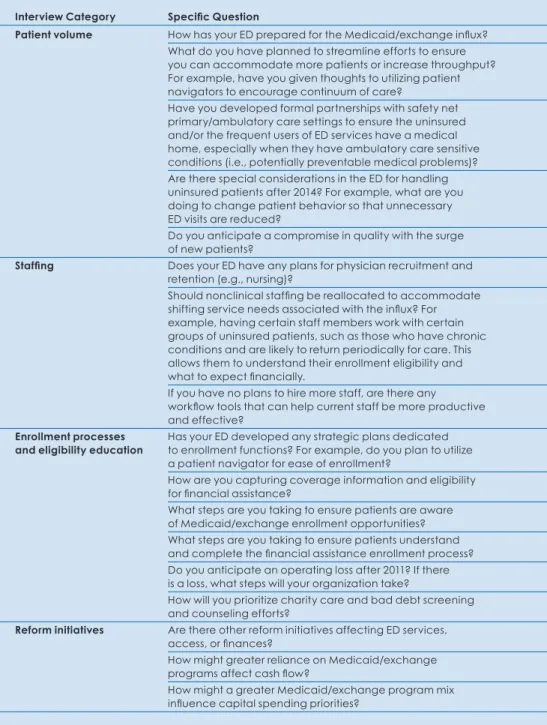
NPHHI interviewed ED directors and other emergency medicine experts on a range of topics in three key categories: patient volume, staffing, and Medicaid and health insurance exchange enrollment processes (Table 1). This research brief summarizes the three times as many patients in
their EDs as the average acute care hospital. Furthermore, an estimated 59 percent of NAPH hospitals’ admissions originated in the ED compared with 45 percent in other hospitals nationally.1, 2
The Medicaid expansion and health insurance exchanges stipulated by the ACA will generate insurance coverage for many of the previously uninsured. Studies show, however, that a
significant number of these individuals will continue to use the safety net ED as their primary source of care for various reasons, including its perceived accessibility and familiar, culturally competent environment.3 While safety
net hospitals are developing processes to efficiently enroll patients in
appropriate health plans, streamlining The Affordable Care Act (ACA) holds
the promise of broadly expanded health care coverage that could increase access to needed care for many
vulnerable patients. But in order for patients to fully benefit from the law, they must have better access to primary care, which can decrease unnecessary use of the emergency department (ED). In addition, improved patient flow through the ED can ensure EDs remain clear and accessible for those who truly need them.
Members of the National Association of Public Hospitals
and Health Systems (NAPH) see a higher than average number of patients in their EDs. In an ED utilization study conducted over the past year by NAPH’s research affiliate, the National Public Health and
Primary Care, Improved
ED Throughput Are
Keys to Reducing ED
Overcrowding and Preparing
for ACA Implementation
TABLE 1 ED Interview Questions
Interview Category Specific Question
Patient volume How has your ED prepared for the Medicaid/exchange influx?
What do you have planned to streamline efforts to ensure
you can accommodate more patients or increase throughput?
For example, have you given thoughts to utilizing patient
navigators to encourage continuum of care?
Have you developed formal partnerships with safety net primary/ambulatory care settings to ensure the uninsured and/or the frequent users of ED services have a medical home, especially when they have ambulatory care sensitive
conditions (i.e., potentially preventable medical problems)?
Are there special considerations in the ED for handling
uninsured patients after 2014? For example, what are you
doing to change patient behavior so that unnecessary
ED visits are reduced?
Do you anticipate a compromise in quality with the surge
of new patients?
Staffing Does your ED have any plans for physician recruitment and
retention (e.g., nursing)?
Should nonclinical staffing be reallocated to accommodate shifting service needs associated with the influx? For
example, having certain staff members work with certain groups of uninsured patients, such as those who have chronic conditions and are likely to return periodically for care. This allows them to understand their enrollment eligibility and
what to expect financially.
If you have no plans to hire more staff, are there any
workflow tools that can help current staff be more productive and effective?
Enrollment processes Has your ED developed any strategic plans dedicated
and eligibility education to enrollment functions? For example, do you plan to utilize a patient navigator for ease of enrollment?
How are you capturing coverage information and eligibility
for financial assistance?
What steps are you taking to ensure patients are aware
of Medicaid/exchange enrollment opportunities?
What steps are you taking to ensure patients understand
and complete the financial assistance enrollment process? Do you anticipate an operating loss after 2011? If there is a loss, what steps will your organization take?
How will you prioritize charity care and bad debt screening
and counseling efforts?
Reform initiatives Are there other reform initiatives affecting ED services,
access, or finances?
How might greater reliance on Medicaid/exchange
programs affect cash flow?
How might a greater Medicaid/exchange program mix
influence capital spending priorities?
INTERVIEWEES
Interview participants were chosen based on their participation in the 2011 ED Throughput Study. Key findings were inferred from telephone interviews with ED directors and expert personnel in emergency medicine at 10 NAPH mem-ber hospitals. Interviewees are as follows:
Leon Haley, MD, Deputy Senior Vice
President of Medical Affairs, Chief of Emergency Medicine, Grady Health System/Grady Memorial Hospital, Atlanta
Yves Duroseau, MD, MPH, Director of
Service, Emergency Medicine, Central Brooklyn Family Health Network/Kings County Hospital Center, Brooklyn
Asaad Sayah, MD, Chief of Emergency
Medicine, Cambridge Health Alliance/ Cambridge Hospital Campus, Cambridge
David Goldstein, MD, Chief Medical
Officer, and Mary Murphy, Project
Man-ager, Patient Safety and Quality, Contra Costa Health Services/Contra Costa Regional Medical Center, Martinez, Calif.
Terry Dentoni, MSN, RN, Nursing Director,
ED Services, Community Health Network of San Francisco/San Francisco General Hospital, San Francisco
Brenda Sutton, RN, Director of Adult
and Pediatric Emergency Medicine, Maricopa Integrated Health System/ Maricopa Medical Center, Phoenix
Christopher Colwell, MD, Director
of Emergency Medicine, Denver Health, Denver
Joseph Ornato, MD, Chairman
of Emergency Department, VCU Health System, Richmond
Doug Brunette, MD, Assistant
Chief of Emergency Medicine for Clinical Affairs, Hennepin County Medical Center, Minneapolis
Janice Gonzalez, MD, Emergency
Medicine, Jackson Health System/ Jackson Memorial Hospital, Miami
patients present for issues that can be handled in primary care or other health care settings. “The primary things they’re coming in for are medication refills and things like dental pain, recheck on an earache— things that occupy space that aren’t necessary in the ED.” The respondent added, “We train them to [use the ED] because we’ve made access to primary care challenging.”
Respondents are also seeing surrounding hospital closures in their regions, which drives more patients to their EDs. One ED director attributed an estimated 15 to 20 percent spike in ED patient volume before 2014 to a recent relocation of another area hospital.
Because of their already increased ED patient volumes, respondents were more focused on finding solutions to immediate challenges than potential future challenges brought on by ACA implementation in 2014. “NAPH member hospitals need to be careful about the idea that 2014 represents a dramatic difference in the mindset of EDs across the country. We know there’s a big challenge coming up in 2014, but we also face those kinds of challenges to some degree or other all of the time,” noted Christopher Colwell, MD, director of emergency medical services at Denver Health.
PHYSICIAN SUPPLY MAY HINDER ACCESS
While 2014 will boost health care coverage, old challenges may persist. address challenges and improve patient
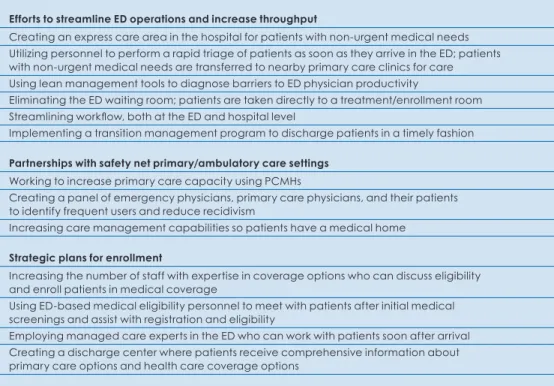
care (Table 2).
Present and Future Challenges MEMBERS FOCUS ON
CURRENT ED VOLUMES
Study participants report steady growth in their ED volumes, citing annual increases ranging from 2 to 6 percent. Respondents attribute these increases to several factors. Limited health care resources for the indigent population render the ED their only access to care. One respondent noted that being the region’s safety net hospital means treating as many as 88,000 patients annually in the ED, which is “bursting at the seams.” Respondent Joseph P. Ornato, MD, chairman of the department of emergency medicine at Virginia Commonwealth University (VCU) Medical Center, reinforced that statement, saying, “...[our hospital] is the safety net hospital for the center of the state, and we already really have the lion’s share of [Medicaid/ uninsured] patients and have had them as part of the system’s major responsibility, historically...”
Such crowding in the ED can have adverse effects on patient access to care. For example, two respondents mentioned patient volumes are so severe, many patients leave the ED without treatment. One noted a “left without being seen” rate of between 3 and 6 percent. The other noted a rate of 10 percent.
“[Our hospital] is the
safety net hospital
for the center of the
state, and we already
really have the lion’s
share of [Medicaid/
uninsured] patients
and have had them
as part of the system’s
major responsibility,
historically...”
care physicians—mean patients, including those newly covered, may still have problems accessing care. As many as 12,000 more physicians
may be required to care for patients newly covered through the Medicaid expansion and health insurance exchanges.5 Furthermore, the areas
with the highest levels of Medicaid expansion are estimated to have the greatest access problems due to insufficient numbers of primary care physicians.6 Because of this
deficiency, many patients are expected to continue to use the ED, keeping volumes high.
When asked if they plan to increase the number of physicians and nurses (primarily in the ED) to handle larger
patient volumes, respondents said that recruitment presents some obstacles. Some noted the relatively low compensation levels safety net hospitals offer compared with private institutions. One respondent mentioned the structure of emergency physician compensation is heavily weighted toward benefits, putting the
respondent’s hospital at a recruiting disadvantage vis-à-vis EDs staffed under contracts that allow physicians to “see all their compensation in cash up front.”
New and Proven Solutions ENROLLMENT BEGINS IN THE ED
As many of those newly eligible for coverage will still enter the health system through the ED, hospitals must implement processes for
enrollment. However, methods for enrolling new patients—many of whom might be eligible for coverage other than Medicaid—are relatively new and untested. While current best practices involve proactive outreach,7 most process changes
must take place at the hospital or health system level, rather than in the ED. Specialized staff may be used to engage uninsured individuals early, educate and enroll them in coverage, and ensure they maintain coverage. Many health systems that have already begun this process have focused on increasing patients’ awareness of third-party payment programs for which they qualify.8
While patient navigators are already widely used in hospitals to assist
patients in overcoming a variety of barriers to care, the ACA specifically requires health insurance exchanges to fund navigators to assist with outreach and enrollment efforts. But states, not hospitals, will determine availability and use of these personnel. In addition, because patient navigators typically assist patients with private health care insurance enrollment, the extent to which safety net hospitals will use them is unclear, given these hospitals’ emphasis on publicly funded health care coverage.
At the ED level, some study participants noted the importance of using already available financial personnel who operate within the ED to help with enrollment and eligibility. Soon after treatment, these financial personnel discuss coverage options
Specialized staff
may be used to
engage uninsured
individuals early,
educate and enroll
them in coverage,
and ensure they
maintain coverage.
available to patients. Depending on the health system, the hospital may enroll these patients in Medicaid, a managed care plan, or—in the future—a private plan offered through the health insurance exchanges.
In 2014, some patients may be eligible for a number of coverage alternatives, and financial specialists in the ED will likely have to be experts in navigating the private insurance application system as well as Medicaid and the Children’s Health Insurance Program (CHIP), and understanding the benefits and shortcomings of each. Respondents noted plans to train specialists in enrollment processes and
PUSHING PRIMARY CARE, STREAMLINING ED THROUGHPUT
The coverage expansion mandated by the ACA offers a significant opportunity to increase access to primary care for vulnerable populations and decrease ED use. In fact, the experience of health care reform in Massachusetts showed the areas of greatest increase in insurance coverage also reported the greatest decreases in ED use for conditions that are “primary care treatable and/or preventable.”9
Given the current patient volumes seen in their EDs, NAPH members are already working to direct more
of study participant strategies.) For example, many NAPH members, including several study participants, refer ED patients to patient-centered medical homes (PCMHs), which have been shown to reduce hospitalizations and ED visits, especially in high-risk patient populations. Among the NAPH membership, there are 207 medical homes recognized by the National Committee for Quality Assurance. For these members,
medical homes have improved the delivery and quality of primary care for patients who are continuously engaged with their PCMH physicians compared with those who are not.10
As one respondent suggested, another alternative to treating patients in the ED is creating an express care area, accessed through the ED, where providers treat patients with non-emergency medical needs. Hospitals may also refer patients to a primary care facility that is part of the hospital system or a community clinic
(including federally qualified health centers [FQHCs]) that allows for same-day care. According to the majority of respondents, regardless of the course of care, efforts are made to ensure patients are connected to a source of primary health care to treat their long-term medical needs.
While the strategies discussed here are a necessary step in reducing overcrowding, they also fill a gap in care for many patients. As one study respondent noted, the
TABLE 2 Effective Interventions in NAPH Member EDs
Efforts to streamline ED operations and increase throughput
Creating an express care area in the hospital for patients with non-urgent medical needs Utilizing personnel to perform a rapid triage of patients as soon as they arrive in the ED; patients with non-urgent medical needs are transferred to nearby primary care clinics for care
Using lean management tools to diagnose barriers to ED physician productivity
Eliminating the ED waiting room; patients are taken directly to a treatment/enrollment room
Streamlining workflow, both at the ED and hospital level
Implementing a transition management program to discharge patients in a timely fashion
Partnerships with safety net primary/ambulatory care settings
Working to increase primary care capacity using PCMHs
Creating a panel of emergency physicians, primary care physicians, and their patients to identify frequent users and reduce recidivism
Increasing care management capabilities so patients have a medical home
Strategic plans for enrollment
Increasing the number of staff with expertise in coverage options who can discuss eligibility and enroll patients in medical coverage
Using ED-based medical eligibility personnel to meet with patients after initial medical screenings and assist with registration and eligibility
Employing managed care experts in the ED who can work with patients soon after arrival Creating a discharge center where patients receive comprehensive information about primary care options and health care coverage options
TABLE 3 Study Participants’ Primary Care Practices to Reduce ED Utilization
Cambridge Health Alliance Cambridge
Cambridge Health Alliance offers primary care services at 12 different sites. The health system utilizes electronic health records to foster communication between Cambridge Hospital and primary care providers.
Contra Costa Health Services Martinez, Calif.
The Contra Costa Health Services system includes a primary care network of 10 community health centers. The MediCal health maintenance organization (HMO) contracts with the primary care providers within Contra Costa to coordinate care for MediCal— California’s Medicaid health care program.
Denver Health System Denver
The Denver Health Network includes eight
primary care clinics certified as PCMHs. The
use of nursing support staff, care coordinators, and patient navigators, as well as advanced information technology, provides patients with a coordinated comprehensive care experience that ensures they receive necessary medical and preventive services.
Grady Health System Atlanta
Grady Memorial Hospital houses an onsite primary care center and operates six additional neighborhood health centers that offer primary care to men and women of all ages. Grady also maintains partnerships with local FQHCs and a local walk-in clinic. Grady’s ED patient navigator program directs non-emergent patients to the local walk-in center, Grady Health Center, or a FQHC. Patients receiving care in the ED are assigned a primary care physician in the Grady Health System or FQHC.
Hennepin Healthcare System Minneapolis
Hennepin Healthcare System’s ambulatory care facilities offer a wide variety of health care services through neighborhood clinics and downtown primary care and specialty clinics. The Hennepin County Medical Center’s ED employs a patient triage process in which nonacute patients are transferred to clinics within the Hennepin system as well as an express care area within the hospital. Hennepin’s coordinated care delivery system has recently evolved into a pilot accountable care
organization for low-income Medicaid patients.
Jackson Health System Miami
The Jackson Health System provides outpatient health care services within three primary care centers and four specialty care centers. In an effort to improve outpatient processes, the system is currently looking at ways to embrace community resources to provide more comprehensive services and make primary care the main focus for keeping patients out of the ED.
Kings County Hospital Center Brooklyn
Kings County’s Central Brooklyn Family Health Network comprises nine community health centers, which provide a variety of health services such as pediatrics, women’s health, podiatry, dental, and medical care.
Maricopa Integrated Health System Phoenix
Maricopa Integrated Health System includes 13 family health centers providing primary care services. Maricopa Medical Center also maintains partnerships with local specialty clinics for patient referrals. All discharged ED patients receive appointments with one of the providers within the system for follow-up care.
San Francisco General Hospital San Francisco
San Francisco General Hospital actively enrolls eligible uninsured ED patients in Healthy San Francisco, a health access program that includes partnerships with eight primary care clinics including those with surgical and medical specialties. The program ensures access to a PCMH within the patient’s zip code.
VCU Health System Richmond
VCU’s Virginia Coordinated Care Program provides a medical home approach to connecting low-income and uninsured patients with local volunteer primary care physicians. The success of this program is evident by continuous
financial rewards to the health system through
reductions in recidivism and overall admissions.
a failure of the primary care system to meet the health care needs of vulnerable populations.
Even with efforts to reduce ED volumes, safety net hospitals—as leading providers of care to the uninsured as well as emergency, trauma, and burn care—will continue to see a significant number of patients in their EDs. As reported in Strategies
to Improve ED Overcrowding: Data from the National Public Health and Hospital Institute ED Throughput Study,
NAPH members have implemented successful strategies for improving ED overcrowding, including refined triage and rapid assessment of patients. One current interviewee referenced the use of rapid triage personnel, referred to as ED patient navigators. These personnel—typically midlevel
providers such as registered nurses and licensed practical nurses—assess the level of medical need required on a case-by-case basis and direct patients to the appropriate site of care.
Another respondent described restructuring and reengineering the ED to “manage any influx in the short or long term without major issues.” As part of the process, new systems were designed that increased the level of cooperation with primary care physicians and medical homes. For example, an electronic system generates an email for a primary care physician if one of the physician’s patients presents to the ED for any reason. Also, by removing the ED’s
increase throughput. Patients are no longer triaged and asked to wait without being seen. Instead, they
are taken to a treatment area, where triage and registration personnel rotate to visit them.
Conclusion
The ACA is expected to add about 12 million people to Medicaid and
CHIP and 25 million to the health insurance exchanges.11 Because many
patients at safety net hospitals enter the health care system through the ED, hospital financial personnel and patient navigators will undoubtedly play a vital role in patient health plan enrollment. While it is too soon to identify optimum enrollment strategies given all plans are not yet in place, ED directors and researchers studying hospital enrollment believe targeting ED patients who are eligible for enrollment under the expanded Medicaid program or health insurance exchanges is crucial.
With current ED overcrowding, ED directors and other emergency medicine personnel must work to reduce patient volume before expanded coverage adds to ED staff workload. Work must also be done to improve ED throughput and rapid triage to improve flow within the ED.12 If indeed expanded coverage
coincides with a shortage of primary care physicians, these strategies will become increasingly important for
“NAPH member
hospitals need to be
careful about the idea
that 2014 represents
a dramatic difference
in the mindset of EDs
across the country.
We know there’s a
big challenge coming
up in 2014, but we
also face those kinds
of challenges to some
degree or other all
of the time.”
1. Obaid Zaman, L. Cummings, S. Laycox, “America’s Safety Net Hospitals and Health Systems,
2010: Results of the Annual NAPH Hospital Characteristics Survey,” National Association of Public Hospitals and Health Systems, May 2012, www.naph.org/Main-Menu-Category/ Publications/Safety-Net-Financing/2010-NAPH-Characteristics-Report.aspx?FT=.pdf.
2. “The Emergency Department as Admission Source,” Healthcare Financial Management, retrieved April 2010 from www.allbusiness.com/ health-care/medical-practice-orthopedics/ 5504499-1.html.
3. Studies include: Leighton Ku, E. Jones, P. Shin, F. Byrne, and S. Long, “Safety net providers after health reform: Lessons from Massachusetts,” Archives
of Internal Medicine, 171(15): 1379–84, August 8, 2011.
4. “Council on Graduate Medical Education Twentieth Report: Advancing Primary Care,” Council on Graduate Medical Education, 2010, retrieved November 2012 from http://ask.hrsa.gov/ saverecord.cfm?address=http://www.hrsa.gov/ advisorycommittees/bhpradvisory/cogme/Reports/ twentiethreport.pdf&id=BHP00225.
5. Benjamin S. Sommers, K. Swartz, and A. Epstein, “Policy makers should prepare for major uncertainties
in Medicaid enrollment, costs, and needs for physicians under health reform,” Health Affairs, 30(11): 2186-93 (November 2011).
6. Leighton Ku, K. Jones, P. Shin, B. Bruen, and K. Hayes, “The states’ next challenge—securing primary care for expanded Medicaid populations,”
New England Journal of Medicine, 364:493-495
(February 2011).
7. Jessica Kendall and J. Sullivan,“Health Centers’ Important Role in Outreach and Enrollment,” September 2012, retrieved November 2012 from Enroll America, http://files.www.enrollamerica.org/ healthcenters/Health_Centers_Important_Role_ in_Outreach_and_Enrollment.pdf.
8. “Preparing for Shifts in Medicaid Coverage,” Healthcare Financial Management Association Website, January 2011, retrieved October 2012 from www.hfma.org/PreparingforMedicaidShifts/.
9. Sarah Marie Miller, “The Effect of Insurance on Emergency Room Visits: An Analysis of the 2006 Massachusetts Health Reform,” June 2012, retrieved October 2012 from the Social Science Research Network, http://dx.doi.org/10.2139/ssrn.1711502.
10. Kristin E. Wade, S.L. Furney, and M.N. Hall, “Impact of community-based patient-centered
medical homes on appropriate health care utilization at Carolinas Medical Center,” North Carolina
Medical Journal, 70(4):341-5 (August 2009).
11. “Updated Estimates for the Insurance Coverage Provisions of the Affordable Care Act,” United States Congressional Budget Office, March 2012, retrieved November 2012 from www.cbo.gov/ publication/43076.
12. “Strategies to Improve ED Overcrowding: Data from the National Public Health and Hospital Institute ED Throughput Study,” National Association of Public Hospitals and Health Systems, April 2011, retrieved November 2012 from www.nphhi.org/Homepage-Layout/Featured- Publications/Research-Briefs/April-2011-NPHHI-ED-Thruput-Data-Brief.aspx?FT=.pdf.