i-Tree
Ecosystem Analysis
Ann Arbor
Urban Forest Effects and Values
February 2013
Summary
Understanding an urban forest's structure, function and value can promote management decisions that will improve human health and environmental quality. An assessment of the vegetation structure, function, and value of the Ann Arbor urban forest was conducted during 2012. Data from 201 field plots located throughout Ann Arbor were analyzed using the i-Tree Eco model developed by the U.S. Forest Service, Northern Research Station.
Key findings
• Number of trees: 1,451,000
• Tree cover: 32.8%
• Most common species: Green ash, American elm, Black cherry
• Percentage of trees less than 6" (15.2 cm) diameter: 61.1%
• Pollution removal: 405 tons/year ($3.85 million/year)
• Carbon storage: 257,000 tons ($18.3 million)
• Carbon sequestration: 9,400 tons/year ($670 thousand/year)
• Oxygen production: 19,000 tons/year ($0 /year)
• Building energy savings: $416 thousand/year
• Avoided carbon emissions: $65.5 thousand/year
• Structural values: $993 million
Ton: short ton (U.S.) (2,000 lbs)
Carbon storage: the amount of carbon bound up in the above-ground and below-ground parts of woody vegetation Carbon sequestration: the removal of carbon dioxide from the air by plants
Carbon storage and carbon sequestration values are calculated based on $71 per ton
Structural value: value based on the physical resource itself (e.g., the cost of having to replace a tree with asimilar tree) Pollution removal value is calculated based on the prices of $1136 per ton (carbon monoxide), $15958 per ton (PM10). Ozone, sulfur dioxide, nitrogen dioxide and particulate matter less than 2.5 microns are calculated based on US EPA BenMAP model.
Energy saving value is calculated based on the prices of $126.7 per MWH and $12.15 per MBTU Monetary values ($) are reported in US Dollars throughout the report except where noted
Table of Contents
Summary ... ... ... ... ... ... ... ... ... 2
I. Tree characteristics of the urban forest ... ... ... ... ... 4
II. Urban forest cover & leaf area ... ... ... ... ... ... .. 7
III. Air pollution removal by urban trees ... ... ... ... ... .... 8
IV. Carbon storage and sequestration ... ... ... ... ... ... 9
V. Oxygen production ... ... ... ... ... ... ... ... 10
VI. Trees and building energy use ... ... ... ... ... ... .. 11
VII. Structural and functional values ... ... ... ... ... ... 12
VIII. Potential pest impacts ... ... ... ... ... ... ... ... 13
Appendix I. i-Tree Eco Model and Field Measurements ... ... ... 17
Appendix II. Relative tree effects ... ... ... ... ... ... 19
Appendix III. Comparison of urban forests ... ... ... ... ... 20
Appendix IV. General recommendations for air quality improvement ... .. 21
Appendix V. Invasive species of urban forest ... ... ... ... ... 22
Appendix VI. Potential risk of pests ... ... ... ... ... ... 23
I. Tree Characteristics of the Urban Forest
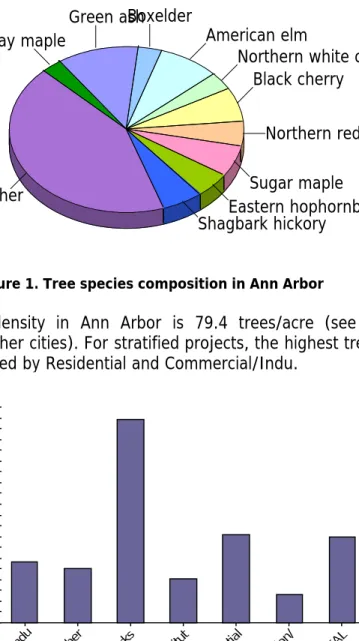
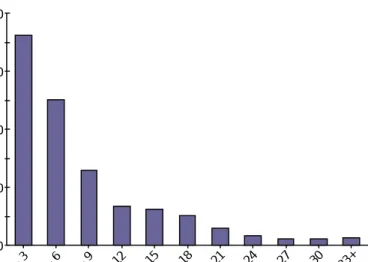
The urban forest of Ann Arbor has an estimated 1,451,000 trees with a tree cover of 32.8 percent. Trees that have diameters less than 6-inches (15.2 cm) constitute 61.1 percent of the population. The three most common species are Green ash (11.4 percent), American elm (8.6 percent), and Black cherry (6.7 percent).
Norway maple
Green ashBoxelder
American elm
Northern white cedar Black cherry
Northern red oak
Sugar maple Eastern hophornbeam Shagbark hickory
Other
Figure 1. Tree species composition in Ann Arbor
The overall tree density in Ann Arbor is 79.4 trees/acre (see Appendix III for comparable values from other cities). For stratified projects, the highest tree densities in Ann Arbor occur in Parks followed by Residential and Commercial/Indu.
0 20 40 60 80 100 120 140 160 180 200 Other Parks Trees/ac
0 10 20 30 40 0 - 3 3 - 6 6 - 9 9 - 12 12 - 15 15 - 18 18 - 21 21 - 24 24 - 27 27 - 30 30 - 33+ Percent DBH class (in)
Figure 3. Percent of tree population by diameter class (DBH=stem diameter at 4.5 feet) Urban forests are composed of a mix of native and exotic tree species. Thus, urban forests often have a tree diversity that is higher than surrounding native landscapes. Increased tree diversity can minimize the overall impact or destruction by a species-specific insect or disease, but it can also pose a risk to native plants if some of the exotic species are invasive plants that can potentially out-compete and displace native species. In Ann Arbor, about 85 percent of the trees are species native to North America, while 69 percent are native to the state or district. Species exotic to North America make up 15 percent of the population. Most exotic tree species have an origin from Europe & Asia (4 percent of the species). 0 10 20 30 40 50 60 70 80 90 100 North America Michigan
Europe & Asia Asia
North America + Europe
Europe & Asia + Unknown
North & South America +
Percent
Origin
Figure 4. Percent of live trees by species origin
Invasive plant species are often characterized by their vigor, ability to adapt, reproductive capacity, and general lack of natural enemies. These abilities enable them to displace native plants and make them a threat to natural areas [1]. Four of the 91 tree species sampled in Ann Arbor are identified as invasive on the state invasive species list [2]. These invasive species comprise 5.8 percent of the tree population though they may only cause a minimal level of impact. The three most common invasive species are Norway maple (2.8 percent of population), Black locust (1.7 percent), and European alder (1.0 percent) (see Appendix V for a complete list of invasive species).
II. Urban Forest Cover and Leaf Area
Many tree benefits equate directly to the amount of healthy leaf surface area of the plant. In Ann Arbor, the three most dominant species in terms of leaf area are Northern red oak, Silver maple, and Black walnut. Trees cover about 32.8 percent of Ann Arbor, and shrubs cover 17.1 percent.
The 10 most important species are listed in Table 1. Importance values (IV) are calculated as the sum of relative leaf area and relative composition.
Table 1. Most important species in Ann Arbor
Species Name Percent Population Percent Leaf Area IV American elm 8.6 5.2 13.8
Northern red oak 4.7 8.3 13.0
Green ash 11.4 1.1 12.5 Sugar maple 6.0 4.7 10.6 Black cherry 6.7 3.6 10.4 Shagbark hickory 5.7 3.5 9.2 Black walnut 2.6 5.3 8.0 Silver maple 1.3 6.7 8.0 Apple spp 2.3 4.9 7.2 Boxelder 3.3 3.2 6.5
The two most dominant ground cover types are Grass (28.6 percent) and Tar (17.9 percent). Cement Tar Bare Soil Rock Duff/mulch Herbs Grass Wild Grass Water Building
III. Air Pollution Removal by Urban Trees
Poor air quality is a common problem in many urban areas. It can lead to decreased human health, damage to landscape materials and ecosystem processes, and reduced visibility. The urban forest can help improve air quality by reducing air temperature, directly removing pollutants from the air, and reducing energy consumption in buildings, which consequently reduces air pollutant emissions from the power plants. Trees also emit volatile organic compounds that can contribute to ozone formation. However, integrative studies have revealed that an increase in tree cover leads to reduced ozone formation [3].
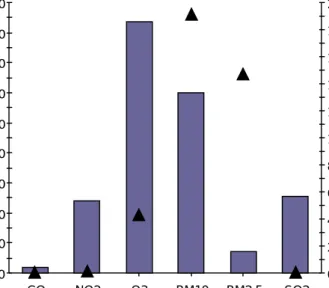
Pollution removal by trees and shrubs in Ann Arbor was estimated using field data and recent available pollution and weather data. Pollution removal was greatest for ozone. It is estimated that trees and shrubs remove 405 tons of air pollution (ozone (O3), carbon monoxide (CO), nitrogen dioxide (NO2), particulate matter less than 10 microns (PM10), particulate matter less than 2.5 microns (PM2.5), and sulfur dioxide (SO2)) per year with an associated value of $3.85 million based on estimated local incidence of adverse health effects of the BenMAP model and national median externality costs associated with pollutants [5].
0 20 40 60 80 100 120 140 160 180 CO NO2 O3 PM10 PM2.5 SO2
Pollution removed (tons)
Pollutants 0 200 400 600 800 1000 1200 1400 1600 1800 2000
Value (thousands of US Dollars)
Figure 6. Pollution removal (bars) and associated value (points) for trees in Ann Arbor Pollution removal and value for PM10 excludes PM2.5 removal and value
IV. Carbon Storage and Sequestration
Climate change is an issue of global concern. Urban trees can help mitigate climate change by sequestering atmospheric carbon (from carbon dioxide) in tissue and by altering energy use in buildings, and consequently altering carbon dioxide emissions from fossil-fuel based power plants [7].
Trees reduce the amount of carbon in the atmosphere by sequestering carbon in new growth every year. The amount of carbon annually sequestered is increased with the size and health of the trees. The gross sequestration of Ann Arbor trees is about 9,400 tons of carbon per year with an associated value of $670 thousand. Net carbon sequestration in the urban forest is about 7,140 tons. Carbon storage and carbon sequestration values are calculated based on $71 per ton.
0 100 200 300 400 500 600 700 800 900
Northern red oak
Black oakWhite oak Shagbark hickory
Black cherrySilver maple Norway maple BoxelderApple spp Red maple Sequestration (tons) Species 0 7,000 14,000 21,000 28,000 35,000 42,000 49,000 56,000 63,000
Value (US Dollars)
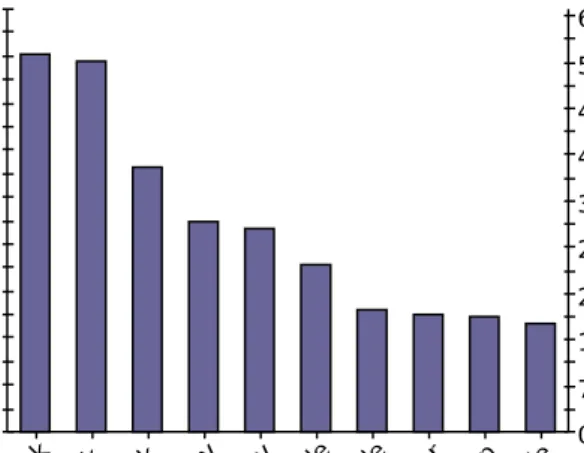
Figure 7. Carbon sequestration and value for species with greatest overall carbon sequestration in Ann Arbor
As trees grow they store more carbon as wood. As trees die and decay, they release much of the stored carbon back to the atmosphere. Thus, carbon storage is an indication of the amount of carbon that can be lost if trees are allowed to die and decompose. Trees in Ann Arbor are estimated to store 257,000 tons of carbon ($18.3 million). Of all the species sampled, Northern red oak stores and sequesters the most carbon (approximately 14.0% of the total carbon stored and 11.3% of all sequestered carbon.)
V. Oxygen Production
Oxygen production is one of the most commonly cited benefits of urban trees. The net annual oxygen production of a tree is directly related to the amount of carbon sequestered by the tree, which is tied to the accumulation of tree biomass.
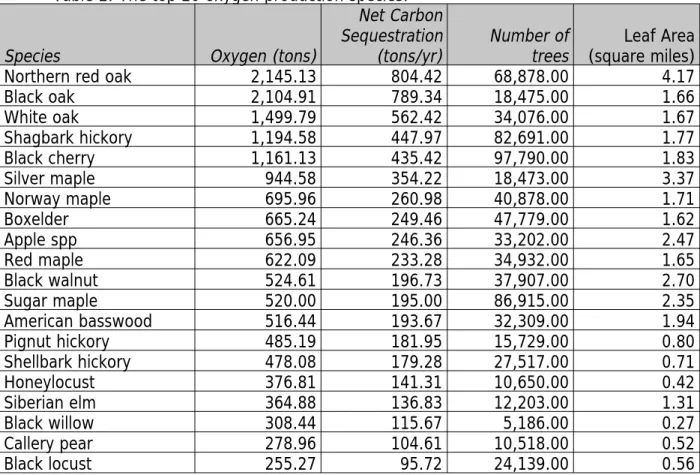
Trees in Ann Arbor are estimated to produce 19,000 tons of oxygen per year. However, this tree benefit is relatively insignificant because of the large and relatively stable amount of oxygen in the atmosphere and extensive production by aquatic systems. Our atmosphere has an enormous reserve of oxygen. If all fossil fuel reserves, all trees, and all organic matter in soils were burned, atmospheric oxygen would only drop a few percent [8].
Table 2. The top 20 oxygen production species.
Species Oxygen (tons)
Net Carbon Sequestration (tons/yr) Number of trees Leaf Area (square miles)
Northern red oak 2,145.13 804.42 68,878.00 4.17
Black oak 2,104.91 789.34 18,475.00 1.66 White oak 1,499.79 562.42 34,076.00 1.67 Shagbark hickory 1,194.58 447.97 82,691.00 1.77 Black cherry 1,161.13 435.42 97,790.00 1.83 Silver maple 944.58 354.22 18,473.00 3.37 Norway maple 695.96 260.98 40,878.00 1.71 Boxelder 665.24 249.46 47,779.00 1.62 Apple spp 656.95 246.36 33,202.00 2.47 Red maple 622.09 233.28 34,932.00 1.65 Black walnut 524.61 196.73 37,907.00 2.70 Sugar maple 520.00 195.00 86,915.00 2.35 American basswood 516.44 193.67 32,309.00 1.94 Pignut hickory 485.19 181.95 15,729.00 0.80 Shellbark hickory 478.08 179.28 27,517.00 0.71 Honeylocust 376.81 141.31 10,650.00 0.42 Siberian elm 364.88 136.83 12,203.00 1.31 Black willow 308.44 115.67 5,186.00 0.27 Callery pear 278.96 104.61 10,518.00 0.52 Black locust 255.27 95.72 24,139.00 0.56
VI. Trees and Building Energy Use
Trees affect energy consumption by shading buildings, providing evaporative cooling, and blocking winter winds. Trees tend to reduce building energy consumption in the summer months and can either increase or decrease building energy use in the winter months, depending on the location of trees around the building. Estimates of tree effects on energy use are based on field measurements of tree distance and direction to space conditioned residential buildings [9].
Based on 2002 prices, trees in Ann Arbor are estimated to reduce energy-related costs from residential buildings by $416 thousand annually. Trees also provide an additional $65,548 in value [10] by reducing the amount of carbon released by fossil-fuel based power plants (a reduction of 920 tons of carbon emissions).
Table 3. Annual energy savings due to trees near residential buildings. Note: negative numbers indicate an increased energy use or carbon emission.
Heating Cooling Total
MBTU¹ -24,055 n/a -24,055
MWH² -200 5,789 5,589
Carbon avoided (t³) -440 1,360 920
¹One million British Thermal Units ²Megawatt-hour
³Short ton
Table 4. Annual savings¹ ($) in residential energy expenditure during heating and cooling seasons. Note: negative numbers indicate a cost due to increased energy use or carbon emission.
Heating Cooling Total
MBTU² -292,266 n/a -292,266
MWH³ -25,340 733,466 708,126
Carbon avoided -31,322 96,869 65,548
¹Based on the prices of $126.7 per MWH and $12.15 per MBTU. ²One million British Thermal Units
VII. Structural and Functional Values
Urban forests have a structural value based on the trees themselves (e.g., the cost of having to replace a tree with a similar tree); they also have functional values (either positive or negative) based on the functions the trees perform.
The structural value of an urban forest tends to increase with a rise in the number and size of healthy trees [11]. Annual functional values also tend to increase with increased number and size of healthy trees, and are usually on the order of several million dollars per year. Through proper management, urban forest values can be increased; however, the values and benefits also can decrease as the amount of healthy tree cover declines.
Structural values:
• Structural value: $993 million
• Carbon storage: $18.3 million
Annual functional values:
• Carbon sequestration: $670 thousand
• Pollution removal: $3.85 million
• Lower energy costs and carbon emission reductions: $481 thousand (Note: negative
value indicates increased energy cost and carbon emission value)
0 20 40 60 80 100 120 140 160
Northern red oak
Black oakWhite oakSilver maple
Shagbark hickoryEastern white pine American basswood
Sugar maplePignut hickorySassafras
Structural value (millions of US Dollar)
Species
VIII. Potential Pest Impacts
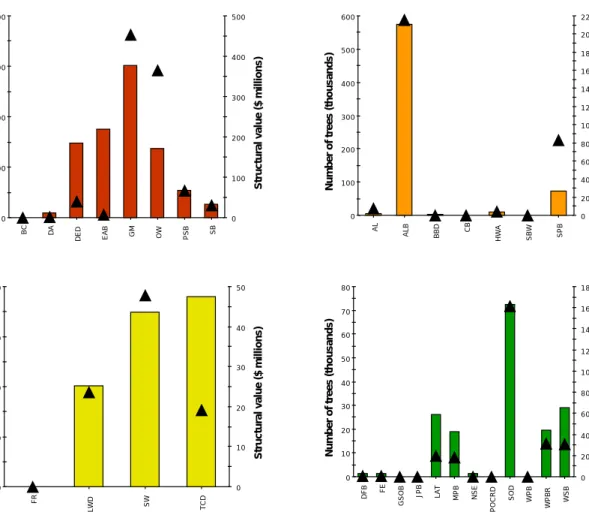
Various insects and diseases can infest urban forests, potentially killing trees and reducing the health, value and sustainability of the urban forest. As pests tend to have differing tree hosts, the potential damage or risk of each pest will differ among cities. Thirty-one pests were analyzed for their potential impact and compared with pest range maps [12] for the conterminous United States. In the following graph, the pests are color coded according to the county's proximity to the pest occurrence in the United States. Red indicates that the pest is within the county; orange indicates that the pest is within 250 miles of the county; yellow indicates that the pest is within 750 miles of the county; and green indicates that the pest is outside of these ranges.
0 1 0 0 2 0 0 3 0 0 4 0 0 BC DA DED EAB GM OW PSB SB
Number of trees (thousands)
0 1 0 0 2 0 0 3 0 0 4 0 0 5 0 0
Structural value ($ millions)
0 1 0 0 2 0 0 3 0 0 4 0 0 5 0 0 6 0 0 AL ALB BBD CB HWA SBW SPB
Number of trees (thousands)
0 2 0 4 0 6 0 8 0 1 0 0 1 2 0 1 4 0 1 6 0 1 8 0 2 0 0 2 2 0
Structural value ($ millions)
0 1 0 2 0 3 0 4 0 FR LWD SW TCD
Number of trees (thousands)
0 1 0 2 0 3 0 4 0 5 0
Structural value ($ millions)
0 1 0 2 0 3 0 4 0 5 0 6 0 7 0 8 0 DFB FE GSOB JPB LAT MPB NSE POCRD SOD WPB WPBR WSB
Number of trees (thousands)
0 2 0 4 0 6 0 8 0 1 0 0 1 2 0 1 4 0 1 6 0 1 8 0
Structural value ($ millions)
Figure 9. Number of susceptible Ann Arbor trees and structural value by pest (points)
Aspen Leafminer (AL) [13] is an insect that causes damage primarily to trembling or small tooth aspen by larval feeding of leaf tissue. AL has the potential to affect 0.4 percent of the population ($7.86 million in structural value).
Asian Longhorned Beetle (ALB) [14] is an insect that bores into and kills a wide range of hardwood species. ALB poses a threat to 39.5 percent of the Ann Arbor urban forest,
which represents a potential loss of $215 million in structural value.
Beech Bark Disease (BBD) [15] is an insect-disease complex that primarily impacts American beech. This disease threatens 0.1 percent of the population, which represents a potential loss of $70.3 thousand in structural value.
Butternut Canker (BC) [16] is caused by a fungus that infects butternut trees. The disease has since caused significant declines in butternut populations in the United States. Potential loss of trees from BC is 0.0 percent ($0 in structural value).
The most common hosts of the fungus that cause Chestnut Blight (CB) [17] are American and European chestnut. CB has the potential to affect 0.0 percent of the population ($0 in structural value).
Dogwood Anthracnose (DA) [18] is a disease that affects dogwood species, specifically flowering and Pacific dogwood. This disease threatens 0.6 percent of the population, which represents a potential loss of $1.38 million in structural value.
American elm, one of the most important street trees in the twentieth century, has been devastated by the Dutch Elm Disease (DED) [19]. Since first reported in the 1930s, it has killed over 50 percent of the native elm population in the United States. Although some elm species have shown varying degrees of resistance, Ann Arbor could possibly lose 10.2 percent of its trees to this pest ($39.7 million in structural value).
Douglas-Fir Beetle (DFB) [20] is a bark beetle that infests Douglas-fir trees throughout the western United States, British Columbia, and Mexico. Potential loss of trees from DFB is 1.17 thousand ($784 thousand in structural value).
Emerald Ash Borer (EAB) [21] has killed thousands of ash trees in parts of the United States. EAB has the potential to affect 12.1 percent of the population ($7.61 million in structural value).
One common pest of white fir, grand fir, and red fir trees is the Fir Engraver (FE) [22]. FE poses a threat to 0.1 percent of the Ann Arbor urban forest, which represents a potential loss of $784 thousand in structural value.
Fusiform Rust (FR) [23] is a fungal disease that is distributed in the southern United States. It is particularly damaging to slash pine and loblolly pine. FR has the potential to affect 0.0 percent of the population ($0 in structural value).
The Gypsy Moth (GM) [25] is a defoliator that feeds on many species causing widespread defoliation and tree death if outbreak conditions last several years. This pest
As one of the most damaging pests to eastern hemlock and Carolina hemlock, Hemlock Woolly Adelgid (HWA) [26] has played a large role in hemlock mortality in the United States. HWA has the potential to affect 0.7 percent of the population ($4.61 million in structural value).
The Jeffrey Pine Beetle (JPB) [27] is native to North America and is distributed across California, Nevada, and Oregon where its only host, Jeffrey pine, also occurs. This pest threatens 0.0 percent of the population, which represents a potential loss of $0 in structural value.
Quaking aspen is a principal host for the defoliator, Large Aspen Tortrix (LAT) [28]. LAT poses a threat to 26.1 thousand percent of the Ann Arbor urban forest, which represents a potential loss of $19.8 million in structural value.
Laurel Wilt (LWD) [29] is a fungal disease that is introduced to host trees by the redbay ambrosia beetle. This pest threatens 1.4 percent of the population, which represents a potential loss of $23.7 million in structural value.
Mountain Pine Beetle (MPB) [30] is a bark beetle that primarily attacks pine species in the western United States. MPB has the potential to affect 1.3 percent of the population ($18.2 million in structural value).
The Northern Spruce Engraver (NSE) [31] has had a significant impact on the boreal and sub-boreal forests of North America where the pest's distribution overlaps with the range of its major hosts. Potential loss of trees from NSE is 1.17 thousand ($160 thousand in structural value).
Oak Wilt (OW) [32], which is caused by a fungus, is a prominent disease among oak trees. OW poses a threat to 9.5 percent of the Ann Arbor urban forest, which represents a potential loss of $365 million in structural value.
Port-Orford-Cedar Root Disease (POCRD) [33] is a root disease that is caused by a fungus. POCRD threatens 0.0 percent of the population, which represents a potential loss of $0 in structural value.
The Pine Shoot Beetle (PSB) [34] is a wood borer that attacks various pine species, though Scotch pine is the preferred host in North America. PSB has the potential to affect 3.7 percent of the population ($67.3 million in structural value).
Spruce Beetle (SB) [35] is a bark beetle that causes significant mortality to spruce species within its range. Potential loss of trees from SB is 26.8 thousand ($30.2 million in structural value).
Spruce Budworm (SBW) [36] is an insect that causes severe damage to balsam fir. SBW poses a threat to 0.0 percent of the Ann Arbor urban forest, which represents a potential loss of $0 in structural value.
Sudden Oak Death (SOD) [37] is a disease that is caused by a fungus. Potential loss of trees from SOD is 72.4 thousand ($162 million in structural value).
Although the Southern Pine Beetle (SPB) [38] will attack most pine species, its preferred hosts are loblolly, Virginia, pond, spruce, shortleaf, and sand pines. This pest threatens 4.9 percent of the population, which represents a potential loss of $82.6 million in structural value.
The Sirex Wood Wasp (SW) [39] is a wood borer that primarily attacks pine species. SW poses a threat to 2.4 percent of the Ann Arbor urban forest, which represents a potential loss of $47.8 million in structural value.
Thousand Canker Disease (TCD) [40] is an insect-disease complex that kills several species of walnuts, including black walnut. Potential loss of trees from TCD is 37.9 thousand ($19.1 million in structural value).
The Western Pine Beetle (WPB) [41] is a bark beetle and aggressive attacker of ponderosa and Coulter pines. This pest threatens 0.0 percent of the population, which represents a potential loss of $0 in structural value.
Since its introduction to the United States in 1900, White Pine Blister Rust (Eastern U.S.) (WPBR) [42] has had a detrimental effect on white pines, particularly in the Lake States. WPBR has the potential to affect 1.3 percent of the population ($31.9 million in structural value).
Western spruce budworm (WSB) [43] is an insect that causes defoliation in western conifers. This pest threatens 2.0 percent of the population, which represents a potential loss of $31.0 million in structural value.
Appendix I. i-Tree Eco Model and Field Measurements
i-Tree Eco is designed to use standardized field data from randomly located plots and local hourly air pollution and meteorological data to quantify urban forest structure and its numerous effects [10], including:
• Urban forest structure (e.g., species composition, tree health, leaf area, etc.).
• Amount of pollution removed hourly by the urban forest, and its associated percent
air quality improvement throughout a year. Pollution removal is calculated for ozone, sulfur dioxide, nitrogen dioxide, carbon monoxide and particulate matter (<2.5 microns and <10 microns).
• Total carbon stored and net carbon annually sequestered by the urban forest.
• Effects of trees on building energy use and consequent effects on carbon dioxide
emissions from power plants.
• Structural value of the forest, as well as the value for air pollution removal and carbon
storage and sequestration.
• Potential impact of infestations by pests, such as Asian longhorned beetle, emerald
ash borer, gypsy moth, and Dutch elm disease.
In the field 0.10 acre plots were randomly distributed. Typically, all field data are collected during the leaf-on season to properly assess tree canopies. Within each plot, typical data collection (actual data collection may vary depending upon the user) includes land use, ground and tree cover, individual tree attributes of species, stem diameter, height, crown width, crown canopy missing and dieback, and distance and direction to residential buildings [44, 6].
Invasive species were identified using an invasive species list [2] for the state in which the urban forest is located. These lists are not exhaustive and they cover invasive species of varying degrees of invasiveness and distribution. In instances where a state did not have an invasive species list, a list was created based on the lists of the adjacent states. Tree species that are identified as invasive by the state invasive species list are cross-referenced with native range data. This helps eliminate species that are on the state invasive species list, but are native to the study area.
To calculate current carbon storage, biomass for each tree was calculated using equations from the literature and measured tree data. Open-grown, maintained trees tend to have less biomass than predicted by forest-derived biomass equations [45]. To adjust for this difference, biomass results for open-grown urban trees were multiplied by 0.8. No adjustment was made for trees found in natural stand conditions. Tree dry-weight biomass was converted to stored carbon by multiplying by 0.5.
To estimate the gross amount of carbon sequestered annually, average diameter growth from the appropriate genera and diameter class and tree condition was added to the existing tree diameter (year x) to estimate tree diameter and carbon storage in year x+1.
The amount of oxygen produced is estimated from carbon sequestration based on atomic weights: net O2 release (kg/yr) = net C sequestration (kg/yr) × 32/12. To estimate the net carbon sequestration rate, the amount of carbon sequestered as a result of tree growth is reduced by the amount lost resulting from tree mortality. Thus, net carbon sequestration and net annual oxygen production of the urban forest account for decomposition [46].
Air pollution removal estimates are derived from calculated hourly tree-canopy resistances for ozone, and sulfur and nitrogen dioxides based on a hybrid of big-leaf and multi-layer canopy deposition models [47, 48]. As the removal of carbon monoxide and particulate matter by vegetation is not directly related to transpiration, removal rates (deposition velocities) for these pollutants were based on average measured values from the literature [49, 50] that were adjusted depending on leaf phenology and leaf area. Removal estimates of particulate particulate matter less than 10 microns incorporated a 50 percent resuspension rate of particles back to the atmosphere [51]. Recent updates (2011) to air quality modeling are based on improved leaf area index simulations, weather and pollution processing and interpolation, and updated pollutant monetary values [52, 53, and 54].
Air pollution removal value was calculated based on local incidence of adverse health effects and national median externality costs. The number of adverse health effects and associated economic value is calculated for ozone, sulfur dioxide, nitrogen dioxide, and particulate matter <2.5 microns using the U.S. Environmental Protection Agency's Environmental Benefits Mapping and Analysis Program (BenMAP). The model uses a damage-function approach that is based on the local change in pollution concentration and population [5].
National median externality costs were used to calculate the value of carbon monoxide removal. As particulate matter <10 microns is inclusive of particulate matter <2.5 microns, the pollution removal value for particulate matter <10 microns utilizes both local incidence values from particulate matter <2.5 microns and national median externality costs from particulate matter <10 microns to estimate the air pollution removal values. Thus the value for particulate matter <10 microns = ((PM10 (mt/yr)-PM2.5 (mt/yr))*median externality)+PM2.5 ($/yr).
If appropriate field data were collected, seasonal effects of trees on residential building energy use were calculated based on procedures described in the literature [9] using distance and direction of trees from residential structures, tree height and tree condition data.
Structural values were based on valuation procedures of the Council of Tree and Landscape Appraisers, which uses tree species, diameter, condition, and location information [55].
Potential pest risk was based on pest range maps and the known pest host species that are likely to experience mortality. Pest range maps from the Forest Health Technology Enterprise Team (FHTET) [12] were used to determine the proximity of each pest to the county in which the urban forest is located. For the county, it was established whether the insect/disease occurs within the county, is within 250 miles of the county edge, is between 250 and 750 miles away, or is greater than 750 miles away. FHTET did not have pest range maps for Dutch elm disease and chestnut blight. The range of these pests was based on known occurrence and the host range, respectively [12].
Appendix II. Relative Tree Effects
The urban forest in Ann Arbor provides benefits that include carbon storage and sequestration, and air pollutant removal. To estimate the relative value of these benefits, tree benefits were compared to estimates of average municipal carbon emissions [56], average passenger automobile emissions [57], and average household emissions [58].
Carbon storage is equivalent to:
• Amount of carbon emitted in Ann Arbor in 135 days • Annual carbon (C) emissions from 154,000 automobiles • Annual C emissions from 77,400 single-family houses
Carbon monoxide removal is equivalent to:
• Annual carbon monoxide emissions from 16 automobiles
• Annual carbon monoxide emissions from 65 single-family houses
Nitrogen dioxide removal is equivalent to:
• Annual nitrogen dioxide emissions from 3,050 automobiles
• Annual nitrogen dioxide emissions from 2,030 single-family houses
Sulfur dioxide removal is equivalent to:
• Annual sulfur dioxide emissions from 75,000 automobiles • Annual sulfur dioxide emissions from 1,260 single-family houses
Particulate matter less than 10 micron (PM10) removal is equivalent to: • Annual PM10 emissions from 358,000 automobiles
• Annual PM10 emissions from 34,600 single-family houses
Annual carbon sequestration is equivalent to:
• Amount of carbon emitted in Ann Arbor in 4.9 days • Annual C emissions from 5,600 automobiles
• Annual C emissions from 2,800 single-family houses
Note: estimates above are partially based on the user-supplied information on human population total for study area
Appendix III. Comparison of Urban Forests
A common question asked is, "How does this city compare to other cities?" Although comparison among cities should be made with caution as there are many attributes of a city that affect urban forest structure and functions, summary data are provided from other cities analyzed using the i-Tree Eco model.
I. City totals for trees
City % Tree Cover Number of trees Carbon storage (tons) Carbon Sequestration (tons/yr) Pollution removal (tons/yr) Calgary, Canada 7.2 11,889,000 445,000 21,422 326 Atlanta, GA 36.8 9,415,000 1,345,000 46,433 1,662 Toronto, Canada 20.5 7,542,000 992,000 40,345 1,212 New York, NY 21.0 5,212,000 1,351,000 42,283 1,677 Baltimore, MD 21.0 2,627,000 596,000 16,127 430 Philadelphia, PA 15.7 2,113,000 530,000 16,115 576 Washington, DC 28.6 1,928,000 523,000 16,148 418 Boston, MA 22.3 1,183,000 319,000 10,509 284 Woodbridge, NJ 29.5 986,000 160,000 5561.00 210 Minneapolis, MN 26.5 979,000 250,000 8,895 305 Syracuse, NY 23.1 876,000 173,000 5,425 109 Morgantown, WV 35.9 661,000 94,000 2,940 66 Moorestown, NJ 28.0 583,000 117,000 3,758 118 Jersey City, NJ 11.5 136,000 21,000 890 41 Freehold, NJ 34.4 48,000 20,000 545 21
II. Per acre values of tree effects
City No. of trees Carbon storage (tons) Carbon sequestration (lbs/yr) Pollution removal (lbs/yr) Calgary, Canada 66.7 2.5 0.120 3.6 Atlanta, GA 111.6 15.9 0.550 39.4 Toronto, Canada 48.3 6.4 0.258 15.6 New York, NY 26.4 6.8 0.214 17.0 Baltimore, MD 50.8 11.5 0.312 16.6 Philadelphia, PA 25.0 6.3 0.190 13.6 Washington, DC 49.0 13.3 0.410 21.2 Boston, MA 33.5 9.0 0.297 16.0 Woodbridge, NJ 66.5 10.8 0.375 28.4 Minneapolis, MN 26.2 6.7 0.238 16.4 Syracuse, NY 54.5 10.8 0.338 13.6
Appendix IV. General Recommendations for Air Quality
Improvement
Urban vegetation can directly and indirectly affect local and regional air quality by altering the urban atmosphere environment. Four main ways that urban trees affect air quality are [59]:
• Temperature reduction and other microclimate effects
• Removal of air pollutants
• Emission of volatile organic compounds (VOC) and tree maintenance emissions
• Energy effects on buildings
The cumulative and interactive effects of trees on climate, pollution removal, and VOC and power plant emissions determine the impact of trees on air pollution. Cumulative studies involving urban tree impacts on ozone have revealed that increased urban canopy cover, particularly with low VOC emitting species, leads to reduced ozone concentrations in cities [60]. Local urban management decisions also can help improve air quality.
Urban forest management strategies to help improve air quality include [61]:
Strategy Result
Increase the number of healthy trees Increase pollution removal
Sustain existing tree cover Maintain pollution removal levels
Maximize use of low VOC-emitting trees Reduces ozone and carbon monoxide
formation
Sustain large, healthy trees Large trees have greatest per-tree
effects
Use long-lived trees Reduce long-term pollutant emissions
from planting and removal
Use low maintenance trees Reduce pollutants emissions from
maintenance activities Reduce fossil fuel use in maintaining
vegetation
Reduce pollutant emissions
Plant trees in energy conserving locations
Reduce pollutant emissions from power plants
Plant trees to shade parked cars Reduce vehicular VOC emissions
Supply ample water to vegetation Enhance pollution removal and
temperature reduction Plant trees in polluted or heavily
populated areas
Maximizes tree air quality benefits
Avoid pollutant-sensitive species Improve tree health
Utilize evergreen trees for particulate matter
Appendix V. Invasive Species of the Urban Forest
The following inventoried species were listed as invasive on the Michigan invasive species list [2]:
Species Name Number of trees
% Tree
Number Leaf Area (mi2) % Leaf Area
Norway maple 40,878 2.82 1.71 3.38
Black locust 24,139 1.66 0.56 1.11
European alder 15,116 1.04 0.55 1.09
Tree of heaven 4,303 0.30 0.01 0.01
TOTAL 84,436 5.82 2.82 5.59
Appendix VI. Potential risk of pests
Based on the host tree species for each pest and the current range of the pest [12], it is possible to determine what the risk is that each tree species sampled in the urban forest could be attacked by an insect or disease.
Spp Risk AL ALB BBD BC CB DA DED DFB EAB FE FR GM GSOB HWA JPB LAT LWD MPB NSE OW POCRD PSB SB SBW SOD SPB SW TCD WPB WPBR WSB Pest Risk Weight Species Name 13 Norway spruce 11 Black willow 11 Scotch pine 10 Eastern white pine 9 Northern red oak 9 Pin oak 9 Austrian pine 9 Jack pine 9 Red pine 9 White spruce 8 Black oak 8 Bur oak 8 European larch 8 Northern pin oak 8 Sawtooth oak 8 Shingle oak 8 Swamp white oak 8 White oak 8 Blue spruce 8 Gray birch 8 Paper birch 8 River birch 7 American elm 7 Green ash 7 Serbian spruce 7 Siberian elm 7 Slippery elm 7 Ulmus x notha 7 Douglas fir 6 Carolina hemlock 6 Eastern hemlock 4 American basswood 4 Apple spp 4 Callery pear 4 Eastern hophornbeam 4 Flowering dogwood 4 Littleleaf linden 4 Sweetgum 4 White ash 3 American beech 3 Black maple 3 Boxelder
3 Crimson king norway maple 3 Eastern cottonwood 3 Freeman maple 3 Japanese maple 3 Norway maple 3 Ohio buckeye 3 Paperbark maple
3 Red maple 3 Silver maple 3 Sugar maple 2 Black walnut 2 Sassafras 1 European alder Note:
Species that are not listed in the matrix are not known to be hosts to any of the pests analyzed.
Species Risk:
• Red indicates that tree species is at risk to at least one pest within county
• Orange indicates that tree species has no risk to pests in county, but has a risk to at
least one pest within 250 miles from the county
• Yellow indicates that tree species has no risk to pests within 250 miles of county, but
has a risk to at least one pest that is 250 to 750 miles from the county
• Green indicates that tree species has no risk to pests within 750 miles of county, but
has a risk to at least one pest that is greater than 750 miles from the county
Risk Weight:
Numerical scoring system based on sum of points assigned to pest risks for species. Each pest that could attack tree species is scored as 4 points if red, 3 points if orange, 2 points if yellow and 1 point if green.
Pest Color Codes:
• Red indicates pest is within Washtenaw county
• Orange indicates pest is within 250 miles of Washtenaw county
• Yellow indicates pest is within 750 miles of Washtenaw county
References
1. U.S. Department of Agriculture. National Invasive Species Information Center. 2011. http://www.invasivespeciesinfo.gov/plants/main.shtml
2. State invasive species lists were compiled for the following:
AL: Alabama Invasive Plant Council. 2007. Center for Invasive Species and Ecosystem Health at the University of Georgia. <http://www.se-eppc.org/alabama/2007plantlist.pdf> AK: Alaska National Heritage Program. University of Alaska Anchorage.
<http://aknhp.uaa.alaska.edu/botany/akepic/non-native-plant-species-biographies/> AZ: Arizona Wildlands Invasive Plant Working Group. 2005. Invasive Non-Native Plants That Threaten Wildlands in Arizona.
<http://sbsc.wr.usgs.gov/research/projects/swepic/SWVMA/InvasiveNon-NativePlantsThatThreatenWildlandsInArizona.pdf>
AR: Jardine, Jude; Witsell, Theo. Arkansas Native Plant Society. Working List of Non-native Invasive Plant Species of Concern to Natural Areas in Arkansas.
<http://www.deltic.com/hunting/ANPS%20INVASIVES%20LIST.pdf>
CA: California Invasive Species Advisory Committee. 2010. The California Invasive Species List. <http://www.iscc.ca.gov/docs/CaliforniaInvasiveSpeciesList.pdf>
CO: Colorado Weed Management Association. Colorado Noxious Weed List. <http://www.cwma.org/noxweeds.html#list>
CT: Connecticut Invasive Plants Council. 2009. Connecticut Invasive Plant List. <ftp://ftp-fc.sc.egov.usda.gov/CT/invasives/WordInvasivesListCommonNameW-Authors4PDF.pdf> DE: McAvoy, William A. 2001. Invasive Plant Species in Delaware.
<http://www.dnrec.state.de.us/fw/invasive.htm>
FL: Florida Exotic Pest Plant Council Plant List Committee. 2007. FLEPPC 2007 List of Invasive Plant Species. <http://www.fleppc.org/list/07list_ctrfld.pdf>
GA: Georgia Exotic Pest Plant Council. List of Non-native Invasive Plants in Georgia. <http://www.gaeppc.org/list.cfm>
HI: Hawaii State Alien Species Coordinator. Hawaii's Most Invasive Horticultural Plants. <http://www.state.hi.us/dlnr/dofaw/hortweeds/specieslist.htm>
Hawaii Invasive Species Partnership. Hawaii's High-Profile Invasive Species. <http://www.hawaiiinvasivespecies.org/pests/>
IL: Invasive.org: Center for Invasive Species and Ecosystem Health. Illinois Invasive Plant List. <http://www.invasive.org/species/list.cfm?id=152>
IN: Indiana Cooperative Agricultural Pest Survey. 2007. Indiana's "Most Unwanted" Invasive Plant Pest List - FY 2007.
<http://www.extension.entm.purdue.edu/CAPS/downloads/IndianaInvasivePlantPestList.p df>
IA: Iowa. Forest Invasive Plants Resource Center. Current and Future Invasive Plants. <http://na.fs.fed.us/spfo/invasiveplants/states/ia.asp>
Iowa Department of Natural Resources. Invasive Plant Species. <http://www.iowadnr.gov/forestry/invasive.html>
KS: Kansas Native Plant Society. 2006. Invasive Plant Fact Sheet. R.L. McGregor Herbarium. University of Kansas.
KY: Kentucky Exotic Pest Plant Council. Center for Invasive Species and Ecosystem Health at the University of Georgia. <http://www.se-eppc.org/ky/list.htm>
ME: Public Laws of Maine. An Act to Prevent the Spread of Invasive Aquatic Plants. <http://www.mainelegislature.org/ros/LOM/LOM119th/5Pub701-750/5Pub701-750-21.htm>
Department of Conservation. Maine Natural Areas Program. Invasive Plant Fact Sheets. <http://www.maine.gov/doc/nrimc/mnap/features/invsheets.htm>
MD: Maryland Invasive Species Council. Invasive Species of Concern in Maryland: Terrestrial Plants. <http://www.mdinvasivesp.org/list_terrestrial_plants.html>
Maryland Invasive Species Council. Invasive Species of Concern in Maryland: Aquatic Plants. <http://www.mdinvasivesp.org/list_aquatic_plants.html>
MA: Massachusetts Invasive Plant Advisory Group. 2005. The Evaluation of Non-native Plant Species for Invasiveness in Massachusetts.
<http://www.newfs.org/docs/docs/MIPAG040105.pdf>
MI: Michigan Natural Features Inventory. Michigan State University Extension. Michigan Invasive Plant Species Account.
<http://web4.msue.msu.edu/mnfi/education/factsheets.cfm>
MN: Minnesota Department of Natural Resources. Invasive Terrestrial Plants. <http://www.dnr.state.mn.us/invasives/terrestrialplants/index.html>
Minnesota Department of Natural Resources. Invasive Aquatic Plants. <http://www.dnr.state.mn.us/invasives/aquaticplants/index.html>
MS: Winters, Faye; Byrd, John D.; Bryson, Charles T. Mississippi's Ten Worst Invasive Weeds: Threatening Fish and Wildlife Habitat.
<http://www.wildlifemiss.org/news/news/2004/mississippi_weeds.htm>
Mississippi Exotic Pest Plant Council. Noteworthy Exotic Plant Species of Mississippi. <http://www.se-eppc.org/mississippi/>
MO: Missouri Botanical Gardens. Missouri Exotic Pest Plants. <http://www.mobot.org/mobot/research/mepp/alphalist.shtml>
NE: Nebraska Invasive Species Advisory Council. Invasive Plants of Nebraska.
<http://snr.unl.edu/invasives/pdfs/Invasive%20Plant%20Lists/NE%20Invasive%20Plants %20List%20Full%20Document%204-14-11.pdf >
NV: University of Nevada Cooperative Extension. Invasive Plants in Nevada: An Identification Handbook.
<http://www.unce.unr.edu/publications/files/ag/other/sp9603.pdf>
NH: New Hampshire Department of Agriculture, Markets, and Food. NH Prohibited Invasive Species List.
<http://www.nh.gov/agric/divisions/plant_industry/documents/list.pdf>
New Hampshire Department of Agriculture, Markets, and Food. NH Restricted Invasive Species List. <http://www.nh.gov/agric/divisions/plant_industry/documents/watch.pdf>
Cygan, Douglas. New Hampshire Department of Agriculture, Markets, and Food. New Hampshire Invasive Species Committee. 2011. Guide to Invasive Upland Plant Species in New Hampshire. <http://extension.unh.edu/Forestry/Docs/invasive.pdf>
NY: New York State Department of Environmental Conservation. Interim Invasive Species Plant List. <http://www.dec.ny.gov/animals/65408.html>
NC: Smith, Cherri. 2008. Invasive Exotic Plants of North Carolina. North Carolina Department of Transportation.
<http://www.se-eppc.org/northcarolina/NCDOT_Invasive_Exotic_Plants.pdf>
North Carolina Native Plant Society. 2010. Invasive Exotic Species List. <http://www.ncwildflower.org/invasives/list.htm>
ND: North Dakota Department of Agriculture. Catalogue of Species. <http://www.agdepartment.com/noxiousweeds/searchweeds.asp>
OH: Ohio Department of Natural Resources. The Nature Conservancy. 2000. Ohio's Invasive Plant Species.
<http://www.ohiodnr.com/Portals/3/invasive/pdf/OHIO%20INVASIVE%20PLANTS.pdf> OK: Oklahoma Native Plant Society. Oklahoma Biological Survey. OSU Natural Resource Ecology and Management. Oklahoma Non-native Invasive Plant Species. <http://www.ok-invasive-plant-council.org/images/OKinvasivespp.pdf>
OR: Oregon Invasive Species Council. 100 Most Dangerous Invaders to Keep Out. <http://oregon.gov/OISC/most_dangerous.shtml>
PA: Pennsylvania Department of Conservation and Natural Resources. Invasive Exotic Plants in Pennsylvania List.
<http://www.dcnr.state.pa.us/forestry/invasivetutorial/List.htm>
RI: Rhode Island Invasive Species Council. Rhode Island Natural History Survey. 2001. Invasives: List. <http://www.rinhs.org/resources/ri-invasive-species-resources/invasive-list/>
SC: South Carolina Exotic Pest Plant Council. Center for Invasive Species and Ecosystem Health at the University of Georgia. <http://www.invasive.org/species/list.cfm?id=27>
South Carolina Exotic Pest Plant Council Invasive Species List 2008. <http://www.se-eppc.org/southcarolina/invasivePlants.cfm>
TN: Tennessee Exotic Pest Plant Council. 2009. Invasive Plants of Tennessee. <http://www.tneppc.org/invasive_plants>
TX: Watershed Protection Development Review. City of Austin. Central Texas Invasive Plants. Volunteer Field Guide.
<http://www.ci.austin.tx.us/growgreen/downloads/invasiveplants.pdf>
VT: Vermont Invasive Exotic Plant Committee. 2005. Invasive Species Watch List for Vermont.
<http://www.vtinvasiveplants.org/pdfs/VIEPC%20Invasive%20Watch%20List.pdf> List of invasive terrestrial plants known to be in Vermont or on our borders.
Developed by Vermont Invasive Exotic Plant Committee. In: Developing Invasive Plant Outreach and Management Projects. The Nature Conservancy
<http://www.nature.org/ourinitiatives/regions/northamerica/unitedstates/vermont/chapter -1-23-for-web.pdf>
VA: Virginia Native Plant Society. Department of Conservation and Recreation. 2009. Invasive Alien Plant Species of Virginia.
<http://www.dcr.virginia.gov/natural_heritage/documents/invlist.pdf> WV: West Virginia Division of Natural Resources. Dirty Dozen.
<http://www.wvdnr.gov/Wildlife/DirtyDozen.shtm>
WI: Wisconsin Department of Natural Resources. Invasive Species. Terrestrial Invasives - Plants.
<http://dnr.wi.gov/invasives/species.asp?filterBy=Terrestrial&filterVal=Y&catVal=Plants> Wisconsin Department of Natural Resources. Invasive Species. Aquatic Invasives - Plants.
<http://dnr.wi.gov/invasives/species.asp?filterBy=Aquatic&filterVal=Y&catVal=Plants>
3. Nowak D.J. and Dwyer J.F. "Understanding the Benefits and Costs of Urban Forest Ecosystems." Handbook of Urban and Community Forestry in the Northeast. Ed. John E. Kuser. Kluwer Academics/Plenum Pub., New York. 2000. 11-22.
4. Murray, F.J.; Marsh L.; Bradford, P.A. 1994. New York State Energy Plan, vol. II: issue reports. Albany, NY: New York State Energy Office.
5. Davidson, K., A. Hallberg, D. McCubbin, and B. Hubbell. (2007). Analysis of PM2.5 Using the Environmental Benefits Mapping and Analysis Program (BenMAP). Journal of Toxicology and Environmental Health, Part A 70(3): 332-346.
6. Nowak, D.J., R.E. Hoehn, D.E. Crane, J.C. Stevens, J.T. Walton, and J. Bond. 2008. A ground-based method of assessing urban forest structure and ecosystem services. Arboric. Urb. For. 34(6): 347-358.
7. Abdollahi, K.K.; Z.H. Ning; and A. Appeaning (eds). 2000. Global climate change and the urban forest. Baton Rouge, LA: GCRCC and Franklin Press. 77p.
8. Broecker, W.S. 1970. Man's oxygen reserve. Science 168: 1537-1538.
9. McPherson, E.G. and J. R. Simpson 1999. Carbon dioxide reduction through urban forestry: guidelines for professional and volunteer tree planters. Gen. Tech. Rep. PSW-171. Albany, CA: U.S. Department of Agriculture, Forest Service, Pacific Southwest Research station 237 p. http://wcufre.ucdavis.edu/products/cufr_43.pdf
10. Nowak, D.J., and D.E. Crane. 2000. The Urban Forest Effects (UFORE) Model: quantifying urban forest structure and functions. In: Hansen, M. and T. Burk (Eds.) Integrated Tools for Natural Resources Inventories in the 21st Century. Proc. Of the IUFRO Conference. USDA Forest Service General Technical Report NC-212. North Central Research Station, St. Paul, MN. pp. 714-720. See also http://www.ufore.org.
11. Nowak, D.J.; Crane, D.E.; Dwyer, J.F. 2002. Compensatory value of urban trees in the United States. Journal of Arboriculture. 28(4): 194 - 199.
12. Insect/disease proximity to study area was completed using the U.S. Forest Service's Forest Health Technology Enterprise Team (FHTET) database. Data includes distribution of pest by county FIPs code for 2004-2009. FHTET range maps are available at
http://www.fs.fed.us/r10/spf/fhp/leaflets/aspen_leaf_miner.pdf
14. Northeastern Area State and Private Forestry. 2005. Asian Longhorned Beetle. Newtown Square, PA: U.S. Department of Agriculture, Northeastern Area State and Private Forestry. http://www.na.fs.fed.us/spfo/alb/
15. Houston, David R.; O'Brien, James T. 1983. Beech Bark Disease. Forest Insect & Disease Leaflet 75. United States Department of Agriculture, Forest Service. 8 p. Can be accessed through: http://www.fs.fed.us/r6/nr/fid/fidls/fidl-75.pdf
16. Ostry, M.E.; Mielke, M.E.; Anderson, R.L. 1996. How to Identify Butternut Canker and Manage Butternut Trees. United States Department of Agriculture, Forest Service, North Central Forest Experiment Station. Can be accessed through:
http://www.na.fs.fed.us/spfo/pubs/howtos/ht_but/ht_but.htm
17. Diller, Jesse D. 1965. Chestnut Blight. Forest Pest Leaflet 94. United States Department of Agriculture, Forest Service. 7 p. Can be accessed through:
http://www.fs.fed.us/r6/nr/fid/fidls/fidl-94.pdf
18. Mielke, Manfred E.; Daughtrey, Margery L. How to Identify and Control Dogwood Anthracnose. NA-GR-18. United States Department of Agriculture, Forest Service, Northeastern Area. Can be accessed through:
http://na.fs.fed.us/spfo/pubs/howtos/ht_dogwd/ht_dog.htm
19. Northeastern Area State and Private Forestry. 1998. HOW to identify and manage Dutch Elm Disease. NA-PR-07-98. Newtown Square, PA: U.S. Department of Agriculture, Forest Service, Northeastern Area State and Private Forestry.
http://www.na.fs.fed.us/spfo/pubs/howtos/ht_ded/ht_ded.htm
20. Schmitz, Richard F.; Gibson, Kenneth E. 1996. Douglas-fir Beetle. Forest Insect & Disease Leaflet 5. R1-96-87. United States Department of Agriculture, Forest Service. 8 p. Can be accessed through: http://www.fs.fed.us/r6/nr/fid/fidls/fidl-5.pdf
21. Northeastern Area State and Private Forestry. 2005. Forest health protection emerald ash borer home. Newtown Square, PA: U.S. Department of Agriculture, Forest Service,
Northeastern Area State and Private Forestry. http://www.na.fs.fed.us/spfo/eab/index.html
22. Ferrell, George T. 1986. Fir Engraver. Forest Insect & Disease Leaflet 13. United States Department of Agriculture, Forest Service. 8 p. Can be accessed through:
http://www.fs.fed.us/r6/nr/fid/fidls/fidl-13.pdf
23. Phelps, W.R.; Czabator, F.L. 1978. Fusiform Rust of Southern Pines. Forest Insect & Disease Leaflet 26. United States Department of Agriculture, Forest Service. 7 p. Can be accessed through: http://www.fs.fed.us/r6/nr/fid/fidls/fidl-26.pdf
24. Society of American Foresters. Gold Spotted Oak Borer Hitches Ride in Firewood, Kills California Oaks. Forestry Source. October 2011 Vol. 16, No.10.
25. Northeastern Area State and Private Forestry. 2005. Gypsy moth digest. Newtown Square, PA: U.S. Department of Agriculture, Forest Service, Northeastern Area State and Private Forestry. http://na.fs.fed.us/fhp/gm
26. USDA Forest Service. 2005. Hemlock Woolly Adelgid. Pest Alert. NA-PR-09-05. United States Department of Agriculture, Forest Service, Northern Area State and Private Forestry. Can be accessed through: http://na.fs.fed.us/spfo/pubs/pest_al/hemlock/hwa05.htm
27. Smith, Sheri L.; Borys, Robert R.; Shea, Patrick J. 2009. Jeffrey Pine Beetle. Forest Insect & Disease Leaflet 11. United States Department of Agriculture, Forest Service. 8 p. Can be accessed through: http://www.fs.fed.us/r6/nr/fid/fidls/fidl-11.pdf
28. Ciesla, William M.; Kruse, James J. 2009. Large Aspen Tortrix. Forest Insect & Disease Leaflet 139. United States Department of Agriculture, Forest Service. 8 p. Can be accessed through: http://www.fs.fed.us/r6/nr/fid/fidls/fidl-139.pdf
29. Laurel Wilt. United States Department of Agriculture, Forest Service, Forest Health Protection, Southern Region. Can be accessed through:
http://www.fs.fed.us/r8/foresthealth/laurelwilt/
30. Gibson, Ken; Kegley, Sandy; Bentz, Barbara. 2009. Mountain Pine Beetle. Forest Insect & Disease Leaflet 2. United States Department of Agriculture, Forest Service. 12 p. Can be accessed through: http://www.fs.fed.us/r6/nr/fid/fidls/fidl-2.pdf
31. Burnside, R.E. et al. 2011. Northern Spruce Engraver. Forest Insect & Disease Leaflet 180. United States Department of Agriculture, Forest Service. 12 p.
32. Rexrode, Charles O.; Brown, H. Daniel 1983. Oak Wilt. Forest Insect & Disease Leaflet 29. United States Department of Agriculture, Forest Service. 6 p. Can be accessed through: http://www.fs.fed.us/r6/nr/fid/fidls/fidl-29.pdf
33. Liebhold, A. 2010 draft. Geographical Distribution of Forest Pest Species in US. In: Frontiers in Ecology and the Environment.
34. Ciesla, William M. 2001. Tomicus piniperda. North American Forest Commission. Exotic Forest Pest Information System for North America (EXFOR). Can be accessed through: http://spfnic.fs.fed.us/exfor/data/pestreports.cfm?pestidval=86&langdisplay=english
35. Holsten, E.H.; Thier, R.W.; Munson, A.S.; Gibson, K.E. 1999. The Spruce Beetle. Forest Insect & Disease Leaflet 127. United States Department of Agriculture, Forest Service. 12 p. Can be accessed through: http://www.fs.fed.us/r6/nr/fid/fidls/fidl-127.pdf
Forest Pest Information System for North America (EXFOR). Can be accessed through: http://spfnic.fs.fed.us/exfor/data/pestreports.cfm?pestidval=62&langdisplay=english
38. Clarke, Stephen R.; Nowak, J.T. 2009. Southern Pine Beetle. Forest Insect & Disease Leaflet 49. United States Department of Agriculture, Forest Service. 8 p. Can be accessed through: http://www.fs.fed.us/r6/nr/fid/fidls/fidl-49.pdf
39. Haugen, Dennis A.; Hoebeke, Richard E. 2005. Sirex woodwasp - Sirex noctilio F.
(Hymenoptera: Siricidae). Pest Alert. NA-PR-07-05. United States Department of Agriculture, Forest Service, Northern Area State and Private Forestry. Can be accessed through:
http://na.fs.fed.us/spfo/pubs/pest_al/sirex_woodwasp/sirex_woodwasp.htm
40. Seybold, Steven ; Haugen, Dennis; Graves, Andrew. 2010. Thousand Cankers Disease-Pest Alert. NA-PR-02-10. Newtown Square, PA: U.S. Department of Agriculture, Forest Service, Northeastern Area State and Private Forestry.
Cranshaw, W. and N. Tisserat. c. 2009. Walnut twig beetle and the thousand cankers disease of black walnut. Pest Alert. Colorado State University.
http://www.ext.colostate.edu/pubs/insect/0812_alert.pdf
41. DeMars Jr., Clarence J.; Roettgering, Bruce H. 1982. Western Pine Beetle. Forest Insect & Disease Leaflet 1. United States Department of Agriculture, Forest Service. 8 p. Can be
accessed through: http://www.fs.fed.us/r6/nr/fid/fidls/fidl-1.pdf
42. Nicholls, Thomas H.; Anderson, Robert L. 1977. How to Identify White Pine Blister Rust and Remove Cankers. United States Department of Agriculture, Forest Service, North Central Research Station. Can be accessed through:
http://na.fs.fed.us/spfo/pubs/howtos/ht_wpblister/toc.htm
43. Fellin, David G.; Dewey, Jerald E. 1986. Western Spruce Budworm. Forest Insect & Disease Leaflet 53. United States Department of Agriculture, Forest Service. 10 p. Can be accessed through: http://www.fs.fed.us/r6/nr/fid/fidls/fidl-53.pdf
44. Nowak, D.J.; Crane, D.E.; Stevens, J.C.; Hoehn, R.E. 2005. The urban forest effects (UFORE) model: field data collection manual. V1b. Newtown Square, PA: U.S. Department of Agriculture, Forest Service, Northeastern Research Station, 34 p.
http://www.fs.fed.us/ne/syracuse/Tools/downloads/UFORE_Manual.pdf
45. Nowak, D.J. 1994. Atmospheric carbon dioxide reduction by Chicago's urban forest. In: McPherson, E.G.; Nowak, D.J.; Rowntree, R.A., eds. Chicago's urban forest ecosystem: results of the Chicago Urban Forest Climate Project. Gen. Tech. Rep. NE-186. Radnor, PA: U.S. Department of Agriculture, Forest Service, Northeastern Forest Experiment Station: 83-94.
46. Nowak, David J., Hoehn, R., and Crane, D. 2007. Oxygen production by urban trees in the United States. Arboriculture & Urban Forestry 33(3):220-226.
deciduous oak forest canopy. Atmospheric Environment. 22: 869-884.
48. Baldocchi, D.D.; Hicks, B.B.; Camara, P. 1987. A canopy stomatal resistance model for gaseous deposition to vegetated surfaces. Atmospheric Environment. 21: 91-101.
49. Bidwell, R.G.S.; Fraser, D.E. 1972. Carbon monoxide uptake and metabolism by leaves. Canadian Journal of Botany. 50: 1435-1439.
50. Lovett, G.M. 1994. Atmospheric deposition of nutrients and pollutants in North America: an ecological perspective. Ecological Applications. 4: 629-650.
51. Zinke, P.J. 1967. Forest interception studies in the United States. In: Sopper, W.E.; Lull, H.W., eds. Forest Hydrology. Oxford, UK: Pergamon Press: 137-161.
52. Hirabayashi, S., C. Kroll, and D. Nowak. (2011). Component-based development and sensitivity analyses of an air pollutant dry deposition model. Environmental Modeling and Software 26(6): 804-816.
53. Hirabayashi, S., C. Kroll, and D. Nowak. (2011). Urban Forest Effects-Dry Deposition (UFORE-D) Model Descriptions,
http://www.itreetools.org/eco/resources/UFORE-D%20Model%20Descriptions V1 1.pdf
54. Hirabayashi, S. (2011). Urban Forest Effects-Dry Deposition (UFORE-D) Model Enhancements, http://www.itreetools.org/eco/resources/UFORE-D enhancements.pdf
55. Nowak, D.J.; Crane, D.E.; Stevens, J.C.; Ibarra, M. 2002. Brooklyn's Urban Forest. Gen. Tech. Rep. NE-290. Newtown Square, PA: U.S. Department of Agriculture, Forest Service, Northeastern Research Station. 107 p. Council of Tree and Landscape Appraisers guidelines. For more information, see Nowak, D.J., D.E. Crane, and J.F. Dwyer. 2002. Compensatory value of urban trees in the United States. J. Arboric. 28(4): 194-199.
56. Total city carbon emissions were based on 2003 U.S. per capita carbon emissions - calculated as total U.S. carbon emissions (Energy Information Administration, 2003, Emissions of Greenhouse Gases in the United States 2003.
http://www.eia.doe.gov/oiaf/1605/ggrpt/) divided by 2003 U.S. total population
(www.census.gov). Per capita emissions were multiplied by city population to estimate total city carbon emissions.
57. Average passenger automobile emissions per mile were based on dividing total 2002 pollutant emissions from light-duty gas vehicles (National Emission Trends
http://www.epa.gov/ttn/chief/trends/index.html) divided by total miles driven in 2002 by passenger cars (National Transportation Statistics
Carbon dioxide emissions from automobile assumed six pounds of carbon per gallon of gasoline if energy costs of refinement and transportation are included (Graham, R.L., Wright, L.L., and Turhollow, A.F. 1992. The potential for short-rotation woody crops to reduce U.S. CO2 Emissions. Climatic Change 22:223-238.
58. Average household emissions based on average electricity kWh usage, natural gas Btu usage, fuel oil Btu usage, kerosene Btu usage, LPG Btu usage, and wood Btu usage per household from: Energy Information Administration. Total Energy Consumption in U.S. Households by Type of Housing Unit, 2001
http://www.eia.doe.gov/emeu/recs/contents.html.
CO2, SO2, and NOx power plant emission per KWh from: U.S. Environmental Protection Agency. U.S. Power Plant Emissions Total by Year
www.epa.gov/cleanenergy/egrid/samples.htm.
CO emission per kWh assumes 1/3 of one percent of C emissions is CO based on: Energy Information Administration. 1994 Energy Use and Carbon Emissions: Non-OECD Countries DOE/EIA-0579.
PM10 emission per kWh from: Layton, M. 2004. 2005 Electricity Environmental
Performance Report: Electricity Generation and Air Emissions. California Energy Commission. http://www.energy.ca.gov/2005_energypolicy/documents/2004-11-15_workshop/2004-11-15_03-A_LAYTON.PDF
CO2, NOx, SO2, PM10, and CO emission per Btu for natural gas, propane and butane (average used to represent LPG), Fuel #4 and #6 (average used to represent fuel oil and kerosene) from: Abraxas energy consulting, http://www.abraxasenergy.com/emissions/
CO2 and fine particle emissions per Btu of wood from: Houck, J.E. Tiegs, P.E, McCrillis, R.C. Keithley, C. and Crouch, J. 1998. Air emissions from residential heating: the wood heating option put into environmental perspective. In: Proceedings of U.S. EPA and Air Waste Management Association Conference: Living in a Global Environment, V.1: 373-384.
CO, NOx and SOx emission per Btu based on total emissions and wood burning (tons) from: Residential Wood Burning Emissions in British Columbia, 2005.
http://www.env.bc.ca/air/airquality/pdfs/wood_emissions.pdf.
Emissions per dry ton of wood converted to emissions per Btu based on average dry weight per cord of wood and average Btu per cord from: Heating with Wood I. Species characteristics and volumes. http://ianrpubs.unl.edu/forestry/g881.htm
59. Nowak, D.J. 1995. Trees pollute? A "TREE" explains it all. In: Proceedings of the 7th National Urban Forestry Conference. Washington, DC: American Forests. Pp. 28-30
60. Nowak, D.J. and J.F. Dwyer. 2007. Understanding the benefits and costs of urban forest ecosystems. In: Kuser, J. (ed.) Urban and Community Forestry in the Northeast. New York: Springer. Pp. 25-46.
61. Nowak, D.J. 2000. The interactions between urban forests and global climate change. In: Abdollahi, K.K., Z.H. Ning, and A. Appeaning (Eds). Global Climate Change and the Urban Forest. Baton Rouge: GCRCC and Franklin Press. Pp. 31-44.