W&M ScholarWorks
W&M ScholarWorks
Dissertations, Theses, and Masters Projects Theses, Dissertations, & Master Projects 2018
Automating Software Development for Mobile Computing
Automating Software Development for Mobile Computing
Platforms
Platforms
Kevin Patrick MoranCollege of William and Mary - Arts & Sciences, [email protected]
Follow this and additional works at: https://scholarworks.wm.edu/etd
Part of the Computer Sciences Commons
Recommended Citation Recommended Citation
Moran, Kevin Patrick, "Automating Software Development for Mobile Computing Platforms" (2018). Dissertations, Theses, and Masters Projects. Paper 1550153845.
http://dx.doi.org/10.21220/s2-9me2-db10
This Dissertation is brought to you for free and open access by the Theses, Dissertations, & Master Projects at W&M ScholarWorks. It has been accepted for inclusion in Dissertations, Theses, and Masters Projects by an authorized administrator of W&M ScholarWorks. For more information, please contact [email protected].
Automating Software Development for Mobile Computing Platforms
Kevin Patrick Moran Maitland, FL
Bachelor of Arts, College of the Holy Cross, 2013 Master of Science, College of William & Mary, 2015
A Dissertation presented to the Graduate Faculty
of the College of William & Mary in Candidacy for the Degree of Doctor of Philosophy
Department of Computer Science
College of William & Mary August 2018
COMPLIANCE PAGE
Research approved by
Protection of Human Subjects Committee
Protocol number(s): PHSC-2015-08-11-10536-dposhyvanyk PHSC-2014-06-16-12172-dposhyvanyk
Date(s) of approval: 08/19/2015 07/08/2017
ABSTRACT
Mobile devices such as smartphones and tablets have become ubiquitous in today’s computing landscape. These devices have ushered in entirely new populations of users, and mobile operating systems are now outpacing more traditional “desktop” systems in terms of market share. The applications that run on these mobile devices (often referred to as “apps”) have become a primary means of computing for millions of users and, as such, have garnered immense developer interest. These apps allow for unique, personal software experiences through touch-based UIs and a complex assortment of sensors. However, designing and implementing high quality mobile apps can be a difficult process. This is primarily due to challenges unique to mobile development including change-prone APIs and platform
fragmentation, just to name a few.
In this dissertation we develop techniques that aid developers in overcoming these challenges by automating and improving current software design and testing practices for mobile apps. More specifically, we first introduce a technique, called
Gvt, that improves the quality of graphical user interfaces (GUIs) for mobile apps
by automatically detecting instances where a GUI was not implemented to its intended specifications. Gvt does this by constructing hierarchal models of mobile
GUIs from metadata associated with both graphical mock-ups (i.e., created by designers using photo-editing software) and running instances of the GUI from the corresponding implementation. Second, we develop an approach that completely automates prototyping of GUIs for mobile apps. This approach, called ReDraw, is
able to transform an image of a mobile app GUI into runnable code by detecting discrete GUI-components using computer vision techniques, classifying these components into proper functional categories (e.g., button, dropdown menu) using a Convolutional Neural Network (CNN), and assembling these components into realistic code. Finally, we design a novel approach for automated testing of mobile apps, calledCrashScope, that explores a given Android app using systematic input
generation with the intrinsic goal of triggering crashes. The GUI-based input generation engine is driven by a combination of static and dynamic analyses that create a model of an app’s GUI and targets common, empirically derived root causes of crashes in Android apps.
We illustrate that the techniques presented in this dissertation represent significant advancements in mobile development processes through a series of empirical
investigations, user studies, and industrial case studies that demonstrate the effectiveness of these approaches and the benefit they provide developers.
TABLE OF CONTENTS
Acknowledgments viii Dedication ix List of Tables x List of Figures xi 1 Introduction 2 1.1 Overview . . . 21.2 Motivation - Language Dichotomies in Software Engineering . . . 4
1.3 Research Context: Mobile Applications . . . 7
1.4 Contributions & Outline . . . 8
2 Background & Related Work 11 2.1 A Brief Introduction to Mobile Software Development . . . 11
2.1.0.1 Unique Aspects and Challenges of the Mobile Devel-opment Process . . . 12
2.1.1 Android Development Tools and Frameworks . . . 15
2.1.1.1 Virtual Android Devices . . . 16
2.1.1.2 Android Debugging Bridge . . . 16
2.1.1.3 UI Automator Framework . . . 16
2.2 Fundamentals of Mobile Graphical User Interfaces . . . 17
2.2.0.1 GUI-Components, GUI-Containers, and Screens . . . . 17
2.2.0.2 Design Violations & Presentation Failures . . . 20
2.3 Work Related to Detection of GUI Design Violations in Mobile Apps . 22 2.3.1 Detecting Presentation Failures in Web Applications . . . 22
2.3.2 Cross-Browser Testing . . . 23
2.3.3 Other Approaches for GUI Verification . . . 23
2.4 Work Related to Automated Prototyping of Graphical User Interfaces for Mobile Apps . . . 24
2.4.1 Reverse Engineering Mobile User Interfaces: . . . 24
2.4.2 Mobile GUI Datasets . . . 25
2.4.3 Other GUI-Design and Reverse Engineering Tools: . . . 26
2.4.4 Image Classification using CNNs: . . . 28
2.5 Work Related to Automated Mobile Testing . . . 29
2.5.1 Automation APIs/Frameworks . . . 29
2.5.2 Record and Replay Tools . . . 33
2.5.3 Automated Test Input Generation Techniques . . . 35
2.5.3.1 Random/Fuzz Testing . . . 37
2.5.3.2 Ripping/Systematic Exploration . . . 37
2.5.3.3 Model-Based Testing . . . 38
2.5.3.4 Other Types of Input Generation Approaches . . . 39
2.5.4 Bug and Error Reporting/Monitoring Tools . . . 41
2.5.5 Mobile Testing Services . . . 43
2.5.5.1 CrowdSourced Functional Testing . . . 44
2.5.5.2 Usability Testing . . . 44
2.5.5.3 Security Testing . . . 45
2.5.6 Cloud-Based Testing Frameworks . . . 45
2.5.7 Device Streaming Tools . . . 46
3 Automated Reporting of Mobile GUI Design Issues 48 3.1 Problem Statement & Origin . . . 52
3.1.1 Problem Statement . . . 52
3.1.1.1 Problem Statement . . . 52
3.1.2 Industrial Problem Origins . . . 52
3.2 Design Violations in Practice . . . 53
3.2.1 Study Setting & Methodology . . . 54
3.2.2 Grounded Theory Study Results . . . 55
3.3 The GvtApproach . . . 56
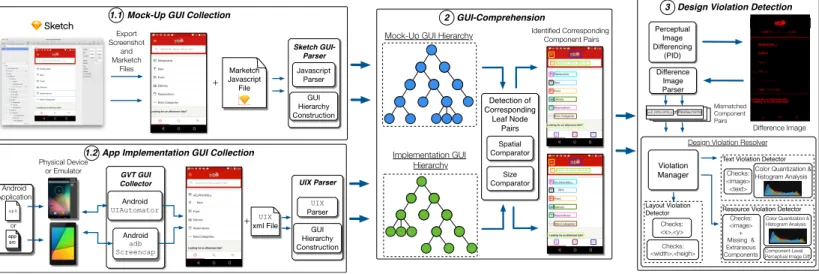
3.3.1 Approach Overview . . . 56
3.3.2 Stage 1: Mock-Up GUI Collection . . . 57
3.3.2.1 Mock-Up GUI Collection . . . 57
3.3.2.2 Dynamic App GUI-Collection . . . 58
3.3.3 Stage 2: GUI Comprehension . . . 59
3.3.4 Stage 3: Design Violation Detection . . . 60
3.3.4.1 Perceptual Image Differencing . . . 60
3.3.4.2 Detecting Layout Violations . . . 61
3.3.4.3 Detecting Text Violations . . . 62
3.3.4.4 Detecting Resource Violations . . . 62
3.3.4.5 Generating Violation Reports . . . 63
3.3.5 Industrial Collaboration Methodology . . . 64
3.4 Design of the Experiments . . . 64
3.4.1 Study 1: GvtEffectiveness & Performance . . . 65
3.4.1.2 Synthetic DV Injection . . . 66
3.4.1.3 Study Methodology . . . 67
3.4.2 Study 2: GvtUtility . . . 68
3.4.2.1 Study Context . . . 68
3.4.2.2 Study Methodology . . . 68
3.4.3 Study 3: Industrial Applicability of Gvt . . . 69
3.4.3.1 Study Context & Methodology . . . 70
3.5 Empirical Results . . . 70
3.5.1 Study 1 Results: GVT Performance . . . 70
3.5.2 Study 2 Results: GVT Utility . . . 71
3.5.3 Study 3 Results: Industrial Applicability . . . 73
3.6 Limitations & Threats to Validity . . . 75
3.7 Conclusion & Future Work . . . 76
4 Machine Learning-Based Prototyping of GUIs 77 4.1 Background & Problem Statement . . . 83
4.1.1 Convolutional Neural Network (CNN) Background . . . 83
4.1.2 Problem Definition . . . 85
4.2 Approach Description . . . 86
4.2.1 Phase 1 - Detection of GUI-Components . . . 87
4.2.1.1 Parsing Data from Design Mockups . . . 87
4.2.1.2 Using CV Techniques for GUI-component Detection: . 89 4.2.1.3 ReDraw Implementation - GUI Component Detection . 89 4.2.2 Phase 2 - GUI-component Classification . . . 90
4.2.2.1 Phase 2.1 - Large-Scale Software Repository Mining and Dynamic Analysis . . . 90
4.2.2.2 ReDraw Implementation - Software Repository Mining
and Automated Dynamic Analysis . . . 92
4.2.2.3 Phase 2.2 - CNN Classification of GUI-Components . . 95
4.2.2.4 ReDraw Implementation - CNN Classifier . . . 95
4.2.3 Phase 3 - Application Assembly . . . 104
4.2.3.1 Deriving GUI-Hierarchies . . . 104
4.2.3.2 Inferring Styles and Assembling a Target App . . . 106
4.2.3.3 ReDraw Implementation - App Assembly . . . 107
4.3 Empirical Study Design . . . 109
4.3.1 RQ1: Effectiveness of the CNN . . . 110
4.3.2 RQ2: GUI Hierarchy Construction . . . 112
4.3.3 RQ3: Visual Similarity . . . 115
4.3.4 RQ4: Industrial Applicability . . . 115
4.4 Experimental Results . . . 116
4.4.1 RQ1 Results: Effectiveness of the CNN . . . 116
4.4.2 RQ2 Results: Hierarchy Construction . . . 118
4.4.3 RQ3 Results: Visual Similarity . . . 120
4.4.4 RQ4 Results: Industrial Applicability . . . 124
4.4.4.1 Front End Android Developer @Google . . . 124
4.4.4.2 Mobile UI/UX Designer @Huawei . . . 125
4.4.4.3 Mobile Researcher @Facebook . . . 125
4.5 Limitations & Threats to Validity . . . 126
4.5.1 Limitations and Avenues for Future Work . . . 126
4.5.2 Internal Validity . . . 127
4.5.3 Construct Validity . . . 130
4.5.4 External Validity . . . 131
5 Improving Automated Android Testing 133
5.1 Background & Motivation . . . 136
5.1.1 Previous Studies on Mobile App Bug/Crashes . . . 136
5.1.2 Limitations of Mobile Testing Approaches . . . 137
5.2 CrashScope Design . . . 138
5.2.1 Extracting Activity and App-Level Contextual Features . . . . 140
5.2.2 Exploration of Apps & Crash Detection . . . 141
5.2.3 Testing Apps in Different Contextual States . . . 142
5.2.4 Multiple Execution Strategies . . . 143
5.2.5 Generating Expressive, Natural Language Crash Reports . . . . 143
5.2.6 Generating & Replaying Reproduction Scripts . . . 144
5.3 Empirical Study 1: Crash Detection Capability . . . 146
5.3.1 Methodology . . . 147
5.3.2 Results & Discussion . . . 149
5.4 Study 2: Reproducibility & Readability . . . 152
5.4.1 Methodology . . . 153
5.4.2 Results & Discussion . . . 154
5.5 Limitations & Threats to Validity . . . 155
5.6 Conclusions . . . 156
6 Conclusions & Future Research 158 6.1 Toward Automatically Documenting Graphical User Interfaces . . . . 159
6.2 Toward GUI-centric Automated Program Understanding & Synthesis . 160 6.3 Toward a Practical, Comprehensive Framework for Automated GUI-based Testing . . . 161
6.3.1 The CEL Testing Principles . . . 162
A Individual Contributions to Projects 171 A.1 Individual Contributions to the Gvt Project . . . 171 A.2 Individual Contributions to the ReDraw Project . . . 172 A.3 Individual Contributions to the CrashScope Project . . . 174 A.4 Individual Contributions to the Formulation of
ACKNOWLEDGMENTS
This Dissertation and the work performed towards its writing would not have been possible without the support and guidance of several individuals. First and
foremost, I would like to thank my advisor, Dr. Denys Poshyvanyk for taking the time to mentor and support a physics major with an initially limited background in computer science. He has tirelessly supported this work and set a great example illustrating how to conduct meaningful research in the field of software engineering with integrity, vision, passion and thoroughness. It goes without saying that without him this work would not have been possible, and I look forward to
continuing to grow as a researcher under his mentorship as I pursue my postdoc. I would also like to thank my committee members, Gang, Xu, Adwait, and Andrian for their mentorship and feedback throughout the writing of this Dissertation. Next, I would like to thank all of the members of the SEMERU group at William & Mary for their support in the projects described in this dissertation and for their mentorship and friendship over my career as a doctoral student. In particular, I would thank to Carlos Bernal-Cárdenas, Mario Linares-Vásquez, Christopher Vendome, Michele Tufano, Michael Curcio, and Dan Jelf. Carlos, your coding expertise and patience in teaching me new techniques has been invaluable. Mario, your research expertise and constructive feedback contributed immensely to my education as a software engineer and research practitioner. Chris and Michele, I am grateful for your support and friendship throughout my time at William & Mary. I cannot possibly give you all enough credit. Michael and Dan, it was a pleasure to advise you as undergraduates and I cannot wait to hear of your future accomplishments.
I thank my parents Brian and Elizabeth, and my brothers Brain, Charles, and Jack for their continued support of my academic pursuits, especially during
difficult times. Mom and Dad, I look to you both for inspiration and motivation in the way you have raised my brothers and me and in the way you live your lives. I would also like to thank my grandparents, Tom and Jeanne Moran, and Mary and Paul Lavin, for always encouraging me in my studies and offering crucial advice when needed.
Most importantly, I would like to thank my wife Emily for her unwavering support throughout my doctoral studies. This dissertation would not have been possible without your companionship, advice, and love in both bad and good times. My full appreciation for having you in my life can not be adequately put into words.
To my wife Emily – Your compassion and strength of character have helped me to become a better teacher, researcher, and person. My love for you grows deeper
LIST OF TABLES
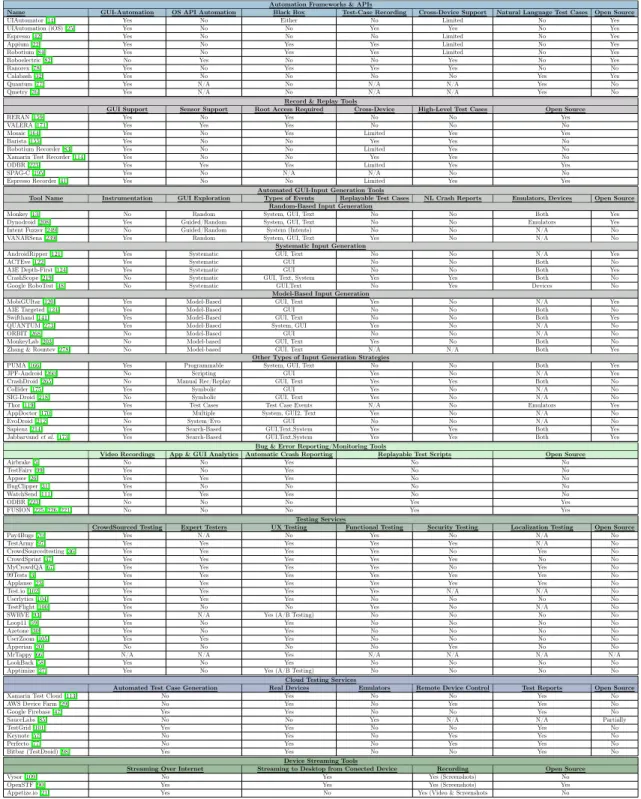
2.1 This Table Surveys the current state of tools, frameworks, and services that support activities related to mobile testing, originating from both Academic and Industrial backgrounds. . . 30 4.1 Labeled GUI-Component Image Datasets . . . 111 4.2 Semi-Structured Interview Questions for Developers & Designers . . . 113 4.3 Confusion Matrix for ReDraw . . . 116
4.4 Confusion Matrix for BOVW Baseline . . . 117 4.5 Pixel-based comparison by MAE: Mann-Whitney test (p-value) and
Cliff’s Delta (d). . . 121
4.6 Pixel-based comparison by MSE: Mann-Whitney test (p-value) and
Cliff’s Delta (d). . . 121
5.1 Tools used in the comparative fault finding study . . . 146 5.2 Unique Crashes Discovered with Instr. Crashes in parentheses . . . 149
5.3 User Experience Results: This table reports the mean average
response from 16 users regarding the User Experience questions posed for bothCrashScope generated reports and the original human written reports found in the app’s issue trackers. (CS = CrashScope Bug Reports, O=Original Bug Reports,M=Mean,SD=Standard Deviation)153
LIST OF FIGURES
1.1 The Hierarchy of Abstraction in Computer Science . . . 3 2.1 Illustration of the GUI Structure of the Pandora Android Application 18 2.2 Examples of Formal Definitions . . . 21 3.1 Distribution of Different Types of Industrial DVs . . . 55 3.2 Overview of GVT Workflow . . . 57 3.3 Study 1 - Detection Precision (DP), Classification Precision (CP),
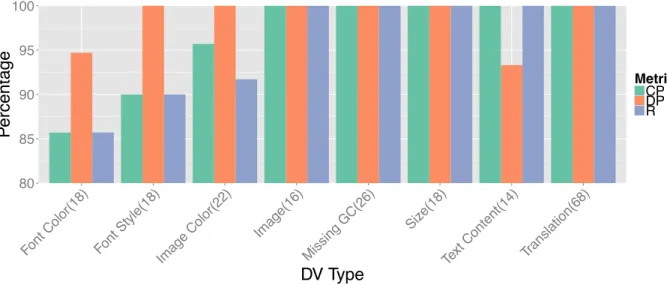
Recall(R) . . . 70
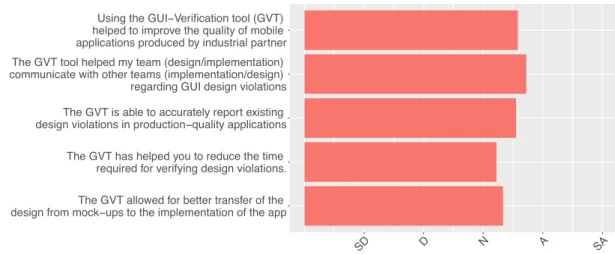
3.4 Study 2 - Developer CP, DP, and R . . . 71 3.5 Study 2 - UX Question Responses. SD=Strongly Disagree, D=Disagree,
N=Neutral, A=Agree, SA=Strongly Agree . . . 71 3.6 Study 3 - Applicability Questions. SD=Strongly Disagree, D=Disagree,
N=Neutral, A=Agree, SA=Strongly Agree . . . 73 4.1 Typical Components of CNN Architecture . . . 84 4.2 Overview of Proposed Approach for Automated GUI-Prototyping . . . 86 4.3 Heat-map of GUI Components by Category . . . 94 4.4 Example of a subset of ReDraw’s training data set consisting of
GUI-Component sub-images and domain (Android) specific labels. Images and corresponding Labels are grouped according to the dashed-lines. . 97 4.5 Heat-map of GUI Components by Category After Filtering . . . 98 4.6 Screenshots of synthetically generated applications containing toggle
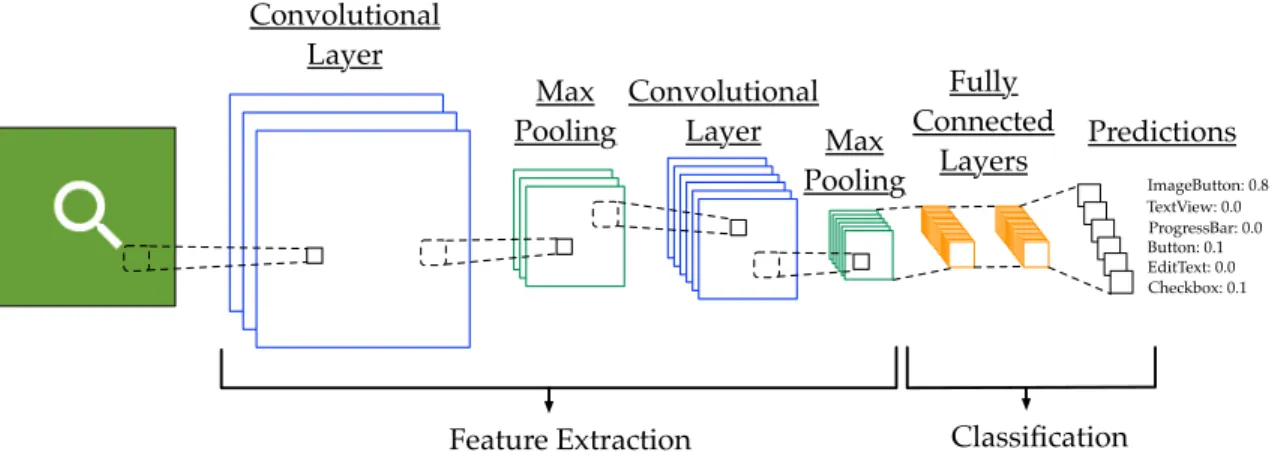
4.7 ReDrawCNN Architecture . . . 102
4.8 Illustration of KNN Hierarchy Construction . . . 105 4.9 Hierarchy similarities based on edit distances . . . 118 4.10 Pixel-based mean average error and mean squared error of screenshots:
ReDraw,Remaui, and pix2code apps . . . 120
4.11 Examples of apps generated with ReDraw exhibiting high visual and
structural similarity to target apps . . . 122 5.1 Overview of CrashScope Workflow . . . 138 5.2 Crash Screen-Flow . . . 144 5.3 Example of Contextual Information and Reproduction Steps sections
in a generated crash report . . . 145 5.4 Average Coverage Results for the Comparative Study . . . 150
Chapter 1
Introduction
1.1 Overview
“The essence of a software entity is a construct of interlocking concepts: data sets, relationships among data items, algorithms, and invocations of functions. This essence is abstract in that such a conceptual construct is the same un-der many different representations. It is nonetheless highly precise and richly detailed. I believe the hard part of building software to be the specification, de-sign, and testing of this conceptual construct, not the labor of representing it and testing the fidelity of the representation.”
– Fredrick Brooks, No Silver Bullet – Essence and Accident in Software Engineering (1986)
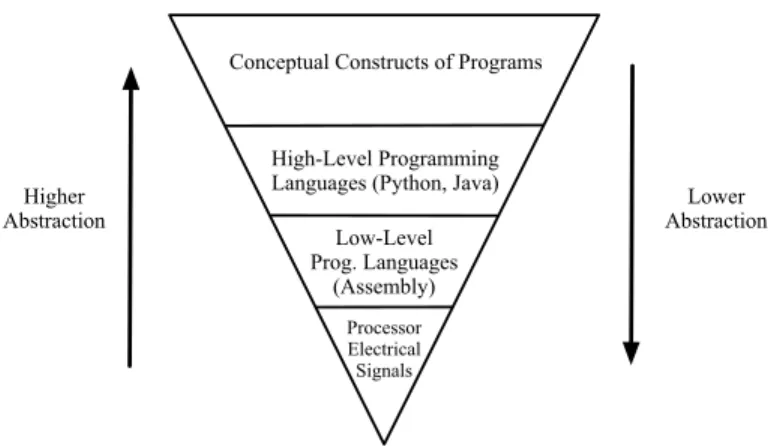
Software developers inherently reason about different abstractions of ideas. In fact, the foundations of computer science more broadly are centered upon a hierarchy of abstrac-tions (Fig. 1.1). This hierarchy begins at the lowest level with the physical representation of computers as a complex assortment of electrical signals, moves toward representations of ideas in code that are able to carry out logical processes, and culminates at the highest level in mental models of programs for solving problems. Thus it can be observed that, at its core, computer science is largely concerned with the interplay between the various levels of this abstraction hierarchy. In his widely regarded“No Silver Bullet” essay [133] Fredrick Brooks acknowledges two most common abstractions from this hierarchy that modern soft-ware engineers must reason between: (i) conceptual constructs (i.e., mental models of a
Higher
Abstraction AbstractionLower
Conceptual Constructs of Programs
High-Level Programming Languages (Python, Java)
Low-Level Prog. Languages (Assembly) Processor Electrical Signals
Figure 1.1: The Hierarchy of Abstraction in Computer Science
given software program), and (ii)representations of these conceptual constructs (i.e., their concrete instantiation in a medium such as code). Brooks argues that the most critical part of the software development process is the conceptualization of interlocking constructs that inherently constitute a piece of software, not the transferral of these concepts into a concrete representation in code. Although translating abstract mental models into a tangible artifact like code is not a trivial process, Brooks recognized that the mental for-mulation of what needs to be built is the most crucial step, as it is a distinctly abstract process requiring intellectual acuity. This is logically evident, as a faithful instantiation of ineffective ideas in code inevitably results in an unsuccessful program. This conceptualiza-tion of the mental model of a program is ultimately what Brooks refers to as the essence of software engineering.
With this view of the software development process in mind, there are evidently two major courses of research for improving engineering practices. Namely, conducting studies to understand, and designing techniques to aid and automate: (i) the derivation of a con-ceptual model embodying the requirements, specifications, and design of a software system, or (ii) the process of translating this conceptual model into a concrete representation that can be understood, executed, and maintained by both humans and computers. However, directly addressing this first course of research is exceedingly difficult, as it attempts to directly operate upon the essence of software engineering. As Brooks argues, due to the widely variable nature of software projects and the distinctly unique thought processes of humans, there is unlikely a “silver bullet” that dramatically improves the process of conceptualizing software.
Humans are likely to play a major role in the process of software development for the foreseeable future, and as such the process of developing conceptual constructs of software is likely to persist. Methods for reasoning about software at a conceptual level tend to assume a multitude of different forms across varying development domains and teams, and require an high level of ingenuity inherent in most skilled software engineers. Thus, as Brooks suggests, it is difficult to develop any singular notable advancement that aids in this conceptualization process. If this is the case, then how can software engineering researchers help to push the field forward? In this dissertation, we posit that helping to make the in-stantiation of conceptual software constructs as frictionless as possible can dramatically improve the overall development process. The quicker and easier it is for an engineer to move from concept to code, the faster that ideas can be proved out, and judgements made about conceived programs, which we assert will lead to more effective and efficient cre-ation and maintenance of software. In fact, this direction of work directly targets Brook’s prescriptions for dealing with the difficulties that arise related to the essence of software engineering namely,rapid prototyping and iterationandgrowing software organically[133]. The work presented in this dissertation attempts to facilitate the process of instan-tiating conceptual software development concepts into accurate, effective representations through automation. The hope is that by automating different parts of the software de-sign, development and testing processes, we will be able to allow developers to focus more effectively on the important task of conceptualizing the data, algorithms and functions that underlie the problem or task to which the software will be applied; thus facilitating the rapid iteration and organic evolution of intuitive, elegant programs.
1.2 Motivation - Language Dichotomies in Software
Engineering
As explained in the previous section, the work conducted in the presented dissertation is aimed at designing techniques to automate various parts of the software development
process. This automation is meant to facilitate the instantiation of conceptual constructs of software into concrete representations. However, these concepts can be concretely rep-resented in several different manners, such as code, natural language, or in graphical user interfaces (GUIs). In this section, we further motivate the work conducted by examining development challenges that surface as a result of the interplay between different represen-tations of software.
When examining the current challenges that exist in software development, mainte-nance, and testing one can observe a common trend throughout, contributing to a myriad of interconnected difficulties related to instantiating mental models of software into various functional representations. Incidentally, this thread stems from the hierarchy of abstrac-tion discussed at the outset of this paper. In their text“Foundations of Computer Science" Aho and Ullman state that“fundamentally, computer science is a science of abstraction – creating the right model for thinking about a problem and devising the appropriate mecha-nizable techniques to solve it." One could argue that software engineering is fundamentally centered upon effectively navigating various levels of an abstraction hierarchy, more specif-ically, the jump in abstraction between mental models and code. There is an inherent cost in reasoning between different levels of abstraction, generally measured in time and mental effort. In turn, the mental labor of such reasoning underlies many of the unique challenges experienced by today’s developers.
However, it is not only effort in reasoning between levels of abstraction that can be difficult, but also between representations of the same abstraction level. Namely, foun-dational abstractions between languages that instantiate mental models of software can prove to be particularly troublesome. Here when we refer to the notion of a language we are not targeting programming languages specifically, but rather the broader definition of language as a medium by which an idea or information is conveyed [222]. In this sense, there are several different languages, or modalities, of information that developers must navigate during the software development process, including natural language and code, just to name a few. In essence, the bridging of the knowledge gap between these
informa-tion modalities constitutes a set of principal challenges related to program comprehension in software development.
Specific challenges in software engineering often stem from difficulties navigating dif-ferent pairs of languages. For instance, when considering challenges related to software traceability, developers must reason between program representations related to natural language and code, interpreting how concepts and functional specifications dictated in natural language are dispersed throughout a codebase. When designing the graphical user interface of program, designers and developers must reason between the modalities of code and pixel-based image representations of the app via the graphical user interface. These pairs of contrasting information modalities have been labeled aslanguage dichotomies[222]. Developing solutions to help developers more effectively reason between various language dichotomies is a key factor in helping to overcome many program comprehensions chal-lenges.
More specifically, a language dichotomy can be defined as a difficulty in program com-prehension resulting from reasoning about different representations or modalities of in-formation that describe a program [222]. There are several language dichotomies that contribute to a varied set of problems. In the presented dissertation we focus on three different modalities of information:
1. Natural Language: This modality represents languages that humans typically use
to convey ideas or information to one another, such as English.
2. Code: This modality represents the languages that humans utilize to construct a program, such as Java or Swift.
3. Visual Software Artifacts (GUIs): Much of today’s user facing software is
graphical. This information modality is highly visual, consisting of pixel-based rep-resentations of a program typically comprised of a logical set of building blocks often referred to as GUI-widgets or GUI-components.
Each of the representations described above have their own powerful uses, often serving to represent a program according to certain goals. For example, a GUI is an extremely powerful representation of program code that allows a user to carry out computing tasks, abstracting away the complexity of the underlying algorithms. However, for a developer, it is often critical to effectively understand and navigate how information represented in one modality translates to another. This is, at its core, a program comprehension task. For instance, a developer must reason about how different parts of the GUI correspond to different sections of code in a mobile app. However, bridging this gap between representa-tions can be an arduous task, and thus underlies many open problems in mobile software development.
We assert that these language dichotomies can be effectively bridged through automa-tion, thus helping to overcome several resulting software development problems. More specifically, by building upon techniques related to program analysis, machine learning, and computer vision, techniques can be derived to help automatically translate informa-tion across modalities, or detect anomalies between corresponding program representainforma-tions in a single modality.
1.3 Research Context: Mobile Applications
In order to devise new approaches that automate the various components of the software development lifecycle, we need a suitable domain within which we can instantiate and eval-uate them. In the scope of this dissertation, we focus our efforts on mobile applications. Mobile applications, often referred to colloquially as “apps”, are quite simply software ap-plications that run on mobile hardware such as smartphones or tablets. Choosing mobile applications as our research domain is beneficial for at least the following three reasons: (i) there are open challenges unique to the software development process for mobile apps, providing a fertile research landscape, (ii) mobile apps, and by extension mobile app de-velopment, are extremely popular, giving our work a large potential for practical impact,
and (iii) mobile platforms provide a wide array of frameworks and utilities that facilitate varying types of program analysis. Background regarding mobile apps and mobile app de-velopment are detailed in Chapter 2. It should be noted that the work carried out in this dissertation is instantiated for the Android platform, mainly due to its open source nature and the litany of supporting tools and frameworks surrounding the platform. However, there are no substantial technical barriers that prevent the techniques presented in this dissertation from being transferred to other platforms.
1.4 Contributions & Outline
The core thesis of this dissertation is as follows:
Automating the process of instantiating and reasoning about the representation of conceptual software constructs in code, natural language, and visualizations allows for more effective software development by enabling rapid prototyping, swift iteration, and organic growth as abstract concepts evolve.
To investigate this thesis, we develop and empirically evaluate models and approaches that aid in automating the design, implementation, and testing of mobile applications. In particular, these approaches focus on automating (i) the verification of visual GUI prop-erties for mobile app user interfaces, (ii) the construction of the code for mobile app GUIs given a target mock-up, and (iii) GUI-based functional testing of mobile apps. The intel-lectual merit of work presented in this dissertation lies in two interconnected contributions. First, we derive and illustrate how to construct a set of novel models for representing vari-ous attributes of mobile apps using information extracted via program analysis techniques. Second, we demonstrate that these models and the underlying encoded information can be utilized, both directly and in combination with machine learning techniques, to make the development and testing process for mobile apps more effective and efficient. The work conducted in this dissertation was of a collaborative nature and a summary of individual research contributions for each of the presented projects can be found in Appendix A.
InChapter 2we provide background related to mobile software development practices, and mobile graphical user interfaces. We also discuss related work related to (i) detecting design violations in mobile apps, (ii) automatically prototyping mobile application GUIs, and (iii) automated GUI-based testing of mobile apps.
InChapter 3we develop a new technique for detecting and reporting instances where the GUI of a mobile application does not adhere to its intended design specifications as stipulated in a mock-up. This technique receives as input two images with accompanying metadata, one for the mock-up and one screenshot of the implemented GUI, and generates a detailed report stipulating instances where the specifications of the mock-up were not properly implemented. Our approach generates a hierarchal models of the mock-up and implementation of a particular screen of an application’s GUI and relates this model to the pixel-based images using coordinates. It then applies a computer vision technique called perceptual image differencing (PID) modeled after the human visual system to measure differences in images, and categorizes image differences according to an empirically derived taxonomy of GUI implementation errors. The content of this chapter is based primarily on the paper describing theGvt approach [224].
In Chapter 4we devise a technique to automate the process of translating an image-based mock-up of a mobile application’s GUI into suitable code. Our approach decomposes this translation process into three major steps: (i) detection of GUI elements, (ii) clas-sification of these GUI elements into domain-specific, programmatic categories, and (iii) the construction and assembly of these categorized GUI elements into hierarchical code representation. Techniques from computer vision are utilized to detect GUI elements in image-based representations of GUIs. A deep convolutional neural network (CNN) trained on an automatically derived ground truth from tens of thousands applications screens is utilized to generate a model that is capable of accurately classify GUI elements into programmatic categories. Finally, we develop a data-driven k-nearest neighbors (KNN) algorithm for constructing realistic hierarchical representations of an app’s GUI before translating this representation into code. The content of this chapter is based
primar-ily on work describing the ReDraw approach [220] for automatically prototyping mobile application GUIs.
InChapter 5we present a novel approach for automated testing of mobile applications that implements part of the vision outlined in Chapter 4. Our approach develops a new technique for constructing an on-the-fly event flow model of an application using systematic GUI exploration. Furthermore, our approach is capable of analyzing an application both statically and dynamically, extracting program features more likely to induce crashes, and stress-testing these features according to one of several strategies. This work described in this chapter is based primarily on work on the CrashScopeapproach [219].
In Chapter 6 we discuss three major avenues for future research motivated by the outcomes of the work described in this dissertation. Finally, we offer general conclusions that summarize the contributions of this dissertation.
In addition to the contributions outlined in this dissertation, the author has worked on a wide array of research topics in software engineering over the course of his career as a doctoral student including: (i) bug reporting [225, 226, 223], Test Case Prioritization [206, 207], Mutation Testing [201, 207, 228], and Mobile Security [130, 262].
Chapter 2
Background & Related Work
In this chapter we first provide background related to mobile software development and the makeup of mobile graphical user interfaces with a focus on the Android platform. We then survey relevant work related to each of the three major projects presented in this dissertation which were introduced in the previous chapter, namely Gvt, ReDraw, and
CrashScope.
2.1 A Brief Introduction to Mobile Software Development
Mobile computing has become a centerpiece of modern society. Smartphones and tablets continue to evolve at a rapid pace and the computational prowess of these devices is approaching parity with laptop and desktop systems for high-end mobile hardware. This facilitates new categories of engaging software that aim to improve the ease of use and utility of computing tasks. Currently, many modern mobile apps have practically the same features as their desktop counterparts and range in nature from games to medical apps. The global “app" economy is comprised of millions of apps and developers, and billions of devices and users. Additionally, commodity smartphones are ushering in a completely new population of users from developing markets, many of whom are using a computer and accessing the internet for the first time. These factors, combined with the ease of distributing mobile apps on marketplaces like Apple’s App Store [24] or Google
Play [50] have made the development of mobile software a major focus of engineers around the world. In fact, according to Stack Overflow’s 2018 survey of over 100,000 developers [1], nearly a quarter of respondents identified themselves as mobile developers.
Mobile applications are typically developed on top of an existingmobile platform. These platforms consist of several different parts and these parts can vary between platforms, however at a minimum usually include: (i) a kernel and an operating system (OS) that runs on mobile hardware such as a smartphone, (ii) an application framework consisting of a set of platform specific APIs and libraries, and (iii) a set of tools and software to aid in developing apps, including IDEs or user interface builders. Mobile apps are typically written using a target programming language supported for a particular platform (e.g., Java and Kotlin for Android, and Objective-C and Swift for iOS), in combination with the APIs from the platform’s application framework. There are a shrinking set of platforms upon which developers can create and publish their apps. These platforms include Android, iOS, BlackBerry 101, Firefox OS, Ubuntu Touch, and Windows 10 Mobile1. However, currently Android and iOS comprise the majority of the market, accounting for 87.7% and 12.1% of the market share respectively for the2nd quarter of 2017 [89].
2.1.0.1 Unique Aspects and Challenges of the Mobile Development Process While the importance and prevalence of mobile in the modern software development ecosys-tem is clear, many of the unique attributes that make mobile platforms attractive to both developers and users contribute a varied set of challenges that serve as obstacles to pro-ducing high-quality software.
Platform Evolution and Instability: Generally, the software development lifecycle typ-ically follows a cyclic set of activities that include (i) requirement engineering, (ii) design, (iii) development, (iv) testing, and (v) maintenance. Modern agile development practices typically iterate quickly through these activities with the goal of delivering working soft-ware in a continuous manner where features are added and bugs are fixed during each
iterative development cycle. However, the rapid evolution of mobile platforms shapes the mobile development process in unique ways. As mobile hardware evolves, platforms evolve to keep pace with technological advancements, and new more convenient software features and capabilities are included with each iteration. For instance, Android has had over 15 major version releases since its inception in 2008 that have dramatically reshaped the un-derlying platform APIs [215], leading to support for advanced features such as Augmented Reality (AR). This iterative process puts immense pressure on developers to evolve their apps with the mobile hardware and platforms to satisfy the expectations of users that their apps take advantage of the latest features [178, 170]. This pressure leads to accelerated de-velopment cycles with a focus on adapting to changes in platform APIs. Adapting to these changes can be difficult and may adversely affect app quality [200, 125]; because develop-ers must cope with adding additional app functionality based on new platform features, or on fixing bugs that arise due to changes in APIs currently used in an app. This may detract from time that could be spent on other activities such as fixing general regressions, refactoring, or improving the performance of an app, while also leading to undue technical debt. Thus, platform evolution has a clear affect on mobile development.
GUI-Centric, Event Driven Applications: Perhaps one of the most important fea-tures of mobile devices is the ease of use provided by high-fidelity, touch-enabled displays. Users primarily interact with their smartphones, tablets, and wearable devices and by ex-tension the apps that run on these devices, through a touchscreen interface. This means that mobile apps are centered around the graphical user interface, and are driven by touch events on this interface. While other types of apps such as web apps, are also heavily event-driven, the unique touch based gestures and interactivity provided by mobile apps help to shape the software design, development and testing processes in unique ways. For example, the user interface (UI) and user experience in mobile apps must be well-designed for an app to be successful in highly competitive marketplaces. As such design and de-velopment tools for constructing UIs are a core part of IDEs such as Xcode and Android Studio that to mobile developers.
The event-driven nature of mobile apps also impacts testing. While developers can test small pieces of their code using practices such as unit testing, ultimately, testing must be done through the GUI. Manually testing applications is a time consuming practice that is fundamentally at odds with the rapid pace of mobile development practices. Thus, mobile developers and testers will often utilize automation frameworks that either allow for reusable or fully automated test input generation.
Mobile App Marketplaces: The primary (and some cases only) method of distribution for mobile apps is through “app marketplaces" such as Google Play or Apple’s App Store. These digital storefronts are unique to mobile applications, in that they provide users with easy access to purchase, download, and update apps, while providing mechanisms for users to review apps and provide feedback to developers. In recent years, these marketplaces have become increasingly competitive as the number of available apps numbers in the millions. App marketplaces incentivize developers to ensure their apps are of the high-est possible quality, and to take into account the feedback of users. Developers need to ensure the quality of their apps by adhering to proper platform design principles and per-forming extensive testing, or risk being passed over for competitors. Likewise developers need to react to feedback communicated through user reviews by gathering and updating requirements and subsequently improving their app’s implementation.
Market, Device, and Platform Fragmentation: The large and growing user base of smartphones and tablets is one of the most alluring aspects for many developers and companies hoping to reach users. Unfortunately, targeting these users can be difficult due to multiple levels of fragmentation. The first level of fragmentation is at the market-level, which is currently dominated by Android and iOS. Thus, developers hoping to reach the maximum number of users must targetboth of these platforms. Second, there is fragmen-tation at the device level [165], as there is a large and growing number of hardware options for consumers to choose from with more devices being introduced each year. Finally, there is platform fragmentation, as users on the same mobile platform may be running different versions of mobile OSes. For instance, the latest version of iOS, iOS11, is currently
run-ning on 65% of devices whereas iOS10 currently encompasses 28% of the install base [123]. However, in Android fragmentation is more severe, with the two latest versions of Google’s OS, Android 8 and 7, make up only 1.1% and 28.5% of the Android install base respec-tively. In order to create effective apps, developers must ensure that their applications function properly across a wide combination of different platforms, devices, and platform versions. This can make the process of developing and testing mobile apps challenging, as developers need to maintain concurrent codebases and test across a dizzying array of target configurations.
Naturally, these difficulties have led to creation of platform-independent development tools such as Xamarin [113], where a single codebase can be compiled to multiple platforms, eliminating the need for parallel codebases. Alternatively, there exist tools and frameworks like Ionic [54] for creatinghybrid applications which use a combination of web technologies that interface with underlying platform APIs. In addition to hybrid applications, another framework created by Facebook called React Native [79] facilitates the development of na-tive mobile apps using javascript and React. Applications built using react nana-tive are fully native to the target platform, the framework simply assembles the native code according to the javascript written by a developer. All of these approaches can help ease the burden of fragmentation when creating mobile apps. However, multi-platform development solutions come with their own set of compromises. For instance, hybrid apps are known to suffer from performance issues in terms of user interface interactivity, which can frustrate users. Furthermore, frameworks like Xamarin or React Native require their own learning curve, and developers are highly dependent upon the multi-platform framework keeping up with the latest features of modern mobile platforms.
2.1.1 Android Development Tools and Frameworks
Due to the open-source nature of a majority of the code that underlies the Android plat-form, and Google’s push towards making the platform an inviting one for developers, there
exists a wide range of development tools. These tools and frameworks underpin many of the approaches presented in this dissertation, thus, we briefly introduce them here. 2.1.1.1 Virtual Android Devices
Given that applications developed for a mobile device typically will not run directly on the desktop systems used to develop them, it is important to have a vehicle by which developers can quickly test and preview their applications. This is primarily carried out by virtual Android devices. Currently, the most popular solutions for running virtual Android devices are the following: (i) the standard Android emulator officially supported by Google [6], (ii) the Genymotion [45] emulator, and (iii) Virtual Machines based on the androidx86 project [15]. These devices can be used to test apps against different device and platform configurations to help combat the daunting fragmented market. Depending upon the host hardware and the configuration of the virtual devices, several devices can be instantiated concurrently to speed up testing.
2.1.1.2 Android Debugging Bridge
In order to test and verify different application properties, developers need a way to interact with running devices in a programmatic manner. This is primarily accomplished through the Android Debugging Bridge, also referred to as adb. The adb serves as a connection to a device and facilitates a variety of different development actions such as installing or uninstalling apps. It also allows for opening a unix-like shell on the device where a plethora of device actions can be performed, such as capturing screenshots and manipulating files. 2.1.1.3 UI Automator Framework
Given that Android applications are largely driven by touch-based events performed on a GUI, developers need a tool that lets them extract and analyze information about a device’s screen. The Android UI Automator framework, often referred to as uiautomator [14], facilitates this process by offering means to capture hierarchical representations of the
GUI-components (i.e., widgets) displayed on a device’s screen by encoding this structure intoxml files. These xml files can then be parsed and analyzed to infer properties of the GUI of an app running on a target device.
2.1.1.4 Android Logcat
The Android logcat [9] utility is a command-line tool that capture and is capable of dumping a system log of an Android device, including stack traces for application errors and system messages.
2.2 Fundamentals of Mobile Graphical User Interfaces
The first two projects presented in this dissertation are concerned with automating diff er-ent aspects related to the construction of Graphical User Interfaces of mobile apps. Thus, to provide sufficient context to the reader, in this section we introduce the fundamental concepts that underpin mobile graphical user interfaces. These concepts include the log-ical building blocks that comprise modern mobile GUIs as well as the concepts of design violations (DVs), and presentation failures.
2.2.0.1 GUI-Components, GUI-Containers, and Screens
There are three main logical constructs that define the concept of the GUI of a mobile app: GUI-components (or GUI-widgets), GUI-containers, andScreens. AGUI-component is a discrete object with a set of attributes (such as size and location among others) organized according toGUI-containersassociated with a particularScreenof an app. GUI-Containers are logical constructs that group GUI-components and define relative spatial properties. A Screen is an invisible canvas of a size corresponding to the physical screen dimensions of a mobile device. We define two types of screens, those created by designers using professional-grade tools like Sketch, and those collected from implemented apps at runtime. Each of these two types of Screens has an associated set of GUI-components
Relative Layout
TextView TextView Linear Layout
Image
Button ButtonImage ButtonImage
Partial GUI Hierarchy for the Pandora Application
GUI-Component GUI-Container
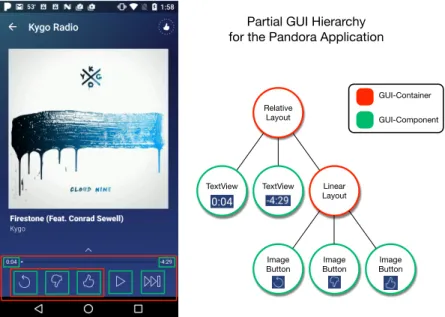
Figure 2.1: Illustration of the GUI Structure of the Pandora Android Application (referred to interchangeably ascomponentsin this text). Each set of components associated with a screen is structured as a cumulative hierarchy comprising a tree structure, starting with a single root node, where the spatial layout of a parent always encompasses contained child components. These various GUI building blocks are illustrated in a partial hierarchy of the popular Pandora music application in Figure 2.1.
It is important to note that there are two parallel representations of mobile GUIs, static representations, and dynamic representations. There are key differences between these two representations that impact the definitions of key concepts described below. Static representations of a mobile GUI are those that are represented in code, usually in a domain specific language such as custom xml in Android, ornib files in iOS. Typically, the spatial attributes of a static representation of a mobile GUI are defined in relative terms, allowing for adaption to different screen sizes and device configurations. Dynamic representations of mobile GUIs are those that are rendered on a target device screen, and the spatial attributes of components are translated from their relative representation in the code to tangible coordinates that exist within the bounds of a target device’s
pixel-based screen dimensions. The definitions presented below are amenable to either of these representations.
Definition 1 - GUI-Component: Atomic graphical elements with pre-defined
function-ality, displayed within a GUI of a software application.
More formally, a GUI-component is a discrete object GC with a corresponding set of at-tributesawhich can be represented as a six-tuple in the form(<x-position>, <y-position>, <height>, <width>, <text>, <image>). Here the first four elements of the tuple describe the location of the top left point for the bounding rectangle of the component, and the height and width attributes describe the size of the bounding box. These spatial elements can be represented either as relative values or as concrete pixel-based coordinates on a target device. The text attribute corresponds to text displayed by the component. Fi-nally, the image attribute represents an image of the component with bounds adhering to the first four attributes. GUI-components have one of several domain dependent types, with each distinct type serving a different functional or aesthetic purpose. For example, common component types include dropdown menus and checkboxes, just to name a few. The notion ofatomicity is important in this definition, as it differentiates GUI-components fromcontainers. The third concept we define is that of aGUI-container:
Definition 2 - GUI-Container: A logical construct that groups member GUI-components
and typically defines spatial display properties of its members.
In modern GUI-centric apps, GUI-components are rarely rendered on the screen using pre-defined coordinates. Instead, logical groupings of containers form hierarchical structures (or GUI-hierarchies). These hierarchies typically define spatial information about their constituent components, and in many cases react to changes in the size of the display area (i.e.,reactive design)[12]. For instance, a GUI-component that displays text may span the text according to the dimensions of its container.
Definition 3 - Screen: A canvas with a predefined height and width corresponding to the physical display dimensions of a smartphone or tablet.
Each Screen S contains a cumulative hierarchy of components, which can be represented as a nested set such that:
S={GC1{GC2{GCi}, GC3}} (2.1) where each GC has a unique attribute tuple and the nested set can be ordered in either depth-first (Exp. 2.1) or in a breadth-first manner. Each nesting level in the set corre-sponds to a GUI-container, that logically groups these components. We are concerned with two specific types of screens: screens representing mock-ups of mobile apps Sm and
screens representing real implementations of these apps, orSr.
2.2.0.2 Design Violations & Presentation Failures
Now that we have introduced the fundamental building blocks of modern mobile GUIs, we next introduce the concepts related to design violations and presentation failures.
Definition 4 - Mock-Up Artifact: An artifact of the software design and development
process which stipulates design guidelines for GUIs and its content.
In industrial mobile app development, mock-up artifacts typically come in the form of high fidelity images (with or without meta-data) created by designers using software such as Photoshop [4] or Sketch [86]. In this scenario, depending on design and development workflows, metadata containing information about the constituent parts of the mock-up images can be exported and parsed from these artifacts2. Independent developers may also use screenshots of existing apps to prototype their own apps. In this scenario, in addition to screenshots of running applications, runtime GUI-information (such as the html DOM-tree of a web app or the GUI-hierarchy of a mobile app) can be extracted to further aid in
A) App Mock-Up B) App Implementation
GUI-Component Screen
Presentation Failure with three Design Violations
(Color, Size, Location) Presentation Failure with one Design Violation (Font)
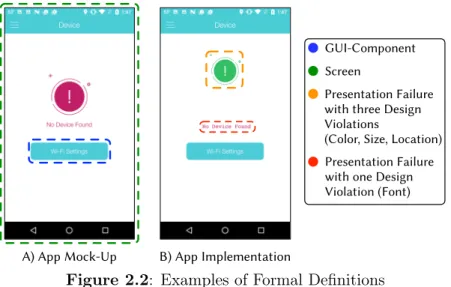
Figure 2.2: Examples of Formal Definitions
the prototyping process. However, this is typicallynot possible in the context of mock-up driven development, as executable apps do not exist.
Design violations correspond to visual symptoms ofpresentation failures, or differences between the intended design and implementation of a mobile app screen. Presentation failures can be made up of one or more design violations of different types.
Definition 5 - Design Violation: A mismatch between at least one of the attributes of
corresponding GUI-components existing in a mock-up artifact, and a dynamic representa-tion of the implementarepresenta-tion of that artifact.
As shown in Exp. 2.2 a mismatch between the attribute tuples of two corresponding leaf-level (e.g., having no direct children) GUI-components GCim andGCjrof two screensSm
and Sr imply a design violationDV associated with those components. (GCim⇡GCjr)^(GCim6=GCjr)
=) DV 2{GCim, GCjr}
(2.2) In this definition leaf nodes correspond to one another if their location and size on a screen (e.g., <x-position>, <y-position>, <height>, <width>) match within a given threshold. Equality between leaf nodes is measured as a tighter matching threshold across all attributes. Inequalities between different attributes in the associated tuples of theGCs lead to different types of design violations.
Definition 6 - Presentation Failure: is a set of one or more design violations attributed to a set of corresponding GUI-components existing in a mock-up artifact, and a dynamic representation of the implementation of that artifact.
Presentation Failures are a set of one or more design violations attributed to a set of corresponding GUI-components between two screensSm andSr, as shown in Exp. 3. For
instance, a single set of corresponding components may have differences in both the<x,y> and <height,width> attributes leading to two constituent design violations that induce a single presentation failure PF. Thus each presentation failure between two Screens S corresponds to at least one mismatch between the attribute vectors of two corresponding leaf node GUI-componentsGCim andGCir.
if {DV1, DV2, ...DVi}2{GCim, GCjr}
then P F 2{Sm, Sr}
(2.3)
2.3 Work Related to Detection of GUI Design Violations in
Mobile Apps
2.3.1 Detecting Presentation Failures in Web Applications
The most closely related work toGvtlies in approaches that aim at detecting, classifying and fixing presentation failures in web applications [209, 210, 242, 211]. Mahajan et. al. introduced WebSee aimed at this task. This approach leverages PID, clustering of difference regions, and localization of faulty html elements by resolving areas with visual discrepancies to content in an R-Tree representation of an html page. Mahajanet. al also developed FieryEye, which builds upon the WebSee approach to identify faulty elements and corresponding styling properties. In comparison, Gvt also performs detection and localization of presentation failures, but is the first to do so for mobile apps. In addition to the engineering challenges associated with building an approach to detect presentation failures in the mobile domain (e.g., collection and processing of GUI-related data) Gvtis
the first approach to leverage metadata from software mock-up artifacts (e.g., Marketch) to perform GC matching based upon the spatial information collected from both mock-ups and dynamic application screens, allowing for precise detection of the different types of DVsdelineated in our industrialDV taxonomy. Gvtis also the first to apply the processes of CQ, CH analysis, and B-PID toward detecting differences in the content and color of icons and images displayed in mobile apps. Gvt also identifies different faulty properties (such as location, color, or image content).
2.3.2 Cross-Browser Testing
Other approaches for XBT (or cross browser testing) by Roy Choudhry et. al. [242, 143, 244] examine and automatically report differences in web pages rendered in multiple browsers. These approaches are currently not directly applicable to mock-up driven de-velopment or mobile apps. An analogous problem in the domain of mobile apps is cross device testing for presentation failures (e.g., ensuring proper rendering of GUIs across de-vices with different physical screen sizes and dimensions). However, this type of work is out of scope for theGvt approach, and left as a promising avenue for future work.
2.3.3 Other Approaches for GUI Verification
There are other approaches and techniques that are related to identifying problems or differences with GUIs of mobile apps. Xieet al. introduced GUIDE [267], a tool for GUI differencing that aims to describe discrepancies between successive releases of GUIs for an app by matching components between GUI-hierarchies. Gvtutilizes a matching procedure for leaf node components using a similarity function based on spatial information, as direct tree comparisons are not possible in the context of mock-up driven development. Joorabchi et. al built an approach for detecting inconsistencies in multi-platform apps, but this was not related to mock-up driven development or GUIs specifically [179]. There has also been both commercial and academic work related to graphical software built specifically for creating high-fidelity mobile app mock-ups or mockups that encode information for
auto-mated creation of code for a target platform [217, 65, 44, 75]. However, such tools tend to either impose too many restrictions on designers who typically carry limited programming experience or do not allow for direct creation of code, thus DVs still persist in practice. Takashi [118] presented an approach for verifying GUI objects using the meta informa-tion stored in Windows graphics APIs and expected output from a set of program acinforma-tions to verify GUI-objects. While this is a potentially useful approach, in the case of mobile mock-up driven development, sufficient GUI information can be gleaned viauiautomator.
2.4 Work Related to Automated Prototyping of Graphical
User Interfaces for Mobile Apps
2.4.1 Reverse Engineering Mobile User Interfaces:
The most closely related research to the approach proposed in this paper isRemaui, which aims to reverse engineer mobile app GUIs [232]. Remaui uses a combination of Optical Character Recognition (OCR), CV, and mobile specific heuristics to detect components and generate a static app. The CV techniques utilized in Remaui are powerful, and we build upon these innovations. However,Remauihas key limitations compared to our work including: (i) it does not support the classification of detected components into their native component types and instead uses a binary classification of either text or images, limiting the real-world applicability of the approach, and (ii) it is unclear if the GUI-hierarchies generated byRemaui are realistic or useful from a developer’s point of view, as the GUI-hierarchies of the approach were not evaluated.
In comparison,ReDraw(i) is not specific to any particular domain (although we imple-ment our approach for the Android platform as well) as we take a data-driven approach for classifying and generating GUI-hierarchies, (ii) is capable of classifying GUI-components into their respective types using a CNN, and (iii) is able to produce realistic GUI-hierarchies using a data-driven, iterative KNN algorithm in combination with CV techniques. In our
evaluation, we offer a comparison of ReDrawto theRemauiapproach according to diff er-ent quality attributes in Sections 4.3 & 4.4.
In addition to Remaui, an open access paper (i.e., non-peer-reviewed) was recently posted that implements an approach called pix2code [127], which shares common goals with
ReDraw. Namely, the authors implement an encoder/decoder model that they trained on
information from GUI-metadata and screenshots to translate target screenshots first into a domain specific language (DSL) and then into GUI code. However, this approach exhibits several shortcomings that call into question the real-world applicability of the approach: (i) the approach was only validated on a small set of synthetically generated applications, and no large-scale user interface mining was performed; (ii) the approach requires a DSL which will need to be maintained and updated over time, adding to the complexity and effort required to utilize the approach in practice. Thus, it is difficult to judge how well the approach would perform on real GUI data. In contrast, ReDrawis trained on a large scale dataset collected through a novel application of automated dynamic analysis for user interface mining. The data-collection and training process can be performed completely automatically and iteratively over time, helping to ease the burden of use for developers. To make for a complete comparison to current research-oriented approaches, we also include a comparison of the prototyping capability for real applications betweenReDrawand the pix2code approach in Sections 4.3 & 4.4.
2.4.2 Mobile GUI Datasets
In order to train an accurate CNN classifier, ReDraw requires a large number of GUI-component images labeled with their domain specific types. To construct an effective classifier, we collect this dataset in a completely automated fashion by mining and auto-matically executing the top-250 Android apps in each category of Google Play excluding game categories, resulting in 14,382 unique screens and 191,300 labeled GUI-components (after data-cleaning). Recently, a large dataset of GUI-related information for Android apps, called RICO, was published and made available [151]. This dataset is larger than
the one collected and described in this dissertation, containing over 72k unique screens and over 3M GUI-components. However, the ReDraw dataset is differentiated by some key factors specific to the problem domain of prototyping mobile GUIs:
1. Cropped Images of GUI-components: TheReDrawdataset of mobile GUI data
contains a set of labeled GUI-components cropped from larger screenshots that are ready for processing by machine learning classifiers.
2. Cleaned Dataset: We implemented several filtering procedures at the app, screen,
and GUI-component level to remove “noisy" components from theReDrawdataset. This is an important factor for training an effective, accurate machine-learning clas-sifier. These filtering techniques were manually verified for accuracy.
3. Data Augmentation: In the extraction of our dataset, we found that certain types
of components were used more often than others, posing problems for deriving a balanced dataset of GUI-component types. To help mitigate this problem, we utilized data-augmentation techniques to help balance our observed classes.
We expand on the methodology for deriving theReDrawdataset in Section 4.2.2.4. The RICO dataset does not exhibit the unique characteristics of theReDrawdataset stipulated above that cater to creating an effective machine-learning classifier for classifying GUI-components. However, it should be noted that future work could adapt the data cleaning and augmentation methodologies stipulated in this project to the RICO dataset to produce a larger training set for GUI-components in the future.
2.4.3 Other GUI-Design and Reverse Engineering Tools:
Given the prevalence of GUI-centric software, there has been a large body of work ded-icated to building advanced tools to aid in the construction of GUIs and related code [146, 134, 188, 139, 250, 216, 190] and to reverse engineer GUIs [137, 154, 153, 168, 253, 248].
While these approaches are aimed at various goals, they all attempt to reason logical, or programatic info from graphical representations of GUIs.
However, the research projects referenced above exhibit one or more of the following attributes: (i) they do not specifically aim to support the task of automatically translating existing design mock-ups into code [154, 153, 168, 253, 248], (ii) they force designers or developers to compromise their workflow by imposing restrictions on how applications are designed or coded [250, 216, 188, 134, 146, 139] or (iii) they rely purely on reverse engineer-ing existengineer-ing apps usengineer-ing runtime information, which is not possible in the context of mock-up driven development [137, 216]. These attributes indicate that the above approaches are ei-ther not applicable in the problem domain whichReDrawaims to overcome (automatically generating application code from a mock-up artifact) or represent significant limitations that severely hinder practical applicability. Approaches that tie developers or designers into strict workflows (such as restricting the ways mock-ups are created or coded) struggle to gain adoption due to the competing flexibility of established image-editing software and coding platforms. Approaches requiring runtime information of a target app cannot be used in a typical mock-up driven development scenario, as implementations do not exist yet. While our approach relies on runtime data, it is collected and processedindependently of the target app or mock-up artifact. Our approach aims to overcome the shortcomings of previous research by leveraging MSR and ML techniques to automatically infer mod-els of GUIs for different domains, and has the potential to integrate into current design workflows as illustrated in Sec. 4.4.4.
In addition to research on this topic, there are several commercial solutions which aim to improve the mock-up and prototyping process for different types of applications [65, 75, 44, 61, 73, 117, 64, 43, 56, 74, 55, 28]. These approaches allow for better collaboration among designers, and some more advanced offerings enable limited-functionality prototypes to be displayed on a target platform with support of a software framework. For instance, some tools will display screenshots of mock-ups on a mobile device through a preinstalled app, and allow designers to preview designs. However, these techniquesare not capable of
translating mock-up artifacts into GUI code, and tie designers into a specific, potentially less flexible software or service. At the beginning of 2017, a startup has released software called Supernova Studio [92] that claims to be able to translate Sketch files into native code for iOS and Android. While this platform does contain some powerful features, such as converting Sketch screen designs into GUI code with “reactive" component coordinates, it exhibits two major drawbacks: (i) it is inherently tied to the Sketch application, and does not allow imports from other design tools, and (ii) it is not capable of classifying GUI-components into their respective types, instead relying on a user to complete this process manually [91]. Thus, ReDraw is complementary in the sense that our GUI-component classification technique could be used in conjunction with Supernova Studio to improve its overall effectiveness.
2.4.4 Image Classification using CNNs:
Large scale image recognition and classification has seen tremendous progress mainly due to advances in CNNs [186, 275, 255, 257, 167, 191]. These supervised ML approaches are capable of automatically learning robust, salient features of image categories from large numbers of labeled training images such as the ILSVRC dataset [246]. Building on top of LeCun’s pioneering work [191], the first approach to see a significant performance improvement over existing techniques (that utilized predefined feature extraction) was AlexNet [186], which achieved a top-5 mean average error (MAE) of⇡15%on ILSVRC12.
The architecture for this network was relatively shallow, but later work would show the benefits and tradeoffs of using deeper architectures. Zeiler and Fergus developed the ZFNet [275] architecture which was able to achieve a lower top-5 MAE than AlexNet (⇡ 11%)
and devised a methodology for visualizing the hidden layers (or activation maps) of CNNs. More recent approaches such as GoogLeNet [257] and Microsoft’s ResNet [167] use deeper architectures (e.g., 22 and 152 layers respectively) and have managed to surpass human levels of accuracy on image classification tasks. However, the gains in network learning capacity afforded by deeper architectures come with a trade off in terms of training data